Norman and I were browsing in a second-hand bookshop recently, when I came across a book about the American artist Edward Hopper that included this illustration:
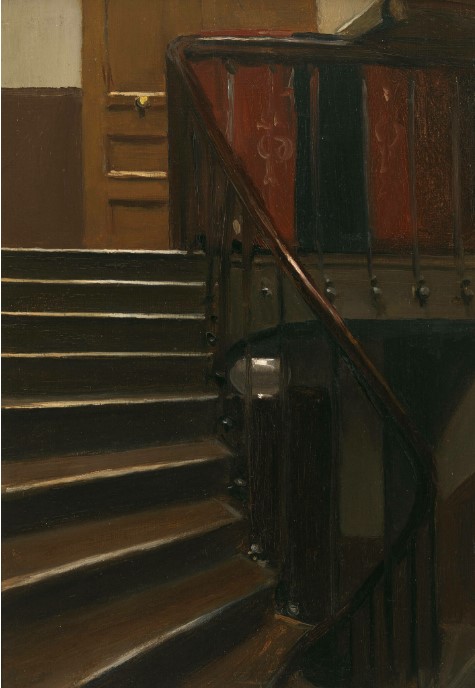
The caption read, “Stairway at 48, rue de Lille, Paris, 1906.” I shouldn’t have been surprised. Even though Hopper (1882–1967) is considered a quintessentially American painter, many artists of his generation spent at least some time in Paris honing their skills (I earlier wrote about Emily Carr’s experiences). But I had not known much about Hopper’s life, so I was pleased to learn that there were more than a hundred of his paintings and drawings from his time in Paris: one longish stay from 1906 to 1907, and two shorter visits in 1909 and 1910.
You can view many of Hopper’s Paris works on the website of the Whitney Museum of American Art in New York.
The painting of the staircase is small, little more than 12 inches high and 9 inches wide. The very tight cropping, leaving out the lefthand wall, the top of the door and the rest of the landing (is this the top floor or is there a further flight of steps?) makes the illustration in the book look like a detail from a larger painting, but no, this is exactly what Hopper wanted to show us, no more and no less.
The iron banisters and the way they are attached to the floor of the landing, the curve of the stairs, the wooden handrail, the gloomy lower landing dimly seen…such familiar details, instantly recognizable. Staircases like this can still be found in many Paris buildings. I cannot identify the red object on the landing. It might be a box or a large suitcase. What are those markings on the side?
The text beside the image is a translated quotation from a book by Michel Boujot called Amours Américaines.
Pascale…had just discovered, in a work published in New York, that the American painter Edward Hopper had lived at 48, rue de Lille, during his first stay in Paris from the fall of 1906 to the spring of 1907 – in the building belonging to the Evangelical Baptist Church, which adjoined it. He had boarded with a widow.*
Hopper’s sojourn at the Evangelical Baptist Church was arranged through family connections. He stayed there again in 1909 (he stayed in a hotel during his brief 1910 visit to Paris). Hopper also painted the courtyard at 48, rue de Lille, both from ground level…

…and from higher up, perhaps from his own window.

Again, they are small images, tightly cropped, focusing on a few details and leaving others out.
The Baptist church and the building behind it are still there. The church dates from the 1870s. (Before that time, the Baptists in France, never very numerous, were often persecuted and did not build prominent churches like this one; religious freedoms expanded after the fall of the Second Empire.)
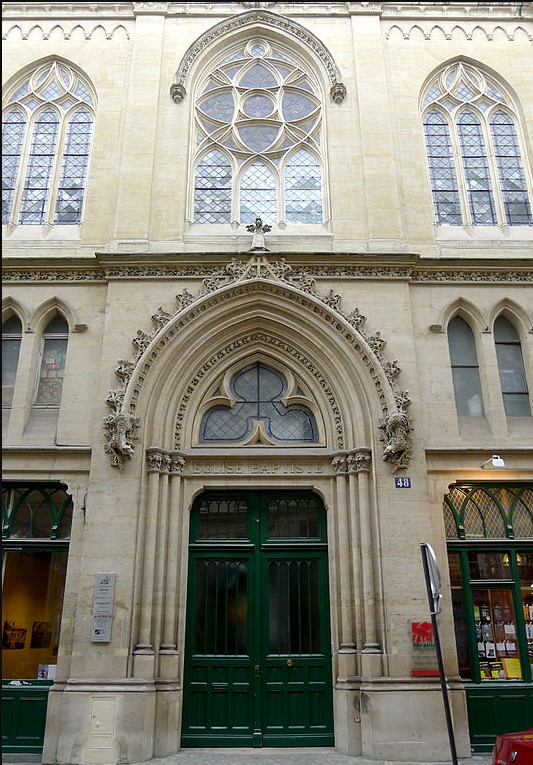
Hovering overhead using Google Earth, I can see that the courtyard is largely unchanged from Hopper’s time there. I expect the staircase is too.
The Paris works by Hopper shown on the Whitney website largely fall into two categories: landscapes and cityscapes without people, and people without much in the way of background. Only a few show people within the city.
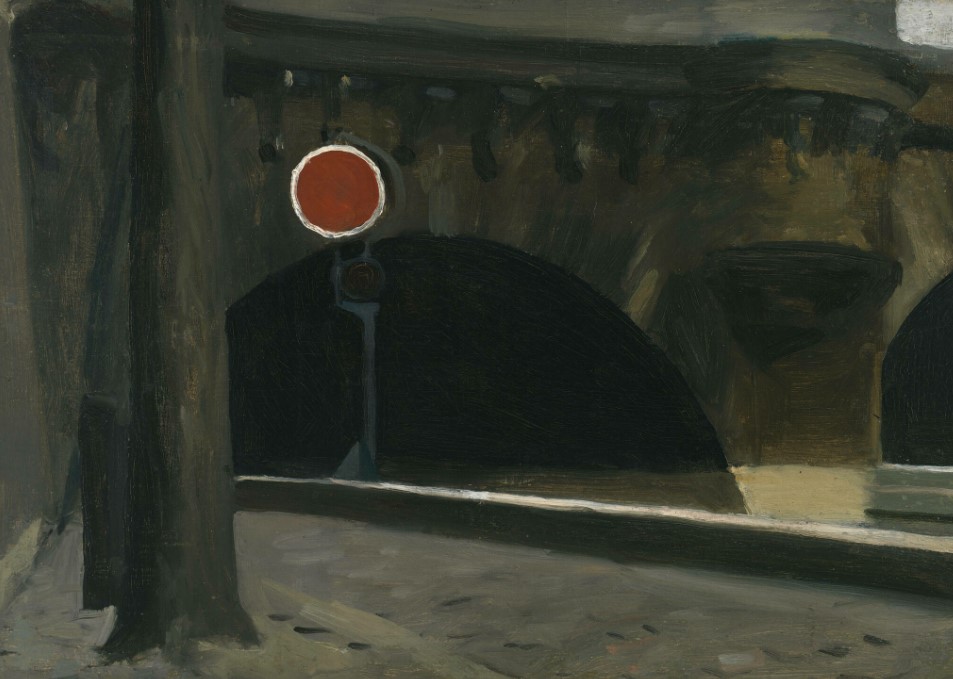
The early landscapes are quite dark. This is just called “Bridge in Paris.” (It is the Pont Neuf.)
The later ones are brighter and lighter. This is “Les Lavoirs, Pont Royal.”
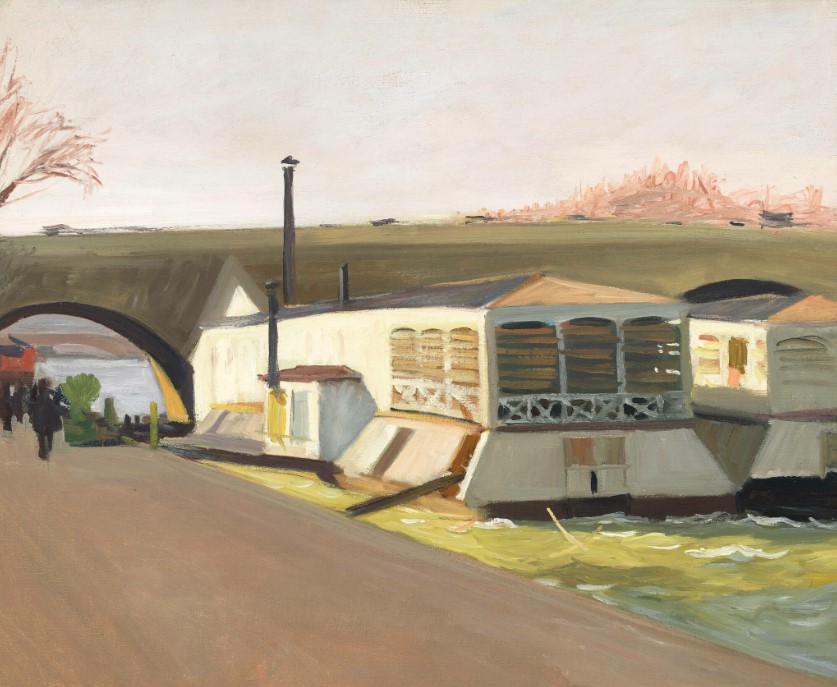
We shouldn’t read too much into that. It was apparently a dark, gloomy fall in 1906 and a bright spring and summer in 1907.
But the painting that grabbed my attention was this one, titled simply “Paris Street.”

Of course, being me, I wanted to know which street, but an online search of information about Hopper in Paris did not provide any clues. Nor did the books about Hopper in the library. So I decided to find out for myself.
The main clue was the presence of steps on the righthand side. Not many streets in Paris look like that. Another clue was the way in which the street comes to a T-junction in which two different buildings are visible.
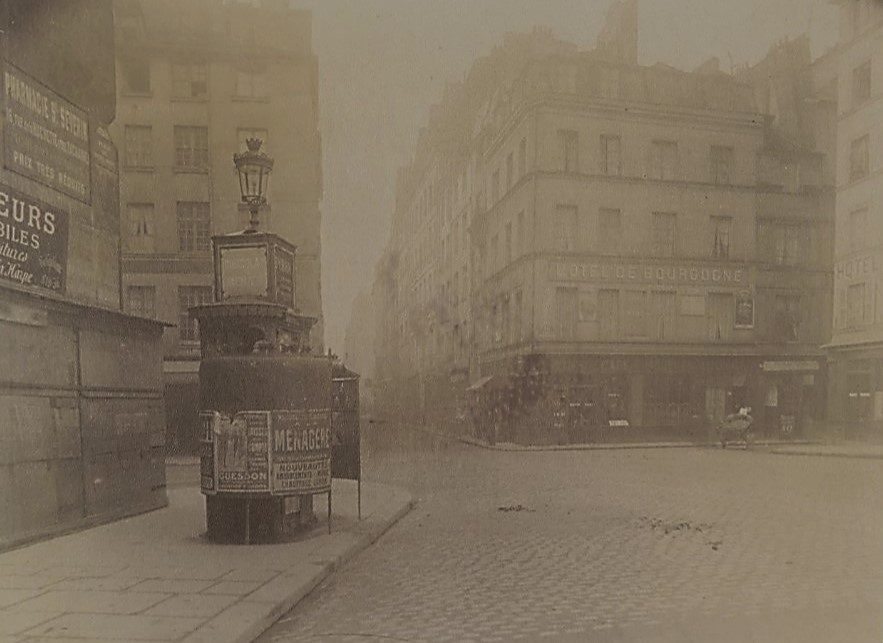
I began by leafing through our huge book (more than 700 pages) of Charles Marville’s photographs. On my first pass, nothing quite fitted the specs, so I started again, peering at the images more closely, noting streets that might be candidates and hoping that the one I sought was not among those listed as “disparu.” In the section on the area of St-Séverin and the Place Maubert in the 5th arrondissement, a couple of photos looked promising. So I looked online for other photos of the area by other photographers.
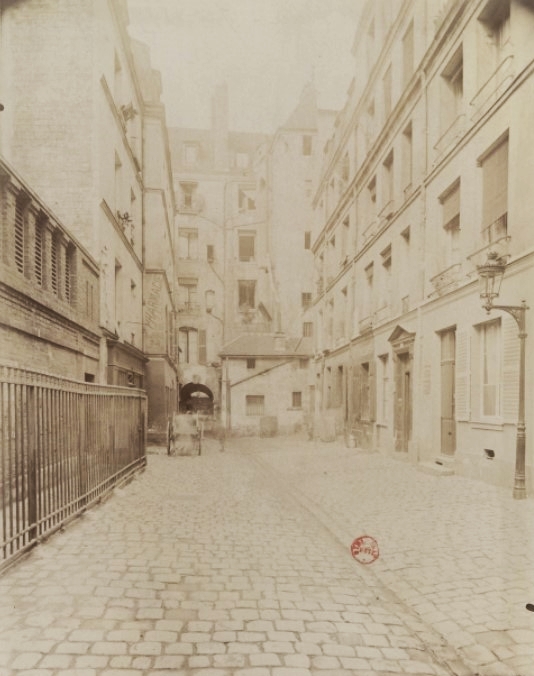
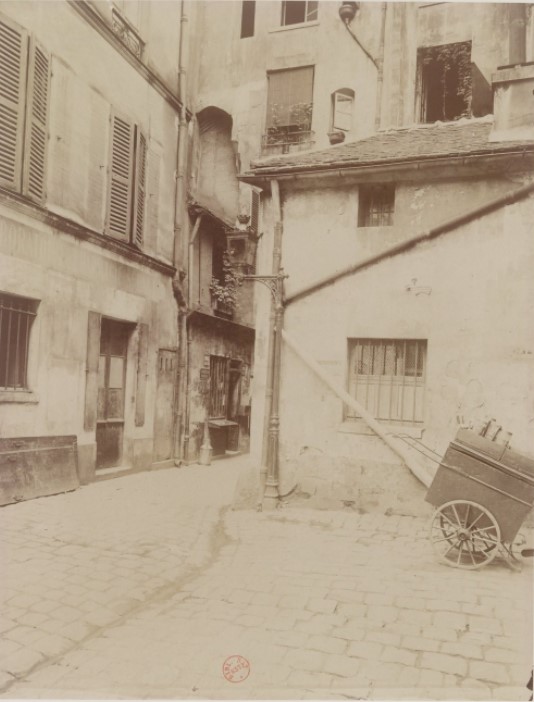
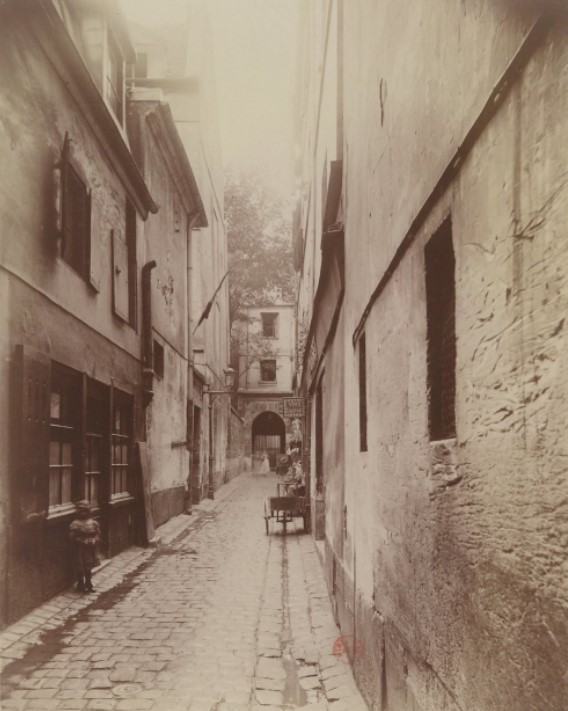
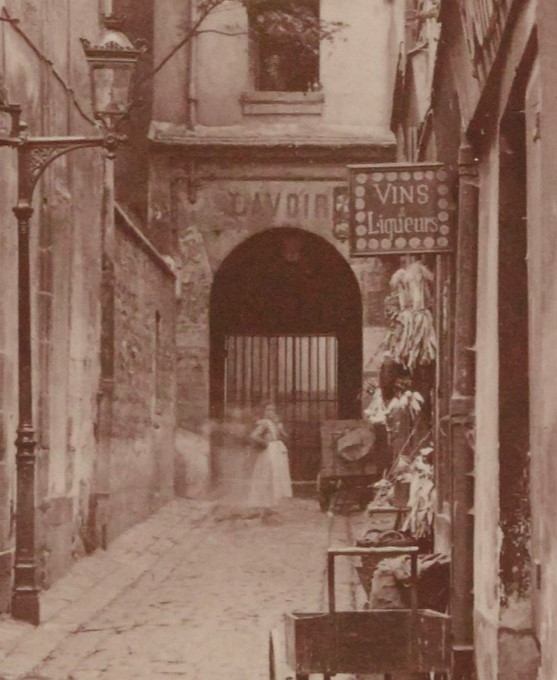
I discovered that the rue des Anglais had a section in which there were steps, and had been photographed later by Eugene Atget, from a different angle.

It wasn’t exactly right, but I felt I was getting close.
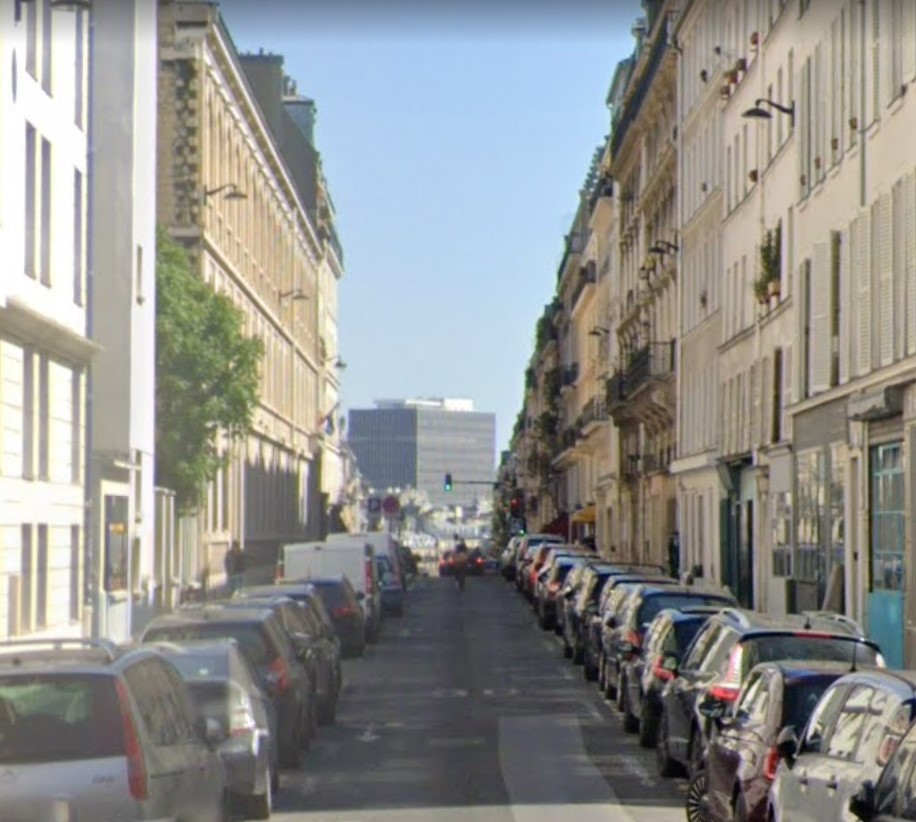
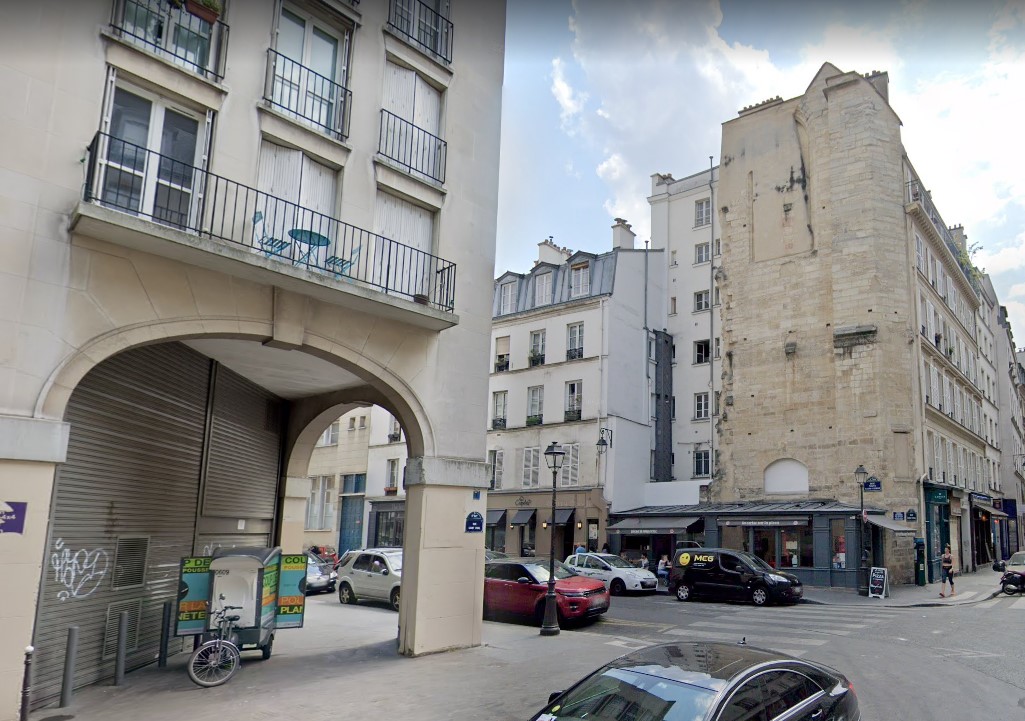
So I took a walk on Google Street View and what to my wondering eyes should appear, but a street just around the corner, rue Domat (formerly rue du Plâtre), complete with the steps, the four-storey building on the left, the two facades in the junction, one set back a little relative to the other, and even a little balcony up high up on the right, which explained the black shape there in Hopper’s painting. The streetlights are new. The narrow street at the T-junction is the rue des Anglais.

Once I had the name of the street, I discovered other recognizable images of it online, by other artists and photographers. I’m surprised nobody else seems to have made the connection.
Judging by the images on the Whitney website, Hopper did very few street views like this, although he often painted bridges and major buildings. What was it about this particular scene that caught his eye, a good 25-minute walk from the rue de Lille? Perhaps it was the antiquity of the buildings. In a letter home, he wrote:
Paris…is a most paintable city…the streets are very old and narrow and many of the houses slope back from the top of the first story which gives them a most imposing and solid appearance. The wine shops or stores beneath are dark red or green, contrasting strongly with the plaster or stone above… The roofs are all of the Mansard type and either of grey slate or zinc. On a day that’s overcast, the same blue-grey permeates everything.**
You can see one of those sloping houses on the left in his painting, as well as buildings with dark red and dark green on the lower floors.
What else do we know about Hopper’s time in Paris?

He did not enrol in classes or rent a studio. He simply drew and painted what interested him in his surroundings, and visited galleries and salons to see the work of other painters. He socialized with other Americans, including fellow art students. He didn’t learn much French. He bought a camera and took photographs. Wherever he went, he sketched people, from theatre goers to soldiers to prostitutes.
He even had a couple of girlfriends. One was Enid Marion Saies, a young Englishwoman born in Wales who had come to Paris to study literature at the Sorbonne, and boarded with the same landlady on the rue de Lille. Hopper followed her back to the United Kingdom to meet her family, but she told him she had a French fiancé, and Hopper retreated in dismay. In the end, she didn’t marry the Frenchman; she married a Swede and went to live in Malmö.
The other was a Norwegian-American from Minnesota called Ragnhild Alta Hilsdale, whom Hopper had met in the United States before going to Paris. They corresponded while both of them were living in the city and for some years thereafter. Alta, as she was known, seems to have been a young woman of means, sent to Paris to learn French and discover French culture.
For much of his life, Hopper kept his friendship with Alta a secret, but her letters to Hopper were discovered in the attic of the Hopper house after his death and were published in 2013.
Most of Alta’s Paris letters are sent from 21, rue Jacob, and she describes her lodging as a “pension.” A 1907 copy of the Journal of Education and a Baedeker Guide from the same year place an international hall of residence for women students, known as Ruskin House, at that address. Today, it is a hotel.
Alta was a highly unsatisfactory correspondent. The earliest letter in the collection states flatly that she is “terrible about answering letters.” Her letters are full of excuses not to meet Hopper because she is too busy or has another engagement or simply because the weather is bad. In one letter she says:
I do wish you wouldn’t take everything so alarmingly seriously. It is most distressing. Certainly I might have spared you one evening this week – I might also have spared several other people one evening – and where would my evenings have been?***
I cannot warm to Alta. A portrait of her by Hopper depicts a dark-haired woman looking bored. She went on to marry an American and live in Los Angeles.

After leaving Paris in 1910, Hopper never returned. But he seems to have been deeply affected by his time there, and once said “It took me ten years to get over Europe”; he found the United States “crude and raw” by comparison.† At other times, he downplayed his time in Paris as an influence on his American paintings, and many art historians have done likewise. However, the late Richard R. Brettell, an American specialist in French art, claimed that Hopper’s time in Paris made him “essentially himself and… ‘American’.”†† Isn’t that what Paris has done for so many people – made them themselves?

“Pont des Arts,” Edward Hopper, 1907
Text by Philippa Campsie, Hopper paintings from Wikiart (public domain), photograph of Edward Hopper from Wikimedia Commons, Atget photograph from Gallica, painting of Alta Hilsdale from artnet.com, contemporary street images from Google Street View.
*Quoted in Silent Places: A Tribute to Edward Hopper, fiction collected and introduced by Gail Levin (New York: Universe, 2000), p. 33.
** Quoted in Gail Levin, Edward Hopper: An Intimate Biography, updated edition (New York: Rizzoli, 2007 1998), p. 56.
*** Elizabeth Thompson Colleary (ed.), My dear Mr. Hopper (New Haven: Yale University Press, 2013), p. 54.
† Gail Levin, Hopper’s Places, second edition (Berkeley: University of California Press, 1998), p. 153.
†† Richard R. Brettell, “Comment Edward Hopper devint en France un peintre américain,” in Edward Hopper: Les années parisiennes 1906–1910 (Giverny: Musée Américain d’Art Giverny, 2004), p. 27.