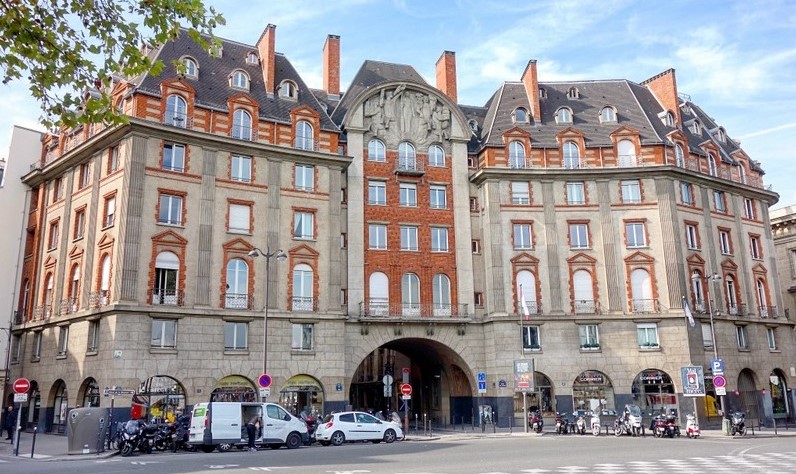
Silent witnesses

Early one morning, Norman and I dropped off our car for servicing at a local garage. We had breakfast at the Goat Café and then took a walk for an hour or so until it was time to retrieve the car. We were in a part of Toronto we don’t often visit, and were pleased to note two massive plane trees on our stroll. When we later mentioned them to our neighbour, artist Jane Hunter, she said, “Just like in Paris!”

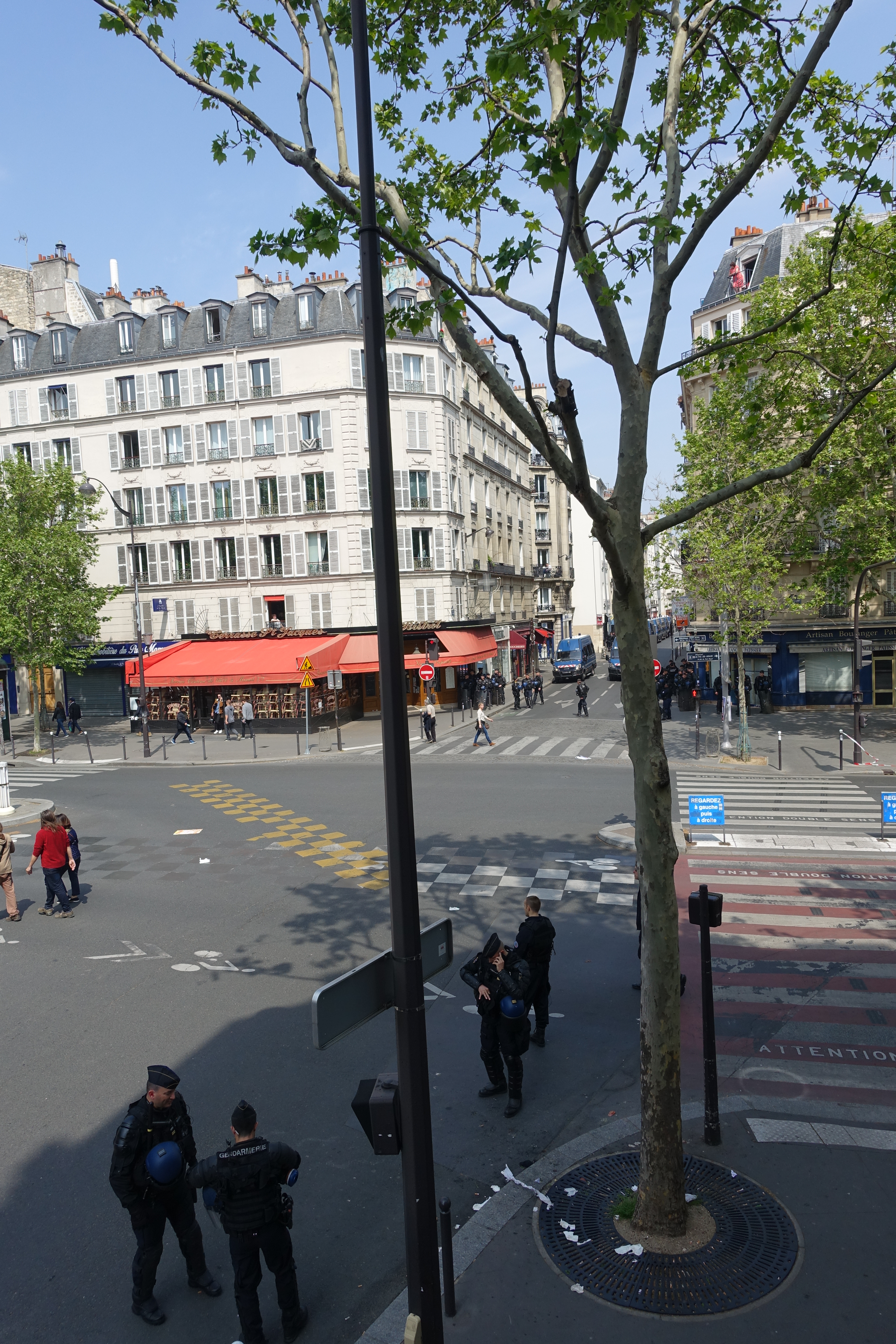
Exactly. The Paris plane tree we know best grows just outside the apartment we have rented several times. We have seen it in all seasons with its maplelike leaves, its patchy multicoloured bark, and its bobbly seed pods. It grows out of the pavement, surrounded by those lacy iron rings common to Paris street trees.

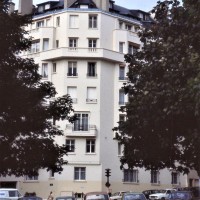
Here it is, on May 1, 2019, just before the May Day parade, which accounts for the lack of traffic in the intersection and the heavy police presence. If trees are silent witnesses to history, our plane tree saw a bit of history that day, when the parade and the gilets jaunes were particularly lively.
We hope it has survived. More than 10 years ago, blogger Susan Walter of “Days on the Claise” documented the incursions of a fungus that has killed many plane trees across Europe. She wrote:

The deadly fungal disease was introduced accidentally in 1944 when American troops disembarked in Provence. The wooden munitions boxes made from American Sycamore P. occidentalis that landed with the troops were infected, and the local French plane trees were unable to resist this invader.

The thousands of plane trees lining the Canal du Midi, planted on Napoleon’s orders, were particularly affected and many had to be cut down. The good news is that scientists have bred a disease-resistant version to replace the lost trees. But replacing a 200-year-old tree with a new one is still a loss.

Disease is not the only threat. In 2022, an arborist called Thomas Brail hoisted himself into a plane tree on the Champ de Mars that was due to be cut down under a plan to expand tourist infrastructure around the Eiffel Tower in anticipation of the 2024 Paris Olympics. Forty trees in the area were eventually granted a reprieve, but individuals and environmental groups still need to be vigilant to alert the public when development clashes with the city’s green canopy.

Officially, the city has promised to plant 170,000 new trees by 2026 to reduce the urban heat island effect (that is, the heat that builds up in paved areas without green space – think the Avenue de l’Opéra in July). Between November 2020 and April 2023, the city planted 63,700 trees. Some are new; some replace dead or dying trees. That means 107,000 more to go in the next three years.

Plane trees are particularly favoured, as they tolerate air pollution, last for centuries, and send down deep roots. How deep? Here is an illustration from a City of Paris publication, showing the roots penetrating well below the level of the Métro and into the old quarries underneath the city.

It’s not just plane trees, of course. All kinds of species flourish in Paris, some of them in courtyards and private gardens, others along tree-lined streets and in parks. Recently, my niece Alex sent us a map called “Great Trees of Paris,” which showcases some of the city’s finest and most historic trees. The first one listed is the oldest living tree in Paris, the Robinia pseudoacacia in Square René Viviani in the 5th arrondissement. The name commemorates the man who planted it, Jean Robin, the king’s gardener, and the fact that it looks so much like an acacia that only a trained botanist can tell the difference. Robin had brought the seeds back from North America, so it is not a tree native to Europe.

This tree also features as part of a walking tour of trees on six sites created by the City of Paris, which also offers an interactive map of remarkable trees.
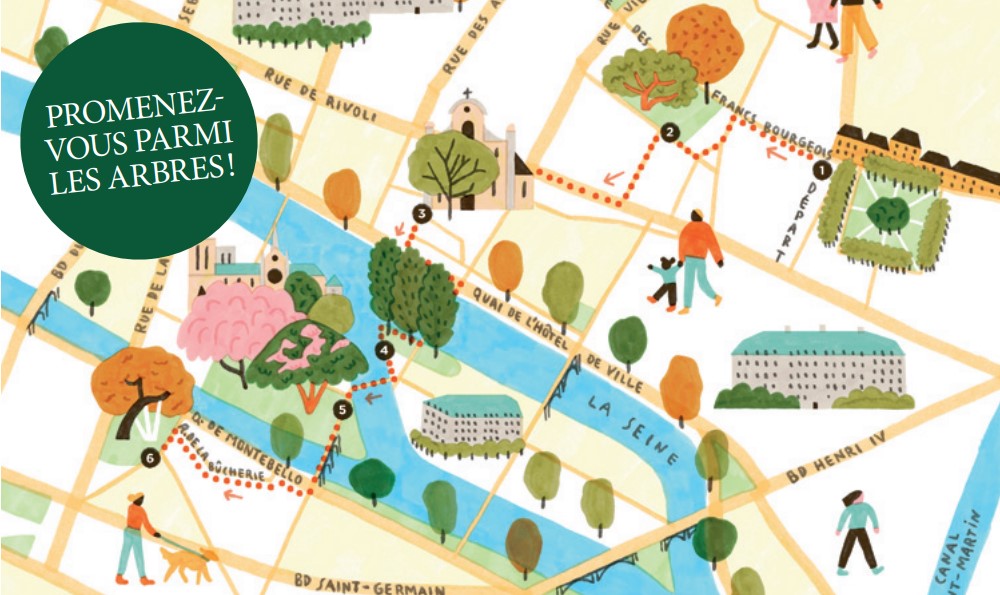
The walk starts with the horse chestnuts of the Place de Vosges that provide deep shade in summer…

…and leads pas the lilacs of the rue des Rosiers, the elm of the place St-Gervais – formerly the site of an enormous tree that served as a local meeting place for settling debts (the current tree is a descendant of the original and dates from 1935) – the poplars of the Ile St-Louis, the tamarisks and mimosas behind Notre Dame, and ending with the Robinia in the Square René Viviani.

The map Alex gave us contains 50 examples across the city, such as the four foxglove trees (Pawlownia tomentosa) in the rue Furstemberg. Foxglove trees are covered with lavender-coloured blossoms in spring. According to the information on the map, these four particular trees are protected with cosy little blankets in winter. (Update: the largest of the four was recently felled by the city, which claimed it was diseased and a security hazard.)
There is even a dawn redwood (Metasequoia glyptostroboides) in the Square de la Villa Sainte Croix in the 17th. This tree is familiar to us, as several of them grow in a nearby park in Toronto. It’s an odd-looking thing, with branches that emerge at sharp angles from the folds of the trunk (look at the tree behind the playground equipment on the right).

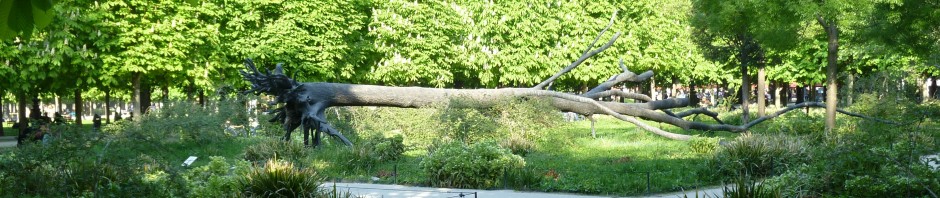
There are fig trees and hornbeams and ginkgos galore. A Judas tree in the Tuileries (shown below). Weeping willows trailing their leaves in the Seine. Persimmons and sweet gum in the Bois de Vincennes and a handkerchief tree in the Bois de Boulogne. Tulip trees in the Cité universitaire and a Kentucky coffeetree in Square Robert Schumann in the 16th (both of the latter are also trees that grow on our street in Toronto).

Adolphe Alphand’s massive Les Promenades de Paris contains detailed instructions on how to plant good-sized trees along avenues and in parks. Alphand was not satisfied with planting tiny little trees tied to a metal rod in the hopes that they would survive and grow up. He planted large trees with large root balls that were wheeled to their destinations using special equipment.

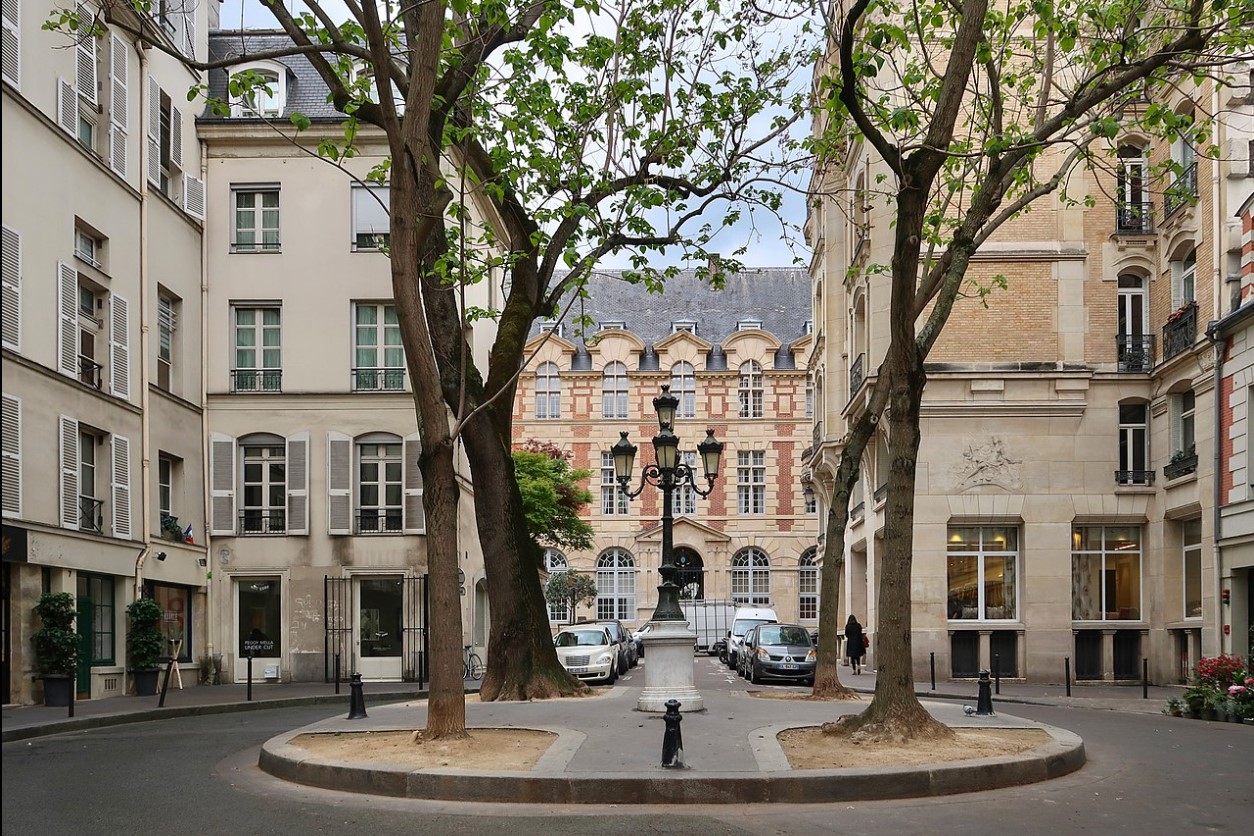
Once in place, Paris trees are not permitted to grow just anyhow. New trees may have a “corset” to keep them straight. These were in the Place Dauphine a few years ago.

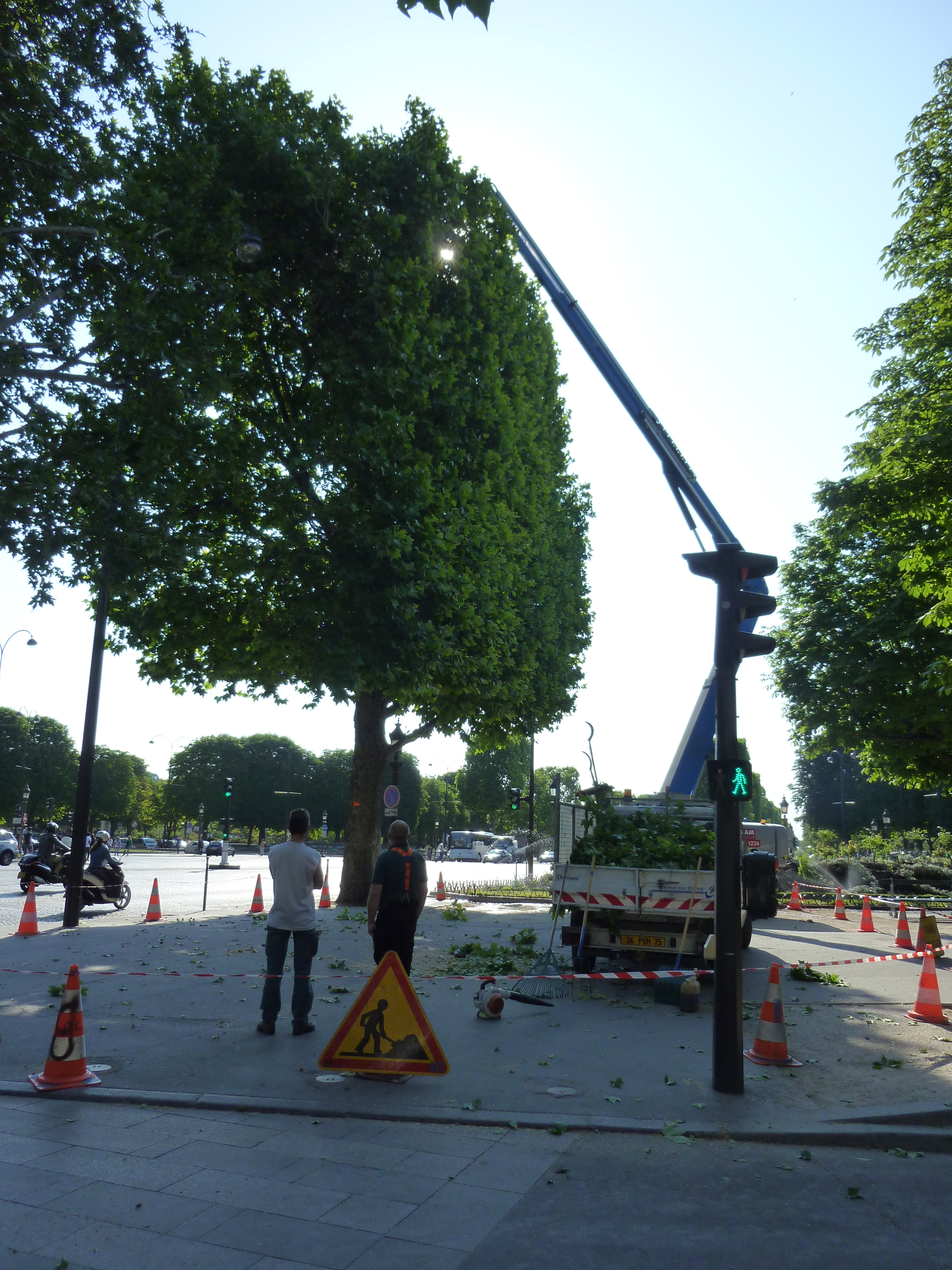
Many are pruned to within an inch of their lives, maintaining rectangular canopies that remain within fixed limits. The trees on the Champs-Elysees are subjected to this treatment. It takes serious machinery to keep them in line.
Fruit trees may be espaliered, that is, flattened out or rendered two-dimensional. These ones are in the Jardin du Luxembourg.

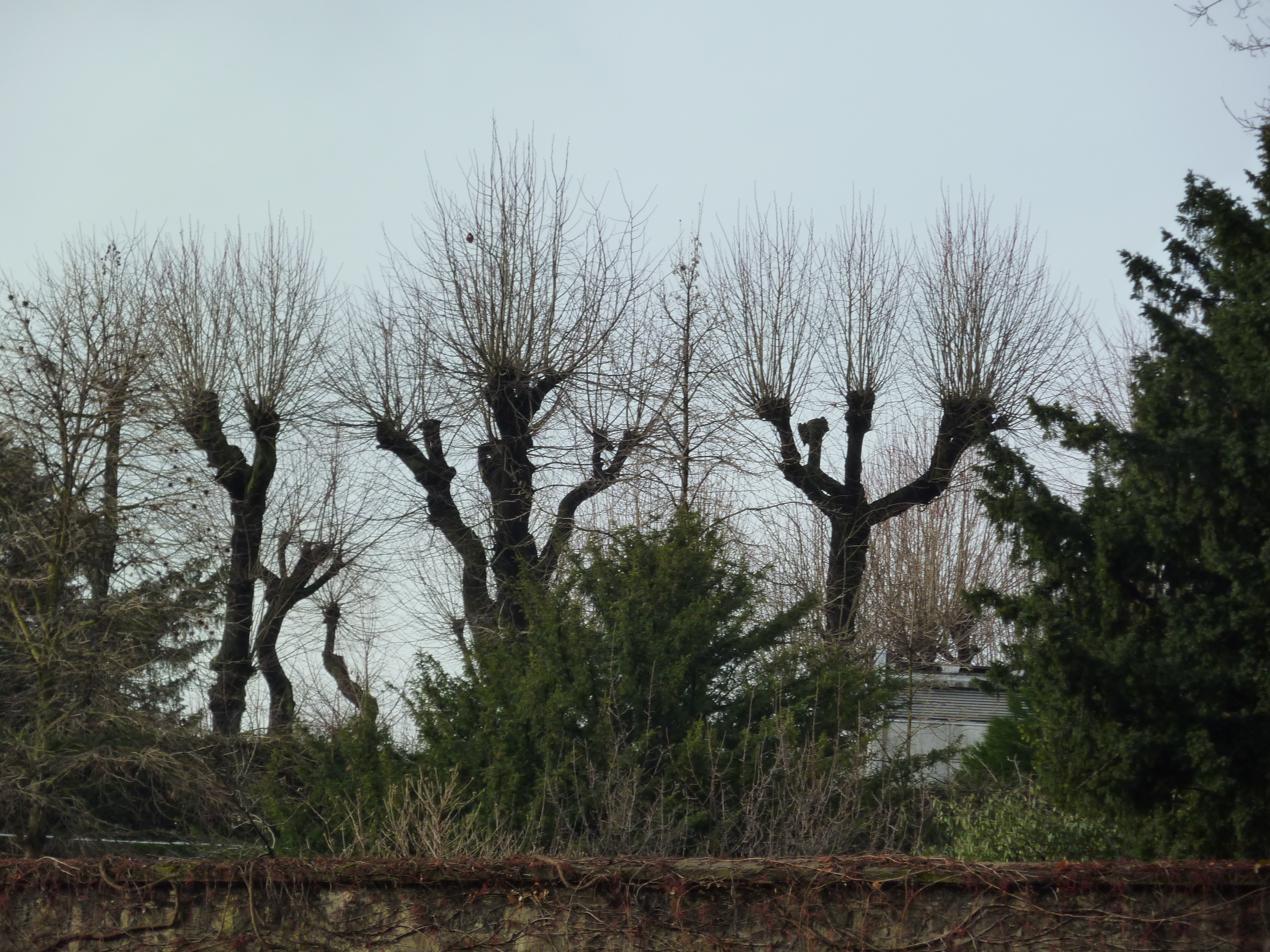
Then there is pollarding, a very French fashion, whereby branches are cut back severely so that they become stubs from which new growth bursts out. Pollarding is done at regular intervals (about every five years) to keep the tree at a certain height. These ones were photographed in winter in the garden of the Observatoire.
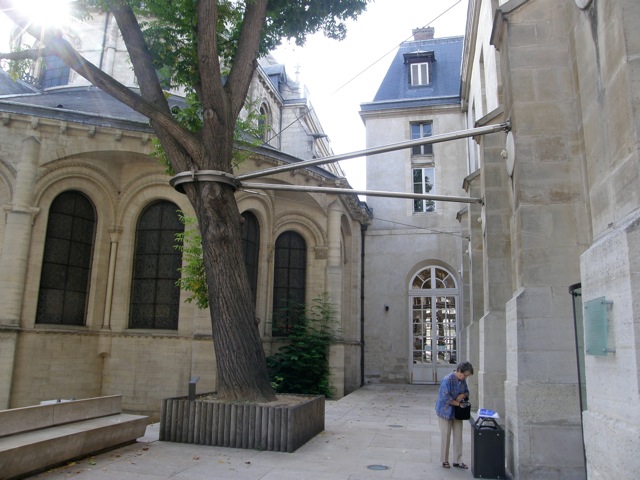
And when trees get droopy, they are propped up with wooden beams or, in the case of the tree in the courtyard of the Musée des Arts et Métiers, held with a metal ring that is attached to the side of a building.
This elderly tree (a reader suggests it is a quince) in the garden of the Musée de Montmartre has a support shaped like a lyre.

When you see older trees treated with such respect, the proposal to cut trees down around the Eiffel Tower seems all the more shocking.

I wonder where those additional 107,000 trees will fit into the city. Given the new law in France that commercial buildings must have green roofs (or solar panels), some may sprout from the rooftops. Between now and 2026, Paris will get greener and shadier.
Text by Philippa Campsie; photographs of Robinia, Judas tree, foxglove tree and dawn redwood from Wikimedia Commons; photograph of Arts and Métiers by Norman Ball; all other photographs by author.
Posted in Paris parks, Paris streets, Toronto | Tagged , , , , , , , , , , , , , , , , | 20 Comments

Eclairage Chauffage: Helen McNicoll and the painting of light

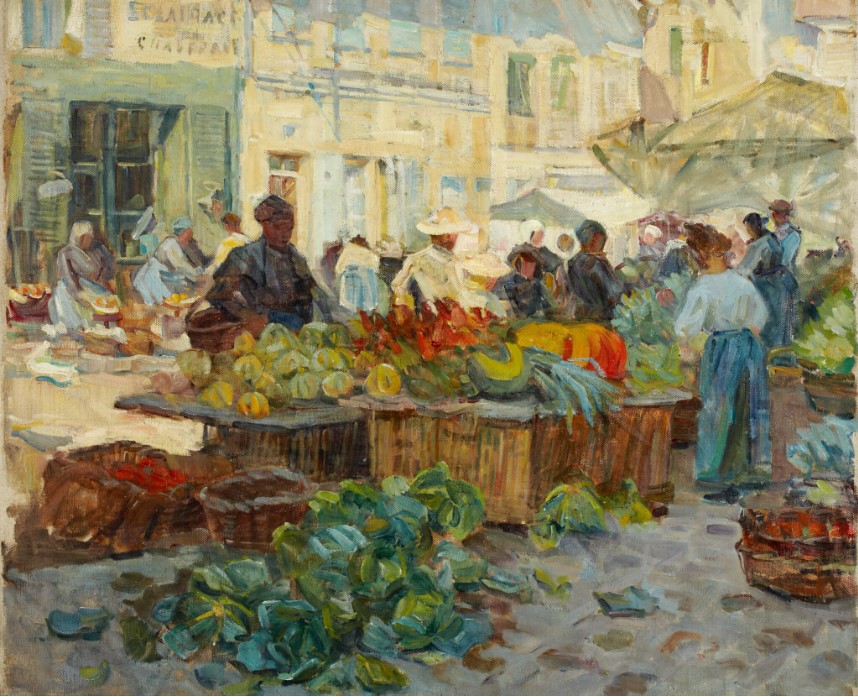
This image of a market in Brittany was painted by Helen McNicoll in 1910. The sign “Eclairage Chauffage” on the building in the background seems appropriate, since the sun is beaming down and you can almost feel its warmth. McNicoll had a genius for painting light, including dappled light and filtered light.

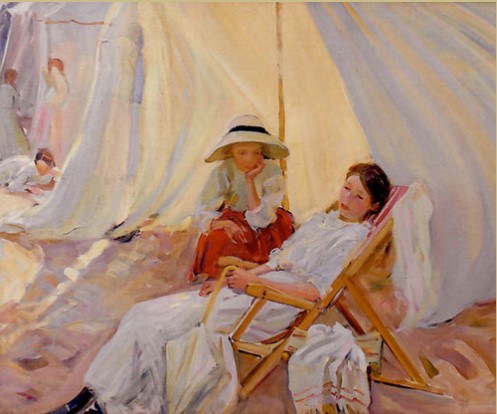
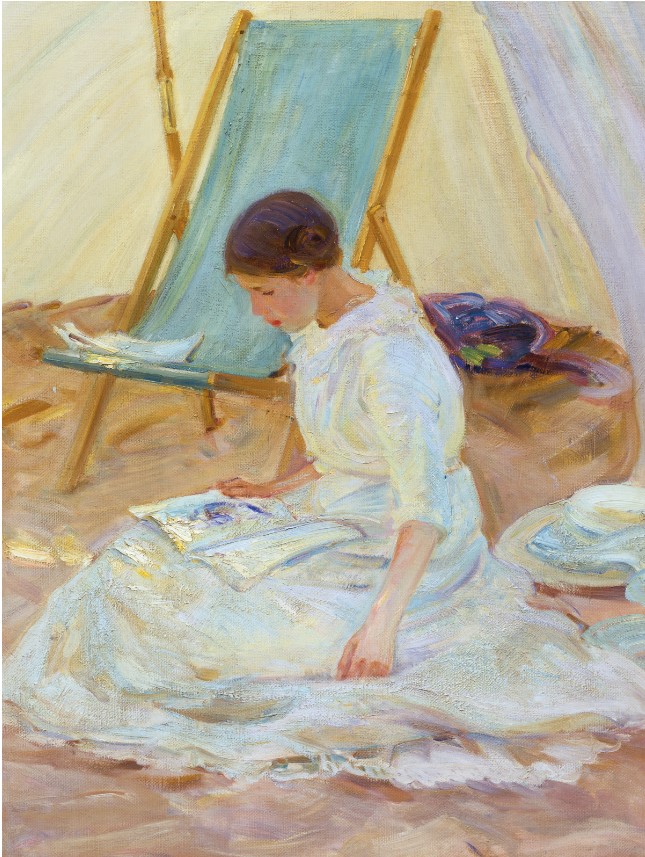
One of my favourite McNicoll paintings is In the Tent, painted on a beach in the south of France in the summer of 1914. The diffused light is magical and you can almost feel the heat of the day.

This is the image that greets you as you enter the exhibit “Cassatt/McNicoll: Impressionists Between Worlds” currently on view at the Art Gallery of Ontario. I fell in love immediately with this picture’s light and calm. Cassatt I knew about (I once reviewed an exhibit of her art in Paris for another blog), but McNicoll was a discovery. The two women were not contemporaries and never met, but the parallels in their lives and art made for a thought-provoking exhibition.

Helen Galloway McNicoll was born in Toronto in 1879, raised in Montréal, and became deaf at the age of two after a bout of scarlet fever. She moved to England when she was 23 and attended the Slade School in London, where she received training in life drawing (something not available to women art students in Montréal). In 1905 she began studies at the Cornish School of Landscape, Figure and Sea Painting in St. Ives, which emphasized working outdoors (plein air).

England became her home base, and she maintained a studio in London, making frequent trips back to Canada to see her family and to France to paint in the company of her friend Dorothea Sharp, another artist. In fact, they were in France at St-Valéry-sur-Somme in August 1914 when the First World War broke out. Helen was excited by the activity around her and keen to stay, but McNicoll’s father was vice-president of Canadian Pacific, and the company arranged to get her and Dorothea out of France posthaste. It all happened so quickly that they had to leave some of their belongings behind. (The exhibition catalogue notes that the gallery’s collection of her sketchbooks contains nothing dating from later than 1910. Were the others left behind in France in 1914?)

Helen McNicoll died the following year, aged only 35, of complications from diabetes, in Swanage, Dorset, leaving behind an impressive body of work.

Her painting of the marketplace is unusual for her in that it depicts a crowd and a certain bustle. As one might expect from a painter who is deaf, most of her pictures depict quieter moments. Her subjects, usually shown alone or with one other person, are often absorbed in a task such as reading or sewing, seemingly oblivious to the world around them, and those depicted in a landscape may be only vaguely sketched in.

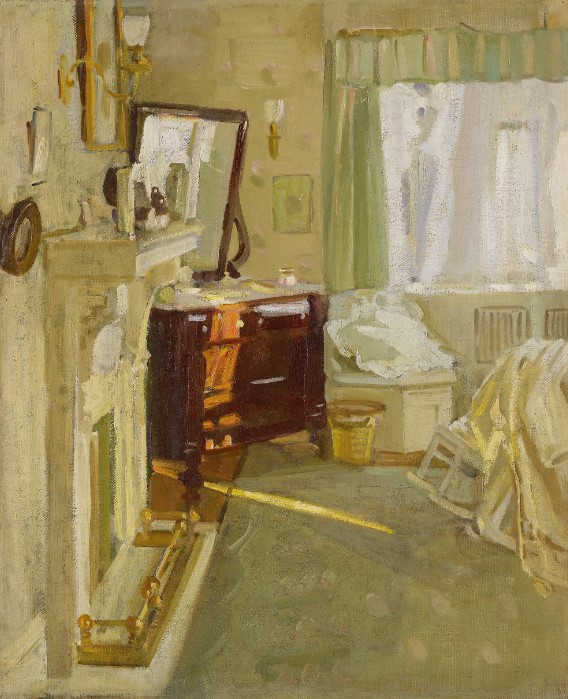
Sometimes people are missing altogether, as in Interior, painted in about 1910. It’s the strip of sunlight on the carpet and chest of drawers that I love. Eclairage. The chauffage is represented by the fireplace. (The AGO has created an extraordinary animated version of this painting for the exhibition.)

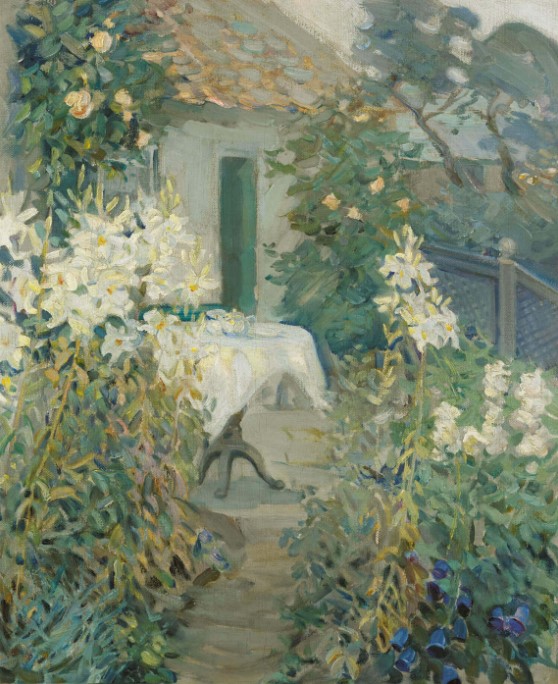
Here’s a table set for tea, but without anyone partaking.

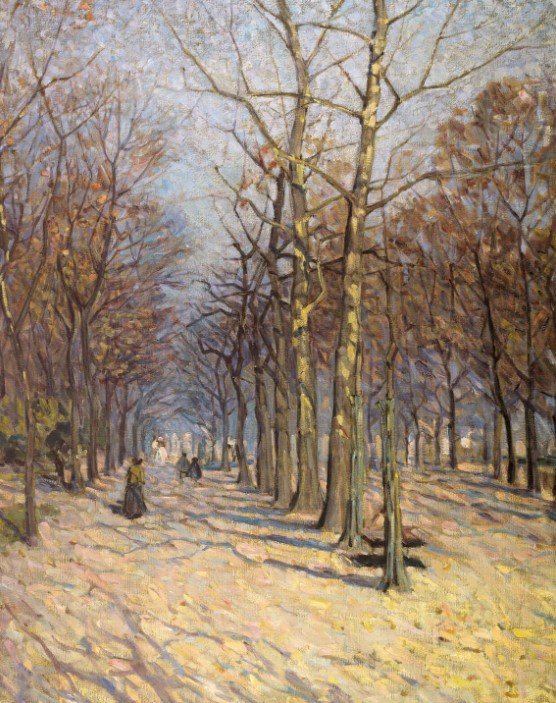
Of course, I looked to see if there were any paintings of Paris. One, The Avenue, dating from about 1912, might have been painted in Paris. It depicts a few isolated figures among the wintry plane trees in a park.

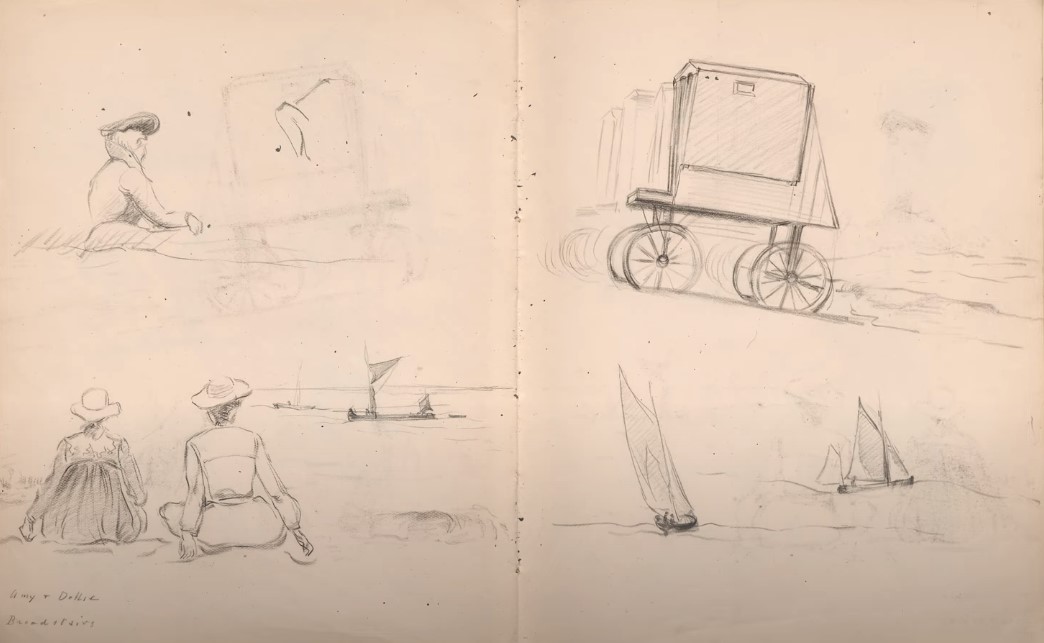
One delightful element of the exhibit is the display of McNicoll’s sketchbooks. The Art Gallery of Ontario has even made a little video of these books, filled with quick takes on people, animals, and places. I’ve put the link at the bottom of this post.

A few of those in the sketchbooks are identified. “Dollie” is a sister, and “Amy” a cousin. The former is not to be confused with “Dolly,” Helen’s name for Dorothea Sharp (whose real name was Lydia Mary Sharp). Dorothea called Helen “Nellie.”

Dorothea Sharp (1873–1955) was six years older than Helen. She had studied in Paris at the Académie Colarossi in Montparnasse, and had been deeply influenced by the work of Claude Monet. She painted many images of children and visits to the seaside, and she and McNicoll often worked with the same models at the same time.

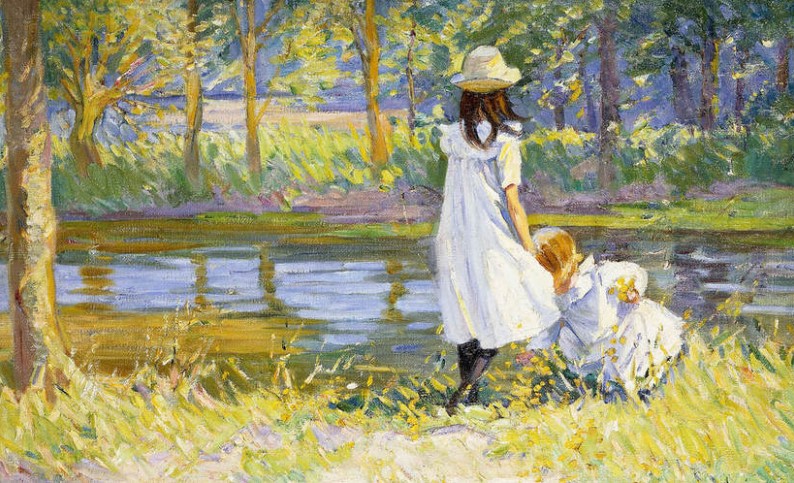
The book that I bought at the gallery (Samantha Burton, Helen McNicoll: Life & Work) includes two images on the same page of the same scene in 1912, one painted by Sharp and the other by McNicoll. Dorothea’s (shown first, below) is a little spikier, and I like the reflections in the water. Helen’s is softer, with one child in the shade and another in the sun, and the children are watching other children on the far shore launching a toy boat. Same scene, viewed by two different personalities.

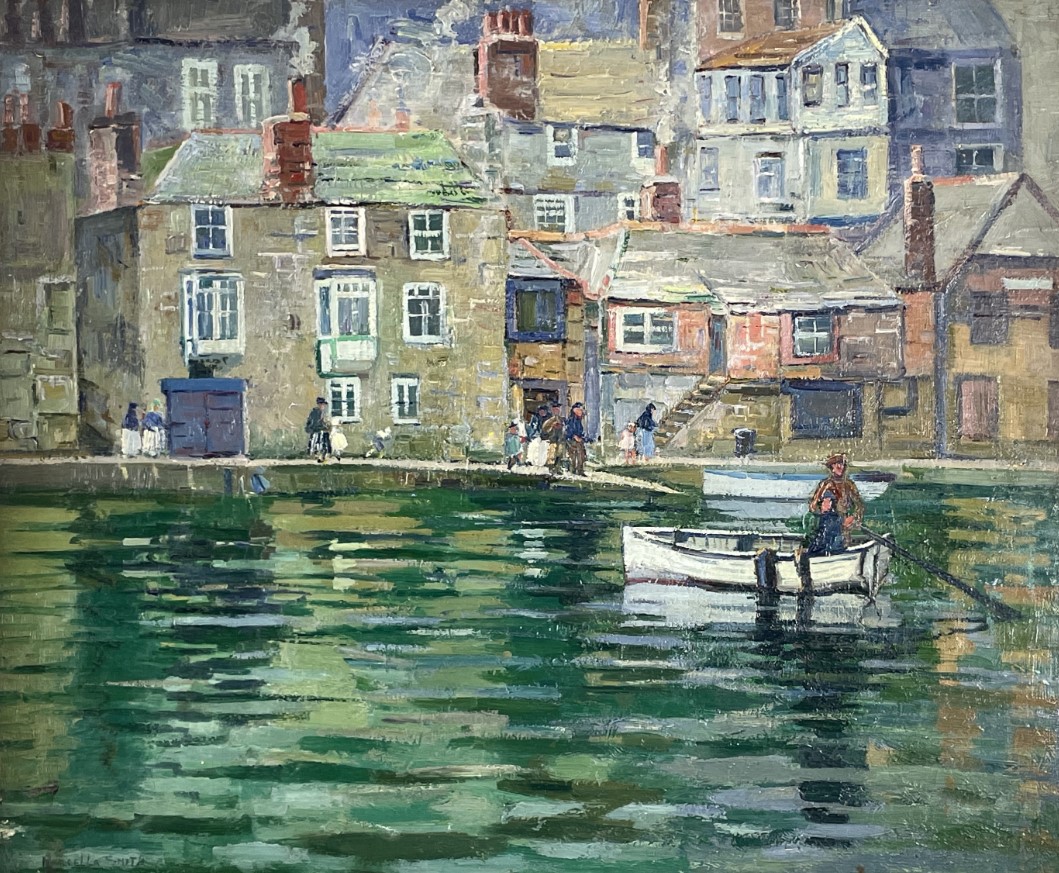
The book also informed me that after Helen McNicoll’s death, Dorothea continued to travel and paint with a younger friend, Marcella Smith (1887–1963). Marcella had been born in England but grew up in the United States. It turns out that she too had studied at Colarossi’s and lived for many years in St. Ives, Cornwall. So I went to look for some of her paintings.

This one is called Neap Tide, St. Ives. Marcella Smith painted many maritime scenes with boats, but also flowers and landscapes.

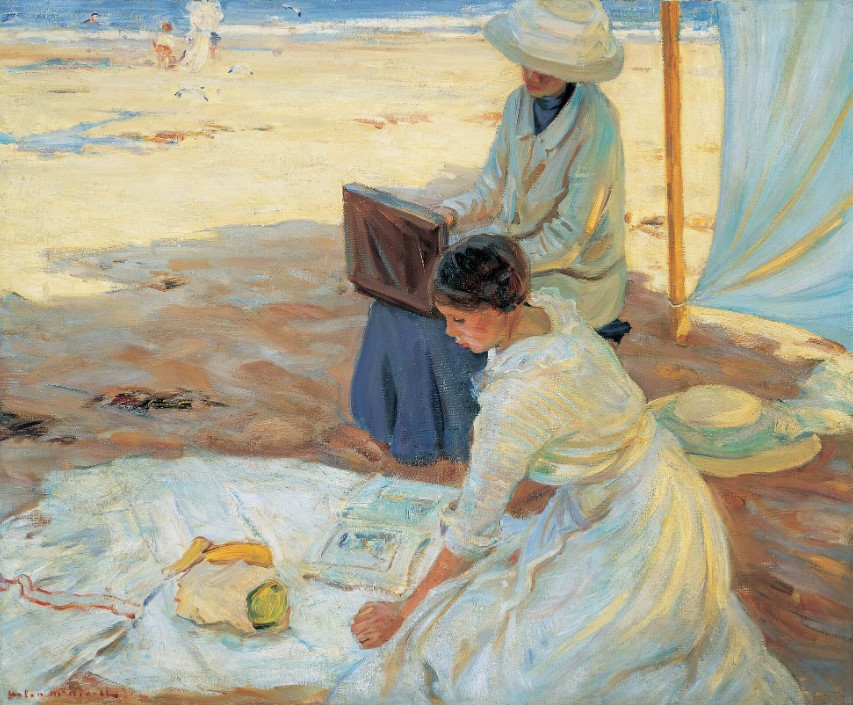
What interested me is that those 1914 paintings from the beach in southern France appear to include Marcella as well as Dorothea. This one, painted by Dorothea, is called Marcella Smith at the Beach.

So is that picture in the exhibition of the dark-haired young woman in the tent on the beach a picture of Marcella? She would have been 27 in 1914. Or was it Dorothea, who also had dark hair but was 41 at the time? A second picture by McNicoll shows two people in the tent. Maybe it’s Dolly with the paintbox and Marcella on the blanket, or maybe not.

One should not necessarily read anything into these relationships beyond friendship and mutual support. For one thing, middle-class women simply could not travel alone. For example, for Canadian painter Emily Carr, travel meant travel with her sister. And in pursuing the life of a professional artist, women needed to team up. Samantha Burton, McNicoll’s biographer, writes:

Informal personal relationships…helped to bolster a woman artist’s professional career…Together, women like McNicoll and Sharp could share the costs of studio space, support one another during their travels, and give immediate feedback while they painted…Given McNicoll’s hearing loss, Sharp must also have provided important help in navigating the more practical parts of artmaking: hiring models, renting lodgings, and purchasing supplies.*

Dorothea was vice-president of the Society of Women Artists and did what she could to advance Helen’s career. In return, Helen opened some doors for Dorothea in the Montréal art market. In those days, women struggled to be recognized as professionals rather than amateurs, and women artists needed all the support they could get. And even then, their subject matter was often limited to landscapes, still life, and domestic or outdoor scenes of women and children, because those were the subjects most easily available to them.

I plan to revisit the exhibit a few more times this summer and enjoy the sunshine and warmth of the south of France without leaving Toronto. If you want to do so too, you have until September 4.

Text by Philippa Campsie. Images from the National Gallery of Canada; Helen McNicoll: Life and Work by Samantha Burton; portrait of Helen McNicoll by Robert Harris, 1910.

* Samantha Burton, Helen McNicoll: Life & Work, The Canadian Art Library, 2020, p. 68.

Posted in Paris art, Toronto | 15 Comments

A convent education

As I was leaving for the hospital, I grabbed a book from the bookshelf near the bedroom door. I chose it because it was a small paperback I could slip into my little bag of belongings.

Just as well. There were delays and lots of time to read. By the time I was wheeled into the operating room, I was already enthralled with My Convent Life by George Sand. It is a translated extract from her voluminous autobiography, Histoire de ma Vie, published in 1855. The events in the book take place between 1817 and 1820, when Aurore Dupin, as she was known then, was at boarding school.

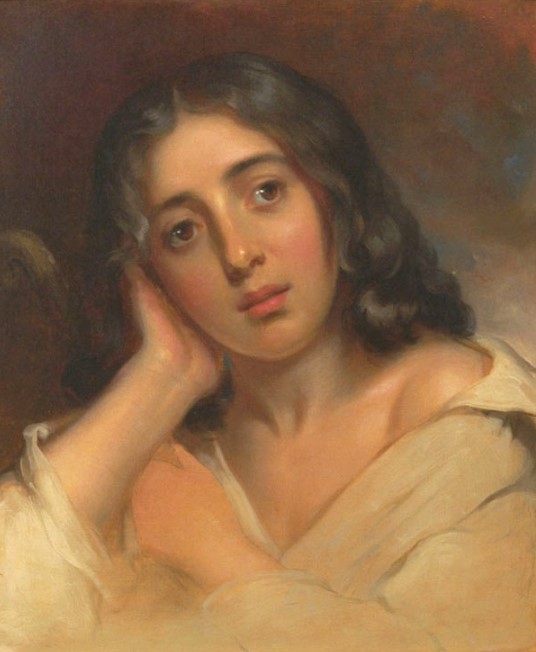
This portrait of her by George Sully dates from 1826.

The informative opening sentence drew me in right away.

The English Augustinian Convent Rue des Fossés St. Victor is one of the three or four British communities established in Paris in the time of Cromwell, and the only one left unharmed by the French Revolution.

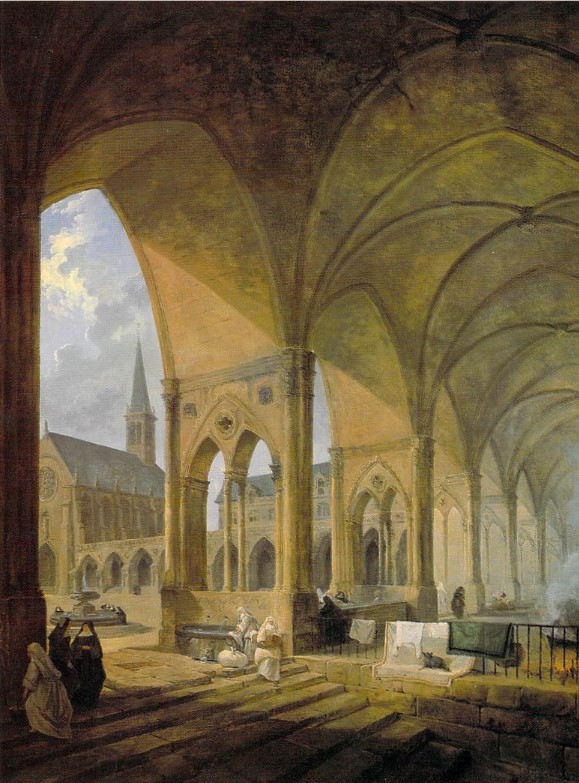
(I do like descriptions that provide precise locations.) I found an image of the cloister – the proportions are probably exaggerated – painted in the 18th century by Hubert Robert. The convent’s official name was Notre-Dame-de-Sion.

Interesting that Aurore went to an English convent. Even more interesting in light of the fact that her paternal grandmother, Madame Dupin, had been incarcerated in that very building during the Revolution, when it was being used as a house of detention for women. Here is a picture of Madame Dupin, painted before the Revolution, fashionablly dressed in the style popularized by Marie-Antoinette. Don’t let the milkmaid outfit fool you. She was tough as nails.

Another inmate during the Revolution was the woman who was to become Aurore’s mother, Sophie-Victoire Delaborde, imprisoned for singing royalist songs. Sophie-Victoire was an orphan and the grand-daughter of a bird seller. And no, that is not how Sophie-Victoire got to know Madame Dupin’s son Maurice. They met much later and married in 1804, a month before Aurore’s birth in Paris.
The aristocratic Madame Dupin was appalled by the marriage of her son, a handsome hussar, to the grand-daughter of a bird seller. Maurice and Sophie-Victoire went on to have a second child, a son who died in 1808. A week after his son’s death, Maurice himself died after a fall from his horse. His death left the widowed Madame Dupin, Sophie-Victoire, and Aurore on their own. I can imagine the two older women glaring at each other over the girl’s head.

It was an unequal struggle. In 1810, Sophie-Victoire gave custody of her child to Madame Dupin in return for a pension, and moved out of the family house in Nohant in the Loire Valley (although she kept in touch with her daughter).

Boarding school may have come as something of a relief to Aurore, after life with Grandmother Dupin. She was there for the better part of three years. Her grandmother did not even let her come home for extended vacations, although she received occasional visits from family members.

The nuns at the convent presumably still wore the distinctive English Augustinian habit shown here, in an 18th-century painting. (I could find nothing much later than this, but nuns’ habits didn’t change much over the years in those days.) A thin black veil over a white coif, a heavier black mantle over a full and pleated white garment coming down past the knees, wide cream-coloured sleeves, and a plainer skirt underneath.

Most of the teaching, however, was relegated to laywomen of varying talents and dispositions. Sand provides little information about the curriculum, if there was one, although she mentions in passing music, English, and Italian. An early conflict in the story is between Aurore and Miss D–––, one of the lay teachers. Sand describes her as “harsh and often cruel, sly and vindictive, ill-tempered and ill-mannered,” yet Sand tries to be fair-minded – “I must say that she seemed really devout and austere – a sort of intolerant, detestable fanatic, who might have had a certain grandeur about her if she had lived long ago in the desert with the anchorites whose faith she emulated.” Eventually, the two are somewhat reconciled.

The school was officially divided into two groups by age and 13-year-old Aurore was placed in the lower division with the younger children. Her education to that point had been patchy, and she spoke no English. But the most meaningful distinctions in the school were made by the girls themselves: good girls (les sages), stupid girls (les bêtes), and devils (les diables). Aurore was immediately drawn to the last group, girls who delighted in doing whatever was forbidden.

Their mischief consisted largely of exploring out-of-bounds areas of the convent, an establishment that Sand describes as “mysterious and labyrinthine – in all its ugliness not devoid of a certain poetic charm.”

This drawing shows some of the buildings from the garden side, as well as two interior views.

It was really a collection of buildings, a main building and

several other constructions, very ruinous, a perfect maze of dark passages, spiral staircases, little detached buildings, connected with one another by flights of worn and uneven steps, or by boards thrown across… There were galleries that led nowhere and passages that you could hardly squeeze through to strange edifices… This part of the convent baffles description, and the uses to which these buildings were put were as various as their grouping.

For anyone who grew up either on the stories of Enid Blyton or those about Nancy Drew (or both), the appeal is immediate. Sign me up as a would-be diable!

Les diables penetrated the gloomy cellars, opened doors to disused rooms, and in one memorable episode, found themselves trapped on the roof. From her perch up there Aurore feels a shoe fall off, but later recovers it, unnoticed, in the garden.

The garden was vast, shaded by superb horse-chestnut trees. On one side a high wall separated us from the Scotch convent, and on the other stood a long row of small houses tenanted by pious ladies retired from the world. Besides this garden, there was also in front of the new building, a double quadrangle planted with vegetables, also bordered by houses, all occupied by old matrons or by boarding-pupils who had quarters to themselves.

I finished the book as I was recovering at home (doing nicely, thank you), and then went in search of the building. First, I had to find the Fossés St-Victor. A modern map of Paris did not include it, although there are three other streets named Fossés – St-Bernard, St-Jacques, and St-Marcel, all in the fifth arrondissement. Eventually, I found the street on Turgot’s map. It was part of what is now the rue Cardinal Lemoine. You’ll see it at the bottom of this image. You can see the gardens, the high wall separating the Augustinians from the Scotch congregation on the right, and the little houses on the left.

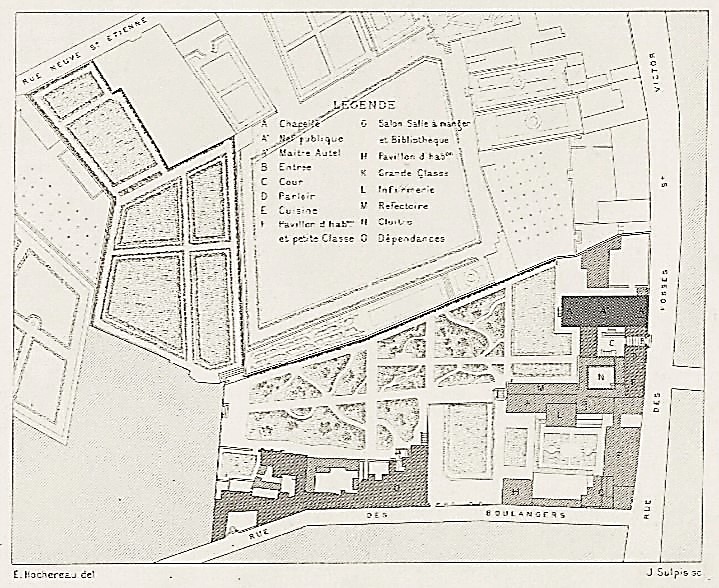
Gallica even provides a plan of the jumble of buildings composing the convent. The rue des Fossés St-Victor is on the right.

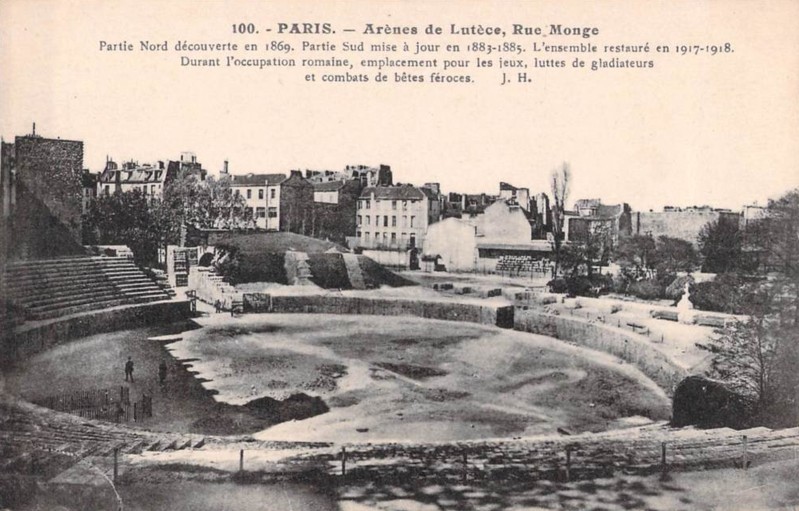
The convent moved to a new building in Neuilly* when its land was appropriated and the rue Monge created in the 1860s. The buildings that took its place date mostly from the late 19th and early 20th centuries. But in the process of carving up the block to create the new street, something else emerged from underneath those vast gardens: the Arènes de Lutèce.

Imagine if the diables had discovered that during their nocturnal explorations!

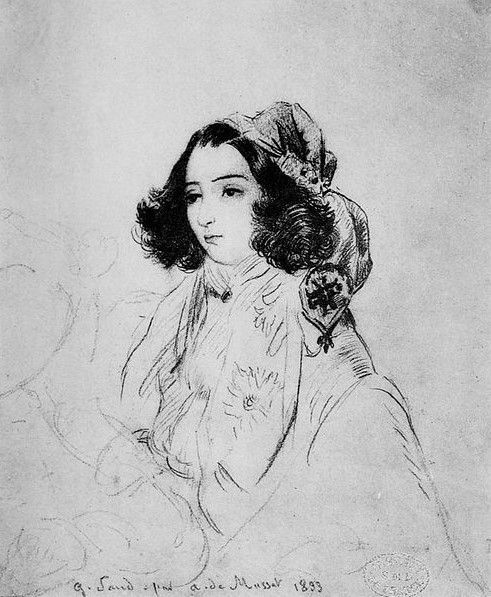
George Sand, in a drawing by Alfred de Musset, 1833.

Text by Philippa Campsie, Turgot map and convent plan from Gallica; drawing of convent from Musées de Paris; postcard of Arènes de Lutèce from http://photos.piganl.net/2017/lutece/lutece.php; all other images from Wikimedia Commons.

George Sand, My Convent Life, translated by Maria Ellery McKay (Chicago: Cassandra Press, 1978).

* After the 1901 law that put restrictions on religious orders, the nuns gradually dispersed and the Neuilly building was sold in 1913. The former convent is now home to the Lycée Sainte-Marie on the rue Victor-Hugo, Neuilly.

Posted in Paris books, Paris history | Tagged , , , , , , , , , | 22 Comments

Astérix and the lost streets of Montparnasse

I am a latecomer to the adventures of Astérix, the hero of more than 30 bandes dessinés – comics, or perhaps “comix” à la René Goscinny, the creator of Astérix and all those other “x” characters.

There’s Obélix, the pigtailed menhir* delivery man. And Getafix (Panoramix in the French original), the bearded druid. Cacofonix (Assurancetourix in French), the mustachioed bard with his bagpipes. Vitalstatistix (Abraracourcix), the chief of the tribe. And, of course, Dogmatix (Idéfix), the dog. All brought to life in the colourful drawings of Albert Uderzo.

I got all the French puns except Abraracourcix. I had to look that one up. It comes from “à bras raccourcis,” which literally means “with shortened arms” to indicate someone assuming the stance of a boxer, with arms up and bent, ready to attack.

Meanwhile, the Roman encampments are called Aquarium, Laudanum, Compendium (Petibonum), and Totorum (Babaorum).

When I read an article about the Astérix books by Martin Sorrell in Slightly Foxed, I decided it was high time I took a look, and got a couple of the books from the library. One in English, one in French. I enjoyed the bits of random Latin sprinkled here and there (Sic! Ipso facto! Alea jactus est!) or fake Latin (Ave Crismus bonus!) and the general silliness.

But what I found myself thinking about was not so much ancient Gaul as a part of Paris in which Norman and I once stayed. Here is the bit from Sorrell’s article that got my attention:

Goscinny’s inspiration for Asterix was Vercingetorix, chief of the Arverni tribe, who, towards the end of Julius Caesar’s Gallic Wars, united what remained of Gaul’s tribes in an uprising against the Roman occupiers. In 52 BC, under Vercingetorix’s leadership, the Gauls won a famous victory at Gergovia…but shortly after they were defeated at the battle of Alesia.

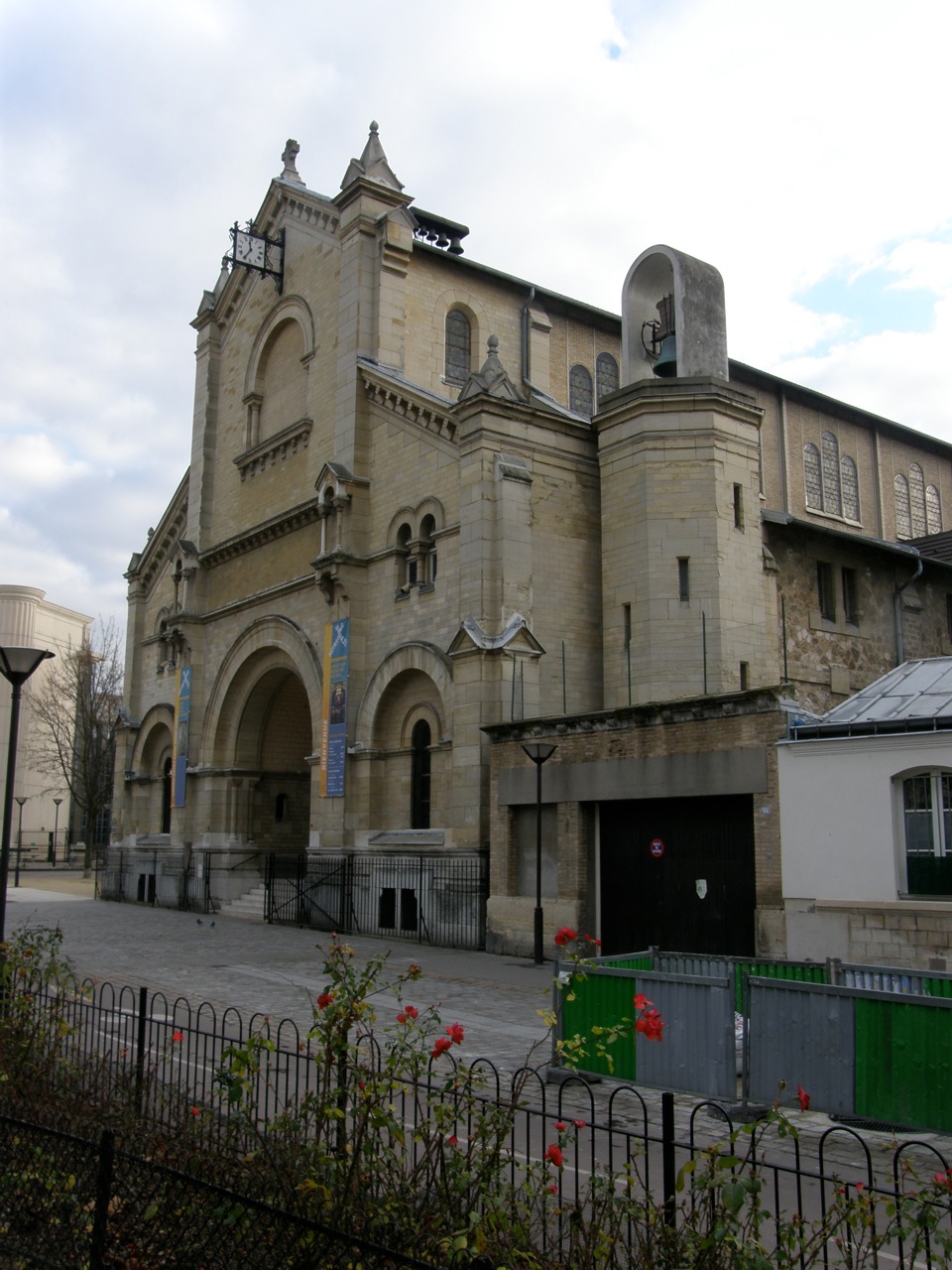
Oh, those familiar names. I was reminded of the times we stayed in a friend’s place on the rue de Gergovie in the 14th arrondissement, not far from the rue d’Alésia. I have written about the villa d’Alésia in a previous blog. As for the nearby rue Vercingétorix, it parallels the railway lines coming from the Gare de Montparnasse, and our favourite Paris church, Notre Dame du Travail, faces it.

Much of the original rue Vercingétorix was destroyed with the redevelopment of Montparnasse around the station and the railway lines. But I know something of what it once looked like from a book called The Streets of Paris, by Richard Cobb with photographs by Nicholas Breach, published in 1980. The photographs depict five walks in the city, beginning with the quartier de Gergovie.

Richard Cobb’s introduction explains his choice of the neighbourhood in this way:

The quartier de Gergovie, the only interesting area in the otherwise sadly banal and often rather mean and hopeless – what could be more wretched than the rue Gassendi – XIVme, seemed to call out pathetically for attention, before its small houses and amazing courtyards were smothered by the spreading horror of Maine-Montparnasse.

I take exception to his remarks about the 14th arrondissement, where we have often stayed. Okay, some little houses and their courtyards are gone, but the rue Gassendi is far from wretched and the rest of the arrondissement is mostly leafy and pleasant. There are still many amazing courtyards in the area. Banal? Mean? Hopeless? I beg to differ.

In fact, the time we stayed on the rue de Gergovie, we occupied part of a small house, formerly a workshop, separated from the buildings fronting the street by a narrow courtyard. On the far side of this little house, separated from the houses by a wall, was an open area of grass and trees, containing what looked like an old country house that had become marooned in the city. There was also a newer building in this open area that served as an Evangelical church, and on Sundays we heard people talking quietly as they walked down the path before and after the service. It was oddly bucolic.

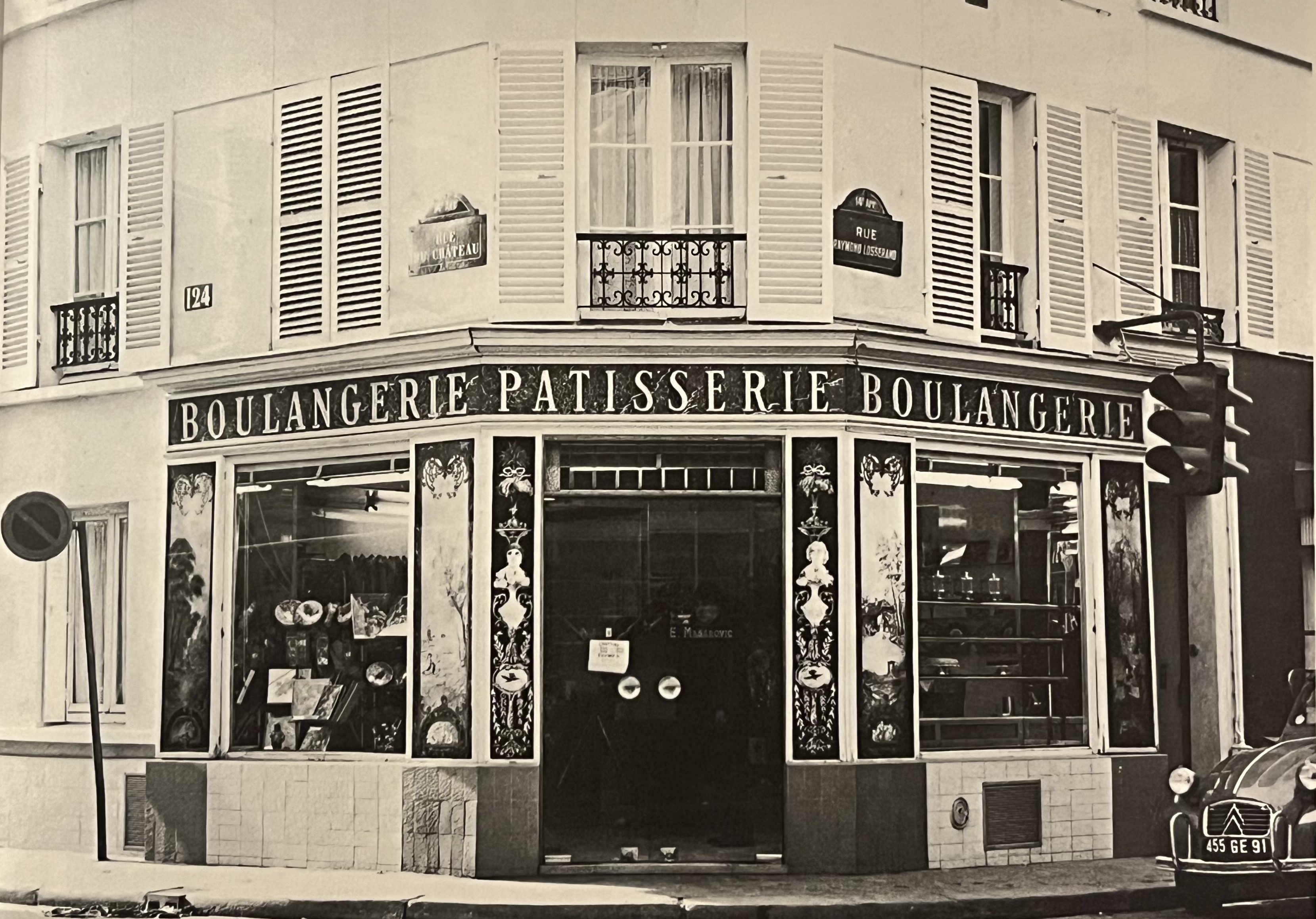
Not only does Cobb overstate his case, but the photographs seem intended to suggest that all is lost. Far from it. The very first photograph, depicts a boulangerie-patisserie at 124 rue du Chateau, a business that is still thriving, and looks much the same as it did back then.

And of the remaining 19 photos of the quartier, six are of the same courtyard in a complex at 9 rue de l’Ouest that was later demolished and another six are of a doomed courtyard at 3, rue Vercingétorix. That doesn’t seem to constitute enough data to support his gloomy dismissal of the quartier.

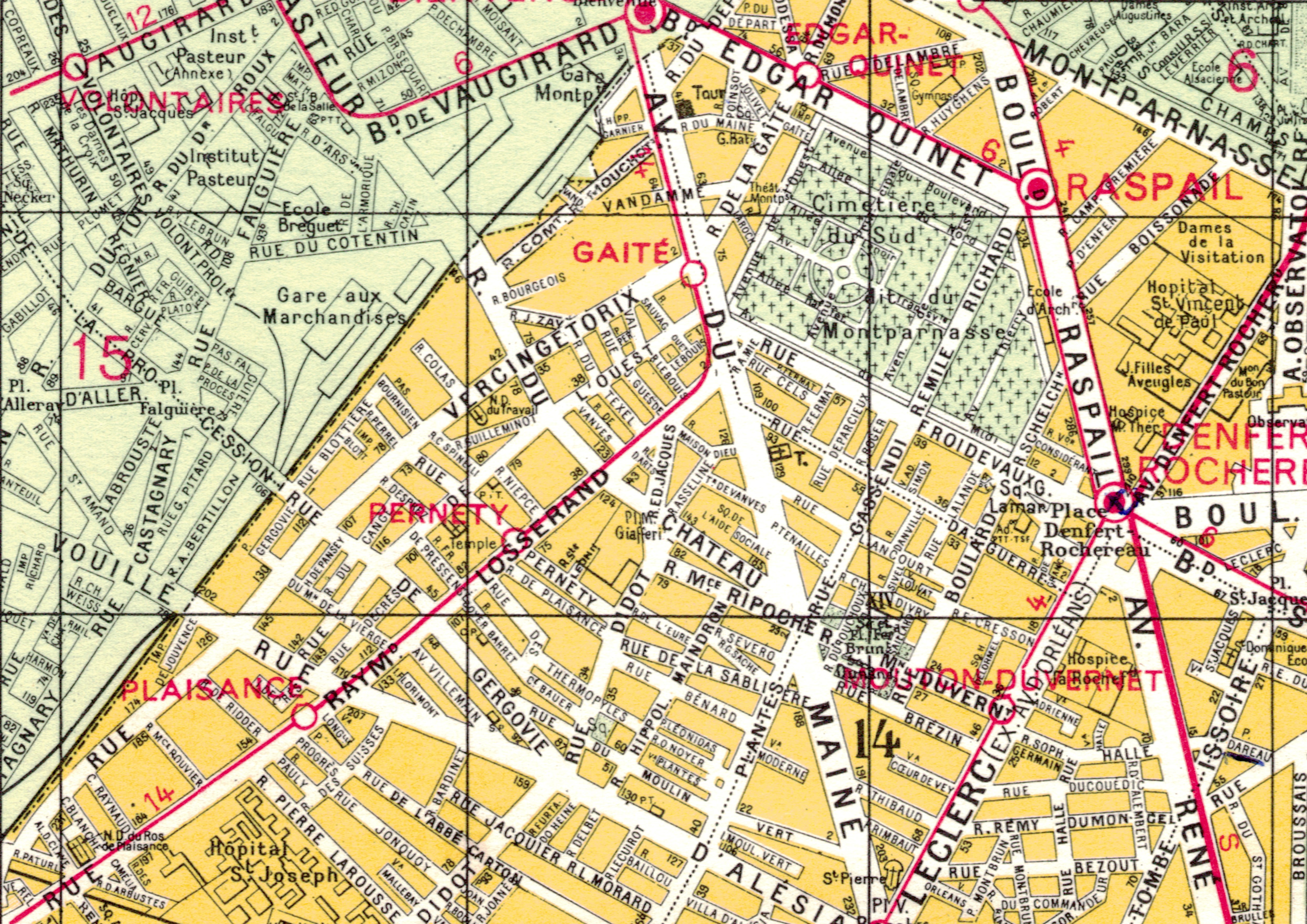
But I guess things seemed hopeless in 1980, when entire streets were disappearing. In search of the old quartier, I found a map from 1978.

Compare that with what is there now (this is from a 2010 Michelin map).

All those streets between the rail lines and the rue Vercingétorix are gone, replaced by green space. There is a circular place where the old rue Bourgeois met the rue du Chateau. There are small parks that were not there before, and in a densely populated area, that is a good thing.

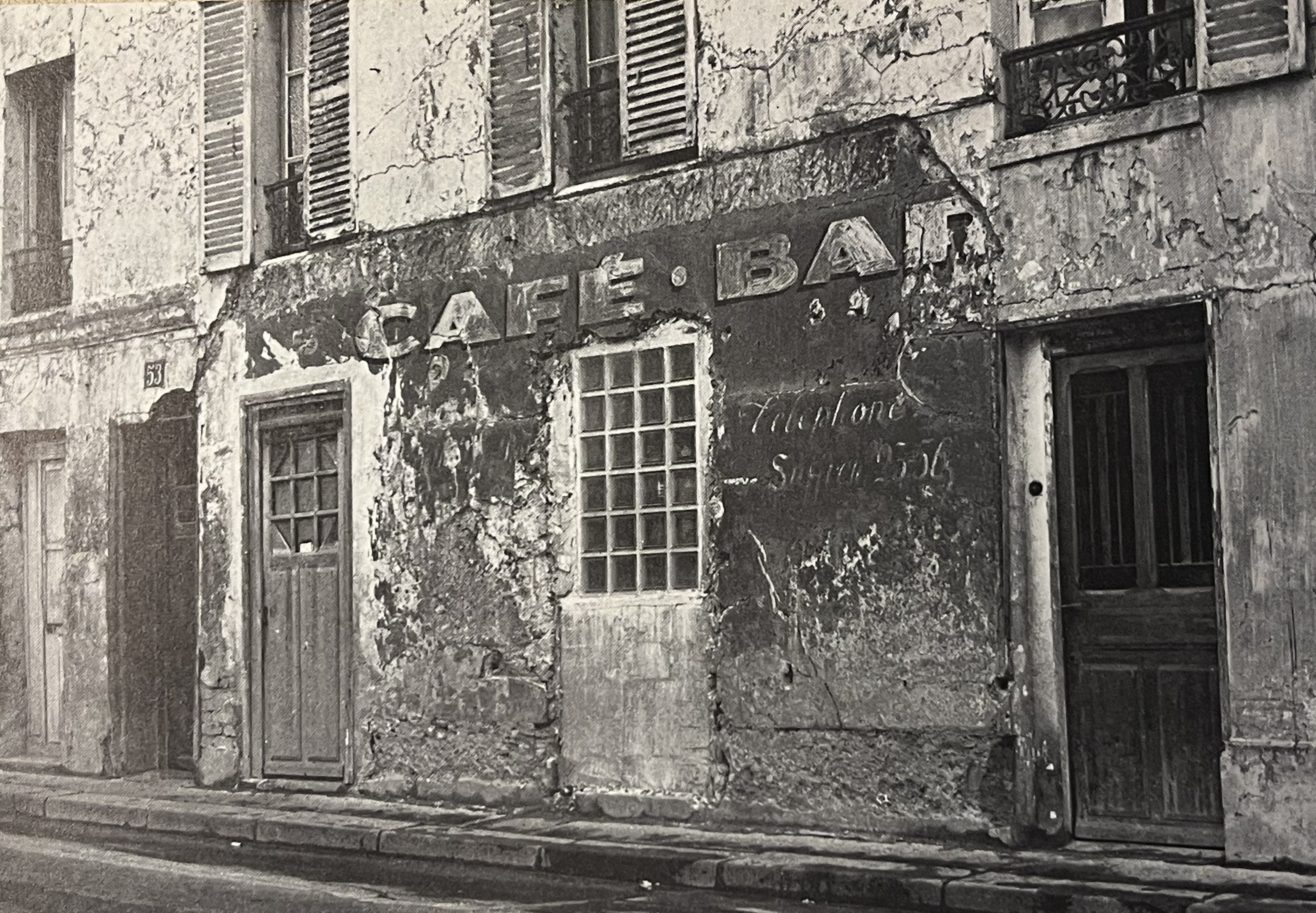
When Cobb and Breach were exploring the area before its transformation, many buildings had already been abandoned. The Tour Montparnasse was there, completed in 1973, overshadowing the neighbourhood. Here is a typical photograph, showing a defunct café-bar, at 53 rue Vercingétorix. This is now an open area beside Notre Dame du Travail.

The caption mentions the faint vestiges of the telephone number on the wall, Suffren 2556. “Suffren, as a telephone exchange, has long since been overtaken, along with Danton, Odéon, Jasmin, Nord, Botzaris, Daumesnil, by computerized numbers,” Cobb notes. (Hands up those old enough to remember when telephone numbers started with the name of the exchange – mine in Toronto was “Hudson” and Norman’s in Hamilton was “Liberty”).

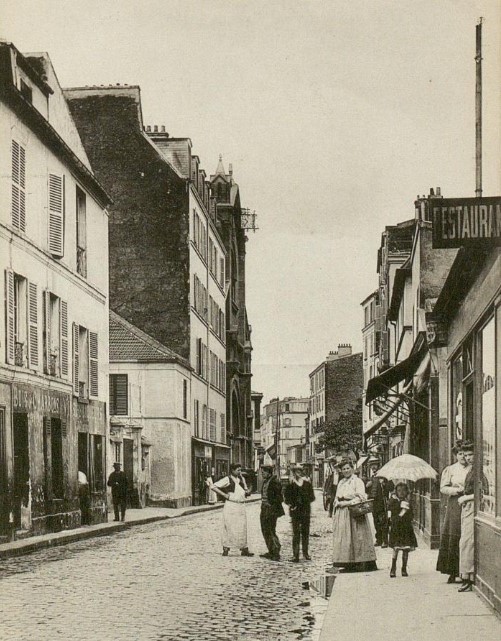
A postcard from Gallica shows how the building looked in better days (around 1910). It’s the one just this side of the church with its projecting clock on the left.

Another of Breach’s photographs shows part of the façade of the Hotel de l’Industrie at 65 rue Vercingétorix.

The caption reads, “The very faint and peeling reminder, in Second Empire lettering, Chambres au mois, Chambre à la journée at each end, of the past social history of the quartier de Gergovie, the home of immigrant Breton workers, settling near the old Gare du [sic] Montparnasse, most of them building labourers… The lettering is pale yellow on faded red.”

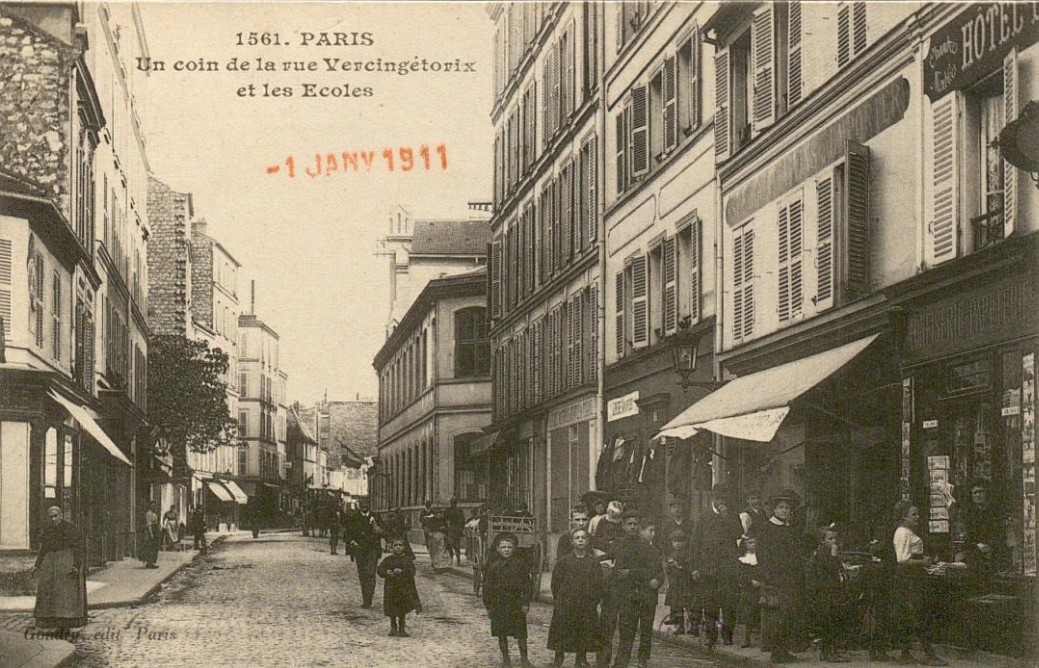
The hotel is just visible on the right in this postcard from Gallica. The two-storey building on the right beside the church survives to this day, as does the five-storey building on this side of it, but the rest have disappeared.

A tradition survives in this area, too. Although the Breton workers may have been displaced over the years, Montparnasse is still a good place to find a crêperie selling a traditional Breton meal of buckwheat galettes.

As it happens, some popular cookie-sized galettes in boxes have the image of Astérix on them, a tribute to the series, which is set in Brittany. We are back where we started.

*A menhir is an upright stone or standing stone from the prehistoric period. The word is of Breton origin.

Text by Philippa Campsie, images from Gallica and The Streets of Paris (New York: Pantheon, 1980). Cartoon image from Wikimedia, cookie box from eBay, and photograph of Notre Dame du Travail by Norman Ball.

Posted in Paris churches, Paris popular culture, Paris streets | Tagged , , , , , , , , , , , , , | 13 Comments

The boating party

For Marnie, with thanks for many happy memories, and for your long-standing support of this blog. Sail on, silver girl.

I am thinking about boats today, for several reasons. One is the fact that a good friend of ours who has been a keen and competent sailor for much of her life has been diagnosed with ALS and has had to let her boat go to someone else. We have many memories of sailing around the Toronto islands in that boat.

Another reason is that I have inherited a trove of family documents that includes an album of photographs depicting a boating party in the waterways in and around Shanghai in 1911. The photograph below shows the houseboat on that occasion. I can identify my grandmother Dora, my great-grandmother Wilhelmina, and my great-uncle Gerald among the party.*

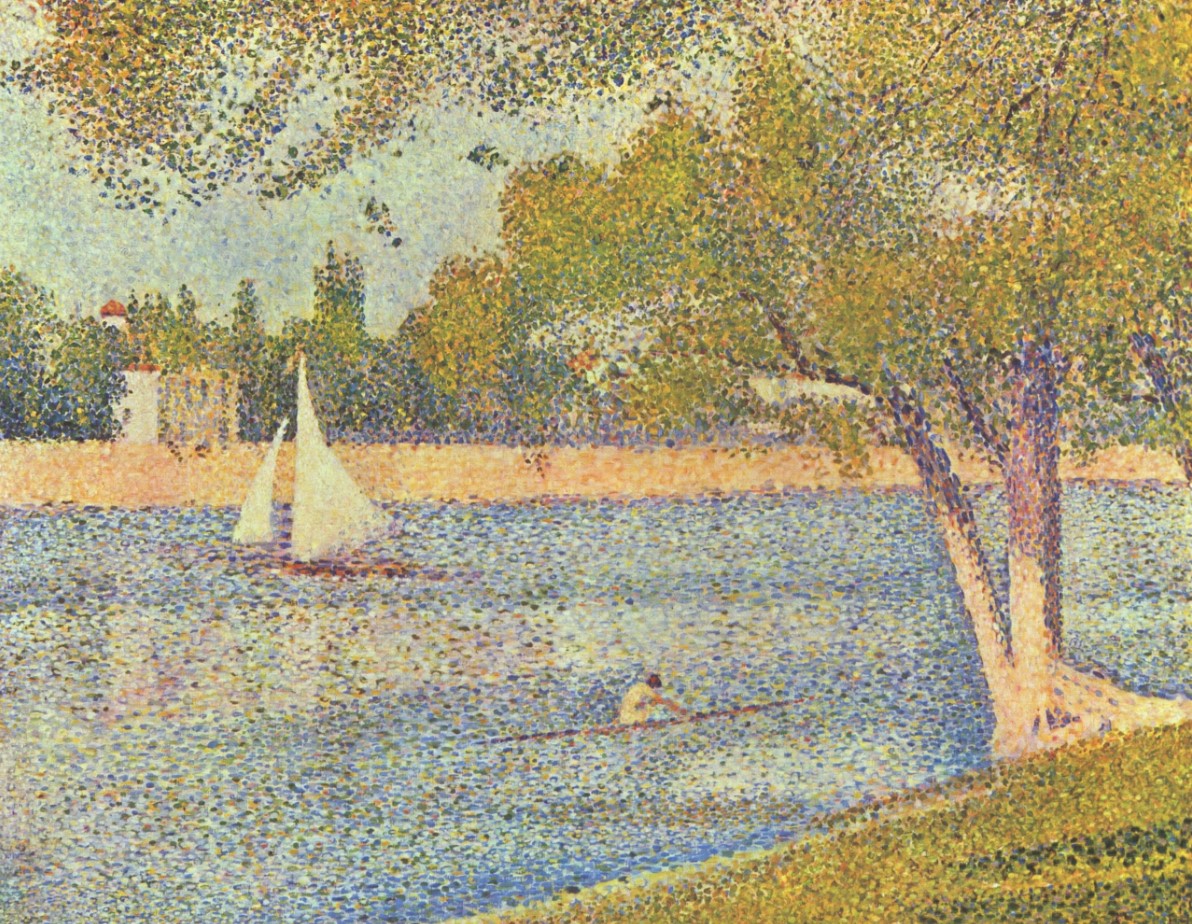
We have written about working boats and péniches on the Seine, but have not paid as much attention to pleasure boats. This was not true of French painters in the late 19th century. I’m not so much thinking of Renoir’s “Luncheon of the Boating Party,” which is all about luncheon and not so much about boating, but more of a print that hung on the wall in my bedroom from the time I was 10 to the time I left home.

It had been given to my father, along with several other reproductions of French paintings, and he had had them framed. My sister had Degas’s ballerinas, Van Gogh’s Church at Auvers hung in my father’s study, and Rousseau’s Carnival Evening hung in my parents’ bedroom.

I loved my Seurat. It was usually the last thing I saw before Mum turned out the light at night. I have never aspired to rowing, but I was always calmed by the sight of the man bent over the oars, and the sailboat moving on its own without human intervention (that I could see).

Mary Cassatt’s boating parties are less relaxing to contemplate, because I always worry about the fate of the children, who seem to be held rather casually and do not wear appropriate life preservers while on the water. I just have to hope they returned to shore safely.

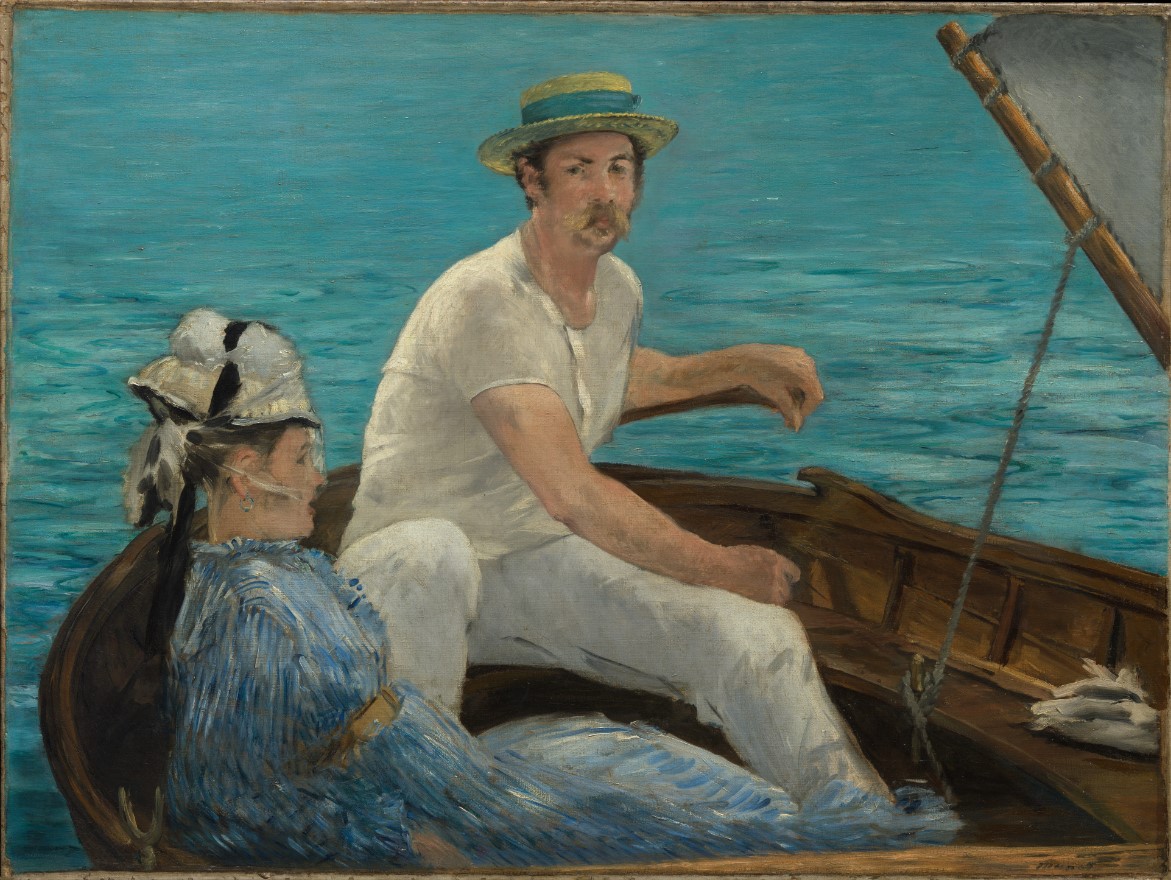
There are dozens of paintings of boaters from the late 19th century. I find the clothing endlessly interesting. Some wear informal attire, as shown by Manet (although the remarkably relaxed lady appears to be wearing her Sunday best).

By contrast, Gustave Caillebotte’s top-hatted gentleman seems to have walked out of an office or a drawing room, thrown his jacket into the boat, and picked up the oars.

Sailing and rowing became popular in the 1830s and 1840s in France, following the lead of Great Britain, where messing about in small boats is a religion, at least for those who can afford it. According to one scholar:

The new French pursuit of pleasure-boating, modelled on the sport of the British upper classes, was … intended to form the character of national élites. The Yacht-Club de France, with offices in Paris, was sponsored by the Emperor and patronised by the Minister of the Marine, while clubs at Asnières and Argenteuil included British diplomats and businessmen among their directors and, through to the 1870s, were open only to the wealthy and the well-connected.**

By the time the Impressionists were painting in the 1880s and 1890s, however, pleasure boating was no longer just a pursuit for the wealthy, but was well established among the middle classes. Shoals of people headed downstream along the Seine on Sundays to rent a boat or lunch in a guinguette (a casual restaurant).

The only guingette by the river we can claim to have patronized was near the museum of porcelain in Sèvres, which we visited with our friend Mireille. Plastic chairs and take-out food, but a good view. On one riverbank, it was all greenery with a river path that led to the Parc St-Cloud, with a row of boats moored in the river.

On the other, very large buildings, also with boats moored in front.

The view today is less bucolic than it was in the days of Cassatt and Caillebotte, but the passion for boating appears unabated.

We also love to stroll along the Bassin de l’Arsenal, near the Bastille, to see the pleasure boats and their green-glass reflections and imagine a life in which we own one of them and could set off at a moment’s notice to explore the waterways of France.

Parisians’ love of boating stood them in good stead in January 1910. When the waters rose, and rose, and then rose some more in 1910, and Paris turned into Venice, a flotilla of skiffs and punts and rowboats appeared to ferry people through the flooded streets. Here is an example from our postcard collection.

Of course, the symbol of the City of Paris is a boat and the original inhabitants were island dwellers. Pleasure-boating of a certain style may have been imported from Great Britain in the 19th century, but boating itself is woven deep into the fabric of the city. Think of all those boats pictured in Turgot’s map depicting the city in the 1730s. Paris has always been focused on its waterways.

When we finally get back to Paris, I want to get out on the water, and feel the breeze.

Text and contemporary photographs by Philippa Campsie; photograph of the Bassin de l’Arsenal by Norman Ball. Postcard from our collection. Paintings from Wikimedia Commons.

*Great-uncle Gerald went to Shanghai before the First World War to work as a stockbroker. He married a teacher and lived there until the 1930s. His mother and sister visited him in the course of a trip around the world. This fact is quite impressive, given my grandmother’s disposition to dreadful motion sickness of all kinds, which I have written about before.

** Tricia Cusack, “Bourgeois Leisure on the Seine: Impressionism, Forgetting and National Identity in the French Third Republic,” National Identities, vol. 9, no. 2, 163–82, June 2007.

Posted in Family history, Seine, Toronto | Tagged , , , , , , , | 5 Comments

Up Stairs. Down Stairs.

One of our favourite walks starts close to the apartment we often rent that overlooks the Boulevard de Port Royal. It begins when you go through a hole in the sidewalk and down a set of stairs.

Just west of the Avenue des Gobelins, the Boulevard de Port Royal crosses over a sunken street, the rue Broca. Four openings, similar to Metro entrances, lead down to the lower street. (A little further east along the boulevard, more stairs connect to the rue Pascal, another street below a street. But we always take the stairs that go to the rue Broca, which is curvier and quirkier.)

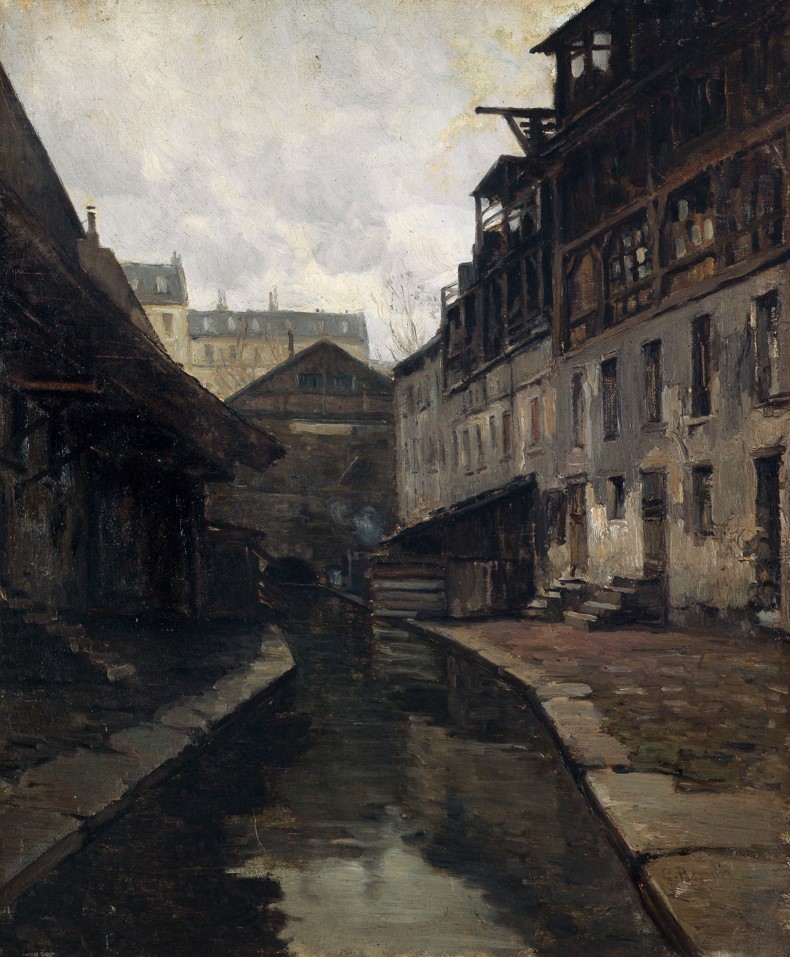
Broca is a medieval street that has gone through several name changes (the current one dates from 1890 and commemorates a doctor who also gave his name to the hospital at the southern end of the street). When I wanted to find out why the rue Broca goes underneath the boulevard Port-Royal, it took me a while to realize I was asking the wrong question. Rather, the 19th-century Boulevard de Port Royal was built like a bridge over this low-lying area, which was once part the valley of the Bièvre river. Here is a 1900 view of the river between the rue Broca and the rue Pascal, painted by Germain Eugène Bonneton.

On this bird’s-eye-view map from the 1920s, you can just see the Port Royal overpass and the sunken street underneath.

There is something magical about finding a complete street below an existing street. It reminds me of a children’s book, The Secret World of Og by Pierre Berton (1961), in which five children find a whole civilization of small green people living in a village deep beneath their playhouse.* The strangeness of the rue Broca has given rise to a whole book of fantastic stories by Pierre Gripari, published in 1967. (On this edition, the cover art is by Voutch.)

At the bottom of the stairs, the space below the boulevard welcomes the explorer with murals and coloured lighting. The murals evoke the stories by Gripari.

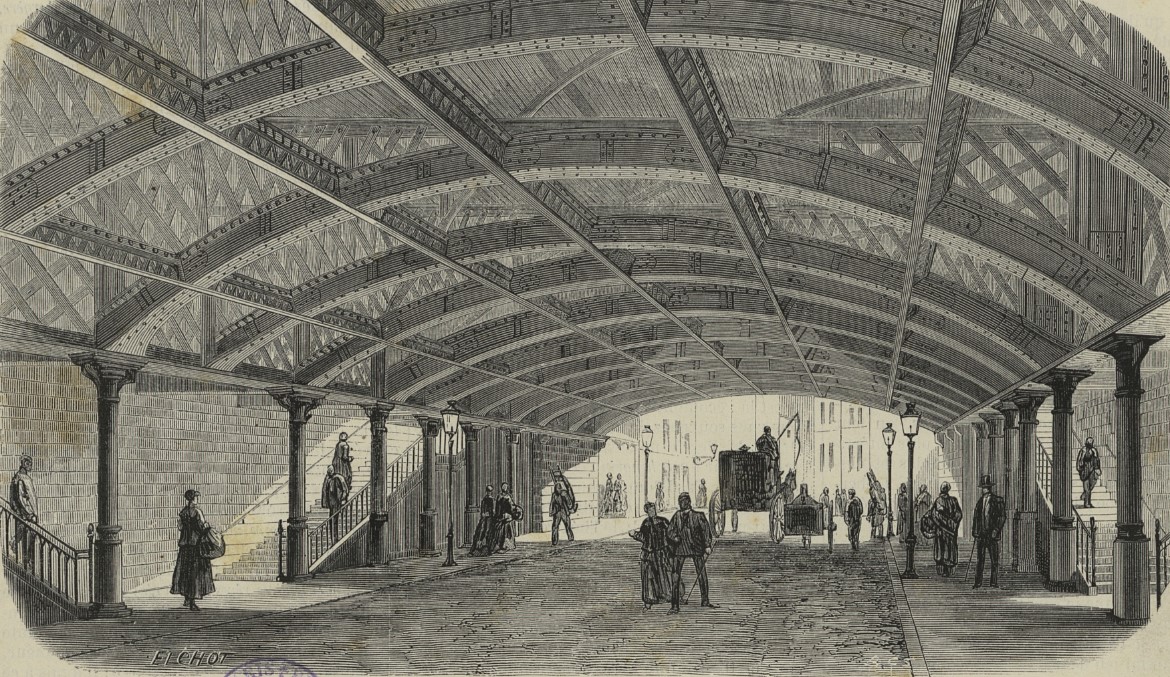
This is just the newest version of a space designed to make strollers feel welcome rather than threatened. Here’s how it looked in the late 19th century.

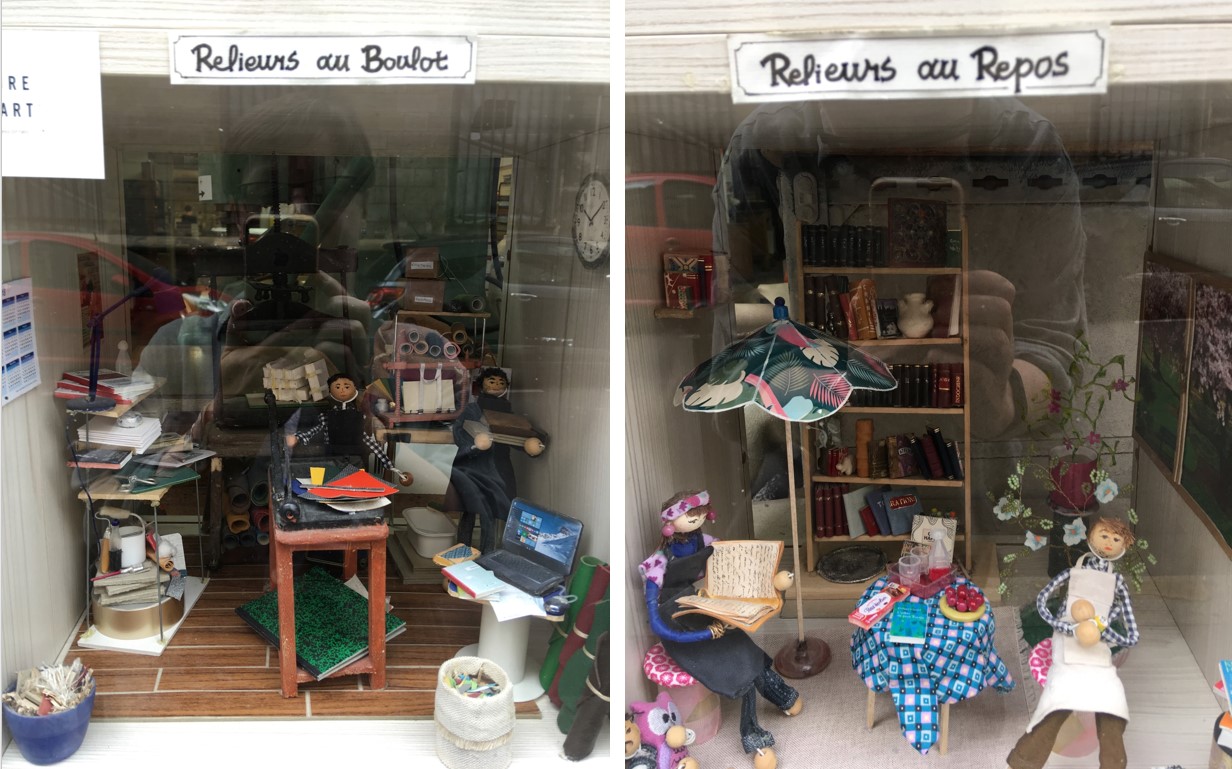
The rue Broca winds past shops, restaurants, and businesses. One is a bookbinder, and the window display includes little model rooms. The last time we went past, they showed Relieurs au boulot (bookbinders at work) and Relieurs au repos (bookbinders at rest). The sort of thing one would expect in a magical street below a street.

If you walk north, the road changes its name after it crosses rue Claude Bernard, before opening out into the place in front of the church of St. Médard, at the bottom of the rue Mouffetard. There are bookshops and food shops here, all very tempting, and we seldom resist. Then we climb up the rue Mouffetard in search of a restaurant called Le Verre à Pied. The restaurant is so small we sometimes pass it unwittingly, get to the top of the hill, and have to retrace our steps to find it. The patron serves wines from the Pays d’Oc, which he told us represent the best value for money (le meilleur rapport qualité-prix).

We generally end up in the steep little streets behind the Pantheon. This is the Montagne Ste-Geneviève, one of many hills on which Paris was built. But it is only a small elevation in comparison with Montmartre or Belleville on the Right Bank, famous for their views – and their steps.

A less well-known hill is the Butte Bergeyre, an odd little neighbourhood just west of the Parc des Buttes Chaumont. It perches on its own little plateau high above the city. The day we visited, we approached up the steps of the rue Michel Tagrine. Norman here is contemplating the climb ahead.

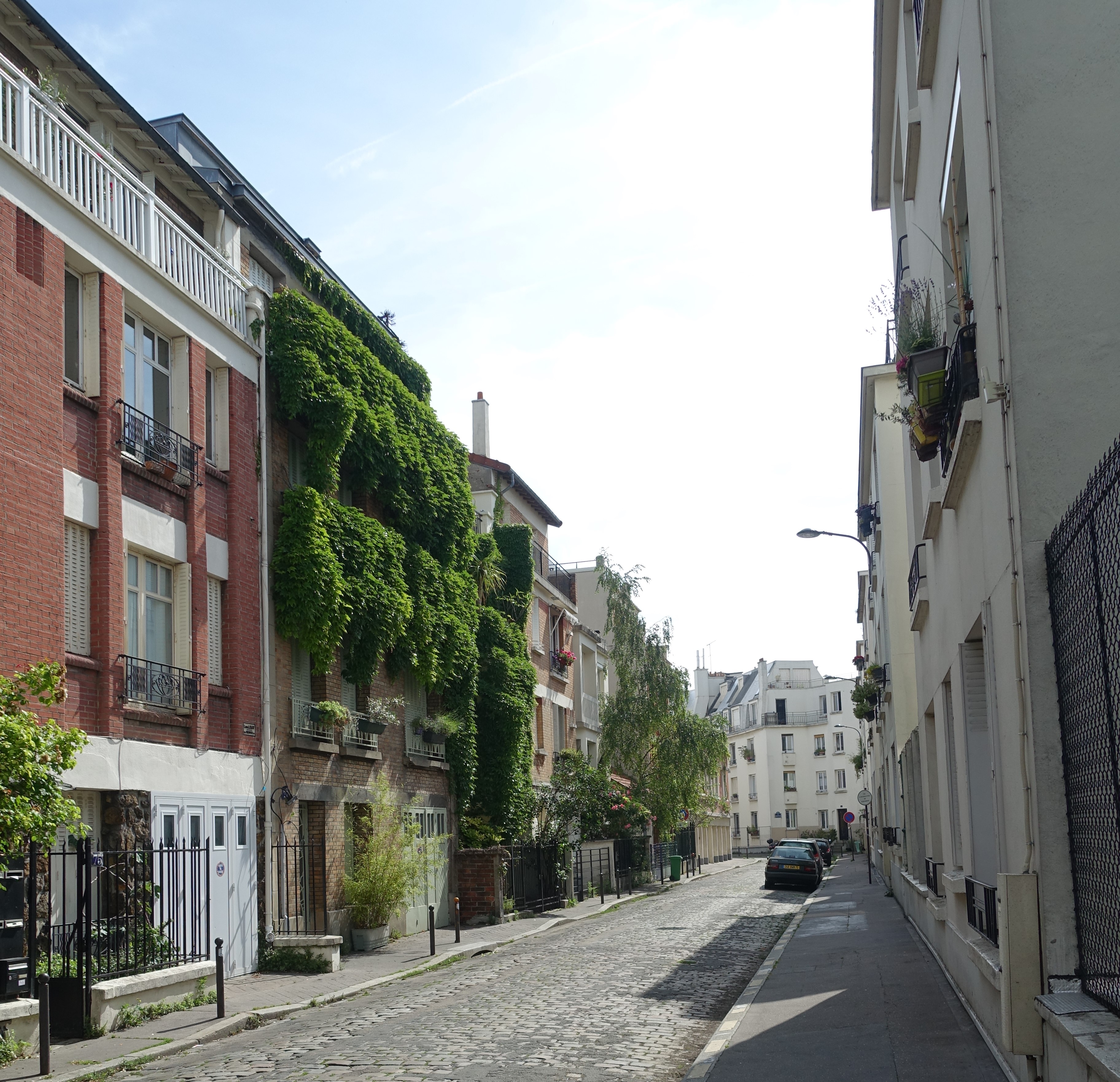
At the top of the butte is an enclave of houses with remarkable views. Quite a few are covered in ivy. This is a residential area almost entirely without business establishments, unusual in Paris.

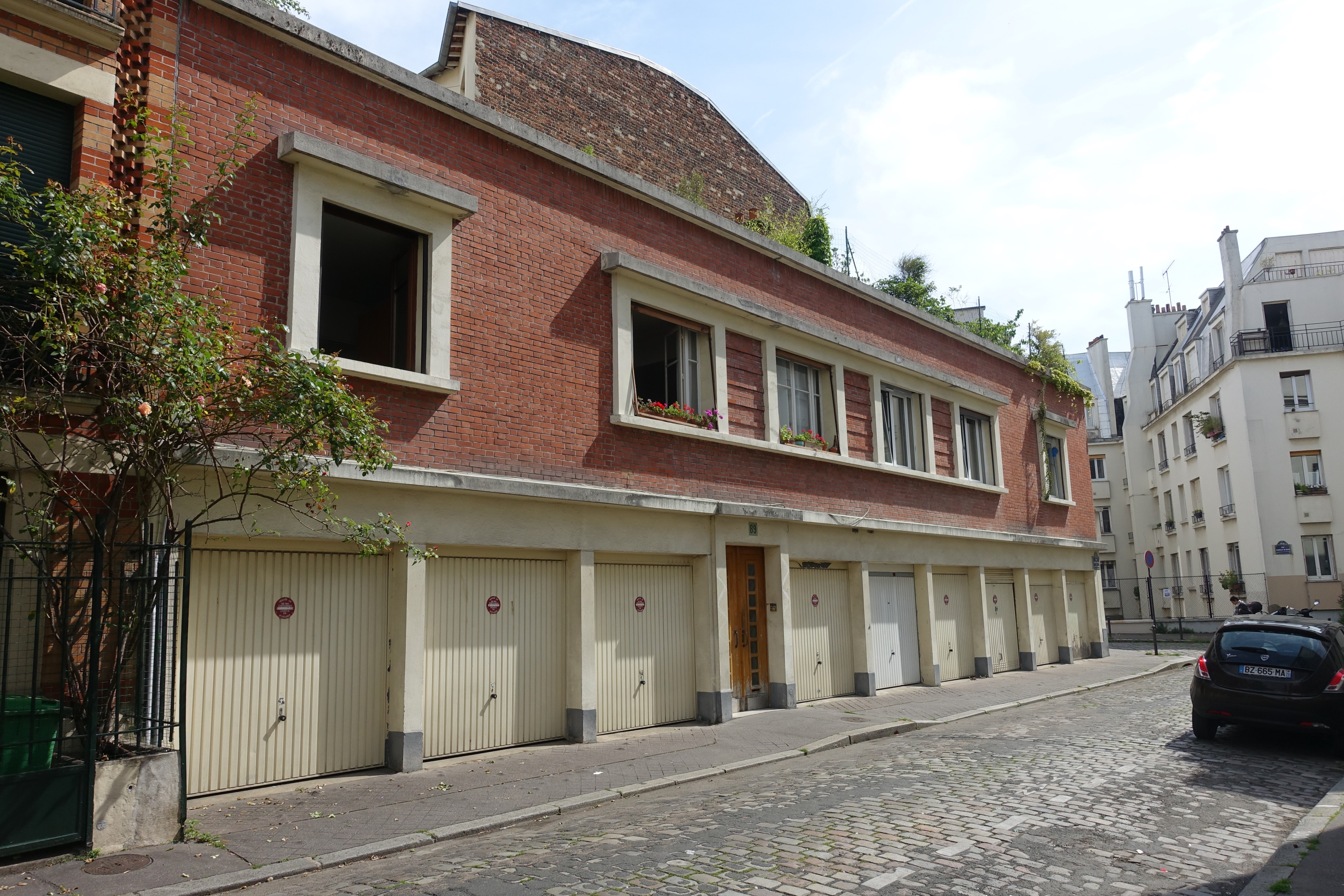
Also unusual – an abundance of garages. Living here without a car would be difficult, I imagine.

There are allotment gardens and even a vineyard. Wine is produced here, but I have never tried it and so cannot possibly comment on the rapport qualité-prix.

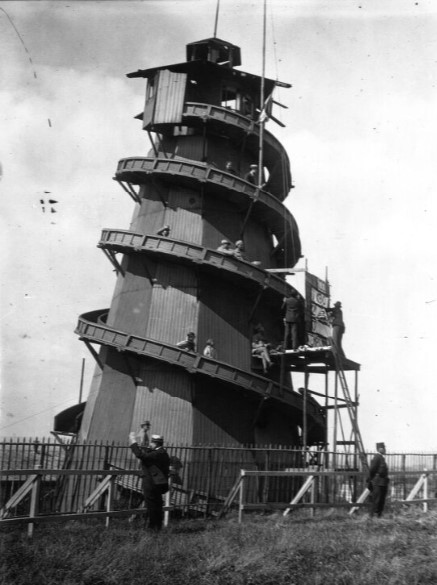
On hunting for information about this area on Gallica, the first historic photograph that caught my attention was this one:

This structure formed part of the “Folles Buttes,” an amusement park. The entrance, with the tower in the distance, is shown in this postcard, also from Gallica.

There is no date on either image, but the Folles Buttes are mentioned in newspapers from before the First World War. La Presse, in June 1912, announced the opening, with 50,000 square metres of attractions, where “Le Scenic, les Toboggans, la Maison Hantée, et toutes les attractions fonctionneront au milieu des jeux de 50.000 lampes électriques” (the Rollercoaster, the Toboggans, and the Haunted House and all the other attractions are illuminated by 50,000 electric lights). The Folles Buttes closed in the 1920s.

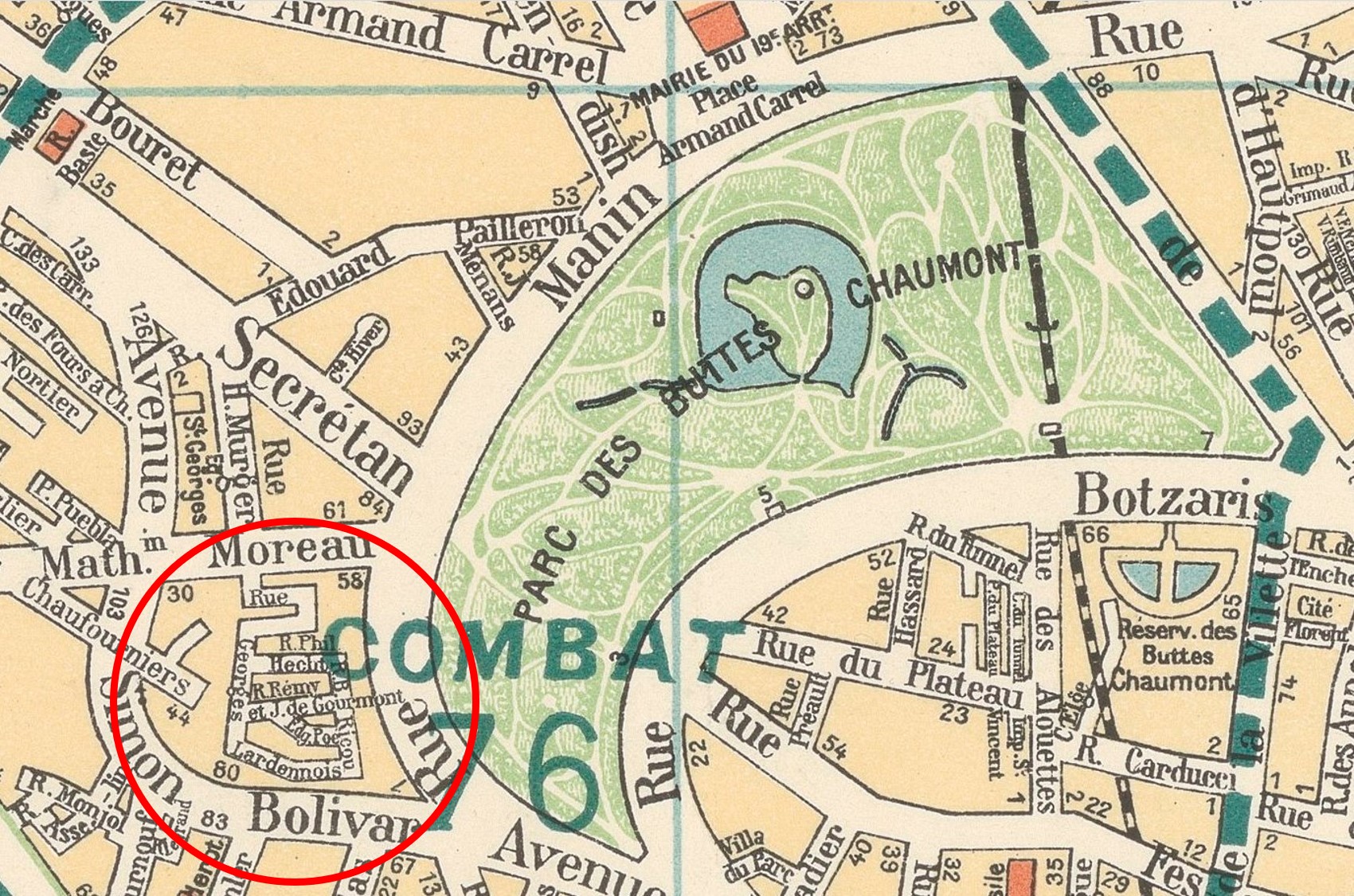
During the 1924 Paris Olympics, the top of the butte was used as a stadium for soccer matches, named for Robert Bergeyre, a noted sportsman who had died in the Great War. Some time after the Games were over, the land was developed as it is now – streets of smallish houses, surrounded and partly hidden by tall apartment buildings on the lower slopes. The neighbourhood first appears on maps from the early 1930s (this is from 1933):

The quartier as a whole is known as Combat, from the nearby Place du Combat – now the Place Colonel Fabien. (The name Combat had nothing to do with war, but recalls a time when the space here was used for animal fights, such as those pitting dogs against boars. Such things were finally outlawed in the 1830s.)

We left the butte by another staircase that leads through an archway to the rue Manin…

…and emerged opposite the park Buttes Chaumont, the former quarry, with its hills and bridges and staircases. In this postcard from our collection, the stairs are described as “rustic.” The park is full of concrete steps and handrails made to look like wood.

Stairs are a huge part of walking in Paris, particularly if you take the Metro. That’s hard on those with hip or knee problems or those struggling with strollers or wheelchairs or suitcases. But the three dimensions of the city are part of its character. Almost everywhere you go, there is something above you and something below you, and you need to take the stairs.

Text and original photographs by Philippa Campsie, Bonneton painting from Paris Musees, historic photo and postcard from Gallica, maps from Wikimedia Commons, postcard of the Buttes Chaumont from our collection.

*This book may have inspired a recurring dream from my childhood, in which I found a little door in our house that led to a whole world underneath the road in front, complete with houses, shops, and people.

Posted in Paris history, Paris parks, Paris streets | Tagged , , , , , , , , , , , , , | 16 Comments

Beer and sandwiches from the Brasserie Dauphine

If the title of this blog rings a bell for you, you must be a fan of the mystery novels of Georges Simenon. When Inspector Maigret holds an interrogation at the Quai des Orfèvres, more often than not he orders beer and sandwiches from the Brasserie Dauphine, not only for the police officers involved, but also for the suspect. Nobody ever goes hungry (or thirsty) in a Maigret novel.

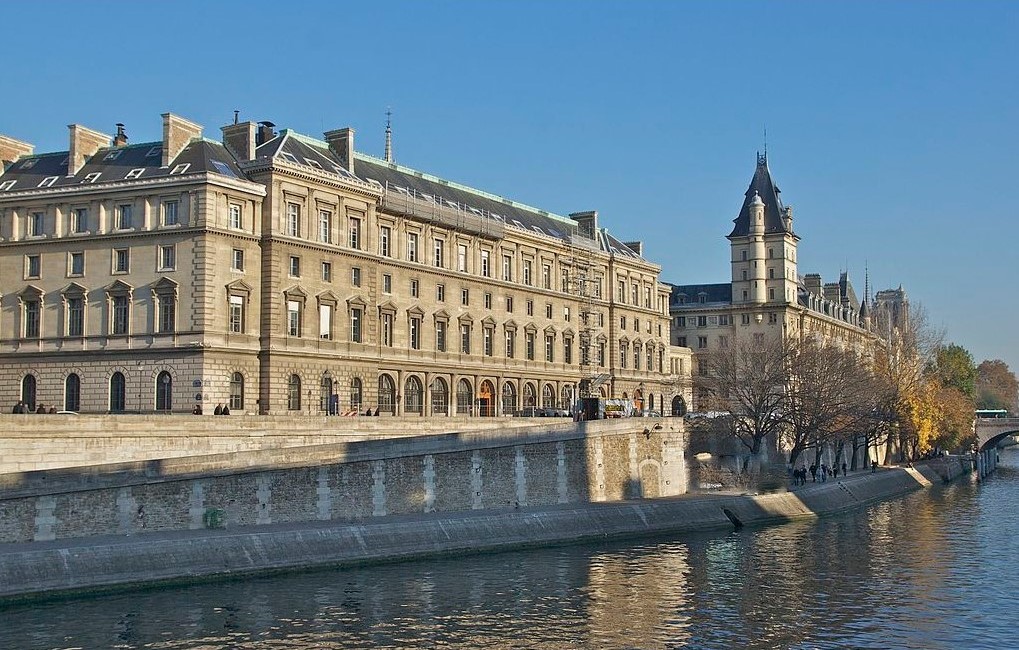
If you are not familiar with the Inspector Maigret mysteries by Simenon, I should back up a bit. The building at 36, Quai des Orfèvres, on the Île de la Cité, was for many years the headquarters of the police in Paris.

It is a real place invoked in Simenon’s novels. Not any more, though. Police headquarters recently relocated to a more modern facility in the 17th.

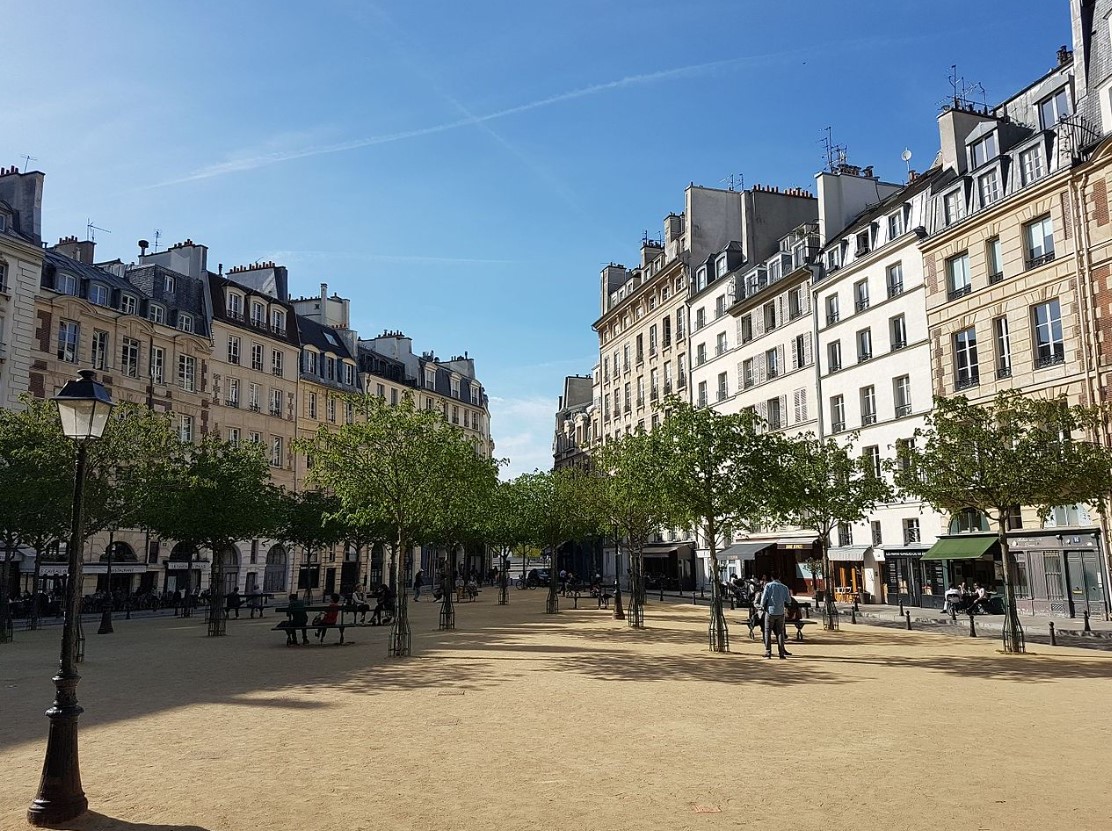
The Brasserie Dauphine, however, is Simenon’s invention. The Place Dauphine, just around the corner from the Quai des Orfèvres, has always had cafés and restaurants, but today’s fashionable eateries do not look like the kind of place that would send out a tray of sandwiches and beer to the local cop shop.*

I read several Maigret novels recently while recovering from Covid. As one does. On the back of my second-hand copy of Maigret in Exile (translated from the French, Harcourt Brace Jovanovich, 1978) is a quotation from The New Yorker:

Georges Simenon has probably done as much for the common cold as the aspirin and more for travel than the overnight suitcase. Limp, semi-recumbent people all over the world wanly open his latest tale…and somehow, no matter what the outcome, close it with a feeling of inexplicable pleasure.

The only thing I would disagree with there is the word “inexplicable.” I think the pleasure of his books is quite explicable.

For me, one doesn’t so much open a Maigret novel as wrap oneself in it, like a comfortable overcoat, perhaps one smelling faintly of pipe smoke. It’s Paris in the 1940s or 1950s, the city of old movies and nostalgia. There are buses with open-air platforms at the back, you need a jeton to make a phone call from a bistro, and eagle-eyed concierges lurk within the entrance to every residence.

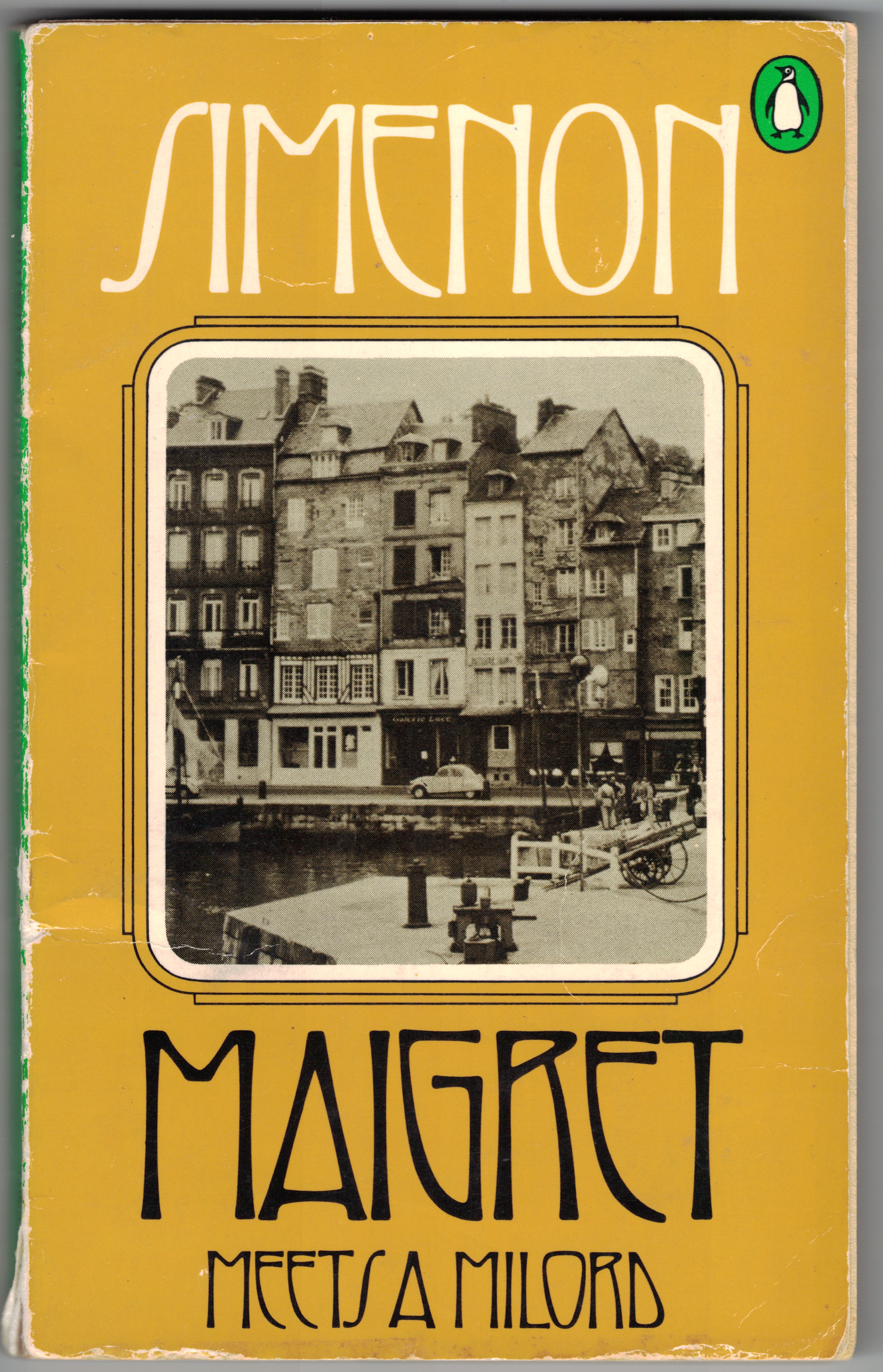
Adam Gopnick, writing about Simenon in the New Yorker in September 2022, says that the author “takes gray as his distinct and constant color.” I beg to disagree. Perhaps Gopnick is confusing the books with their publishers’ frequent use of black and white photography on the covers, particularly the old Penguin versions with their lovely typography. Here’s a typical example, taken from my own shelves.**

For me, the books are full of light and colour. Here’s the opening of Maigret and the Headless Corpse, which takes place in (and I do mean in) and around the Canal St-Martin:

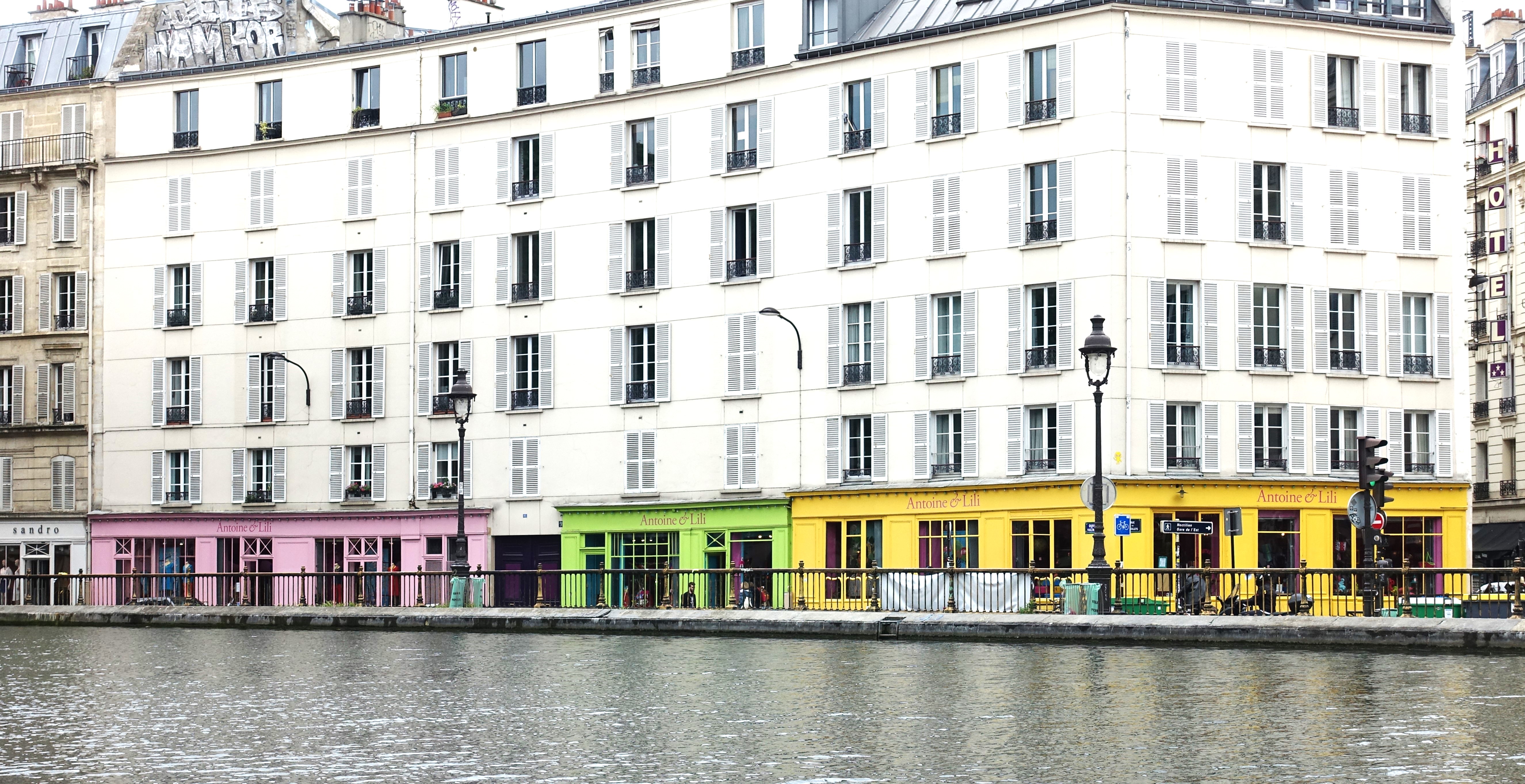
The sunlight was beating down on the buildings along Quai de Valmy, sunlight so bright that it made you wonder why that stretch of the canal had such a sinister reputation. True, the paintwork on the fronts of the buildings was faded, the whites and yellows pale and washed out, but on this March morning, everything seemed as bright and clear as a painting by Utrillo. (p. 8)

I immediately thought of that spot on the Quai de Valmy with the colourful facades.

In Maigret Goes to School (1954), it is spring and “bright sunlight as cheerful as lilies-of-the-valley shone on Paris and made the pink chimney pots gleam.” Grey? The books set in winter, perhaps, but I wouldn’t colour all his work in grey.

Food is hugely important. Even junior officers need to eat. Maigret has three lieutenants at his beck and call – Janvier, Lapointe, and Lucas (they probably have first names and distinctive characteristics, but I can’t remember any offhand) – and Maigret wouldn’t dream of sending them to do surveillance or a house-to-house inquiry without ensuring that they have a square meal first. If they are far from the Quai des Orfèvres, he recommends a nearby restaurant.

Madame Maigret provides wonderful meals on the rare occasions Maigret makes it home for lunch or dinner. Here’s an exchange over breakfast from Maigret Hesitates:

“Do you think you’ll be back for lunch?”

“I think so.”

“Would you like fish?”

“Skate in black butter, if you can get any.” (p. 113)

I love that. Other men would simply have said “Yes, fish would be nice.” Alas, later that morning, Maigret finds a body, and Madame Maigret, whose patience is inexhaustible, must have had to eat the skate with black butter alone, if indeed she found any.

In Maigret Goes to School, the Inspector takes an interest in a murder in a small community near the coast simply because he hopes to eat oysters there. Alas, he arrives during the neap tides, when oysters are not available. (Don’t ask me. I have no idea what that means, and neither did Maigret when he was given the news. Apparently during certain kinds of ocean tides, oysters and mussels are not gathered or eaten.)

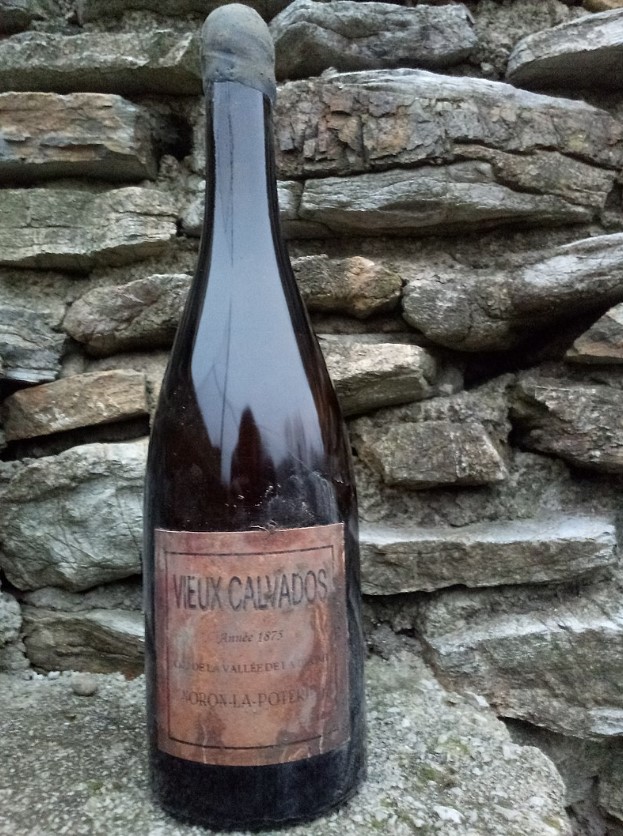
And the drinking, my dear, the drinking. White wine is for the morning. Just to get going or to obliterate the taste of bad coffee. Then one has a bottle of wine at lunch. Calvados in the late afternoon (well, Calvados any time it’s offered), and no end of libations all evening. There’s a funny scene in Maigret and the Headless Corpse in which Maigret and a provincial lawyer who has a crucial story to tell make a night of it with brandy. The following morning, Maigret wakes up with an unaccustomed headache, and for Maigret, that is saying something.

All of which is to say that what Simenon may have intended as background comes to the fore when I read the novels. The details give me quite explicable pleasure.

The plots are sometimes straightforward whodunnits that start with a body and end with the identity of the murderer, but some are “what-on-earth-is-going-on?” stories that draw you along in puzzlement (in Maigret Hesitates, the murder doesn’t occur until two-thirds of the way through the book). Maigret’s methods would not, of course, pass muster in real-life policing, but that’s the thing about fiction. You can get away with…well, nobody gets away with murder in traditional crime fiction, but detectives get away with the most unorthodox approaches to solving crimes.

None of the novels are more than 200 pages long. A perfect length for someone recuperating from Covid or undertaking a journey. Given the level of compression, the detail is sometimes sketched in, as in this rapid-fire description in Maigret in Exile, when Maigret is at a train station in a rush and needs to send a message.

A brasserie. A fat cashier. A railway timetable. A well-chilled glass of beer. “Could you bring me some writing paper and a ham sandwich… oh, and another beer!” (p. 79)

Imagine calling for writing paper in a modern railway station today. Imagine getting a well-chilled glass of beer.

The unravelling of each mystery involves a back story. The past is always present. The story is often told to Maigret accompanied by generous amounts of drink and, if the speaker is a man, a great deal of tobacco as well. After one long session over port and pipes, “The air was so thick with smoke it was almost impossible to breathe.” (Maigret in Exile, p. 77)

The stories are of affairs, betrayals, losses, estrangements, buried secrets, thwarted ambitions, and a range of passions. Sometimes the perpetrator is a sad soul more sinned against than sinning; sometimes he or she is a respected member of society who conceals a dreadful secret behind an appealing façade.

But the stories always end at the point at which Maigret knows who did what, how, and why, and hands the case over to the examining magistrate (juge d’instruction). The guilty party may or may not pay his or her debt to society in the end; but that is not Maigret’s (or the reader’s) concern. The point is to understand. What happens in the justice system is another matter entirely.

It’s flu season. I recommend laying in a stock of Vitamin C, chicken soup (or skate with black butter if you can get any), and Simenon novels to get through it all.

***

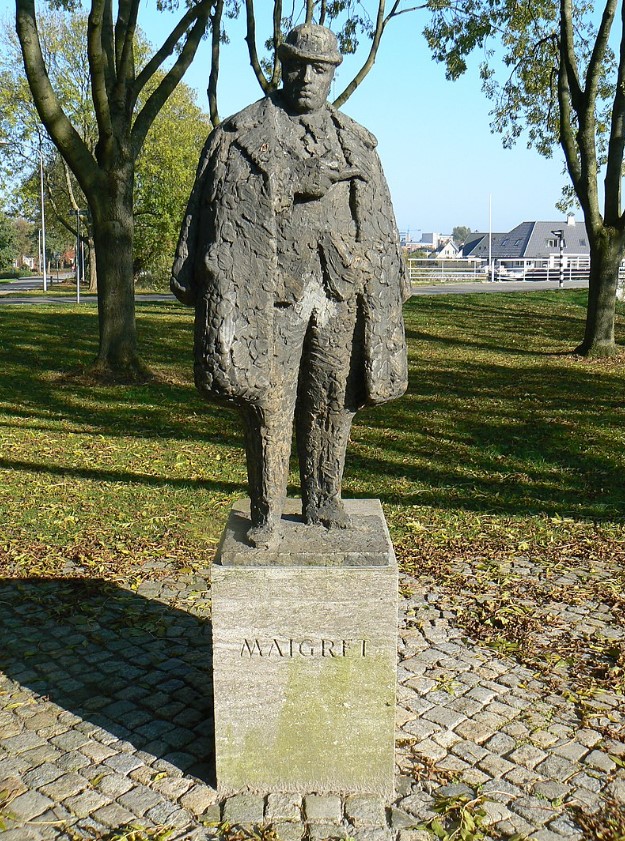
Text by Philippa Campsie. Photograph of Canal St-Martin by Philippa Campsie. All other images from Wikimedia Commons. The statue of Maigret is by Pieter d’Hont and stands in a park in Delfzijl in The Netherlands.

*One blogger argues that the inspiration for the Brasserie Dauphine was actually the Café Restaurant Aux Trois Marchés around the corner from the Quai des Orfèvres on the rue de Harlay. It is now gone.

**The crime in this novel takes place in the canal near Epernay, but the photograph is not of the canal at all, although at first glance it seems to be. And it’s not Paris; the roofs are all wrong. I was curious, as always, and took a closer look. After a few hours of hunting, I discovered that it is the Quai Ste-Catherine in Honfleur, at the mouth of the Seine. The houses in the photograph are still there.

Posted in Paris books, Paris crime, Paris nostalgia | Tagged , , , , , | 35 Comments

A museum of images in a garden of peace

With such an abundance of museums and galleries in Paris, should it be a surprise that on occasion, the one you had your heart set on visiting happens to be closed? But then there is the flip side of the coin: you find a space that was closed for the past five or six years and has now reopened. On our next trip to Paris we will definitely go to the recently reopened Musée Carnavalet. But what I look forward to with the greatest anticipation will be our first visit to the Musée Départemental Albert Kahn in Boulogne-Billancourt.

I had heard about Albert Kahn (1860–1940): successful banker, self-made man, philanthropist, world traveller, lover of and commissioner of gardens and, perhaps most important, a pacifist who was a global pioneer in colour photography. But until the arrival of the June-July issue of Côté Paris, I had no idea there was a museum with gardens dedicated to his life and work, or that it had been closed for radical reconstruction, conservation, and new construction. Then, by chance, our friend Mireille visited the museum and gardens on a glorious autumn day and emailed us some of her stunning photographs. I had to know more.

Kahn was born in 1860 in Marmoutier, Alsace, in what was then eastern France. However, after the Franco-Prussian War, the 11-year-old boy found himself a subject of the German Kaiser. In 1876, aged 16, he moved to Paris and changed his first name from Abraham to Albert to symbolize his bond to France. Through family connections, he became an apprentice banker with Charles et Edmond Goudchoux. Albert was noted for his financial insight. When he was still in his twenties, he brokered investments in diamonds and gold in South Africa – deals that benefited his employers, but also brought him great personal wealth.

A rising financial star had to be suitably accommodated. In 1893, Kahn rented a brick-and-stone hôtel particulier on rue du Port in Boulogne-Baillancourt, not far from the Rothschild’s family château. The image below was taken in 1924, during a flood that covered the lawn.

In 1895, the self-made millionaire bought the estate he had been renting and began to purchase adjoining properties, bringing his estate to 4.1 hectares, which he proceeded to turn into seven magnificent gardens. However, he was not always at home to see the work proceed, as his job took him around the world. In 1897 he made his first trip to Japan, where he fell in love with Japanese landscapes and gardening.

The Japanese village is perhaps the most well-known part of the gardens, with its three houses, including a tea house. These Kahn sought out in Japan, had disassembled, and brought to his estate, where they were reassembled and restored by carpenters brought from Japan. But gardens keep growing and sometimes outgrow their original spaces. in the 1990s the Japanese landscaper Fumiaki Takano created a new Japanese garden (shown above) to replace the original version.

A focal point of the French formal gardens is a large glass-and-iron greenhouse, the Palmarium, a reference to the nineteenth-century craze for growing palms in greenhouses. The Palmarium is currently undergoing restoration and serves as a winter garden.

For Kahn, though, accumulating wealth and landscapes was not enough of a legacy. His goal was more ambitious: world peace. His childhood experience of war had led to a lifelong interest in pacifism. For him, an underlying cause of war was the lack of mutual understanding and appreciation of other cultures, peoples, and ways of living. His landscaped gardens represented his views on the potential of humanity. Plants from many countries came together harmoniously. The garden, created under the knowledgeable eye of Kahn’s chief landscaper, Édouard André, was a manifestation of a world at peace.

Kahn’s gardens were beautiful, but for much of his lifetime, the only visitors were his friends and colleagues. Kahn realized that he needed a project that would play a broader role in spreading his ideas about mutual understanding as a cornerstone of peace.

So, in 1898, he established a scholarship program, Bourses de Voyage autour du Monde. Kahn wanted to provide cultural education for young teachers, the people who would help mould the minds and world views of the youth of the day. Those who applied had to propose a study project; beyond that, there were few requirements other than periodic reports. At a time when travel was often difficult and expensive, recipients of Kahn’s bursaries were able to travel in comfort on an itinerary they had devised for up to eighteen months.

These fortunate young people came from France, the United States, Britain, Germany, and Japan. Between 1898 and 1931 there were 150 recipients, of which 27 were women – a remarkable proportion in that day and age. In 1906, Kahn created la Société Autour du Monde to bring about exchanges between former bursary holders and the international elite.

The bursaries were a start, but Kahn was concerned about sharing what the recipients had seen and experienced. At the time, a photographic holy grail was an easy-to-use system of still photography that reliably gave good colour rendition on conventional glass plates. In 1905 the Lumière brothers, who had made their name with moving pictures, began to pursue what would be their next grand achievement. On 10 June 1907, in a newspaper office, they demonstrated their new autochrome technology for producing coloured photographic images on glass plates. Kahn immediately saw the potential of this new technology.

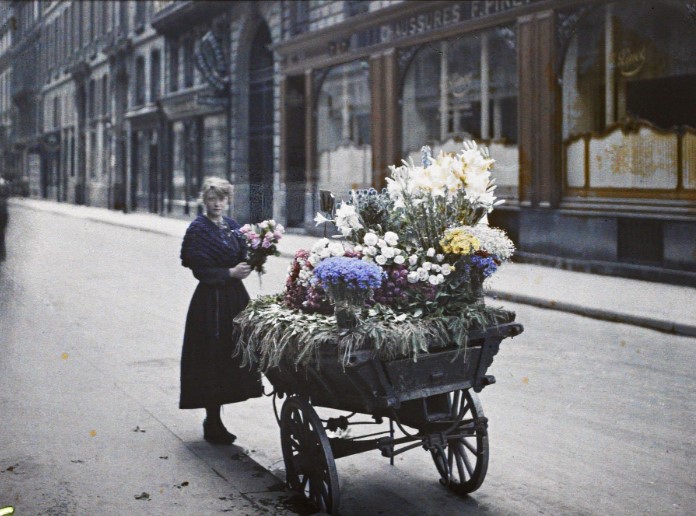
Here is one example of the colour photography possible at the time, showing a Parisian flower seller, taken by Auguste Léon in 1918. Unlike the hand-tinted images of the time, this showed the actual colours of the street and the flowers.

Armed with new photographic equipment, Kahn, accompanied by his chauffeur and travelling companion Alfred Duterte (1884–1964), toured the world, including Japan, China, and the United States, beginning in 1908. In 1909 they visited South America, and in 1910 Scandinavia.

At some point during or after these trips, Kahn came up with his plan to create the Archives de la Planète (Archives of the Planet), which now forms the core of the Musée Départmental Albert Kahn. It consists of 111 miles of silent film reels, 4,000 stereoscopic plates, and 72,000 autochrome colour glass plates. They represent the combined efforts of professional photographers sent to more than 50 countries between 1909 and 1931 with photography equipment and film – all fully funded by Kahn. Their orders were simple: “Keep your eyes open.” Of the collection, 69,000 photographs have been digitized and are available online.

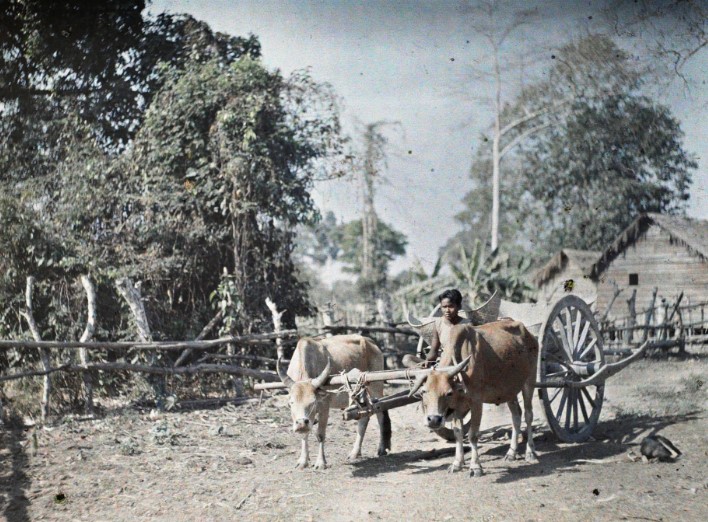
Here is a sample image of a boy with water buffalo, taken in Cambodia in 1921 by Léon Busy.

At Boulogne-Billancourt, Kahn maintained facilities for images to be developed, projected, and screened. Kahn’s screenings attracted notable people such as Auguste Rodin, Colette, Auguste Renoir, Henri Bergson, and the Nobel prize winner Rabindranath Tagore.

As the 20th century wore on, Kahn was aware of the horrors of rising nationalism and the impact of globalization with the consequent loss of traditional cultures. Readily usable autochrome colour photography was an educational tool for Kahn’s aims. In addition to documenting daily life, his photographers also captured conflict and strife. This image shows a hospital in 1916 by Stéphane Passet.

The Wall Street Crash and the Great Depression would bring an end to Kahn’s projects. In 1931 he had to stop funding the bursaries and the Archives of the World. His bank folded and he was personally bankrupt. But here the story takes an unexpected turn. By 1936 his property and possessions were safely in the hands of the Département de la Seine, and he was allowed to live in his former home until his death. In 1937 his gardens, which were close to the site of the International Exposition, were opened to the public. And in the same year, his photographic collection was put on display.

Kahn died in November 1940, shortly after the start of the German occupation of Paris. Because he was Jewish, his body was thrown into a mass grave – a shocking end for a man who had dedicated his life and fortune to the pursuit of peace. But his vision lived on, even through the darkest days of the war.

In 1968 the newly created Département des Hauts-de-Seine became owner of the Kahn property, gardens, and collection. By 1975, work was under way to study and demonstrate the value of the collection. And in 1986 it was reorganized as a departmental museum and later as a nationally significant “Musée de France.” In 1990 the museum opened its first gallery exhibition in a new building designed by architect Gérard Planes. The museum and gardens grew in stature and visitor numbers so much that as the 21st century dawned, annual visitor numbers had risen to 120,000.

Kengo Kuma, a globally recognized architect known for the harmonious integration of his projects in their environmental and cultural contexts, won the competition for a new building. Construction started in 2012, the same year the site was declared a historic monument. The site, complete with its inaugural exhibit and catalogue reopened to the public 2 April 2022.

We hope to visit the Musée Départemental Albert Kahn in 2023. I look forward to perusing the autochrome and other still-photo collections, as well as the moving pictures in the museum. And I long to walk through the varied gardens and perhaps find the calm that will lower my blood pressure somewhat. Albert Kahn, of all people, would understand the need for tranquillity and reflection.  

Text by Norman Ball, contemporary photographs by Mireille Duhen. Photograph of Palmarium from Wikimedia Commons. Historic photographs from the Kahn collection.

Posted in Paris gardens, Paris history | Tagged , , , , , , , , , , , , , , | 13 Comments

Napoleon slept here

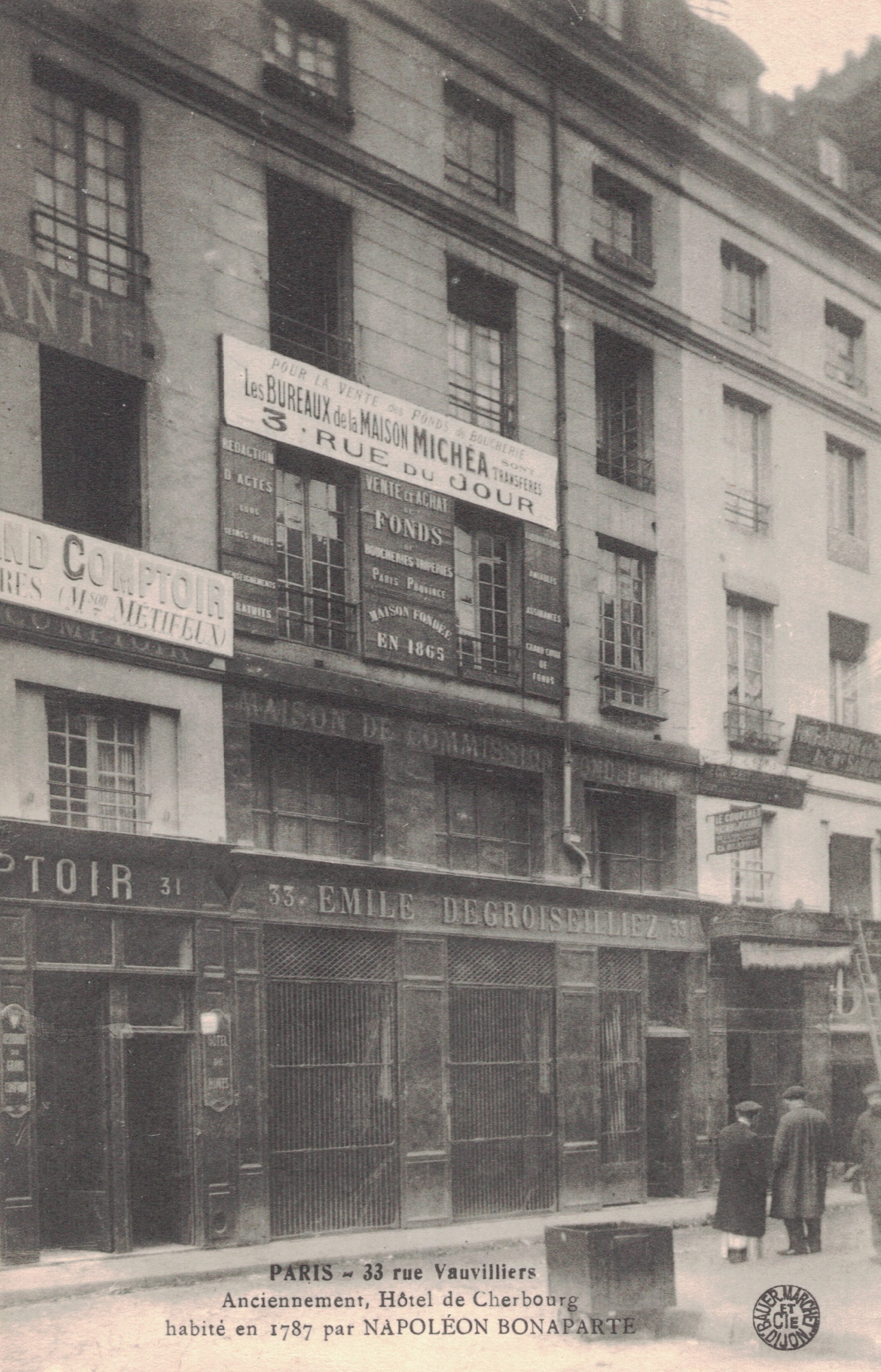
I don’t remember where I bought the postcard, although the price on the back shows that I lashed out a whopping 5 euros on it. It shows an undistinguished shopfront covered in advertising. It must have been the caption that caught my eye: “33 rue Vauvilliers, Anciennement Hotel de Cherbourg, habité en 1787 par Napoleon Bonaparte.”

When the photograph was taken in the early 1900s, the former Hotel de Cherbourg was an agency owned by one Emile Degroiseilliez who bought and sold butcher’s shops or their equipment (if I am translating the signs correctly).

To the left, at No.  31, is an establishment owned by someone called Métifeux, who appears in a 1907 business directory as a wine merchant at that address. The business on the right is harder to make out, but the same directory tells me that No. 35 was occupied by someone called Sutter, who sold specialized attire for people working in kitchens or other parts of the food business.

Today, the rue Vauvilliers extends for one block only, between the rue St-Honoré and the rue Berger, which skirts the south side of the huge development of Les Halles. No. 33 is nowhere to be seen. The numbers go up only as far as 11 on the odd-numbered side of the road.

But the rue Vauvilliers (in Napoleon’s day it was called the rue du Four St-Honoré) once continued north all the way to the space in front of St-Eustache. In the late 19th century, and at the time the photograph was taken for the postcard, the huge market buildings of Les Halles took up the eastern side of the street.

So my fingers did the walking to the wonderful website of the archives of Paris to look at their detailed maps.

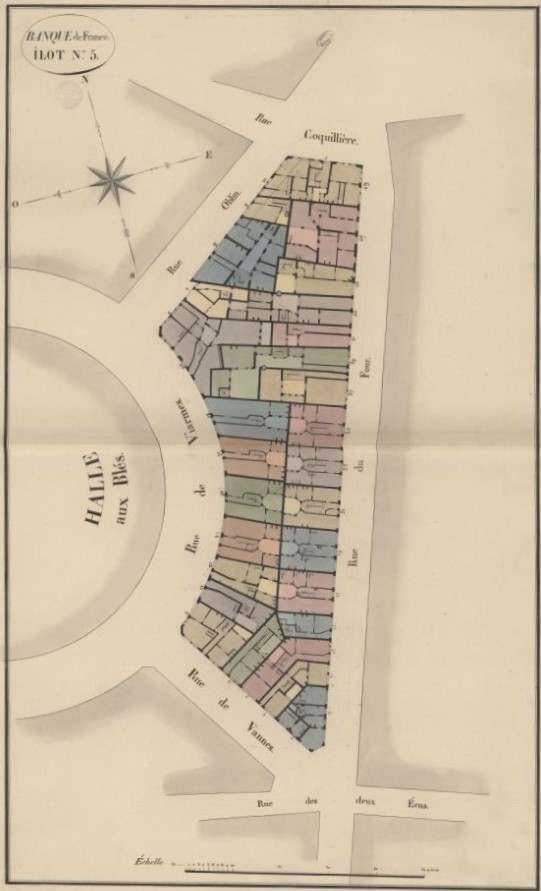
The archives provide maps for before and after 1860, when the city’s geography changed. Here is the older version. I love the way it shows the interior layout of the buildings. No. 33 is about halfway up on the right side of the block.

The archives also providea a map from later in 19th century showing that when the postcard was made, No. 33 faced the market buildings in Les Halles where meat and fowl were sold (so the enterprise for buying and selling butcher’s shops makes sense).

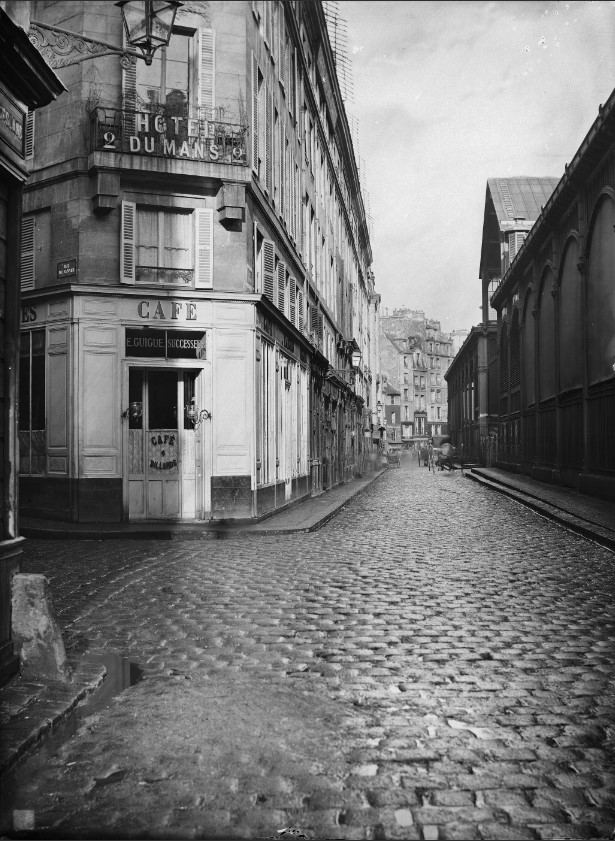
This is what it looked like in 1866, in a photograph taken from the intersection with the rue de Vannes (another street that has disappeared) by Charles Marville, long after Napoleon’s day.

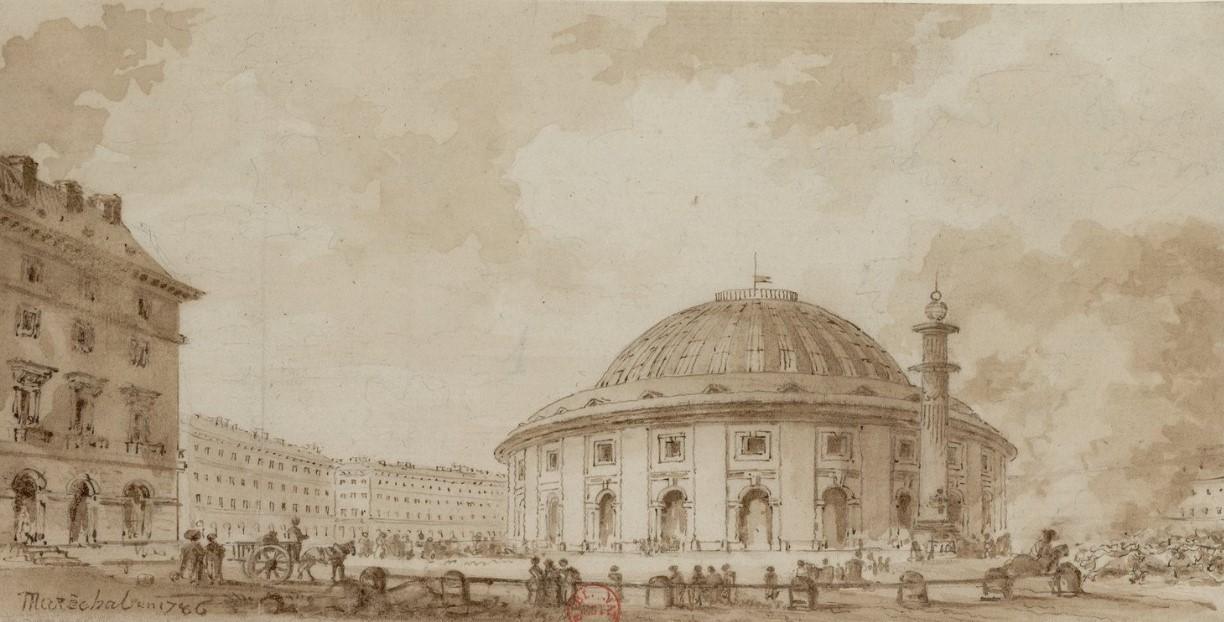
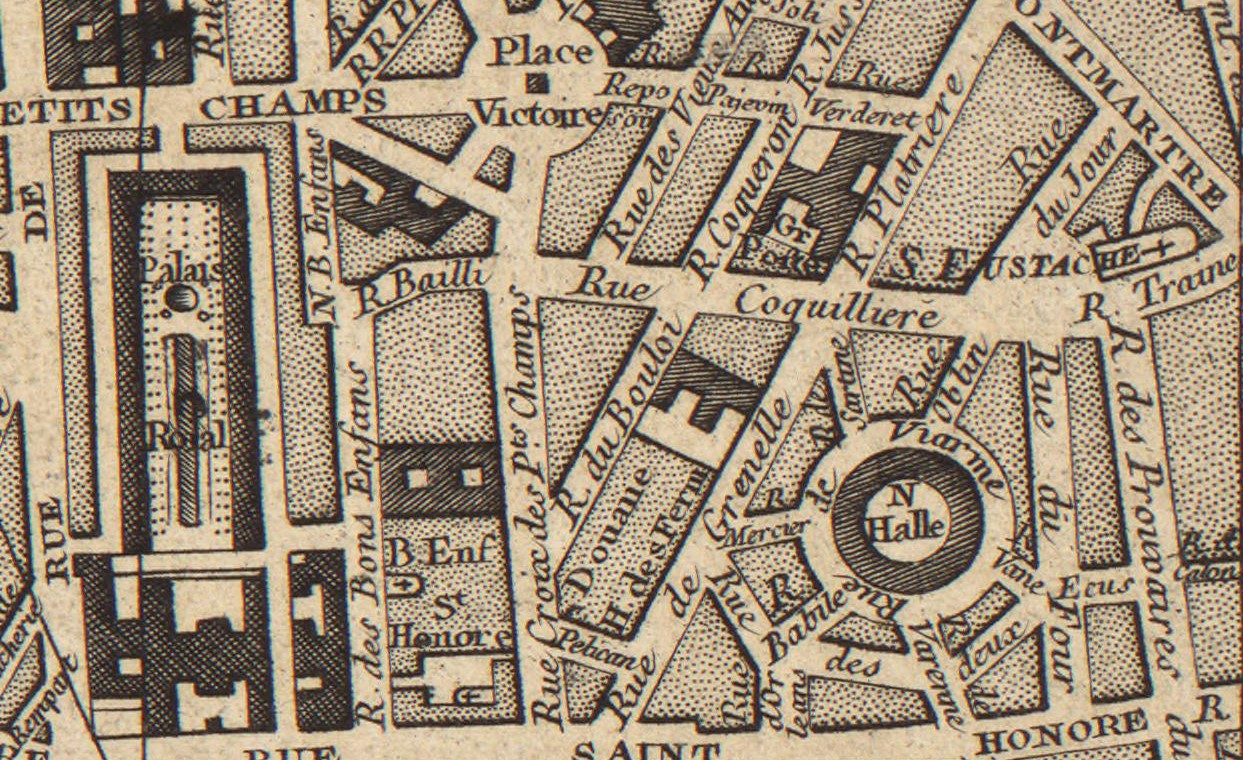
The map from the archives shows how this oddly shaped block was designed to complement the circular market building to the west, the Halle aux Blés, later known as the Bourse de Commerce, now an art exhibition space. That was certainly there in Napoleon’s day, as shown in a 1785 drawing by Jean-Baptiste Maréchal.

It also appears on a 1788 map by L.F. Deharme.

So what was Napoleon, aged about 18, doing hanging about in Paris in September 1787? He had, of course, spent time in Paris at the Ecole Militaire when he was in his mid teens, but at this point, he was on leave from the military, and was in the capital on family business. He occupied room No. 9 on the third floor at the hotel Cherbourg.

Apparently it was all about mulberry trees. Bear with me. Mulberry trees are used to raise silkworms. Napoleon’s family had started a plantation of mulberry trees, with funding from the government, hoping to develop the silk industry in Corsica. Mulberry trees take a while to mature, and before the plantation was fully grown, the government cut off the funding. Napoleon’s job was to get the funding restored.

He was not successful. It’s a wonder that anyone thought that this teenager without connections would make any headway on a project in which the bankrupt government of Louis XVI had long since lost interest. Otherwise, he spent time trying to write historical fiction. That wasn’t successful either. He didn’t stay long at the Hotel de Cherbourg.

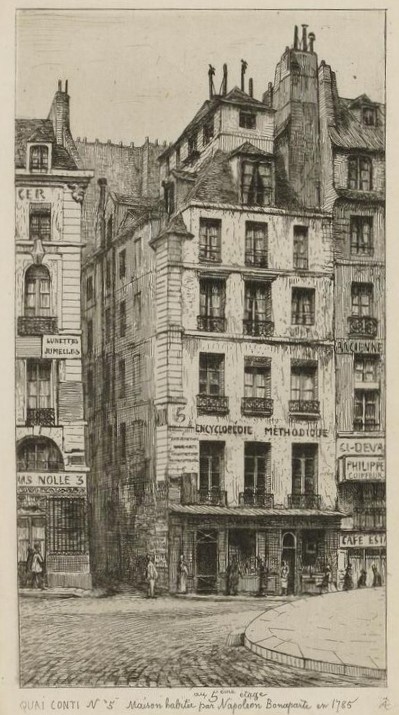
Napoleon had many addresses in Paris over the years, but one other establishment is connected with his teenaged years: No. 5, quai de Conti, where he spent time in 1785. This image dates from 1827, when the building contained the offices of the Encyclopédie Méthodique.

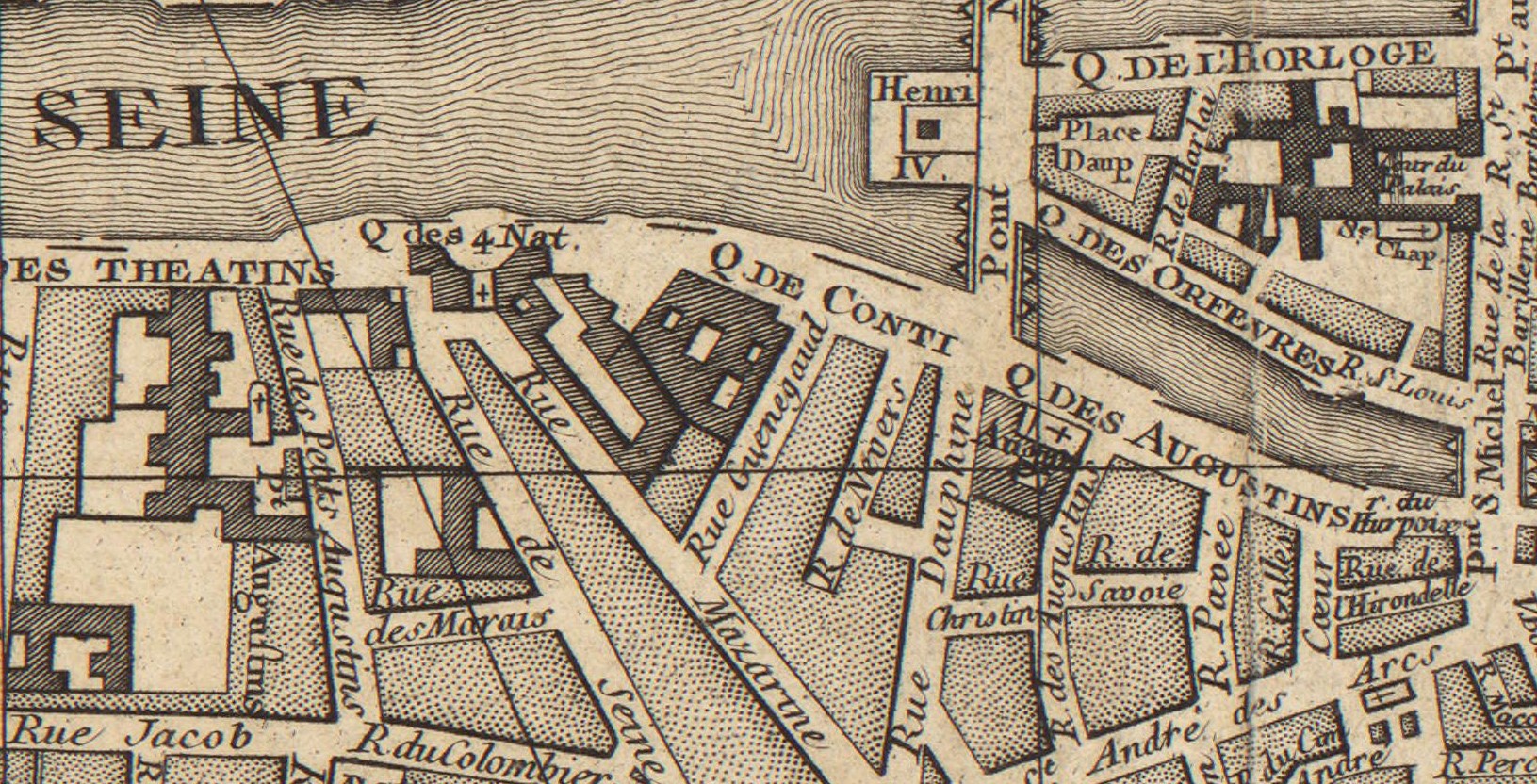
Here is where it fits on the map from 1788. It was on the corner between the rue de Nevers and the rue Dauphine, facing the Pont Neuf.

Napoleon didn’t live there. It belonged to a family called the Permons (or Permonds), Corsican friends of the Bonapartes, who invited him to stay from time to time while he was studying at the Ecole Militaire. One of the daughters of the family, who later married the Duc d’Abrantes, wrote down her memories of Napoleon:

My father, who was acquainted with almost all the heads of the military school, obtained leave for him sometimes to come out for recreation. On account of an accident—a sprain, if I recollect right—Napoleon once spent a whole week at our house. To this day, whenever I pass the Quai Conti, I cannot help looking up at a garret window at the left angle of the house, on the third floor. That was Napoleon’s chamber when he paid us a visit, and a neat little room it was. (p. 23)

That house is gone now, too, replaced by a group of buildings from the 1920s known as the Carrefour Curie, which makes an architectural nod to the 18th century, with an unusual arched entryway to the adjoining rue de Nevers right through the middle of the building.

However, the old quai de Conti house would have stood long enough for Napoleon to have seen it in later days, if he ever looked across the river from the Louvre. But I doubt that he was sentimental about old buildings.

Text by Philippa Campsie, image of No. 33, quai Conti from Musee d’Art d’Histoire; image of Carrefour Curie from Paris La Douce; all other images from Gallica and our postcard collection; maps from Wikimedia and the Paris Archives.

Posted in Paris history, Paris markets, Paris streets | Tagged , , , , , , , , , | 7 Comments

Lorette

“What is the significance of the name Loretto?” asked Norman, looking at a picture of the former Loretto Academy in Niagara Falls. “It reminds me of that church in Paris.”

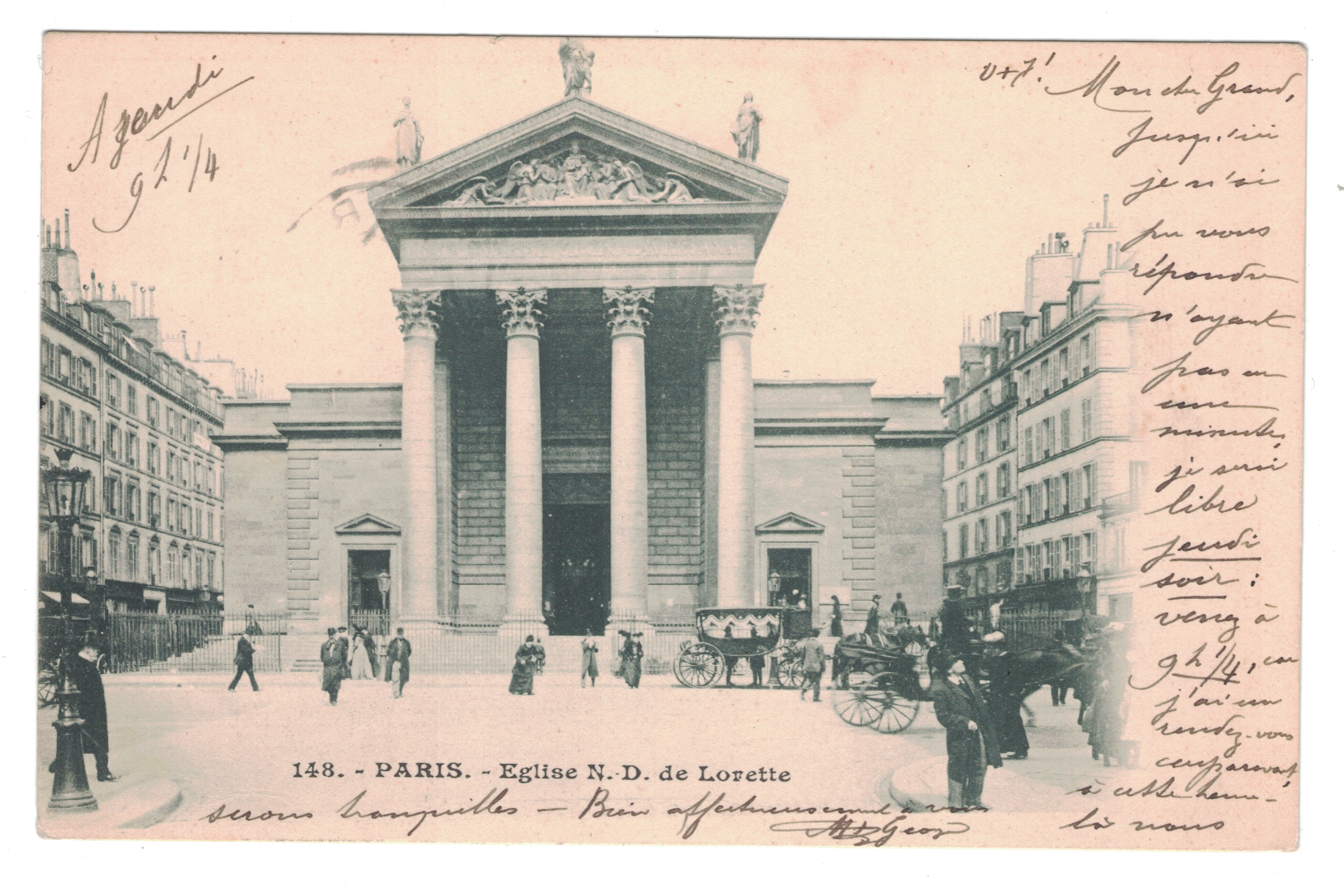
Notre-Dame-de-Lorette in Paris is an imposing Neoclassical edifice in the 9th arrondissement, and I vaguely remembered something about the name being used for prostitutes operating in that area, but clearly some research was in order.

First, I dug out a postcard from our collection. (For the curious, the message is an invitation to a Robert Guillon to visit on a Thursday at 9:15 in January 1904, from his friend M.B. Georges. I think.)

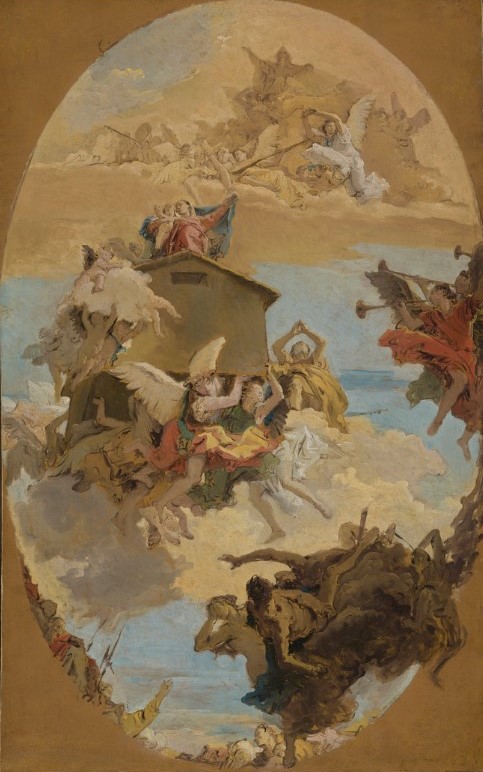
Since I am not a Catholic, it was news to me that Loreto in Italy is a pilgrimage site containing what is believed to be the house from Nazareth in which the Virgin Mary lived at the time of the Annunciation by the Angel Gabriel. According to legend, angels brought it from the Holy Land, after a stopover in what is now Croatia.

The more prosaic version is that in the 13th century the house in Nazareth was dismantled stone by stone, transported by ship and overland, and reassembled in Loreto by a family called Angelos in order to protect it from non-Christian aggressors in the Holy Land. The legend, however, is more picturesque, as this preparatory study for a fresco by Giovanni Battista Tiepolo* suggests.

The name Notre-Dame-de-Lorette (Our Lady of Loreto or Loretto) has been given to Catholic churches and schools in many countries, including Canada, and to a huge French military cemetery from the First World War near Arras. In 1920, Our Lady of Loreto became the patron saint of aviators and airplane passengers. I love that.

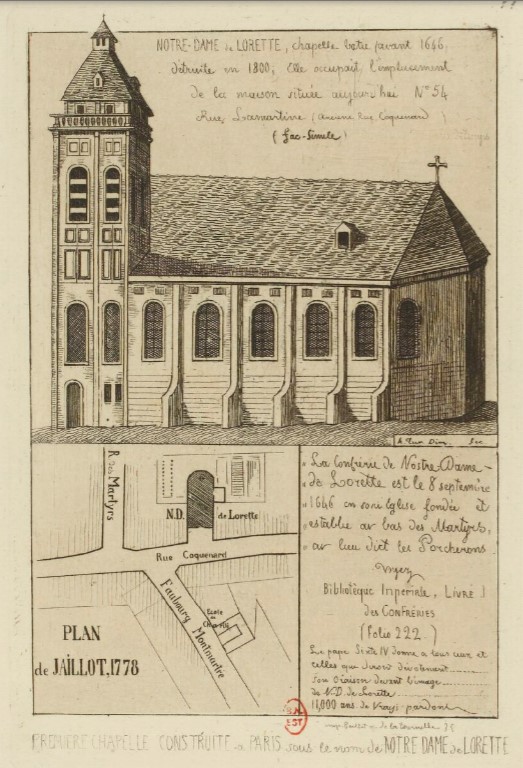
The Paris church dates from the 19th century, and replaces an older church near the site that was destroyed during the Revolution, a more modest structure.

On the little map, the newer church is across the road, roughly where it says “Plan de Jaillot.”

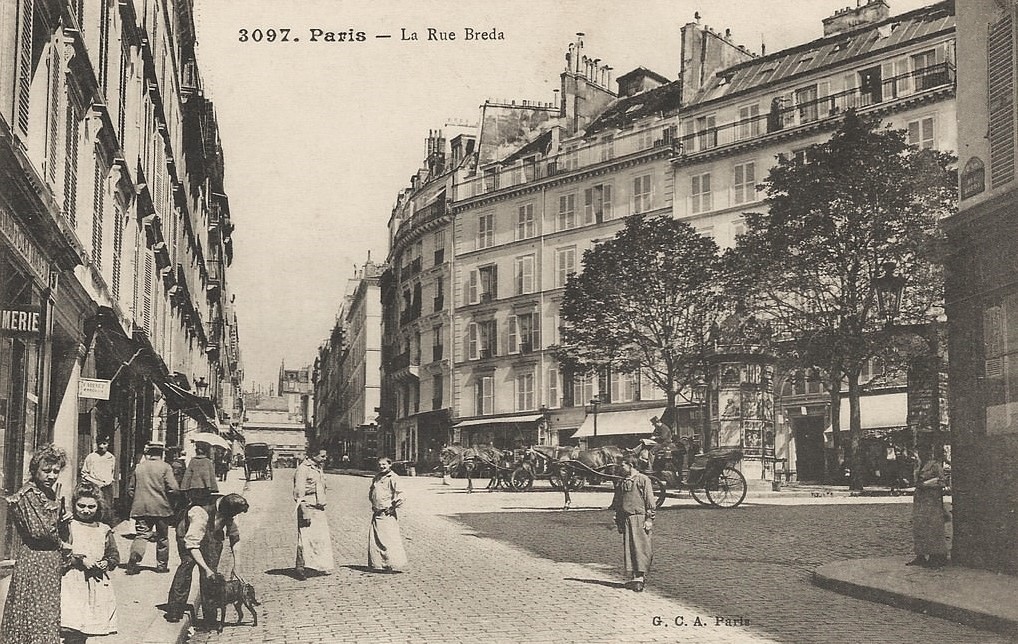
In the 1830s, the surrounding area was known as La Nouvelle Athènes (New Athens), and rue Bréda (now called rue Henry Monnier) was known for its population of prostitutes. Lorettes were also known as brédas.

In those days, prostitution took different forms. As with everything else, class distinctions mattered.

In the top rank were the courtesans or grandes horizontales, mistresses who were expected to provide their services exclusively (or so he was led to believe) to a wealthy and aristocratic man. They lived fashionable and often quite public lives.

Much farther down the spectrum were the grisettes, working-class women who set up housekeeping with students or artists. Some worked a triple shift: as seamstresses or shopgirls during the day, as housekeepers and cooks in the evening, and as bed companions at night. Although some depictions of grisettes make them sound like romantic figures, devoted to their partners, the arrangement tended to break down when the student left Paris or the artist began to make a name for himself. The name grisette is said to reflect the grey dresses that seamstresses and shop assistants wore.

Some women worked in maisons closes, brothels that were managed by a “madam” (often a former prostitute too old to do that work, but who knew her way around the profession) and regulated by the police.

Then there were filles publiques – streetwalkers, often harassed by police.

In the middle were the lorettes, freelancers, or filles insoumises, who did not report to the authorities or to a madam. Their clients tended to be middle-aged or older, bourgeois, and often affluent, but not sufficiently wealthy to be patrons of the grandes horizontales. Conversely, the lorettes’ favours were seldom exclusive. The men were known as “Arthurs.” According to Maurice Alhoy in Physiologie de la lorette (1841), “Arthur” was a name often used by men when they signed into a hotel where they did not want to be identified.

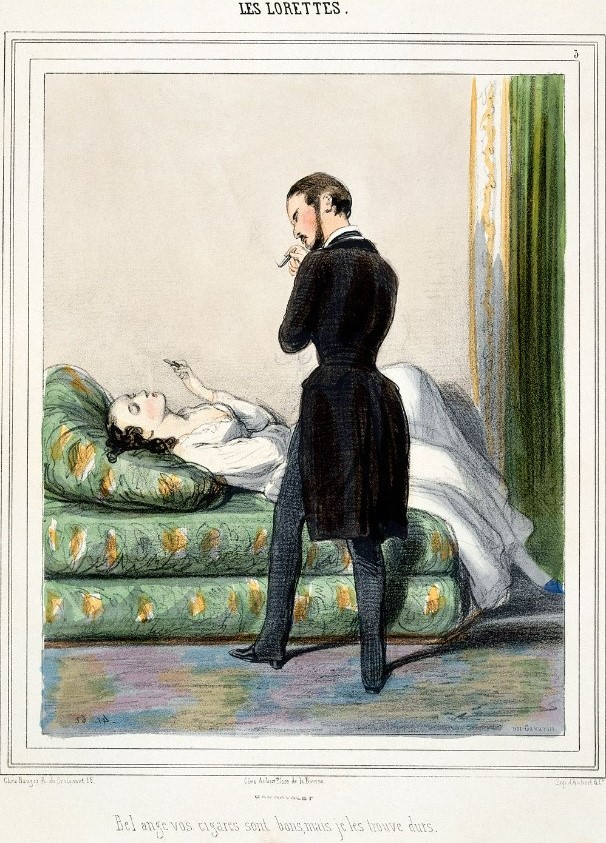
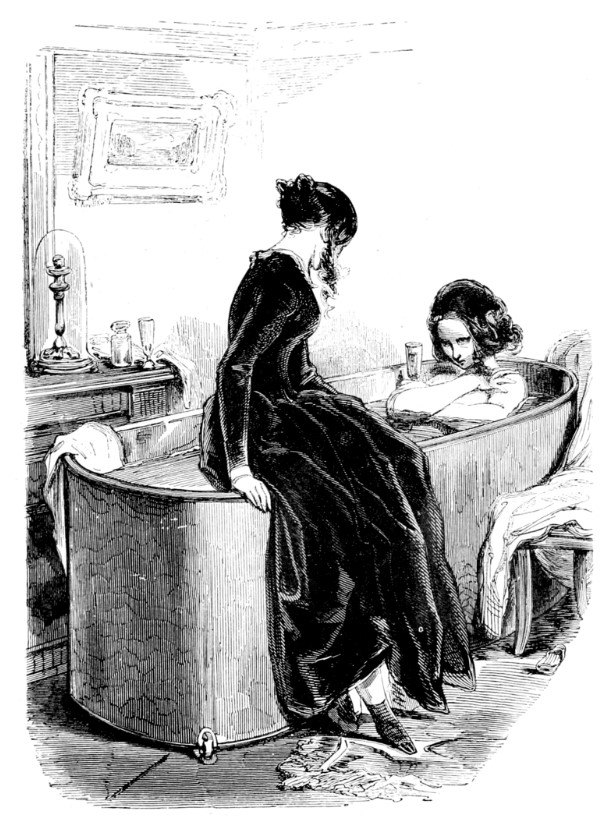
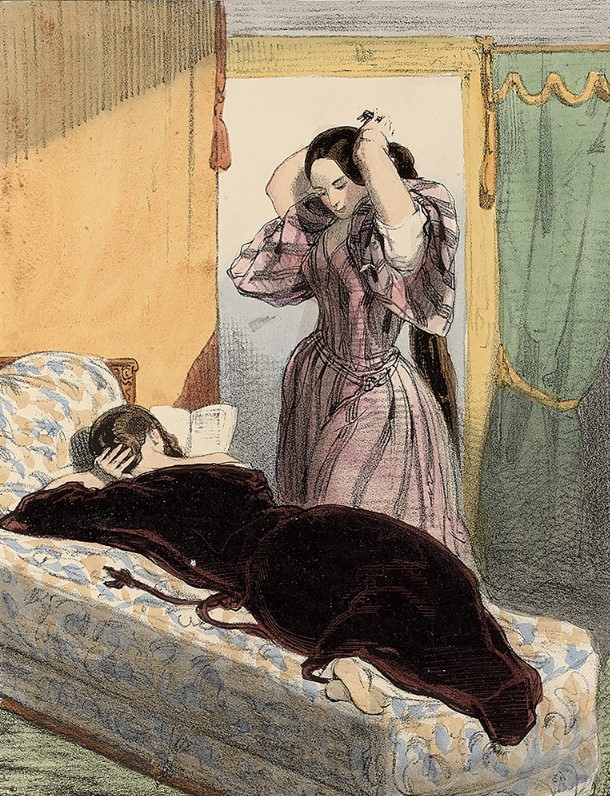
Lorettes appeared in magazine illustrations by artists such as Paul Gavarni. He often depicted them in languorous poses (since they did not work during the day), informally dressed, reading (they had some education), playing cards, or even (gasp) smoking.

Sometimes they were pictured in pairs, talking about their lives, such as this one with one girl in a bathtub.

Or this one, with one mocking the other for reading about “good women.”

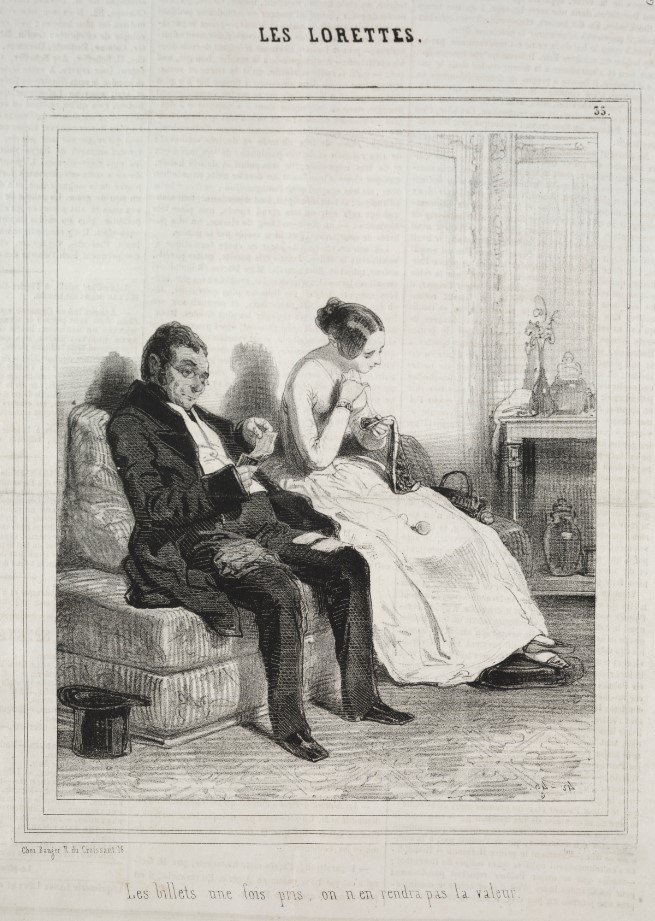
When shown with their clients, the clients don’t necessarily look happy with the situation. In many illustrations and in fiction, lorettes were portrayed as gold-diggers, preoccupied with money and getting every franc they could out of the Arthurs.

The caption reads: “Les billets une fois pris, on n’en rendra pas la valeur.” In other words, Once the banknotes have been taken, one does not get their value back.

Why did they cluster in that particular quartier? In the mid-19th century, the area between the Gare St-Lazare and Montmartre was still largely under construction, known for its dust and grit. Those who first moved in were said to “essuyer les plâtres,” which means to live in accommodation in which the plaster was barely dry. (Modern homeowners living in houses made with drywall have no idea – why do you think it is called drywall?)

Property owners had difficulty finding respectable tenants to live in the resulting chaos and humidity and were prepared to offer the rooms at a modest rent to anyone prepared to keep the rooms heated and close the curtains while entertaining. Demand met supply. And so a quartier with a church named for the Madonna of the Holy House became a synonym for the good-time girls of the just-finished flats. Funny how these things work, isn’t it?

Text by Philippa Campsie, church with map and Gavarni images from Gallica, Tiepolo image from Useum, postcard from our collection.

*The fresco was on the ceiling of a Venetian church that was destroyed by an Austrian bombardment in 1915; only the preparatory study remains to show how it once looked.

Posted in Paris churches, Paris history, Paris quartiers | Tagged , , , , , , , , , , , , , | 10 Comments