Hiding in plain sight

When we rented an apartment near the Val-de-Grâce, the lady who owned the flat told us that the church and buildings there were very beautiful, but the only way to see inside was to go for mass on Sunday morning. She was right about the first half of that observation, and wrong about the second.
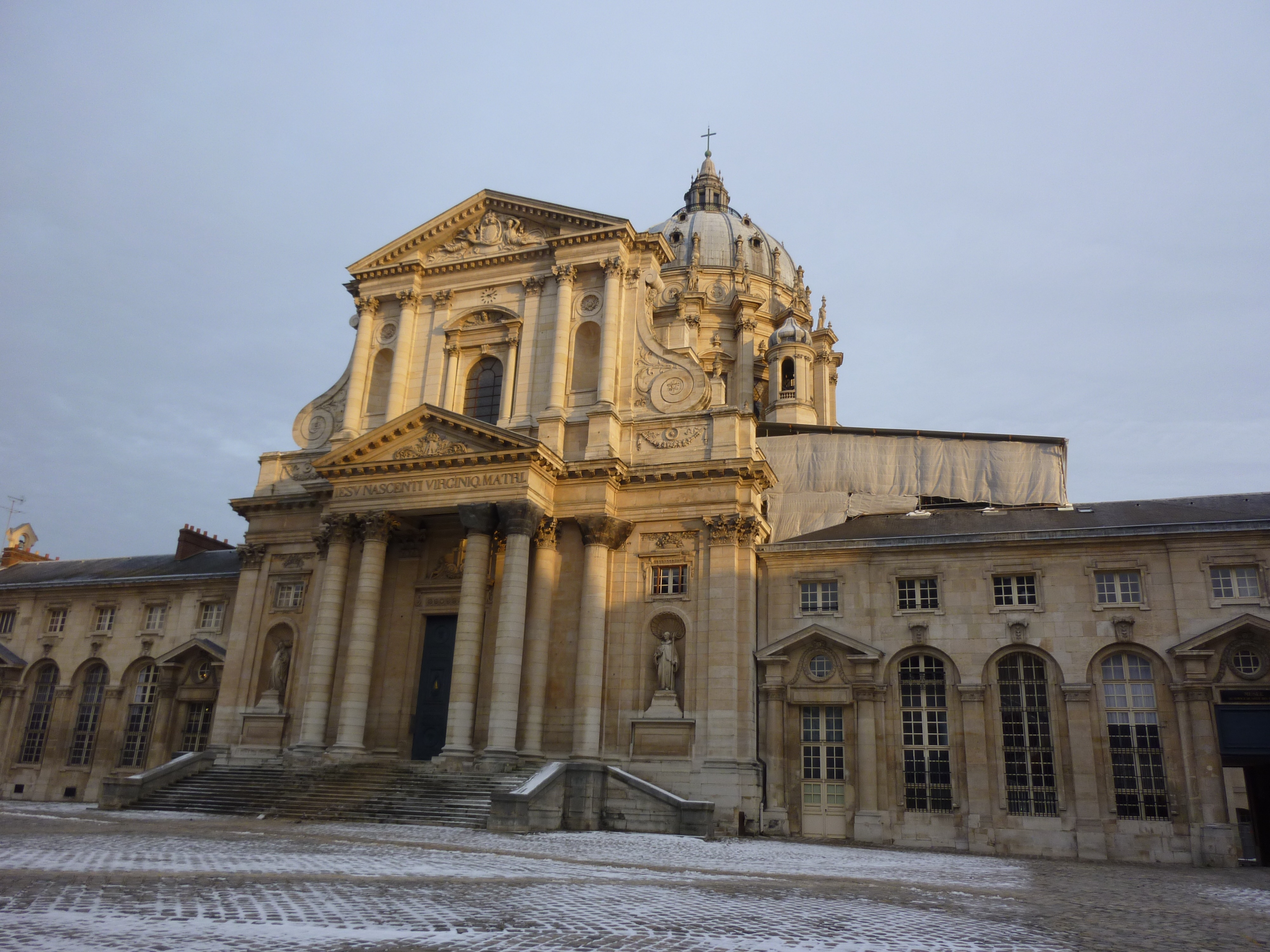
Perhaps others labour under the same misapprehension, because the Val-de-Grâce is little visited. We’d like to set the record straight and encourage more visitors. This beautiful group of 17th-century buildings is open to the public four days a week and contains a museum devoted to the history of military medicine, the Musée du Service de Santé des Armées.

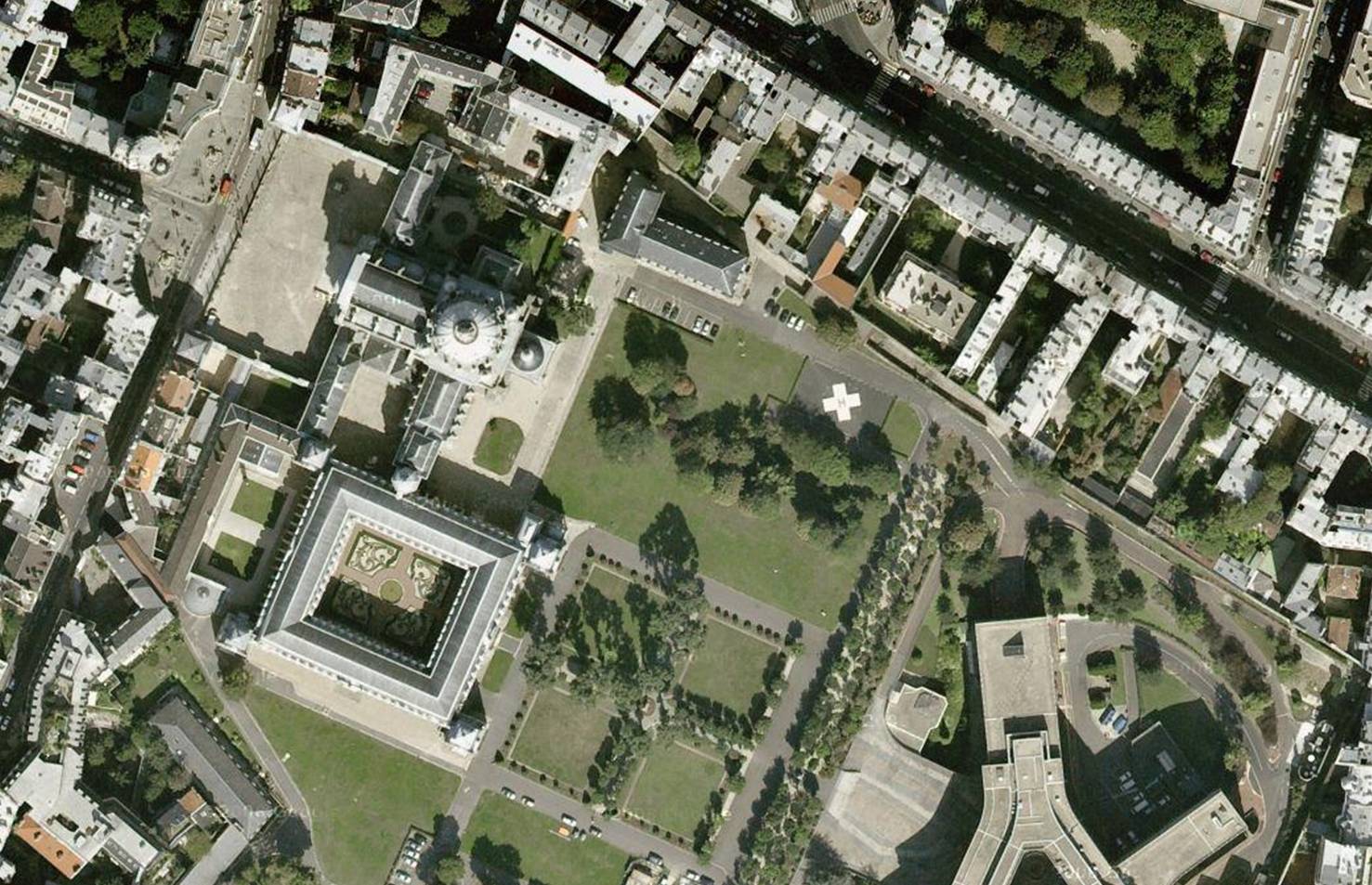
The Val-de-Grâce complex includes a general hospital that was at one time a military hospital, hence the focus of the museum. The hospital is now housed in a modern building on the east side of the property, separated from the original buildings by a large garden. The older buildings have been beautifully restored and consist of a church, the museum, and a library, all of which are open to the public. There is also a medical school for the military in one wing and on the upper floors, apartments for senior military personnel.
What is it and why is it there? Anne of Austria, wife of Louis XIII, commissioned the whole thing after the birth of her son in 1638 (the child went on to become Louis XIV, the Sun King). To her, the birth was a gift from God and this was her way of saying thank you. The queen had had several miscarriages, and her relationship with her husband was not good (he blamed her for at least some of the miscarriages). Mind you, they’d been married when they were both 14 when she barely spoke any French (she was half-Spanish, half-Austrian). Not a recipe for marital success.

The queen had prayed desperately to her namesake St. Anne for years, and finally, when she had reached the ripe old age of 37 and was close to giving up hope, she gave birth to a son. Rejoicing all round. Something this momentous demanded a suitable token of the queen’s gratitude, so she summoned the best architects in France and commissioned a Benedictine convent, complete with a domed church. Construction began in 1645. By this point, Louis XIII was dead, Louis XIV was only seven, and Anne was in charge, as Regent.* She used her new-found power to get the Val-de-Grâce built.

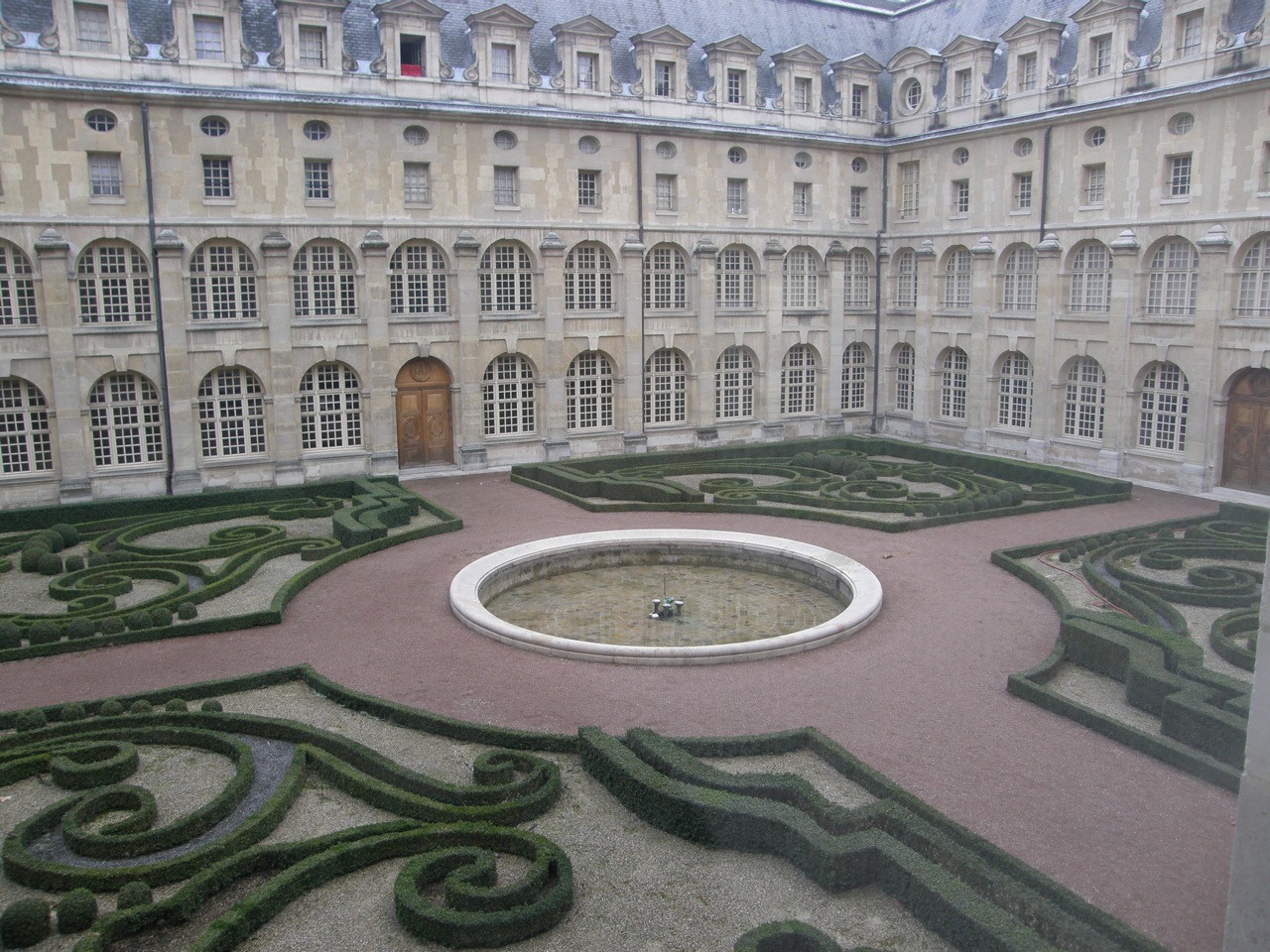
The original design was by Francois Mansart. He was later kicked off the job for going over budget (some things never change), but the building was completed following his plans. Perhaps the best way to appreciate the whole is to see it from above: the domed church, the courtyards, including the formally laid out beds in the main cloister, and the gardens to the east (that white cross in the gardens is a helicopter pad, by the way).
The day we visited, accompanied by two friends, the place was filled with sunlight bouncing off the warm golden stone inside and out. A few days earlier, the four of us had passed Sacré-Coeur with its deformed domes and had wandered in: it was gloomy and crowded and depressing. Here we had the place pretty much to ourselves and it was gloriously spacious and bright.
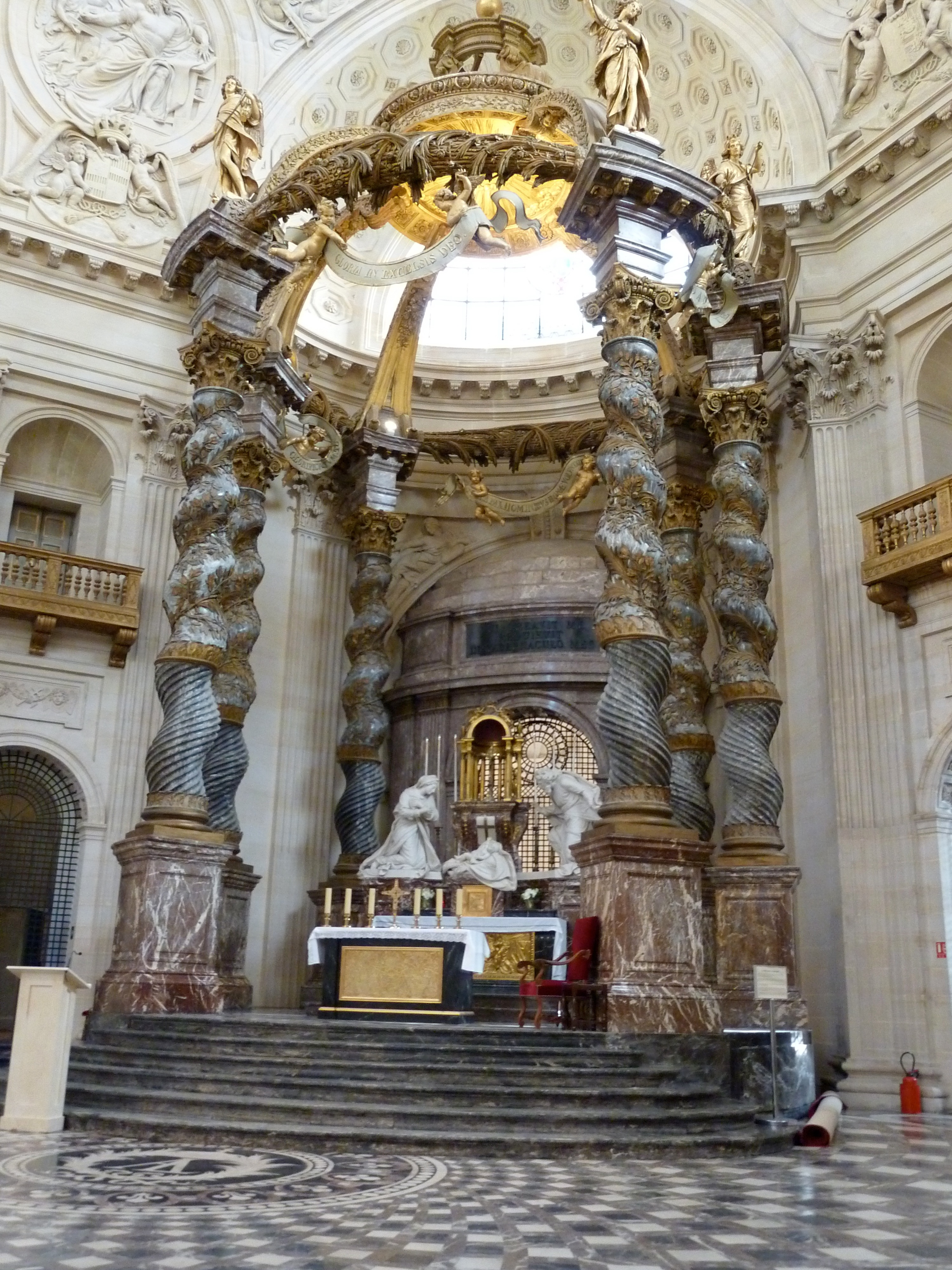
At the front of the church is a baldaquin like the one in St. Paul’s, Rome. This is a canopy over the altar with distinctive twisty columns, intended to represent the rustic stable in which Jesus was born. Mind you, this is the 17th-century take on “rustic.” Huge marble statues represent the Nativity scene, with a clearly delighted Mary and Joseph admiring their baby boy. The parallel is not subtle; the birth of Louis, as far as Anne was concerned, was on a par with that of Jesus.
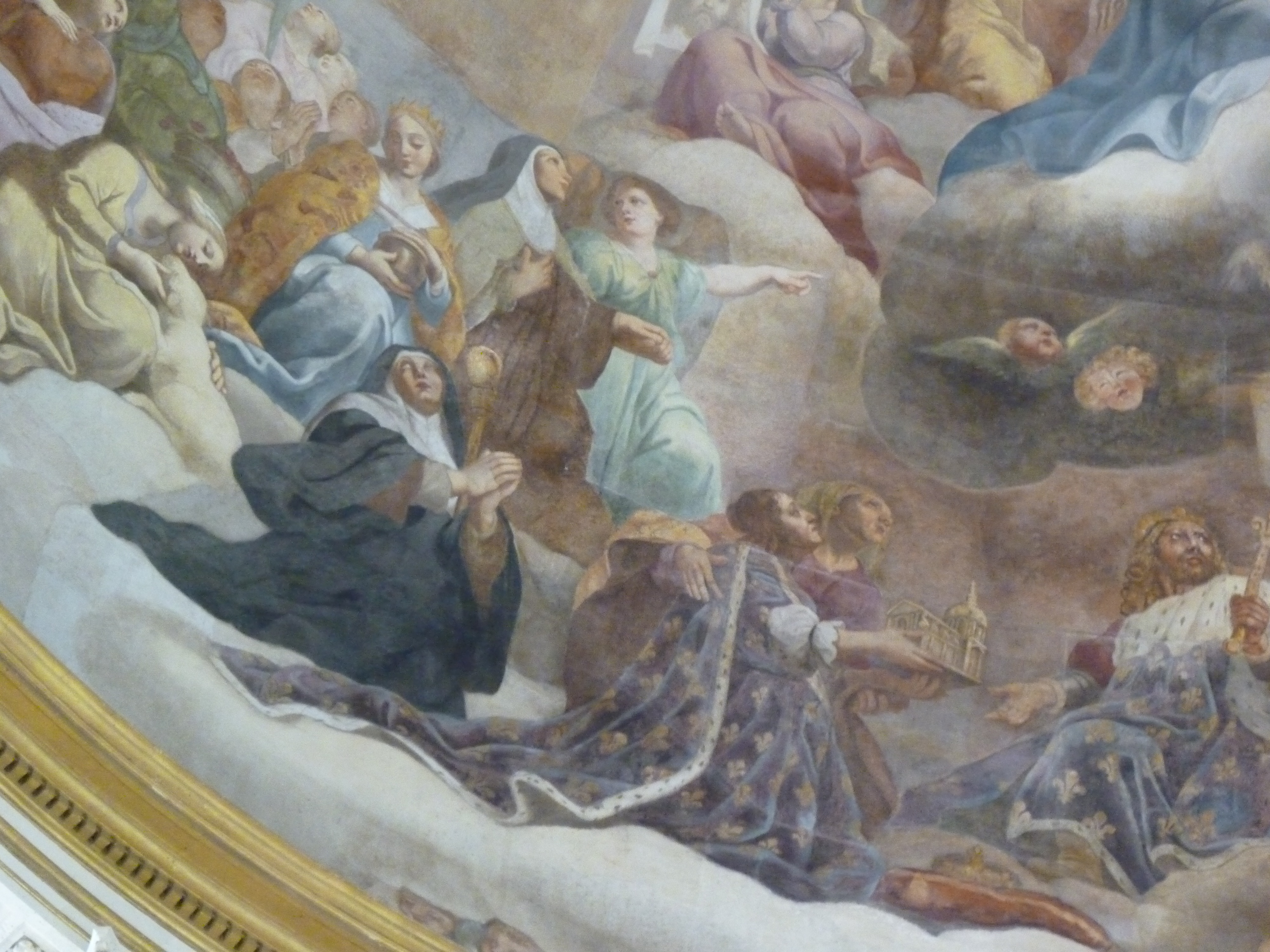
Overhead, inside the dome, there is an elaborate painting, in which Anne of Austria and her patron, St Anne, can be seen. The queen is carrying a small replica of the Val-de-Grâce. It was so close to her heart that when her son was fully established on the throne and she no longer needed to act as Regent, she retired there to live.
There is a splendid organ, and organ recitals are held once a month to show off the instrument.

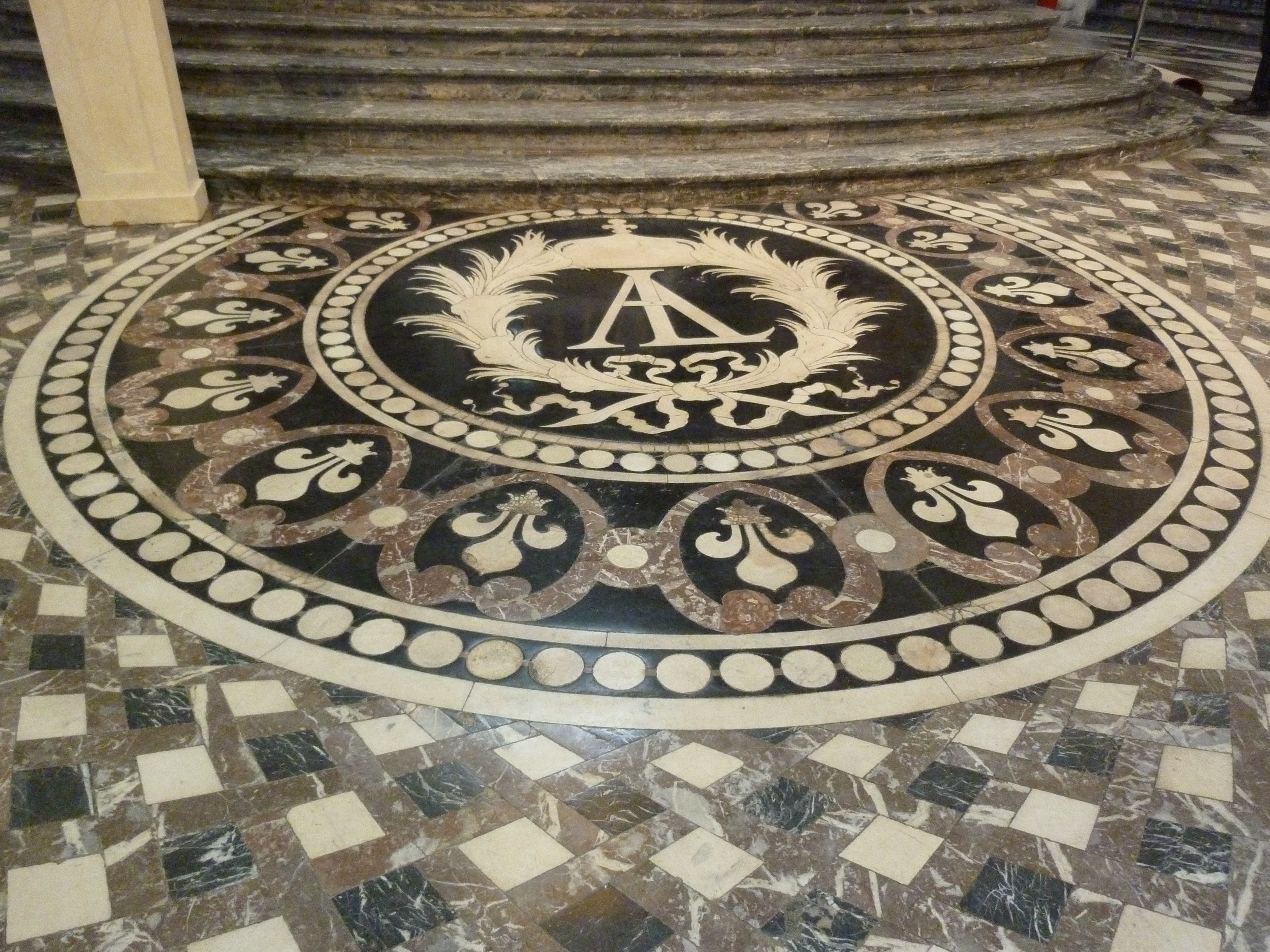
Around the nave and under the ceiling are some lovely bas-reliefs. The marble floor features a great many fleur-de-lys and the initials A and L for Anne and Louis are everywhere. But wait a minute….would that be Louis XIII or Louis XIV?
In 1793, during the Revolution, the Benedictines were evicted and the place became a military hospital. Considering its spaciousness and sense of calm, you could probably do a lot worse in the late 18th century if you were recovering from war wounds.

We wandered through the museum, founded during the First World War and filled with medical paraphernalia, from colourful faience apothecary jars to paintings of medics at work on the battlefield (think M.A.S.H., circa 1814) to some touchingly old-fashioned little displays with dolls taking the place of patients.
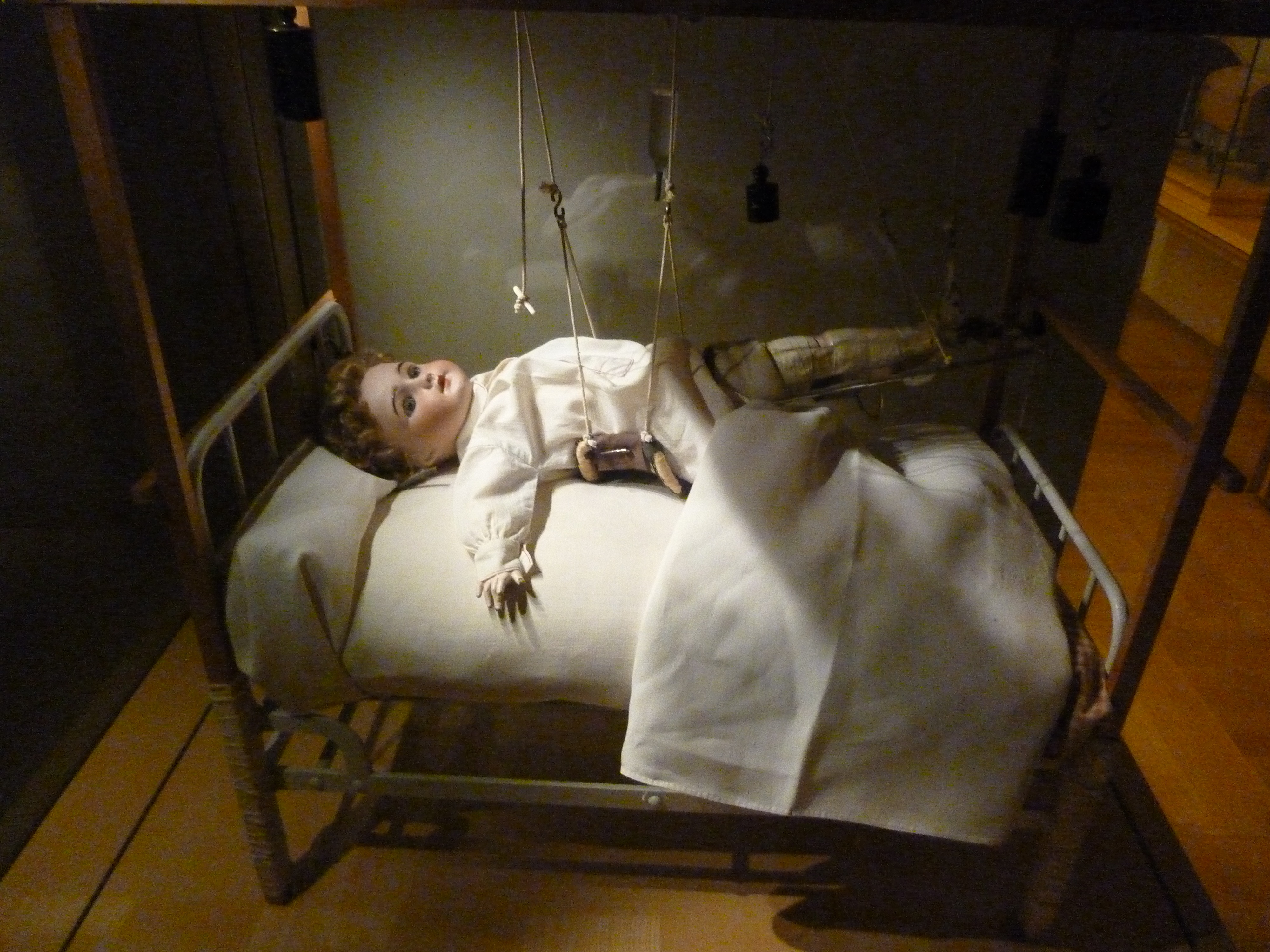
You’d need to be a medical fanatic to take it all in (we were flagging by the time we reached the section on tropical medicine), but it was oddly charming. There is something about seldom-visited museums on obscure subjects that makes one relax and slow down. (Philippa remembers a leisurely visit to a museum on the history of the lawnmower somewhere in England that produced the same effect.)

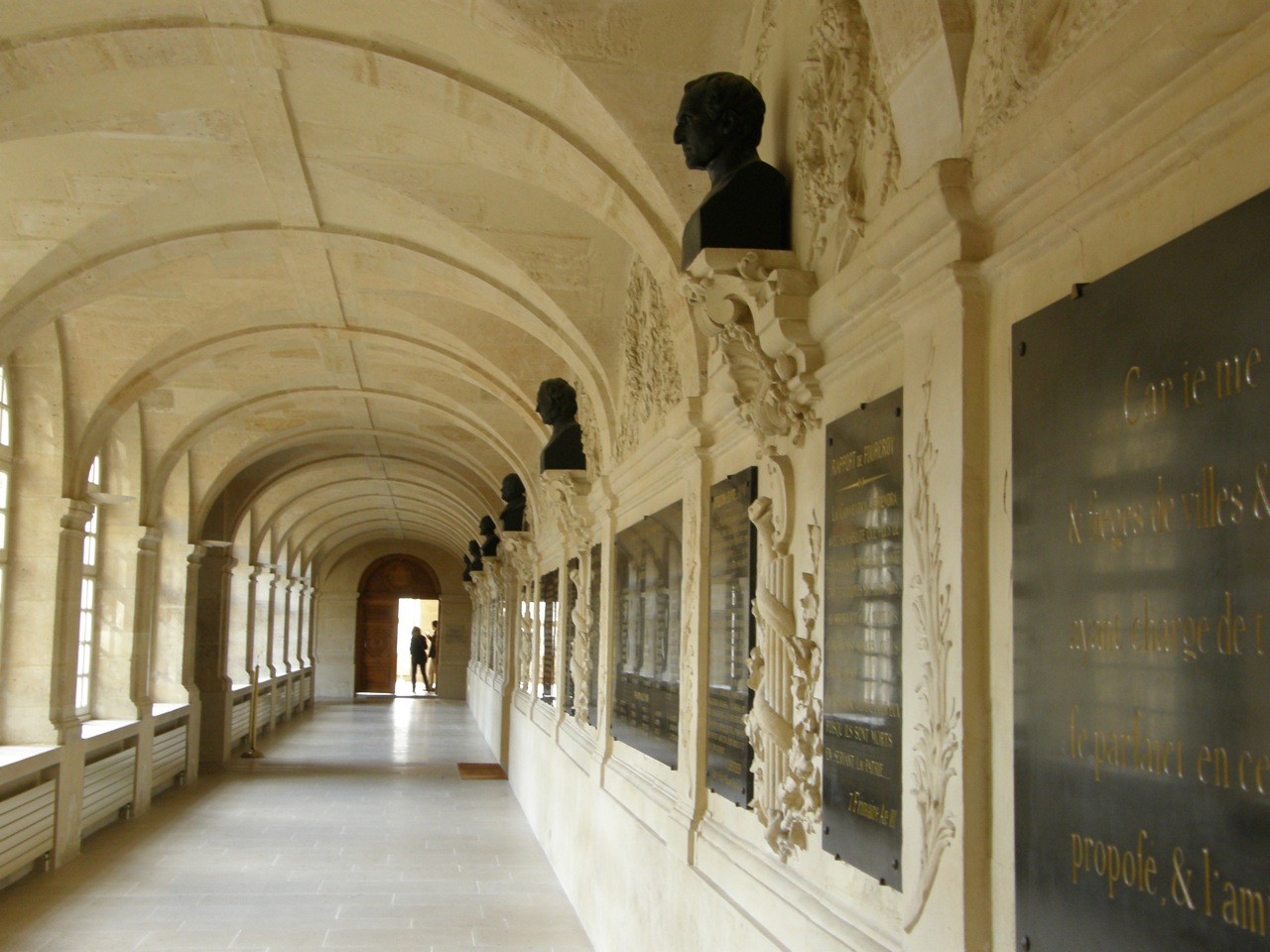
Finally, we wandered into the cloister, which surrounds a formal garden. Although there were security guards elsewhere in the building, the cloister was empty, and it seemed amazing to walk all by ourselves along this wide hallway with its memorial tablets to medics killed in the field. At one corner, we found a staircase going up to the library.

We like libraries, but have found that many of those in Paris are hard to get into (although we have been able to secure library cards for some of them), so we were surprised that a library in a military building was so easy to enter. It was quiet the day we visited, but presumably it is full of students during term time. The lucky students have their choice of a reading room with tables overlooking the main garden, or a sunny spot with comfortable chairs overlooking the cloister.
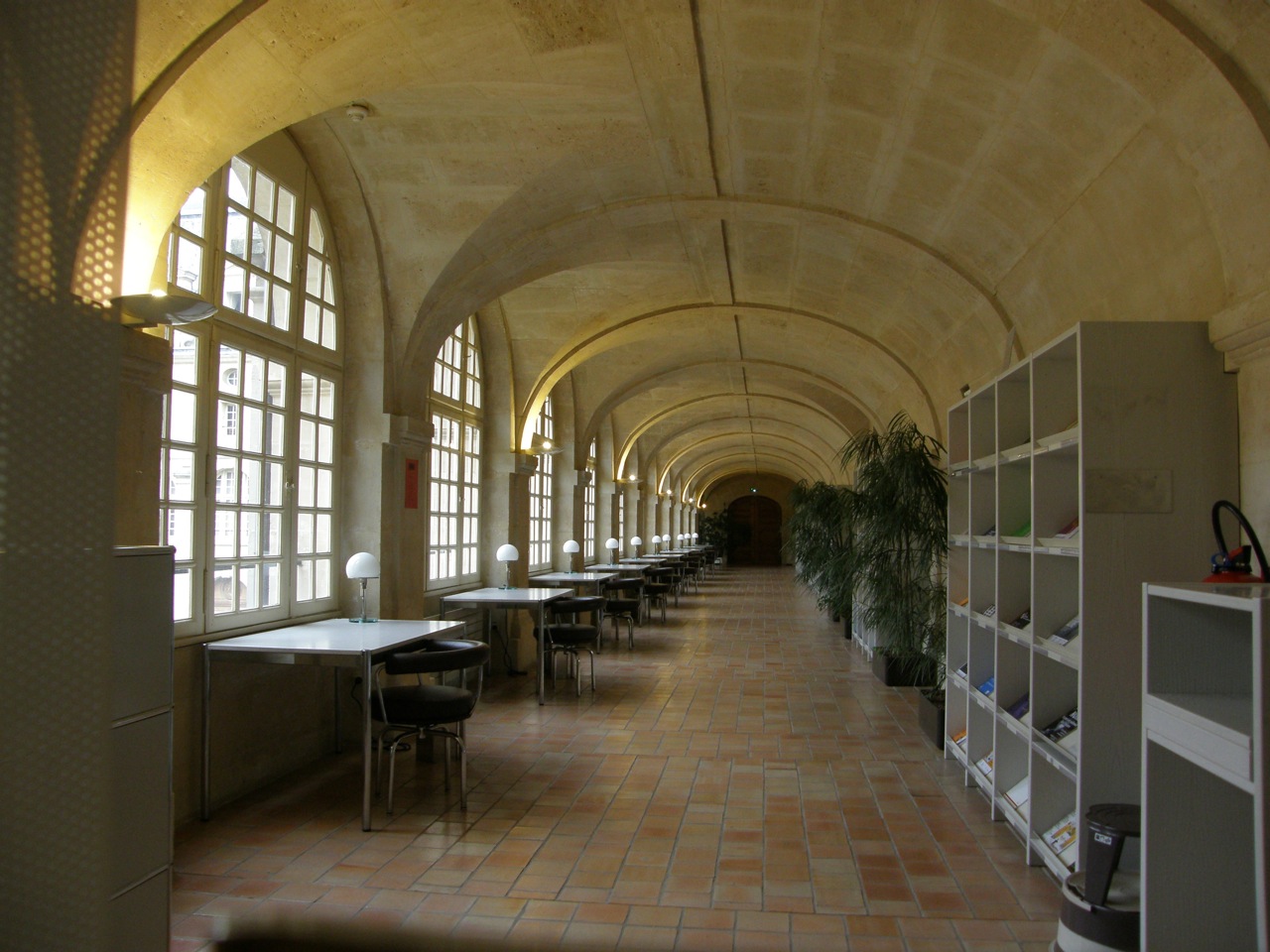
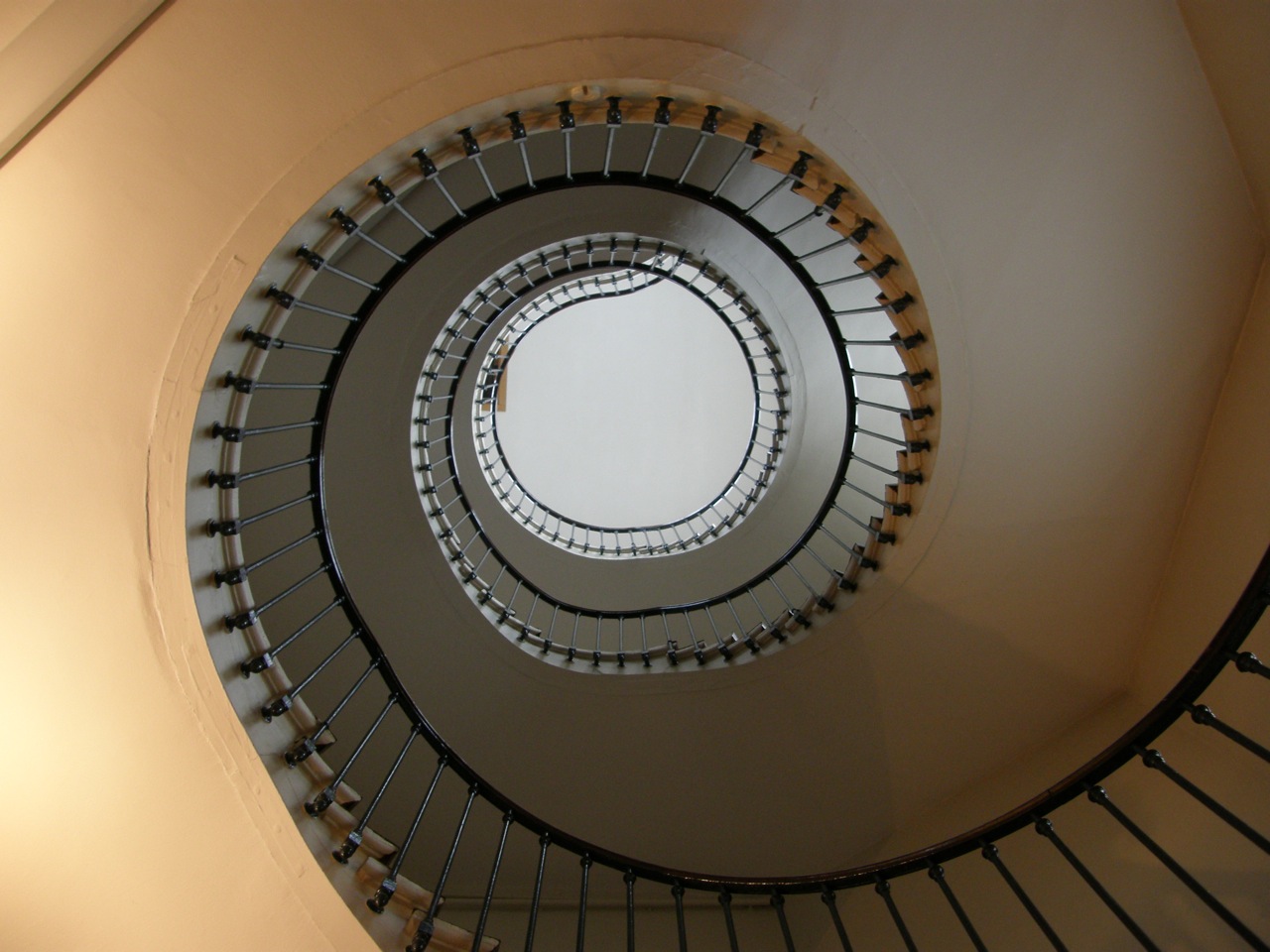
The whole ensemble is a wonderful antidote to the crowds that fill so many other historic spaces in Paris. Because the place is so quiet, the staff and guards actually seemed pleased to have us there, and readily answered questions. When Norman was trying to capture a picture of a staircase, it was the guard who suggested that he place the camera flat on the floor to shoot a picture straight upwards.
If you want somewhere to unwind in Paris, this could be the place. Take the RER to Port Royal, walk up the boulevard St-Michel to the rue du Val-de-Grâce, and you’ll glimpse the dome between the buildings. It’s open Tuesday, Wednesday, Saturday and Sunday from noon to 5 p.m. In any other city, this would be a must-see place on the tourist circuit, but in Paris, it’s a well-kept secret. Pass it on.

*Being Regent was the only way a queen could govern in France. Louis XIII’s own mother, Marie de Medicis did so; she built the Palais du Luxembourg. An earlier regent, Catherine de Medicis, built the Palais des Tuileries.

Text by Philippa Campsie; photographs by Philippa Campsie and Norman Ball.
Posted in Paris art, Paris churches, Paris gardens, Paris history, Paris hospitals | Tagged , , , , , , , , | 8 Comments

Are these the souvenirs I left behind?

Last week’s blog talked about some of the things we have brought home from Paris. But I have also left behind many fascinating and varied things. I have photos of some, but even when I don’t, their memories are still vivid enough to make me smile. If I left them behind, are they still souvenirs?

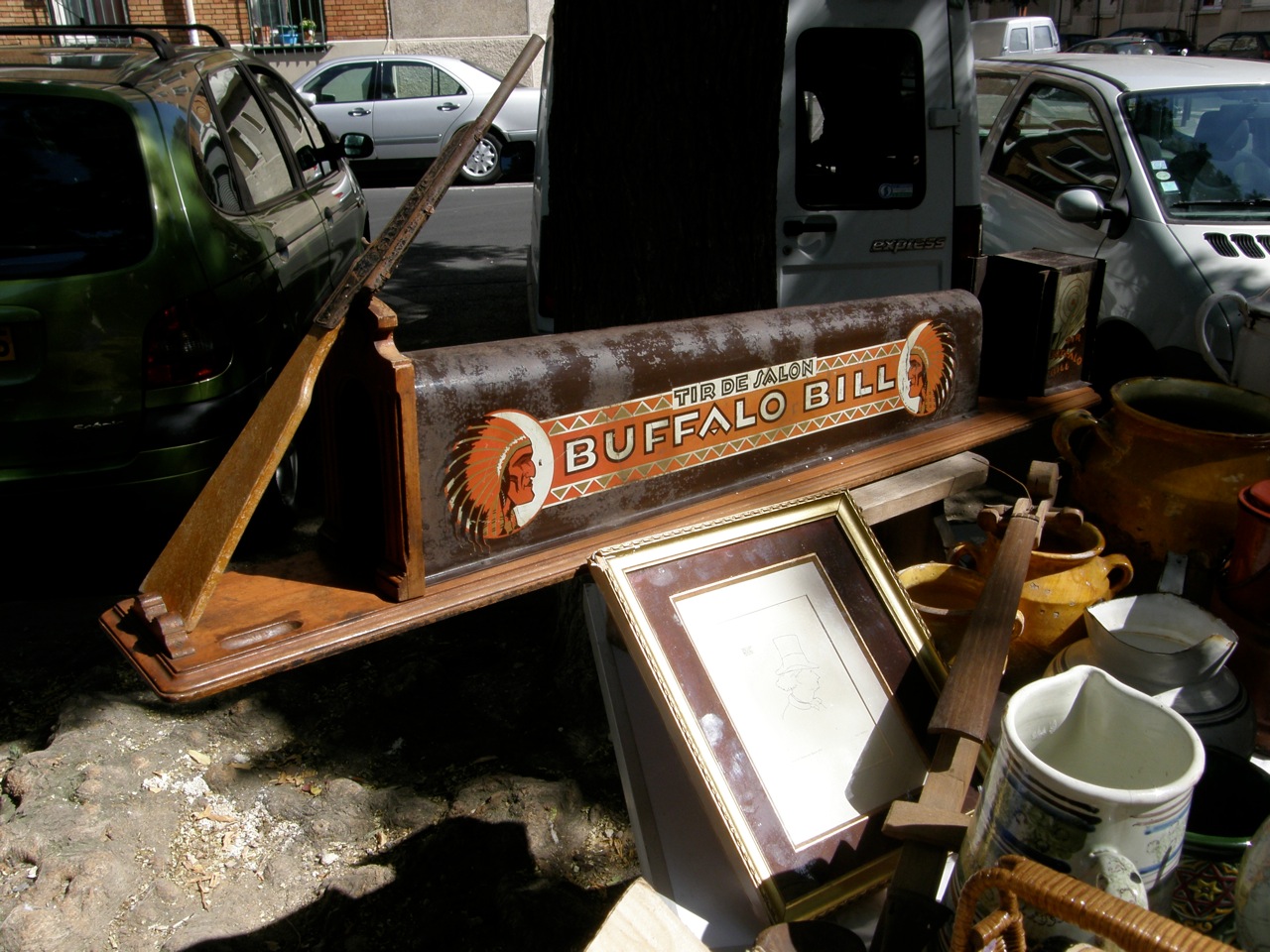
Consider the Buffalo Bill Tir de Salon (Shooting Gallery) that I did not buy. I still think of it fondly.

The Tir de Salon jumped out at me as Philippa and I ambled through the Porte de Vanves Flea Market on a beautiful Saturday morning in August. A French toy drawing on the allure of Buffalo Bill, the great American showman who romanticized the American West, did not seem at all unusual. I was prepared for the sight by Jill Jonnes, a historian whose work I admire. While I was researching and writing The Canadian Niagara Power Company Story, I read Jonnes’s Empires of Light: Edison, Tesla, Westinghouse, and the Race to Electrify the World. It was such a wonderful book that when I saw she had written about my favourite engineer/entrepreneur Gustave Eiffel in Eiffel’s Tower and the World’s Fair Where Buffalo Bill Beguiled Paris, the Artists Quarreled, and Thomas Edison Became a Count, I read it immediately.

Jonnes does a wonderful job of describing how Buffalo Bill and Annie Oakley won over the sceptical French public in Paris at the 1889 Exposition. “A hollow glass ball the size of an orange whizzed through the air and Oakley whirled into action, shooting it precisely. The air was soon alive with flying objects, and Oakley blasted each and every one, tossing her guns on the table as she used up their shots….Oakley was shooting as fast as the wind, absolute mistress of her guns…As the last hot gun hit the table, the crowd roared to its feet, throwing handkerchiefs and sunshades into the arena. Annie Oakley had arrived.” (pp. 124-5)

Buffalo Bill Cody had arrived too. “Under Cody’s powerful spell, the French were even willing to try snacking on the pink and white popcorn balls sold at Wild West refreshment stands. This was no small gustatory concession, for the French had long held that corn (maize) was a food fit only for pigs.” (p. 125) Interestingly, my father, who had grown up in Saskatchewan, had the exact same view, to the chagrin of my mother.

In the summer of 1889, “out in Neuilly, Buffalo Bill’s Wild West had become un succès fou. Twice each day, fifteen thousand spectators packed the grandstand, while many were turned away. Among that huge audience sat Paul Gauguin, who was determined to soak up all the exotica of the fair including these astonishing cowboys and Indians.” (p. 129)

Parisians have a long association with fashion and the Wild West Show left its mark, albeit temporarily. The “fashionable young men bought American and Mexican saddles for their rides in the Bois [de Boulogne]. Cowboy hats appeared everywhere on the street. Relics from the plains and mountains, bows, moccasins, and Indian baskets sold like hot cakes in the souvenir stores.” (p. 125)

As I look at my photos, my CD player brings back another element of that day at the Porte de Vanves.

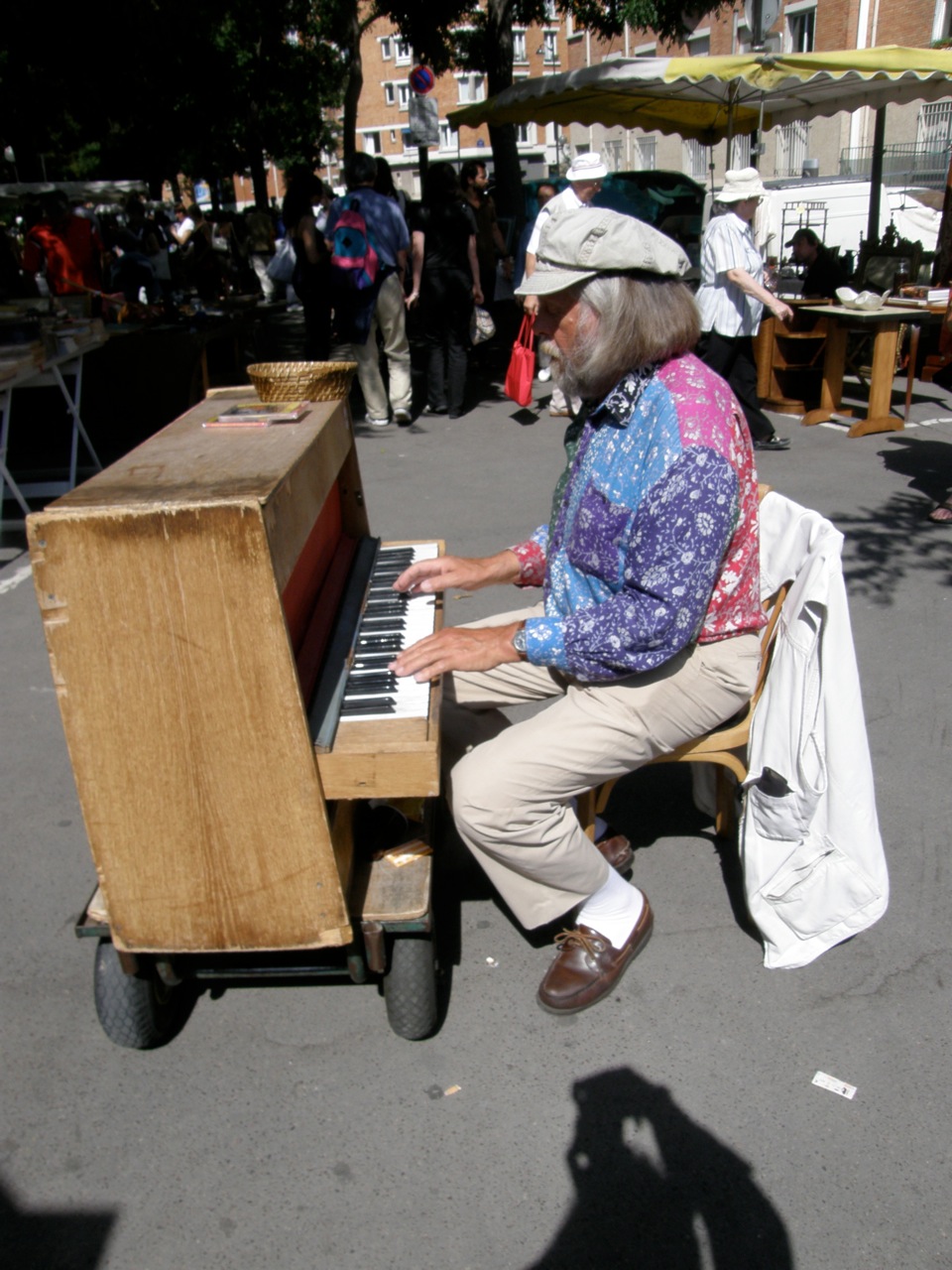
I am listening to Roland Godard et Son Piano à Tout Faire. That morning I could hear him playing his portable piano as I examined the Tir de Salon. With my jumbled but enthusiastic French, I chatted to the stall owner and we soon had a small crowd around the booth listening to tales of Buffalo Bill, Indians, horses, and Wild West encampments at Neuilly. The vendor even offered to reduce the price, but at some point he knew I was not going to buy it. Then the moment of truth. To my “Monsieur, est-ce-que je peux prend un photographie?” he countered with “Dix Euros, Monsieur.” I responded, “Ah Monsieur, c’est trop. Soyez gentil.” He motioned favourably.

I showed him the photo in my camera screen, we shook hands and parted. I hope the Tir de Salon went to a good home. Then Philippa and I talked to Roland Godard for a while, bought a CD, and browsed at a few more stalls. At one point, we looked down at the traffic on the Periphérique from the bridge over the highway and realized we were out of the 14th arrondissement and had entered the Ville de Malakoff. In a small café we had something to eat and tried not to appear too interested in a group of knife dealers or collectors who were displaying their wares to one another amid much discussion and admiration.

The Buffalo Bill episode lasted no more than 4 or 5 minutes. But these curious experiences are an important part of our visits to Paris and of our reasons for coming back as often as we can. We recently spent our first Christmas and New Year’s in Paris and it too gave us new experiences, stories and memories.

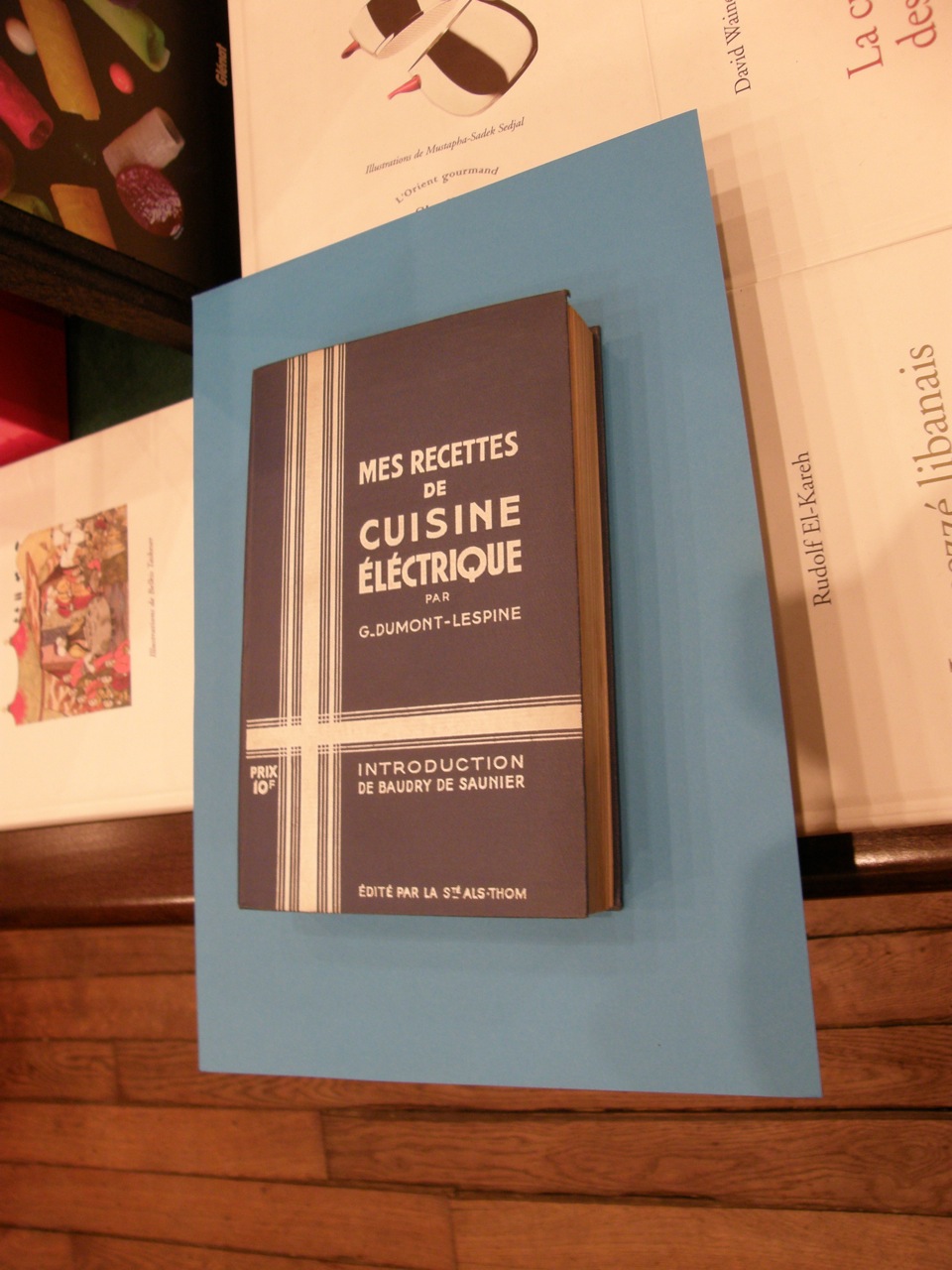
One day, as evening approached, we were on rue du Bac. The unusual cookbooks and culinary ephemera in the window display at no. 9 caught our eye. It was chilly and we decided to go in. Soon we were ensconced in the cosy antiquarian bookshop (Librairie Ancienne) Rémi Flachard, which the New York Times regards as “Paris’s finest for gastronomic history.”

As we chatted with the owner, the item below caught my eye.

It is a fine example of a very specific genre of cookbook published in the 1930s, when electricity was being introduced to people’s homes. The purpose of such books was to help customers feel more comfortable with domestic uses of electricity and thereby increase the demand for electricity. I told the shop owner about my research on a Canadian electric company that had had its own appliance showroom, a cooking school and three home economists on staff for the same purpose. I wrote about this in The Canadian Niagara Power Company Story as well as in “Electricity From Niagara Falls: Popularization of Modern Technology for Domestic Use” in a book of essays titled Covering Niagara: Studies in Local Popular Culture.

This genre of cookbooks is fascinating for the variety of recipes of the period, as well as the constant references to electricity. Our host seemed pleased to have someone in the store who appreciated such an unusual book. I had a camera and was told I could take a photo of the book cover and given a copy of his most recent catalogue. Oh yes, and we also purchased several items (fodder for a future blog).

A third unbought souvenir also comes to mind from our recent visit. One day between Christmas and New Year’s Day, we accompanied Marie and Michel—friends from Normandy—to the Musée Rodin. On the way, we passed a ceramic tile business. I think our friends were a bit surprised by what had caught my eye. This is something we might have bought, but the shop was never open the whole time we were in Paris. It would have been fun to leave it lying about or perhaps use it innocently as a coaster. But perhaps it would be a bit too much for some people.

So now you know about three things we enjoyed but did not buy. I am reminded of the words of a song by Tom Waits, one of our favourite singer/songwriters. Each was, in a different sense, “The one that got away.”

But did they get away? Are they souvenirs or not?

In English a “souvenir” is an object that one buys and brings home to remember a journey or holiday. Paris has no shortage of objects made specifically to be such souvenirs. But if I enter the word souvenir into my electronic Franklin Larousse, I find that the French word le souvenir is much richer. The first meaning is a “memory.” The expression “en souvenir de” translates as “in memory of.”

The expression “avec mes meilleurs souvenirs” translated as “with kind regards” or with best regards. In the province of Quebec, the motto on the license plates is “Je me souviens,” which for many is more than a simple “I remember” – it is an emotionally charged reminder to think of larger issues in Quebec history and of the French in Canada.

Memories, photos, stories and associations are an important part of our souvenirs in this sense. Some of these souvenirs are tied to physical things we have brought back. Other souvenirs are more about the memories we recall, talk about and share with others. So these three souvenirs never got away; we have them still.

Text and photographs by Norman Ball

Posted in Paris bookstores, Paris flea markets, Paris popular culture | Tagged , , , , , , , , , , , , , , , , , | 3 Comments

Bringing home a taste of Paris

Remember that old grade-school assignment, “What did you do on your summer vacation?” The mind tends to go blank. Similarly, when the customs officer at the airport us, “What did you buy in Paris?” our minds go blank. What did we buy?

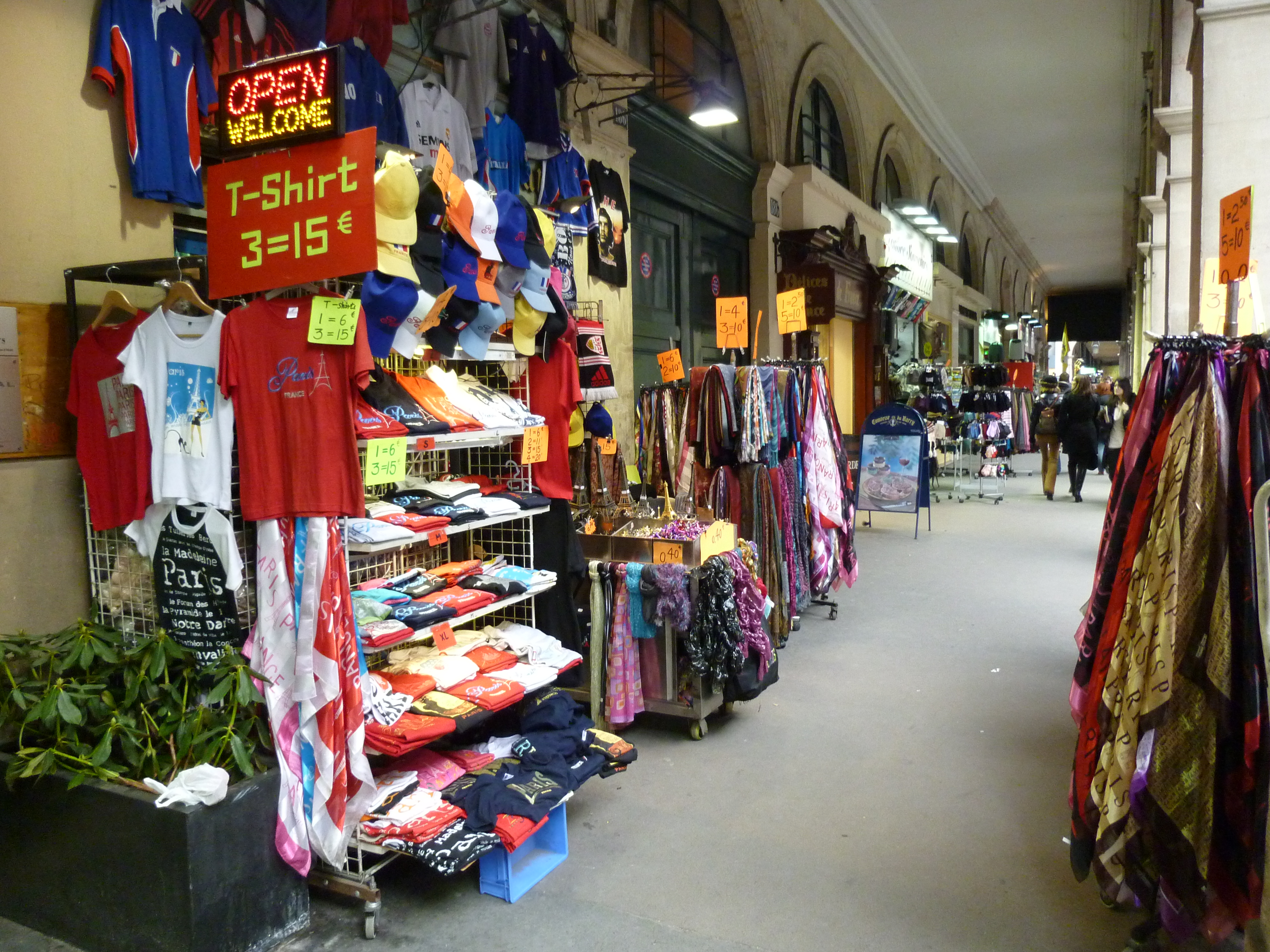
Some of the other people on the flight home from Paris have clearly been shopping at the souvenir stores, and sport bags and scarves and headgear with images of the Eiffel Tower. There is, apparently, nothing on earth that cannot have the image of the Eiffel Tower printed on it somewhere. The souvenir shops on the rue de Rivoli are bursting with all manner of keychains and stuffed toys and salt-and-pepper shakers emblazoned with the image.

And on the steps of the Palais de Chaillot, men carry armloads of little Eiffel Towers in varying sizes and colours or spread them out on blankets on the ground.

What do we bring back? Well, the full story would take several blogs, but one thing that comes to mind immediately is kitchen implements and food.

For one thing, we always end up adding to the “batterie de cuisine” that we take with us. Future apartment renters, please note: if you are planning to do your own cooking in Paris, you should know that French kitchens may not have all the things you rely on at home. So we always bring a Pyrex measuring cup (yes, really), a silicon spatula, an apron (don’t laugh), and a couple of very sharp knives (in our checked luggage, of course). And still we find we need something more. This time, we had to buy a pair of oven mitts after Philippa burned her hand taking something out of the oven with only a folded towel for protection. Something to remember for next time.

We also found that there was no can opener in the kitchen either, probably since most French cans have a pull tab and can be opened without one. But not all French cans. We bought a can that didn’t have a tab and had to improvise with a sort of bottle opener. Rather a mess, but we managed in the end. Next time, we’ll pack a can opener, too.

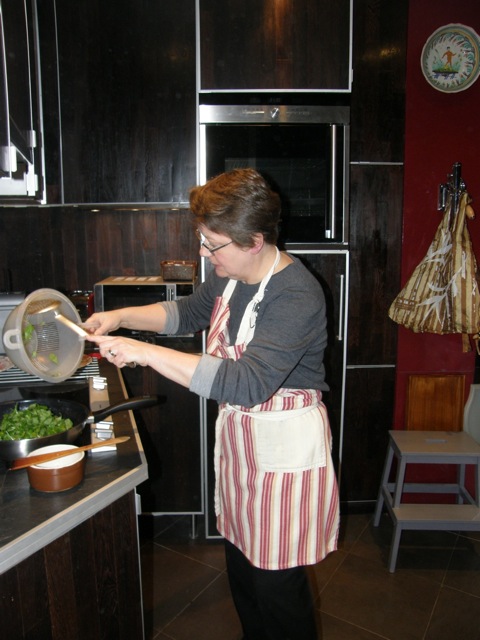
Here’s a view of the kitchen in the apartment we rented this time. It was a bit dark with all that wood, but very modern and functional. Philippa is wearing her apron from BHV, which she takes with her every time.

We also tend to return with a few more reusable shopping bags to add to our growing collection (these also make easy-to-pack and useful gifts) We have two sturdy ones from Bon Marché that we have used for years, as well as a special bag for carrying wine bottles that we found at Nicolas, the wine merchant (there are Nicolas shops all over the city). And when we bought gifts at a wonderful shop on the rue du Bac called Les Toiles du Soleil, they gave us a delightful striped bag to carry our purchases home.

We also buy favourite foods nearly every time we visit. For example, in a previous blog, we mentioned Poivre Saveur, which we cannot get in Canada. So we buy several little grinders, use one while we are there for our dinners in the apartment, and bring the rest home.

We sometimes buy vinaigre de Banyuls (which we rarely see in stores here). And this time we found a container of real cinnamon, after we had read that most of what is sold by that name in North America is actually cassia. The Grande Epicerie in the Bon Marché store had the real thing from Sri Lanka, which has a subtly different smell and flavour compared with cassia.

We are endlessly fascinated by the range of flavours available in Paris food shops. Coming from a country in which in most average shops, you can get any flavour of jam you like as long as it is strawberry, the offerings in even the most mundane grocery stores are a revelation. On our first day, we bought fig-and-violet jam (Bonne Maman), which we had for breakfast each day we were there. Sheer heaven, slathered on a baguette.

Sure, we love the patisseries and indulge from time to time…

… but there are hundreds of unexpected delights in every Monoprix store.

Sometimes, we get a little overenthusiastic and buy something to bring home just because it seems so wildly exotic. Rose petal and star fruit jam, anyone? (That was a previous visit.)

Come to think of it, we have a tendency to bring home unusual eatables from all kinds of places. There was the molé mustard we found in Colorado. And the cranberry horseradish sauce from Wisconsin. The pear vinegar from Michigan was one of our more successful finds, and we still buy it online and use it in summer salads. But the blueberry-anise chutney from…where did we buy that?… was definitely a one-off.

The other day, we were talking about how someone should write a cookbook for people who own exotic condiments they don’t know how to use. Ten uses for that zucchini-wasabi relish someone brought to your summer barbeque. Five things you can do with tangerine-coriander ketchup or key lime and rhubarb chutney.

Just to get the ball rolling, here are a couple of ideas. Norman puts interesting ingredients into marinades for barbeques and stir-fries and we have found that adding a dash of something unusual perks up a plain vinaigrette. Mind you, this is not something a French cook would do, since in France, vinaigrette is vinaigrette and you don’t mess with it, but we don’t mind a dash of a slightly fruity flavour or a touch of unusual mustard with our salad dressing.

And when all else fails, we have a foolproof standby: a recipe for pork tenderloin that can take whatever you throw at it. Pork goes well with either fruity or piquant flavours, and this recipe allows all kinds of flavours to blend. So for all of you who received strange condiments in your Christmas stockings, here is a way to make use of them.

Pork tenderloin à la whatever

1 tbsp. olive oil
1 lb. pork tenderloin
1 cup white wine
1 to 3 tbsp of “whatever” (mustard, chutney, jam, relish, ketchup – 1 tbsp for stronger flavours and up to 3 tbsp for milder ones)
Salt and pepper to taste

In a Dutch oven, heat the olive oil and add the pork tenderloin. Sauté, turning frequently, until browned all over, about 5 minutes. Add the wine, the “whatever” and the salt and pepper. Simmer at medium-low heat for 15 to 20 minutes. Add water or more wine if the mixture reduces too much. Remove the pork tenderloin from the pot, cut into medallions and return to the pot for a final 5 minutes, turning to saturate both sides with the sauce. Serves 3 or 4 people, depending on what else you are having with it.

Better than any souvenir from a souvenir stall. Bon appetit!

Text and photographs by Norman Ball and Philippa Campsie

Posted in Paris food | Tagged , , , , , , , | 4 Comments

Life in a quiet Paris quartier

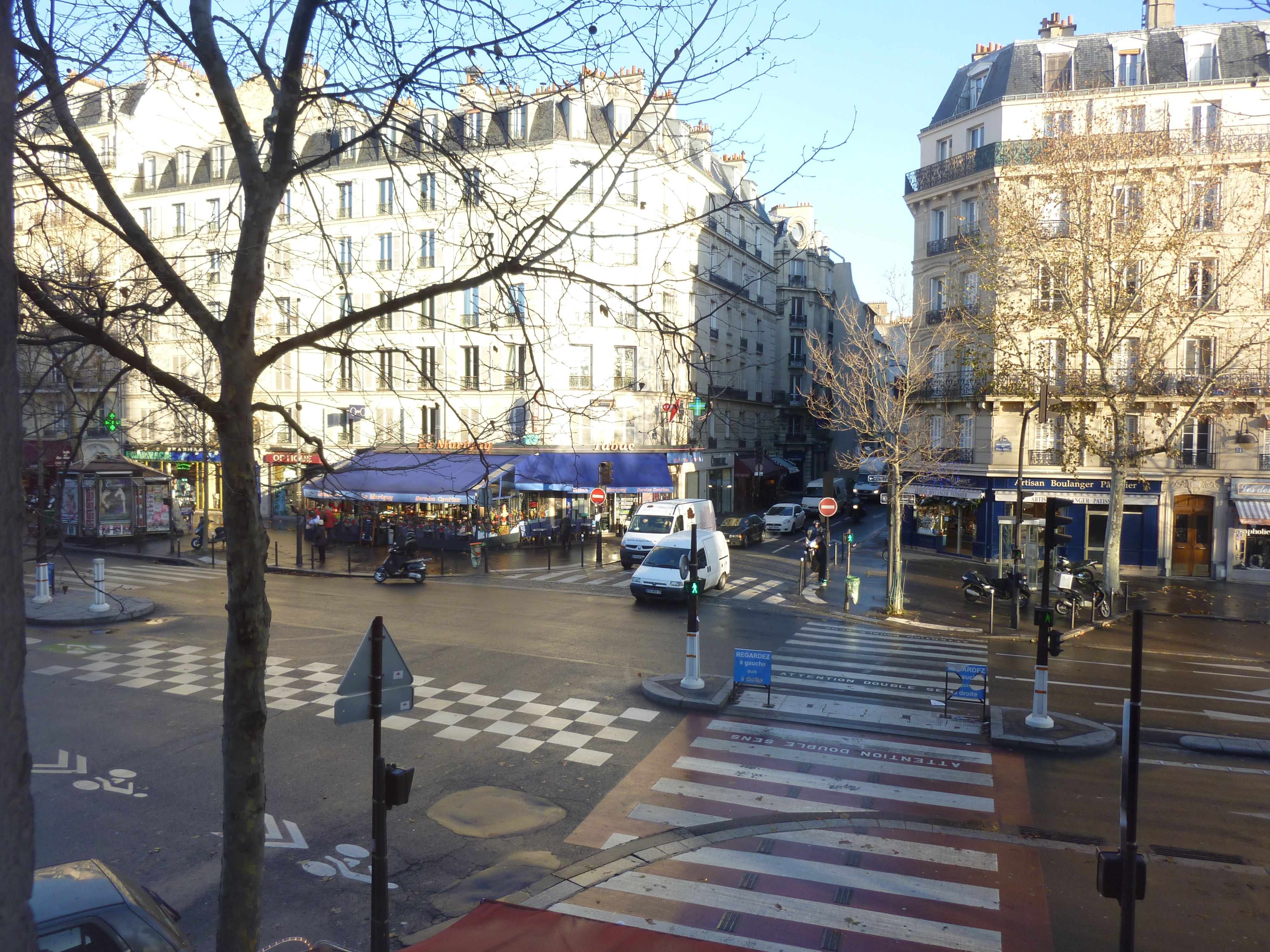
We are back in Canada, but still enjoying our memories of Paris. We stayed in a comfortable apartment in an area of the city we had never before explored, not far from the intersection of the Boulevard Port-Royal and the rue St-Jacques (which is called the rue du Faubourg St-Jacques on the south side of the boulevard).

Tourists seldom visit part of the 14th arrondissement – or at least, we hope not, because it is home to three large hospitals, and the most visible local businesses are the Pompes Funebres (funeral homes). We counted at least half a dozen within a few steps of the intersection. Is this French practicality or a comment on the efficacy of the French medical system?

The hospitals are the Val de Grâce, the Cochin Hospital, and the Port-Royal Maternity Hospital, occupying, respectively, the northeast, southeast, and southwest quadrants of the intersection. Before the Revolution, this was all convents and countryside, and an 1850 map of the area still shows large gardens and orchards, some of which survive.

The Val de Grâce was for years a military hospital, and its graceful 17th-century buildings, including a huge domed church, are worth a blog on their own (stay tuned). A 20th-century general hospital has been constructed to the east of the original buildings, but part of the original garden remains between the two buildings. At the centre of the garden is a statue of two army medics struggling to transport a wounded man.

The Cochin Hospital was originally a hospice for workers and the poor founded by a local curé (clergyman) called Jean-Denys Cochin in the 1780s; it is now a big research and teaching institution. The 1850 map indicates an “Hôpital des Vénériens” (hospital for venereal diseases) and we noticed the following sign on one of the Cochin’s buildings. We do not know if the hospital still treats cases of syphilis.

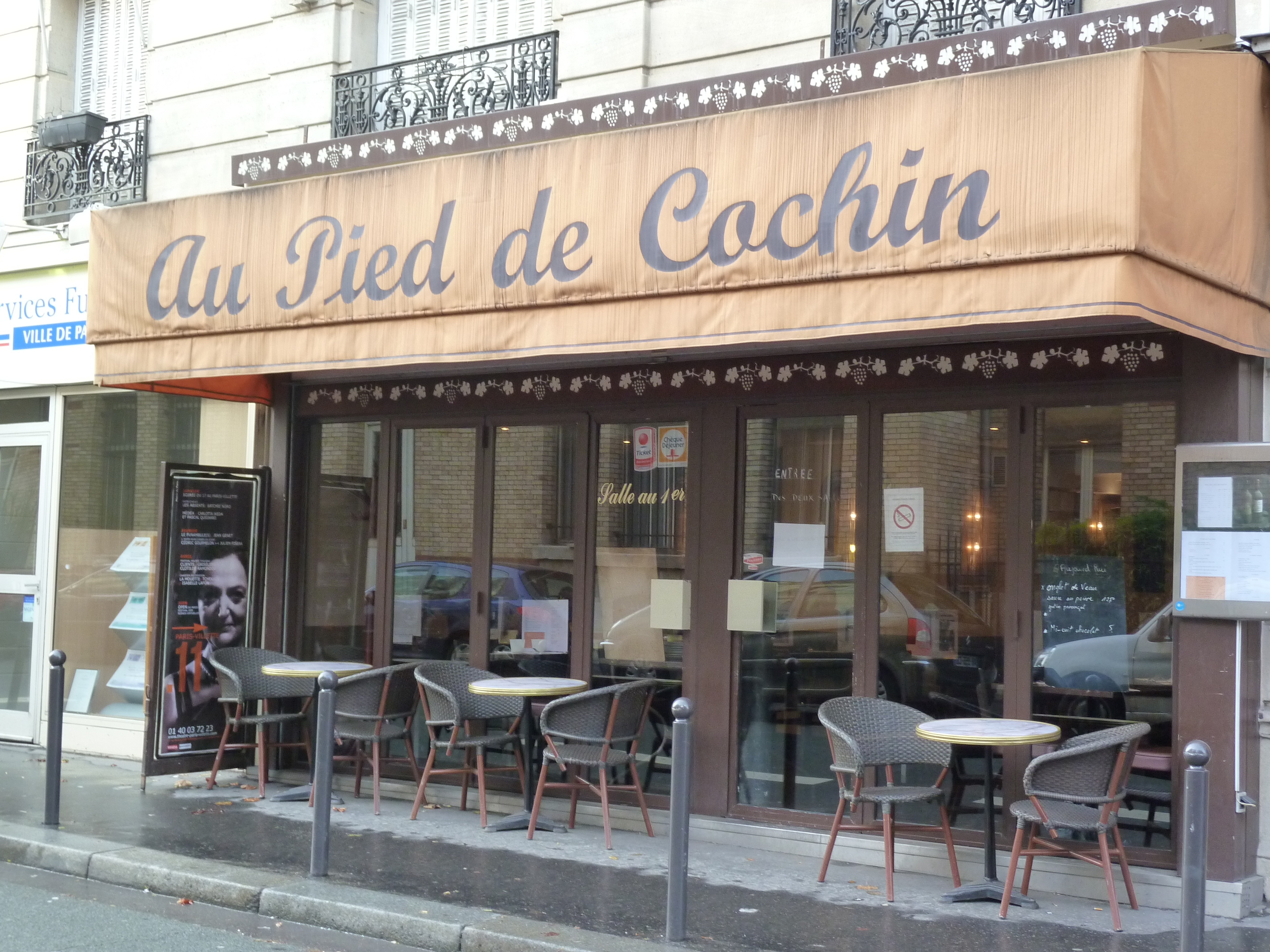
Across the street is a restaurant called Au Pied de Cochin (a word-play on Au Pied de Cochon, or Pig’s Foot).

The Maternité Port-Royal (now part of the Cochin hospital complex) was founded during the French Revolution on the site of the Abbey of Port Royal. This abbey had been associated with an austere and pessimistic religious movement known as Jansenism, which was forcibly suppressed in the late 17th century by both the pope and the King of France. The expulsion of the nuns of Port-Royal is a dramatic episode in French history that influenced several works of literature, including a play called Port-Royal by Henri de Montherlant. Most of the current buildings on the site are modern, but a few elements of the old abbey and its Revolutionary successor remain.

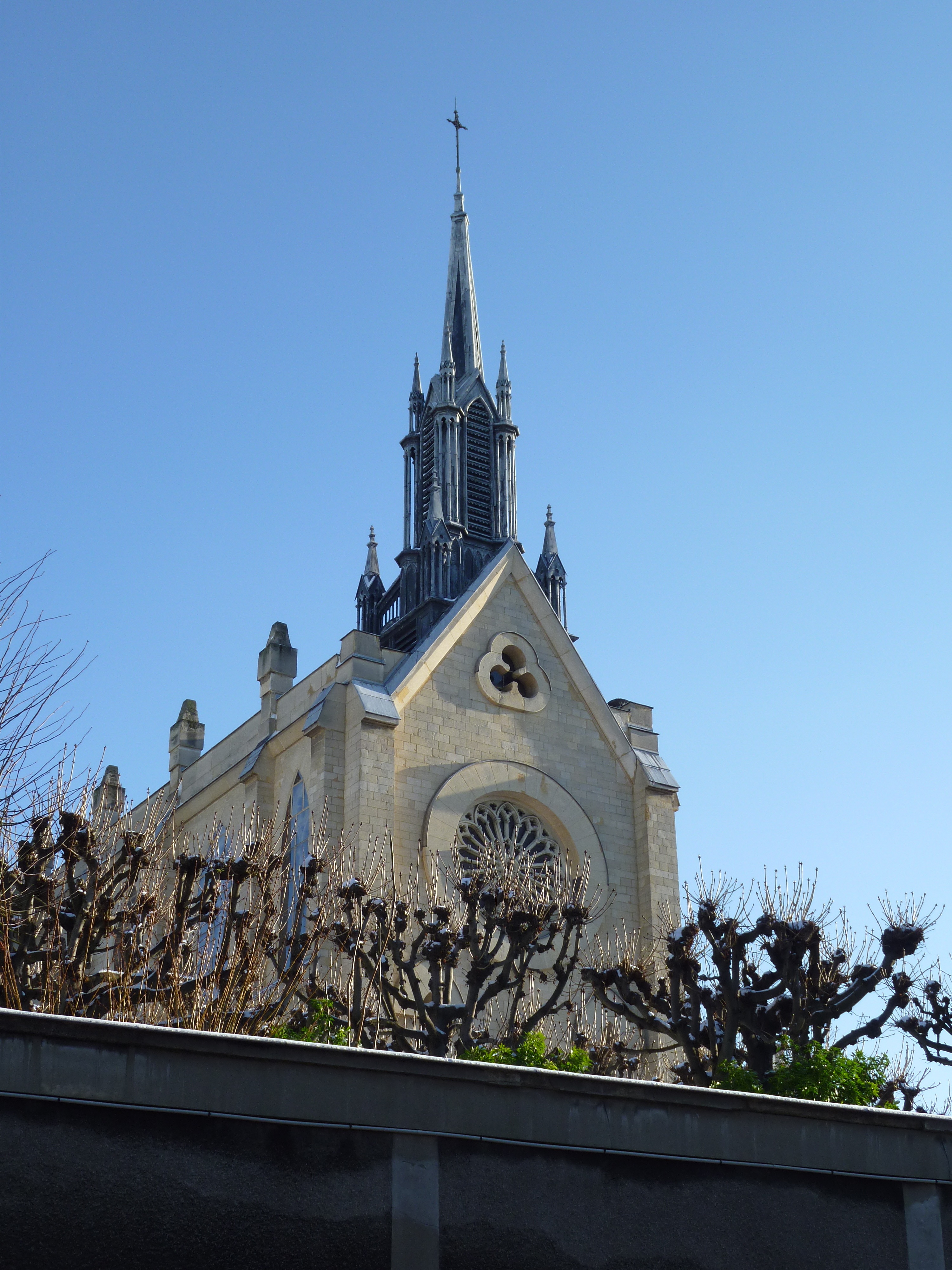
At least one religious foundation survives in the quartier – that of the sisters of St Joseph of Cluny. We wandered into the open gate one day until the nun in charge spotted us, but otherwise, all we could see was what was visible over the high wall: severely pollarded trees in a garden and a tall church spire. The church is open for mass on Sundays, and that seems to be the only way to see inside. Alas, we had other plans for Sunday morning.

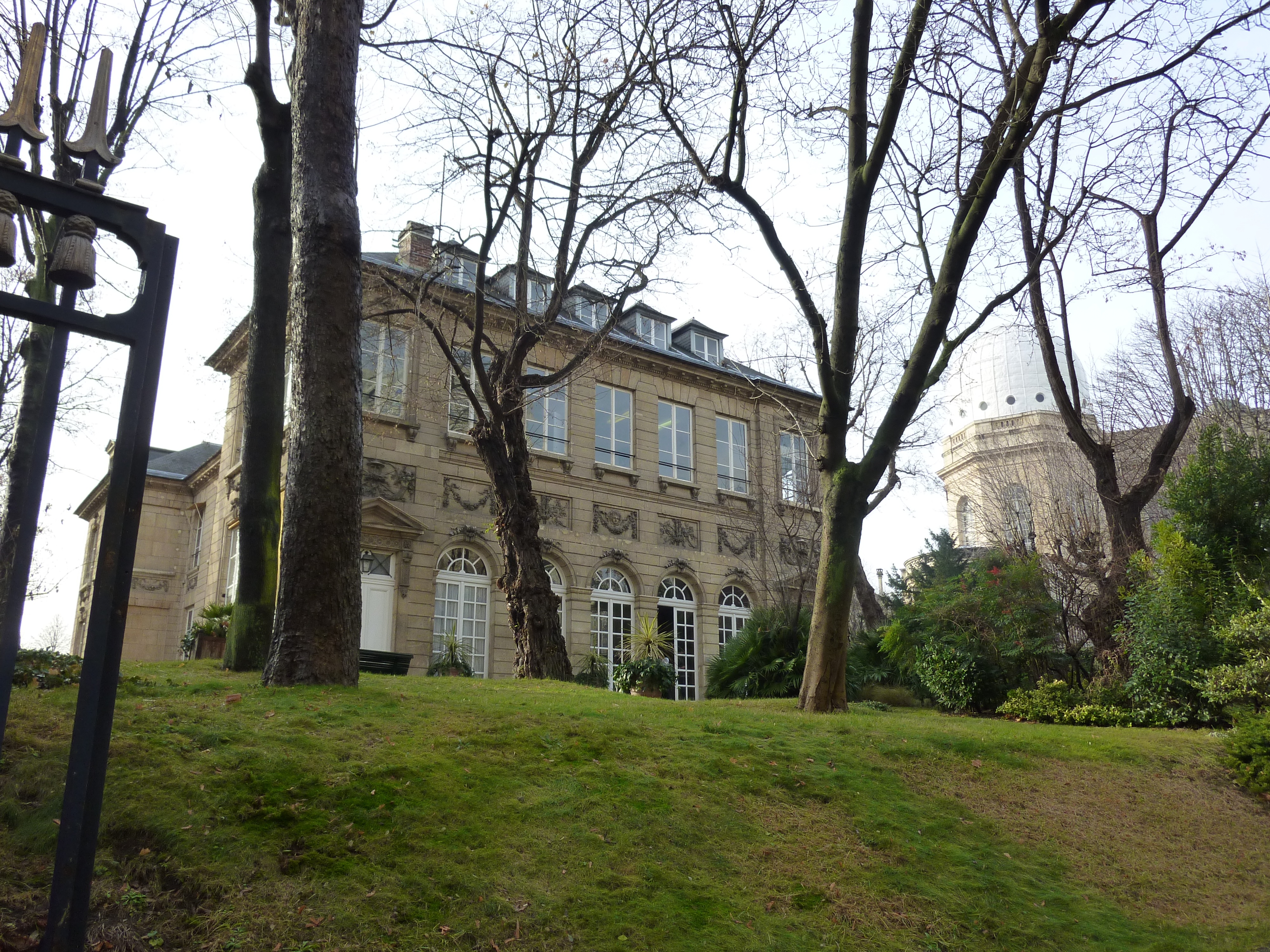
Across the rue du Faubourg St-Jacques is another walled garden, surrounding a large house. This is the home of the Société des Gens de Lettres, a writer’s association founded in 1838 by Honoré de Balzac, among others. The historic plaque outside explains that the house had once stood on the Champs-Elysées and had been dismantled stone by stone and rebuilt on this site. Beyond the house and garden the nearby Observatoire is visible.

As a temporary home, we found the quartier ideal. There is a three-day-a-week market on the boulevard in front of the gardens of the Val de Grâce. Buses run along the boulevard: the 91 takes you straight to the Place de la Bastille and the Marais and the 83 goes to the Bon Marché and rue du Bac area. There is a Metro station on the No. 6 line, which takes you to the Place de l’Etoile (Arc de Triomphe) and a station of the RER – the Paris commuter train network, which zips you into the centre of the city in no time.

The boulangerie on the corner near the Val de Grâce is excellent (we got our Christmas bûche de Noël there) and the butcher’s shop specializes in beef from the Limousin region. The two local convenience stores remain open late into the evening, sell fresh fruit and vegetables, and offer a remarkably varied selection of wines.

There are, of course, several pharmacies, not to mention a newsstand, a flower shop, a chocolate shop, a laundromat, several clothing stores, a jewellery store (where the proprietor sells the jewellery he has made and mended a watch band for free a few minutes before closing time one evening), a bottle bank, and a public toilet.

Two restaurants located diagonally across from each other on the intersection serve the lunch and afternoon crowd and close in the early evening. Both are run by people from the Aveyron region. Generations of people from southern France have settled near the Montparnasse train station, just west of this quartier, as this was the part of Paris they first experienced when they arrived.

One restaurant includes a Tabac. Although we never went into this part of the establishment, a friend who works in Paris told us that Tabacs don’t just sell cigarettes; they are essential service centres that sell everything from phone cards to lottery tickets and accept payment for parking tickets (for those foolish enough to keep a car in Paris). The latter involves a complicated and arcane transaction featuring stamps.

Traffic in the intersection provided endless entertainment, as motorists on the one-way, southbound rue St-Jacques negotiated the complicated junction with the boulevard. The south side of the boulevard has two-way bus/taxi lanes, divided from the regular lanes by a median, but when motorists turn left onto the boulevard from the one-way street, it is not at all clear which lane they should aim for. Time after time we would watch a hapless driver start to turn into the bus/taxi lanes, realize his or her mistake, and, after a pause, reverse into the middle of the intersection as traffic swirled around, and head for the correct lane. Amazingly, we never once saw anyone crash into anyone else during this delicate manoeuvre.

To the west of this little quartier is Montparnasse with its enormous station and shopping centre and its large, famous cafés that once welcomed artists and now welcome tourists. To the north is the busy Latin Quarter. But here in the quartier St-Jacques, the shops are small and independent, Starbucks and McDo have not made inroads, and only the ambulances disturb the peace. Even then, the sound of Paris ambulances is not nearly as aggressive and intrusive as that of Toronto sirens, and we slept soundly every night.

Text by Philippa Campsie and Norman Ball; photographs by Philippa Campsie

Posted in Paris gardens, Paris history, Paris hospitals, Paris quartiers | Tagged , , , , , , , , , , | 7 Comments

Child’s Play

We never cease to be amazed at the persistence of traditional children’s pastimes in Paris. Merry-go-rounds (known as manèges) are found throughout the city. Some offer children the added enjoyment of spearing brass rings as they go around the circle. Here is a photo taken last spring near the Musée Marmottan.

You can also find double-decker manèges near major tourist sights…complete with children riding on everything from roosters to tiny aeroplanes. Perhaps it’s just so the parents can take cute pictures. Who knows? But there they are, year after year. And the children in general appear to be having fun.

At Christmas, there are all kinds of old-fashioned delights. The line-ups for a traditional circus performance with animals, clowns, and trapeze artists at the Cirque d’Hiver are long and the nearby cafés are filled with families enjoying hot chocolate before or after the show.

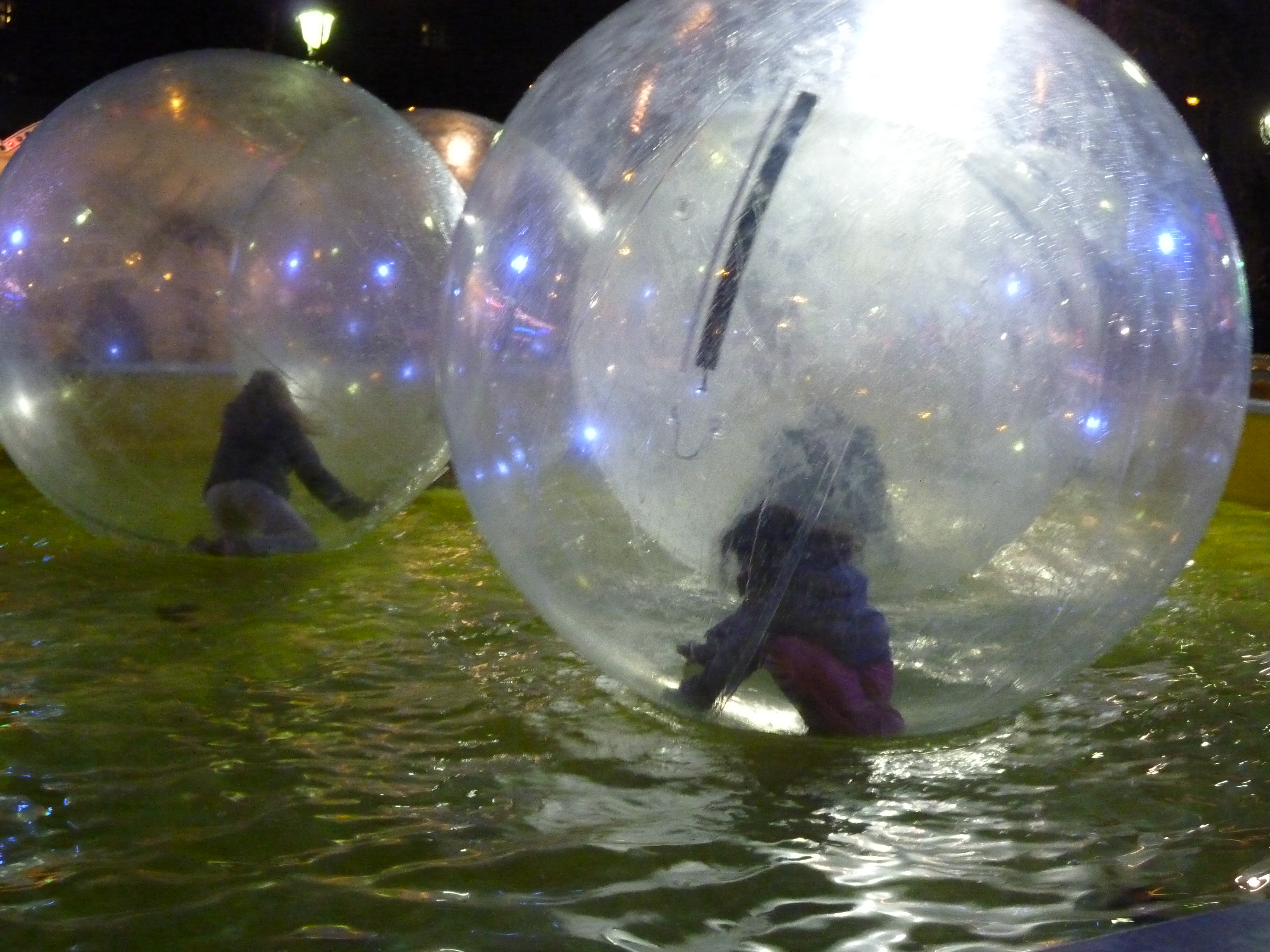
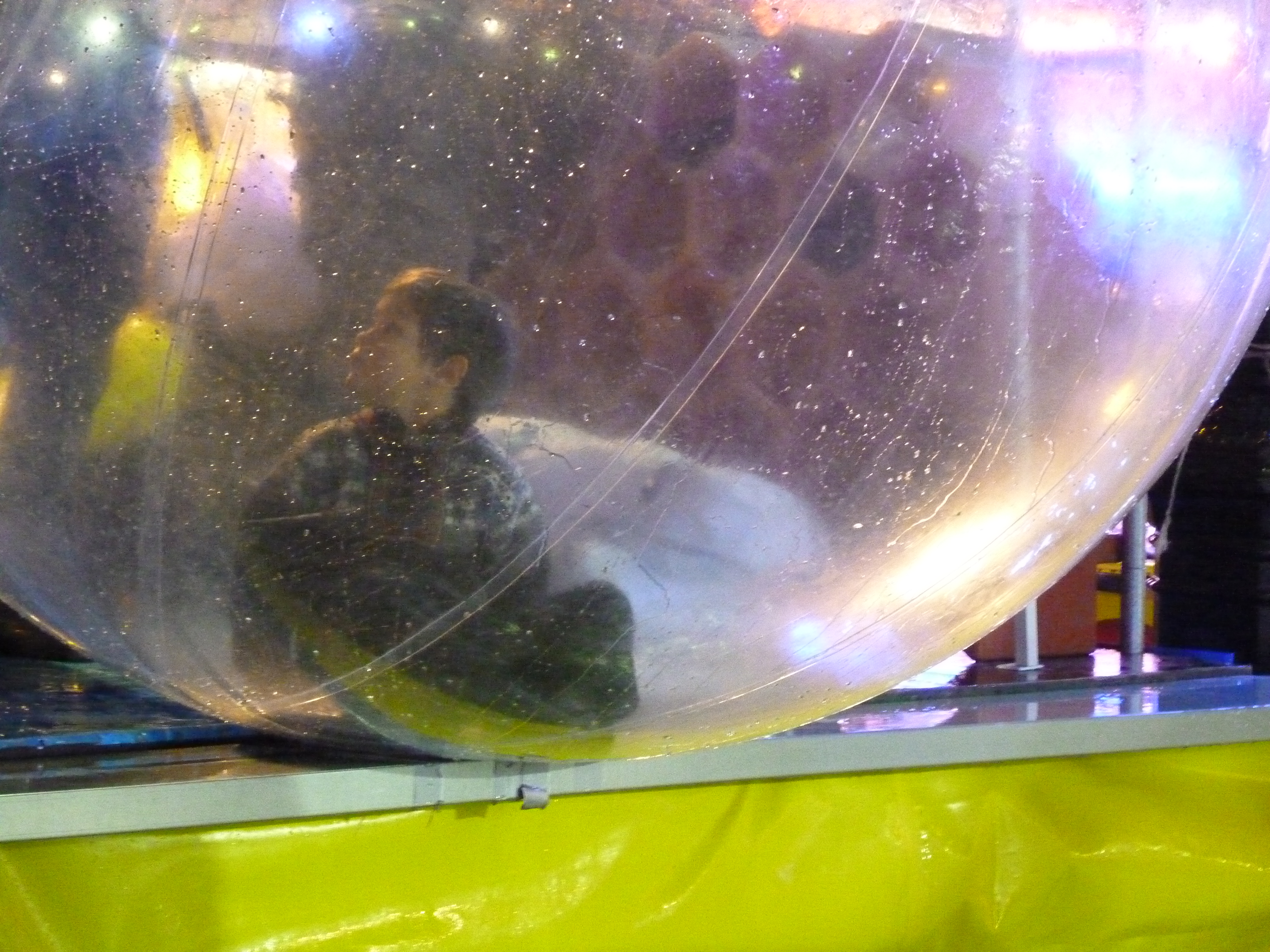
Near the Bastille, we came across a children’s fun fair. Two of the most popular entertainments seemed to be the bumper cars (when was the last time you saw bumper cars?) and the pool in which children in waterproof spheres cavorted in the water.

We watched as a slightly apprehensive little boy was sealed into one of these things.

A moment later, he was happily flopping about as the sphere rotated in all directions.

There was also an inflatable (gonflable) rooster. Of course.

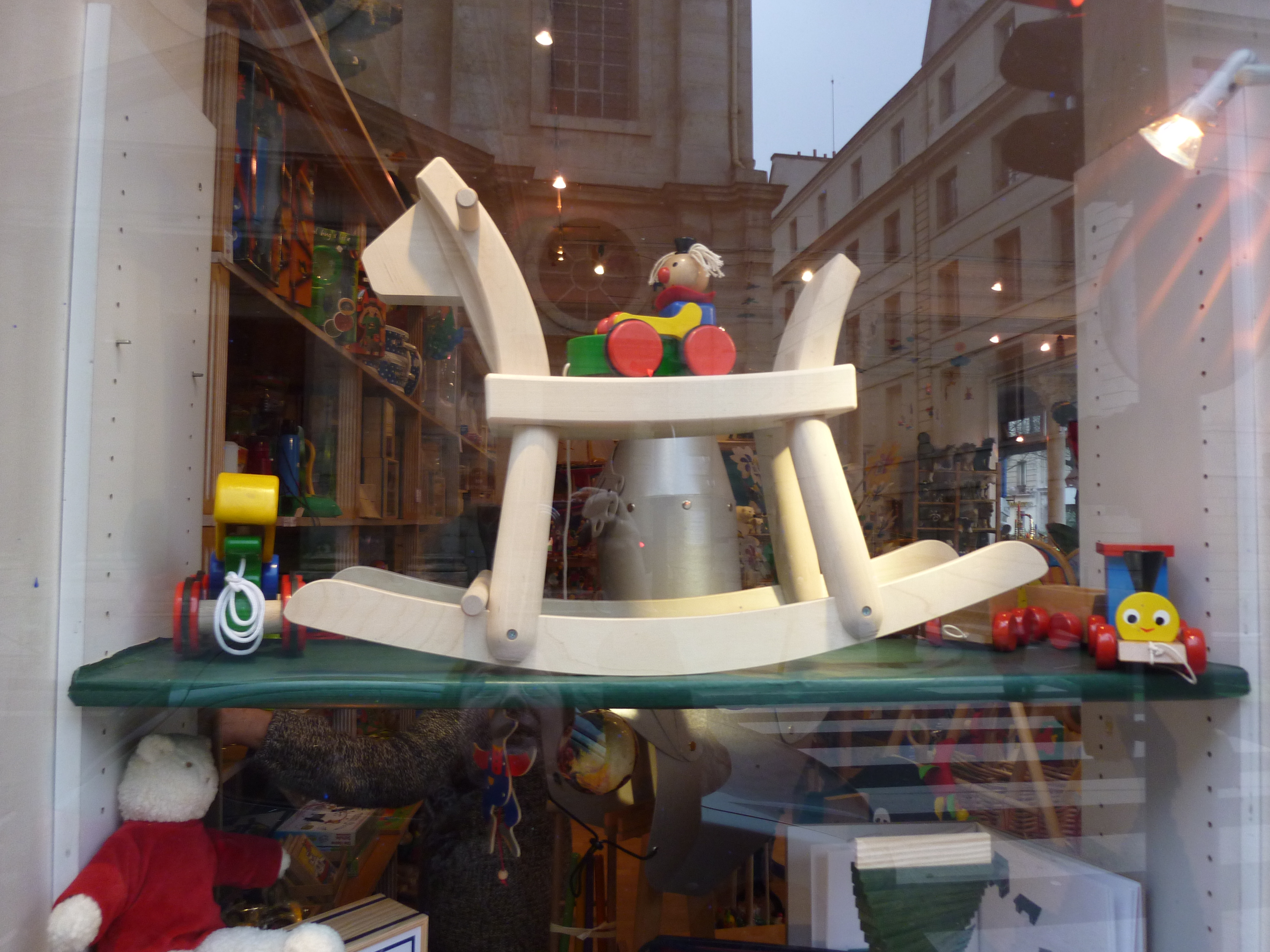
Children’s toy shops are a delightful exercise in nostalgia for grandparents, but the cynic in us wonders if the handmade wooden toys appeal to today’s children as much as computer games do. We honestly have no idea what French children do behind closed doors, but in the shops, the 1950s (heck, the 1920s) are alive and well.

On Christmas Day, we went for a walk in the Luxembourg Gardens, along with many other couples and families. We saw some young men playing table tennis in the snow (yes, really), and children having a snowball fight. Some people had found sheltered spots and were sitting enjoying the sunshine. It all seemed rather timeless and relaxing.

Christmas was chilly, but bright, and lots of people were out in cafés and cinemas, or just walking in a city still powdered with snow. We did not sense the Christmas hysteria we see in Canada.

As for the Boxing Day sales, they do not start until the middle of January. Apparently some fanatics do camp outside certain French stores in order to get coveted objects at a discount, but the madness is mercifully separate from Christmas itself.

New Year’s, of course, is party time, and may be a different story altogether. But Christmas is just a short holiday with better food than usual, and a time to enjoy some traditional pleasures. Maybe we’ll get one of those handmade wooden toys to bring home.

Text and photographs by Philippa Campsie

Posted in Paris popular culture | Tagged , , , , , , | 3 Comments

A Rudolf-free Noel

We’ve been asked many times why we decided to spend Christmas in Paris this year, and we have all kinds of answers. “We didn’t want to do another turkey.” “We thought it would be fun to spend Christmas just the two of us away from family,” and so on. But to be perfectly honest, it was Rudolf. And his buddy Frosty. And all the rest of his ilk, including overexcited tenors singing “O Holy Night” in throbbing tones.

We’d planned our getaway early in the year, but the minute the Toronto shops started playing Rudolf the Red-Nosed So-and-so and Frosty the Frigging Snowman, we knew we’d made the right decision. This was early November, as soon as the Halloween decorations came down.

The French don’t make a fetish of Christmas. It’s a short, enjoyable holiday, not a way of life. We tried to explain to someone in French that in North America there are year-round shops devoted to Christmas; the response was a look of utter incomprehension.

As of December 23, the French are still buying their Christmas trees, which they will decorate on Christmas Eve and remove shortly thereafter (unlike many North Americans, who keep their decorations up until March). Here is a pile of Christmas trees waiting for buyers on a Paris sidewalk.

Decorations vary wildly, from a perfunctory wisp of tinsel in the entry of an apartment house to an over-the-top effusion that takes over an entire store…

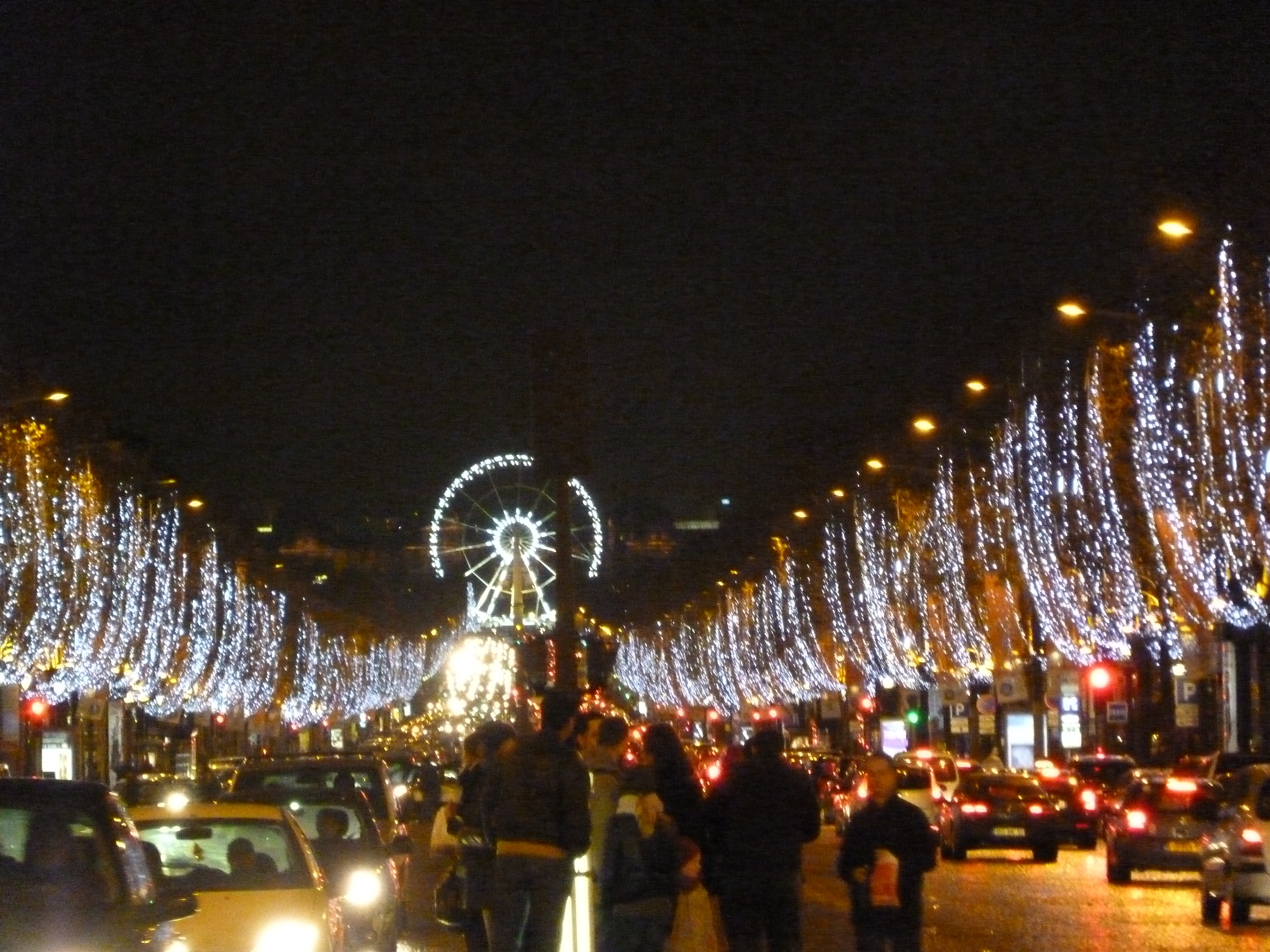
…from the exuberance of the Champs Elysees, brought to you by a host of corporate sponsors…

…to the fearfully tasteful arrangements in the Place des Vosges.

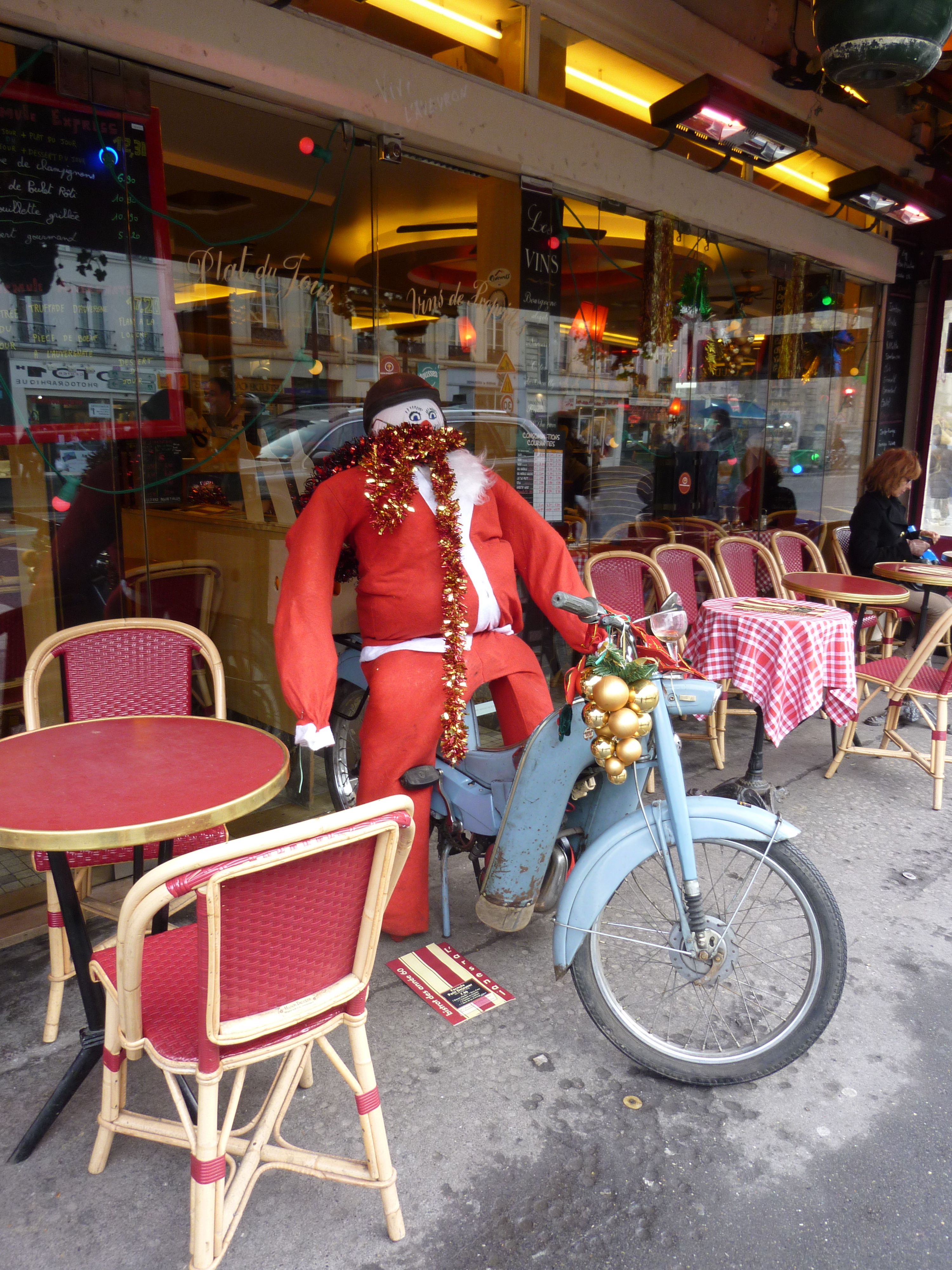
A particularly popular effect is a little stuffed Santa tryng to crawl in a window (this is from the Cochin Hospital).

The flower shops sell all kinds of arrangements to take home, including a reindeer head like a hunting trophy from the Musee de la Chasse et de la Nature (except that the reindeer looks like an oversized mouse with antlers).

As for the auditory environment, we are happy to report that Le Bon Marché does not play carols or Christmas songs (except outside near its postmodern, highly conceptual Christmas windows), and the Bazar de l’Hotel de Ville has rather ironic blues versions of Jingle Bells and other standards. But, thank God, no Rudolf and no Frosty.

The plan is working.

It may be a white Christmas in Paris this year, but the Parisians themselves don’t really care one way or another, as long as it doesn’t interfere with the real business of the season…eating oneself into a stupor in the company of one’s nearest and dearest. Or one’s family. As long as the boudin* is blanc, the landscape can be any colour.

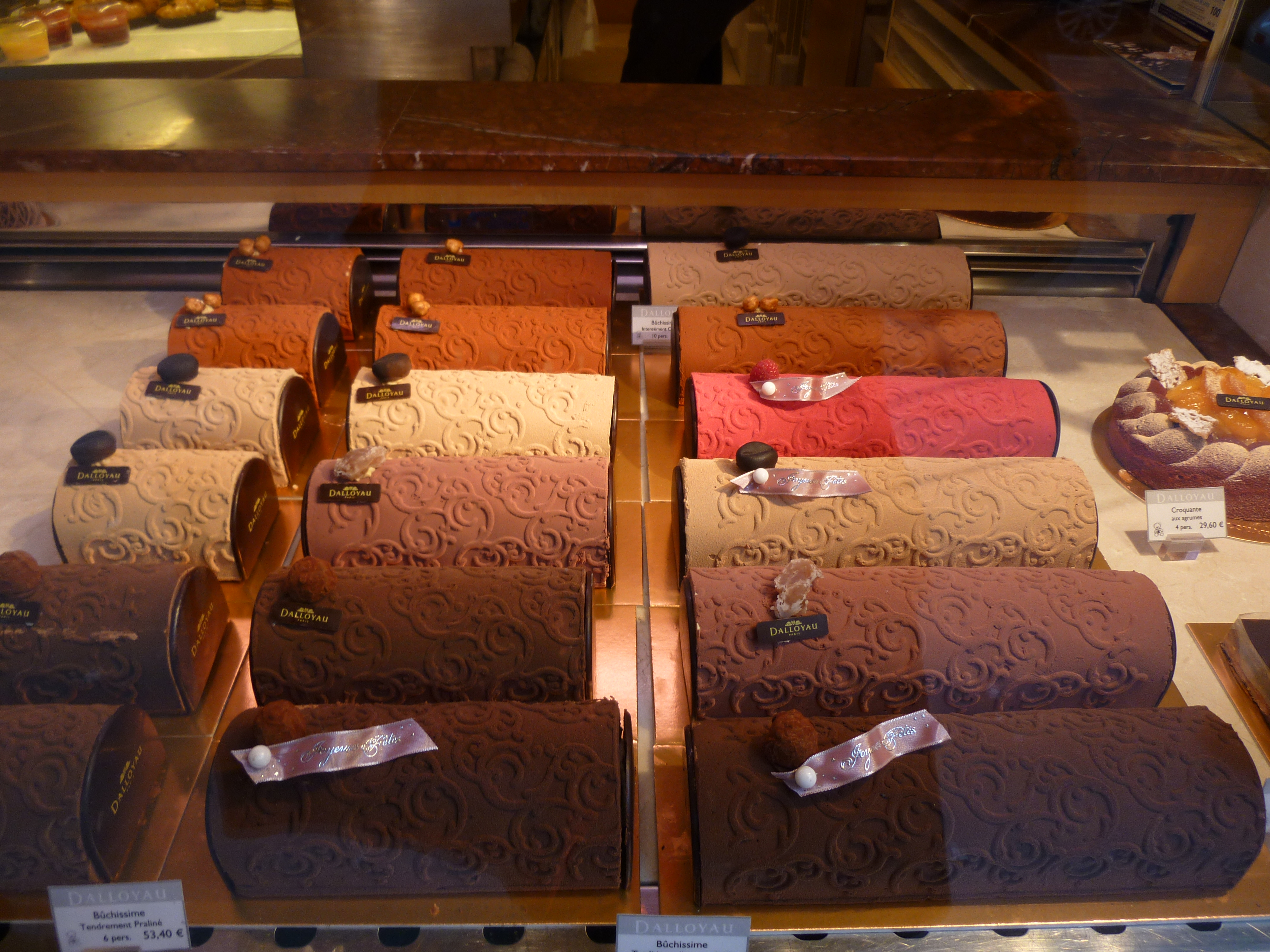
And so, it appears can the bûche de Noël.

This afternoon the bus heading to the Gare de Montparnasse was jammed with people lugging enormous suitcases, but everyone was in a good mood. They’ll be home for Christmas. There will be oysters and goose and bûche de Noël for everyone. Everyone will be in good humour, not having been force-fed a diet of Christmas carols for two months like a Strasbourg goose being force-fed corn.

We wish we could spend every Christmas here.

*Boudin is a type of pork sausage, and the pale version called boudin blanc is popular at Christmastime, although some people prefer boudin noir, which is blood sausage.

Text by Philippa Campsie and Norman Ball, photographs by Philippa Campsie.

Posted in Paris food, Paris hospitals, Paris music, Paris popular culture | Tagged , , , , , , , , | 1 Comment

Keeping warm in a wintry Paris

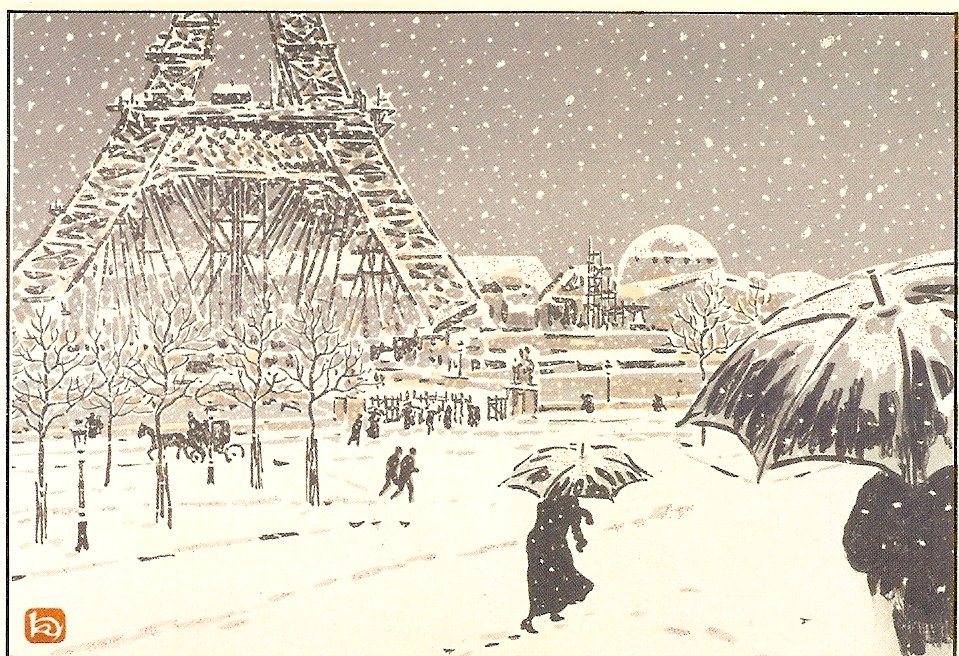
Last week snow was falling, snow on snow, in Paris. The international press (when it hits the Toronto papers you know it is Major News) even reported that the Eiffel Tower was temporarily closed because of it. Unimaginable! Well, actually, not really. Think of all those images of Paris in the snow by painters such as Alfred Sisley, Maurice Utrillo, and Gustave Caillebotte. Quiet streets covered in white. Snow on the bridges and barges along the Seine.

Our all-time favourite image of Paris sous la neige is the print by Henri Rivière, part of his 36 Views of the Eiffel Tower (1902), created in a Japanese style and inspired by 36 views of Mount Fuji.

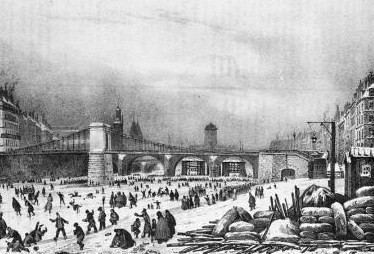
Paris doesn’t have ice and snow every year, but it happens. The Seine even freezes up on occasion. Here’s an image from 1830 of people happily skating on the river.

So snow is hardly news. We were once caught in a snow flurry in Paris in December, which cut short a planned walk in Montmartre. We beat a hasty retreat to a café where we indulged in a winter favourite – vin chaud. This is the French version of mulled wine, available in most cafés and bistros in winter.

Here’s a recipe for French vin chaud. It will keep you warm inside when it’s cold outside.

Vin chaud

1 bottle of red wine (a fruity type, preferably)
1/3 cup of cognac
1/3 cup of brown sugar (or more…experiment)
Zest of one entire orange
4 whole cloves
3 or 4 cinnamon sticks

Put the wine and cognac into a pan and heat. Once it is good and warm, and if you are feeling particularly brave, hold a match to it and let the cognac flame off. Or leave it be and enjoy the extra warmth. Lower the heat and add the sugar, orange zest, cloves, and cinnamon. Let it heat through for another ten minutes. Strain and taste. If it is a bit overpowering, water it down a bit. Serve it in glass mugs if you have them.

We’ve enjoyed it with lunch, or as a before-dinner warm-up, or an after-dinner wind-down. It goes well with a croque Monsieur, or some savoury appetizers, or dessert (such as gingerbread). Bon appetit!

Meanwhile, the snow has stopped in Paris. We arrived yesterday, and today the sun is shining. We have a flat overlooking the Boulevard de Port Royal, which for some reason functions as 2 two-way streets side by side (that is, there are east and west lanes on the north side of the street and yet more east and west lanes on the south side of the street). We have already seen several close shaves as pedestrians, bicyclists and motorists negotiate the intersection below the windows. Hours of entertainment to be had just watching the scene unfolding.

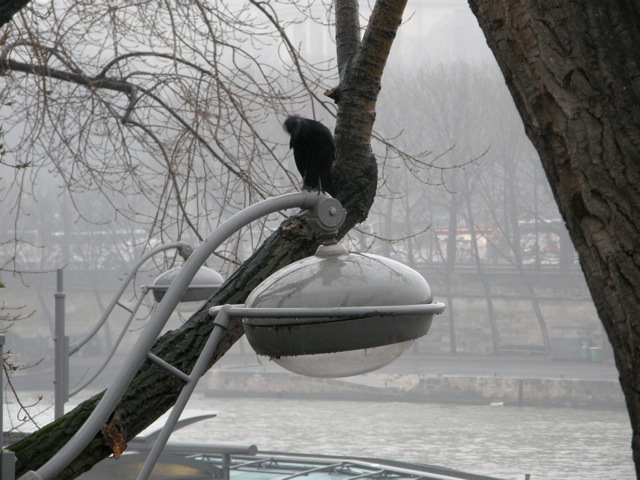
We shall have more to say about this neighbourhood as we discover it, but for now, we would like to wish a very merry Christmas to all our readers and subscribers. Joyeux Noel! Meilleurs voeux! And for those of you who know about and understand Norman’s fascination with large black birds, here is a special image from our Paris photographs for the holidays.

Text by Philippa Campsie, original photography by Norman Ball.

Posted in Paris art, Paris food, Paris history | Tagged , , , , , , , , | 3 Comments

Memento mori

The past is ever-present in Paris, and so are the dead. I don’t know of another city in which so many of the top tourist sites are in some way memorials to those who have gone before. There is the Pantheon, with its Great Men (and two Great Women), and Les Invalides, with Napoleon in his marble bathtub, surrounded by the tombs of his family members and military commanders.

The city’s cemeteries are big tourist draws. Père Lachaise, shown in the photograph, is the biggest (both in acreage and in tourist numbers – what is it about the desire to see Jim Morrison’s grave, anyway?), but the cemeteries of Montparnasse, Montmartre, Passy, and Picpus, along with assorted smaller graveyards, attract many visitors who come to see the resting place of celebrities and historical figures.

And for sheer ghoulish weirdness, there are the Catacombs, where the bones of those buried in the city’s central cemeteries were moved in the late 18th century, and artfully arranged in a former underground quarry.

Mind you, just over a hundred years ago, the Catacombs would have come a distant second in the sheer ghoulish weirdness category to the Paris Morgue, the must-see tourist site for all fashionable visitors. This was the place to see and be seen, but mostly to see. In fact, the word Morgue comes from an obsolete French verb “morguer” – to stare fixedly. (The term today has a somewhat different meaning.)

The original idea was to make it possible for people from the city to view unidentified bodies found in the streets or fished from the Seine in order to identify and claim them. But when you read about tens of thousands of people filing past an especially interesting display (children were a top draw), it is clear that the original purpose was left behind. It was free. And it was fascinating.

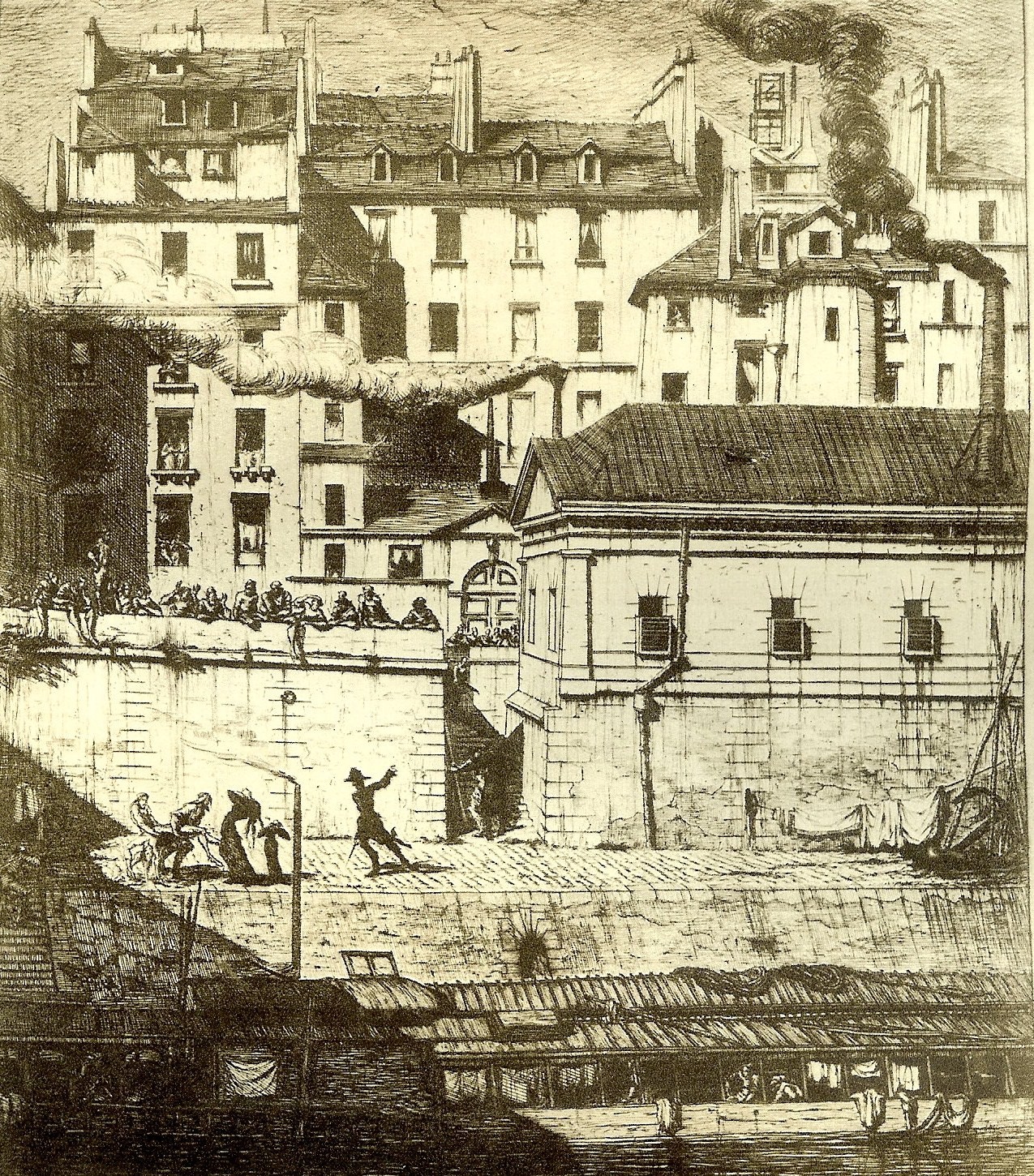
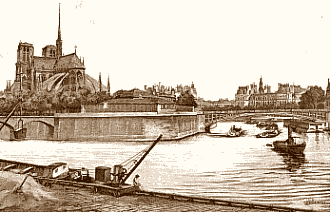
The first proper morgue, shown above in an etching by Charles Meryon, was built in 1804 on the Quai du Marché on the Ile de la Cité. In 1864, Haussmann ordered the demolition of this morgue and the creation of a much larger building on the Quai de l’Archevêché behind Nôtre Dame, on what is today the site of the Memorial of the Deportation. The photograph below shows this newer building; it’s the long, low building to the left of the bridge.

Inside the building was a viewing room, with huge windows like the windows of the grands magasins. Behind the glass, the dead were laid out naked on two rows of six slabs each. A cloth hid the private parts, and the clothing was hung nearby. Small children were propped up on chairs. The window had a curtain that could be drawn across when the attendants added or removed a body. When the stage was ready – and it was very much like a stage – the curtains were drawn back to reveal the new display.

Women and children drew enormous crowds, along with those who were believed to be the victims of foul play. One female murder victim attracted about 10,000 visitors a day. Another popular event occurred whenever the police brought a murder suspect to “confront” a supposed victim in an effort to force a confession or an expression of guilt.

The morgue was featured on tours organized by Thomas Cook, and mentioned in tourist guides to the city. But its greatest publicity came from press reports about the latest inhabitants of the place. Papers such as Le Journal Illustré often featured photos of some of the more interesting bodies.

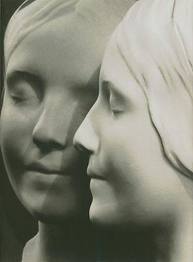
One odd story attached to the morgue was that of l’Inconnue de la Seine. In the 1880s, a young woman was pulled from the Seine; she had drowned, but there was nothing to indicate whether she had fallen into the river, jumped, or been pushed. She had attractive features and the hint of a smile on her face. The pathologist at the morgue found her face so interesting that he had a plaster cast made of it.

The cast was copied, and copied again. Further versions were made from photographs of the original cast. These death masks became bestsellers – many artists and writers owned copies. And many of the owners wrote stories and plays about her, offering up varying versions of what might have happened to her before she went into the river.

The original young woman was never identified, but she was nonetheless famous. The photograph of the mask shown here is by Man Ray. Years later, in the 1950s, when some of the first lifelike resuscitation models were created to teach the skills of artificial respiration, her famous, lifeless face was used on these models, known as “Rescue Annie” or “CPR Annie.”

The public morgue closed in 1907. This move caused an outcry among the various vendors who hawked their wares near the building and prompted a petition from 40 nearby merchants, whose businesses declined sharply when the Quai de l’Archevêché lost its major attraction. After 1907, only people who had strong reason to believe they could identify a corpse were admitted.

Today, the same function is carried out in the Institut médico-légal on the Quai de la Rapée in the 12th arrondissement. The tour buses do not stop there.

Text and photograph of Pere Lachaise by Philippa Campsie

Posted in Paris history, Paris popular culture | Tagged , , , , , , , , , , , , , , | 1 Comment

The Parisian Fields playlist

The pile of CDs beside the CD player is threatening to topple. No, we aren’t iPod people with everything neatly packaged in a little white contraption – at least not yet. We have CDs and we listen to the radio, and we like to make new discoveries. Some of the things we like may not even be available on iTunes. But if they were… here is a little playlist of a few of our French favourites, illustrated with some of Norman’s pictures of Paris street musicians in flesh and stone (the one below from the Parc Monceau amuses us, as it seems that the woman is getting a migraine from listening to the pianist).

We’d start with the delicious slow second movement of the Piano Concerto in G major, by Maurice Ravel. performed by Martha Argerich with the London Symphony Orchestra. This piece was the subject of our very first post on “Parisian Fields” in July 2010. You can hear it on YouTube – we recommend putting on headphones and closing your eyes and letting your mind drift with the music.

In order not to break the mood, this could be followed by “La Javanaise” by Serge Gainsbourg. We like the version sung by American singer Madeleine Peyroux. Old-fashioned, a little dreamy, in slow waltz time. “Ne vous deplaise, en dansant la Javanaise.” For a different take, you can see Gainsbourg himself perform it on YouTube, whispering rather than singing, complete with drags on a cigarette, but we think Peyroux’s interpretation does more for the melody, and the accompaniment is less tinny.

If we were to choose a Gainsbourg sung by Gainsbourg on our playlist, we’d go for “Marilou sous la neige.” It pokes a little fun at the French obsession with bandes dessinées (cartoons), and there are some clever jeux de mots about copyright and “tous droits de réproduction interdits.” (The YouTube version begins with a strange visual of a speeded-up 1950s cocktail party.)

Maybe it’s tactless of us, but we’re going to follow up with a song by Jane Birkin, who was Gainsbourg’s lover back in the day (they recorded the notorious “Je t’aime…moi non plus” together in 1969). Norman heard this song, “Madame,” on the radio some months ago and immediately went and bought her album Enfants d’hiver. One of the things we like about this reflective song about getting older (the singer is surprised to be addressed as “Madame” instead of “Mademoiselle”), is the odd way in which the words and music fit together. The phrasing of the music has nothing to do with the phrasing of the words. But together they sound just right. You can listen to it here and see some nice old-fashioned photographs of Paris.

Next up, a song by Thomas Fersen called “Café de la Paix.” An oddly jaunty little song about a man down on his luck (he lives in a cardboard box under Pont Marie), waiting for a former lover in a café. We heard this on a CD given to us for Christmas last year by Norman’s daughter – one of those compilations made by Putumayo called simply Paris. This particular song was originally released in 1995 on an album called Les Ronds de Carottes. Have a listen here.

What next? Well, it isn’t Parisian, but we’re going to throw a Quebecois song and singer into the mix, because we had to go all the way to France to discover her. Our friend Marie, who lives in Normandy, gave us a CD of Lynda Lemay’s – she was shocked that we had never heard of her. Her album, Les Lettres Rouges is a delight. We’ve chosen “L’Enfant au cheveux gris.” At the end of the song, Lemay sings a fragment of an exuberant 1937 French song by Charles Trenet: “Y a d’la joie.” Listen to it here.

And while we’re thinking about Marie… years ago, when Philippa was attending university in France, Marie played her a funny little song about that quintessential French institution: dictée. Singer-songwriter Michel Fugain wrote a little ditty on the subject in 1975, complete with articulated punctuation (virgule, point, point final). The YouTube version has photos of a stern teacher wearing those grey-blue coats (sort of like lab coats) that French instructors used to wear.

We’ll round out this short playlist with another instrumental. Here’s one that we found, of all places, on the website of the Hotel Bristol. We liked it so much that we actually e-mailed the hotel, asking for the name of the composer. The music is called “La grande ourse” (the great she-bear) and it’s by Nicholas Errèra. The original version was written for the 2002 movie Le Papillon, and the composer made a special arrangement of it for the hotel’s website.

While we’re on the subject, several other big Paris hotels use music on their websites. In most cases, it is just vague electronic harmonies or a endlessly repeated riff, which is why the Hotel Bristol music, which is a fully realized piece, stands out. The Hotel Raphael (once Audrey Hepburn’s home-away-from-home) has a slightly sinister theme. As the music plays and the website pans across the various features of the hotel (lobby, dining room, guest suites, bathrooms), I almost expected to see something odd appear, like a spy with a gun lurking behind a pillar or a body in the bathtub.

Some choices are predictable: the Ritz, of course, uses Irving Berlin’s “Putting on the Ritz” in its opening video. Some are not. The Hotel Square, for some reason, has chosen “Life is just a slow train crawling up a hill.” What on earth is that supposed to indicate?

The Hotel Fouquet’s Barrière has a variety of themes in its opening video, ranging from “Unforgettable,” an understandable choice, to “Smile While Your Heart is Breaking,” a perplexing one.

[Later note: The hotel websites have all been altered since this blog was written and now very few use music.]

If you have some favourite French music to add to this playlist, please send in your comments and suggestions. We love to learn about new songs, singers, musicians, and composers.

Text copyright Philippa Campsie, photographs by Norman Ball.

Posted in Paris music | Tagged , , , , , , , , , , , , , , , , | 3 Comments

Englishwomen abroad

I recently came across two oddly similar stories about Englishwomen in Paris. Both women came to the city to work, both became pregnant with men they met in Paris, both had baby girls while living with these men. But the men, absorbed in their work, grew distant. The women found solace in writing; their work was published. Both ended up meeting and marrying other men and having a second child by these husbands.
One is a contemporary story― that of Catherine Sanderson, author of Petite Anglaise, a blog and then a “blook” (book based on a blog). She wrote about the intimate details of her life in Paris, referring to her first child as “Tadpole” and the child’s father as “Mr. Frog.” Her posts were followed by hundreds of readers, who offered advice, consolation, and admonitions as she had an affair, left Mr. Frog, broke up with the other man, struggled as a single mother, and eventually found happiness. You can read all about it on her website. A testament to the strangeness of life in the early 21st century.

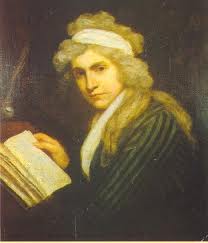
The other woman’s experiences constitute a testament to the strangeness of life in the 1790s. The Revolution had broken out, and the massacre of prisoners in September 1792 had scared off most expatriates. Yet one Englishwoman, a sufficiently unusual one that she worked as a freelance writer, headed for Paris to find out for herself what was going on and to send back a report to her publisher. Her name was Mary Wollstonecraft, and she was the author of A Vindication of the Rights of Woman.

Mary arrived in December 1792, only to find that the friends she had planned to stay with had left Paris. Fortunately, they left a message that she could live in their house on the rue Meslée (today the rue Meslay). Unfortunately, the servants were unhelpful (they put her in a remote room on an upper floor), and Mary’s spoken French was not very good. An unpromising start.

The rue Meslée was close to the Temple fortress, where King Louis XVI was imprisoned. Mary saw him pass in his coach on the way to his trial on December 26 (shown in the image below). She was frightened and disturbed by the event and wrote to her publisher:

I cannot dismiss the lively images that have filled my imagination all the day―Nay, do not smile, but pity me; for, once or twice, lifting my eyes from the paper, I have seen eyes glare through a glass-door opposite my chair, and bloody hands shook at me. Not the distant sound of a footstep can I hear. My apartments are remote from those of the servants, the only persons who sleep with me in an immense hotel… I wish I had even kept the cat with me! I want to see something alive; death in so many frightful shapes has taken hold of my fancy. I am going to bed―and for the first time in my life, I cannot put out the candle.

She was still staying in the house when Louis went to his execution nearly a month later.


Why didn’t she leave? For one thing, she had begun to make some new friends in the group of expatriates who gathered at White’s Hotel in the passage des Petits Pères. For another, she was invited to contribute to a plan for education in the new republic. And third, she fell in love with an American businessman, Gilbert Imlay. In the upheaval of the Revolution, life was precious and the normal rules of relationships did not apply. She embarked on an affair with Imlay.

By the summer, English residents of Paris were in danger. The English had denounced the execution of the king and the two countries were on the brink of war. Mary’s hosts from the rue Meslée owned a cottage just outside the city in Neuilly-sur-Seine, and sent her there, with a gardener to look after her. She lived in Neuilly during the summer of 1793, working on a book about the Revolution, and waiting for Imlay’s visits.

To visit Neuilly, he had to pass through the barrier in the wall that encircled Paris in those days. On his visiting days, Mary would go to meet him, and she later spoke of his “barrier face” ―his expression of pleasure at the sight of her.

Writing a book on the Revolution without being in central Paris wasn’t easy, but Mary was able to do some on-the-spot reporting when she visited the Palace of Versailles, now an empty, echoing shell, filled with ghosts:

How silent is now Versailles!—The solitary foot that mounts the sumptuous stair-case rests on each landing-place, whilst the eye traverses the void, almost expecting to see the strong images of fancy burst into life.—The train of the Louises, like the posterity of the Banquoes, pass in solemn sadness, pointing at the nothingness of grandeur, fading away on the cold canvass, which covers the nakedness of the spacious walls—whilst the gloominess of the atmosphere gives a deeper shade to the gigantic figures, that seem to be sinking into the embraces of death.

That autumn, she returned to live with Imlay in Paris in the St-Germain area (probably the rue Jacob). Shortly thereafter she became pregnant. To protect her, Imlay registered her as his wife, which gave her the status of an American citizen. (The United States supported the French Revolution, so she was no longer an enemy alien.) When all English residents were rounded up and imprisoned, she remained free, able to visit them and keep them in touch with the outside world.

The Revolution was good business for men like Imlay. He saw opportunities in rising prices and trade embargoes. When he moved his base of operations to Le Havre, Mary went with him. She finished her book there, and gave birth to a girl―officially named Françoise, but generally known as Fanny―in May 1794. The three lived together as a family for a few months before Imlay went to London on business and Mary returned to Paris.

Mary’s return journey to Paris was difficult (the coach overturned four times) and her future was uncertain. Although the Terror had ended in July 1794, most of her English friends had left the city after being released from prison. Mary had little money and single motherhood left her no time for work. That winter was also one of the coldest Paris had ever experienced―the Seine froze, food was scarce, and some Parisians starved to death.

Mary’s relationship with Imlay had become strained, and she suspected there was another woman in his life. Nevertheless, Imlay asked her to return to London.

Once again, why did she stay? Mary wanted to bring up her daughter in France. Although the radical feminism of the early Revolution had been crushed during the Terror, women in France were still better off than women in England. The tide of English public opinion had swung against equal rights, as part of a strong reaction to the Revolution. On balance, Mary felt that republican Paris offered greater freedom than repressive London.

But she had no money and no resources, so she gave in and reluctantly went back to England in April 1795. She must have regretted leaving Paris. Imlay had indeed met another woman, and Mary was so unhappy in London she attempted suicide. Twice.

Eventually, she met and married the writer William Godwin, and had a second daughter by him in 1797. But Mary did not live long after the birth of her second child, another daughter, christened Mary Godwin, who much later went on to elope with Percy Bysshe Shelley and write Frankenstein. But that is another story.

Mary Wollstonecraft is buried in London, but I suspect she left her heart in Paris.

Text copyright Philippa Campsie

Posted in Paris history | Tagged , , , , , , , , , , | 2 Comments