Notre Dame du Travail: more than meets the eye

If I had to pick only one place to visit on a trip to Paris, it would be Notre Dame du Travail. What makes it so special? It starts with the eye, but there is more than meets the eye.
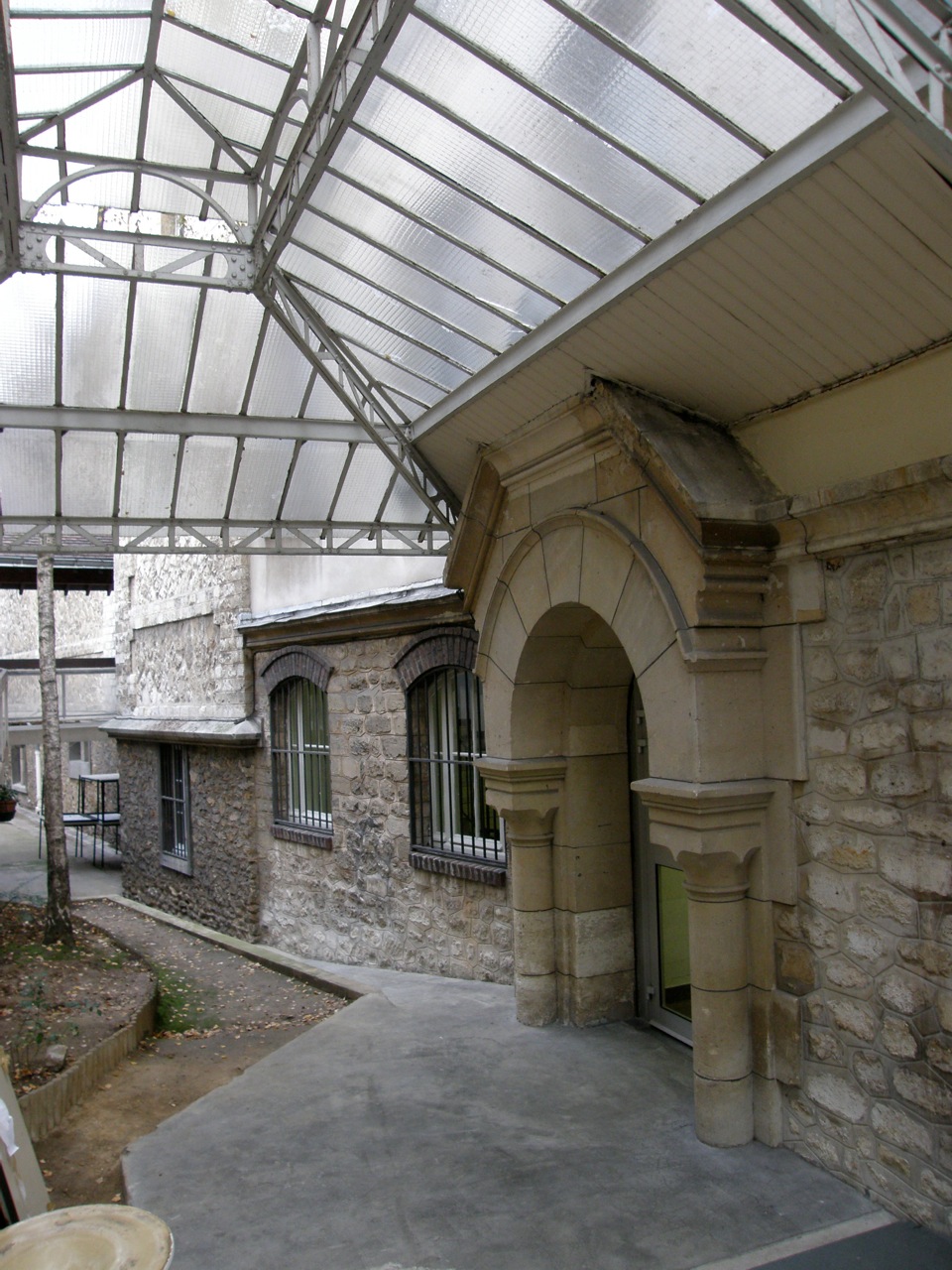
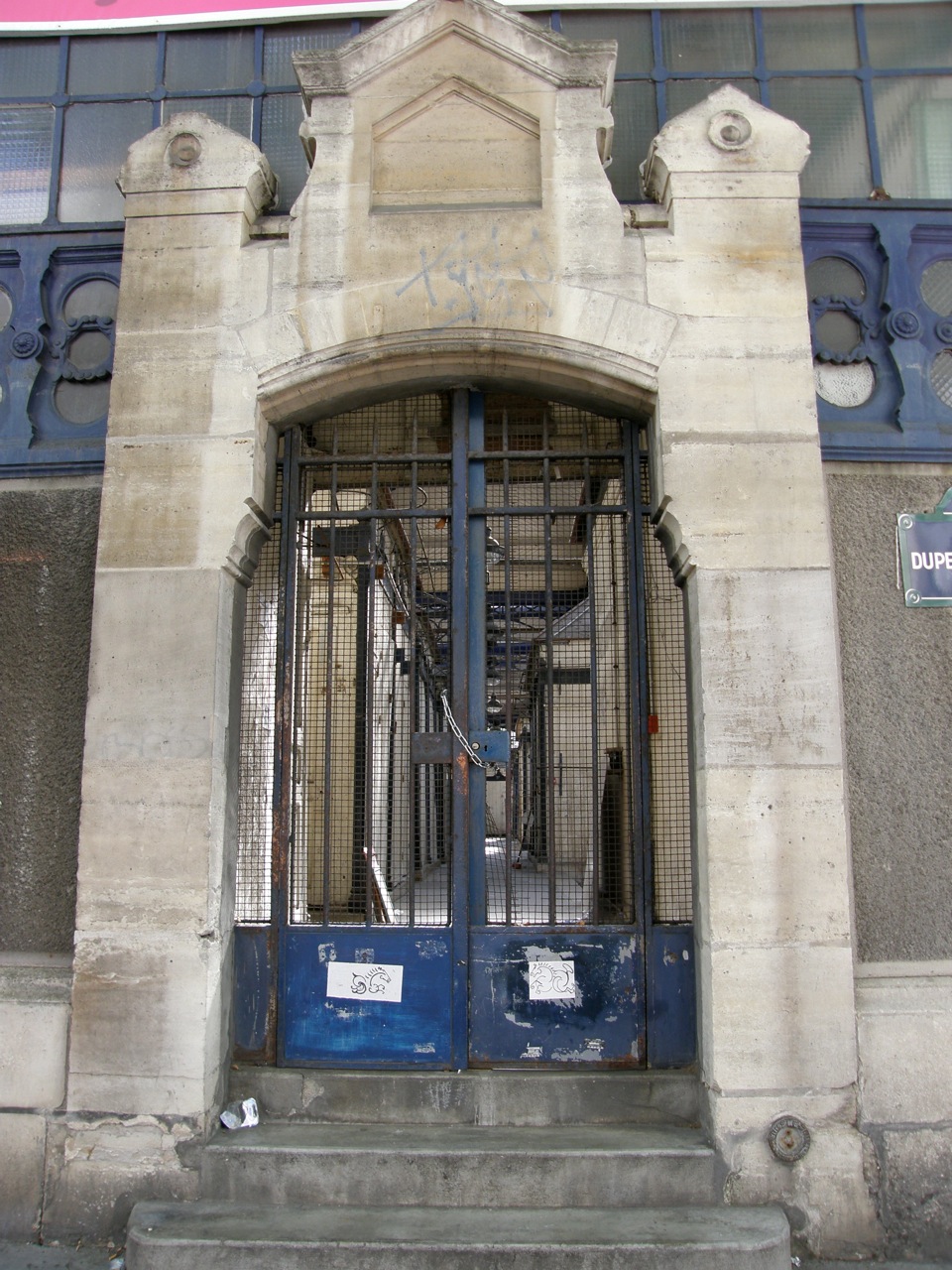
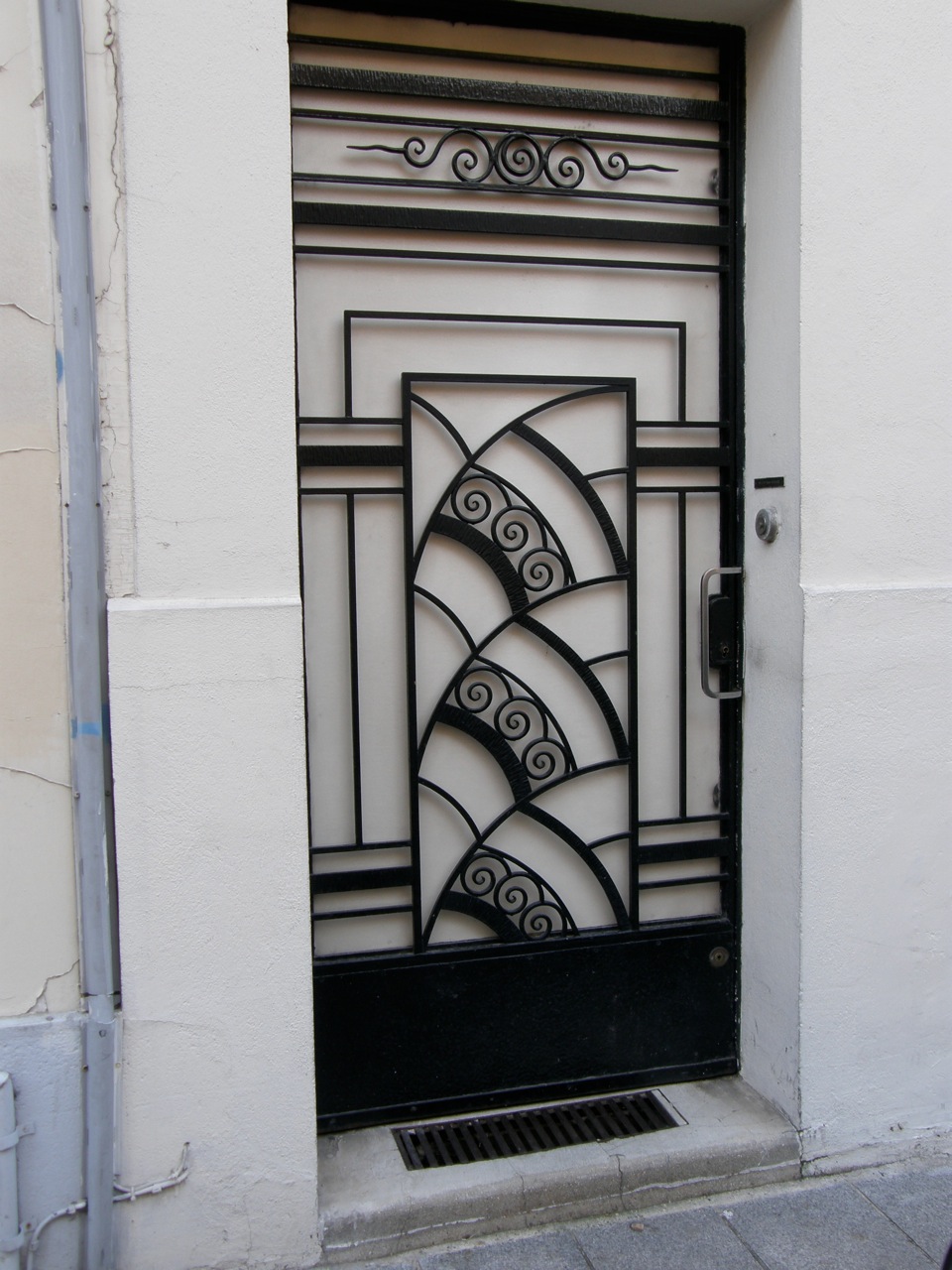
Philippa and I had rented a flat on rue de Gergovie in the 14th. On a beautiful mid-December day, I took a walk with no purpose other than to breathe in Paris. The entryway seen above struck me as beautiful, but not in the usual Paris way. It was not a grand entryway for those coming to worship or for tourists “doing Paris churches.”

Quite inadvertently, I had entered Notre Dame du Travail on the path taken by community members seeking a variety of services offered by a living church with a history of strong community involvement. It was a comforting and welcoming entrance. Only later did I understand it a bit more.

I am a historian of technology and design. So naturally some things caught my eye more than others. The rugged details and construction that I associate with industrial buildings were exciting, but at the same time reassuring. As I entered the sanctuary, I felt as if I were coming home, or coming to somewhere I belonged. It was a curious feeling.
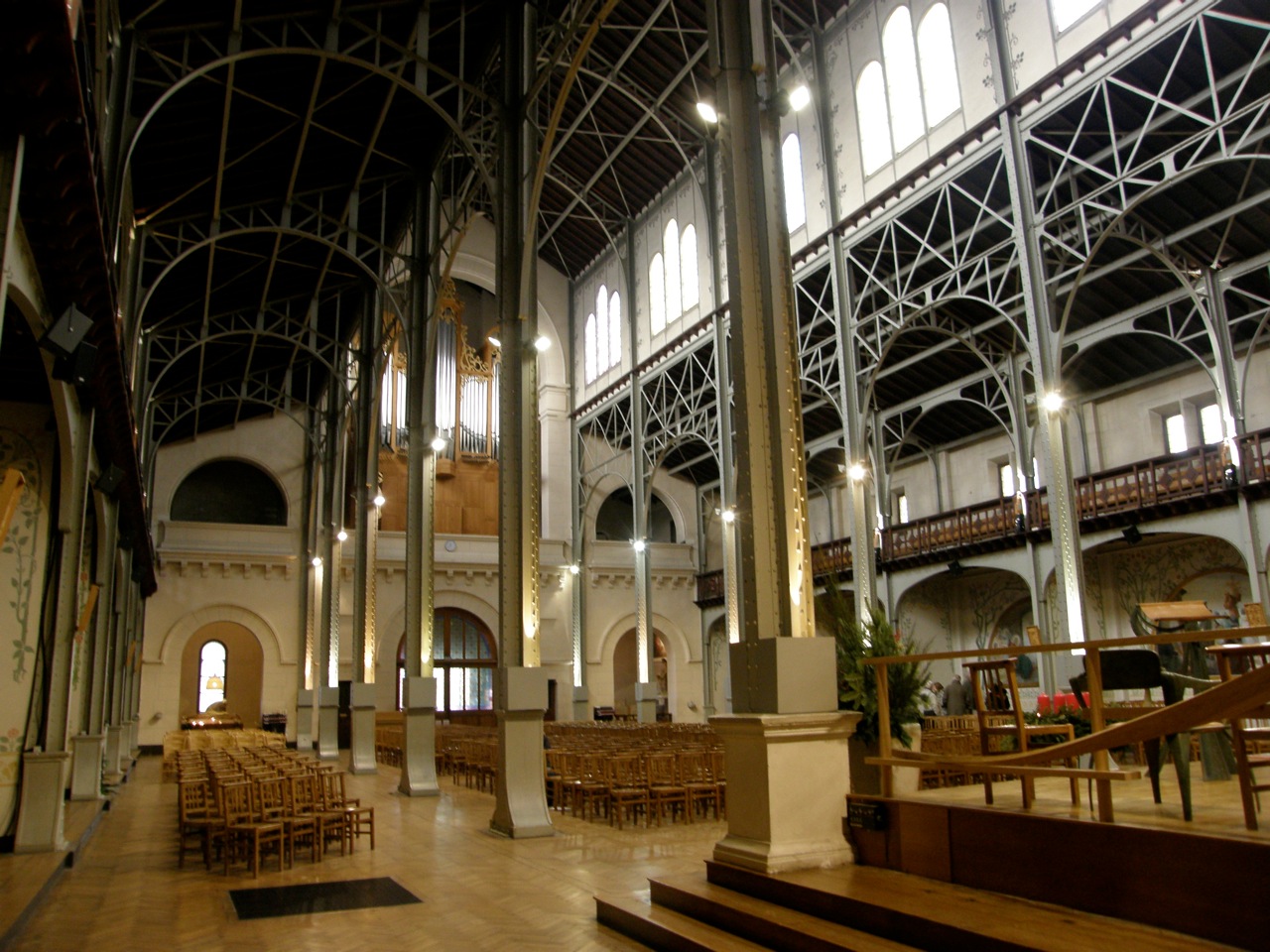
I was alone, not in a rush, and the views and details did not intrude too quickly.
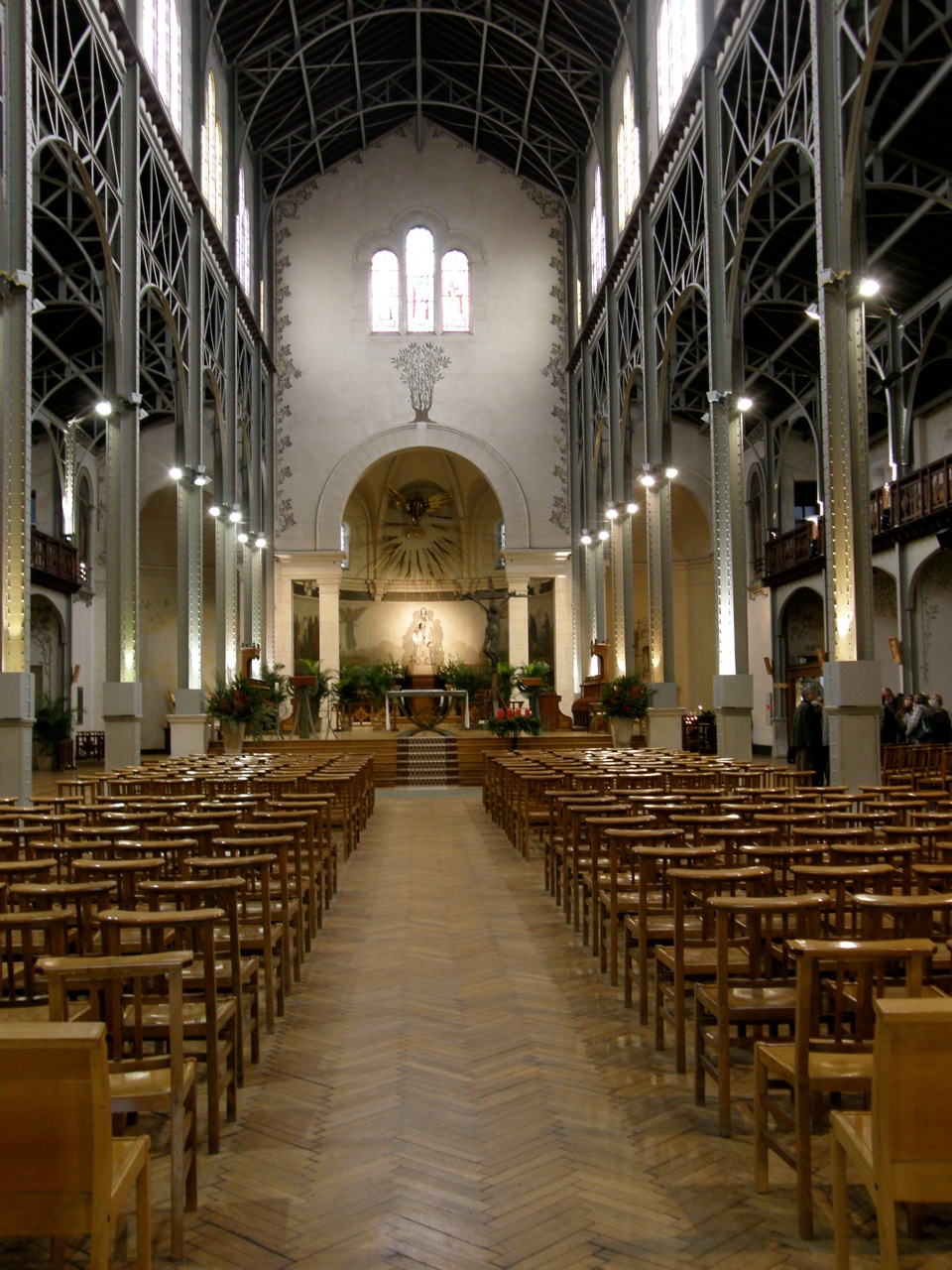
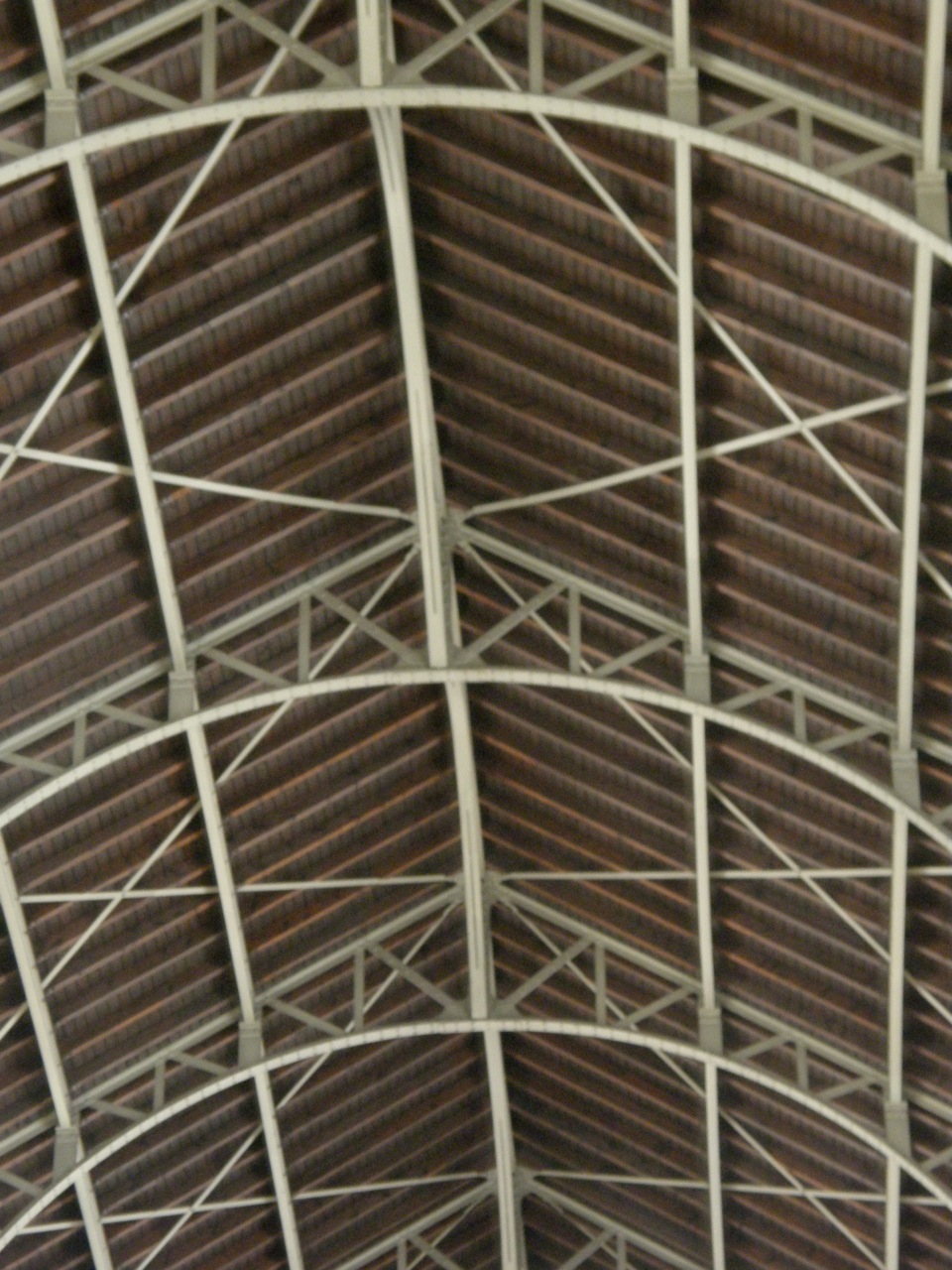
Had I come through the grand entryway of the front door, this magnificent scene would have welcomed me. Many things caught my eye, but most of all the strength and grace of the exposed structural steel.
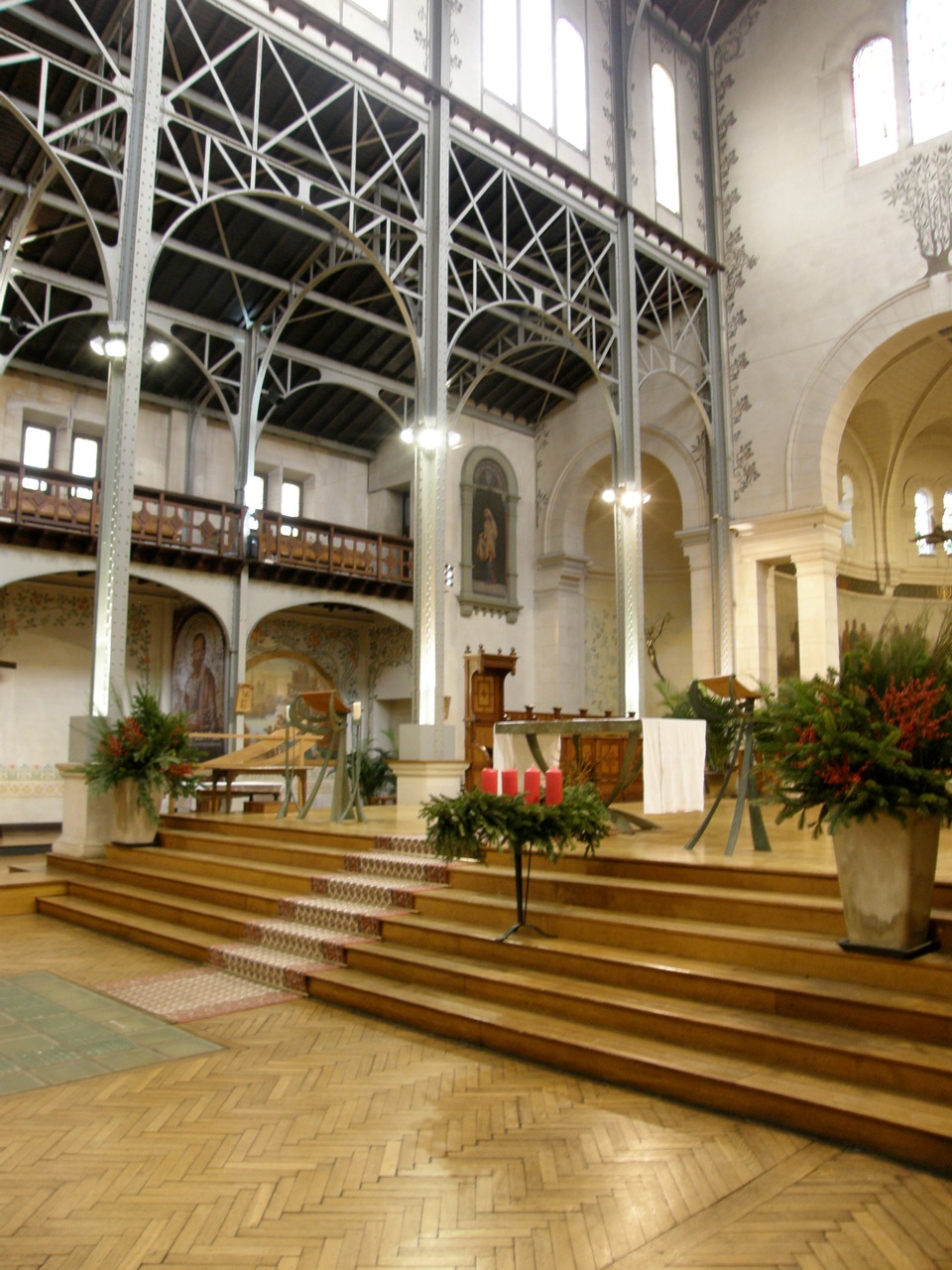
Unhurried, I walked into the church. As I looked back towards the nave, I was captivated by the elegance of all that I saw.
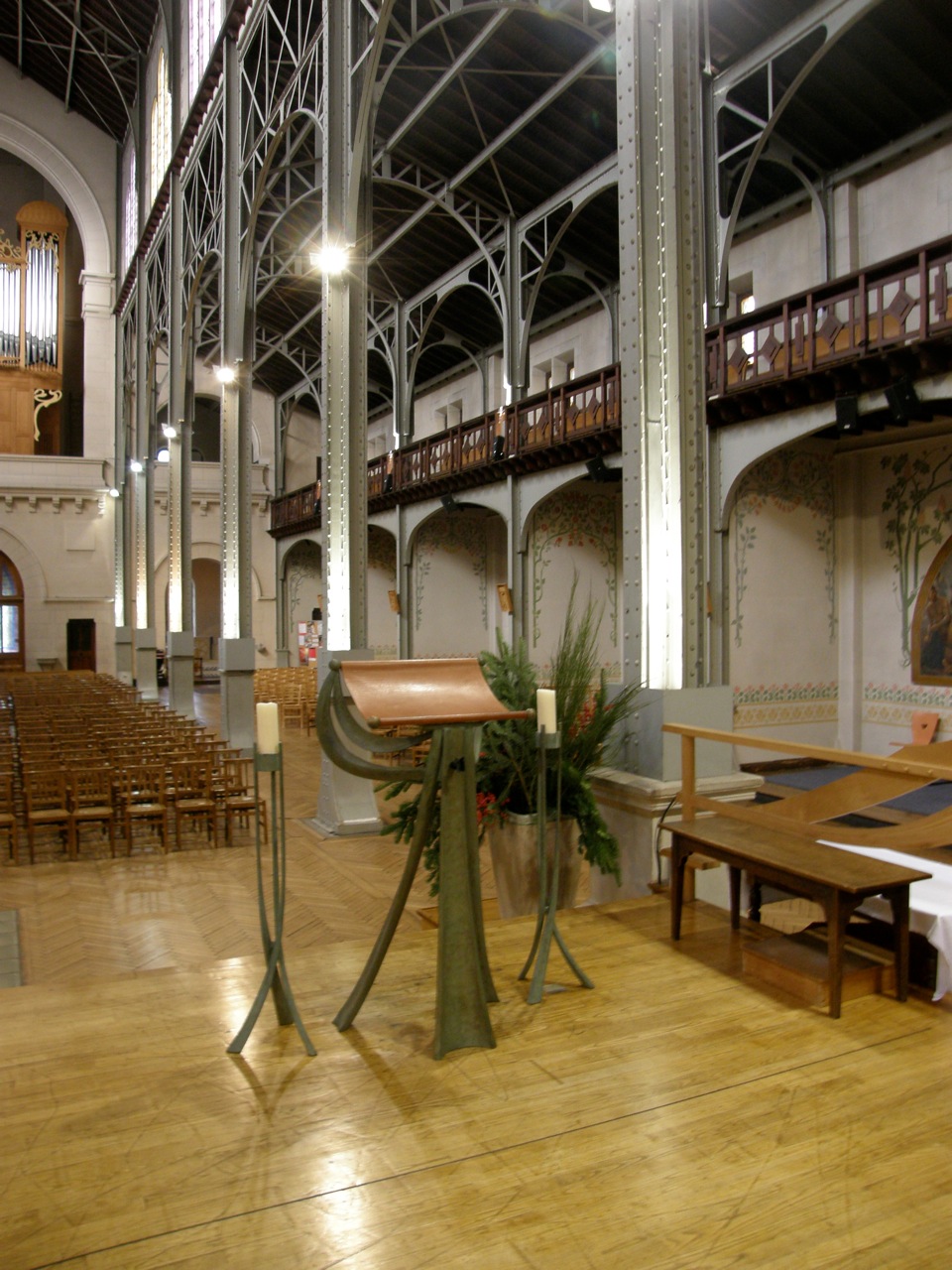
Here I am looking towards the aisle and the front of the church. Details slowly crept up on me as I focused more closely. The elegant lectern held my attention, as did the quiet side chapels with their beautiful artwork.

I grew aware of an art nouveau organ cradled between stone and structural iron. I have a fondness for art nouveau, but it was if I was seeing art nouveau for the first time.

I have since learned more about the church that so captivated me.

When the Montparnasse Railway Station in the Plaisance quartier opened in 1840, it marked the beginning of rapid growth and change in this part of Paris. The local parish was known as Notre Dame de l’Assomption de Plaisance. When the quartier became part of Paris in 1860, the parish was renamed Notre Dame de Plaisance.

Montparnasse was a gateway to Paris, and the parish struggled to help meet the needs of an ever-increasing number of working-class residents.

Perhaps no one was better suited for the task of leading this growing parish than the abbé Soulange-Bodin, who was appointed vicar in 1884. Twelve years later (1896), he was appointed parish priest (curé) of the parish of Plaisance. Father Soulange-Bodin was clearly a compassionate man with great love for his often poverty-stricken parishioners and a reputation as a crusader for social justice. More important, he could hold a large vision and combine it with a canny understanding of the times.

He asked questions. Why should the 35,000 parishioners who lived and toiled in the centre of industry not have a church befitting them? In a faubourg of 35,000 workers, why not have a church inspired by their workplaces and the materials—iron and wood—that they handled daily? Why not, in anticipation of the rapidly approaching Grand Exposition of 1900, have a church to welcome the many workers who would come first to build it and then to visit it? Why not a national campaign to build a church to honour the workers of France in a parish composed almost entirely of workers?

Indeed, why not? Money came from many quarters.

What about the design? Although the Eiffel Tower, built in 1889, was still controversial in the late 1890s, it had advanced the image of Paris as a city of iron. It had also highlighted those who erected great works in iron. The well-chosen architect, Jules Astruc (1862-1935), spoke the language of inspiring structural ironwork. He embodied the strong links between French architecture and engineering (one reason why Paris has such wonderful bridges). Above all, the new church had to show respect for those who worked with their hands and were often ill-rewarded for their strengths, skills, hard work, and dedication.

Perhaps I was taken by the church because of my background and upbringing (my father was a miner, then later a carpenter and construction superintendent). But that is a small part of the story. It is less about me than about Father Soulange-Bodin, architect Astruc Jules, and the people they served.

Here the dramatic lighting makes an homage to strength and beauty.
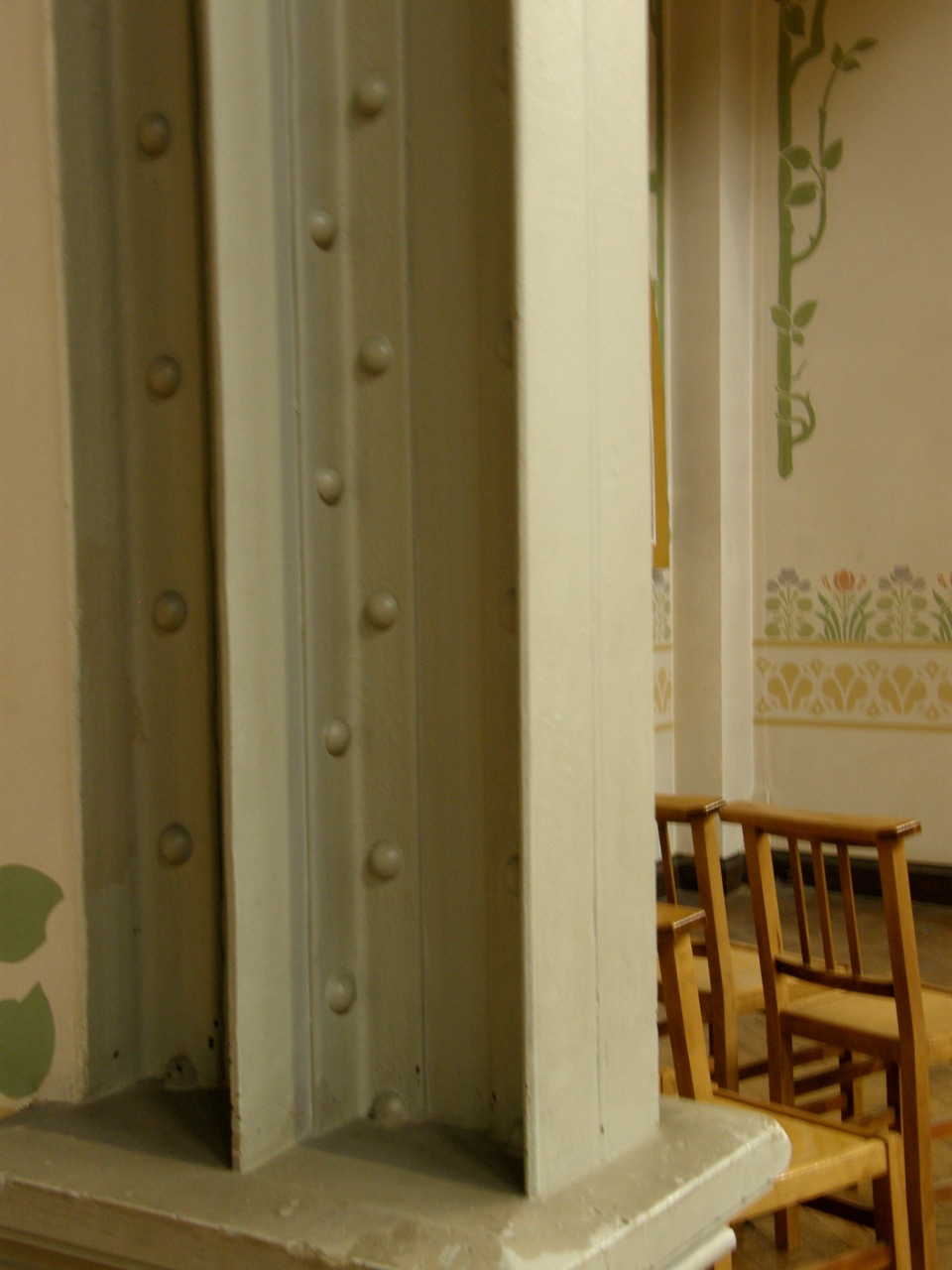
From another point of view, the same material seems so soft and welcoming to the warmth of the art nouveau stencil work.

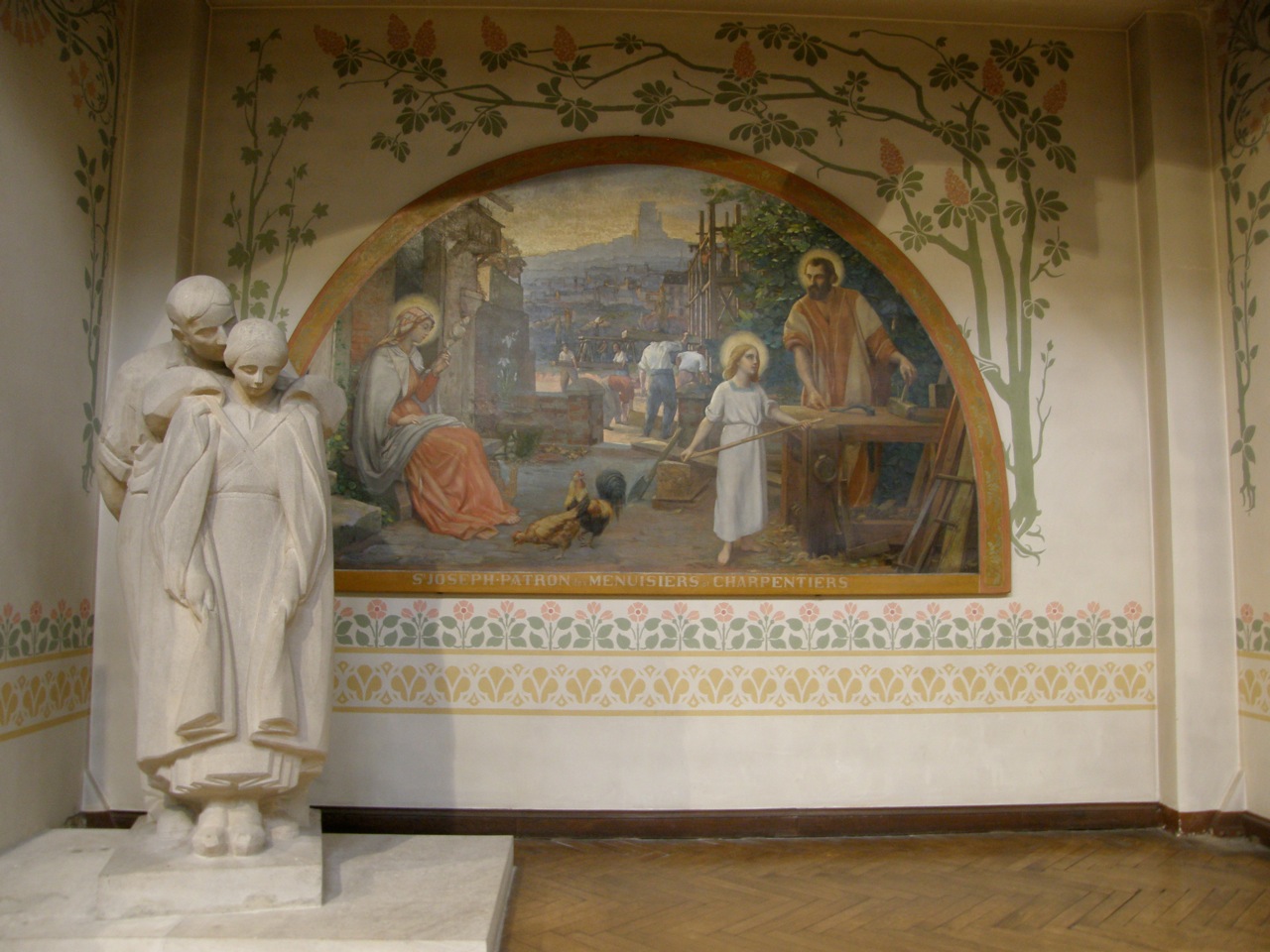
Notre Dame du Travail is much more than 135 tonnes of iron and steel leavened by respect for workplace materials and forms. Father Soulange-Bodin also wanted to elevate and inspire parishioners through other means. Thus the much-admired art work such as that below.
As I walked out of the church, through the door that one might normally enter, I was struck once again by this church as part of a real, living community. From the front door I could see children playing in a playground and I thought of continuity. Yes, these were the children of more prosperous families than those who had once lived here. Many poor families were displaced when the 4,400 lodgings around the Gare Montparnasse were torn down in the 1960s in a bout of “urban renewal.” But new dwellings were built and Notre Dame du Travail still serves many who need help.
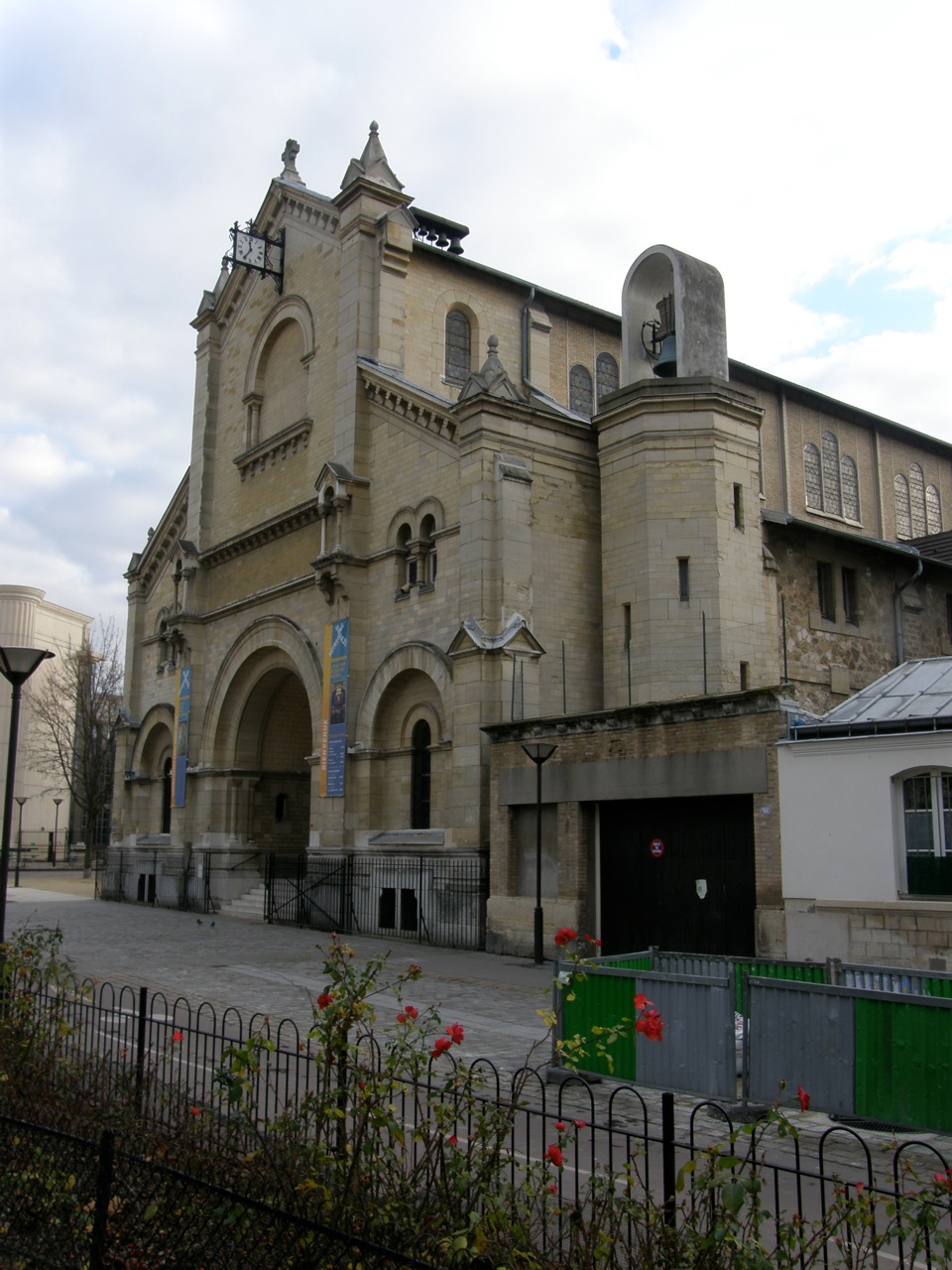
As I stood outside the front of the church I wondered how many people walked by its traditional front façade and failed to realize the drama inside. How close did I come to missing it? I had been attracted by a different and, to me, more interesting entryway.

On a later visit to Paris, Philippa and I were at the Gare St. Lazare. As usual, I was wandering about in dreamy contemplation of design, materials and details. As I gazed at the geometric patterns of the dramatic glass and iron roofs I wondered how many of those who built and maintained them had lived in the 14th.
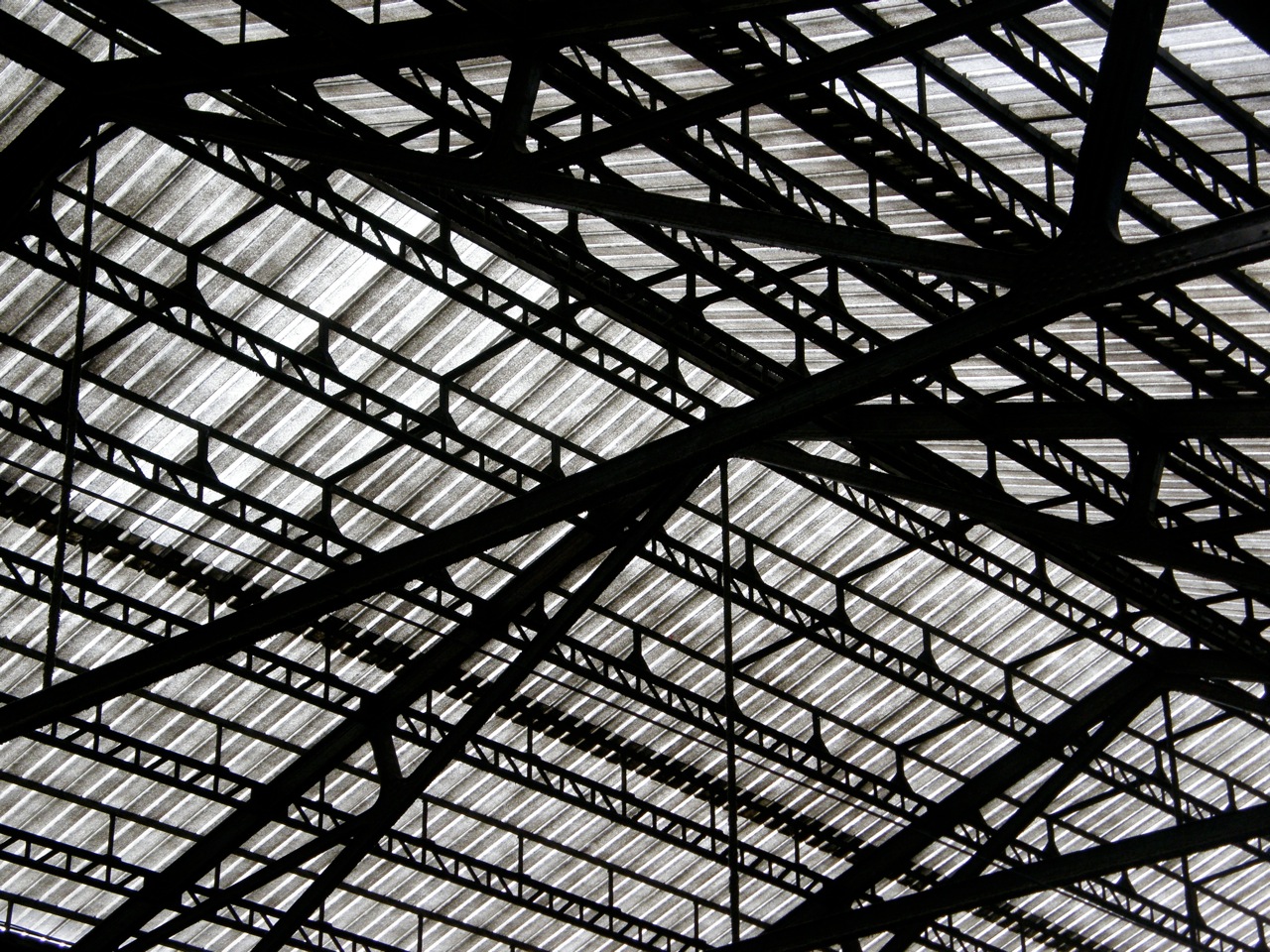
I thought back to another roof and thanked Father Soulange-Bodin and Jules Astruc for giving me the privilege of seeing the material embodiment of his respect for others and me a new way of looking at the roof of a grand railway station.

It was not easy being poor and we should not glamorize it, but nor should we say there is no place for beauty in poverty. In a wonderful railway station, the memory of a church reminded me of the important place that the quest for beauty and dignity occupy in my life.

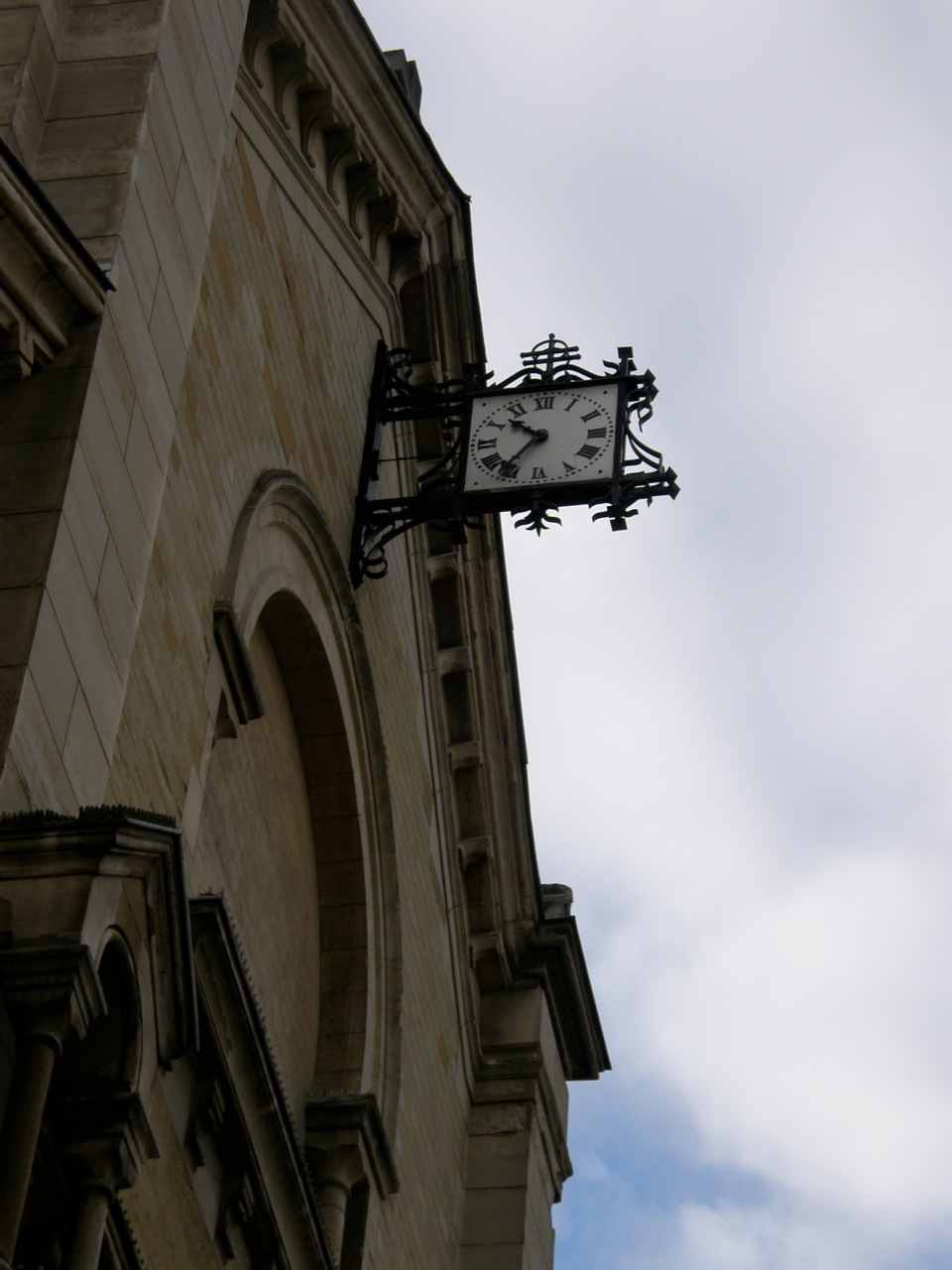
Let me end with the roof on the inside and the clock (a gift of emperor Napoleon III to the parish for the previous church on the site) on the outside of something I love and I think I understand.
Text and photographs by Norman R. Ball

Posted in Paris churches, Paris history, Paris quartiers | Tagged , , , , , , , , , , , , , , | 14 Comments

Leeks Vinaigrette

I have my favourite French food writers, but among my best-loved cookbooks are those by Canadian food writer Lucy Waverman and the English Nigel Slater. Recently, I came across the following words by Slater that got me thinking:

Sourness in the kitchen is underrated. It took me years to realize this. A bite of sharpness in a sauce or a salad dressing can bring food to life, making it sing in the mouth. … what is especially useful is vinegar’s ability to help adjust the seasoning of something that is too rich, too sweet, or too cloying. This alone makes it an essential kitchen ingredient (Appetite, p. 86).

It’s interesting that he took a long time to figure it out. I sense that French cooks know this secret from early on. Vinegar is an important staple in French kitchens.

After all, the guild of vinegar-makers (vinaigriers) received royal recognition in French in the 14th century. The trade was centred on the town of Orléans, but the rue des Vinaigriers in Paris (near the Canal St-Martin) suggests that there were vinegar makers in Paris too. Today, the one remaining traditional vinegar maker based in Orléans is Martin Pouret (founded in 1797).

Slater recommends maintaining a small selection of vinegars in the pantry, and singles out red wine vinegar as the best all-round choice, but he also makes room for white wine vinegar, tarragon vinegar, sherry vinegar and balsamic vinegar (the French take on balsamic, Banyuls, is hard to find outside France).

The Martin Pouret website also distinguishes between “Les Essentiels” (several types of wine vinegar, tarragon vinegar, plus cider vinegar and vinegar containing minced shallots) and “Les Tentations” (special wine vinegars made from Muscadet, Cabernet Franc et Chardonnay, citrus and raspberry vinegars, and – this I have got to try – vinaigre de vin aux coquelicots sauvages de Nemours/wine vinegar with wild poppies from Nemours). There are also some vintage vinegars aged five to seven years.

We go through vinegar pretty quickly in this household. There’s our favourite Pork Chops Piquant and a good chicken in vinegar recipe from Laura Calder’s French Food at Home (she says she got it from cooking teacher Anne Willan of La Varenne).

The Paris publishing house Editions de l’Epure has published at least two of their exquisite little cookbooks on vinegar. These cookbooks features ten recipes each, focusing on an ingredient (oysters, lavender), a food type (soups, risottos), a colour (pink foods, yellow foods), a local specialty (sel de Guerande, fromage St-Nectaire), or a theme (earth, air, fire, water). The vinegar books feature sherry vinegar and balsamic vinegar. The photograph below shows the interior of the Editions de l’Epure office at 25, rue de la Sablière in the 14th arrondissement.

We have the little cookbook on sherry vinegar, by Alberto Herráiz, the Spanish chef at the Restaurant Fogon in the 6th arrondissement. His chosen ten recipes include one for small chocolate cakes (cupcakes, really) made with sherry vinegar. I’ve never made it, but stay tuned.

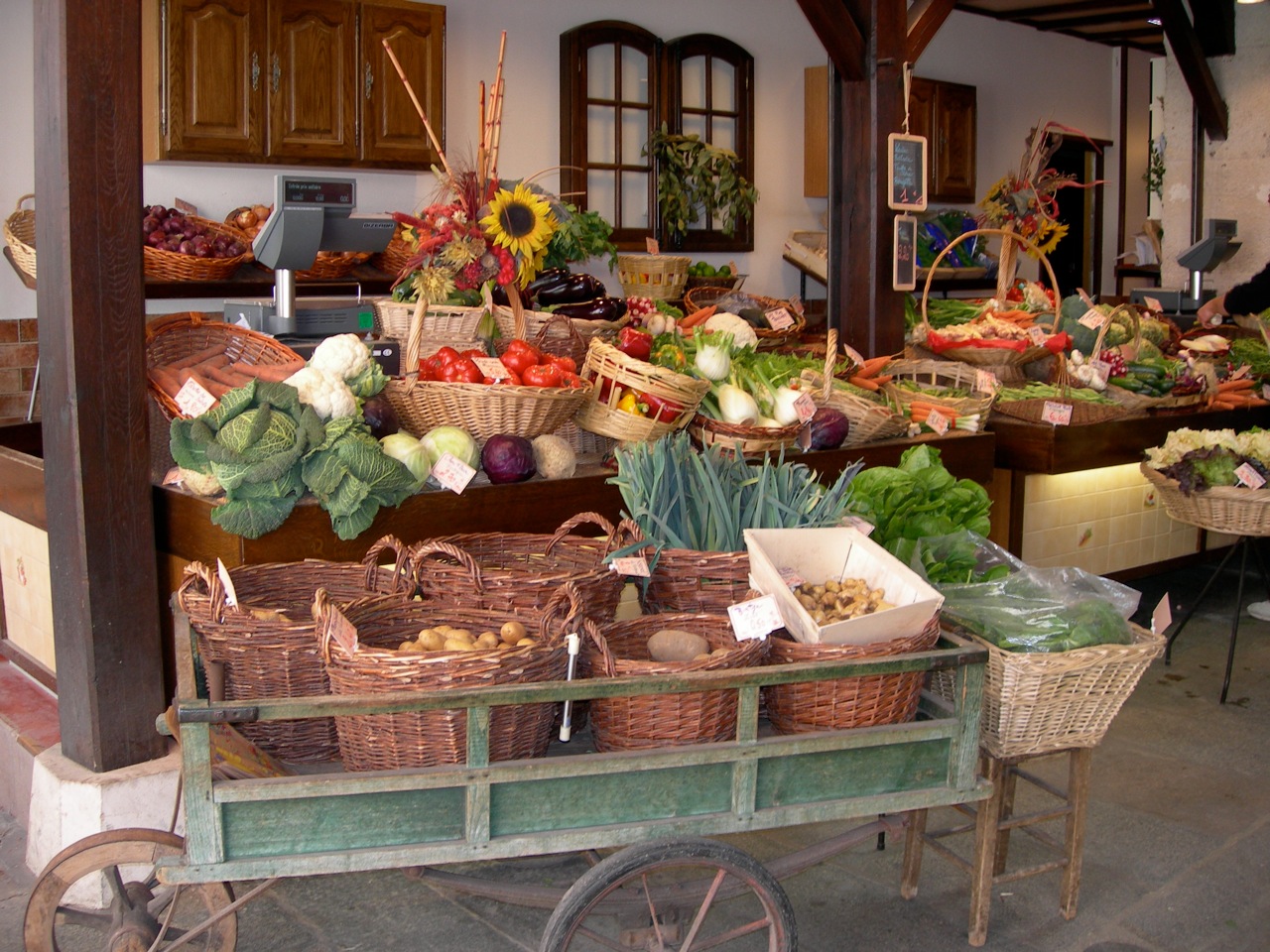
And then, of course, are all the things you can do with vinaigrette. Salad dressing is only the beginning. It can be even better on warm veggies, such as leeks. Leeks vinaigrette (poireaux vinaigrette) can be served as an appetizer or a side dish. The simplest versions call for leeks, white wine vinegar, olive oil, shallots, and Dijon mustard, but you can add other things. Laura Calder’s version calls for lemon and grated Parmesan cheese, for example, and Molly Wizenberg suggests adding finely chopped bacon or crumbled hard-boiled egg.

That’s all very well, but the crucial thing is just to get the vinaigrette right, and that means experimenting. Some people swear by a three-to-one ratio of oil to vinegar, others favour two-to-one or even one-to-one, but it all depends on the ingredients. And choose your mustard carefully. Last time we used a bright green Maille mustard (it contains chives, parsley, and basil), and the taste and colour went wonderfully well with the leeks. Finally, choose slender leeks. Supermarket leeks can be as thick as a tennis racket handle and have as much flavour.

Here’s the recipe for two people:

1 to 1½ tbsp. white wine vinegar
1 tsp. Dijon vinegar
3 tbsp. olive oil
Minced shallot (about half a shallot)
6 slender leeks

Make the vinaigrette by mixing the first three ingredients. The easiest approach is to put them in a jar with a tight-fitting lid and shake it vigorously. Test, and make adjustments to the ingredients according to taste. Then add the shallots.

Bring a pot of salted water to a boil. Trim off the hairy ends of the leeks (but not so far up that the leeks fall apart) and remove the hard dark green leaves. Make one or two lengthwise cuts so that the leeks fan out at the top, but not all the way through, so they remain held together at the bottom. Wash away any soil or sand and boil in the salted water for about 10 minutes. Strain, then put the leeks in a bowl and toss with the vinaigrette. Serve warm.

With the green mustard, it tastes of spring. Here in Canada, we could use a little more of that.

Text by Philippa Campsie; photographs by Norman Ball. (The markets shown are Montorgueil and Beauvau.)

Posted in Paris food, Paris markets | Tagged , , , , , , , , , , , , , , , , , | 1 Comment

Goosebumps

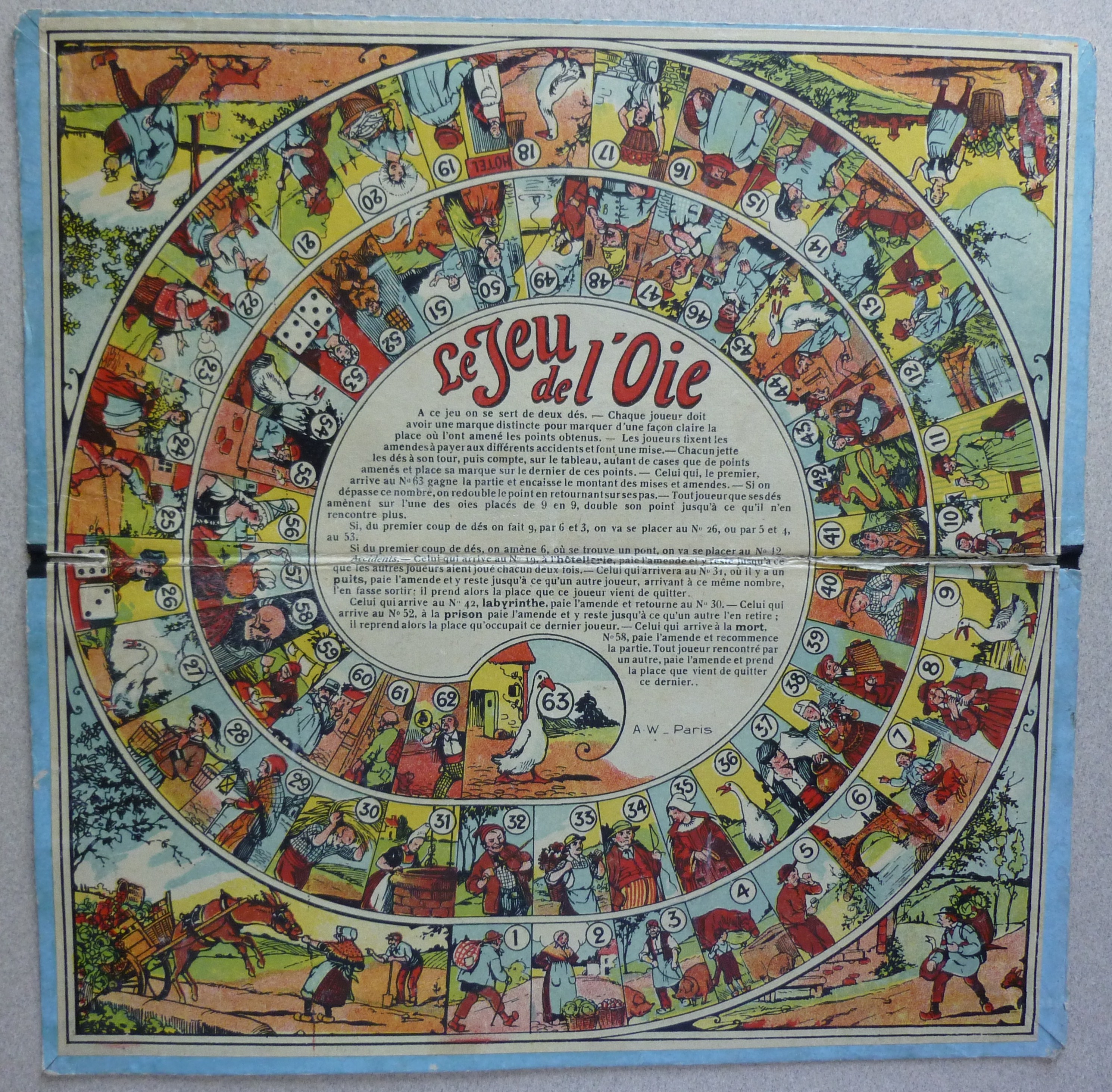
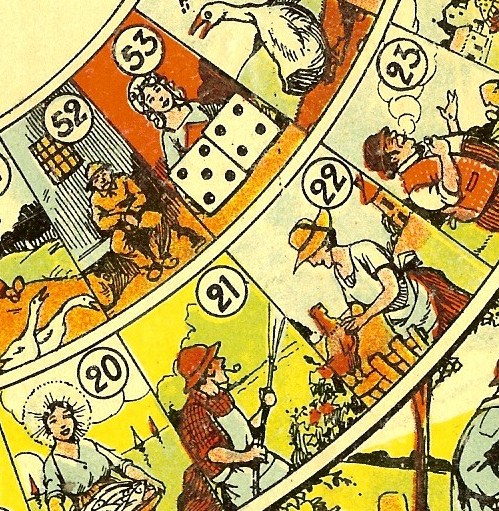
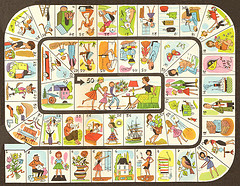
One day, at a flea market, I bought an old board game called Le Jeu de l’Oie (the Game of the Goose). I was attracted to it because I had seen a reproduction of a similar board in a newspaper around that time and wanted to know what it was and how it was played. Here’s what my flea-market version looks like.

It’s a square 10 inches by 10 inches, on a thin cardboard backing, and the maker is shown only as “A.W – Paris.” I have no idea how old it is.

This version of Le Jeu de l’Oie is distinctively French-looking, with images of rural characters in traditional garb and lots of pictures of food. As in Snakes and Ladders, the players are trying to reach the final place on the board (No. 63) and are subject to snake-like setbacks (called “accidents”) or ladder-like advancement (you get two turns whenever you land on a picture of a goose). But there’s a difference, because you have to pay fines and put up some sort of “stake” – money or matchsticks or counters – that the winner collects at the end of the game.

Here is a fairly free translation of the instructions printed in the middle of the board.

For this game, you need two dice. Each player needs a distinct piece to mark progress around the board. The players fix the fines to be paid for different accidents and each puts up a stake. Each player throws the dice in turn and moves his or her piece forward the number of places shown by the dice.

Whoever arrives exactly at the 63rd box wins and takes the stakes, plus any fines. If the number shown on the dice takes the player past No. 63, he or she retreats the number of excess spaces.

Any player who lands on one of the geese placed at every ninth spot on the board gets an extra throw.

If a player, on the first throw, gets a 6 and a 3, he or she moves immediately to No. 26, and if he or she throws a 5 and a 4, to No. 53.

If a player, on the first throw, lands on No. 6, which shows a bridge, he or she moves to No. 12.

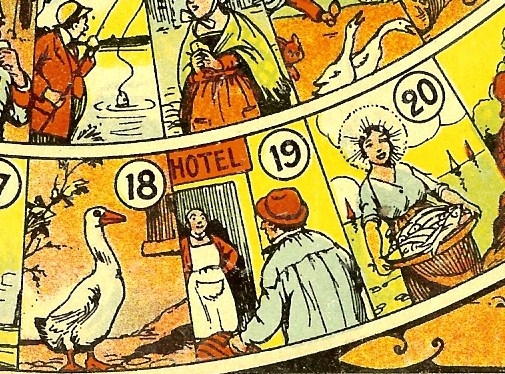
Accidents: If you land on No. 19, the inn, you have to stay, that is, pay a fine and miss a turn.

If you land on No. 31, the well, you have to pay a fine and wait until another player comes to the same place; at which point, he or she takes your place.

If you land on No. 42, the labyrinth, you pay a fine and return to No. 30.

If you land on No. 52, the prison, you pay a fine and wait until someone else lands on the spot; that person will replace you in prison.

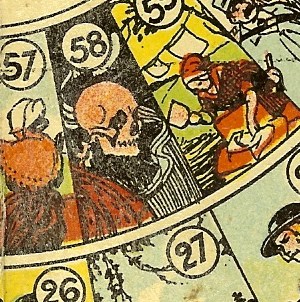
If you land on No. 58, death, you pay a fine and return to the start.

If you land on a number occupied by another player, he or she pays a fine and takes the place that you had started from on that turn.

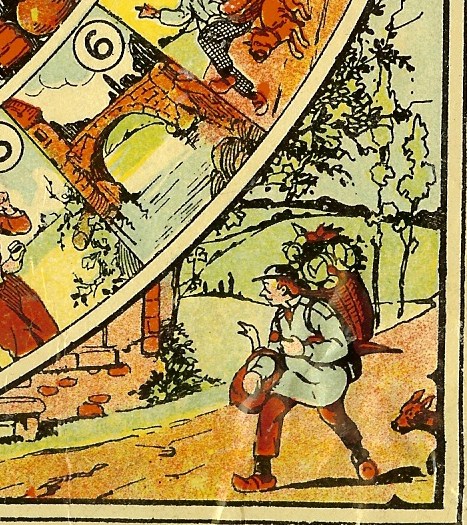
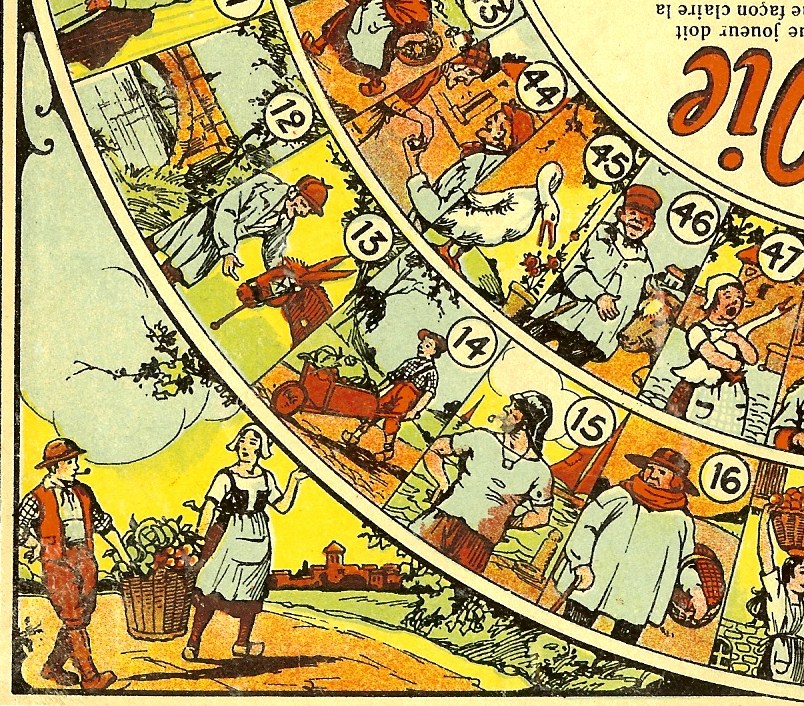
The flea market board is more detailed than some other versions, which have illustrations only in the places that matter – the bridge, the inn, the well, the prison, the labyrinth, death, the geese. I love the wealth of detail on this version, including the illustrations in the corners.

According to a website devoted to the game, it originated in the 16th century in Italy (although the Italians apparently got the idea from the ancient Greeks), and versions have been created in all kinds of countries, including China and Japan. It seems to have been well known in North America in the 19th century. There is even an example in Canada’s virtual museum.

So I wonder why I had never seen it before. Clearly, though, it persists in France, and modern versions are available in toy stores.

Le Jeu de l’oie is to French people what Monopoly is to North Americans. Most North Americans immediately understand what it means to “land on Park Place” or the implications of that immortal phrase “Go to Jail. Go directly to Jail. Do not pass Go. Do not collect $200.” Similarly, the French seem completely attuned to the perils of the goose game and the term appears in newspapers and magazine articles as a synonym for a game of chance.

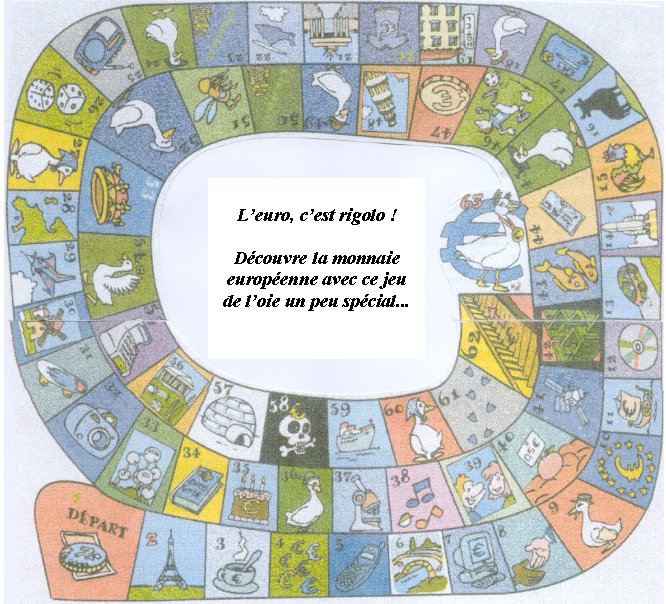
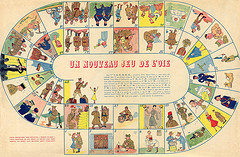
If you search online for images of the French game, you will find versions pressed into service to make political points or raise AIDS awareness or teach children about everything from arithmetic to geography.

One can imagine collecting multiple versions of the game, and I’ve no doubt that somewhere out there, somebody does just that. There are so many iterations that one could spend a lifetime tracking them all down. I think I will just stick with my flea market version. We have, after all, only so much house room.

All I need now is some dice, some counters, some markers, and a partner. Norman, what are you doing this evening?

Text and original photographs by Philippa Campsie

Posted in Paris flea markets, Paris nostalgia, Paris popular culture | Tagged , , | 5 Comments

A tricycle built for work

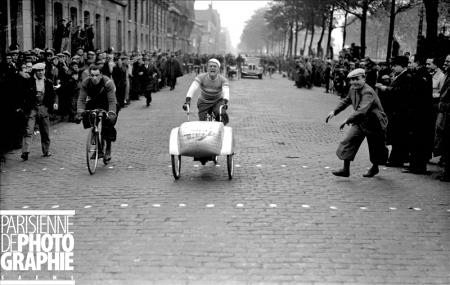
Head down and shoulders hunched, the lead cyclist pedals furiously through the streets of Paris. He is barely a cycle’s length ahead of his closest pursuers. Anxious onlookers line the streets. We are not witnessing the final moments of the Tour de France: these are tricycles racing through the streets of Paris in 1940.

This astounding photo from the Roger-Viollet Collection captures the energy, speed and grim determination one expects in bicycle races. On the image below, from the same collection, look at the expression of joy and agony combined on the face of the tricyclist crossing the finish line.

Now look more closely at the two photos. Those racing in the first photo look like everyday working delivery cycles. Whereas the cycle in the second photo (taken in 1939) looks built for speed, with its streamlined fairing and fenders. It does not take too much imagination to link this streamlining with that of some ultra-powerful prewar racing cars.

The furiously racing tricycles seem far from the more relaxed image below.

The word tri-porteur translates as a “delivery tricycle” and is usually spelled as one word. The triporteurs made by the Paris firm of Alexandre & Juéry appeared to be particularly sturdy, as did the cyclist who is dressed in traditional work garb. The company sold, rented, and repaired triporteurs in addition to manufacturing them. They also issued a catalogue – one I would love to see. Trade catalogues from this era and earlier are generally both colourful and informative. This one shows a splendid image of an important commercial vehicle.

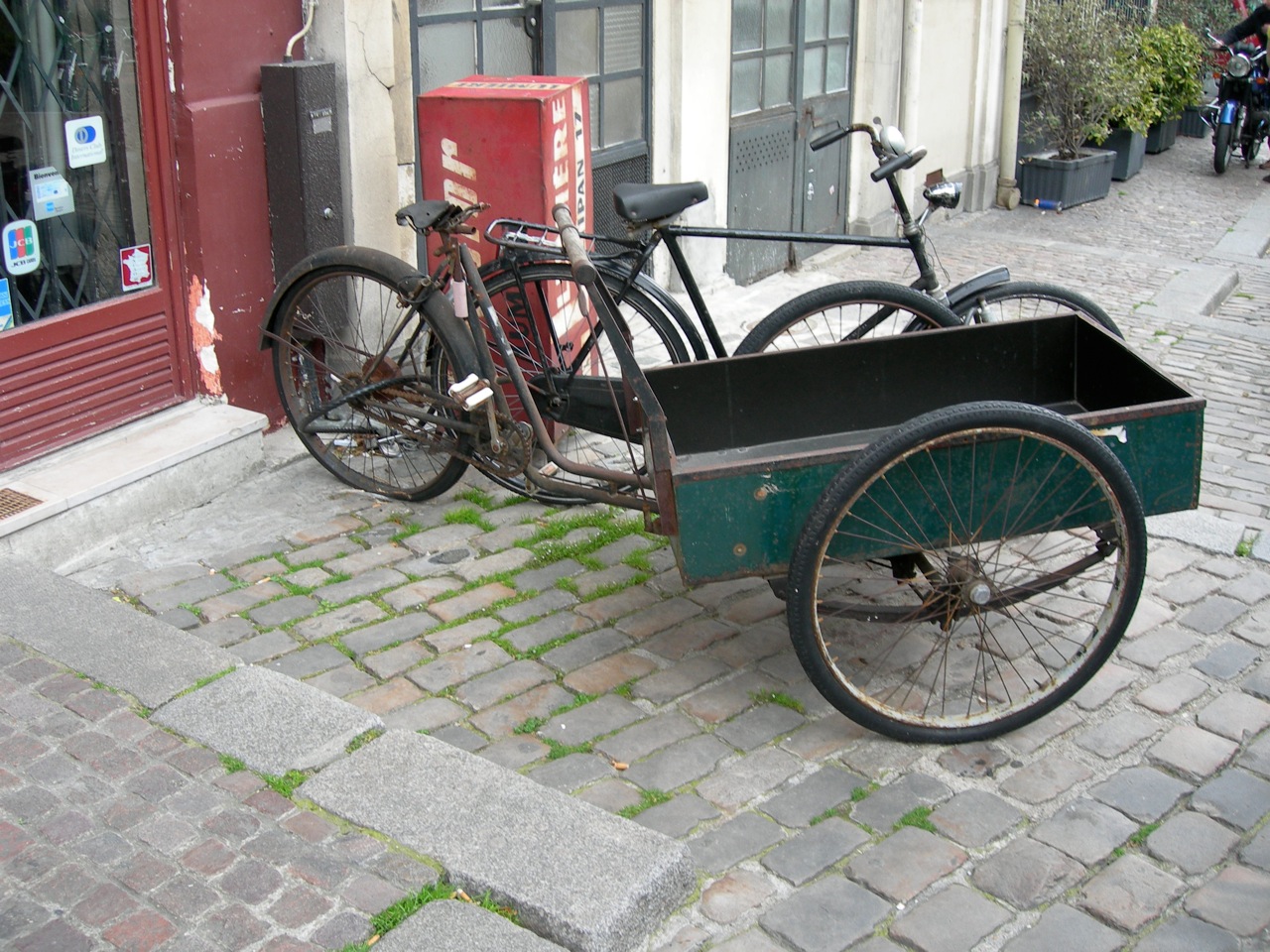
If we regard triporteurs as pedal-powered workhorses, then the one I photographed in April 2006 in front of an antique store is a bit knackered, maybe only a few steps from the glue factory. But let us hope it has found a good owner who has restored it to former glory. It and the advertisement from Alexandre & Juéry show some of the essential features of delivery tricycles.

Both have a long, low-slung frame. The weight of the driver and the distance from the front wheels help stop the tricycle from pitching forward and upending if it hits a bump or if the box is unevenly loaded. Each tricycle has a box mounted on two wheels. While driving, the cyclist holds onto the handle attached to the box and for steering the carrying box and front wheels pivot as a unit.

In both triporteurs the box is mounted on leaf springs to which the axles are attached. This simple suspension system is an important feature that reduced the severity of bumping, bouncing and generally being jarred on cobblestoned streets or other rough surfaces. This made for a smoother, more comfortable, and safer ride. But what about stopping?

In the Alexandre & Juéry ad we see no evidence of a front brake nor do we on the triporteur I photographed. A front brake would be suicidal: with a heavy weight on the front if the front brake were applied the least bit hard the rear wheel would lift and the rest needs no explanation. Nor is there any evidence of an external rear brake in the ad; we must assume that it is a coaster brake and that one simply pushed back on the pedal to stop. It could be quite a task with a heavy load. Perhaps that is why the triporteur I photographed had the mechanically operated brake we see above on the back wheel. At the time it was a tad rusty but this was meant for heavy-duty work.

Recall that Alexandre & Juéry had their shop at 18, Rue Rambuteau. Not far away, number 79 housed the fishmonger shown in this wonderfully rich street photograph. The wealth of period detail gives us good reason to linger over this photograph. The two-wheeled handcart is a reminder of the hard physical work of getting things from place to place. But the triporteur used by the fish delivery boy remind us that triporteurs are work vehicles.

At the time, there were also pedal-powered wheeled vehicles called tricycles – the word is the same in French and English – but they were pleasure vehicles.

Where are the worthy successors to these Parisian delivery tricycles? Must they be pedal-powered? The 1912 photo shown below demonstrates there were early electric models as well.

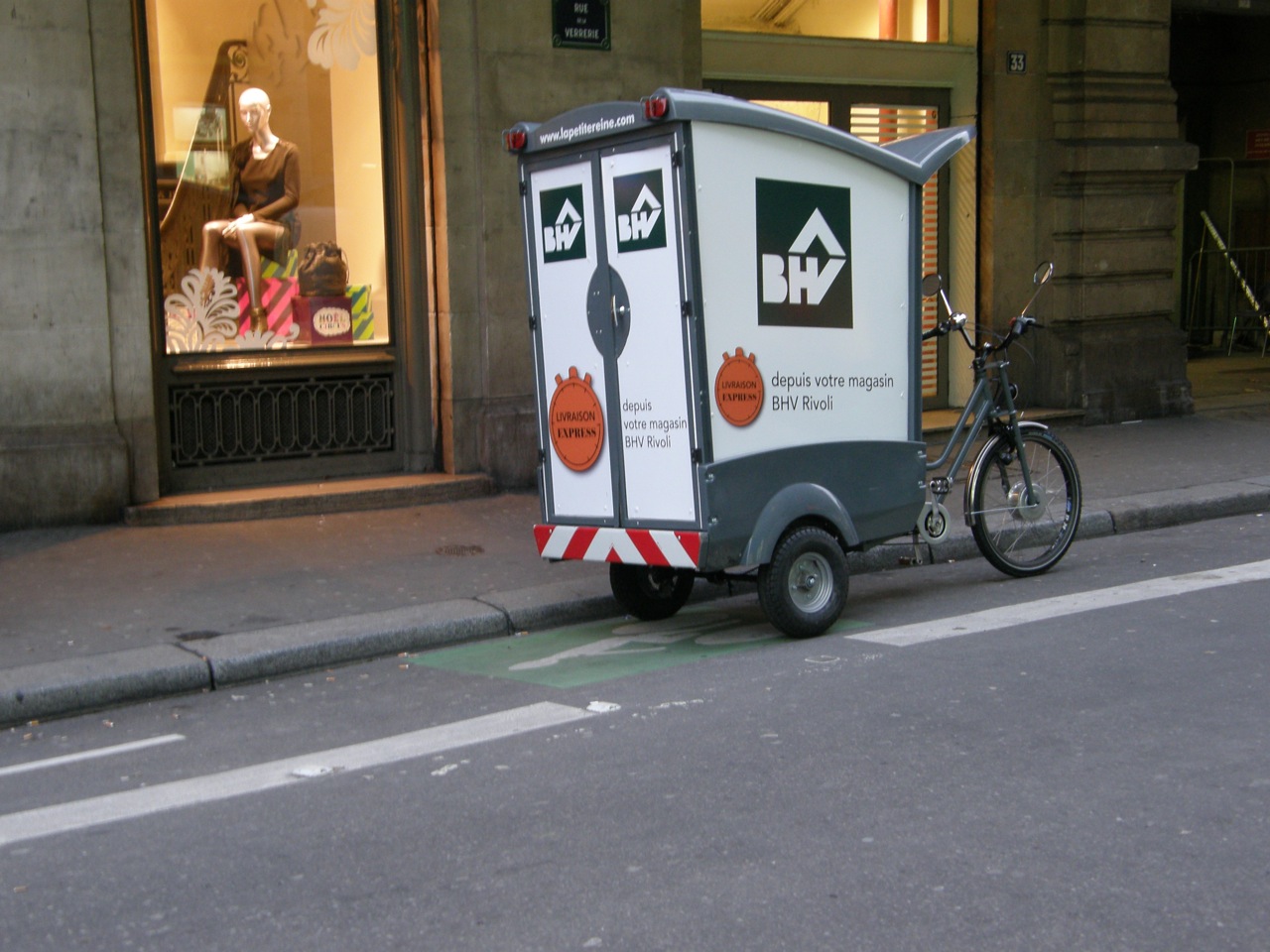
Philippa and I were quite surprised this past December when we saw this BHV triporteur outside the store, but do not know how widely it travels. We have also seen other triporteurs in various parts of the city.

Perhaps the crown for continuing the early Parisian triporteur lineage goes to La Petite Reine.

When Philippa and I first saw it on a November day in 2007, just outside Notre Dame de Bonne Nouvelle on rue de la Lune, we wondered if it was simply a rolling billboard or a working vehicle. It was the latter and I am delighted to say the company is still in business and has grown since then. La Petite Reine was founded in 2001 with the aim of offering an alternative to using large polluting vehicles for urban deliveries.

The company has a variety of tricycle types ranging from strictly pedal to electric assist and operates in Paris, Bordeaux, Rouen, Dijon, and Geneva. With both electric and pedal powered triporteurs, La Petite Reine continues the tradition of tricycle deliveries in Paris and other cities.

Perhaps the final word on the fate and future of triporteurs might be from Mark Twain who, upon hearing that he had been reported dead, replied, “Reports of my death are greatly exaggerated.”

Text and original photographs by Norman Ball; historic photographs from Paris en Images, courtesy Roger Viollet Agency.

Posted in Paris history, Paris popular culture | Tagged , , , , , , , , , , , , , , , | 2 Comments

The queen in the tower

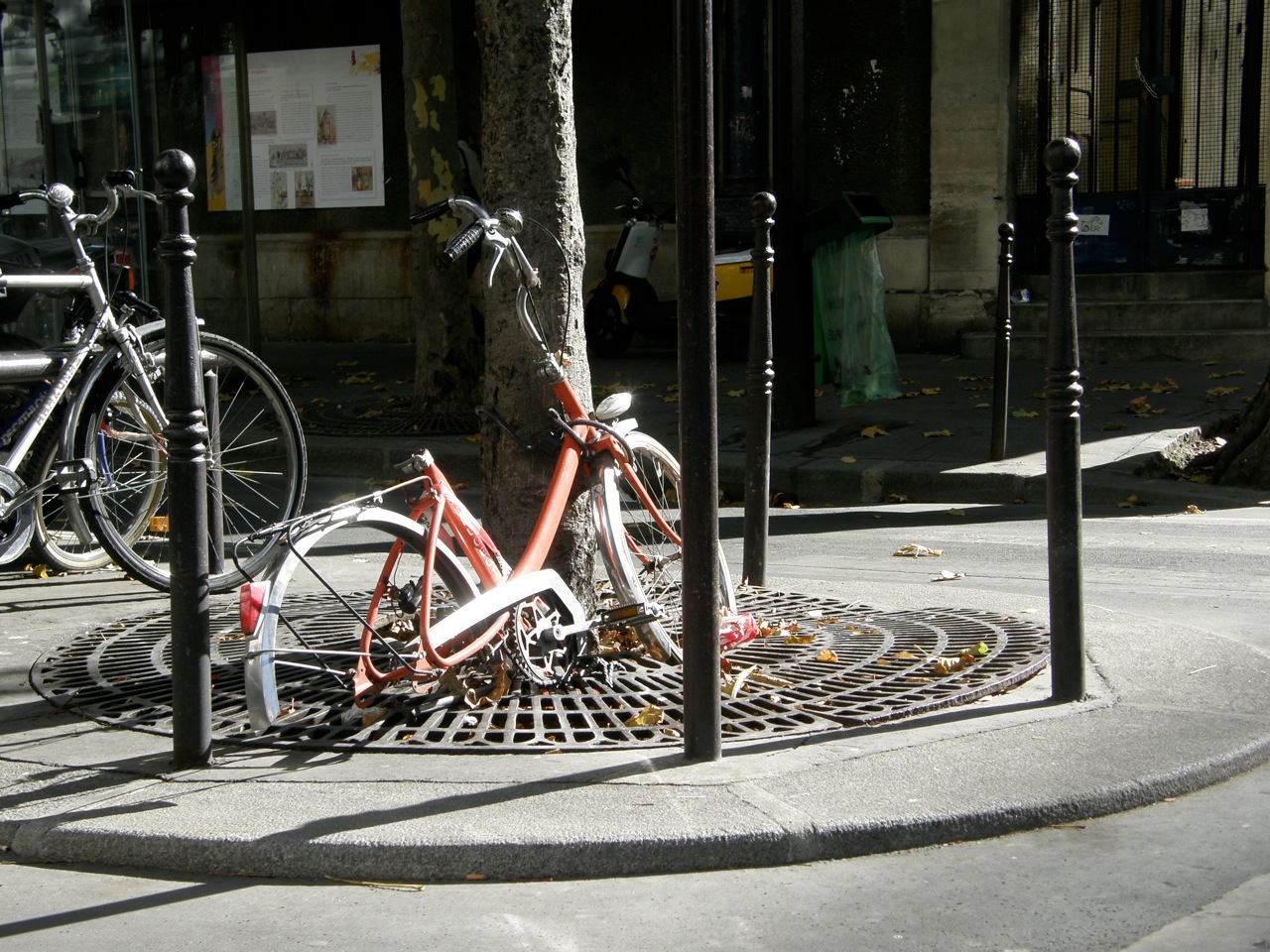
Last week, Norman posted his picture of a “melting bicycle” and it got me thinking about the place and time we saw it. Then a reader wrote in and asked about places to stop and sit in the Marais, and I included that particular location in the 3rd arrondissement because it was on my mind.

In fact, that day we were sitting in front the Café Crème on the rue Dupetit-Thouars, just where it intersects with the rue Dupuis. We’d just come from Goumanyat/Thiercelin, a wonderful spice shop on the rue Dupuis, and we’d stopped for a drink.

We sat in the shade and looked across the street. Immediately in front of us was the melting bicycle. To our right across the road was a Lycée Technologique, and in front of it was parked a Citroen with a child’s toy (Sophie la Girafe) in the back window.

To the left was an empty market building.

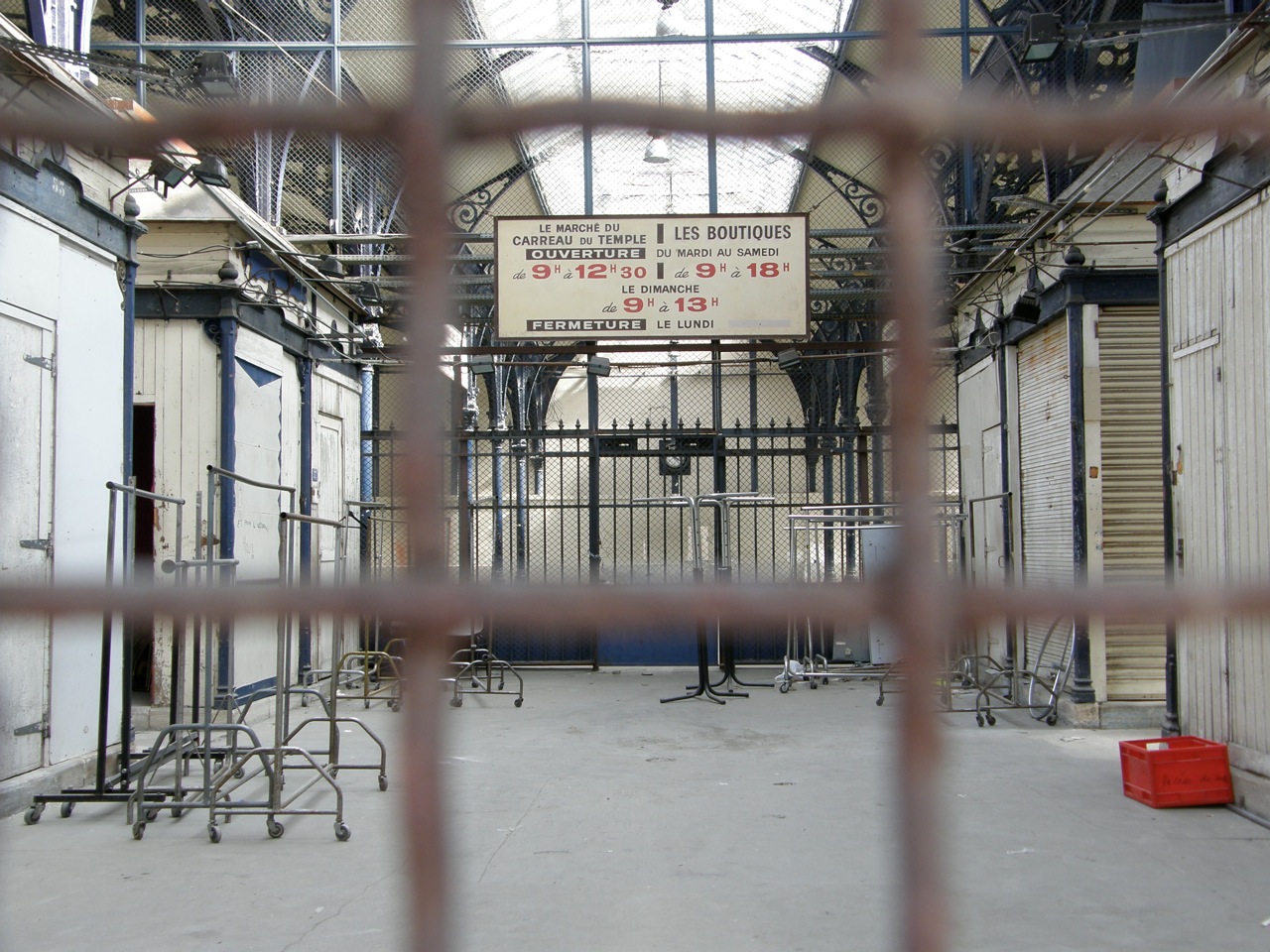
When we had finished our wine, we went across the street and took a closer look at the market. It had once been a market for clothing, but the booths were closed and the doors were chained up. Big posters announced that the place was to be renovated as a multi-functional community space (espace polyvalent – which sounds dully institutional compared to a market, but the pictures showed happy people doing happy things, as all architectural renderings do).

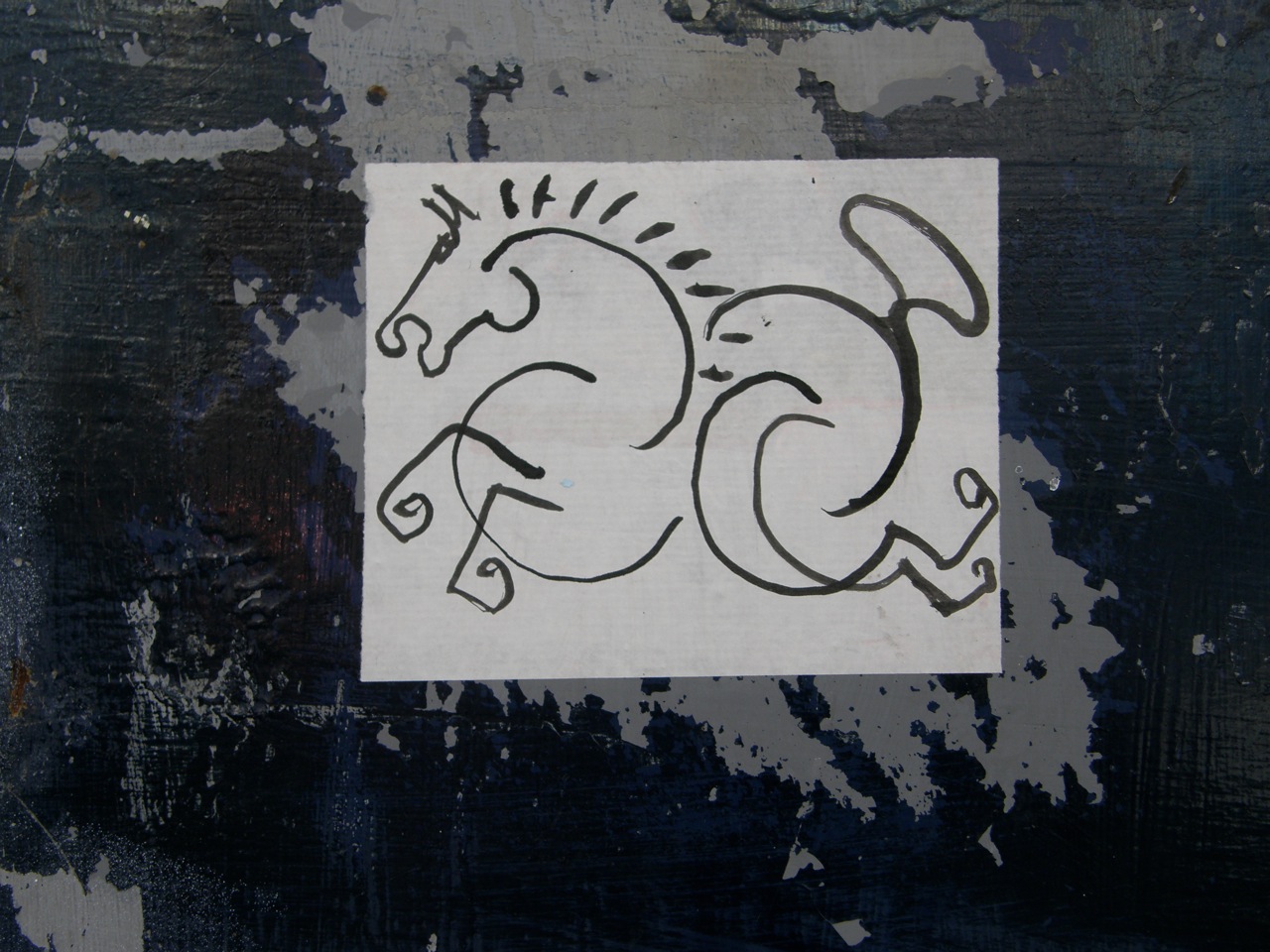
We noticed some wonderful paper graffiti showing stylized horses. If I had an original, I would frame it.

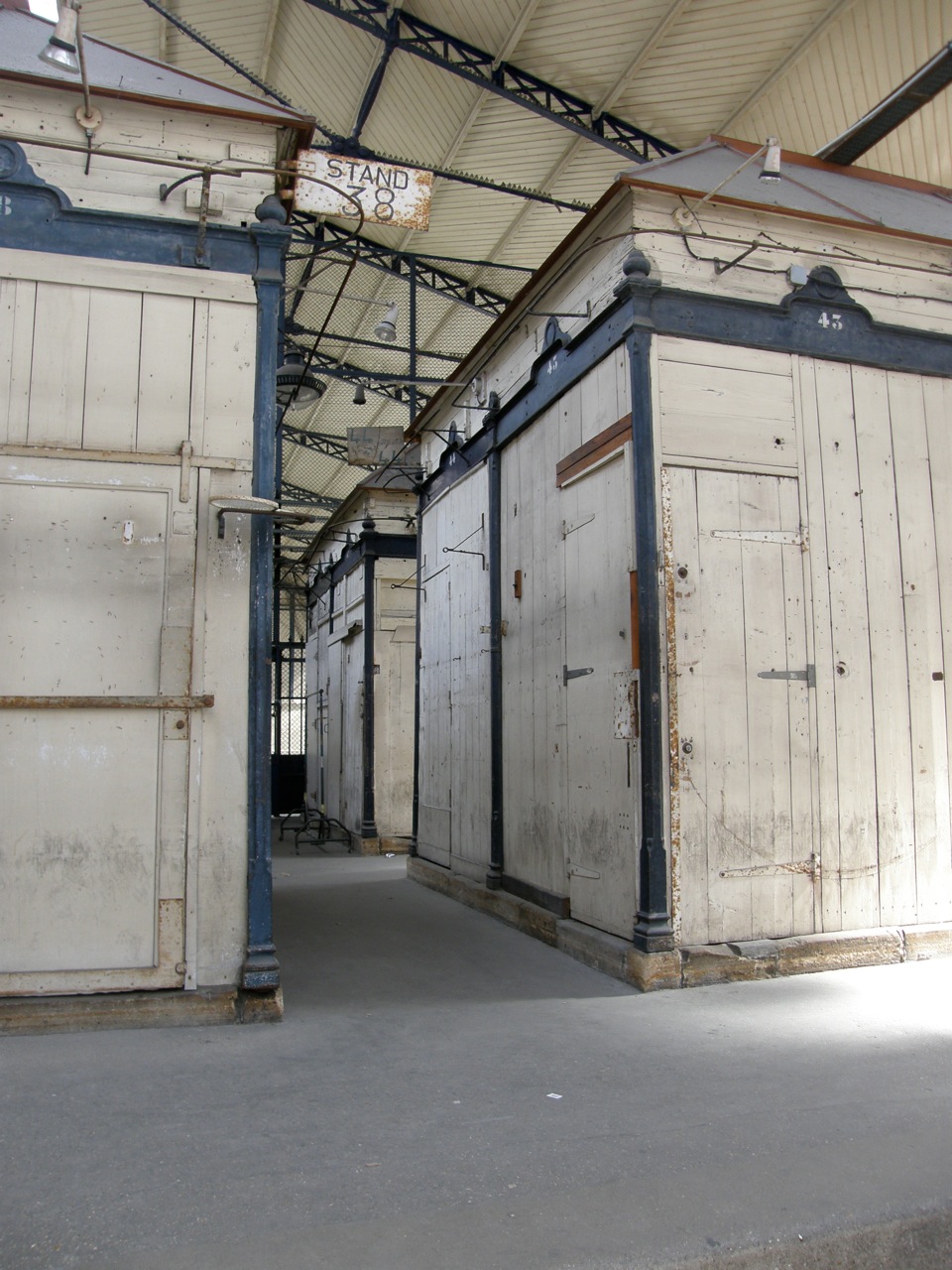
We took photographs through the gates of the empty market stalls – an evocative space that had once been lively and will be again, we hope.

It was only later when I took a closer look at Norman’s photos that I realized this was the Carreau du Temple, part of the vanished Temple complex, which exists now only in the name of a Metro station, a square, and a few streets.

The name comes from the Knights Templar, who built a church here in the 12th century. At that point, this area was outside the city walls, and the Knights created a little village of their own around the church.

The picture from the Turgot map of 1734 is a bit confusing, until you realize that north is to the left. The rue du Temple and the rue Charlot are still there, and so is the church of St. Elizabeth. There was a palace for the Prior about where the Square du Temple is now, and a forbidding tower with turrets stood approximately where the southernmost part of the market building is now.

The Temple tower! That grim fortress where Louis XIV and Marie-Antoinette were imprisoned! I was recently reading about them in The Fatal Friendship by Stanley Loomis. The book describes Marie-Antoinette’s friendship (and possible romantic liaison) with the Swedish count who orchestrated the royal family’s failed attempt to flee the Revolution in June 1791, which ended disastrously at Varennes.

The royal family was taken back to the Tuileries Palace after that attempt to escape, but in August 1792, when a mob attacked the Palace, they were moved to the Temple. At first, they did not realize which part of the precinct they were to stay in. As Loomis tells it:

When, as the light was beginning to fade, the French royal family arrived at the Temple that evening it never crossed their minds that their destination was to be the Tower, rather than the palace. They were served an elaborate meal – even in its worst temper, the Commune was never to stint on the food – in the Salle des Quatre Glaces [at the palace] … among those who presided over the fallen family’s supper table that night none could summon the courage to tell them that after the festivities they were to be taken to the Tower… [But] at one o’clock in the morning, under armed guard, they were conducted across the garden to the donjon that they were only to leave to go to their trials and death.

There were several more attempts to rescue them before the worst befell. But every plot seemed to run aground on someone’s blunder or indifference or greed (or the family’s steadfast refusal to be separated), and bit by bit, every hope was withdrawn.

Loomis is a particularly interesting guide through this story. You can tell that he didn’t think much of Marie-Antoinette in her glory days – self-absorbed, spendthrift airhead that she was during the years at Versailles. But as the Revolution took away her privileges and comforts one by one, and she endures with dignity, he clearly becomes more and more impressed in spite of himself.

Indeed, he has the same reaction that many of her contemporaries apparently did when they met her during this period. They were usually determined to hate her, and found themselves won over by her character and her calm demeanour under appalling conditions.

He concludes, “The Revolution destroyed her but it was the Revolution that lent to the life of this essentially uninteresting woman an interest that is spectacular…Through affliction the woman grew strong and out of physical destitution she carried that element of individual triumph that is inseparable from great tragedy.”

As for the Temple tower, it was demolished in 1808 on Napoleon’s orders – he didn’t want it to become a magnet for Royalist pilgrims. Part of the Temple precinct became a market for clothing and textiles in 1811. The final Temple buildings came down under Napoleon III and the cast-iron and glass building went up in 1865.

And now the market is to be turned into “une espace modelable et polyvalent.” You can see a little video about the building and the plans for it here. The grim old tower appears for barely a second, then gives way to pictures of the market buildings, including a good photograph by Robert Doisneau.

You can understand that nobody wants to remember the tower, the site of so much sorrow. Better to imagine happy people in colourful garb playing sports.

Text by Philippa Campsie; original photographs by Norman Ball.

Posted in Paris history, Paris markets, Paris street art | Tagged , , , , , , , , , , , , , | 3 Comments

Still life with bicycle

Paris has a long association with cycling. Consider the early 19th-century velocipede craze or Art Nouveau advertising lithographs by artists such as Alphonse Mucha. Since it began in 1903, the Tour de France always ends with a dash into Paris. The Velib’ bicycle lending program in Paris is known, admired and studied worldwide. But there are less obvious sides to Paris and cycling.

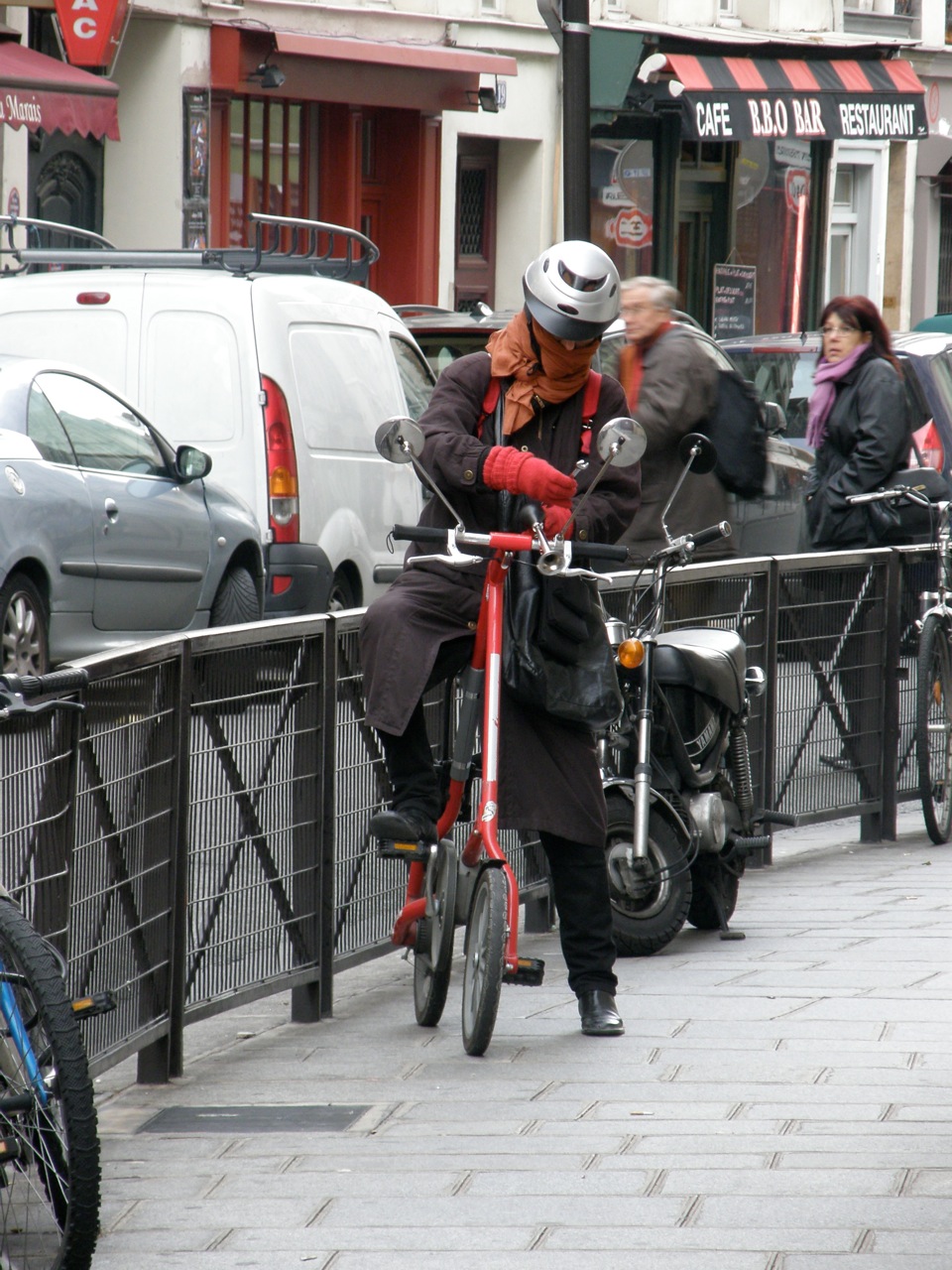
Much more than fashion, a sense of style pervades Paris. The elegantly turned-out man preparing to ride away on his folding bicycle on a November afternoon looks unmistakably Parisian. And the open-ended wrench (or spanner, as the British would say)? It’s a fine touch, the sort of artful prop one might find in a fashion shoot. But no, it was real, part of something I spotted during a flâneur’s moment on a Parisian street.

In December 2008 Philippa and I spent a relaxing couple of hours at the Musée de la Mode et du costume at the Palais Galliera (currently closed and undergoing renovations) We had been drawn there by the enticing title, “Sous L’Empire des crinolines 1852-1870.” Wandering amongst the exquisitely theatrical Second Empire gowns and accoutrements from the era of the Empress Eugénie left us feeling languid. We drifted outside; the bicycle at rest on the stairs seemed to fit the mood perfectly. It appeared to be slouching, languid and perhaps even rakish.

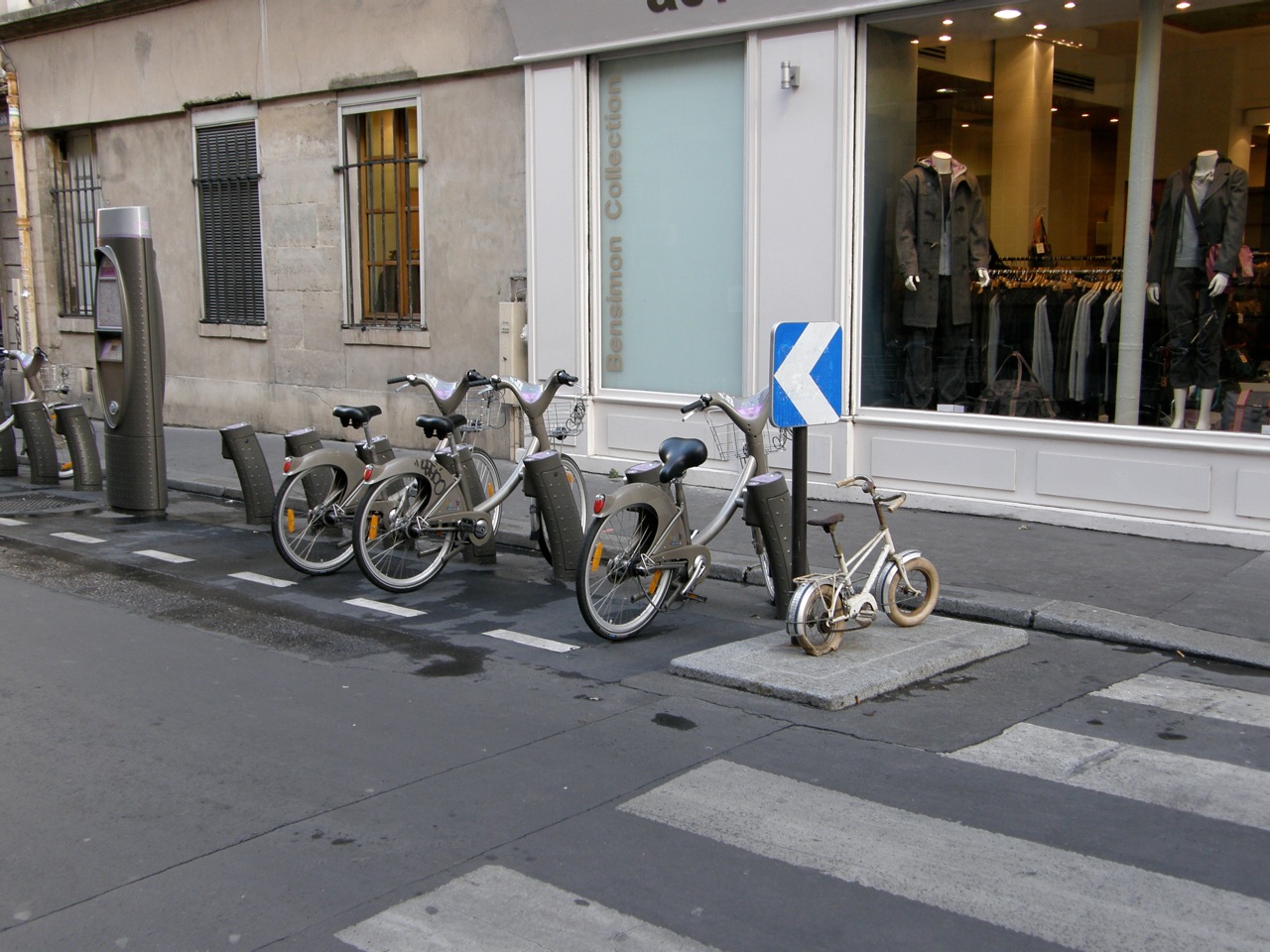
The louche bicycle lounging outside the Musée seemed a far cry from the carefully marshalled, almost official-looking picture postcard view of the Velibs. But look below and you see something decidedly less official-looking. For several days we had seen the child’s bicycle with its long-dead rear tire. Was it abandoned? A work of art? And the almost backwards seat on the Velib’ beside it? There is a story here. But you will have to make it up for yourself.

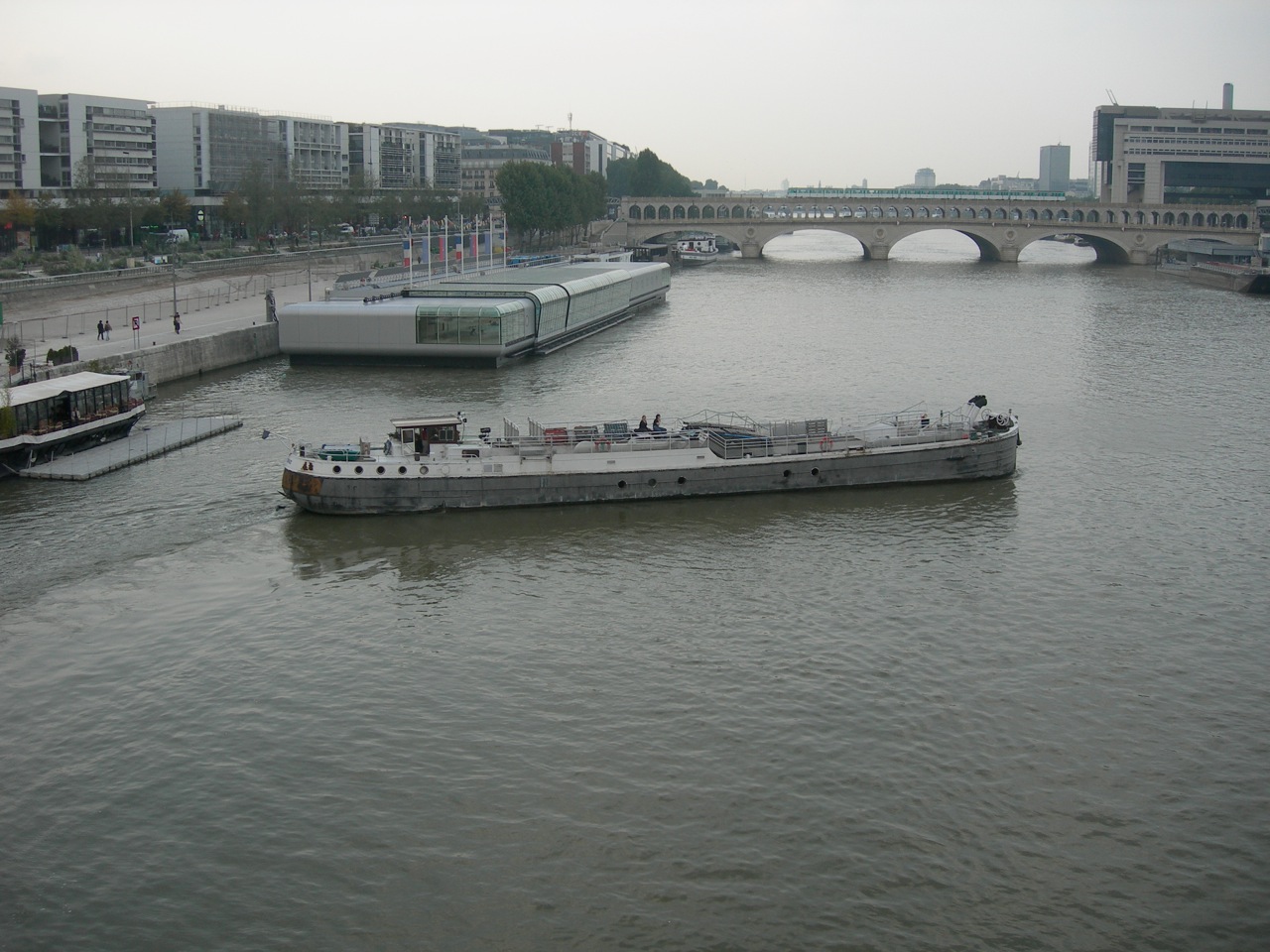
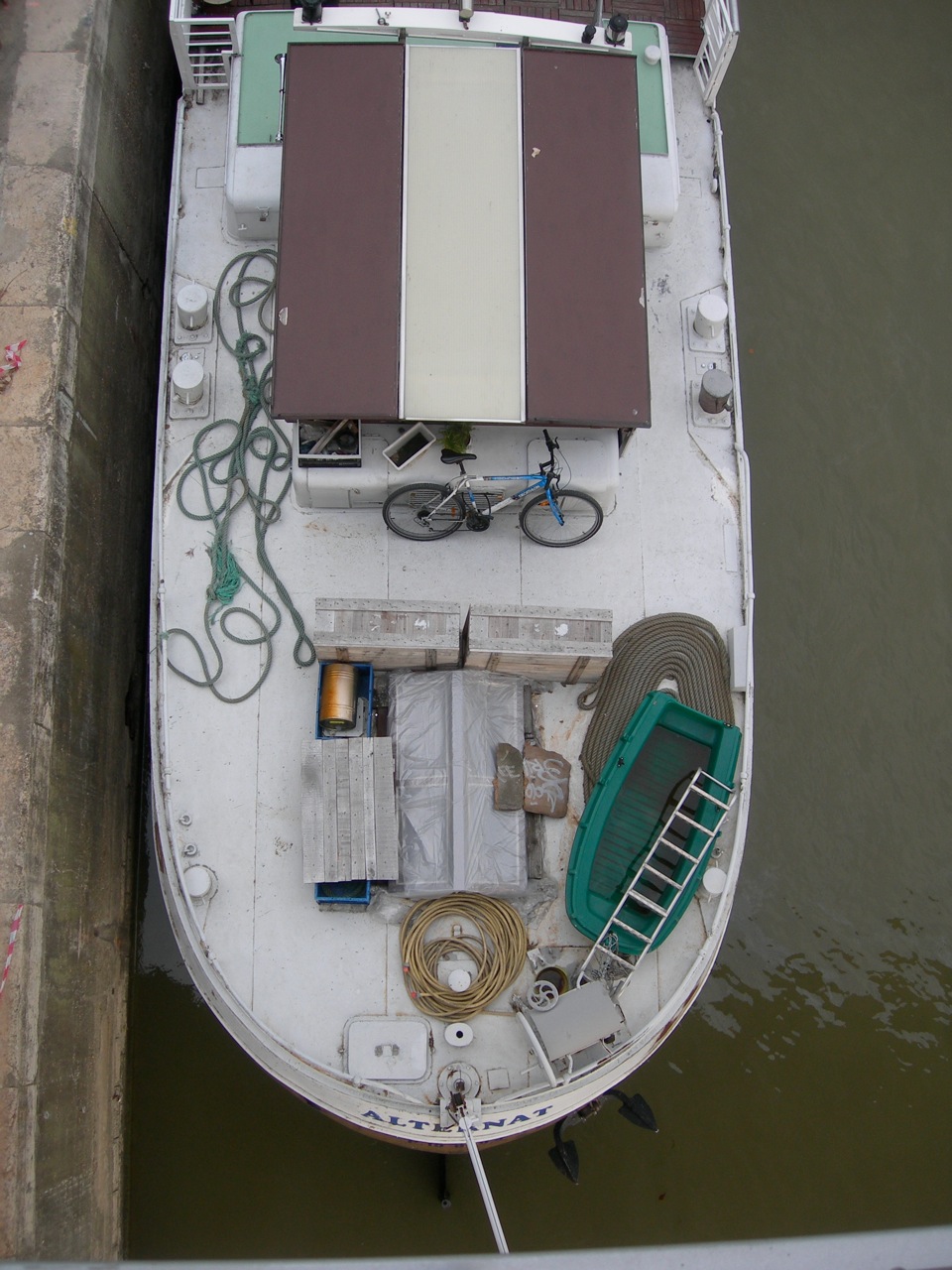
On a mid-October afternoon we walked from the National Library towards Bercy Park and lingered on the Passerelle (footbridge) Simone de Beauvoir to gaze at the Seine. It is still a working river that rewards those who take time to look quietly and slowly. In the near distance the barge Alternat drifted in front of the floating swimming pool anchored to the bank.

The Alternat was skilfully piloted and as we watched (in line with our general philosoply of “no schedule, no rush”), it pulled in and was tied up just below the bridge. There was another bicycle.

Because Philippa and I walk so much in Paris, our Paris is very much a city of slowly encountered vistas where bicycles often seem to complete the scene, somewhat like punctuation.

With so many bicycles, there is great variation, including states of repair or disrepair. In the image below, the deformed wheel seems to tell us something important about Paris and bicycles: it is sometimes a risky or precarious encounter.

On an August day the month dwindled away but not the heat; tired of walking, we sat outside at a small café in the 3rd and drank red wine in the shade. Even the bicycle opposite the café seemed to be feeling the heat, sinking into the earth and returning to nature.

We are so used to seeing locked bicycles in varying states of disarray, that they often earn only a passing glance. However, the assemblage shown below demanded a second look. It was not just a front wheel and forks locked to the pole. It was a unicycle locked to a pole and the owner had prudently removed the seat.

A Paris without bicycles would seem incomplete. Even though it was a raw, damp and grey December day when I took the photo below, the bicycles seemed oddly at home and so did we. They had been there for days, perhaps left behind by students who had returned home for the Christmas break. Maybe the cyclists saw that the snow was winning and were waiting patiently for the return of better cycling weather.

Less than a week later, it was Christmas Day and we were walking through the Jardin du Luxembourg. Sun-starved Parisians positioned themselves to soak up the rays, the ducks in the Medici Fountain paddled calmly, friendly snowball exchanges erupted here and there. And a bicycle wheel wondered if it would ever be reunited with its missing pieces.

Text and photographs by Norman Ball

Posted in Paris streets | Tagged , , , , , , , , , | 6 Comments

A villa in the south

When we say the south, we don’t mean the south of France, we mean the southern parts of Paris, particularly the 14th arrondissement. And when we say “villa,” we don’t mean a detached house. The villas of Paris are cul-de-sacs, many lined with distinctive buildings. Some are private and shut off from the world by a gate with a digicode, like the Villa Adrienne (which is actually a large square surrounded by attractive buildings). But most are accessible to the flâneur, and provide little glimpses of gardens and studios, workshops and lofts. Our favourite is the Villa d’Alésia, just off the rue d’Alésia, in the quartier known as Petit Montrouge.

The first thing we spotted as we turned in off the rue des Plantes was a combined studio and boutique at no. 51, Isapocket, which sells the work of several artists. This one-storey building, a former printing shop, is painted with whimsical motifs, which change from time to time.

On that visit, we bought a delightful children’s book called Papa Lézard and it turned out that the woman minding the store was the illustrator, Isabelle Pongitore, who with her husband David Loche, created Isapocket. She promised to draw a special illustration and inscription for Norman’s grandson Emmanuel, and we returned a few days later to pick it up.

The shop also sells various items (cards, tablecloths, aprons) featuring a map of the street, indicating which studios were used by which artists (we bought the apron, in green). The names of the former residents make up a who’s-who of 20th century art.*

After some years of wearing the apron, I finally spread it out and looked at it and tried to track down some of the names on it. (I hope you appreciate that I washed and ironed the apron to get it ready for its close-up, but I admit it’s seen some wear.)

Auguste Leroux, the painter and illustrator, was probably there the longest: he and his wife Clothilde lived at no. 11 from 1908 to 1954. Apparently they gave good parties. Jacques Grüber (a stained glass artist) had an atelier there too; he’s the one we can thank for the gorgeous ceiling in the Galeries Lafayette.

Henri Matisse was photographed in a villa d’Alésia studio by Brassaï in 1939. But it wasn’t his; it belonged to an American sculptor called Mary Callery. The following year, she lent it to Fernand Léger, who painted Composition aux deux perroquets there. Picasso’s name also appears on the drawing of the street – from what we can find out, he didn’t own a studio there, but his name has been linked to that of Mary Callery, so perhaps she let him use the place, too.

The Isapocket map shows only French artists and writers, but other illustrious names are associated with this tiny street. Aaron Copland lived there in 1922. Samuel Beckett hung out with a Romanian artist who had a studio at no. 10. All in all, most of the Montparnasse group of artists and writers probably fetched up there at some point – if they didn’t live or work there, they visited others who did. But who needs all this name dropping? It is a wonderful street to stroll along.
The road is narrow and cobbled and branches at the end – one part ends at a big gate, beyond which seems to be a school playground; the other part leads out to the tree-lined rue d’Alésia. Each house or studio is unique – no uniform Haussmannian façades here. The buildings come in different heights and colours, many with large expanses of windows, a couple set back from the street with tiny gardens in front.
There are still a few workshops and studios on the street, although most of the buildings have been turned into spiffy offices and flats. The oldest houses date from the late 1890s, when the street was created. (The street does not appear in its complete form on my 1897 map.)

An archway through no. 31 leads into a pretty public garden (le Jardin de la rue de Chatillon), a good spot for a picnic on a warm day. It was created in 2000 on the site of several demolished houses.

The yellow-brick building over the archway that leads into the garden (not shown here) was also a printing shop, but an unusual one in that it employed deaf-mutes (l’Imprimerie d’Ouvriers Sourds-Muets). Since printing can be fairly noisy, this strikes us as a fairly sensible business proposition.

We visited the Villa d’Alésia before we knew any of this. We just found it an attractive street filled with one-of-a-kind houses and we enjoyed wandering along, taking pictures and imagining the lives behind the unusual façades.

That’s one of the reasons we write this blog. We get to revisit in our memories the places we have seen, we dig up a bit more information about them, and we find out all kinds of new reasons to appreciate our collection of photographs and our memories of the city.

A friend of ours (who is both a war artist and a children’s writer) once said, “Writers are often told to write what they know, but I write about things I want to learn about,” and that is what we do. We write this blog in order to find out more about our favourite city, not because we are experts, but because we are still students with so much more to learn.

Text by Philippa Campsie, photographs by Norman Ball.

*The drawing includes the names of Pablo Picasso, Georges Braque, Henri Matisse, Auguste Leroux, Fernand Léger, Eduard-Marcel Sandoz, Wilfredo Lam, Marc Tobey, and the resoundingly named Balthasar Klossowski de Rola (dit Balthus), along with Jacques Loire and Jacques Grüber (both artists in stained glass), and the writers Blaise Cendrars and Claude Simon.

Posted in Paris art, Paris gardens, Paris streets | Tagged , , , , , , , , , , , , , , , , , , , | 3 Comments

Men in green

The first one we noticed was right under the window of our hotel room. It was 1995 and we were staying on a narrow street in the 6th. Actually, it was the broom that caught our attention first. It was fluorescent green and shaped like a witch’s besom. Someone had actually fashioned violently coloured plastic into the form of a twig broom. Amazing. (Does Harry Potter know about these?) So we took this picture, looking straight down.

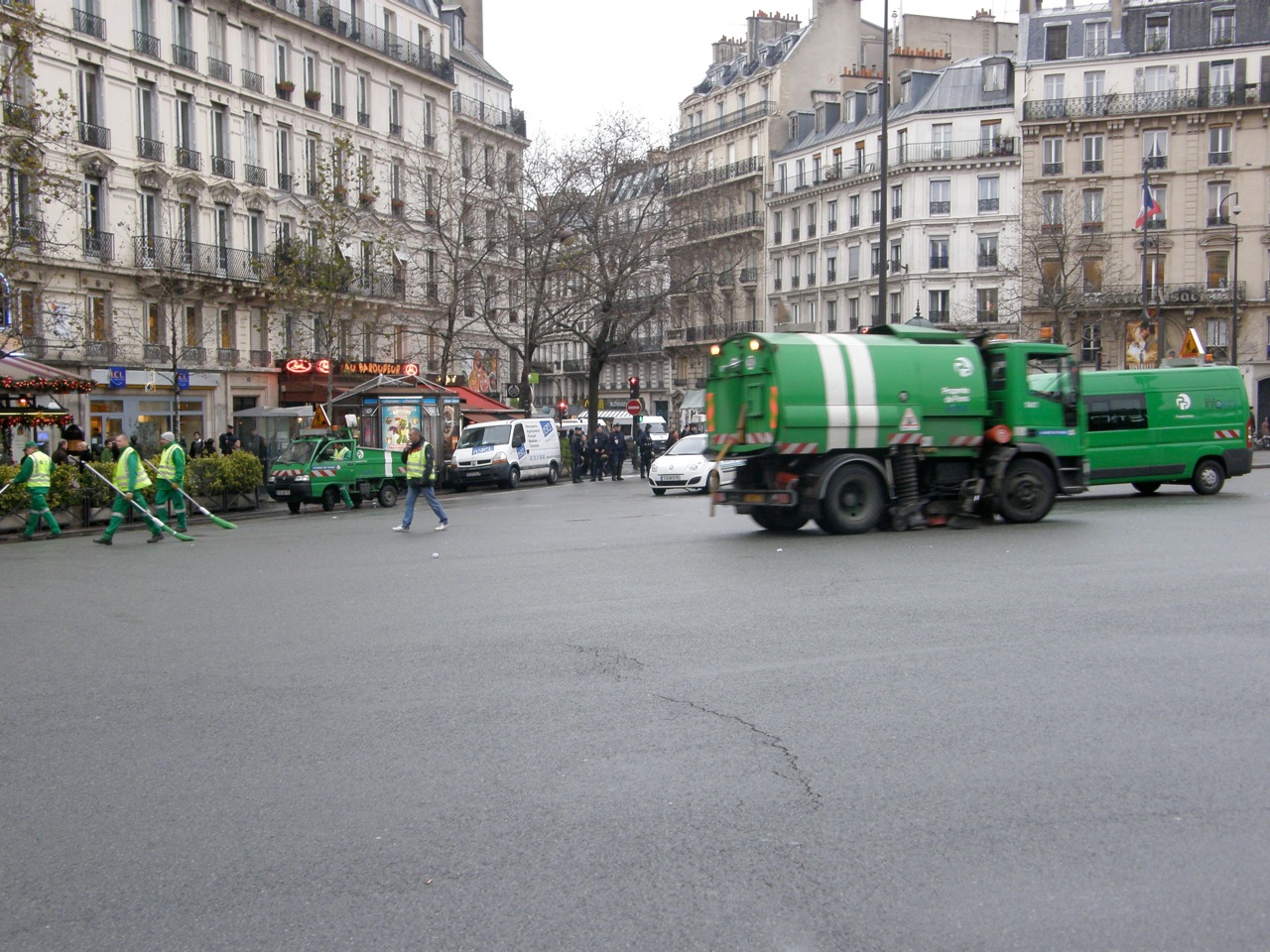
On a later visit, we saw a huge demonstration (manifestation) on the boulevard Montparnasse. The police obligingly closed the side streets to keep out traffic, the demonstrators marched by with their banners, yelling slogans (the topic was education reform), followed by… the men in green. They picked up the dropped handbills and other trash, tidied the street up, and in a twinkling, all was as if the demonstration had never occurred.

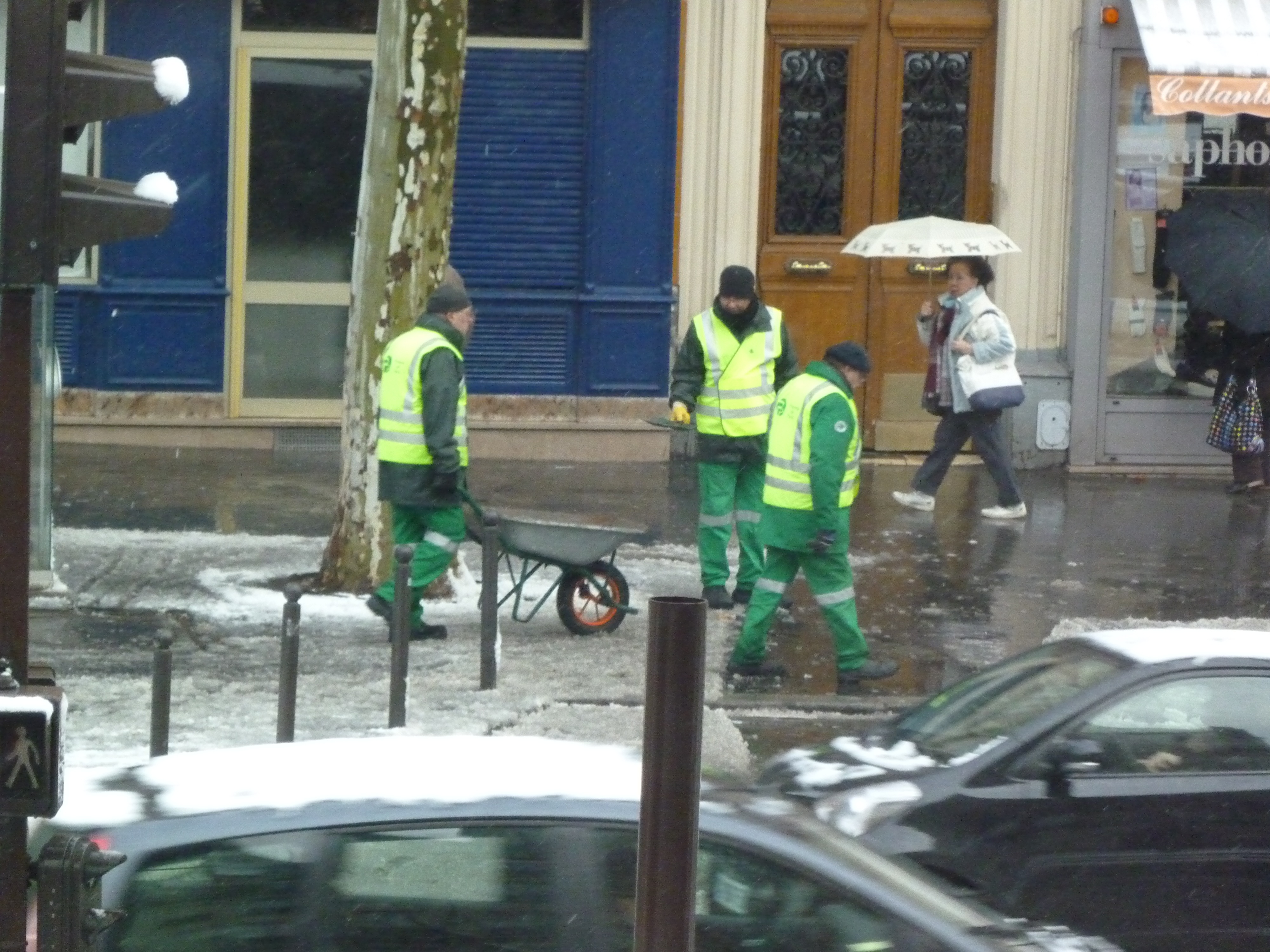
On our most recent visit this past Christmas, we noticed that the men in green were taking on extra duties. Paris does not have the snow removal technology we have in Toronto (un “snowplough”?qu’est-ce que c’est que ça?). So, on an icy day on the boulevard Port Royal, three of them were out there making the sidewalks safe. One had a wheelbarrow full of road salt and the others had little dustpans. They distributed the salt along the boulevard using the dustpans as they went.

We even saw them at it on Christmas Day. We appreciated their dedication to the important business of snow removal on such a day.

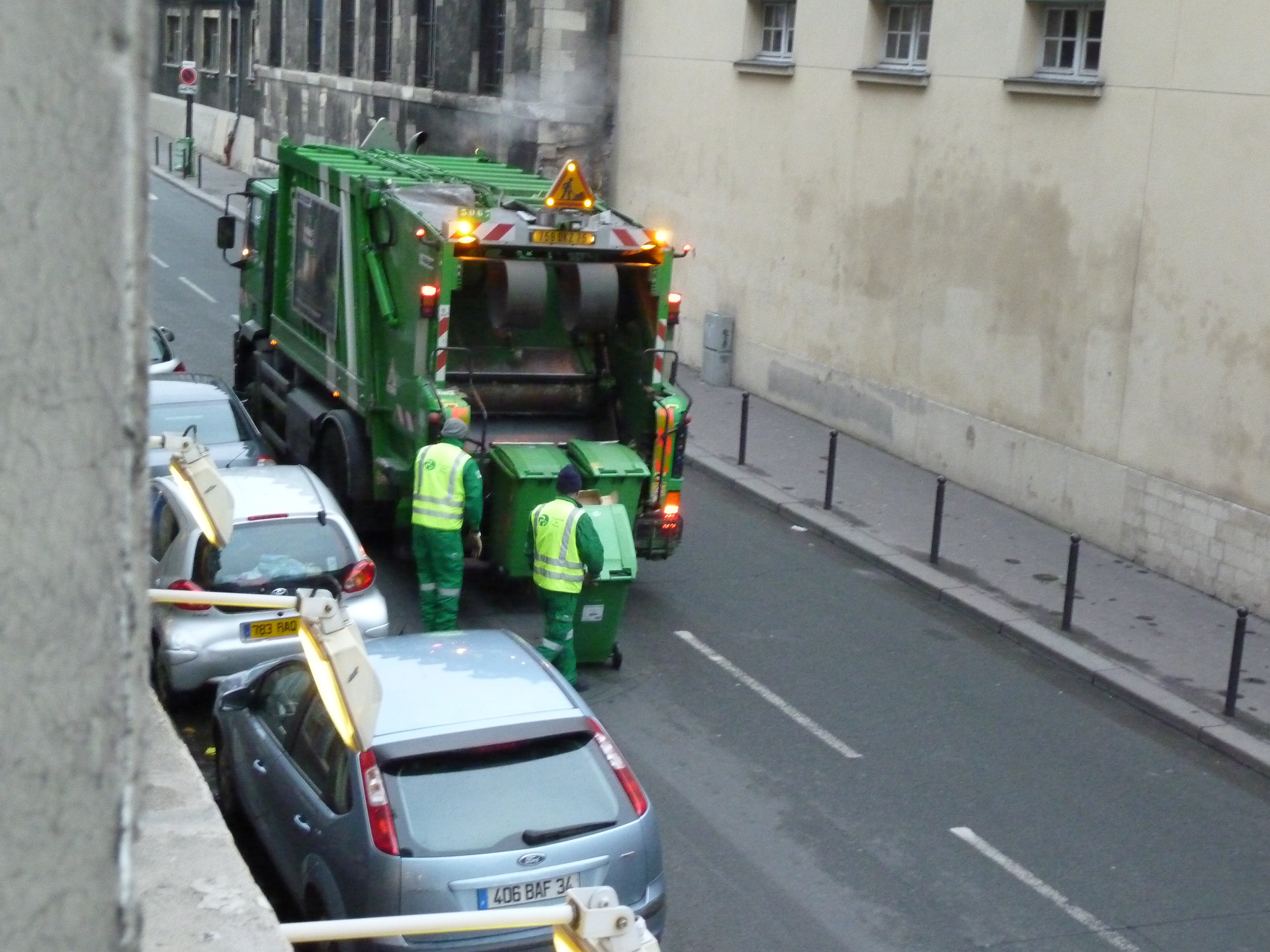
And on New Year’s Day, the first sound we heard in the morning was a garbage truck making its way down our street, picking up the trash from the previous night’s revels. What a civilized sound. We snapped this hasty photograph of evidence that the men in green were on the job early in the New Year, keeping the city beautiful.

They take on extra little civic duties, too. Just outside St-Sulpice, a kindly man in green was giving instructions to a flustered woman in a car who was having difficulty manoeuvring out of a tight parking space.

The official name for the sanitation department is Proprété de Paris. The website lists their many duties. As well as removing garbage in 10 of the 20 arrondissements (in the other 10, private companies remove the garbage) and keeping sidewalks clear of snow, they deal with dogshit (les crottes), pigeonshit (les fientes), and public toilets (les sanisettes). (They don’t do graffiti removal, which is outsourced to a private company.)

Six nights a month, they are out there cleaning the Périphérique – not just the roadway, but the walls and the undersides of tunnels and underpasses. (You can see the equipment they use on this video). They have all kinds of wonderfully specialized machinery for cleaning.

If you’d like some numbers, here they are:
• 2,400+ km of sidewalk cleaned each day
• 30,000 public garbage bags emptied 1 to 6 times a day
• 1,500 km of roadway vacuumed or washed at least once a week using 380 machines

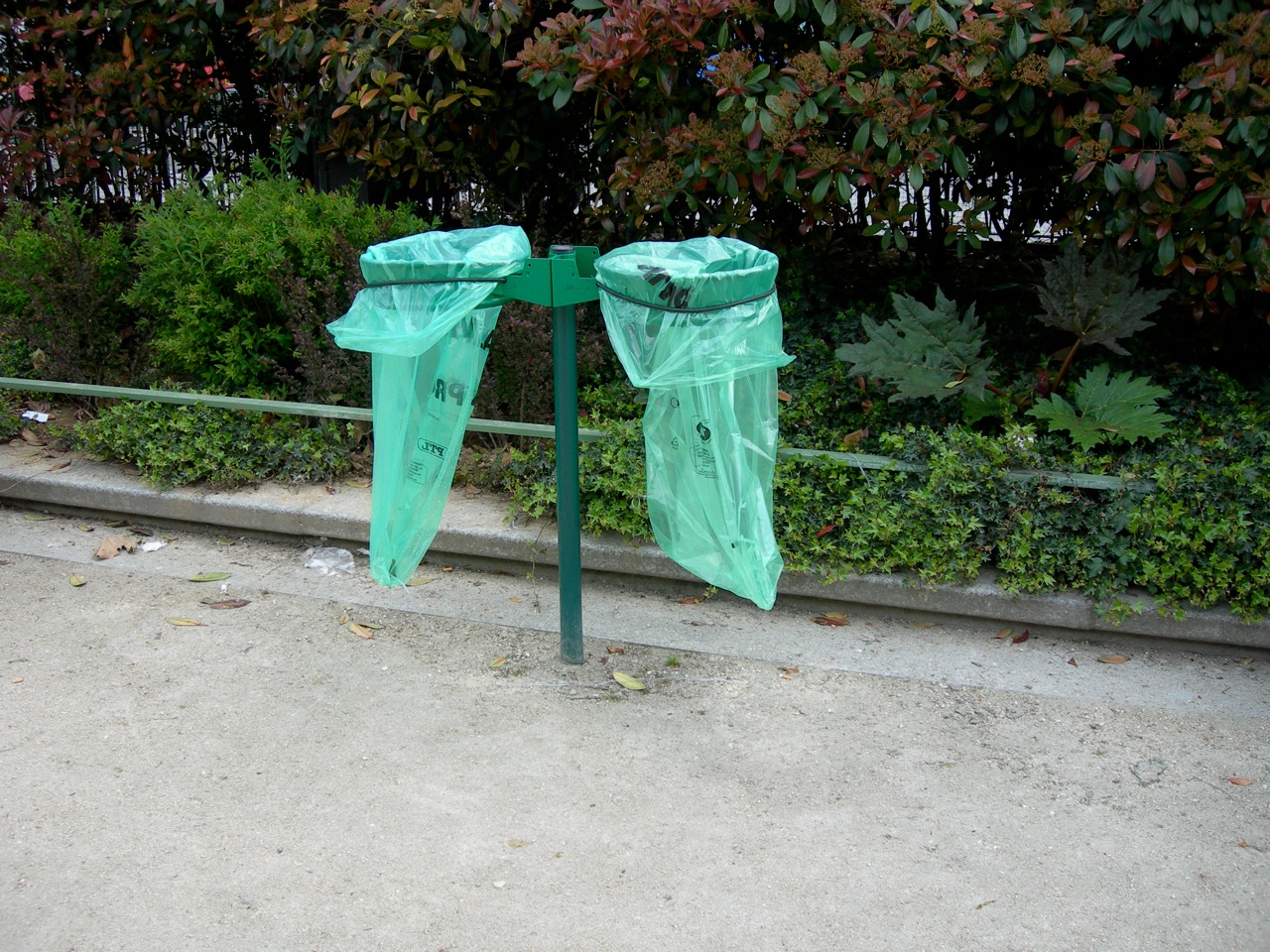
Did you see that? They empty public trash bags up to six times a day in busy areas. (Here in Toronto, we’d be pathetically grateful for more than once a week in a good week.) Years ago, when terrorists were putting bombs in garbage cans, Paris switched to a system of green-tinted transparent bags, held in place by a metal hoop. As solutions go, it is reasonably unobtrusive, and no exploding green bags have been reported to our knowledge. We’ve watched the operation and we calculate that an experienced man in green can make the substitution in approximately 15 seconds (loosen the hoop, grab the bag and tie it, unfurl a new bag and position it, then slam down the hoop again).

One of the most common sights in the morning is the flushing of the Paris street gutters. Here and there you will notice little bits of rolled carpet beside a street drain. No, that is not rubbish, that is a low-tech device for channelling the water from the gutters into the drain. We could write a whole blog on this fascinating process, and one day, perhaps, we will.

For the men in green, the fight against dogshit is an ongoing battle. Now, the conventional view is that Parisians do not believe in poop-and-scoop and that the city is one giant toilet for pets. One writer – Stephen Clarke – trades on this stereotype in the title of all of his novels (A Year in the Merde, Merde Actually, Dial M for Merde, etc.). The reality is a little more complicated. We’ve seen signs indicating that some Parisians find dogshit unacceptable…

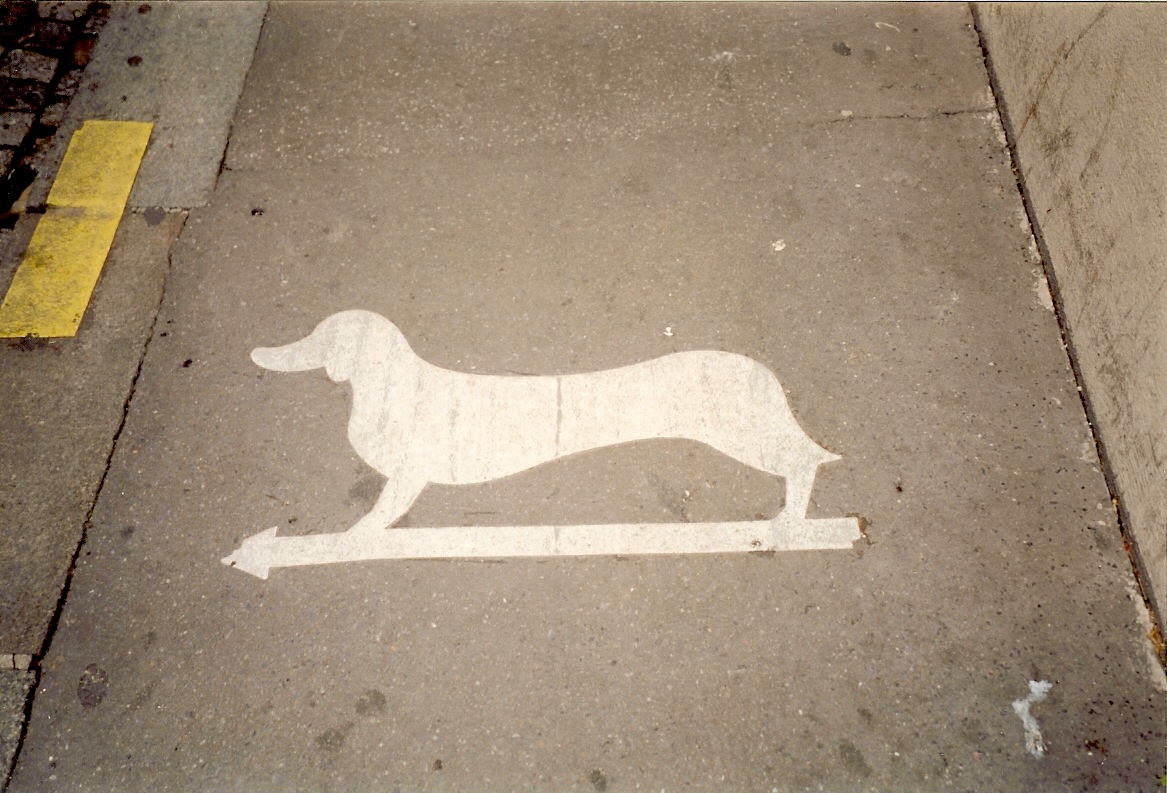
… and the city does its best to remind dog owners to get their pooches to use the gutter rather than the sidewalk.

There are even official poop-and-scoop signs, exhorting citizens to do the decent thing.

Technically, you can be fined several hundred euros if an inspector catches you letting your pet poop in the public way (arrêté du Maire de Paris du 2 avril 2002). Similarly, there is a fine for feeding pigeons. Alas, old habits die hard and there are not enough inspectors to go around, so the men in green have to keep at it.

OK, they are not perfect. They go on strike – most recently in fall 2010, during the massive strikes that paralysed all of France for several weeks. But when they are on the job, they are highly visible and generally effective. And they have those wonderful brooms…

Text and photographs by Philippa Campsie and Norman Ball.

Posted in Paris civic functions, Paris popular culture, Paris streets | Tagged , , , , , , , , , | 4 Comments

Finding the world in Paris postcards

Last week we showed a picture of a bridge, which was on my list of must-sees in Paris. And I wondered how many of those who flock to the Eiffel Tower also visit the 1867 suspension bridge over the artificial lake in the Parc des Buttes Chaumont. The connection? They were both designed by Gustave Eiffel.

The suspension bridge is as stunning as the 19th century park around it. For those who think of French parks in terms of flat terrain and formally laid out flowerbeds in which mathematical precision dominates nature, the Parc des Buttes Chaumont will be an eye-opener. It opened in 1867, the same year as the Universal Exposition. The park was created on the site of a former quarry that had degenerated into a slum.

However, unlike, say, the Tuileries, which had also been an industrial site (a tile works), the Parc des Buttes Chaumont makes the most of its past as a quarry. With its artificial lake, stalactite-filled cave, waterfalls, brooks, bridges, and changes in elevation, Buttes Chaumont seems more English or Chinese than French. Perhaps its crowning glory is the Belvedere, an architectural feature designed to make the most of a good view. How different the park would have been had this tall outcropping been levelled.

One of the paradoxes of Paris is that is it so densely populated and so green. Although the legacy of Napoleon III and Baron Haussmann is sometimes criticized, we can thank these two for many of the city’s loveliest parks. During the 17-year reign of Napoleon III, the city added 4,950 acres of woods, parks and gardens and planted 600,000 trees. Buttes Chaumont, the steepest and third-largest of Paris’s parks was one of those created in this period.

The suspension bridge in the park was the work of a relatively unknown young engineer making his first imprint on the city. Twenty-two years later, the same engineer had become famous for his elegant and daring long-span bridges. Across the River from the Champ-de-Mars, he erected Paris’s most famous monument for the 1889 Exposition: the Eiffel Tower.

Philippa and I visited the park a few years ago on a warm spring afternoon. We marvelled at the suspension bridge, admired the view from the belvedere, and lamented the fact that we had to leave too soon. We will be back in a few months with a picnic lunch and more time to enjoy the view. It is one of the world’s “Great Public Spaces… the places we remember most vividly, the places where serendipitous things happen, the places we tell stories about.”

But there is more to my interest than just the view and the connection with the famous Gustave Eiffel. I am a historian of technology and design, and when I find myself looking at old postcards, my eye is often caught by interesting technology.

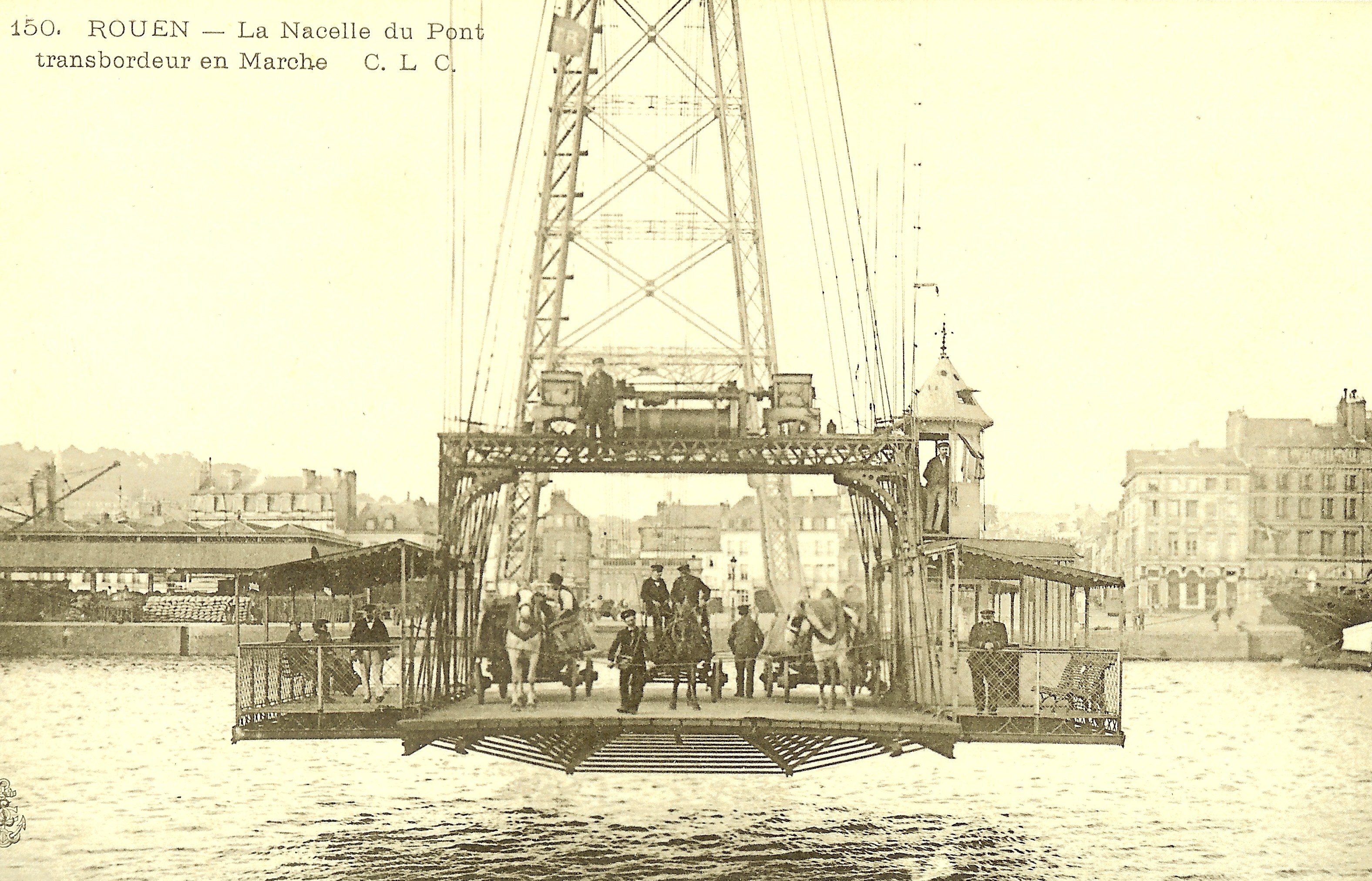
For me, a Paris postcard can be anything you find in Paris. It doesn’t have to be about Paris. The next images are among my most treasured Paris postcards. I bought them there, but they are of unusual river crossings in Rouen and Nantes, two cities I have never visited.

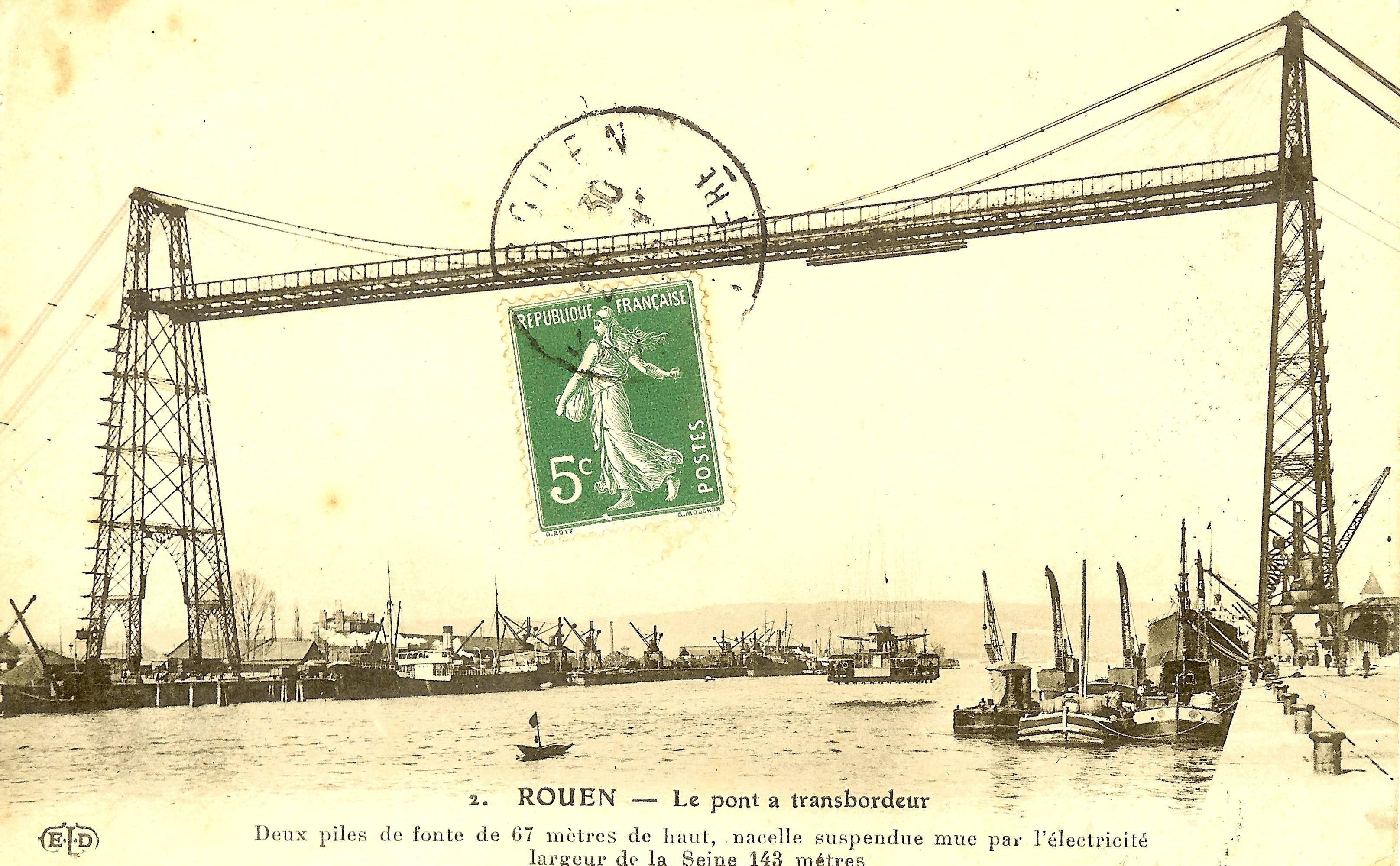
It seems a peculiar way to cross the water. And the translation of the text on these postcards isn’t a lot of help. La nacelle can mean the basket under a hot-air balloon or a type of small boat. And le pont transbordeur is a transporter bridge.

The next photograph should make things a bit clearer.

The two tall towers (70 metres high) are joined by what looks like an elevated roadway. That roadway or deck is 142 metres long, and under it is a movable overhead electric crane. Cables drop 50 metres from the crane to the suspended nacelle. You can just see the nacelle here, skimming above the water. In the picture, the cables are not visible, but you can see the shadow under the nacelle.

Pure genius. How to get goods, vehicles and people across a busy waterway without interfering with the clearance needed for tall-masted ships in the age of sail? Clearly one needs a tall bridge. But instead of having the extremely long approach roadways that a conventional bridge of such height would demand, Ferdinand Amondin (1845-1924) used the elevated deck roadway to carry a moving electric-powered crane that would support what was essentially a section of bridge at ground level, lift it as needed and then move it across the river and dock it on the other side.

Pedestrians could walk onto one of the two outside passenger sections, and drivers went onto the centre portion of the nacelle and waited to be transported across the river to dock on the other side.

Amondin made other bridges besides those at Rouen (1899) and Nantes (1903). I have spent some time finding out more about him and them. And for all the fun I have had learning about him and his bridges, I have to thank a serendipitous encounter with postcards at a flea market in Paris.

If I have whetted your appetite for Paris postcards, here is where you can find out some more about them, and where you can buy them for yourself.

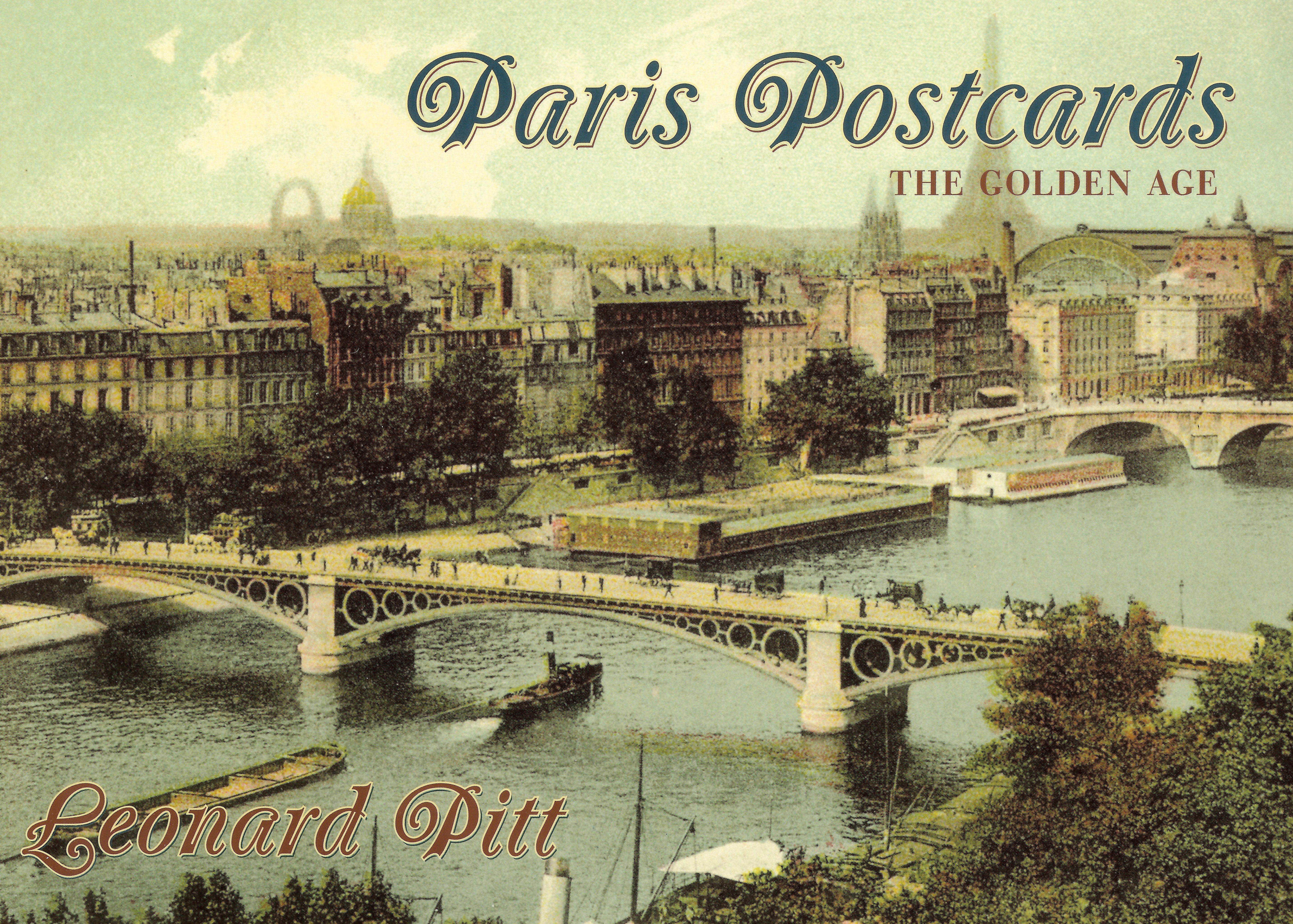
The best source of information I know is the book by Leonard Pitt, Paris Postcards: The Golden Age (2009). I also highly recommend Pitt’s informative website.

Pitt, an American who has lived in France, draws on his own superb collection and knowledge to produce a book that begins when postcards were just being made legal and “created the first form of social networking equivalent to today’s e-mail.” And yes, there were concerns that “this new type of message, shorter than the traditional letter, meant that people would forget how to write” (where have we heard this before?). But the public embraced the new form of communication and by the early 1900s, most families had postcard albums.

Where to find them?

Flea markets are a good place to start. My favourite is the Porte de Vanves. Note that the more they have been picked over and presorted for you by the vendor, the more you can expect to pay.

The Marché aux Timbres et aux Cartes téléphoniques (Postage Stamp and Telephone Card Market) is another rich source of postcards. I found about this one through Dixon and Ruthanne Long, Markets of Paris (New York: The Little Bookroom, 2006). It is held Thursdays, Saturdays and Sundays in a Park on the Avenue de Marigny from Avenue Gabriel to Allée Marcel Proust in the 8th arrondissement. Philippa has reminded me that this market features in one of her favourite Audrey Hepburn films: Charade.

Go on a nice day, as the market is outside. Some dealers have things well organized by arrondissement for Paris and numbered regions for the rest of France. Others organize by subject matter such as bridges, animals, special occasions, or humour. And others just have bins of postcards for you to sort though on your own. The more you are willing to rummage through yourself, the more likely you are to find something that speaks to you at a price you are willing to pay.

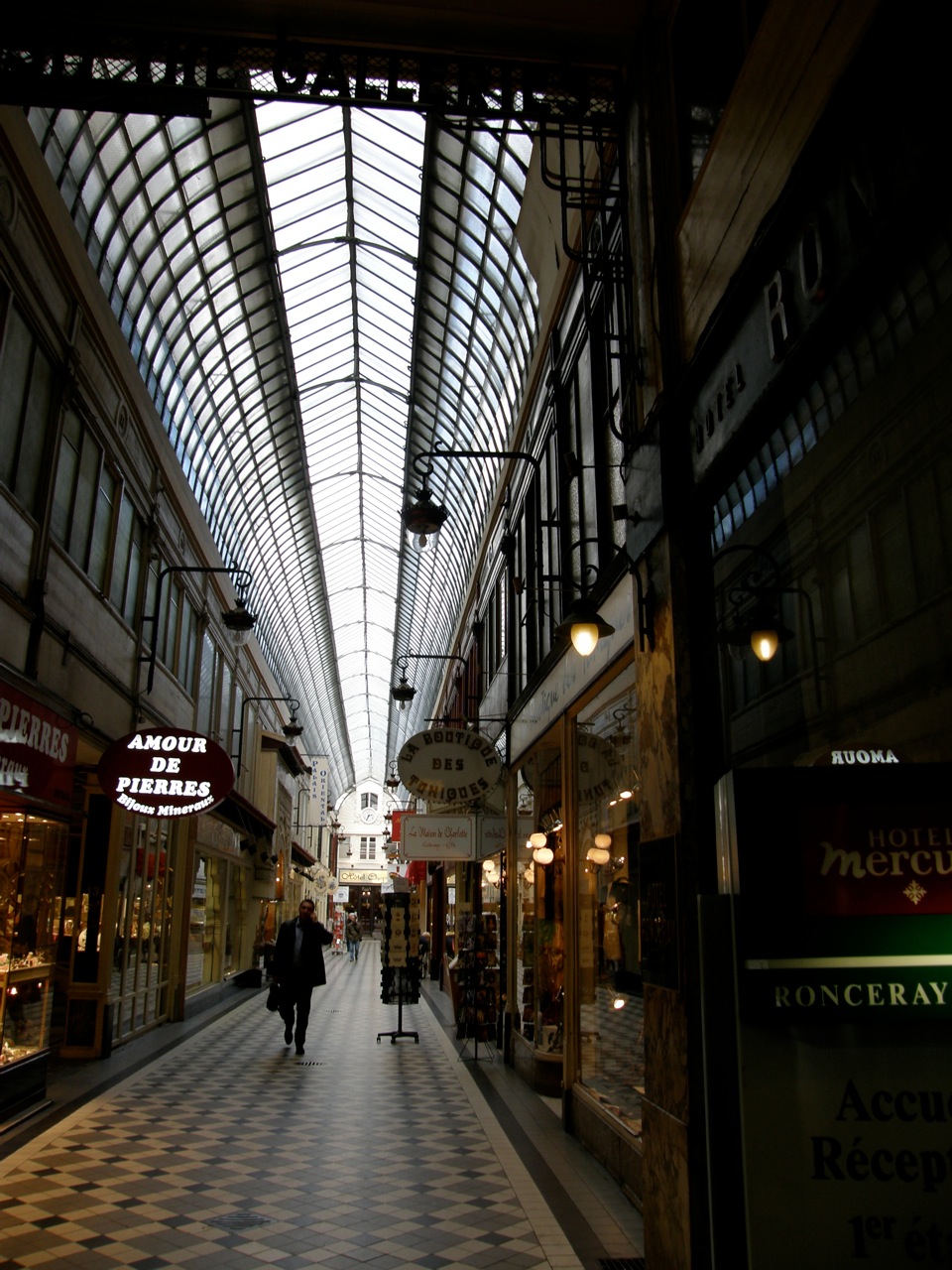
You can also find postcards in several of Paris’s surviving 19th-century shopping arcades (passages couverts), or covered shopping areas.

Passage des Panoramas in the 2nd arrondissement is a traditional philatelic centre, so head there. At Maréchal you will be treated to a wide range of stock in varying price ranges. As in many French stores, the staff have an astounding range of subject knowledge and know their stock well. Don’t be afraid to ask questions, even if your French ranges from the terrible to the non-existent. They are also set up to cater to a wide range of interests, knowledge, and budgets. Several years ago I found some fine Canadian cards relating to a project I was working on, set out on a table in front of the store where all of the cards were one Euro each.

When you’ve finished in the Passage des Panoramas, cross Boulevard Montmartre to Passage Jouffroy, another historic arcade. We always stop in at numbers 39 and 48, the two storefronts of Librairie du Passage, which carries a wide range of books, many beautifully illustrated, often at remarkably low prices.

Where else? Throughout Paris you will find dozens of small shops that sell old objects, some of which are antiques and some of which are just old bric-à-brac: art works—some torn, some stained, some intact—glass, porcelain, jewellery, magazines, books, battered suitcases, walking sticks, you name it, as well as postcards.

Trust me on this: if after you enter, you say “Bonjour, monsieur / Bonjour, madame,” pause, and then ask, “Avez-vous des cartes postales?” they will materialize. Last December I found some unusual postcards at 1 Euro each in a shop in Montparnasse, in an area filled with art supply stores. You just never know.

Postcards are everywhere. Have fun. Tell me about your favourites.

Text and photographs by Norman Ball.

P.S. We are not in Paris right now, but if we were, we’d follow up on some of the Valentine’s Day rendezvous suggestions listed on Paris Weekends, a creation of Adam Roberts, who writes one of our favourite blogs: Invisible Paris. Adam, who has a genius for finding and finding out about overlooked corners of the city, asked for contributions from other bloggers, and we were thrilled to be included. To see what we chose, click here.

Posted in Paris bookstores, Paris bridges, Paris flea markets, Paris history, Paris nostalgia, Paris parks, Paris postcards, Paris shops | Tagged , , , , , , , , , , , | 11 Comments

Finding Paris in old postcards

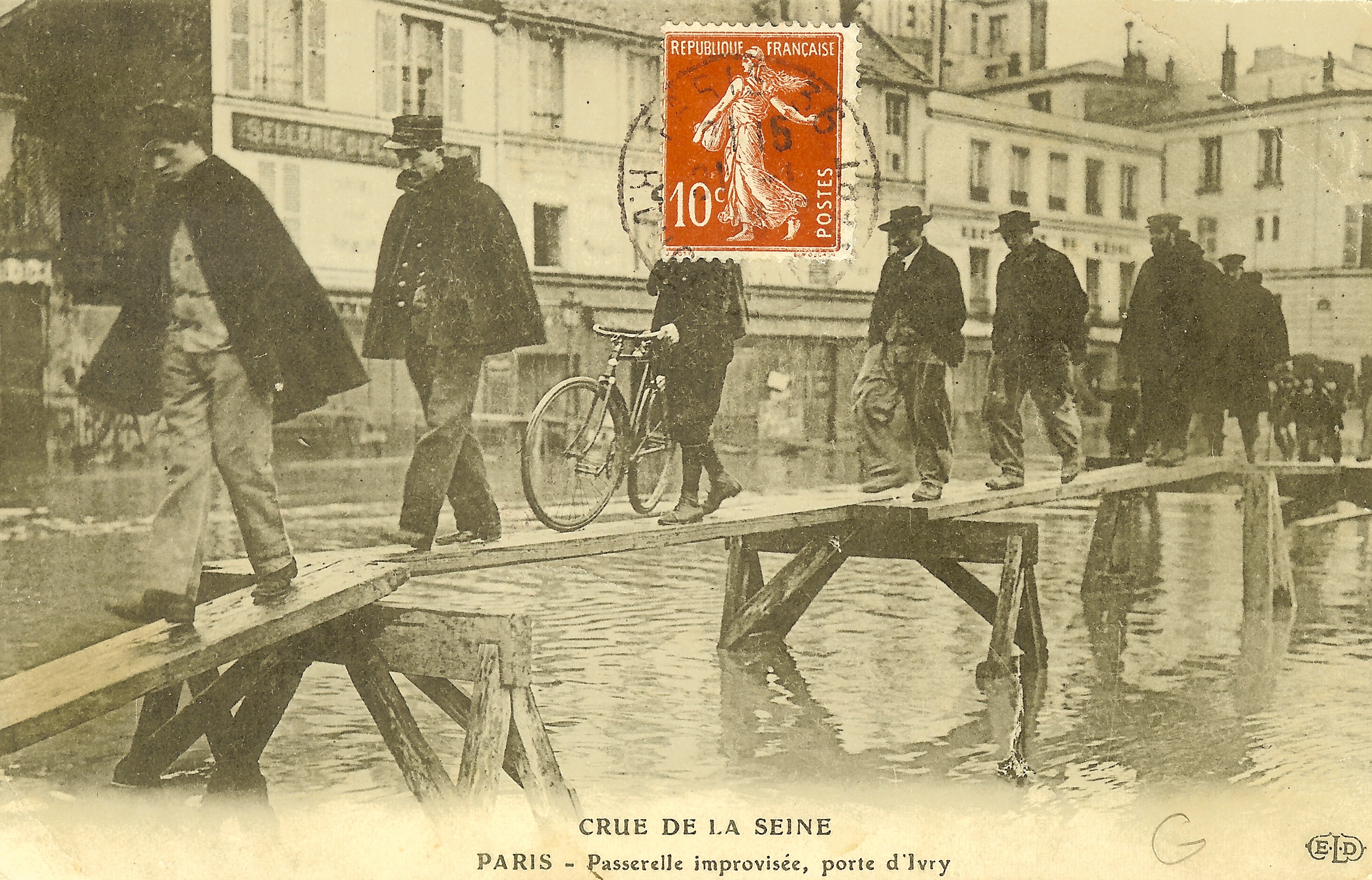
“Pssst. Dirty postcards, monsieur?” Is that your image of Paris postcards? Les cartes coquines (naughty or saucy postcards) are still for sale if you know where to look, but there is much more to old Paris postcards. Many of them offer us new ways of seeing, understanding, and remembering Paris. Consider the unusual street scene in the postcard below.

This passerelle improvisée (improvised footbridge) was one of many built in Paris during the great flood of January 1910. That was a one-of-a-kind disaster (I will write more in a subsequent blog), but Parisiens rose to the occasion. Postcard makers also rose to the occasion. Postcards were very big business; three years earlier, France alone had produced a staggering 300 million of them.

The brief handwritten message on the other side claims this is one of the first cards made to capture images of “les inondations.” Who knows which was first? However, this Paris postcard publisher (Editeur le Deley) was particularly adept at spotting opportunities. The logo that appears in the lower right also appears on a few of the cartes coquines.

When I bought my first postcard of the Paris flood, I knew very little about the event, but it aroused my curiosity. I have since read a considerable amount on the subject. This is one of the things I love about old Paris postcards: they point me towards new interests and previously unknown features of the city.

Old Paris postcards also help me see the familiar in new ways.

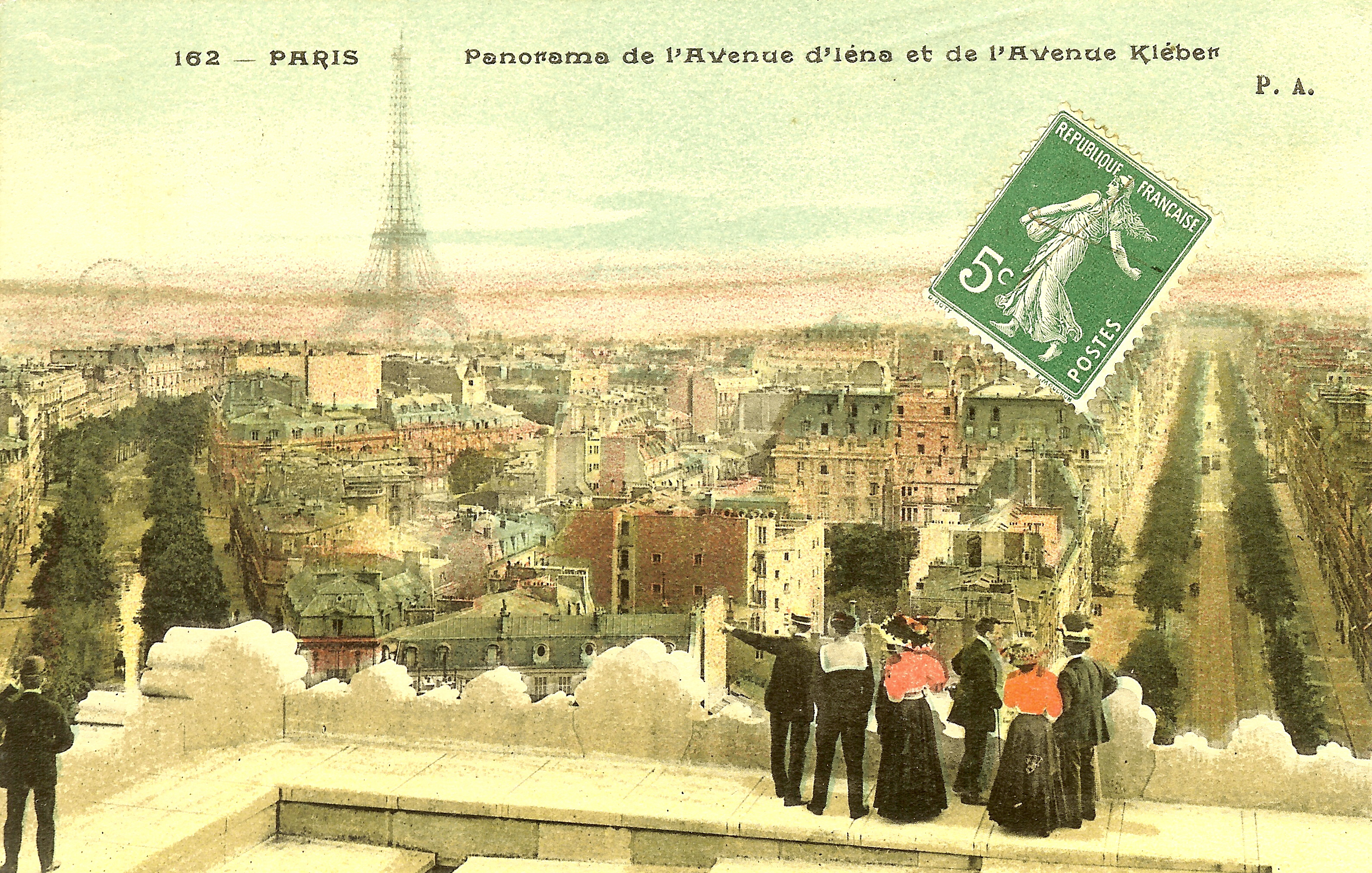
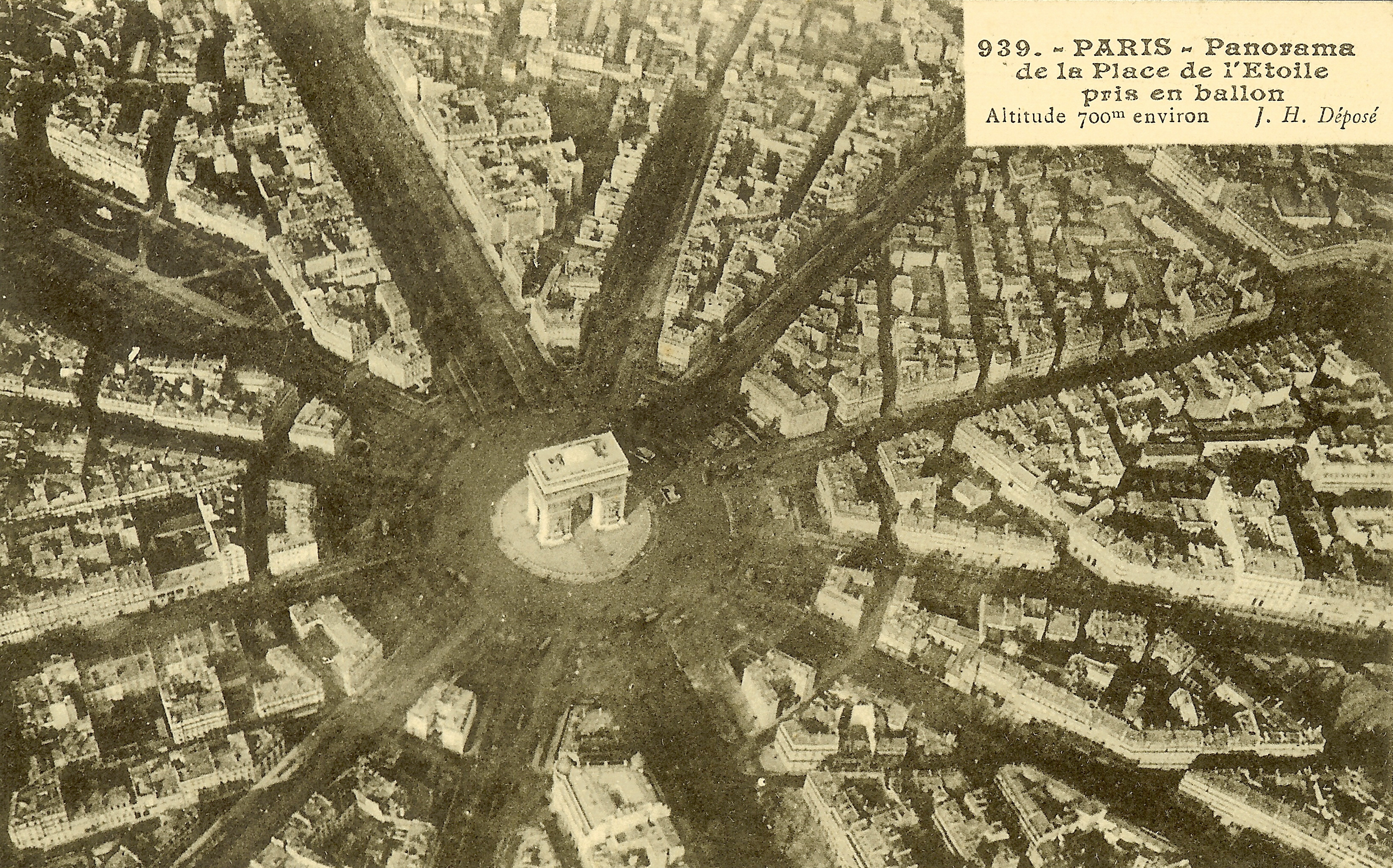
This one is titled simply Paris Panorama de l’Avenue d’Iéna et de l’Avenue Kléber. These two avenues are part of the spokes that radiate outwards from La Place de L’Etoile (now Place Charles de Gaulle). The Place is most famous as the home of the Arc de Triomphe, which you can see in this photo taken from a balloon at an altitude of about 700 metres.

Interestingly, neither postcard mentions the Arc de Triomphe. But the first of the two is clearly taken from there. The view of the streets tells us we are up high and we can see the characteristic stonework around the perimeter. But how different this view is from photos I have taken from the same vantage point.

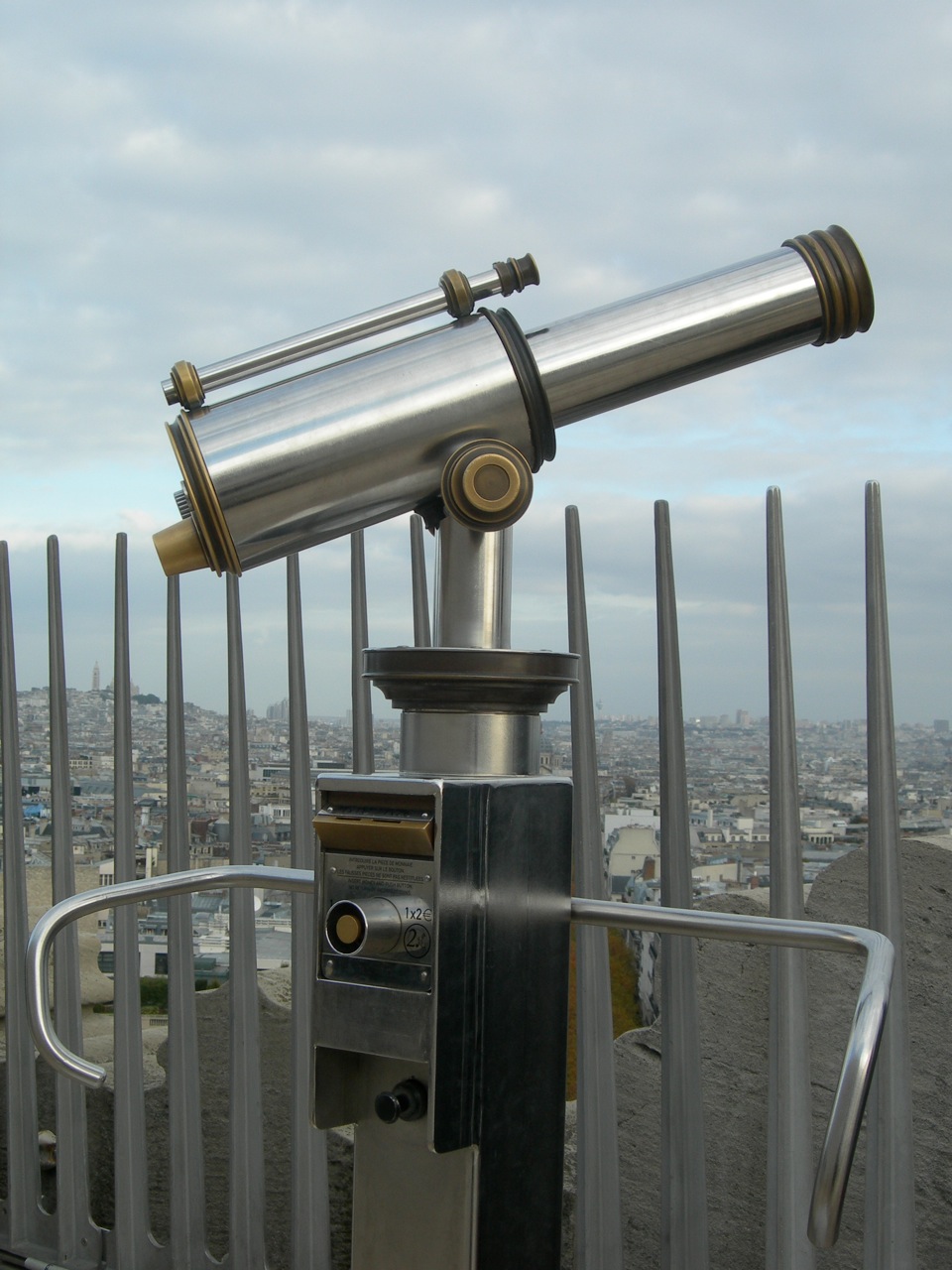
In the photo above the Eiffel Tower is clearly visible as in the postcard. And in the foreground we see the characteristic stonework of the top of the Arc de Triomphe. But I had placed the camera to avoid some of the newer additions that interfere with the view. When I took another photo, where the telescope was my main interest, we see a bit of the stonework, but it is now seen beyond a safety fence of steel pickets.

The safety barriers speak of two important trends. One is simply the staggering growth in the number of visitors and the need to modify attractions to make them safer for crowds. The other is a general trend, particularly since the 1950s and 1960s, to legislate ever-greater safety regulations. I’ll leave it to others to argue about the value and aesthetics of modifying historic monuments to make them safer. But this is one of the sights that greets visitors to the Arc these days.

Now let us turn to something familiar to millions of people, including all those who go to or from Paris on the Eurostar. The Gare du Nord looks a little quieter in the postcard shown below than it does today.

Many people search for unused postcards unsullied by dust, grubby hands, and the markings of the postal service. Not me. Yes, this photographic card of the Gare du Nord is in pristine condition. Moreover, the wide street where horsedrawn carriages outnumber automobiles evokes a sense of time and place.

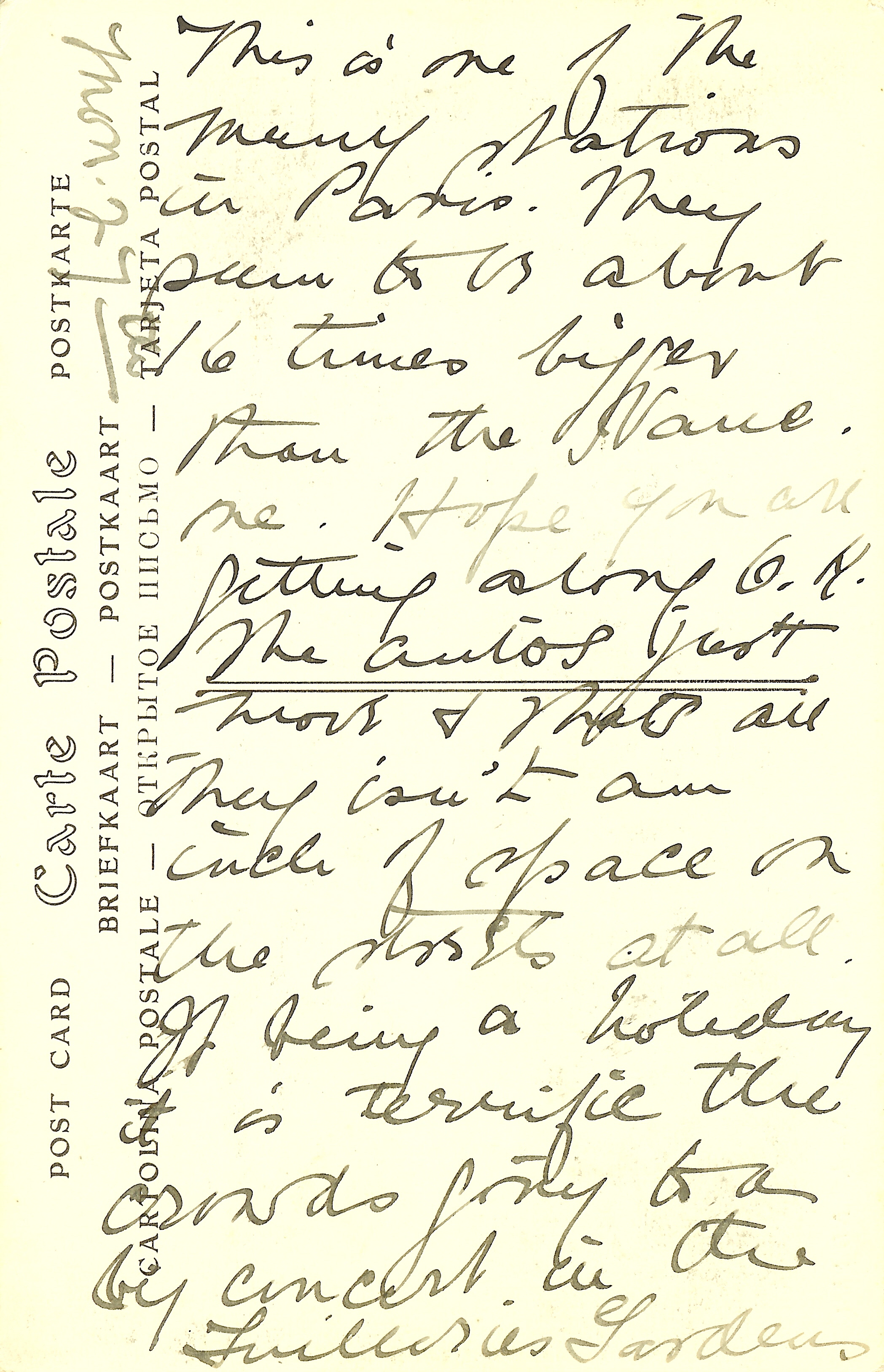
But what really attracted me? Look in the lower right-hand corner. The handwritten comment reads “one of many stations.” And the message on the other side allowed me to peer into the experience of an unnamed visitor who writes:

“This is one of the many stations in Paris. They seem to be about 16 times bigger than the Vane [Vancouver?] one.” (If you are good at old handwriting, have a look at the text, which we have inserted at the end of the blog, and let us know what you think it says.) Then after the obligatory “hope you are getting along,” one catches the visitor’s excitement in the observation “there isn’t an inch of space on the streets at all. It being a holiday it is terrific the crowds going to a big concert in the Tuilleries [sic] Gardens.”

It is written in English and there is no room for stamp or address, so it was probably sent in an envelope.

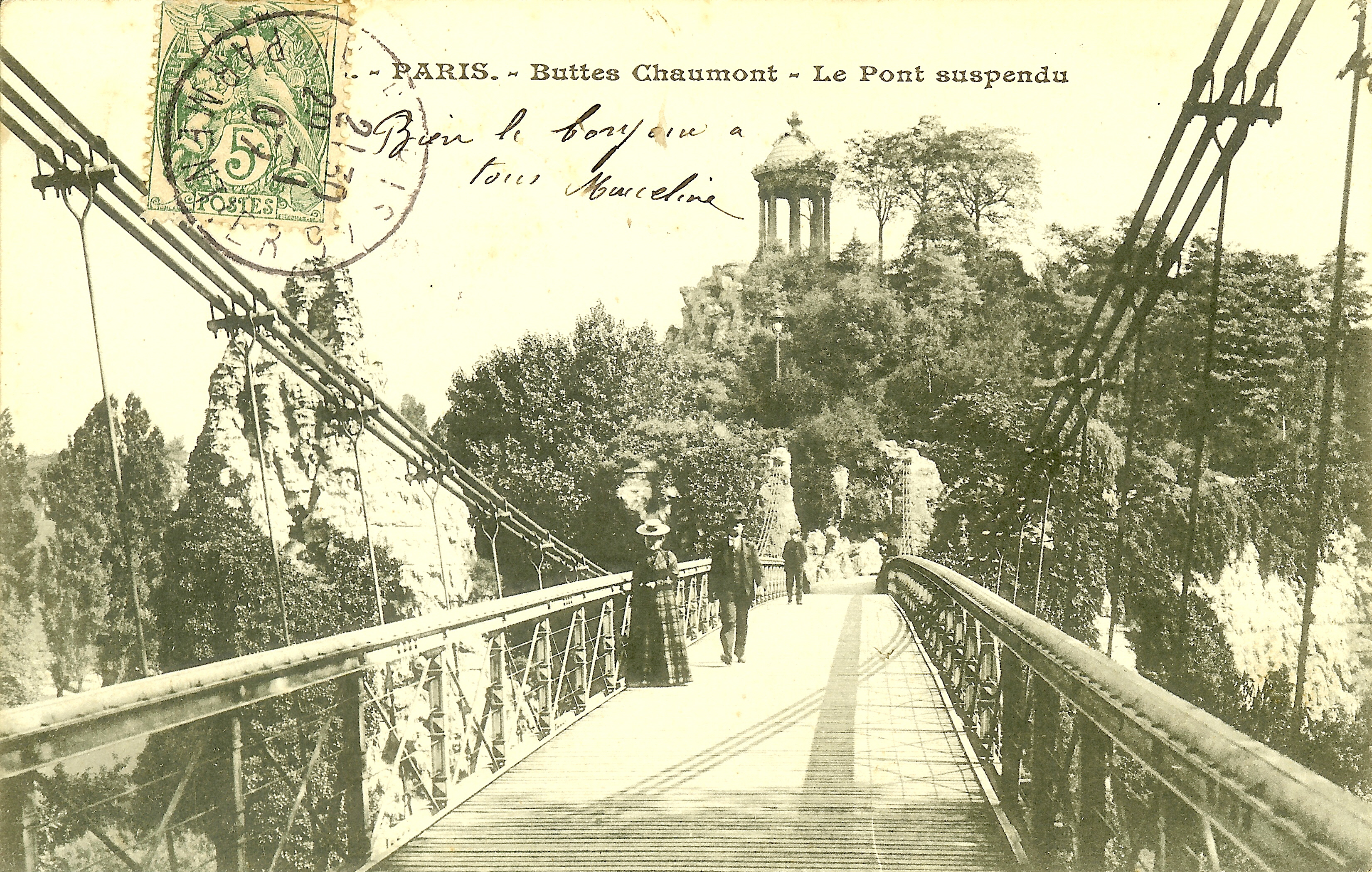
We are also probably safe in guessing that the unknown visitor went to see the Eiffel Tower. People have been flocking to it ever since it opened. But how many visitors made a special trip to see the pedestrian footbridge shown below?

That suspension bridge was on my must-see list. In the next blog, I will tell you why. I’ll also let you know where to find old Paris postcards and explain why some of my best Paris postcards aren’t about Paris at all.

Meanwhile, here’s that message. Can you decipher it?

Text and photographs by Norman Ball.

Posted in Paris history, Paris nostalgia, Paris popular culture, Paris postcards | Tagged , , , , , , , , , | 7 Comments