Paris, City of Reflections

The words Paris, reflections, and mirrors conjure up images of the Hall of Mirrors at Versailles. But Paris holds many more mirrors and reflections. The streets and shops of Paris are a City of Reflections best revealed to the unhurried flâneur who is willing to experience small pieces of Paris slowly.
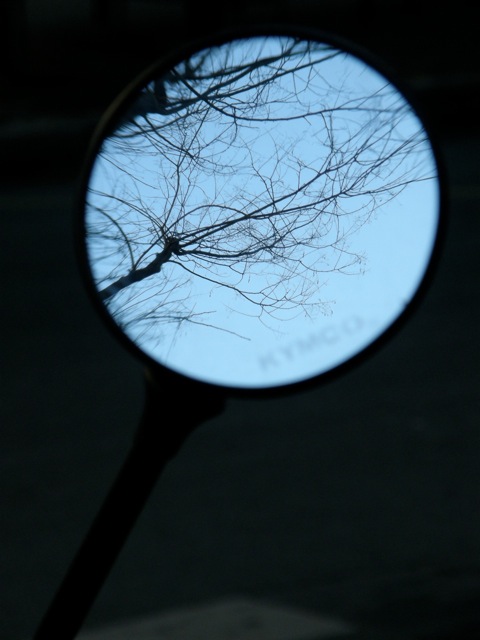
Bare tree limbs and spidery branches against a bright blue sky. Is this late fall or early winter in the country? Or a setting for an Edgar Allen Poe story? What is the faintly visible extension near the bottom left of the image? What are the nearly invisible initials in the bottom right? This is no ordinary photo. It is scene changer. Something I saw when I brought a slow walk to a halt, then looked.

It started out with a small street scene. I moved closer and peered into a rearview mirror. I stood still, moved my head and upper body side-to-side, then up-and-down. Every movement rewarded me with small, reflected scenes of Paris. It was my little game, and in the snippets of the Paris of Reflections I was seeing what was not visible to those who looked directly. And the initials KYMCO? Kwang Yang Motor Company, founded 1963 in Taiwan.
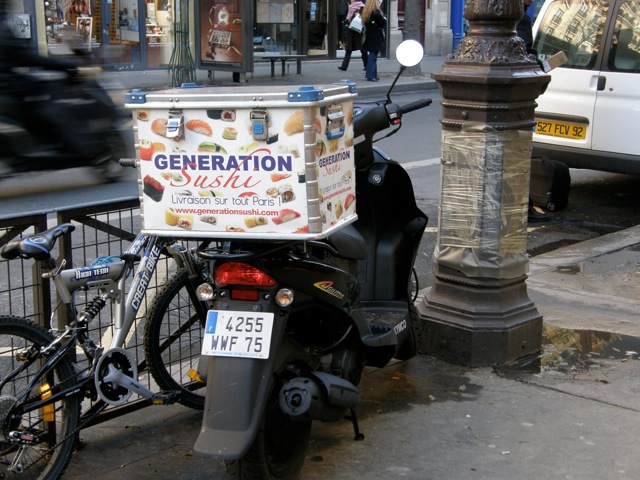
My Paris is a city of shops. My dominant mental maps of Paris are about where I find certain types of shops. I love the wonderful collection of camera shops on Rue Beaumarchais. I look at shop fronts and, oh yes, I often go inside, too. In the 4th arrondissement, my wandering often brings me to Miroir Brot, 15, boulevard Henri IV, a venerable French institution.

Miroir Brot (depuis 1826) on boulevard Henri IV has the quintessentially elegant Parisian shopfront one expects from a purveyor of fine goods. Pause to take it in. The blue is rich, deep, well-maintained. The mirrors on display—each an object of beauty—are so elegantly grouped they look as if there is no other way for them to be and yet each is an individual, giving its own reflected image of the street and its environs.

The plate glass windows also attract my attention. After all, I am a historian of technology with an interest in the 19th-century improvements in glass-making technology that led to bigger and bigger pieces of glass. These in turn helped to create the kinds of shops that made Paris a global shopping destination. But my window-shopping at Miroir Brot takes in more than history and the elegant display of fine products.
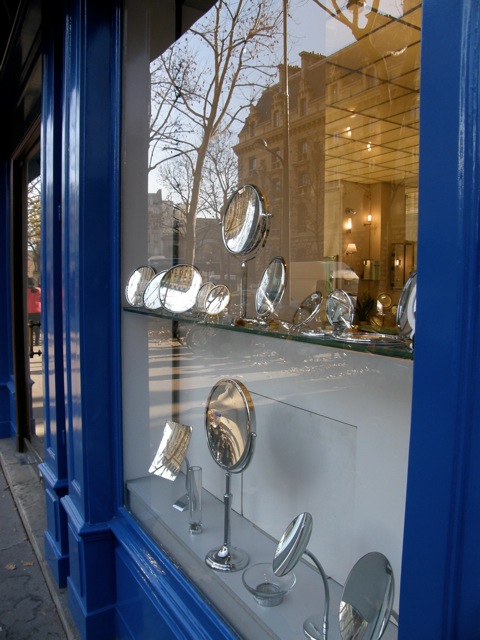
The artistic array of mirrors is a show in itself. More than that, the plate glass window temporarily holds a golden semi-transparent reflection of the building on the other side of boulevard Henri IV. This juxtaposition of seemingly disparate elements is one of the most important characteristics of Paris. The reflections make the scene look more expansive. But at the same time, the reflections bring things closer to me and help me see Paris in different perspectives. While the reflections in the mirrors and plate glass are intriguing, the visible part of the interior becomes more mysterious.

But let us look more closely. Look at the mirror and the reflected image in the mirror in the lower left of the photo above. The photo below is of the same mirror, but when I moved to a slightly different position, it changed the world held in that mirror.

The mirror has turned the view upside down and yet I see more. Perhaps it is simply because I have to work more to understand the scene, simple as it is. Reflections allow me, or perhaps force me, to see with different eyes.

With the image below we return to a grouping of mirrors that Miroir Brot has so kindly provided the flâneurs of boulevard Henri IV.
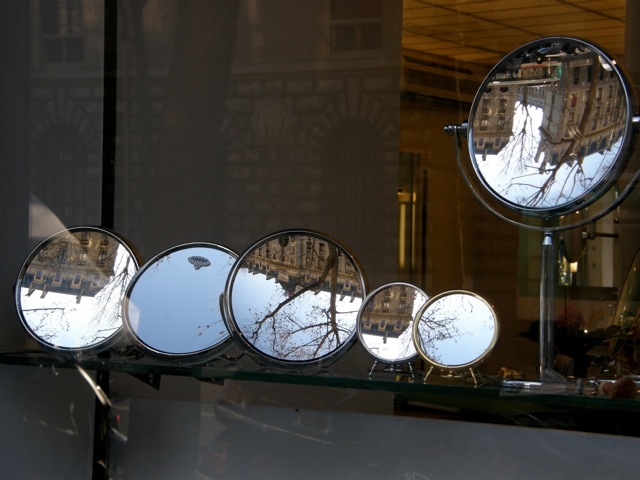
As with so many of the window displays I have admired in Paris, it offers the eye so much, because so little has been arranged so artfully. Each mirror captures and projects ever changing images as one walks by or simply with the passage of time. Let us look more closely at the image in the mirror on the upper right.

The reversed mirrored image seems to have concentrated the richness of the architectural heritage. It is the visual equivalent of what we do in cooking when we concentrate the flavours in, say, a red wine reduction. I pay particular attention to the bus, because it took me a moment to figure out what it was. I am more aware of the trees. Then another mirror and its images distract me.
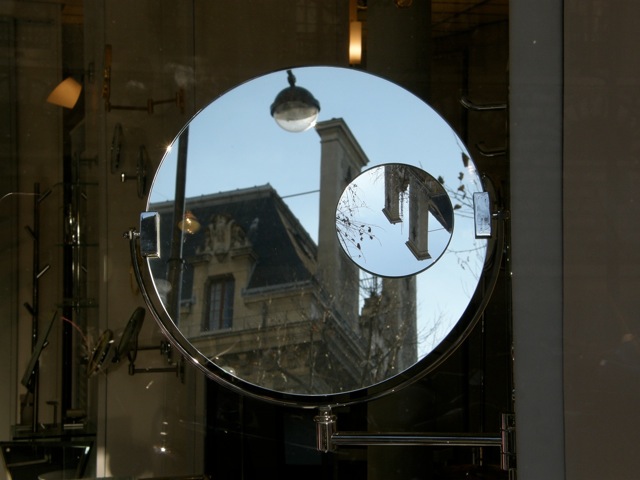
Here the smaller image of the upsidedown chimney superimposed on the larger view of the right-side-up chimneys forces me to think about chimneys. I pay attention to the details. I have to assure myself that indeed these are the same two chimneys in each part of the mirror. Would I have noticed them were it not for the mirrors? Probably not.

Paris is many cities. One of mine is the City of Reflections.

Text and photographs copyright Norman Ball.

Posted in City of Reflections, Paris art, Paris shops | Tagged , , , , , , , | 3 Comments

How to Make a Surprisingly Enduring Film

It’s not the best movie ever made in Paris. Nor is it the best movie made by either of its stars or its director. And yet, with its stylishness and wit, it remains watchable when so many other movies from the 1960s seem hopelessly dated.

I am talking about How to Steal a Million, 1966, directed by William Wyler and starring Audrey Hepburn and Peter O’Toole.

For one thing, of the various movies that Audrey Hepburn made in Paris (such as Funny Face, Love in the Afternoon, Charade, or Paris When it Sizzles), she finally got to act with someone close to her own age. Fred Astaire, Gary Cooper, Cary Grant, and William Holden were all much older than she was; but with Peter O’Toole she had a believable love interest.

For another, the movie doesn’t try to be more than it is – an enjoyable romp. There is no violence (as in Charade) or singing and dancing (as in Funny Face) or hectic fantasy (Paris When it Sizzles) or torrid affair (Love in the Afternoon) to spoil the enjoyment. It’s just an amiable caper – a heist that is not really a crime, with some light-hearted romance woven in.

The plot is quite simple. Audrey plays Nicole Bonnet, the daughter of a gifted art forger, Charles Bonnet. Charles Bonnet makes the mistake of lending a forged sculpture of Venus to a famous museum for a blockbuster exhibit. Meanwhile, a specialized art detective called Simon Dermott (O’Toole) is closing in on Bonnet. Nicole surprises Dermott one night when he sneaks into the Bonnet mansion to take a paint sample from a forged Van Gogh. She assumes him to be a burglar.

When the museum tells the Bonnets that the sculpture must be subject to expert scrutiny before it can be insured, Nicole contacts the man she thinks is a professional thief to help her steal it back. Dermott is falling for her, so he agrees to help her.

The small statue is protected by a sensitive burglar alarm and Dermott conceives a plan to set off the alarm repeatedly, until the guards assume that it is malfunctioning and turn it off. The plan works. Dermott grabs the statue. Dressed as a cleaning lady, Nicole smuggles it out of the museum in a bucket. Dermott sells the statute to an eccentric collector who agrees never to display it in public. Then he and Nicole head off in his pale yellow E-type Jaguar to live happily ever after.

Audrey Hepburn was happy to work again with director William Wyler, who had brought her to fame in 1953 in Roman Holiday (another delight, but with another older man). For his part, Peter O’Toole was hoping for a break from the intensity of his previous films, Lawrence of Arabia and Becket. In preparing for How to Steal a Million, he watched Cary Grant movies to get the hang of the debonair man-about-town character.

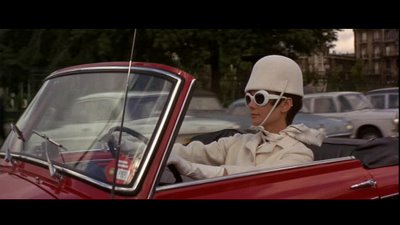
Although the movie starts with an auction, followed by the delightful sight of Audrey dressed in head-to-toe white Givenchy, driving a tiny red Italian convertible (Norman tells me it is an Autobianchi Eden Roc) across the Pont de la Tournelle, the first scenes to be filmed were, in fact, those in which Audrey and Peter are scrunched up in a museum broom closet as they carry out the heist.

This part of the film took eleven days to film, and according to one of Audrey’s biographers, the two stars kept getting fits of the giggles and spoiling take after take by laughing.

Fortunately for everyone’s nerves, the film was shot on the “French schedule.” In Los Angeles, filming starts at 9 a.m. or earlier and usually wraps up in the early evening, with a break for lunch, largely so that the technicians involved can keep regular hours. In France at the time, filming never began before noon and continued until 7:30 without a break, to allow for a civilized dinner at 9 p.m. William Wyler found this arrangement congenial and added, “Who can play a love scene at nine o’clock in the morning?” No doubt O’Toole, a notoriously heavy drinker, also appreciated the schedule.

Audrey never drank on the job, but at one point the weather turned chilly during an exterior shoot, and O’Toole offered her some brandy. The next scene called for her to roar off in the Autobianchi, which she did, knocking over several large lamps and sending the lighting crew diving for cover.

This scene took place outside the museum in which much of the action takes place. It is, from the outside, the Musée Jacquemart-André at 158, boulevard Haussmann. In the film it is called the “Musée Kléber-Lafayette.”

The interiors are a different story. They were constructed on the studio lot at Boulogne-Billancourt. The set designer, Alexander Trauner, who lived in Paris, contacted several Paris painters to create the “masterpieces” that line its walls. For $100,000 he amassed a collection of fake Renoirs, El Grecos, Goyas, Rembrandts, Rubenses, Van Goghs, Monets, Cézannes, Tintorettos, and Picassos. For another $50,000, he bought authentic antique frames. The fake artwork was so attractive that real thieves helped themselves to several objects during the filming.

While in Paris, Wyler took a house on the rue Weber, where he and his wife could entertain. Audrey Hepburn stayed at the Hotel Raphael (returning to her family in Switzerland on weekends), and O’Toole bunked at the Hotel George V. But the hotel featured in the movie was the Ritz, where Dermott stays while investigating Charles Bonnet. When Nicole finds out he is there, she figures that he must be a very successful burglar indeed.

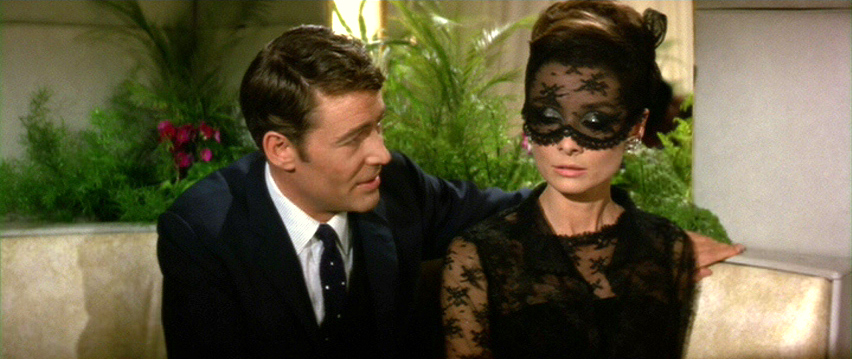
They begin to plan the heist at the hotel, in a scene in which Audrey wears a black lace Givenchy number with black lace stockings, a black lace eye veil, and glittering silver eye shadow. Peter O’Toole’s character does a double take when he sees her. (That dress later sold at auction for £600,000.) More of the plotting takes place in the gardens beside the Champs-Elysées. Another scene takes place in Maxim’s, where the eccentric millionaire, played by Eli Wallach, tries to woo Nicole Bonnet.

(A sidelight: The part of the millionaire was first offered to Walter Matthau, but he wanted too much money, and then to George C. Scott, who failed to show up on set when he was needed and was fired. William Wyler settled on Eli Wallach, who was both affordable and dependable.)

The other important location is the Bonnet mansion, a three-storey, nineteenth-century pile with a large forecourt, and a double staircase leading up to the front door. Where is it? It took me a while to find out, until I discovered that when Peter O’Toole puts Audrey Hepburn in a taxi and tells the driver to take her home to “38 rue Parmentier,” that is, in fact, the address – in Neuilly. Today the house has disappeared, replaced by an apartment block. The wall and the gate of the forecourt are still visible, however.

The film’s capable supporting cast included the Welshman Hugh Griffith as the Frencher-than-French Charles Bonnet, the notable French actor Charles Boyer as a gallery owner, and a comical character known only as “Moustache,” playing a museum guard. The chirpy soundtrack is credited to Johnny Williams, who turns out to be John Williams, of Star Wars fame.

When it was released, the movie received only lukewarm reviews. It was derivative (the critics sneered). It was not even funny. It was time Audrey Hepburn stopped playing ingénues. Time has been kinder to How to Steal a Million. I must have seen it a dozen times, and it always delights.

Text by Philippa Campsie

Acknowledgements: Thanks to Michael Schurmann, author of Paris Movie Walks, who identified the museum in the movie as the Musée Jacquemart-André. His book is a useful guide to movie locations throughout Paris. For more information, go to: http://parismoviewalks.co.uk/

Posted in Paris film | Tagged , , , , , , , , , , , , , , , | 15 Comments

A Flâneur’s Advice on Parking in Paris

Baudelaire’s nineteenth-century flâneur explored the city by strolling. A flâneur walked, observed, listened, and had no destinations, appointments or deadlines. With due respect to Monsieur Charles Baudelaire, I have proclaimed myself un flâneur de la circulation et du parking when I am in Paris. What have I seen?

Paris, like nature, abhors an unoccupied small space. The smallest spaces seem to have the most in them. And the flâneur finds the treats in these spaces by walking the centuries-old narrow streets and alleys that wiggle through Paris. I will leave the driving to others.

If you must drive and park in the city, I suggest you follow this link. The authors “strongly advise most people not to drive in Paris,” but for those who must it provides advice on parking.

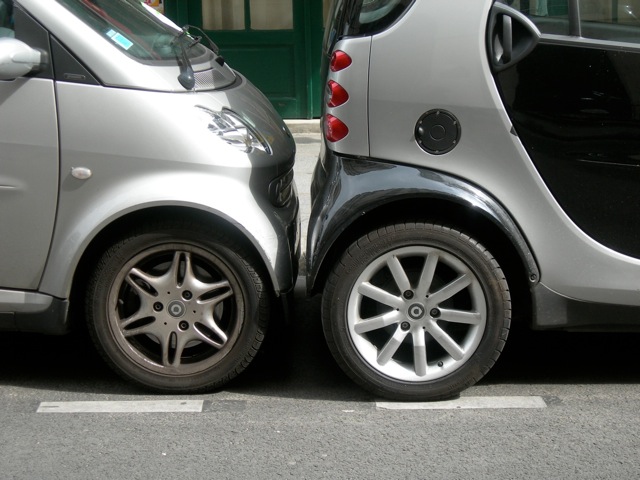
Paris is no place for drivers who are used to parking only in the wide-open prairie-like vastness of North American shopping malls. The scarce, almost impossibly small, on-street parking spots have elevated the art of parallel parking to an urban survival skill in which a small car is essential survival gear. Although I know a bit about where cars come from, the two Parisian Smart cars shown above seem like a breeding pair.

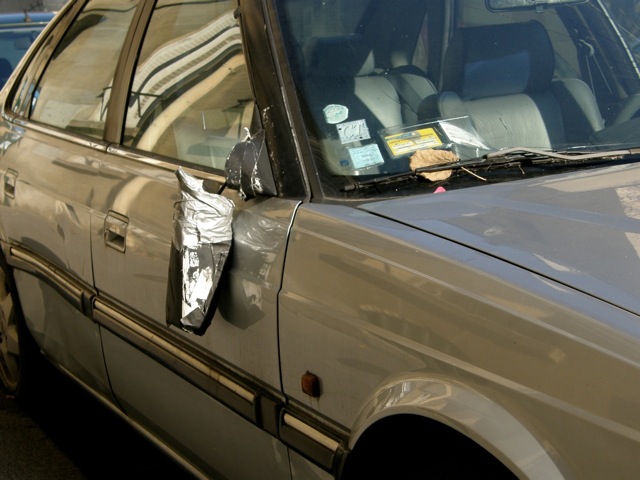
You might have a small nimble car. What about the other drivers? They might not be as careful or skilful as you. Safe parking requires protection from drivers of the crunch-and-grind school of parking. I was struck (so to speak) by the colour-coordinated foam and duct tape on this Citroën 2CV, an eloquent reminder that ingenuity and individuality are alive and well in Paris.

And thinking of Citroëns, a chosen few get parking spaces that are both well-protected and elevated above the common mass of cars. The luckiest ones are at C42 (C for Citroën, 42 for the street address) on the Champs-Elysées. Since 1927, when it acquired the property, the Citroën showrooms have added to the Champ Elysées’ reputation for elegance.

On 27 September 2007, a new building emerged on the site as the Citroën Flagship Showroom. This astounding showplace, the first new building on the Champs Elysées in 30 years, is the work of French architect Manuelle Gautrand, who won this honour through an international competition. “The central focus to the building’s interior are eight rotating turntables each topped by mirrors, each featuring a different Citroën model, that rise up vertically through the building to create a spectacular column of cars.”

But don’t take my word for it. You have to visit it.

Before we leave the Citroën Flagship Showroom, look closely at the rear bumper of the impeccable Citroën 2CV in its amazing parking spot in C42’s column of cars. Note the stylish curving upright element near the end that emphasizes and protects the tail light. Such an elegant touch might be fine for a protected—or even polite—parking world. But what of the street level world of bump-and-grind parking?

Remember the foam protectors on the front bumpers of the blue Citroën with red and blue duct tape. Now we see the other end of the story. And once again, my compliments to practical ingenuity.

While we’re on the Champs Elysées, let’s take a short walk to L’Atelier Renault. This is a place to linger. Aside from the boutique and exhibit space for both cars and art, the main attraction is the restaurant bar above the showroom. We have sipped, eaten, talked, rested, and even written there many times.

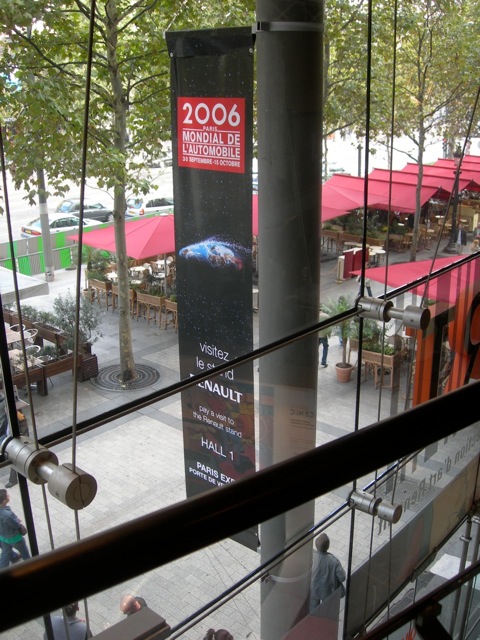
The memory of our first visit to L’Atelier Renault is the most intoxicating. From our table overlooking the Champs Elysées, we could see the banner for the 2006 Paris Auto Show (Mondial de l’Automobile) that we had visited a few days before. Dating back to 1898, the formerly annual show, now held only every two years, is the oldest and (for us) the best automobile show in the world. In addition to displays of the newest, latest, fastest, most famous, most futuristic, most exotic and perhaps dreamiest cars, it was also the site of a large well-presented collection of historic French vehicles.

Try to imagine our excitement a few days after the Motor Show when we visited L’Atelier Renault to find an exhibit about the Renault plant and its workers at Boulogne-Billiancourt. The photographer? Robert Doisneau. Long before his photographs of lovers at the Hotel de Ville, he was photographing workers at their stations in the assembly plant, as well as at the company’s cafeteria tables, where a bottle of wine awaited each worker.

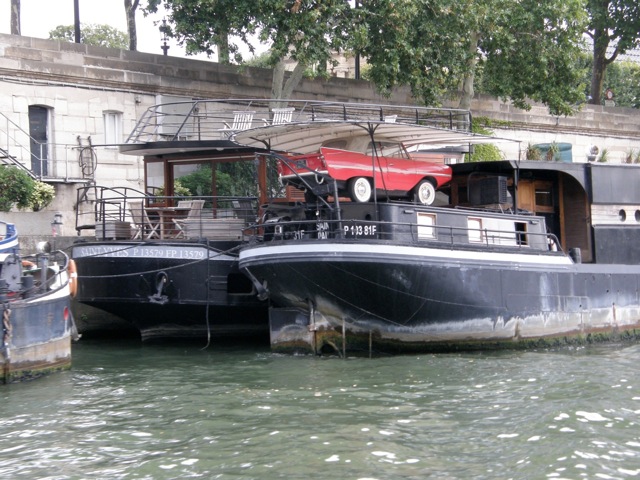
The Champs Elysées is not the only place with one-of-a-kind parking places. One day as I walked along the Seine, I took the image below. I call it the “bring-your-own” parking spot.

It was no ordinary parking spot and no ordinary car. Having once been a car-crazed teenager, I recognized it instantly as an Amphicar.

I like cars and I like driving. One of my summer jobs as a university student was loading trucks on the night shift. When the trucks were loaded, I made obstacle courses out of oil and gasoline barrels and practised backing up and parking in tight spots, a skill that has served me well. If I ever find myself with a car in Paris, I’m ready.

Text and photographs copyright Norman R. Ball.

Posted in Paris automotive | Tagged , , , , , , , , , , | 6 Comments

“A vile business clumsily done”

In 1847, the year that Charlotte Brontë published Jane Eyre, Paris society was riveted by a similar triangle –a wealthy and prominent man, his unbalanced wife, and a young governess. Their story, however, had a very different ending.

In August of that year, the Duc de Praslin murdered his wife and shortly thereafter committed suicide. The governess (that’s her in the photograph), who like Jane Eyre was a nearly friendless orphan, was imprisoned and questioned about her role in the murder and her relationship with the Duc. Were they lovers? Had she pushed him to kill his wife? Just what was her position in this strange household?

But I am getting ahead of my story. Let’s start at the beginning.

In 1824, Théobald de Praslin, aged 19, married Fanny Sébastiani, aged 17. The wedding caused something of a sensation because these two young people, both descended from aristocratic and wealthy families, actually appeared to be in love.

They started a family immediately. In retrospect, perhaps this wasn’t such a good idea. Over the next fifteen years, Fanny gave birth to nine surviving children, and suffered a few miscarriages as well. By the time she was 32, the willowy girl had become an obese and unhealthy matron whose husband had lost interest in her. Yet she still loved him passionately, and the more she tried to cling to him, the more he distanced himself.

She poured out her heart in letters and diaries, sometimes writing to her husband several times a day with entreaties, recriminations, apologies, demands, and expressions of longing for him. As the rest of the household slept, she sat at her desk, scribbling these cris de coeur. Even though they lived under the same roof, she had a footman deliver notes to her husband, sometimes several a day. One can only imagine what she would have done if she’d had access to e-mail.

Her frequent emotional outbursts unnerved Théobald and the children, yet much of the household staff was devoted to her, and she still moved in society. The aristocratic show must go on – there may be screams and scenes behind closed doors, but appearances are to be kept up. She was no Mrs. Rochester in the attic; she was a public figure.

Théobald also had little in common with Jane Eyre’s Mr. Rochester. He was a quiet man, cold and somewhat inert, and his usual reactions to his wife’s outbursts were silence and withdrawal, with occasional bursts of icy rage. He was wealthy and idle and had little to occupy him until the death of his father in 1841 made him the duke. He immediately set about restoring the family seat, today known as Vaux-le-Vicomte – the huge chateau that had once made Louis XIV so jealous that he created Versailles to rival it.

In that same year, the family hired Henriette Deluzy, the latest in a series of governesses. Did she know what she was getting into? Before she arrived, Théobald had insisted that his wife sign a paper stating that she would not see her children unless someone else (such as a governess) were present. It is not clear whether he considered his wife an actual threat to them or simply a bad influence.

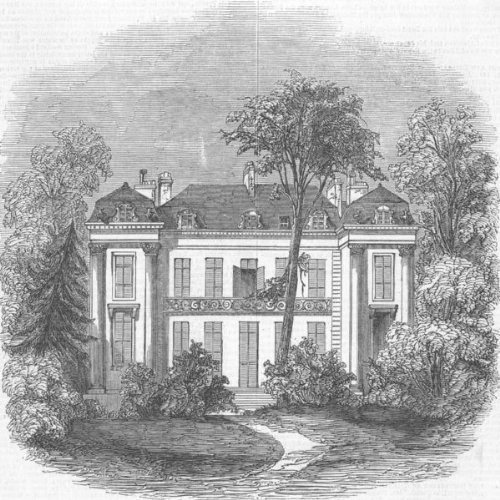
And Henriette Deluzy arrived at the family’s house on the rue du Faubourg St-Honoré (the Hôtel Sébastiani, shown in the picture) with her own baggage. She was an orphan – worse still, illegitimate – and dependent on her grandfather, who resented her very existence. She had once studied art seriously in the studio of Pierre Claude François Delorme, a historical painter, but had become a governess when her mother died and she needed to earn a living.

Henriette seems to have impressed many of those who met her with her charm and intelligence, but she was no Jane Eyre – she was more vivacious and outgoing, and at times bossy in her new position (the other servants never warmed to her).

In the six years she was with the family, the growing distance between the husband and wife, and the Duc’s obvious preference for spending time with his children and their governess led to inevitable speculation. The gossip increased when the family (minus the Duchesse) travelled to Italy. Big mistake. By then, all society agreed that the Duke and the governess were lovers.

For the record, it probably wasn’t true. Henriette may have been in love with her employer, but her employer doesn’t seem to have returned the feeling, although he was fond of her in his rather distant way.

Nevertheless, the duchess believed the rumours and started divorce proceedings, planning to take the children from their father. She probably would have succeeded. Although it was common for men to have mistresses, keeping them within the household and giving them charge of one’s children was simply not done.

In June 1847 she dismissed Henriette, who was distraught at being separated from the charges she had grown to love. Henriette found a position in a girls’ school, but wrote some unwise letters to the family she had left, pouring out her misery and loneliness at the separation. Another mistake.

Nobody knows what really happened in those weeks after Henriette left the household, but the Duc seems to have snapped. On an August night when the family was in Paris between returning from Vaux-le-Vicomte and embarking on the family’s annual trip to Dieppe, he tried to cut his wife’s throat while she lay in bed. He didn’t kill her immediately. She woke up and struggled with him. He then tried to bludgeon her, first with the butt of a pistol, then with a candlestick. Her screams awoke the household before she collapsed. Meanwhile, the duke retreated to his rooms and attempted to burn his blood-stained clothing in the fireplace.

It was an inept murder. The police investigator who entered the Duchess’s bedroom and saw the blood and damage said immediately, “This is not the work of a professional thief or murderer. It is a vile business clumsily done. It is the work of a gentleman.”

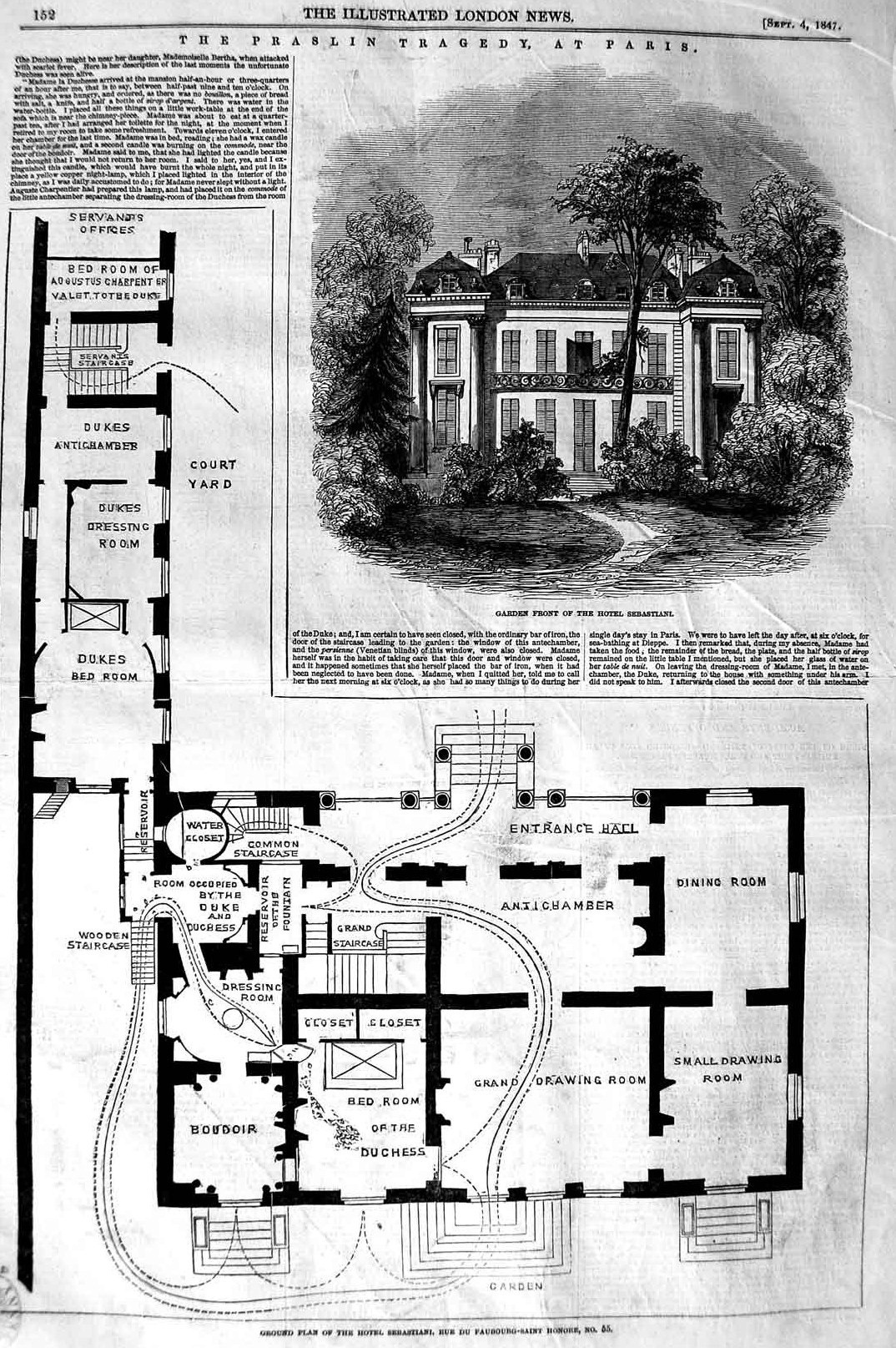
After her murder, the papers printed details of the condition of the house, including a lurid diagram of the scene of the crime with the location of bloodstains carefully noted. I will spare you that, but show you the floor plan of the vanished Hôtel Sébastiani, published in the Illustrated London News. It’s an odd L-shape, and the Duc and Duchesse occupied rooms on the ground floor (hers was right next to the main salon).

The duke was placed under surveillance. He couldn’t be taken into custody right away because he was a French peer, and his arrest could only be arranged with the agreement of his fellow peers. Despite the close watch, he managed to swallow arsenic. It took him six days to die. He was questioned repeatedly, at home and after being taken to the Luxembourg prison, but he did not confess.

Henriette was also arrested, and kept in solitary confinement, so she would not obtain any outside information about the investigation. She did not learn of the duke’s suicide until three weeks after his death. She was repeatedly questioned, and her thoughtless letters to the family were scrutinized, but she was never charged and was eventually released. She went to the United States and married a clergyman.

The story is interesting in itself, but this was more than just an appalling domestic tragedy. The affair was the last in a string of scandals that undermined public confidence in the court of King Louis-Philippe and it contributed to the revolution of 1848, which brought the Louis-Philippe’s reign to an end.

Today, Vaux-le-Vicomte still stands, lovely as ever, but the site of the murder has been erased completely. In the 1840s, it stood at 55, rue du Faubourg St-Honoré (now the address of the French President). It was demolished in the early 1850s and the rue de l’Elysée (shown in the photo) was cut through its gardens. I wonder – does the ghost of the murdered Duchesse haunt the street by the President’s residence?

Further reading: The best book on the subject is Stanley Loomis’s Crime of Passion (1967). But well before he did his meticulous research in the official records, a popular novelist, Marjorie Bowen, used the same story for a fictional account called Forget-Me-Not (1932). Then Henriette’s great-niece, Rachel Field, wrote a 1938 novel about the murder called All This and Heaven Too, made into a 1940 movie with Bette Davis in the role of the governess. There’s just something about governesses that spells drama and passion.

Text copyright Philippa Campsie


Update (2015): The comments have yielded a lively correspondence about what happened to Théobald, who may not have died of poisoning after all, but may have been smuggled out of the country. According to some accounts, he fetched up in Central America. A reader has contributed the following photograph of him in later life. Will we ever know the truth about what happened on that night in August 1847?

Theobald

Posted in Paris crime, Paris history | Tagged , , , , , , , , , , , , , , , | 54 Comments

Parisian cats

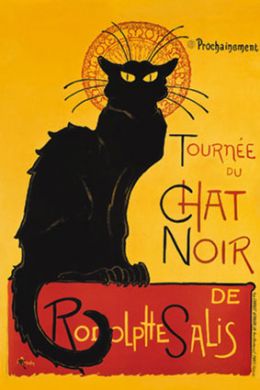
Le Chat Noir is undoubtedly Paris’s most famous cat, or at least its most commercially reproduced cat. But it is only one of many cats who are part of the city’s story.

Countless millions have seen Le Chat Noir on posters, postcards, T-shirts, coffee mugs, coasters, napkins, and umbrella stands. Far fewer have seen the rare 1896 original lithograph by French artist Théophile Steinlen.

Born in Lausanne in 1859, Steinlen arrived in Paris in 1878 to work as a technical draftsman, moved to Montmartre in 1883, and two years later drew the first of several hundred lithographed advertising posters. Théophile loved cats and they became a common motif in his work. However, none are as famous as Le Chat Noir and for the origins of that image, we must turn to Rudolphe Salis—painter, poet, and son of a wealthy brewer.

In the 1880s Montmartre was a poor district more famous for prostitutes and pickpockets than artists. But artists were being priced out of the Left Bank and the Latin Quarter, and more and more came to take up residence on the Montmartre slopes. Rudolphe Salis was one of them.

Artists and writers like to hang out with others like them, to talk, drink, and solve the problems of the world. No one is quite sure how it happened—more chance than planning, it would seem—but by 1881 Rudolphe’s small apartment had become a regular meeting place. He had the family connections to provide a steady stream of drinks; thirsty artists temporarily short of currency gave him their pictures to put on the walls. After a while, he moved to larger quarters next door (84 boulevard Rochechouart, in the 18th arrondissement) and called it the Chat Noir.

What was the Chat Noir? Rudolphe Salis called it a cabaret, an antiquated word for a tavern or wine cellar (only later did cabaret carry the promise of public entertainment). The place attracted leading artists and musicians such as Claude Debussy, Guy de Maupassant, and Henri Rivière, as well as Erik Satie, who worked there for several months as pianist. The bourgeoisie—always on the lookout for new experiences and places—came to see the artists. In 1882, the regulars even started a magazine called Le Chat Noir. But nothing lasts forever, and in 1897 Le Chat Noir closed. (The current bistro of the same name on the Boulevard Clichy is a modern creation.)

Meanwhile, the Steinlen lithograph Le Chat Noir grew even more famous. At one level, it is the image of choice for many tourists. But its real importance is as an example of the how lithography changed printing, advertising, and tourism.

In the 1860s, most commercial posters were black-and-white, but by the 1880s they were colourful and more dynamic, often featuring well-endowed ladies, no matter what the product. The innovation was so popular that as early as 1891, the Parisian art dealer Edmond Sagot issued a 112-page catalogue of colour lithographic prints. He knew that what sells in galleries defines what is art. So he worked with printers to buy the overruns that ordinarily would have been thrown out. Later, posters were made and printed in quality purely for sale to art collectors, and Sagot became an art poster publisher as well as art gallery owner. It was a turning point in art.

Lithographic posters were art for the masses, just as railroad trains offered mass transportation and the international exhibitions (such as the one in 1889 for which the Eiffel Tower was built) spurred mass tourism. And Le Chat Noir? Along with the Eiffel Tower, it became one of the most famous representatives of the city.

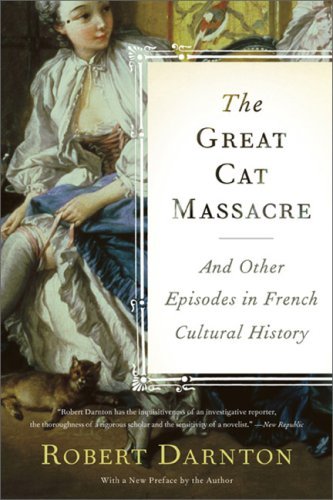
Le Chat Noir is a much-beloved cat, but love and affection for cats can sometimes lead to jealousy and misadventures. Historian Robert Darnton, a Chevalier of the Legion d’Honneur (1999) reveals what must be one of the world’s most bizarre worker protests ever. Even the title of his book is unusual: The Great Cat Massacre and Other Episodes in French Cultural History.

Historically, apprentice printers not had a happy life and have often been at the forefront of organized protests. In the 1730s, some apprentice printers on Rue Saint-Severin in Paris felt particularly hard done by. They lived and worked in squalid conditions and were fed mouldy food, while the neighbourhood cats their master’s wife doted on were offered much better fare. The apprentices longed to be treated as well as those cats.

To protest the maltreatment, one apprentice hit on a bizarre and ultimately cruel plan. He spent several nights imitating the howling of a cat. The sleep-deprived master printer and his wife were driven to despair. The printer ordered the apprentices to round up and dispose of the cats. The massacre was carried out. Did it improve the apprentices’ lives? That’s another story.

In today’s Paris, cats seem to have a rather happy lot. And in the opinion of Paris blogger Fred Moussaїan, perhaps none have a better life than those in “Les Villas de la Mouzaїa.”

In our travels in Paris we have seen a number of rather contented cats doing what cats seem to do best.

They sit in sunny spots, watching the world go by. They know there will be food and they will eat it when they feel like it. Sometimes a cat sitting in front of food reminds me of what my mother told me I would do as a little boy. As I sat at the table I would inform parents or visitors: “I wouldn’t be in the least offended if you fed me.”

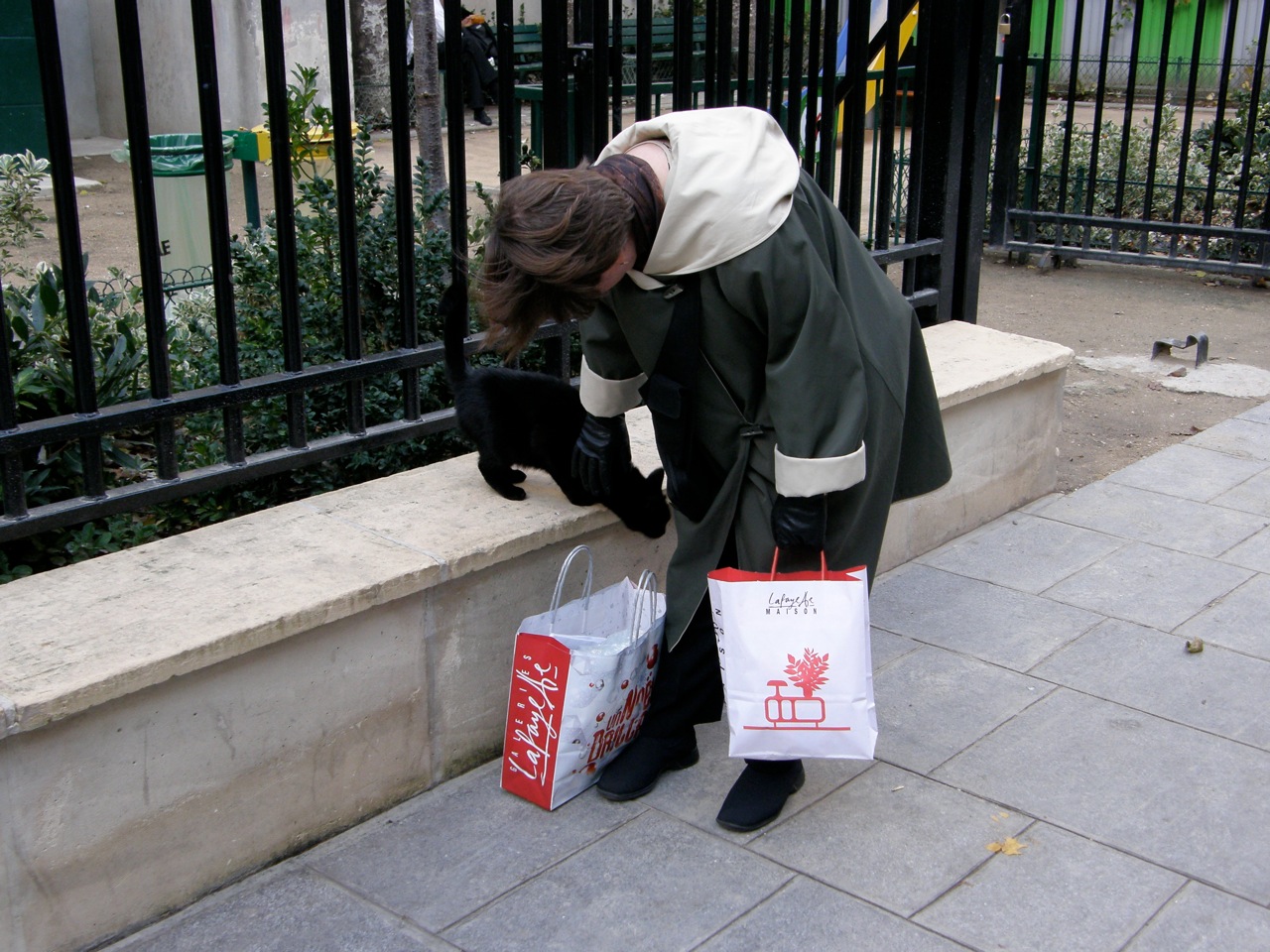
Cats will let you intrude on their territory if you have some potential amusement value. This black one had been sitting looking into a little playground in a park. It paid attention when two shopping bags arrived along with their owner. Perhaps the latter would be kind and the bags be interesting.

There are also plenty of out-of-the-way spots where a cat can enjoy some peace and quiet. This one was enjoying the sunshine on the tracks of the old Petite Ceinture, sheltered from the hustle and bustle, with no fear of traffic or tiresome humans.

One of our favourite bookshops, Le Dilettante, uses an image of a cat snoozing peacefully on an open book as its logo. We’re not sure that it is the most commercial of images (it suggests that the books are not all that stimulating, and might be better used as cat beds), but the drawing is certainly endearing.

In our walks, we have also found evidence of cats needing special care or owners who are particularly tolerant of feline idiosyncrasies. As I wandered down a narrow street in the 14th, this door sign caught my attention.

Too many late nights, carousing with the artists, perhaps.

Text copyright Norman Ball; original photographs by Norman Ball & Philippa Campsie.

Posted in Paris art | Tagged , , , , , , , , , , , , , | 5 Comments

Paris piquant

I’m going to swim against the current here (the Salon du Chocolat is, after all, coming up at the end of October) and state that if you are the sort of person who goes to Paris merely for the boulangeries, patisseries, chocolatiers, and salons de thé, and the vast array of sweet, pretty, pastel-coloured edibles so enticingly displayed in their windows, then you are missing most of the fun. (If that describes you, you can stop reading now.)

Paris is piquant. It is sharp, sour, spicy, savoury, not just blandly sweet. Its young chefs combine a range of flavours in delightfully unexpected ways. I remember a lentil salad with a sharp vinaigrette that included tiny crumbs of gingerbread for contrast, and a another salad made entirely of nearly black foods – dark red lettuce leaves, black radishes, purple carrots, and black beans, in a deep chestnut-coloured vinaigrette that looked and tasted amazing.

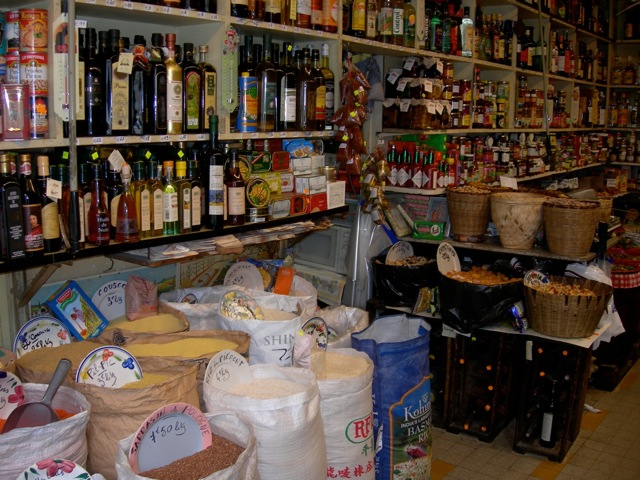
So when we go to the food-emporium-to-end-all-food-emporia, the Grande Epicerie at the Bon Marché, you’ll find us in the aisles devoted to the products of Delouis, Pommery, Amora/Maille, and Edmond Fallot, looking for the ingredients for vinaigrette and pork chops piquant (recipe below).

And we well remember the day we had the good fortune to stumble across Goumanyat/Thiercelin in the 3rd arrondissement and its amazing collection of spices, saffron, and fleur de sel. Izraël in the Marais is like Aladdin’s Cave, filled with delights never seen before, or elsewhere.

We discovered Banyuls vinegar in a wine shop when we were looking for something else entirely. And we’ve spent hours at street markets, investigating unfamiliar-looking mushrooms, cheeses, cuts of meat, and varieties of seafood.

Even the most pedestrian Monoprix store can be a treasure trove of the unexpected. Once when we were looking for plain black pepper, we found a heady mixture of pepper, coriander, and cardamom (“Poivre Saveur” by Ducros), that is now a staple in our kitchen.

So many tastes to try, so few meals a day. But here are a few of our favourites.

Ready-made entrées are so ubiquitous the French take them for granted, but we can’t get enough. (Note that when the French use the word “entrée,” they mean the first course or appetizer, not the main dish.) Even a run-of-the-mill of French supermarket provides a range of ready-to-eat options that would be considered sophisticated in North America, including our all-time favourite, céleri rémoulade. This consists of julienned celery root (celeriac) in a mustardy mayonnaise that we find irresistible. (Norman has been known to eat it for breakfast.)

Many butchers sell choucroute, the French version of sauerkraut, brought to Paris via Alsace (the part of France on the border with Germany). Purists insist that the native white Alsatian cabbage known as quintal is the only proper basis for this dish, which is delicious hot or cold, or with chopped-up Alsatian sausages, when it is known as choucroute garnie, a common offering in traditional brasseries. And if you see “à l’alsacienne” on a menu of main dishes, chances are choucroute is involved somewhere. The secret ingredient? Juniper berries (genièvre).

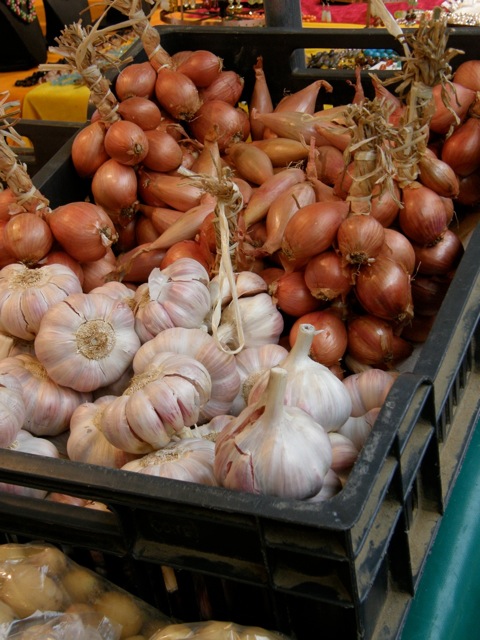
Every market abounds in shallots (échalotes). These smaller, richer and more flavourful offshoots of the onion family are essential components of traditional sauces such as béarnaise (white wine, vinegar, shallots, chervil, tarragon, thyme and bay leaf, to which are added eggs yolks and butter; this is often served with steak). The Romans apparently considered shallots an aphrodisiac; maybe this contributes to the French libido.

Most people have heard of Dijon mustard, which is smooth and pungent, but France has many other mustards. Meaux, once made by monks, is grainier and a bit milder and was Brillat-Savarin’s favourite (look for the Pommery earthenware containers with the red wax-sealed tops). One exception: The version called “Pompiers/Firefighters,” which is hot enough to cause damage to the unsuspecting.

Mustards use grape juice or must from the wine-making process, so you will find variations from the wine regions of Bordeaux, Beaujolais, and Champagne (the latter is sometimes called Florida mustard). “Moutarde à l’ancienne” is mild and grainy. Traditional flavourings include tarragon, fennel and (curiously) violet, but these days, you can find mustards flavoured with everything from lemon to lavender. One day I shall write an entire blog about mustard.

Wine and herb vinegars (such as tarragon vinegar) are everywhere, but more distinctive versions, such as Banyuls, are gaining popularity. This dark concoction is the French answer to Italy’s balsamic vinegar. It comes from Banyuls-sur-Mer (on the Mediterranean coast, close to the Spanish border), and is less sweet than balsamic, but with a slightly nutty flavour. It is made with a sweet wine from that region.

Cornichons are little pickles, often bottled with a few pickled onions. They are sharper, crunchier, and more flavourful than the large, flabby pickles generally sold in North America (Maille cornichons are available in some specialty stores in Canada and the U.S.). In England, cornichons are known as gherkins. French restaurants often serve these with charcuterie. Norman, as you can see, eats them simply, with bread.

The following recipe, one of our favourites, brings together the flavours of shallots, mustard, vinegar, and cornichons with pork. We make it whenever we are in France, and frequently when we are at home. It calls for a simplified version of the traditional “Sauce Piquante,” found in most standard French recipe books.

We ran across the recipe in Saveur magazine c. 2002, described by a fellow who had learned to cook when he was living on a houseboat in Manhattan. He had mislaid the original version, which he had discovered in a 1970s paperback French cookbook, but had recreated a version of the original that uses some of our favourite flavours. We have tweaked it a bit. This was what we made for Canadian Thanksgiving last weekend, as an alternative to the blander turkey. Here’s to Paris piquant and flavours that make our mouths pucker.

Pork Chops Piquant

Ingredients:
5 tbsp. olive oil
2 lbs. thin-cut pork chops
Salt and freshly ground pepper
2 shallots, peeled & diced
6 tbsp. red wine vinegar
1 cup white wine
8 cornichons, chopped into small pieces
2 tbsp. Dijon mustard

Method:
Heat half the olive oil in a heavy skillet over medium-high heat. Season chops with salt and pepper. Brown chops on each side, about 1-2 minutes per side. Transfer the chops to a plate, and cover to keep warm.

Add the rest of the oil, over medium-high heat. Sauté the chopped shallots, until they begin to brown. Add vinegar and stir for a minute or so. Add wine and cook for a few minutes, until it thickens. Stir in cornichons, mustard, and any juices from the chops. Lower the heat and stir until the mixture makes a thick sauce. Put the chops back in, warm them through, and serve.

This recipe serves 4 people. For 2 people, use less pork, but about the same quantities of the other ingredients, because the sauce is what it’s all about.

Me, shopping at the Marché des Enfants Rouges, in the Third Arrondissement.

Text copyright Philippa Campsie; photographs copyright Norman Ball

Posted in Paris food | Tagged , , , , , , , , , , , , , , , | 4 Comments

Scooting through Paris

What is your Paris? Beauty, colour, art, elegance, fashion, intrigue, rich and varied history? Or work? Think of the great Paris photos and novels about working people. My Paris is often mirrored or expressed in the scooters buzzing about Paris.

Paris and elegance are long-time dance partners. My memories of that dance include the sight of a simple baguette wrapped in a scarf of paper, the Passerelle Leopold-Sédar-Sénghar (usually called by its predecessor’s name Passerelle Solférino, and a favourite bridge of mine), every passing Citroen 2CV, unattainable lithographs in small galleries, or the seemingly infinite number of stunning building details that prolong the walks Philippa and I never seem to finish.

I cannot define elegance in the abstract. However, I find it where the purpose or intent—or even mood—of the object matches the design and setting with no superfluity, where nothing could be taken away without loss. Elegance can spring from the juxtaposition of elements.

Individually, I had admired each of the key elements in the photo above: the semi-enclosed red BMW scooter parked in the street and the wrought iron gates in a stone archway that opened into an enticing courtyard. One day the scooter was positioned just in front of the archway. Something new had been created. A slice of Parisian elegance. Thank you.

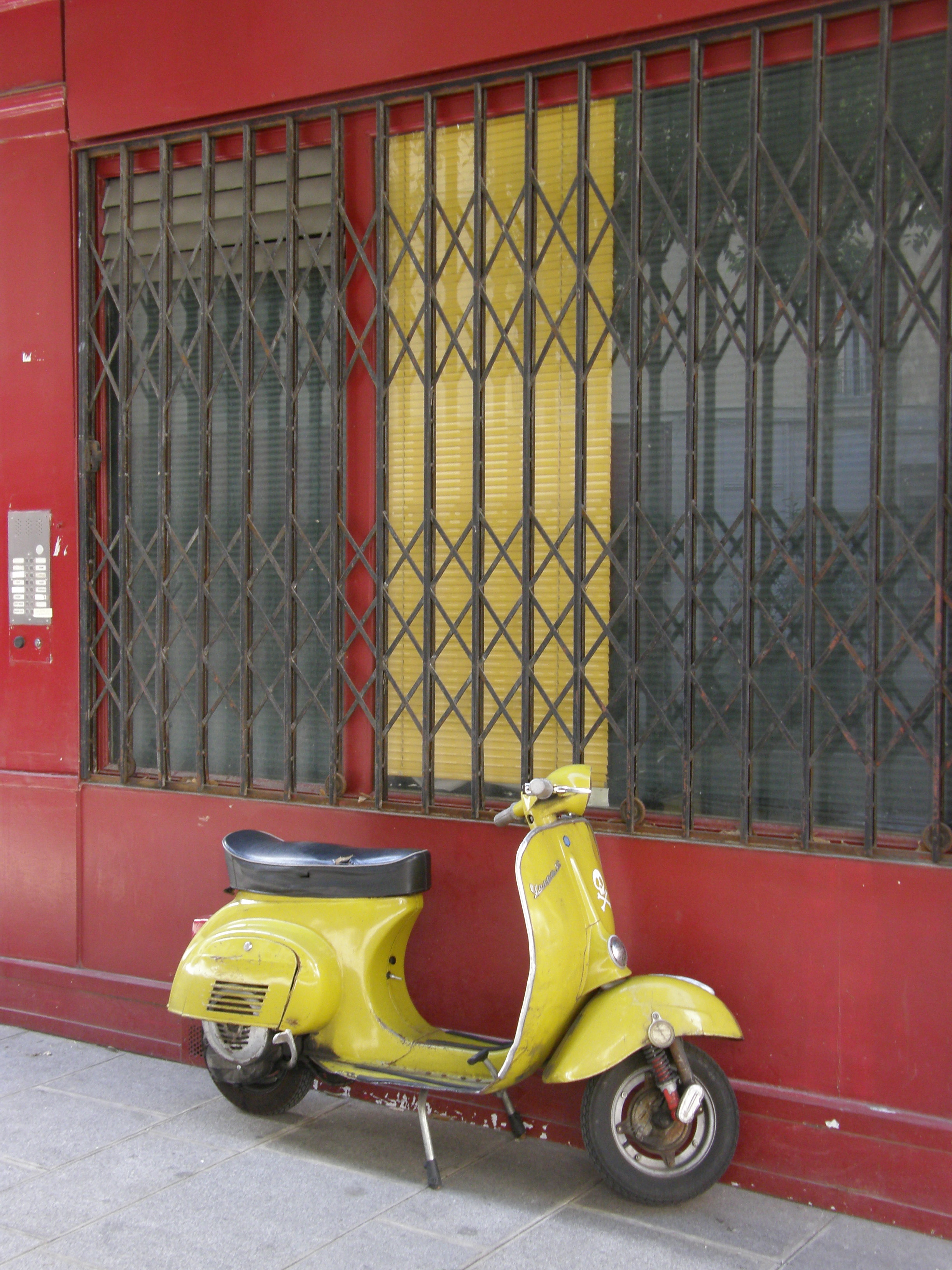
Let me admit two biases. If it has a motor and wheels, it gets my attention. And if it is red or yellow, so much the better. On an August afternoon, we were wandering in a somewhat familiar area. Colours became bolder as the sunlight grew more intense, shadows became more intriguing. What was behind the drawn shutters? Who would answer the door intercom?

My reveries were broken when a young student—or artist?—and his girlfriend buzzed up on a Vespa, parked it, dismounted, and departed, leaving it just as you see above. The casual addition of one colourful Vespa made a visually captivating bit of Paris remarkably more complete. (Click here for an introduction to Vespa history.)

The Piaggio company was founded in 1894, but after the Second World War, Enrico Piaggio recognized Europe’s need for low-cost personal transportation. Enrico turned to aeronautical engineer Corradino D’Ascanio. D’Ascanio disliked conventional motorcycles because they were uncomfortable, bulky, dirty, and hard to maintain, and they left the dishevelled-looking driver unprotected from the wind.

Ascanio’s brilliant design was more influenced by airplanes than motorcycles. Enrico called it a Vespa (Italian for wasp) because of its narrow-waisted design, but Vespas also sound like wasps.

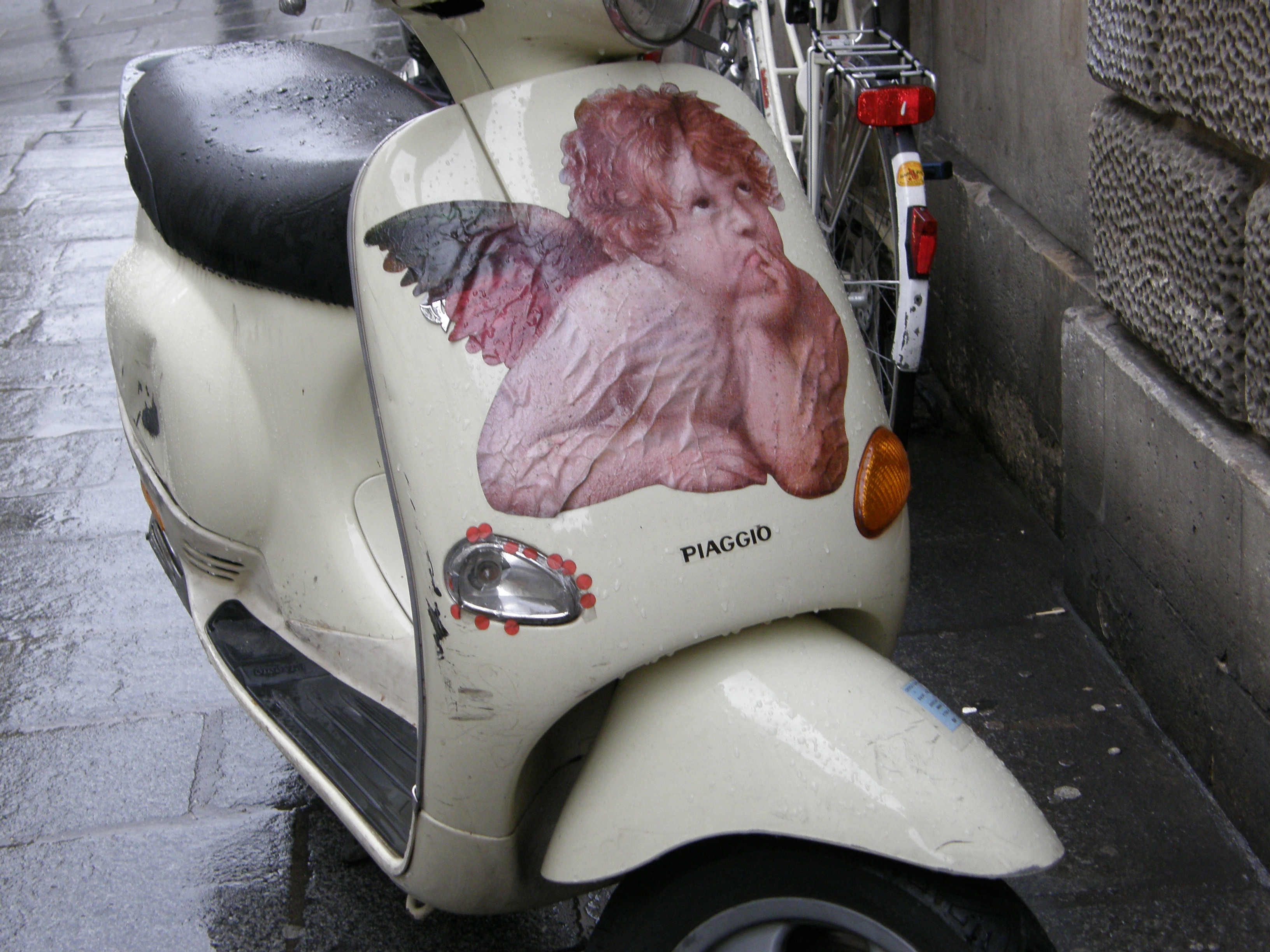
Now back to Paris which, in addition to galleries and museums, is well supplied with artists and art students. Who else would have plucked one of Raphael’s cherubs from a perch at the bottom of his Sistine Madonna and transplanted it to the front of a Piaggio scooter? Did I assume it was an art student because I was in Paris? Perhaps. Or was it because I expect artists to help us see the familiar in new ways? Whoever it was, I now see both Vespas and Raphael’s Sistine Madonna differently.

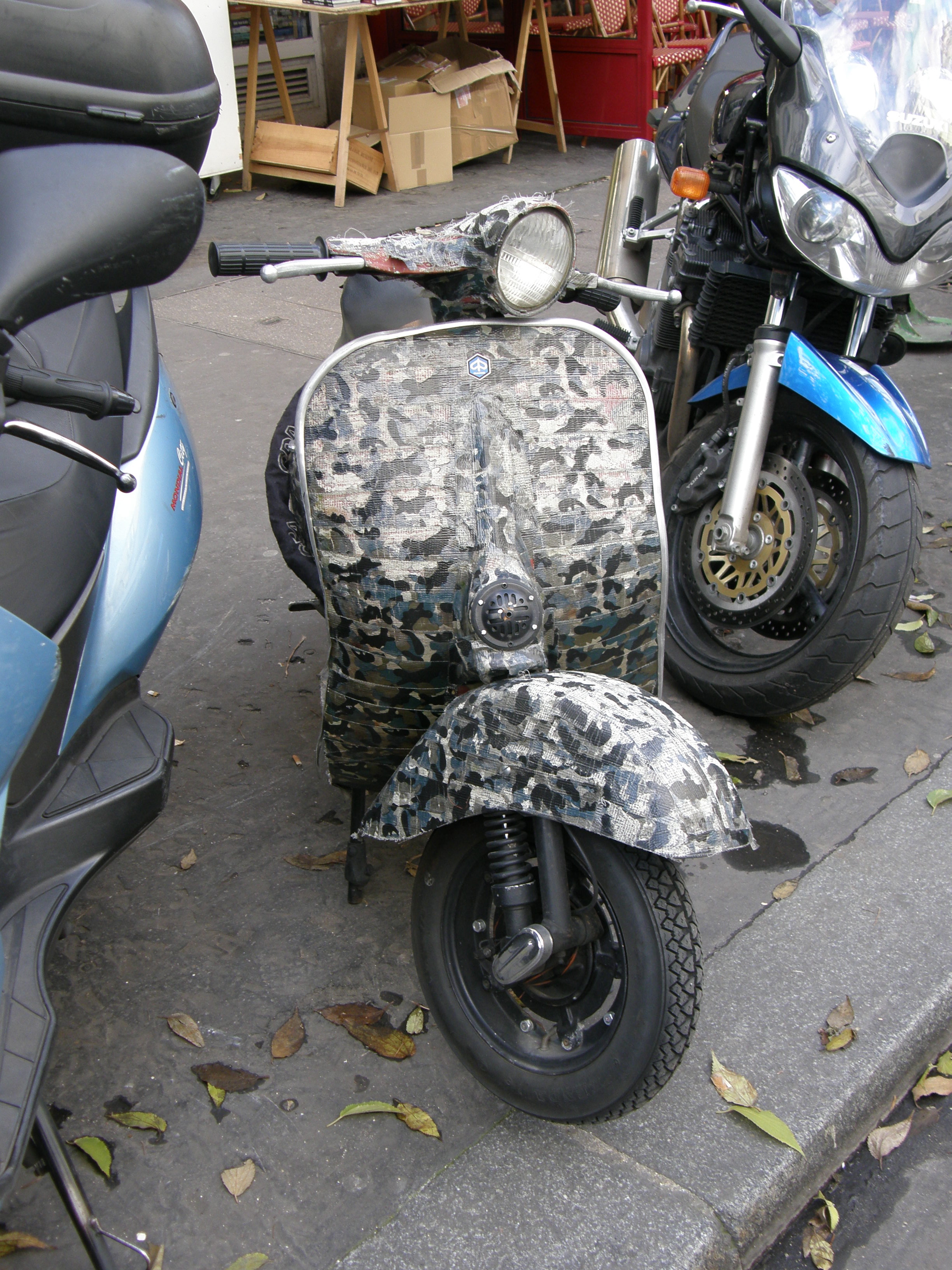
Was it an art student who customized this Vespa? The generous application of what appears to be camouflage-pattern duct tape leaves two distinctive features visible: the chrome frame of the protective front panel and the distinctive logo. On the rear fender the bright tail light assembly is treated equally respectfully and the “Make Love Not War” decal is properly centred. Nicely done.

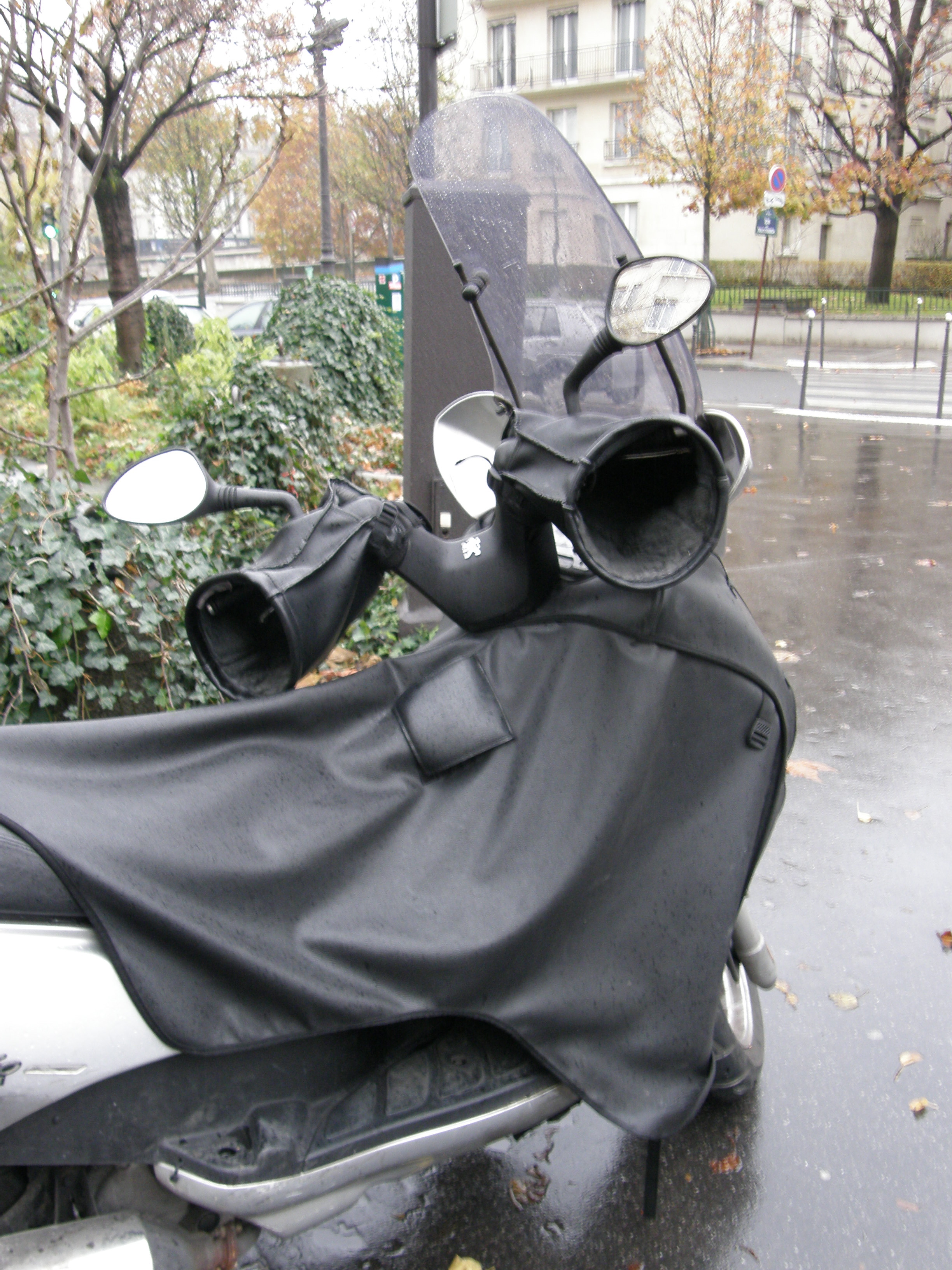
In Paris – and in many other cities outside North America – scooters are basic daily transportation. They are not simply fairweather friends, fashion statements, or cries for attention from the suddenly single or visibly aging. Scooters get many Parisians to and from work year-round. The image below shows one of the ways scooters are made to work in cold or wet weather.

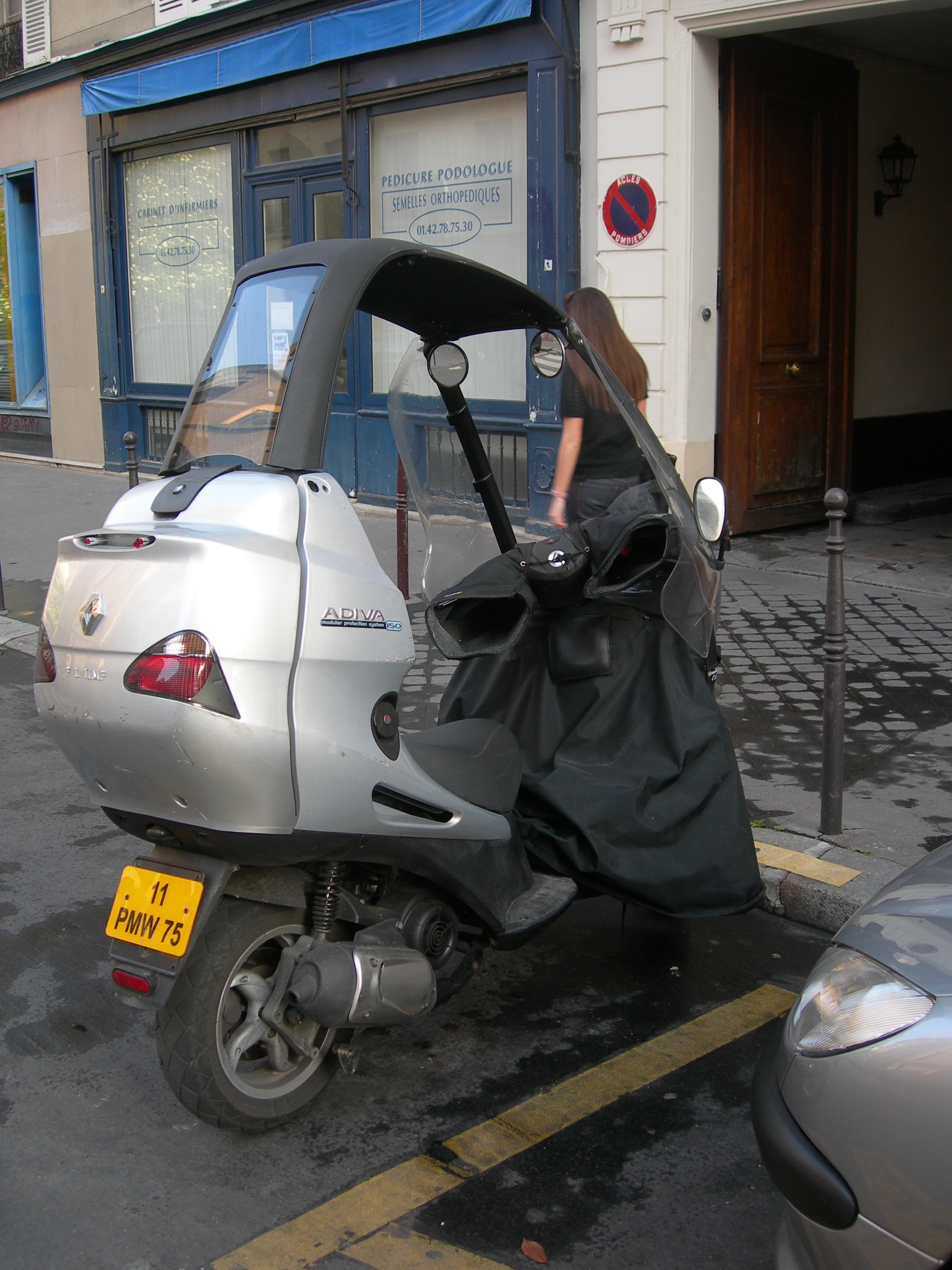
Here we see a windscreen, attached gauntlets to give access to hand controls as well as blanket-like lower body protection. In the following image we have moved slightly upscale financially and have even more protection. There is a wraparound windscreen that culminates in a removable top and the hand and lower body protection is more complete.

Naturally one dresses for the weather and it is not unusual to watch an office worker come out of the office wearing suit, tie and overcoat, step out of that cocoon and put on a different outfit for the road. Then there are those for whom the scooter is the workplace.

I come from a city where take-out food is generally delivered in beat-up cars with fewer markings than undercover police cruisers. I am intrigued by Paris’s delivery scooters. I love seeing scooters bearing specially made insulated boxes proudly proclaiming the culinary delights speeding through the streets.

Of all the fleets of pizza scooters, Speed Rabbit is my favourite, even though I have never tasted their pizzas. Yes, I like the yellow colour, but the name is just too perfect. Where did it come from? What do rabbits have to do with pizza? Then again, who cares?

Outside the shop for “Atlas Couscous: Gastronomie Marocaine” I saw another fleet, poised for action.

I could go on and on. Perhaps I will…some other time.

Text and photographs by Norman Ball.

Posted in Paris automotive, Paris popular culture | Tagged , , , , , , , , , | 2 Comments

The lady is not a sofa

Not far from the Bon Marché in the 7th arrondissement is a short dead-end street that terminates in a quiet space enclosed by the surrounding buildings, with trees, paths, and some flowerbeds: the Square Récamier.

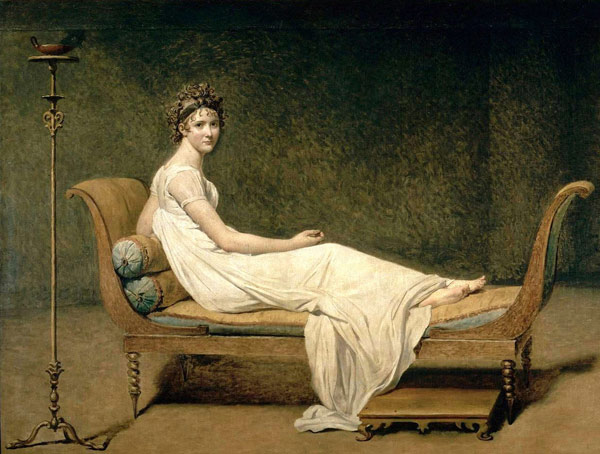
Récamier. When we first entered this sunken garden, all the name meant to me was a painting in the Louvre of an attractive woman posed on an elegant sofa. The sofa and the woman had the same name, and that was the sum total of my knowledge about Madame Récamier.

I don’t think I’m alone. When most people hear the name “Récamier,” that’s all they think of – some famous painter depicted her, she was very pretty, she wore Grecian-inspired garments typical of the early 1800s, and she lounged around on sofas. End of story.

The lady is not a sofa. Indeed, she had an extraordinary life, and I’m amazed there are no recent biographies of her. The museum in her birthplace, Lyon, presented an exposition in 2009 that collected some of the most famous artifacts associated with her (including the inevitable sofa), but otherwise, she seems to have slipped into obscurity.

It’s not that she led an uninteresting life. She was sufficiently interesting for Napoleon to banish her, and he banished people because they threatened him. So she wasn’t a cupcake.

I feel she should be better known. And so, with apologies to Jean-Luc Godard, I present Deux ou trois choses que je sais d’elle (Two or three things that I know about her).

Thing 1: Juliette Récamier (née Bernard) married a 42-year-old man, who may well have been her biological father, when she was 15 years old.

Her husband, Jacques-Rose Récamier, was certainly a very, very close friend of the family, particularly of her mother, and the speculation was inevitable. But why would he do this? There is a reason, if a strange one.

Juliette married in April 1793 in Paris, at the height of the Terror. Every day, aristocrats were being guillotined. If Jacques-Rose Récamier was indeed her natural father, there was method in his madness. Apparently, he fully expected to die in the Terror. He was even in the habit of attending the executions each day in order to steel himself for the time when he himself would have to mount the scaffold. He may have thought that marrying his daughter would be a way to preserve his fortune and pass it on to her.

If so, the plan backfired. He wasn’t executed. The Terror ended, and there he was, married to a teenager (who at that point was still living with her parents). A quandary if there ever was one.

Jacques and Juliette eventually moved in together, but the marriage was never consummated. Did she know who he was? If so, when did she find out? One wonders if at some point, her mother took her aside and said something like, “Juliette, there is something you should know about your, ah, husband…”

Oddly, though, the marriage endured. He lost all his money, and they stayed married. She fell in love with someone else, and they stayed married (although this episode brought her close to suicide). They didn’t live together much, but they never divorced. There is a story there.

Thing 2: She maintained a salon and was banished from Paris for doing so.

Her salon is what drove Napoleon nuts. She entertained, and the people she entertained expressed disapproval when Napoleon made himself Emperor. From Napoleon’s perspective, this was not to be tolerated.

Juliette Récamier was not possessed of a razor-sharp wit, nor was she one of those women who manoeuvre politically behind the scenes or write inflammatory books. She was beautiful, kind, and hospitable, and when she still had money, she employed a good cook. That was enough to make her a salon hostess, and her salon attracted many of Napoleon’s opponents.

More importantly, Juliette was a close friend of Madame de Staël, who was a writer and a brilliant conversationalist and who persistently meddled in politics. Germaine de Staël was not a classic beauty, but she was attractive in a emotional and extremely high-maintenance way. One biographer neatly summed up one typical episode as “Scenes. Screams.”* Madame de Staël wrote books and lobbied like mad for the causes she believed in, but she also kept falling in love with the wrong men and suffering agonies when things fell apart.

Juliette Récamier and Germaine de Staël were an odd couple, but Juliette was devoted to her friend, and when Napoleon banished Madame de Staël, Juliette had to make herself scarce as well.

Thing 3: She lived much of her life in a convent.

As a child, Juliette lived in the interestingly named l’Abbaye royale de la Déserte in Lyon, where her parents left her while they moved to Paris. She was apparently very happy there.

Then in 1819, when Napoleon was himself exiled, her husband had lost all his money, and Germain de Stael was dead, she returned to living in a convent. This was l’Abbaye-aux-Bois in Paris, located where the Square Récamier is now.** The nuns offered inexpensive rooms to impoverished gentlewomen, and Juliette moved in with her books and her harp and, of course, her sofa.

The nuns allowed visitors, and Juliette was able to maintain her salon. In fact, the arrangement was quite pleasant, because the nuns required visitors to leave at midnight, so the hostess was not obliged to stay up too late with over-talkative types. Juliette lived in a small suite for several years, and then took a larger suite when it became available. Her friends continued to visit, but left promptly at midnight.

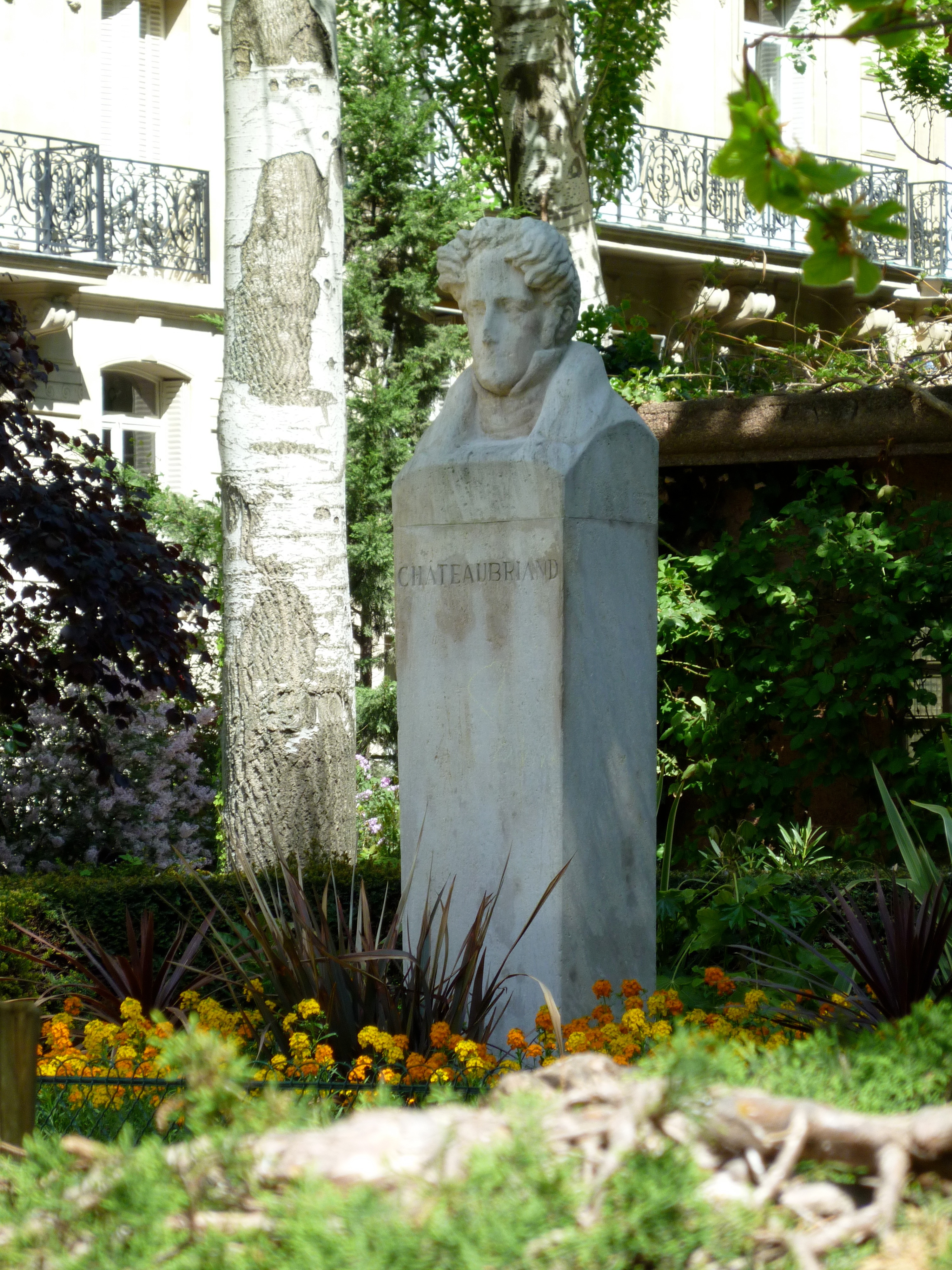
One of them was the writer François-René de Chateaubriand. Everything I have read about him makes him sound like a tedious, self-important windbag, but Juliette was inexplicably fond of him. He was a constant presence at her evenings, and often read from his writings. People kept coming anyway.

Chateaubriand haunted the area, and there is a statue of him in a nearby park. Not the Square Récamier, but not far away.

Thing 4: She ended her life blind, and died of cholera.

Juliette’s life was not easy. She was married before she knew what was what, and there was an impediment that made the marriage sterile (she had no children, but adopted a niece, who was devoted to her). She was temporarily banished from Paris for befriending a strong-minded writer and salon hostess. Her husband lost his money and left her penniless. She fell in love when she was about 30, but could not marry the object of her affections.

When she was in her sixties, she lost her sight, but she did not tell anyone. Her servants arranged the furniture so she could move around her apartment without trouble, and she was good at recognizing voices. Many of her visitors never suspected a thing, although close friends knew the truth.

She nursed her husband through his final illness in April 1830, and he spent his last days with her at the Abbaye-aux-Bois.

In May 1849, Juliette Récamier died of cholera at the age of 71. Now, for most people that is probably an unremarkable fact, but it jumped out at me because several of my ancestors died of cholera later that year, when the epidemic reached Lancashire. Cholera was a horrible way to die, because the victims remained conscious and knew what was happening to them. In 1849, the origin of the disease was unknown, and so was the treatment. It was only in the 1850s that the source of the infection (tainted water) was identified – too late for Juliette, and too late for my great-great-great-grandparents.

Juliette is buried in Montmartre Cemetery.

A lot more than a sofa

Juliette Récamier (born Jeanne Françoise Julie Adélaїde Bernard in 1777) was one of those people who had their eventful lives thrust upon them. She was beautiful and by all accounts, sweet-natured. She married the man her parents told her to marry, and stayed married to him until he died. She was painted and sculpted by everyone who was anyone during her lifetime, even when she was quite elderly. She was loyal to her friends, even when she had to make sacrifices to maintain those friendships. She was so beautiful that men kept falling in love with her, but she kept these would-be suitors at arm’s length and usually ended up retaining them as long-term friends. She defied Napoleon and outlasted him. There is a lot more to her than a sofa.

* Margaret Trouncer, Madame Récamier, Macdonald, 1949, p. 67.
** Although convents and monasteries were suppressed during the Revolution, many were re-established in the early 1800s. The abbey was demolished in 1907 (for photographs of what it looked like just before demolition, click here). A theatre was constructed on the site of the former church, and called the Theatre Récamier. It closed in 1976 and the space became a rehearsal hall for the Comédie-Francaise until 2008.

Further reading: Good luck. The biographies in English are all quite dated: H. Noel Williams, Madame Récamier and her Friends, Harper, 1901; Edouard Herriot, Madame Récamier, William Heinemann, 1906 (2 vols.); Margaret Trouncer, Madame Récamier, Macdonald, 1949; Maurice Levaillant, The Passionate Exiles, George Allen, 1958.

The beautiful and detailed catalogue from the Lyon exhibit, Juliette Récamier: Muse et Mécène, published in 2009, is available only in French. There is more information (in French) on the museum’s website.

Text by Philippa Campsie; contemporary photographs by Philippa Campsie & Norman Ball.
Posted in Paris history | Tagged , , , , , , , , , , , | 11 Comments

Stained Glass Less Seen

Paris’s many churches are treasure troves of spectacular, often monumental, stained glass windows. The cemeteries of Paris have stained glass windows too, but these are small, less visible, and easily overlooked except by those who walk slowly and peer through tiny openings.

According to the City of Paris website, “there are fourteen cemeteries in Paris proper, three of them—Pere-Lachaise (in the east), Montmartre (in the north) and Montparnasse (in the south)—particularly well known to lovers of history and old monuments.”

Montparnasse, the second-largest, is one of the city’s main green spaces, a peaceful park in one of the busiest quarters of Paris, a retreat and place of calm solace. And even on an overcast winter day, Montparnasse offers up patches of rich colour and subtle gradations of lighter tones.

This is, after all, the City of Light, and I love the subtle, gentle ever-changing light of Paris. And in the soft light of an overcast winter afternoon, the bare branches of the trees emphasized even more strongly that Montparnasse is filled with trees, more than twelve hundred of them.

Winter, late afternoon, overcast sky. With no schedule, no mission, not even a map, the quiet dignity of the cemetery took hold of me. I contemplated family sepulchres that ranged from modest narrow edifices with a peaked roof and a front door to more elaborate structures.

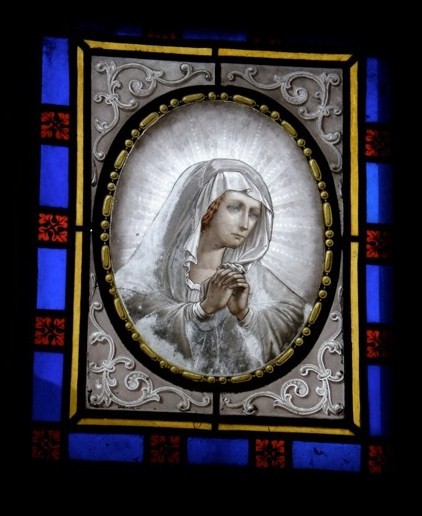
Drawn by Gothic tracery in cast iron, I peered through a crystal-clear opening left where the glass had disappeared. As my eyes adjusted to the dim light, a shining stained glass window emerged.

A cast iron door stood slightly ajar. My eyes were drawn inwards first by the radiance of cobalt blue and red, then by quieter greys and silvers of a woman at prayer. Trite as it may sound, it was awe-inspiring.

The windows drew me back through centuries to a time when ecclesiastical art and soaring architecture conveyed a sense of mystery, awe, and power to a largely illiterate populace. The illiterate could read; they just couldn’t read words.

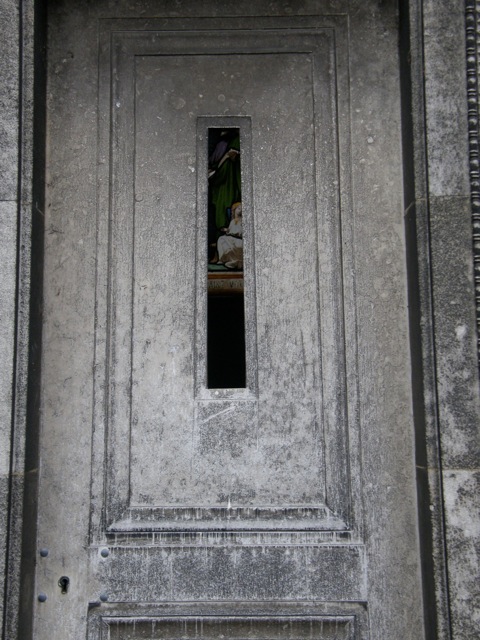
A flash of colour drew me to a vertical slit in a locked and weathered metal door.

Filled with anticipation and a sense of being alone but not alone, I realized I was holding my breath. My face almost touched the door, my eyes adjusted to the near darkness from which Saint Mathieu emerged. I felt something words could not capture or contain. I understood more about the faith of others as well as my own. I thought of the trust we put in symbols and things we cannot grasp fully, things we cannot prove but nonetheless know.

At another crypt I wondered if the angels floating in clouds were reminders of a child who died too young. Or was it later yearning for innocence and a life less complicated?

My first experiences with the hidden stained glass windows of the Montparnasse Cemetery were surprises. The day was right. I let myself wander and discover what was there.

Many visitors to Paris go to cemeteries in search of famous names and celebrated memorials. These tombs are certainly interesting, and their history now includes the stories of those who have visited them. But the Paris I cherish is the unexpected Paris. I hope others who search for the expected will also find, and treasure, the unexpected.

Text and photographs copyright Norman R. Ball

Posted in Paris cemeteries | Tagged , , , | 2 Comments

Oscar the Grouch goes to Paris

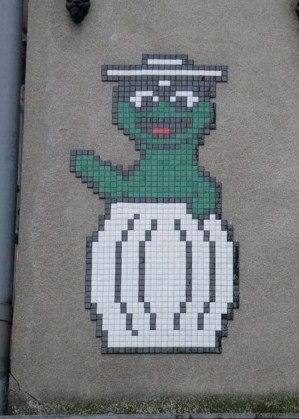
Paris is full of incongruous juxtapositions. A moment after leaving the square around the ancient Fontaine des Innocents, we were confronted with the image of Oscar the Grouch from Sesame Street near the Banana Café (also decorated with some unbananalike palm trees). Oscar! What are you doing here?

Good location, nice restaurant, excellent view. Great to see you, you’re looking good.

It took more than 1,100 pieces of ceramic tile to make Oscar, who surveys the corner of Rue de la Ferronerie and Rue Sainte-Opportune from his perch 3 or 4 metres up the wall. How did he climb so high?
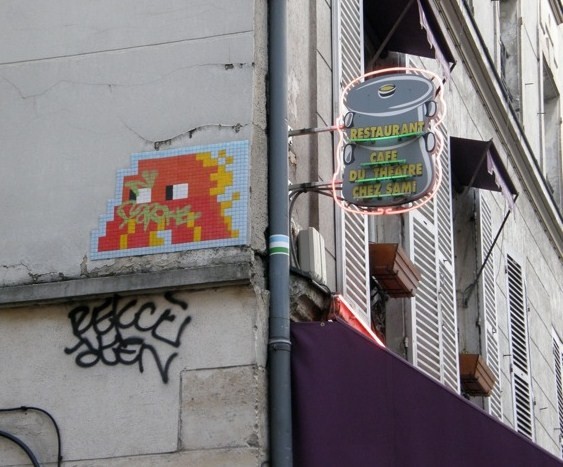
This anonymous piece of ceramic street art falls into a tradition of work started in Paris in 1998 by the artist known as Invader. The 110-tile figure shown below—probably made by Invader—that I photographed in December 2007 is typical of early ceramic street art in terms of geometric simplicity and relatively small number of tiles.

Images like these evoke early video games. Indeed, it was the pixelated look of Space Invaders that inspired Invader. Space Invaders debuted in 1978 as an arcade game and several years became available on Atari computers (anyone remember Atari?).

The large pixels in the early games gave the figures a characteristically chunky look readily captured by ceramic tiles. In time, ceramic street art grew more refined through the use of larger numbers of smaller tiles.

The early Invader-type ceramics usually had about 120 tiles. Even though the image above has over 1,050 tiles it has the unmistakable Space Invaders look. Regrettably, spray painted overlay has reduced the impact of the furtive glance of the eyes. Nonetheless it remains an arresting piece of street art.

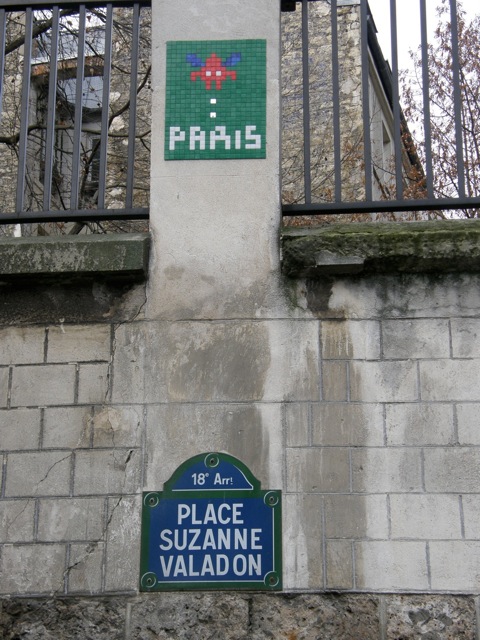
One of my favourite pieces of ceramic street art is the “Paris” image, which I photographed in December 2008 at Place Suzanne Valadon. As with Space Invaders–type figures and Oscar the Grouch, the “Paris” image also draws upon an element of popular culture.

This simple construction beautifully mimics the game of Tetris. For me, and doubtless many others, it brings back fond memories of many hours playing that game.

Space Invaders was an action video game; Tetris a puzzle video game. Designed and programmed by Alexey Pajitnov during his spare time as a programmer at the Moscow Academy of Sciences, the game first appeared in June 1984. Although Tetris dramatically illustrated the power of computer programs to revolutionize puzzle games, its early years were slow. Everything changed in 1989 with the release of the hand-held Nintendo Game Boy with a Tetris cartridge, a combination that went on to sell 35 million. Today, there are more than 100 million Tetris games on mobile communications devices.

Available today in a wide array of formats and degrees of difficulty, all Tetris games are variations of a simple objective: slot the falling pieces into the holes in the matrix to complete a line, which then disappears to make room for more lines. In its simplest version, the falling pieces may be shifted left or right to fill the gaps in the line.

The artist who created the piece in Place Suzanne Valadon has got it right. The letters of the word Paris are composed of square white pixels, with four pixels missing. There are four falling white pixels. The first two single pixels must go to the right or the left to complete the P and the I. Then the final pair can be shifted to the left and fall to fill in the gaps in the A and the R together.

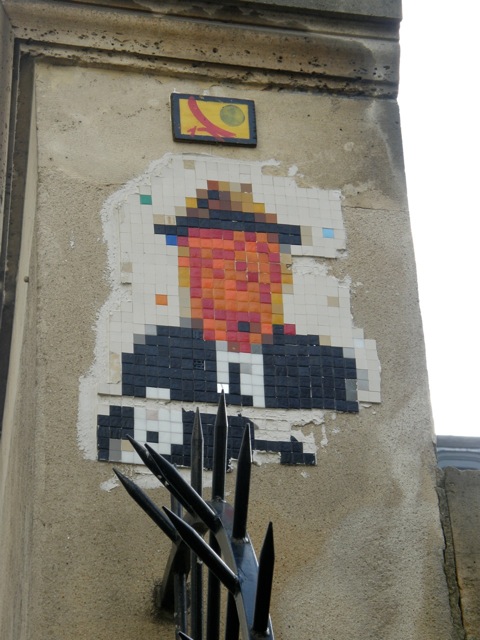
This final image, which I photographed in 2007, evokes another familiar sight – the digitally obscured face so often seen in magazines, on television, or on Google Street View captures, either to protect the guilty or to maintain the privacy of the innocent. Who is this faceless man – a perpetrator or a bystander?

Ceramic street art is hardly more than a decade old and yet we can see its movement from pioneering to polished. The Paris piece in Place Suzanne Valadon has been so carefully executed and artfully placed that it looks as if it belongs there.

Ceramic street art is not put up in the street tile-by-tile, which would take far too long. The work is assembled elsewhere, as the artist mounts individual tiles on a backing which is taken as a single piece that can be glued on a wall quickly. A comment on an earlier blog about paper street art suggested that the technique of creating the work in a studio first and then putting it up in the street detracts from the spontaneity usually associated with street art. It’s an interesting idea.

Will the need to stand out from similar pieces along with greater number of smaller tiles give a look that is too polished? Will we lose the sense of furtive hastiness that is part of so many pieces? Perhaps all we can ask is that there be room for variety.

And what of Invader the pioneer? He maintains a comprehensive website and his work can be found in the streets of about 30 cities. He has moved beyond street art and created works for sanctioned sites such as museums, galleries, and shops. You can even buy his branded form of shoes. He appears (with his face digitally obscured, of course) in Banksy’s movie Exit Through the Gift Shop and briefly (pp. 160-1, 176) in the book Sticker City. He is also included as one of the influential street artists described in Patrick Nguyen and Stuart Mackenzie’s Beyond the Street: With the 100 Most Important Players in Urban Art.

Text and photographs copyright Norman R. Ball

Posted in Paris popular culture, Paris street art | Tagged , , , , , , , , , , , , , , , , | 5 Comments