Sometimes we go looking for blog ideas, and sometimes they come along and tap us persistently on the shoulder. This one did – three times.
First, I spotted an “advertorial” in a 1912 issue of a small American magazine called The Philistine. It was a two-page item on “Napoleon’s Visual Telegraph: The First Long-Distance System” and it was sponsored by American Telephone and Telegraph. The illustration looked vaguely familiar.

A few days later, I was hunting for a postcard in our collection and I ran across this one of “La Tour du Télégraphe” in Montmartre, sitting on top of what appear to be the ruins of a church. But I still wasn’t sure what I was looking at. What was that thing on the tower?

Finally, out of the blue, my stepson Alex sent us a link to an article from The Economist about “the world’s first cyber-attack” featuring this same telegraph system.
When I mentioned this to Norman, he looked thoughtful and went to find a history of telegraphy called The Victorian Internet by Tom Standage as well as Volume IV of the Oxford History of Technology. And so I came to read about Claude Chappe (1763–1805) and the world’s first telegraph system.
Claude Chappe, whose intended career as a member of the clergy was derailed by the French Revolution, became obsessed with finding a way to communicate at a distance. His first effort, with his brother René, used sounds that corresponded to numbers that could be decoded into messages. But he soon realized that visual methods would allow for communications over even longer distances. So he experimented with a large disc painted black on one side and white on the other that could be used to transmit numerical information; if the receiver used a telescope, the information could be detected 16 km away. The brothers demonstrated their invention in 1791, and a friend of theirs suggested the name “télégraphe” – meaning “far writing.”
Still, the process of transmitting numbers with a simple black/white, on/off system and then decoding them into words was cumbersome, and Claude Chappe kept hunting for a better method. He eventually came up with the “optical telegraph,” which consisted of a vertical post on which was mounted a hinged arm, with smaller hinged arms at the two ends. (It is sometimes called a “semaphore” system, which reminds me of my days as a Brownie, when we had to pass a test in semaphore; I was hopeless at it and had to take the test several times before I passed.)

The central arm of Chappe’s visual telegraph could be set in four positions – vertical, horizontal, and at two 45-degree angles – and the two smaller arms could be set in seven different positions, allowing for 98 possible combinations, each of which corresponded to a letter or number. The system also allowed for abbreviations of whole words, to speed up communication.
A clockmaker, Abraham-Louis Bréguet, developed the control mechanism for the device, which was connected by pulleys to the actual transmitter. An operator inside a building could manipulate a scale model, and the pulleys attached to it controlled the full-scale version on the roof of the building.
An early attempt at a demonstration in Paris came to grief when a Revolutionary mob attacked Chappe and demolished his device, believing him to be using it to communicate with the imprisoned Louis XVI.
But in 1793, Chappe was invited by the government of the day (the Convention) to demonstrate his invention, for which three prototype towers were constructed. The first was in Belleville-Ménilmontant, in the northwest of Paris, where there is a prominent hill. The next was 18 km due north in Ecouen, where the chateau commands a panoramic view of the countryside. This is how it looks today.

The third was in Saint-Martin-du-Tertre, another 12 km north-north-west of Ecouen. Saint-Martin-du-Tertre commemorates this event by using an image of the telegraph on its municipal coat of arms.

The experiment was judged a resounding success, and the Convention realized that Chappe’s device could help the central government direct events across France from Paris. The first line of telegraph towers to be completed went north as far as Lille, more than 200 km away. By 1794, it was being used to report on battles with the Austrians and Prussians. A second line connected Paris to Strasbourg to the east – also in the direction of a war zone.
When Napoleon Bonaparte came to power, he wanted even more telegraph lines. A new line went southeast to Dijon, Lyons, and on into Italy. That way, Parisians could get rapid news about his military conquests there. Napoleon even asked Claude’s brother Abraham to plan one that would cross the English Channel, to report on his invasion of England. He got a little ahead of himself there.
But it seemed that the more his idea spread, the more Claude Chappe was beset by rivals, claiming they had had the idea first, or that they had a better idea, or that the clockmaker Bréguet was the real genius behind the invention. In 1805, suffering from depression, he committed suicide by throwing himself into a well at the main Telegraph Administration, which at that time was on the rue de l’Université. He was buried in Vaugirard cemetery, but when it was closed in 1824,* his remains were transferred to Père Lachaise, where a remarkably ugly funerary monument displays his invention.

Claude’s brothers René and Abraham continued to run the system until the 1830s.
Around that time, twin brothers in Bordeaux, François and Louis Blanc, came up with a plan to bribe telegraph operators between Paris and Bordeaux to introduce “typos” (the French use the delightful word coquilles) into messages sent across the system; the coquilles indicated the direction of the Paris stock market each day. This allowed the brothers to beat the Bordeaux market in government bonds. They were eventually caught, and even tried, but since they had not broken an existing law (laws generally lag behind new technology), they were not punished. So the two happily went off to Monte Carlo to run the casino.
The optical telegraph remained in use until 1852, when it was superseded by the electric telegraph system. By then, the network consisted of 556 stations covering more than 4,800 km. The towers were everywhere. In Paris, even St-Sulpice (shown below) and the Louvre had Chappe telegraphs installed on them.

Paris gave Claude Chappe his due in 1893, on the hundredth anniversary of his successful demonstration, erecting a statue to him, posed in a jaunty attitude, at the intersection of the boulevards Raspail and Saint-Germain.

Alas, the statue was removed during the Second World War and melted down as scrap metal. Paris en Images even has a photograph of it just before it disappeared forever.

However, many Chappe towers are still visible, as I found on French Wikipedia, where an enthusiast has posted a catalogue of the remaining ones, including six that have protected heritage status. A few are even in working order.
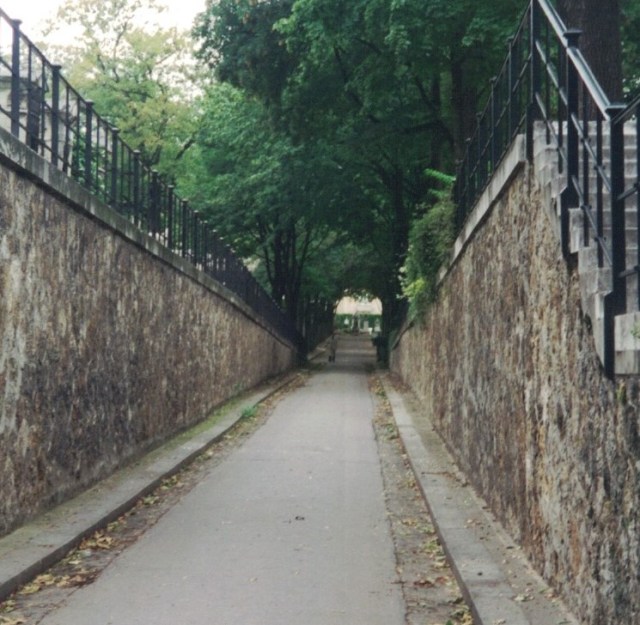
The one on my postcard has gone, though. It was on a church called St-Pierre de Montmartre, which stands immediately to the west of Sacré-Coeur. The church had been badly damaged during the Revolution, but in 1794 the ruin was used as the base of an optical telegraph tower that remained until 1840. The church has now been restored. Before the basilica was built, St-Pierre probably had the best view of any church in Paris. A little farther down the Montmartre hill is the rue Chappe, a steep street with a great many stairs, and the Café Chappe at the bottom. We plan to go there on our next visit and raise a glass in his honour.

Other traces of Chappe can be found in Belleville, on the rue du Télégraphe, where a plaque near the cemetery commemorates one of the first towers constructed. Another Chappe tower is part of the ensemble of buildings at 103, rue de Grenelle, which became the headquarters for the telegraph system in the 1840s. A memorial to Chappe has been installed inside the main building entrance. There is even a website devoted to the inventor (www.claudechappe.fr). Chappe might be comforted to know that he is not forgotten and nobody now disputes his achievements.
Text by Philippa Campsie, images from Paris en Images, Gallica, Wikipedia, and Google Street View.
*There is still a Vaugirard cemetery in Paris, but it is a different one. Chappe was buried in a cemetery located where the Boulevard Pasteur and the Lycée Buffon are today.


































 Parisian Fields