The balcony scene

The painter Gustave Caillebotte and his brother, photographer Martial Caillebotte, loved balconies. They frequently painted and photographed people standing on ornate balconies overlooking wide boulevards, gazing down at the passing scene below.* And sometimes they set up an easel or a camera on a balcony and captured what they saw from that viewpoint. One of my favourite pictures is the one that Gustave painted of the view from his balcony on the boulevard Haussmann in 1880 – a tiny view into the everyday world 130 years ago.
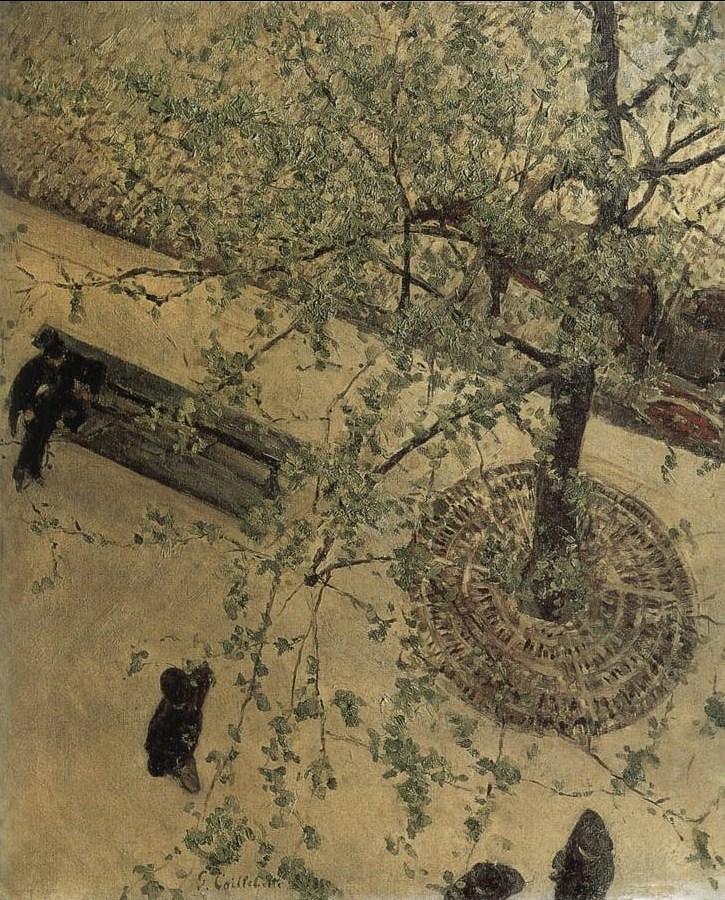
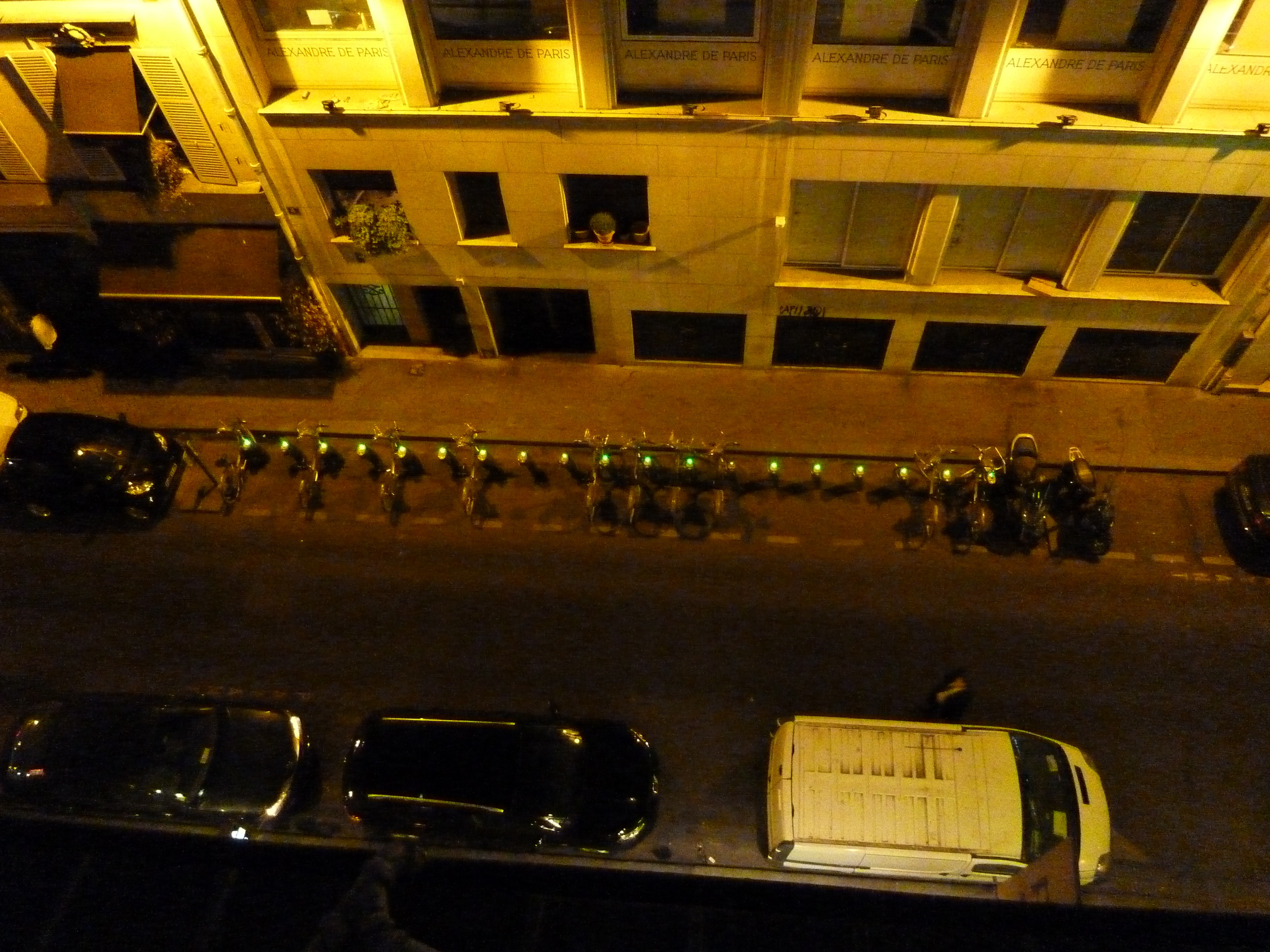
On our most recent visit to Paris, we rented an apartment with a balcony, and like the Caillebottes, we spent a lot of time on it, watching people come and go. However, our apartment did not overlook a wide boulevard, but a narrow, one-way street, and the first thing we saw when we looked out was not a tree and a bench, but…a Velib’ stand. Here it is, with some of Paris’s finest pedalling by.

We realized after a while that this stand served much the same function as the bench in Caillebotte’s picture. People sat on the bicycles or the docking stations just like the man pictured on the bench, but in this day and age, they were usually smoking a cigarette or making a phone call.
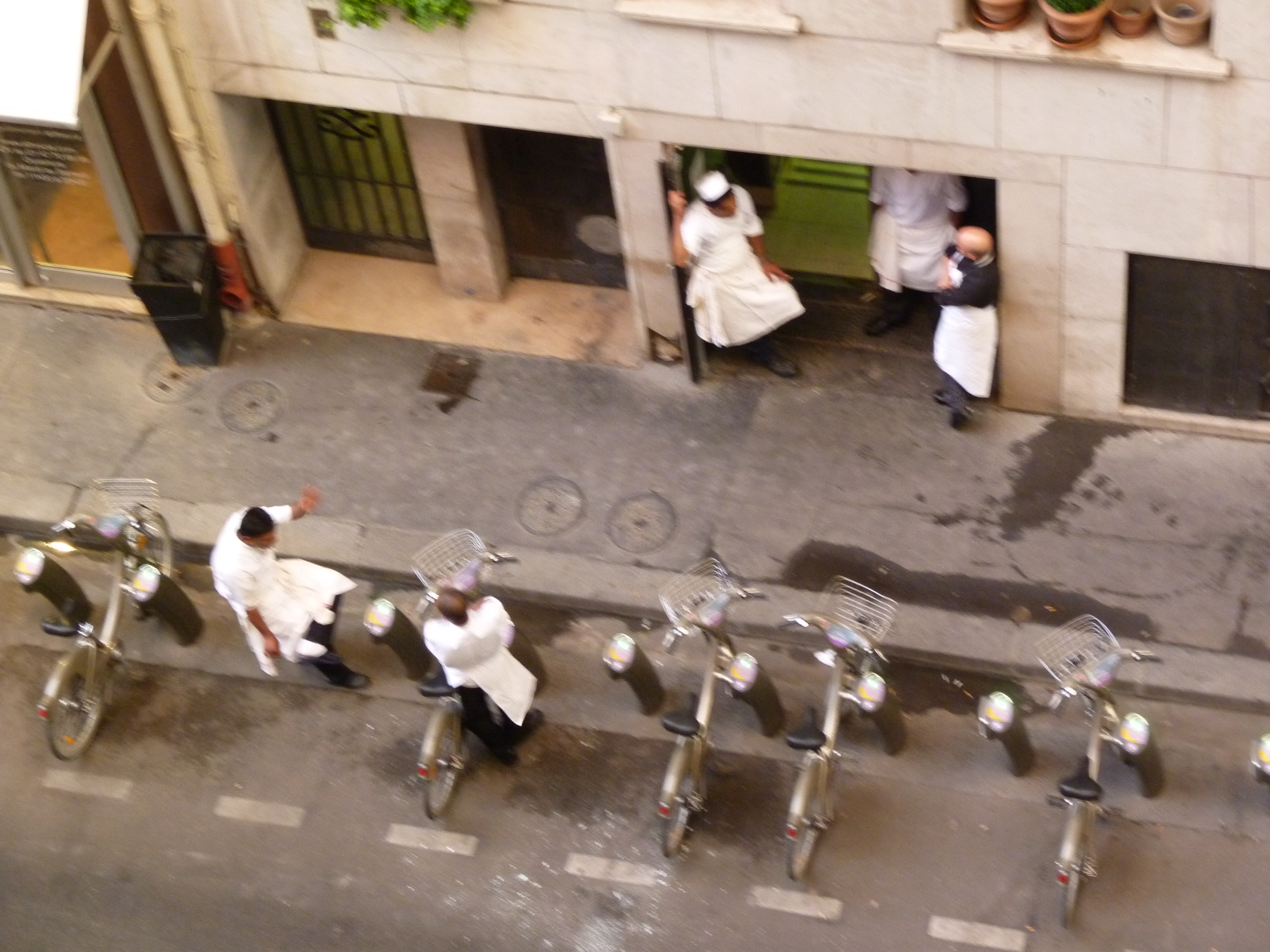
With the introduction of anti-smoking laws in France, outdoor smoking is common and the spot was a popular one for smoke breaks for the kitchen staff and wait staff of a local restaurant. The restaurant entrance was on the next street over (a spacious boulevard), but our balcony overlooked the staff entrance. The women’s footwear is a clue to the type of restaurant.

Another 21st century feature of the view was the green cross advertising a pharmacie – this establishment also faced onto the boulevard one block over, and the sign simply directed customers to the location of the entrance. These green crosses fascinate me. Somewhere, there is a factory churning them out for the French market, and the workers must spend their lives coming up with new patterns of green lights on a black background. It seems that no two signs have exactly the same patterns.

Because the street was one way with parking on both sides, and because it served as the back entrance to the buildings opposite, we would sometimes hear car horns blaring in futile frustration as the street was blocked by someone loading or unloading. The noise would reach a particular crescendo when the blockage was caused by the green recycling truck that picked up the wine bottles from the restaurant. The truck had hoists to raise up the bins full of bottles and tip them out into the pile inside. Deafening. And there were always a lot of bins to empty.

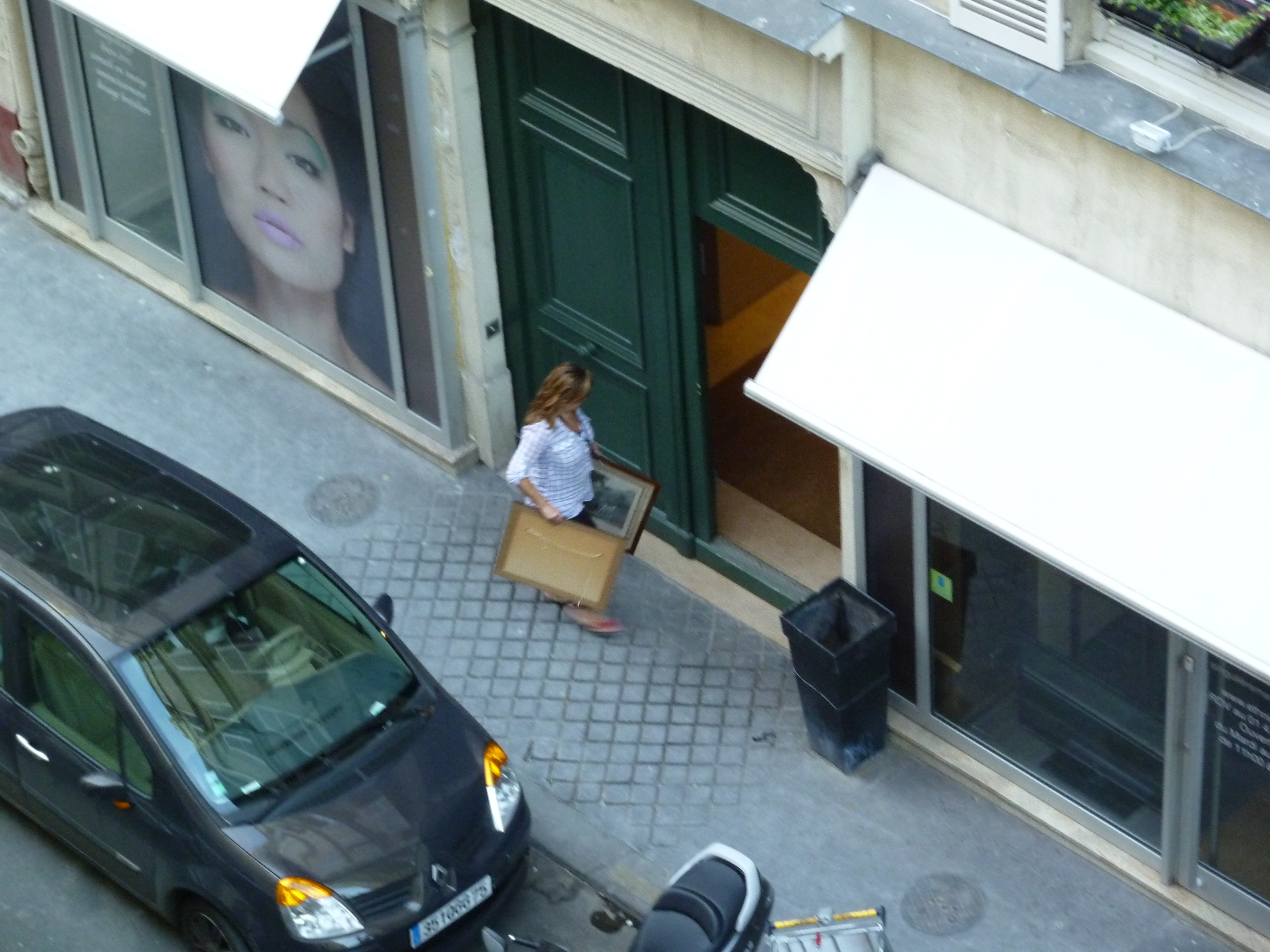
Every day, indeed every hour, there was something new to see – somebody doing a little housekeeping…

…moving in…
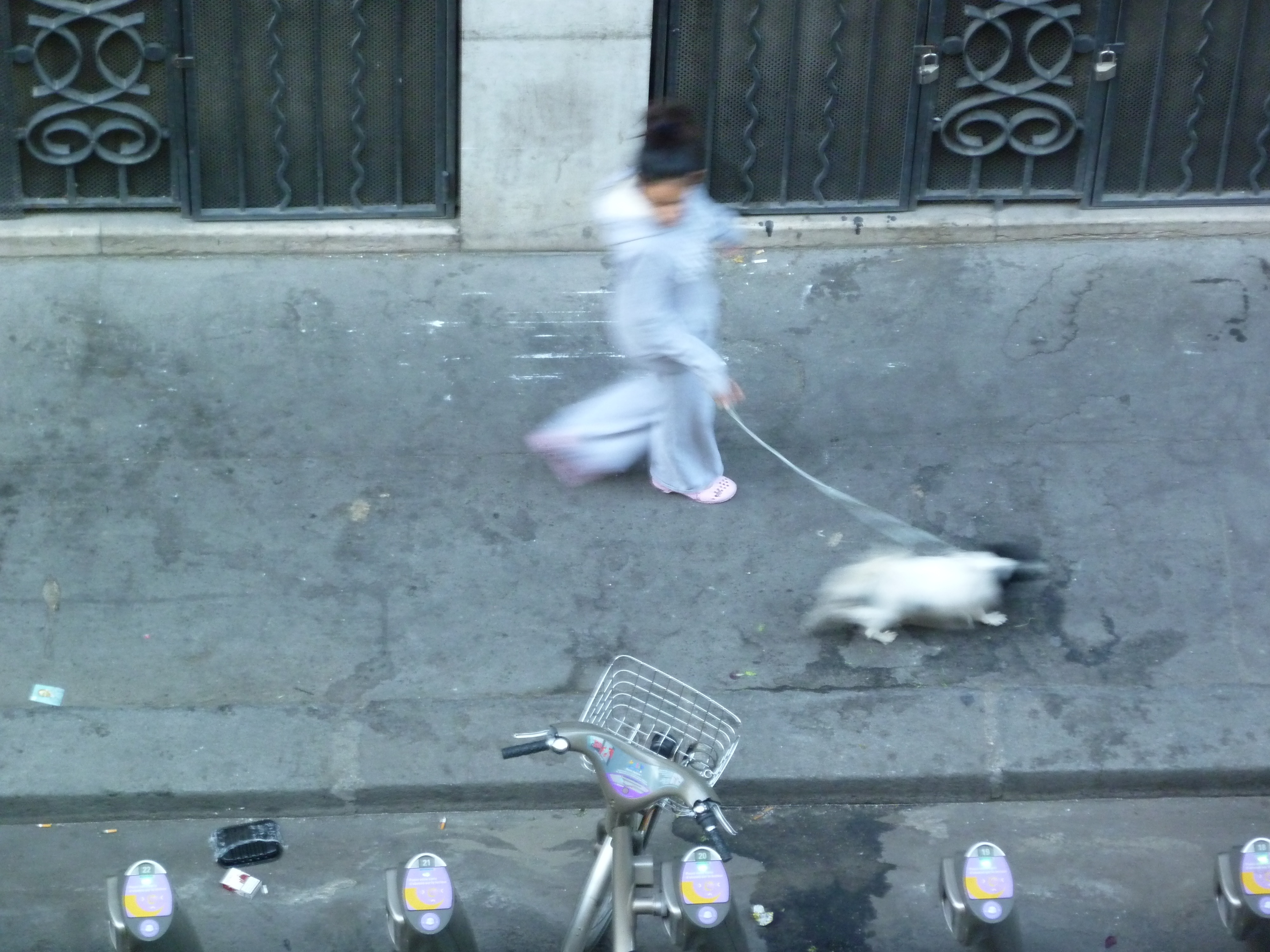
…or walking a dog.
But every evening, we were treated to free entertainment in the form of the valet parking guy (voiturier). Farther down the street was a Chinese restaurant that was clearly popular with the well-to-do. Between 8 and 9 p.m., the BMWs, the Jags, the SUVs, and the Bentleys would pull up and disgorge their impeccably dressed occupants. Then the parking guy would take over.

His job was to find a spot somewhere, anywhere, in the vicinity, park the car, and sprint back to his position to get the next car. He was very fit and very good at parking. We once watched him back up and round a corner at the next intersection when a spot became available on a cross street. His office was a battered Peugeot, where he kept the keys to all the cars. He had an assistant who stood around looking helpless and who was clearly not allowed to get behind the wheel of a car. I guess his job was to keep an eye on the car where the keys were kept.

If you look closely in the picture below, you will see a sort of blur in front of the Velib’ stand. That’s our guy, running flat out, to retrieve or move a car. My camera shutter speed couldn’t keep up with him.

Never a dull moment. What, I wonder, would Caillebotte have chosen to paint if he had lived on this street today?

* We saw the work of the brothers Caillebotte at the Musée Jacquemart-André. This special exhibition continues until July 11, 2011.
Text by Philippa Campsie; photographs by Philippa Campsie and Norman Ball

Posted in Paris art, Paris automotive, Paris civic functions, Paris streets | Tagged , , , , , , , , | 7 Comments

Don’t go there

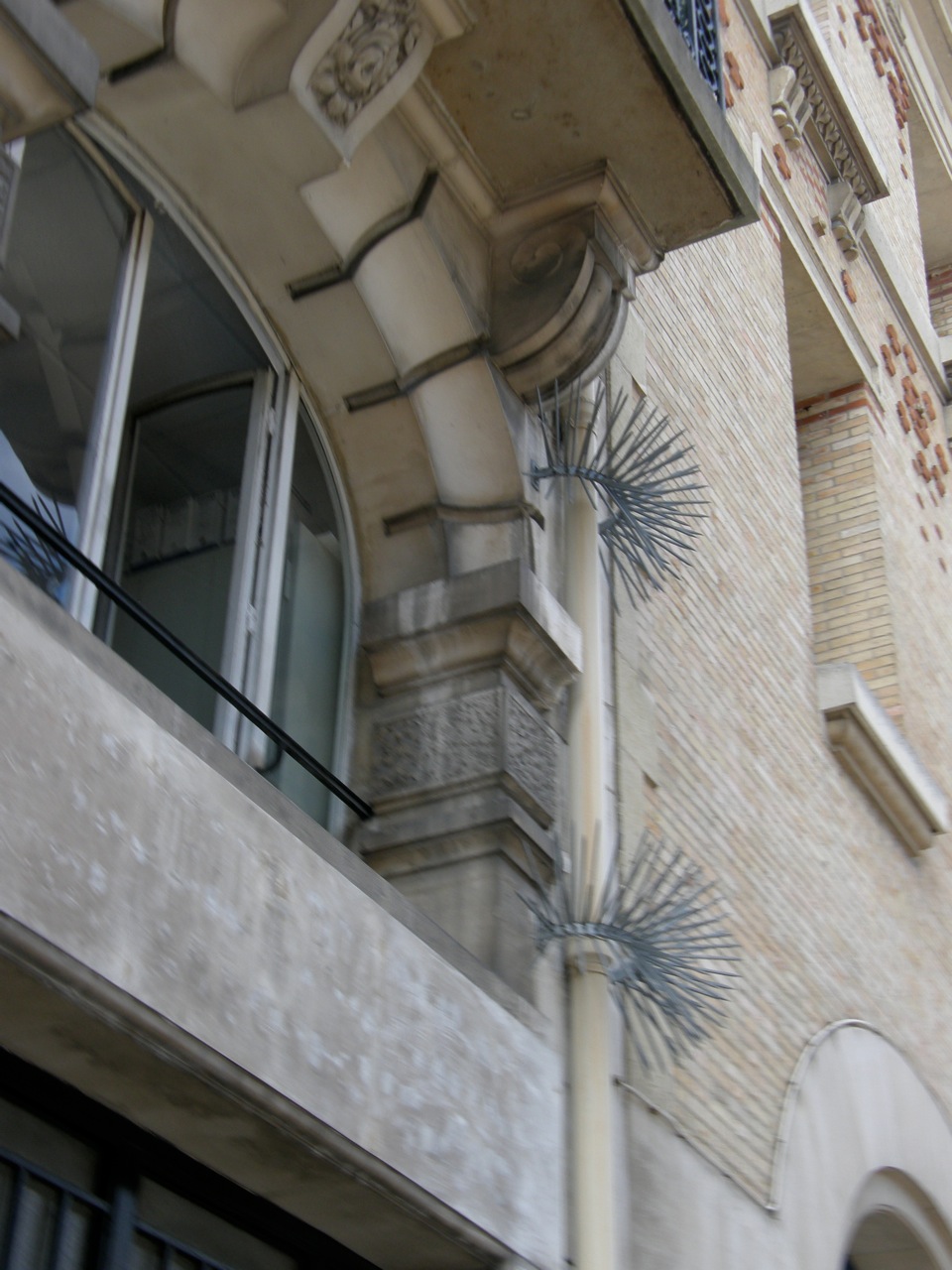
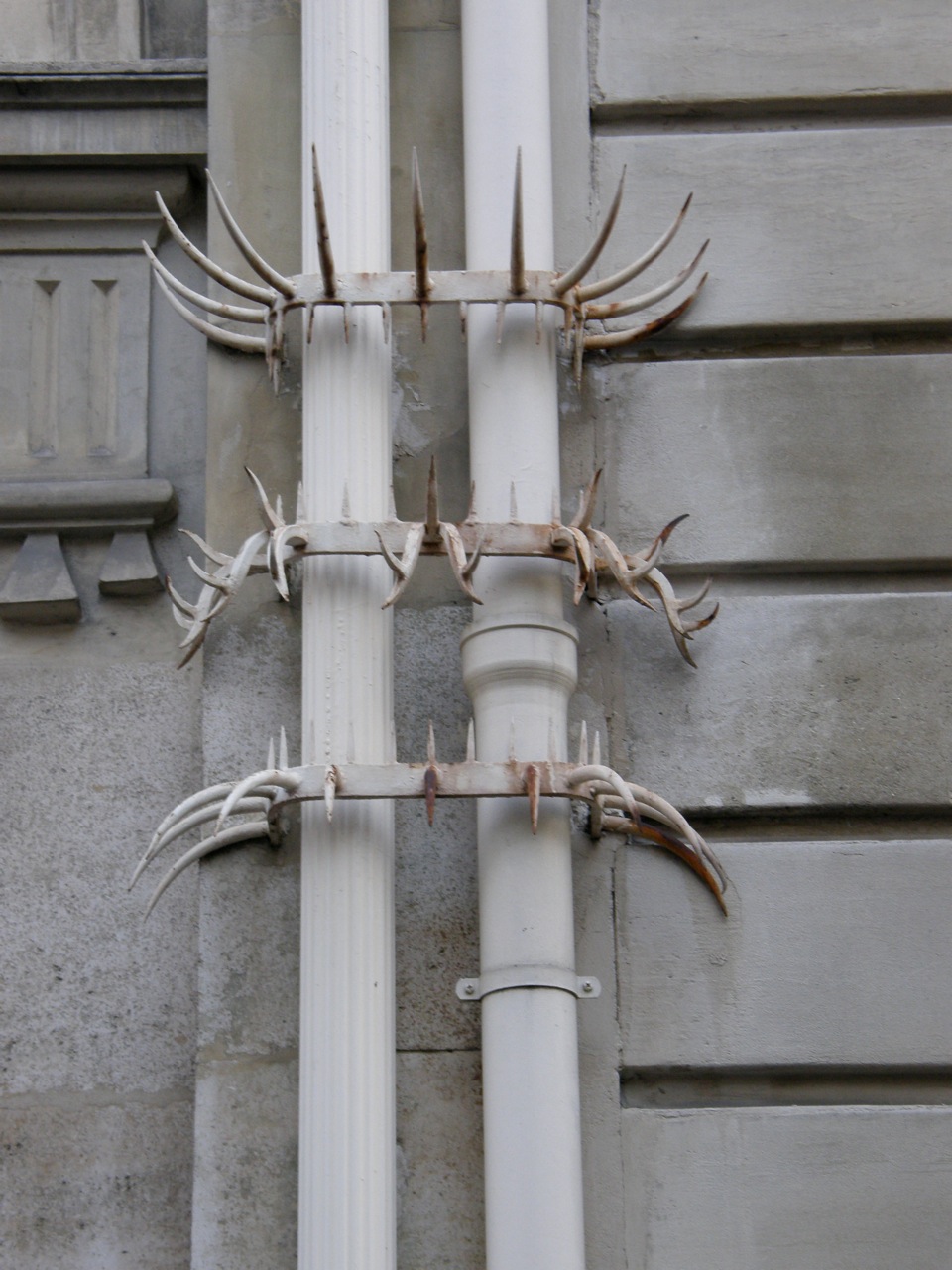
On a recent trip to Paris, we arranged to meet up with a friend, a Canadian architecture-school librarian. As the three of us wandered about Montmartre, she asked us an intriguing question: “What are those spiked things for?” I replied, “They mean don’t go there.” They are more than mere barriers – they are designed to intimidate.

Some are simple, with only a single layer or row of spikes. Others, such as this fierce specimen, threaten intruders with evisceration.

All of them – and I include only a few of the many I have photographed – have one purpose: to tell you not to even think about going there and to stop you very painfully if you try. The two shown above are warnings not to climb up the drainpipe to gain entry to anything you might otherwise plan on breaking into.

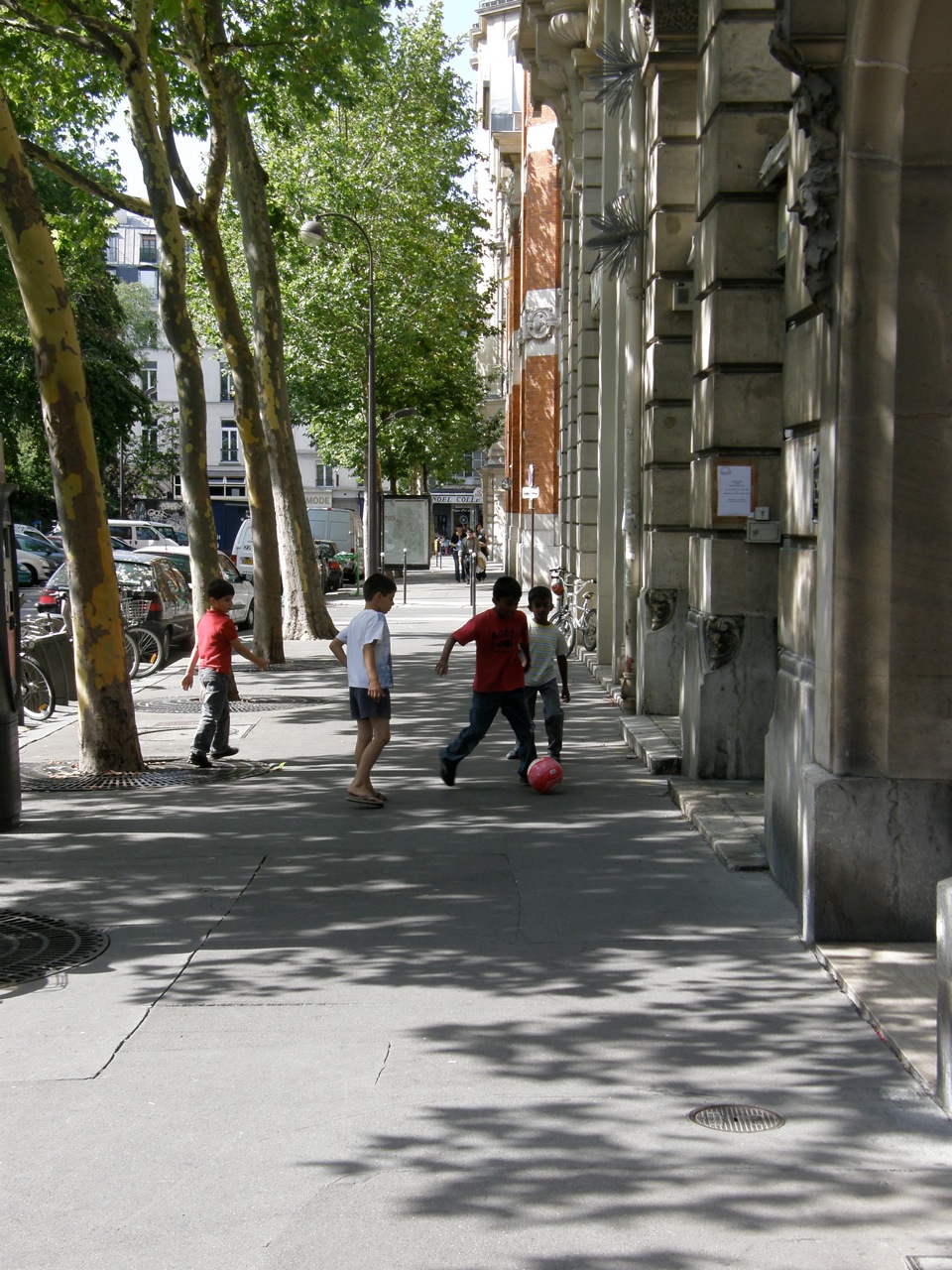
Sometimes they are less obvious. On a lazy August day, we watched boys playing soccer on the wide, shady sidewalk in front of an attractive Ministere des Finances building. It was an idyllic scene.

But take a closer look. Cast your eye upwards along the grey front to the right of the group of boys. Here, let me help you with a telephoto shot.

The rings of metal thorns – even when reflected in a windowpane – are all about business, the business of saying: don’t go there.

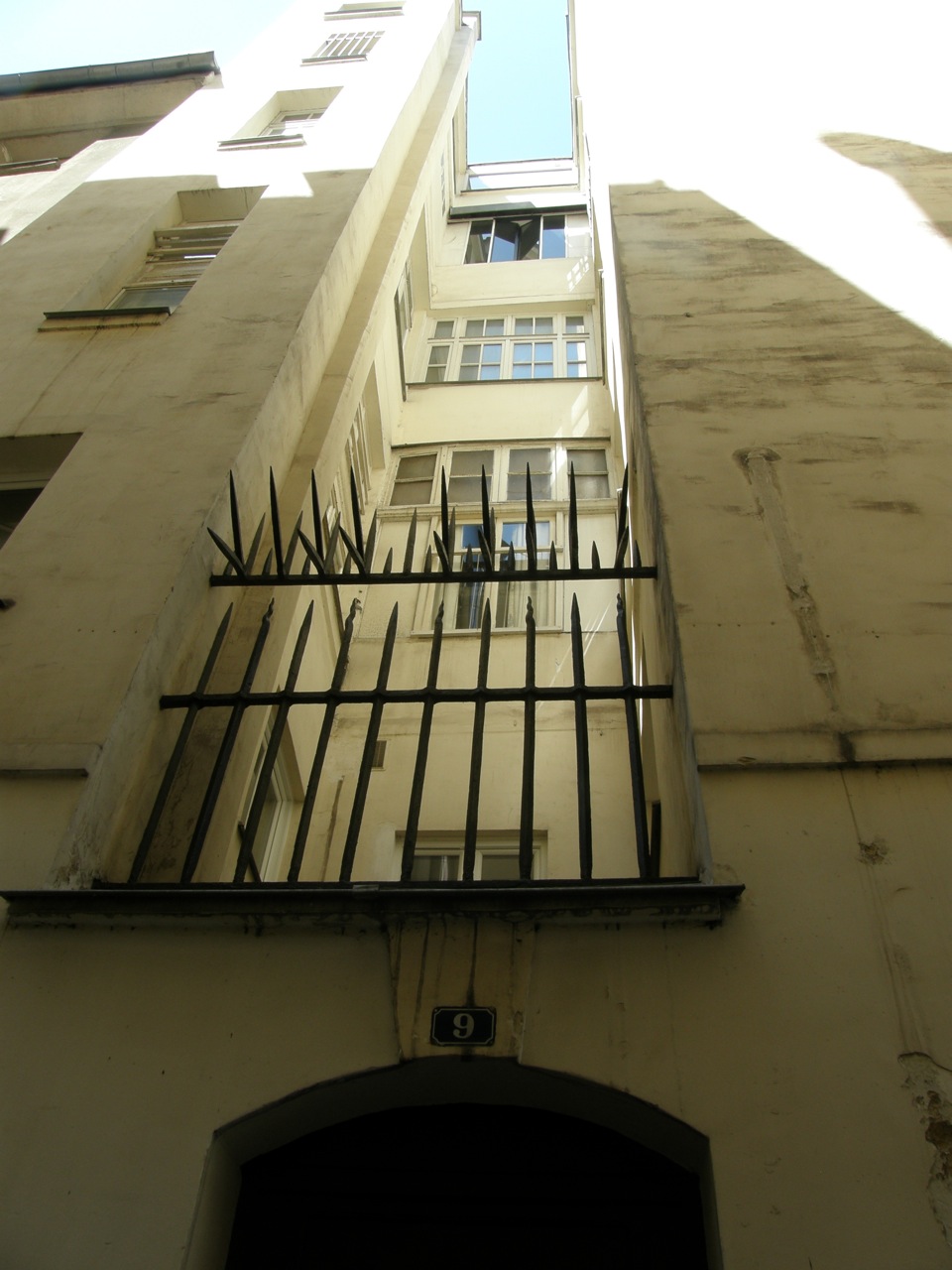
On another building, the U-shaped light well that brightened the interior of the apartments might have provided an ideal entry point for those with evil intentions. The message of the intimidating barriers is clear: Think twice about it.

On the building below, the downspout ring of iron thorns seems lacking in enthusiasm but the bottom two levels of windows are barred. Moreover, there are three security cameras.

Now take a closer look at the barriers at the side of the building. It would be very dangerous to stand on the pillar or to try to get past it.

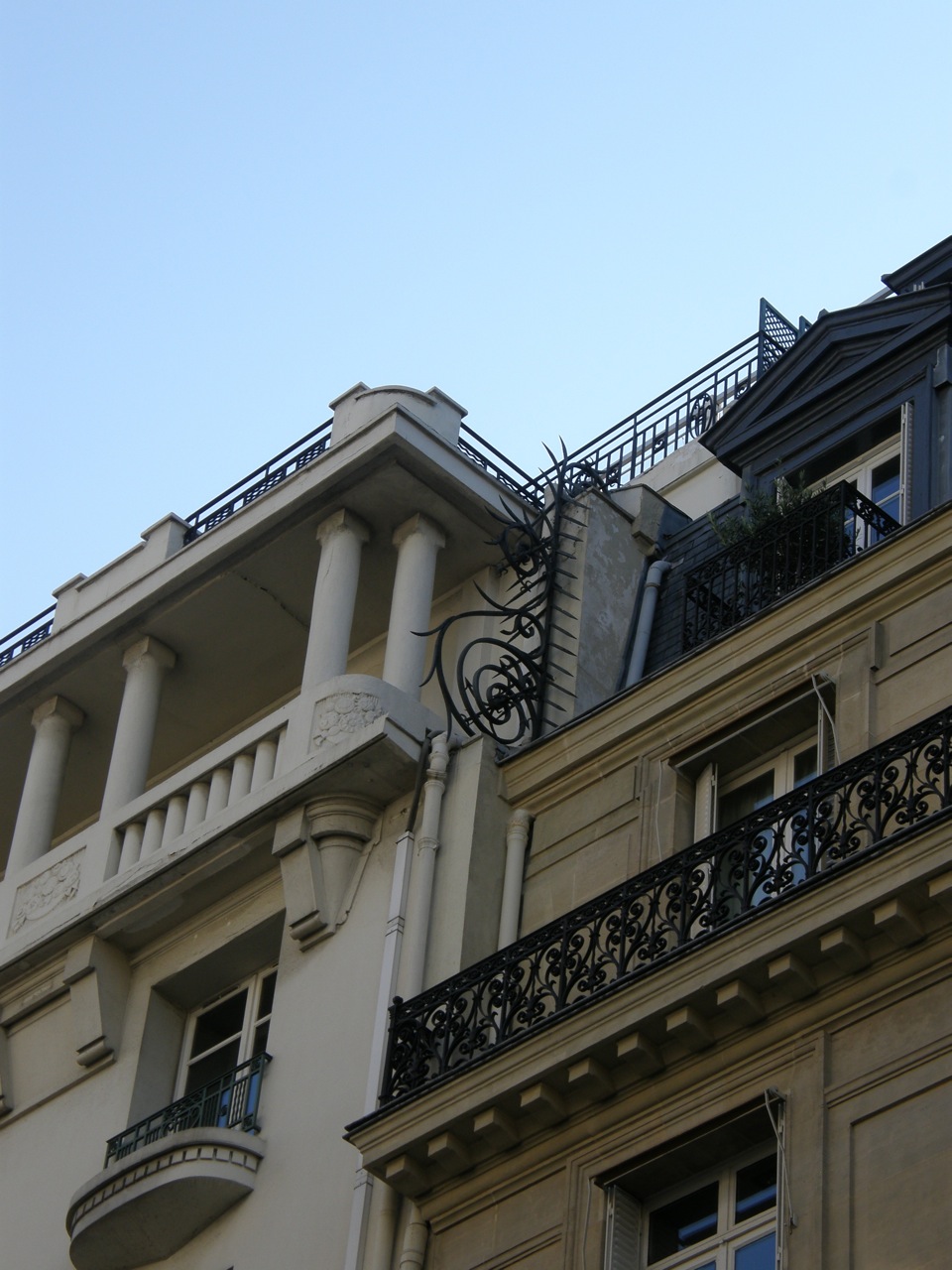
Even those who might gain access to the higher levels will find that many buildings have barriers to moving sideways from one building to another. Some manage to be ornamental as well as intimidating.

Others are less subtle. The closer you get the louder they seem to scream their message.

As we paused to look closer, we noticed the netting that usually indicates there is structural work to be done on whatever is underneath. Another good reason not to climb.

And the nearer you get to your imagined destination the more you know you ought to be somewhere else.

And it is not just people who get the messages. In the inner courtyard of Le Petit Palais, where we paused for lunch, we noticed a few messages directed at the pigeons: don’t even try to land or perch here. Your feet will regret it.

Best to just fly on by. There are better career opportunities elsewhere. How about acting as a “fascinator” at a regal gathering?

Text and photographs by Norman Ball.

Posted in Paris crime, Paris streets | Tagged , , , , , , | 7 Comments

A palace of commerce and a 1904 rendez-vous

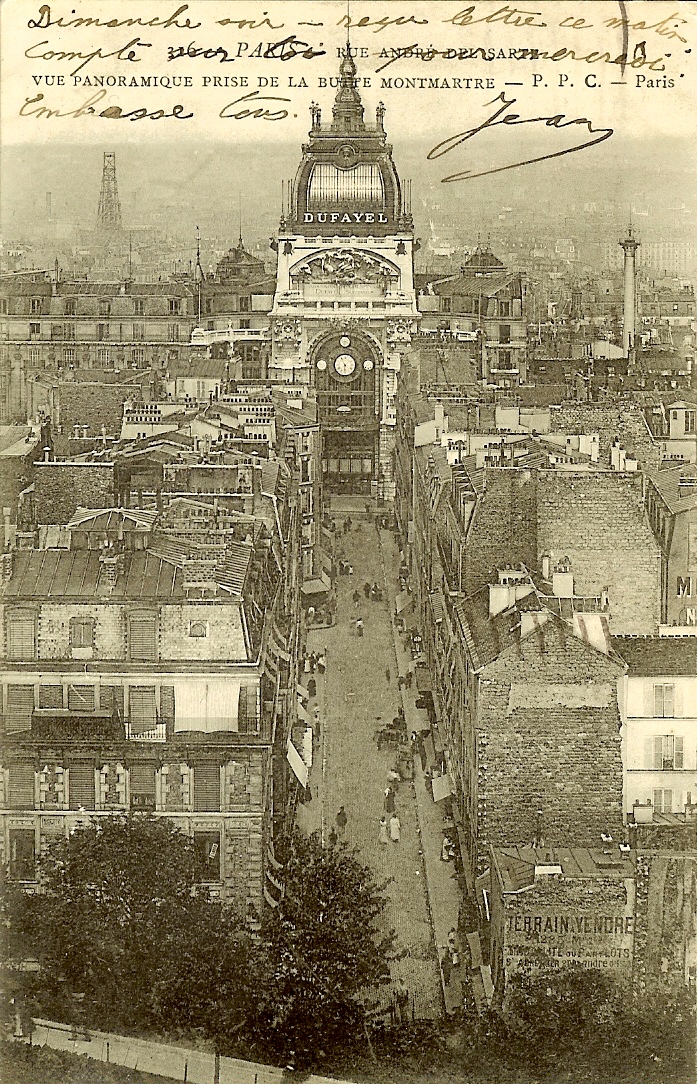
Dimanche soir – reçu lettre ce matin. Compte sur toi pour mercredi. Embrasse tous. Jean.” Sunday night – received letter this morning. [I] count on you [to come] on Wednesday. Love to all, Jean. The date on the postmark is June 13, 1904.

The message is written on the picture side of a postcard that we found in the stamp and card market in the gardens just off the Champs-Elysées. The photograph showed a huge building we didn’t recognize, with the words Dufayel on an elaborate clock tower topped with a dome which was further topped with a spire. Printed on the card are the words “Vue panoramique prise de la Butte Montmartre – P.P.C. – Paris.” (Panoramic view from the Montmartre Hill. P.P.C. might mean “picture post card.”)

Dufayel? Apparently it was a huge department store that sold furniture and housewares. When it opened in 1856, it was called Le Grand Magasin des Nouveautés. When the original owner died in 1888, an ambitious employee called Georges Dufayel bought it and gave it his own name.

Dufayel (1855 -1916) was quite an operator. He either invented or popularized the notion of buying goods on the installment plan and buying from a catalogue. He also sold coupons that could be used in other stores, and took a cut of each transaction.*

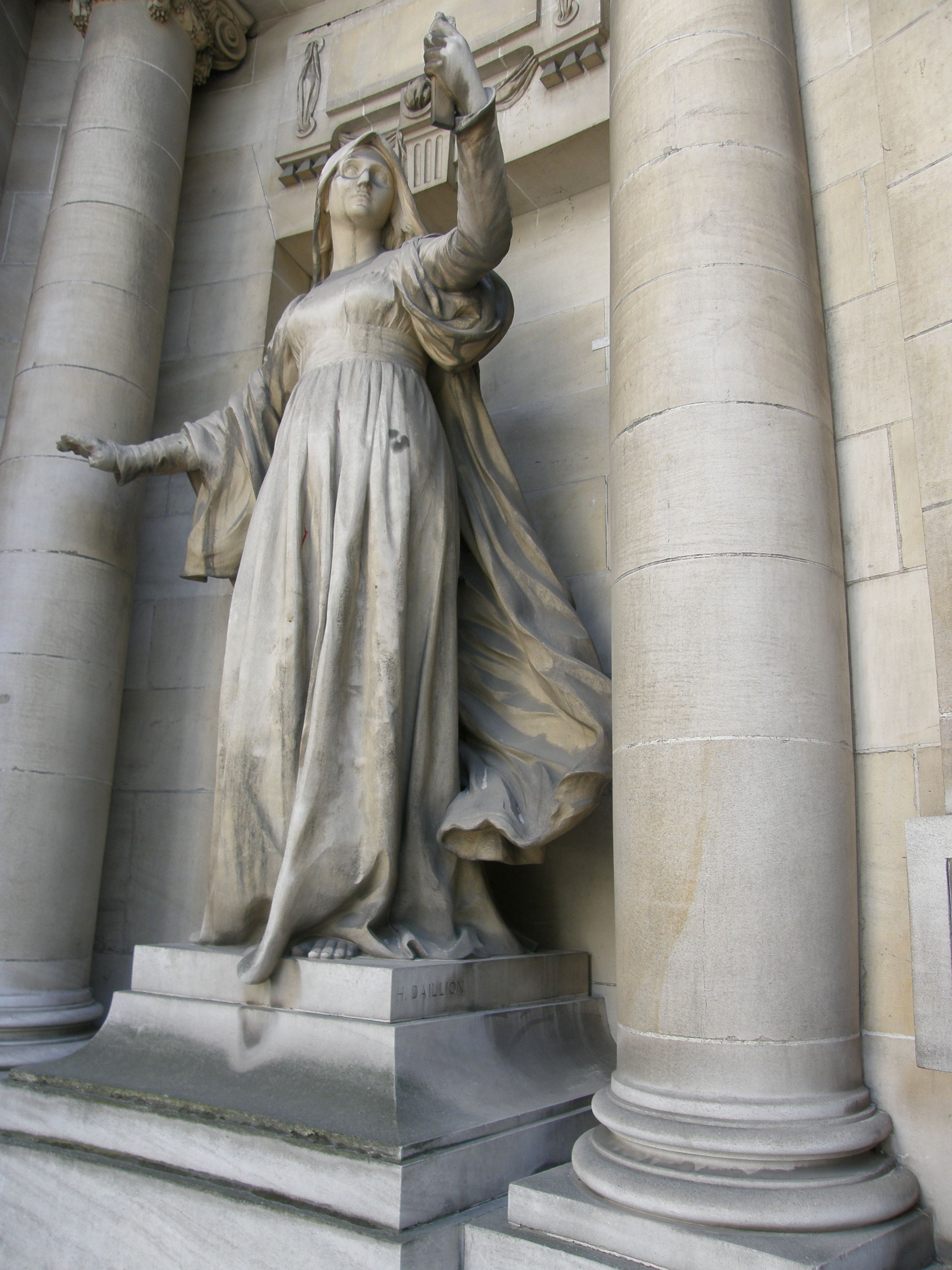
Les Grands Magasins Dufayel expanded over the years until the store occupied most of a city block to the east of the hill of Montmartre – about a hectare in all. The inside was palatial, with chandeliers and mirrors, and contained a winter garden and a theatre that seated 3,000. On top of the dome was a revolving searchlight of 10 million candlepower – roughly similar to the light that currently revolves on top of the Eiffel Tower. The statues on either side of the entrance represent “Credit” and “Publicity” and over the door is “Progress” riding in a chariot. (For pictures of the interior, click here or here.)

The building is only one of the points of interest in the photo. There is a tall chimney on the right, and a sort of crane on the left. In front is a lively street scene, with people coming and going to and from small, awning-shaded shops. The area is not fully developed, since “Terrain à Vendre” (land for sale) is painted on one of the walls in the foreground.

Curious to see what was there now, we set off with a friend on a fine May morning to find out. We located the building shortly after leaving the Barbès-Rochechouart Metro station. We approached its southern front first, which was also impressive, before we found the west-facing façade shown on the postcard. The building is now occupied by the BNP Paribas bank.

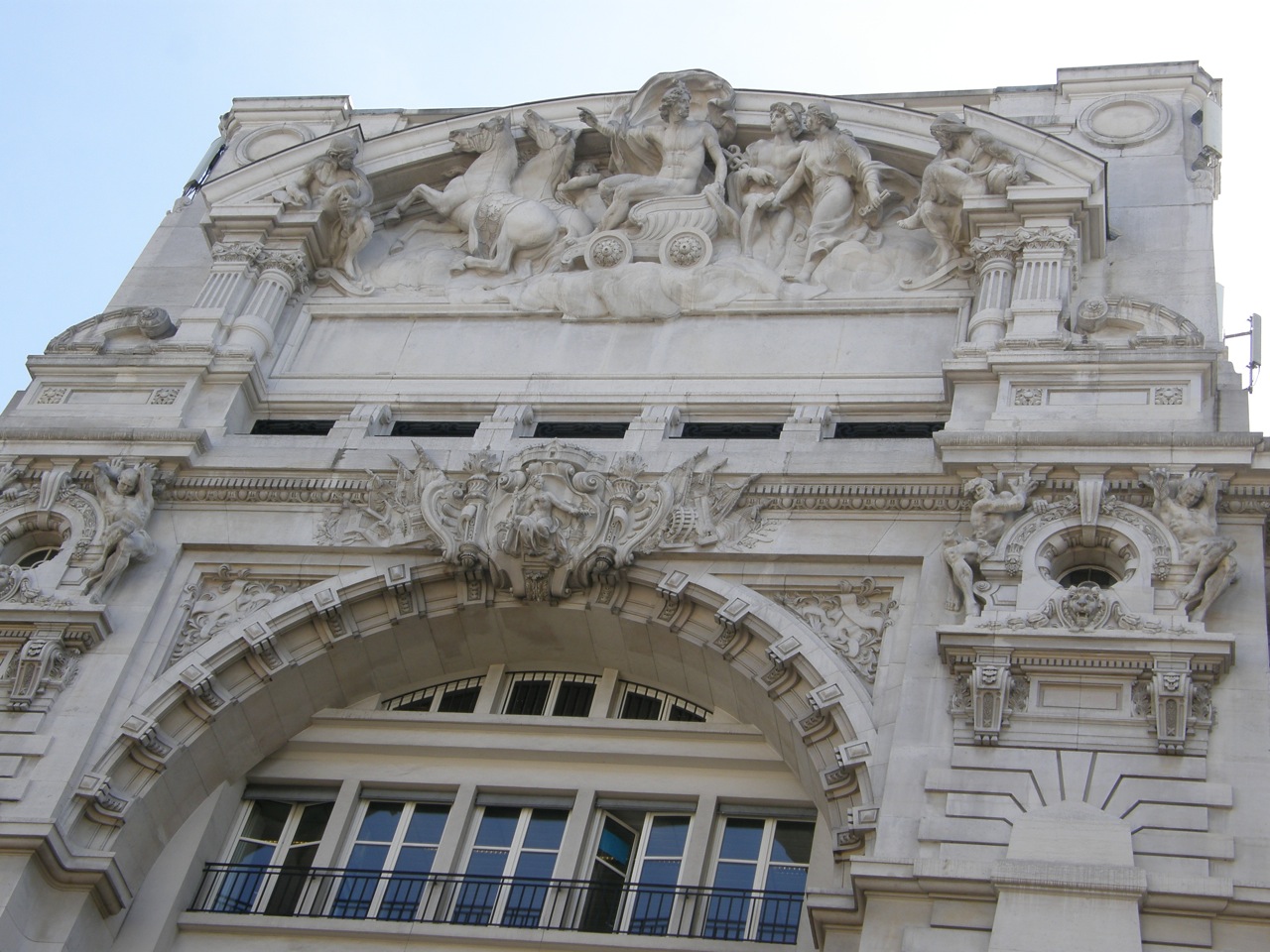
Alas, what was once the front entrance is now the back of the building and is obscured by an ugly fence. The squared-off dome was gone, and so is the huge clock face, but the stonework with its relief sculpture of Progress riding in a chariot is still there.

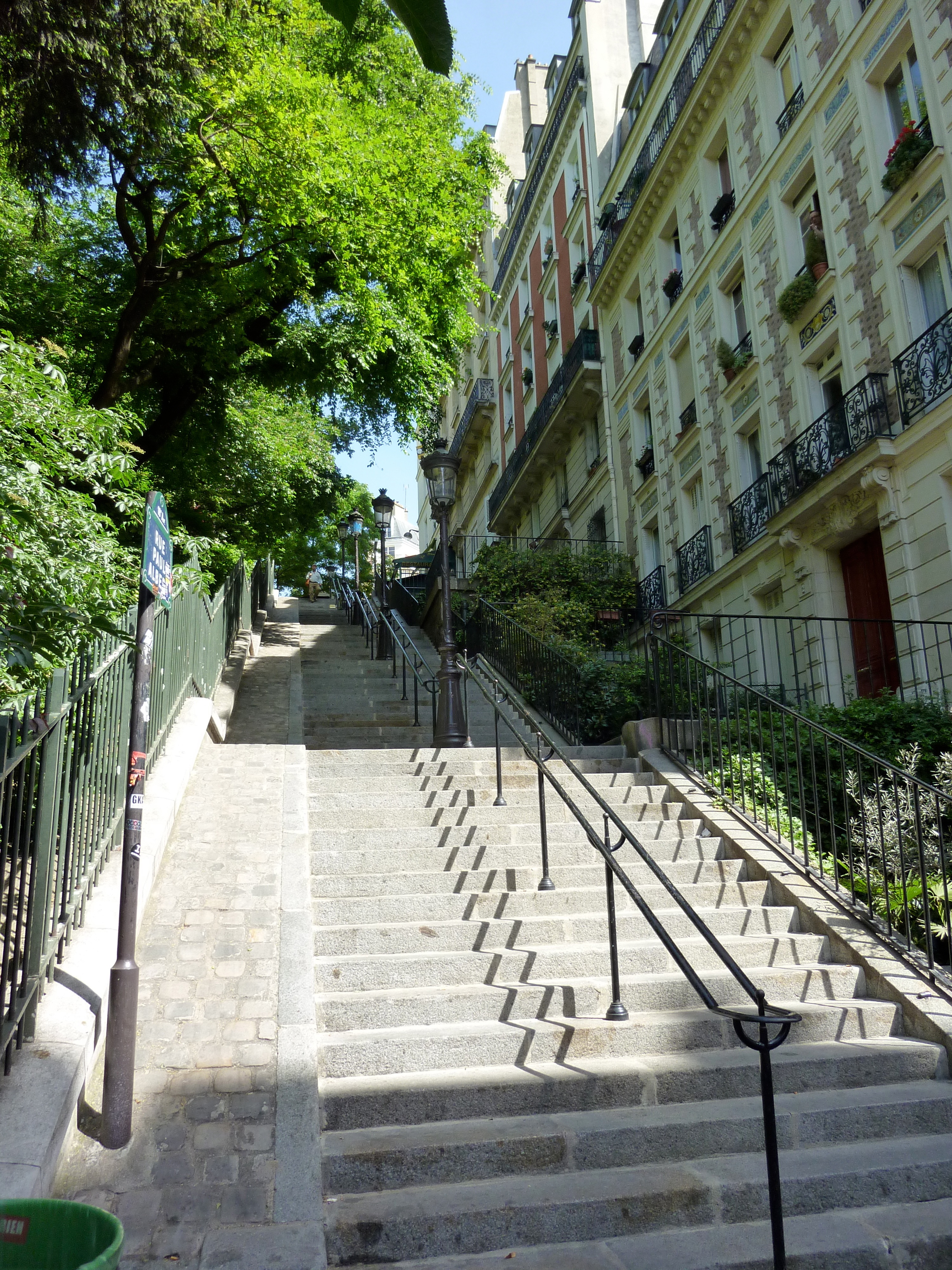
We wondered if the view from the Butte Montmartre would still show the street in front (rue André del Sarte). We climbed the steps at the end of the street and headed into the Louise Michel park to take a look.

At first we took the lower path, where thick trees and bushes prevented us from getting a clear sight of the building.

But when we took a closer look at the postcard, we realized that since the lower path was visible at the bottom left, the picture had been taken from much higher up.

Eventually, on one of the upper paths, we found a bridge over what must have been a small creek or gully that gave the same view as the postcard, although trees still obscured part of the view.

The land that was for sale at the turn of the century had been sold. The chimney and the crane were gone. But the street still contained small shops and cafés, and people were still coming and going.

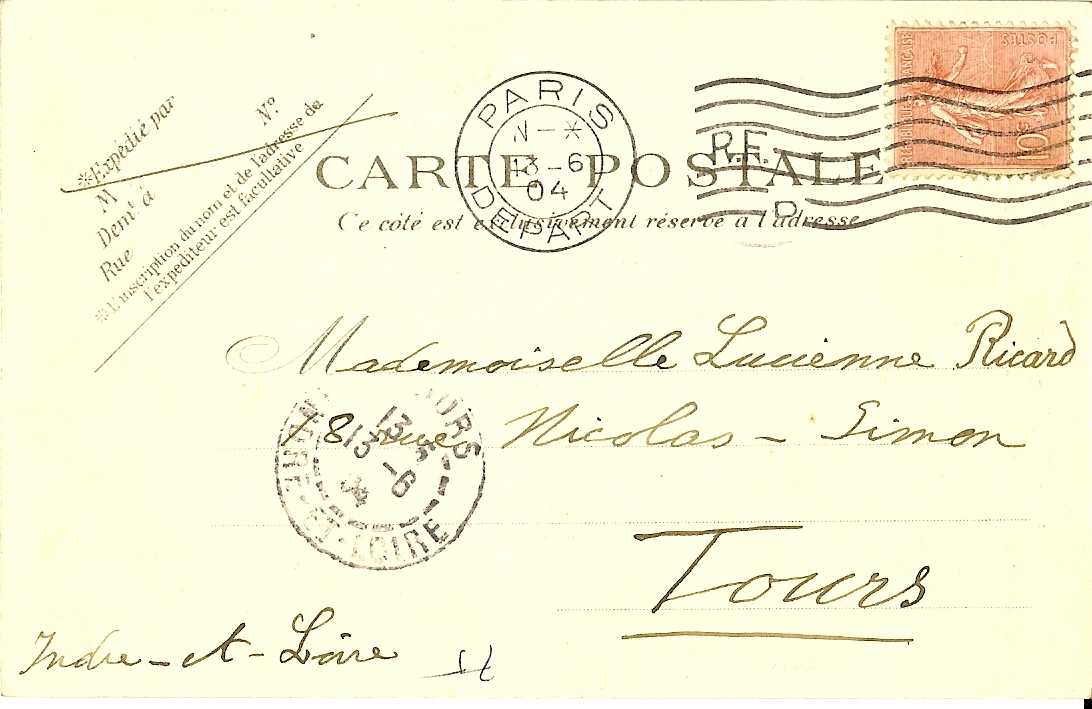
What about the other side of the postcard? Who was Jean expecting on Wednesday? The card arrived on the same day it was sent (the Monday). Who needed e-mail in those days of same-day mail service?

The postcard was addressed to “Mademoiselle Lucienne Ricard, 18 rue Nicolas-Simon, Tours, Indre-et-Loire.” Rue Nicolas Simon does not appear on Google maps, but I found it on an image of an old Baedeker map of Tours. When I compared it to the current map, I realized that the street had been renamed rue Jules Simon. No. 18 is still there, visible in Street View.

Jean must have known Lucienne well, because he used the intimate “tu” form of address. I wonder if they were brother and sister. And, if Jean’s last name was Ricard, whether he was the novelist of that name who published several books in the 1920s and 1930s.

I hope Lucienne made the rendez-vous in Paris with Jean. Perhaps they shopped at Dufayel, entering the palace of commerce by the grand doors under the clock tower.

Text by Philippa Campsie, photographs by Philippa Campsie and Norman Ball.

*Dufayel also bought a house at 76, avenue des Champs-Elysées, which had once belonged to a duchess, tore it down, and had the architect who had designed his store (Gustave Rives) create an even more elaborate mansion (now demolished). He installed himself there in 1905 or so with his art collection. His name is also associated with Sainte-Adresse in Haute-Normandie, where there is another large building bearing his name. He created a resort area in the town known as “Nice – Havrais” (the Nice of the area of Le Havre). Busy guy.

Posted in Paris history, Paris postcards, Paris quartiers, Paris shops, Paris streets | Tagged , , , , , , , , , , , , , , | 32 Comments

Rattled in Raspail (adventures in banking)

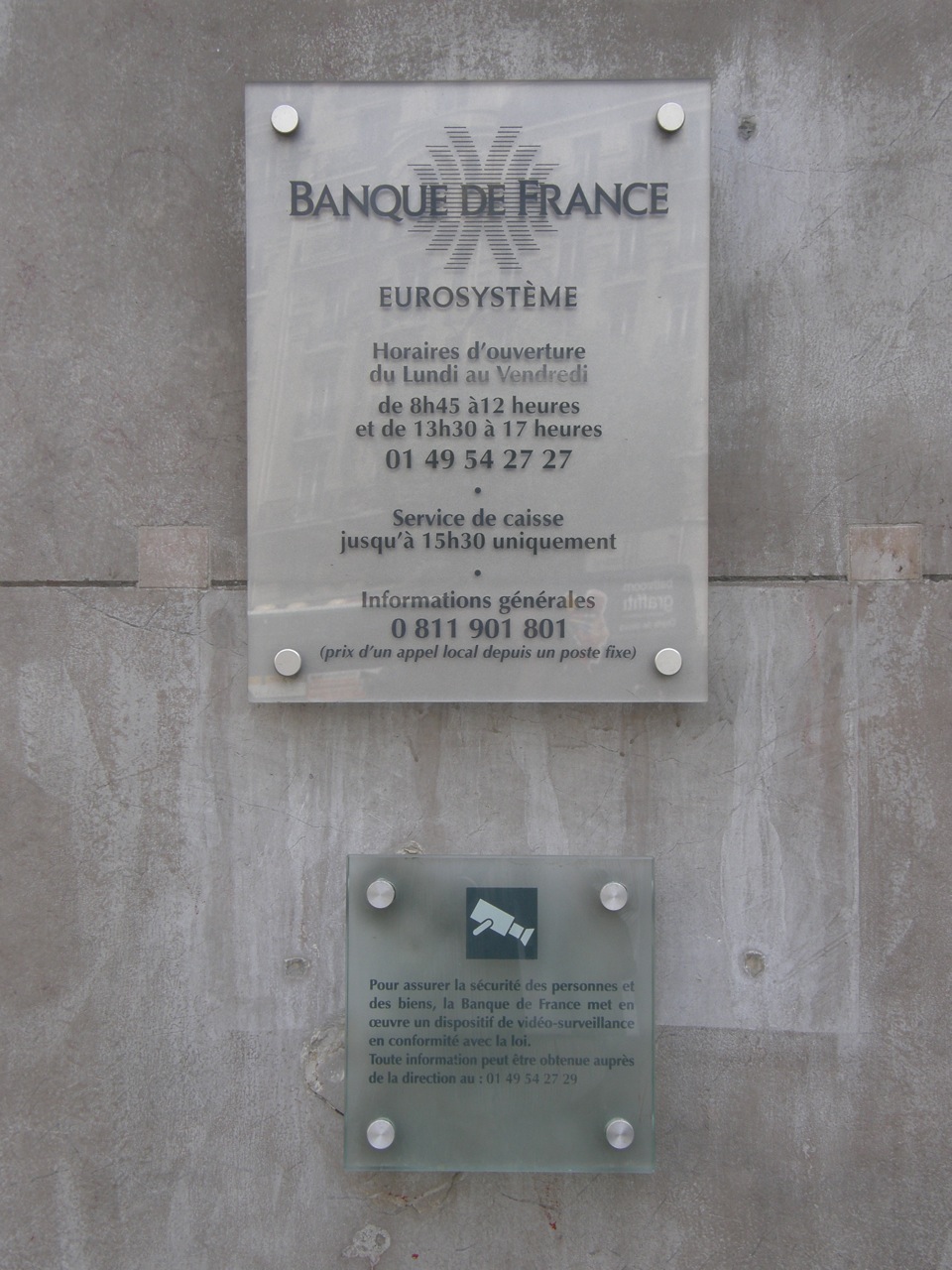
In 1910, Stephen Leacock wrote a short story called, “My Financial Career,” which began with the words, “When I go into a bank I get rattled. The clerks rattle me; the wickets rattle me; the sight of the money rattles me; everything rattles me.” Leacock expressed this reaction to a bank in a small Canadian town. What would he have made of the grand and intimidating Banque de France on the Boulevard Raspail?

Perhaps we should explain. We had received a 500-euro note from our bank in Canada. They didn’t have much in the way of choice, and we needed some cash for our trip, so we took it.

When the time came to change it, we entered an ordinary bank near our apartment. The teller was aghast. Surely we did not expect change for this note? No, no. Banks do not change money. What a preposterous idea!

We asked politely where we could change this troublesome note. The Banque de France and only the Banque de France was the answer.

The next day, we found ourselves on the Place de la Bastille, where there is a branch of the Banque de France. We entered. This itself is a process. Press a button. Wait. Enter a little airlock between two sets of doors. Perhaps decontamination occurs at this point. Push another button. Wait. Enter the bank.

We approached the teller and repeated our request. Ah non! Not this branch of the Banque de France! How could we have thought such a thing! No, no. We must go to the bank on the Boulevard Raspail. That is the one and only place in Paris to change a 500-euro note.

OK, fine. Whatever. It is close to the Bon Marché and we are always happy to visit the Grand Epicerie there. So we head to the Boulevard Raspail.

Now, it is important to time one’s arrival. The bank isn’t open just any old time to passersby. It opens at 8:45 a.m. and remains open until noon. At that point, the bankers need their lunch. It reopens at 1:30 p.m. and remains open until 5 p.m. But if you need the services of a teller, you must get there before 3:30 p.m., when the guichets (tellers’ wickets) close.

So far, so good. We arrive just before 3 p.m. We go through the airlock ritual and enter the bank. It is all heavy marble and dark wood and gloomy shadows. We see a desk labelled “Accueil” (welcome), but no one is there to welcome us. Somehow, we cannot imagine feeling welcomed to this oppressive spot.

On the desk we find forms that must be completed in order to carry out a cash exchange. Norman gets out a pen. (The bank does not supply one.) Date, name, first name, address, amount, origin of the funds, phone number, profession, signature. Proof of identity is required.

At the bottom of the form is written, “The lack of compulsory information will make the operation impossible.” (This is the bank’s translation, not ours.)

To one side are three guichets, enclosed in glass. Probably bullet-proof. Only two are staffed. A woman teller is occupied with a young man who has what appear to be large pouches of money. He has been there some time, we can tell, and he has the air of someone who expects to be there for even longer. He tries to make a cellphone call and the teller raps angrily on the glass. He is to desist, immediately. He promptly ends his call.

The other teller, a man, is engaged in a transaction with another customer. Across from the tellers are some benches with people sitting on them. They are formal and rigid, and when you sit on them, you feel like someone waiting for the outcome of a judgement in a courtroom. The benches imply that you are guilty.

After a while, we notice a little contraption that dispenses paper tickets with numbers on them. We tear off a numbered ticket and sit down again. Nothing happens for quite a while. Godot was here some time ago, but he left in despair.

Eventually, the male teller finishes with his customer, and a man from the bench steps forward eagerly. The teller motions for him to stay where he is. He freezes. After a while, it becomes clear that the teller is having computer difficulties. Time stands still.

Eventually, a woman member of staff approaches the benches of the accused. She says that the ordinateurs (computers) are hors de service (out of order). They might be working again in five minutes, or in an hour, or not for some time. She has no idea. Teller service is hereby suspended. She does not apologize for the inconvenience.

One might wonder why a computer is needed to change one cash note for a series of smaller notes. Presumably one’s passport must be scanned to determine whether one is wanted by Interpol. It is clear that someone with a 500-euro note is up to no good.

Norman says he will wait until 3:30 since we are here anyway. Philippa goes across the road to the Bon Marché to use the facilities. When she returns, there is a notice on the door.

No exchange today. We go home.

Norman goes back the following day on his own, and approaches a teller with a working computer. The man delivers something of a lecture on the inadvisability of travelling with such a monstrously large note. Norman replies with some feeling that he was not given a choice by his bank in Canada, and that Paris did not give him any choice in where to cash it. Standoff. Security is not summoned. This time.

Years ago, on our first visit, we used American Express travellers’ cheques, which we exchanged at the Amex office opposite the Opera. This was once a grand place to see and be seen, where people used to come to fetch their “post restante” mail and book tickets to exotic places. It gradually withered to a small hole-in-the-wall office, but it was still bright and cheery and the staff members were pleasant. Those were the days.

Well, our time at the Banque de France was, as they say, a learning experience. If you are reading this and planning a vacation in Paris, heed our advice: do not let your bank fob you off with cash in large denominations. Get nothing larger than a 50-euro note.

Text and photographs by Philippa Campsie and Norman Ball
Posted in Paris travel | Tagged , , , , | 10 Comments

Traces of tragedy on a quiet street

Not many people walk the length of the rue Jean Goujon in the 8th arrondissement. Either they are strolling along the river, or gazing at the likes of the Christian Dior boutique on avenue Montaigne (fashion central), the next street over. The rue Jean Goujon runs between the river and avenue Montaigne, and it is as quiet as the tomb. I use this simile advisedly.

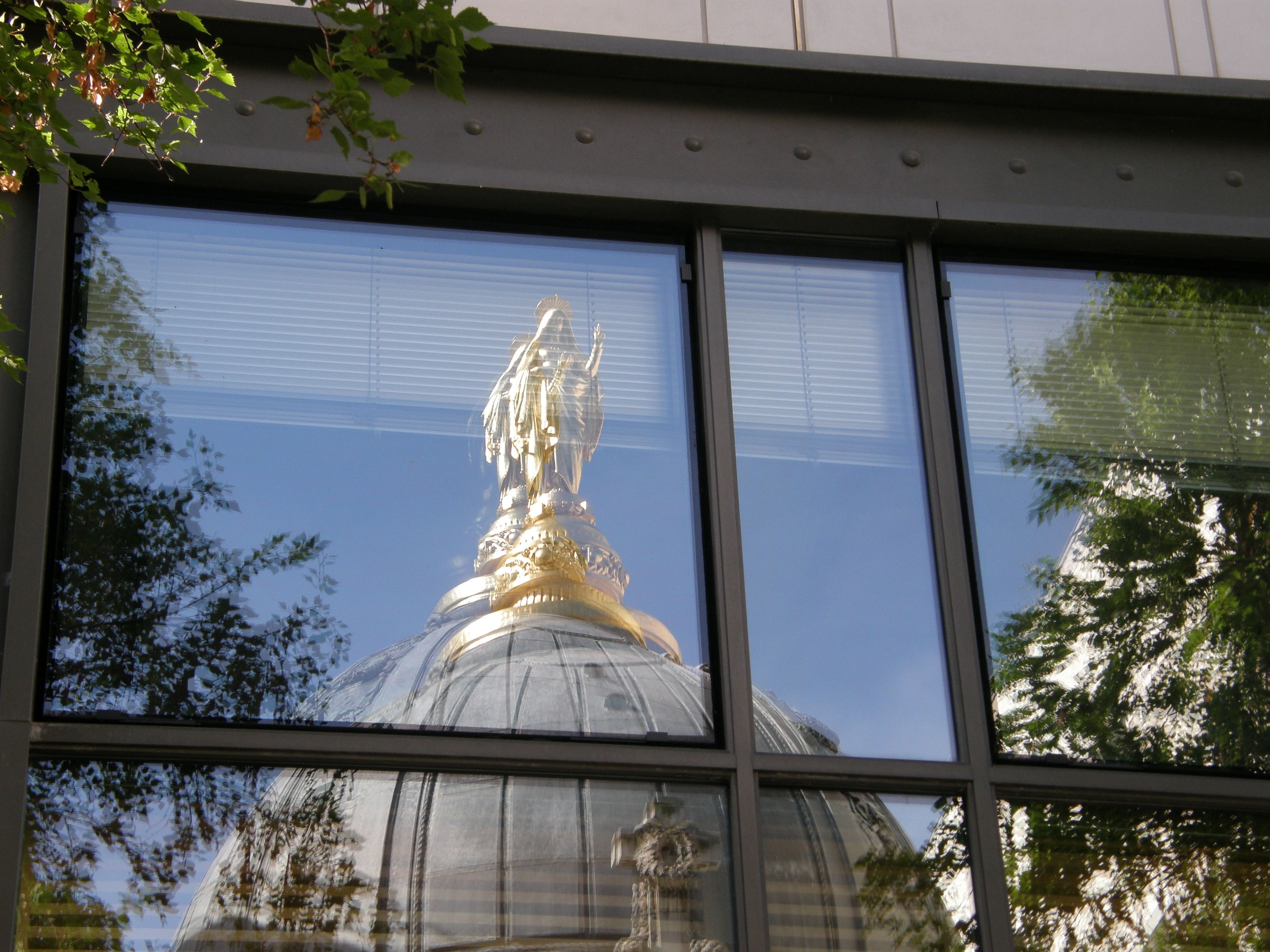
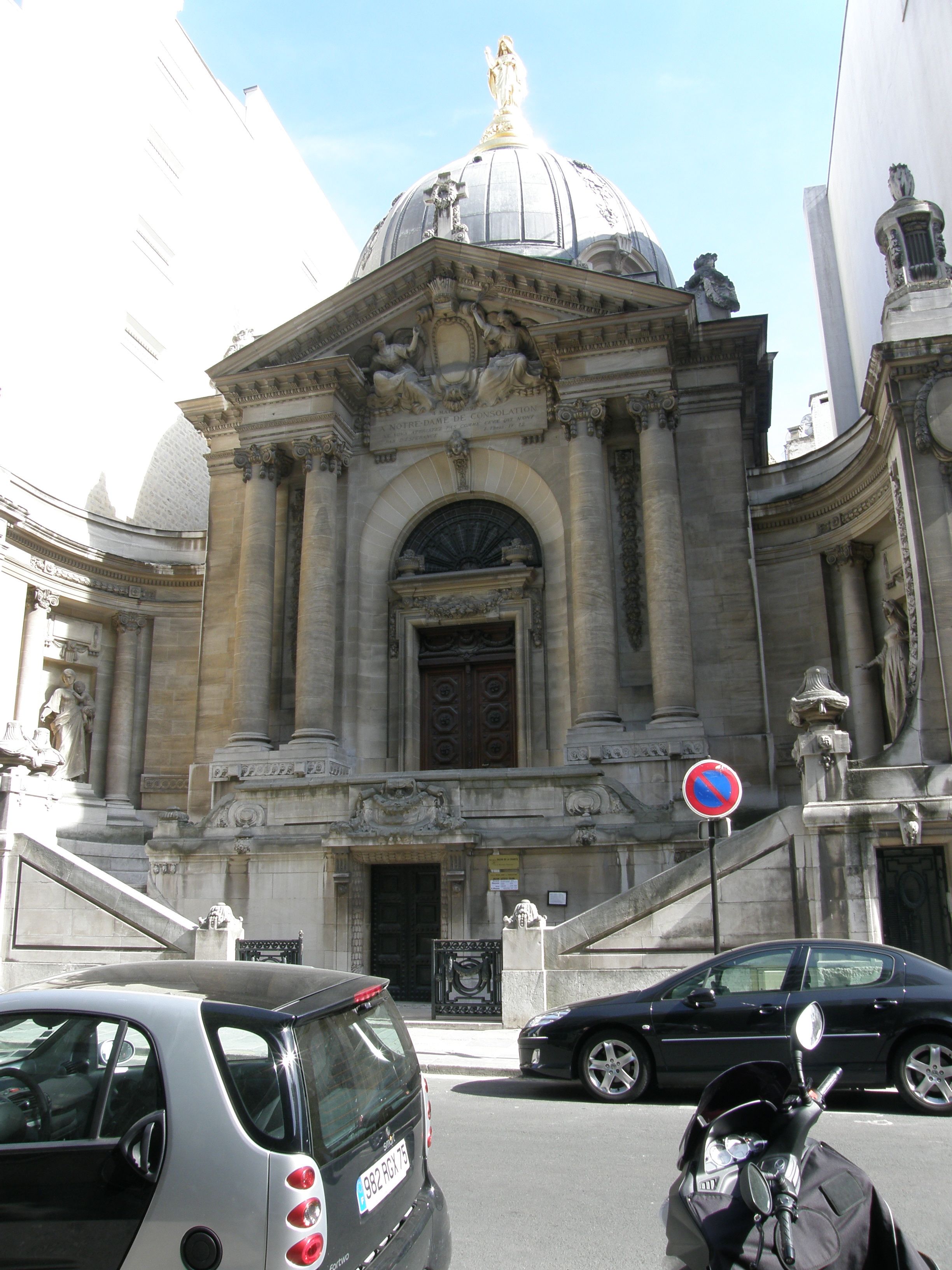
We chose it by chance, and by chance we stopped to admire a handsome church facade and dome topped with a golden statue reflected in the windows of the office building opposite. The double glazing made a double image.

A small sign by the church caught our attention. Something to do with a “Bazar de la Charité.” We crossed the road for a closer look. No, it wasn’t about an upcoming rummage sale. It was the raison d’être for the whole structure.

The church is called Notre Dame de la Consolation, and the consolation is that of the bereaved whose wives, husbands, children and parents perished in the fire of May 4, 1897, that occurred here.

The Bazar de la Charité was an annual fundraiser for the poor, and like all successful fundraisers, the organizers had secured the participation of some celebrities — in those days, that meant people with titles. The Duchesse d’Alençon was the highest ranking of those in attendance.

The bazaar wasn’t just your average church craft and white elephant sale. The organizers had created something that looked like a medieval street in a large wooden building on this site, made of painted cloth, cardboard and papier-mâché. There was food and drink on offer, and trinkets to buy in little boutiques staffed by society ladies, but most of all there was entertainment. And so, to be as up-to-the-minute as possible (this was 1897), the organizers arranged for moving pictures.

Alas, the equipment didn’t work as it should have. In the end, nobody was really sure what happened. Some said the assistant did something wrong. Others said it was a malfunctioning projector that started the fire that immediately spread to the rest of the building. Many of those in attendance escaped, but about 130 people perished, most of them women.

The chapel was later built on the site to commemorate the dead of the Bazar de la Charité. It is not a large church, as it might seem from the façade, but a rotunda under a dome that can accommodate about 75 or so people. We also glimpsed a cloister open to the sky, with tombs on one side, opening off to the rear of the chapel.

Feeling thoughtful, we continued our walk. And a few steps further, we found another memorial of another kind, this one to people who died far away, in another country.

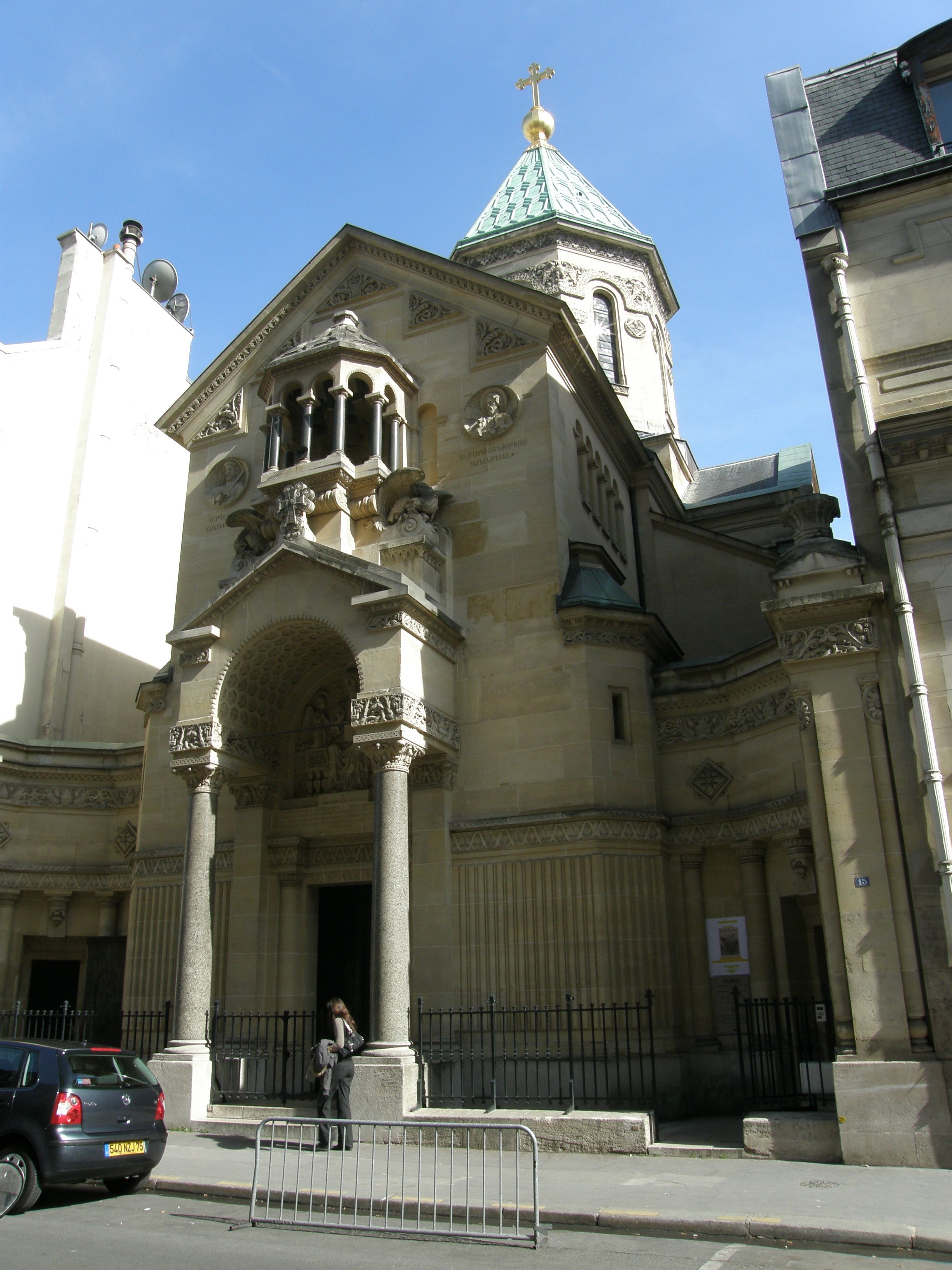
The Apostolic Armenian Cathedral in Paris, St-Jean Baptiste, is a completely different style of church, although it was built only a few years later, in the early years of the 20th century.

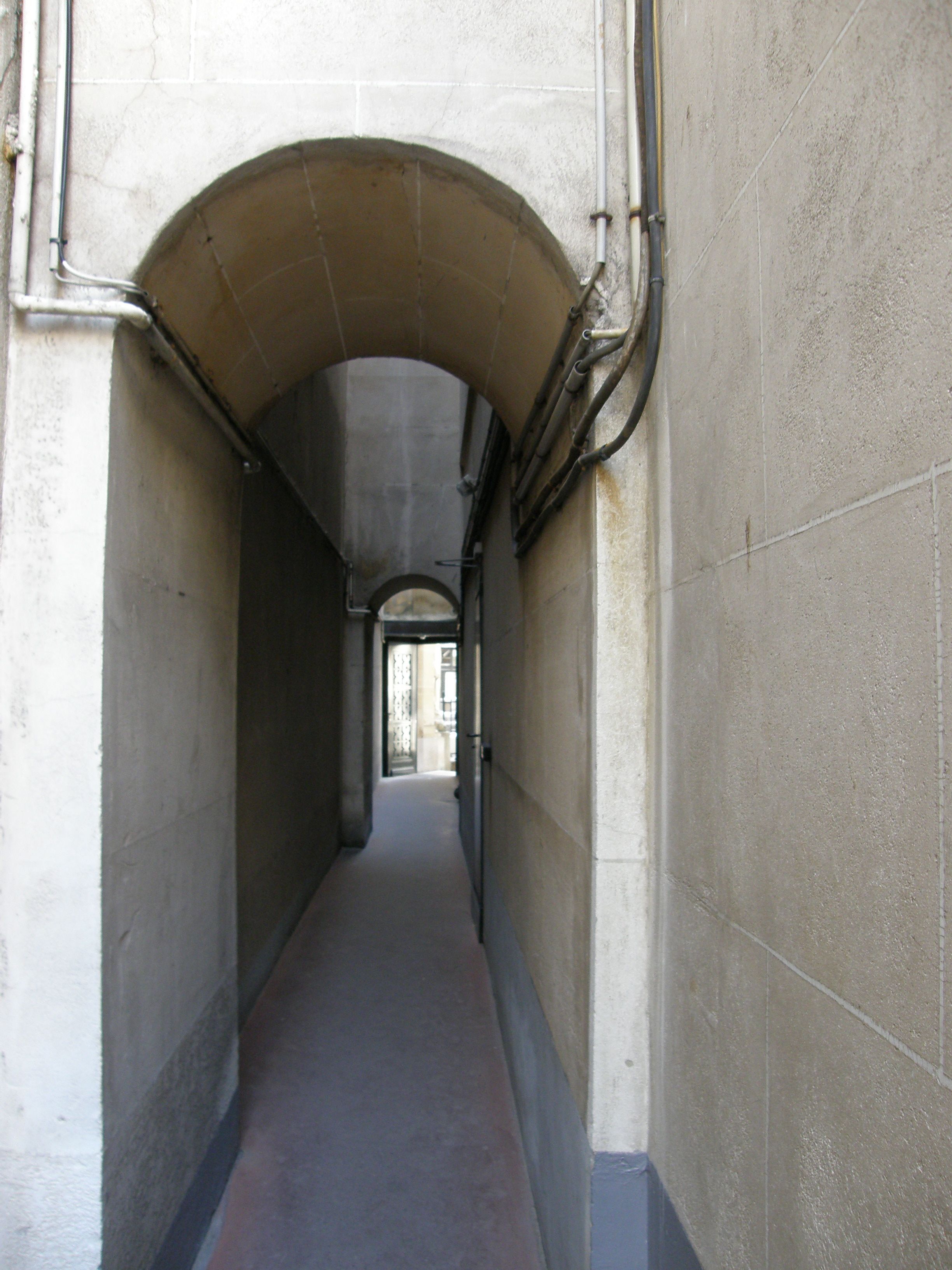
A small poster indicated a display of front pages from international newspapers and magazines relating to the massacre of the Armenians during the First World War. The exhibit was in a space behind the church, reached by a narrow passage that opened out into a courtyard.

Although the exhibit was officially closed (it was after 5 p.m.), a woman motioned for us and another visitor to enter through the glass doors, and descend the staircase to the underground exhibition hall.

We spent some time examining the display, but we didn’t want to linger too long and incommode the church staff. What we saw was sufficiently sobering. When we came up the stairs, the lady in charge asked if we would like to see the church. She ushered us through the side entrance.

The church was a little larger than the chapel of Notre Dame de la Consolation, but it was still an intimate space, with an organ in a loft over the entrance, and an impressive painting on the curved apse behind the altar. The space was full of colour, with rich carpets on the floor, and glittering chandeliers hanging from the ceiling.

We emerged into the sunny street thinking about two different stories of tragedy and loss — one local and immediate, one distant and unimaginably vast. Paris is a space of memories, held within its stones and its communities. There is still an association devoted to the memories of those who died in the fire of 1897, just as there are associations that perpetuate the memory of the victims of the Armenian genocide.

Behind almost any facade on any street in any city there are stories to be told. If we were to pick a Paris street at random and an address at random, and somehow talk to the oldest inhabitant of that address, what stories would we hear?

Text by Philippa Campsie; photographs by Norman Ball.

Posted in Paris churches, Paris history, Paris streets | Tagged , , , | 5 Comments

Signs of Paris

On the first day of our first shared trip to Paris, signs such as this made me realize we were walking through history. We had bought the makings of a picnic lunch, which we ate on a park bench. We wandered about Montmartre and one of us spotted a now-familiar blue-and-white sign.

Cities and progress often go hand-in-hand. Paris is filled with majestic signs of progress. Think of the Eiffel Tower, the Wallace fountains, the Louvre, the historic grand department stores such as Le Bon Marché and arcades that showed the world how to shop, or the many bridges that have turned the river into an art gallery of civil engineering and construction.

But for people who lived in the flats of Paris, this sign indicates a more immediate kind of progress. “Gas on all floors.” Gas for cooking and lighting, perhaps even heating. If you hadn’t had such a luxury before, this was important.

We have since seen many variants of this type of sign, the most common touting both “Eau et gaz à tous les étages.” Gas and running water.

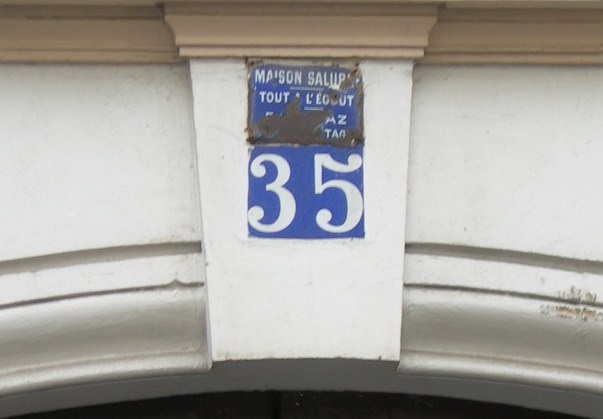
But we have only seen one sign such as this. Perhaps one of our readers could help us find another where less of the writing has disappeared. The sign proudly proclaims this is a Healthy House (Maison Salubre). The next line tells us why it is so healthy. “Tout à l’égout.” All the floors are hooked up to the sewers. Indoor plumbing had arrived; no need for chamber pots; the so-called night soil disappeared instantly. This, along with water and gas, announced real progress.

Indeed, simply having standard signs of any kinds was at one time an important innovation. Street numbering was introduced during last years of the 18th century, when France still used the Revolutionary calendar. Not everybody was in favour of the idea. Some people thought it was a precursor to new forms of taxation. Others objected to the fact that everyone had a number. Liberté, égalité, and fraternité was all very well, but the wealthy objected to having the same type of identifier as poor households. The numbers were put up at night in order to attract as little attention as possible, but this led to all kinds of errors. The blue-and-white enamel versions for streets and numbers were introduced in the 1840s.

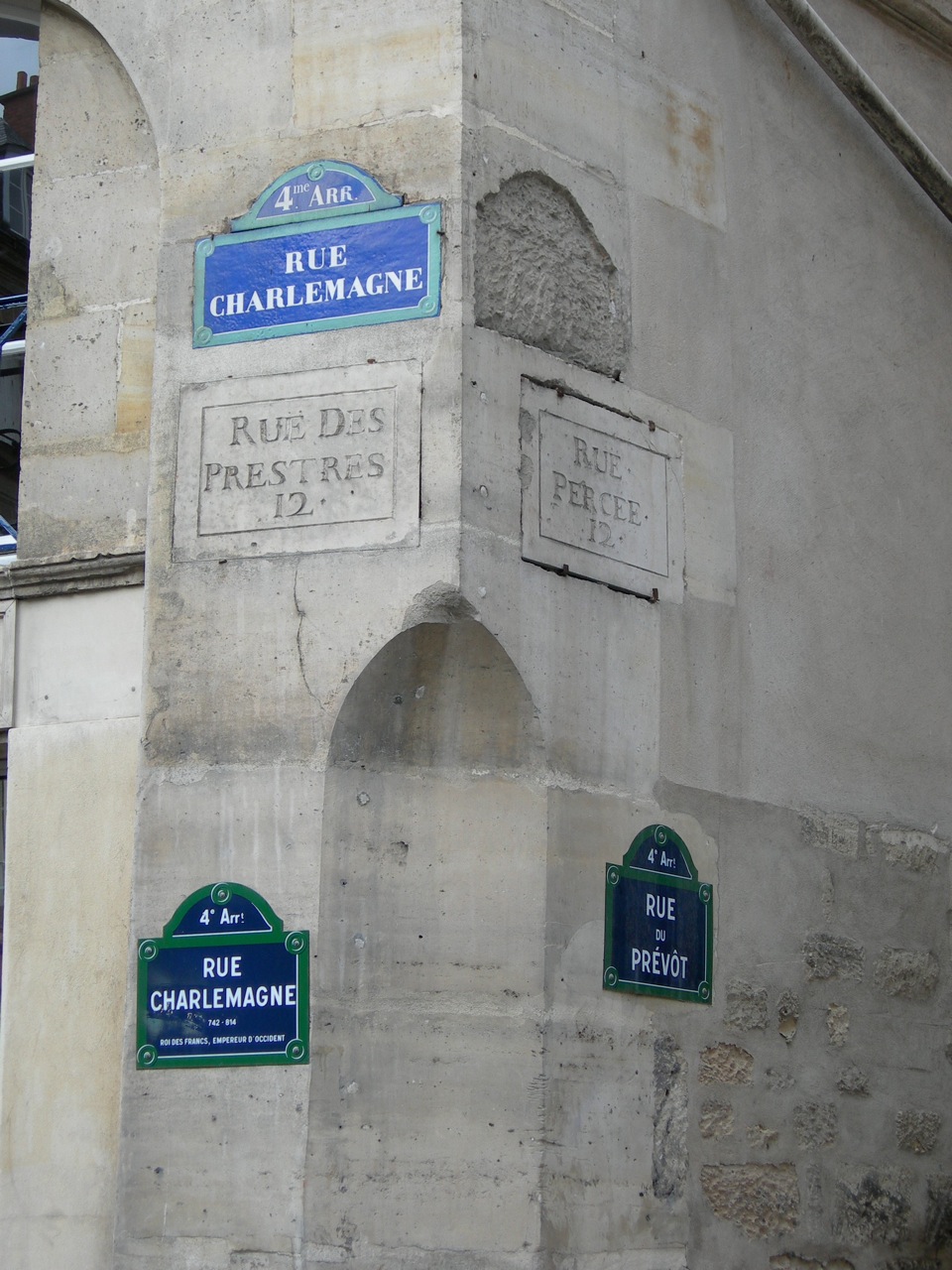
Street signs represent layers of history. The name of Charlemagne conjures up powerful images of history long gone. But even before it was rue Charlemagne, it was rue des Prestres. As the language evolved, the letter “s” sometimes disappeared to be replaced by a circumflex accent and Prestres became Prêtres or priests. At some point, Charlemagne’s name displaced that of priests. Perhaps it occurred during a period of anti-clericalism. But then, why change rue Percée, a street named to mark an opening in a wall, to Prévôt (Provost), which can stand for a clerical office? There is a story there, but I don’t (yet) know what it is.

Official statements of name changes are relatively common. Unofficial reminders of what went before are less common. Is this a real name, or a personal comment about a former inhabitant of the street?

And some signs suggest that another name would be more appropriate, or that more thought should be given to the rights of children. Did this sign appear only here or was it put up more widely?

Other signs speak to us of different slices of Paris history. It was a chilly November day when Philippa drew my attention to a small but important sign and explained it marked the water level of the great flood of January 1910. At that time, I had not even heard about the flood. Since then, I have learned a great deal more and read whole books on the subject.

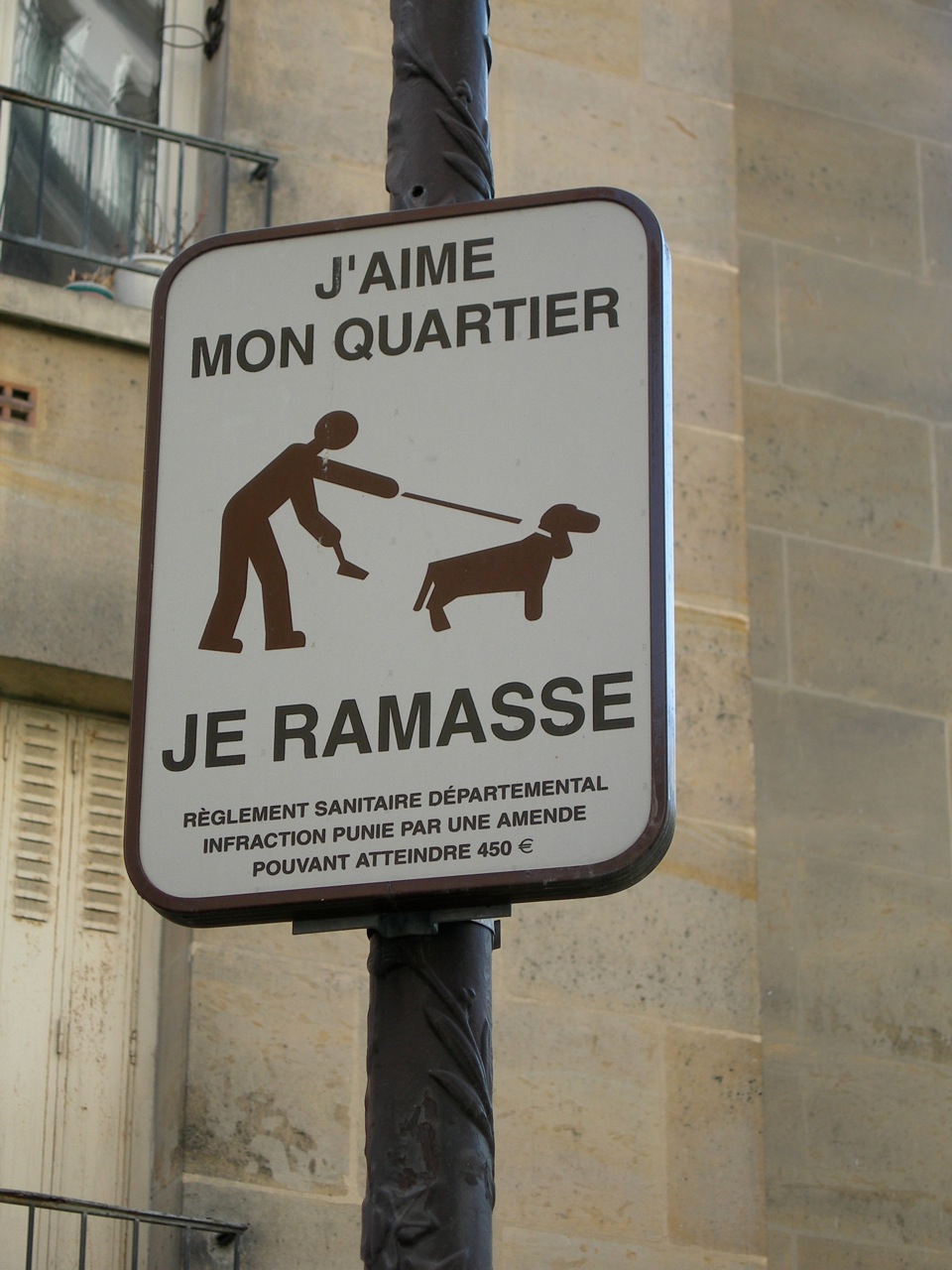
Many modern signs announce other kinds of social standards. Cities succeed only because people cooperate voluntarily in upholding certain norms. But sometimes we need reminders of how to behave in areas we share with many others. It is a nice dog but….

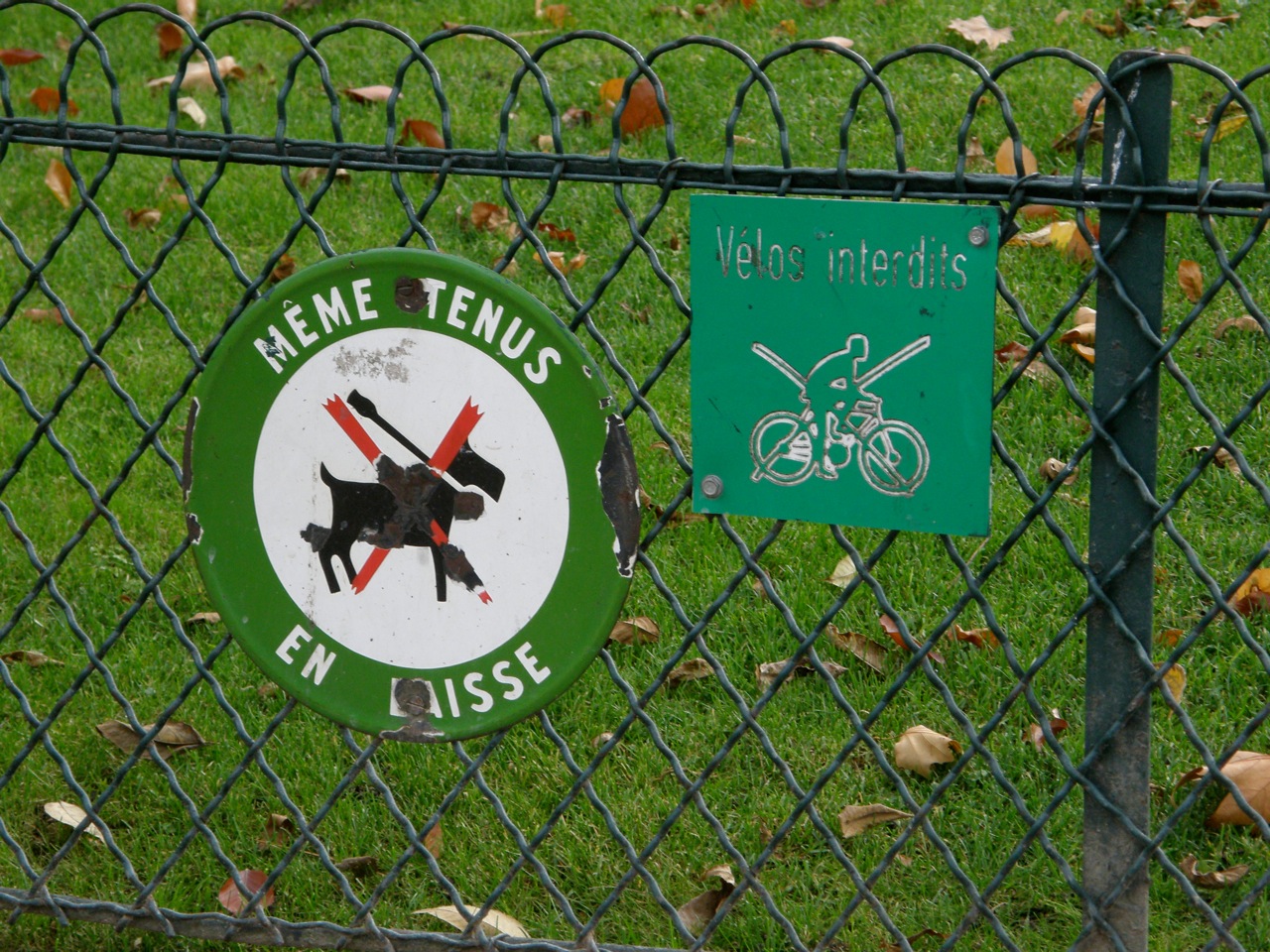
And we know your dog loves children, but sometimes children want to be alone, even when the dog is on a leash.

Sometimes signs confirm other impressions. On an April day, it was more than the warm sun that reminded us of a trip we had both made to Malta to speak at a conference. Some of the enclosed balconies on the street reminded us of those in the streets of Valetta and as we talked about Malta (where Philippa’s father was born), this is what we stumbled upon.

A little corner of the Mediterranean on the streets of Paris. Perhaps there is another story there, too.

Signs help us peer into the past, glimpse the daily life of others, and anchor our thoughts and experiences. They are documents I study.

Text and photographs by Norman Ball.

Posted in Paris history, Paris popular culture, Paris streets | Tagged , , , , , , , , , , | 7 Comments

Cheap eats

The very first time we went to Paris as a couple, we took along a book called Cheap Eats in Paris by Sandra Gustafson. This was in the days before the Internet and iPhones made restaurant recommendations easy to find, and we used the book to find inexpensive cafés and restaurants (we had used the companion volume, Cheap Sleeps in Paris, to find our hotel).

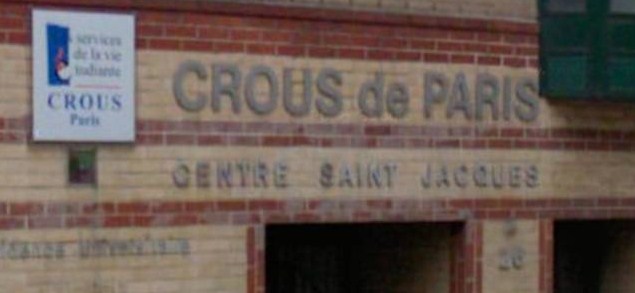
Years before, when I was a student in Paris, cheap eats meant the student cafeterias dotted around the city, run by an organization called CROUS (Centre Régional des Oeuvres Universitaires et Scolaires) de Paris. I had a meal ticket that entitled me to a lunch at any one of several cafeterias, and from time to time I would investigate a different campus to see if the student engineers or doctors got better food than the foreign students (not really, I concluded).

The meals were basic, but typically French, and although there was considerable variety from day to day, seldom did one have much choice on any given day. The servers behind the counter simply added things to one’s tray as one moved through the line, and at the end, one would assess the whole and make the best of it.

Most meals began with some sort of starter (which the French call an entrée) – usually something like crudités (raw vegetables such as grated carrots or sliced cucumbers prepared with a bit of vinaigrette). Then a main course, which included some protein and a certain amount of bulk (lentils were often featured in large quantities). Then a small green salad. Finally, a choice of cheese or dessert. Copious amounts of bread were available to eat alongside the meal.

A few dishes were unappetizing. I remember the day tripe was served. I didn’t really get a good look at it until I was sitting down at one of the long tables, and when I did, it seemed to be looking back at me. This was not tripe à la mode de Caen, slowly braised in Calvados; it had been boiled, and it was pale and flabby. I took another plate and covered up the dish so that I could eat the rest of my lunch without having to see it.

Mind you, I don’t suppose it would have been much worse than some of the cafeteria food I ate during my Canadian university years – things that we called mystery meat or Syncrude pie, or that perennial feature, fried bologna.

These days, we rent an apartment when we go to Paris, and we save money on food largely by shopping at markets and cooking for ourselves. Yet we still love discovering cheap eats in the form of little cafés when we are out and about. If you want to find them yourself, there is really only one guideline: get away from the tourist areas. No, there may not be much English spoken, but if you can read enough of a French menu to point at your choices, you’ll be fine. And be prepared for places to look unprepossessing from the outside. Money saved on decor can be money spent on food, and that is a good thing. Spot the cheap eats in the following photograph.

The menu may be written up on a board rather than printed on paper, and you may have a limited range of choices. But chances are all the food is simple but flavourful, and it will probably be a prix fixe arrangement that offers several courses. Even with wine and coffee added on, it will come in at a fraction of the price of a fashionable café. Usually with excellent people-watching opportunities thrown in, and often conversation with the waiter or diners at nearby tables.

One that we recently enjoyed was just outside the city, in the suburb of Malakoff. We found it after strolling through the flea market at the Porte de Vanves. It was decidedly no-frills – formica tables, bare floor – but a few euros bought us each a generous lunch. Most of the other diners were regulars or market stallholders. At one table, a group of men compared ornate knives. People came and went for a quick coffee or glass of wine, consumed standing up at the bar. In the following picture, its orange awning is just visible on the right.

Another time we found a little place near the Parc des Buttes-Chaumont. It had the traditional zinc counter and the tables were crowded together very tightly, but the food was splendid. There was also a tiny place in the 14th, now closed, that offered only three choices at lunchtime, prepared on a little stove in the back, and featured the work of local artists on the walls. We chatted with the waiter, who introduced us to one of these local artists. We ended up buying an ink sketch, which he signed for us. I can see it on the wall as I write this.

I was telling a friend about these discoveries, and we found ourselves talking about the days of workingmen’s cafés and Chinese noodle houses and those London chophouses that feature in the novels of Charles Dickens. All part of a range of cheap eats that were once available to single people living in rooms without kitchens, when masses of people lived in lodgings where cooking was impossible.

These eateries often had large common tables and benches rather than small tables and chairs, just like the university cafeterias. There wasn’t much choice, but you could get a reasonably nutritious and often very flavourful meal of several courses for a nominal sum. They were cheap because of the economies of scale possible by feeding lots of people at the same time with a set menu offering limited choice.

Today, food has become individualized and people equate “cheap eats” with fast food, which isn’t, in fact, cheap relative to its quality, and – as Morgan Spurlock showed in Super Size Me – is not healthy for day-in-day-out eating. Say what you will about university cafeterias, but students can eat there every day, three meals a day, without developing liver damage.

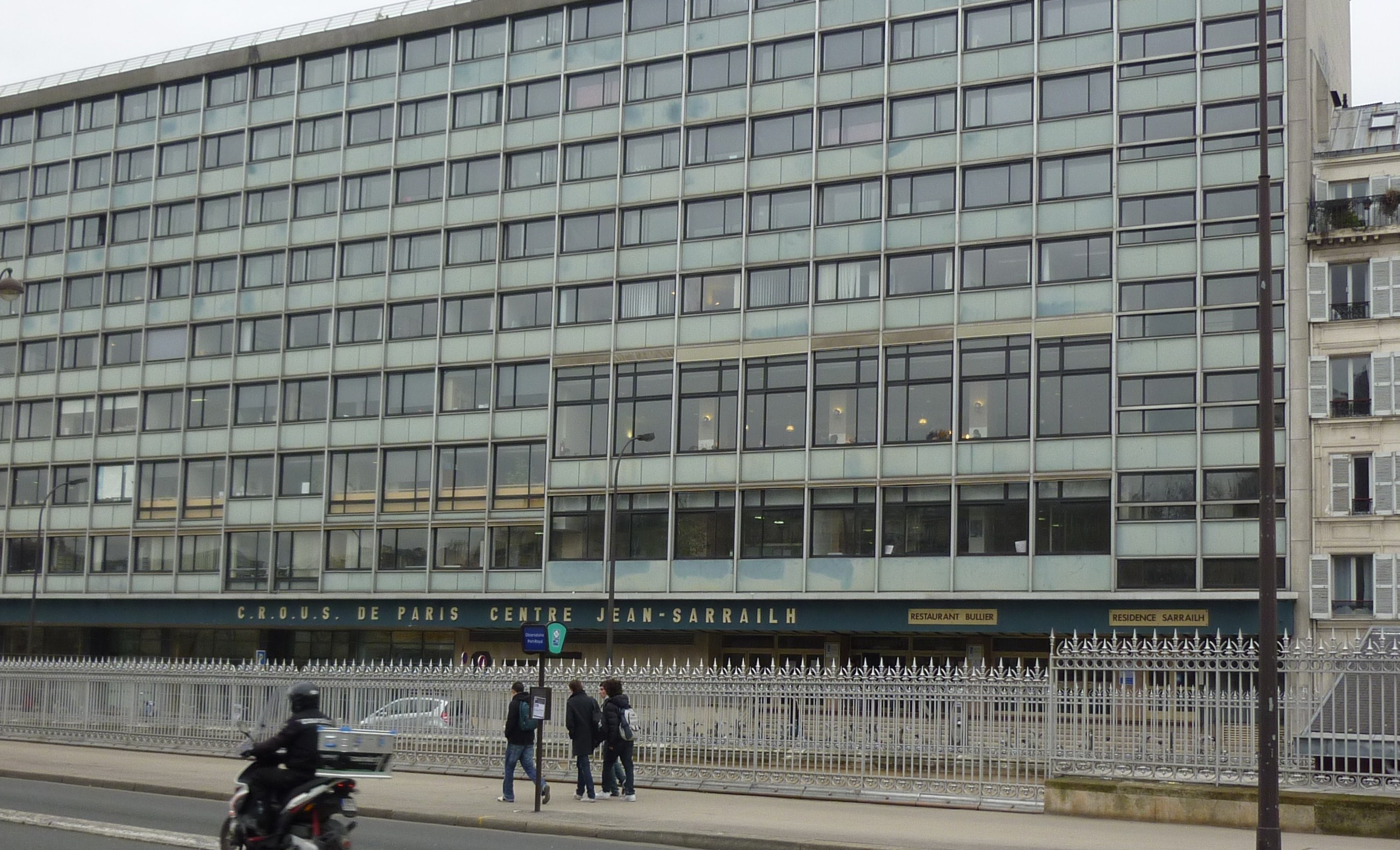
The university cafeterias are still dotted around Paris – when we stayed in the hospital district, there was one down the road – but the equivalent of the workingmen’s café or the cheap neighbourhood joint serving a few simple dishes at limited hours is an endangered species in the central city.

That’s too bad, and I don’t just mean for tourists like us. Students, artists, shop assistants and a whole range of people of slender means once relied on these places as a way of surviving in an expensive city. The very people who made Paris the place it is were nourished in cheap eateries. In these cafés they met their friends, argued about politics, fell in and out of love, and planned their futures. And not just in Paris, but in many other cities.

What will it take to bring back the cheap lunch at a long table in a crowded room where the choices are few but the food is plentiful and conversation is free?

Text by Philippa Campsie; original photographs by Norman Ball and Philippa Campsie. Thanks to Wayne Roberts for the inspiration: visit his website for more inspiration on local food and sustainable food practices.
Posted in Paris food | Tagged , , , , , , , , , , , , , , | 2 Comments

The photograph I didn’t take

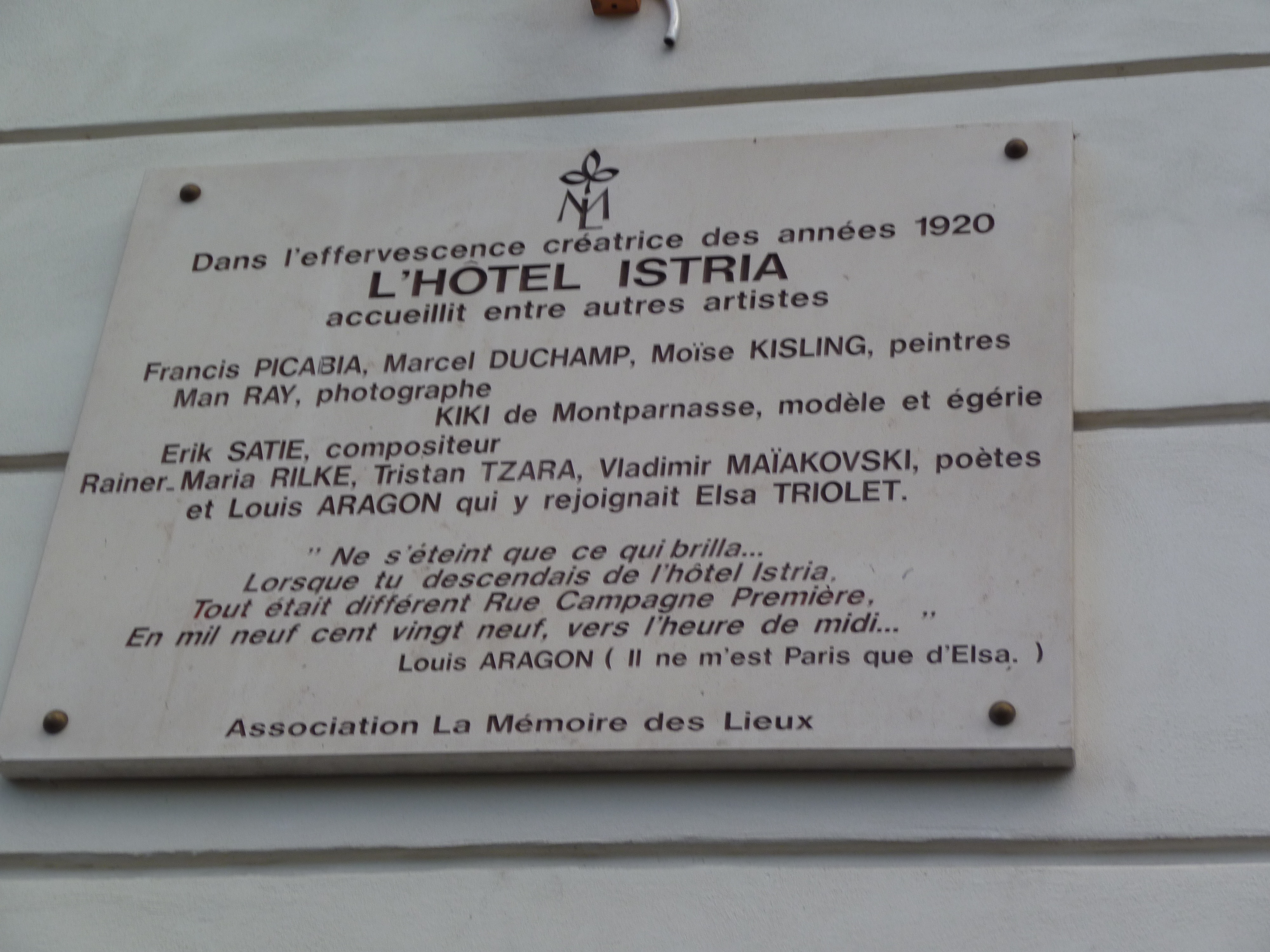
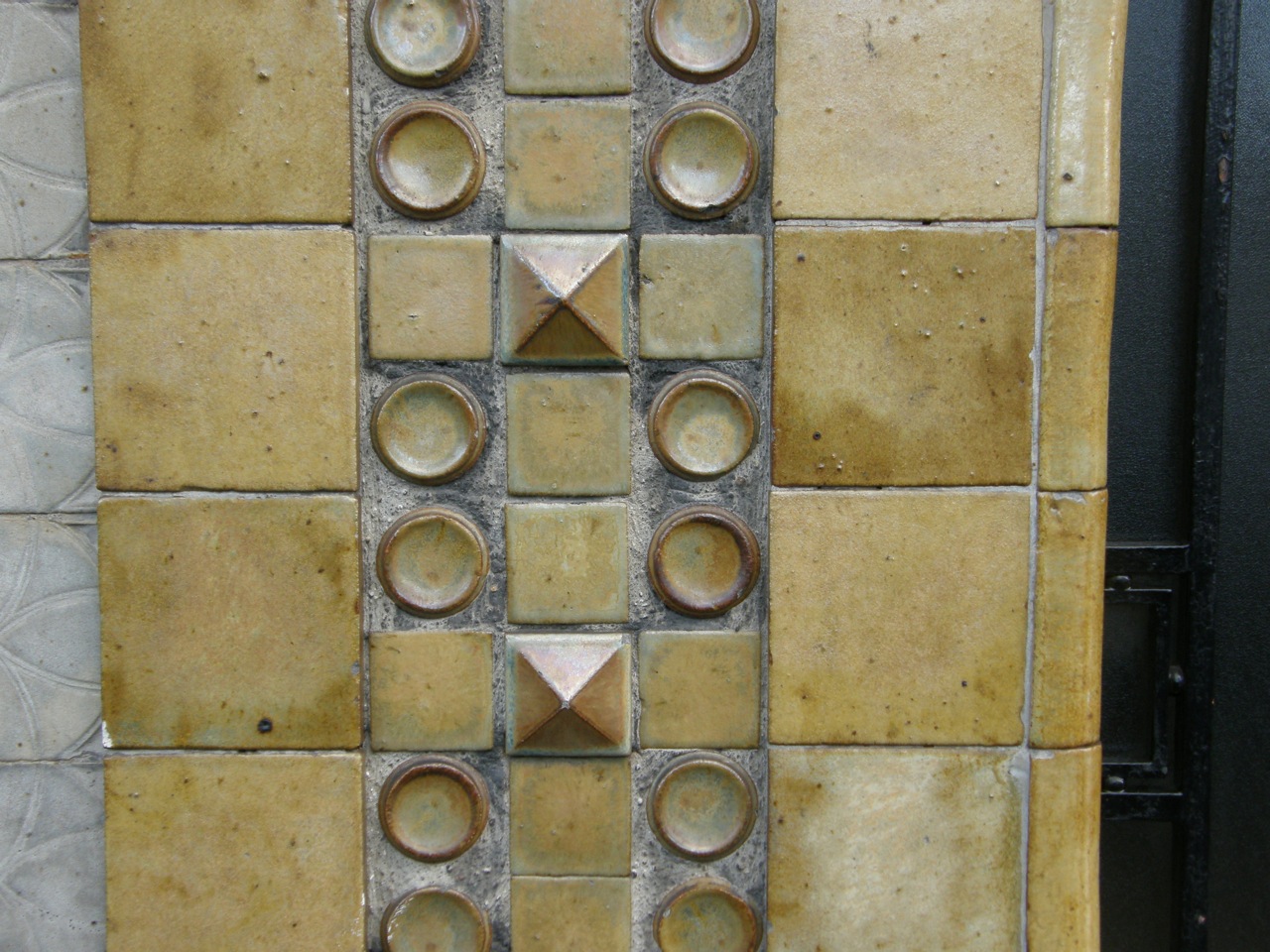
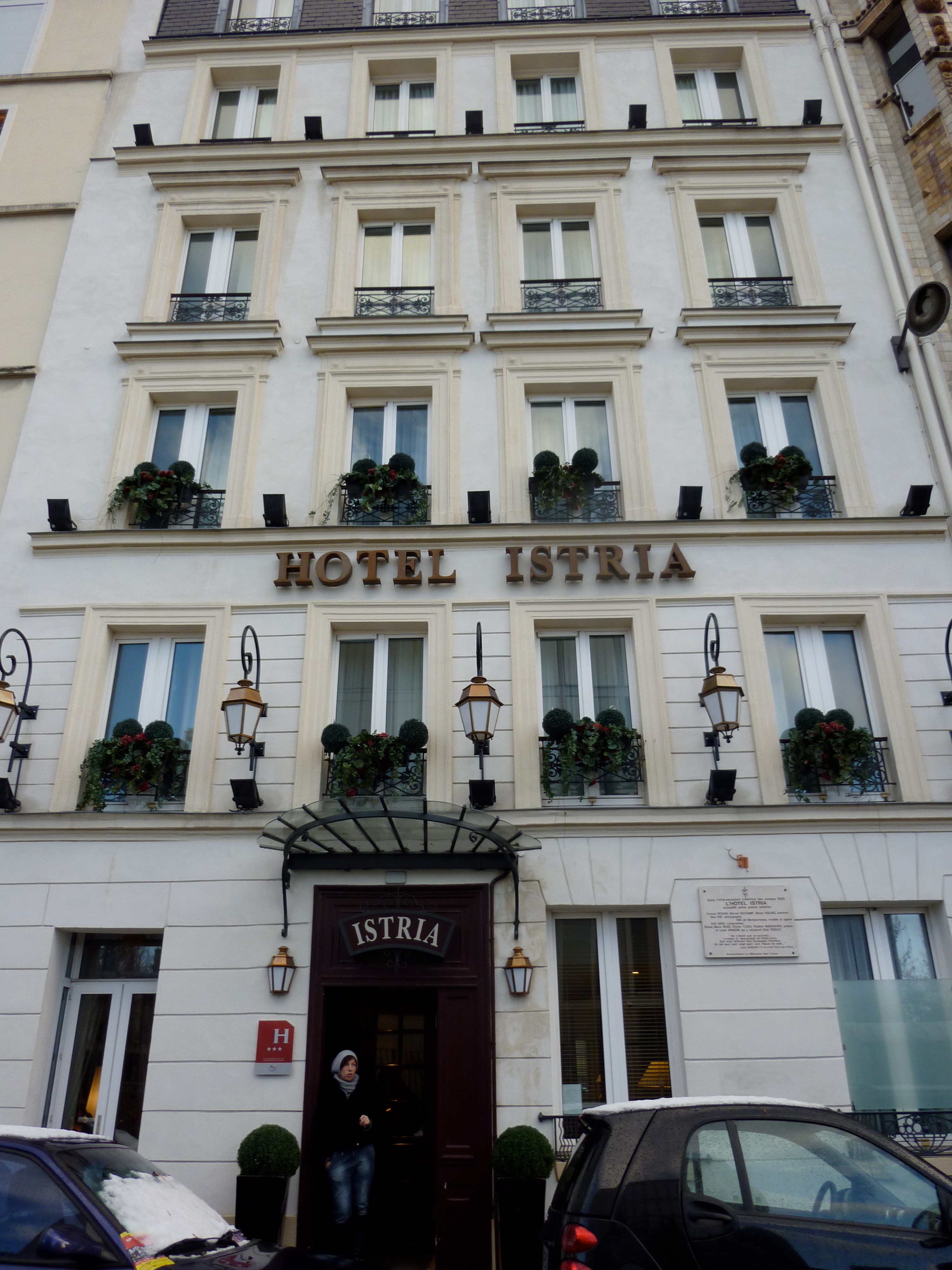
It was winter and we were walking back to our rented apartment in the 14th arrondissement from Monoprix, with a borrowed buggy filled with basics – toilet paper, dried pasta, yogurt. We traipsed down a road called rue Campagne Première. Norman stopped to take a photograph of some ceramic tiles that had caught his attention. I dawdled along, and found myself looking at this plaque on the wall.

Hey, I thought, here are some names I recognize. Erik Satie who wrote those Gymnopédies for the piano (I can sort of play some of them). Louis Aragon, who wrote Paris Peasant (which I can sort of read in the original French). Marcel Duchamp who made toilets into art (which I have seen in a retrospective). And Man Ray, that surrealist photographer from the United States.

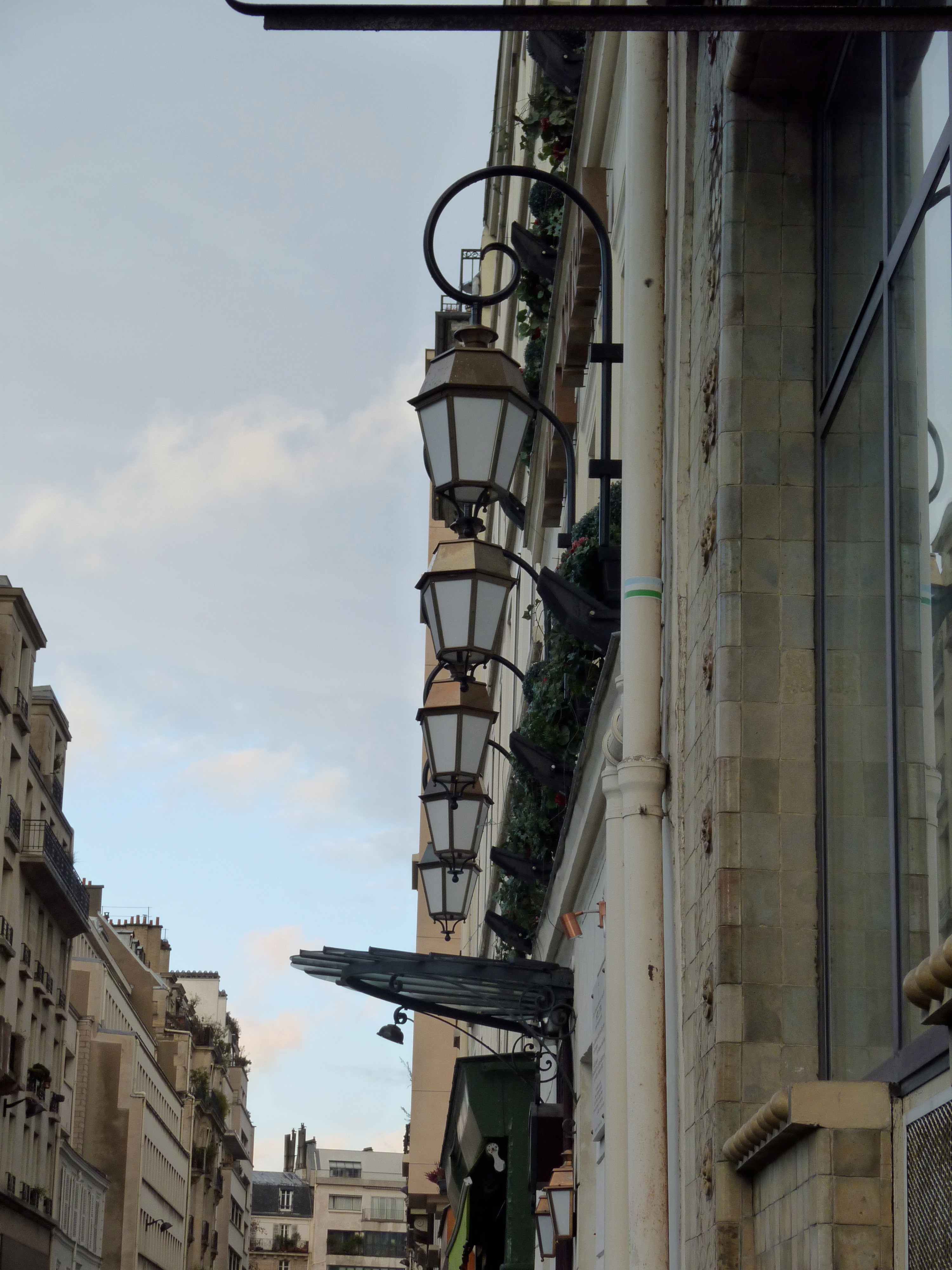
I photographed the plaque (alas, it isn’t a very good shot). And because Norman was still busy, I photographed the building it was attached to, the Hotel Istria, with its line of lamps hanging from the wall. That made a better shot.

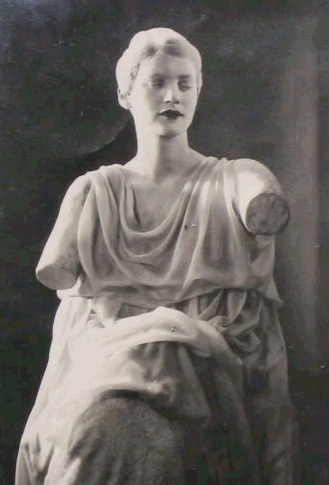
Dang. If I’d known then what I know now, I would have photographed the building next door – 31 bis rue Campagne Première. The one with the interesting ceramics. Because that is where Lee Miller met Man Ray for the first time in 1929. It was an important meeting for both of them, and for the history of photography. I won’t miss my chance next time.

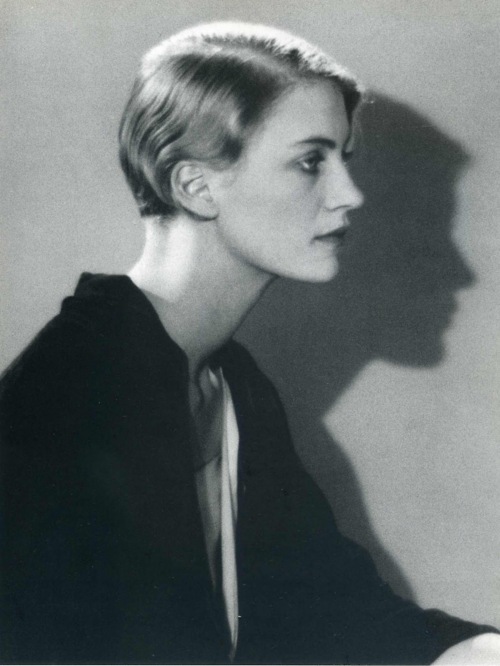
I had become interested in Lee Miller years ago after seeing a photograph of her by Man Ray in a book called The Women We Wanted to Look Like (St. Martin’s Press, 1977). The text said that she had gone from being a model to being Man Ray’s student/muse/companion, and later a war photographer, and that after the age of 53, she had not taken a single photograph, because, as she said, “You can’t be an amateur when you have been a professional.”

And here was the building where it all began – well, some accounts say they met here, others that they first saw each other in a nearby bar – but this was where they worked and collaborated and where Lee learned to be a professional photographer.
Only recently did I read a biography that filled in the details that earlier book had hinted at.

Elizabeth (Lee) Miller was born in 1907 in Poughkeepsie, New York. She was the indulged daughter of a wealthy businessman whose hobby was photography. Over the years, he got into the habit of photographing his daughter in the nude (her biographer, Carolyn Burke, does not speculate on his motives, and neither will I).

He continued this hobby even after the day that his seven-year-old daughter, who had been briefly left in the care of a friend of the family, was sexually abused. And, if that were not bad enough, she contracted gonorrhoea from this single episode, which required ongoing and painful treatment for years thereafter. One cannot even begin to imagine how she felt.

Elizabeth Miller grew up something of a troublemaker and was expelled from nearly every school she attended. In 1925, aged 18, she was sent with a chaperone to a finishing school in Nice, in the south of France, but she never got there. After a few days in Paris at the beginning of the trip, she decided this city was where she belonged. The chaperone went on to Nice without her.

Elizabeth enrolled in a school for stage designers, lived in a chambre de bonne (a maid’s room on the upper floor of a typical Parisian apartment building) – I did the same when I was a student – and spent a blissful few months steeped in bohemian Paris culture. But when her course was finished, her family decided that enough was enough and her mother firmly escorted her home.

Back in the United States, Elizabeth did some theatre work, and became a model for Vogue. Did I mention that she was amazingly photogenic, with a graceful figure, an impossibly long neck, and deep-set blue eyes?

It took a few more years for Mr and Mrs Miller’s daughter to leave the nest for good. She changed her name from the prosaic Elizabeth to the androgynous Lee and went back to Paris in 1929. She made her way to 31 bis rue Campagne Première, found Man Ray, and announced that she was going to be his new student/apprentice. He said he didn’t take on students and was about to leave town anyway. She said she would accompany him, and she did. They spent the next three years together.

It probably wasn’t quite that simple, but that is the story Lee told people later, and stranger things happened in the 1920s. In 1930, she moved to her own studio on rue Victor Schoelcher, opposite the Montparnasse Cemetery, but she remained Man Ray’s muse and lover – at least for a while. She broke Man Ray’s heart, in the end. But during the three years they were together, she absorbed enough knowledge to become a reputable photographer.

Man Ray had two sides to his career. He photographed the rich and fashionable (anyone who was anyone in Paris in the 1930s had a portrait taken by Man Ray). And he was part of the surrealist group, pushing at the boundaries of representation and artistic convention.

Lee Miller had more than two sides to her career. She modelled for French Vogue (known as Frogue). She took portrait photographs, and she photographed street scenes and landscapes that were not exactly surrealist, but were not realistic either. She does not fit neatly into any category.

She earned surrealist credentials, however, playing the part of a statue that comes to life in the Jean Cocteau film Le Sang d’un Poète (The Blood of a Poet). Cocteau painted eyes on her eyelids and told her to walk with closed eyes across the set, wearing a sort of armour that made her look armless and was applied to her body with butter and flour, which cooked itself under the intense lights. On top of all that, the old mattresses that were being used as soundproofing rained down bedbugs on the cast and crew. Nobody ever said it was easy being a surrealist. Still, the film became something of a cult classic. (If you have ever taken a film history course, you will probably have seen it.)

Lee went back and forth between Paris and New York in the 1930s, married an Egyptian in 1934, and lived briefly in Cairo, but it took a world war for her to find something really meaningful to do. She became a war photographer, photographing everything from London during the Blitz to the opening of the death camps in Germany after the war. (Amazingly, Vogue published her realistic photo journalism – not the sort of thing one can imagine in today’s version of the magazine.) There is a famous photograph of her in Hitler’s bathtub in Munich in 1945: the house had been commandeered by the American army, and she was invited to stay for a few days.

She was one of those people whose wartime experience was so intense that everything afterwards seemed inconsequential. After the war she divorced, remarried, and went to live in England. She did some work for British Vogue (aka Brogue), produced a few pieces of photojournalism, and achieved renown as a gourmet cook, but nothing ever lived up to her wartime experience. Nothing ever could. I have encountered other Second World War veterans like that. They used up all their emotion and adrenalin in the war and postwar life never came close to that feeling of immediacy and importance. In 1960 Lee Miller gave up photography, and in 1977, aged 70, she died of cancer.

And it all began, really, on the rue Campagne Première, a few blocks away from our rented apartment, in a building that I didn’t think to photograph, beside the Hotel Istria.

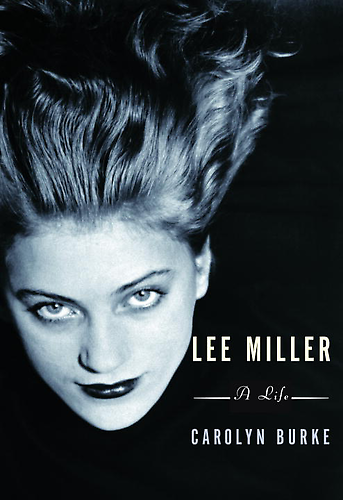
Further reading: Carolyn Burke, Lee Miller: A Life, New York: Knopf, 2005.

Text and original photographs by Philippa Campsie; additional photograph by Norman Ball.

Posted in Paris art, Paris film, Paris history, Paris streets | Tagged , , , , , , , , , , | 4 Comments

Jules Verne in the Métro

As a young boy, I longed to live in the fantastic worlds of Jules Verne, to explore the depths of the ocean in the Nautilus with Captain Nemo. I had not told Philippa this, but as we set off to visit the Musée des Arts et Métiers (Museum of Arts and Trades) in the 3rd arrondissement, she suggested an intriguing possibility. “You’ll love the Jules Verne Métro station.” She was dead on – but don’t look for it by that name on a map.

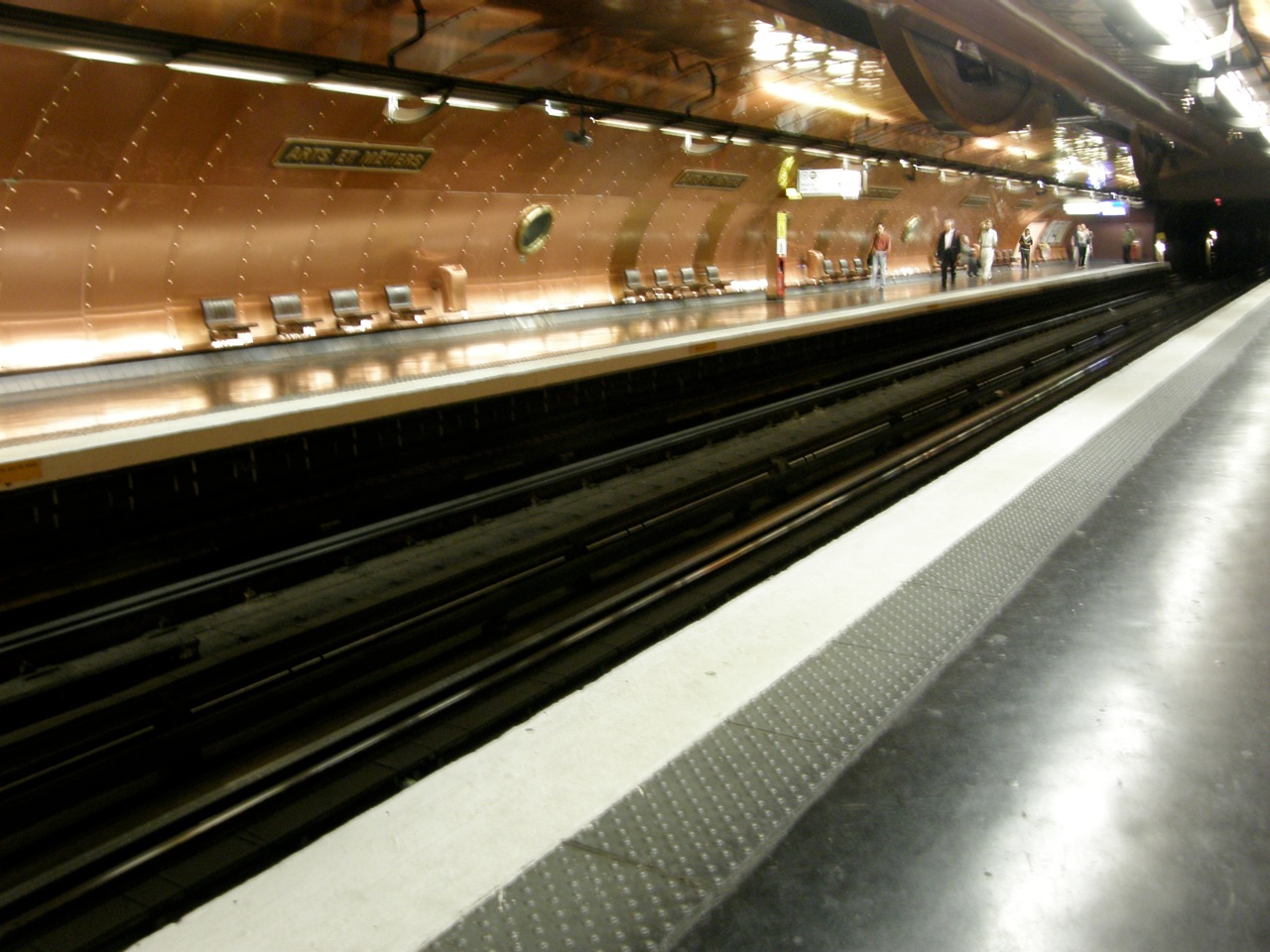
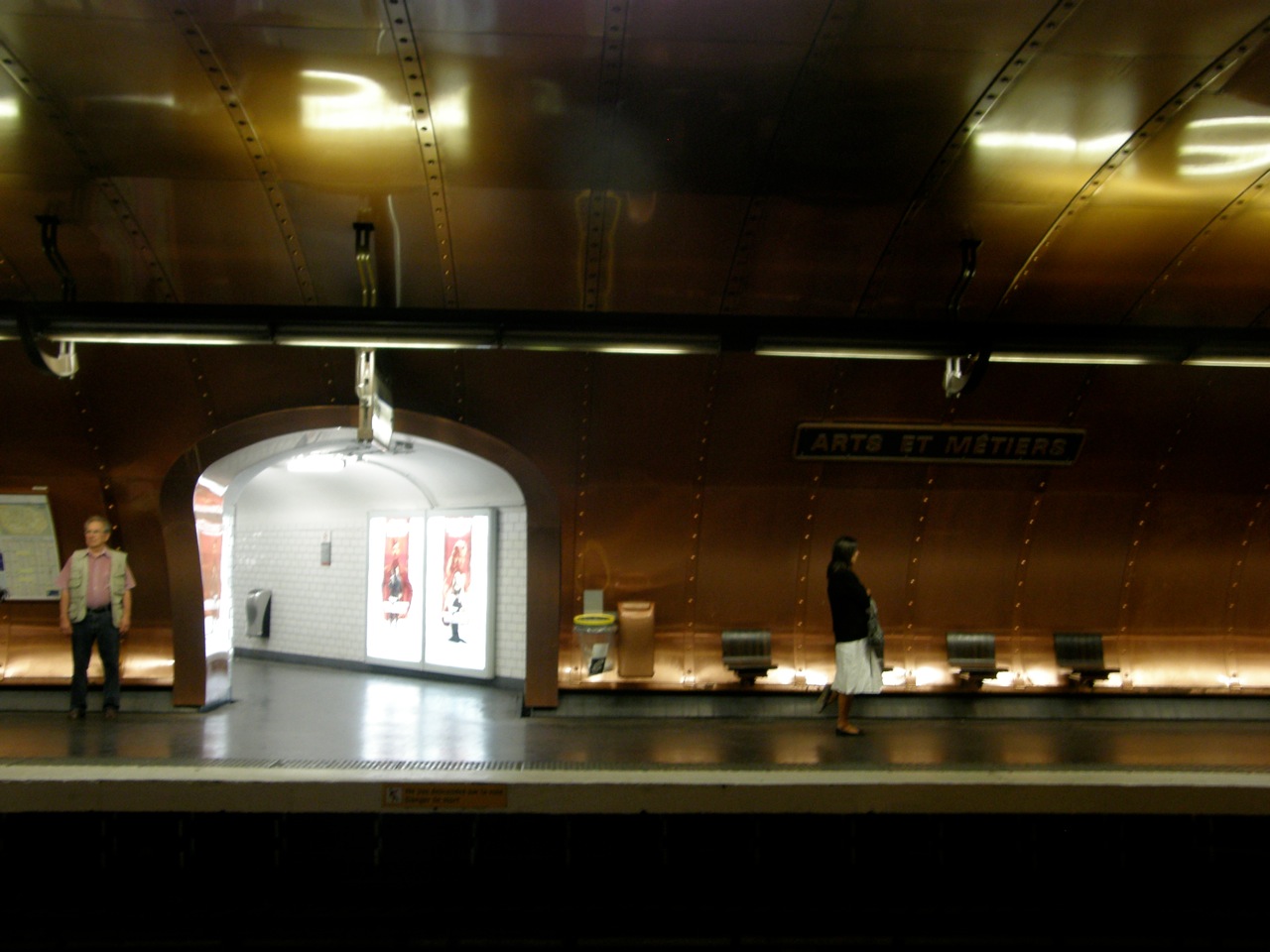
As the train slowed to a stop at the Arts et Métiers station on line 11, we entered a magical world. My youthful Jules Verne world was that of Twenty Thousand Leagues Under the Sea: heavy machinery and gears, smooth glistening metal and tiny round portholes looking out on new worlds. Everything was neat and orderly, unlike the messy work area where I built model planes that crashed and boats that listed.

Aside from the glistening copper and rivet heads, the first impression is simply vastness and a curious sense of disconnection from being on the Métro line.

Then more details begin to emerge. In the image above, it is easy to miss the overhead equipment but not in the image below.

The large gear and a drive wheel protruding from the ceiling are powerful images of 19th-century heavy machinery and industry. More hidden than exposed, they invite onlookers to create their own meaning and story.

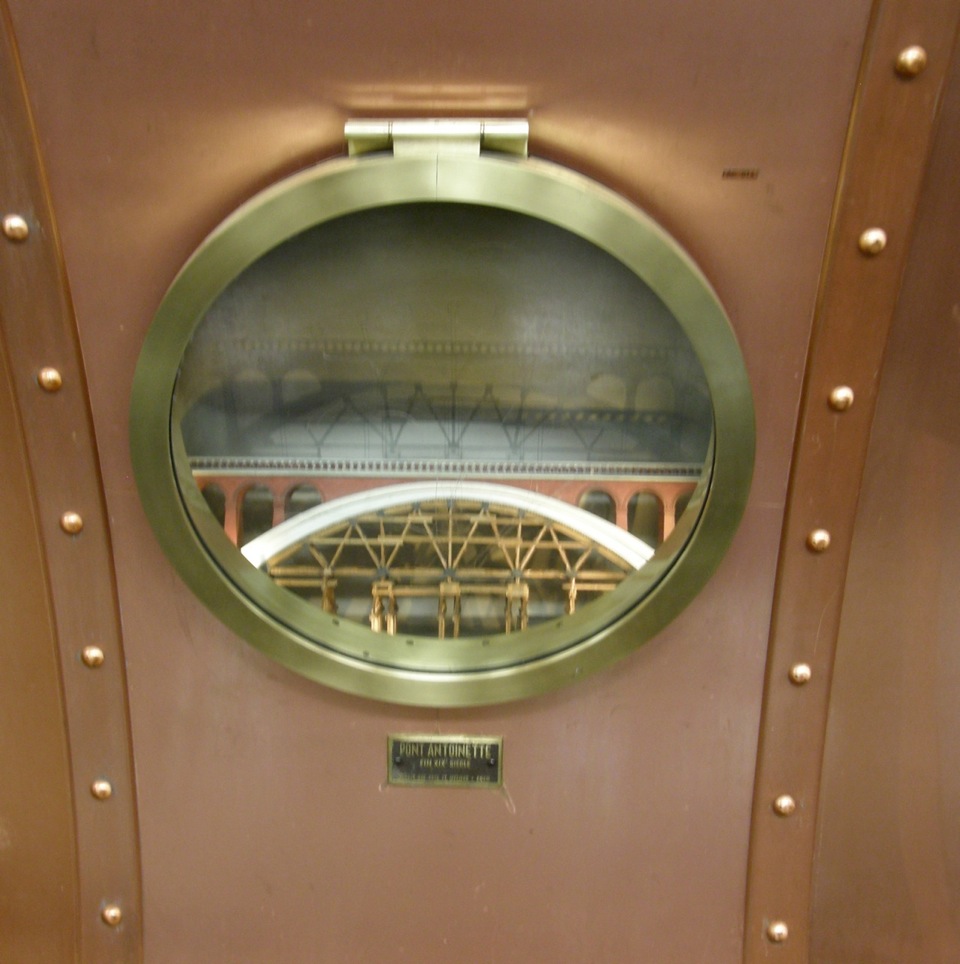
On the Nautilus, portholes opened on to the mysteries of the depths. In the Jules Verne station at Arts et Métiers, portholes reveal a technological past that includes everything from steelmaking and ancient buildings to dreams of flight and astronomical instruments.

I lingered longest at this porthole because I like bridges. The fact that the designer chose to show the bridge under construction with falsework still in place was a lovely touch. Later I learned that the Pont Antoinette was built in 1883-1884 near Vielmur-sur-Agoût, Tarn (81) in the Midi-Pyrénées region of France. It was the first major project by Paul Séjourné (1851-1939) who was to become one of France’s eminent bridge engineers.

But why the name Pont Antoinette? Who was this lady? In a romantic touch that I admire the engineer Paul Séjournè dedicated his first major work to his wife Antoinette Lesueur de Pérès.

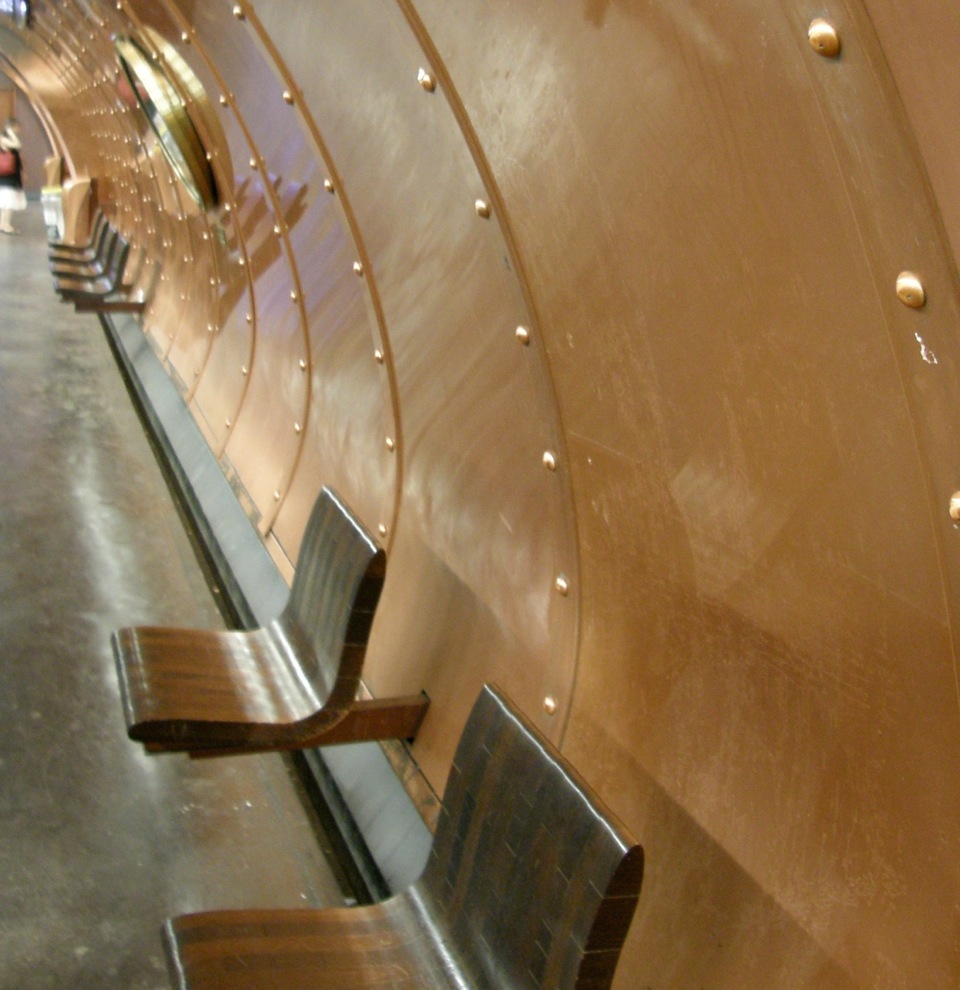
Even the seating in this wonderful Métro station is a world away from the institutional look.

We lingered in the station, then visited the Musée des Arts et Métiers and talked excitedly about the range of exhibits. (We also had a fine lunch in the Musée.)

When I left the Arts et Métiers station, it did not leave me. I kept thinking about it. How had such a wonderful station come about?

The long-wished-for Métro was part of the Paris created for visitors to the International Exposition of 1900. Not everyone liked the idea. The first line from Porte Maillot to Porte Vincennes opened officially on 19 July 1900 to monumental press indifference. Le Figaro gave it a paragraph, stuffed between an apoplectic fit of the Czar and a local charity sale.

The Métro grew and on 19 October 1904 the Arts et Métiers station opened on the third line. Ninety years later, Belgian artist François Schuiten redesigned the connecting station on the No. 11 line to evoke the Nautilus of Jules Verne. It was a perfect choice and one must commend all who had a hand in choosing this designer.

Why 1994? The redesign celebrated the 200th anniversary of the founding of the Conservatoire National des Arts et Métiers (National Conservatory of Arts and Trades) in 1794. The museum attached to the Conservatoire is a fine place to wander, contemplate, and be fascinated by the work of many centuries of inventive minds. And why Jules Verne? He was chosen to represent two centuries of French science and technology.

François Schuiten was the ideal choice to unite Jules Verne and the Arts et Métiers. If the prolific Jules Verne is best known for one work, Twenty Thousand Leagues Under the Sea, the still very active and equally prolific François Schuiten is perhaps best known for his Cities of the Fantastic (Les Cités Obscures). His graphic novels portray a love of cities and the potential of architecture to build a better future that combines the work of other greats such as architectural visionaries Victor Horta and Étienne-Louis Boullée, and the early science fantasies of Jules Verne.

While portraying better worlds, Schuiten and Jules Verne also portray the dark side of technology. And quite regrettably, the opening of the original Arts et Métiers Métro station came hard on the heels of a tragedy on the Métro.

On 10 August 1903, a catastrophic fire started by an electrical short circuit in the Métro left 84 people dead: seventy-five at the Couronnes station, seven at Menilmontant and two in the tunnel. As with many such disasters, a number of factors contributed: the electrical systems were ill-conceived and later changed; varnished wooden cars were tinderboxes waiting to be ignited; there were no clear procedures for communications and what to do in the event of a fire; exits were not marked and bodies were found piled at the wrong end of the platform; and for some reason, passengers who had already been evacuated earlier and put on a different car refused to leave unless their ticket price was refunded – they chanted “nos trois sous” (we want our three sous) and pounded on the rattan seats and the sides of the cars until it was too late.

Critics of the Métro had a field day. It was technology gone horribly wrong, perhaps in part because the construction of the Métro had been so rushed. But even before then, Jules Verne was already writing about the impact of too much technology in our lives. (For an excellent introduction to the ideas and writings of Jules Verne click here.)

In 1863 Jules Verne wrote a novel titled Paris in the 20th Century. His publisher rejected it as too unbelievable, too far from what the public was willing to accept. Paris in the 20th Century was set aside only to be rediscovered in 1989 by the author’s great-grandson. It was published in 1994, first in French and is now available in English. Set in the 1960s, the book has been described as “a novel about a young man living in a future world with skyscrapers of glass and steel, high-speed trains, gas-powered automobiles, calculators, and a worldwide communications network. The hero cannot find happiness in this highly materialistic environment, however, and comes to a tragic end.”

As with all “discoveries” of lost or unknown manuscripts, there is controversy over who really wrote it. However, to date no one has attributed it to William Shakespeare or even Christopher Marlow. Oh, and the artist who did the cover for the French edition? None other than our friend François Schuiten.

In case you are wondering, I am a great fan of the Paris Métro: it works very well, is clean, I love the design of so many of the stations, even the ads. Moreover, it goes where I want to go. In terms of safety, reliability, and atmosphere it has come a long way since one critic described it in 1900 as “a badly ventilated cellar, recalling at times a sewer.” (Benson Bobrick, Labyrinths of Iron: Subways in History, Myth, Art, Technology, & War, p. 157)

Whether you see it first from a Métro car or by walking down to the platform, the Arts et Métiers (Jules Verne) station is a world you should not miss.

Text and photographs by Norman Ball.

Posted in Paris history, Paris metro, Paris museums | Tagged , , , , , , , , , , , , | 8 Comments

Nine minutes, twenty-one seconds

A recent New York Times article pointed out that the traditional division of Paris into Left Bank / Right Bank might be giving way to a more East-West distinction. (Some people will say that has long been the case.) And where would the dividing line fall? Presumably the Paris Meridian, which splits the city in half, indeed the whole country in half, from top to bottom, anchored by the Paris Observatoire.

Now you know and I know that time and longitude are supposed to be measured from Greenwich, which is two degrees and twenty minutes to the west, but the Parisians have their own meridian, thank you very much, and that Greenwich business is just a typical bit of British double-dealing.

It goes back to 1884 and the International Meridian Conference in Washington when the Paris-vs.-Greenwich feud was finally thrashed out. A year earlier, the French had succeeded in getting the international community to agree to use the metre as the standard for measuring distances. The French had defined the metre as one ten-millionth of the Paris Meridian as it passes over the distance between Dunkirk and Barcelona. (It is defined more precisely now, but that’s how it started.)

So now the meridian itself was up for grabs. And the British weren’t going to let the French have it their own way again. As Mike Parker, in his entertaining book Map Addict puts it:

There had evidently been some anglophonic stitch-up going on behind the scenes between the host Americans and their British cousins… After all, they cried, it’s someone else’s turn! You got the metre, now be a jolly chap and leave go the damned meridian, won’t you? Of course, the irony should not escape us that this Anglo-American pincer movement, so much of which depended on their reminding delegates of the recent French victory in measuring the world, came from two countries who have had as little to do as possible with the metric system ever since.

The French were out-manoeuvred. They abstained from the vote, to avoid looking like poor losers. But they dragged their heels as long as they could, and the Paris Meridian was still marked on French maps as 0˚ longitude until well into the 20th century. They also took to referring to Greenwich standard time as “Paris Mean Time minus 9 minutes, 21 seconds.”

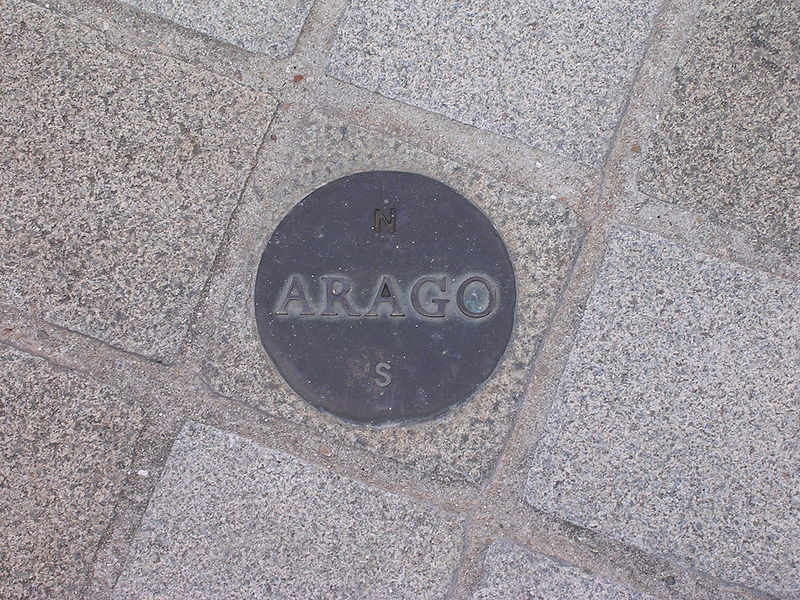
And they still celebrate Their Meridian. In 1994, they commissioned Dutch artist Jan Dibbets to create an artwork to commemorate François Arago (1786-1853), who had calculated the meridian. Dibbets cast small bronze medallions with Arago’s name on them and embedded them in the ground along the line of the meridian through central Paris.

In 2000, as one of the country’s millennium projects, the French planted trees along the meridian line from the north to the south of the country. You don’t see the British doing that with their meridian.

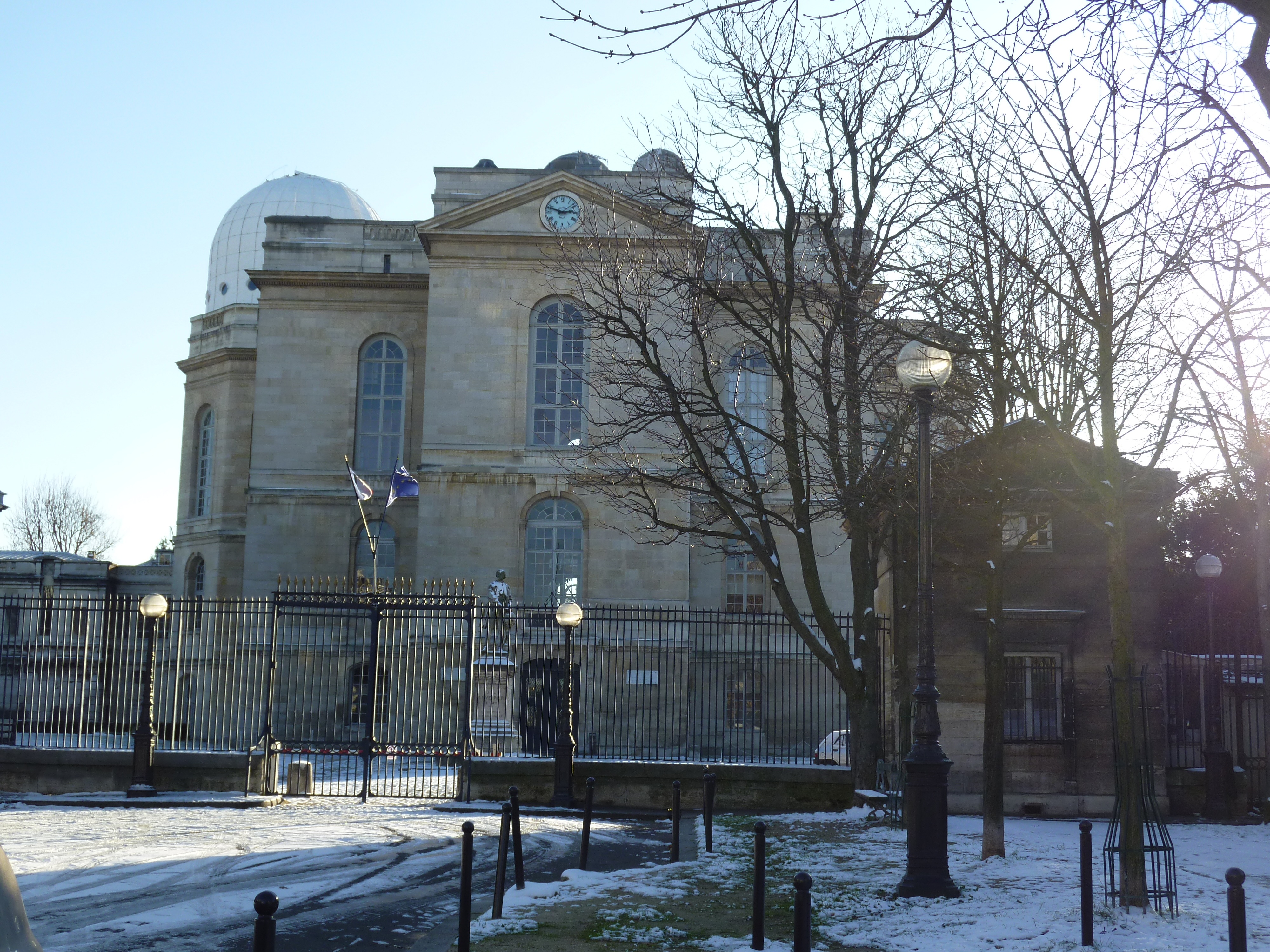
Moreover, the Paris Observatoire is older than its counterpart at Greenwich. Construction began on the day of the summer solstice (June 21) in 1667. The architect was Claude Perrault – the brother of Charles Perrault, author of Cinderella (Cendrillon), Sleeping Beauty (La Belle au bois dormant), Little Red Riding Hood (Le petit chaperon rouge) and other fairy tales. Make of that what you will.

It was finished in 1672, three years before the English got around to laying the first stone of the Greenwich observatory. The Observatoire sits on top of a deep quarry, which means that the underground part of the building is roughly as deep as the building is high. Lurking in the depths are various high-tech clocks and other bits of sensitive equipment that need to be kept at a constant temperature.

Above ground, the building is oriented with its northern façade positioned exactly facing due north. There are two octagonal towers on the south side facing the garden, one of which now has a dome for using a high-powered telescope. When the building was under construction, the royal astronomer, Giovanni Domenico Cassini, asked for a proper viewing pavillion for a telescope, but Perrault ignored him. The architect was more interested in symmetry and views, and couldn’t be bothered with requests from the actual users of the building (there are still architects like that). Cassini had to cobble together a homemade viewing platform on the roof when he finally got into the building. The dome was added in the 19th century.

In 1951, Jean Prouvé was commissioned to create the Meridian Room, which traces the Paris Meridian (oh, hey, let’s just call it The Meridian, we’re among francophiles) the length of its floor.

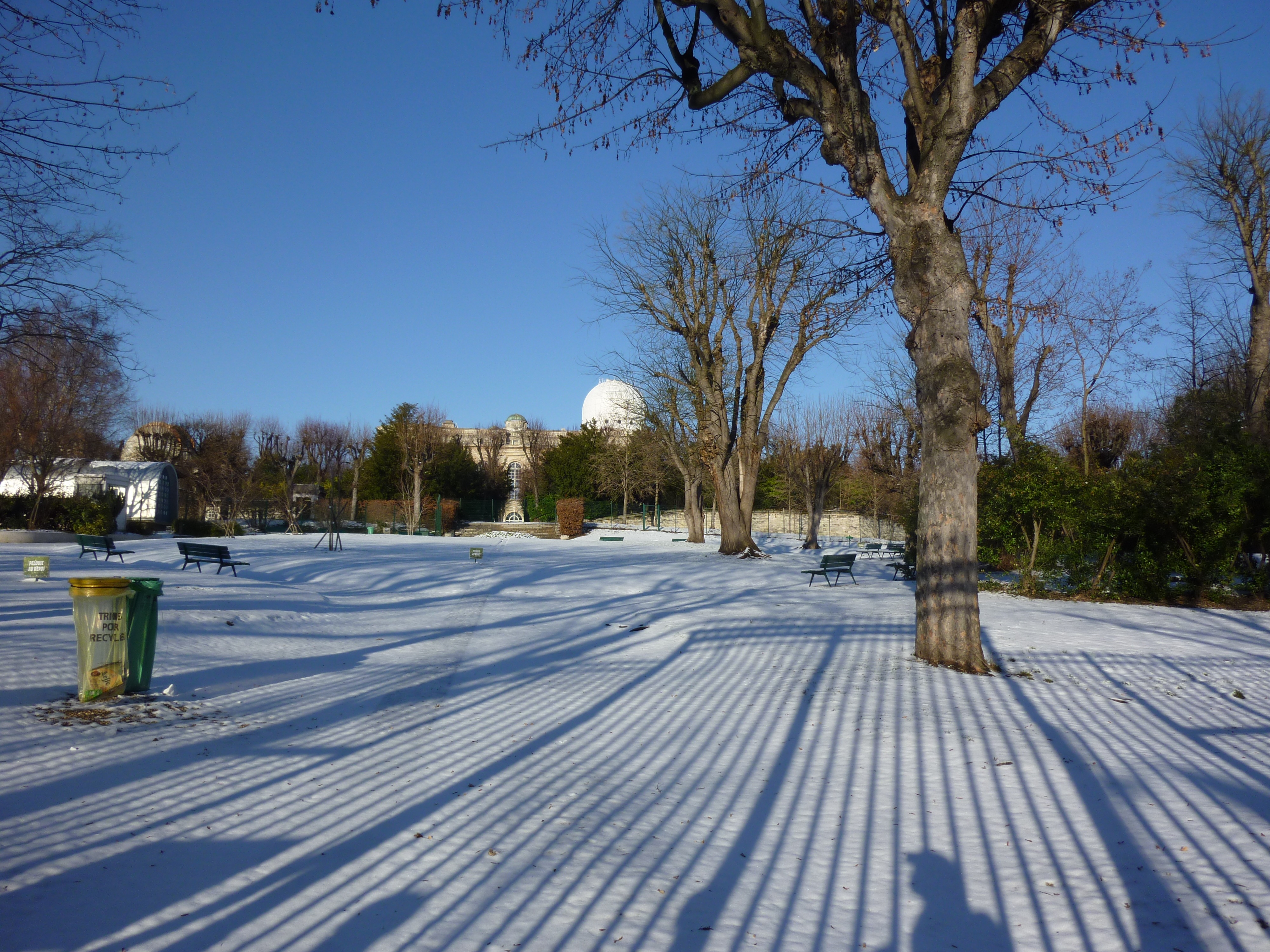
The building is still in use, and we walked around it in December. The garden was closed to allow the grass its winter “repose.”

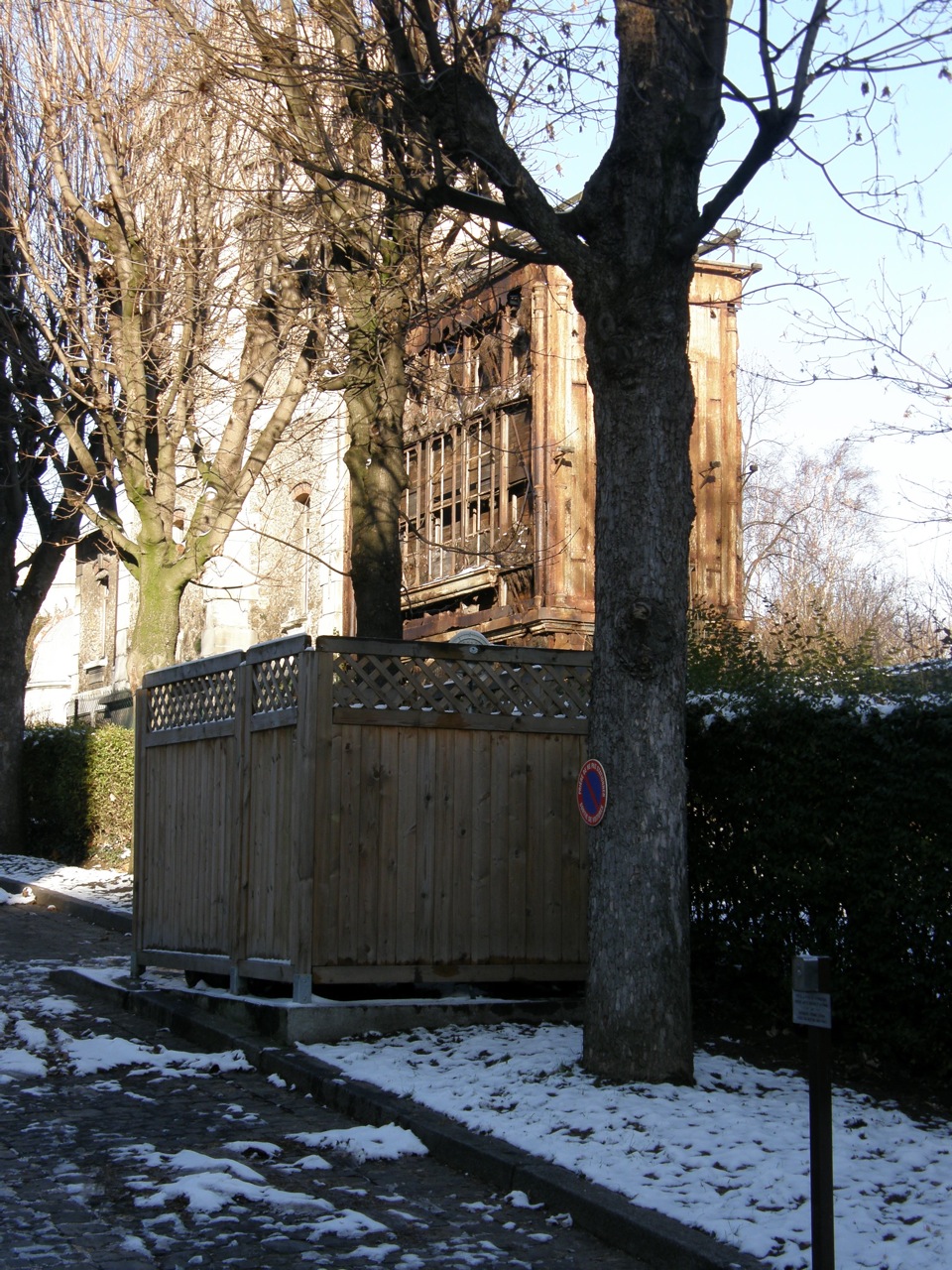
We spotted some odd, falling-down buildings on the south side from the boulevard Arago. The closest one, which is almost a skeleton, seems to be made of metal and has at one time been heavily insulated. We wondered if it had been used for cold-temperature experiments.

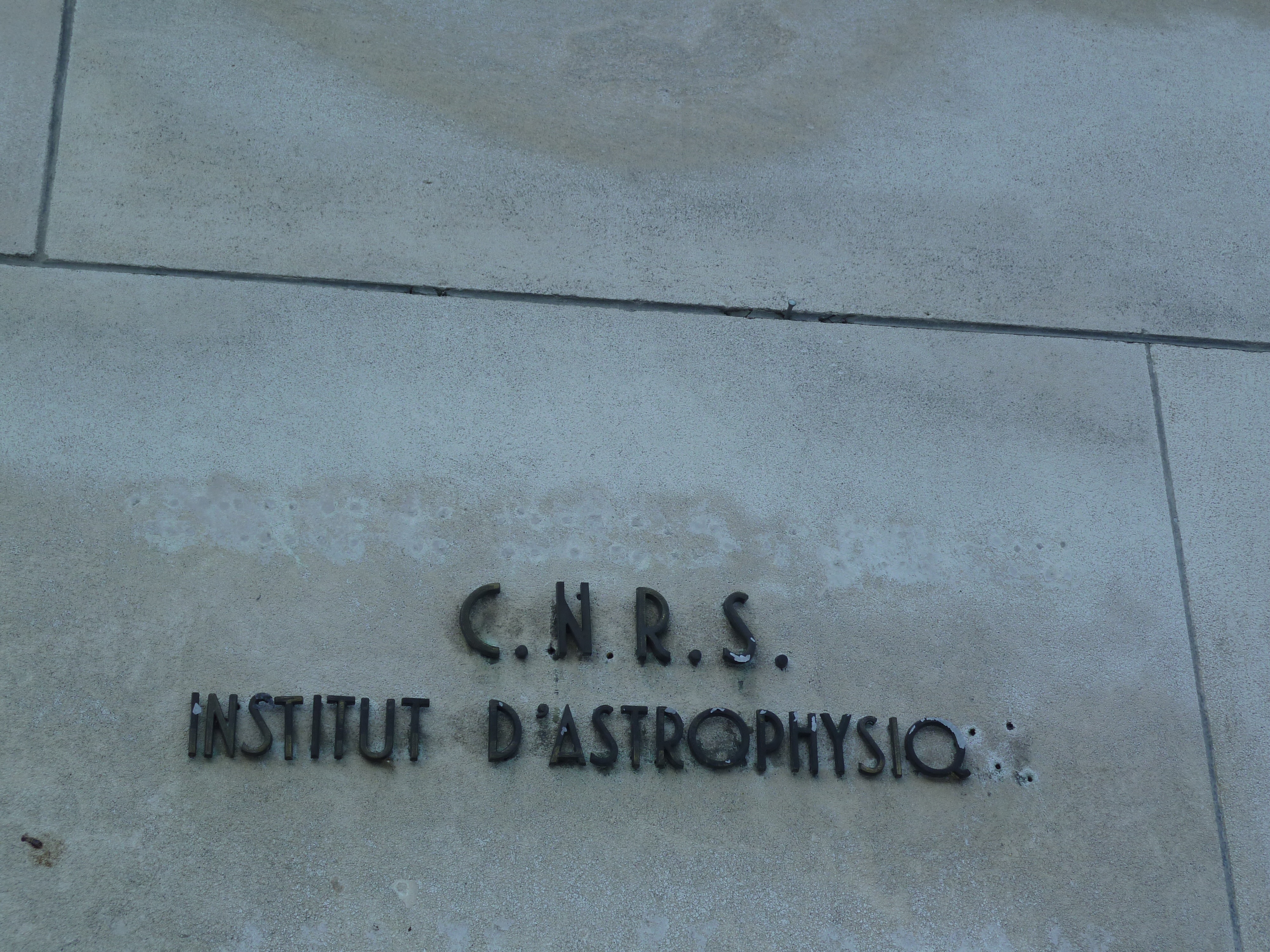
That and the rather-worse-for-wear sign on the Institut d’Astrophysique suggest that perhaps French astronomy is not keeping up with the times.

But The Meridian, by gosh, that they have, and that they will keep. That Other Line is just Paris Mean Time minus 9 minutes, 21 seconds.

Text and photographs by Philippa Campsie; additional photograph by Norman Ball.

Further reading: The story of the Paris Meridian vs. the Greenwich Meridian forms a chapter of Map Addict by Mike Parker (London: Collins, 2009).

Posted in Paris gardens, Paris history, Paris maps | Tagged , , , , , , , , , , , , , , | 3 Comments