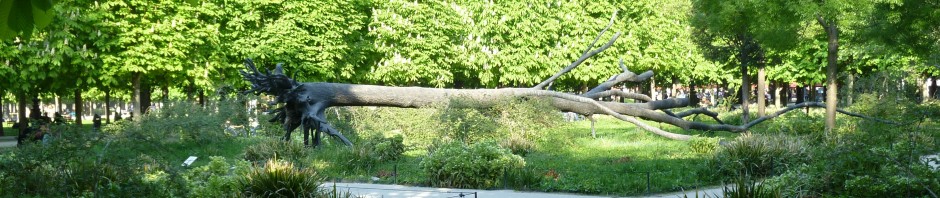
On Christmas Day, before it was time to go to dinner with friends, we wandered into the Parc Monceau. We have walked in the quiet park many times before, but had not noticed the little plaque near the path running along the south side.
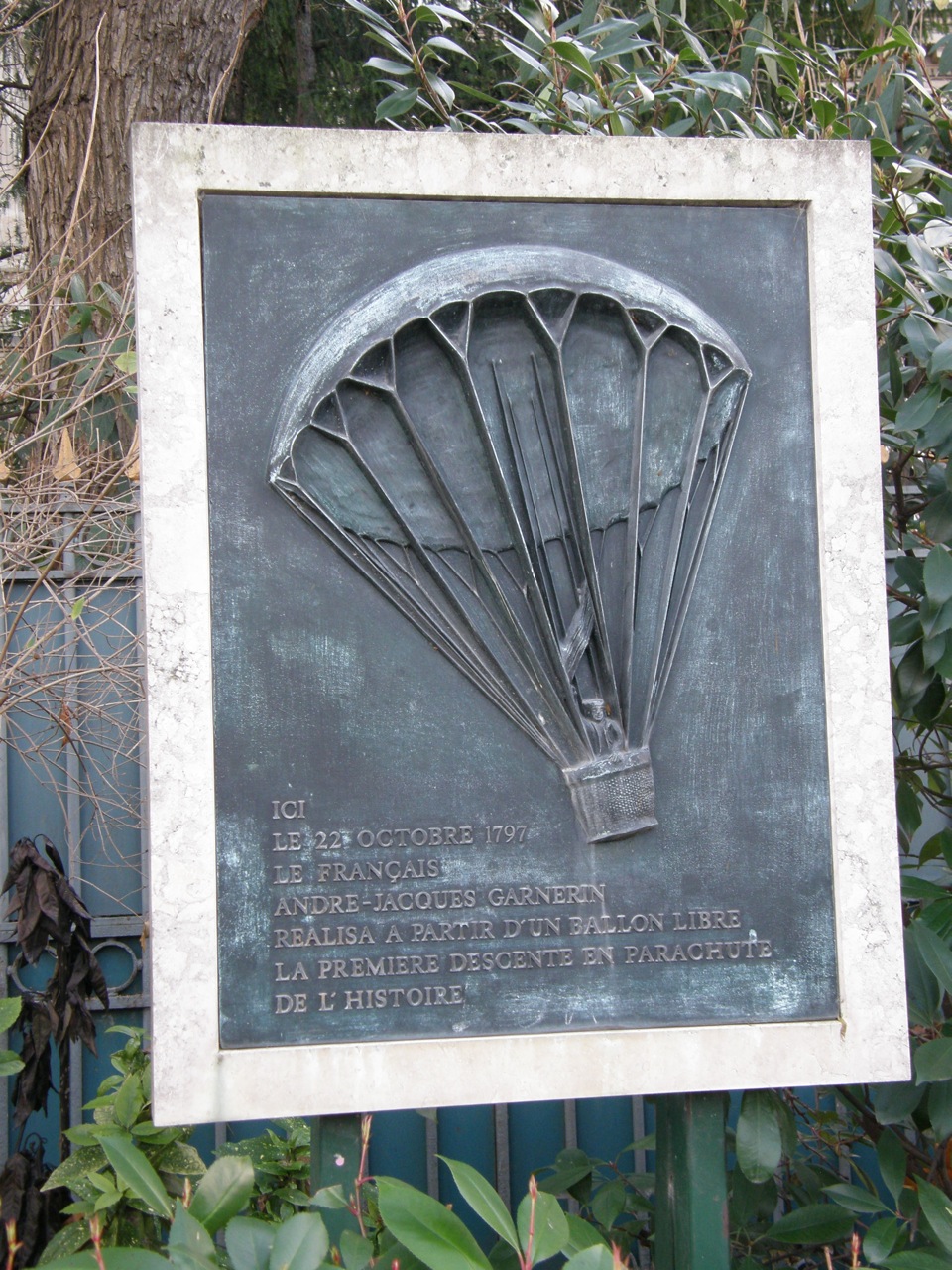
In translation it reads:
Here
On October 22, 1797
The Frenchman
André-Jacques Garnerin
Made from an untethered balloon
The first parachute descent
In history.
We had stumbled upon an important part of French aviation history. In the 1790s, ballooning or aerostatics was glamorous advanced technology. Ballooning represented adventure, fame, and the desire to push out the frontiers of knowledge, practice, and experience.
The ballooning craze burst onto the scene on June 5, 1783, when the Montgolfier brothers, Joseph-Michel and Jacques-Etienne, launched the world’s first successful hot-air balloon. There was no one on board, but the public was entranced. A new word entered the French vocabulary: montgolfier, meaning a hot-air balloon. Public interest grew even more feverish on October 15 of the same year, when Etienne Montgolfier went aloft on a tethered flight, a feat equalled the same day in the same craft by Pilatre de Rozier.
The next step came on November 21, 1783, when two men (Pilatre de Rozier and the Marquis François d’Arlandes) succeeded in going aloft and descending alive after an untethered flight. The feat was both exciting and controversial. King Louis XVI had thought it too dangerous an exploit for solid citizens and had proposed that criminals be sent up first to test the technology. He was over-ruled (not for the only time in his short life).
But hot air was not the only way to go aloft. Hydrogen gas, while dangerously explosive, is also lighter than air. August 27, 1783, was the date of the first unmanned flight in a hydrogen-filled balloon, from Paris to Gonesse, a distance of 25 km (16 miles). There followed flights with animals on board.
Meanwhile, ballooning mania had spread to all manner of toys, ornaments, jewellery, and household goods and furniture, including chairs with balloons carved in their wooden backs. Balloons were even used to hold lanterns aloft at parties.

On December 1, 1783, less than two weeks after the first untethered manned flight in a hot-air balloon, a hydrogen balloon soared aloft from the grounds of the Château des Tuileries, where a huge crowd (one estimate was 400,000 – that is, more than half the population of Paris, so perhaps an exaggeration) turned out to watch.
The hydrogen-filled balloon made two flights that day. The first carried physicist Jacques Charles and his assistant, Nicolas-Louis Robert, 43 km (27 mi) from Paris to Nesles-la-Vallée. Then Jacques Charles took off again from their landing place and ascended to an altitude of 3,000 metres (9,842 feet).
Where does our parachutist of the Parc Monceau enter the picture? André-Jacques Garnerin was born in Paris January 31, 1769. As a teenager he fell under the spell of ballooning. He studied physics under Jacques Charles (yes, the same Jacques Charles) and joined the army, where he held the rank of Inspector. He staunchly advocated ballooning for military purposes.
The year 1792 saw the beginning of what became known as the French Revolutionary Wars. Garnerin was captured by the British, handed over to the Austrians, and spent two or three years in prison in Buda. He survived these ordeals and on his release returned to his favourite pursuit.
Garnerin was both pioneer and showman. He became well-known for ballooning demonstrations in Parc Monceau. But the public can be fickle and Garnerin faced the question that many daredevils face: What next? Going up in an untethered balloon was becoming less novel. The public wanted more. How about jumping from one? The idea of parachutes was not new and there had been stunts such as jumping from a tall building. Garnerin decided to go one better.
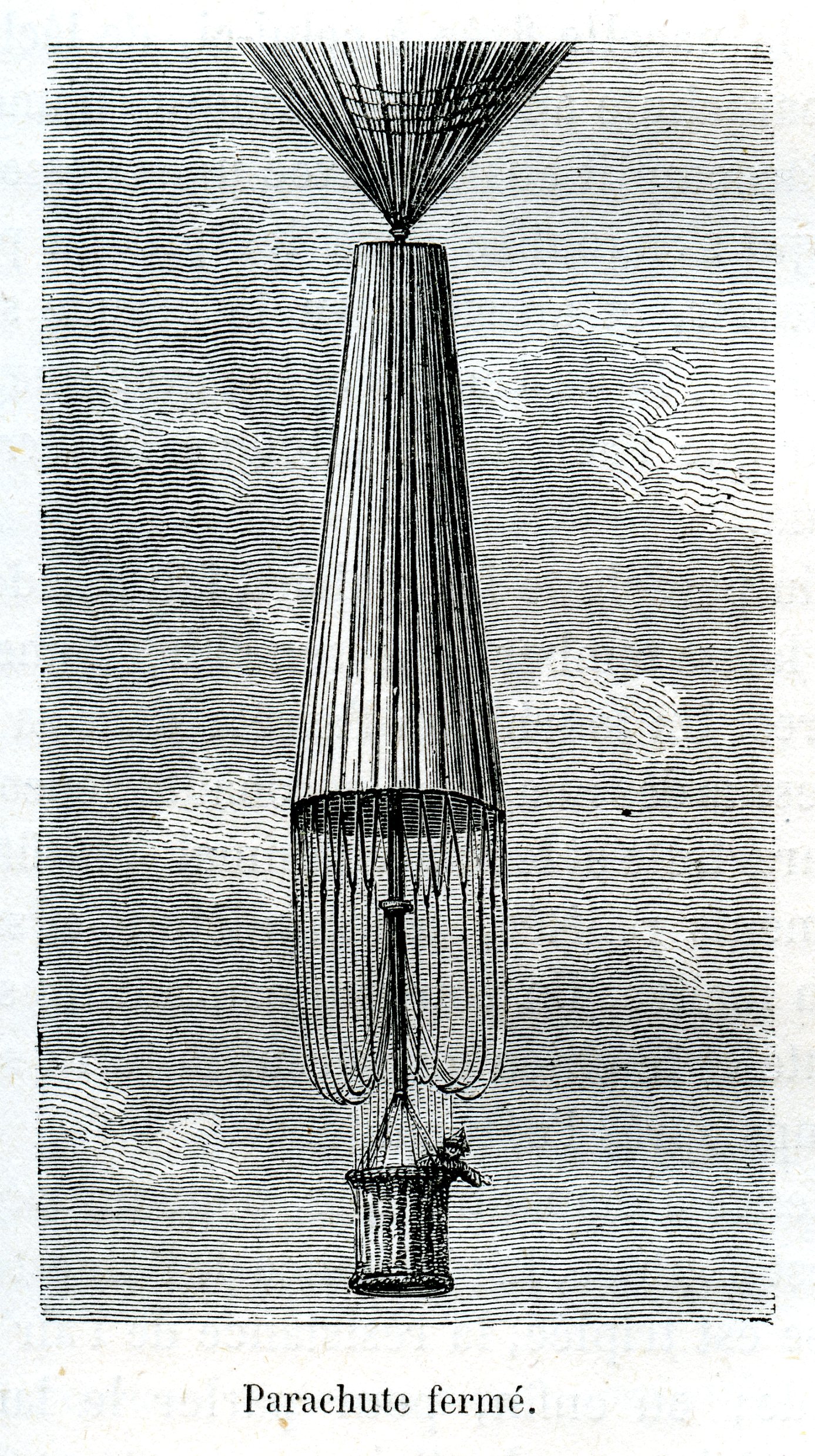
On October 22, 1797, Garnerin ascended from Parc Monceau and leaped into history as the world’s first successful parachutist from a balloon. For his act of faith and courage, he was named “official French aeronaut of the state.”
Unlike modern parachutes, Garnerin’s was not strapped onto his body. His parachute was attached to the underside of the balloon, and he was in a gondola or nacelle attached to the parachute. In the image above, we see the parachute looking like a folded umbrella attached to the underside of a balloon. When it was time for the jump, the parachutist simply released the cords attaching the parachute to the balloon, which drifted away, as we see in the image below of a descent made by Garnerin in 1802 in Britain, the first such feat performed there.

Descriptions of Garnerin’s early jumps suggest that the feat required a lot of nerve. First, the unopened parachute descended quickly; anyone watching feared the worst. As the parachute opened, the speed of descent slowed considerably, but the nacelle was subject to huge oscillations, making it appear as if it would be turned upside down and the parachutist would be lost.
The oscillations occurred because the parachute captured large volumes of air as it descended. This air had to escape, but unlike in more modern parachutes, there were no vents.
Descriptions of both parachute landings as well as balloon landings often included frightful accounts of the nacelle being dragged along with ground with its hapless occupants. Perhaps it is no wonder that a contemporary term for untethered balloons was ballon perdu, which we might translate as a “lost balloon.” It was “lost” only in the sense that there was no way of controlling it; the balloon went where the air currents drove it. There is another meaning to perdu, an archaic military term applied to a mission that seemed doomed from the start. No wonder Louis XVI thought balloon ascents should be reserved for criminals.
Garnerin continued to provide further thrills and parachute jumps as an international showman, balloonist, and parachutist. He shocked many with his proposal to take the first woman passenger aloft in a balloon from Parc Monceau in 1798. Public and press were enthusiastic, officialdom less so. First, there were scientific worries. Increased altitude means less air pressure and there were fears this could damage the delicate organs of even the healthiest female and cause her to faint. And there were worries on moral grounds. Just what might these two aeronauts be up to in the seclusion of the upper altitudes?
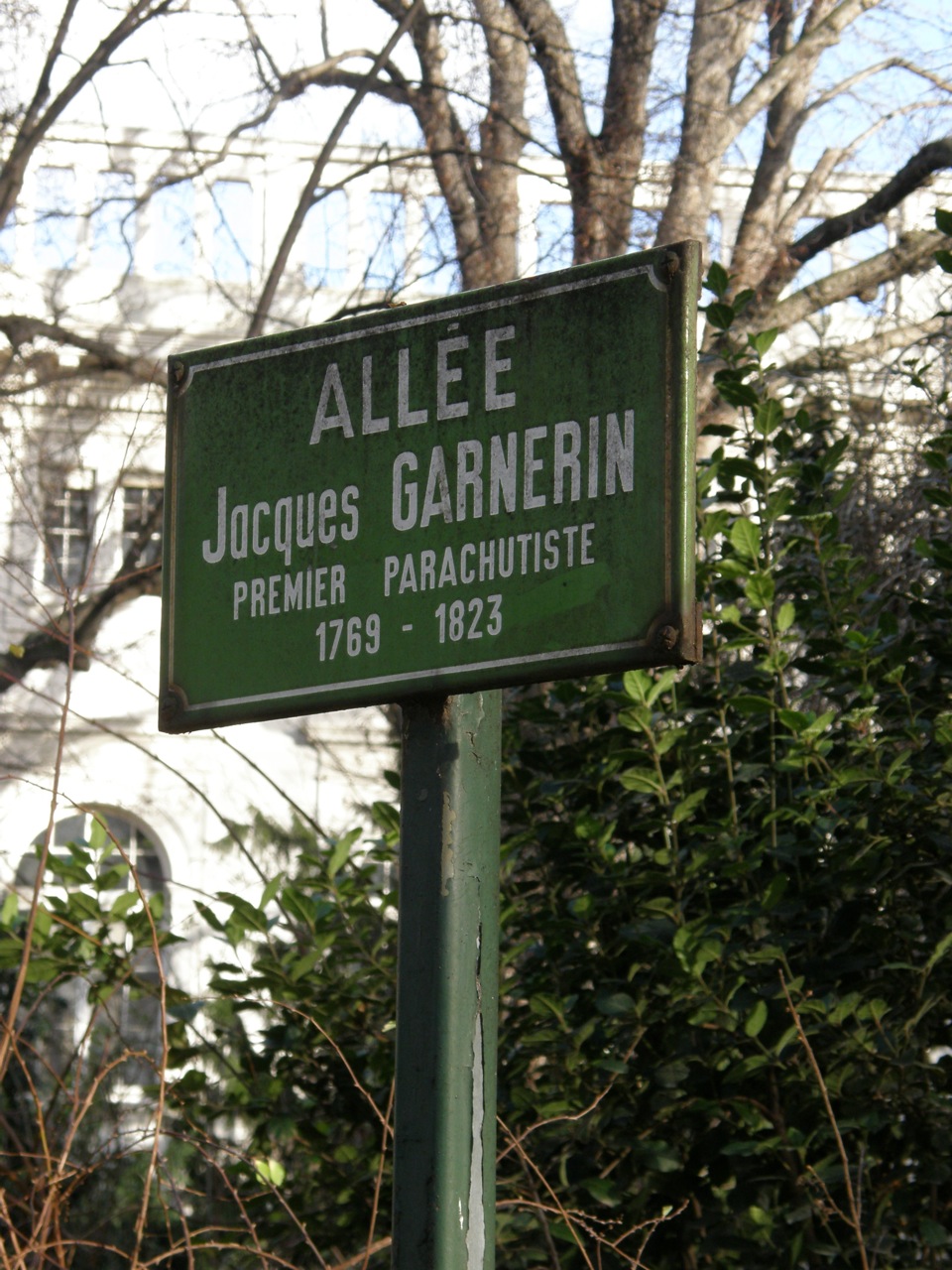
Official worries were overcome, Garnerin looked after publicity, and on July 8, 1798, a large crowd assembled in Parc Monceau to see the reportedly young and beautiful Citoyenne Henri and Garnerin walk about the park before astronomer Jerôme Lalande assisted her into the basket. They were next seen about 30 km (19 mi) north of Paris when they landed at Goussainville.
Citoyenne Henri seemed to be none the worse for wear and whatever happened in the privacy of the balloon’s airborne basket, stayed in the basket. Further developments were reserved for Jeanne-Geneviève, Garnerin’s wife (and former student), who in 1799 became the first woman parachutist.
What happened to André-Jacques? Ballooning eventually took his life, but in an unexpected way. He was hit on the head by a beam while working on balloon equipment and died in Paris on August 18, 1823. His older brother, Jean-Baptiste-Olivier Garnerin, who had worked with André-Jacques for most of the balloonist’s career, lived for another 23 years.
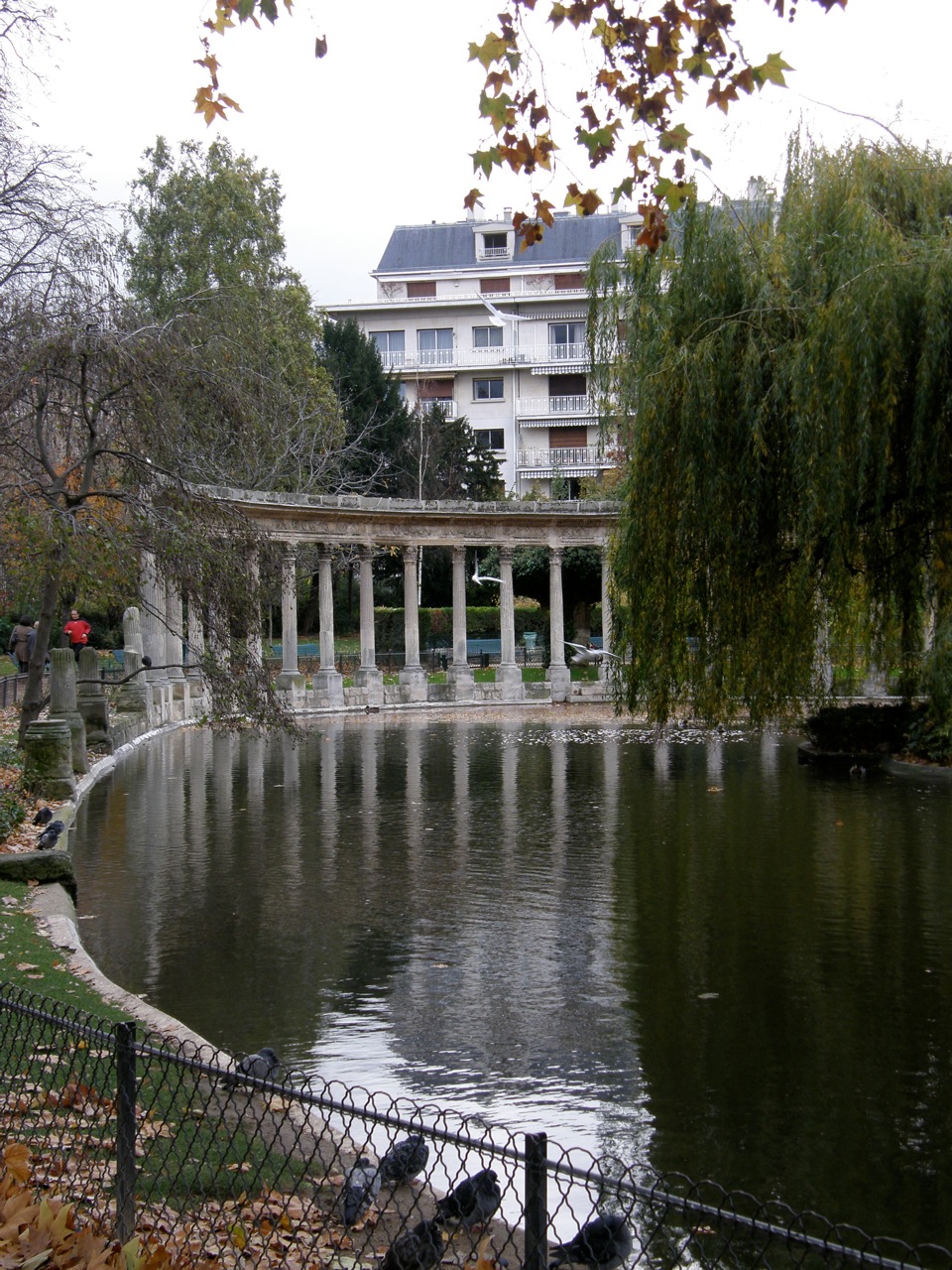
Perhaps one question remains. As we looked at the plaque, Philippa asked, “Why would he do it from here? Surely there are too many trees and houses in the way.” But both Paris and Parc Monceau were different then.
The Parc Monceau was established by the fabulously wealthy Philippe d’Orléans, Duke of Chartres, a cousin of King Louis XVI. In 1769 he began purchasing property in what was then known as the Monceau Plain and nine years later decided to create a public park. Although later modified, it was not intended to be a typical formal French park, but rather something that would surprise and amaze visitors.
The Duke of Chartres gave the design work to Louis Carrogis Carmontelle, who later wrote that the garden was “simply a fantasy, to have an extraordinary garden, a pure amusement.”* The park included statues, a windmill, a farmhouse, a lily pond, a miniature Egyptian pyramid, a Roman colonnade, a tartar tent, a temple of Mars, a minaret, an Italian vineyard, an enchanted grotto, and “a gothic building serving as a chemistry laboratory.”*
The Parc Monceau was unabashedly about fun and amusement. Alas, the Duke was guillotined during the Reign of Terror in 1793, and his park was nationalized. With the restoration of the monarchy in 1815, the park was returned to the Duke’s family, who reduced it by about half when they sold off lots to developers, who built luxurious houses all around. So Garnerin had taken off from a much larger park, with fewer surrounding buildings.

The park changed hands again in 1860, when the city of Paris purchased it. Soon it was swept up in the remaking of Paris by Napoleon III and Baron Haussmann. In August 1861, it became the first of the new public parks in Paris to be remade and its appearance changed again.
Our serendipitous discovery in Parc Monceau on Christmas Day illustrates why we keep returning to Paris. No matter where we go, we find small clues that open up larger vistas, sometimes immediately and sometimes only after further research. Henry David Thoreau captured the essence of the experience of a place with his observation that “The question is not what you look at, but what you see.” He did not have Paris in mind, but we do when we read his words.

Text and original photographs by Norman Ball. Engravings from F. Marion, Les Ballons, Hachette, 1874. Other historic images from the Roger Viollet collection, Paris en images.
*Quoted by Dominique Jarrassé, Grammaire des Jardins Parisiens, Parigramme, Paris (2007), and cited in the Wikipedia article on the Parc Monceau.


































 Parisian Fields