Michael Caine: an English traditional typographer in the heart of Paris

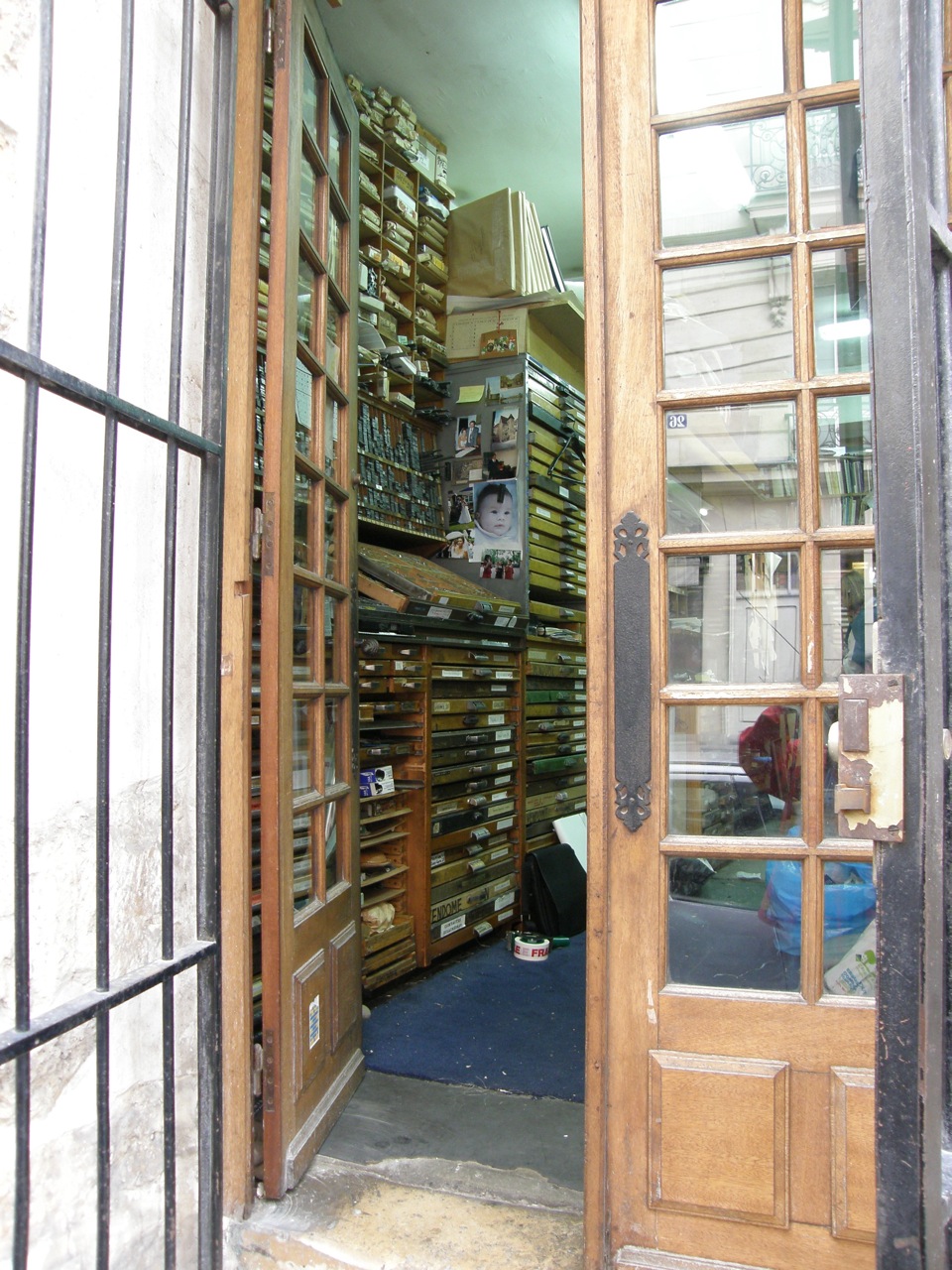
One evening in 2007, we left our rented apartment on rue Charlemagne for a walk in the Marais. On the rue de la Cerisiaie, we peered at a small poster on the glass door of a narrow workshop. Suddenly, the door opened and a man beckoned us in.
P6240074

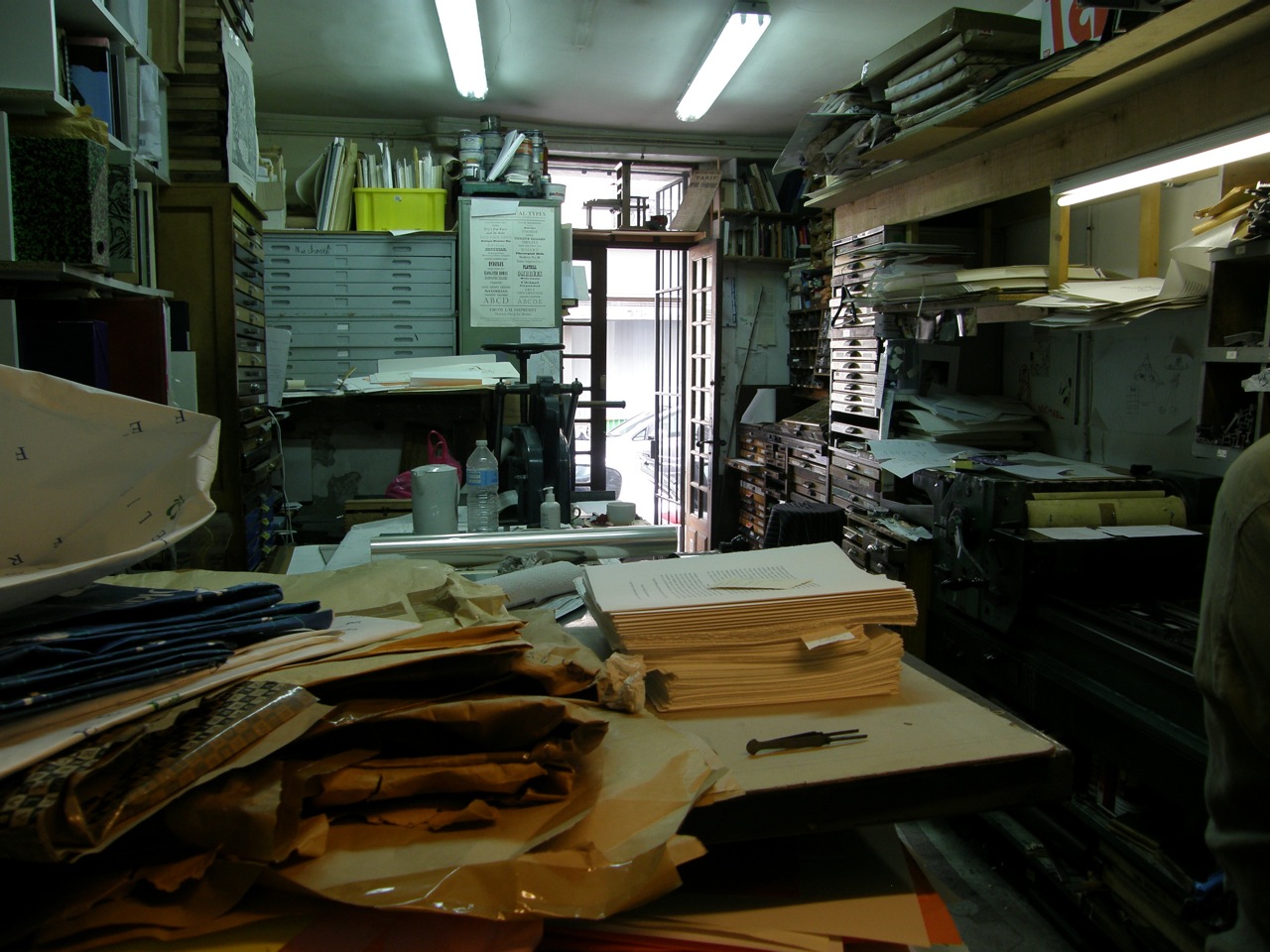
It was a printshop, one with a letterpress printing machine and countless drawers and boxes of lead and wooden type. We were enchanted. The printer’s name was Michael Caine (no relation to the actor of the same name).

Our impromptu visit turned into an hour of conversation about printing and type, and an invitation to attend a closing of a show of his work two days hence at the Librairie des Argonautes. (A closing? Usually one is invited to openings. Philippa said, “Norman, it’s Paris. Any excuse for a party and a drink.”)

The event was delightful. The space was so small that everyone took turns being inside looking at the prints or outside chatting on the sidewalk. We could not afford to buy anything then, but it was the beginning of a friendship.

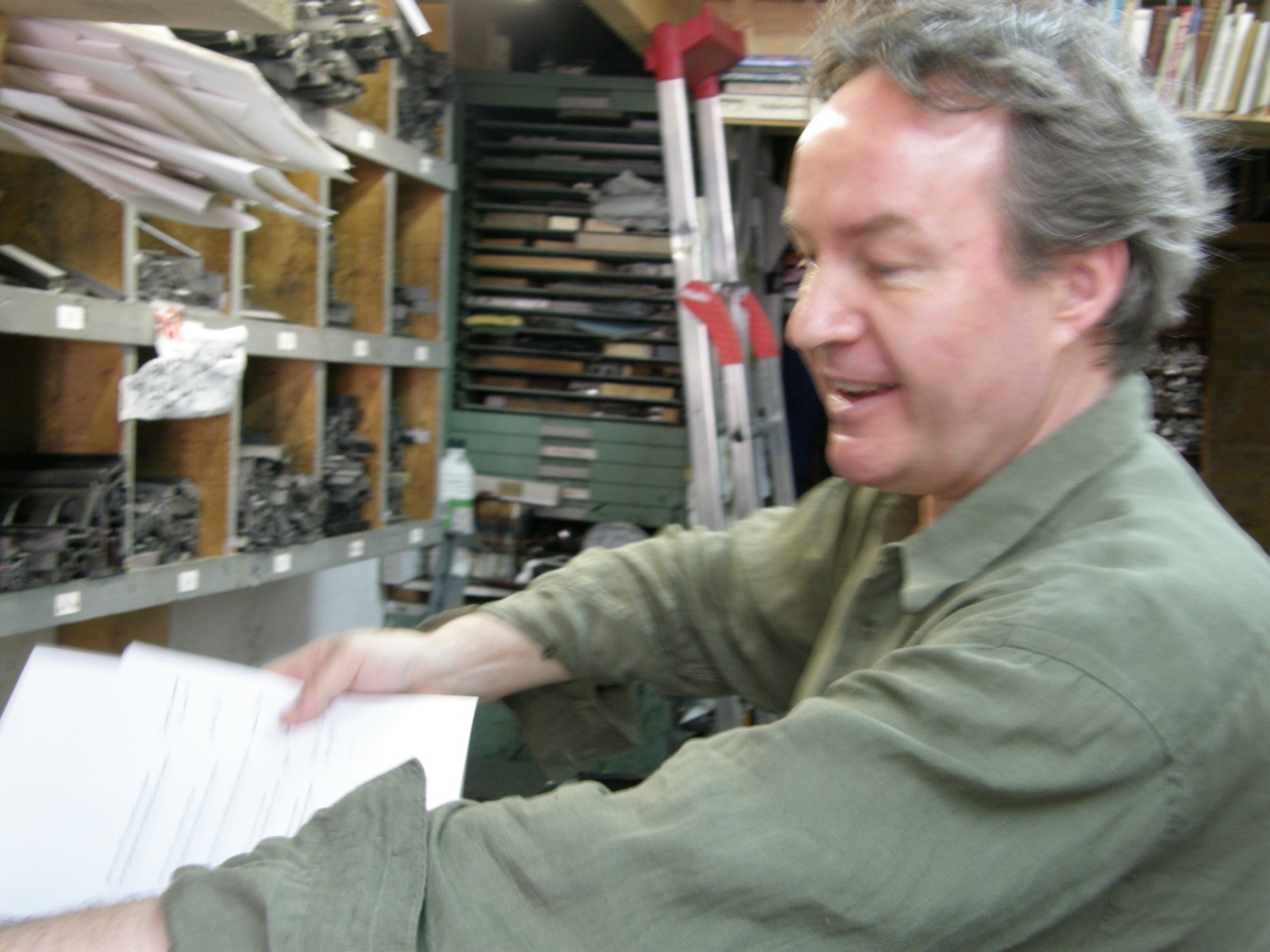
Since that day, no trip to Paris is complete without a visit to the print studio on the rue de la Cerisiaie. At 38 square metres, the studio is small, but the output is astounding. Each time we get together, I am in awe of Michael’s knowledge, artistry, patience and dedication. He is modest about his gifts and told me, “My family, I recently learnt, is composed of painters and decorators on both sides, going back three generations. One grandad was a master woodturner of repro furniture, so it’s following the family line. Good with one’s hands.” But there is more to it than that.

When Philippa and I visited this June, Caine had just finished his second work by James Joyce for Ithys Press in Dublin (his first was The Cats of Copenhagen). We spent a long time poring over pages as Michael explained what he had done and why. The title page alone of Finn’s Hotel was an education in itself.

P1120454 (2)

Michael pointed out that in the four rows of five letters each he used four different fonts: two William Morris initials, some Jenson, boldface Giraldon, and Lombardie. He spent a long time on the letter spacing. The positioning of the bold seems to create a code of its own. Michael knew that readers might puzzle over it as they puzzle over everything that Joyce wrote. Are those letters spelling out an obscure message?

In fact, he was simply looking to balance the darker letters, to create what he called “syncopated randomness.” And, like Joyce himself, he was playing with languages; the language of fonts, which suggest different cultures—in this case, Irish and Scandinavian.

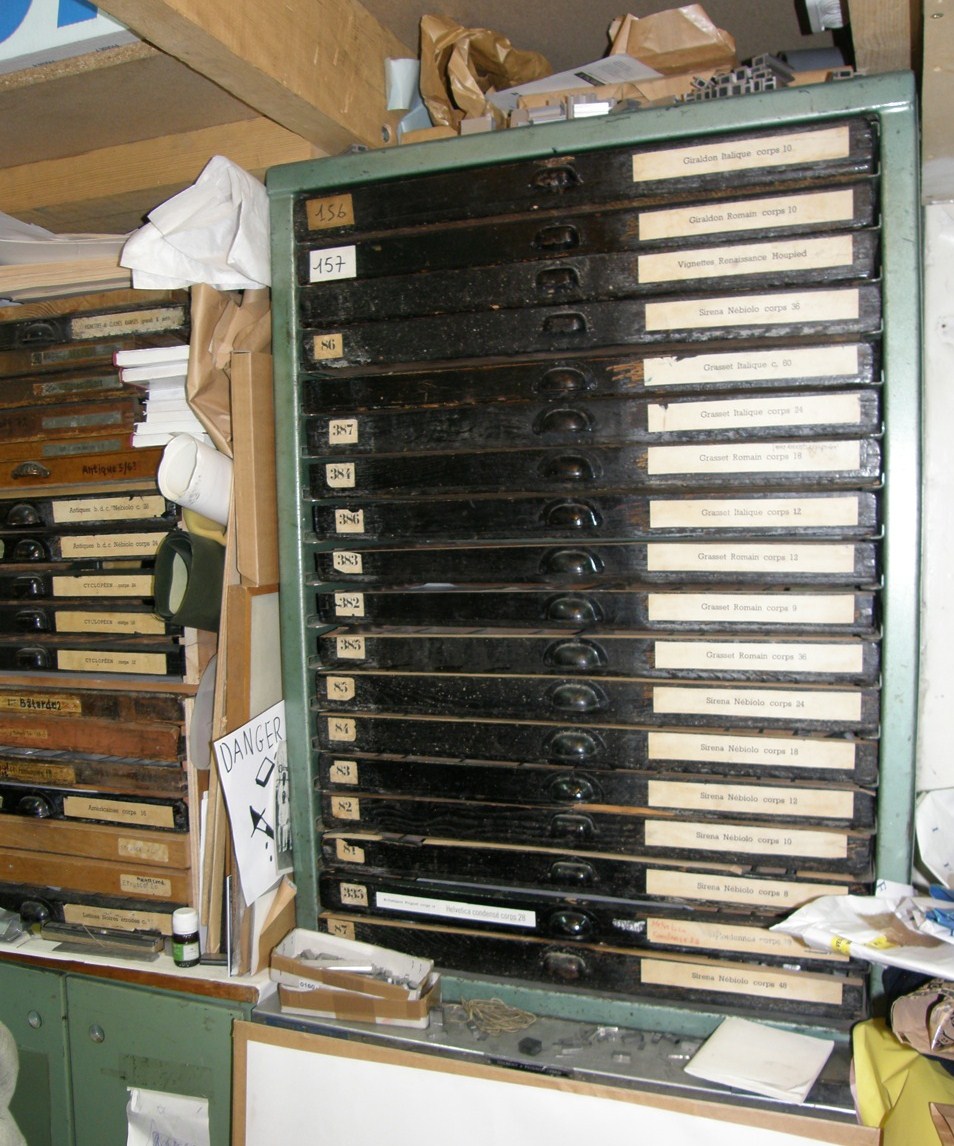
There is a story behind each font, mostly involving rescuing—or buying—types from other print shops that have closed. And if he needs more of a particular letter of a particular font, there is a man in Frankfurt who has a small type foundry in a shed at the back of his garden and will cast letters to order. To Michael it is a wonder of the age that the matrices for many old types have been saved and metal type can be purchased with an e-mail.

P6240064

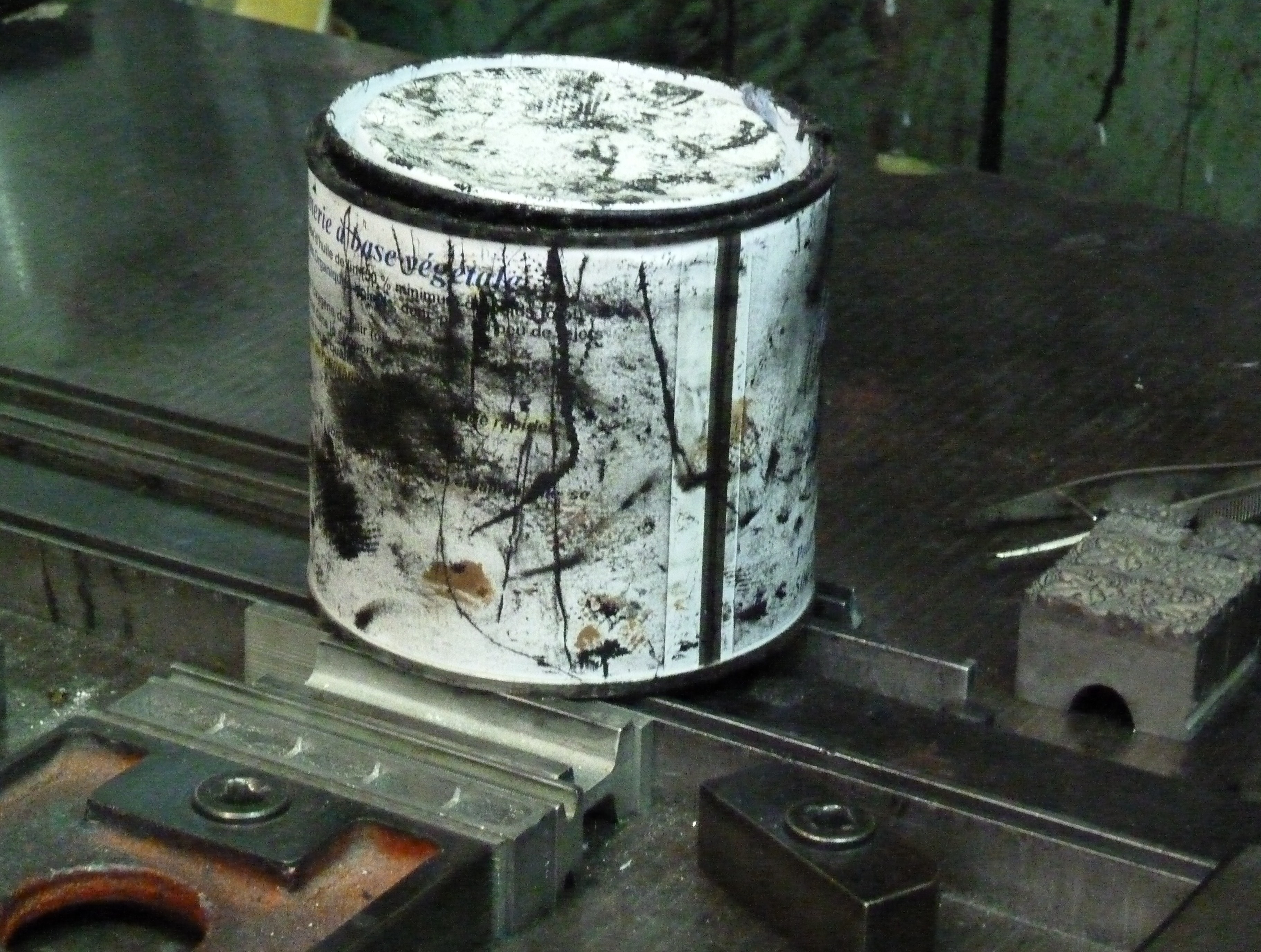
And the black ink that is so rich, deep and velvety? That comes from Monsieur Momal, a retired gendarme in the south of France who learned how to make printing inks from lamp black pigment and linseed oil with the right viscosity for the presses Michael uses. Modern commercial ink makers save money by scrimping on the pigment, no matter what the colour, but the richness of Michael Caine’s printing comes in part from the pigment. Letterpress printers treasure a good ink maker.
P1120441

Letterpress printers must also know paper intimately and how to use the right combination of paper, type, ink, and press, drawing on all of the mysterious little tricks one picks up along the way. Michael recalls that as a student he once did a bad job of printing because he had picked the wrong paper and did not know that it had to be moistened. He has come a long way since then. How far? His books are one answer. So too is the fact that in 1999 the French Ministry of Culture nominated him as the Elève successeur to the Maitre d’Art en Typographie. This is part of a program to perpetuate the arts and crafts that are dying out. In Japan the equivalent honour is to be recognized as a “national living treasure.”

There are fewer and fewer printers like Michael in France, or indeed anywhere in the world. He explained that in the 1920s, France had 180 book societies ordering hand-printed books. Now there are three. Books are the love of Michael’s typographic and printing life, but his business also depends on more mundane orders, such as correspondence cards, posters, menus, business cards, and invitations to weddings and other important occasions.

How did he develop his skills? In 1979, as a first-year graphic arts student at the London College of Printing, he fell in love with “the medium of the hand-printed book” and, as he would later write, “there was no turning back. I was seized by the possibilities of what I could do.”
P6240062

As a student he quickly learned, but ignored, the fact that one was supposed to be either a graphic designer or a printer, but not both. He was warned by his professors that there would be “repercussions” if as a designer (one of the chosen) he spent too much time with the printers (slaves). At the time, he did not realize the immense challenges he would face in being a maker of books.

Happily, he came to France. As a second-year student who didn’t seem intent on following standard paths, he was sent by the London College of Printing on an exchange with the Ecole de Beaux Arts in Nancy in eastern France. Later he would write that “in three happy months in the Art Nouveau heaven that was Nancy, I succeeded in cutting an entire book out of wood; text as well as image, a setting of the absurd surrealist poem The Blue Dream by Louis Aragon.” Caine’s edition of The Blue Dream was selected for inclusion in the 1984 exhibit of British Artists’ Books since 1970.

By the time he graduated in 1982, Caine had not “done the right things” expected of a graphic arts student, but he had worked hard with a prodigious output. In 1998 he wrote that “despite the general hostility to producing books, I managed to produce (and bind myself) eight different editions of Apollinaire, Aragon, Auden, Lorca, Mayakovsky, Ritsos; all illustrated with my own etchings, woodcuts, and linocuts; the final tally being some one hundred and twenty-six books. I left the college with a basic knowledge of every aspect of book production, from comping right through to binding.”

He earned a master’s degree, and continued to produce beautiful work that attracted enough attention and sales that in September 1990 he emigrated to Paris after “having spent most of my adult life dreaming of living in Paris.” There he began the combined life of part-time teacher (at the Ecole Superieure Estienne des Arts et Industries Graphiques) and letterpress printer. He entered the Atelier de la Cerisiaie that year as assistant to French artist-publisher Jean-Luc Lerbourgh. In 1992 when Lerbourgh left for Brittany, Michael took over the studio. He is still there.
P6240065

I recently asked Michael what he was trying to achieve. “To print texts of great value, worth reading in 200 years’ time and at prices people can afford.” He works “to create something alive and contemporary in an old, dead technology.” And yet it is far from dead. Certain connoisseurs see and appreciate what he is doing. It is not just the rare “illustrators who appreciate detail, hard work and long hours spent on the ‘ridiculously futile.’ ”

I am fortunate enough to own some of his work, including a bilingual edition of Livres by Paul Valéry. Here are two of its pages.

Valery

There are times when I pick up something he has created to feel it in my hands, to run my eyes over the text, and find details and subtlety that had eluded me earlier. I am greatly privileged.

Text by Norman Ball; photographs by Norman Ball and Philippa Campsie
P6240056

Posted in Paris art | Tagged , , , , , , , , , , , , , , , | 3 Comments

An honourable education

Every time we plan a trip to Paris, we have a list of things we want to do there. And every time we get to Paris, we end up doing fewer than half of those things. After all, opportunities arise and it would be foolish not to take advantage of them.

Our latest list did not include a visit to an exclusive girls’ boarding school, but that was before we fell into conversation with a stranger in front of Stylos Marbeuf, a pen shop near the Champs-Elysées. The discussion moved from the merits of various pens to the role and function of pens in the age of iPhones, and from there to the question of writing and the effects of technology more generally.

After a while, introductions were in order. And we found that we had been talking with a teacher at the Maison d’Education de la Légion d’Honneur, founded by Napoleon. The third? No, the first. Would we be interested in seeing the school? Indeed we would. We fixed a rendezvous for the following day.

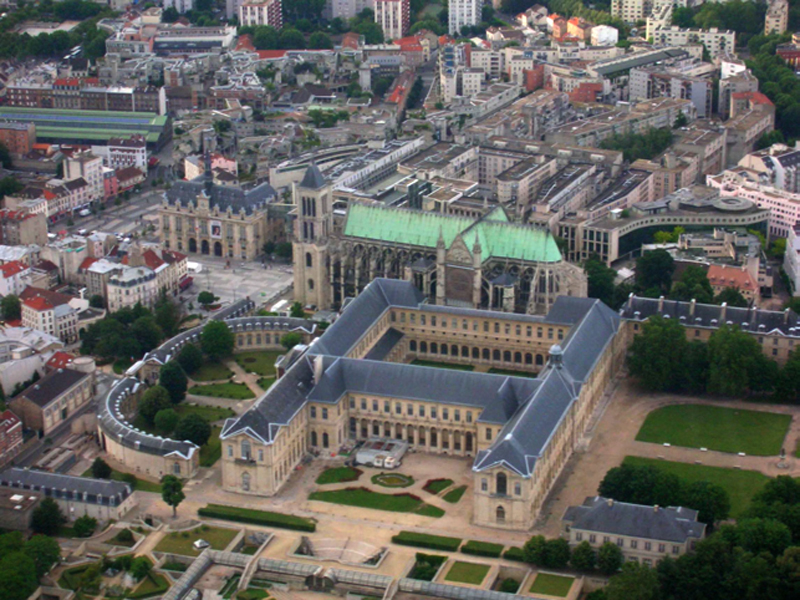
We took the Metro to St-Denis, a suburb to the north of the city. The tourists who go there usually want to see the tombs of the kings of France in the ancient basilica. Not all tourists realize that the basilica was part of a huge abbey, founded in the 7th century, and substantially rebuilt in the early 18th century.

33_melh-st-denis

The abbey buildings are still there – the cloister, the refectory, the chapter house, the dormitories – but they are now part of a lycée for girls. Not just any girls – the school is reserved strictly for the daughters, granddaughters and great-granddaughters of members of the Legion of Honour, those who have received French military honours, or recipients of the more recently created Order of Merit.

In the aerial view shown above, the basilica is the church with the green roof; the buildings in the foreground are those of the abbey.

Our host showed us around, explaining that the senior students were in the middle of writing the exams for the baccalauréat, and that morning had faced the four-hour philosophy exam. (The study of philosophy is compulsory for students in French lycées, and the exam requires them to expound on weighty questions such as “Do technological developments threaten our liberty?”) As we toured the school, our host asked students coming from the exam room, “Did you survive?” Some sounded cheerful; others were less confident.

Because of the exams, we did not see the modern classrooms, which are equipped with computers and the more mundane elements of a 21st-century education. Our tour was largely confined to the former abbey buildings.

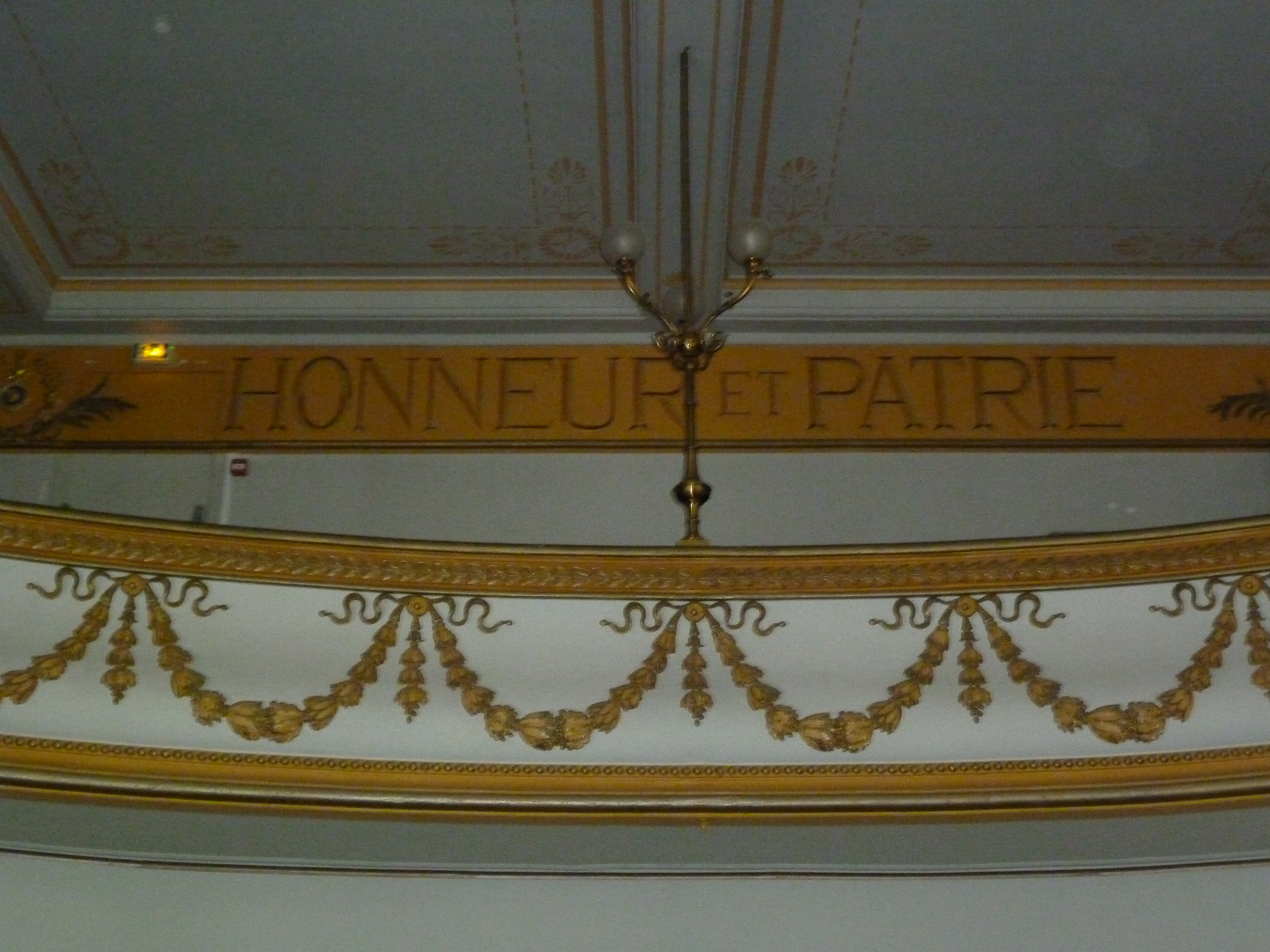
We saw the cloister (the largest in all of France), the old library, and the music room, which is also used for end-of-term ceremonies. Instead of the usual “Liberté, Egalité, Fraternité” on the wall, we saw “Honneur et Patrie” (Honour and Country).

P1110856

We looked out towards the huge park behind the main buildings.

P1110846

We peeked into the art room, which was once the monks’ chapter house.

P1110872

We walked through the refectory, with its marble-topped tables dating from the time of Napoleon I.

P1110912

Our host mentioned that when he arrived at the school, the girls still slept in iron beds of the same vintage, but that these had since been replaced by modern bunkbeds.

The students wear a navy blue uniform with a white blouse and coloured ribbons that indicate their level in the school (seconde, première, or terminale). They are a group set apart – the ultimate authority for the school is not the Ministry of Education, but the Chancery of the Legion of Honour and the Ministry of Justice. Students participate in various Legion of Honour ceremonies during the year.

The foundation of the school dates to 1805. After victory at the Battle of Austerlitz, Napoleon announced that the orphans of the soldiers who had been killed would be his responsibility, and he would educate them, girls included. The school at St-Denis was one of three girls’ schools he founded (one has since closed, but the other school, for younger students, continues at St-Germain-en-Laye).

Napoleon chose Henriette Campan, a former lady-in-waiting to Marie Antoinette, to head up this enterprise. Madame Campan was, I suspect, made of exceedingly stern stuff not only to have survived the Revolution in spite of her associations with royalty, but also to have prospered during the Empire. I imagine she was much like the headmistress of my old school, who had the fitting name of Miss Steele (we referred to her as Stainless, and she was).

Napoleon’s presence lingers in the motto “Honneur et Patrie” and in the many portraits of him that adorn the school’s main rooms. Of course, his intention was not to form independent-minded young women, but to train accomplished and competent wives and mothers for France (women’s rights took several steps backwards during the First Empire). I doubt that he expected his “demoiselles” to take a four-hour philosophy exam, although the baccalauréat was another of his inventions.

P1110841

An oddity that struck me was a long line of elderly pianos, side by side, in one of the  corridors of the cloister. The school has a flourishing music program, but these relics had been left behind. They are not used or maintained. Evidently these now-silent witnesses of days past are a feature of the school – they appear on the postcards sold in the school office and in images on the school website. But why are they there? Why were they abandoned? Why have they been kept? I suppose I will never know.

We left the school through a side door, and found ourselves back in the main street of St-Denis, a suburb with a rough reputation and a recent history of strife. The school, only a few metres from that main street, is a world away.

Text by Philippa Campsie; photographs by Philippa Campsie and Norman Ball
Posted in Paris churches, Paris history | Tagged , , , , , | 11 Comments

The Nuns’ Tale

A few months ago, I was working at my desk while the radio played in the background. All of a sudden, I heard something extraordinary. I had been vaguely aware of some orchestral music that suggested foreboding and sorrow, but then I heard a choir of women’s voices singing a haunting melody. I stopped work to listen. Every so often, there was a swishing noise from the orchestra, the voices seemed to hesitate, but they continued, more quietly each time. Eventually there were only three voices. Swish. Then two. Swish. Then one. Swish. A few more chords from the orchestra, followed by silence. I didn’t know what I had just heard, but I was almost in tears.

After a pause, the announcer explained that this was the final scene from François Poulenc’s opera, Dialogues des Carmélites.

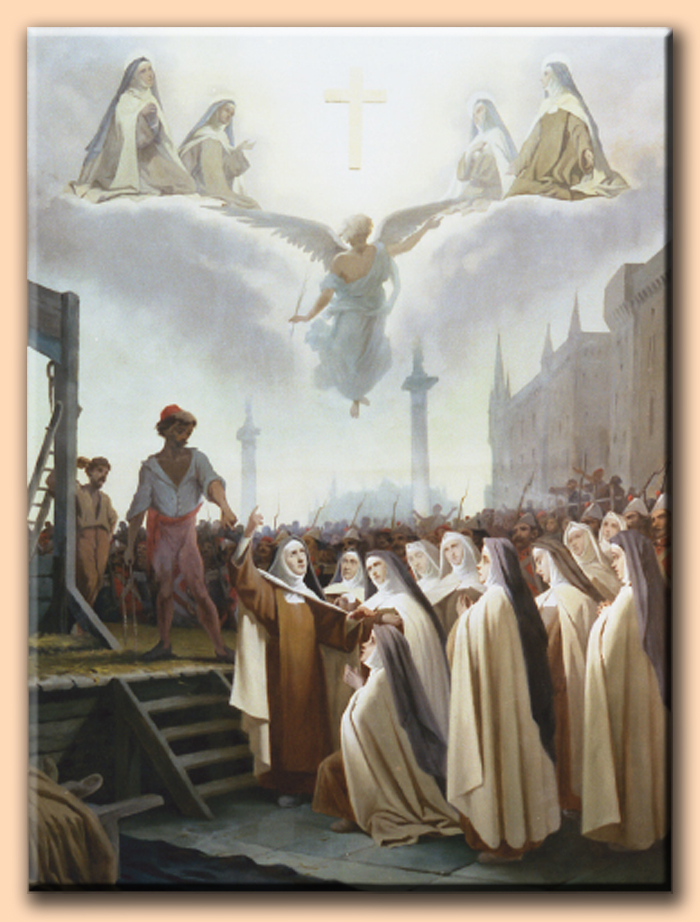
The music depicted a real event – the death by guillotine of 16 Carmelite nuns during the Terror in 1794. The nuns had stood at the foot of the scaffold, singing the Salve Regina and the Veni Creator Spiritus, while one by one they mounted to the top and were executed.

Carmelites of Compiegne

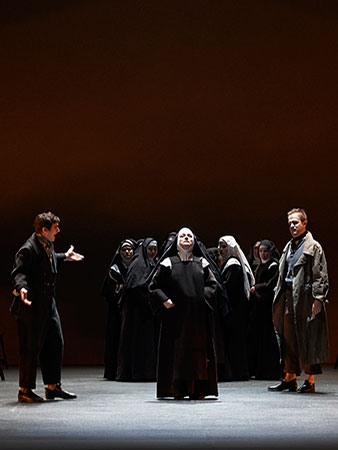
The announcer also said that the opera was to be performed in Toronto by the Canadian Opera Company. So, this past May, Norman and I went. The production, directed by Robert Carsen, was superb.

DialoguesCOC1

The story focuses on an aristocratic but timid young woman called Blanche de la Force (played by Isabel Bayrakdarian in the opera) who joins the Carmelites of Compiègne just as the French Revolution is beginning. In the convent, she befriends the dying prioress Madame de Croissy and a high-spirited novice called Constance. When Revolutionaries close the convent and expel the nuns, Blanche flees. The remaining nuns choose to face martyrdom together rather than disbanding. The nuns are condemned to death for sedition. On the day of their execution in Paris, Blanche stands in the crowd, watching. At the end, only her friend Constance is left. At the last moment, Blanche walks forward to accept the same fate as her Carmelite sisters.

I continued to think about the performance for a long time afterwards. As usual, I wanted to know what had really happened. I knew from the opera program that Blanche was a fictional character created by the novelist Gertrud von Le Fort (she even gave her heroine a French version of her own last name: von Le Fort became de la Force), but she had set her story against the backdrop of historic events. The novel, translated into English as Song at the Scaffold, was transformed into a screenplay by the Catholic writer Georges Bernanos shortly before his death in 1948 and into an opera by Poulenc in 1956. It was first performed in Italian at La Scala in 1957.

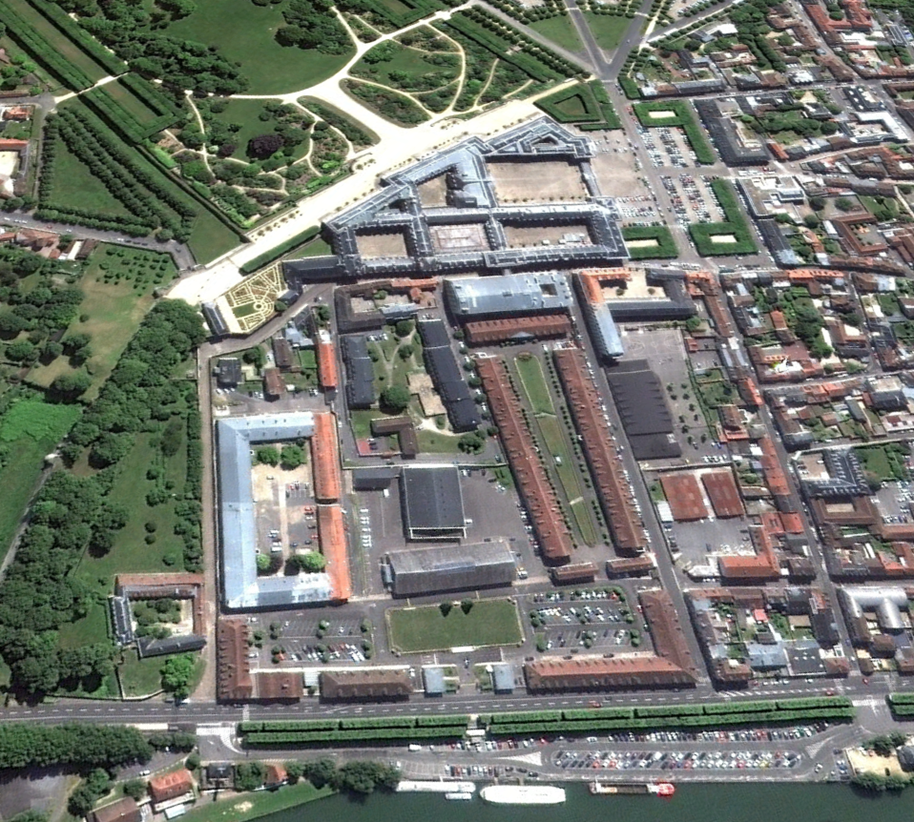
First, I went looking for the convent. It is long gone, but it stood near the river Oise in Compiègne, close to the royal chateau and park. It was built in the 1640s and destroyed in the early 1800s. Today, the Imperial Theatre stands on the site of the chapel and the Ecole d’Etat-major (a military school for officers) occupies the space that provided living quarters for the nuns.

Compiegne

In this picture from Google Earth, taken looking southeast, the military school occupies the foreground facing the river, and the theatre is the rectangular building with the silvery-grey roof in the middle distance. The Chateau of Compiègne lies immediately beyond, facing the formal park.

As for the place in which the sisters met their end, it was not, as you might suppose, on what is now the Place de la Concorde. In spring 1794, as the executions continued, the guillotine was moved away from the centre of the city. As Stanley Loomis explains in Paris in the Terror:

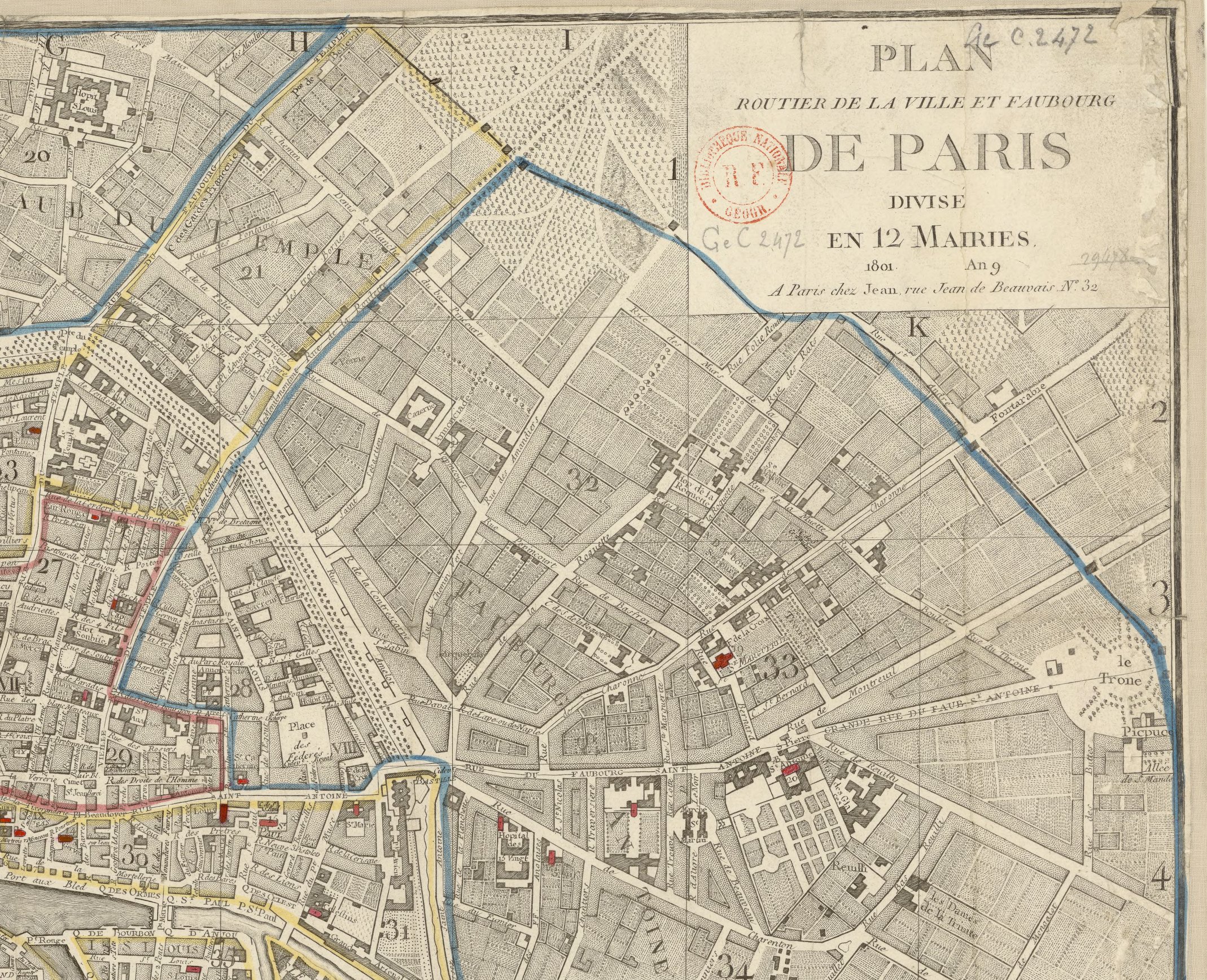
The guillotine was first moved to the poor quarter of the Place de la Bastille, where it was indignantly rejected by the residents of that vociferous neighbourhood. It was finally moved to the Place du Trône [by that time called Place du Trône Renversé or Place of the Overturned Throne], now known as the Place de la Nation, a vast unvisited public square…at the remotest end of the rue du Faubourg St. Antoine. Far from the sight of respectable property owners, yet publicly displayed for the benefit of those who enjoyed watching the executions, the guillotine could here unapologetically go about its business.

Map

A map from about 1800 shows the site, surrounded by fields (it is at the very far right of this image). The bodies were dumped in a pit nearby, which is now part of the Cemetery of Picpus (or Piquepuce, meaning fleabite). Today, a memorial to the 16 Carmelites can be seen in the cemetery.

Plaque_Carmélites_de_Compiègne,_Cimetière_de_Picpus,_Paris_12

The tablet includes the name de Croissy. In the opera, the Prioress de Croissy dies in a harrowing scene at the end of the first act, before the Revolution encroaches on the convent. But the real Madame de Croissy died on the guillotine with her sisters. According to Carmelite tradition, a Reverend Mother serves for only a limited term, after which an election takes place for a successor. This had happened before the Revolution began, and the office of Prioress had been transferred to Madame Lidoine, who is listed as Reverend Mother on the tablet.

You can also see the name Constance of Saint Denis, the novice. She was a real person. Her name at birth was Marie-Geneviève Meunier, born at St-Denis in 1765, so she was 29 when she died. She had been unable to take her final vows, since religious orders had been suppressed during the Revolution. Although in the opera, she was the last to die, in truth she was the first (the Reverend Mother Lidoine was the last) and she pronounced her vows to her superior just before mounting the scaffold.

So what, exactly, happened? In 1790, the new Revolutionary government decided to abolish religious orders, for a number of reasons. For one thing, many religious orders had strong ties to the monarchy and tended to be royalist. For another, the Revolutionaries felt that human reason was the ultimate authority, not religion, and priests, monks, and nuns had no part in their world. And finally, there was a practical reason: the government needed money, and those churches, convents, and monasteries represented wealth they could seize – from agricultural estates to gold and silver vessels.

Orders that provided services such as nursing or teaching were not targeted at first, but the Carmelites were a contemplative order – their vocation was prayer and meditation. In 1792, all contemplative nuns and monks were expelled from their convents or monasteries, forced to wear civilian clothing, and required to swear an oath of loyalty to the state.

DialoguesCOC3

All across France, monks and nuns faced three options: return to secular life, go into exile and join an order in another country, or continue the religious life in hiding. The Carmelite nuns in Compiègne took a somewhat different path. They split into four groups and took lodgings in the town. Although they wore secular clothing, they continued as much as possible to live a contemplative life, attending mass at the church of St-Antoine in Compiègne. It seems they did not make much attempt to conceal what they were doing. For two years, they continued in this way.

They were arrested in June 1794 and taken to Paris for trial, accused of conspiring against the state and of religious fanaticism (one nun asked the judge who was the real fanatic). Reverend Mother Lidoine tried to take full responsibility and spare the others, but all 16 who had been arrested were condemned to death. Three other nuns who had not been in Compiègne at the time of the arrest escaped, including one who wrote a memoir about her experiences.

An interesting historical detail is that at their trial and execution, the nuns were wearing their habits, despite the prohibition against religious clothing. It turns out that when they were imprisoned in Compiègne they asked for permission to wash their clothes. In the meantime, they put on the only other things they had: their Carmelite habits. Just as their civilian clothes were soaking wet, the order came through that they were to be taken to Paris. Therefore the pictures of the nuns going to the guillotine in their habits are accurate – with one exception. They wore white caps, instead of the wimples and veils most images show. Their executioners demanded bare necks.

BTR1

Why did they have to die? What difference did it make to the Revolution if this group of women in a small town 70 kilometres away from Paris continued to pray and attend mass? There are two ways of thinking about it.

From the Revolutionaries’ point of view, this form of passive resistance was unacceptable. The nuns would not submit to the authorities; they had to be punished for insubordination. Some personal motives also played a part. The mayor of Compiègne, who was anxious to curry favour with the authorities, hastened their arrest to indicate his loyalty to the Revolutionary cause.

Another view is that the nuns chose to be martyrs. They believed that by sacrificing themselves, they could help save France. Certainly, at their execution, the sight of their habits and the sound of their singing silenced (for the first time) the jeering mob in the Place de la Nation. The nuns’ serenity must have made at least some observers feel a compunction they had not felt when watching others die.

And, indeed, ten days after they died, the Terror came to an end with the execution of Robespierre. His downfall had already been set in motion when the nuns mounted the scaffold, but who is to say that the manner of their death did not help change attitudes and hasten his end?

In 1906, the Carmelites of Compiègne were beatified by the Catholic church (they have not been canonized, so they are not considered saints). To some, their story is beautiful; to others it is merely sorrowful. But thanks to the genius of Poulenc, their story will never be forgotten.

martyrsofcompiegne

Text by Philippa Campsie. Images from Google Earth, Gallica, Wikipedia, and the Canadian Opera Company.

To hear the final scene from the opera, click here. I chose this YouTube version because it includes the full orchestral prelude to the scene and because it does not show the staging; it is intended for listening only.

Sources:

William Bush, Bernanos’ « Dialogues des Carmelites » : Fact and Fiction, Carmel de Compiègne, 1985.

Steven Payne, The Carmelite Tradition: Spirituality in History, Liturgical Press, 2011.

Peter Thomas Rohrbach, Journey to Carith: The Story of the Carmelite Order, Doubleday, 1966.

Posted in Paris history, Paris music | Tagged , , , , , , , , , , , , , , , , , , | 22 Comments

Buttes Chaumont: The Park for the People

Although it lacks the aristocratic pedigree of some Paris parks, the Parc des Buttes Chaumont in the 19th arrondissement is my favourite. The Bois de Boulogne and the Bois de Vincennes were formerly royal domains for hunting. But the Buttes Chaumont was once a gypsum quarry, an abattoir for horses, a malodorous dumping ground for night soil, and a hiding place for criminals. A long-gone neighbour was the infamous Gibbet de Montfaucon, where the bodies of criminals who had been hanged would dangle in the breeze, supposedly as a deterrent to other malefactors, but more usefully as a treat for crows and ravens.

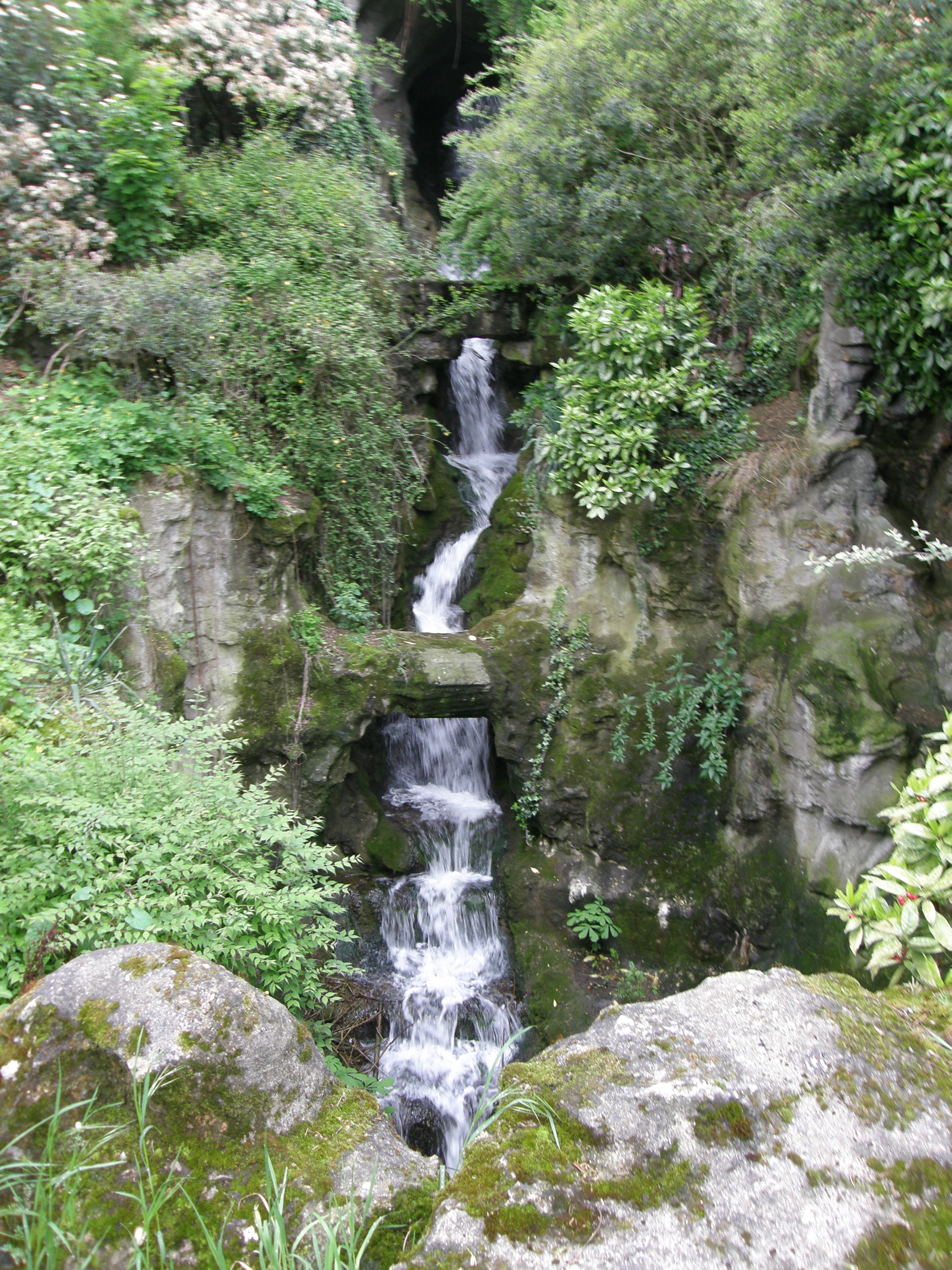
Even today, the park’s rocky waterfall seems far removed from the well-organized Paris created by Baron Georges-Eugène Haussmann.

OLYMPUS DIGITAL CAMERAThis park was primarily the work of two men: Adolphe Alphand, who oversaw the design and construction of parks under Haussmann, and Jean-Pierre Barillet-Deschamps, chief gardener for Paris.

OLYMPUS DIGITAL CAMERA

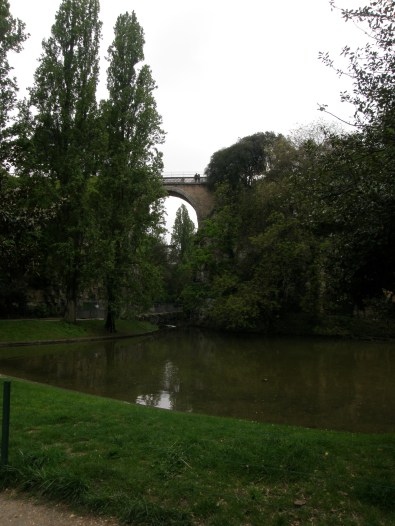
A single-arch bridge overlooks a lake; one could be out in the country.

OLYMPUS DIGITAL CAMERA

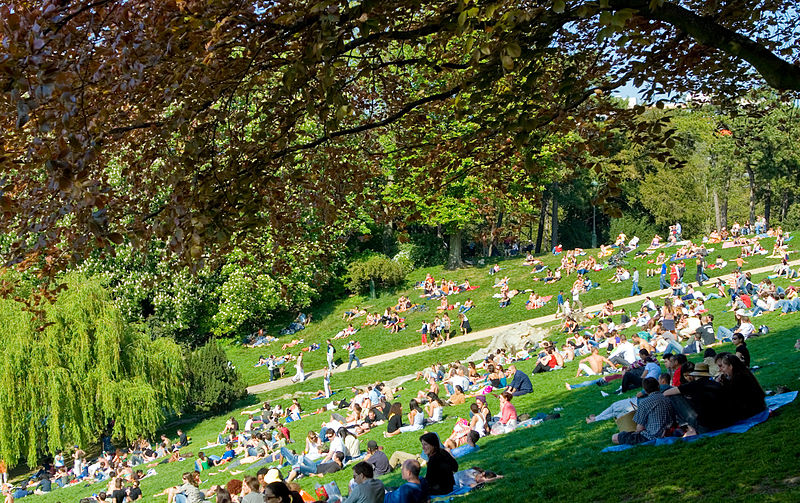
But consider the view below: it is quintessentially Parisian. Start with grassy space, add sunshine and soon Parisians will be lounging about enjoying themselves. It is a wonderful sight.

800px-070422_Parc_des_Buttes_Chaumont_001

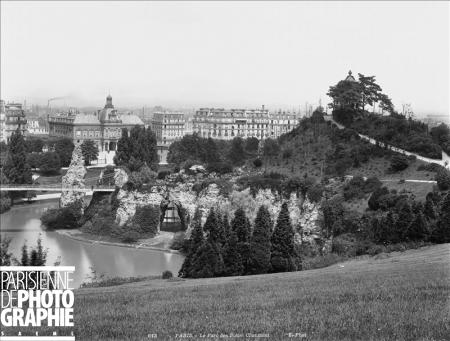
In the photo below, taken between 1880 and 1890, we see an island in a lake, covered with trees. At the top is a temple or belvedere, with a long approach path. On the left is the suspension bridge that connects the island to the main body of the park. The background appears to be densely populated.

20246-4

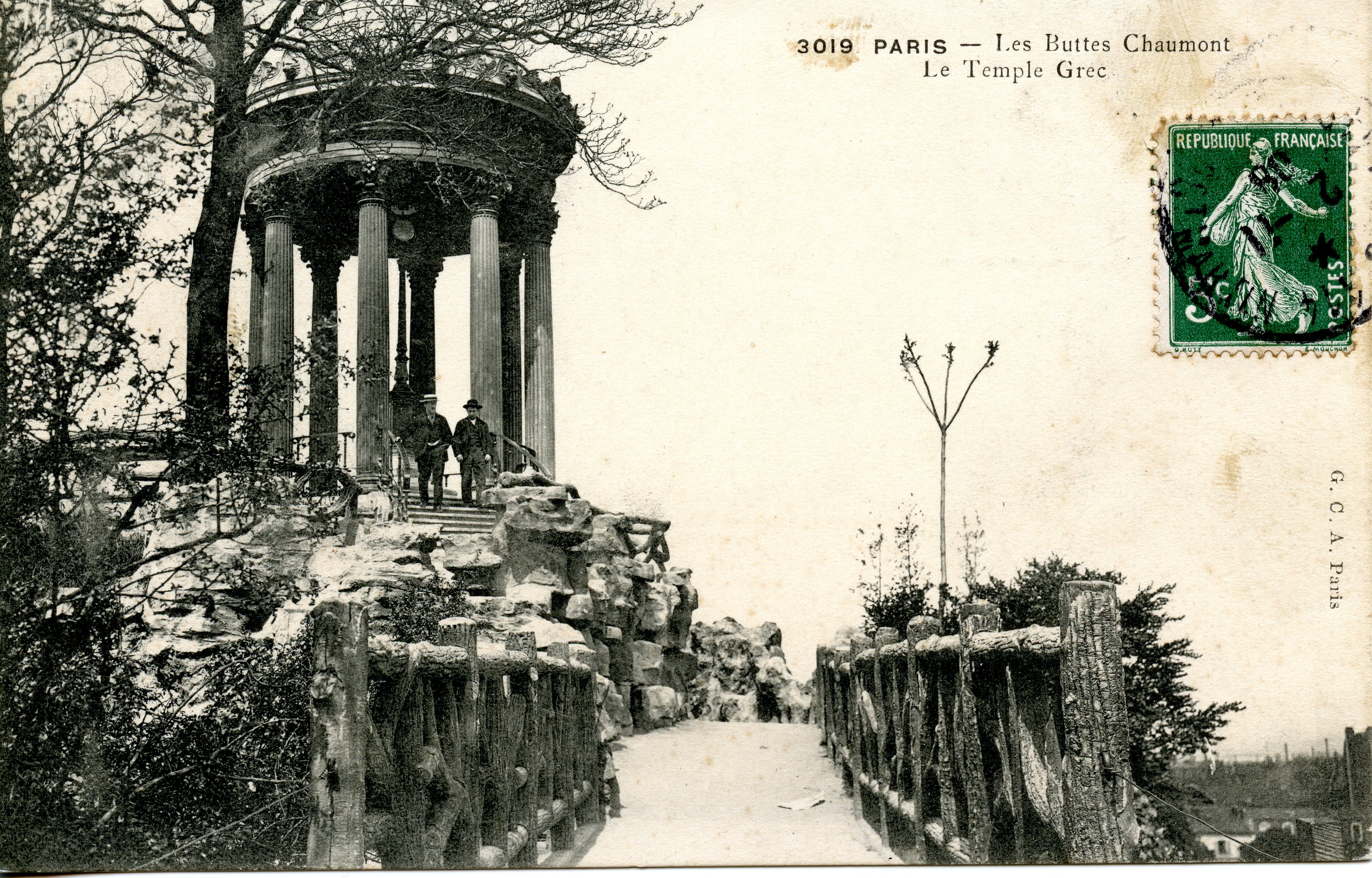
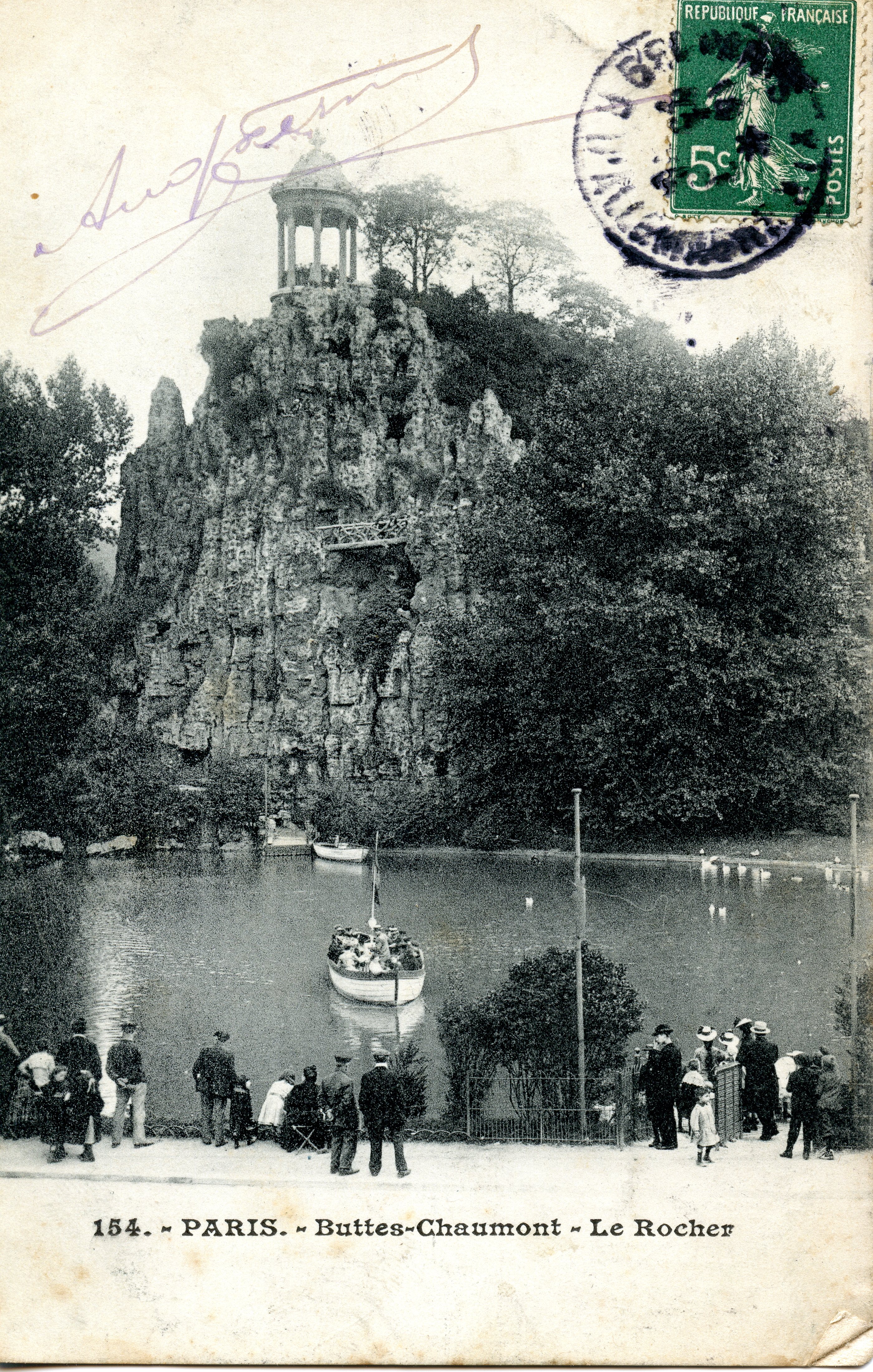
Clearly, the temple is a significant monument placed for maximum visibility. But to get a proper sense of scale, one has to be there, or see images such as the one in the postcard below. Although it is labelled “Le Temple Grec,” it was actually modelled after the Roman temple of Sybil in Tivoli, Italy.

Paris Buttes Chaumont001

However, the most astounding feature of the park is the huge distance between before and after.

The Parc des Buttes Chaumont opened as a free public park on April 1, 1867, as part of the opening of the Paris Universal Exposition on the same day. The city was in the midst of the upheaval often called “Haussmannization” that transformed Paris from a mediaeval city of narrow, often filthy and smelly winding streets into the Paris of wide boulevards, long vistas, sculptures and monuments, imposing public and private buildings, a reliable water supply, sewer systems and clean streets.

While much has been written of the geometry of boulevards, vistas and buildings, Napoleon III also wanted parks, like those he had seen in London during his sojourn in England. Under his orders, the Bois de Boulogne was completely redesigned to fit the English model, with winding paths and varied terrain. But not all of Paris had former royal hunting grounds that could be converted so easily.

Through annexation, Napoleon III nearly doubled the size of Paris and during his reign the population of Paris also nearly doubled. Some of the newly annexed areas, particularly those in the north and northeast were sparsely populated and largely poverty-stricken. But they, too, needed parks. Parks were seen as healthy antidotes to poor living conditions as well as an aid to keeping political turbulence and restlessness in check.

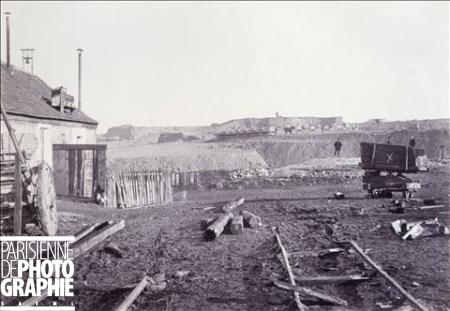
Part of the annexed area included the quarries of the Buttes Chaumont. So much of the gypsum quarried in this area had been sent to the United States that the site became known as the American Quarries. Parks were supposed to be beautiful, restful, green, healthy. This was a scar on the landscape. The photo below of a part of the quarry was taken in 1877.

34479-3

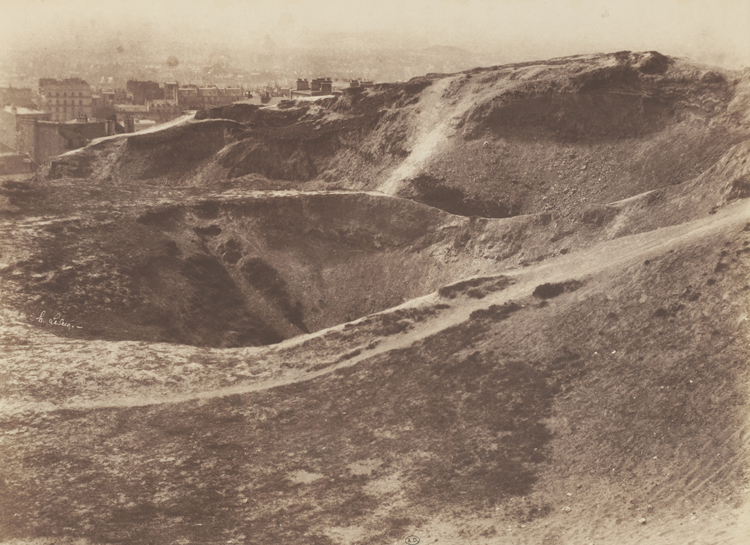
Here, in an 1852 photo by Henri le Secq, we see the desolate, almost lunar landscape, but also how closely it encroaches on inhabited areas.

arton2154-a0780

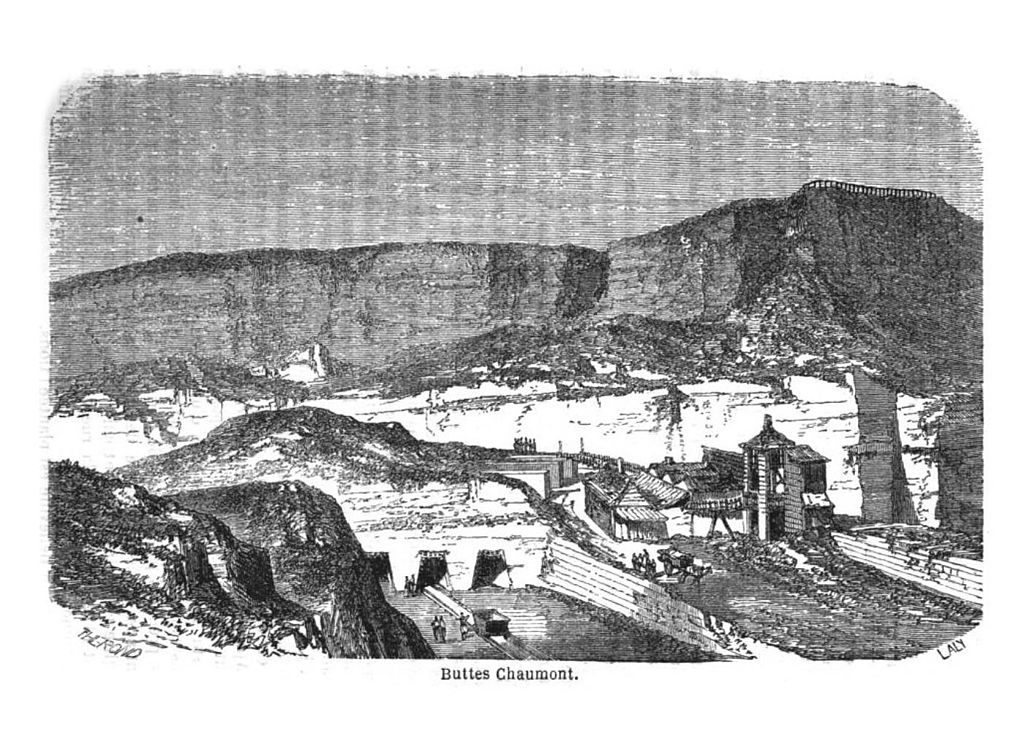
Perhaps an even better idea of the unlikely site comes from this image from an 1863 guidebook.

1024px-Buttes_chaumont_carrieres_joanne_1863

Unlikely as the site was, it became the focus of Haussmann’s plans for a new park. Things happened quickly. In late 1863 the city of Paris acquired the site between La Villette and Belleville. Construction started the following year.

Some of the statistics are staggering. There were about 1,000 workers, 100 horses, 450 wagons on 39 km of temporary rails, huge amounts of dynamite. Workers excavated 800,000 cubic metres of material and brought in 200,000 cubic metres of soil ready for planting. Part of the site included a suspension bridge by a young engineer by the name of Gustave Eiffel. The bridge remains, but is less well-known and visited far less than the tower he co-designed and built for the 1889 exposition.

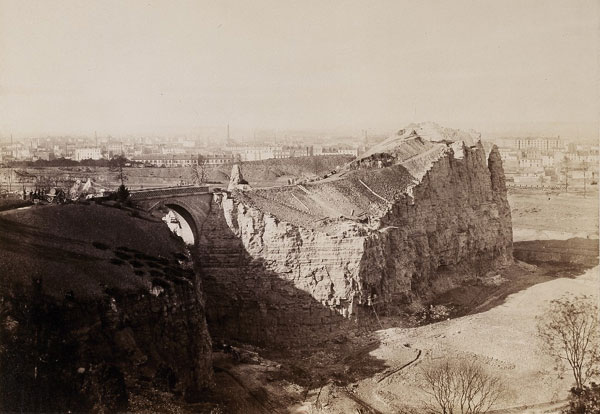
In this photo, taken during construction, we begin to see the key features emerging. The famous brick bridge is visible on the left and we see the large land mass above what is to be the lake.

Buttes_Chaumont_Charles_Marville-1

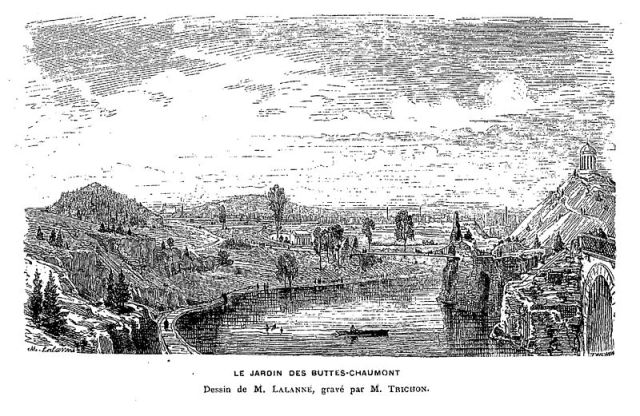
In an 1867 guide to Paris, an engraving of the completed park shows the suspension bridge in the middle distance, the brick arch bridge on the far right, and, on top of the promontory, the temple.

800px-Buttes_chaumont_paris_guide_1867

Having the park ready for opening day April 1, 1867, was a staggering achievement. However, the park was not a financial success. Like many of Haussmann’s projects, it ran over budget. Moreover, it did not have the economic effect that had followed the creation of the Bois de Boulogne. That park had raised real estate values in the surrounding area, which in turn increased taxes flowing into the city coffers. Money had also come from the sale of state property whose value increased as a result of the Bois de Boulogne. This scheme of raising real estate values near parks worked in the more well-to-do western areas, but it did not work in the northeast of Paris.

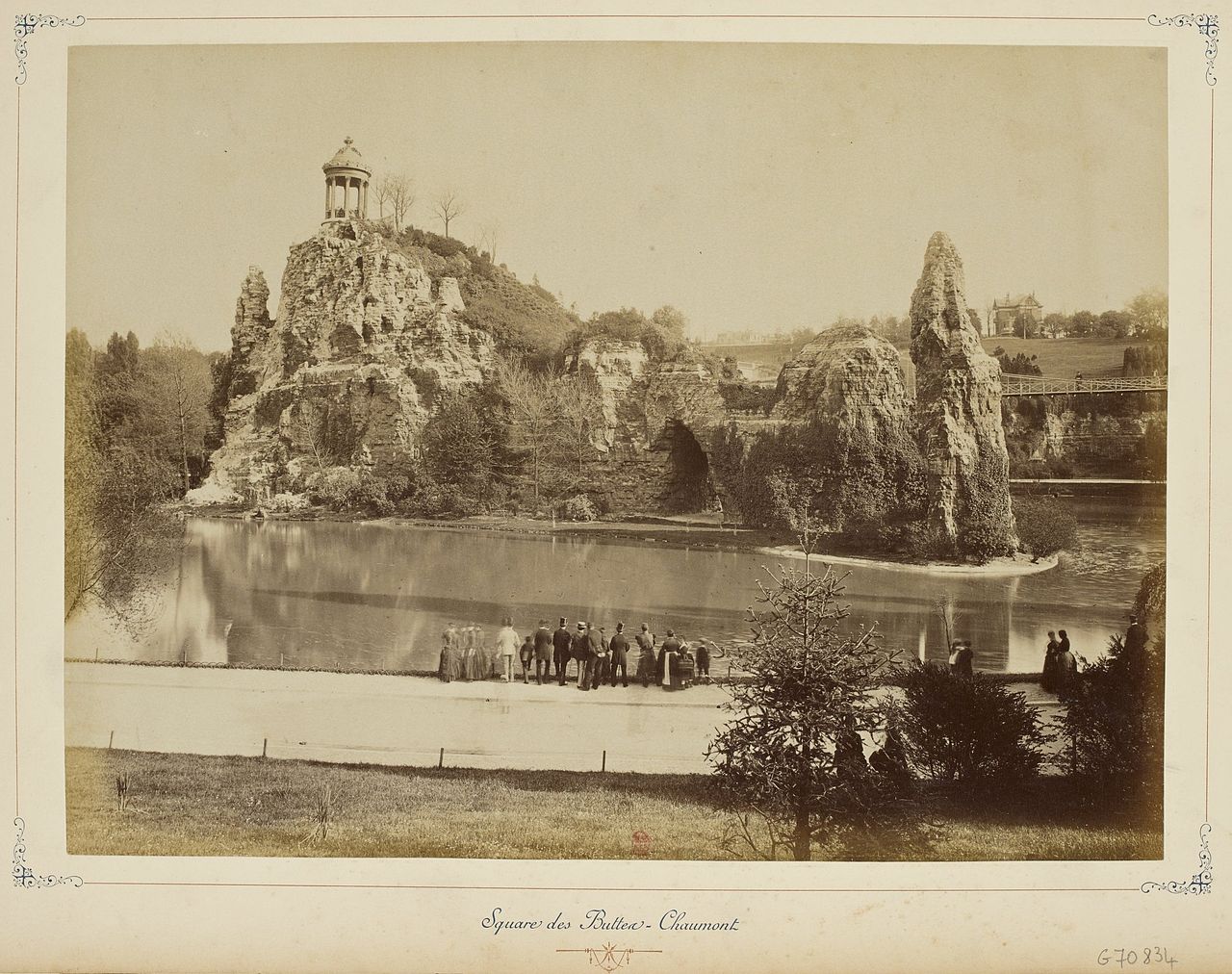
Of all the late 19th and early 20th century photos of the park, the one below is perhaps my favourite. Somehow the massive landscape and the people seem to fit as they should. But what else is the photo saying?

1280px-Paris_et_ses_environs_1890-1900_square_des_buttes_chaumont

When I look at the people in this photograph, I see that they are dressed formally, but are probably not wealthy. The women’s gowns are quite plain. They might be visiting on a special occasion, but they may not be far from their homes. Perhaps they are proud of their park. When I think of who might be in this photo, who might have come to the park, I think of something that touched me deeply when I first read it.

Baudelaire’s “Eyes of the Poor” was written in 1864 and published in 1868 in his collection of works titled Paris Spleen. It is written from the point of view of a man with the woman he loves. They are sitting in one of the glittering cafés on one of the new boulevards where things were not yet finished, but still splendid. On the street they could see those for whom the changes meant little or nothing:

A worthy man of about forty, with a tired face and greying beard, stood holding a small boy by the hand and carrying on his arm a tiny child, still too weak to walk. He had assumed the role of nurse-maid, taking the children for an evening stroll. All were in rags.

Each looked at the scene differently.

The eyes of the father said: “How beautiful it is! How beautiful it is! All the gold of the poor world is displayed on those walls!” The eyes of the little boy: “How beautiful it is! How beautiful it is! But it is a place where only people who are not like us can go.” As for the youngest child, he was too fascinated to express anything but a stupid and profound joy.*

Baudelaire might have written the same scenario about the father and children in rags looking at the rich flaunting their wealth in the Bois de Boulogne and the child saying “it is a park where only people who are not like us can go.”

The photo above was taken about 40 years after Baudelaire wrote those lines. One hopes that the people who knew that the bright cafés of the new Paris were not for people “like us” could go to the Parc des Buttes Chaumont because it was for people like them. Did the poor boy once dressed in rags come there as a man?

I appreciated the Parc des Buttes Chaumont before I knew its story, its history, and its possible meanings. It reminds me of another park I knew as a child growing up in Hamilton. When visitors came, we would take them to see the Rock Garden in the Royal Botanical Gardens on the far side of the city. It was a magical place for a little boy. Later I learned it had been built in a disused gravel quarry as a make-work project for the unemployed during the Depression of the 1930s.

Like the Buttes Chaumont, it was a place where you could feel you belonged, no matter what part of the city you lived in.

Paris Buttes Chaumont010

Text and original photographs by Norman Ball. Postcards from the collection of Norman Ball. Additional images from Paris en Images, Wikimedia Commons, and Gallica.

*Droit devant nous, sur la chaussée, était planté un brave homme d’une quarantaine d’années, au visage fatigué, à la barbe grisonnante, tenant d’une main un petit garçon et portant sur l’autre bras un petit être trop faible pour marcher. Il remplissait l’office de bonne et faisait prendre à ses enfants l’air du soir. Tous en guenilles…

Les yeux du père disaient: «Que c’est beau! que c’est beau! on dirait que tout l’or du pauvre monde est venu se porter sur ces murs.»—Les yeux du petit garçon: «Que c’est beau! que c’est beau! mais c’est une maison où peuvent seuls entrer les gens qui ne sont pas comme nous.»—Quant aux yeux du plus petit, ils étaient trop fascinés pour exprimer autre chose qu’une joie stupide et profonde.

Posted in Paris parks | Tagged , , , , , , , , , , , , , | 5 Comments

The man who gave Paris 50 fountains

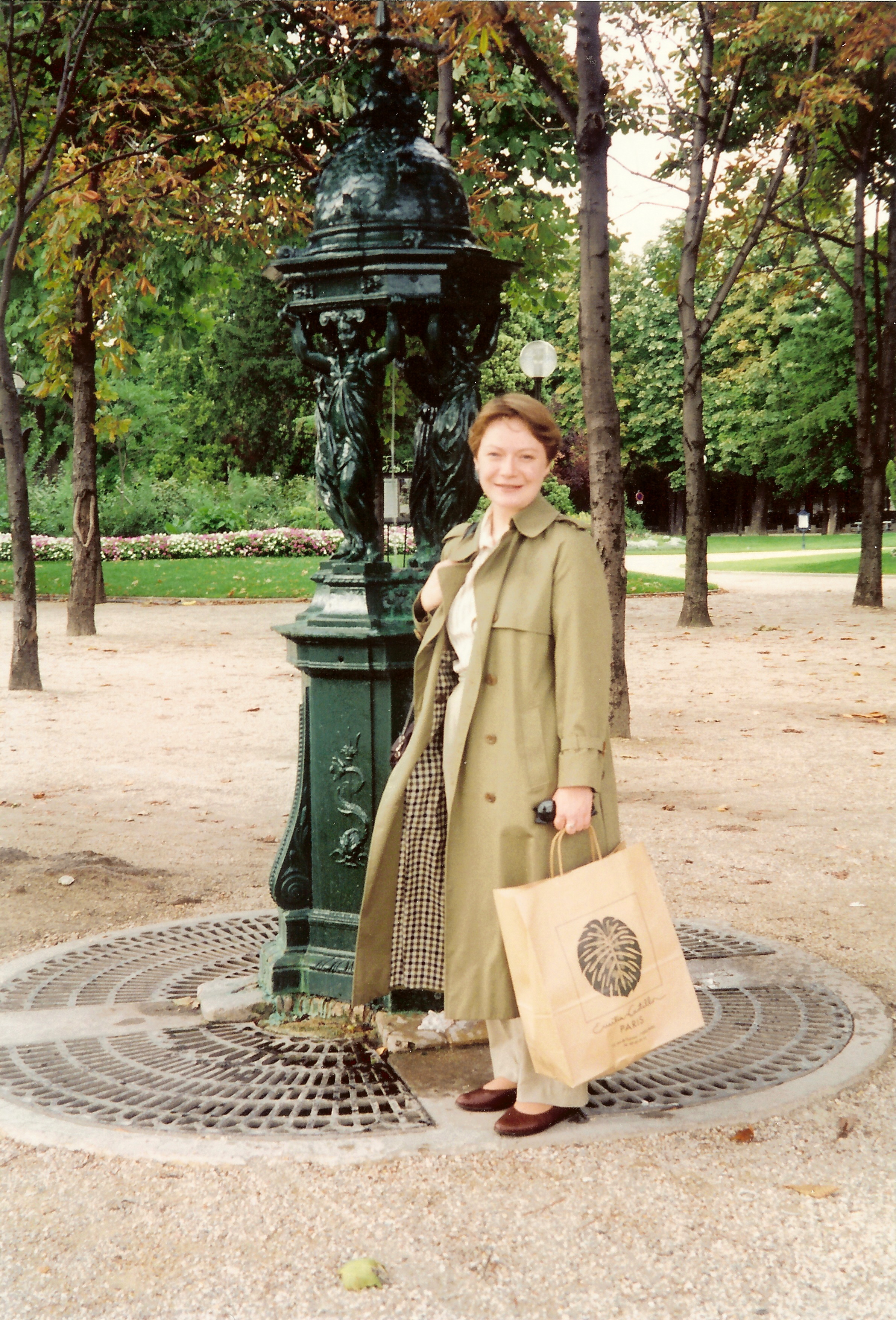
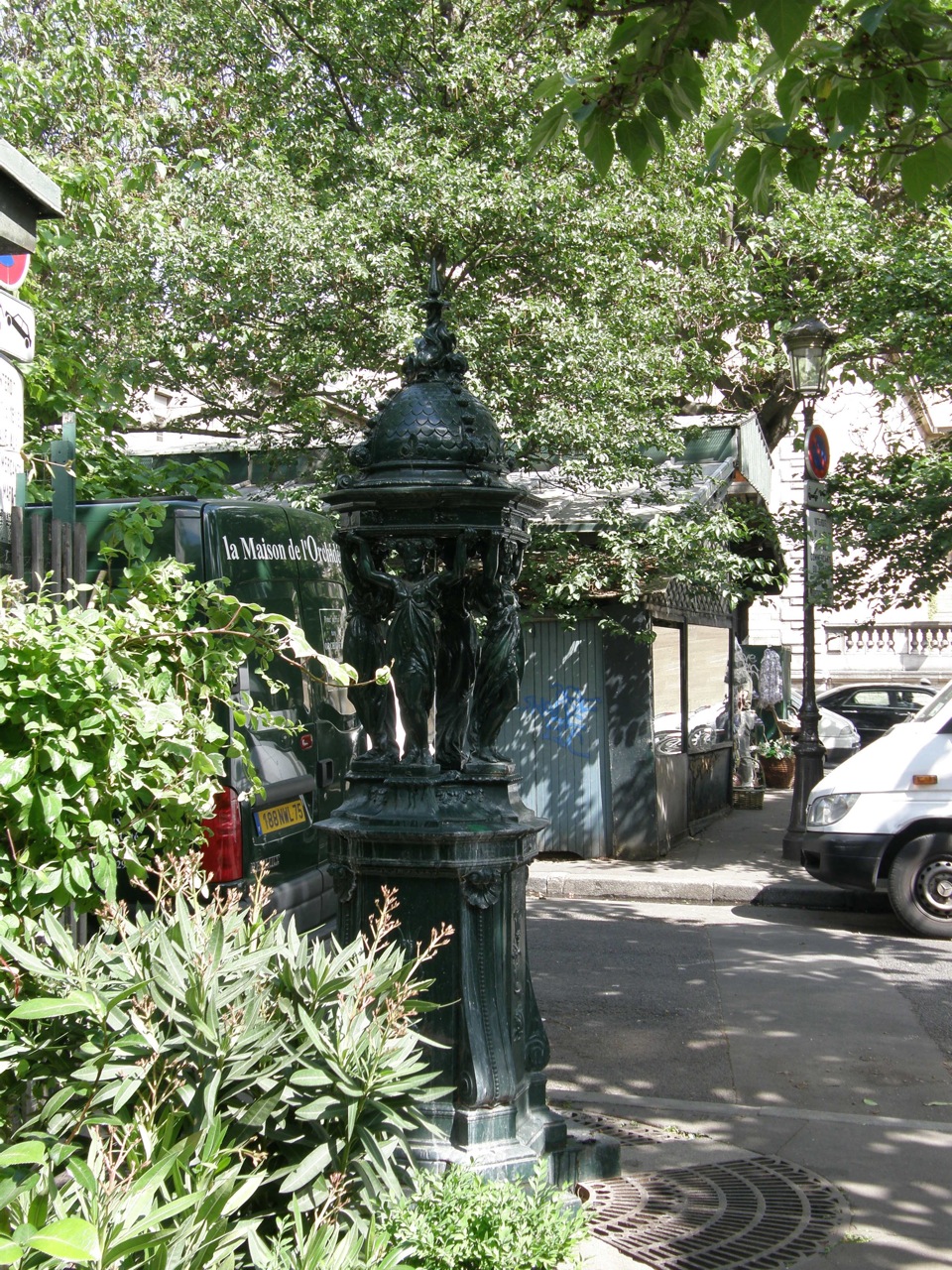
On our first visit to Paris together, Norman took a picture of me standing beside a Wallace fountain. I liked the dark green caryatids and the elegant dome.

PhilippainParis

Later, on a visit to the Pavillon de l’Eau, we learned that these fountains were a gift to the City of Paris from an Englishman named Wallace. How jolly decent of him, we thought. And until recently, that was all we knew about the matter.

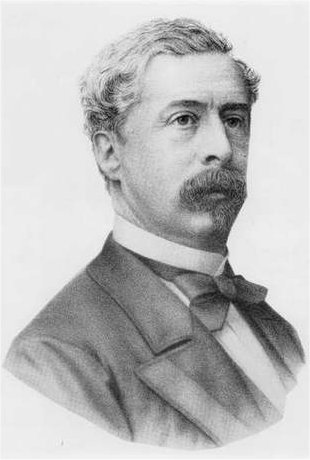
Then I read Matthew Harrison’s history of St. George’s Church in Paris, in which he summarized the odd life of Richard Wallace (1818-90), a benefactor of the church. Intrigued by his tale, I did more research and found a very complicated story indeed.

historical2

To start with, Wallace was not his name by birth, but one that he chose for himself. He was brought up in Paris by his grandmother, but he called her Aunt. He was the illegitimate son of an English nobleman who employed him as a secretary and left him a fortune, but never acknowledged him as a son. His French wife lived for years in England, but never learned to speak English, although she was the one who left the huge bequest of mostly French art to the English nation: it is now known as the Wallace Collection and is still on view in London.

Maybe I should start at the beginning.

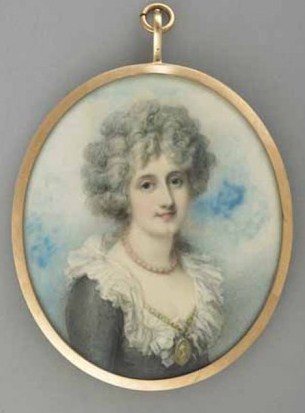
Let’s go back to 1798, when Richard Wallace’s grandfather, Francis, son of the Marquess of Hertford, eloped with the illegitimate daughter of an Italian dancer. There is a lot of illegitimacy in this story. Her name was Maria Emily, but everyone called her Mie-Mie. Although she had been born out of wedlock, her wealthy father (the Duke of Queensberry) made sure that she grew up in comfort. Here is a picture of her, in a miniature from the Wallace Collection.

Mie-Mie

Mie-Mie was wealthy, but because of her origins, she was not accepted into London society after her marriage. She convinced her husband to move to Paris with their two children (a girl and a boy). This was 1802, during a short truce in the war between England and France. Mie-Mie loved Paris and settled in happily, but her husband frequently went back to England without her.

Soon, relations between England and France were fraying, and so were those between Francis and Mie-Mie. Francis returned to England, but Mie-Mie stayed in Paris, now with three children (one was, ahem, not her husband’s). When her father the Duke of Queensberry died, he left her a comfortable inheritance, and she no longer needed her husband’s support.

Her first son Richard (who had been born in 1800) grew up in France and went to England after Napoleon’s defeat at Waterloo in 1815. He joined the British army as a hussar. In 1822, his father Francis succeeded to the family title and became the third Marquess of Hertford. Mie-Mie was now a Marchioness.

Two years later, Richard turned up on his mother’s doorstep with a six-year-old boy called Richard Jackson. This was his illegitimate son, who had been given his father’s Christian name and his mother’s surname. (Well, it wasn’t really her name, it was the name she had taken after separating from her husband – I told you this was complicated – but close enough.)

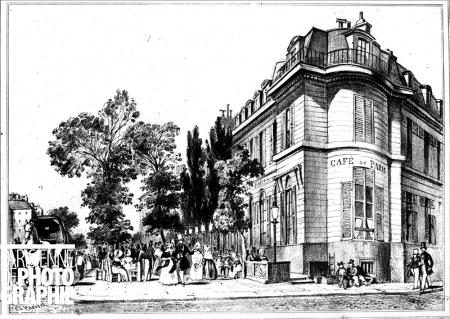
Mie-Mie took the little boy in and told him to call her “Tante.” Her beloved daughter had died a few years earlier and Richard Jackson seemed to fill a hole in her life. She moved to the rue Taitbout and took an apartment directly over the Café de Paris, one of the smartest restaurants in the city. Richard Jackson grew up watching the comings and goings of le haute monde underneath his windows. He also watched the comings and goings of Mie-Mie’s younger son Henry, a founder of the Jockey Club and well-known man about town.

5473-6

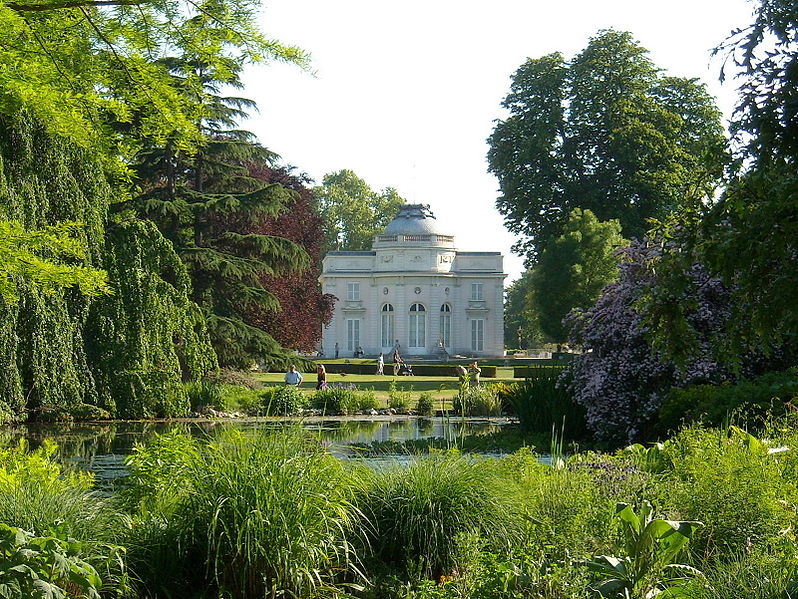
Meanwhile, his father Richard wandered around Europe, at one point stopping in Paris long enough to acquire a mistress and a little chateau in the Bois de Boulogne called Bagatelle. Eventually, he settled in Paris in an apartment on the rue Laffitte, installed his mistress nearby, and started to collect art.

His first purchase was a Fragonard, which he bought at a public auction. At the time, nobody was interested in 18th-century French art. It had gone out of favour  during the Revolution and in the 1840s, you could pick up Fragonards, Watteaus, and Bouchers for a song.

In 1842, Mie-Mie’s husband Francis died, and her son Richard became the fourth Marquess of Hertford. Having inherited the family fortune and estates, he could now collect art on a grand scale, and he did.

That same year, at the age of 24, Richard Jackson formally changed his name to Richard Wallace, his mother’s maiden name. By now, he had a mistress of his own, and even a son by his mistress (the apple doesn’t fall far from the tree), but he still lived with Mie-Mie, leading a bohemian life and frequently running into debt. The new Marquess decided that his son needed an occupation, so he made Richard Wallace his personal secretary. But he never acknowledged that his secretary was his own son.

The two worked together closely. Richard frequently acted as the Marquess’s agent in art purchases, and kept records of the ever-expanding collection, which contained Dutch, Italian and Spanish masters as well as French, and furniture as well as pictures.

When the Revolution of 1848 broke out, the family (minus Richard Wallace’s mistress and child) beat a hasty retreat. They spent six years in Boulogne before returning to Paris. Mie-Mie, Henry and Richard settled back into the rue Taitbout, while Richard Wallace’s mistress lived elsewhere, looking after their son, who was now in his teens.

Mie-Mie died in 1856, deeply mourned by her sons and grandson. Her younger son Henry died two years later (his will listed four children by various mothers – typical). Her remaining son, the Marquess, who never married, settled at Bagatelle and became increasingly reclusive while continuing to amass artworks.

Fast forward to 1870, when everything changed. As the French engaged in a disastrous war with the Germans, the Marquess was dying at Bagatelle. After his death and burial at Père Lachaise, the family estates passed to a cousin, who became the new Marquess, but the art collection, several properties (including Bagatelle), and a huge sum of money went to Richard Wallace.

Wallace had little time to enjoy his new wealth. Paris was in chaos. The French army was defeated, the Emperor Napoleon III was captured, and the Empress Eugénie fled to England. Wallace moved the collection from Bagatelle into his father’s old apartment on the rue Laffitte to keep it safe (he himself still lived in Mie-Mie’s former apartment). It was the right decision, as the lovely Bagatelle was later commandeered by the military.

798px-Jardin_de_Bagatelle-Mai_2010

Wallace never thought of leaving Paris, but he helped other English residents escape. He started a relief fund to help feed the poor, who were starving in the besieged city, and to help people left homeless by shelling. He also set up a medical clinic to treat the wounded. At some point, he even found time to marry his long-suffering mistress, Julie Castelnau, 30 years after the birth of their son.

Wallace also remained in Paris during the Commune that followed the war, horrified by the bloodshed it caused, but willing to help those in need. When it was over, the French made him a member of the Legion of Honour and named a street after him, and Queen Victoria made him a baronet in recognition of his services to the English in Paris.

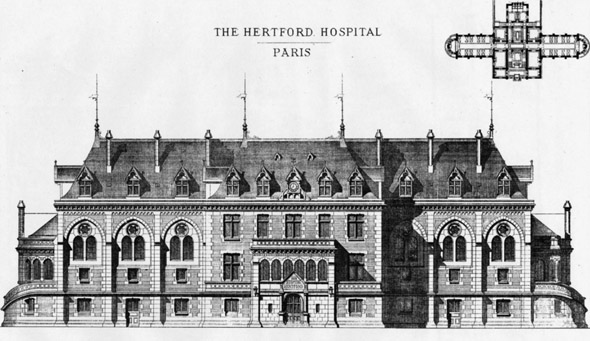
The violence of the Commune had so shocked Wallace that he decided to move to London in 1872, taking most of the collection with him. His parting gift to the city where he had lived was the 50 fountains that Parisians call les Wallaces, designed by the sculptor Charles Auguste Lebourg. (Later, Wallace honoured the memory of his father by founding and endowing the Hertford British Hospital in Paris, which opened in 1879.)

HertfordHospital

In London, Wallace moved in the best circles, dining with the Prince of Wales and the Prime Minister, but his wife Julie never learned to speak English and did not go out much. Their son, Edmond, disliked England and returned to France frequently. You won’t be surprised to learn that he had four children with a woman he did not marry. Wallace was furious and said, “Mon Dieu, est-ce que nous n’aurons jamais fini de bâtards?” (Are we never to have an end to bastards in this family?). Although Wallace became estranged from his son, he was devastated when Edmond died in 1877.

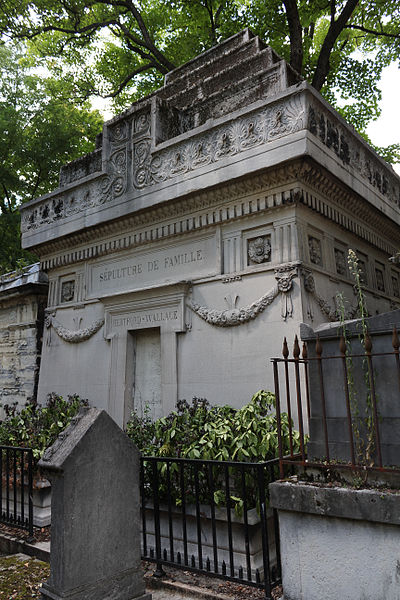
After this blow, Wallace withdrew from society, and went back to Paris to live at Bagatelle, leaving Julie in their huge London house with its enormous art collection. He died in 1890 in the same bed and in the same room as his father, attended only by a few servants, and was buried with his father at Père Lachaise.

Père-Lachaise_-_Division_28_-_Wallace_01

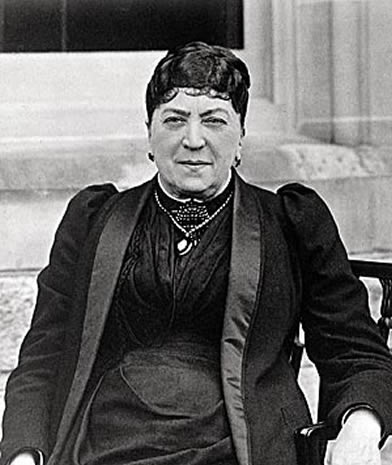
His will left everything he owned to his wife. It was she who left it to the British nation in her will. She remained in England to the end of her life, taking a translator with her whenever she went out. She died in 1897 and was buried with her husband in Paris.

ARTOIS_38

Edmond’s descendants are still living in France, the Bagatelle still stands in the Bois de Boulogne surrounded by its gardens, and the Wallace Collection remains a fixture in London. The Café de Paris, which stood at the intersection of the rue Taitbout and the boulevard des Italiens, closed in 1856, the year that Mie-Mie died (there is another restaurant there now, and a Monoprix). But the Wallace fountains continue to adorn the streets of Paris, the enduring legacy of an unconventional family.

P5190234

Text by Philippa Campsie, original photographs by Norman Ball, portraits from the Wallace Collection website, picture of Cafe de Paris from Paris en Images, photograph of Bagatelle and Hertford-Wallace family tomb from Wikimedia Commons; photograph of the Hertford Hospital from Archiseek.

 Sources:

An Anglican Adventure: The History of Saint George’s Anglican Church, Paris, by Matthew Harrison, 2005, published by Saint George’s Anglican Church, Paris

The Greatest Collector: Lord Hertford and the Founding of the Wallace Collection, by Donald Mallett, 1979, Macmillan.

Posted in Paris churches, Paris history, Paris hospitals | Tagged , , , , , , , , , , , , , , , , , | 15 Comments

Postcards of a Working River

We don’t often think of Paris as a port city. But the city handles about 20 million tonnes of cargo a year, and with more than 7 million people travelling on the river each year, Paris is the leading river port in Europe for passenger transportation.

A hundred years ago, it was more than just passenger traffic. All kinds of products were shipped along the Seine: construction materials, farm products, fuel.

I gravitate to postcards of the working river and snap them up when I see affordable ones. Here is one of my favourites. Notice the white-shirted deckhand near the stern lowering the smokestack so that this boat can get under the Pont au Change.

Port of Paris011

Many of the postcards refer to different “ports” within the city. Each one was associated with a particular product. I was curious about the covered barges or péniches that came in to the Port de l’Hôtel de Ville shown in this postcard.

Port of Paris001

Apparently this was the place where apples were brought in from Normandy and unloaded underneath the windows of Paris’s city hall. At the quai, the apples were loaded by hand into baskets or paniers and handed up to the next worker.

Once up from the hold, workers had to carry the heavy baskets across a narrow gangplank to the quai. It was tiring and potentially dangerous work, particularly in bad weather.

One of the more famous specialized port areas was Bercy, where wine was unloaded. It grew to become the major wine warehousing area – not just in France, but in the world.

Les Halles de Bercy represented the wine equivalent of the Les Halles food market. And like the food market, the area fell on hard times in the mid 20th century. In the 1970s, when Les Halles was demolished, the Bercy area had fallen into ruins. Today, it is a redeveloped area with a park that preserves some of the old wine storage sheds or chais.

My image of Bercy shows it looking desolate during the flood of 1910. That is the customs shed underwater.

Port of Paris014

Other quais were the specialized sites for unloading bulk commodities such as plaster or coal.

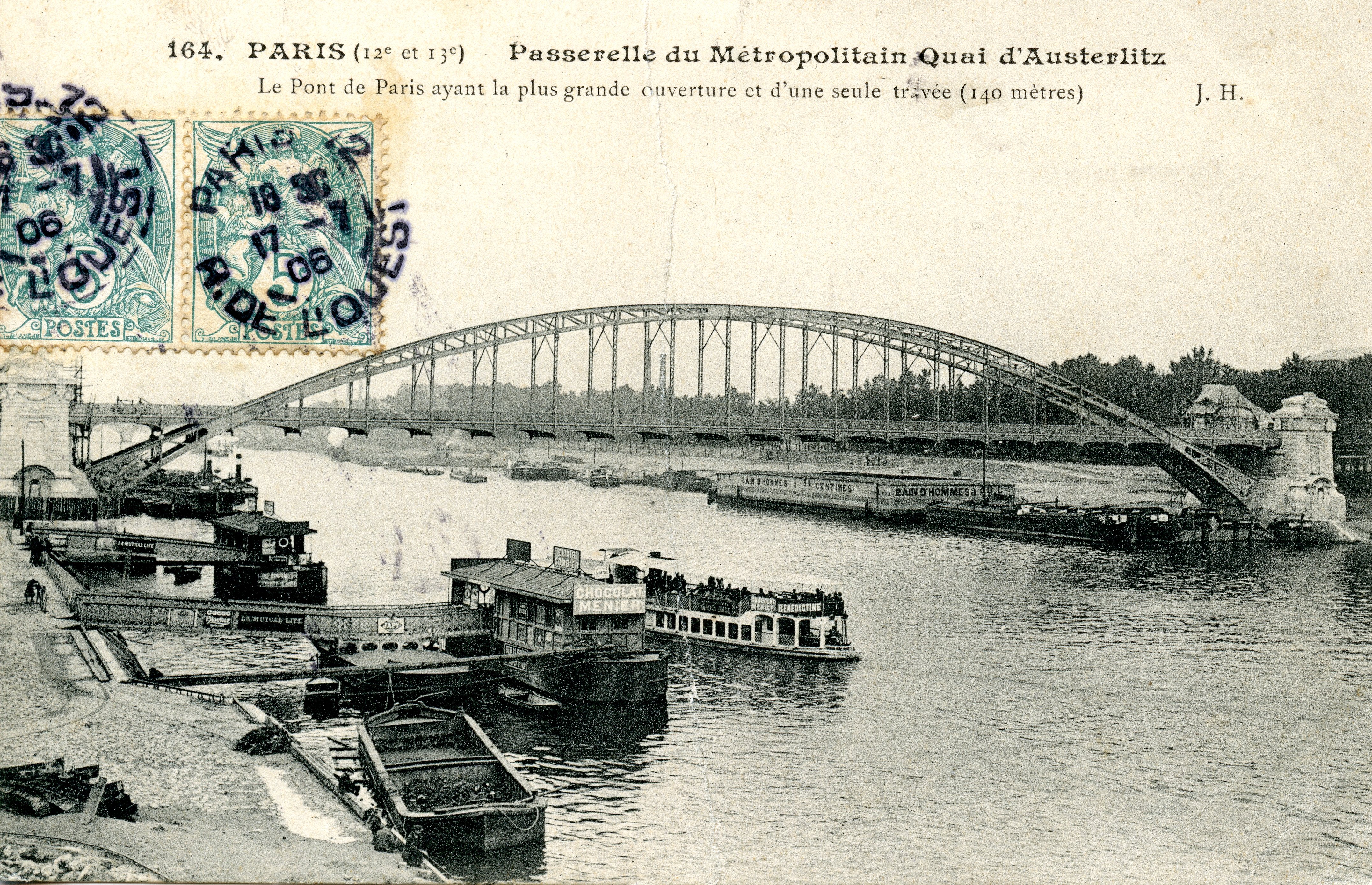
Not far from Bercy, the port d’Austerlitz handled bricks. Yet all this workaday activity co-existed with passenger traffic, recreation, and other activities.In this postcard of the Quai d’Austerlitz, sent in 1906, notice the advertisements for Chocolat Menier, Benedictine and “La Mutual Life,” and the “Bain d’Hommes – 30 centimes” on the far bank. At a time when many apartments were rather rudimentary in terms of water and sanitation, low-priced public bathing places were an important part of public health measures.

Port of Paris010

In many ways, it is this kind of extraordinary detail and variety that attracts me to these images.

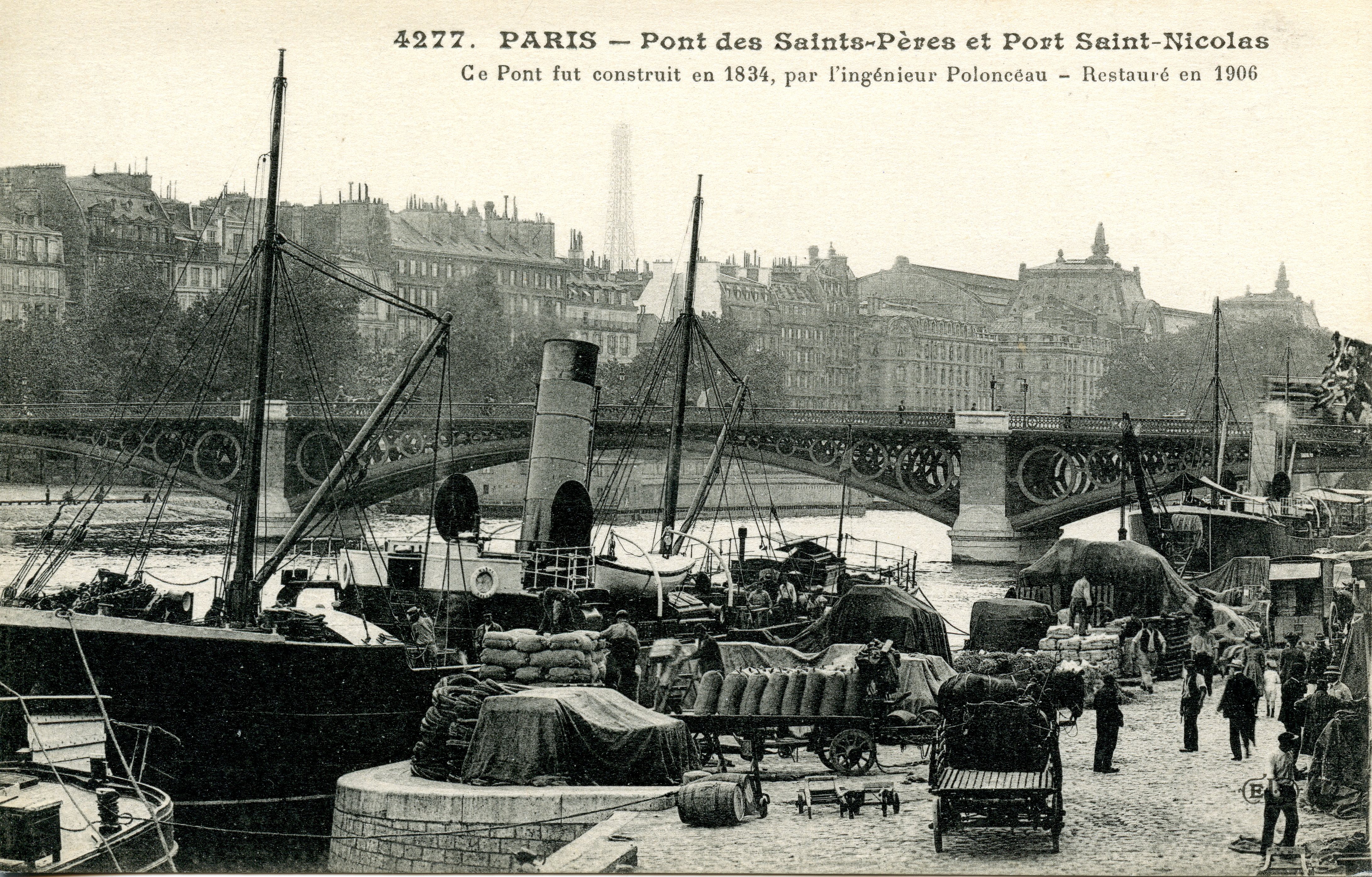
The postcard below shows the Port Saint-Nicolas, where a river boat from Rouen is unloading sacks (possibly containing plaster or lime). The Pont des Arts is in the background, which means that the Port Saint-Nicolas (now long gone) is right in front of the Louvre, and indeed, this area was also known as the Port du Louvre.

Port of Paris002

Notice the floating men’s swimming school beyond the piled-up sacks (Ecole de Natation du Louvre. Hommes).

In the next postcard, we see the same swimming school, but this view shows more activity on the quai and some passenger or pleasure boats in the river. But the same Rouen boat is tied up in roughly the same place. Perhaps it was a fixture in this spot.

Port of Paris003

The vantage point is identified as the Pont des Saints-Pères, today the Pont du Carrousel.

This third postcard is taken from the busy port, looking back at the bridge, as it was then. And, yes, it looks like the same Rouen boat once more.

Port of Paris004

What happened to the Pont des Saints-Pères? The website for the City of Paris tells us:

This first structure comprised a major technical innovation. It was designed by the engineer [Antoine-Rémy] Polonceau, who fought tooth and nail to have his project accepted in the face of opposition from the partisans of a suspension bridge. He even went as far as to finance the initial foundation work from his own pocket. The very lightweight structure consisted of three equal main arches, each of which itself comprised five composite wood and cast iron arches supporting a wooden deck. Although daring, this structure was nonetheless fragile, and in 1883, the bridge was closed for six months for replacement of some of the beams and cross-members. The technicians took this opportunity to suggest replacing the wooden deck with beaten [that is, wrought] iron, which was in fact done, but not before 1906. However, the structure was still extremely flexible and with the growth in the volume and weight of traffic, it shook and bounced disconcertingly.

Eventually, the bridge was replaced with the concrete structure that now crosses the river at this point.

Many people lived on houseboards and barges. The postcard below, which was mailed in 1904, depicts a rather ramshackle scene in which working and living are haphazardly mingled.

Port of Paris005

You can just see the Eiffel Tower on the right. This would have been in the river just off the 15th arrondissement and may have been taken from the Pont Mirabeau. The water level is very low, and a motley set of walkways connects the barges and houseboats to the shore.

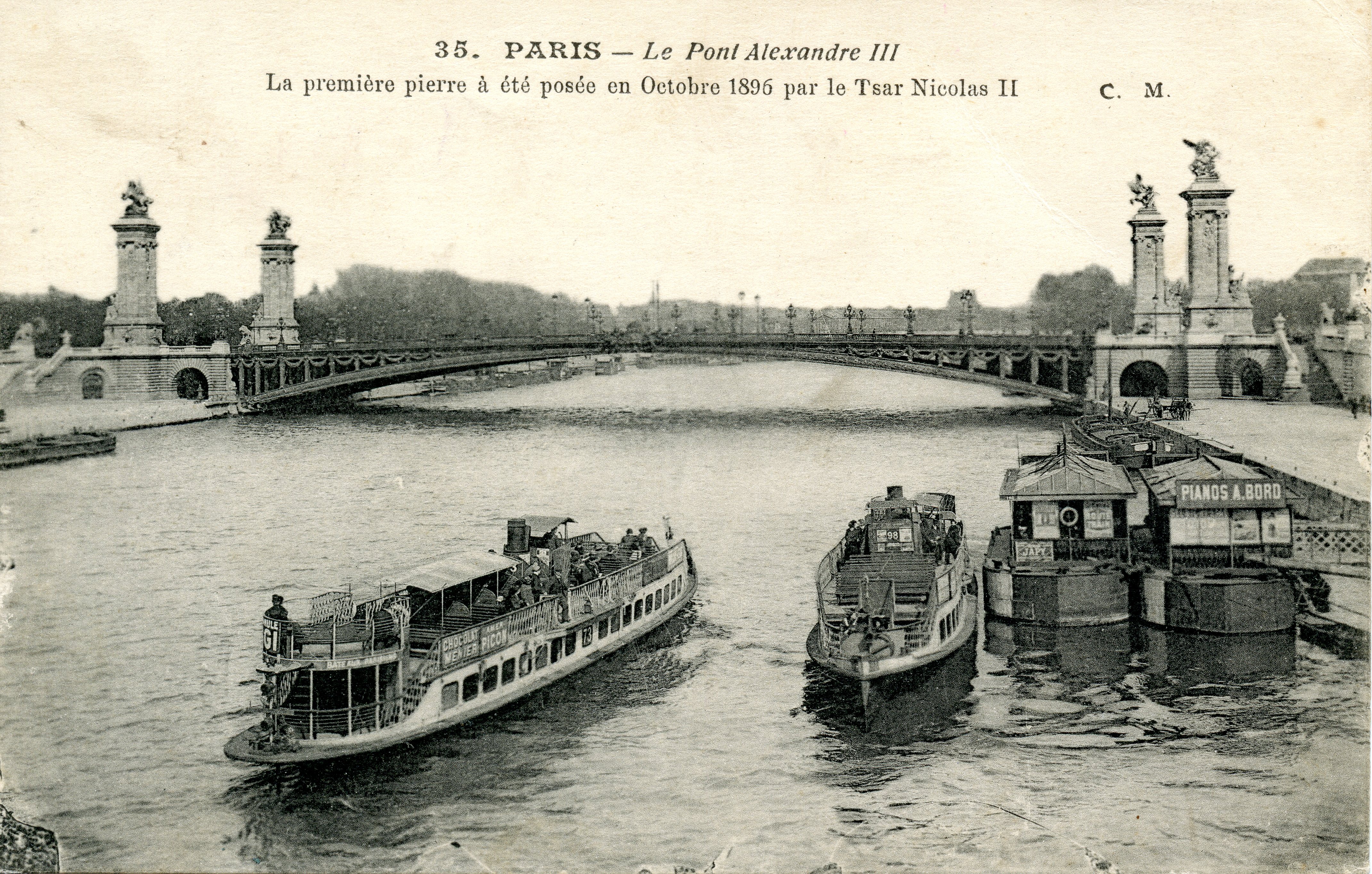
Today Paris is famous for its ubiquitous sightseeing boats – bateaux mouches – as well as boats for dining and entertainment. The idea of floating entertainment and sightseeing is well represented in early photos and postcards. In the image below, in addition to the magnificent Pont Alexandre III, one of the enduring monuments from the Exposition of 1900, we see a typical Parisian combo: tourist passenger boats cruising the river and two permanently moored entertainment vessels, with the promise of live piano music.

Port of Paris006

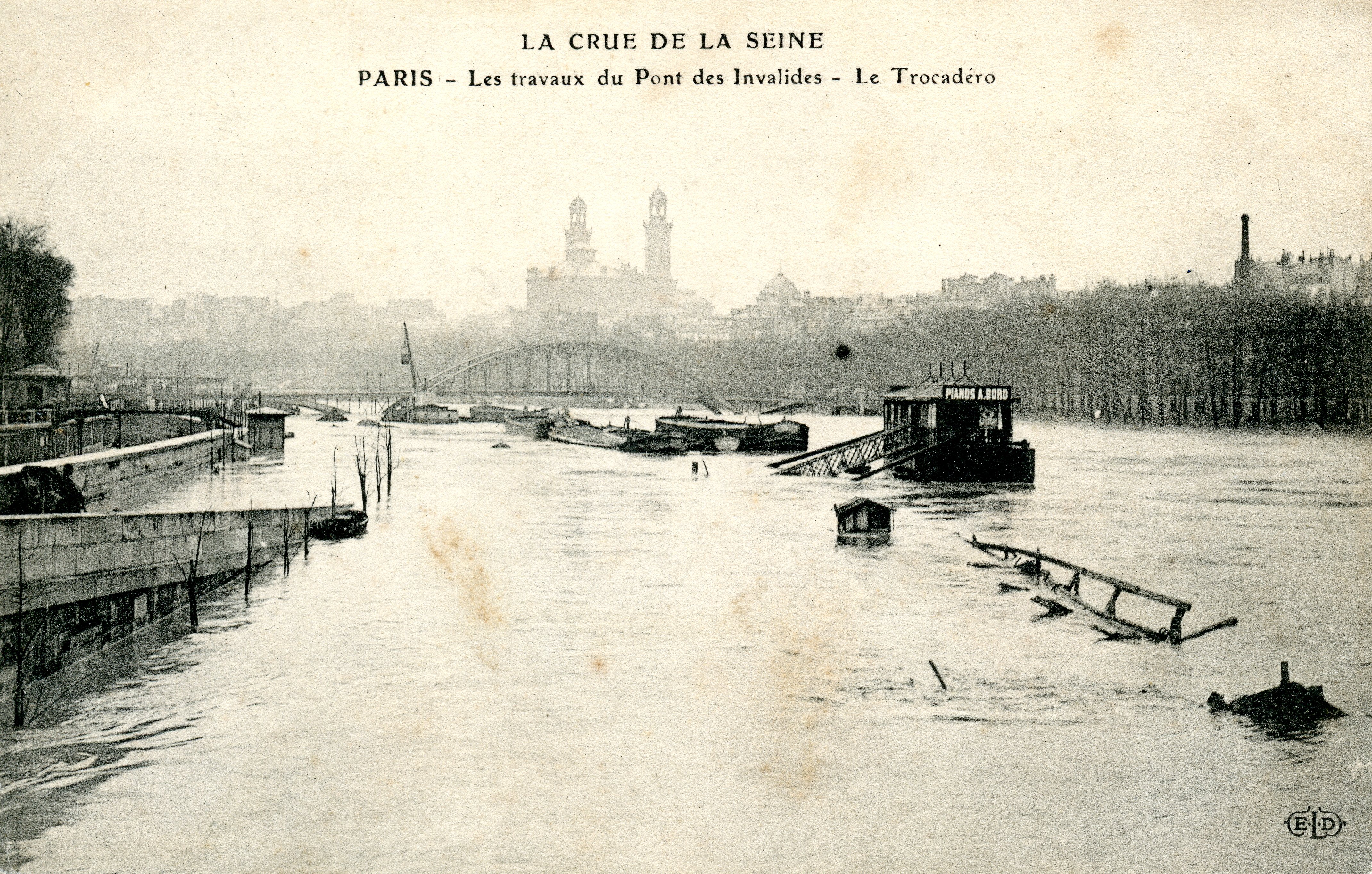
The great flood of 1910 was hard on floating places of entertainment like this. In the following postcard, the forlorn little boat in the middle is either the same as the boat second from the right in the postcard above, or one very like it. This was taken farther upstream, showing the nearly drowned Passerelle Debilly, which I wrote about in an earlier blog.

Port of Paris007

These are just a few of the many postcards I have collected of the working river. Perhaps I will show some others in a future blog.

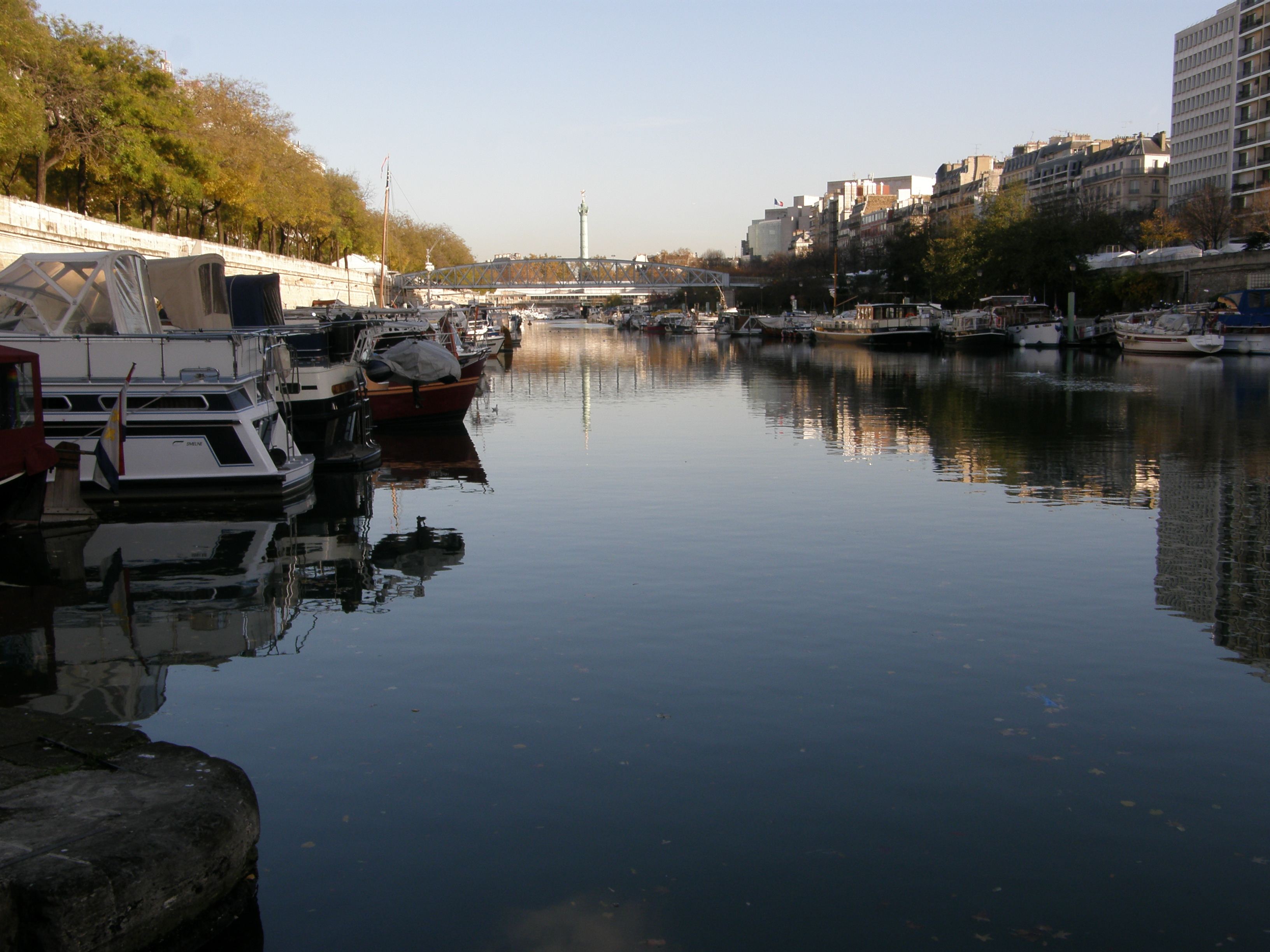
I will end with a view of the Bassin de l’Arsenal, looking towards the Colonne de Juillet in the Place de la Bastille. Note the barges full of sand and gravel.

Port of Paris008

Today, the same view shows pleasure boats and leisure. But they, too, are a form of work for their owners and caretakers.

OLYMPUS DIGITAL CAMERA

The Seine is still a working river, even as the work changes.

Text and original photograph by Norman Ball.

Posted in Paris bridges, Paris history, Paris markets, Paris postcards, Seine | Tagged , , , , , , , , , , , , , , , , , , , , | 10 Comments

Baltard’s Children

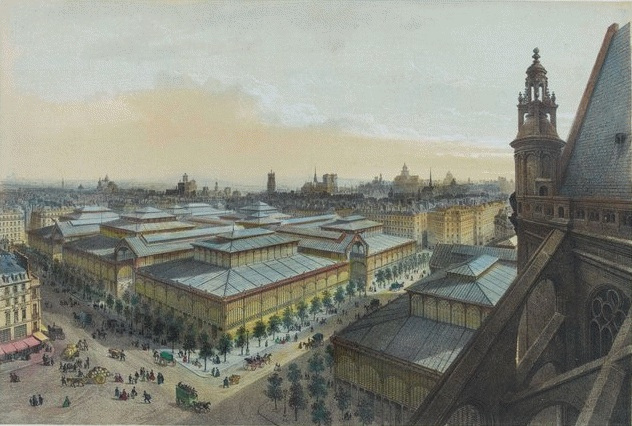
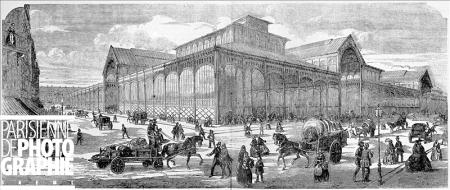
It is common among Parisians and lovers of Paris to bewail the loss of the nineteenth-century market buildings at Les Halles. Those pavilions of iron, wood and glass designed by Victor Baltard stood in the heart of the city from 1857 to 1973, when they were demolished in a fit of modernizing frenzy after the market itself had moved to suburban Rungis.

8080105097_e076f4da89_z

The story behind the pavilions contains a few surprises, as Norman and I found out at an exhibit at the Musée d’Orsay called Victor Baltard: Le fer et le pinceau (Victor Baltard: Iron and paintbrush).

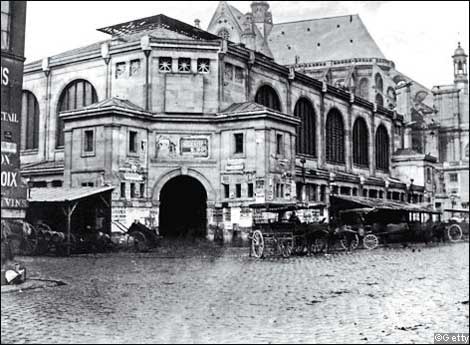
For one thing, the iron-and-glass pavilions were not the original plan for the markets. Baltard had designed something rather more traditional, capped by an iron roof but with stone walls. Construction was nearly complete on one of these buildings when in 1853 the Emperor Napoleon III decided to do a site visit. Apparently the Emperor was Not Pleased and work was halted. This was the building in question, photographed by Charles Marville.

db6b666c-2800-11df-9598-00144feabdc0.img

One can just imagine Napoleon striding about the site, and Baltard anxiously following, watching as the Emperor’s frown deepens and darkens. Finally, the Emperor speaks. “This won’t do at all. You’ll have to take it down.” Or words to that effect. Not the sort of thing an architect wants to hear.

What did the Emperor want? According to Baron Haussmann, who worked closely with Napoleon III and was sensitive to his tastes, he wanted something more along the lines of the huge open trainshed at the Gare de l’Est, which had been completed a few years earlier. Haussmann quoted the Emperor as saying, “Ce sont de vastes parapluies qu’il me faut; rien de plus!” (It’s vast umbrellas that I want; nothing more!”)

Baltard’s competitors probably rubbed their hands in glee, hoping that they might have another crack at the plum assignment (Baltard was not the most popular choice for the job; to that point his résumé consisted mostly of church restorations). But after 10 days of furious rethinking, Baltard and his associate Félix Callet came back with three alternative designs, and the Emperor gave the nod to something that more closely resembled the vast umbrellas he had in mind.

The Emperor was right. The stone building that was demolished had narrow entries at the corners that would have become bottlenecks very quickly. Vast umbrellas of iron and glass would allow for much better circulation. Markets are all about circulation.

282-14

It was a fresh design, but not radical or unprecedented. The Crystal Palace at the Great Exhibition of 1851 in London had shown what was possible with iron and glass. Closer to home, the Bibliothèque Ste-Geneviève, designed by Henri Labrouste, had further demonstrated how slender iron columns could create a space with a high ceiling and plenty of room at floor level.

Baltard just needed a push to come up with the design that now seems inevitable. But once pushed, he made the most of his ideas. One could say that Baltard wrote the book on the design of market buildings, and it would not be a metaphor. He gathered his experiences into a practical guide called Monographie des halles centrales de Paris, filled with illustrations and construction details so that others could follow his lead. And one by one, new market buildings arose around the country, indeed, all around Europe, with slender iron pillars and wood-and-glass canopies. All you had to do was follow Baltard’s careful instructions, add a few tweaks and local adjustments, and voilà.

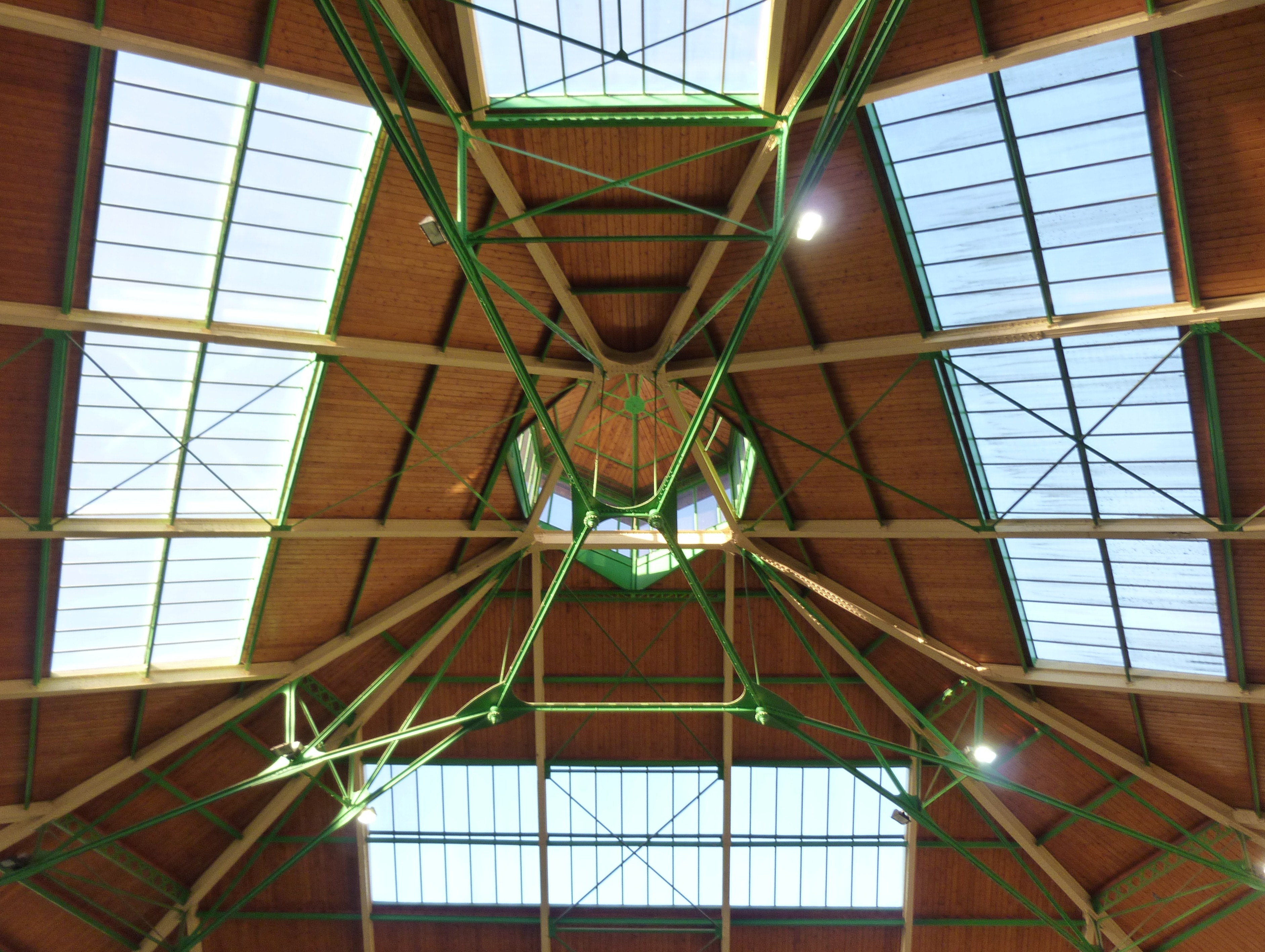
Norman and I saw one of Baltard’s children in Sens. We had gone to visit some friends who lived nearby and on a sunny Saturday morning, we wandered into the market building in the middle of town. It was an odd six-sided shape, but it was clearly in the Baltard tradition. This is a view up into the roof.

P1100261

So even though the original pavilions were demolished in 1973 (the authorities carried out the dirty deed in the summer, when many Parisians were on holiday and not on hand to protest), Baltard’s children live on in hundreds of other cities and towns.

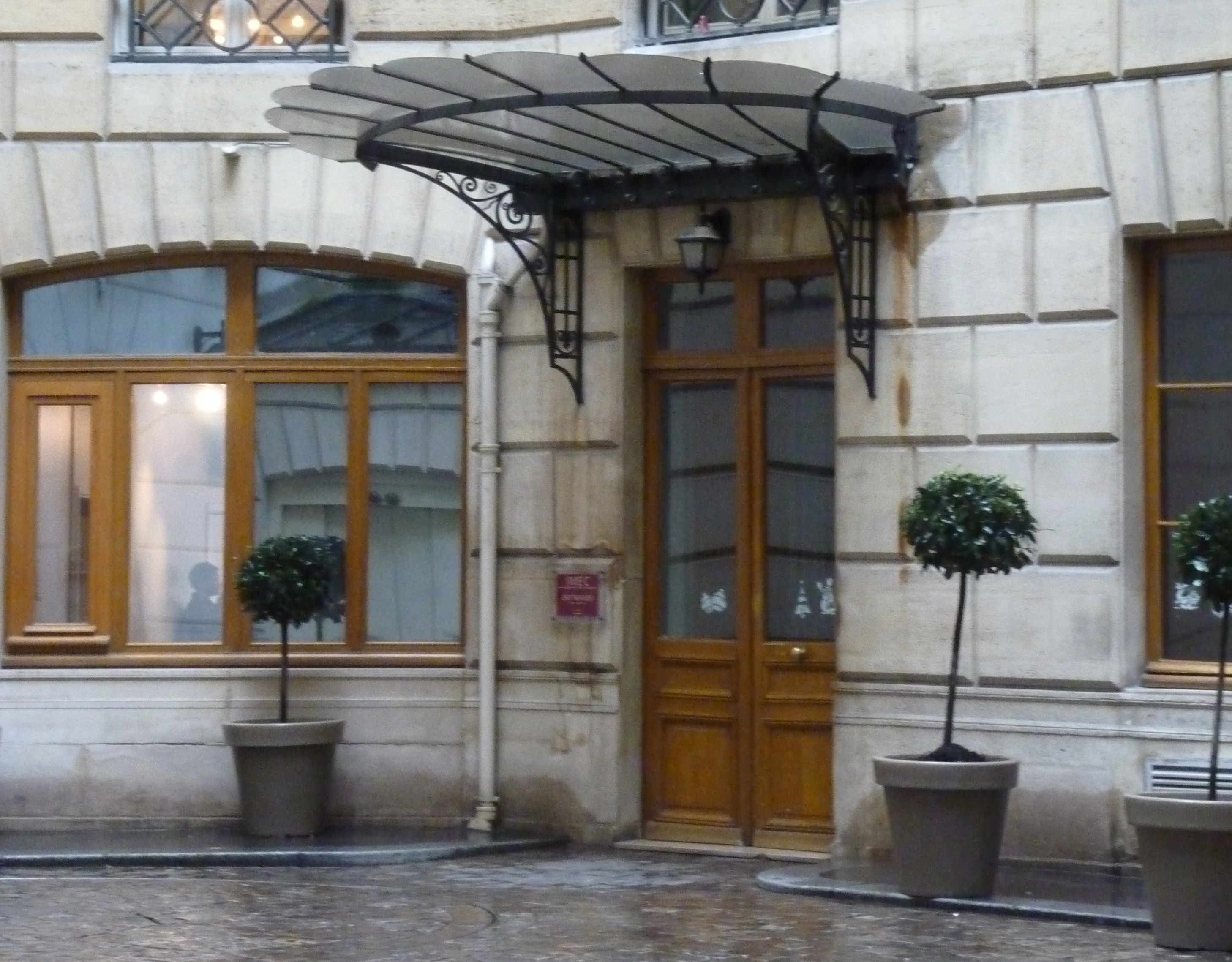
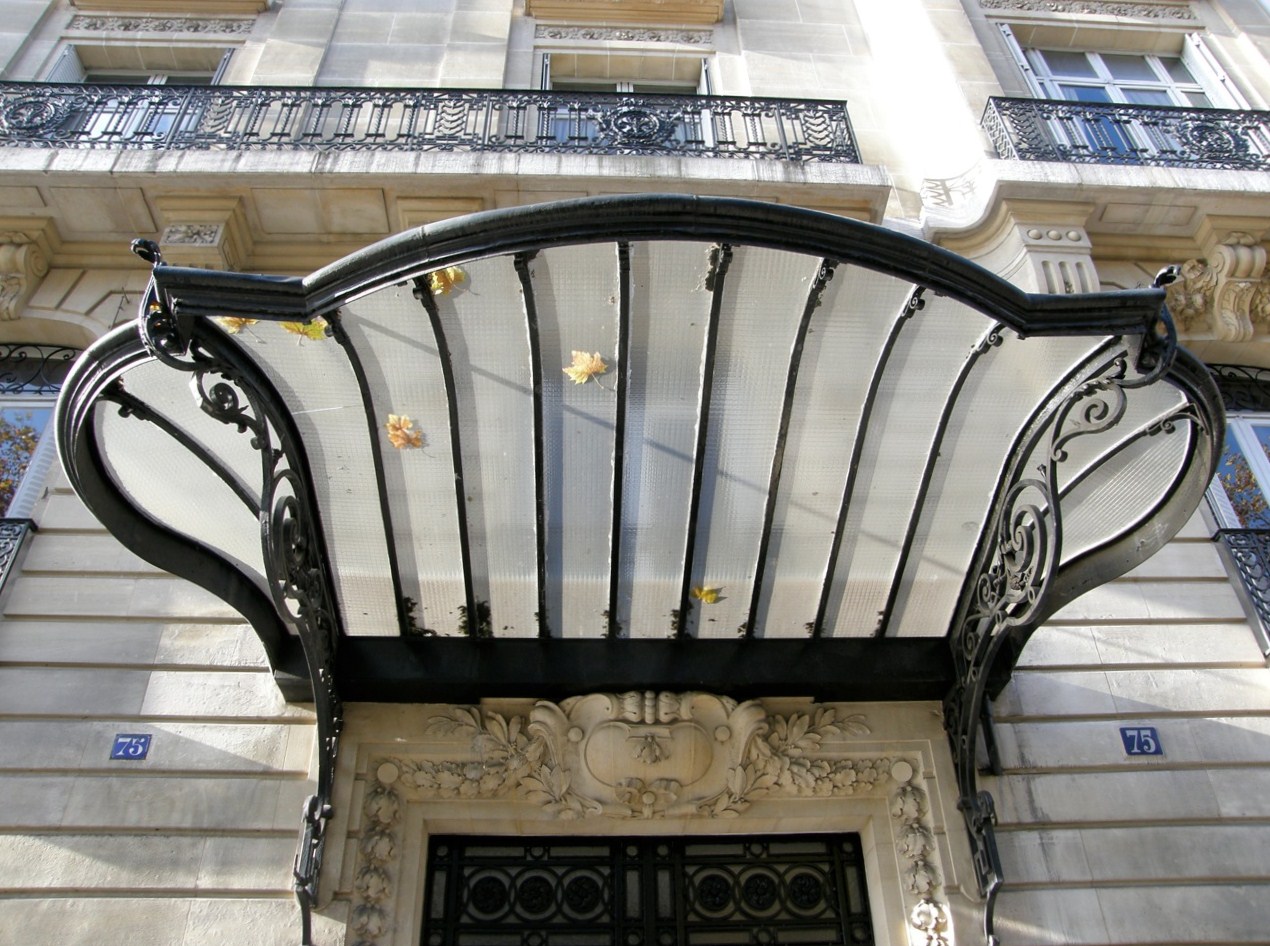
As for Paris itself, I see Baltard’s children in the iron and glass canopies over the entrances to many Paris buildings. Known as marquises (think “marquees”), these architectural umbrellas evoke Baltard for me. He didn’t invent them, of course (the connection exists solely in my imagination), but each one seems to pay a little homage to Les Halles.

Ostensibly they are there to provide shelter, but many are too small or too high to offer much protection against the rain. They are simply architectural accessories in iron and glass, the two materials that were so fashionable in the nineteenth century.

In Baltard’s day, when Haussmann was still controlling the look of Paris streets, marquises were not permitted on the exterior façades of buildings. There were found only in interior courtyards. You can still see them framing the courtyard entrances to grand buildings such as those on the rue du Faubourg St-Honoré (can you spot the marquise in this picture?).

P1030232

But as the architectural controls weakened during the late nineteenth century and buildings became more flamboyant, the marquises began to venture out of courtyards and take their places on the boulevards and avenues.

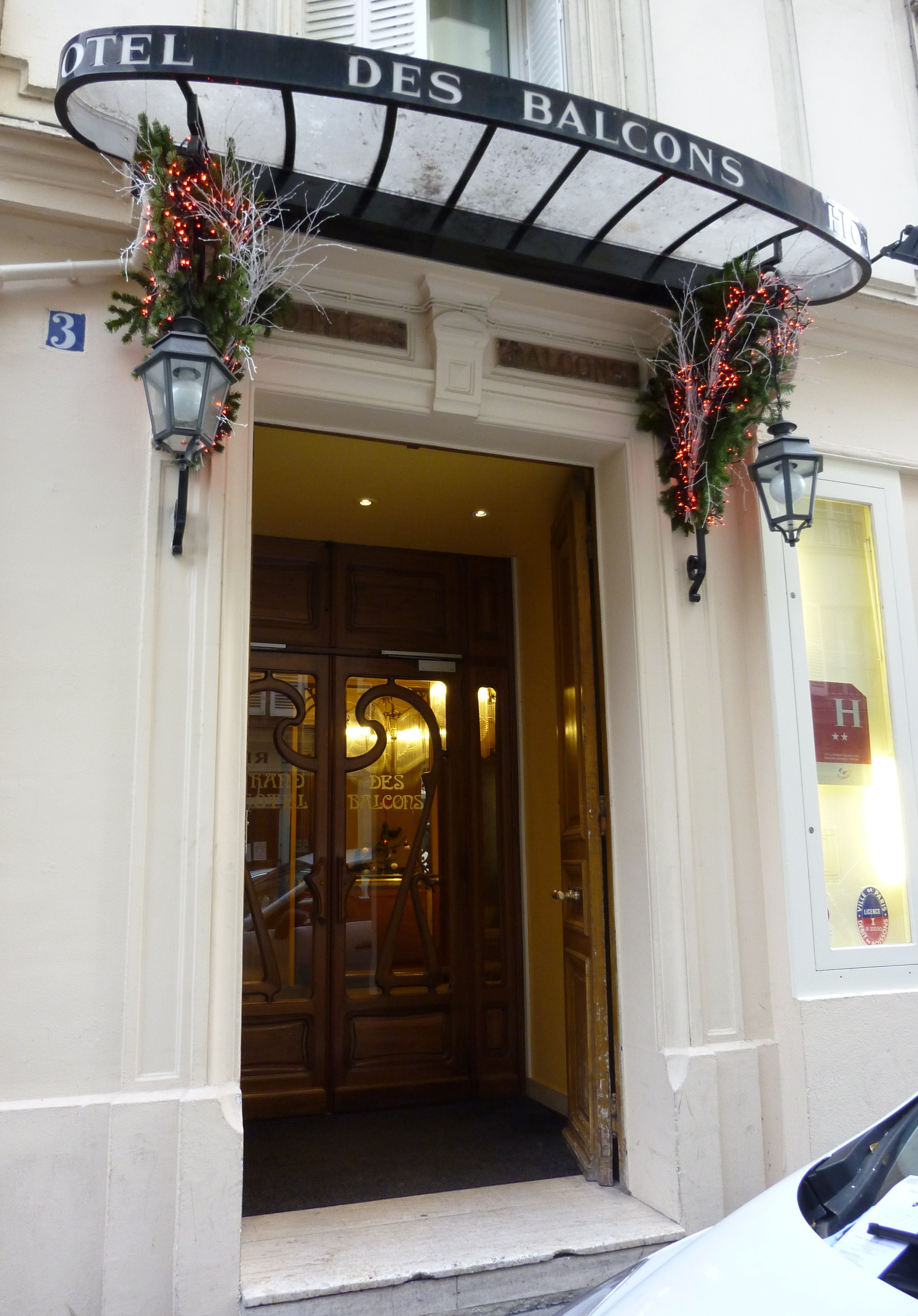
There is a tiny one on the Grand Hotel des Balcons, the hotel where Norman and I stayed on our first trip to Paris together, near the Place d’Orléans. Many happy memories and associations there.

P1100167

There is another on a little hotel close to the apartment where we stay these days.

P1090486

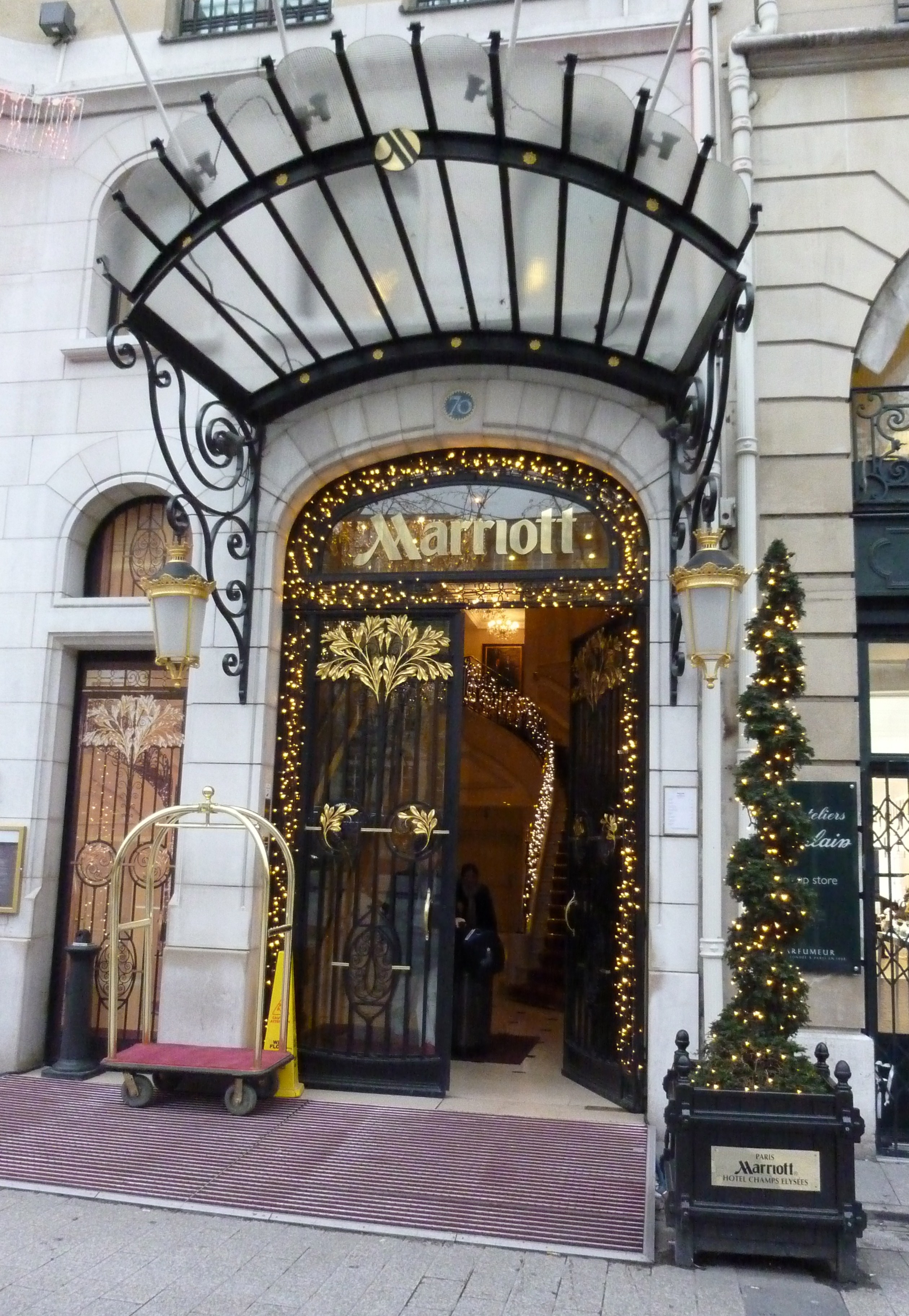
Indeed, marquises seem to be de rigueur for hotels, large and small. And hotels, like markets, are all about circulation.

P1090969

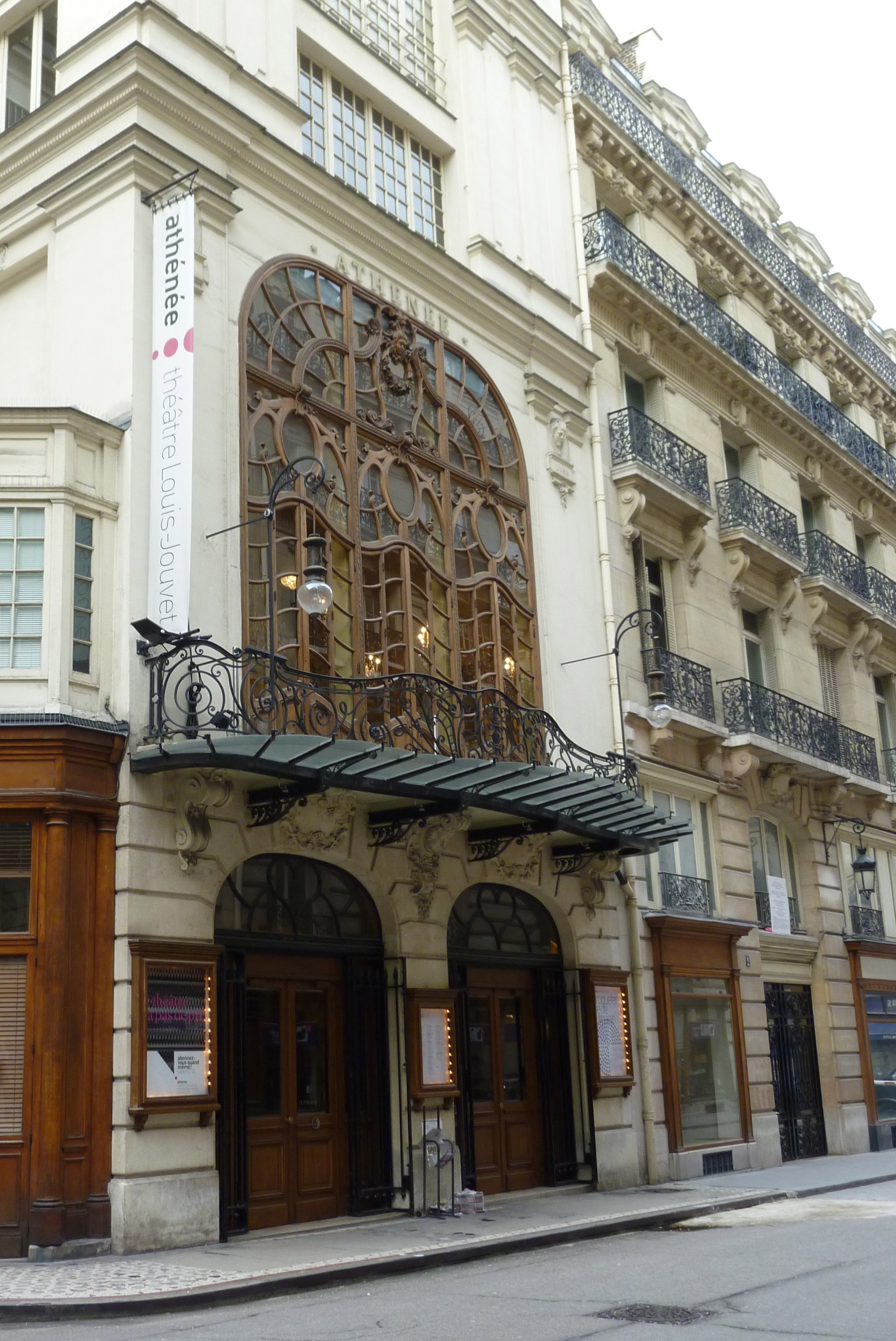
Many theatres have them.

P1090734

But some decorate otherwise anonymous doorways.

P1090609

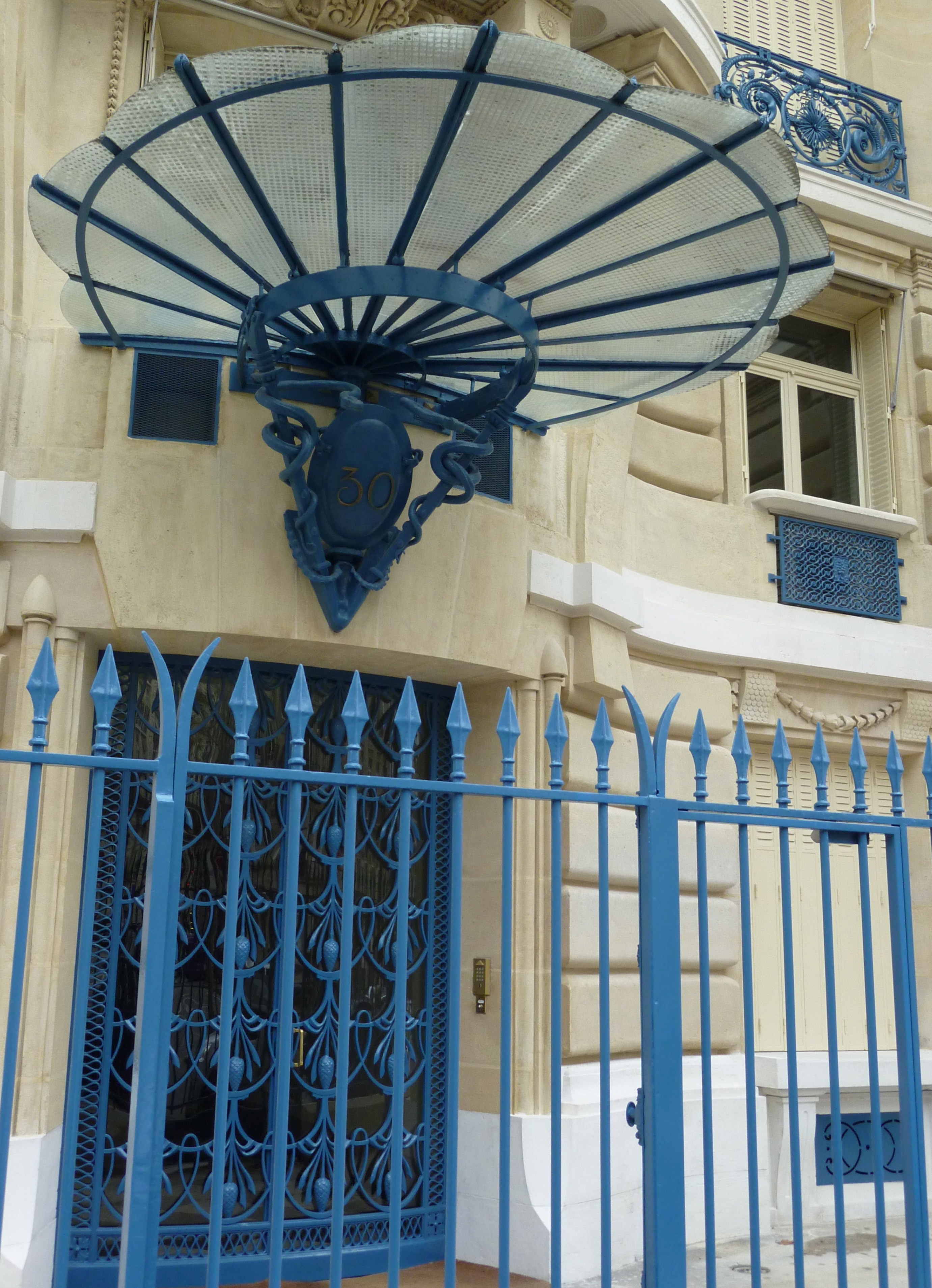
This parasol-like version in blue is on a grand and wildly decorated building on the Avenue Marceau. This may be the entrance to the concierge’s loge.

P1080935

I notice marquises wherever I go in Paris, and I’ve collected quite a few photographs of them.

P1090784

I think of them as little shards of Les Halles that have scattered throughout the city to remind us of the lost mother ship.

Text and original photographs by Philippa Campsie and Norman Ball. Historical photographs from Paris en images.
PB110212

Posted in Paris architecture, Paris history, Paris markets | Tagged , , , , , , , , , , , , , | 9 Comments

An Unbuilt Bridge and the Allure of Paris

The bridges crossing the Seine are a major part of Paris’s beauty. Could a bridge that was never built also be an asset? Consider the magazine headline below. What does it tell us about Paris and tourism when in July 1910 the American magazine Popular Mechanics featured this story?

Pop. Mech, 1910, Paris008

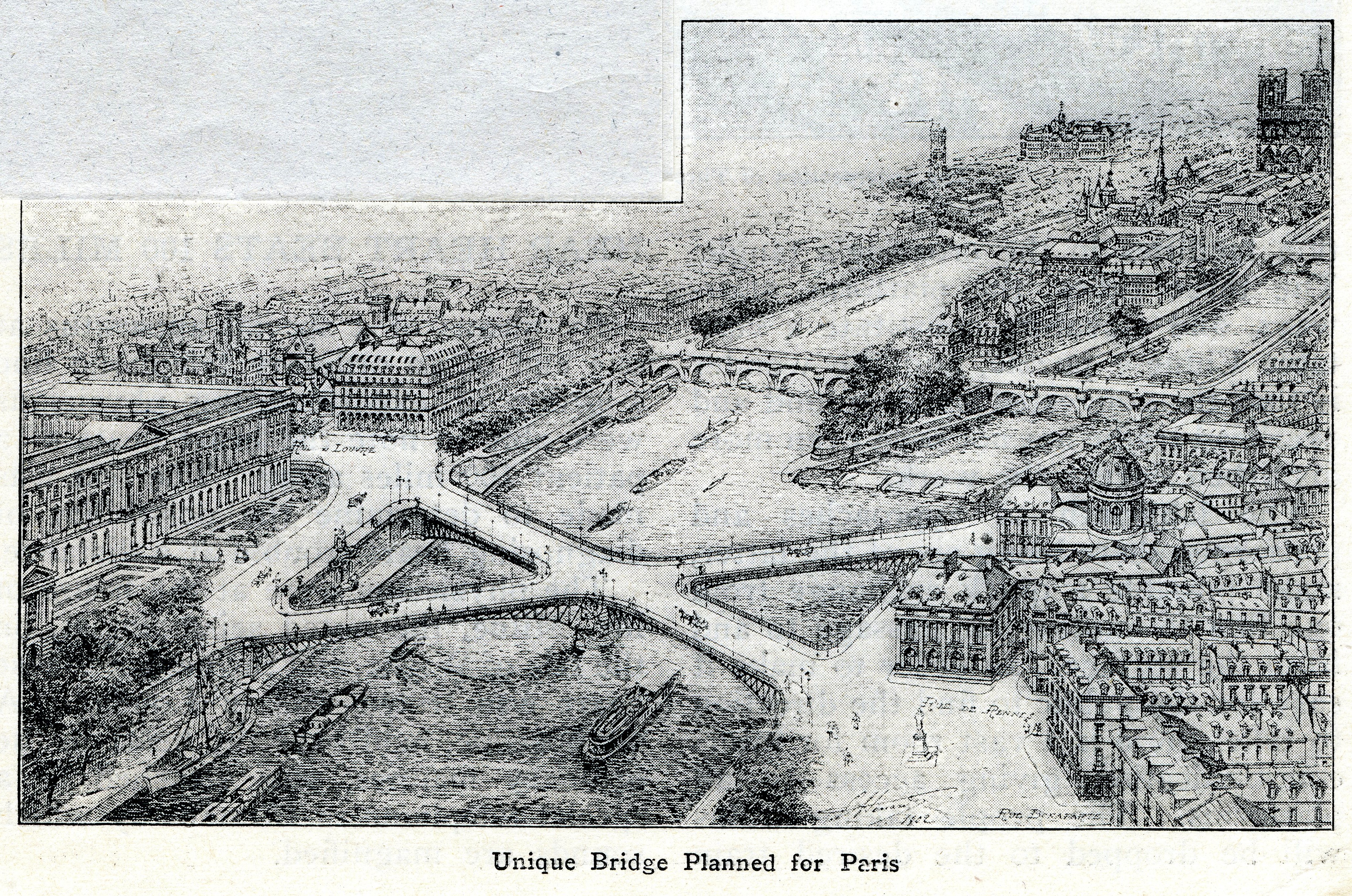
The upbeat article begins with the declaration that “Paris, which is today considered one of the most beautiful cities in the world, is still striving to become more beautiful” (p. 47). In pursuit of that aim, “the city has been authorized to borrow the immense sum of nearly $200,000,000.” Part of this amount was to go to “the creation of new boulevards and highways” including the projected letter-“X”  bridge shown in the rendering below.

Pop. Mech, 1910, Paris013

Much of the image is familiar. The Louvre is visible to the left, on the right bank. In the upper right, one sees the Ile de la Cité crossed by the oldest bridge in Paris, le Pont Neuf. In the very top right corner, Notre Dame Cathedral sits at the upstream end of the island. In the lower right we can see the dome of the Institut de France. And dominating the image is the “X” Bridge with “one branch connecting the rue de Rennes with the rue de Louvre, and the other forming a junction between the wharf of the Louvre and the wharf Conti.”

Something seems to be missing. Where is the pedestrian bridge Pont des Arts with its graceful arches springing across the river? The “X” bridge seems to have been designed to replace this historic river crossing, shown below in a photograph dating from 1900.

1407-15

The Pont des Arts, which opened in 1804, came to represent the dreams of an ideal artistic path. One studied art on the left bank at l’École des Beaux Arts and as one’s career blossomed, one crossed to the right bank where one’s work would be hung and exhibited in the Louvre.

The Pont des Arts was one of many contributions to the city by Napoleon, to beautify Paris and glorify his reign. As First Consul, he ordered the construction of this, Paris’s first metal bridge, a nine-arch pedestrian bridge or passerelle. It took its name from the Palais des Arts (Arts Palace), as the Palais du Louvre (Louvre Palace) was known during the First Empire.

With abutments for nine arches, however, the Pont des Arts represented quite a obstruction for ships and barges, which hit it frequently. This photo shows an engraving by Jules Després of the Frigorifique which ran aground against the bridge piles in 1879.

282-8

One can understand the logical appeal of the X-bridge: with only one pier in the centre of the river, it would be a less likely target for passing vessels than the Pont des Arts.

Nonetheless, the Pont des Arts survived the unrealized “X” bridge proposal. Popular Mechanics (July 1910, p. 47) made no mention of the impracticality of having horse-drawn traffic negotiate the mid-river intersection (the illustration, like so many renderings of proposed structures, shows enough life to make the bridge seem useful, but not so much that it reveals the potential bottleneck the bridge might represent). Nor does the article mention what would be torn down and lost to make its construction possible. The only hint of disbelief is found in the words “If erected” rather than “When erected.”

The Pont des Arts suffered bombardment during the First and Second World Wars, but it survived and was eventually replaced by a similar-looking structure of seven steel arches that opened in 1985. The new Pont des Arts is still a lovely pedestrian crossing, somewhat marred by the heavy incrustation of padlocks left by visiting “lovers.” The bridge is a space free from vehicles in a busy area. Places for moments of quietness are one of the great riches of Paris.

Having seen many renderings, visions and proposals from various times advocating a “new and improved” Paris, I am not particularly surprised by the “X” Bridge proposal. I am only grateful it did not go ahead.

But there is more to the story. I read about this in the July 1910 issue of Popular Mechanics, not in a fashion or tourist magazine. Popular Mechanics was then the kind of magazine aimed largely, but not exclusively, at young men with “grease under their fingernails.” In the early 1970s I interviewed a then-retired mechanical engineering professor who was in his eighties. He told me that in each freshmen class of the 1920s, it was easy to spot the students who would become good engineers: “they were the ones with grease under their fingernails; they tinkered with motorcycles and engines.” They also read magazines such as Popular Mechanics.

So here in a magazine for people with grease under their fingernails we find a bridge proposal for Paris. We also find Paris being praised as one of the most beautiful cities in the world. Perhaps it is a measure of just how much Paris was part of consciousness of the western world that it turned up in Popular Mechanics. And in that one issue, the X-bridge was not the only bit of Paris.

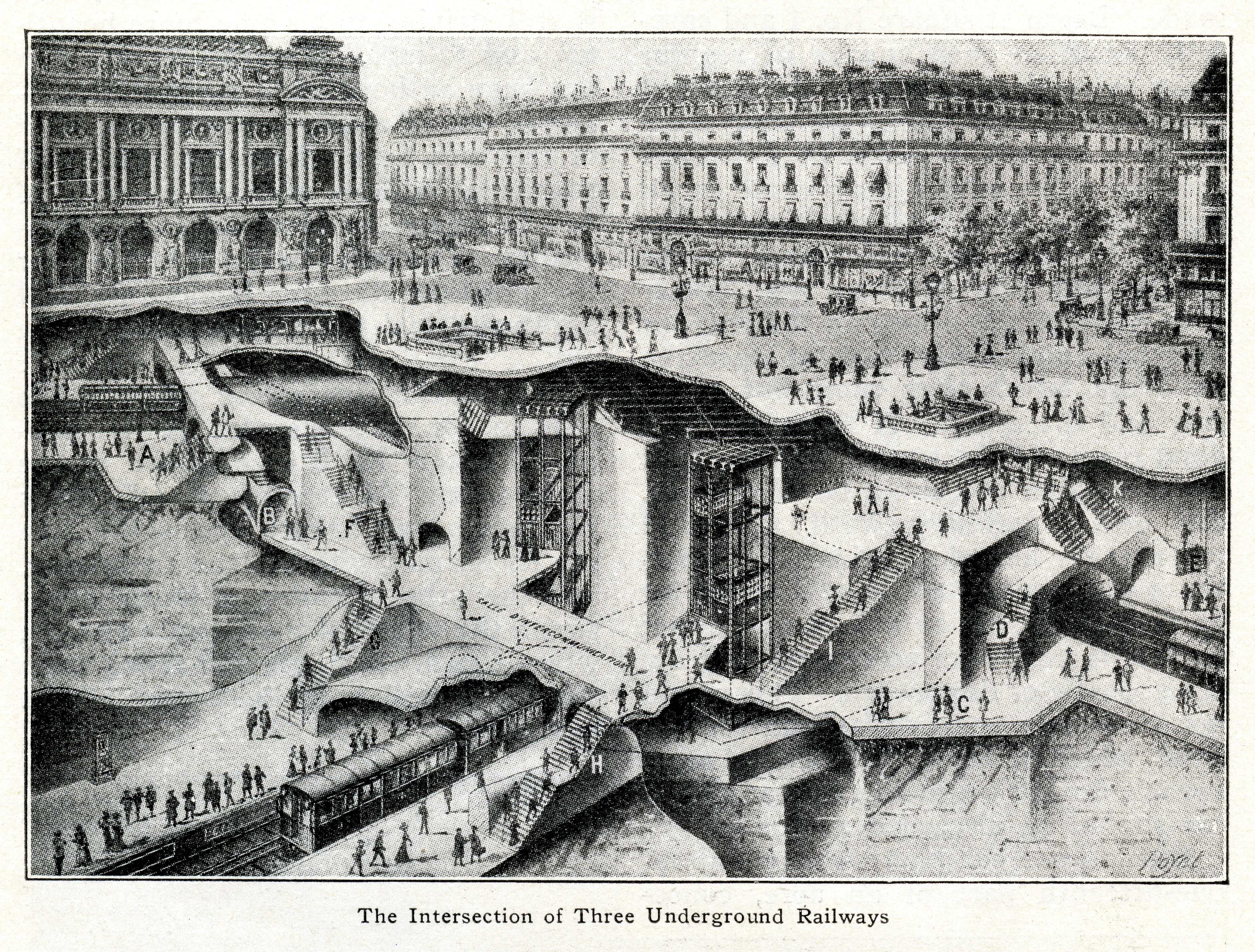
Among other features, an article titled “The Busiest Underground Corner in Paris” appeared in the same issue.

Pop. Mech, 1910, Paris010

The author appears to have been awe-struck, as I often am when using the Paris Metro. It starts: “Of all the wonderful engineering work done by the Metropolitan underground railways of Paris, the most complicated is that under the Place de l’Opera, where three great tubes cross each other, all of which must have station facilities in the crossing’s tangle.  The three tubes, the platform, stairways, and elevators constitute a veritable Chinese puzzle, and the wonder is that the congested underground and overhead traffic has not been even more disturbed during the work” (p. 48).

The image clearly shows “the three subway tubes, the platforms, stairways, elevators, and two of the openings leading from the boulevard.” Today, escalators move people far faster than elevators. The station is still a marvel and what the magazine failed to mention is that all this hidden “tangle” lies beneath the beautiful space in front of the Opera Garnier. It is all part of what makes Paris the world’s most-visited tourist destination and the second densest metro system; the Metro takes a bit of practice to get the hang of it, but soon one appreciates how easy it is to get around.

I wonder if the July 1910 issue of Popular Mechanics helped spark someone’s love affair with Paris; the love of someone with grease under his fingernails, perhaps. Each of us has a story about how we came to love the city. Mine started with the woman I love and with whom I write this blog. Those who hunted for gold in the Klondike and elsewhere used to say “gold is where you find it.” These pictures in a long-ago magazine for tinkerers and future engineers suggest that “Paris is where you find it.”

Text by Norman Ball

Photograph and illustration of the Pont des Arts from Paris en images.

Posted in Paris bridges, Paris metro | Tagged , , , , , , , , , | 16 Comments

The further adventures of the Nurse Who Wore Pearls

A friend recently asked us how we plan what to write about in our blog. The answer, in Norman’s words, is this: “Planning is what you resort to when chance breaks down.” And somehow, chance seldom seems to break down. This blog is a case in point.

A few months ago, I received a comment about a blog post I had written on Queen Philippa. The writer was a professor of medieval history who wanted to use one of my photographs in a lecture. Turns out she taught at the University of Toronto, where I am an adjunct professor myself. We arranged to meet for coffee.

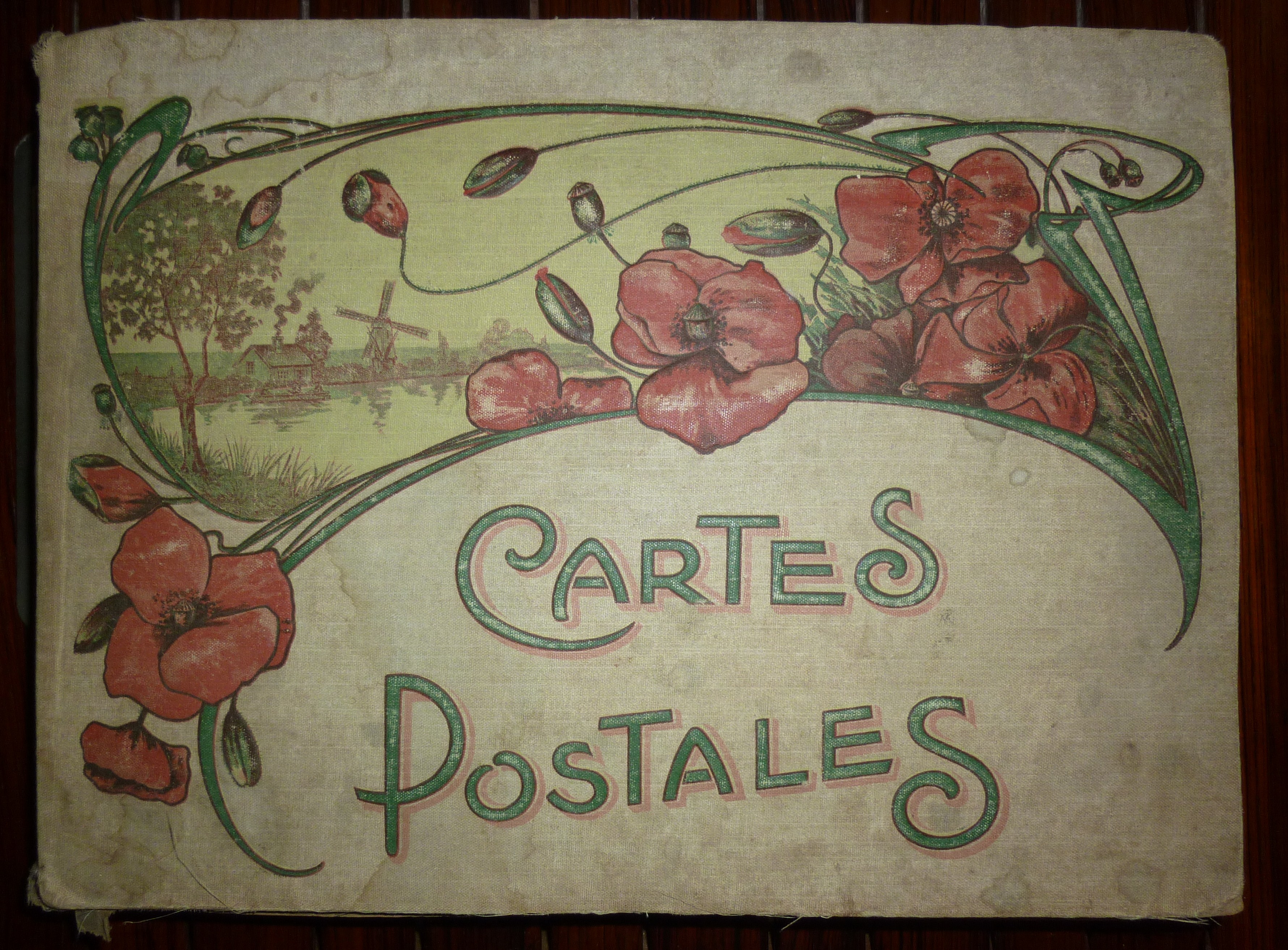
Chatting in her light-filled office with a view over one of the prettier parts of the campus, we found we had many common interests. She was originally from France, but had spent much of her life in Québec. When I mentioned the enjoyment we get from researching stories behind old postcards, she went over to a shelf and took down an album:

P1100742

She had inherited it from a relative who had collected postcards, particularly those in series, and offered to lend it to me.

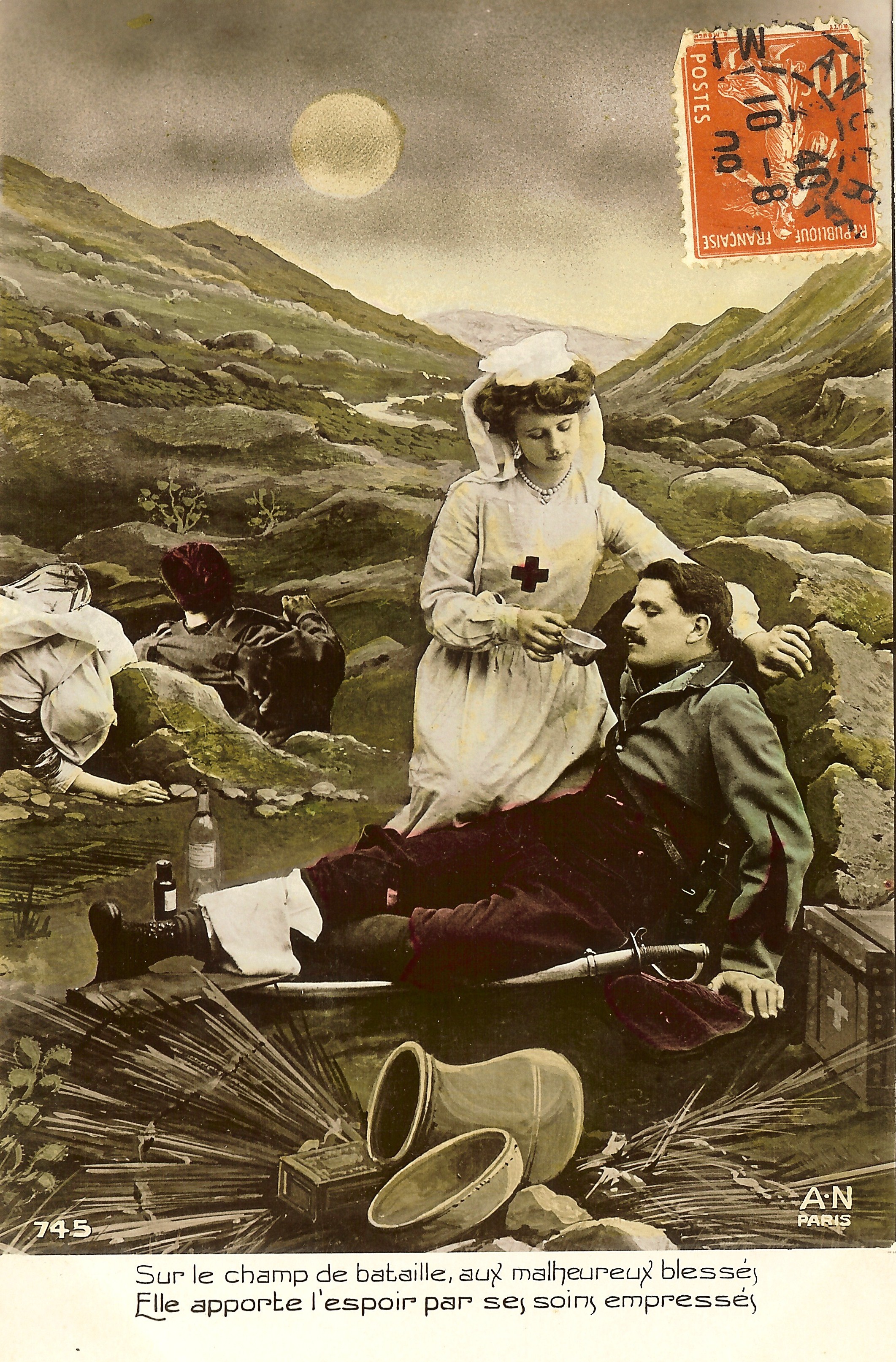
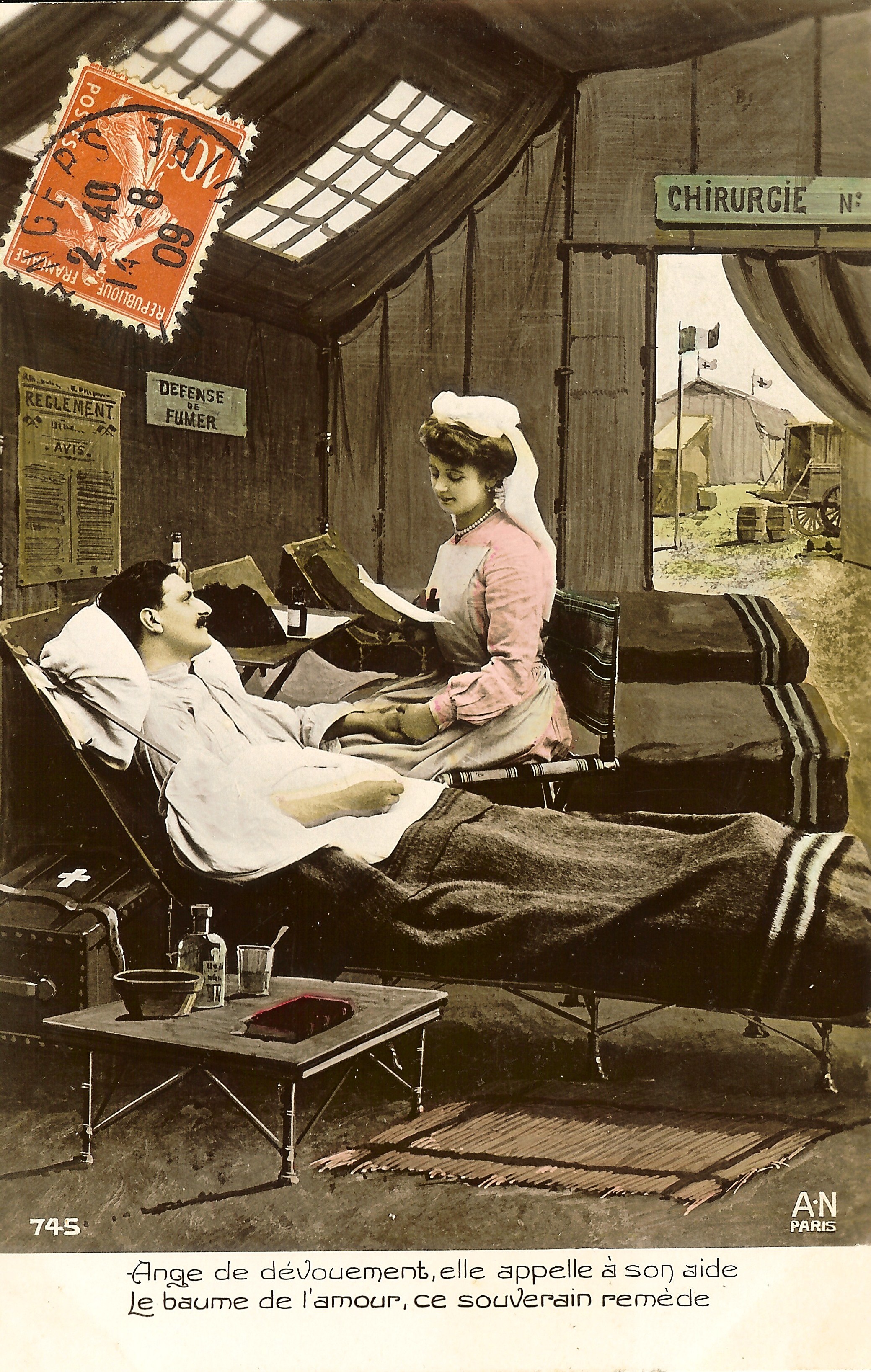
That night, Norman and I went through the pages, turning them carefully as some were a bit crumbly. About halfway through the album, I saw a familiar face: the Nurse with the Pearls, who had made an appearance in a previous blog.

WartimePostcards0001

The picture above is the postcard in my own collection. In my friend’s album, the postcard was part of a series, and the card had some interesting differences. I realized that I had made some erroneous assumptions about the card when I had seen it before.

The first thing that struck me was the postmark: 1909. This was not, as I had supposed, a First World War card. The “Ange de Dévouement” had been pressed into service as a wartime card in 1914, but its origins went farther back. But before I go on, let me show you the series of five, with captions translated rather literally, so you can follow the story.

Nursewithpearls0001 (2)

“Go, my dear daughter, where duty calls you. Of all missions, yours is the most beautiful.”

Nursewithpearls0002 (2)

“On the battlefield, she brings hope to the wounded with her attentive care.”

Nursewithpearls0003 (2)

“The angel of devotion, she calls to her aid the balm of love, that sovereign remedy.”

Nursewithpearls0004 (2)

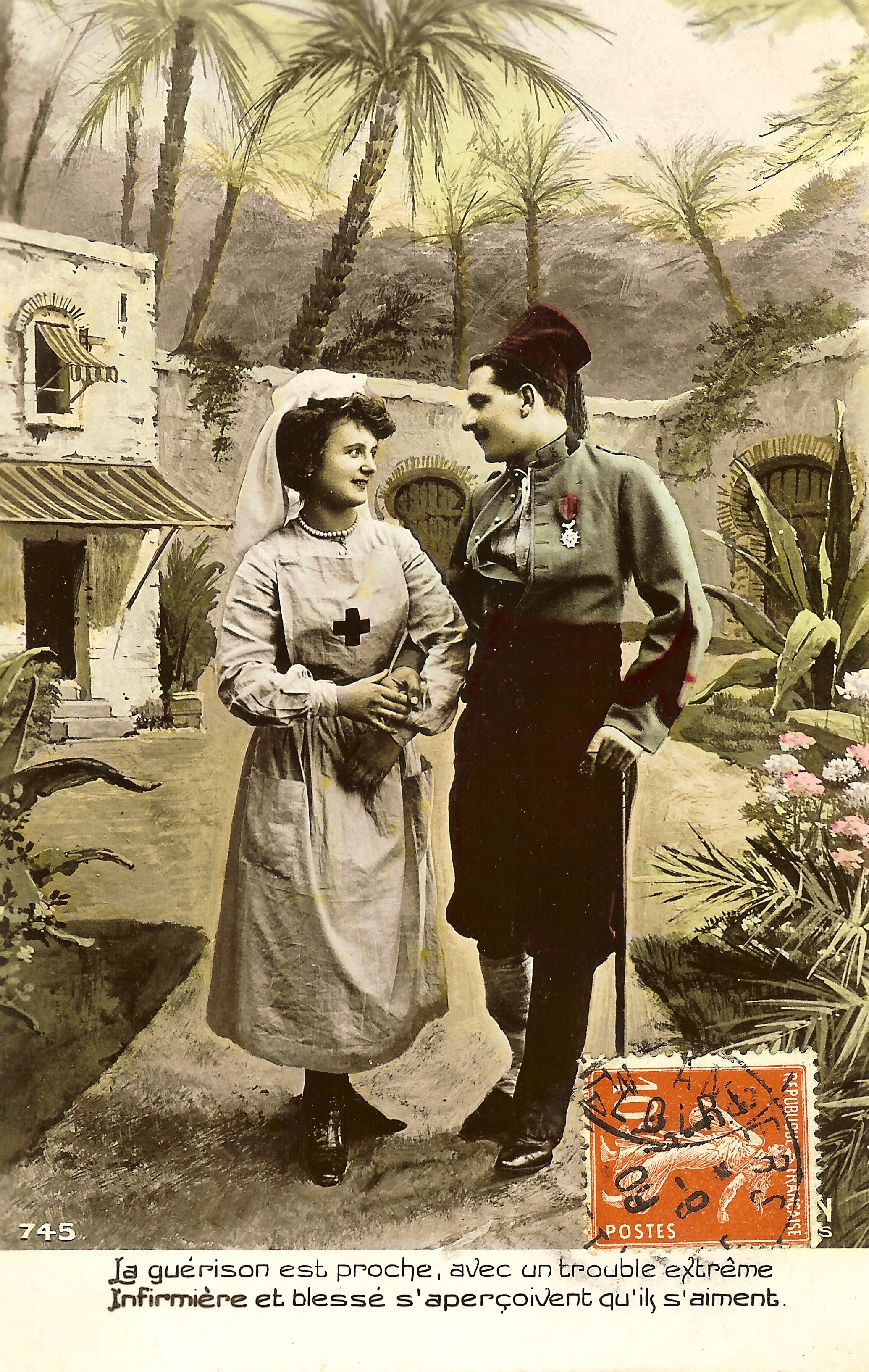
“Healing is nearly complete, which brings a deep anxiety, [since] the nurse and the wounded man realize that they love each other.”

Nursewithpearls0005 (2)

“When one has been in peril, one can be happy: to charm my old age, unite your two hearts.”

The cards, unlike others in series, are not numbered, so there might have been others. I wonder if there was some further complication before the happy resolution. But I love the fact that her pearls are firmly in place in the three middle images.

If you look closely, you will see that the backgrounds are not real. The figures have been photographed in a studio, and their images cut out and superimposed on painted backgrounds. Perhaps the least convincing is the one inside the hut; the two empty bunks are at the wrong angle, although the view through the tent flap is more realistic.

And look at the man’s uniform in the last two, especially the fez and the baggy trousers. He is no ordinary French soldier; he is a Zouave. In the late 19th and early 20th century, these regiments were made up of French settlers in Algeria and Tunisia conscripted into the French army. The background of the fourth postcard also suggests north Africa, with its palm trees and keyhole-shaped archways.

And what was the battlefield? Was it one of the battles by which the French extended their control over north Africa, or one of the skirmishes with British soldiers, as Britain was also trying to assert itself in that part of the world? We’ll never know. I think the postcard was left deliberately vague so that buyers could imagine what they wanted.

One purpose of the series might have been a bit of propaganda for the Red Cross. Would young women be more inclined to join the ranks of the nursing sisters if there was a possibility they would meet handsome young soldiers they could marry? Perhaps.

The mark “AN Paris” indicates that the series was the work of Armand Noyer, a prolific creator of postcards, stereocards, and cartes de fantaisie, many of them featuring shapely women in various states of déshabille (the risqué ones date mostly from the 1920s and 1930s; his prewar production was more straitlaced). He numbered each series: this one is 745.

The postcards were sent from someone called Madeleine, who lived in Angers, to Monsieur and Madame Emile Marsais, who lived at Les Grandes Barres, St-Aubin-de-Luigné, about 25 km southwest of Angers. Today there is a vineyard there.

The first four were sent between July and September 1909. Madeleine asks when Mrs Marsais will be visiting Angers, inquires about the couple’s trip to Lourdes, notifies them that she will be on the 1:57 train but not to worry about meeting her, and lets them know that she and her father will be driving out to “see the vines on Sunday.” Ah, so there was a vineyard then, too.

The fifth does not have a clear postmark, but seems to have been sent later than the others. Madeleine notes that the water has finally retreated from her father’s cellar, and none too soon, since at its height it came up to the highest step on the stairs. From that detail, we can determine the date: there was a flood in Angers in March 1910, two months after the devastating Paris floods.

Madeleine sent other series of cards to Mr and Mrs Marsais, although in most cases, she just scrawled “Bonjour” or “Amitiés” for a message. In the cards with a more detailed message, Madeleine’s spelling is a bit erratic; perhaps she was still just a teenager, or perhaps she had not had much of an education. Or perhaps she just was not very good at spelling.

Her last name might have been Gouadon. On one of the cards from another series, she invites Mr and Mrs Marsais to lunch and concludes, “Amitiés à tous et à 11 heures Maison Gouadon.” This unusual surname is associated with that area.*

The album contains dozens of these series, many of them with winsome children in place of adult protagonists. These ones may seem impossibly sentimental, but in an age in which cat videos go viral, we in the 21st century cannot claim that the early 20th century had a monopoly on cutesiness.

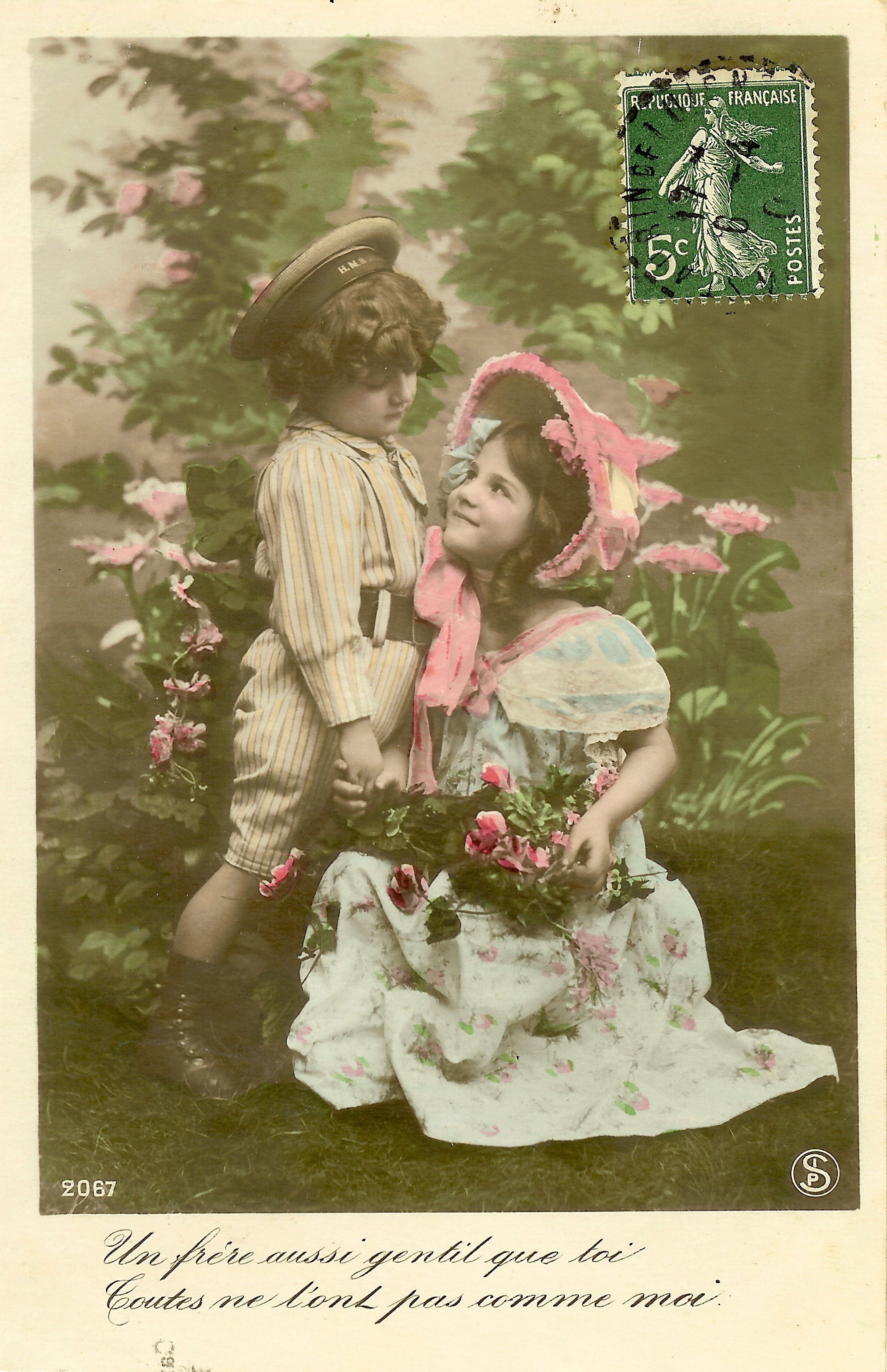
I’ll leave you with some images from one of the children’s series, also sent by Madeleine [Gouadon?] to Mr and Mrs Marsais. All were mailed in April 1909.Since they are all rather similar, I will show only the first one in detail. The words underneath are about the joys of being brother and sister. I’ll spare you the translation.

scan0003

Children

Note that in the few months between the time these were sent, and the time Madeleine sent the series about the nurse, the price of postage has doubled, from 5 centimes to 10!

Text by Philippa Campsie
*The French have a wonderful website that that allows you to see where certain surnames are most concentrated. Type in a family name and the map will indicate where people with that name were born during four periods: 1891-1915; 1916-1940; 1941-1965; 1966-1990. For example, only 5 people with the name Gouadon were born in all of France between 1891 and 1915, two of them in the Maine-et-Loire department, where Angers is located. Perhaps Madeleine was one of them.

Posted in Paris postcards, World War I | Tagged , , , , , , , , , | 3 Comments

I’ll meet you on the passerelle Debilly

The passerelle Debilly is often overshadowed by its flamboyant neighbour, the Eiffel Tower. But then, the Eiffel Tower has been upstaging everything in the neighbourhood since it opened in 1889. Consider one of the first photos I ever took of the passerelle Debilly. I noticed the bridge, but at that time, I didn’t know its name. In the photo, the Eiffel Tower is, even partly obscured, the star.

PC170851

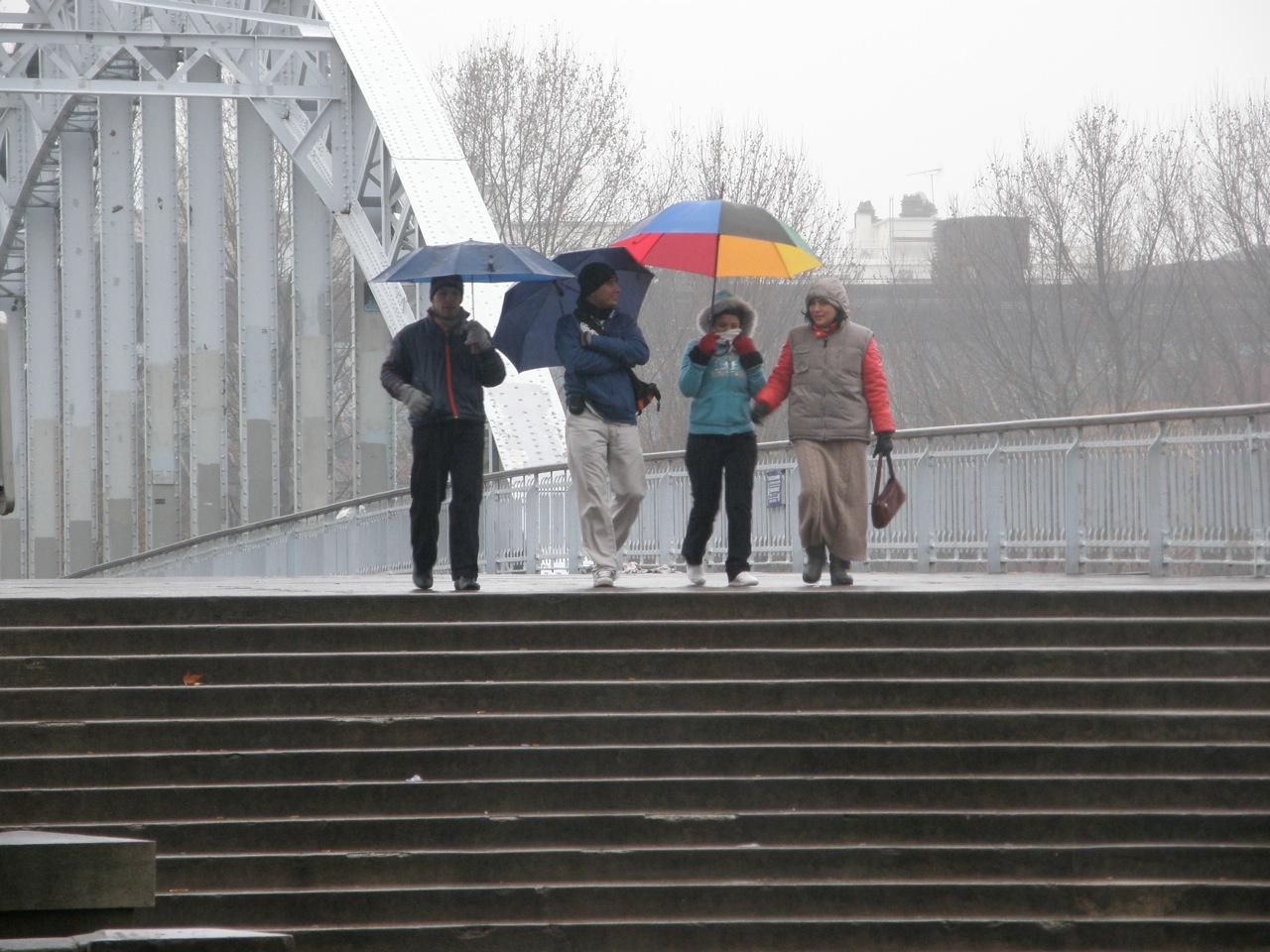
Philippa and I had just left the Palais de Tokyo. Outside it was a grey rainy day. I slipped on the stairs going down to the river, but it was Paris, and I didn’t mind so much.

Soon I was photographing others who seemed to take the rain in stride. I liked the bridge, but I was concentrating on the people and their umbrellas.

PC170859

We encountered the bridge on other occasions, but I never had a chance to look at it more closely. Then, last December, I found myself near the bridge with time on my hands on a sunny day.

PC120142

As I drew closer, the bridge seemed to grow ever more exuberant.

PC120183

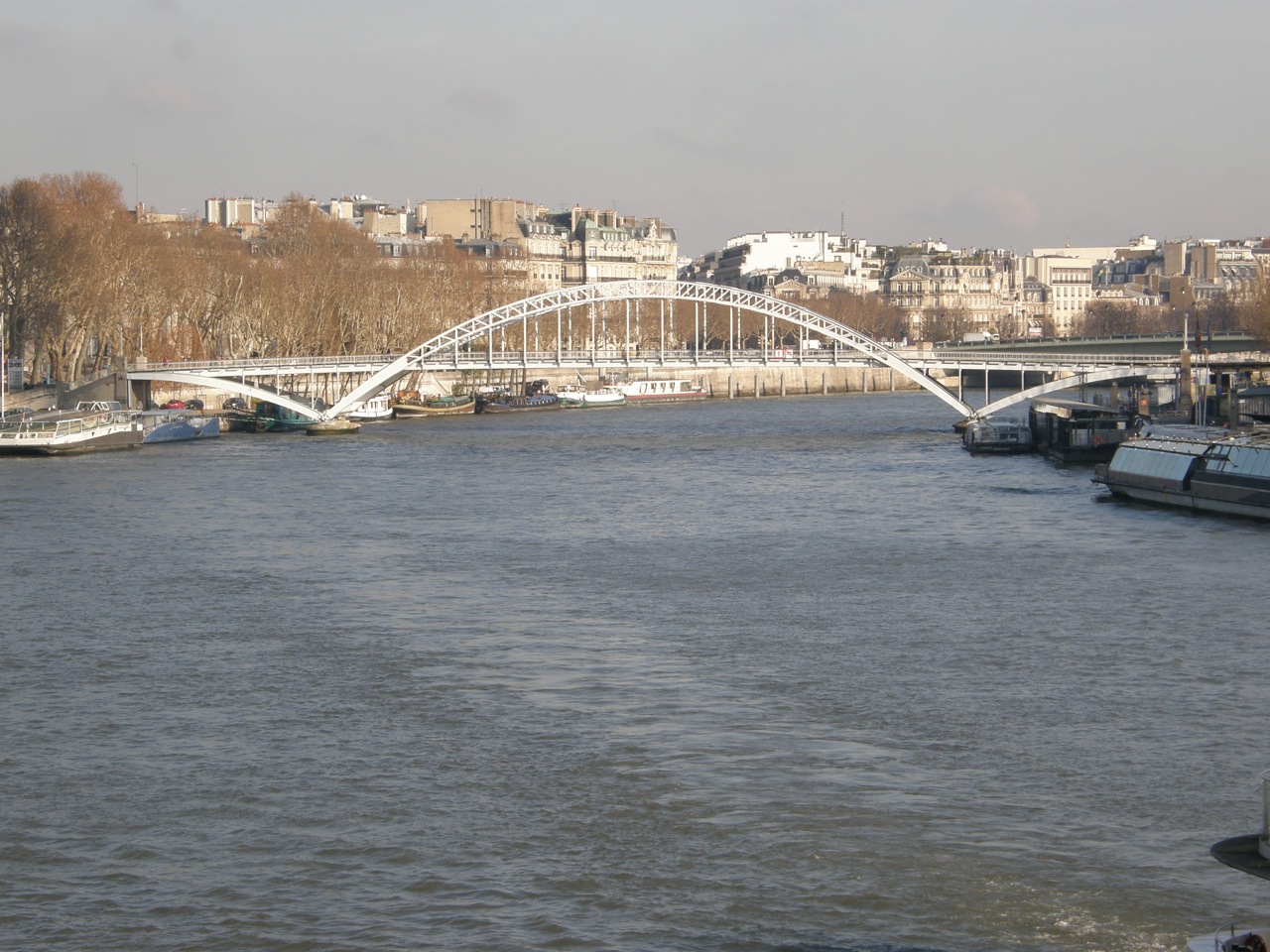
I was captivated. It was as if structural steel had captured the path of a skipping stone thrown from the bank of the Seine across the river.

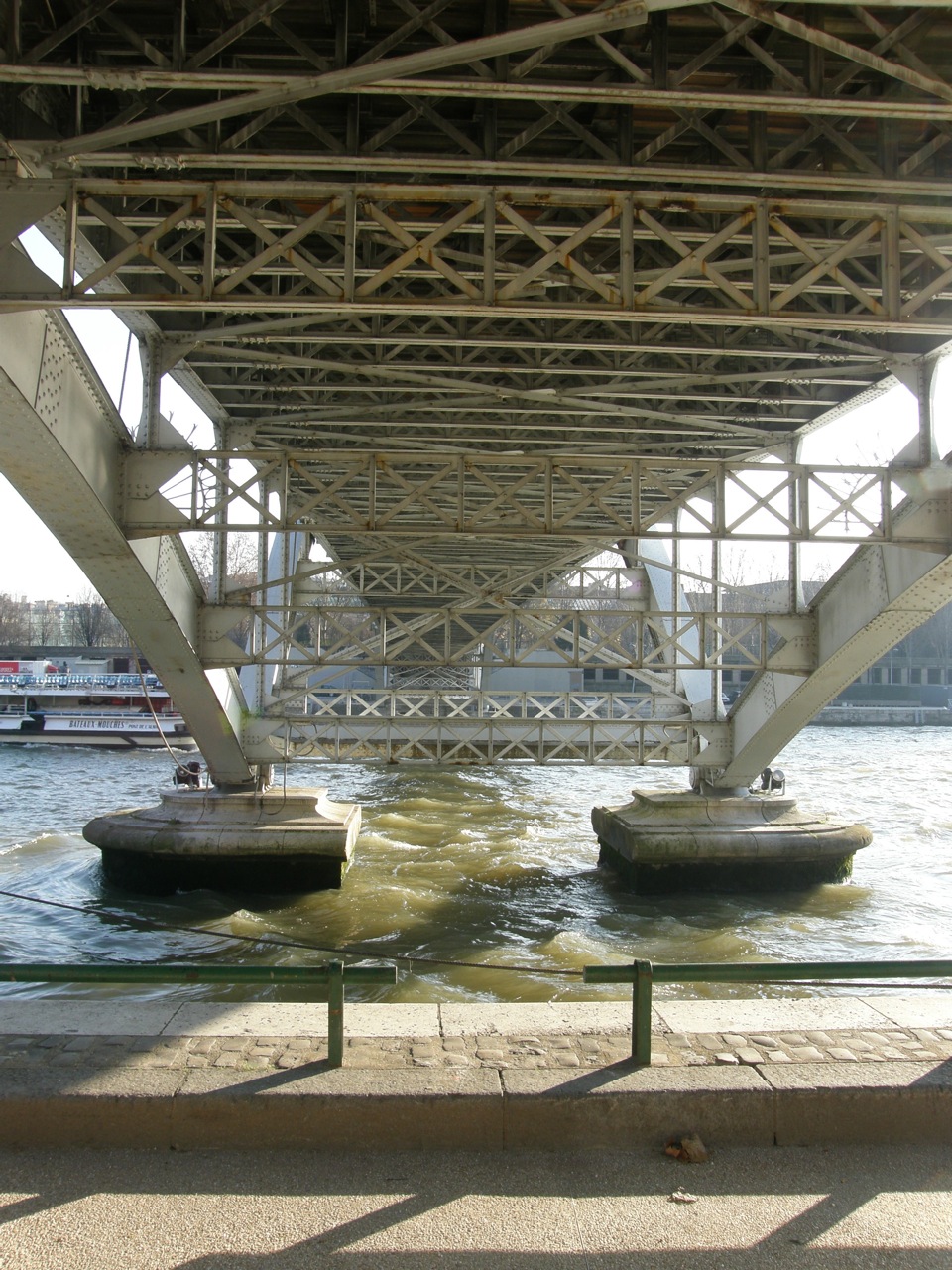
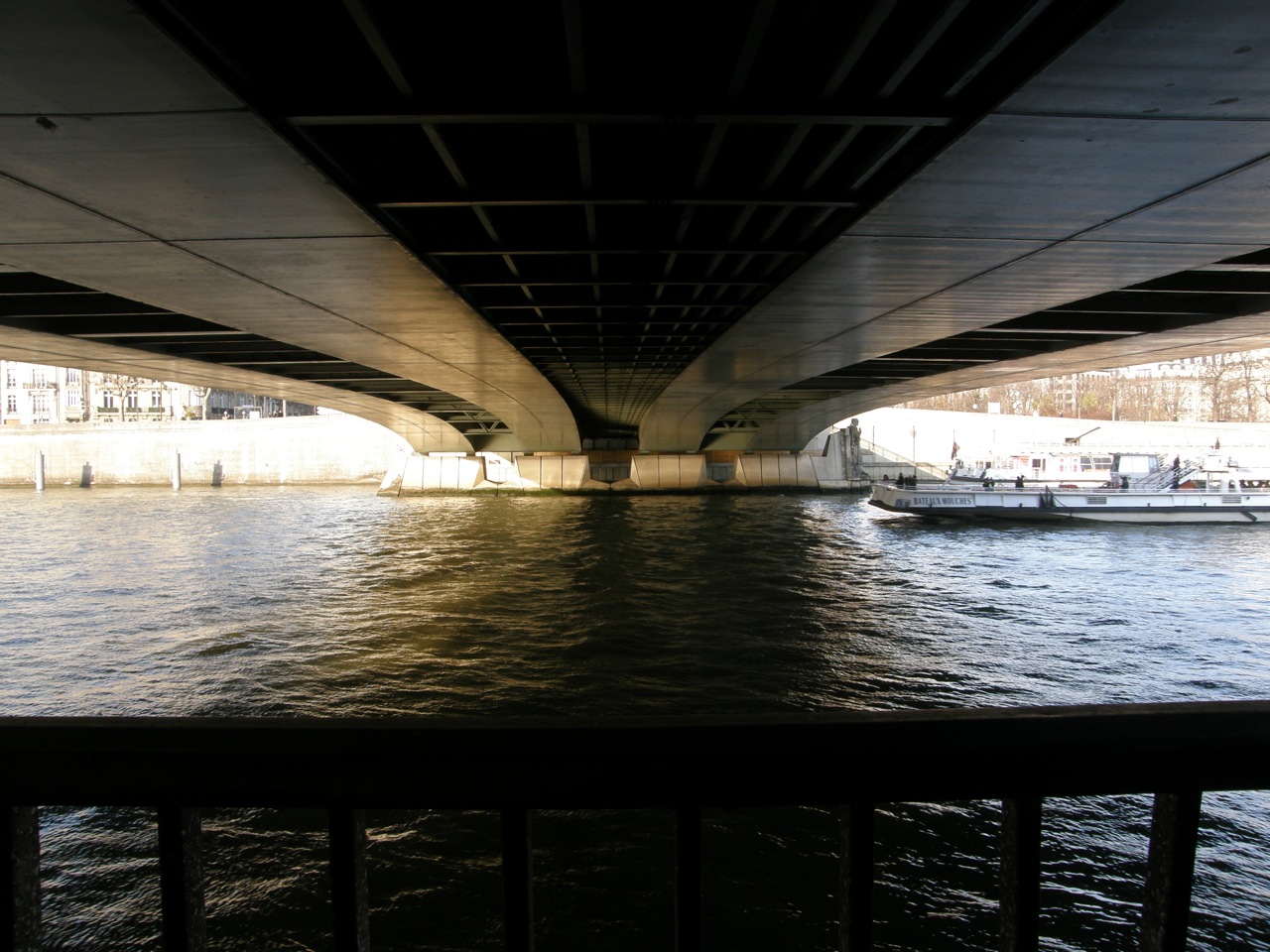
I always want to see the underside of bridges. Beneath the bridge, just above water level, I could appreciate the geometry of structural steel. The river was high that day, and fast-flowing muddy water bent gracefully around the piers. No vehicles rumbled overhead; I could hear the water.

PC120192

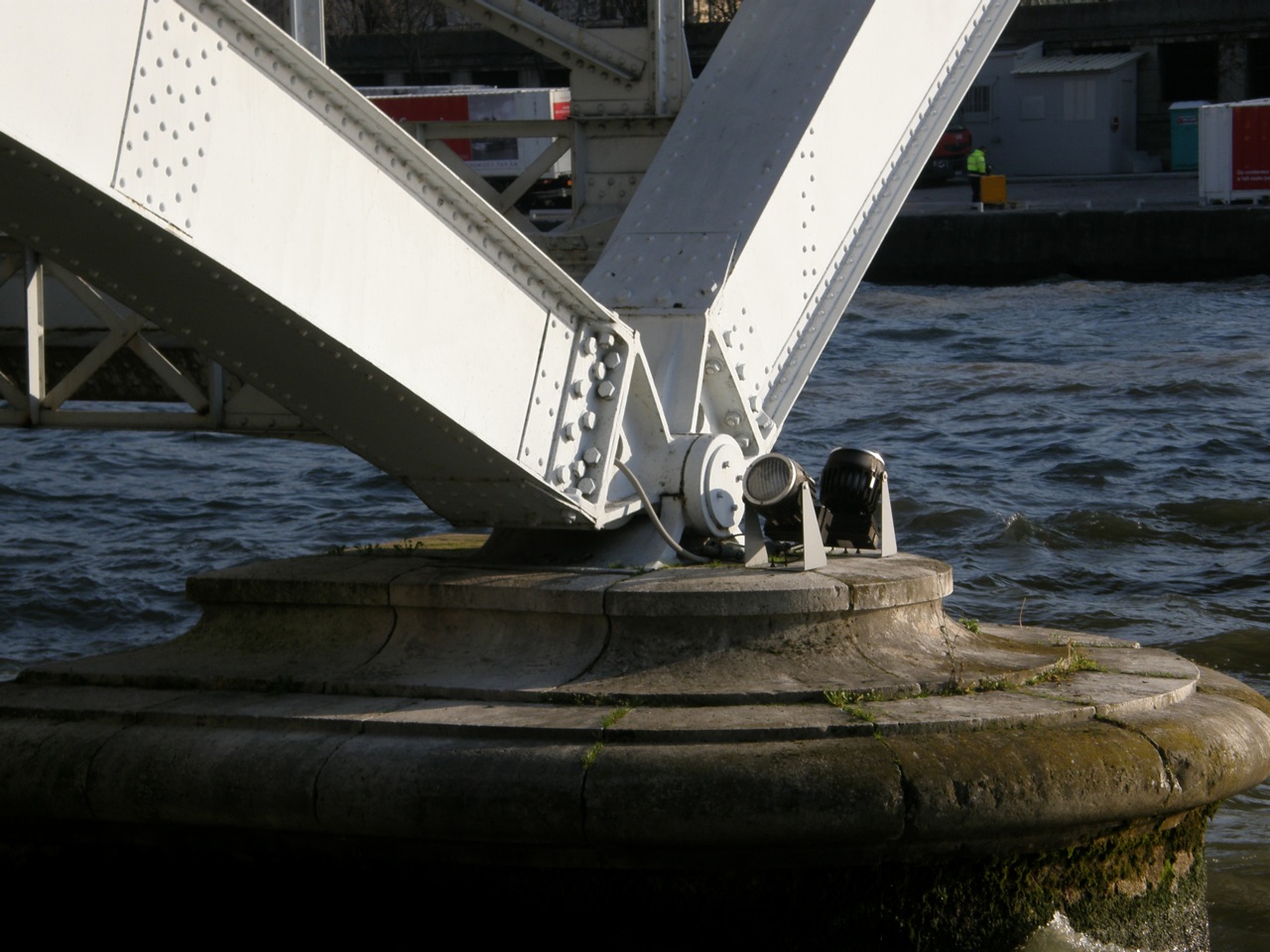
I was intrigued by the gracefulness of the two structural members that transfer the load to the bearings that support the bridge and allow slight movement as the bridge expands and contracts with changes in temperature.

PC120184

I also paid attention to the signs with no words. One sees variants of this warning all over Paris. The sharp points contrasted with the smooth regularity of the rivet heads.

PC120217

Soon I discovered that there was more to this bridge than seductively shaped ironwork and gracefully weathered wood. I began to notice more and more unusual details.

PC120228

Clearly someone had been given the freedom to make something very special.

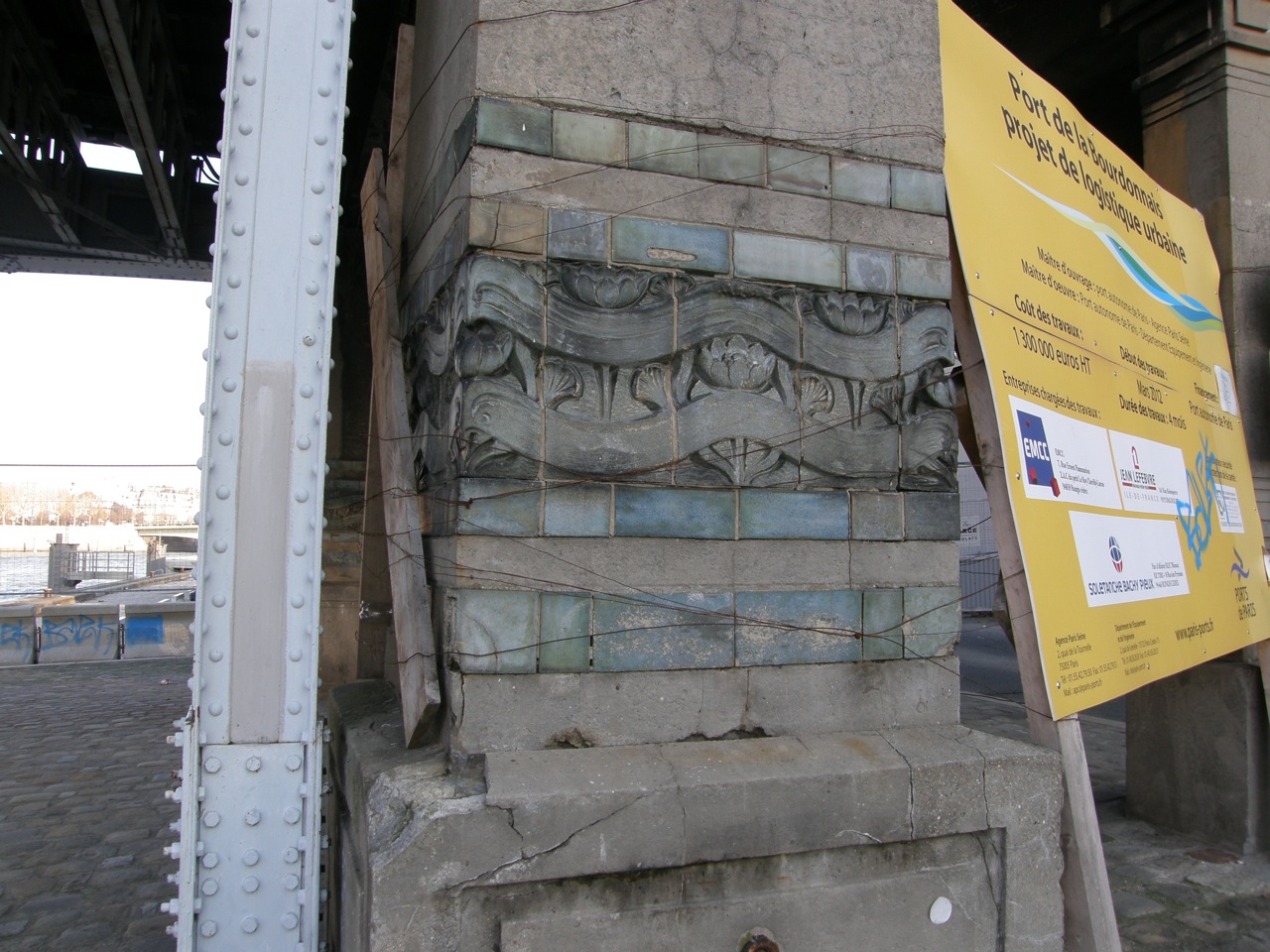
The columns were most unusual, the work of an artist capturing the waves on the Seine, an artist reminding us that Paris is an important port.

PC120238

On that afternoon I was looking at a rare beauty that clearly needed help. And it appears to be getting it. Restoration is under way.

PC120237

One can only hope that the inevitable signs of age can be restored and that the passerelle will one day be returned to its former glory.

PC120222

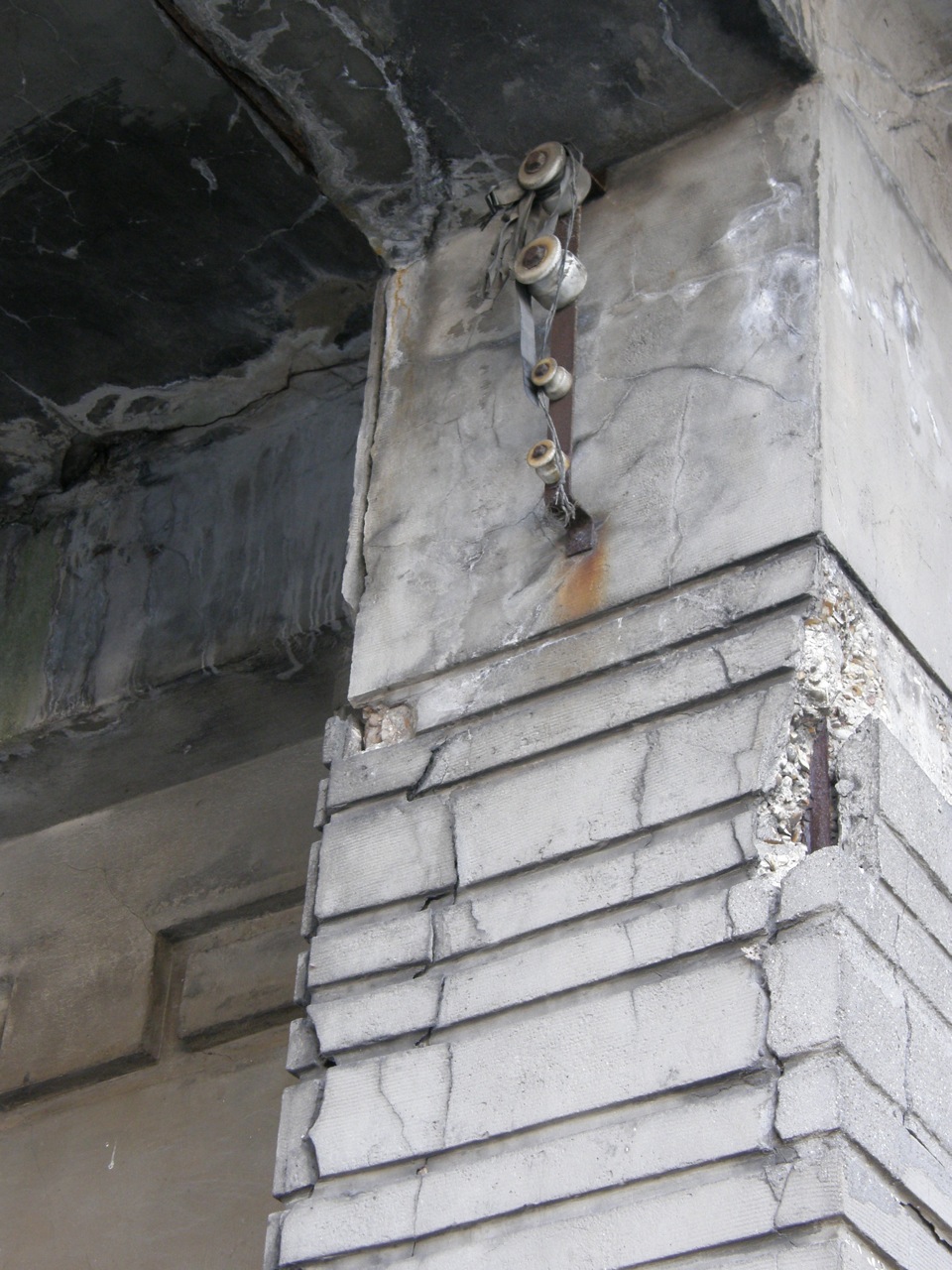
Perhaps a sensitive restoration will leave some evidence of former ways and former days. I am rather fond of this evidence of an older way of putting in electric wires. Surely anyone who has worked on rehabilitating an older house will recognize the porcelain insulators. I like them. I hope the remnants will stay as a tiny bit of history in-situ.

PC120225

After a couple of hours, I wandered away from the bridge and a few minutes later my cell phone rang. It was Philippa; she was on the right bank near the pont de l’Alma, which I could see quite clearly as I talked on the phone. My path to our meeting place inadvertently turned out to include a construction site I had to exit from carefully. But I did get an unusual view of a very different, and very modern bridge.

PC120256

Back at home in Toronto I started to find out more about the passerelle Debilly.

Structures made for International Expositions often have a short intended lifespan and most do not survive. The Eiffel Tower built for the 1889 International Exposition was expected—at least by some—to be torn down soon afterwards and it nearly met that fate. Three of my favourite Parisian sites, the Petit Palais, the Grand Palais, and the Alexander III bridge, were built for the Universal Exposition of 1900 and they too have survived. The modest passerelle Debilly was also a survivor from 1900.

It was originally known as the “passerelle de l’exposition militaire” and then the “passerelle de Magdebourg,” before it took the more dignified name of Passerelle Debilly in 1906 to honour the First Empire Army General Jean Louis Debilly, who died in the battle of Iéna (Jelna) in 1806. The Exposition included buildings on both sides of the river and the bridge was designed to link the Army and Navy Hall on one side with the “Old Paris” series of buildings on the other bank. These buildings have long since disappeared, but the bridge still crosses the Seine with pont de l’Alma upstream and the pont d’Iéna downstream.

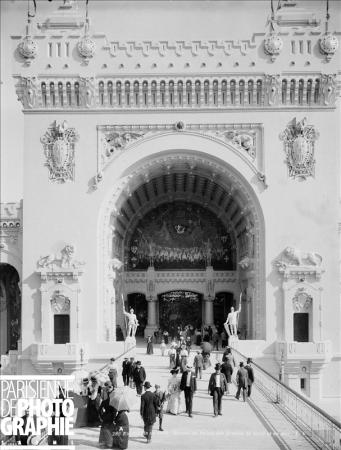
The image below, taken from a stereograph view, shows the bridge, on the upper left, entering the Army and Navy Hall, a magnificent structure. The Eiffel Tower is out of sight to the right of the photograph.

Paris exhibition 1900001

Here’s a closer view of the Army and Navy Building as seen from the passerelle.

5347-5

The bridge survived in part because it was useful and well-built. The City of Paris acquired it in 1902. Originally built to align with Avenue Albert de Mun, the city in 1906 moved it “quelques dizaines de mètres en amont” (several dozen metres upstream, actually more than 200 metres) towards Pont de l’Alma to a position opposite rue de la Manutention. Here it was further away from the pont d’Iéna, a name of no happy memories to Debilly.

Not everyone approved of the bridge. In 1941 one architect argued for its destruction because it was no more than an “accessoire oublié d’une fête passée” (a prop or accessory from a faded or past festival). Cooler heads or perhaps simply inertia prevailed and the bridge was left as is. In 1966 it was added to the supplementary registry of historical monuments. It was repainted in 1991 and the deck redone in 1997.

The 3-span bridge has a total span of 120 metres, but the large central span of 75 metres allows the piers to be quite close to the banks. This gives a wider navigation channel than would be the case with arches of equal length. The 22.5-metre side arches are actually half arches.

The passerelle Debilly was designed by engineers Jean Résal, Amédée Alby and André-Louis Lion. Résal was a professor at the famed École Polytechnique and he and Alby were the design engineers for the much more famous Pont Alexandre III, which also opened in 1900. Lion was the official engineer for Ponts et Chausées (Roads and Bridges).

The stunning ceramic tiles were made by the French company of Gentil et Bourdet.

Well-known as a rendezvous for lovers, Paris has also been the meeting place for spies from various nations. During the Cold War, the passerelle Debilly was apparently a favoured meeting place for spies and assorted “diplomats” who needed to exchange messages, currency, or other things. It was also the bridge on which, several days after the fall of the Berlin Wall, an agent of the Democratic Republic of German was found dead.

Who knows what other stories the bridge could tell? What happened when Martine and Anna had their “vacances” in Paris?

PC120210

Perhaps next time I will arrange a top-secret meeting on the bridge to exchange, um, stereocards?

Text and photographs by Norman Ball. Photograph of the Army and Navy building from Paris en Images.

Posted in Paris bridges | Tagged , , , , , , , , , , | 8 Comments