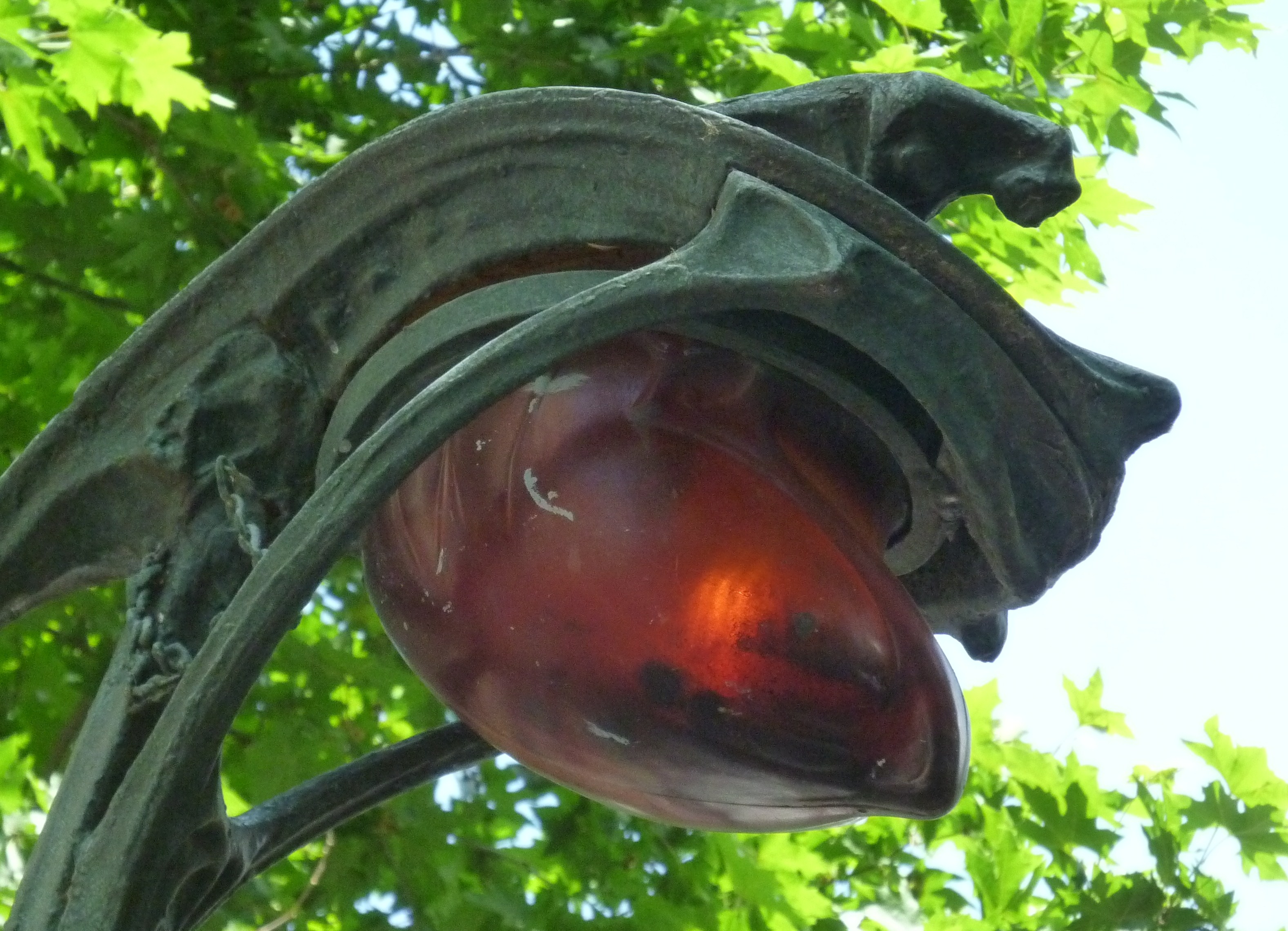
George Barbier and the dream of Paris

Every year, millions of people come to Paris dreaming of beauty, elegance, high fashion, personal freedom, decadent leisure, titillating knowledge, romantic affairs, sexual dalliances, and secret places. What they may not realize is that some of their dreams are built on the artistic foundations of Art Deco artist George Barbier (1882–1932) and his contemporaries.

front_cover

Years ago, Arthur Smith, librarian at the Royal Ontario Museum in Toronto, fell under the spell of Barbier’s artworks and the technical brilliance with which many were printed. His curiosity and diligence in learning more has led to a stunning exhibition at the Thomas Fisher Rare Book Library at the University of Toronto.

Today, most overseas visitors fly to Paris crammed into crowded airplanes, arriving hot, sweaty and grubby at an unfashionable hour of the day. But Barbier lets us dream that we made the crossing first-class on a transatlantic liner, where we would lounge about, sipping cocktails with glamorous international travellers. This was the world of 1927 he created for an S.S. Île de France menu.

F6794

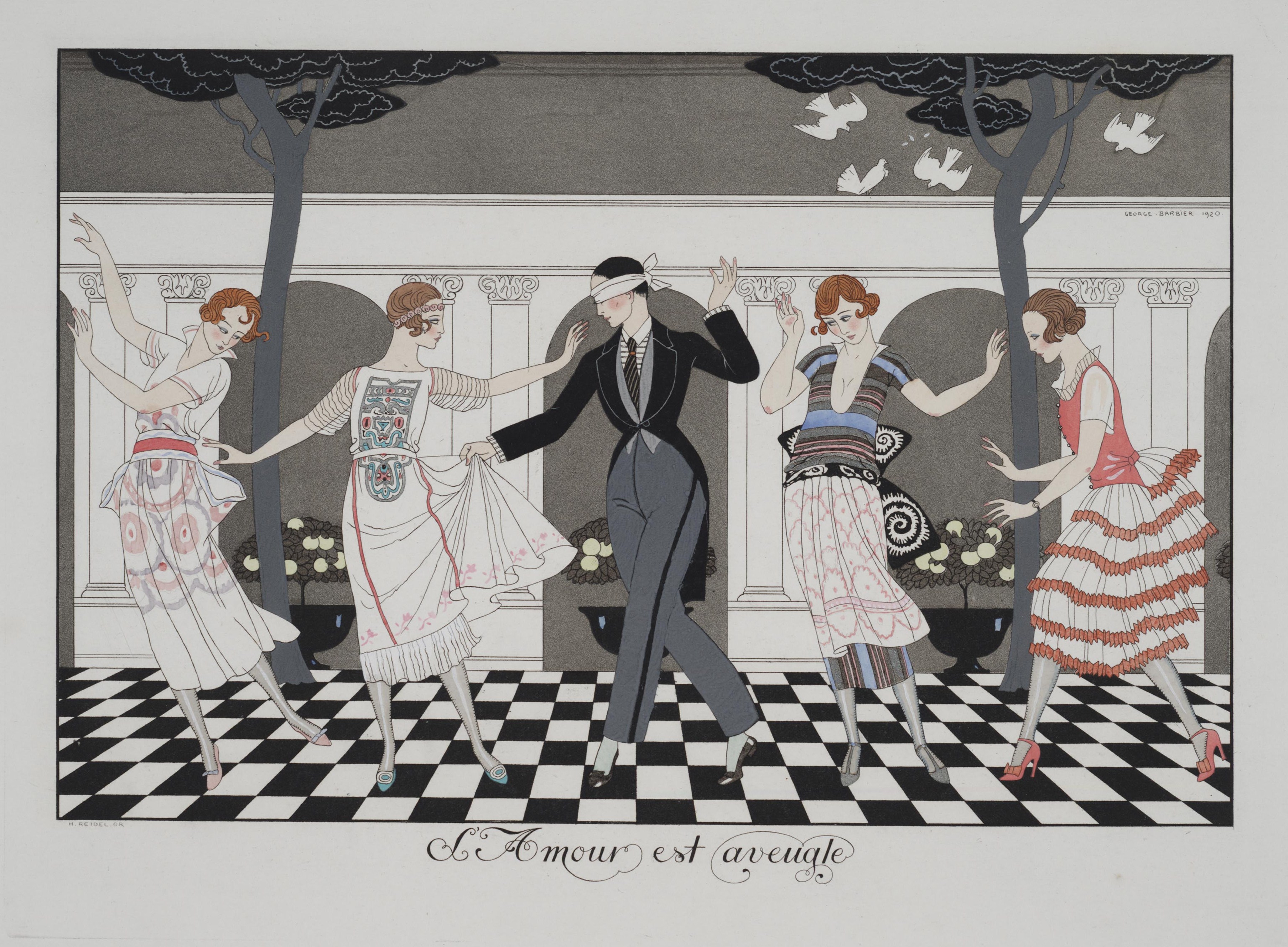
And when we arrived in Paris, there would be parties at which everyone would be dressed in the height of fashion, ready to dance and flirt, as in L’Amour est aveugle (Love is blind).

F6820

Perhaps the dance would lead to a quiet tête-à-tête with an intriguing stranger in an exquisite garden. And of course one would be the very picture of elegance.

Have those who dream of elegance today been overpowered by fads and ephemeral fashion? Who today would dare proclaim, as did the Journal des dames et des modes did in 1912, that

Elegance resides in the perfect harmony of thoughts, words, acts, gestures, attitudes and costume. It is through costume that elegance expresses itself most quickly. The elegant person should not wear anything conspicuous or extreme. He refrains from colours that are too crude, clothes of eccentric cut, perfumes that are too heavy, jewellery that is too rich, excessive gestures, vocal outbursts, and words that are too strong. The elegant person is the one who makes himself noticed by means of discretion.*

F6778

Ah, discretion. So important. As it is for this lady garbed in an afternoon dress from the House of Paquin. Barbier’s caption, N’en dites rien (Tell no one about this) suggests a mysterious secret.

F6872

Who was this artist who drew captivating worlds of wealth and refinement? He was part of a group of talented French artists, most of whom had graduated from the École des Beaux-arts in Paris, “nicknamed by Vogue the Chevaliers du bracelet (knights of the bracelet) for their dandyish attire, flamboyant mannerisms, dapper appearance, and common practice of sporting a bracelet.” Barbier was described as “un élégant jeune homme blond, tranquille et réservé.” He was as privileged as those he portrayed.

As Arthur Smith writes in the exhibit catalogue:

He was the son of a well-to-do Nantes businessman who left Barbier a ritzy apartment building in Paris and the means to maintain a comfortable Paris lifestyle. Barbier enjoyed a luxurious residence, a substantial income to finance his theatrical pursuits, and the resources to acquire an extensive personal library, valuable antiques, and works of art. He also possessed an automobile to facilitate his escapes into the French countryside.

Clearly the stuff of Paris dreams.

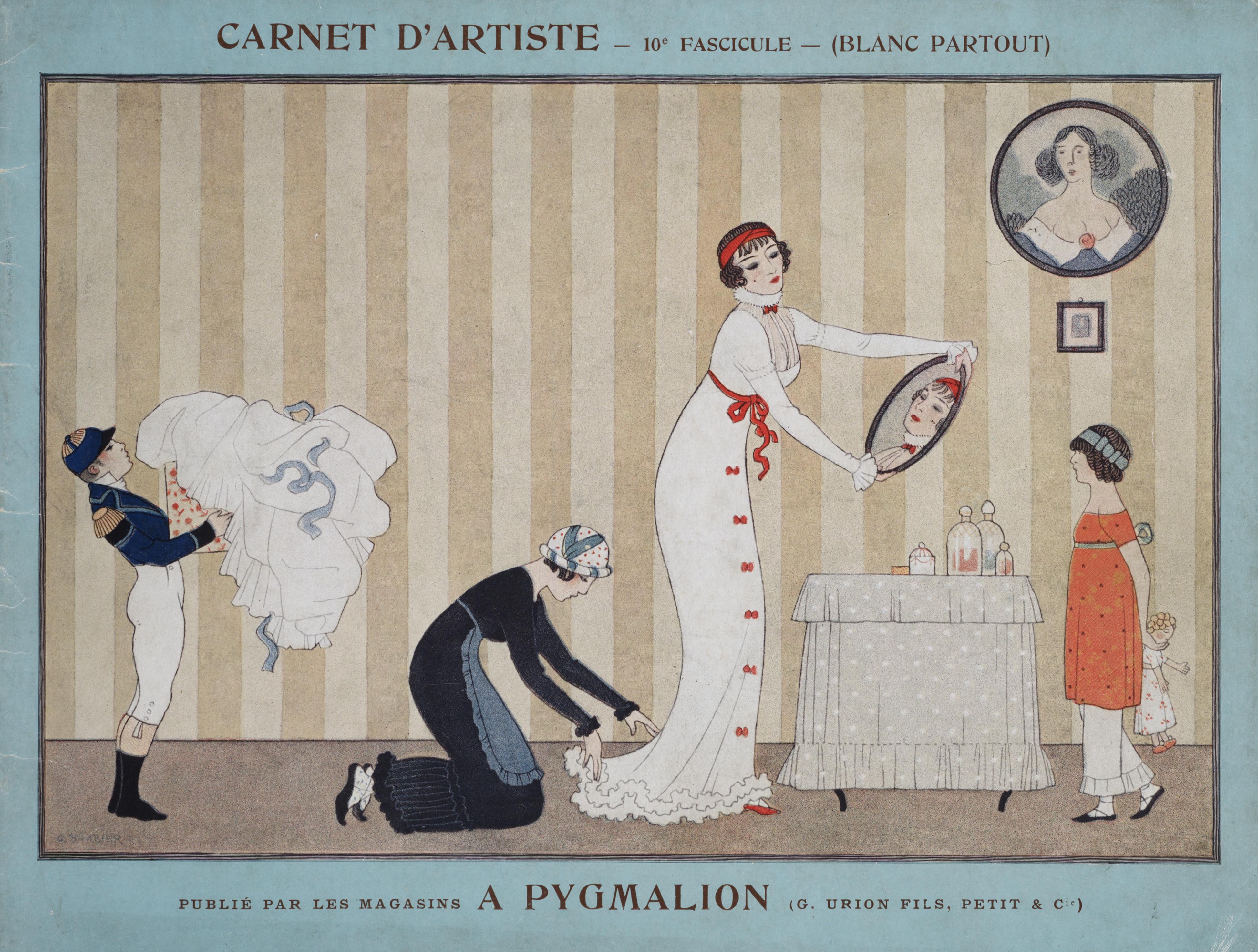
In her wonderful book The World of Department Stores, Jan Whitaker describes Paris’s contribution to  the history of the modern department store. The first ones were as far from the modern serve-yourself bargain emporium as it is possible to imagine. Well-dressed staff waited for you and waited on you, as we see in this 1913 image from the cover of an artist’s sketchbook Barbier drew for the department store À Pygmalion.

F6802

Arthur Smith describes À Pygmalion as

an imposing multi-storey building located on rue Saint Denis. It was known as a novelties shop that marketed the latest fashions, jewellery, and fabrics to a well-to-do female clientele. This volume illustrated by Barbier featured table linens and elaborately trimmed undergarments, with vignettes of ladies engaged in such activities as playing tennis, boating, skiing, riding, golfing and dining.

When the woman had finished her shopping, she would travel to her next rendezvous by a chauffeur-driven motor car, to emerge impeccably outfitted, where she would be greeted by an improbably slender, tall, and perfectly tailored man.

F6795

Did his lips alight upon her outstretched hand or linger close to her cheek while both thought of what the evening might bring?

The title “Envie” (Envy) suggests a slightly sinister undercurrent. Drawn for a collection illustrating the seven deadly sins, the maid holding the hat box is presumably the envious one. But such warnings rarely intrude on Barbier’s world. His world is more properly represented by the yachting costume from Costumes Parisiens.

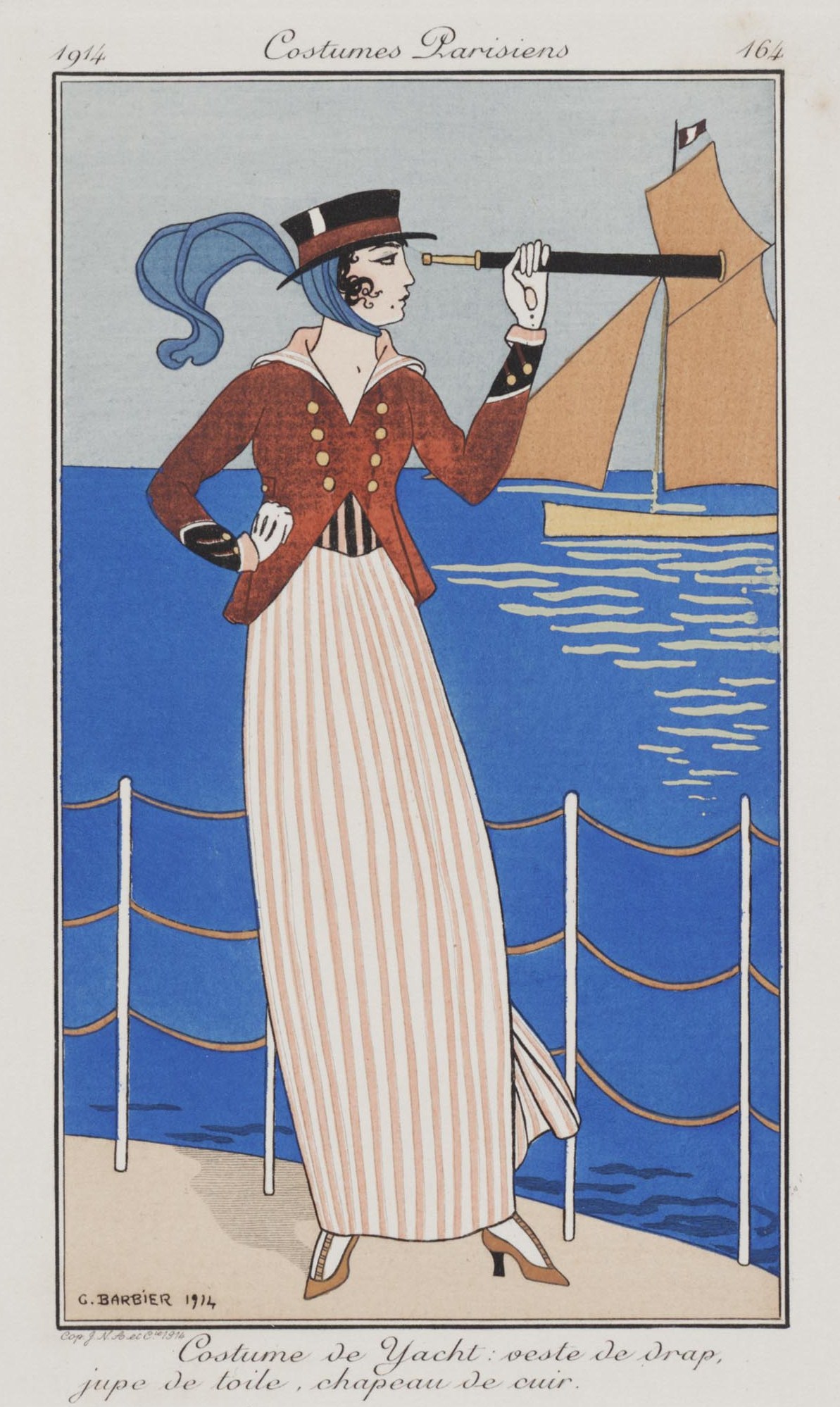
This picture shown below was circulated with an issue of Journal des dames et des modes. Can you imagine something so extravagant as a magazine published three times a month, limited to 1,250 copies per issue? It first appeared on 1 June 1912, and 79 issues later, on 1 August 1914, it ceased publication.

F6772

In addition to “literary articles, poems, society columns and fashion reports,” the exclusive circle of subscribers “received colourful unbound fashion plates entitled Costumes Parisiens, which were engraved on copper and coloured au pochoir. The plates were contributed by leading fashion illustrators of the day including Barbier” and a host of other luminaries. Costumes Parisiens illustrations such as Barbier’s Costume de Yacht shown above occasionally appear in antique shops and print galleries, where they are much sought after and priced accordingly.

The labour-intensive pochoir technique involved making and printing from many zinc or copper stencils to colour the print, which had first been made from an engraving or woodblock print of the original.

As fashion historian Alison Matthews David writes in her introduction to Arthur M. Smith’s exhibition catalogue ‘Chevalier du Bracelet’: George Barbier and his illustrated works,

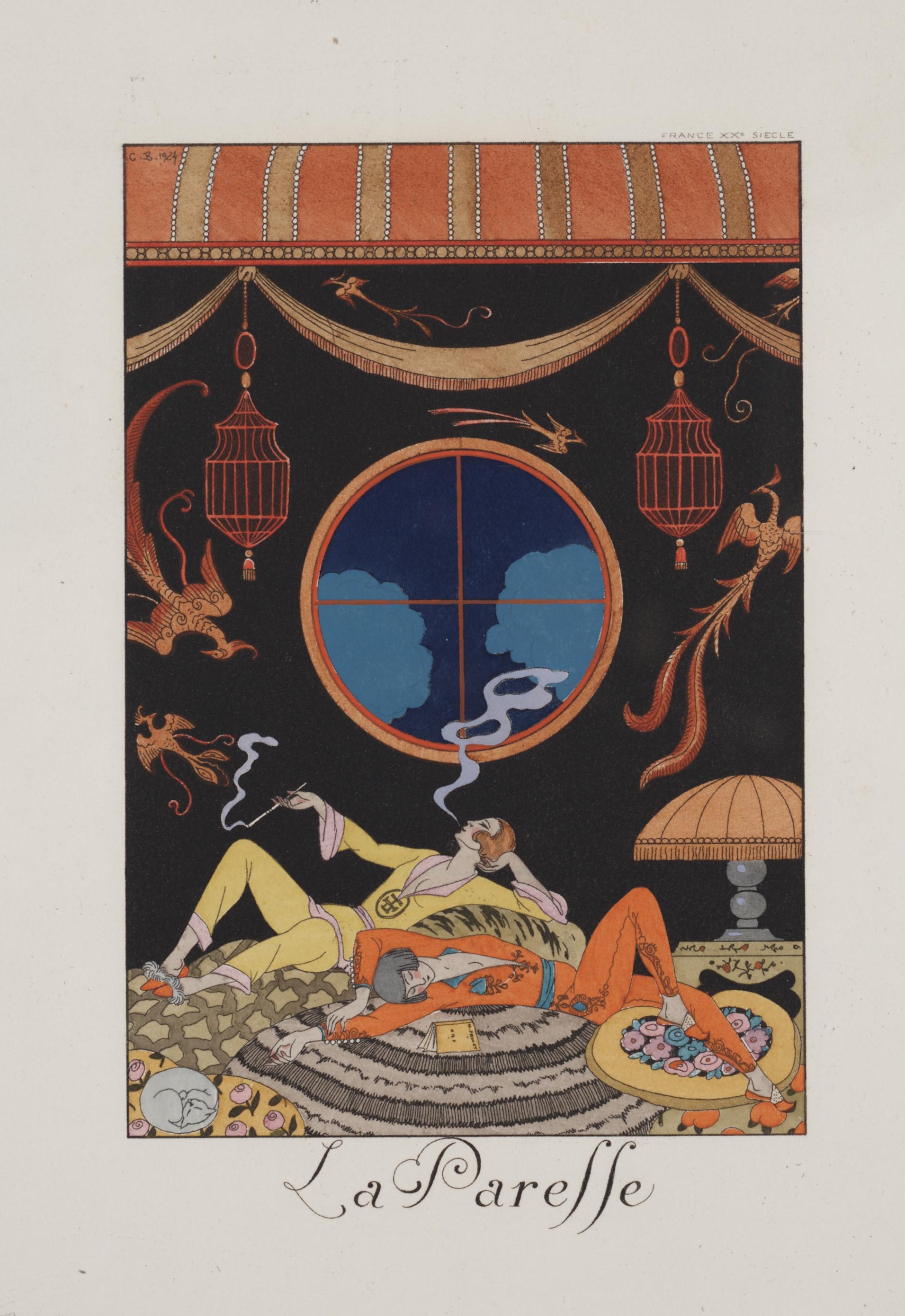
Barbier captured the modern but rarified world of haute couture fashions, illustrating the chic hats and the changing silhouettes of the best French [fashion] houses, including Worth, Paquin and Poiret. His colourful, sophisticated tableaux commissioned by the elite fashion publications of his era show young, elegant Dianas skiing at St. Moritz or being twirled in arms of Tango dancers, but also indolent femmes fatales reclining on pillows while smoking in their Asian-inspired silk evening pyjamas.

La Paresse (idleness, indolence) is a stunning evocation of the studied indolence so inseparable from many dreams of glamorous Paris. Here we see perfectly what Albert Flament meant when he said of his friend George Barbier, “When our times are lost…some of his water-colours and drawings will be all that is necessary to resurrect the taste and spirit of the years in which we lived.”

F6776

And sometimes an introduction to Barbier adds to our appreciation of what we already know and admire. In my case, the Cartier panther. Philippa and I spent Christmas 2012 in Paris. On more than one evening we stopped to admire this view on the Champs-Elysées.

PC230770

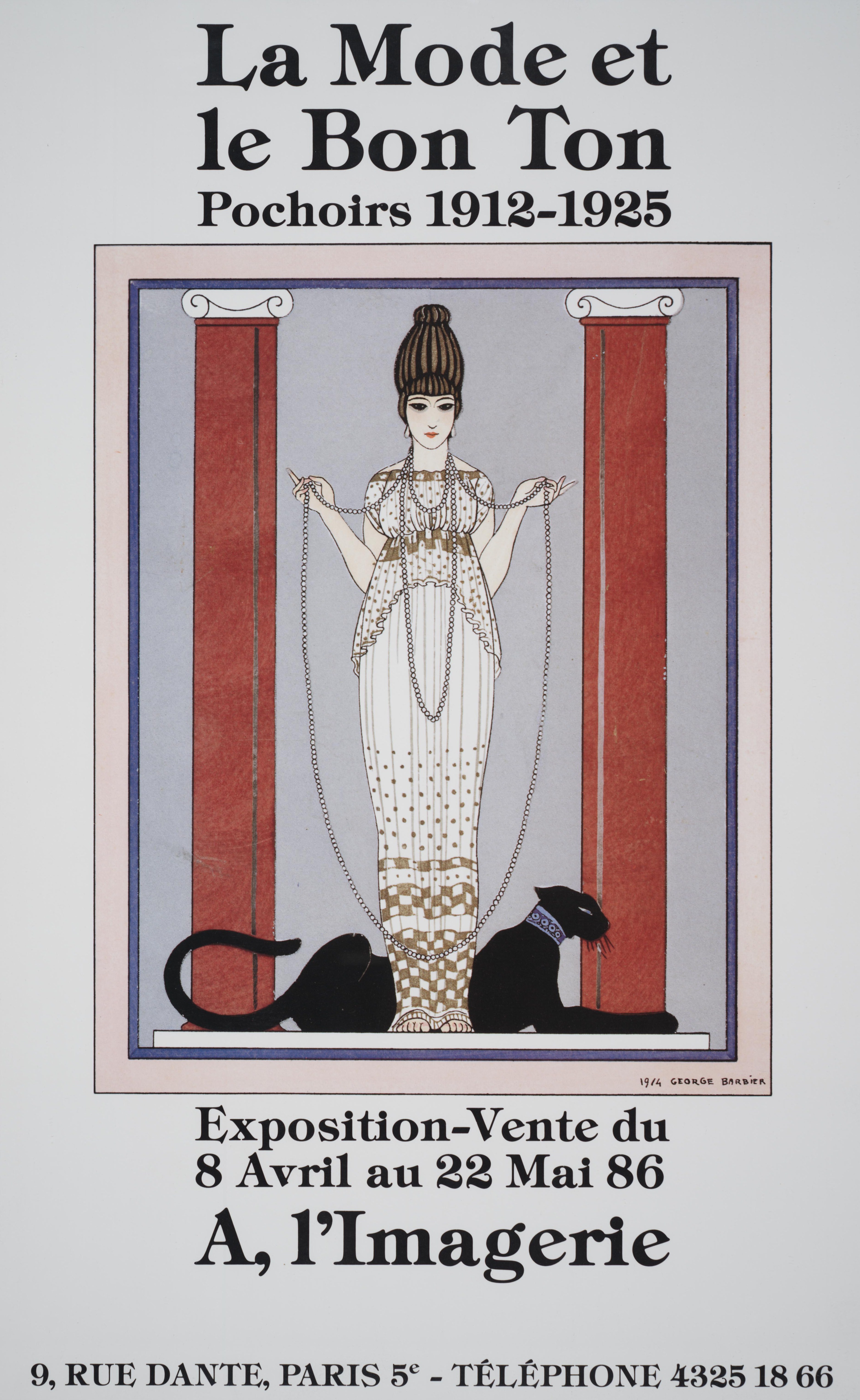
Only later would I learn from Arthur Smith that Barbier created the “iconic piece…the design of the panther that remains emblematic of the House of Cartier to the present day. The image of a classical figure, attired in a Poiret dress, and accessorized by the presence of a black panther, was used on an invitation card designed by Barbier for L’exposition d’une collection unique de perles et de bijoux de decadence antique hosted at La Maison Cartier from 27 May to 6 June 1914. The illustration bore the caption La femme avec une panthère noire, which was reproduced in a 1920s French magazine advertisement for Cartier.”

F6786

Yet for all the glamour of the era, there was also a dark side.

F6774

The attractive evening dress is from Worth, generally regarded as the first French fashion house, paradoxically started by an Englishman. However, beauty notwithstanding, there is something sinister, or threatening in this image. One senses the need for caution, for this is the “Merciless beautiful lady.” Here is a woman of power, not to be treated lightly or incautiously. Undoubtedly inspired by the John Keats poem “La Belle Dame Sans Merci” we find there someone who “met a lady” and quite unexpectedly later found himself “Alone and palely loitering.” Too late—

I saw pale kings and princes too,
Pale warriors, death-pale were they all;
They cried—‘La Belle Dame sans Merci
Hath thee in thrall!’

Perhaps La Belle Dame sans Merci is the city of Paris itself; sometimes hard to please, but impossible to forget. Far away, one feels alone and palely loitering. Barbier captured and created a particular Paris, a Paris that haunts and holds many of us in her thrall.

Text by Norman Ball. Many thanks to Arthur Smith, Anne Dondertman, John Shoesmith, and all who brought Barbier back to life in this stunning exhibit and fine catalogue.

All Barbier images courtesy Thomas Fisher Rare Book Library, University of Toronto.

*All quotations from ‘Chevalier du Bracelet’: George Barbier and His Illustrated Works, Exhibition & Catalogue by Arthur M. Smith, Thomas Fisher Rare Book Library, University of Toronto, 30 September – 20 December 2013, Catalogue printed by Coach House Press. Foreword by Anne Dondertman, Introduction by Alison Matthews David. Available for $20 Canadian. Click here.


Posted in Paris art, Paris nostalgia | Tagged , , , , , , , , , , , , , , , , , | 11 Comments

The once and future Paris transport museum

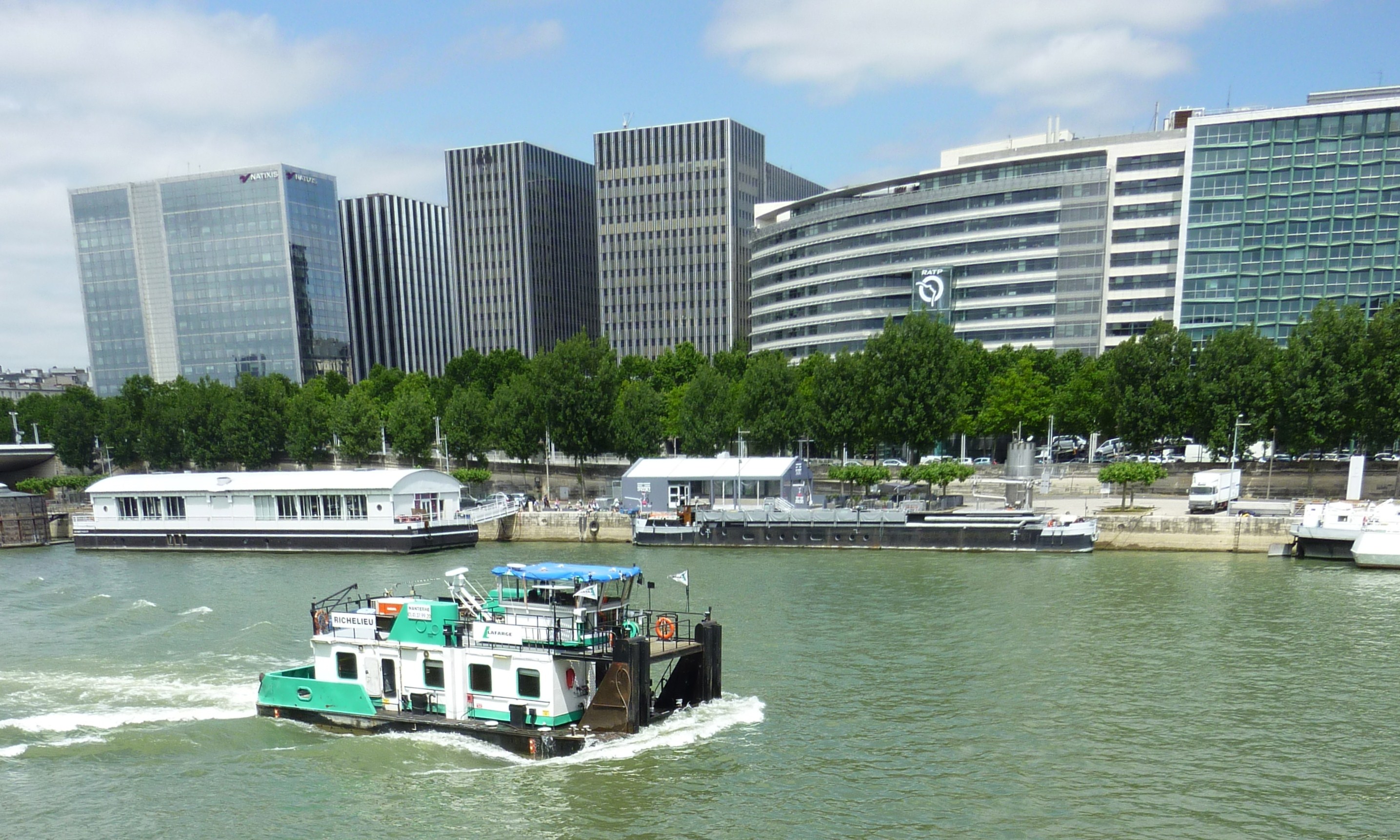
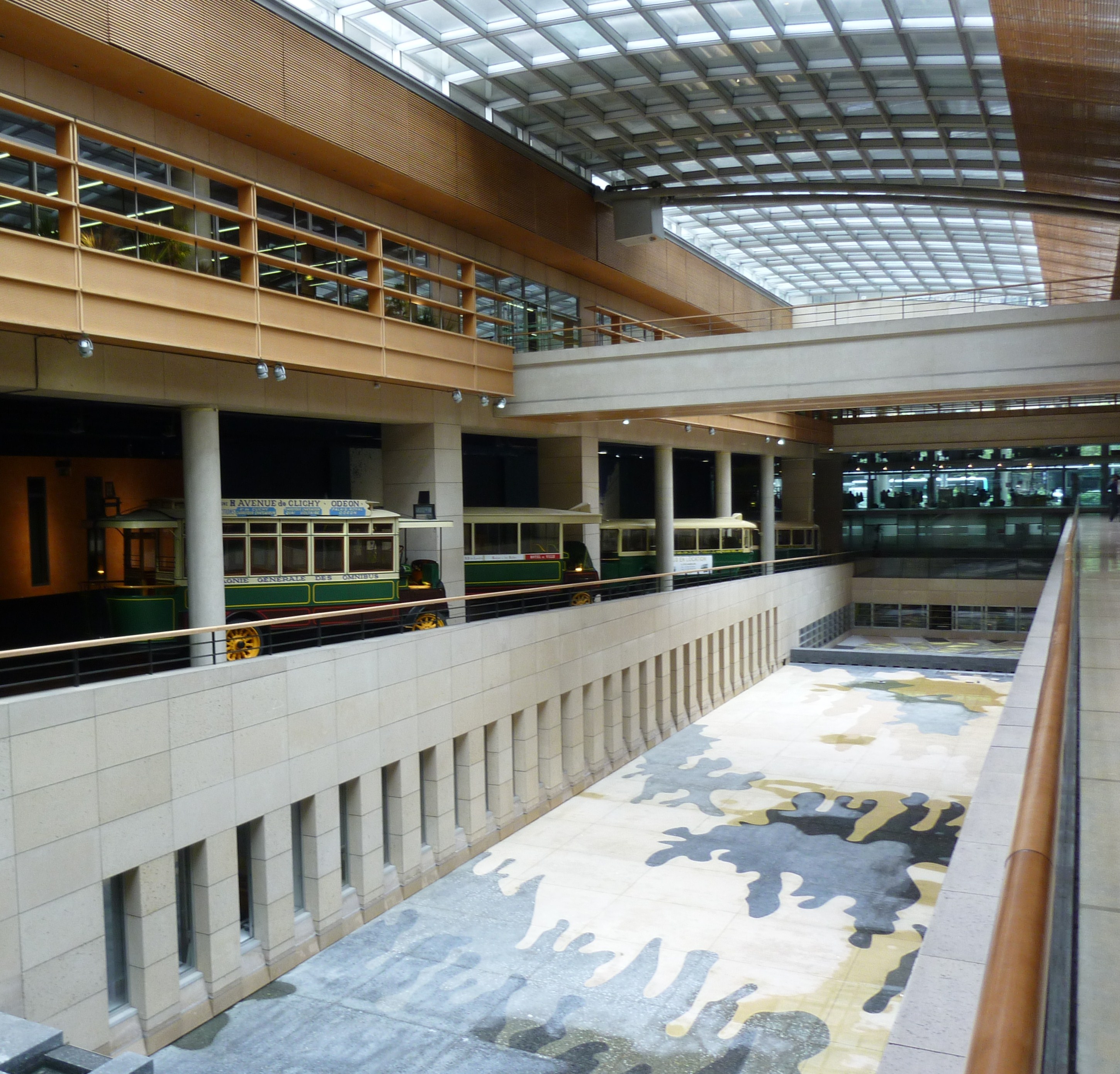
The huge Maison de la RATP on the quai de la Rapée has a sweeping view of the Seine and an impressive central atrium in which are positioned a few examples of historic trams and omnibuses. What it does not have, surprisingly, is a proper museum or even a small gift shop.

P1130517

Norman and I wandered in on a summer’s day earlier this year. We’d seen the building from across the river as we were lunching on the roof of the Cité du Design et de la Mode, and we were curious about the interior. We asked about the non-existent museum and shop at the reception desk and were directed to the tiny hard-to-find gift shop in the bowels of Les Halles (shown below; now closed). The receptionist was sympathetic. She’d seen the same disappointment in tourists’ faces before.

P1040897

We also went in search of toilettes. The building had several, but they were accessible only to those who knew the digicode. Eventually a woman at a desk in a side area where conferences and seminars were being held took pity on us and allowed us to use the ones there.

Before we left the building, we took some pictures. But the experience was unsatisfying. For a city with such a rich array of specialized museums (such as the one we mentioned in the last blog), the lack of a transport museum is distinctly odd.

P1130543

Later, in a book called Metro Insolite by Clive Lamming, I found an interesting comment in a photo caption. Below a picture of the lush foliage in the modern Gare de Lyon station, I read: “Ambiance tropicale à la station Gare de Lyon ; cet espace était destiné à accueillir un accès au musée des Transports, hélas non réalisé.” [Tropical ambiance in the Gare de Lyon station; this space was intended to house the access to the Museum of Transport, alas, never realized.] That was all. Clive had nothing further to say on the subject beyond that telling “hélas.” So I went looking for clues.

In fact, there is (or was) a museum, outside Paris, operated by the Association pour le Musée des Transports Urbains, Interurbains, et Ruraux (AMTUIR), showcasing rolling stock from cities throughout France, including Paris. It was created in 1957 at the time that most French cities were tearing out tramlines and tossing out tramcars (which are now being carefully put back in many cities, at considerable expense).

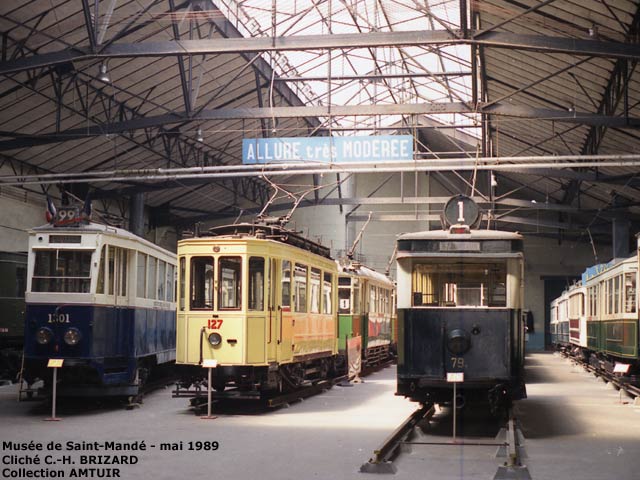
The Association, composed mainly of enthusiastic amateurs and some retired transport employees, saved what trams it could, and put them on display, first in a former tram depot in Malakoff, and then, in 1972, in an old bus depot in Saint-Mandé. Later it added omnibuses, trains, and other rolling stock from various European cities. The photo below is of the Saint-Mandé museum.

AMTUIR(You can also see some 1970 pictures of the Malakoff museum at this Flickr site. The depot sheds are still there in Malakoff, near the intersection of boulevard Gabriel Péri and avenue du 12 février 1934, but have been put to new uses.)

RATP has had a cordial relationship with the Association, offering spaces in its unused depots for the collection, and lending out old vehicles for display. But in 1998, when the new RATP headquarters was built on the quai de la Rapée, the Saint-Mandé depot was sold. The Association, with the help of the RATP, went looking for a new home. A former airplane factory in Colombes seemed suitable, the RATP bought part of the site, and the collection was moved there in 2001. Studies were done on how to fix up the place to make it into a proper museum.

Then, following a municipal election in 2002, the administration of Colombes changed. The incoming mayor and councillors declared themselves adamantly (and inexplicably) opposed to hosting the museum. Planning came to an abrupt halt. Stalemate. Several years passed.

In 2006, another suburban municipality, Chelles, expressed interest in hosting the museum and an agreement was reached. AMTUIR moved some of its vehicles there. But the space was much smaller, and could not accommodate the 170 or so trams, buses, and trains AMTUIR had collected. The remainder were put in storage in a northern Paris suburb. Since then, the project seems to have stalled, and it appears that the museum has never officially opened.

OLYMPUS DIGITAL CAMERA

All of which, you will have noticed, has nothing whatsoever to do with the Gare de Lyon near the Maison de la RATP. What was planned for that site? After all, the AMTUIR museum seems to have been a museum of rolling stock, but a Museum of Transport, like the ever-popular one in London’s Covent Garden, can tell a much wider story – about the stations, the routes, the design, the passengers, the people who worked for the company. Transport is not just about vehicles; it’s also about people and their stories.

The question, and the comparison with London, got me thinking. The Paris Métro and its associated buses and trams are very different from their London counterparts. The London Underground is much older (the first line opened in 1863). It has a strong visual identity, from red double-deckers to the circle-and-bar logo to the widely imitated map by Harry Beck. It has its emotional wartime history, when it provided shelter to so many people during the Blitz. It has a legacy of attractive and often witty advertising posters. Its lines have memorable names, and are consistently associated with certain colours (Bakerloo is always brown, Picadilly is always blue).

P1090601

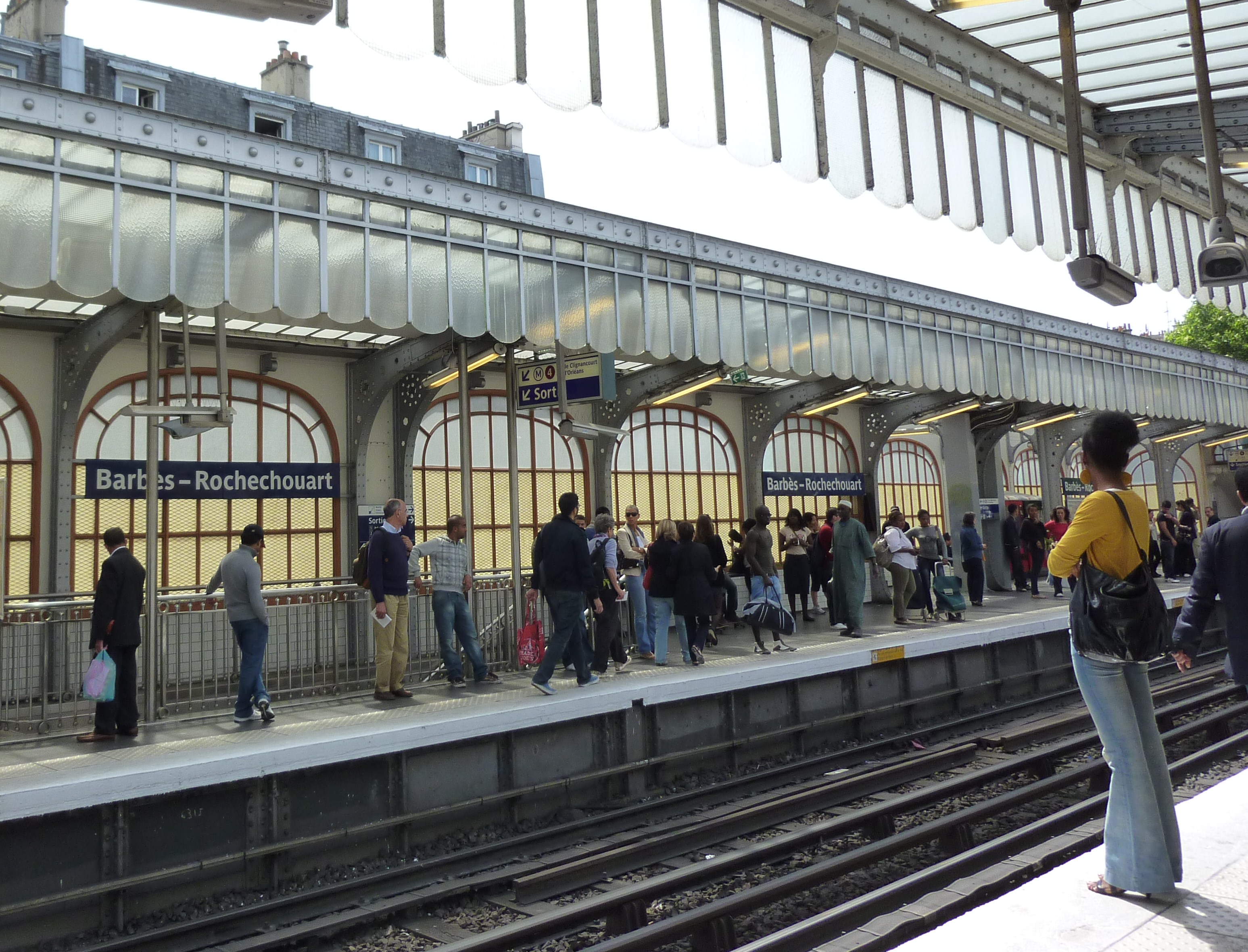
Now think about the Paris Metro. Built in 1900, it was a relative latecomer in municipal railway-based transit compared with London and New York. Its visual identity is idiosyncratic and incoherent – from writhing Hector Guimard entrances to modern signs (a yellow M in a circle) to the current, quite lovely RATP logo to one-off signs like the one shown above. Its stations range from our favourite, the imaginative Arts-et-Metiers station that evokes Jules Verne, to old-fashioned open-air platforms (shown below) to bleakly functional underground stops to unsuccessful makeovers, like the one at Franklin Roosevelt on the No. 1 line, which reminds me of the interior of a 1980s disco.

P1040743

The buses today are unremarkable, now that the green ones with the open-air platforms at the back are gone (ah, fond memories!). There are many versions of the map, using a variety of designs and colours (the one below is from our copy of Paris Arrondissements, and the colours of the various lines do not necessarily correspond to those you will find on official maps). The Métro did provide shelter in a few stations on a few occasions during the war, but Paris did not suffer through a Blitz. It has few advertising posters and those are unmemorable.

Metro map (2)

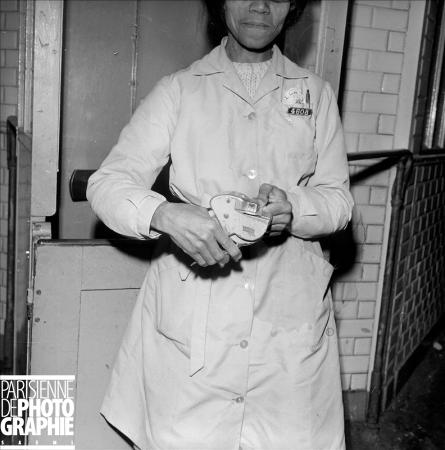
All of which is not to say that the RATP doesn’t deserve a museum. It may have lost control of its visual identity, but it is still an institution with a long and distinctive history. You have only to look at a book published in 2011 called Les archives inédites de la RATP, 1850–1950  [The Unpublished Archives of the RATP, 1850–1950] by François Siegel. This huge coffee-table tome is filled with never-before-seen photographs of everything from the other flood (did you know there was one in 1924 as well as the big one in 1910?) to the camps created for Les Enfants du Métro (the children of Métro employees) to the lonely plight of the poinçonneurs and poinçonneuses (the men and women who once sat in station booths to punch passengers’ tickets).

PoinconneuseA whole social history is there. Paired with some of the actual artefacts, it would make for a riveting museum. One day.

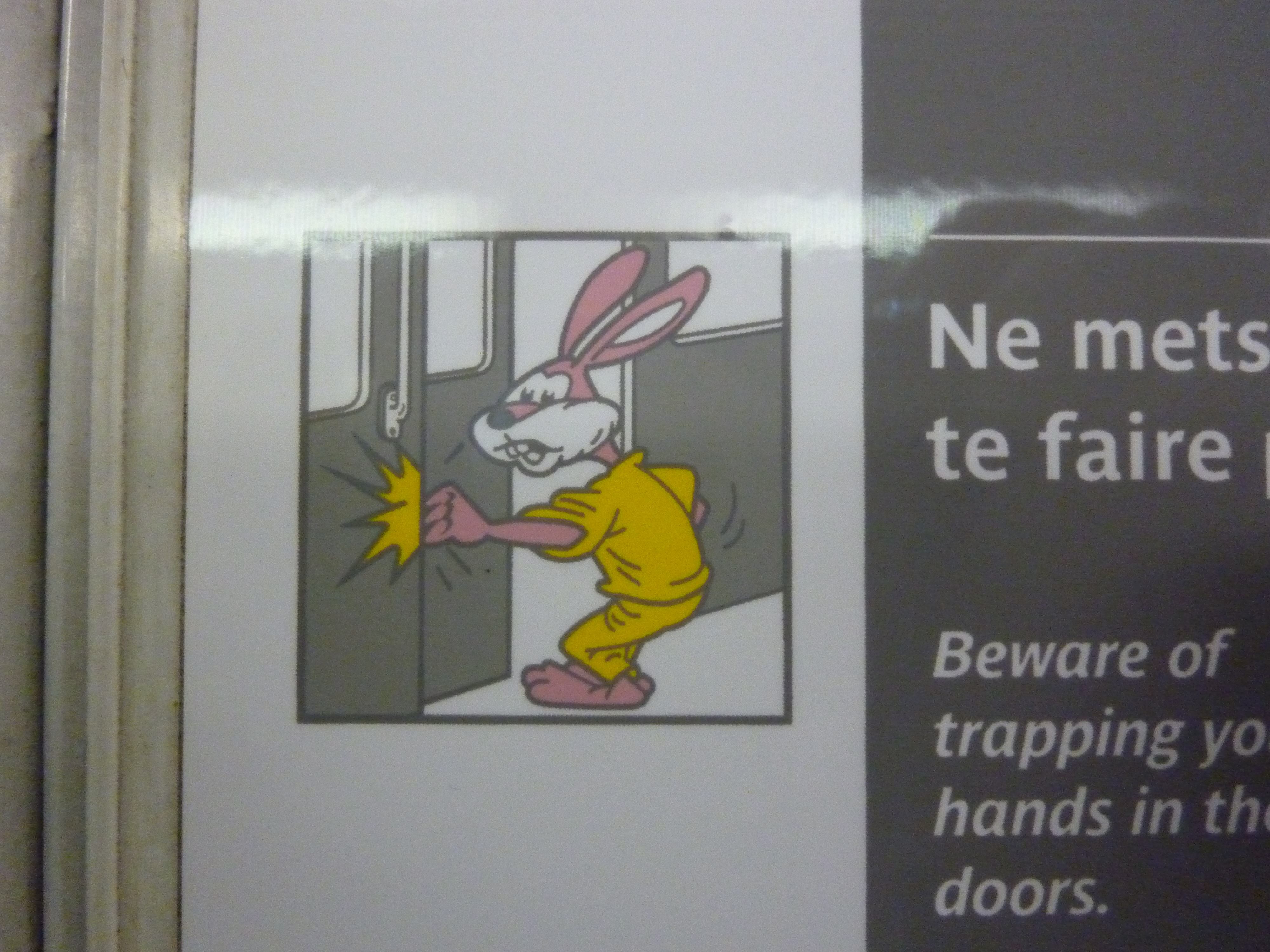
And think of the merchandising opportunities in a proper shop! Metro maps on everything from mousepads to mugs, not to mention model trains, Hector-Guimard-style trinkets, and perhaps even a series of children’s books about the further adventures of the familiar pink rabbit in yellow pyjamas – le Lapin du Métro.

P1020925

But for now, the RATP is not very welcoming. According to the RATP website, its archives are open to the public – by appointment only. You can’t just wander in.

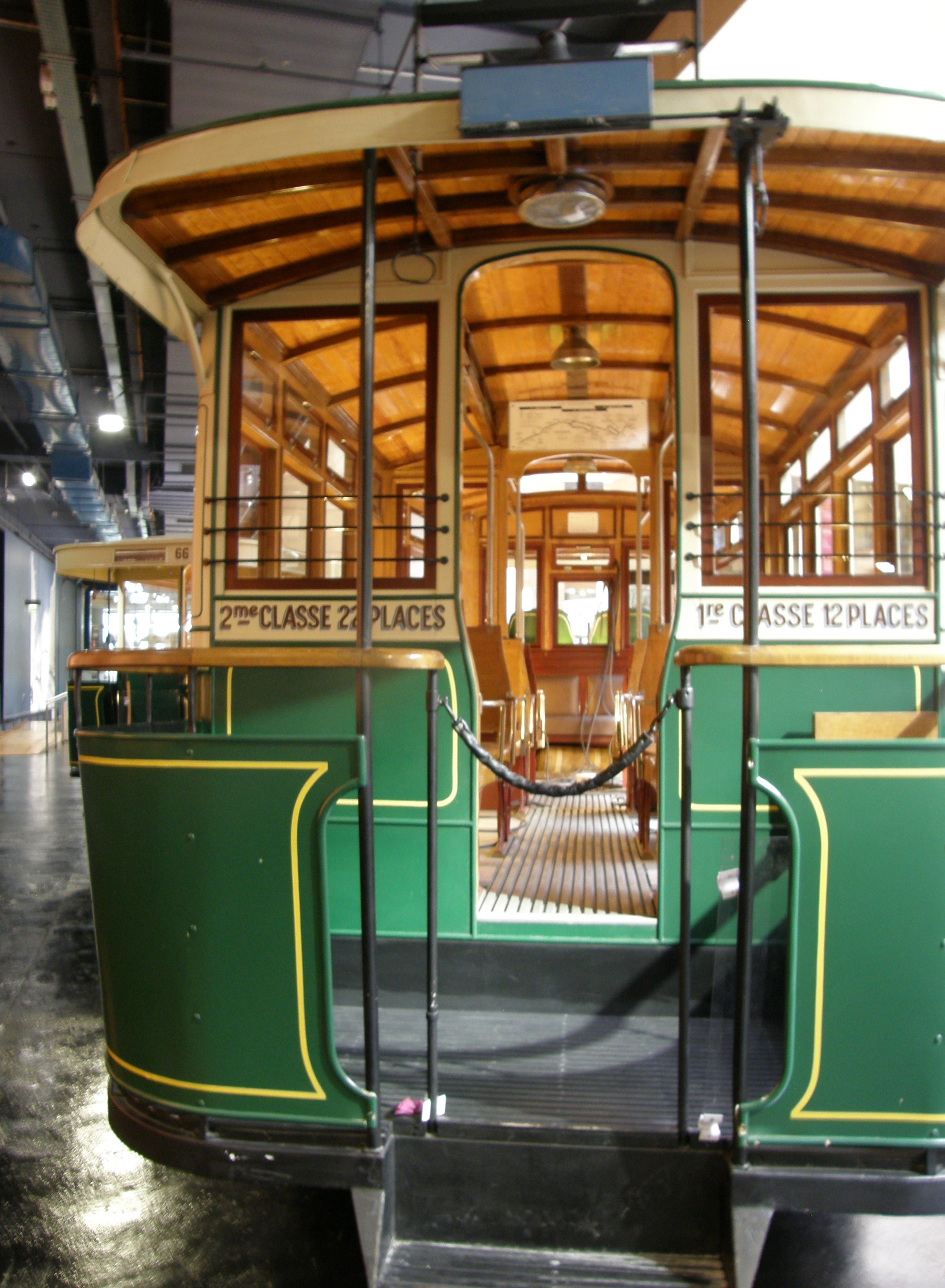
The website also notes: “Since 1992, RATP has embarked upon a vast process of restoring its historic rolling stock. When a series of rolling stock is discontinued, one example is taken away to be preserved for future generations. A number of vehicles and objects from this collection are exhibited permanently in the reception hall of the Maison de la RATP (RATP’s headquarters near Gare de Lyon). The others are preserved and stored, with a view to being exhibited at the new Musée national des transports urbains.”

One day. One day.

P1120500Text by Philippa Campsie; original photographs by Philippa Campsie and Norman Ball. Image of poinçonneuse from Paris en Images. Image of museum at Saint-Mandé from Direction générale des patrimoines de France.

Posted in Paris metro, Paris museums | Tagged , , , , , , , , , , , , , , , , , , , , , , , , , | 11 Comments

Le Musée Valentin Haüy: A different vision of history

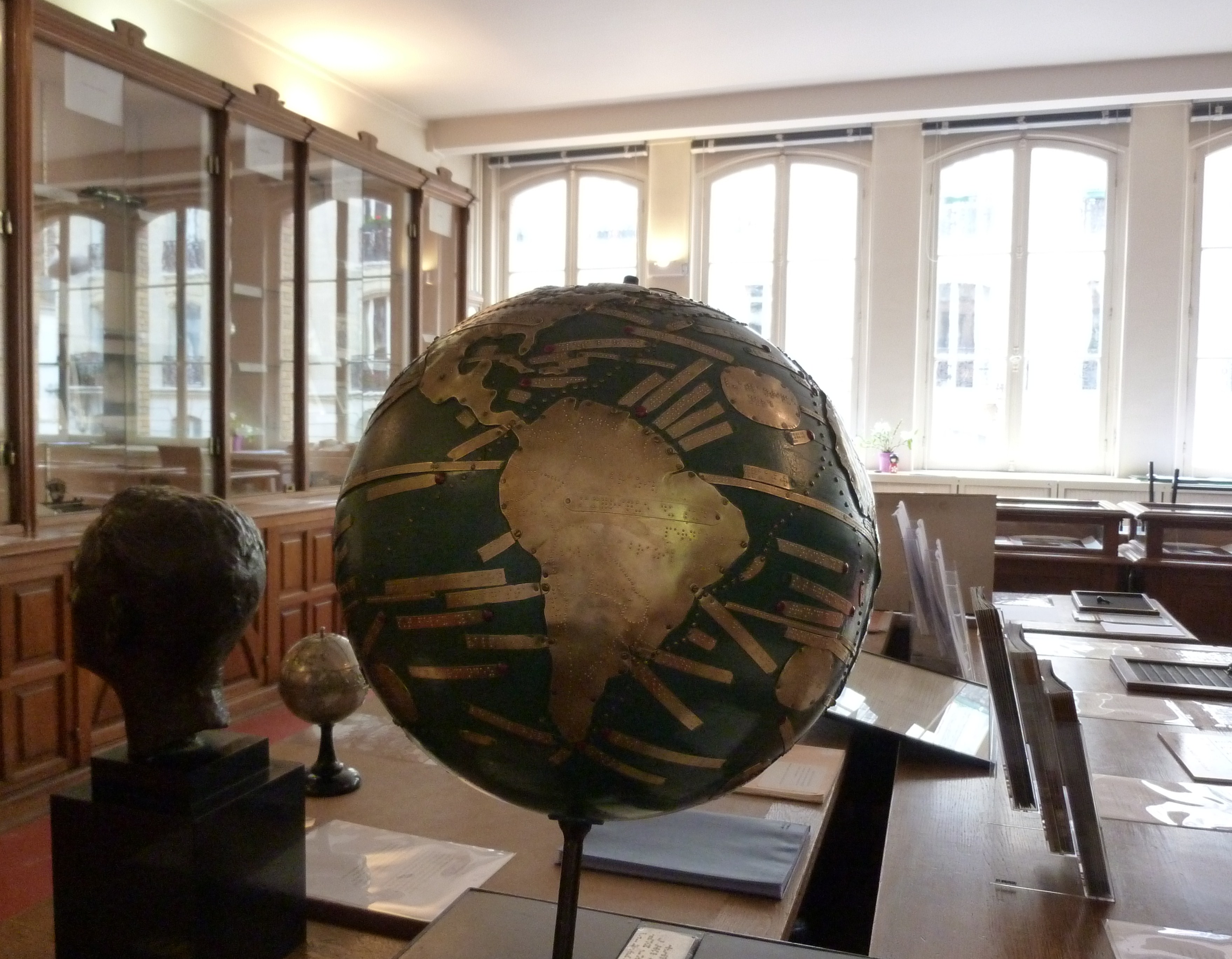
This is no ordinary terrestrial globe. And you’ll find it in a museum that is anything but ordinary.

P1120079

When we move in closer, we find that it is labelled in Braille.

Copy of P1120079And the map shown below is not your average stuff-it-in-the-bag tourist map of Paris. But, for the blind, it gave a good introduction to the layout of Paris. Take a good look. I am sure you can locate the Seine and the Ile de la Cité. It was designed to be read by the blind who read by touch.

P1120075

Welcome to the Museum Valentin Haüy (his unusual last name is pronounced Ah-oo-ee), which honours the founder of Europe’s first school for the blind. More than that, it is an excellent guide to how life has changed for the blind.

Before the 18th century, the traditional lot of the blind included poverty, ridicule, little or no formal training or education, and life at the margins of society. At a street fair for Saint Ovide in 1771, a café owner put together an “orchestra” composed of people from a nearby residence for the blind. The crowd was there to laugh at the blind:

Tricked out in long red robes, and wearing pointed dunce caps and opaque glasses, the ensemble played horribly discordant “music.” Seated on a peacock throne, the “conductor,” wearing wooden clogs and a hat with ass’s ears, tried unsuccessfully to keep time. The crowd laughed uproariously at this bizarre performance, which was a great money maker for the owner of the café where it was staged.*

Not everyone was amused. The 26-year old Valentin Haüy, a well-educated interpreter, was so moved by the humiliation suffered by the blind that he dedicated his life to making life better for them. He decided to start with one of their strengths, namely their ability to distinguish shapes through touch. Through that they could learn to read. His belief that the blind were competent and capable was unheard of in his day.

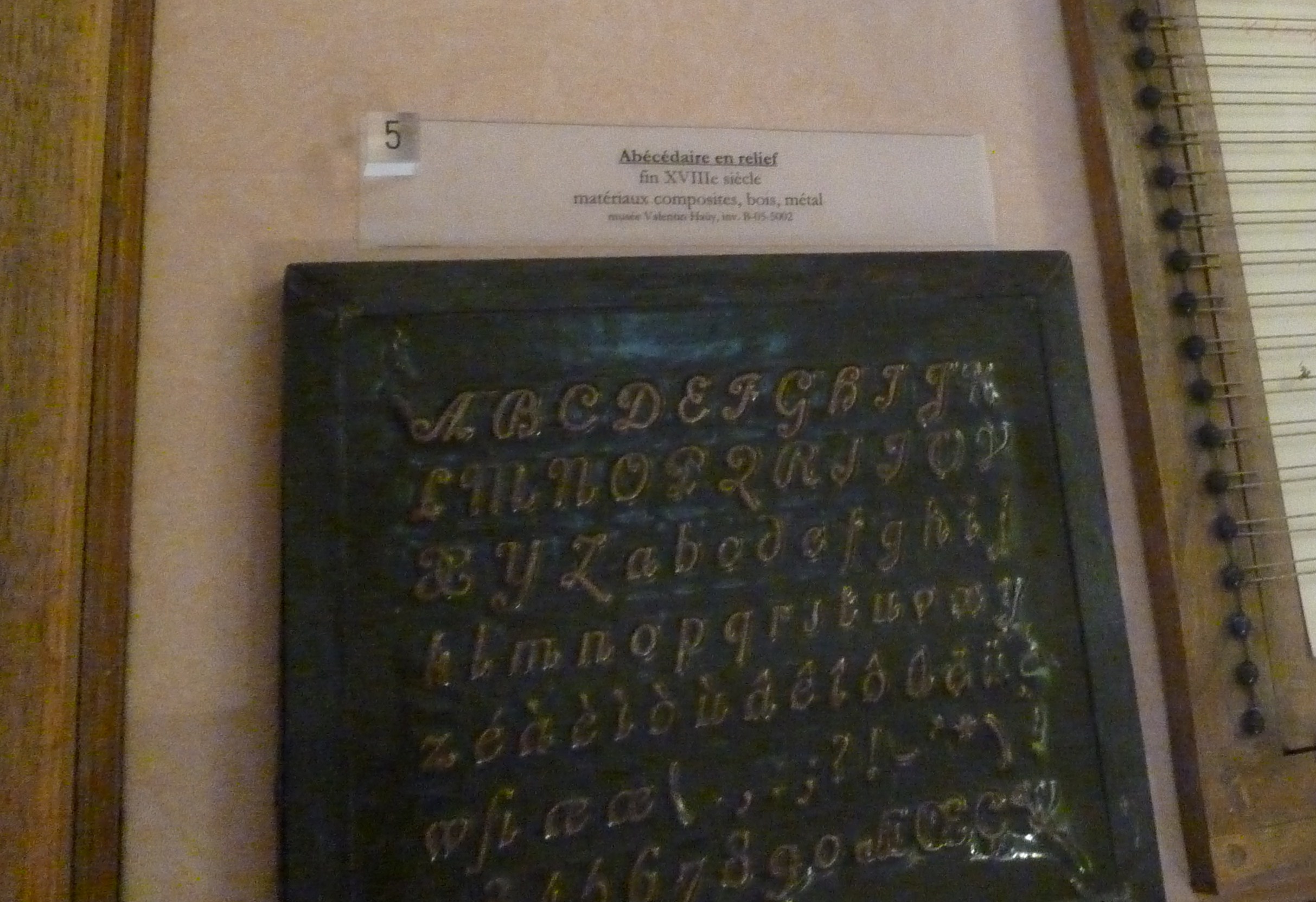
Valentin was not rich, but he was committed to his cause, persuasive, and somewhat well-connected. He tried to make the writing system used by sighted people visible to the blind by creating raised, embossed letters that the blind could read by touch.

P1120078(For more examples of embossed type, see this online exhibit from Birkbeck University.)

Haüy had to make a living, but he found time and money to support a young blind beggar whom he taught to read his system. Then in 1786, Haüy rented space at 18 rue Notre-Dame-des-Victoires for l’Institution des Enfants Aveugles (Institution for Blind Children), the first educational institution of its kind in Europe.

The school did not have it easy; there was always the need for money despite the efforts of a Philanthropic Society. When Haüy’s students impressed Louis XVI, the word Royal was added to the school name, which became the Institution Royale des Jeunes Aveugles (Royal Institution for Blind Youth), but the new name brought no extra funding and later Louis XVI and his wife Marie Antoinette were executed during the Revolution.

The school was nationalized by the revolutionaries in 1791. In the end neither they nor their successors proved any more supportive and understanding. Eventually Haüy was forced to retire in February 1807. His pension was less than half his former salary. Nonetheless, Haüy had shown that the blind could be taught to read by touch. Others built on this breakthrough.

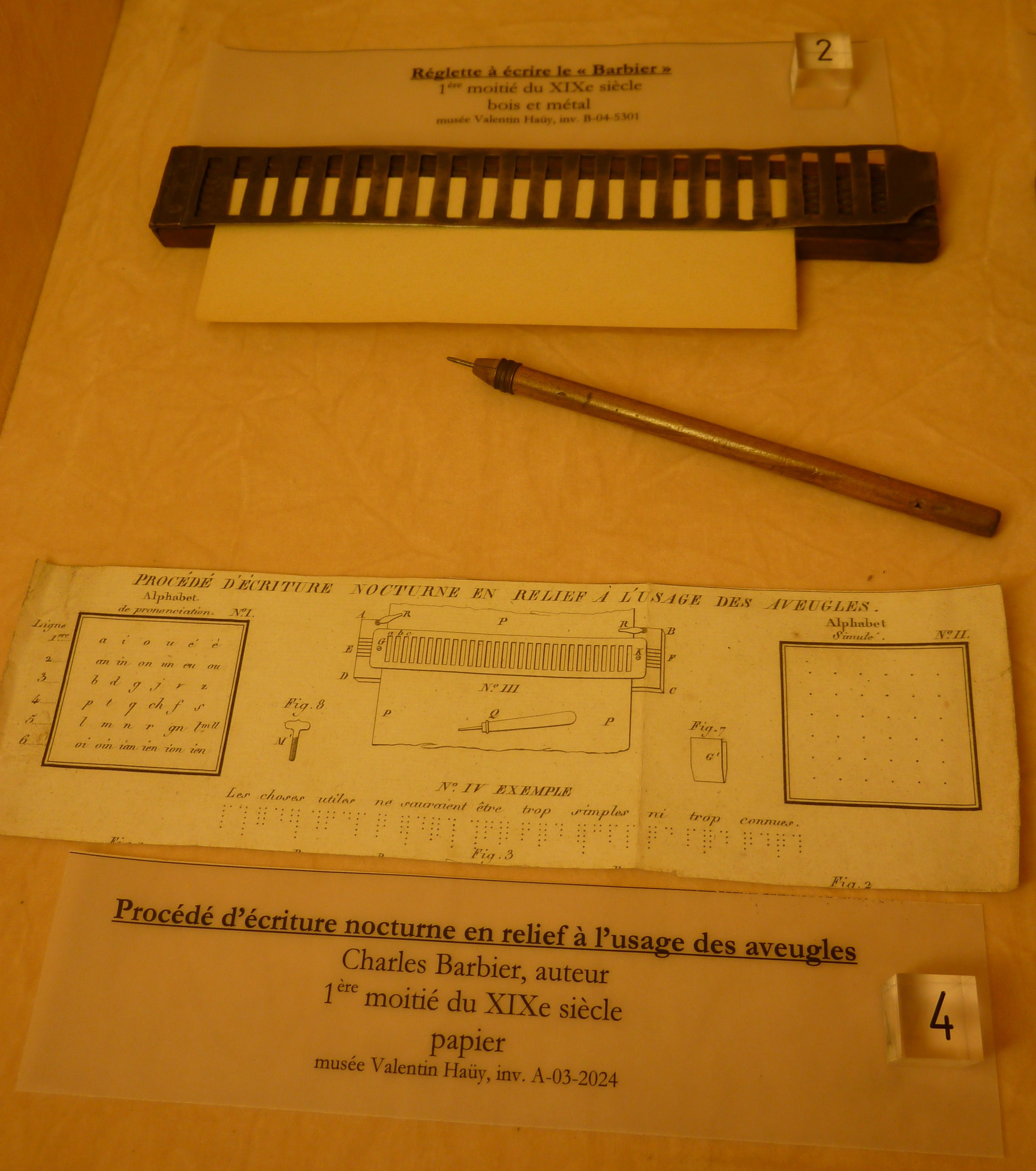
One such pioneer was a retired French military officer, Nicholas Charles Barbier de la Serre (1767-1841). At a time when teaching the blind to read and write was based on imitating the standard forms of letters, he had a different approach.

Contrary to popular myth, Barbier did not develop his ideas on the suggestion of Napoleon, who wanted a way for soldiers to communicate messages in the dark. I confess to making this error in an earlier blog.

After his military career was over, Barbier dedicated his life to languages and communications. He wanted to create a written language that would be easy to learn. He felt that people had been “déshérités de l’instruction” (disinherited from, or robbed of, instruction) by the difficulties of writing.

His new system was phonetic, and did not require its users to know how to spell. All they had to do was to record the sounds of words. The French language consists of 36 distinct sounds. The 36 sounds can be listed in a table of six columns, each of six lines. In Barbier’s system, each sound was represented according to its coordinates on the table: one number for the column and one for the line. These coordinates were recorded by a system of raised or embossed dots.

P1120102

One must credit Barbier with freeing the blind from the need to decipher stylized versions of the written alphabet, which were confusing (how to distinguish a cursive a from an o from a c?). And he was the first to propose that blind people use a stylus to make the indentations on the paper that, when turned over, became raised points the blind could read.

P1120120

Unfortunately, the system was still too complicated, with 2 columns of 6 dots.

P1120106When the ten-year-old Louis Braille arrived at the school for the blind in February 1819, he was taught the method introduced by Haüy. Two years later,  Barbier introduced his system to the students at the school. Braille realized that if Barbier’s system could be simplified, it would be even better. He modified the system to a total of 6 dots in 2 parallel columns of 3. Moreover, because there were so many ways to pronounce words (depending on regional accents), he returned to representing letters instead of phonetic sounds.

P1120084

His fellow blind students recognized the brilliance of Braille’s system far faster than their sighted educators and administrators. Alas, educational systems seem to be inherently conservative. It took a very long time for the Braille system to be accepted.

The standard Braille system of raised dots allowed the blind to write for the blind. But what about writing for the sighted who did not know Braille? Louis thought of that too. He realized that the roman alphabet could also be reduced to a system of points which he called decapoint. Here is a sample from the Louis Braille Museum in Coupvray.

P1120363

It was, as one might imagine, very laborious to write such a letter. So Braille worked with another blind man, Pierre Foucault, to produce a mechanical system to write decapoint.

P1120091

One simply pressed the appropriate plunger depending on which of ten possible positions one wanted.

A considerable number of the blind were also deaf, or deaf and mute. The museum also shows equipment developed to meet their needs. In the image below we have a device to communicate with someone both blind and deaf. The sender pressed the keys and the receiver could feel the appropriate pins rising and falling, spelling words in Braille.

P1120161

And for a two-way conversation one could use this device.

P1120158

The stories of devices, systems, ingenuity and perseverance that the Valentin Haüy Museum tells are astounding. We first visited the museum at the suggestion of a friend in Paris, Farouk, who shares my interest in the history of typewriters (the museum has an excellent collection of typewriters for the blind).

Since visiting the museum, where curator Madame Noëlle Roy graciously welcomed us and patiently answered our questions, I have changed my research interests. There is so much to learn about devices for the blind that I will leave the research on devices for the sighted to others.

The Valentin Haüy Museum is a unique resource filled with extraordinary objects. I can hardly wait to get back. I want to spend more time looking at this machine to write both Braille and inked writing at the same time on two separate sheets of paper.

P1120124

And as a Canadian I would like to know the story behind this item. Does anyone have any suggestions?

P1120143Text by Norman Ball, photographs by Philippa Campsie. Thanks to Farouk Derdour, Madame Noëlle Roy, and Stéphane Mary for their kind assistance.

* C. Michael Mellor, Louis Braille: A Touch of Genius (Boston: National Braille Press, 2006), p. 30.

Posted in Paris history, Paris museums, Paris typewriters | Tagged , , , , , , , | 8 Comments

Going, going, gone

34495-7In the 1850s, as the old Paris of narrow streets and ramshackle houses gave way to the broad boulevards and uniform apartment blocks planned by Napoleon III and carried out by Georges-Eugène Haussmann, Charles Baudelaire wrote an epitaph for the city he remembered:

Old Paris is no more (the form of a city / Changes more quickly, alas! than the human heart)
Le vieux Paris n’est plus (la forme d’une ville / Change plus vite, hélas! que le coeur d’un mortel)

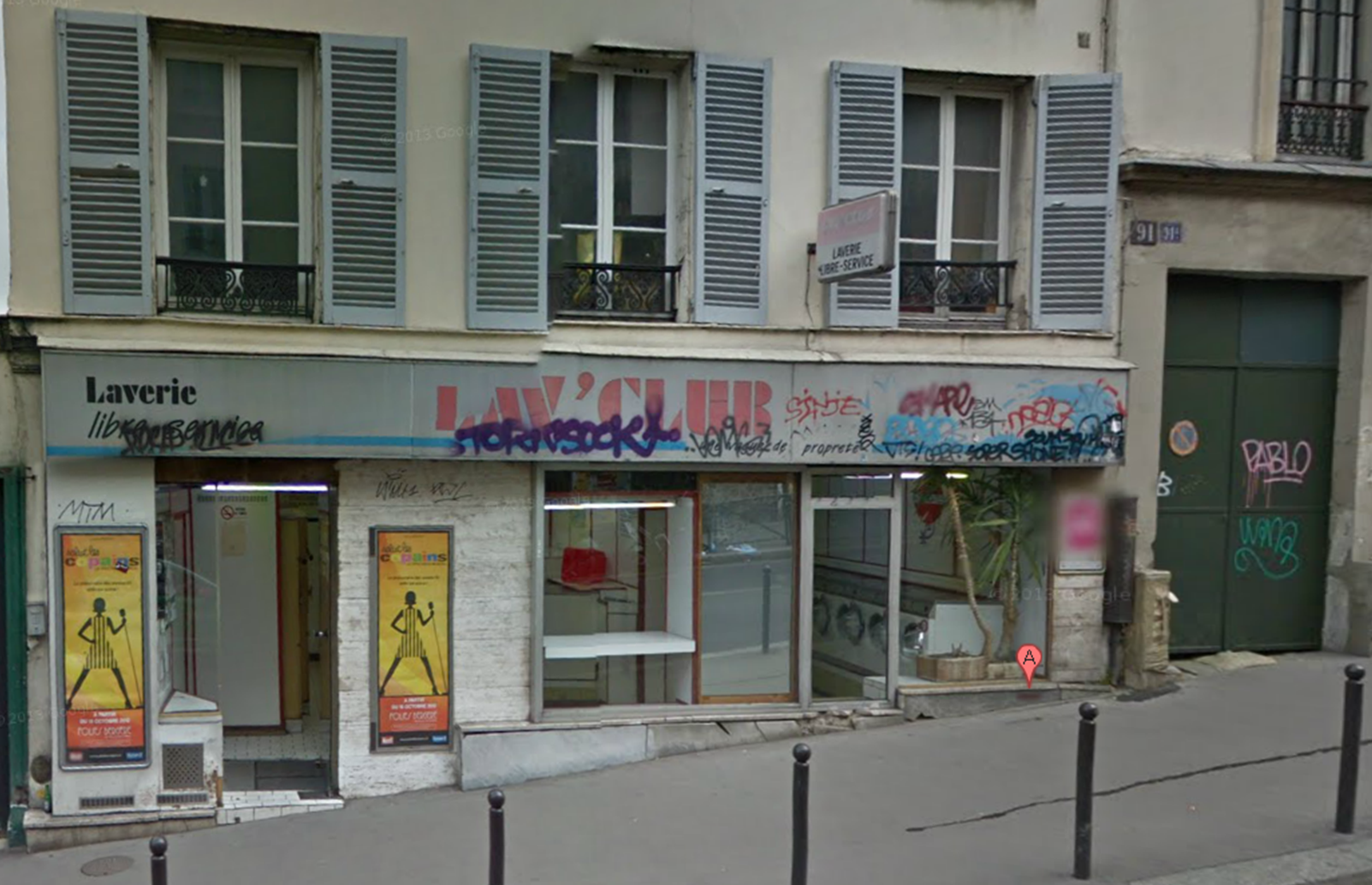
Baudelaire was right at the time, and indeed, you could say the same thing of Paris today. It never stops changing. Just as you cannot step into the same river twice, you cannot set foot in the same city twice. Ask any visitor who has gone on a futile quest to find “that wonderful little restaurant / hotel / shop / patisserie we discovered on our honeymoon / student year abroad / first visit / previous visit.” We’ve all done it, and we’ve usually ended up looking sadly at the space it once occupied, now a laudromat / modern high-rise / government office / vacant lot.

One gets used to the changes, typical of any modern city. Every time we leave Toronto to visit Paris, we return to find that in our neighbourhood, one business has closed, a new one has opened, and a sign on a third proclaims that a developer is seeking to turn a row of older shops into “a 52-unit condominium with retail at grade and underground parking.”

On this past summer’s visit to Paris, however, we noticed a pattern to the disappearances. It started on the first day, when we passed the Livre Sterling on the avenue Franklin Roosevelt, an idiosyncratic bookshop we have written about in a previous blog.

P1040631This time, the tables outside advertised books on sale and the shelves inside were almost empty. It was going out of business. Perhaps it wasn’t an ideal location for a bookshop, but it was the only one in the area, and now it has gone.

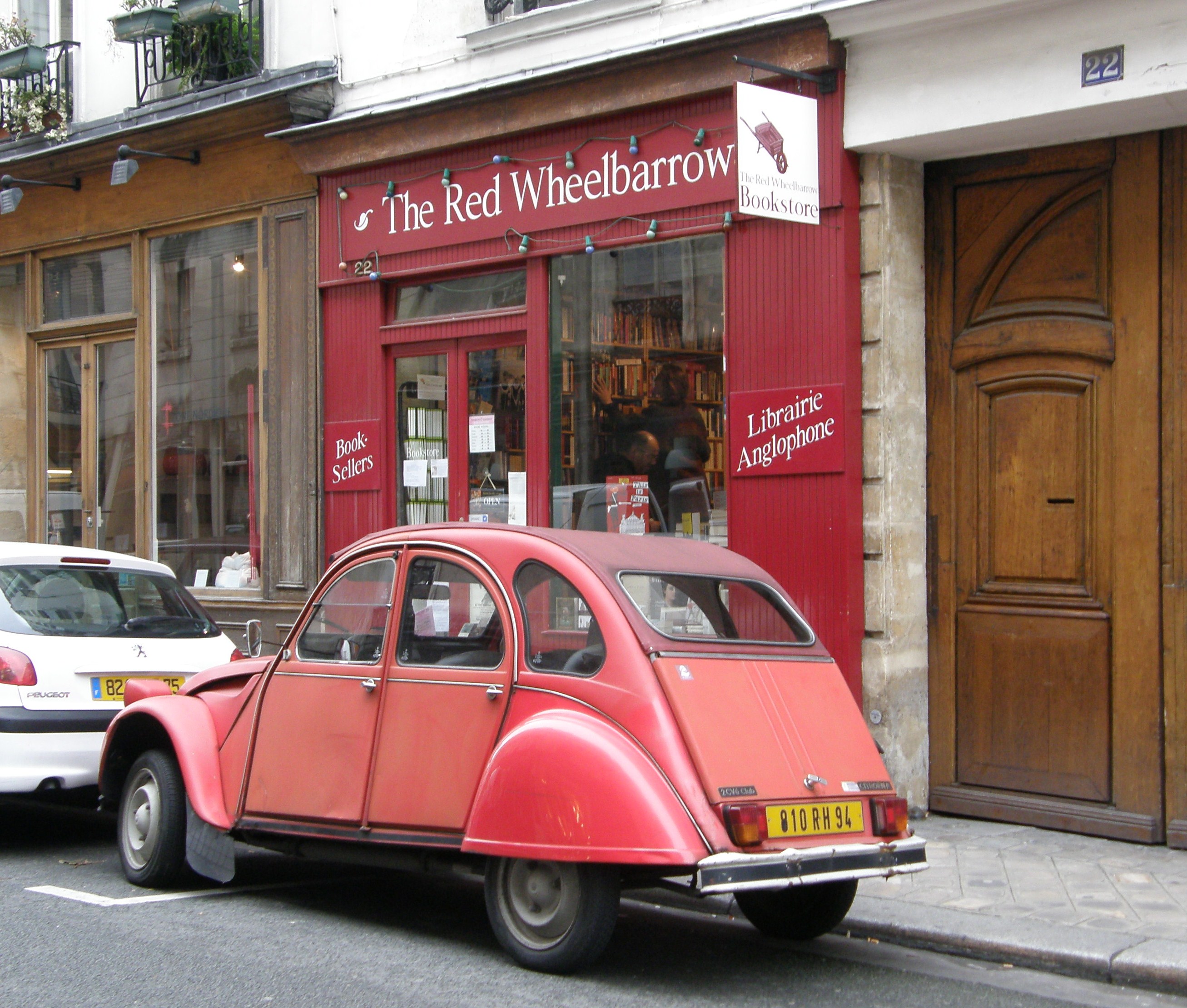
We already knew about the demise of our favourite English-language bookshop – the Red Wheelbarrow on the rue St-Paul in the Marais. Here it is as we remember it.
OLYMPUS DIGITAL CAMERAThe owner had had to move away for personal reasons, and had been unable to find a buyer to take over the business. So the books were sold and the place closed. The sign remained for a long time after the shop went dark.

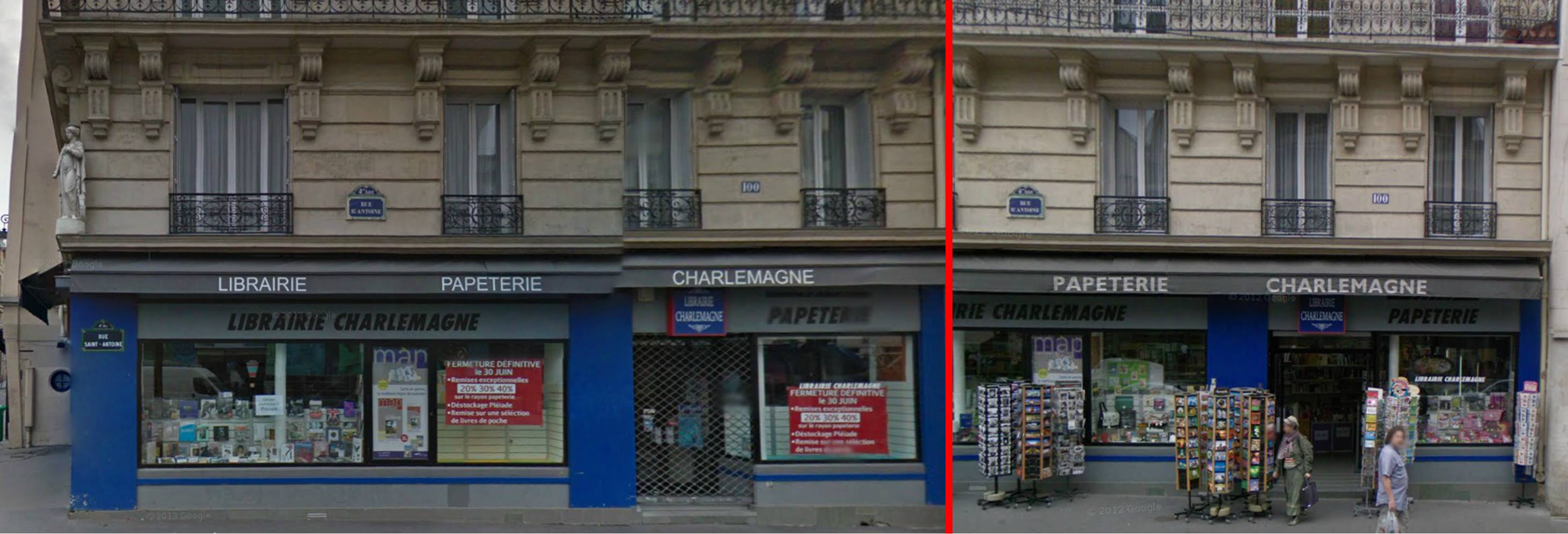
What threw us completely was the disappearance of another Marais book and paper store – the Librairie Charlemagne on the rue St-Antoine, which had closed a year earlier. How had we missed that? We’d bought books, maps, gifts, stationery in that store countless times over the years. It had vanished so completely that I had to ask in a nearby store if I had got the address wrong. No, a young woman told me, it had closed and been replaced by a clothes shop.

By a curious quirk of Google Street View, the view of the bookshop is split between 2008 and 2012. I have spliced the two together here with a red line to show the overlap: on the right is the bookshop when it was still a going concern. On the left is the same entrance again and the rest of the facade with signs advertising the going-out-of-business sale. I wonder if the little statue still graces the corner of the rue St-Antoine and the rue de Sévigné.

Picture1

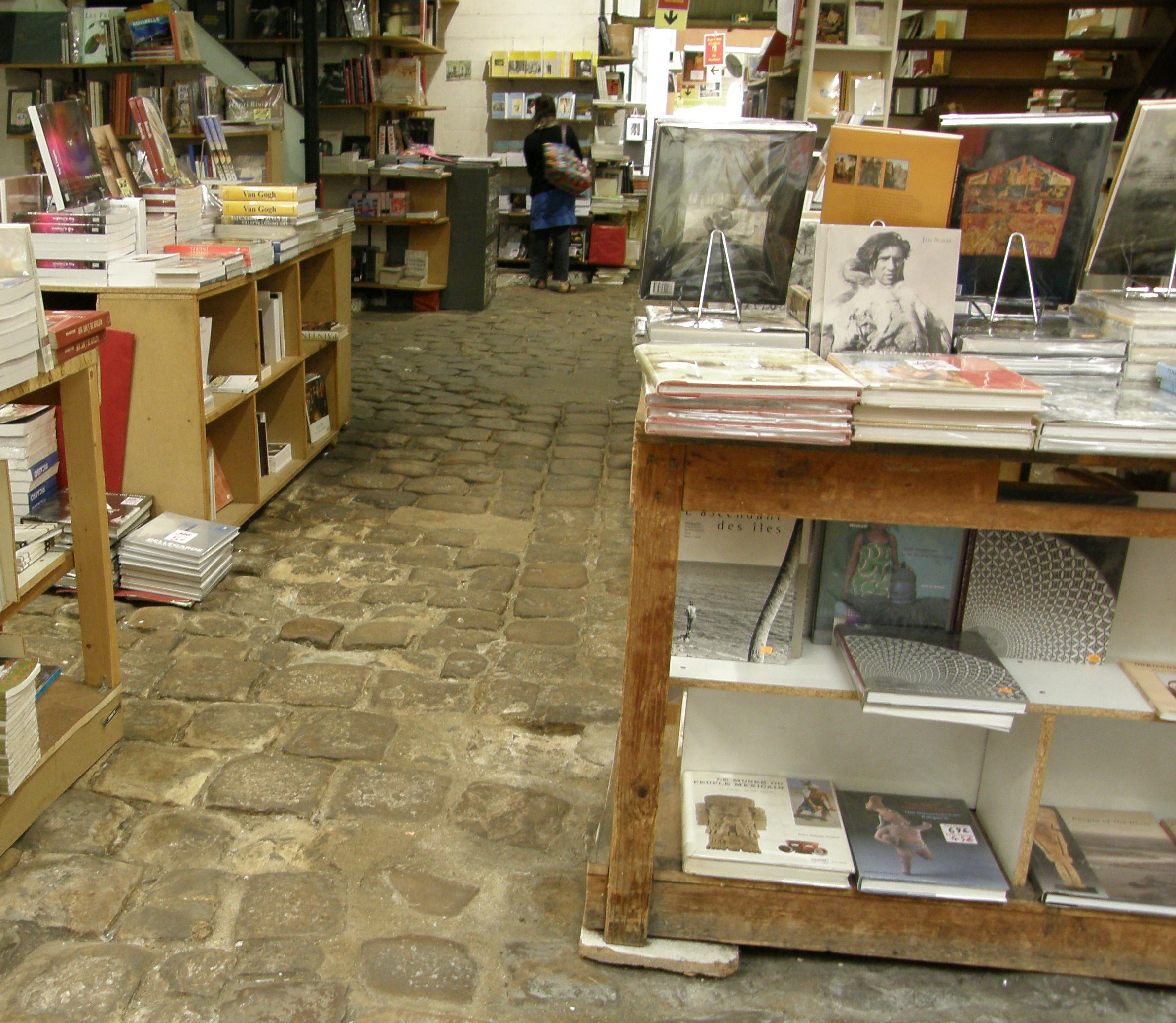
We wandered over to Mona Lisait nearby (a chain that sells secondhand and remaindered books). The branch in the Marais occupies an odd, interim space that seems to have been a cobbled lane at one point.
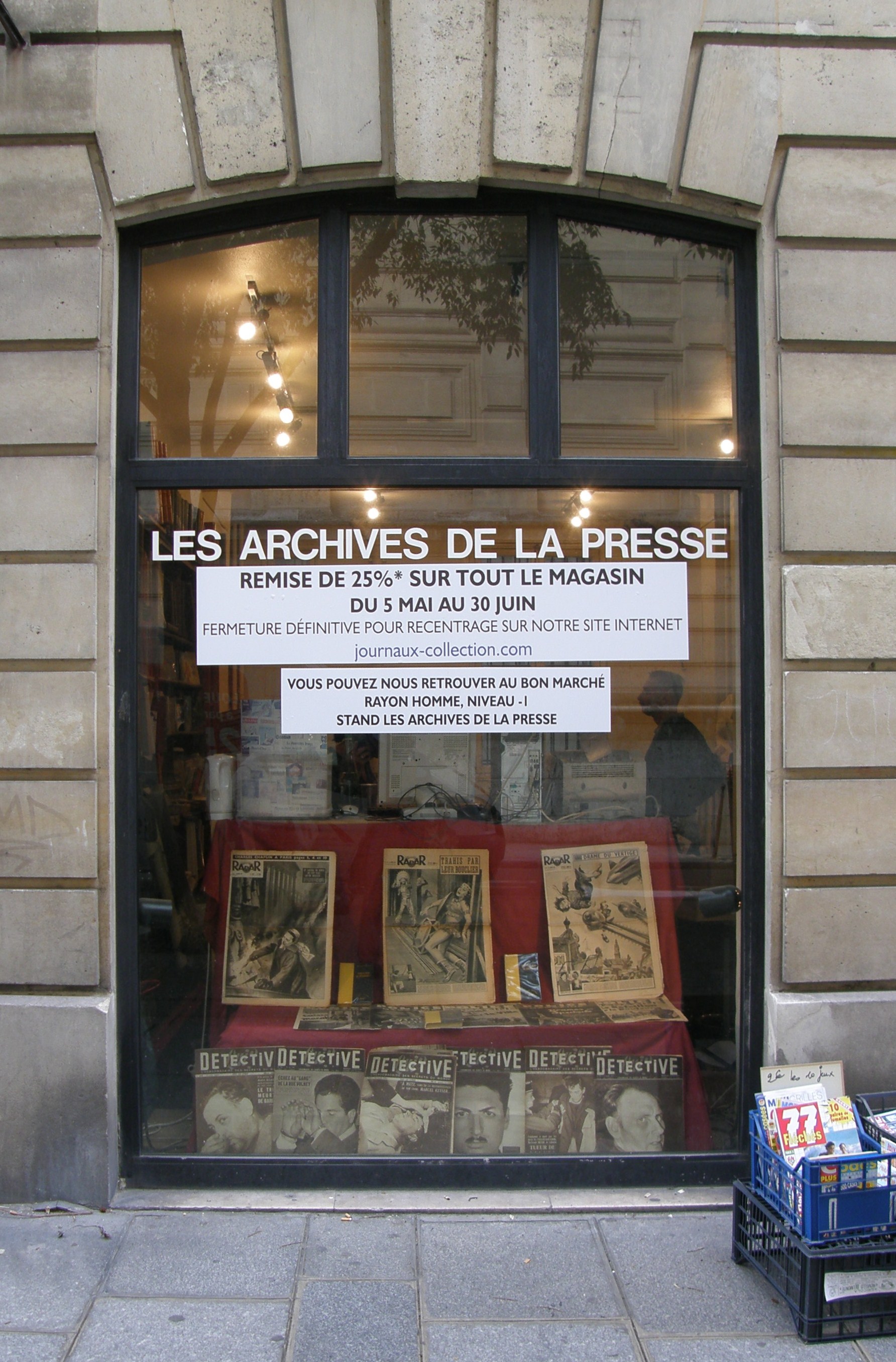
OLYMPUS DIGITAL CAMERANorman then suggested we have a look for the Archives de la Presse, a place selling old magazines and advertisements, where we had often rummaged for materials related to our research. Of course, we couldn’t exactly remember the name, but we described what we wanted to the man behind the counter at Mona Lisait, and he gave us some generalized directions. We set off and after a few wrong turns, arrived in front of the shop.
OLYMPUS DIGITAL CAMERAAs we watched, burly guys carried out boxes of books and magazines and put them in a truck. The shop was closing, although it will continue selling old magazines and newspapers online and maintaining a small stand in the Bon Marché. They even have a Facebook page. Score one for the Internet.

OLYMPUS DIGITAL CAMERATea and Tattered Pages in Montparnasse closed earlier this year when its proprietor died. Her daughters are searching for someone to carry on the business, which even at best seemed like the triumph of hope over experience. We can remember eating a modest lunch with a friend in the back room, surrounded by books, and the proprietor at one point asked us to keep an eye on things while she popped out to get a carton of milk for our tea.

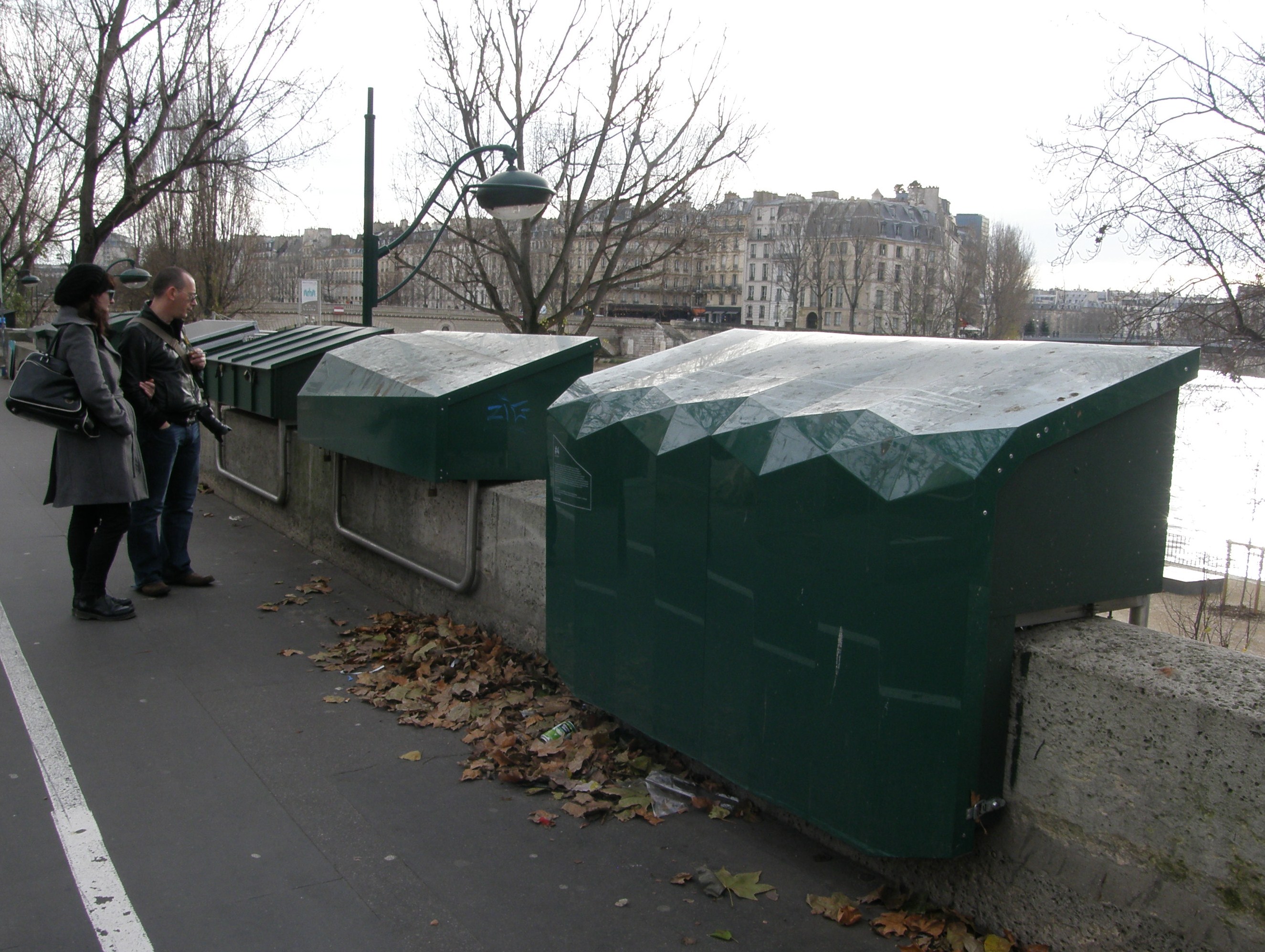
Oh, there are still plenty of bookshops in town. There are still bouquinistes, and we even saw a display of prototypes of modernized bouquiniste stands on display near the Hotel de Ville last December.

OLYMPUS DIGITAL CAMERABut the form of the city is changing, and its independent bookshops are dwindling, despite efforts by the government to prop them up.

I can’t help thinking of that scene in Victor Hugo’s book Notre Dame de Paris, in which the archdeacon gazes at the huge pile of stone that is the cathedral and then points to a book, open on the table, saying with a sigh “This will kill that.” The printed book will kill the cathedral.*

Well, the cathedral is still standing, but it is filled mainly with tourists and their colourful guidebooks rather than worshippers taking spiritual nourishment from its carvings and stained glass windows. Those who do look for guidance may seek it in solitude from a book, and not from a huge religious building and the community associated with it. I suppose that is what the archdeacon meant.
Now the book is changing and the city is changing with it. It’s not that people aren’t reading. The big libraries are full of scholars, although they are often staring at laptops and tablet computers rather than actual books.

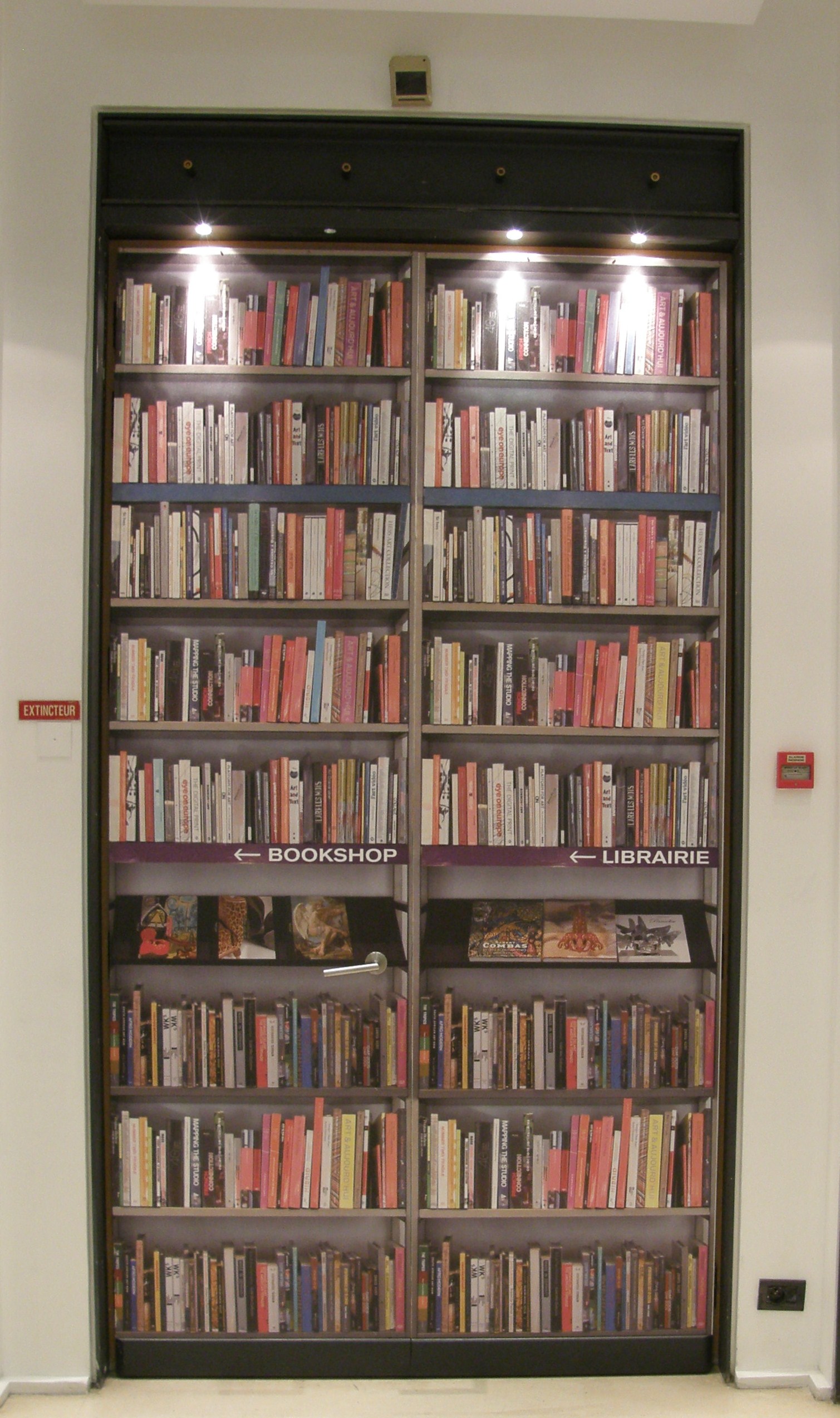
P1070559Parisians wander obliviously past the bouquinistes, absorbed in the latest news from their handheld devices. And in some places, physical books are considered décor, not the vehicle for enlightenment or spiritual nourishment. You can even get virtual books, like this wallpaper that indicates the presence of a real bookshop inside Artcurial. Note the door handle in the middle. (Ceci n’est pas une collection de livres.)

OLYMPUS DIGITAL CAMERA

Books are objects, like typewriters, that once performed a function. And for many people, the function can be performed in other ways, through other media. But bookshops have a function too. They were never just about selling books. They hosted readings and launches, and they were places to go for conversation and news. At the Red Wheelbarrow, the people behind the desk recommended not just books, but the best boulangerie in the area. The staff weighed in on the merits of local cafés, and introduced us to other browsers crowding into the tiny space. You can’t get that on an e-book.

In Paris, where sometimes it can be hard to find one’s feet and where much is unfamiliar, a space like the Red Wheelbarrow allowed us to feel on solid ground. Lost bookshops are lost friends. When a place like that disappears, it is not just the end of a business, it is the end of a friendship.

OLYMPUS DIGITAL CAMERAText by Philippa Campsie, photographs by Norman Ball. Photograph of the rue Pontoise by Charles Marville from Paris en Images.

*L’archidiacre considéra quelque temps en silence le gigantesque édifice, puis étendant avec un soupir sa main droite vers le livre imprimé qui était ouvert sur sa table et sa main gauche vers Notre-Dame, et promenant un triste regard du livre à l’église : Hélas ! dit-il, ceci tuera cela.

Posted in Paris bookstores, Paris shops | Tagged , , , , , , , , , , , , , , | 18 Comments

The colours of the Batignolles

The Batignolles does not attract many tourists. That, in itself, is part of its charm. But there are many reasons to venture there. Food. Gardens. Places for children to play. And colour, because that is what struck us both – this is an area filled with colour.

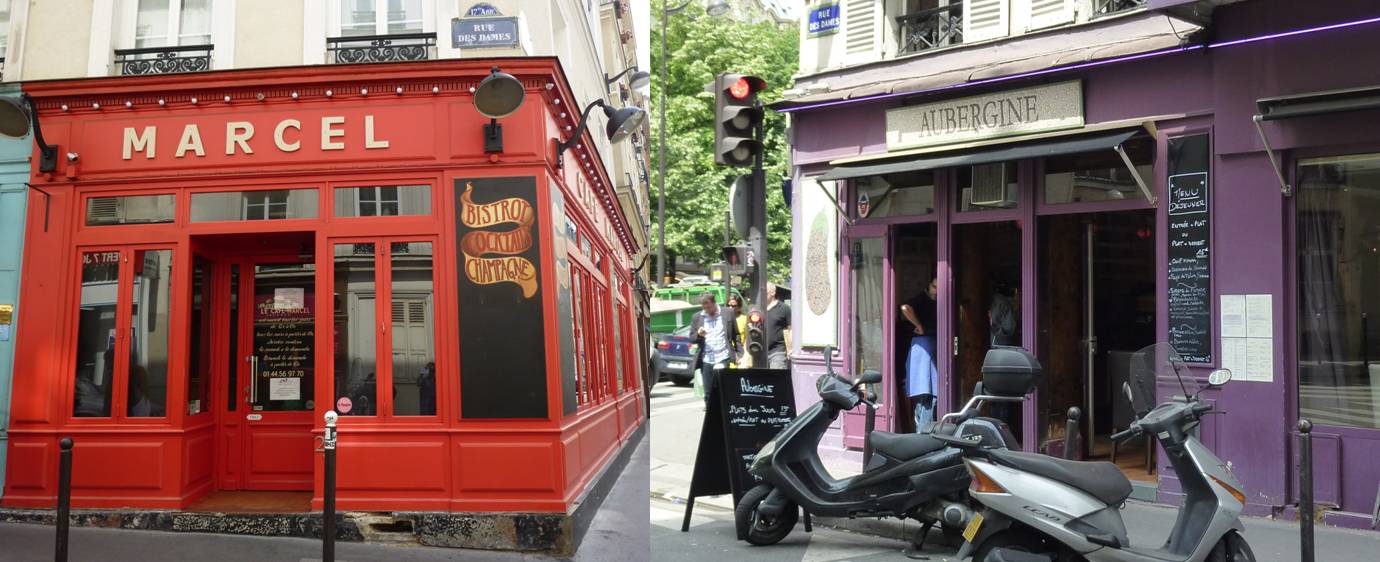
The restaurants are colourful.

BatignollesRestaurants

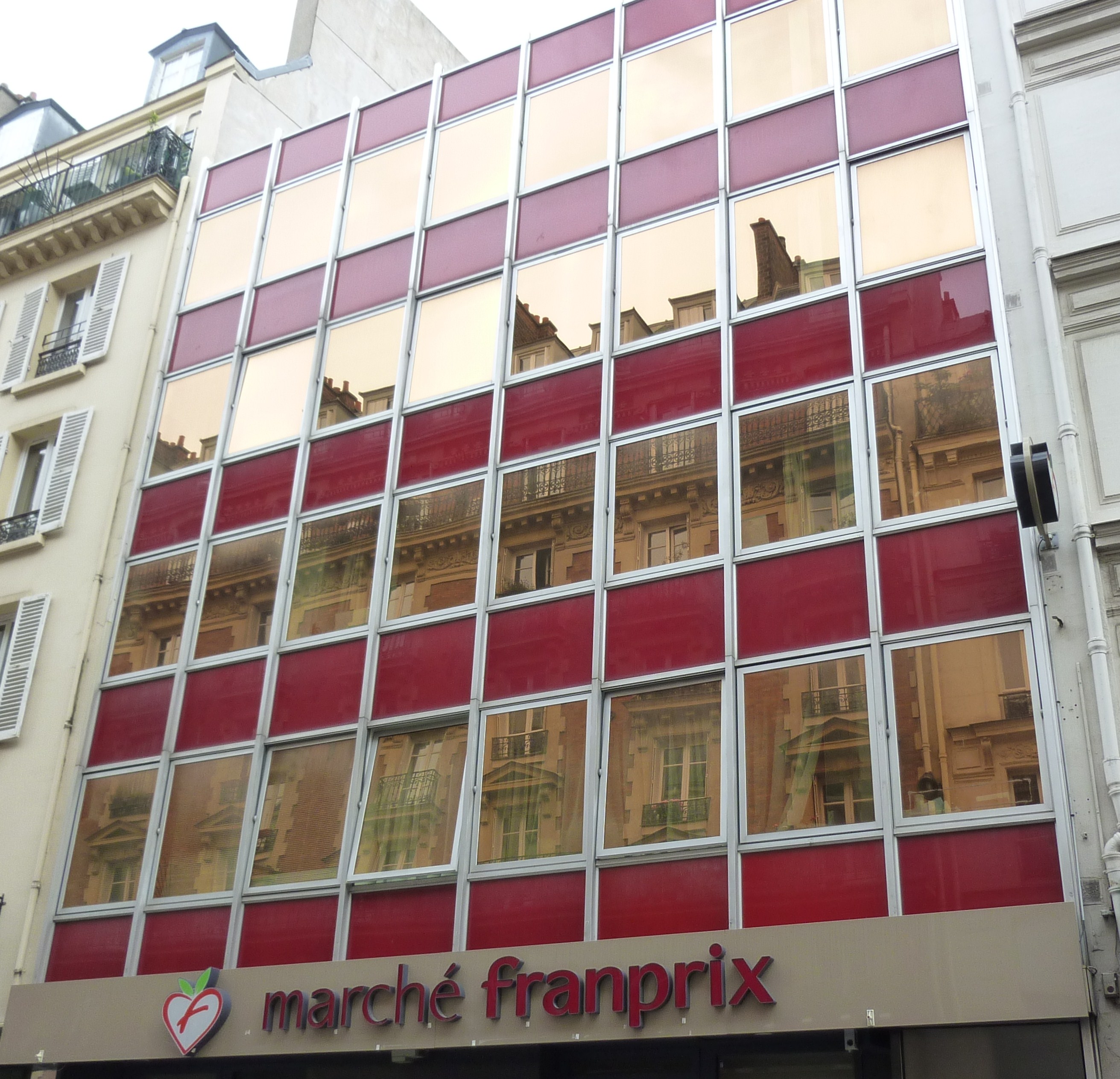
The grocery stores are colourful.

P1130308

The corner stores are colourful.

P1130133

The antique shops are colourful (we found some nice antique postcards in this one).

OLYMPUS DIGITAL CAMERA

The library is colourful.

P1130311

The street machinery is colourful.

P1130294

Even the residents are colourful (this lady has coordinated her pink outfit wonderfully).

P1130144

The residents also seem to have a sense of humour, if this bilingual pun is anything to go by.

P1130139

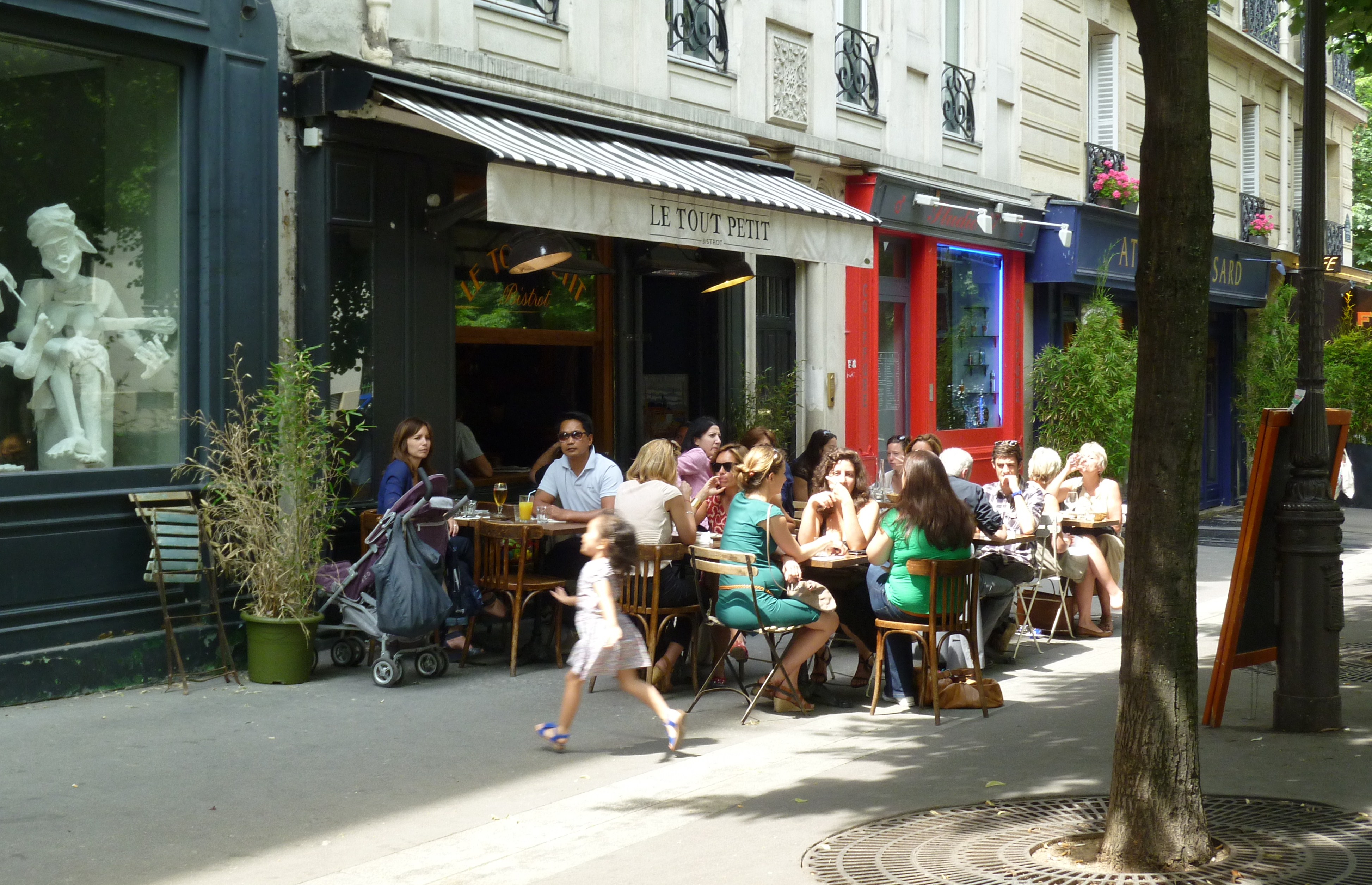
After a morning ramble, we had lunch under the trees at le Tout Petit, which seemed appropriate for a quartier filled with children. The couple on the left, who lived in the area, said it was very child-friendly.

P1130180

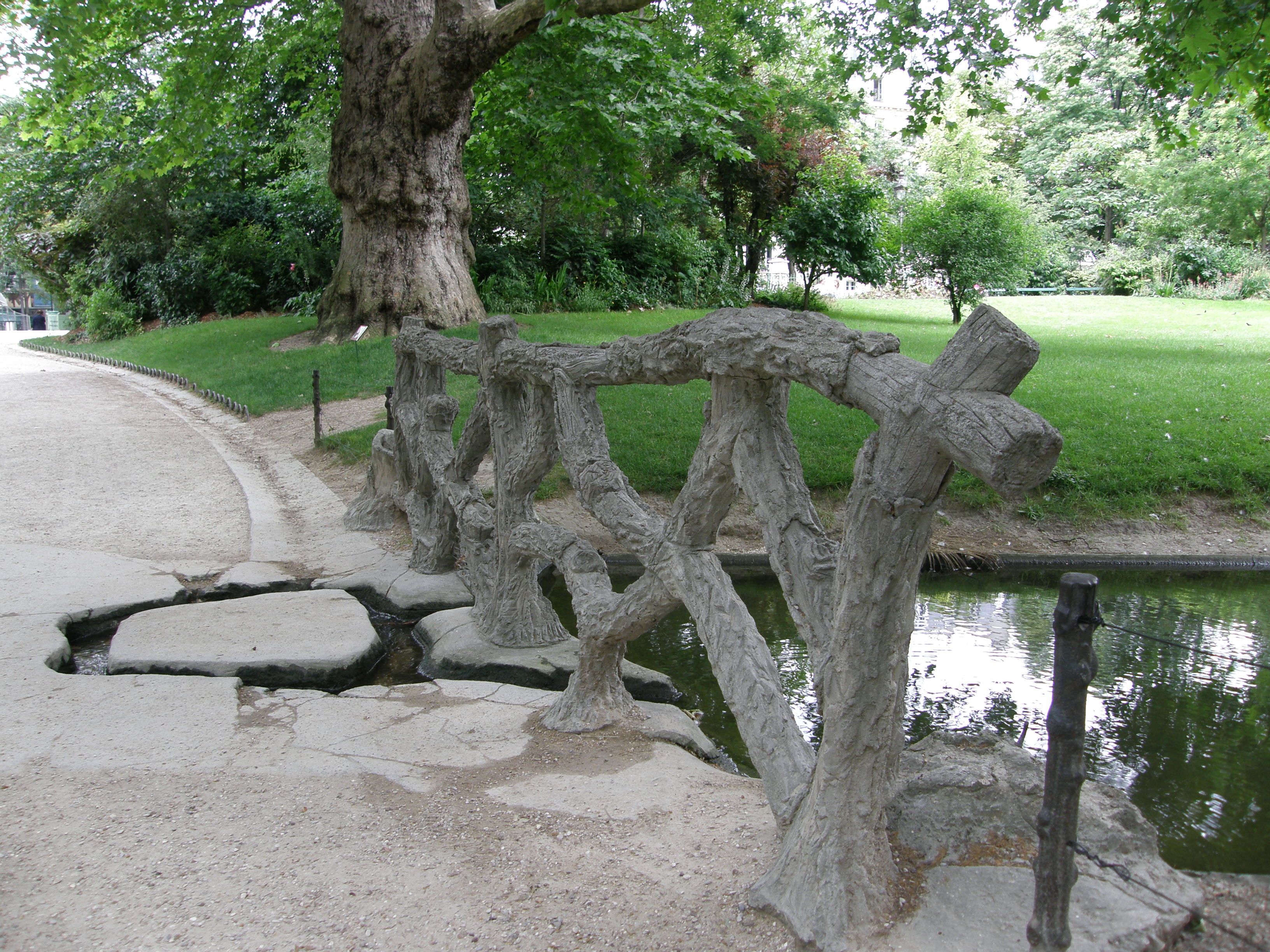
We later saw the couple from the café with their children in the playground that is part of Square des Batignolles. We can thank Adophe Alphand (again) for the design of this miniature wonderland. You enter down a winding little path, lined with Norman’s favourite concrete-made-to-look-like-wood.

OLYMPUS DIGITAL CAMERA

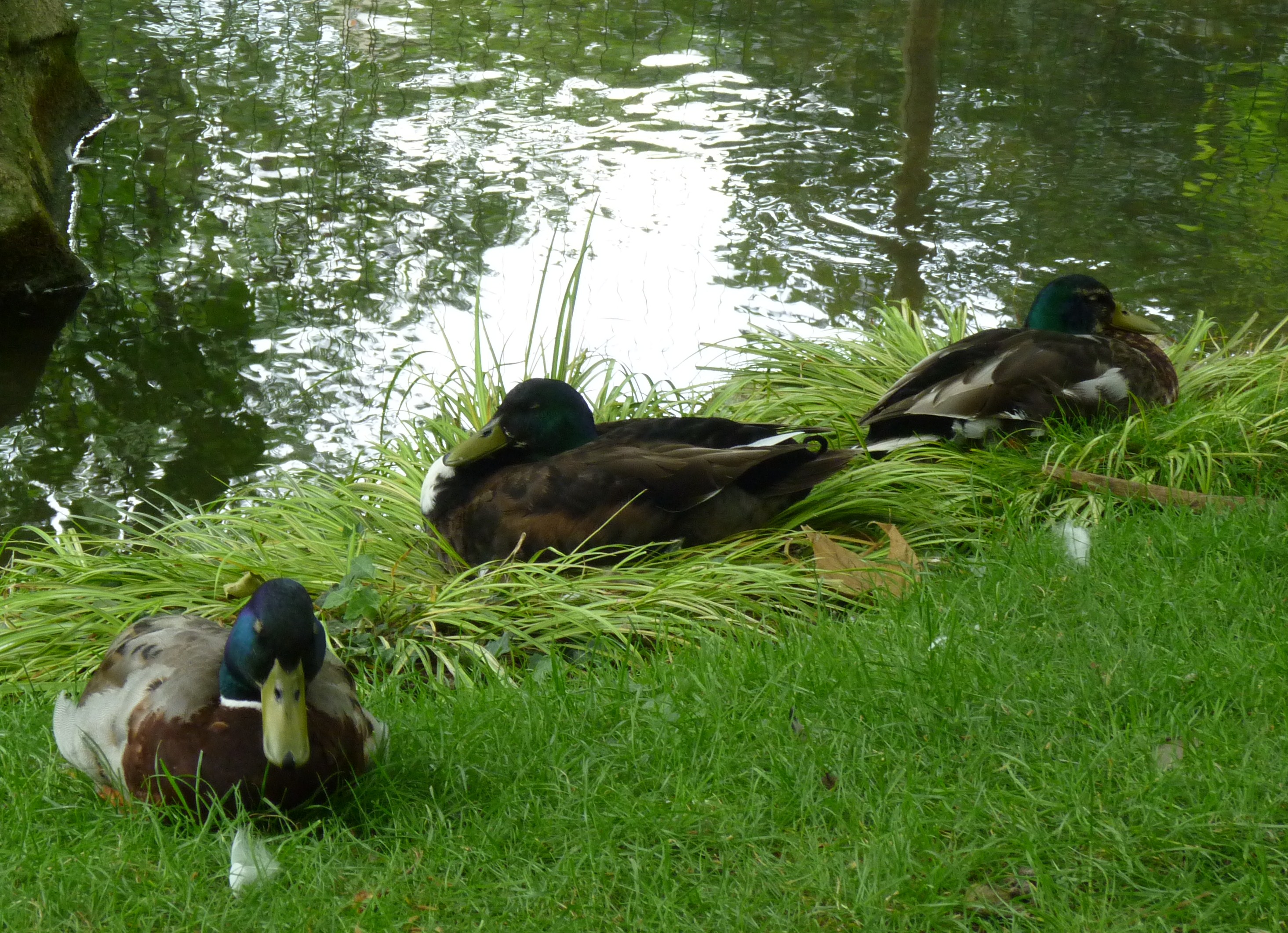
And there you will find more colourful residents of Batignolles: the ducks and waterfowl. Take a look at this little fellow’s beak. You’d never get away with something that gaudy in the Tuileries.

P1130202

Of course, there is the ever-popular black-and-white look.

P1130219

And the classic mallard colouring is never out of fashion.

P1130218

Across the rue Cardinet from the Square des Batignolles is a park so new that it is not quite finished. Parc Martin Luther King is just part of  the huge new Clichy-Batignolles development. Its long straight paths, its reconstruction of a wetland, and its skateboard facilities make for a contrast with the much older park. All very 21st century. Parc Martin Luther King seems popular with children and teenagers, and it’s nice to have both spaces in the quartier. Something for everyone.

P1130260

With so much colour, the area attracted its share of artists back in the day. Manet lived at 34, boulevard des Batignolles, which I failed to photograph when I was there, but Google Street View has captured its lovely blue door.

ManetDoor

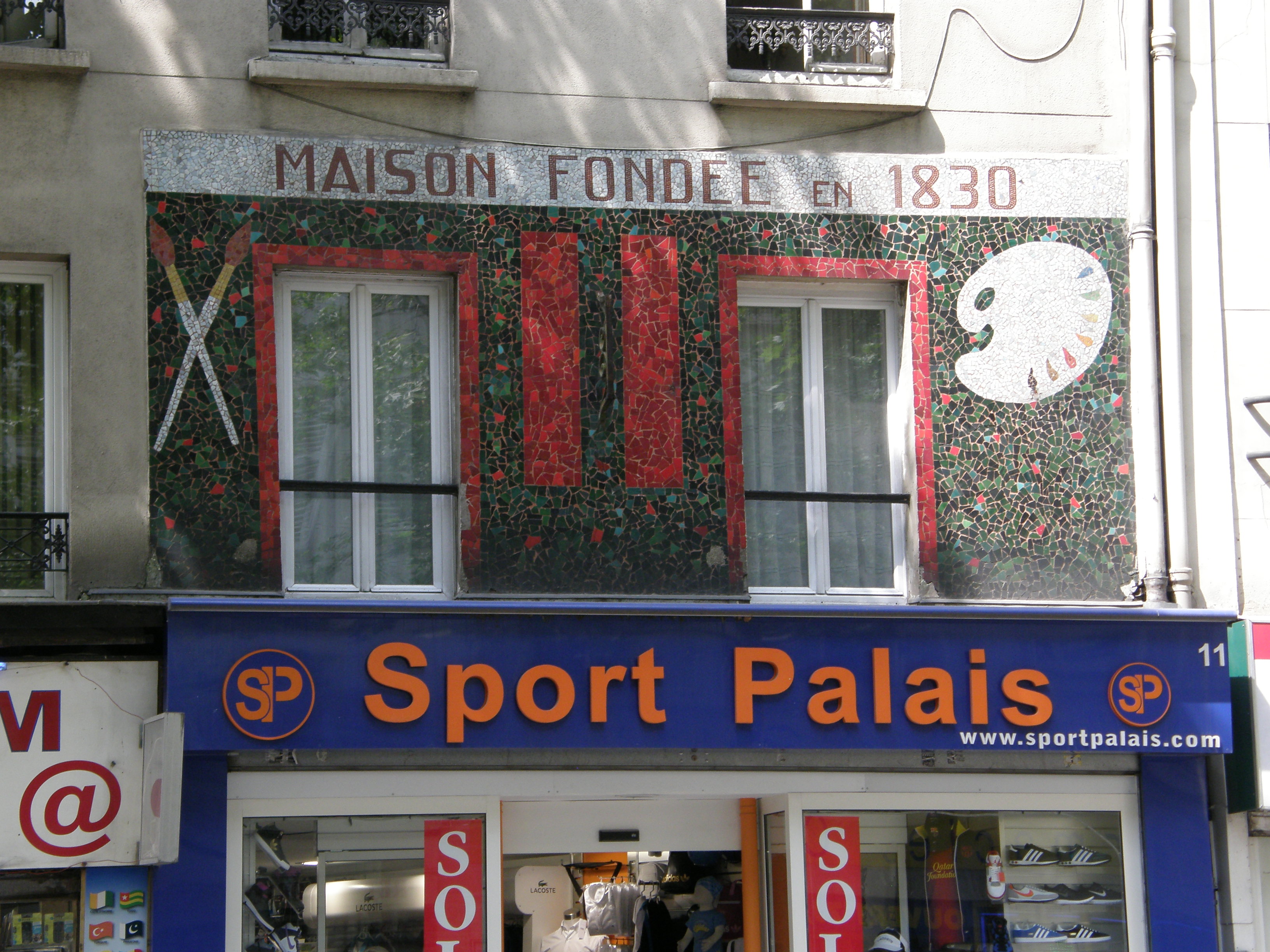
The Café Guerbois on what is now the avenue de Clichy, was a noted hangout for Edouard Manet and his friends at no. 9 (it’s now a menswear shop). At no. 11, we spotted this façade.

OLYMPUS DIGITAL CAMERA

This was once the establishment of G. Hennequin, a merchant in “Couleurs Fines, Toiles et Pinceaux” (fine colours, canvases and brushes). Some Impressionist canvases still bear a paper sticker with the name of the shop on it. It functioned as an art supply store until 2010. You can see what it used to look like here.

We felt that if Manet or his friends could see the Batignolles today, they would still find places they recognized. In time, they would even find a new watering hole to replace the Café Guerbois. I wonder which of the many local cafés they would choose…

P1130310

Text by Philippa Campsie; photographs by Philippa Campsie and Norman Ball.

Posted in Paris gardens, Paris parks, Paris quartiers | Tagged , , , , , , , | 13 Comments

Mushrooms, manure, and the secret of French food

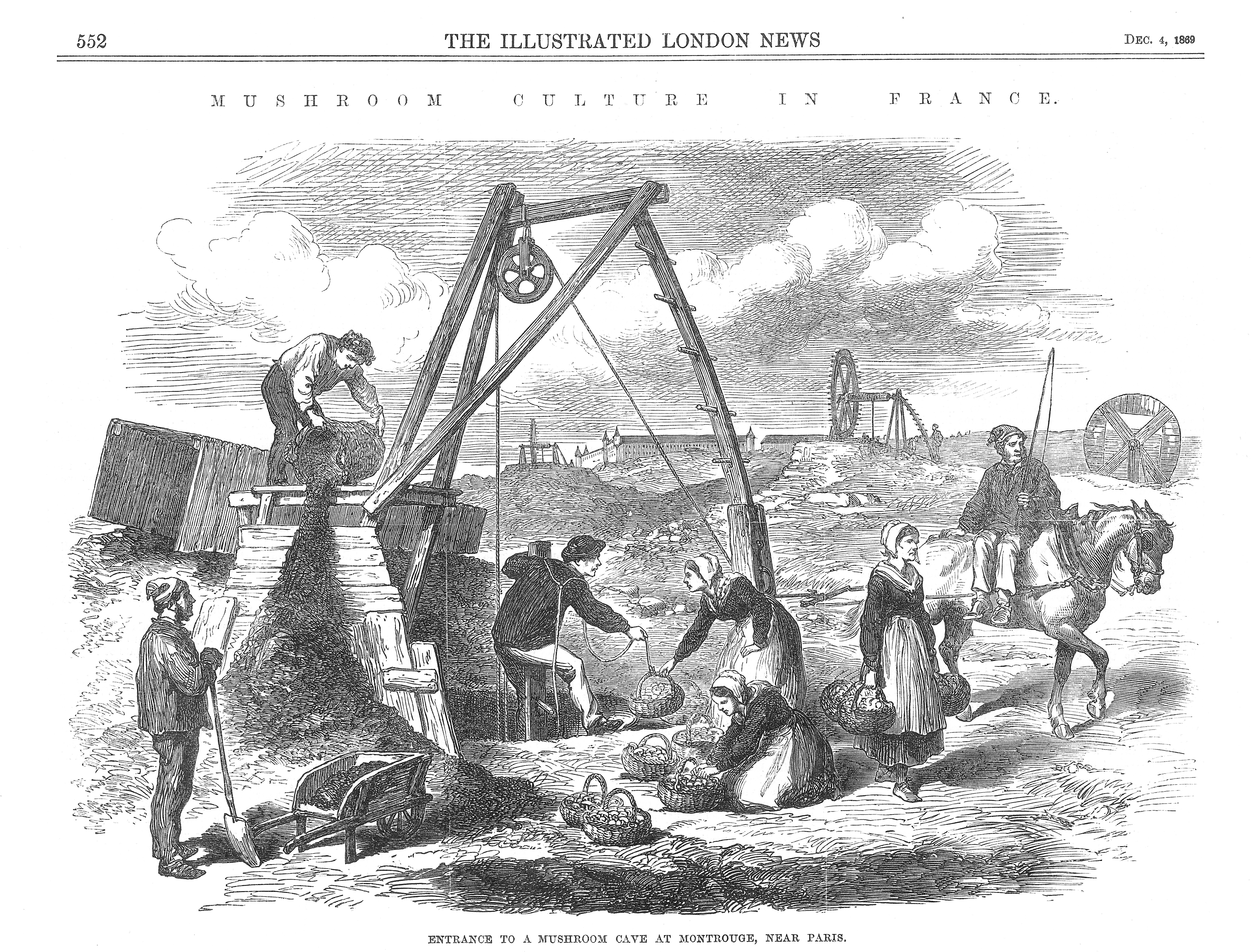
Recently, at The Astrolabe Gallery, a print and map store on Sparks Street in Ottawa, I chanced upon a page from the London Illustrated News, Dec. 4, 1869. Two woodcuts depicted “Mushroom Culture in France.”

Montrouge0002

The “entrance to a mushroom cave at Montrouge, near Paris” intrigued me. The central figure is a young man handing over a basket that he appears to have brought up from below ground. Three women take the baskets away. A man sits astride a pony harnessed by a whiffle tree to a cable that runs over a pulley to below ground. Another man is emptying a larger wicker basket and the contents run down a rough chute. A fourth man leans on a shovel. In the background there are three heavier lifting wheels and in the distance a large fortified building (Philippa wonders if it might be the Montrouge fort, one of 16 built around Paris in the 1840s).

Montrouge0001

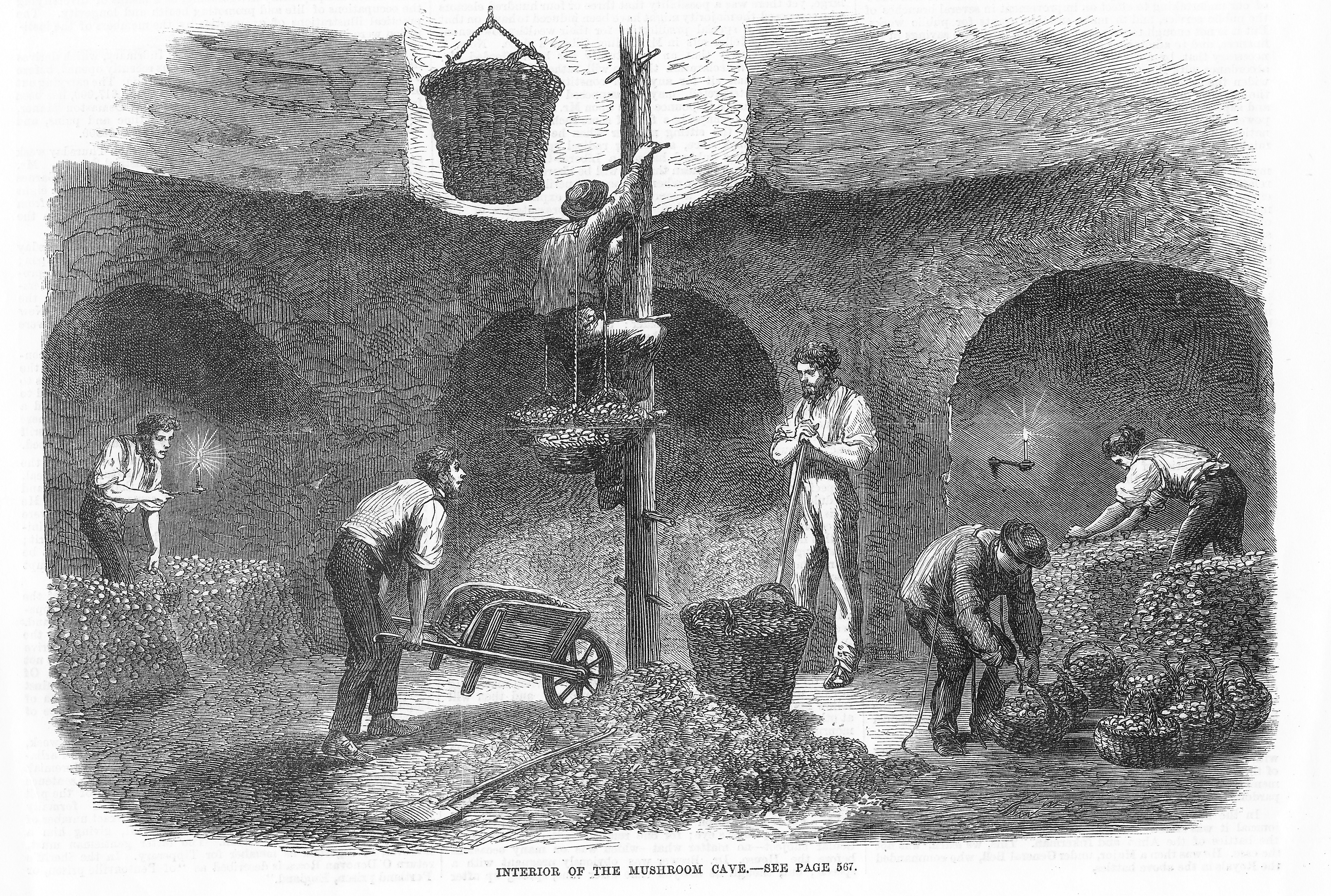
The next cut portrays the “interior of the mushroom cave.” It is lit by candles and was probably much darker than the artist portrays. On the far right, a man appears to be picking mushrooms and another is loading them into baskets, which he will then pick up using a shoulder harness similar to that used by the man climbing the pole to take the mushrooms above ground. A man leans against a shovel next to a large wicker basket on the ground and another similar basket is either ascending or descending. The man with the wheelbarrow looks to have been working hard and on the left are more mushroom beds. The walls appear to have been hewn out of stone.

For the rest of the story, I needed to “see page 567” from the Illustrated London News. Thank goodness for online historic newspapers available through the library. The short text described the way in which mushrooms were cultivated on horse manure in caves and the abandoned mines or quarries that underlie much of the Paris region. The text noted, “Some account of this curious subject will be found in Mr. Robinson’s book, ‘The Parks, Promenades, and Gardens of Paris,’ just published by Mr. Murray, which is a volume full of pleasant and instructive matter.”

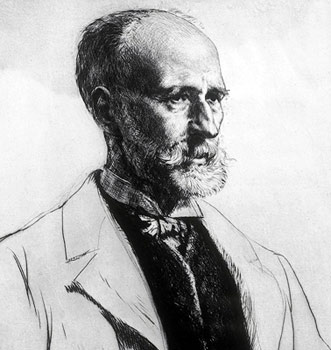
Nothing I enjoy more than pleasant and instructive matter. Mr. Robinson turned out to be William Robinson, an Irish gardener and journalist who promoted “wild gardens” of perennials, rather than the formal gardens of annual bedding plants that were common in his day. (He would probably approve of our chaotic Toronto garden of perennials, herbs, and vines, shaded by a maple tree.)

WilliamRobinson

The full title of his book was The Parks, Promenades & Gardens of Paris Described and considered in Relation to the Wants of our Cities and of Public and Private Gardens (Victorians didn’t believe in short, snappy titles). He wrote it when he was the Times correspondent for the Horticultural Department of the Great Paris Exhibition. The book describes French horticulture, market gardening, and food and compares them with their English equivalents. The English versions are usually found wanting.

Robinson was impressed by the great care French growers took with their crops. He contrasted it with less careful and less productive practices in England. In writing about lettuce, for example, he exclaimed, “The culture of salads for the Paris market is not merely good—it is perfection.”

He devotes an entire chapter to Mushroom Culture, and begins by stating enthusiastically, “Mushroom growing as carried on around, or rather beneath Paris and its environs, is the most extraordinary example of culture that I have ever seen either above or below ground, under glass or in the open air.”

Like any good journalist, Robinson had connections, so he was able to find a normally wary champignonniste (mushroom grower) to escort him into “one of the great ‘Mushroom caves’ at Montrouge, just outside the fortifications of Paris, on the southern side” on July 6, 1868.

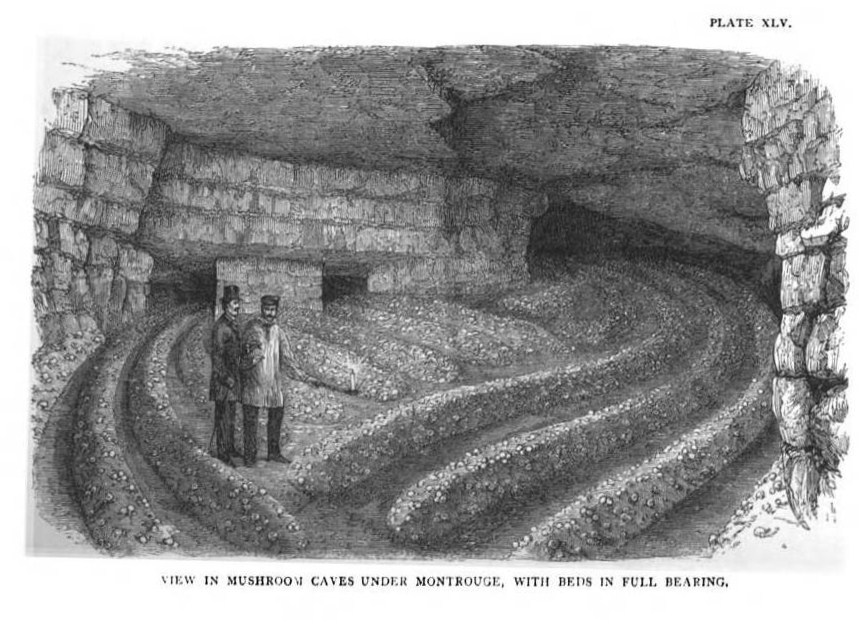
MushroomCaves

Robinson took pains to help his British readers gain a clear picture. “The surface of the ground is mostly cropped with Wheat; but here and there lie, ready to be transported to Paris, blocks of white stone, which have recently been brought to the surface of the ground through coalpit-like openings. There is nothing like a ‘quarry,’ as we understand it, to be seen about; but the stone is extracted as we extract coal, and with no interference with the surface of the ground.”

This underground quarrying had led to the hundreds of kilometres of galleries, caverns, tunnels, and open spaces that still lie beneath many parts of Paris. Occasional subsidence had led to collapses, such as that of a row of houses on the rue d’Enfer (now the rue Denfert-Rochereau) in 1774. Napoleon later prohibited all further quarrying and mining under the city. However, Montrouge was outside the walls. There, conventional farming continued above, while below, limestone or gypsum were quarried and mushroom farming took place in underground caverns.

The depth of these mushroom farms ranged from 20 to 160 feet below ground. Robinson described the entrance as “a circular opening like the mouth of an old well, but from it protrudes the head of a thick pole with sticks thrust through it.” After descending this precarious contraption, the champignonniste entered a network in which one cave and its many passageways held six or seven miles of mushroom beds.

This was an area of year-round production at a constant temperature, so as one wandered about one saw beds in varying stages of growth and maturity. It was also an area of intensive cultivation in which beds were crowded together with little or no spare room, “every available inch of the cave being occupied.” Moreover, it was kept extremely clean at all times so that everything looked in “perfect condition.”

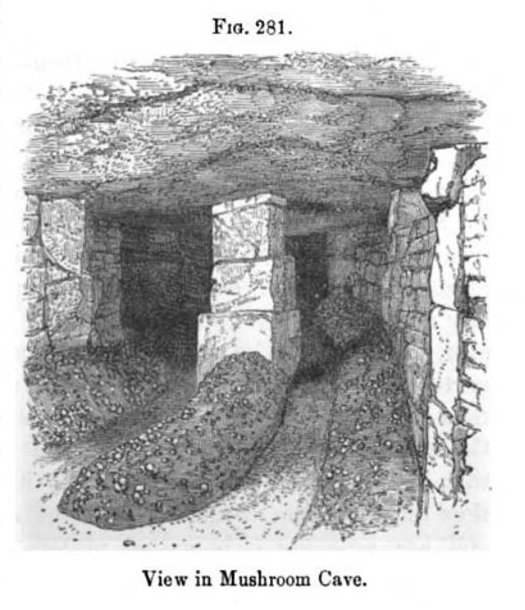
The harvest went on every day, growers “occasionally sending more than 400 lb. weight per day, the average being about 300 lb.” The white button mushrooms produced for the Paris market were Agaricus bisporus. The beds were of two basic shapes, both of which we see in this image.

MushroomCave

The key was good manure; it is the same with cooking, you have to start with good ingredients. Champignonnistes wanted “ordinary stable manure, not droppings [from the street].” There is manure and manure, and the stuff in the street could easily be contaminated with other things. The manure “is thrown into heaps four or five feet high, and perhaps thirty feet wide. The men were employed turning this over, the mass being afterwards stamped down with their feet, a water-cart and pots being used to thoroughly water the manure where it is dry and white.” After five or six weeks it would be ready for mushroom cultivation.

Then into the underground caves, where the half-decomposed manure would be mixed again, formed and compacted into shape. It was planted with what Robinson calls “mushroom spawn,” including the naturally occurring version that grows in manure, which Robinson said ensured the best mushrooms. The beds would be covered with about an inch of soil. This soil was “simply sifted from the rubbish of the stone-cutters above, giving the recently made bed the appearance of being covered with putty.”

Harvesting was labour-intensive. It was not just a matter of pulling the mushrooms out and moving on. Instead, when the mushrooms were removed, “the very spot in which they grew is scraped out, so as to get rid of every trace of the old bunch, and the space covered with a little earth from the bottom of the heap. It is the habit to do this in every case, and when the gatherer leaves a small hole from which he has pulled even a solitary Mushroom, he fills it with some of the white earth from the base.” It is this extraordinary capacity for taking pains, for looking after the details, that I believe is the secret of French food.

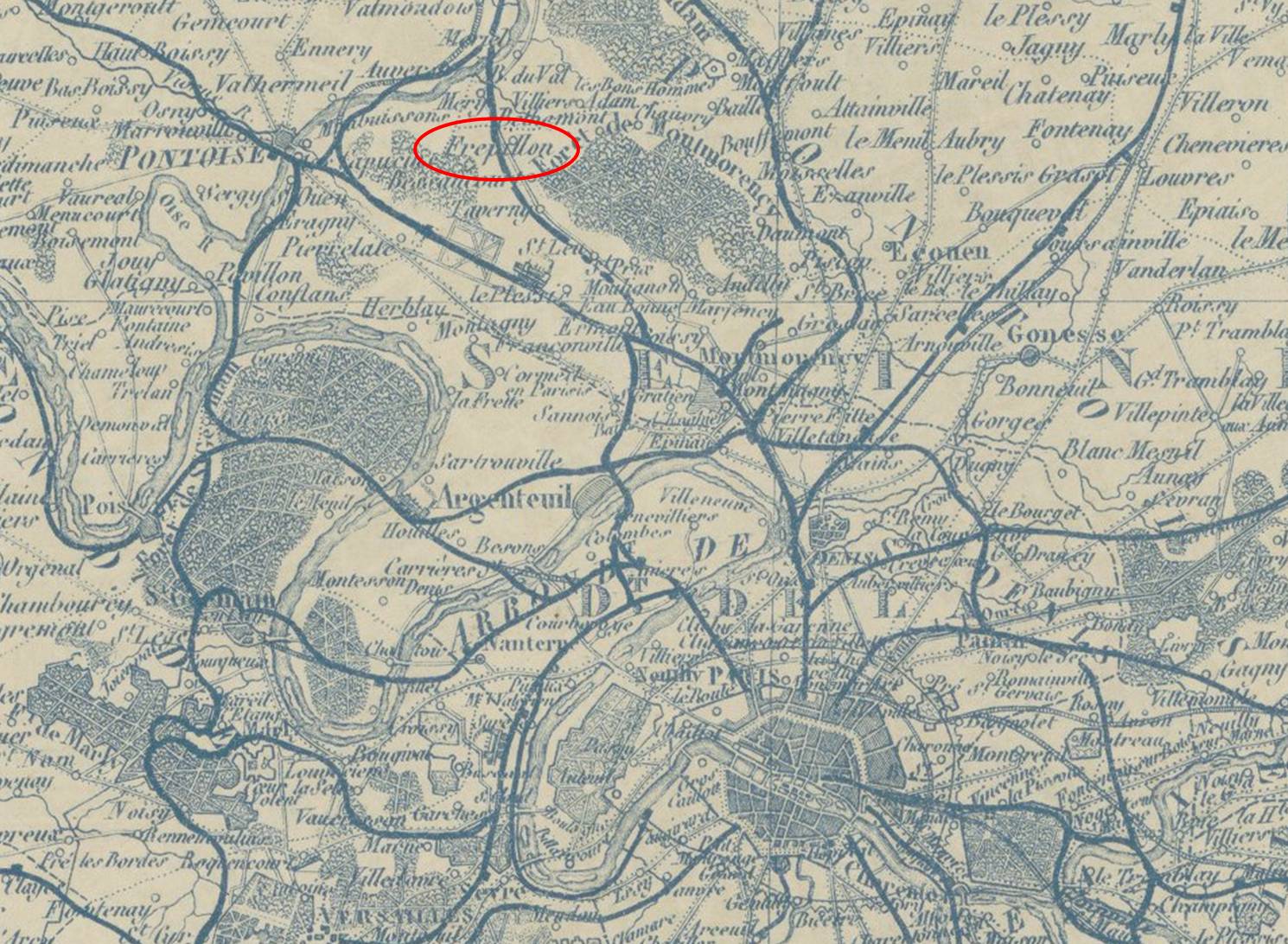
The indefatigable Robinson also visited another mushroom farm owned by a Monsieur Renaudot on September 29, 1868, in Frépillon, Méry-sur-Oise.* He took the train, alighting at Auvers. Again, he found “vast quarries in the neighbourhood, both for building-stone and the plaster so largely used in Paris.”

Frepillon

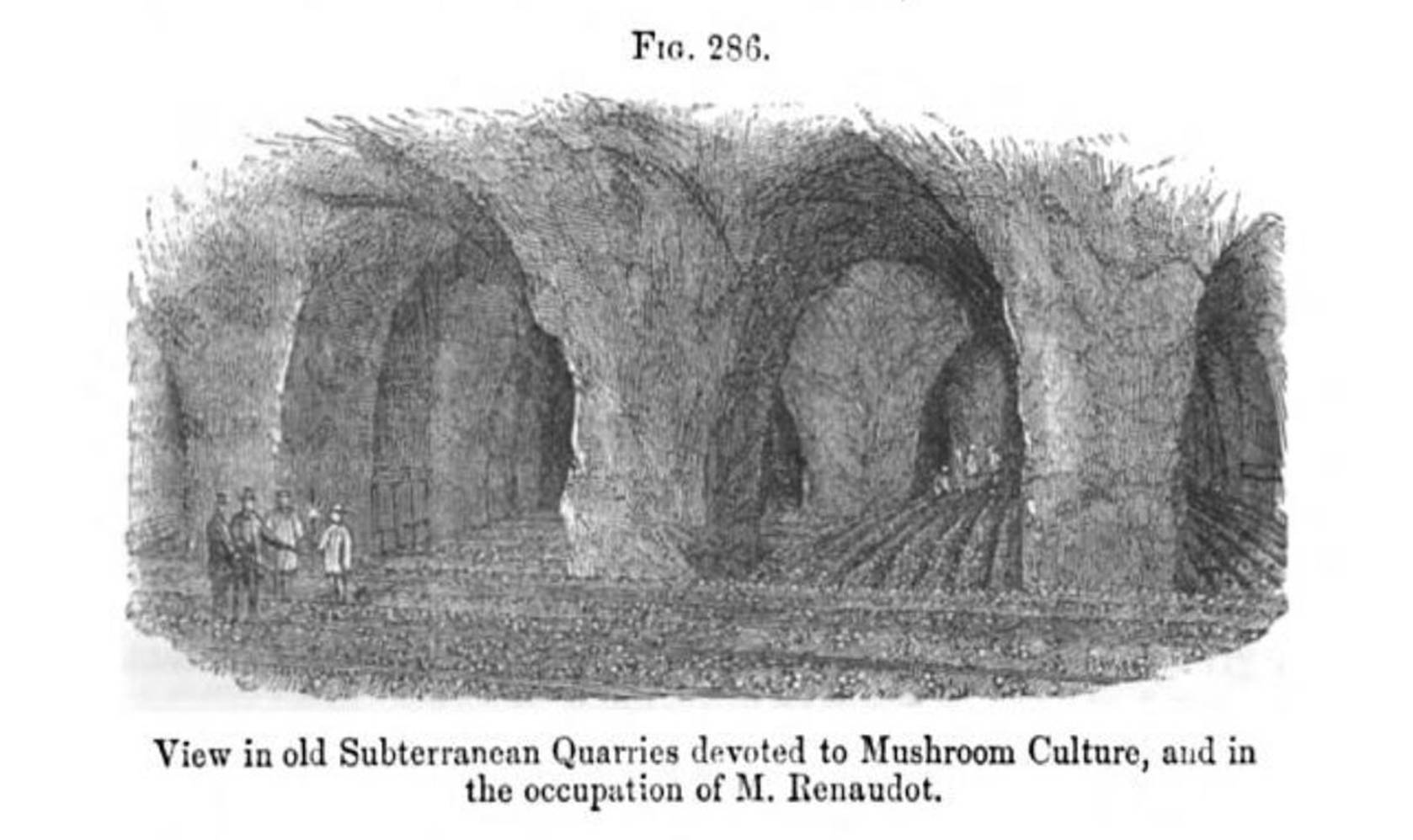
The entry point to this farm was in the side of a hill “so that the interior looks like a vast gloomy cathedral.” The method of careful cultivation and “perfect cleanliness” was similar to that at Montrouge. However, there was a significant difference: “The chief advantage the cultivator here has is the facility of taking his manure of anything else in or out in carts, as easily as if the beds were made in the open air. Near Paris, on the contrary, everything has to be sent up and down through shafts like those of old wells, and the men have to creep up and down a rough pole like mice.”

Renaudot“All the manure employed is brought from Paris by rail. … so much per horse per month is paid in Paris for the manure; then it has to be carted to the railway station and loaded in the wagons; next it is brought to the station of Auvers, and afterwards carted a couple of miles to the quarries, paying a toll for a bridge over the Oise on the way. That surely is difficulty enough for a cultivator to begin with! Then it is placed in great flat heaps…and here it is prepared, turned over and well mixed three times, and as a rule watered twice. About five or six weeks are occupied in the preparation.” And this went on constantly, day in and day out.

Over time, the manure lost its nutritional value and had to be removed. It was then used in gardens for mulch. Nothing was wasted.

In a good year, the underground caves at Méry-sur-Oise produced 3,000 pounds a day. It was all astounding for a method developed only in the early nineteenth century, by a Monsieur Chambry. But perhaps not surprising in a country that takes growing food as seriously as preparing and eating it.

311-11

Text by Norman Ball. Additional images from the Google Book edition of The Parks, Promenades & Gardens of Paris by William Robinson and Gallica maps. Picture of mushroom sellers at Les Halles from Paris en Images.

For insight into the modern cultivation of mushrooms in caves (in the Loire Valley), click here.

* Méry-sur-Oise was the location of Baron Haussmann’s unrealized plan to build a giant cemetery outside the city and send the bodies there by train. He chose it because the area had sandy soil that would aid decomposition.

Posted in Paris food, Paris gardens, Paris history | Tagged , , , , , , , , , , | 15 Comments

Death and taxes

Whenever I buy postcards or other pictures of Paris, I gravitate to anything unfamiliar. So when I was leafing through some inexpensive engravings at an antiques fair on the Place St-Sulpice in June, I was immediately drawn to this one.

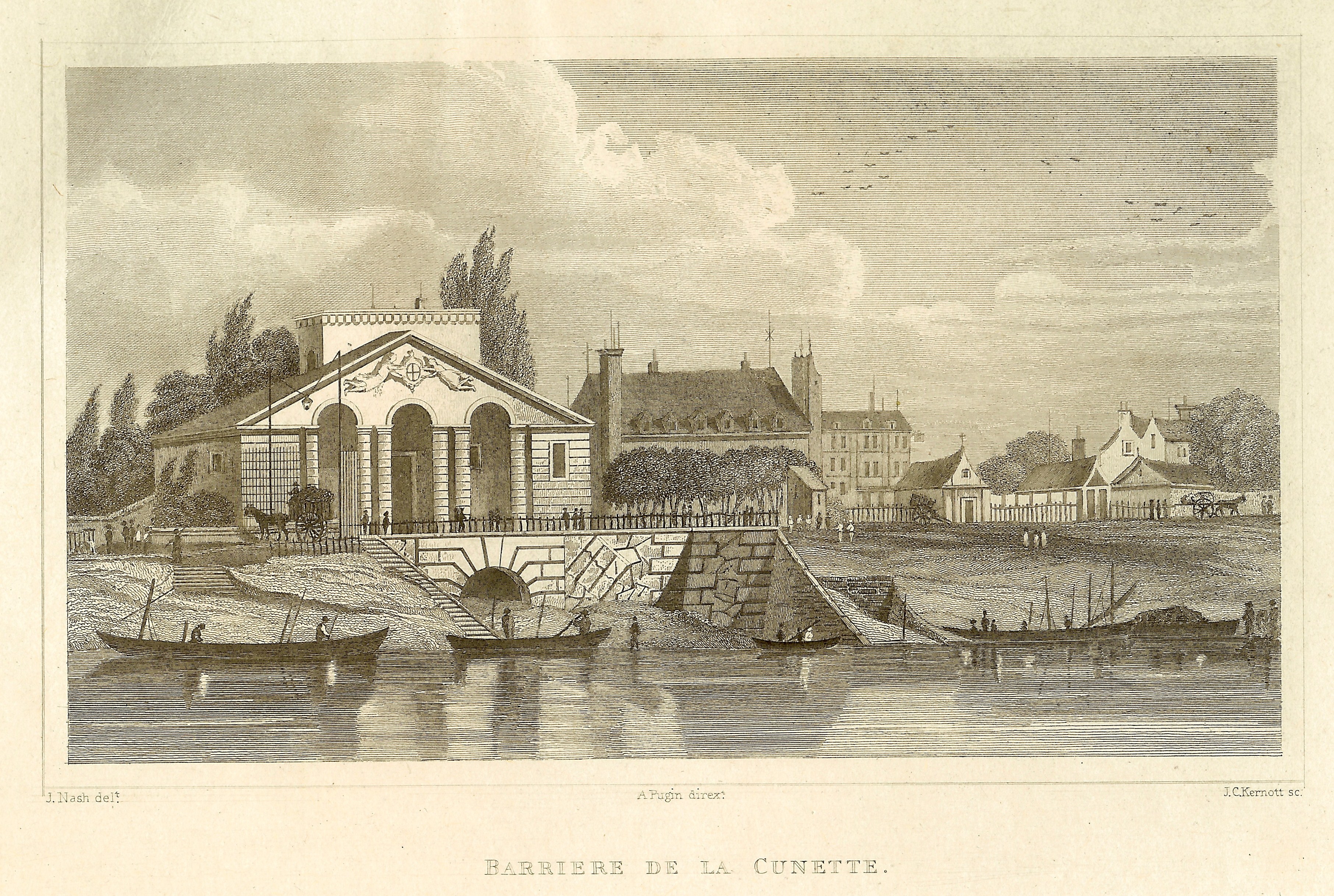
Cunette1831

Barrière de la Cunette? “Where was that?” I asked the young woman who was in charge of the stall. She consulted Wikipedia on her iPhone and said vaguely that it had been on the Left Bank, over to the west. Of course I bought the engraving, along with one of the Barrière de Passy. Both dated from 1831.

Passy1831

Time for some research. I knew a bit about the “barrières” (customs houses) that had once encircled Paris, because four of them are still there. The Rotonde de la Villette is one, and others can be seen in the Parc Monceau, the Place Denfert-Rochereau, and the Place de la Nation. However, I hadn’t realized how many there were originally (more than 50) nor did I know much about their creation.

But first, I wanted to pin down the location of the Barrière de la Cunette. I consulted my reproduction 1850 map of Paris, which shows the city as it was before the 1860 expansion that reconfigured the city and its arrondissements. There it was, on the river’s edge near the Champ de Mars, opposite the narrow island known as the Allée des Cygnes, slightly downstream of today’s Pont de Bir-Hakeim. As it happens, the corresponding barrière on the Right Bank was that of Passy (also known as the Barrière des Bonhommes or Barrière de la Conférence). This map from Gallica dates from 1800.

Gallica Map

And just what, exactly, is a “cunette”? It’s a military ditch usually associated with fortifications; when filled with water, it becomes a moat (une douve). There appears to have been a ditch or canal emptying into the Seine at this point.

Next question: when was it built? The vaguely Classical look seems to hark back to the First Empire of Napoleon, when Classical architecture was all the rage. In fact, it was designed and built in the dying days of the ancien régime, in the 1780s, along with 54 other barrières and the wall that encircled Paris.

This was not a defensive wall; it was all about customs and excise. It was built at the behest of a group called the Fermiers Généraux (General Farmers), which sounds very rural and agricultural, but it was nothing of the kind. These were tax farmers, well-to-do financiers who collected money for the king and had a fair bit of leeway in how they approached their task.

In the 1780s the Fermiers realized how easy it was to evade paying the duties required on goods entering Paris. Anyone could saunter in unobserved and smuggling was common. So they did what a typical financial concern would do these days: they commissioned a study by one of their number, Antoine Lavoisier (yes, that Lavoisier, the famous scientist known as the “father of modern chemistry”).

Lavoisier estimated the tax loss at 6 million livres a year and proposed a wall 3.3 metres (10 feet) high surrounding Paris that would require those bringing in goods to pass through gates at which the tax could be levied. He also sketched the route of the wall, which instantly tripled the size of the city, earning him the undying hatred of the tavern keepers on the former edge of town who had once profited from selling tax-free wine and now had to collect and remit the required taxes. (They didn’t forget about this. A decade later, Lavoisier was guillotined during the Terror, along with the other Fermiers Généraux.)

Lavoisier’s plan was adopted in 1784 and the wall went up. It is long gone now, but a portion remains on rue Bruant on the grounds of the Salpetrière Hospital. Here is an image from Google Street View.

Rue Bruant

The architect Claude-Nicolas Ledoux was assigned the job of designing the buildings that would be positioned wherever the wall crossed a major road (or the river). It was quite a commission. The barrières on major routes included offices for the tax collectors, sentry boxes and observation posts for the guards, living quarters for the staff, customs sheds, warehouses for impounded goods, and stables. Those on minor roads were less extensive.

The Barrière de la Cunette and the Barrière de Passy, being on the river, had an additional feature: a boat called a patache that monitored river traffic and collected taxes on waterborne goods. Here is a model of one of the pataches that Ledoux designed for the riverfront barriers, from the collection of the Musée Ledoux in Arc-et-Senans. I don’t know if this over-the-top vessel was ever actually constructed. There is no sign of it in the engravings.

patache

Ledoux called his barriers Propylées (or Propylaea, a Greek term for a monumental gateway), and ensured that no two were the same. The architectural historian Anthony Vidler notes that Ledoux had a “propensity for architectural overstatement and hyperbole, for elevating modest subjects by their architectural treatment.”* Indeed. Compare the Barrière de la Cunette with the last customs post you passed in your travels.

Vidler also describes how Ledoux went about the task of designing so many buildings: “all were invested with a similar architectural character, fabricated as it were out of a versatile kit of parts, abstracted by Ledoux out of Renaissance and antique prototypes, with apparently infinite properties for combination and re-combination.”** In other words, a classical Lego kit, but made up of columns, porticos, and domes.

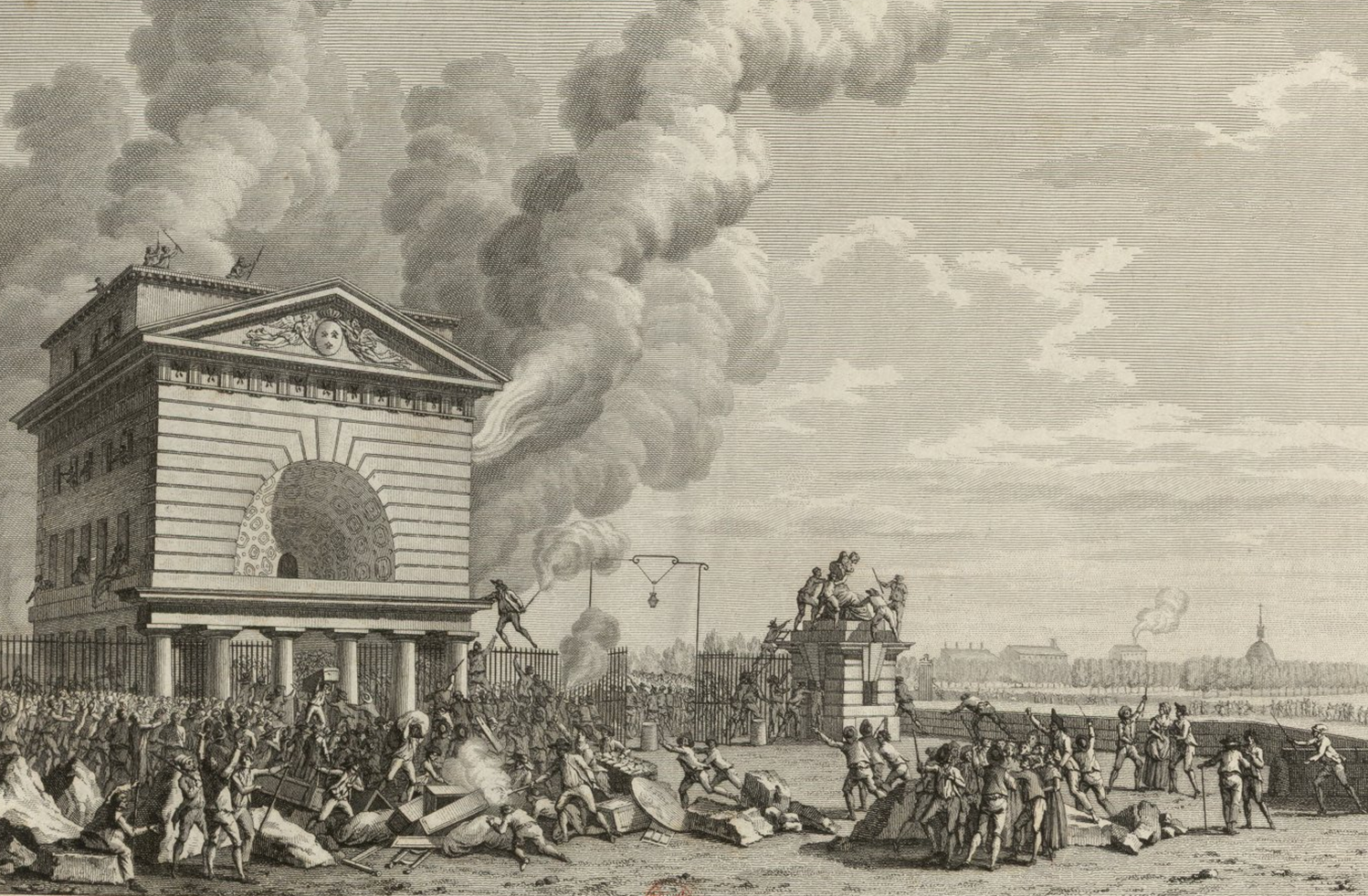
Ledoux enjoyed the work, but his employers (not surprisingly) complained of cost overruns and removed him from the project. Meanwhile, his fellow architects accused him of bad taste. And Parisians hated anything and everything to do with the wall. They did not attack Ledoux personally (he survived the Revolution), but a Parisian mob looted and burned the barrières, even before attacking the Bastille. The destruction started on July 10, 1789, and continued for several days. Forty-six barrières were badly damaged. One academic has argued that this attack was every bit as momentous as that on the Bastille on July 14, but has not received the same attention from historians.

Here is a picture of the attack on the Barrière de Passy.

Passy burning 2

These events did not, however, put the Ferme out of business, at least not immediately. The Fermiers appointed another architect to supervise repairs and the customs gates were back in business in 1790. As the Revolution proceeded, however, the Ferme lost power. The tax was suspended in May 1791, an occasion for boisterous celebrations by the populace.

But nothing is as certain as death and taxes. The Terror may have killed the Fermiers, but the country still needed money, and in 1798, the tax on goods entering the city (known as octroi) was reinstated by the Directory. Octroi was collected in Paris until 1943.

By the time the architectural draughtsman Augustus Charles Pugin (father of the celebrated architect Augustus Welby Northmore Pugin) decided to include these two barrières in his 1831 collection of 200 engravings called Paris and its Environs, the buildings were considered picturesque. Mind you, the English version of the book notes drily that the barrières were “by no means favorably regarded by the people” of Paris.

The wall and most of the barrières were demolished in the 1850s and 1860s, as part of the expansion of Paris under Napoleon III and Haussmann. They no longer represented the outskirts of town and had no further purpose.

The Barrière de la Cunette seems to have been forgotten until 1896, when the archway that once stood under the now-demolished customs building was rediscovered during excavations for a railway running along the Left Bank eastwards to the Invalides station.

In this drawing by Jules-Adolphe Chauvet, the background looks bleak, compared to that in Pugin’s 1831 version.

Cunette 1890s

Ledoux probably thought his monumental Propylées would endure forever. He could not have imagined that 100 years later, the relics would be considered archaeological curiosities.

Text by Philippa Campsie, map and additional images from Gallica.

*Anthony Vidler, Claude-Nicolas Ledoux: Architecture and Utopia in the Era of the French Revolution, Basel: Birkhäuser, 2006, p. 106.

**Vidler, p. 108.

Posted in Paris architecture, Paris history, Paris maps | Tagged , , , , , , , , , , , , , , , , , , , , , , , , | 17 Comments

Michael Caine: an English traditional typographer in the heart of Paris

One evening in 2007, we left our rented apartment on rue Charlemagne for a walk in the Marais. On the rue de la Cerisiaie, we peered at a small poster on the glass door of a narrow workshop. Suddenly, the door opened and a man beckoned us in.

P6240074

It was a printshop, one with a letterpress printing machine and countless drawers and boxes of lead and wooden type. We were enchanted. The printer’s name was Michael Caine (no relation to the actor of the same name).

Our impromptu visit turned into an hour of conversation about printing and type, and an invitation to attend a closing of a show of his work two days hence at the Librairie des Argonautes. (A closing? Usually one is invited to openings. Philippa said, “Norman, it’s Paris. Any excuse for a party and a drink.”)

The event was delightful. The space was so small that everyone took turns being inside looking at the prints or outside chatting on the sidewalk. We could not afford to buy anything then, but it was the beginning of a friendship.

Since that day, no trip to Paris is complete without a visit to the print studio on the rue de la Cerisiaie. At 38 square metres, the studio is small, but the output is astounding. Each time we get together, I am in awe of Michael’s knowledge, artistry, patience and dedication. He is modest about his gifts and told me, “My family, I recently learnt, is composed of painters and decorators on both sides, going back three generations. One grandad was a master woodturner of repro furniture, so it’s following the family line. Good with one’s hands.” But there is more to it than that.

When Philippa and I visited this June, Caine had just finished his second work by James Joyce for Ithys Press in Dublin (his first was The Cats of Copenhagen). We spent a long time poring over pages as Michael explained what he had done and why. The title page alone of Finn’s Hotel was an education in itself.

P1120454 (2)

Michael pointed out that in the four rows of five letters each he used four different fonts: two William Morris initials, some Jenson, boldface Giraldon, and Lombardie. He spent a long time on the letter spacing. The positioning of the bold seems to create a code of its own. Michael knew that readers might puzzle over it as they puzzle over everything that Joyce wrote. Are those letters spelling out an obscure message?

In fact, he was simply looking to balance the darker letters, to create what he called “syncopated randomness.” And, like Joyce himself, he was playing with languages; the language of fonts, which suggest different cultures—in this case, Irish and Scandinavian.

There is a story behind each font, mostly involving rescuing—or buying—types from other print shops that have closed. And if he needs more of a particular letter of a particular font, there is a man in Frankfurt who has a small type foundry in a shed at the back of his garden and will cast letters to order. To Michael it is a wonder of the age that the matrices for many old types have been saved and metal type can be purchased with an e-mail.

P6240064

And the black ink that is so rich, deep and velvety? That comes from Monsieur Momal, a retired gendarme in the south of France who learned how to make printing inks from lamp black pigment and linseed oil with the right viscosity for the presses Michael uses. Modern commercial ink makers save money by scrimping on the pigment, no matter what the colour, but the richness of Michael Caine’s printing comes in part from the pigment. Letterpress printers treasure a good ink maker.

P1120441

Letterpress printers must also know paper intimately and how to use the right combination of paper, type, ink, and press, drawing on all of the mysterious little tricks one picks up along the way. Michael recalls that as a student he once did a bad job of printing because he had picked the wrong paper and did not know that it had to be moistened. He has come a long way since then. How far? His books are one answer. So too is the fact that in 1999 the French Ministry of Culture nominated him as the Elève successeur to the Maitre d’Art en Typographie. This is part of a program to perpetuate the arts and crafts that are dying out. In Japan the equivalent honour is to be recognized as a “national living treasure.”

There are fewer and fewer printers like Michael in France, or indeed anywhere in the world. He explained that in the 1920s, France had 180 book societies ordering hand-printed books. Now there are three. Books are the love of Michael’s typographic and printing life, but his business also depends on more mundane orders, such as correspondence cards, posters, menus, business cards, and invitations to weddings and other important occasions.

How did he develop his skills? In 1979, as a first-year graphic arts student at the London College of Printing, he fell in love with “the medium of the hand-printed book” and, as he would later write, “there was no turning back. I was seized by the possibilities of what I could do.”

P6240062

As a student he quickly learned, but ignored, the fact that one was supposed to be either a graphic designer or a printer, but not both. He was warned by his professors that there would be “repercussions” if as a designer (one of the chosen) he spent too much time with the printers (slaves). At the time, he did not realize the immense challenges he would face in being a maker of books.

Happily, he came to France. As a second-year student who didn’t seem intent on following standard paths, he was sent by the London College of Printing on an exchange with the Ecole de Beaux Arts in Nancy in eastern France. Later he would write that “in three happy months in the Art Nouveau heaven that was Nancy, I succeeded in cutting an entire book out of wood; text as well as image, a setting of the absurd surrealist poem The Blue Dream by Louis Aragon.” Caine’s edition of The Blue Dream was selected for inclusion in the 1984 exhibit of British Artists’ Books since 1970.

By the time he graduated in 1982, Caine had not “done the right things” expected of a graphic arts student, but he had worked hard with a prodigious output. In 1998 he wrote that “despite the general hostility to producing books, I managed to produce (and bind myself) eight different editions of Apollinaire, Aragon, Auden, Lorca, Mayakovsky, Ritsos; all illustrated with my own etchings, woodcuts, and linocuts; the final tally being some one hundred and twenty-six books. I left the college with a basic knowledge of every aspect of book production, from comping right through to binding.”

He earned a master’s degree, and continued to produce beautiful work that attracted enough attention and sales that in September 1990 he emigrated to Paris after “having spent most of my adult life dreaming of living in Paris.” There he began the combined life of part-time teacher (at the Ecole Superieure Estienne des Arts et Industries Graphiques) and letterpress printer. He entered the Atelier de la Cerisiaie that year as assistant to French artist-publisher Jean-Luc Lerbourgh. In 1992 when Lerbourgh left for Brittany, Michael took over the studio. He is still there.

P6240065

I recently asked Michael what he was trying to achieve. “To print texts of great value, worth reading in 200 years’ time and at prices people can afford.” He works “to create something alive and contemporary in an old, dead technology.” And yet it is far from dead. Certain connoisseurs see and appreciate what he is doing. It is not just the rare “illustrators who appreciate detail, hard work and long hours spent on the ‘ridiculously futile.’ ”

I am fortunate enough to own some of his work, including a bilingual edition of Livres by Paul Valéry. Here are two of its pages.

Valery

There are times when I pick up something he has created to feel it in my hands, to run my eyes over the text, and find details and subtlety that had eluded me earlier. I am greatly privileged.

Text by Norman Ball; photographs by Norman Ball and Philippa Campsie

P6240056

Posted in Paris art | Tagged , , , , , , , , , , , , , , , | 3 Comments

An honourable education

Every time we plan a trip to Paris, we have a list of things we want to do there. And every time we get to Paris, we end up doing fewer than half of those things. After all, opportunities arise and it would be foolish not to take advantage of them.

Our latest list did not include a visit to an exclusive girls’ boarding school, but that was before we fell into conversation with a stranger in front of Stylos Marbeuf, a pen shop near the Champs-Elysées. The discussion moved from the merits of various pens to the role and function of pens in the age of iPhones, and from there to the question of writing and the effects of technology more generally.

After a while, introductions were in order. And we found that we had been talking with a teacher at the Maison d’Education de la Légion d’Honneur, founded by Napoleon. The third? No, the first. Would we be interested in seeing the school? Indeed we would. We fixed a rendezvous for the following day.

We took the Metro to St-Denis, a suburb to the north of the city. The tourists who go there usually want to see the tombs of the kings of France in the ancient basilica. Not all tourists realize that the basilica was part of a huge abbey, founded in the 7th century, and substantially rebuilt in the early 18th century.

33_melh-st-denis

The abbey buildings are still there – the cloister, the refectory, the chapter house, the dormitories – but they are now part of a lycée for girls. Not just any girls – the school is reserved strictly for the daughters, granddaughters and great-granddaughters of members of the Legion of Honour, those who have received French military honours, or recipients of the more recently created Order of Merit.

In the aerial view shown above, the basilica is the church with the green roof; the buildings in the foreground are those of the abbey.

Our host showed us around, explaining that the senior students were in the middle of writing the exams for the baccalauréat, and that morning had faced the four-hour philosophy exam. (The study of philosophy is compulsory for students in French lycées, and the exam requires them to expound on weighty questions such as “Do technological developments threaten our liberty?”) As we toured the school, our host asked students coming from the exam room, “Did you survive?” Some sounded cheerful; others were less confident.

Because of the exams, we did not see the modern classrooms, which are equipped with computers and the more mundane elements of a 21st-century education. Our tour was largely confined to the former abbey buildings.

We saw the cloister (the largest in all of France), the old library, and the music room, which is also used for end-of-term ceremonies. Instead of the usual “Liberté, Egalité, Fraternité” on the wall, we saw “Honneur et Patrie” (Honour and Country).

P1110856

We looked out towards the huge park behind the main buildings.

P1110846

We peeked into the art room, which was once the monks’ chapter house.

P1110872

We walked through the refectory, with its marble-topped tables dating from the time of Napoleon I.

P1110912

Our host mentioned that when he arrived at the school, the girls still slept in iron beds of the same vintage, but that these had since been replaced by modern bunkbeds.

The students wear a navy blue uniform with a white blouse and coloured ribbons that indicate their level in the school (seconde, première, or terminale). They are a group set apart – the ultimate authority for the school is not the Ministry of Education, but the Chancery of the Legion of Honour and the Ministry of Justice. Students participate in various Legion of Honour ceremonies during the year.

The foundation of the school dates to 1805. After victory at the Battle of Austerlitz, Napoleon announced that the orphans of the soldiers who had been killed would be his responsibility, and he would educate them, girls included. The school at St-Denis was one of three girls’ schools he founded (one has since closed, but the other school, for younger students, continues at St-Germain-en-Laye).

Napoleon chose Henriette Campan, a former lady-in-waiting to Marie Antoinette, to head up this enterprise. Madame Campan was, I suspect, made of exceedingly stern stuff not only to have survived the Revolution in spite of her associations with royalty, but also to have prospered during the Empire. I imagine she was much like the headmistress of my old school, who had the fitting name of Miss Steele (we referred to her as Stainless, and she was).

Napoleon’s presence lingers in the motto “Honneur et Patrie” and in the many portraits of him that adorn the school’s main rooms. Of course, his intention was not to form independent-minded young women, but to train accomplished and competent wives and mothers for France (women’s rights took several steps backwards during the First Empire). I doubt that he expected his “demoiselles” to take a four-hour philosophy exam, although the baccalauréat was another of his inventions.

P1110841

An oddity that struck me was a long line of elderly pianos, side by side, in one of the  corridors of the cloister. The school has a flourishing music program, but these relics had been left behind. They are not used or maintained. Evidently these now-silent witnesses of days past are a feature of the school – they appear on the postcards sold in the school office and in images on the school website. But why are they there? Why were they abandoned? Why have they been kept? I suppose I will never know.

We left the school through a side door, and found ourselves back in the main street of St-Denis, a suburb with a rough reputation and a recent history of strife. The school, only a few metres from that main street, is a world away.

Text by Philippa Campsie; photographs by Philippa Campsie and Norman Ball

Posted in Paris churches, Paris history | Tagged , , , , , | 11 Comments

The Nuns’ Tale

A few months ago, I was working at my desk while the radio played in the background. All of a sudden, I heard something extraordinary. I had been vaguely aware of some orchestral music that suggested foreboding and sorrow, but then I heard a choir of women’s voices singing a haunting melody. I stopped work to listen. Every so often, there was a swishing noise from the orchestra, the voices seemed to hesitate, but they continued, more quietly each time. Eventually there were only three voices. Swish. Then two. Swish. Then one. Swish. A few more chords from the orchestra, followed by silence. I didn’t know what I had just heard, but I was almost in tears.

After a pause, the announcer explained that this was the final scene from François Poulenc’s opera, Dialogues des Carmélites.

The music depicted a real event – the death by guillotine of 16 Carmelite nuns during the Terror in 1794. The nuns had stood at the foot of the scaffold, singing the Salve Regina and the Veni Creator Spiritus, while one by one they mounted to the top and were executed.

Carmelites of Compiegne

The announcer also said that the opera was to be performed in Toronto by the Canadian Opera Company. So, this past May, Norman and I went. The production, directed by Robert Carsen, was superb.

DialoguesCOC1

The story focuses on an aristocratic but timid young woman called Blanche de la Force (played by Isabel Bayrakdarian in the opera) who joins the Carmelites of Compiègne just as the French Revolution is beginning. In the convent, she befriends the dying prioress Madame de Croissy and a high-spirited novice called Constance. When Revolutionaries close the convent and expel the nuns, Blanche flees. The remaining nuns choose to face martyrdom together rather than disbanding. The nuns are condemned to death for sedition. On the day of their execution in Paris, Blanche stands in the crowd, watching. At the end, only her friend Constance is left. At the last moment, Blanche walks forward to accept the same fate as her Carmelite sisters.

I continued to think about the performance for a long time afterwards. As usual, I wanted to know what had really happened. I knew from the opera program that Blanche was a fictional character created by the novelist Gertrud von Le Fort (she even gave her heroine a French version of her own last name: von Le Fort became de la Force), but she had set her story against the backdrop of historic events. The novel, translated into English as Song at the Scaffold, was transformed into a screenplay by the Catholic writer Georges Bernanos shortly before his death in 1948 and into an opera by Poulenc in 1956. It was first performed in Italian at La Scala in 1957.

First, I went looking for the convent. It is long gone, but it stood near the river Oise in Compiègne, close to the royal chateau and park. It was built in the 1640s and destroyed in the early 1800s. Today, the Imperial Theatre stands on the site of the chapel and the Ecole d’Etat-major (a military school for officers) occupies the space that provided living quarters for the nuns.

Compiegne

In this picture from Google Earth, taken looking southeast, the military school occupies the foreground facing the river, and the theatre is the rectangular building with the silvery-grey roof in the middle distance. The Chateau of Compiègne lies immediately beyond, facing the formal park.

As for the place in which the sisters met their end, it was not, as you might suppose, on what is now the Place de la Concorde. In spring 1794, as the executions continued, the guillotine was moved away from the centre of the city. As Stanley Loomis explains in Paris in the Terror:

The guillotine was first moved to the poor quarter of the Place de la Bastille, where it was indignantly rejected by the residents of that vociferous neighbourhood. It was finally moved to the Place du Trône [by that time called Place du Trône Renversé or Place of the Overturned Throne], now known as the Place de la Nation, a vast unvisited public square…at the remotest end of the rue du Faubourg St. Antoine. Far from the sight of respectable property owners, yet publicly displayed for the benefit of those who enjoyed watching the executions, the guillotine could here unapologetically go about its business.

Map

A map from about 1800 shows the site, surrounded by fields (it is at the very far right of this image). The bodies were dumped in a pit nearby, which is now part of the Cemetery of Picpus (or Piquepuce, meaning fleabite). Today, a memorial to the 16 Carmelites can be seen in the cemetery.

Plaque_Carmélites_de_Compiègne,_Cimetière_de_Picpus,_Paris_12

The tablet includes the name de Croissy. In the opera, the Prioress de Croissy dies in a harrowing scene at the end of the first act, before the Revolution encroaches on the convent. But the real Madame de Croissy died on the guillotine with her sisters. According to Carmelite tradition, a Reverend Mother serves for only a limited term, after which an election takes place for a successor. This had happened before the Revolution began, and the office of Prioress had been transferred to Madame Lidoine, who is listed as Reverend Mother on the tablet.

You can also see the name Constance of Saint Denis, the novice. She was a real person. Her name at birth was Marie-Geneviève Meunier, born at St-Denis in 1765, so she was 29 when she died. She had been unable to take her final vows, since religious orders had been suppressed during the Revolution. Although in the opera, she was the last to die, in truth she was the first (the Reverend Mother Lidoine was the last) and she pronounced her vows to her superior just before mounting the scaffold.

So what, exactly, happened? In 1790, the new Revolutionary government decided to abolish religious orders, for a number of reasons. For one thing, many religious orders had strong ties to the monarchy and tended to be royalist. For another, the Revolutionaries felt that human reason was the ultimate authority, not religion, and priests, monks, and nuns had no part in their world. And finally, there was a practical reason: the government needed money, and those churches, convents, and monasteries represented wealth they could seize – from agricultural estates to gold and silver vessels.

Orders that provided services such as nursing or teaching were not targeted at first, but the Carmelites were a contemplative order – their vocation was prayer and meditation. In 1792, all contemplative nuns and monks were expelled from their convents or monasteries, forced to wear civilian clothing, and required to swear an oath of loyalty to the state.

DialoguesCOC3

All across France, monks and nuns faced three options: return to secular life, go into exile and join an order in another country, or continue the religious life in hiding. The Carmelite nuns in Compiègne took a somewhat different path. They split into four groups and took lodgings in the town. Although they wore secular clothing, they continued as much as possible to live a contemplative life, attending mass at the church of St-Antoine in Compiègne. It seems they did not make much attempt to conceal what they were doing. For two years, they continued in this way.

They were arrested in June 1794 and taken to Paris for trial, accused of conspiring against the state and of religious fanaticism (one nun asked the judge who was the real fanatic). Reverend Mother Lidoine tried to take full responsibility and spare the others, but all 16 who had been arrested were condemned to death. Three other nuns who had not been in Compiègne at the time of the arrest escaped, including one who wrote a memoir about her experiences.

An interesting historical detail is that at their trial and execution, the nuns were wearing their habits, despite the prohibition against religious clothing. It turns out that when they were imprisoned in Compiègne they asked for permission to wash their clothes. In the meantime, they put on the only other things they had: their Carmelite habits. Just as their civilian clothes were soaking wet, the order came through that they were to be taken to Paris. Therefore the pictures of the nuns going to the guillotine in their habits are accurate – with one exception. They wore white caps, instead of the wimples and veils most images show. Their executioners demanded bare necks.

BTR1

Why did they have to die? What difference did it make to the Revolution if this group of women in a small town 70 kilometres away from Paris continued to pray and attend mass? There are two ways of thinking about it.

From the Revolutionaries’ point of view, this form of passive resistance was unacceptable. The nuns would not submit to the authorities; they had to be punished for insubordination. Some personal motives also played a part. The mayor of Compiègne, who was anxious to curry favour with the authorities, hastened their arrest to indicate his loyalty to the Revolutionary cause.

Another view is that the nuns chose to be martyrs. They believed that by sacrificing themselves, they could help save France. Certainly, at their execution, the sight of their habits and the sound of their singing silenced (for the first time) the jeering mob in the Place de la Nation. The nuns’ serenity must have made at least some observers feel a compunction they had not felt when watching others die.

And, indeed, ten days after they died, the Terror came to an end with the execution of Robespierre. His downfall had already been set in motion when the nuns mounted the scaffold, but who is to say that the manner of their death did not help change attitudes and hasten his end?

In 1906, the Carmelites of Compiègne were beatified by the Catholic church (they have not been canonized, so they are not considered saints). To some, their story is beautiful; to others it is merely sorrowful. But thanks to the genius of Poulenc, their story will never be forgotten.

martyrsofcompiegne

Text by Philippa Campsie. Images from Google Earth, Gallica, Wikipedia, and the Canadian Opera Company.

To hear the final scene from the opera, click here. I chose this YouTube version because it includes the full orchestral prelude to the scene and because it does not show the staging; it is intended for listening only.

Sources:

William Bush, Bernanos’ « Dialogues des Carmelites » : Fact and Fiction, Carmel de Compiègne, 1985.

Steven Payne, The Carmelite Tradition: Spirituality in History, Liturgical Press, 2011.

Peter Thomas Rohrbach, Journey to Carith: The Story of the Carmelite Order, Doubleday, 1966.

Posted in Paris history, Paris music | Tagged , , , , , , , , , , , , , , , , , , | 22 Comments