This blog is dedicated to my son Alex, his wife Dawn, and their two children who, on September 12, 2013, were evacuated from a home to which they can not return to escape the ravages of the Colorado flood.
With the Seine in Paris currently rising to uncomfortable levels, one sincerely hopes 2013-2014 will not see another catastrophic flood. The Seine has dealt Paris many a harsh blow, but perhaps none so serious as the Great Flood of January 1910.

There are countless images of the flood, but perhaps none speaks so eloquently of the disruption as the interior of the Gare d’Orsay. It looks like an over-the-top swimming pool. This photo, as with all of the images in this blog, is from the Paris en Images website, one of my favourite Paris places.

In addition to destruction, floods turn the familiar into the unfamiliar. Perhaps the most disconcerting element of this photo of the Gare d’Orsay, now a museum with a stunning collection of impressionist art, is the stairway descending into the water. It seems surreal, something that Jules Verne might have given to Captain Nemo, had the submarine Nautilus been big enough to have a swimming pool.
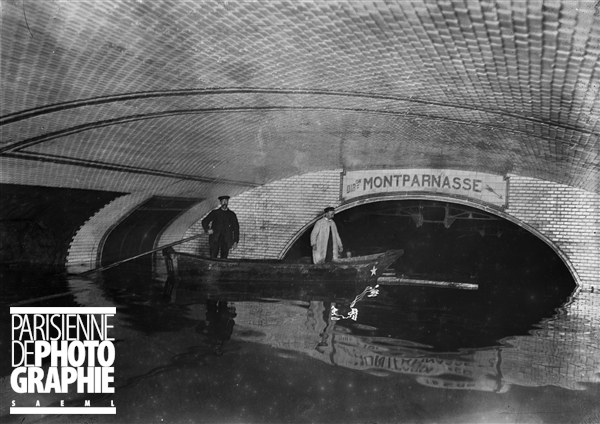
The Gare d’Orsay had been built as part of the preparations for the International Exposition of 1900. The world famous Paris Métro was also inaugurated to celebrate the Exposition of 1900. And it, too, succumbed to the flood.

Familiar stately streets such as the Boulevard St. Germain took on an eery unfamiliarity. How can one imagine this being one of the places to take a stroll, to shop, to see and be seen and above all to linger? Much of the city had been transformed.

One hardly expects to find a boat in a Parisian doorway. But boats became one of the main ways to get about the flooded city.

People still had to move about the flooded city. Here we see men poling a boat through an unidentified street in Paris. We are not sure about the bits of wood floating in the water. They seem too thin and in too many different sizes to be wooden pavers. If anyone reading this has a theory, let us know.
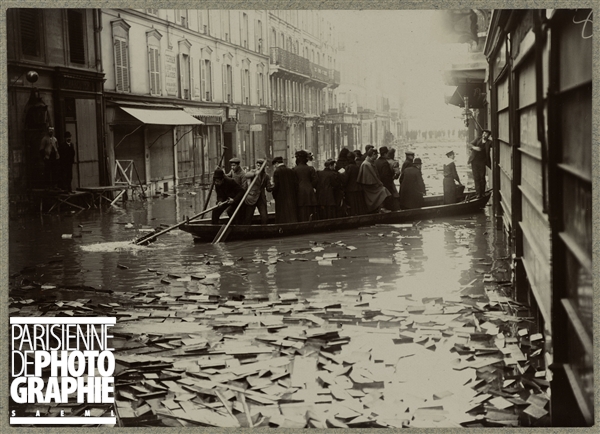
The rue de Montaigne is an area where one should be properly dressed. However, during a flood? Well, one must arrive at work looking as if one belonged there and the passengers seemed to have maintained a proper dress code.

As one reads about the flood, one is appalled by the extent of the damage, loss, human suffering, and heartache. However, one also stands in admiration of those who carried on as best they could. The boats were helpful, but the greatest transit aid in flooded areas were the numerous elevated walkways supported on everything from trestles to wheelbarrows. Here we see an orderly progression on rue du Bac in the 7th.

As in any flood, inhabitants tried to hold back the water. The workmen putting sandbags in position on rue Gros in the 15th had a different dress code and tasks from those taking the boat on rue de Montaigne.

One could also try to block the path of the rising water by making higher walls and filling in window openings. As we see in the opening photos, these efforts at the Gare d’Orsay failed.

The city of Paris has a voracious appetite and flood or no flood, residents needed massive amounts of food every day. In this photo taken near the Austerlitz viaduct, the sacks are filled with flour, not sand.

In the image below, we might wonder if we are witnessing an exercise in extreme optimism. We are told the men in the boat are delivering meat to a butcher’s shop on rue Surcouf in the 7th. They seem to be heading towards the hairdresser (Coiffeur). But if one looks to the top left of the photo, there is the unmistakable symbol of a butcher who sells horsemeat.

Many people’s homes were uninhabitable and those who could not find refuge with friends or elsewhere ended up in shelters. The refuge in the Lambert gymnasium was not elaborate, but it was shelter.
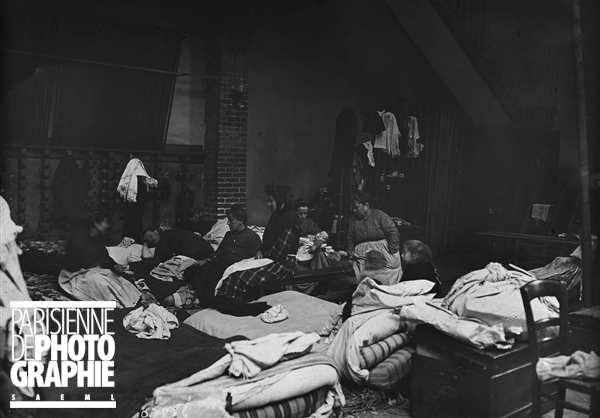
Where possible, additional equipment would be brought in to help make the shelters more comfortable. The mattresses shown here were for flood victims who had sought shelter in the Saint Sulpice Seminary in the 7th.

And as with so many disasters, the Red Cross played a prominent role. Here a Red Cross station advertises “Secours aux Inondés” (Aid or help for flooded-out residents).
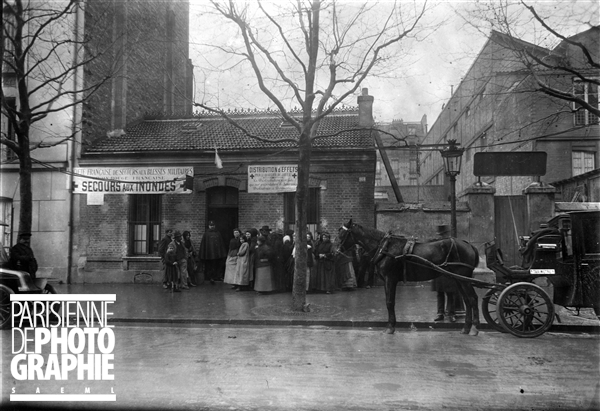
One wonders how long these Red Cross ladies’ uniforms would keep their crisp looks in the shelter at the hospital on rue Michel-Ange.

But even when the water receded, there was much to do. Portable pumping units spread through the flooded areas to pump out cellars. Workmen helping to restore the city posed as the water poured from a hose and ran down the street.

Some of the pumping equipment was on a much larger scale. Here are two massive steam engines driving huge water pumps. One can see the cascade of water disgorging from the pipe between the two engines and draining away down the street.

Many people lost most, or all, of their possessions, some irreplaceable. But for some things such as basic furnishings, the Red Cross was there to help as people returned home.

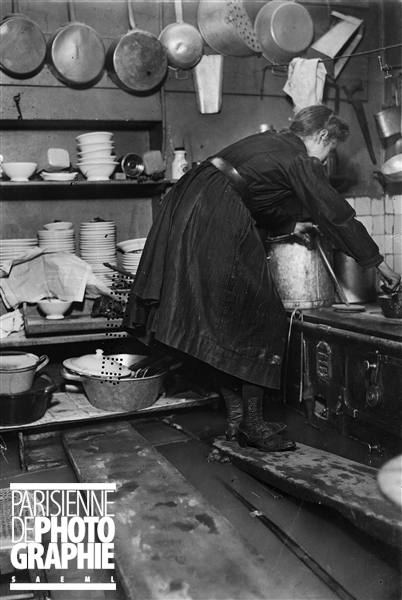
As the immediate ravages of the flood disappeared, there would be a seemingly endless number of memories. And some would talk of their heroes and the unforgettable incidents. Perhaps it would be of the kitchen in the café on rue Félicien David in the 16th that stayed open throughout the flood. Undoubtedly the cook would have long memories of that difficult time.
And perhaps no drink from a corner café ever tasted better than those consumed during the flood while everyone was balanced precariously on the planks that kept them out of the water. Perhaps no zinc bar was a more welcome sight than this, also on rue Félicien David.

Perhaps others had a special place in their hearts for those who unloaded and delivered the coal so desperately needed for heating and cooking.
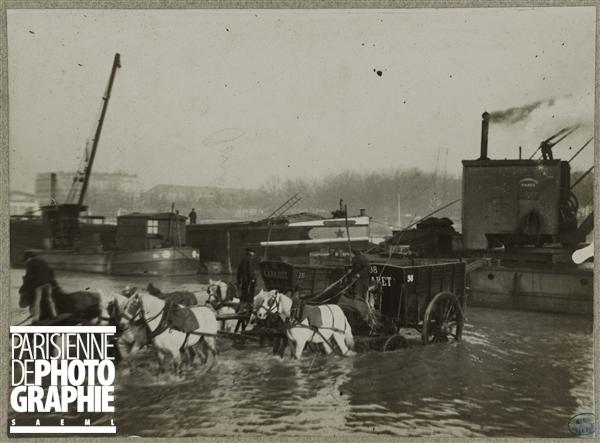
Others would remember that even after the water receded, there was still a lot of cleaning that had to be done, inside and out.

And undoubtedly many remembered the many solid workmen who just worked, then worked some more, and never found themselves enjoying the limelight. Identified only as a “Seine Flood Rescuer,” this photo represents the numerous workmen who helped bring Paris back from the brink.
 Text by Norman Ball, images from Paris en Images.
More images of the flood can be found on the Historic Cities website.