The first time I saw Paris

This blog is dedicated to the memory of my father, John Campsie, 9 April 1921 – 8 February 2014. He passed his love of travel on to me and encouraged me to learn French.

The first time I saw Paris, it was a mistake. We were actually supposed to be in Greece, not Paris. And it was all my fault.

I was eight years old. At the time, my family was living in North Berwick, Scotland, because my father had taken a year-long sabbatical from his publishing job in Toronto to write a book. During the Easter holidays that year, he planned to take us first to Malta, his birthplace, and then to Greece.

At first, our holiday went pretty much according to plan. We flew to Malta, and spent one night in a hotel that my father remembered from his childhood in Valletta in the 1920s. Time had not been kind to the hotel – everything seemed mouldy and damp and the waiters in the dining room were elderly and hard of hearing. The next day we moved to a modern hotel.

On Sunday, we went to a service at St. Andrew’s Scots Church in Valletta. In the 1920s, my grandfather had been the minister at this church, as well as a chaplain to the Royal Navy’s Mediterranean Fleet stationed in Malta. That is how my father had come to be born there – in the manse beside the church on Old Bakery Street.

000010

The photo shows my mother, my sister Alison, and me dressed in our Sunday best outside the church. The house just beyond the stone church, with the knobs on the top, is the one where my father was born.

During the service, I started to feel queasy, and then very sick indeed. My mother took me outside and we wandered about in the sunshine for a while, until the service was over. I spent the rest of the day in bed. The following day, I was still very sick, and my parents got a doctor, who discovered that I had a perforated eardrum. He prescribed antibiotics and told us, “She cannot fly in an aeroplane for at least three months.”

So we had to scrap the plan to go to Greece. Instead, my father had to figure out a way of getting from Malta back to Scotland by land and sea. This must have been enormously stressful for him, but I didn’t know that at the time. When you are eight years old, you assume your parents will solve all problems. And he did.

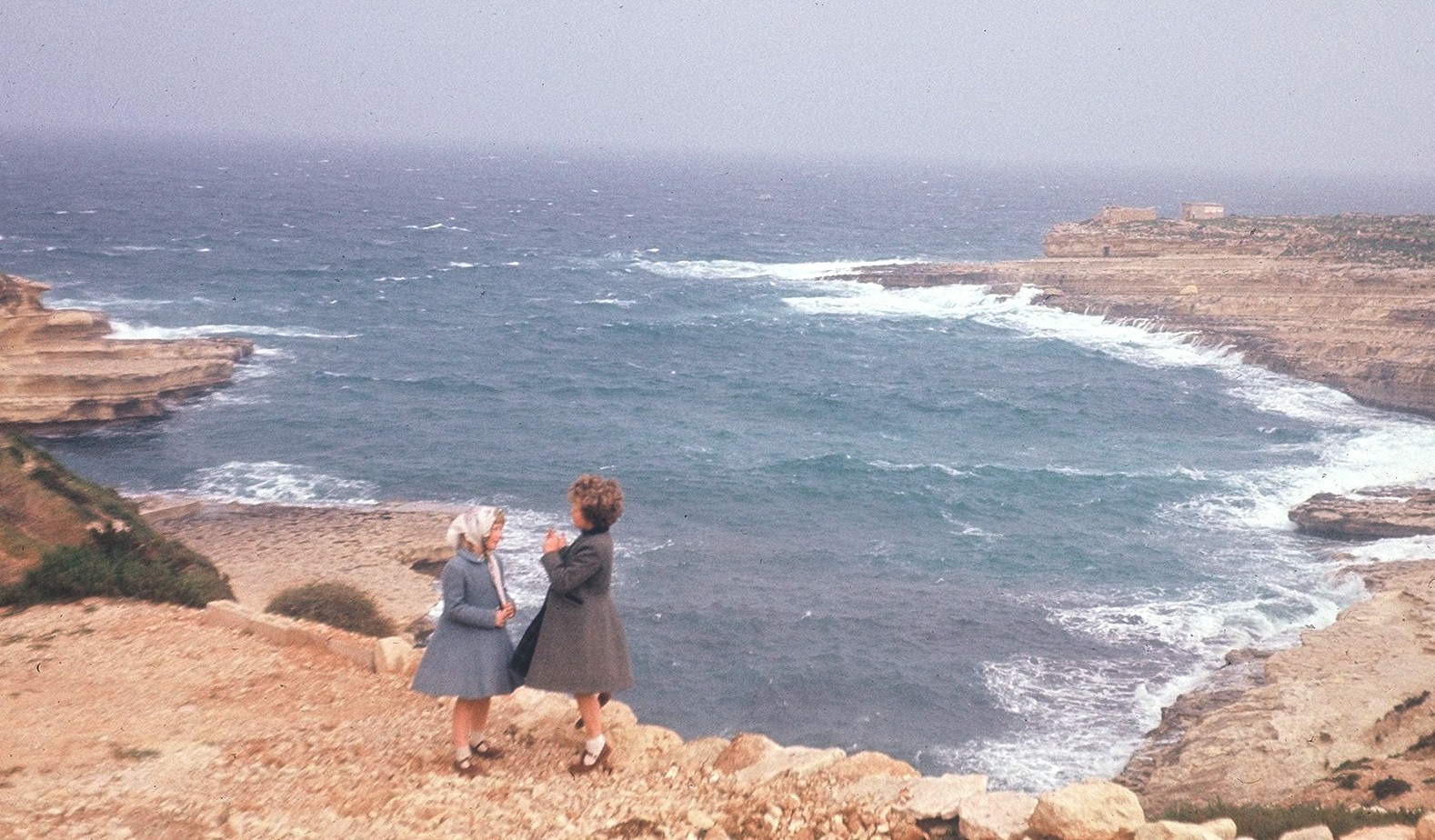
I recovered enough to see something of the island – I have my father’s 35 mm slides showing trips here and there in a rented Morris Minor convertible. But I had to wear one of my mother’s scarves to keep the wind out of my ear.
000012

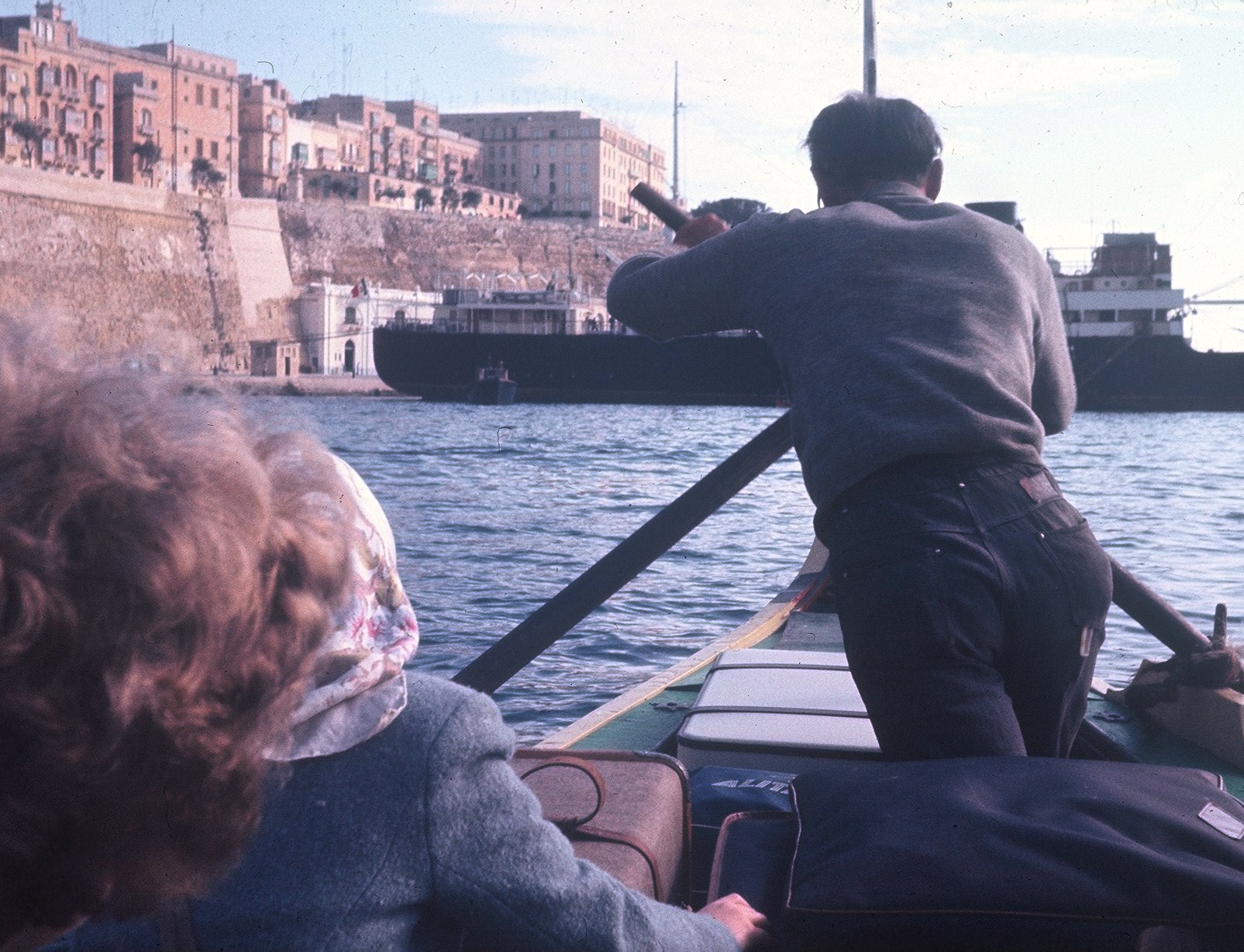
Eventually, we set out on our epic journey home. First, we had to take a djasa (one of the colourful local rowboats) out to a steamer that would take us to Sicily. This is the photograph my father took while we were crossing Valletta harbour with our luggage.
000009

The crossing was choppy. We landed in Syracuse, where we spent the night. Octopus was on the menu of the restaurant where we ate, something none of us had ever tried before. I understand that there is a way to prepare octopus that makes the experience of eating it less like chewing boiled rubber bands, but the chef in Syracuse did not use that technique.

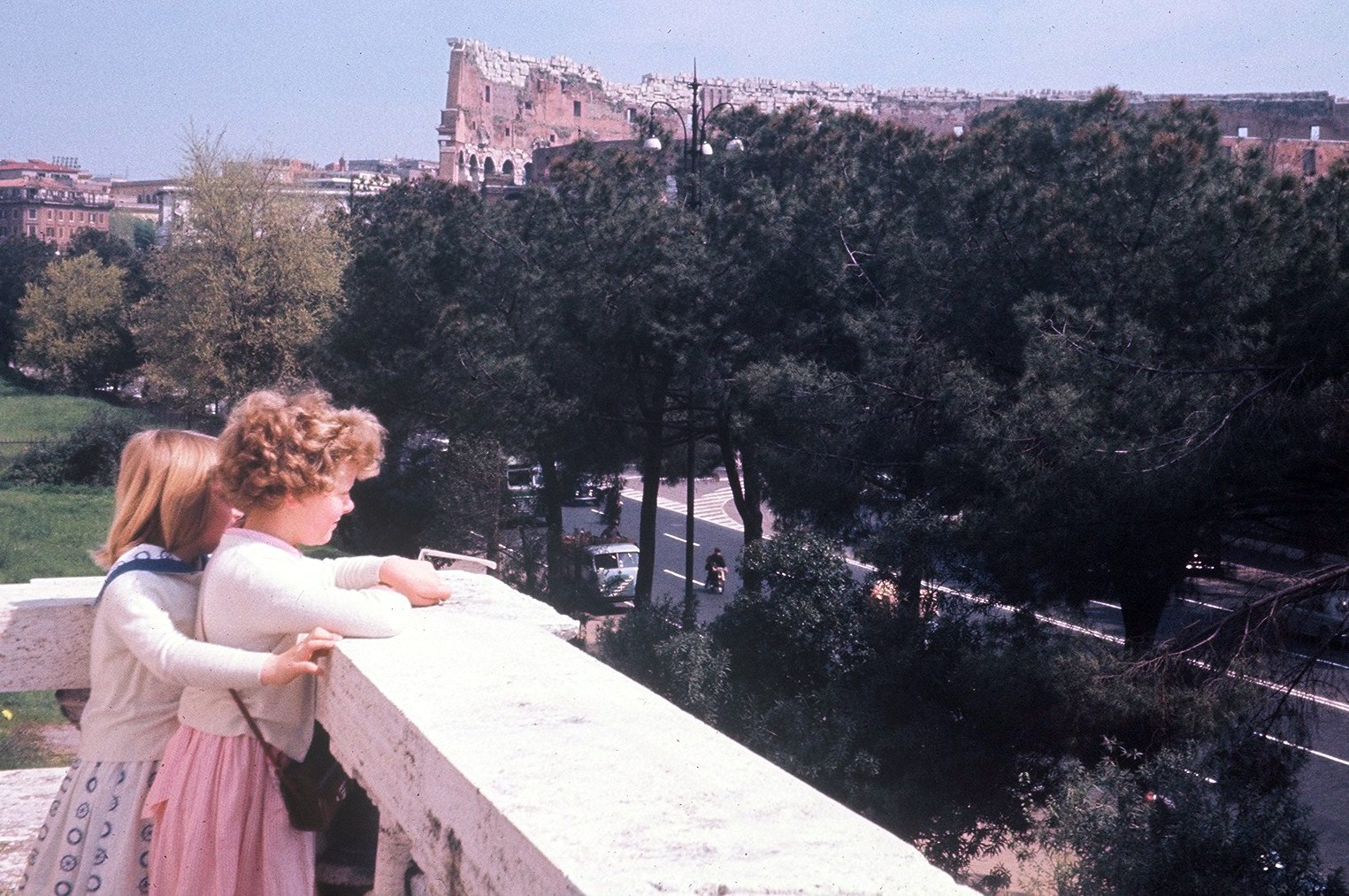
The next day, we took a train to Messina, ferry to Reggio, and another train to Rome, where we stopped for a couple of days. My father’s pictures show us in the Forum and the Boboli Gardens and touring the Vatican. Here Alison and I are standing on the entrance gate to the Palatine Hill, with the Colosseum in the background.
000014

Looking back, I am astonished that we found a hotel room, because it was Holy Week and people were pouring into Rome. But my father seems to have solved that problem somehow. The name “Hotel Lux” sticks in my mind. The hotel is still there, near the train station. It may well have been where we stayed.

Here is a rare picture of my father in Rome. Rare, because he was usually behind the camera, not in front.

000013

We left Rome on Easter Day itself, on an almost-empty train to Turin. That in itself is remarkable. Who do you know leaves Rome on Easter Day?

From Turin, we went to Torre Pellice for a few days. This was another place my father had known as a child: in the 1920s, he and his family had spent several annual vacations in a nearby village called Angrogna.

I gather his family holidays consisted largely of taking long walks and admiring mountain scenery. So that is what we did, too. I have pictures of us hiking along mountain trails and eating picnics beside streams. Here we are in the Italian Alps; I am looking enviously at my sister’s camera. My father seems very formally dressed – perhaps it was a Sunday.

000005

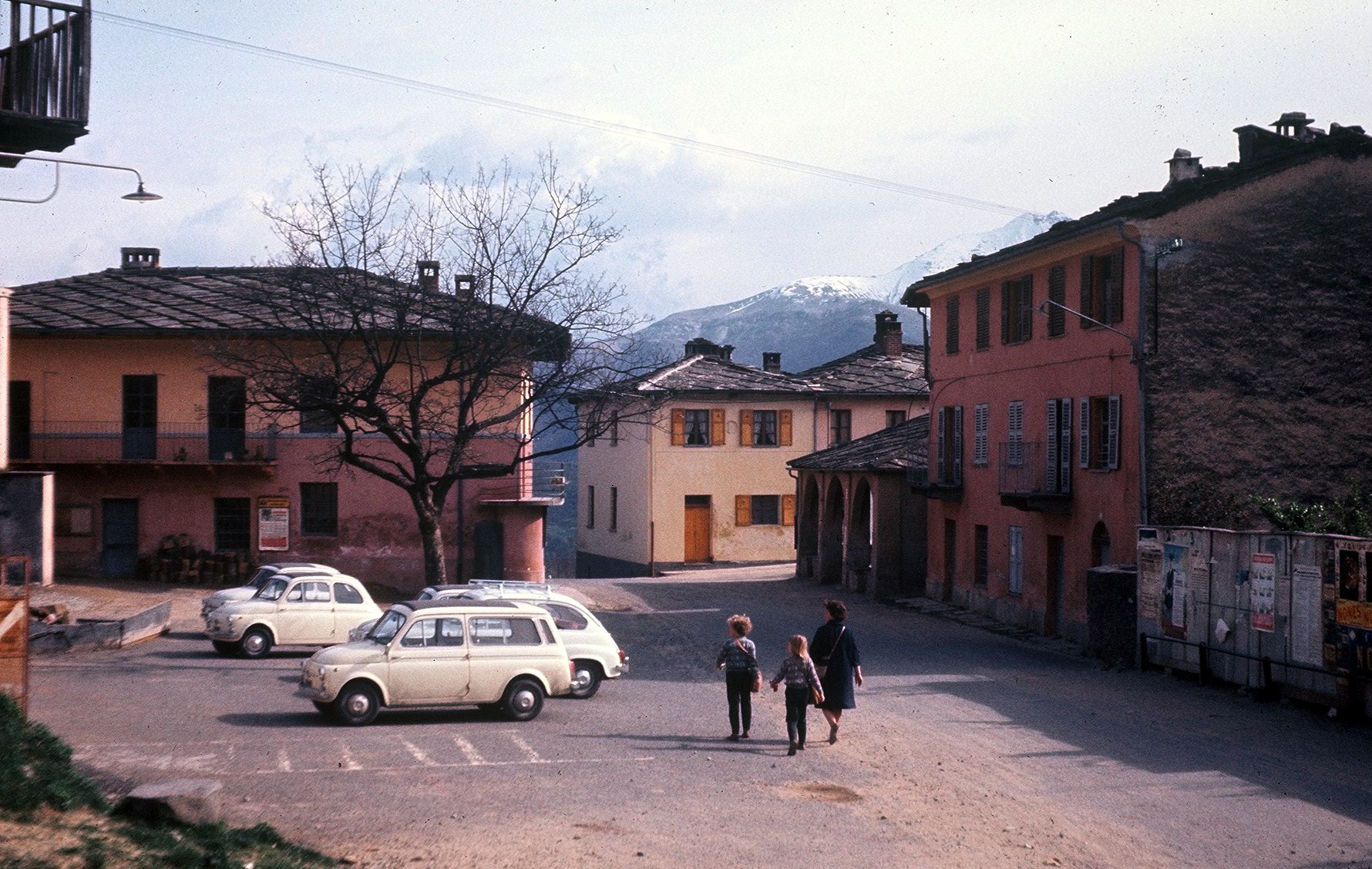
I don’t know what Angrogna is like now, but back then, it didn’t seem to have changed much since the 1920s. My father happily recognized his family’s old haunts. Indeed, the photo below, which he took on that trip, resembles a watercolour my grandmother  painted several decades earlier, with the addition of a few cars. And the three of us. (What do you suppose had caught our attention on the left?)
000002

After a few days of mountain walking, we set off again, by train from Turin to Paris. I suppose we would have arrived at the Gare de Lyon. That must have been my first view of the city.

Where did we stay? My memory is that the hotel was not very big, on a narrow street opening into the Place de la Madeleine. The only street that fits that description is the Passage de la Madeleine, on which is located the Hotel Lido at number 4. It was well-established at the time and apparently quite cheap. So that might have been the place. Or not; memory does play tricks.

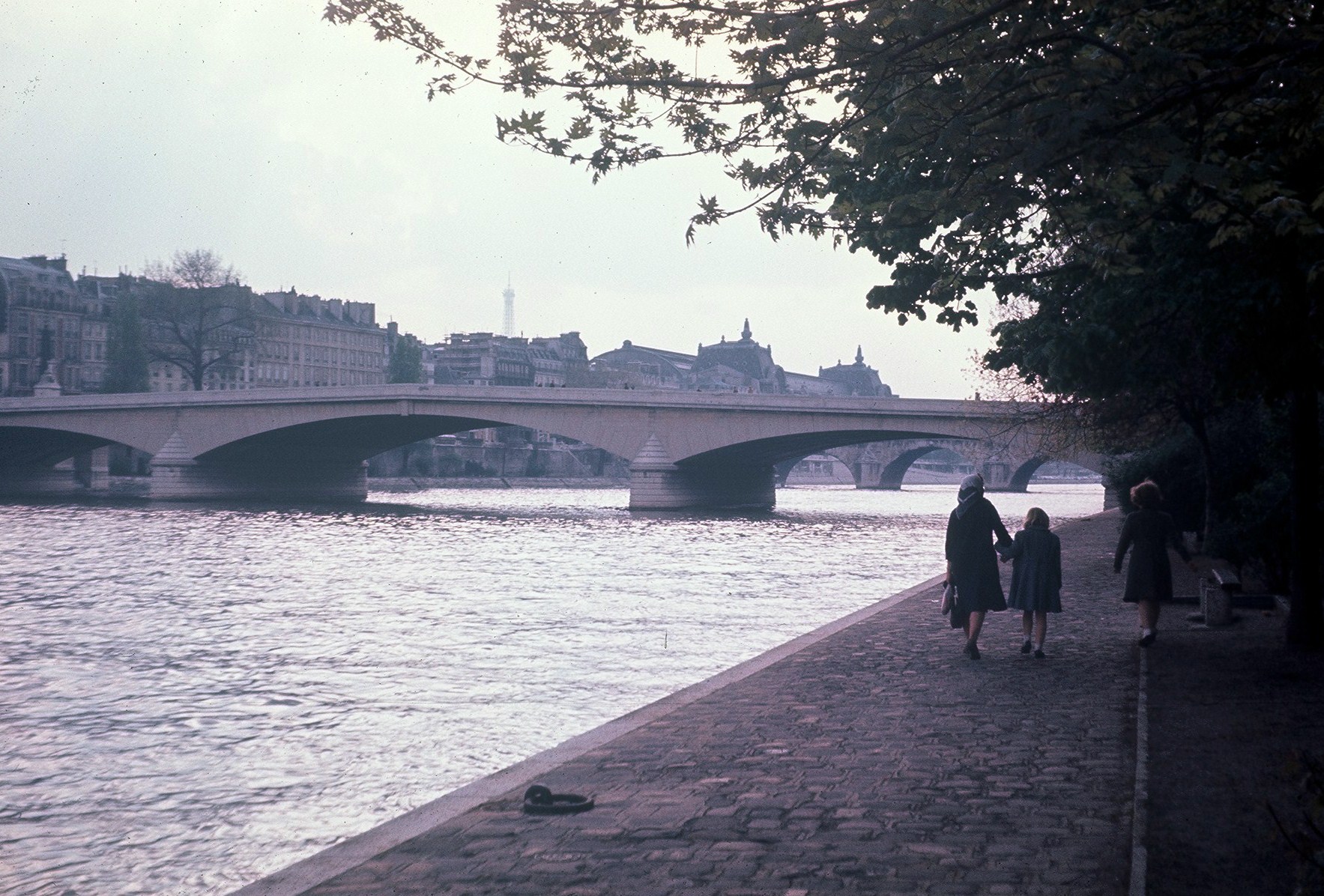
What did we do? Here my memories are overladen by those from subsequent trips and, alas, my father took only a couple of photographs. But there is one of us walking by the Seine and another of Alison and me pushing around a toy sailboat on the pond in the Jardin du Luxembourg. I do remember that.

000007

After a few days, we moved on. Train to Calais, ferry to Dover, train to London, train to Edinburgh, train to North Berwick, journey’s end.

So that is how I first saw Paris. We went back as a family when I was a teenager, and there were two memorable school trips before I returned to study at the Sorbonne. In 1983, my father and I found ourselves in Paris – once again by mistake. We were supposed to be in Russia. This time, it wasn’t my fault. But that is another story altogether.
000006Text by Philippa Campsie; photographs by John Campsie.

Posted in Family history, Paris hotels, Paris nostalgia, Paris travel | Tagged , , , , , , , , , , , | 48 Comments

Walls within walls

According to an old proverb, “Good fences make good neighbours.” It may or may not be true. But do good walls make good cities? Or, more simply, do walls help make cities? It seems that a wall built during the reign of Philippe II, known as Philippe Auguste, may have helped Paris become the city it is now. Or maybe that process started earlier, with a wall that archaeologists are just beginning to discover.

I knew of Philippe Auguste’s wall, because we had seen the part that is still visible in the Marais. A few years ago, we rented an apartment nearby and we used to pass the wall and the sports ground in front of it on our way to and from Monoprix and the Village St-Paul.

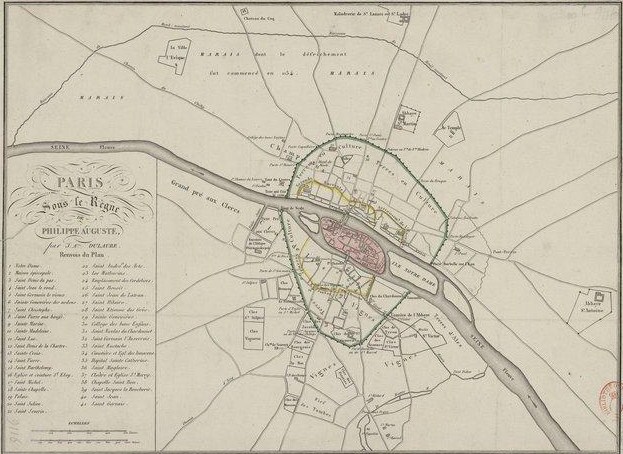
DSCN0918_1More recently, I found a map dating from the 1820s showing Paris under the reign of Philippe Auguste that was published in Histoire physique, civile et morale de Paris depuis les premiers temps historiques jusqu’à nos jours, by Jacques Antoine Dulaure.

PhilippeAugusteI realized I knew nothing of the king who had a name like mine. So I went looking for him.

Philippe II succeeded to the throne of France (at that time a much smaller entity than today’s republic) in 1180. He was considered a pretty good king as kings go, but his track record as a husband is dismal. His first marriage was contracted when he was 15 and the bride, Isabelle of Hainault, was 10 years old. He didn’t take to her, and was on the point of seeking a divorce from her until somebody gently reminded him that if he did that, he would have to give back her dowry (it consisted of rather a lot of land). This argument made an impression, and Isabelle stayed. She bore him a son and died in 1190.

Shortly thereafter, Philippe went on the Third Crusade with Richard the Lionheart of England (when Richard was imprisoned and Philippe did not come to his aid, the former allies became deadly enemies – but that’s another story). On his return from the Holy Land, Philippe married Ingeburg of Denmark. Nobody knows what happened on the wedding night in 1193, but the very next morning, he sent her away. He took another wife (or concubine) called Agnes de Méranie, who went on to bear him two children.

The pope was furious and ordered the closing of all churches in France to force Philippe to renounce Agnes and take back Ingeburg. Philippe refused and it was only the death of Agnes in 1201 that ended the standoff. Philippe eventually recalled Ingeburg as queen (although he still didn’t want her as his wife – you do wonder what on earth happened on their wedding night). Ingeburg put a brave face on it, reigned as queen, and managed to outlive Philippe when he died in 1223.

All of which has nothing to do with the wall. Unless Philippe built it to protect himself from irate in-laws.

Colin Jones, in Paris: Biography of a City, notes that the wall was never used defensively, since the city was never besieged while it was in place, but it was an important symbol and helped consolidate the city. As he puts it:

This was power architecture. It made Paris the most heavily – and the most conspicuously – defended military stronghold in western Europe… The choice of Paris as royal capital meant that the cronies and clients of the monarch became eager to establish themselves in the city… high courtiers built permanent residences.

Before this time, courtiers had tended to camp out – grandly, with servants and cloth-of-gold tents, but camping nonetheless. Now they were putting down roots.

Jones adds: “Building the wall was a way of inhibiting external expansion and stimulating the consolidation of undeveloped land within the walls.” Today this is known as growth management or urban intensification and is intended to combat suburban sprawl. Philippe was way ahead of the curve on that one.

The map shows plenty of undeveloped land to build on, as the wall enclosed vineyards (“vignes”) and farms (“terres en culture”). Note the route of the Bièvre – a canal has been built from its original route that empties near the Ile de la Cité. Apparently you can still see the archway under the wall that allowed the passage of the canal. Today it lies underneath a post office at 30 bis, rue Cardinal Lemoine.

There are a dozen or so gates (portes) and posterns (poternes), and four towers where the wall met the river – Tour de Nesle, Tour qui fait le coin, Porte Barbelle sur l’Eau (elsewhere called Barbeau), Tournelle. All gone now, although the name Tournelle persists in the name of a bridge.

This modern picture shows what the Tour de Nesle might have looked like.*

tour-de-nesle2But Philippe was not the only wall builder. If you look closely at the map, you can see something called the “Seconde Enceinte” (Second Wall) faintly traced in yellow on both sides of the river. One section is labelled “Accroissemt de l’Enceinte” (Enlargement of the Wall).

PhilippeAuguste3Dulaure dates this wall to the early 12th century; other historians had suggested that it was built much earlier, at the end of the Roman period. To support his argument, Dulaure cites a poem containing a detailed account of the Viking raids on Paris in the 9th century and insists that if there had been a wall around Paris at the time, the poet would have said so. It makes sense.

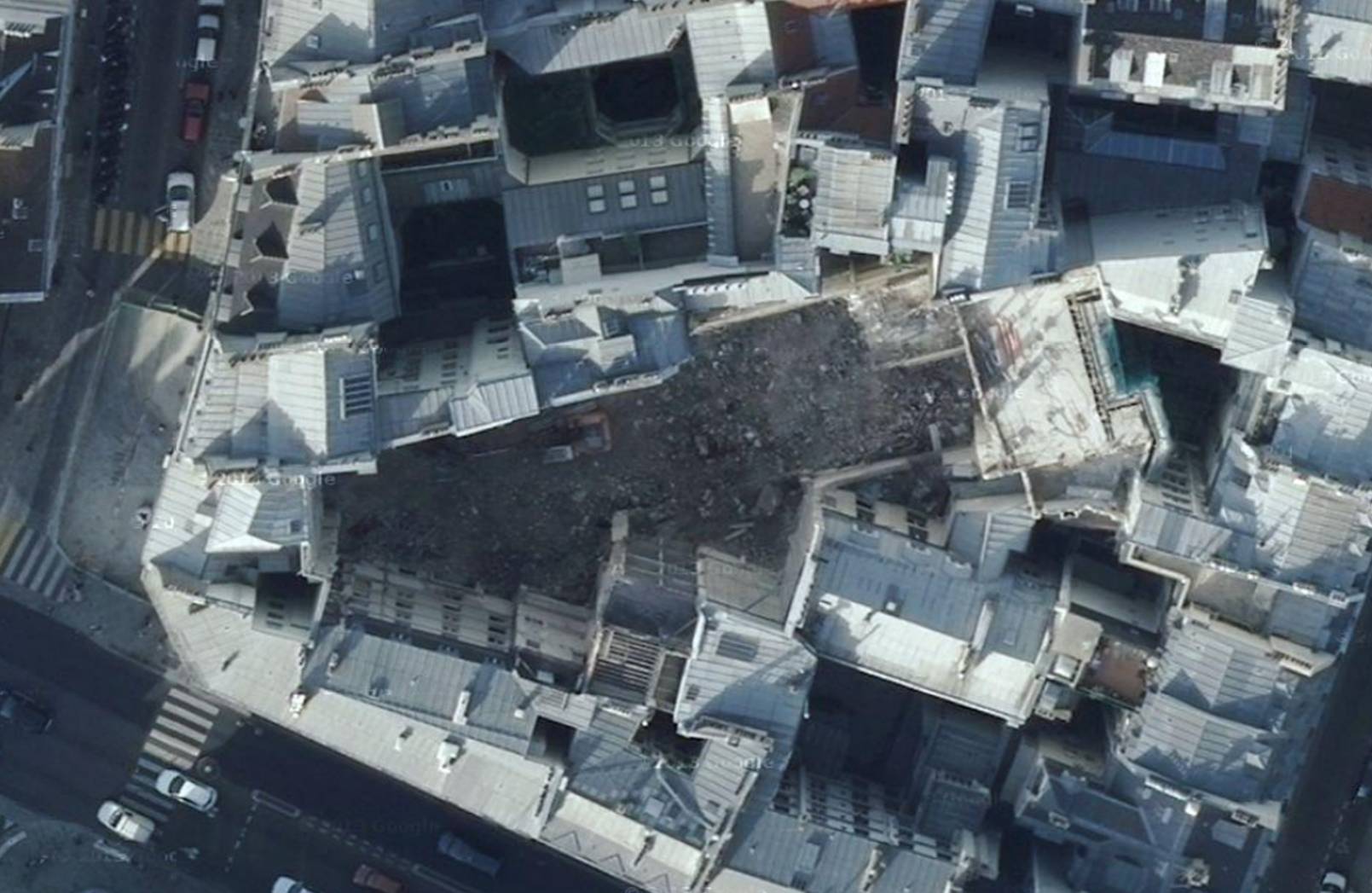
Colin Jones mentions a wall defending some of the churches on the Right Bank, but considers it a late Roman addition. My historical atlases do not mention or show this earlier wall. However, in 2009, the Institut national de recherches archéologiques préventives (INRAP) found traces of a medieval wall at the intersection of the rue de l’Arbre Sec and the rue de Rivoli in the 1st arrondissement.

INRAP calls it the “second wall” and  dates it from the 10th or 11th century. There is a short video on the INRAP website showing the excavation. Here’s the Google satellite view. That’s the rue de Rivoli at the bottom.

INRAP2The archaeologist interviewed on the video notes that there is no documentation for the wall; nonetheless, starting in the 18th century, historians began to suspect the existence of a wall inside that of Philippe Auguste and had theories about its location and gates. Dulaure was one. And his instincts were right about the date.

Dulaure’s map also shows a second wall on the Left Bank as well as the Right. He has some evidence from documents about its location, which at its easternmost extent, is shown running alongside the canal de Bièvre. INRAP hasn’t confirmed this part yet, but my money’s on Dulaure. I’m sure it’s there.

Maybe, just maybe, this was the wall that helped start Paris on what Colin Jones calls “the greatest quantum leap in the history of Paris, before or since. Not much more than a dot on the map even in 1100, by the end of the twelfth century it was the largest city in Christendom and a pre-eminent cultural and intellectual centre.” Perhaps this medieval enclosure played a role far larger than anyone imagines.

Text by Philippa Campsie; photograph taken in the Marais by Norman Ball. Map images from Gallica, satellite view from Google Earth, painting of the Tour de Nesle from Wikipedia.

This website has a complete list of the remaining pieces of the Philippe Auguste wall that are still visible.

*The name of the Tour de Nesle was immortalized in another royal scandal 100 years after Philippe Auguste’s reign, as the site of adulterous assignations between the daughters-in-law of the king (Philip IV) and their lovers. When these liaisons came to light, the men were tortured and executed and the women were imprisoned. In the 19th century, Alexandre Dumas turned this event into a play called La Tour de Nesle.

Sources: John W. Baldwin, Paris, 1200, Stanford University Press, 2010; Colin Jones, Paris: Biography of a City, Penguin, 2004.

Posted in Paris history | Tagged , , , , , , , , , , , , , , , , | 3 Comments

Pugin’s Picturesque Paris

For us, no trip to Paris is complete without time browsing through racks, boxes or bins of old engravings of Paris. We find them at antique fairs, flea markets, galleries, book stores and many other places. Quite a few were originally published as part of books long since disassembled.

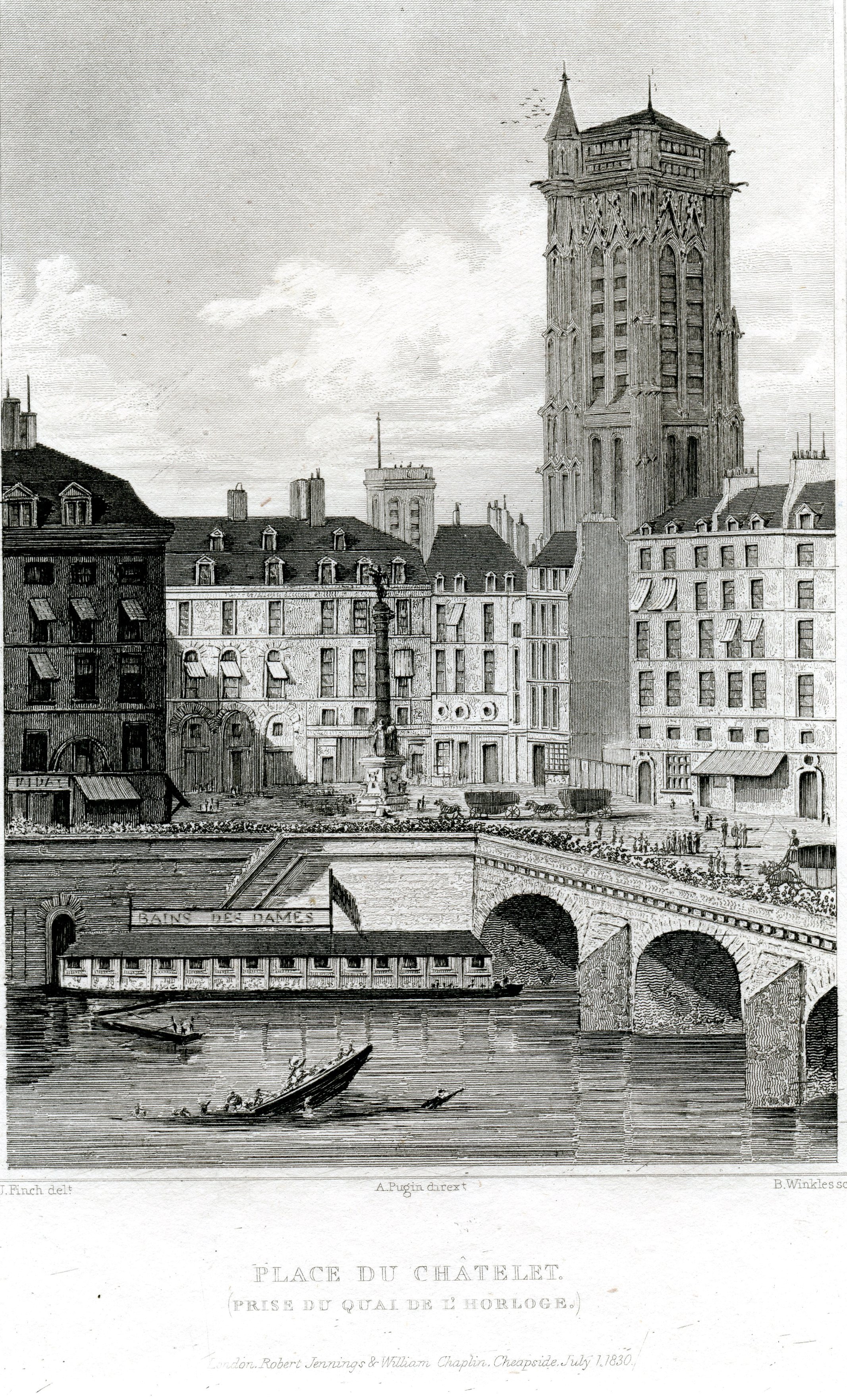
Pugin Paris001

This is one of a half-dozen prints we bought one afternoon at an antiques fair outside the Saint-Sulpice church in June 2013. Initially attracted by the view of the Tour St. Jacques, it was the lesser details on the river that caught our attention. The floating bathhouse for women (Bains des Dames) spoke of an important part of Paris life. And what is the story behind the sinking vessel in the foreground?

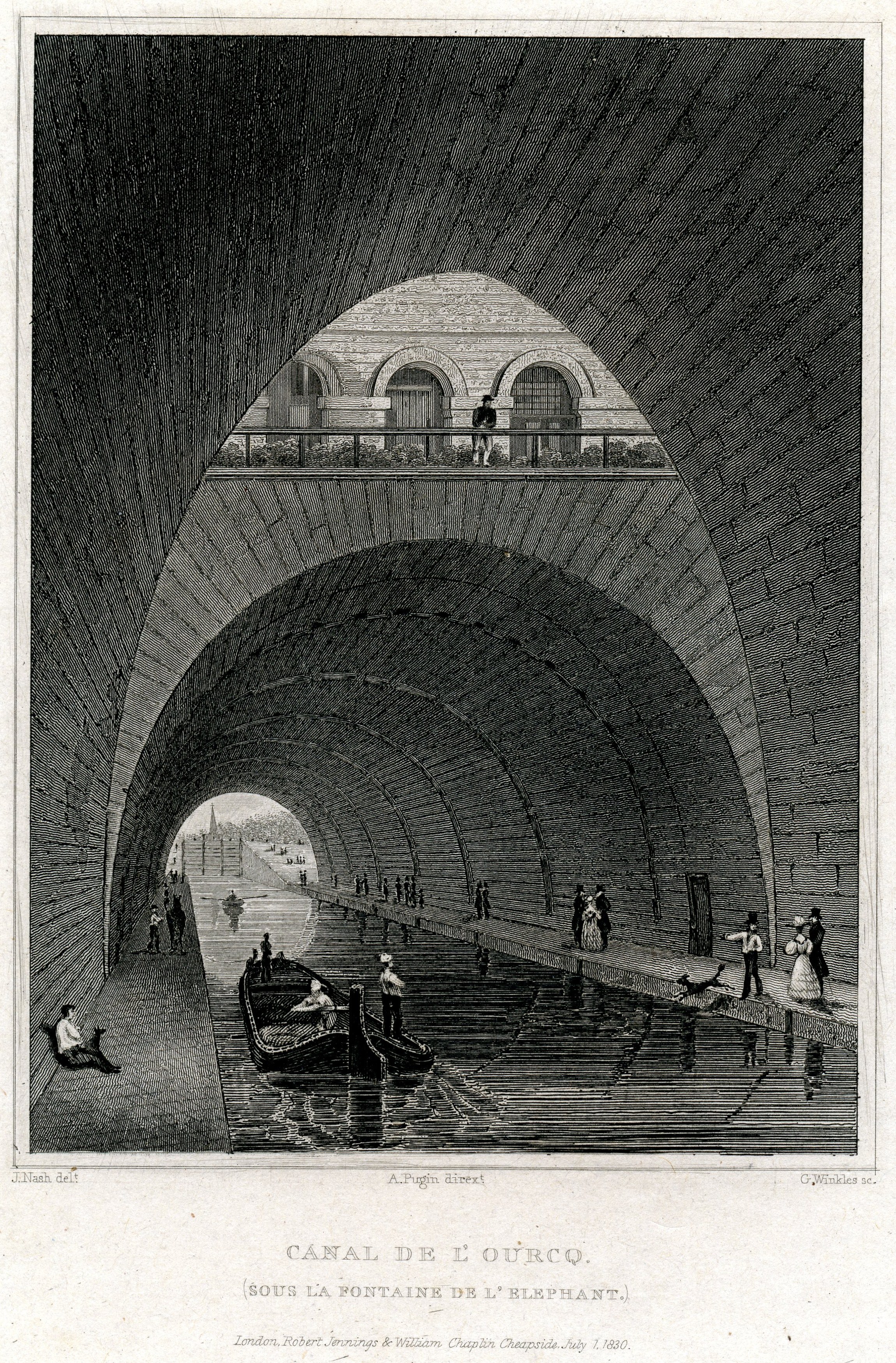
Pugin Paris002

This view of the Canal de l’Ourcq also attracted me with its exaggerated perspective and height. I did not hesitate to put in the purchase pile.

Both engravings bore the inscription “A. Pugin Dirext.” immediately below the image. It meant that Pugin was not the artist, but the one who had supervised the work. The Paris-born Augustus Charles Pugin (1762–1832) was a renowned artist, writer on mediaeval architecture, and draftsman.

Philippa used some of these images in a blog on the old customs houses of Paris. But we wanted to know more about the source of the illustrations.

Then, in early November, we attended the Toronto International Antiquarian Book Fair, where we enjoyed looking at the books on display and meeting old friends. Gordon Russell of Alexander Books in Ancaster, Ontario, told us he had a book that “might be of interest.”

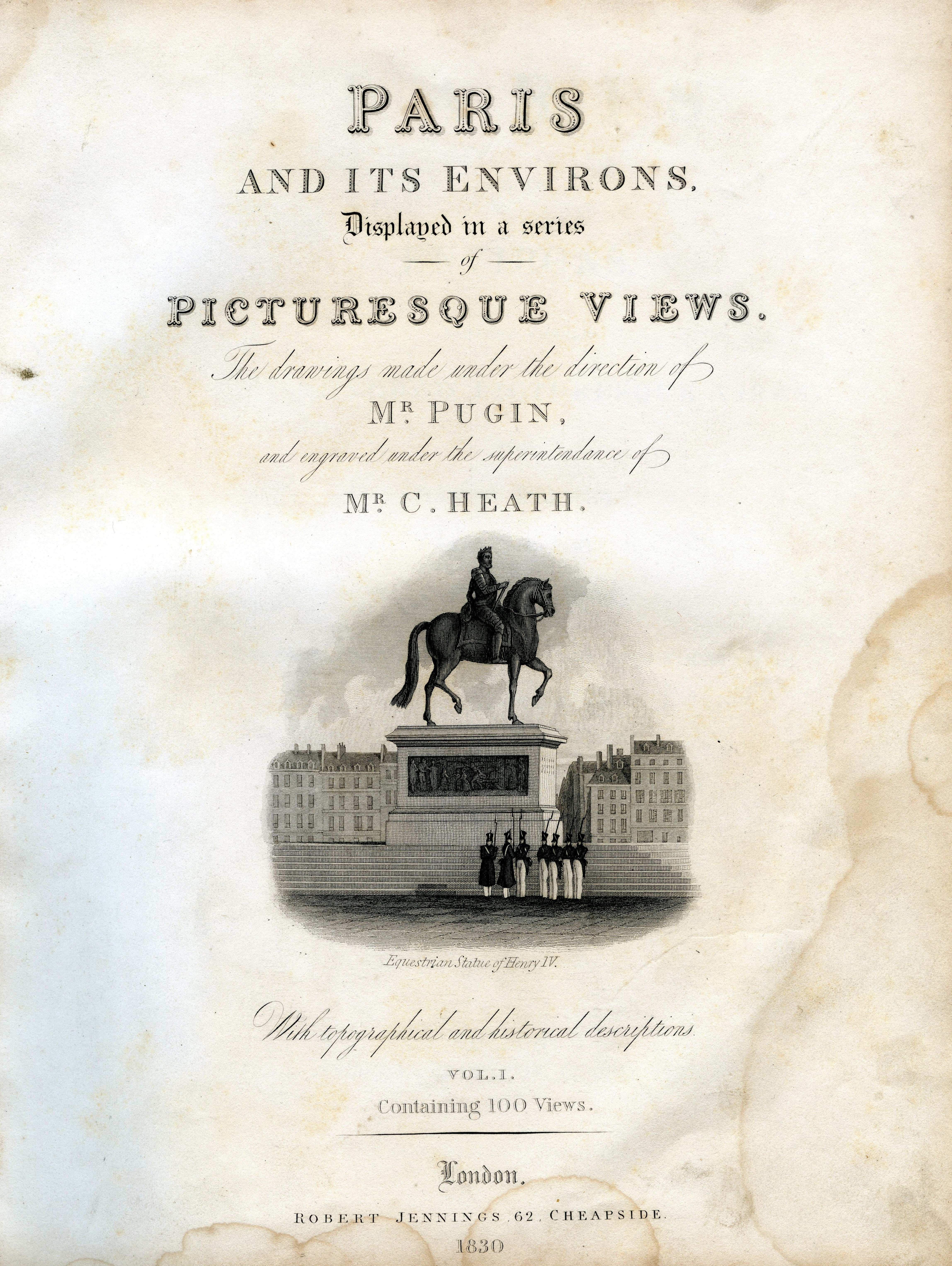
The object of interest had clearly not had a happy life. There was water damage, the binding was fragile with one hinge broken, and the other was ready to go. But it was already an old friend, nonetheless, and it seemed our duty to rescue it. This is how we became the owners of Paris and its Environs Displayed in a Series of Picturesque Views. The drawings made under the direction of Mr. Pugin, and engraved under the superintendence of Mr. C. [Charles] Heath, with topographical and historical descriptions.

Volume I had been published in London in 1830 by Robert Jennings (62 Cheapside) and Volume II the following year by the renamed Jennings and Chaplin at the same address. Each volume contained 100 engravings plus accompanying text in French and English.

Pugin Paris003

We were thrilled to own the book, but concerned about its fragility. Fortunately, Toronto bookbinder Kate Murdoch of Taylor-Murdoch-Beatty bookbinders turned it into a sturdy volume that will easily last another century or more.

Now we can browse the book with no worries that it will fall apart. It allows us to enter the Paris of the 1820s. Some of the scenes have disappeared completely, some have been changed dramatically; but every image is intriguing. So come browse a few images with me.

The title page above is one of the most damaged pages in the book. It also leads to an intriguing story about the statue(s) of Henry IV which it portrays.

The Pont Neuf was started in the reign of Henry III and finished in the reign of Henry IV. Composed of two parts of unequal length that meet on the Ile de la Cité, it is here that a famous statue of Henry IV was erected. But the story of the statue is more complicated than most people realize.

The story starts far away from Paris. Ferdinand, Grand Duke of Tuscany, planned a magnificent equestrian statue of himself. He began by arranging to have a colossal bronze horse cast, but his own death prevented the casting of his own statue to ride the horse. The riderless horse eventually ended up in the hands of Marie de Medici, regent of France, who had it shipped to France.

The ship carrying it was wrecked on the coast of Normandy. The horse “was, however, by immense efforts, dragged from its watery grave, and finally conducted in triumph to Paris.” Still riderless, it was set upon the Pont Neuf and eventually became known simply as the Cheval de Bronze, until a statue of Henry IV was added.

The statue suffered indignities during the Revolution and “in 1792, when the revolutionists were short of cannon, the horse and rider disappeared,” presumably melted down for cannon. Henri and his horse returned after the Bourbon restoration, when another statue was erected on the same spot. This is the statue we see today.

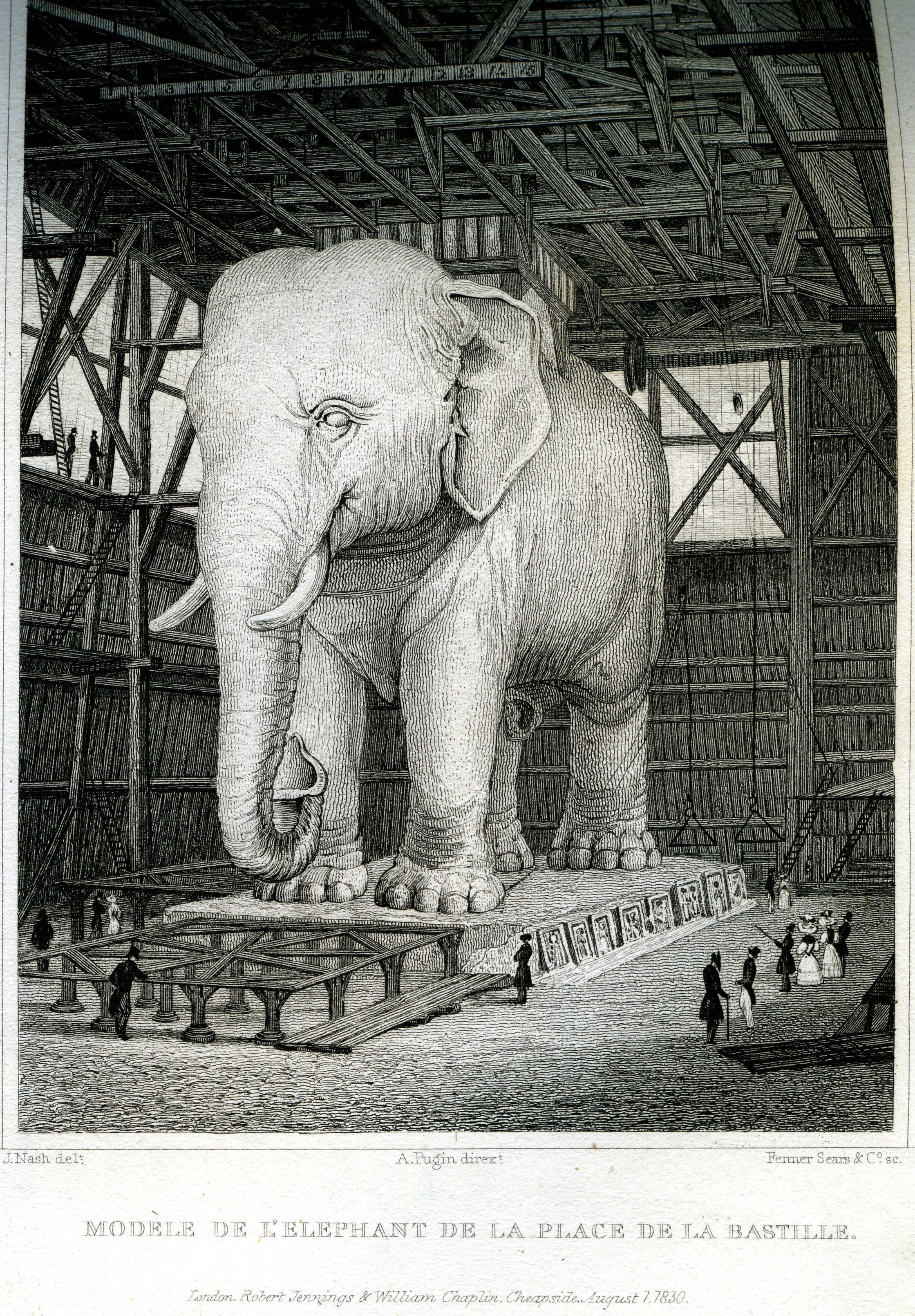
The Canal de l’Ourcq shown above has the intriguing subtitle, “Sous la fontaine de l’éléphant” (under the elephant fountain). What elephant would that be?

Pugin Paris004

The image is described as “the model in wood of the celebrated bronze Elephant which Napoleon designed to erect in the Place de la Bastille.” Had the decree of February 9, 1810, been carried out, it would have been quite something. The elephant and its proposed castle or tower would have risen to a height of 24 metres (72 feet). The legs were two metres in diameter and one would have had a winding staircase for visitors to climb. The whole thing was to be cast in bronze from the “cannon taken from the ‘Spanish insurgents.’ ” The foundation masonry was constructed, but that was as far as it went. “The ‘Spanish insurgents’ were destined to overthrow this amongst other colossal schemes of Napoleon.” (For the full story of the elephant, read this post on the excellent blog Culture & Stuff.)

Pugin Paris006

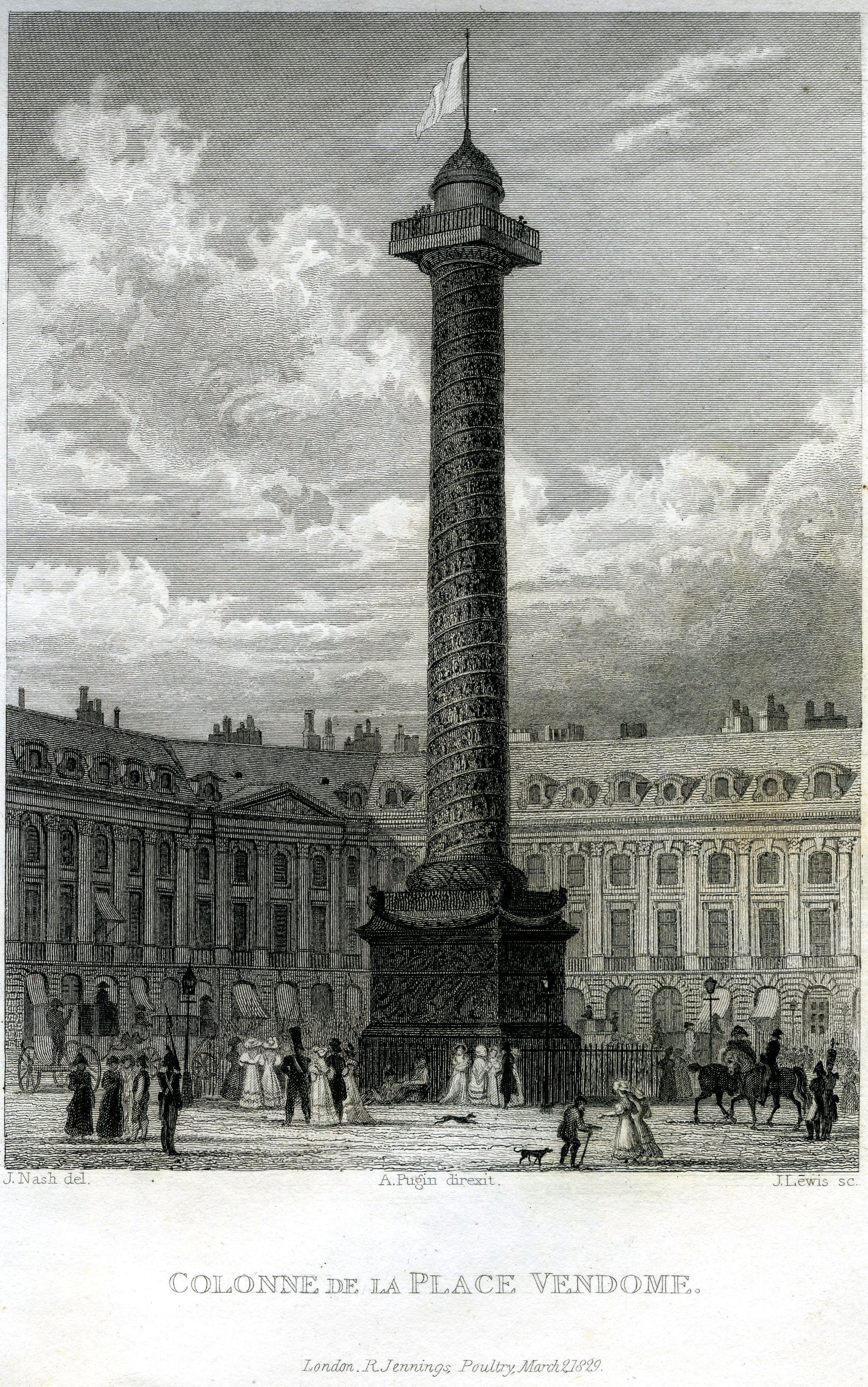
However, Napoleon did succeed in another venture made of melted-down cannons, with the Colonne de la Place Vendôme. The square now known as the Place Vendôme was created in 1699. Until the Revolution, it had been dominated by an equestrian statue of Louis XIV. This, like the Henri IV statue, eventually fell victim to the Revolutionaries.

Later, Napoleon decided this would be the perfect location to celebrate his recent victories. Inspired by the Roman column of Trajan, Napoleon’s column, completed in 1810, rose to a height of 44.3 metres. Built of stone, it is clad in bas-reliefs cast in bronze. And the source of the bronze? Melting down “twelve hundred pieces of cannon, taken from the Russian and Austrian armies.”

Pugin’s book is full of stories like these, written at a time when the Revolution and Napoleon were still part of living memory.

Pugin Paris009

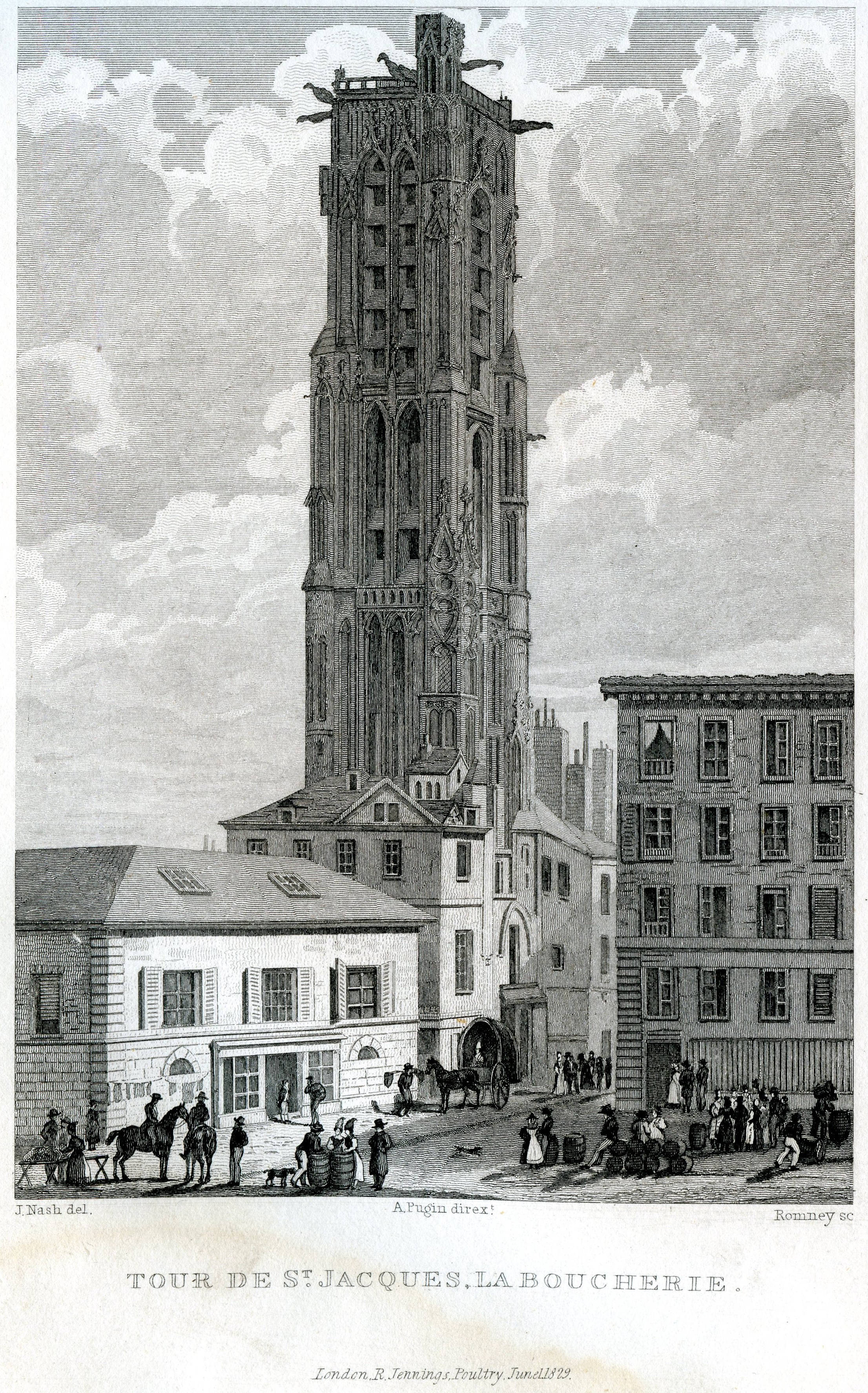
For example, the Tour St. Jacques is all that remains of a church demolished by the Revolutionaries in 1793. However, their zeal was somewhat tempered, as the church was sold so the stone could be re-used for building materials on the condition that the tower would be preserved. There appears to have been no restrictions put on the use of the tower. As the text of Paris and its Environs notes, “The tower, passing into the hands of private persons, has been converted into a patent shot manufactory.”

This sounds like a curious use, but one well suited to the tower’s height of about 50 metres. Lead shot consists of spheres of lead of varying sizes used in firearms, particularly shotguns. It can be made by pouring molten lead through a sieve into water, but in 1782 William Watts of Bristol, England, patented an improved method that put the sieve high above the ground. The molten lead was poured through a sieve and cooled as it fell; the surface tension of the liquid lead formed spheres which fell into water, where they cooled. The height of the Tour St. Jacques proved ideal for this purpose. Later the City of Paris purchased the tower and square.

I find this sort of detail fascinating. More images and stories from Paris and its Environs will find their way into subsequent blogs. However, I should like to close with a few words about this work, drawn from an excellent article, “Paris and its environs: Augustus Charles Pugin’s view of the city” by Andrea Quinlan from the British Art Journal.

The Paris-born Pugin (1762–1832) was a prolific artist who spent most of his life in England. But beginning in 1819, he made frequent trips to France with art students and his son, Augustus Welby Northmore Pugin, an architect whose reputation eventually overshadowed that of his father. The many watercolours the group painted formed the basis of subsequent engravings for this book.

The text was by L.T. Ventouillac. Born in Calais in 1798, Ventouillac came to England in 1816, and became a professor of French literature and language at the Royal College of London in 1830. Ventouillac had “published a number of books on French language and culture” before writing the text for these images.

Paris and its Environs was Pugin’s way of recovering from a financial trough after losing a lawsuit. The book was intended for a middle-class audience and was an early type of travel guide. Not everyone enjoyed such books. One contemporary writer grouped it in with other travel guides as “the damdest, lying, ill got up, money-getting clap-trap possible” while another praised it, noting “the name of Mr. Pugin was a guarantee for the excellence of the drawings…and the superintendence of Mr. Heath was an assurance that the pencil would be done justice to by the burin.”

Who cares if Pugin’s motives were mainly to make money? I have been paid for books and articles I write. Nearly 200 years later, I am grateful to him for capturing a Paris that has largely disappeared. The book preserves the city as it looked after the Revolution and before the changes instigated by Napoleon III and Haussmann, a view seldom seen these days.

Text by Norman Ball

Posted in Paris art, Paris history | Tagged , , , , , , , , , , , , , , , , , , , , , , | 11 Comments

Lutetia, viewed by a 19th-century historian

I have a weakness – no, a fondness – no, a passion for old maps of Paris. On a visit a year or so ago, I bought three old maps from an antiquarian bookseller. During our annual New Year’s tidy-up, I came across those maps again and realized I had never taken the time to study them closely.

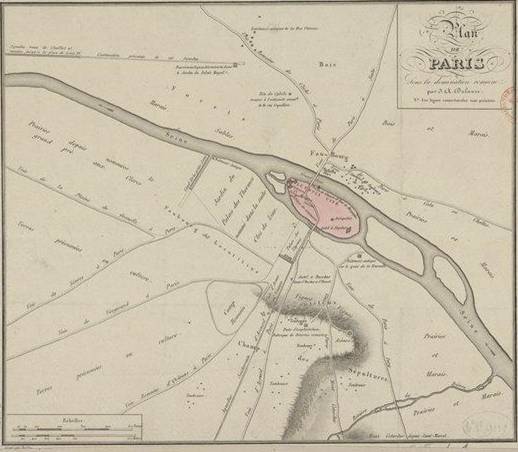
They had been published in Histoire physique, civile et morale de Paris depuis les premiers temps historiques jusqu’à nos jours, by Jacques Antoine Dulaure in about 1825. The maps were created by Jacques-Marie Hacq using information provided by Dulaure.

Dulaure map

This one, from the first volume in this multi-volume work, is called “Paris under Roman domination” and includes elements of the Roman city that had been discovered by archaeologists up to that point. Much more is known now, but Dulaure did his best with the available information and with some creative theorizing. So what you see here is not a map of Roman-era Paris, it is a map of what an early 19th-century historian knew and conjectured about Roman-era Paris. Which in some ways is even more interesting.

Note the number of islands in the middle of the river – five. Only the Ile de la Cité is identified (as Lutetia Cité); the others are left blank. If the Romans used these islands, they left no traces that had been found as of the 1820s. Other maps show different numbers and configurations of islands, but historians agree that there were once several in the Seine here. Only two remain. (The third-largest and the furthest upstream, once known as the Ile Louviers, is now part of the Right Bank.)

The areas on both left and right banks are labelled as “Faubourgs” (suburbs) and many tombs are marked  (tombs survive when traces of the living have been erased). To the east are marshes (marais) and plains (prairies), to the north west are forests, marshes and sandy areas (sables), and only the southwest part of the area is (Dulaure presumes) devoted to agriculture.

The map also shows roads leading out of the city in all directions, two dead-straight aqueducts (an overground one from Chaillot and an underground one from Arcueil), and the Bièvre River (with some small islands of its own), before it was channelled and redirected to empty into the Seine farther downstream.

Lutetia map

Lutetia Cité, handpainted a faint pink, contains a fortress, a prison (Prison de Glaucin et Tour de Marquefas* – Hacq renders this as Tour de Margnefas), an altar to Jupiter, a marketplace (Place du Commerce), a “cippe antique” (funerary monument), and something vaguely marked “Antiquités” roughly where Notre Dame Cathedral is today.

CippeAntique

Dulaure describes each of these elements and explains why he has placed them where he has, using evidence from older texts, archaeological discoveries, etymology, and oral traditions. For example, he says he knows that there was a prison on the island, because it is mentioned in the writings of Gregory of Tours in the 6th century. He placed it where the flower market is now because there were earlier churches here with names that indicated their proximity to a prison. As theories go, it’s not bad.

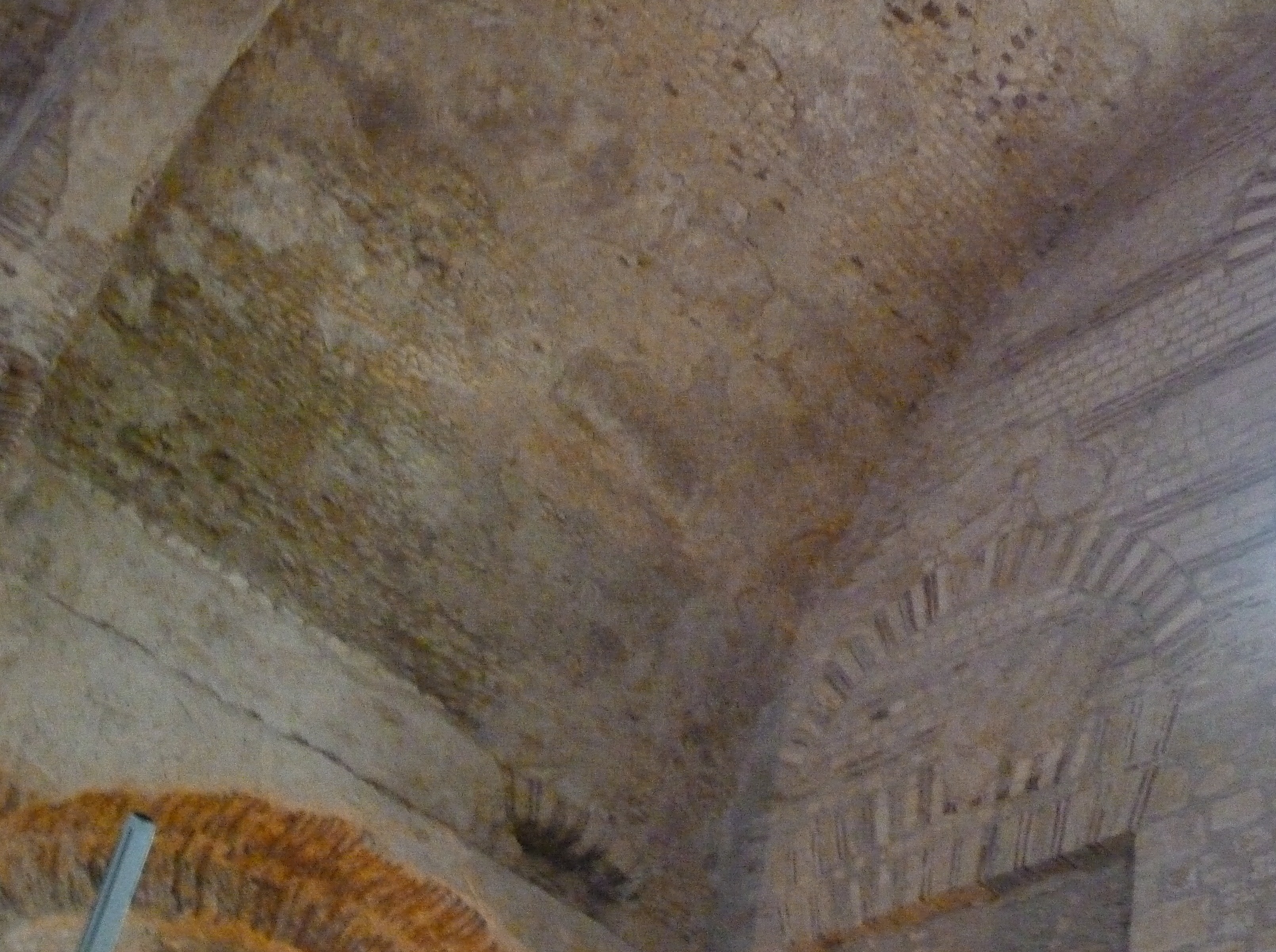
On the Left Bank is a huge “Palais des Thermes,” with spacious gardens, bordered to the west by a short canal. The size and orientation of the palace are approximate, but the Roman baths now incorporated into the Cluny Museum would have been part of this complex. (This not-very-good photo shows some of the Roman brickwork in the frigidarium at Cluny.)

ClunyDulaure adds the garden to the west (he notes that other historians do not mention a garden) with the explanation that Roman baths and major buildings were usually associated with gardens and that 6th-century accounts refer to a garden here. He notes that it was later called “Clos de Lias.” Clos means vineyard, and he traces the origin of Lias as a version of the French article Le plus a modified version of “Arx,” meaning palace or citadel.

The canal marked as “La Petite Seine” to the west of the gardens of the Palais des Thermes lies roughly where the rue Bonaparte is now. There was a stream emptying into the Seine at about this point (now buried), but it is not clear when it was turned into a canal. Some historians had suggested that it was built much later, connected to the moat of the fortified Abbaye St-Germain (the Abbey and its fortifications came long after the Romans had departed). Dulaure disagrees. He insists that the canal was useless as a defence against invaders, and notes the discovery in 1806 of some large foundation stones and gold medals dating from the 3rd century in this spot. He concludes it was an ancient construction, possibly built to enhance the Roman gardens.

On the Right Bank is the Place Tudella – spelled Tndella on the map (Hacq was clearly a bit sloppy with spelling). Dulaure says that Tudella was a common name in ancient France that designates a fortification. Another French antiquarian, however, writing in 1753, had suggested that the name comes from the Latin word for mallet (tudes), and that this was a place on which a game was played with mallets (the jeu de mail, which was rather like croquet). Not sure I can visualize the ancient Romans playing croquet, so I’d give Dulaure the benefit of the doubt on that one.

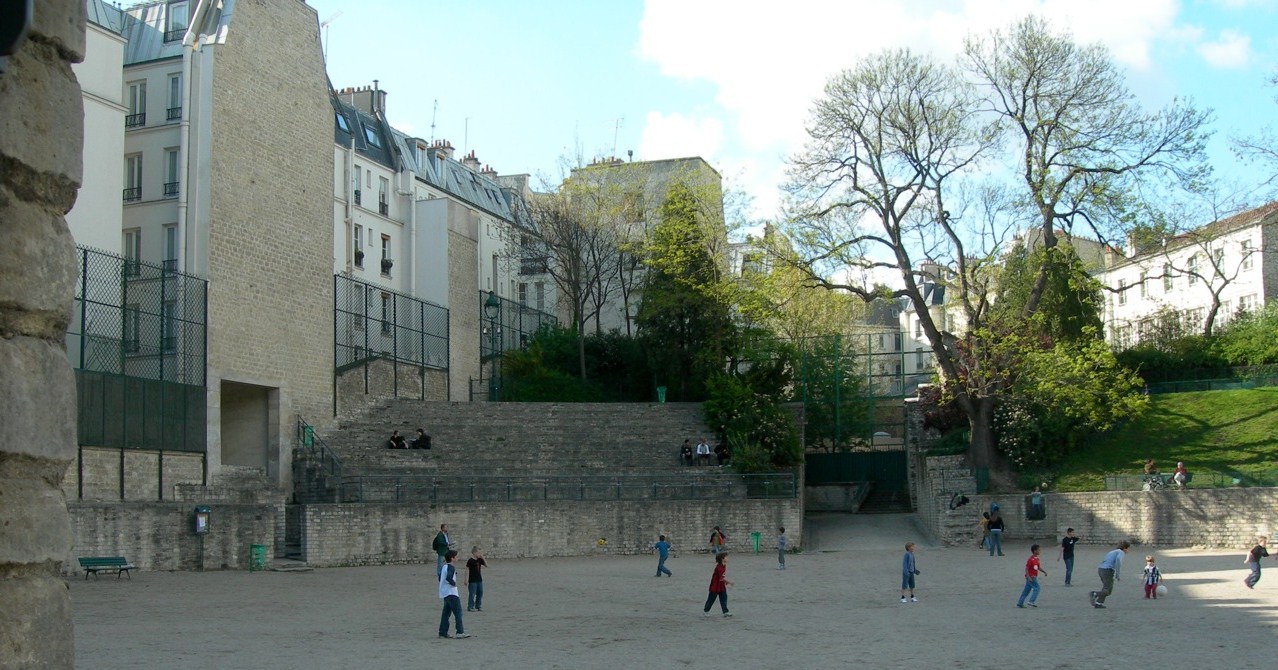
The Arena now known as the Arènes de Lutèce is shown on the map, but its location would have been mere conjecture in the 1820s. Apparently it had long been known that an arena had existed on the Left Bank, but its remains were not discovered until excavations for a tramway in the 1860s. On this map it appears on the side of a hill labelled “Mont Locutitius.” This is where Mont St-Genevieve is now. Today part of the arena has been excavated and is open to the skies.

Arena

Here and there Dulaure has noted a few archaeological discoveries, such as the “Tête de Cybèle trouvée à l’extremité orientale de la Rue Coquillière” (Head of Cybèle found at the eastern end of rue Coquillière). Cybèle was a mother goddess and a bronze head depicting her (she wears a castle on her head like a crown) was found in 1657 near the church of St-Eustache. The head, the authenticity and provenance of which have been questioned, is now in the collection of the Musée des monnaies, médailles et antiques of the Bibliothèque Nationale de France.

VivienneAnother site is marked as “Autel à Bacchus depuis S. Benoit et S. Bacchus.” The altar would have been dedicated to the Roman god of wine and festivity, but St Bacchus (no relation) was a 4th-century Christian martyr from Syria. A church built here called St-Benoit-le-Bétourné celebrated St Bacchus and his fellow martyr, St-Serge. (“Bétourné” refers to the fact that the church was the wrong way around – normally churches are oriented with the altar to the east, but this one had its altar to the west.)

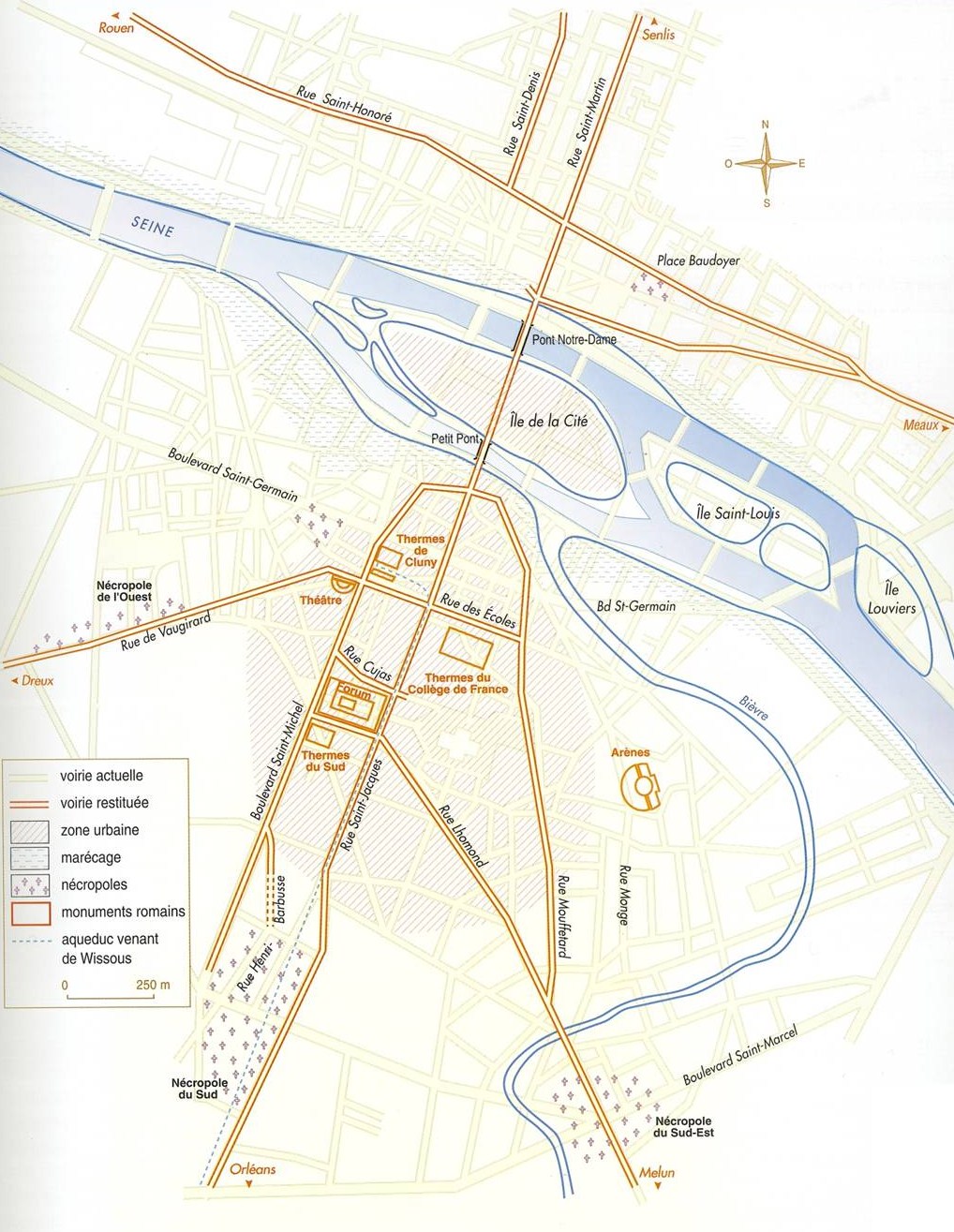
About 150 years after Dulaure wrote his book, a group of historians recreated what they knew about the city in Roman times, in a map created for an exhibit in the Carnavalet Museum in 1984 and republished in Atlas de Paris. There are differences from Dulaure’s map, but on the whole Dulaure holds up pretty well.

New map

In future blogs, we’ll look at the maps of 13th-century and 16th-century Paris from Dulaure’s book.

Text by Philippa Campsie; original photograph of the Arènes de Lutèce by Norman Ball; original photograph of the Cluny Museum by Philippa Campsie. Final map by Jean-Pierre Adam and Philippe Velay, from Atlas de Paris, Parigramme, 1999. The image of the map itself is the Gallica version, because mine is too large for my scanner. Other images are from the Google Books version of Dulaure.
For more information about Roman-era Paris, we highly recommend the website Paris, A Roman City.

* The Tour de Marquefas was later called the Tour-Roland and Victor Hugo uses that name in Notre Dame de Paris, 1831, published a few years after Dulaure’s history. Hugo’s book also refers to the Prison de Glaucin. It is possible that Hugo had a copy of Dulaure and referred to it in recreating medieval Paris.

Posted in Paris history, Paris maps | Tagged , , , , , , , , , , , , , , , , , , , , , , , , , , , , , , , , | 13 Comments

Hark the Herald

In casting about for a Christmassy theme for this week’s blog, I thought about angels. Angels have prominent roles in the Christmas story, and I had photographed lots of them in Paris, hadn’t I? Or had I?

Well, yes and no. There are winged creatures aplenty in Paris, but not all are angels. The golden figure on top of the Colonne de Juillet is the Spirit of Liberty. The Winged Victory of Samothrace in the Louvre is pre-Christian. The Pont Alexandre III is graced with winged horses. And the winged being in the statue that greets those entering the Petit Palais is the Gloria Victis – the spirit of fame carrying a dying soldier.*

P1030526 (2)

But angels, hm.

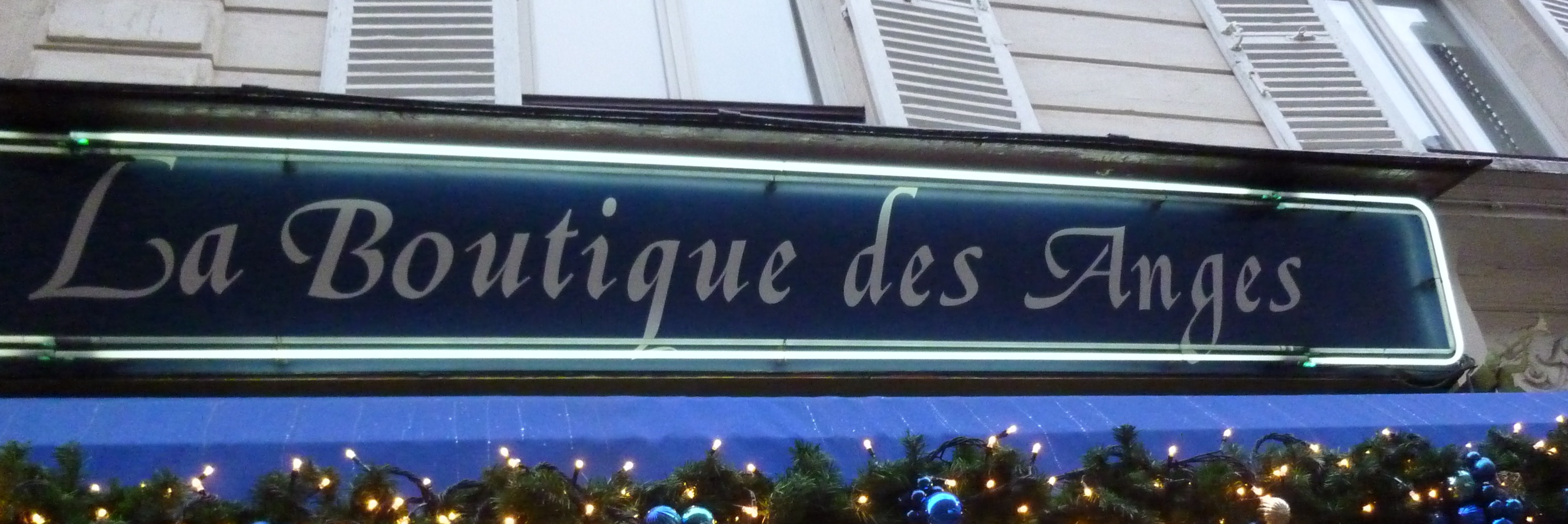
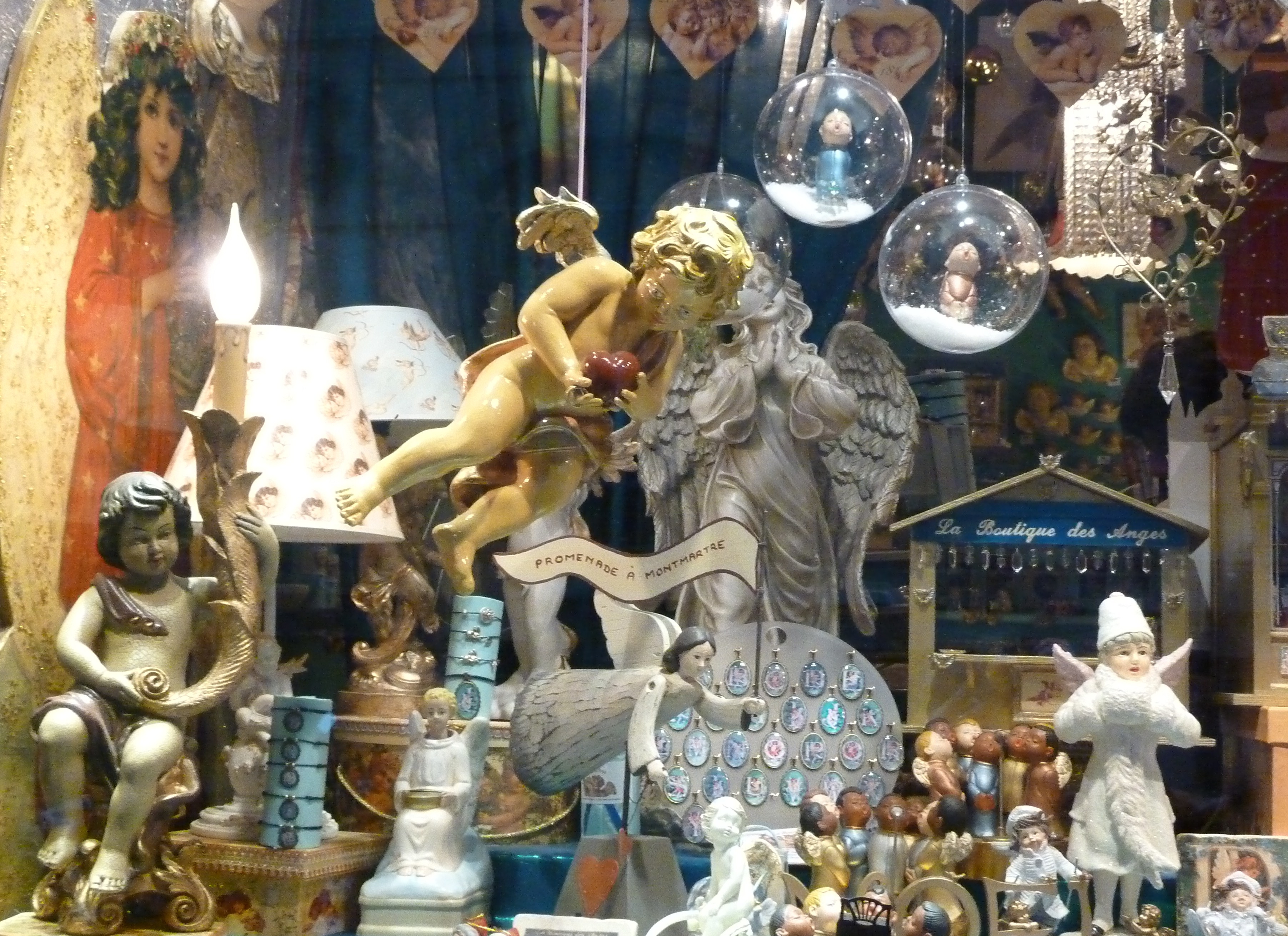
Then I remembered a funny little shop in Montmartre we had seen during a visit in December 2010.

P1020358 (2)

La Boutique des Anges sold angel-themed items, but pictures of its front window showed that most featured what I’d call putti – chubby babies with wings, found in both religious and secular art, and sometimes depicted in the role of Cupid (who was, after all, a Greek god).

P1020360 (2)

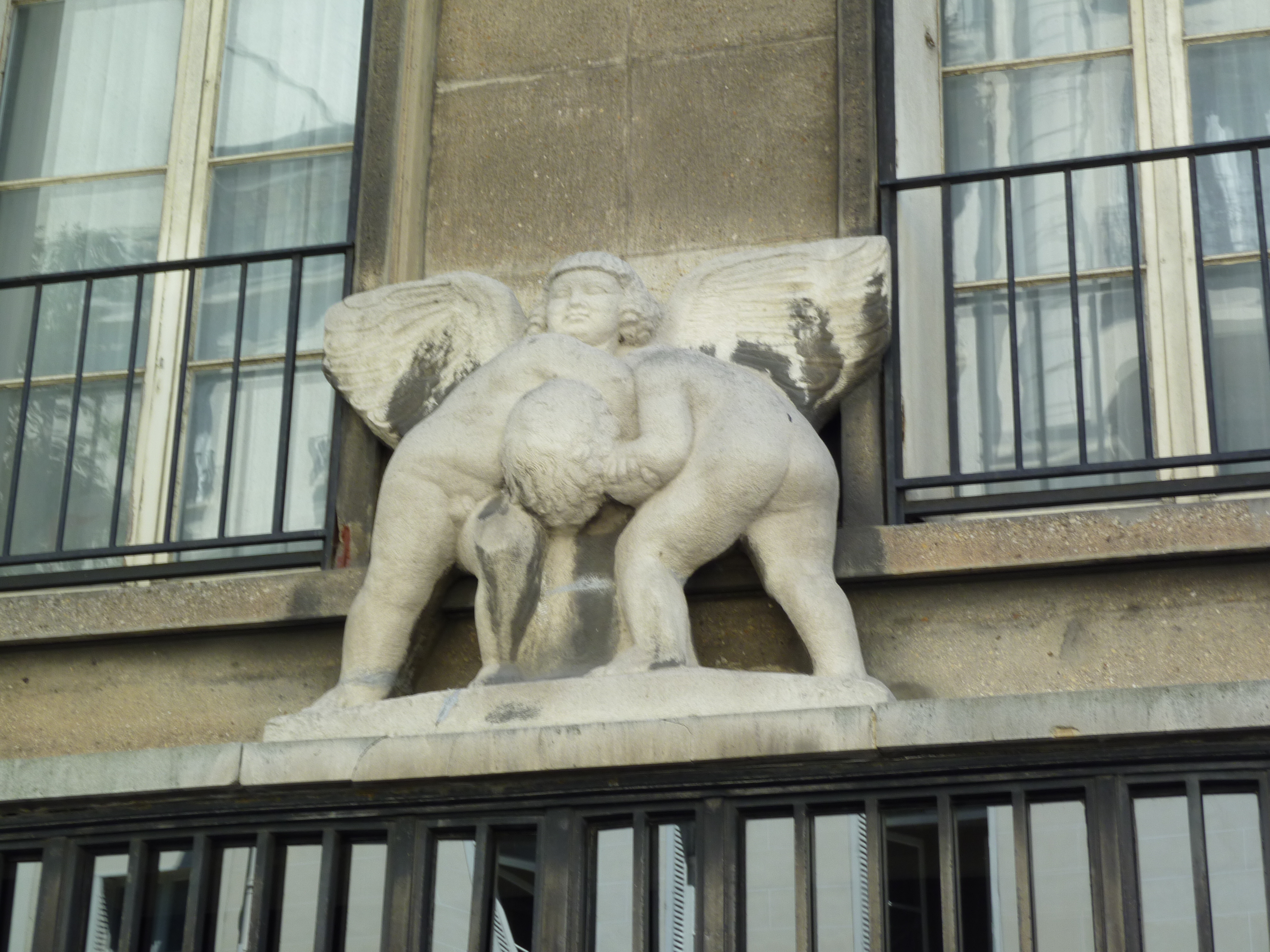
Putti are everywhere, I found as I looked through my photos. There is a stout pair in the 16th arrondissement on rue Raynouard that Norman calls the “sumo cherubs,” because they appear to be wrestling.

P1040130 (2)

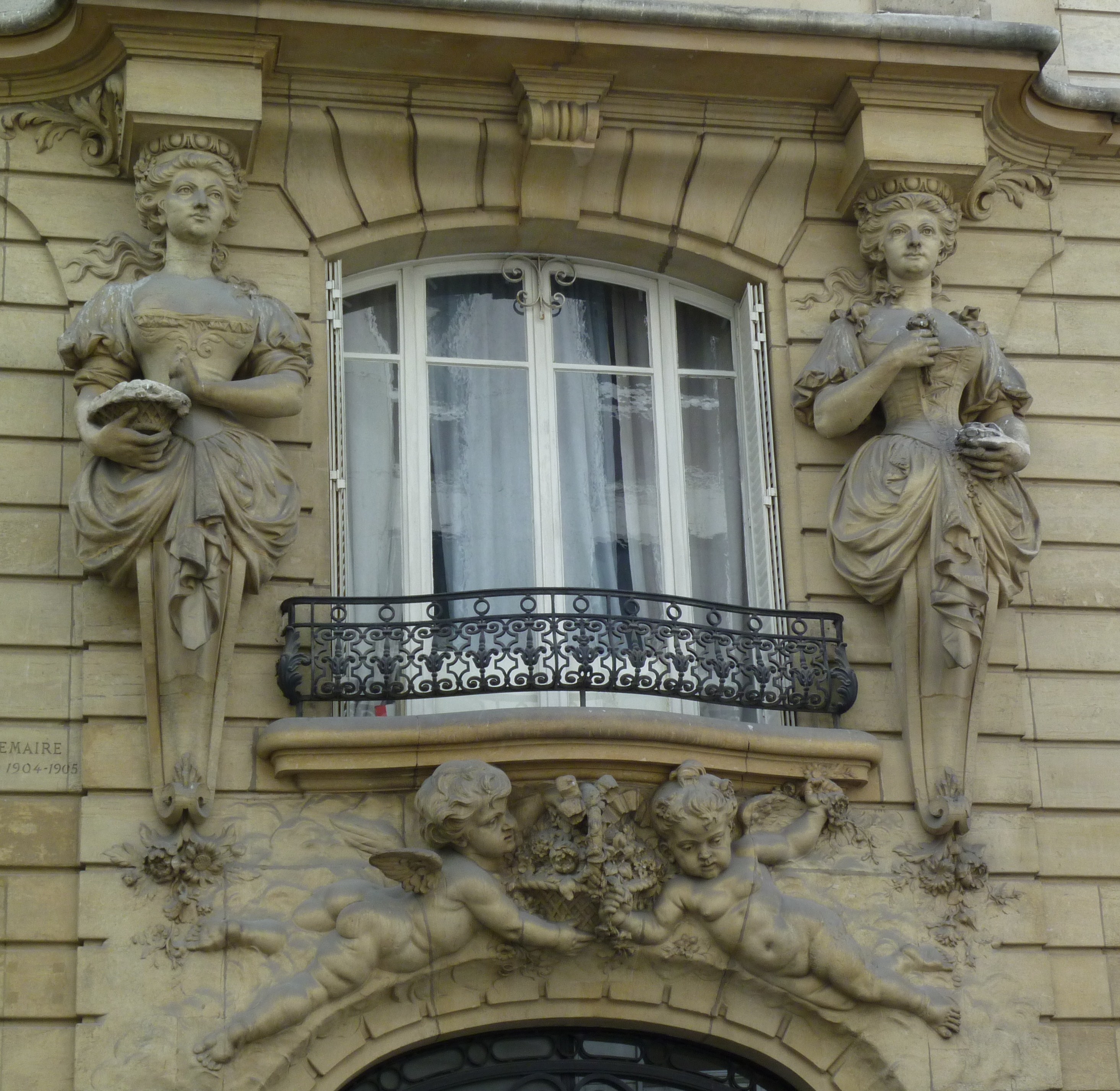
There are quite a few on facades – here are two in need of a good cleaning.

P1030470 (2)

Putti also appear on the front of the mairie of the 7th arrondissement.

P1070376 (2)

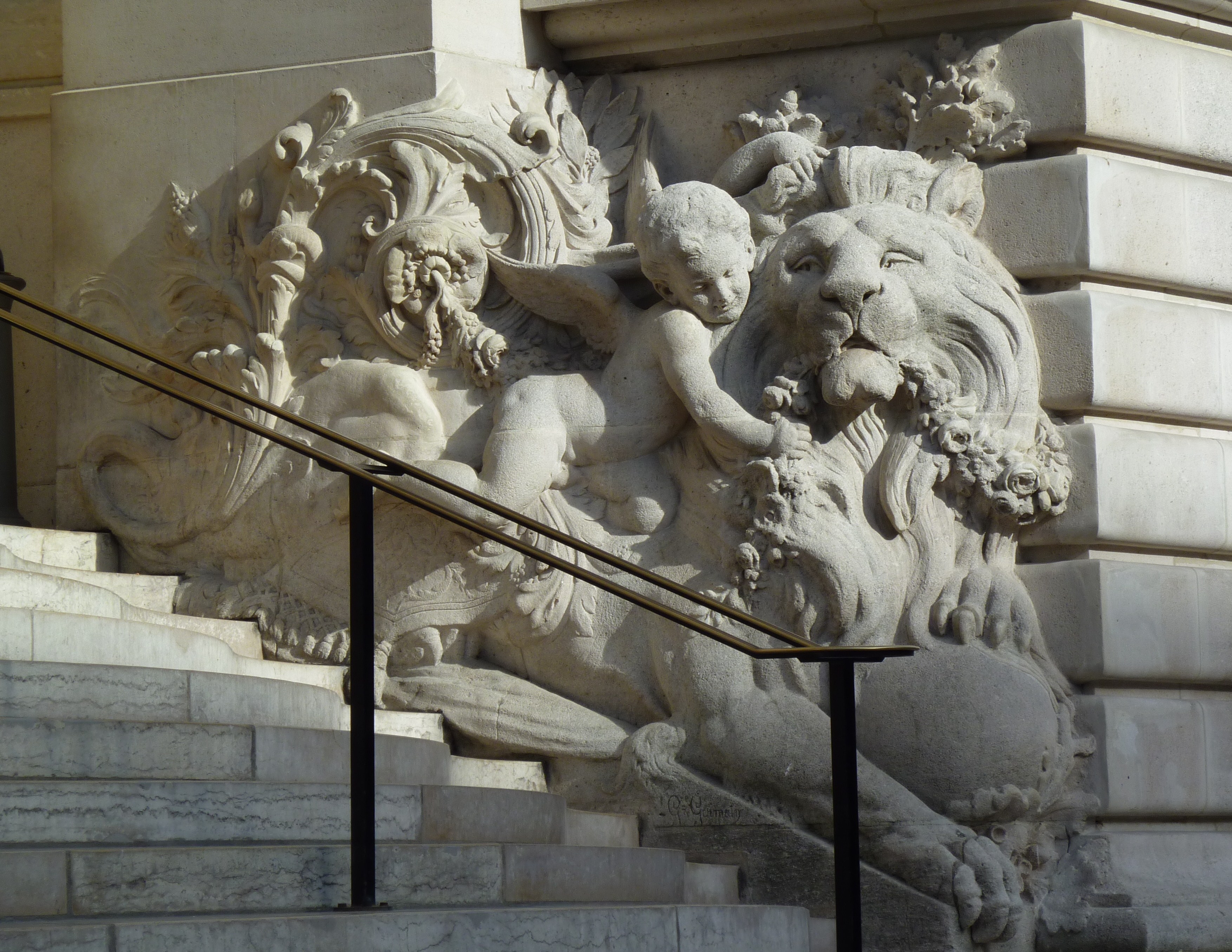
And a putto hugs an unimpressed-looking lion in front of the Palais de la Découverte. The lion appears to absent-mindedly chewing on the putto‘s garland of flowers.

P1030963 (2)

Putti are everywhere in Paris. This image from the Raphael Sistine Madonna, glued to the front of a Vespa, seems to sum up a certain Parisian attitude to art.

PB200861

But I wanted to find a herald angel, like Gabriel in paintings of the Annunciation.

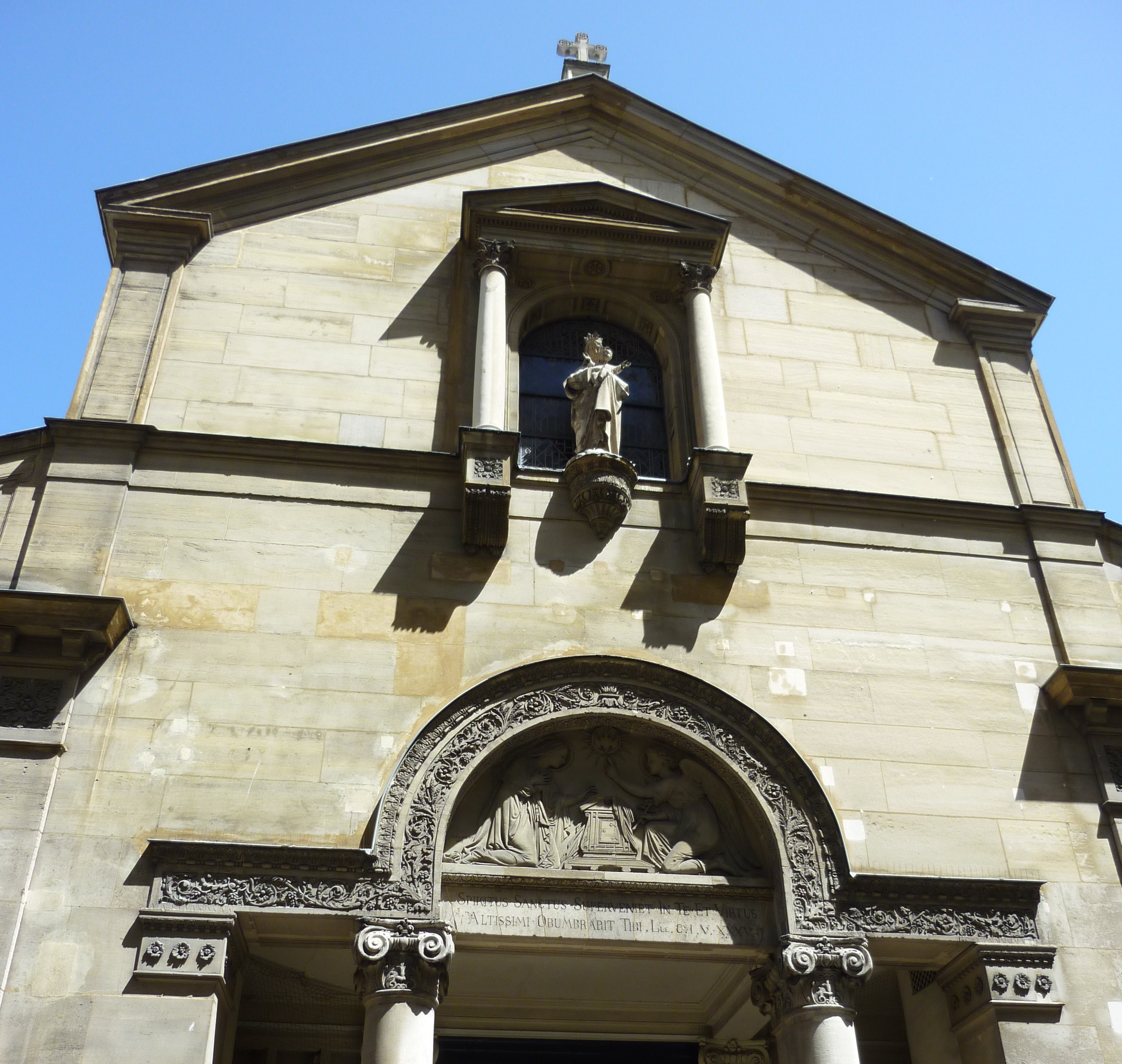
That made me think of the rue de l’Annonciation in Passy. Sure enough, just over the door to the church of Notre Dame de Grace de Passy on that street, there is an image of Gabriel making the announcement to Mary.

P1040104 (2)

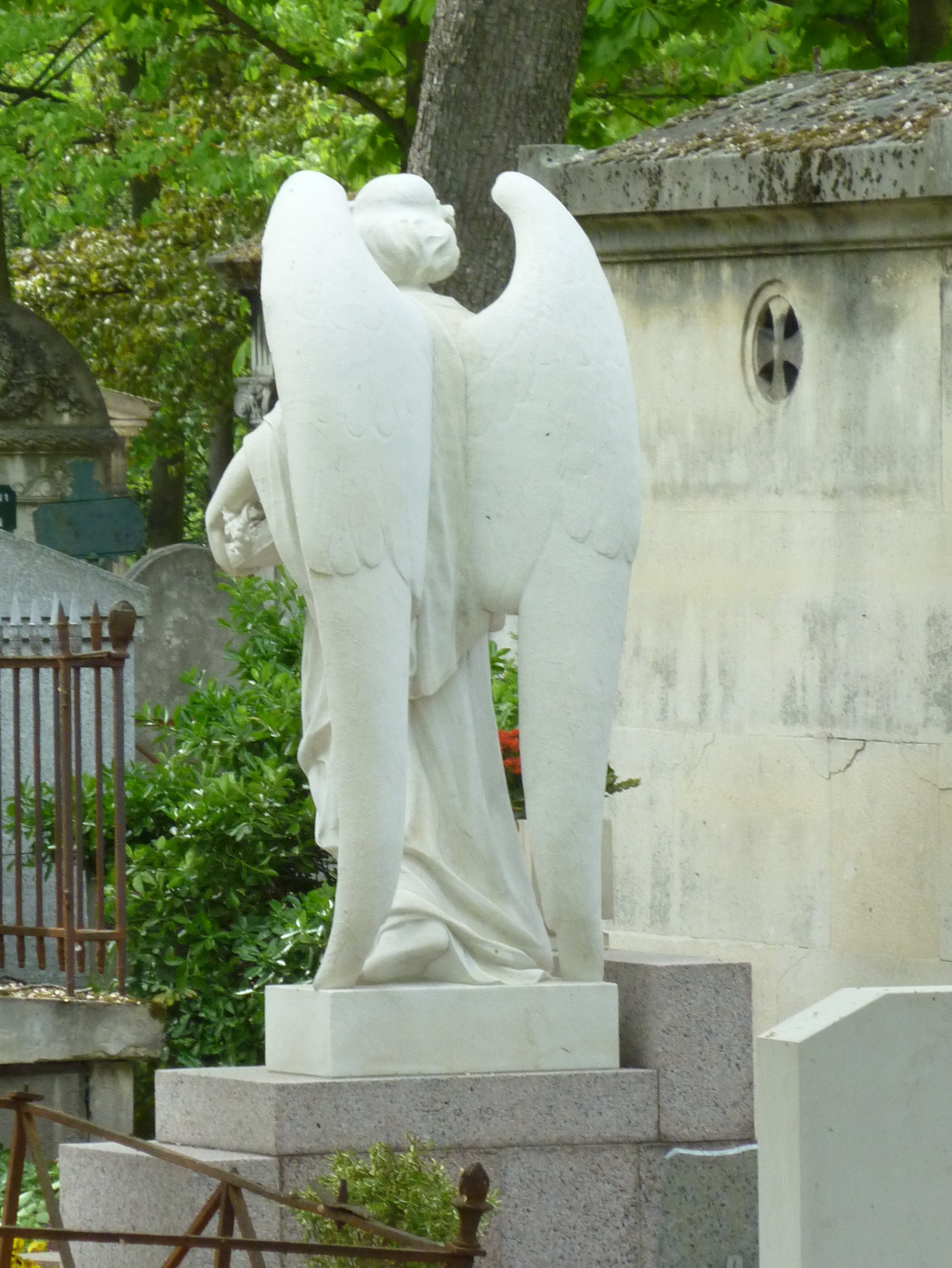
And I thought of the photographs of Pamela Williams and went looking in my images of Père Lachaise. I found another angel.

P1010147 (2)

The Val-de-Grâce, about which we have written before, is filled with angels. They are in the ceiling…

P1020503 (2)

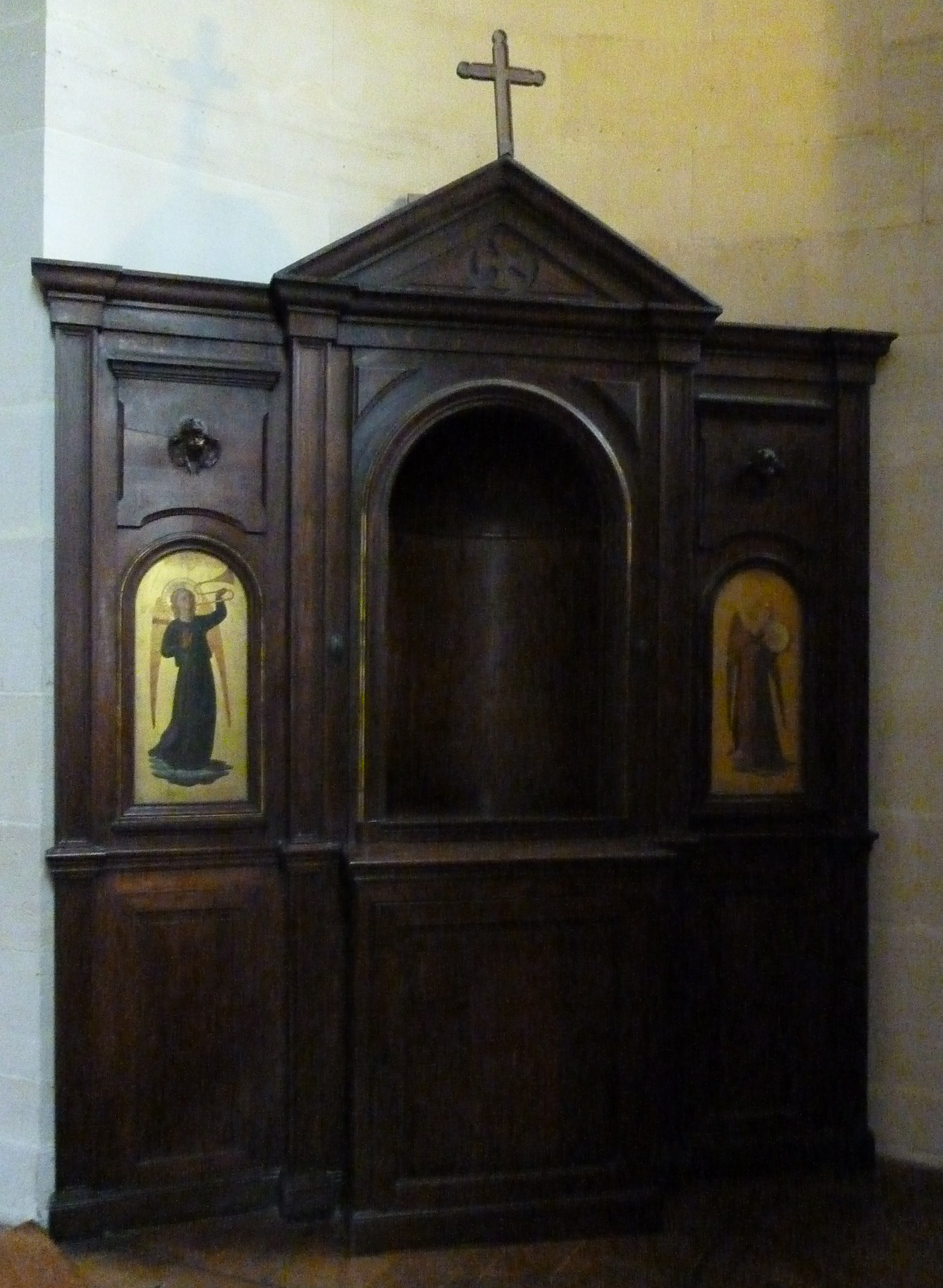
…playing musical instruments on the doors of confession boxes…

P1020527 (2)

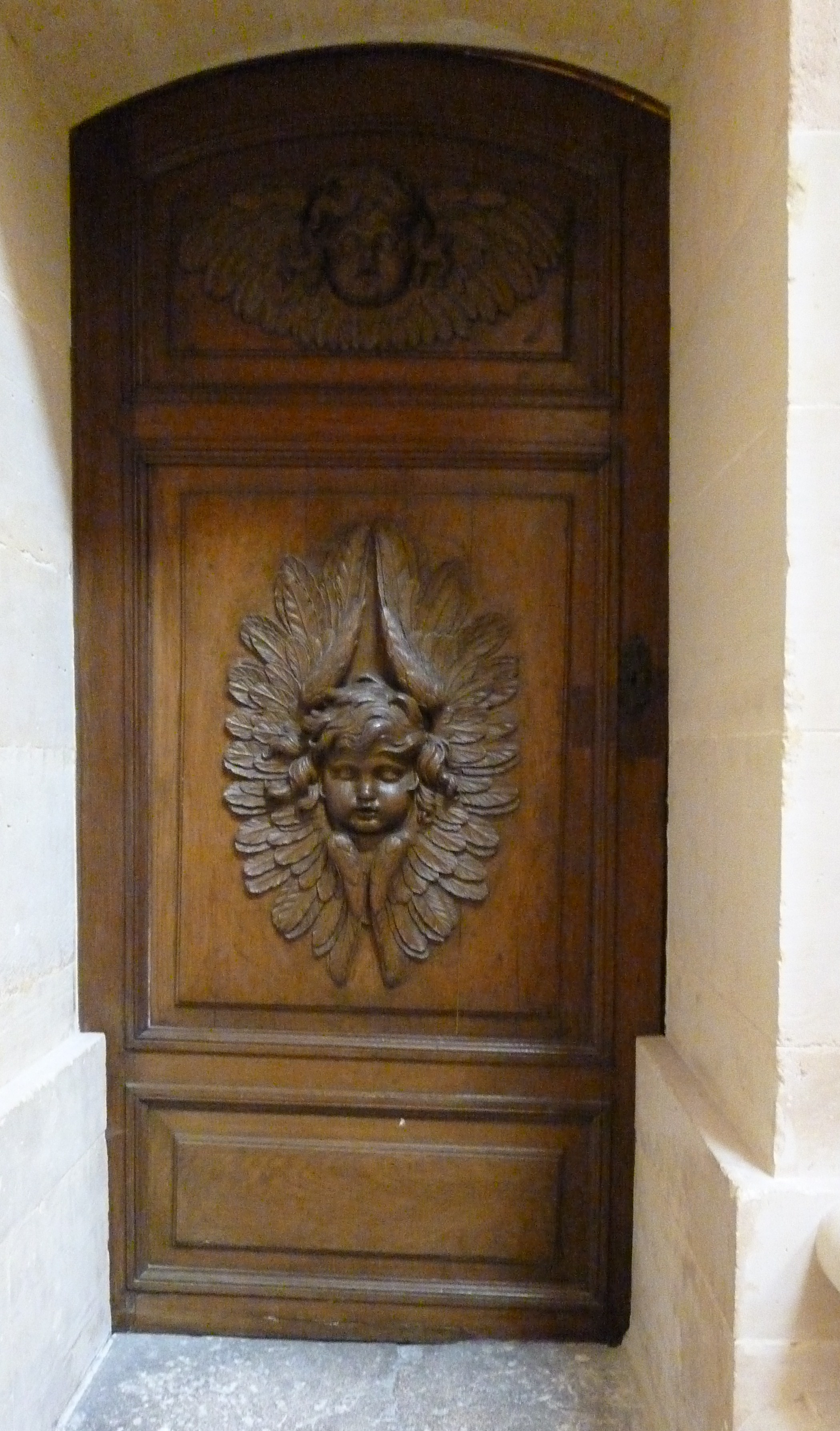
…and guarding secret doors to who knows what.

P1020513 (2)

The Cluny Museum has angels with trumpets.

P1020395 (2)

We even found one on the façade of the Hotel Roblin near the Place de la Madeleine.

P1030256 (2)

Angels grace the blackened fragment of the façade of the Tuileries that has come to rest behind the Hotel Carnavalet.

P1070540 (2)

But what pleased me particularly was to find one on the roofline of a building just off the Avenue de la Grande Armée, because the building had been designed by Gustave Rives, about whom I have written in more than one previous blog.

P1070489 (2)

I’d inventoried the buildings designed by Rives for a Wikipedia entry and photographed many of them in Paris, but it was only when I went through my photos that I spotted the angels, high up where few might see them, gazing over the rooftops.

P1070497 (2)

But these are just the stone angels that anyone can see. We have met many real angels in Paris. They are the people who help us find places to stay, who recommend places to visit, who help us in our our research quests, who invite us into their homes. Our Paris is full of living, breathing angels.

We are not in Paris this Christmas,but we think of the many angels who have helped us during previous visits there. We have been blessed many times over by angels who make our visits memorable.

Merry Christmas to all, and to all, a good visit to Paris, whenever you are there. May you also find Paris angels who contribute to your visit and help you understand more about this extraordinary city.

Text by Philippa Campsie. photographs by Philippa Campsie and Norman Ball.

* This bronze by Antonin Mercié was a memorial to those who lost their lives in the France-Prussian War.

Rosemary Flannery has filled a book with images of angels in Paris, which sounds like a delightful project and an interesting way to learn about the city’s history.


Posted in Paris architecture, Paris churches, Paris streets | Tagged , , , , , , , , , , , | 6 Comments

Remembering the Great Paris Flood of 1910

This blog is dedicated to my son Alex, his wife Dawn, and their two children who, on September 12, 2013, were evacuated from a home to which they can not return to escape the ravages of the Colorado flood.

With the Seine in Paris currently rising to uncomfortable levels, one sincerely hopes 2013-2014 will not see another catastrophic flood. The Seine has dealt Paris many a harsh blow, but perhaps none so serious as the Great Flood of January 1910.

626634c15189a3e642a6ad66dbd62739

There are countless images of the flood, but perhaps none speaks so eloquently of the disruption as the interior of the Gare d’Orsay. It looks like an over-the-top swimming pool. This photo, as with all of the images in this blog, is from the Paris en Images website, one of my favourite Paris places.

800669f34e8f03e2c66febdc09cd3e29

In addition to destruction, floods turn the familiar into the unfamiliar. Perhaps the most disconcerting element of this photo of the Gare d’Orsay, now a museum with a stunning collection of impressionist art, is the stairway descending into the water. It seems surreal, something that Jules Verne might have given to Captain Nemo, had the submarine Nautilus been big enough to have a swimming pool.

61102248534b6399d78af2009e0400f5

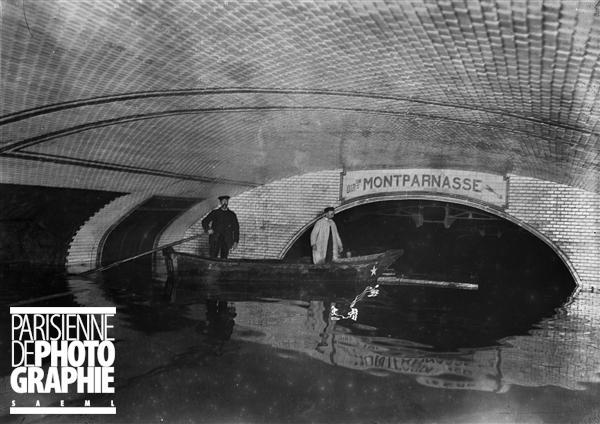
The Gare d’Orsay had been built as part of the preparations for the International Exposition of 1900. The world famous Paris Métro was also inaugurated to celebrate the Exposition of 1900. And it, too, succumbed to the flood.

c1aff83014d681d08ec9b488962dd589

Familiar stately streets such as the Boulevard St. Germain took on an eery unfamiliarity. How can one imagine this being one of the places to take a stroll, to shop, to see and be seen and above all to linger? Much of the city had been transformed.

7b83004d5844cab6e7447d43de04882a

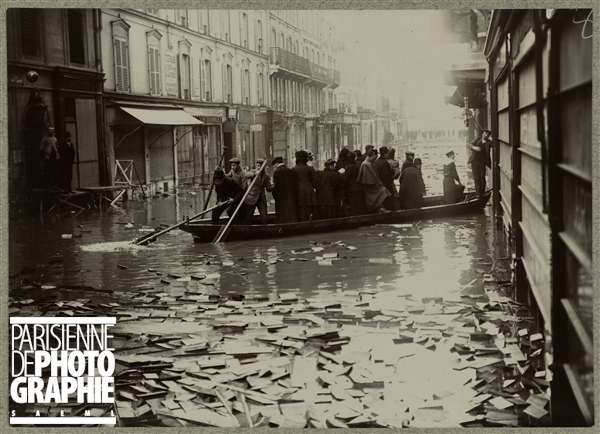
One hardly expects to find a boat in a Parisian doorway. But boats became one of the main ways to get about the flooded city.

592c268e68487fdf625730c3d256eec5

People still had to move about the flooded city. Here we see men poling a boat through an unidentified street in Paris. We are not sure about the bits of wood floating in the water. They seem too thin and in too many different sizes to be wooden pavers. If anyone reading this has a theory, let us know.

b762f4e3a46660276ef4b43a0d5bdf68

The rue de Montaigne is an area where one should be properly dressed. However, during a flood? Well, one must arrive at work looking as if one belonged there and the passengers seemed to have maintained a proper dress code.

3df41555856fd579db00ddd1a4987698

As one reads about the flood, one is appalled by the extent of the damage, loss, human suffering, and heartache. However, one also stands in admiration of those who carried on as best they could. The boats were helpful, but the greatest transit aid in flooded areas were the numerous elevated walkways supported on everything from trestles to wheelbarrows. Here we see an orderly progression on rue du Bac in the 7th.

1abd47de933be753ae61e0c0d67e95a9

As in any flood, inhabitants tried to hold back the water. The workmen putting sandbags in position on rue Gros in the 15th had a different dress code and tasks from those taking the boat on rue de Montaigne.

0bd35f19c52eddb2eeb558602f04966f

One could also try to block the path of the rising water by making higher walls and filling in window openings. As we see in the opening photos, these efforts at the Gare d’Orsay failed.

0a189a975b5741a515b95f1af806b696

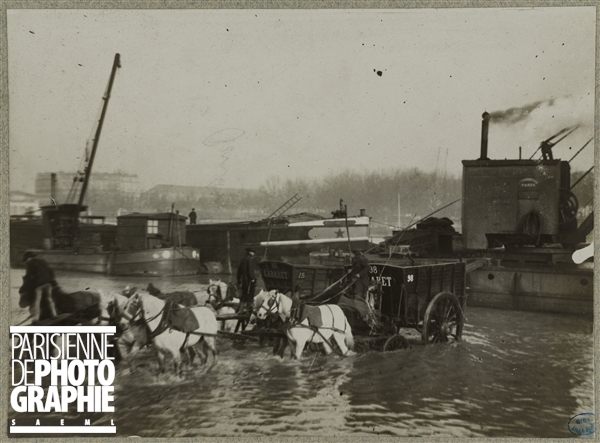
The city of Paris has a voracious appetite and flood or no flood, residents needed massive amounts of food every day. In this photo taken near the Austerlitz viaduct, the sacks are filled with flour, not sand.

7b84f94a87015de21a022cb392fc8fd7

In the image below, we might wonder if we are witnessing an exercise in extreme optimism. We are told the men in the boat are delivering meat to a butcher’s shop on rue Surcouf in the 7th. They seem to be heading towards the hairdresser (Coiffeur). But if one looks to the top left of the photo, there is the unmistakable symbol of a butcher who sells horsemeat.

ef20c0d1fdc11dbc51c4608e33225855

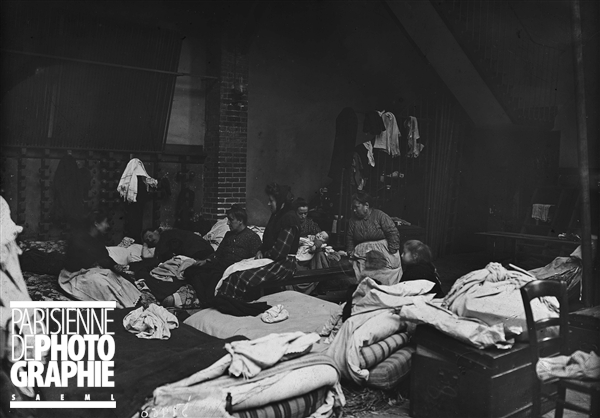
Many people’s homes were uninhabitable and those who could not find refuge with friends or elsewhere ended up in shelters. The refuge in the Lambert gymnasium was not elaborate, but it was shelter.

15820e91b7a4535d0ba580f79a73057c

Where possible, additional equipment would be brought in to help make the shelters more comfortable. The mattresses shown here were for flood victims who had sought shelter in the Saint Sulpice Seminary in the 7th.

16f0881a891034832da2d3e6ff4454f1

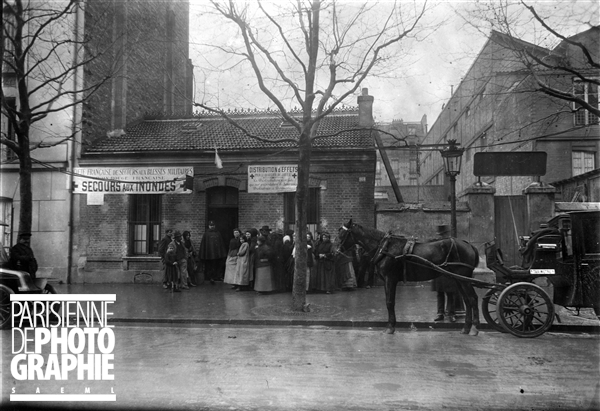
And as with so many disasters, the Red Cross played a prominent role. Here a Red Cross station advertises “Secours aux Inondés” (Aid or help for flooded-out residents).

2836e448293c874573cc0eb4ccda33aa

One wonders how long these Red Cross ladies’ uniforms would keep their crisp looks in the shelter at the hospital on rue Michel-Ange.

199035b8aefd37022ed0608d86e04b93

But even when the water receded, there was much to do. Portable pumping units spread through the flooded areas to pump out cellars. Workmen helping to restore the city posed as the water poured from a hose and ran down the street.

a711760d082b00b6e1edce4d9188cf9b

Some of the pumping equipment was on a much larger scale. Here are two massive steam engines driving huge water pumps. One can see the cascade of water disgorging from the pipe between the two engines and draining away down the street.

efee9a425f04f179a600b86db4964d8f

Many people lost most, or all, of their possessions, some irreplaceable. But for some things such as basic furnishings, the Red Cross was there to help as people returned home.

643190c825b9422aca89972d7c6550cc

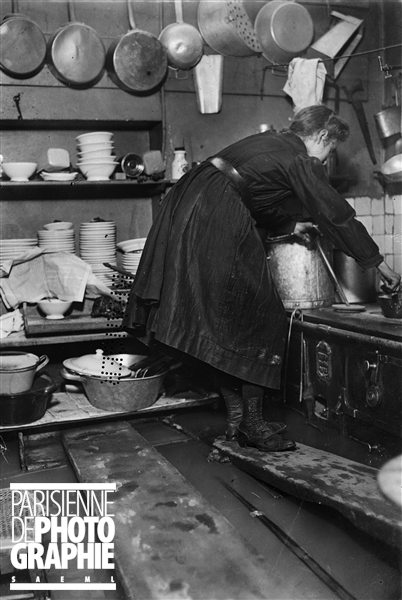
As the immediate ravages of the flood disappeared, there would be a seemingly endless number of memories. And some would talk of their heroes and the unforgettable incidents. Perhaps it would be of the kitchen in the café on rue Félicien David in the 16th that stayed open throughout the flood. Undoubtedly the cook would have long memories of that difficult time.

9175c0631993dfd1bef2b1009c718f59

And perhaps no drink from a corner café ever tasted better than those consumed during the flood while everyone was balanced precariously on the planks that kept them out of the water. Perhaps no zinc bar was a more welcome sight than this, also on rue Félicien David.

4c51301b4a14cb32e9d4b6be57080953

Perhaps others had a special place in their hearts for those who unloaded and delivered the coal so desperately needed for heating and cooking.

7e9dd249ee39f2fe13d985cf5237fb99

Others would remember that even after the water receded, there was still a lot of cleaning that had to be done, inside and out.

e0f0c7cfc843e5dbd03d89af13b2af3a

And undoubtedly many remembered the many solid workmen who just worked, then worked some more, and never found themselves enjoying the limelight. Identified only as a “Seine Flood Rescuer,” this photo represents the numerous workmen who helped bring Paris back from the brink.

b0b78d66005cb5a9103b755e431c355aText by Norman Ball, images from Paris en Images.

More images of the flood can be found on the Historic Cities website.

Posted in Paris history, Paris metro, Paris streets | Tagged , , , , , , , , , , , , , | 10 Comments

A little mystery solved

Curiosity, plus an interest in Paris, has led us to many surprising finds and some unusual encounters. A recent purchase at the Toronto International Antiquarian Book Fair is a case in point.

ModeFeminine001

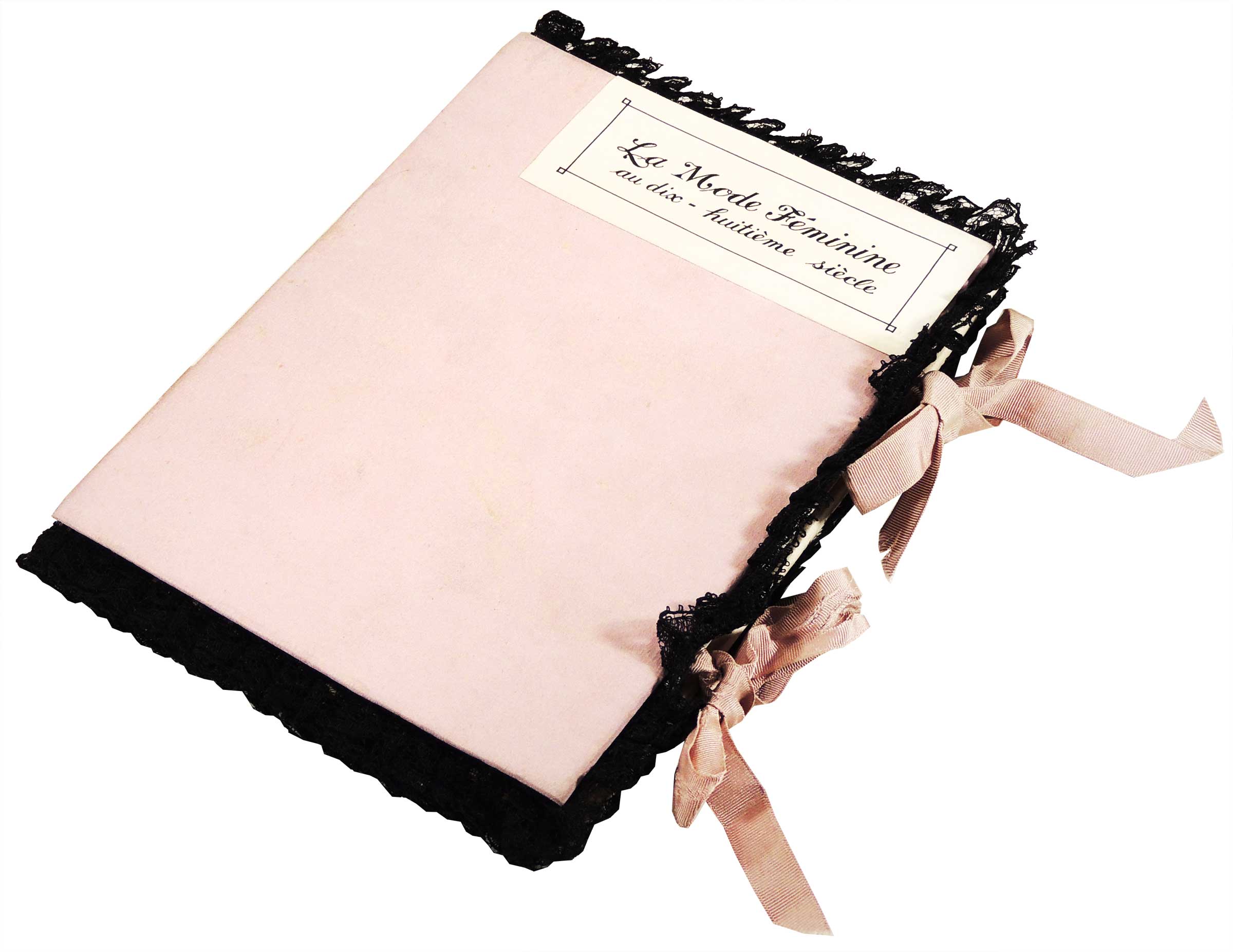
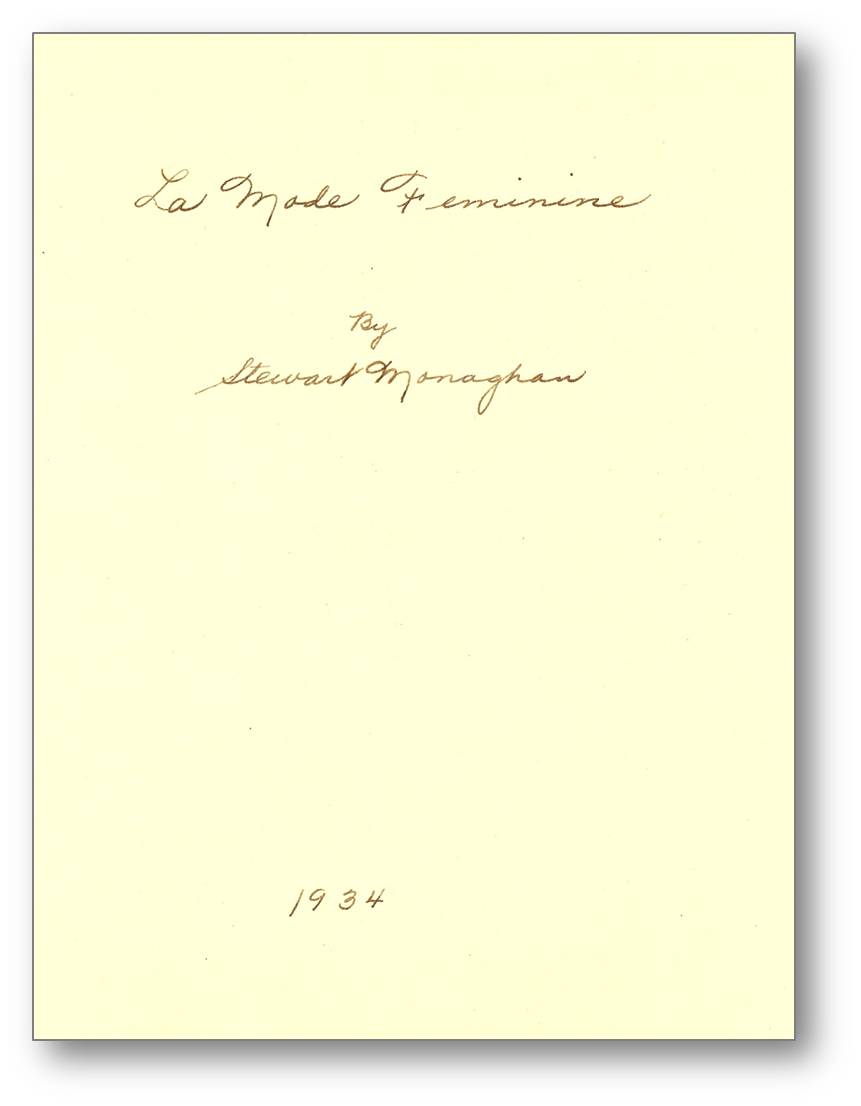
It was a one-of-a-kind object: a handmade, illustrated, unbound book dated 1934, titled La Mode Féminine, dedicated to the School Sisters of Notre Dame by one Stewart Monaghan. Here is the description from the vendor, the Kelmscott Bookshop of Baltimore:

This unique item is a compilation of sixteen handwritten poems written in the 18th century about women, each illustrated by a pretty hand-colored original drawing of a woman in the attire of the period…. A charming item, although Mr. Monaghan’s reasons for creating and dedicating it to the School Sisters is unknown.

The handmade book was held together by boards covered in mauve cloth, edged with black lace, with pink ribbon closings. Not the sort of thing that one would expect to be dedicated to an order of nuns by a man. There had to be a story there.

26970_2

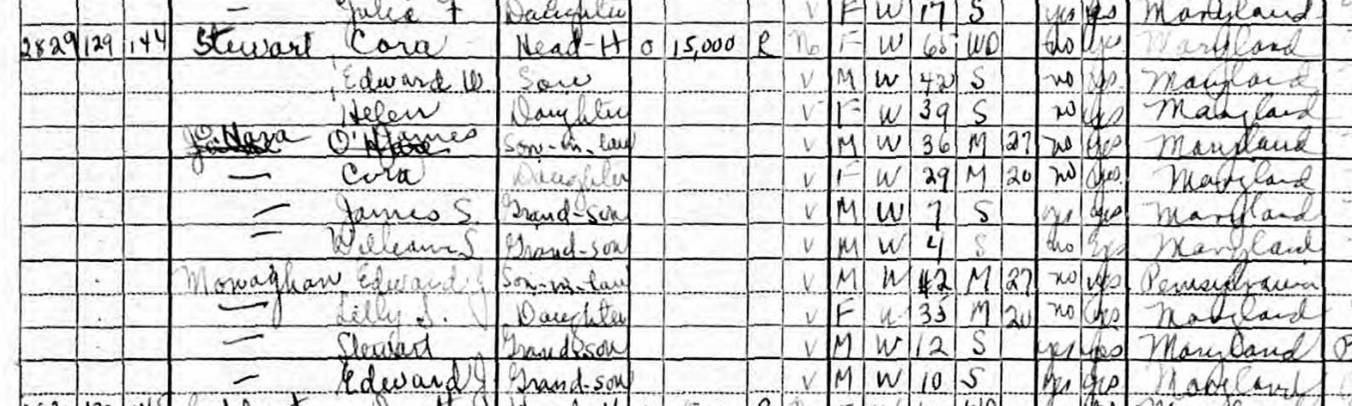
When I got home, I entered the name “Stewart Monaghan” into ancestry.com, the genealogical website. The name appeared in a record from the 1930 census of the United States. Stewart Monaghan was listed as the grandson of one Cora Stewart of Baltimore, living on Guilford Street.

Census1930

That made sense: the bookshop was in Baltimore, and the book itself was preserved in a cardboard box labelled Hutzler Brothers Co., a department store in Baltimore that was a fixture from 1858 to its closure in 1990.

The Stewart Monaghan in the 1930 census was about 12, so he would have been about 16 or so in 1934, when the book was created.

ModeFeminine003

I Googled the head of the family, Cora Stewart, on Guilford Street in Baltimore. Her name appeared in a number of articles in the Baltimore Sun written by the columnist Jacques Kelly, who was clearly a descendant of Cora’s. I sent him an e-mail.

Bingo! Jacques Kelly responded within a few hours and explained why Stewart Monaghan had created a book dedicated to an order of Catholic teaching nuns:

Let me clear up the mystery of Stewart Monaghan. Her full name, as christened, was Margery (it sometimes appeared as Marjorie) Stewart Monaghan, my mother. She hated Margery or Marjorie and NEVER used it. Stewart was her mother’s maiden name. She was an adored child and an adored adult. Her married name was Kelly and as “Stew” Kelly she was known by the cardinal-archbishop, governor and mayor.

She was born Sept. 23, 1917, and spent 16 years, first grade through college graduation in 1939, with the School Sisters of Notre Dame in Baltimore, now called Notre Dame of Maryland University. … How such a document escaped her clutches is a miracle as she saved everything, down to homework assignments of all her six children.

There is a lesson in there about the trustworthiness of census results. And about gender roles. It is hard to imagine a young man in the 1930s creating such a book and dedicating it to a group of nuns; but quite easy to imagine a teenaged girl doing the same thing.

ModeFeminine002

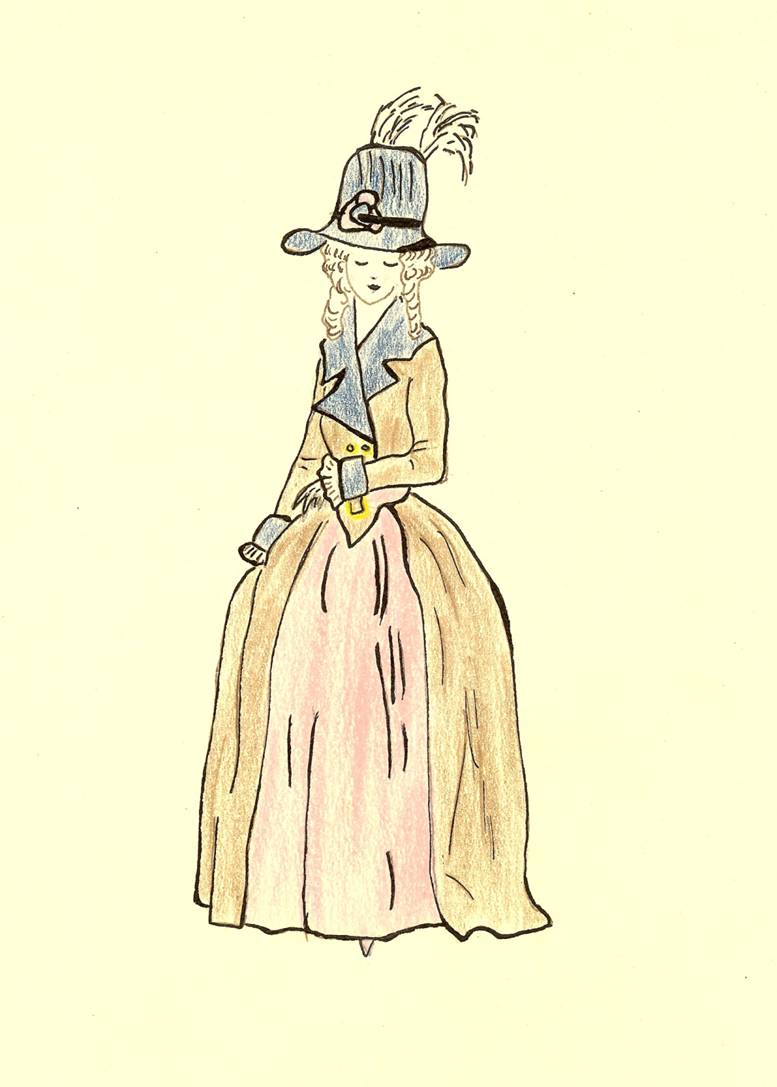
My next question was about the inspiration for the book. The fashion plates were stylish, and it seemed improbable that a 17-year-old girl would have the knowledge and artistic gifts to create such drawings from scratch.

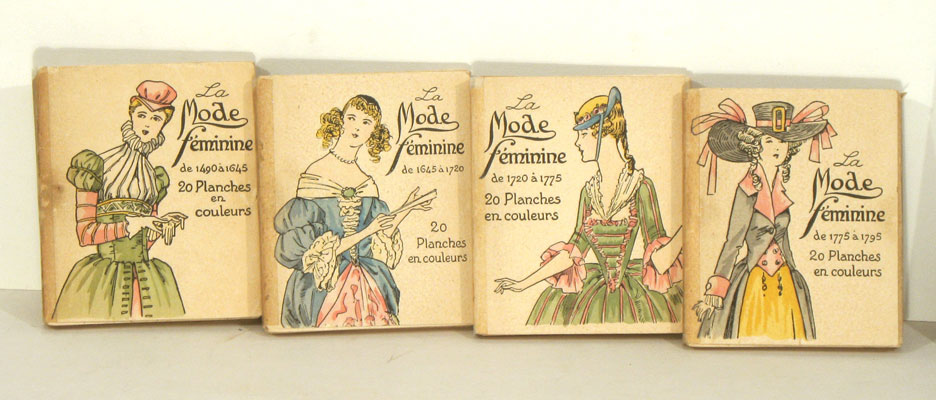
In fact, they were copies or tracings. La Mode Féminine was a series of historic fashion plates, printed in Paris using the labour-intensive pochoir process (also favoured by George Barbier), and published in 1929. The creator was Henri Rouit, art director of the fashionable revue Art-Goût-Beauté.* Sets of his little books are still available on eBay and used-book websites; indeed, the complete set was sold at auction on November 12, 2013 (the starting price was 400 Euros). I, ahem, did not bid.

48720

I wonder how Stewart came across the French fashion plates. They had been published only five years before she created her own book; in those days that was quite a rapid transfer from France to the United States. Did her family own a set? Did the convent library contain images of women in fetching hats and décolleté gowns? Did she see only the 18th-century plates, or did she have access to the full set (which ranges from the 15th to the 20th century) and choose these images specifically? I will never know.

ModeFeminine005

The poetry ranges from courtly poems to romantic ballads to lover’s complaints. It is interesting to imagine this convent-schooled young woman choosing these 18th-century lyrics to go with her French fashion plates. The first one is an excerpt from The School for Scandal by Richard Sheridan. The one shown below, by Oliver Goldsmith, has an unexpected ending. I’m beginning to think that the School Sisters of Notre Dame were not your average teaching nuns.

ModeFeminine007

Thanks to Jacques Kelly, I know how the story turns out. Stewart went on to university, graduating with a master’s degree, became a social worker, and in 1949, married newspaper writer Joseph B. Kelly and had six children: four girls, two boys. She lived all her life in the house on Guilford Street in which she grew up. She sounds somewhat larger than life and full of energy and interests. In a 2009 column, Kelly wrote:

She was made to order for Baltimore because of her lack of pretense and her love of people, whom she cultivated by the hundreds. She was a great worker of the telephone – her calling hour began about 9:30 at night and was accompanied by clouds of Lucky Strike cigarette smoke. Using a clipboard, she was a letter and note writer and could say much in few words. She wrote quickly and kept the impressions coming. Alongside her telephone-tobacco chair was a pile of murder mysteries, many from the Pratt Library.

She sounds like someone I would have enjoyed meeting. She died in 1993, aged 75, never having visited France.

ModeFeminine006

Chances are, she forgot all about the little book she made for her teachers at the convent. It probably sat in a drawer or bookcase until someone did a clear-out and sent it, probably with other books, to the Kelmscott Bookshop, whose owners brought it to Toronto. Now it is part of my library, complete with provenance, “unknown” no more.

ModeFeminine010

Text by Philippa Campsie, illustrations by M. Stewart Monaghan after Henri Rouit.

*The journal had several names throughout its life. First (1920-21), it was called Les Succès d’Art. Goût. Bon Ton. Briefly, it was Art. Goût. Bon Ton. Finally, from 1921 to 1930, it was called Art. Goût. Beauté. Throughout these changes, the initials (AGB) matched those of the publisher – who was actually a silk merchant: Albert Godde, Bedin and Company. For more information on this publication, I recommend an article by Patricia Morris in the California State Library Foundation Bulletin.  Otherwise, not much is known about Henri Rouit. I may have to investigate.
Posted in Paris art | Tagged , , , , , , , , , , , , , , | 11 Comments

An artist finds life among the tombs

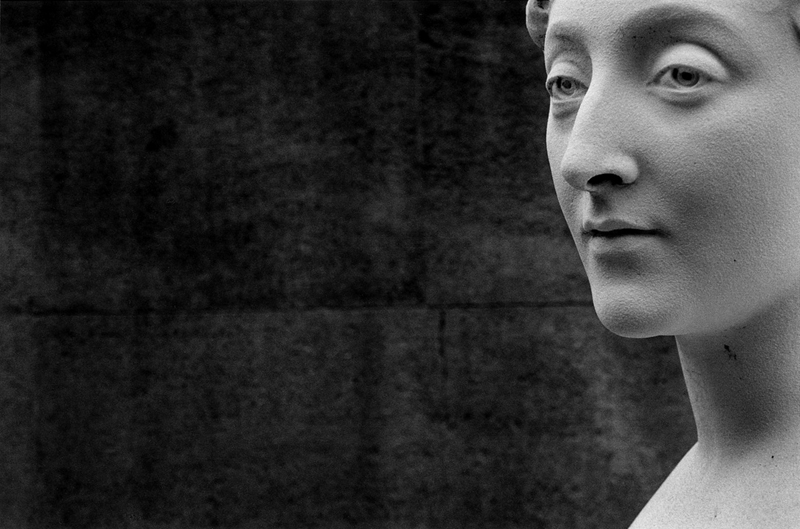
When I look at Pamela Williams’s photographs of sculptures, I feel I am seeing real people.

Glance

This photo, which she calls “Glance,” was taken in 2010 in Passy Cemetery. It is so realistic, one almost does a double-take.

The once-lustrous marble has weathered so that it looks like skin with pores. Over the years, dust and pollution have added highlights and emphasis to parts of the face such as the nose and lips. Alas, since this photo was taken, the statue has been cleaned. The last time Pamela saw it, some of the magic had departed with the dirt.

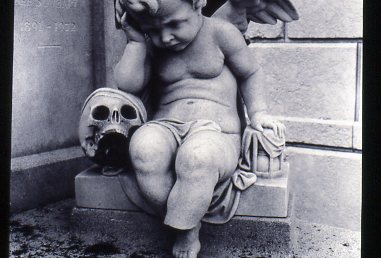
The Toronto-based photographer has spent the last few years capturing the poses, expressions, and emotions of sculptures in cemeteries in Paris, Rome, Milan, Vienna, Prague, Budapest, Havana, and Buenos Aires.

Why cemetery sculpture? Years ago, a friend gave Pamela a copy of the book Permanent Parisians: An Illustrated Guide to the Cemeteries of Paris.* Pamela, who had studied fine arts at York University in Toronto, suddenly saw sculpture in a new light. Instead of being captured inside a museum under controlled light and climate, the works of art were outdoors, exposed to weather and pollution. They changed over time.

She had already been drawn to realistic sculpture. As she explains, “I am able to photograph the work from angles so that I can make it appear human.” She photographs using natural light, without reflectors or flashes and uses traditional film to create portraits of people who just happen to be in stone or bronze, rather than flesh.

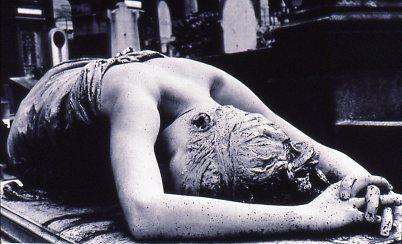
repose2

The weathered bronze she calls “Repose” is in Montmartre Cemetery and dates from about 1880. The elongated figure was hard to photograph. It was hard to find the right angle, and Pamela had to wait some time for the right light to “make it appear human.”

“Repose” graces a family tomb and is intended to be decorative rather than a portrait of either the deceased or the bereaved. It might signify beauty, grief, or the grace of a dancer at rest. Or all three.

When Pamela returned years later to see how time had altered it, the area was closed off so that the authorities could spray for weeds. Such are the hazards of pursuing outdoor sculpture.

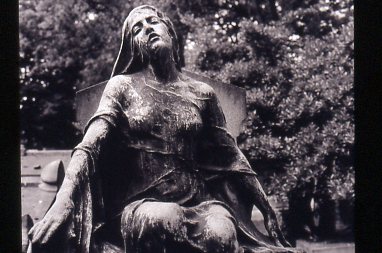
lament

“Lament” is a poignant bronze sculpture, also in Montmartre Cemetery. It expresses the grief of a mother who in 1910 lost her 20-year-old son, Robert Didsbury. Exposed to the elements, the bronze has oxidized to a variegated green and the white splotches and tracks from water add to the dramatic sense of suffering and loss. The sculptor was Robert’s mother. Her anguish is real and time has only added to it.

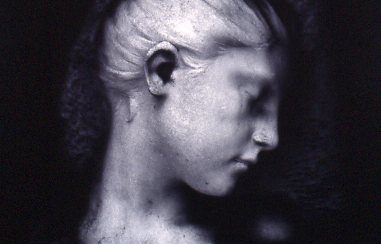
cameo

With digital cameras, we see an image immediately. Traditional film photographers are often surprised when they develop the film and print their contact sheets. Pamela found this sculpture in a partially protected alcove in Père Lachaise; it ends below the shoulder and at first seemed rather ordinary. It was only when she took a closer look at the print that she found it increasingly interesting. She calls it “Cameo.”

Pamela Williams’s photos have appeared in many publications. In 1998 McClelland and Stewart reissued The Stone Angel by the late Canadian writer Margaret Laurence, first published in 1964. In search of a suitable cover illustration, the art department contacted Pamela and asked her to bring in all of her angel photos. None were used. The reason? Editorial insisted that an angel would be far too literal. In the end, the cover featured “Cameo.”

In a short essay in a collection of Pamela’s photographs called Death Divine: Photographs of Cemetery Sculpture from Paris, Milan, Rome, Randall Robertson writes, “Sensational monuments from the late nineteenth century fill Parisian cemeteries. The dead may be invisible, but their memorials definitely are not. For those with money, memorial sculpture was the most accepted, even the most expected, way to commemorate the family—to proclaim the private in a public cultural space…. Wealthy families hired the best sculptors…[and] in virtuosic depictions of hair and skin, these artists created faces and figures so lifelike that one comes to believe in their existence.”

cherub

Although many funerary sculptures were unique pieces, there were exceptions. Some forms were used more than once by the sculptor and some were copied. The image that Pamela calls “Cherub with Broken Foot” is a marble sculpture in Père Lachaise. She has seen copies in other cemeteries, including one in bronze.

A few years ago, Pamela was contacted by a widower who wanted photos of a particularly beautiful angel. To honour his late wife, he wanted to commission a sculptor to create a copy. Pamela sold him some of her photographs. She later found out that the widower had hired a sculptor to go to the European cemetery to study the original and make a copy one and a half times the size of the original sculpture. Pamela said the original sculpture was so popular in its day that she could have directed the widower and the sculptor to good copies in American cemeteries.

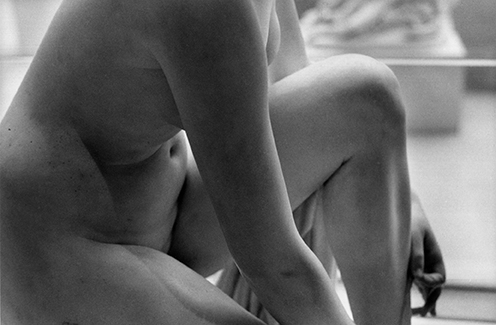
Pamela returns to Paris from time to time to continue her photography of sculpture. Recently she has taken small groups of private students. Yes, they visit cemeteries, but also galleries and museums. And she has rediscovered the joys of photographing sculptures inside museums and galleries. She calls the image below simply “Paris Statue.”

Williams_Pamela_ParisStatue

I have seen other other shots of the same statue, but in hers I could see what she had told me earlier about searching for the angle and the light to make it look human. The one shown here is bathed in light from a skylight and captured by an artist so that it looks like a real person.

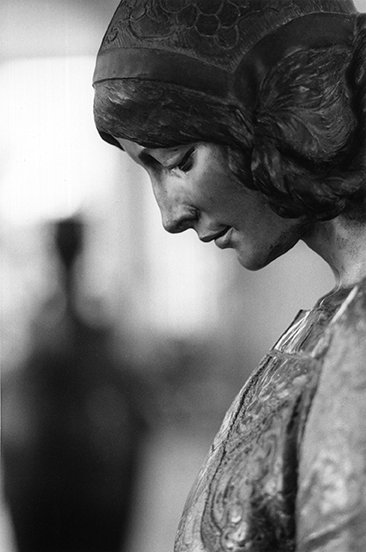
One might say the same about the image below, a painted wooden sculpture in the Petit Palais.

PAWI_VerticalWoman_72DPI

We own one of Pamela’s prints, called “Herald.” It shows a stone angel from a Vienna cemetery, taken at an angle that emphasizes the powerful wings and the back of the angel’s head. Although it is not from Paris, it makes us think of our strolls in Paris’s cemeteries and the amazing sculptures that continue to inspire visitors and artists like Pamela Williams.

Text by Norman Ball, photographs by Pamela Williams. Many thanks to Pamela Williams for her artistry, patience, and co-operation.

To see more photos click here. For more information on Pamela’s three books (Death Divine, Last Kiss, and In the Midst of Angels), click here.

*Judi Culbertson, Tom Randall, Permanent Parisians: An Illustrated Guide to the Cemeteries of Paris, Walker and Company, 1996.

For another view of Paris cemeteries, go to “Stained Glass Less Seen.”

Posted in Paris art, Paris cemeteries | Tagged , , , , , , , , , , | 7 Comments

Paris in the First World War

It’s that time of year again. The poppy-sellers are out on the streets of Toronto, and soon, on the eleventh hour of the eleventh day of the eleventh month, we will stop what we are doing for a minute or two and think about those who have died in wars both recent and remote.

Sufferings and betrayals in Paris under the German Occupation in the Second World War have been recorded in many memoirs, novels, and movies, but the literature on the city in the First World War is more sparse. I decided to look through our collection of postcards and books to learn more.

FirstWorldWar0001

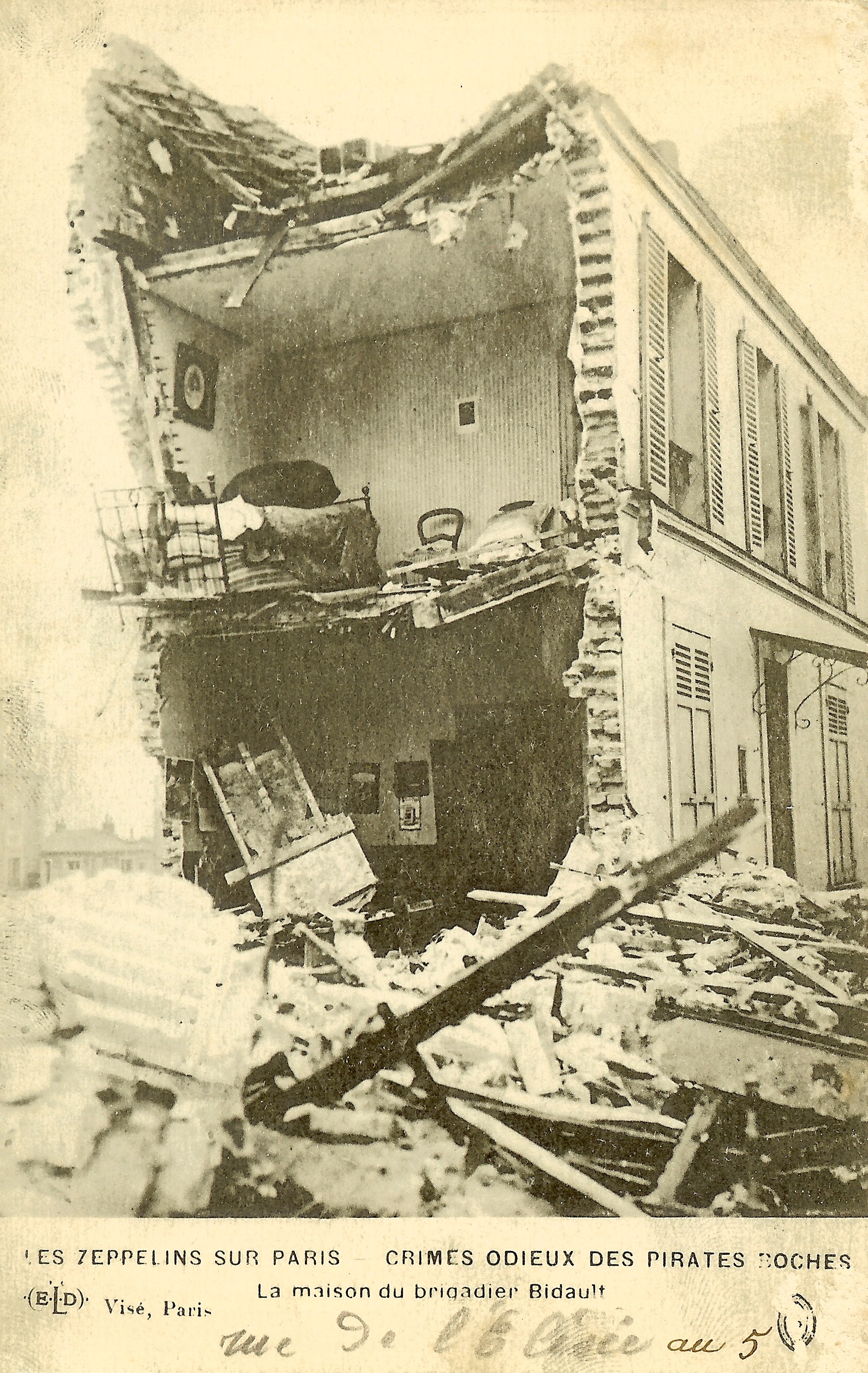
I have two postcards showing Zeppelin damage. Compared with what was to come later, the destruction was fairly limited. The first postcard shows a damaged shopfront (it had sold secondhand goods) and some scattered cobblestones. On either side, children line up to get into the frame of the picture. “Crimes odieux des pirates boches,” says the caption. Clearly the point of the postcard is to stir up anti-German feeling.

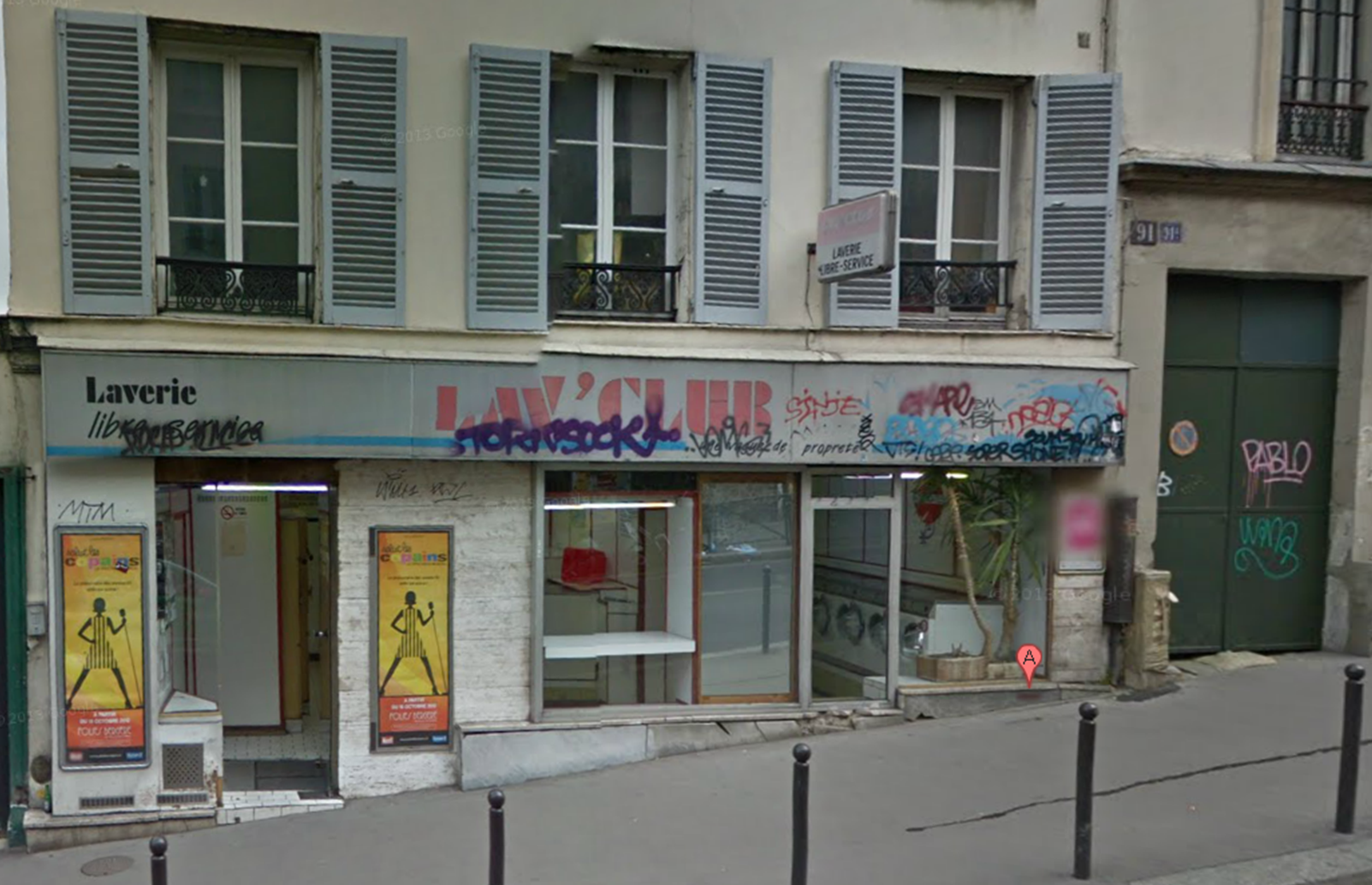
The shop was on the rue Ménilmontant in the 20th arrondissement. Look at the number 91 in the top right-hand corner. Amazingly, the building exists to this day – you can still see the distinctive heart-shaped wrought-iron decorations in the windows on Google Street View.

Menilmontant

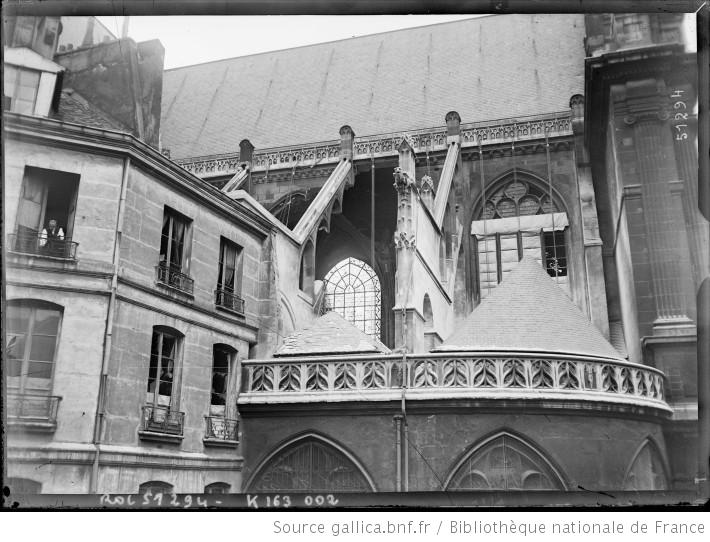
The second shows more damage, a house cut in half. Someone has written in a location (rue de l’Elisée), but this is wrong. A press photograph of the same site on Gallica (the website of France’s National Library) provides additional information: the raid took place on January 29, 1916, at 34, rue du Borrégo, also in the 20th (which seems to have sustained most of the Zeppelin damage). The owner, one sous-brigadier Bidault, was killed.

FirstWorldWar0002In all, the Zeppelin dropped 19 bombs that time, killing 54 people. A special funeral was held for them at Notre-Dame-de-la-Croix.

Funeral

Much greater destruction took place towards the end of the war, when Germans used huge long-range cannons to shell the city from Picardy, 120 km (75 miles) away. Although the nickname “Big Bertha” was given to these cannons, in fact, there were two types. Big Berthas were howitzers, but the enormous “Paris Gun” was much larger and heavier with a longer range. This was the gun that fired a shell that fell came through one of the windows of St-Gervais during the Good Friday service of 29 March 1918, killing 88 people.

St-Gervais

Even so, compared to cities in northern France, Paris emerged from the war relatively unscathed, at least in terms of its streets and buildings. Much more damage had been done in 1870-71, during the Siege and the Commune. Nor did Paris suffer under German occupation in the First World War, the fate of cities such as Lille.

Rather, citizens suffered from shortages and privations, from bereavements as sons and husbands were killed in trench warfare, from the unrelenting pressure of uncertainty as the war dragged on year after year. The city was filled with war wounded and refugees. Life went on in the cafés and shops, and the black market offered luxuries to those who could afford them, but for most people, it was a bleak period of survival and waiting. News was scarce.

FirstWorldWar0005

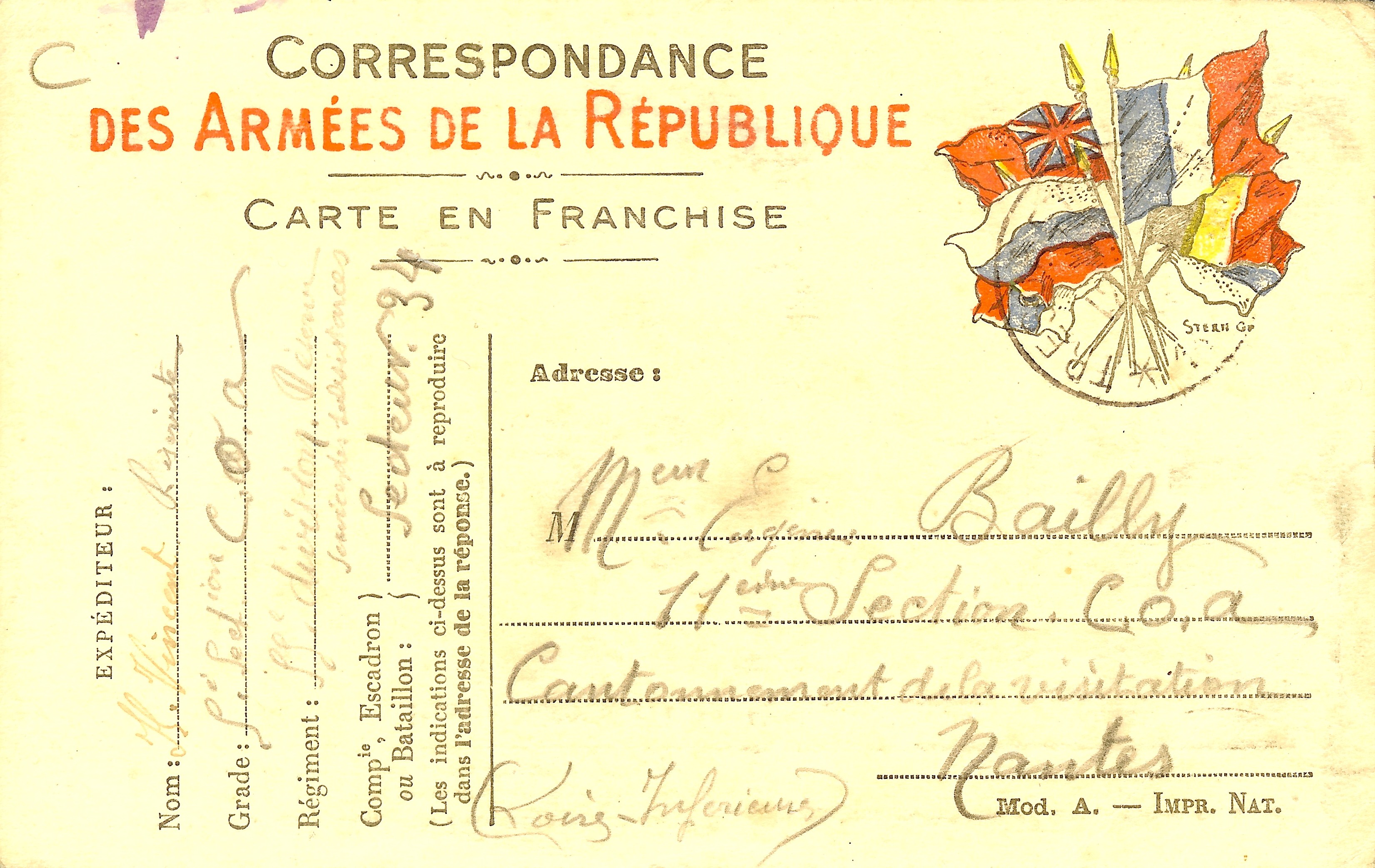
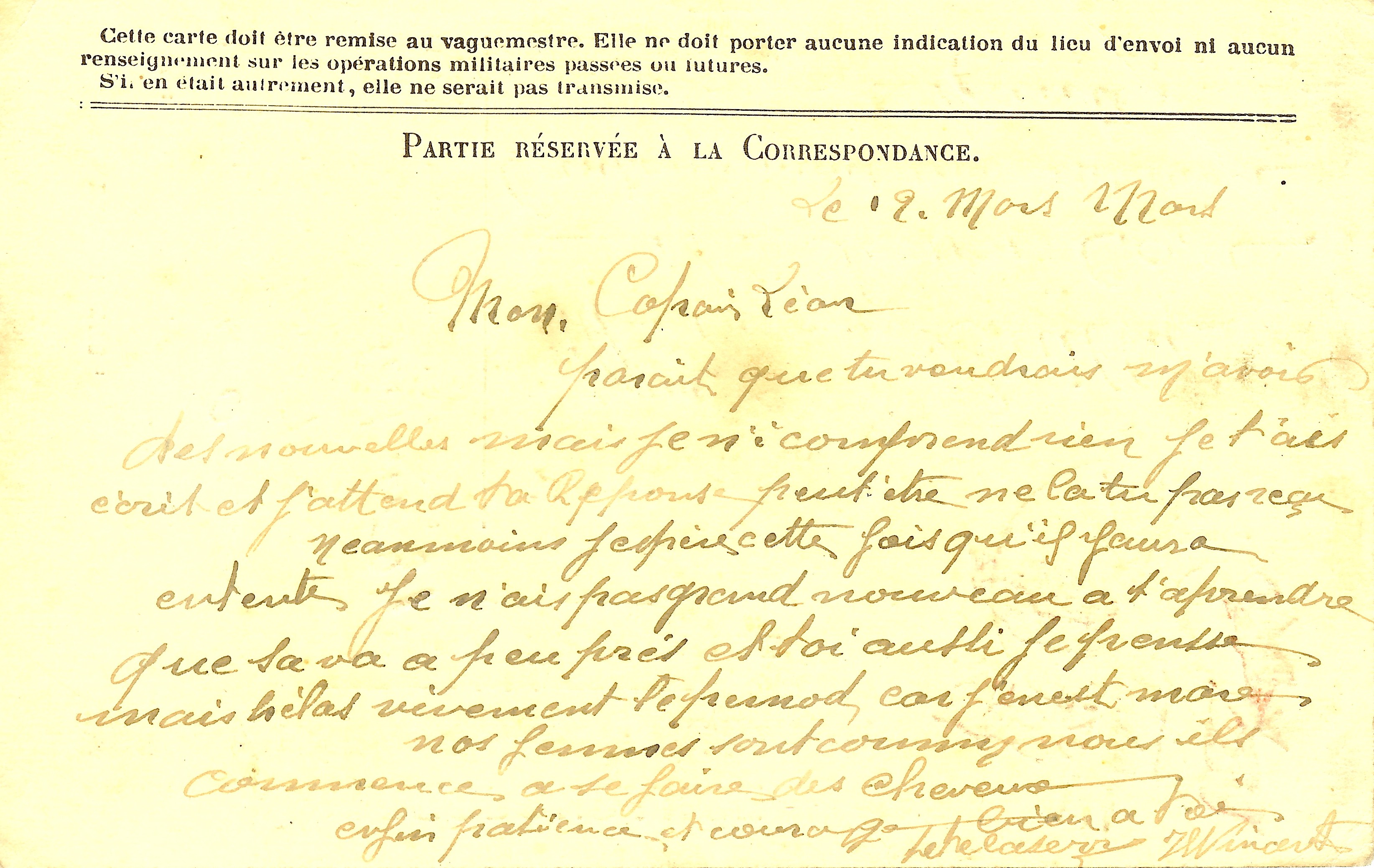
I have two postcards from the Front. The first one was not sent to or from Paris, but it is typical of army correspondence on preprinted cards at that time. H. Vincent, réserviste, writes at some length, with atrocious spelling, to say he has no news. He was serving with the C.O.A. (Commis et Ouvriers militaires d’Administration) – the administrative corps that supported the army. If I’m reading his writing correctly, he was in the 5th  Section of the COA, attached to the 55th Division de Réserve. He writes to Eugène Bailly, also in the C.O.A., 11th Section, stationed in Nantes. Nantes was a huge military centre during the war, with barracks and hospitals for both French and (later) American soldiers.

FirstWorldWar0006

H. Vincent ends his message with “enfin patience et courage, bien à toi.” The postmark is obscured, but I know that it reads “Tresor et Postes,” the French military mark. It is impossible to make out the year. However, by comparing my card with images of similar cards online, I believe it was sent early in the war, because the printed part resembles that of other cards sent in 1914.

FirstWorldWar0003

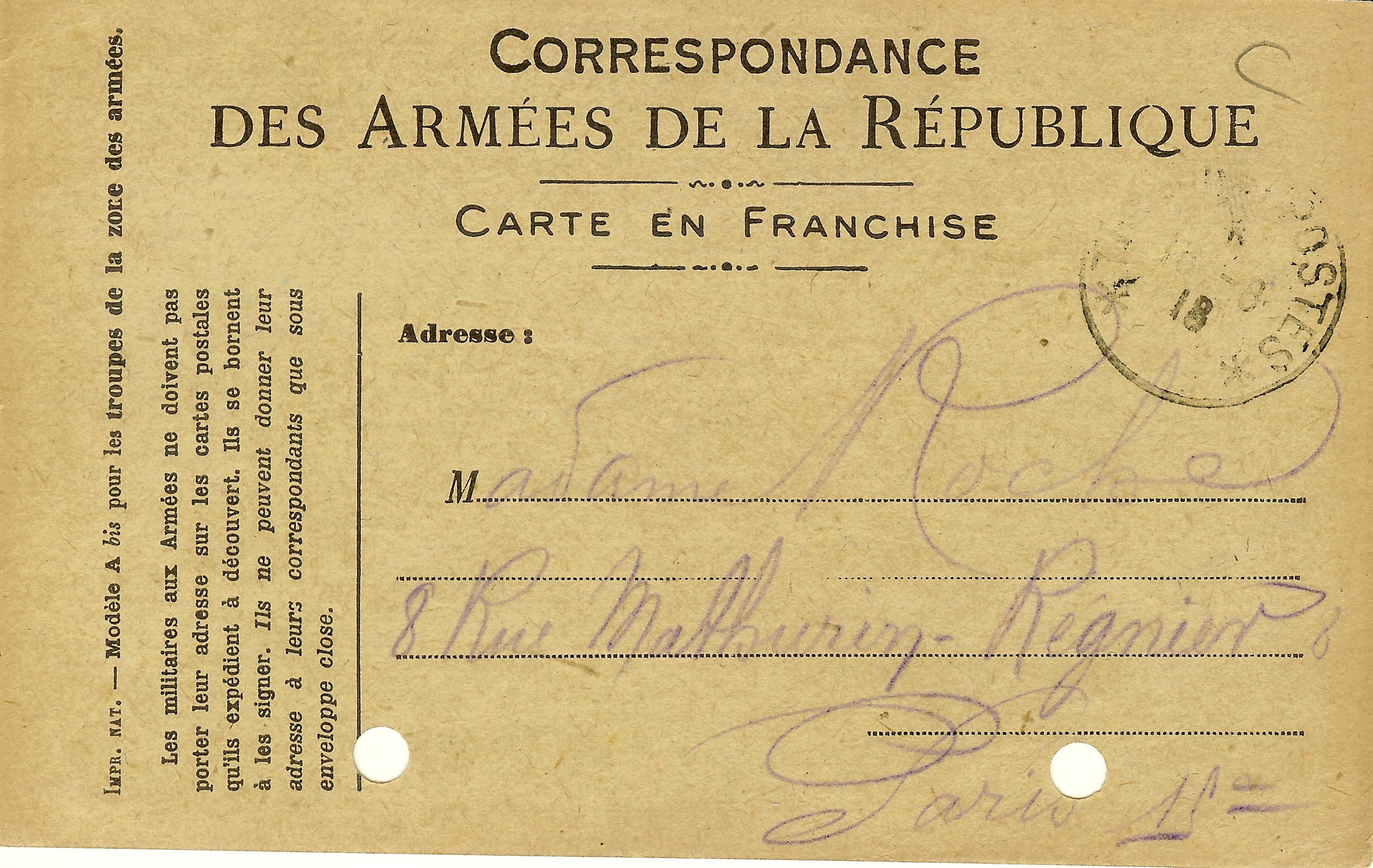
The second was sent in August 1918, as the war was finally turning in favour of the Allies. Gone are the flags and coloured printing – the card has been stripped down to the essentials. A soldier (last name Roche) informs Madame Roche (his wife? his mother?) that he was well (alive and not wounded). She lived at 8, rue Mathurin Régnier, in the 15th, in a house that is still there.

FirstWorldWar0004

There is nothing more on the card (nothing further was allowed), but probably to his wife or mother, that news was enough and she was glad to receive it.

My last view of First World War Paris comes from the 2001 book by Margaret Macmillan on the Paris Peace Conferences (titled Peacemakers in the U.K. and Paris 1919 in Canada and the U.S.). She describes the city as it appeared to the delegations in January 1919:

Signs of the Great War that had just ended were everywhere: the refugees from the devastated regions in the north; the captured German cannon in the Place de la Concorde and the Champs-Elysées; the piles of rubble and boarded-up windows where German bombs had fallen. A gaping crater marked the Tuileries rose garden. Along the Grand Boulevards the ranks of chestnuts had gaps where trees had been cut for firewood. The great windows in the cathedral of Notre-Dame were missing their stained glass, stored for safety; in their place, pale yellow panes washed the interior with a tepid light. There were severe shortages of coal, milk, and bread. French society bore scars too. While the flags of victory fluttered from the lampposts and windows, limbless men and demobilized soldiers in worn army uniforms begged for change on street corners and almost every other woman wore mourning.

The city would not remain sad for long – the hectic gaiety of the 1920s was just around the corner – but for the exhausted populace, peace had not come too soon.

Text by Philippa Campsie.

Posted in Paris churches, Paris history, Paris postcards, Paris streets, World War I | Tagged , , , , , , , , , , , , | 21 Comments

George Barbier and the dream of Paris

Every year, millions of people come to Paris dreaming of beauty, elegance, high fashion, personal freedom, decadent leisure, titillating knowledge, romantic affairs, sexual dalliances, and secret places. What they may not realize is that some of their dreams are built on the artistic foundations of Art Deco artist George Barbier (1882–1932) and his contemporaries.

front_cover

Years ago, Arthur Smith, librarian at the Royal Ontario Museum in Toronto, fell under the spell of Barbier’s artworks and the technical brilliance with which many were printed. His curiosity and diligence in learning more has led to a stunning exhibition at the Thomas Fisher Rare Book Library at the University of Toronto.

Today, most overseas visitors fly to Paris crammed into crowded airplanes, arriving hot, sweaty and grubby at an unfashionable hour of the day. But Barbier lets us dream that we made the crossing first-class on a transatlantic liner, where we would lounge about, sipping cocktails with glamorous international travellers. This was the world of 1927 he created for an S.S. Île de France menu.

F6794

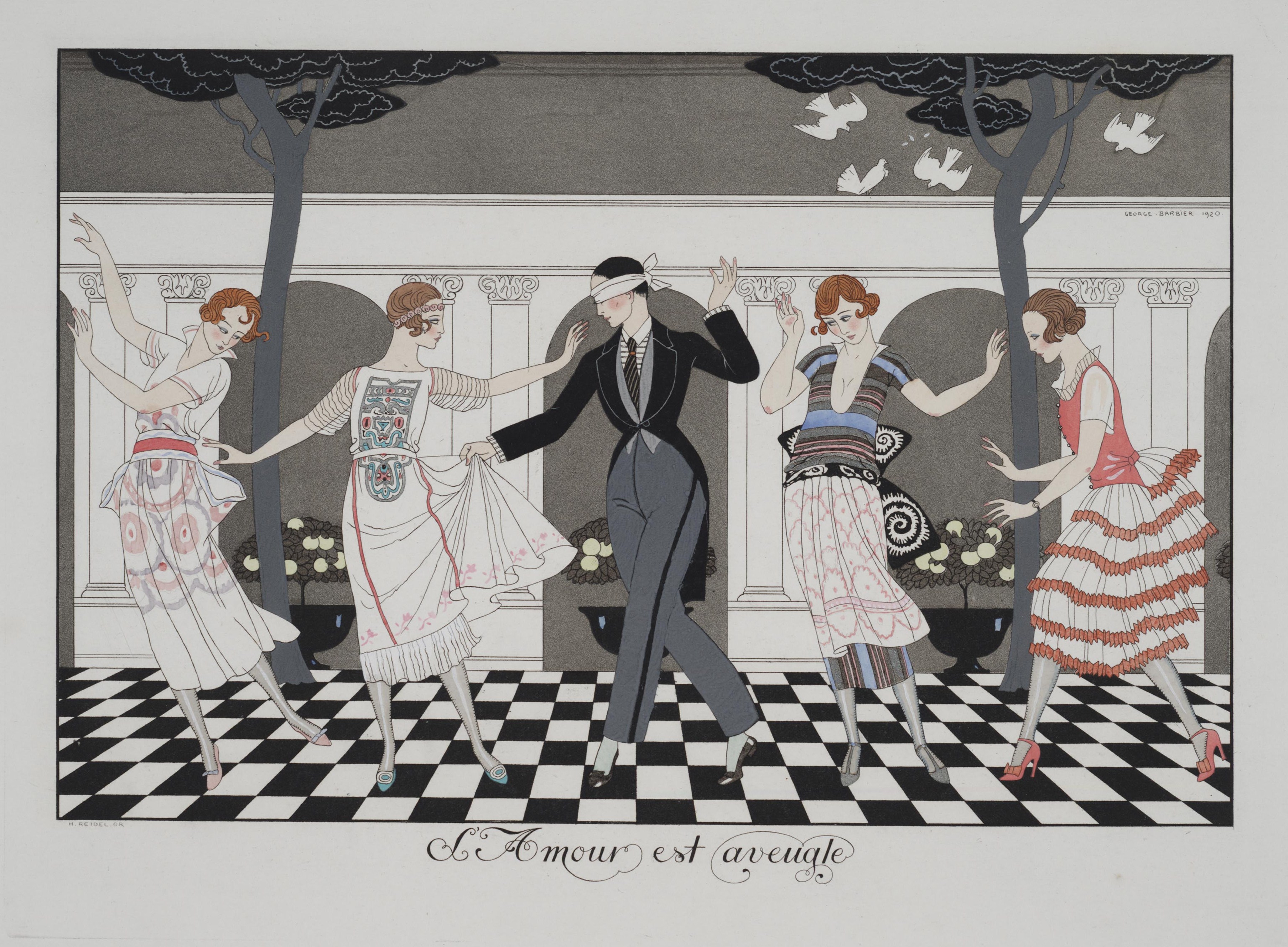
And when we arrived in Paris, there would be parties at which everyone would be dressed in the height of fashion, ready to dance and flirt, as in L’Amour est aveugle (Love is blind).

F6820

Perhaps the dance would lead to a quiet tête-à-tête with an intriguing stranger in an exquisite garden. And of course one would be the very picture of elegance.

Have those who dream of elegance today been overpowered by fads and ephemeral fashion? Who today would dare proclaim, as did the Journal des dames et des modes did in 1912, that

Elegance resides in the perfect harmony of thoughts, words, acts, gestures, attitudes and costume. It is through costume that elegance expresses itself most quickly. The elegant person should not wear anything conspicuous or extreme. He refrains from colours that are too crude, clothes of eccentric cut, perfumes that are too heavy, jewellery that is too rich, excessive gestures, vocal outbursts, and words that are too strong. The elegant person is the one who makes himself noticed by means of discretion.*
F6778

Ah, discretion. So important. As it is for this lady garbed in an afternoon dress from the House of Paquin. Barbier’s caption, N’en dites rien (Tell no one about this) suggests a mysterious secret.

F6872

Who was this artist who drew captivating worlds of wealth and refinement? He was part of a group of talented French artists, most of whom had graduated from the École des Beaux-arts in Paris, “nicknamed by Vogue the Chevaliers du bracelet (knights of the bracelet) for their dandyish attire, flamboyant mannerisms, dapper appearance, and common practice of sporting a bracelet.” Barbier was described as “un élégant jeune homme blond, tranquille et réservé.” He was as privileged as those he portrayed.

As Arthur Smith writes in the exhibit catalogue:

He was the son of a well-to-do Nantes businessman who left Barbier a ritzy apartment building in Paris and the means to maintain a comfortable Paris lifestyle. Barbier enjoyed a luxurious residence, a substantial income to finance his theatrical pursuits, and the resources to acquire an extensive personal library, valuable antiques, and works of art. He also possessed an automobile to facilitate his escapes into the French countryside.

Clearly the stuff of Paris dreams.

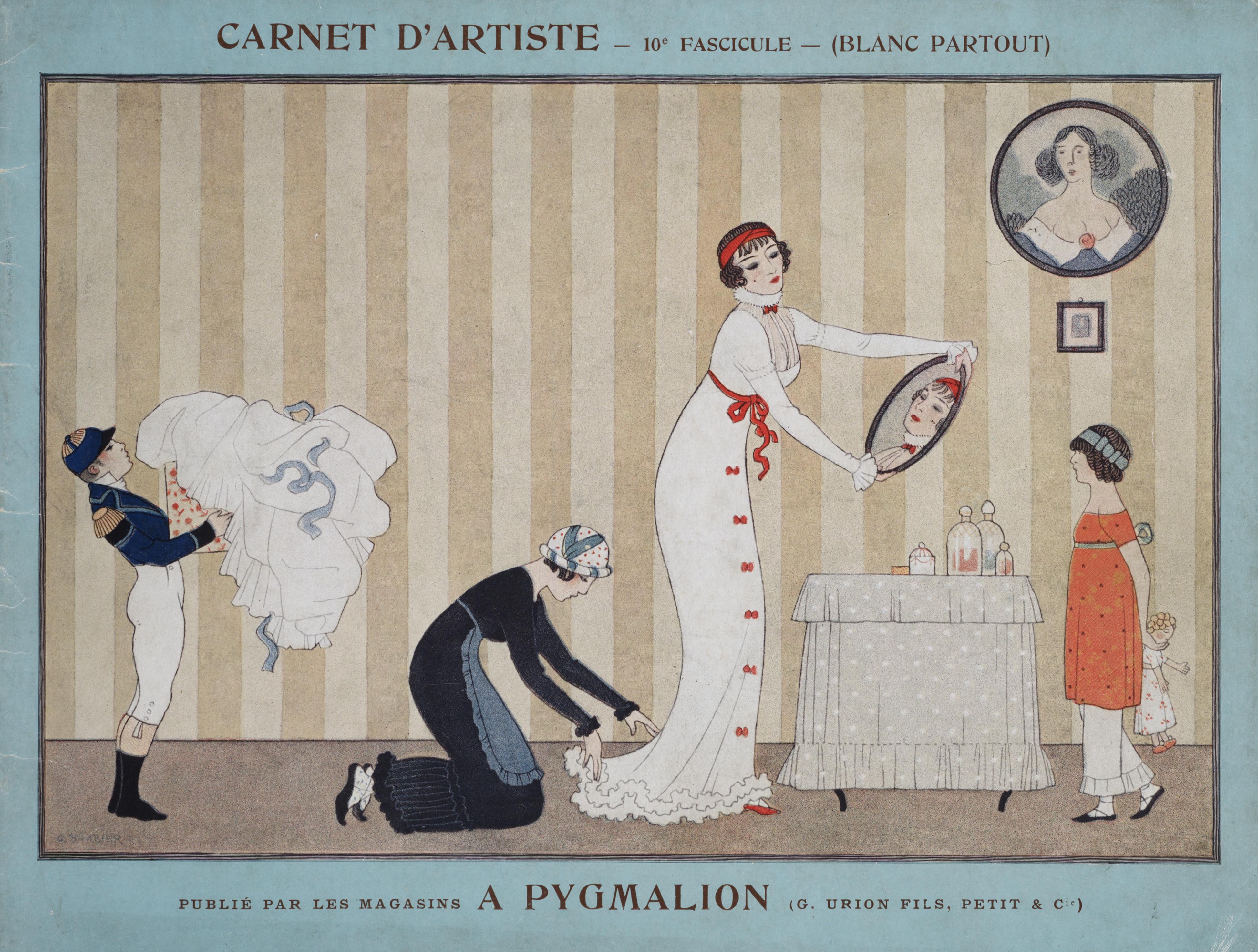
In her wonderful book The World of Department Stores, Jan Whitaker describes Paris’s contribution to  the history of the modern department store. The first ones were as far from the modern serve-yourself bargain emporium as it is possible to imagine. Well-dressed staff waited for you and waited on you, as we see in this 1913 image from the cover of an artist’s sketchbook Barbier drew for the department store À Pygmalion.

F6802

Arthur Smith describes À Pygmalion as

an imposing multi-storey building located on rue Saint Denis. It was known as a novelties shop that marketed the latest fashions, jewellery, and fabrics to a well-to-do female clientele. This volume illustrated by Barbier featured table linens and elaborately trimmed undergarments, with vignettes of ladies engaged in such activities as playing tennis, boating, skiing, riding, golfing and dining.

When the woman had finished her shopping, she would travel to her next rendezvous by a chauffeur-driven motor car, to emerge impeccably outfitted, where she would be greeted by an improbably slender, tall, and perfectly tailored man.

F6795

Did his lips alight upon her outstretched hand or linger close to her cheek while both thought of what the evening might bring?

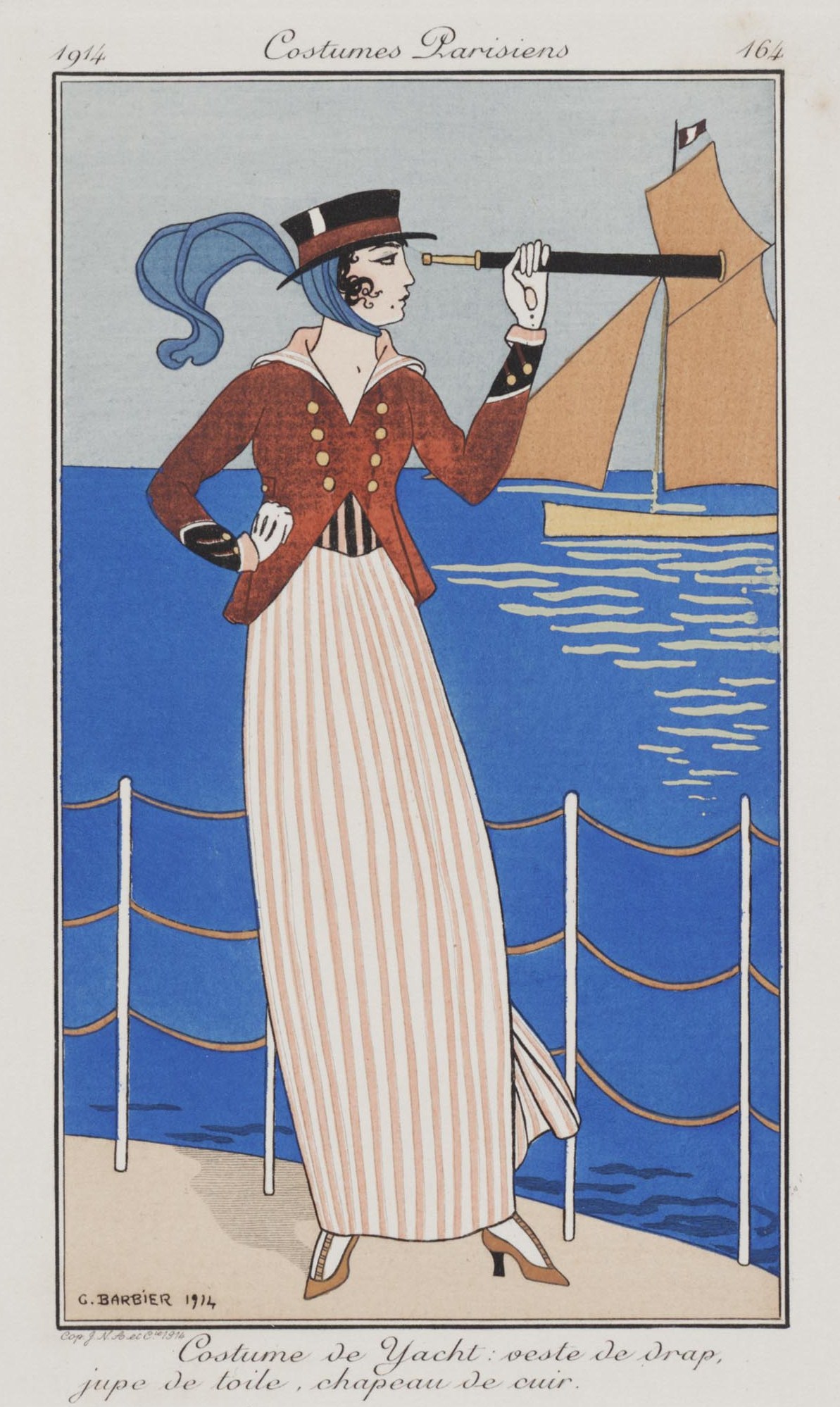
The title “Envie” (Envy) suggests a slightly sinister undercurrent. Drawn for a collection illustrating the seven deadly sins, the maid holding the hat box is presumably the envious one. But such warnings rarely intrude on Barbier’s world. His world is more properly represented by the yachting costume from Costumes Parisiens.

This picture shown below was circulated with an issue of Journal des dames et des modes. Can you imagine something so extravagant as a magazine published three times a month, limited to 1,250 copies per issue? It first appeared on 1 June 1912, and 79 issues later, on 1 August 1914, it ceased publication.

F6772

In addition to “literary articles, poems, society columns and fashion reports,” the exclusive circle of subscribers “received colourful unbound fashion plates entitled Costumes Parisiens, which were engraved on copper and coloured au pochoir. The plates were contributed by leading fashion illustrators of the day including Barbier” and a host of other luminaries. Costumes Parisiens illustrations such as Barbier’s Costume de Yacht shown above occasionally appear in antique shops and print galleries, where they are much sought after and priced accordingly.

The labour-intensive pochoir technique involved making and printing from many zinc or copper stencils to colour the print, which had first been made from an engraving or woodblock print of the original.

As fashion historian Alison Matthews David writes in her introduction to Arthur M. Smith’s exhibition catalogue ‘Chevalier du Bracelet’: George Barbier and his illustrated works,

Barbier captured the modern but rarified world of haute couture fashions, illustrating the chic hats and the changing silhouettes of the best French [fashion] houses, including Worth, Paquin and Poiret. His colourful, sophisticated tableaux commissioned by the elite fashion publications of his era show young, elegant Dianas skiing at St. Moritz or being twirled in arms of Tango dancers, but also indolent femmes fatales reclining on pillows while smoking in their Asian-inspired silk evening pyjamas.

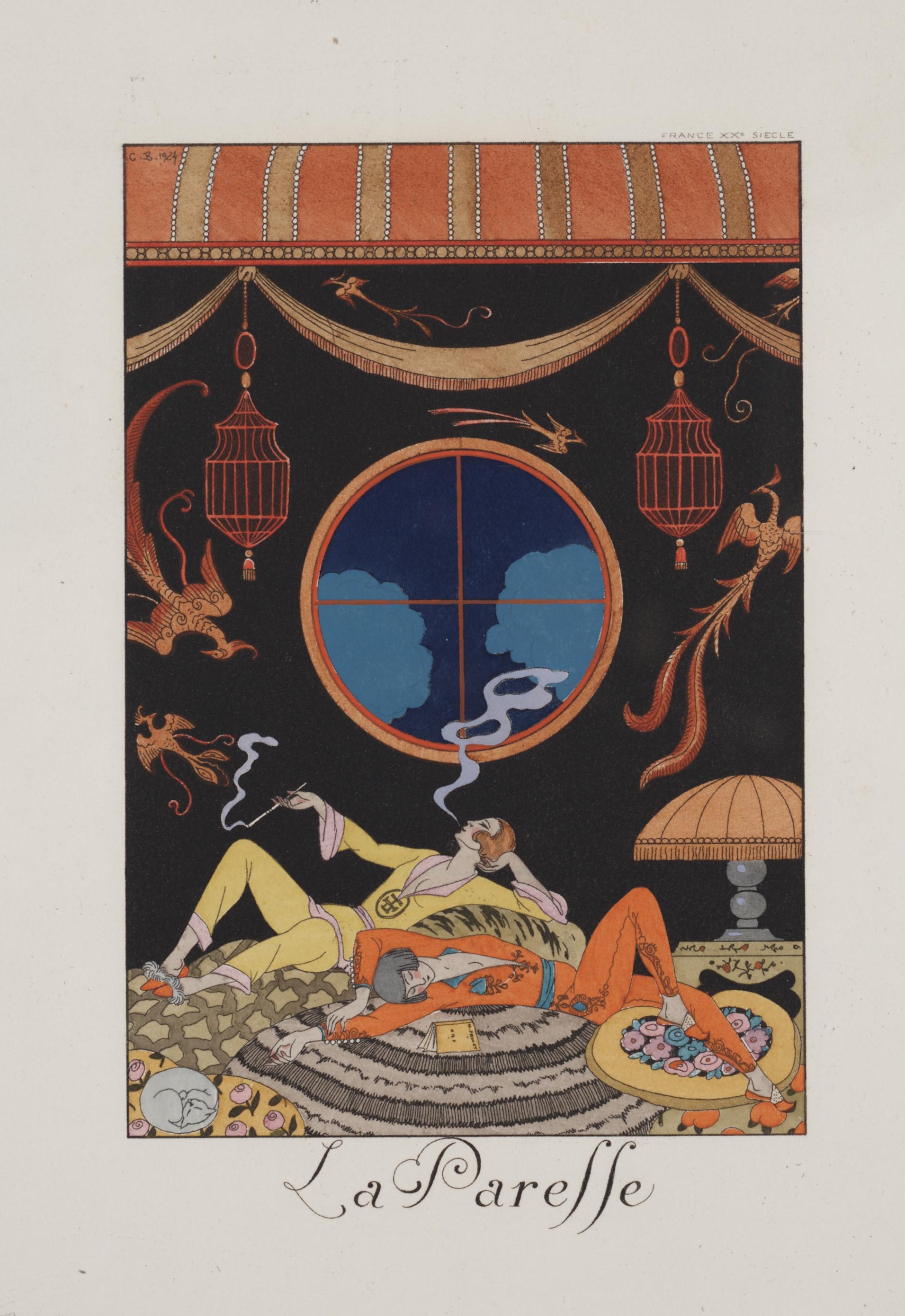
La Paresse (idleness, indolence) is a stunning evocation of the studied indolence so inseparable from many dreams of glamorous Paris. Here we see perfectly what Albert Flament meant when he said of his friend George Barbier, “When our times are lost…some of his water-colours and drawings will be all that is necessary to resurrect the taste and spirit of the years in which we lived.”

F6776

And sometimes an introduction to Barbier adds to our appreciation of what we already know and admire. In my case, the Cartier panther. Philippa and I spent Christmas 2012 in Paris. On more than one evening we stopped to admire this view on the Champs-Elysées.

PC230770

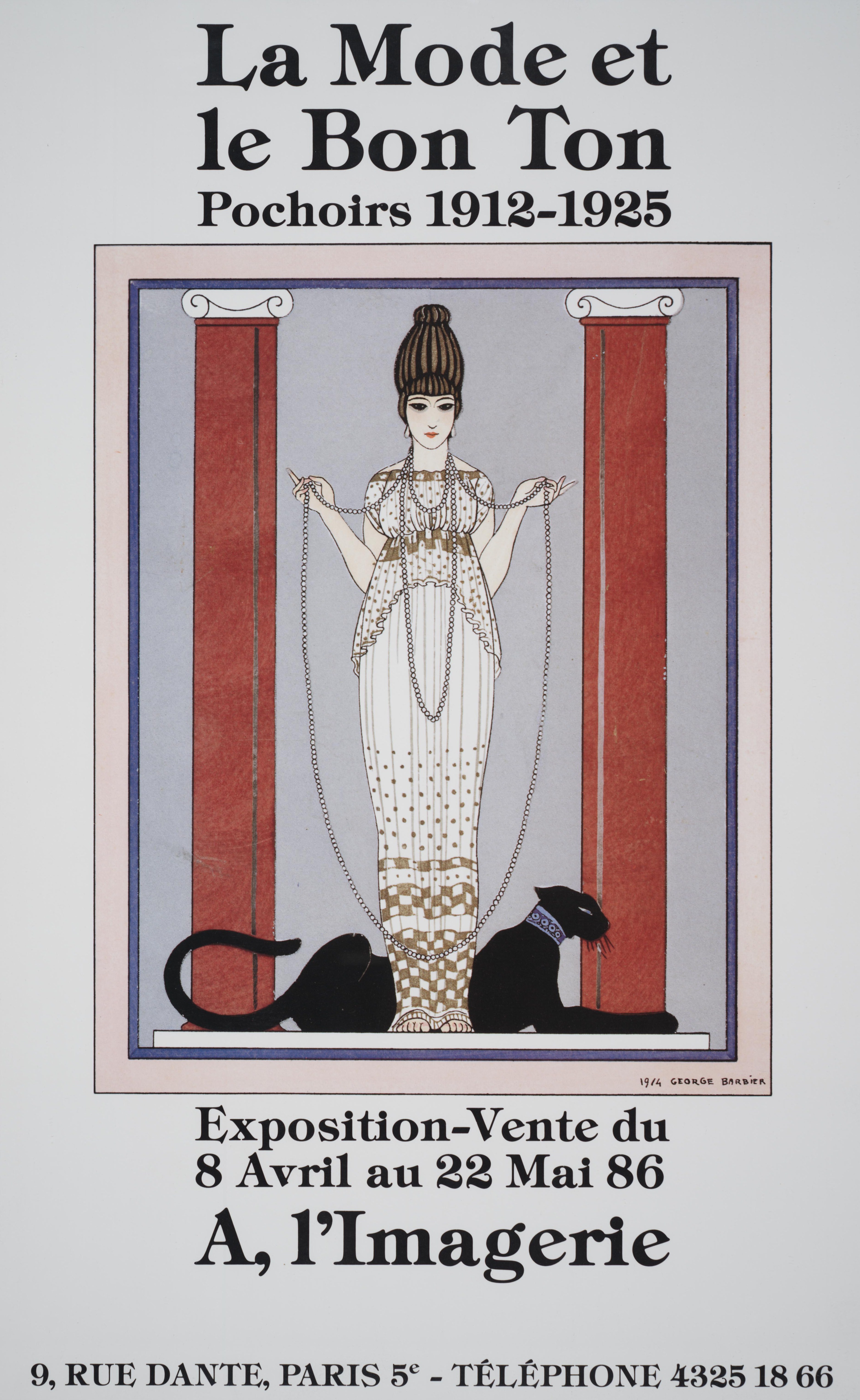
Only later would I learn from Arthur Smith that Barbier created the “iconic piece…the design of the panther that remains emblematic of the House of Cartier to the present day. The image of a classical figure, attired in a Poiret dress, and accessorized by the presence of a black panther, was used on an invitation card designed by Barbier for L’exposition d’une collection unique de perles et de bijoux de decadence antique hosted at La Maison Cartier from 27 May to 6 June 1914. The illustration bore the caption La femme avec une panthère noire, which was reproduced in a 1920s French magazine advertisement for Cartier.”

F6786

Yet for all the glamour of the era, there was also a dark side.

F6774

The attractive evening dress is from Worth, generally regarded as the first French fashion house, paradoxically started by an Englishman. However, beauty notwithstanding, there is something sinister, or threatening in this image. One senses the need for caution, for this is the “Merciless beautiful lady.” Here is a woman of power, not to be treated lightly or incautiously. Undoubtedly inspired by the John Keats poem “La Belle Dame Sans Merci” we find there someone who “met a lady” and quite unexpectedly later found himself “Alone and palely loitering.” Too late—

I saw pale kings and princes too,
Pale warriors, death-pale were they all;
They cried—‘La Belle Dame sans Merci
Hath thee in thrall!’

Perhaps La Belle Dame sans Merci is the city of Paris itself; sometimes hard to please, but impossible to forget. Far away, one feels alone and palely loitering. Barbier captured and created a particular Paris, a Paris that haunts and holds many of us in her thrall.

Text by Norman Ball. Many thanks to Arthur Smith, Anne Dondertman, John Shoesmith, and all who brought Barbier back to life in this stunning exhibit and fine catalogue.

All Barbier images courtesy Thomas Fisher Rare Book Library, University of Toronto.

*All quotations from ‘Chevalier du Bracelet’: George Barbier and His Illustrated Works, Exhibition & Catalogue by Arthur M. Smith, Thomas Fisher Rare Book Library, University of Toronto, 30 September – 20 December 2013, Catalogue printed by Coach House Press. Foreword by Anne Dondertman, Introduction by Alison Matthews David. Available for $20 Canadian. Click here.


Posted in Paris art, Paris nostalgia | Tagged , , , , , , , , , , , , , , , , , | 11 Comments