Richard Ewen: A Texas Artist Whose Watercolours Capture Paris

Richard Ewen is a talented watercolour artist who lives in Austin, Texas. He loves Paris, visits it regularly, and then, back in Texas, creates marvellous paintings of Paris, many of which are based on reflections in shop and café windows.

Watercolour painting is an exacting art, because unlike oil painting, you cannot just cover up your errors with more paint. And any artist can tell you how difficult it is to master the technique of painting reflections. To do so in such an unforgiving medium as watercolour makes Ewen’s work even more impressive.

Consider the painting he calls Guess Who’s Coming to Dinner.
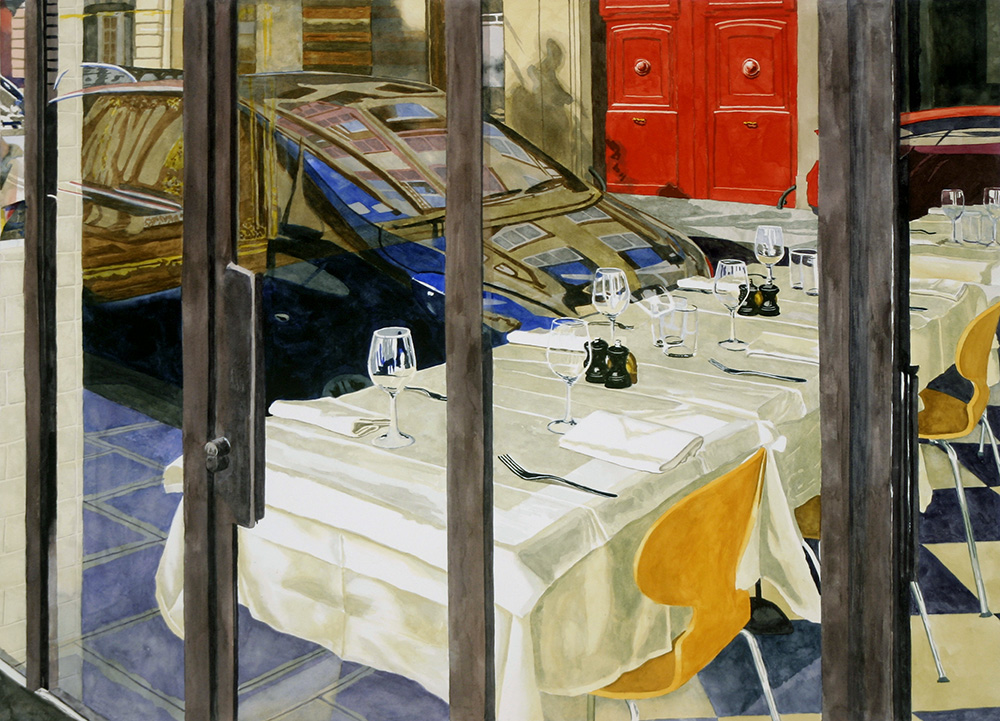
Richard’s paintings begin with his walks, a keen eye, and his camera. He recalls, “I stopped dead in my tracks when I saw the table setting and the car reflected so that it looked as if it was inside the restaurant.”

Recently, we met in Paris and he told me more about how his paintings come about. It begins with the original photo.
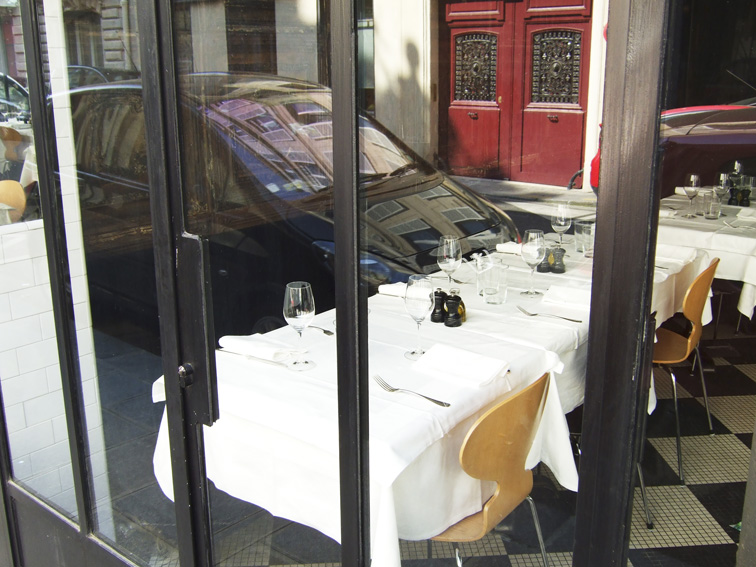
In an e-mail, he explained his method for moving from original photo to painting.
“I work in Photoshop and do the following:
1. Crop the image. I like to get rid of the architecture of the building and the window, no matter how interesting it is, so that there is a little mystery to the first look at the painting. “What is this?” or “Why is the lettering backwards?”
2. Skew the image to be square with the picture plane.
3. Adjust the shadows to bring out details and adjust the highlights to reduce any glare.
4. Increase the color saturation.
5. Brighten the image and set the contrast.”

These procedures give Richard what he calls the “altered photograph” we see below.

The altered photo does not become the exact painting, but it is a crucial step in the process. As Richard explains, “It is important to get the photograph adjusted to the colors and brightness that I want in the final painting. I start painting with light and thinned bright colors first, and try to get colors in every area before strengthening them and darkening the shadows. In other words, bring in the colors lightly at first and then stronger as I keep layering the paint.”

The expression “layering the paint” is a reminder of just how much planning and prevision his work needs. Because he works in watercolour, he has to get it right the first time, so naturally he works carefully. After he has decided on all of the details for the painting, he draws it in pencil on a special translucent paper. Here he must be careful to clearly indicate how the colours will be applied and built up to give the reflections he needs.

Then he takes the watercolour paper on which he will paint and puts a piece of transfer paper—rather like the carbon paper of old used for typewriters—over it, topped by his drawing of the painting. He retraces the lines he made on the translucent paper so they will be transferred from the transfer paper to watercolour paper. Only then does he start painting.

I will leave it to you to examine and re-examine the three images for Guess Who’s Coming to Dinner and to look for changes. Notice, for example, how the structure of the double red doors have changed, how shadows have been sharpened, as have the chasse roues. What has happened to the reflections in the wine glasses or the look of the tablecloth?

Now let us consider “Plage 13.” Plage means beach. It too started with a photo he took one day, but let us look first at the finished painting.
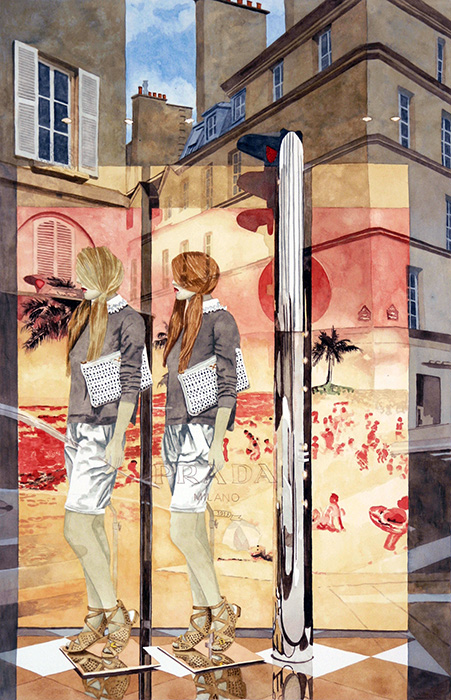
In an e-mail Richard explained, “Plage is the backdrop photo that the window decorator installed behind the mannequins. A beach scene with tropical palm trees and exposed figures on the beach in tones of red and yellow and tan. In the lower right-hand corner you can make out a chid wrapped in a floating device or inner tube. The silver post is a structural element in the store and there is a traffic light positioned near it. At the top of the post the shade from outside ends the visibility of the post and the reflection of the building from across the street takes over. There is printing on the window that says Prada, Milano, 1913” (1913 is the year Mario Prada founded his label).

I have not seen the original paintings, but as I increase the size of the images on my computer screen, I see more and more details, more and more story. Surely many readers have had the same experience with a scanned image or their own photos, which reveal details that are only visible when enlarged. Richard explains that this element of surprise is an important part of how his paintings emerge.

“One of the features I like about these images I take is precisely the detail that comes forward upon inspecting the photograph on the screen after it has been enlarged. The complicated subject matter and haphazard juxtaposition of shape and objects create a very interesting composition and hopefully make the viewer see something new each time he or she views the painting.”

The image immediately below is the altered photo. I leave it to you to find the additional details that emerge as you continue to look at it.

The photo shown below is the original window as photographed by Richard.

In the next painting, titled “Christian Lacroix,” let us start with the original photo.

Richard “liked the broken cubist-like image and the purple and gold.” In the original photo, Richard as photographer is clearly reflected on the left. There is also no mistaking that this is a store window. Looking at the altered photograph below we see a new image and focus emerging as he crops, zooms in, and makes other subtle alterations.
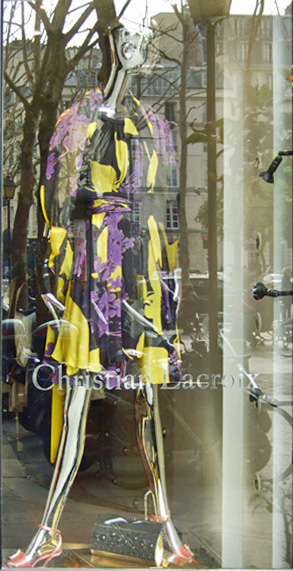
Here is the finished painting that emerged.

Richard did this painting for the assistant in the Austin gallery that exhibits his work. It seems a far cry from the original and yet is clearly connected to the original and retains the same essence.

Artists help us see more clearly by helping us see differently. Perhaps this is why I spend so much time in art galleries, thinking of all manner of art works and, when I get the chance, talking with artists about their work.

As I have explored Richard Ewen’s website I have found myself returning to several favourites. One is the opening painting in the blog, the one with the gorgeous reflections of the car in the restaurant. The other is Le Grand Café.

It started from a photo that Richard says “appealed to me because of the intense red.” (I too like “intense red.” I have a bright red bookcase in my study and a stained glass piece in the window with a triangle of deep red.)

Richard’s café looks very inviting. The red is energizing, yet the overall scene is calming. As a good café does, it draws you in and suggests possibilities, while creating a cocoon-like private space of energy and calm when one needs it. Le Grand Café started with an unnamed café he photographed one day in Paris.

The cigarette butts and debris suggests that the crowds have gone. It could be closing time or very early morning; it does not matter. There is a slash of light on the chair back and an empty table. We see the bottom of equipment on the bar counter and light reflected from floor to the front of the counter. Then Richard started to change the scene.
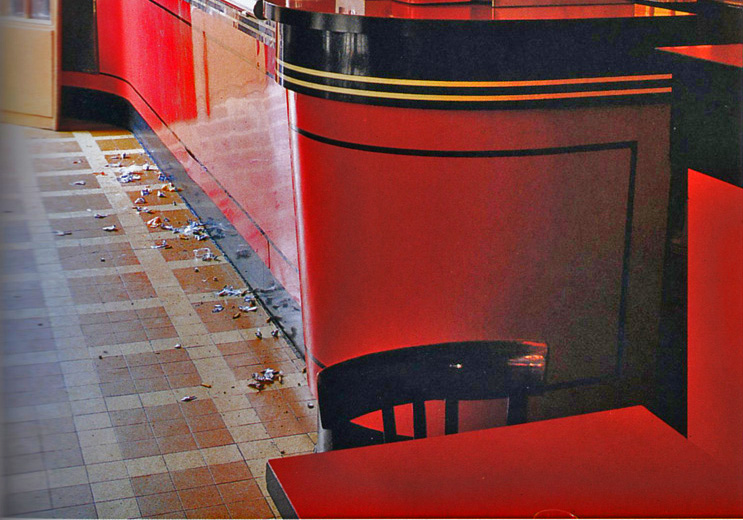
The cigarette butts are still there, but the equipment on the bar has all but disappeared. The floor pattern is still reflected on the front of the counter and the table is still empty.

Now let us revisit Le Grand Café and reflect on how one man has helped us see Paris anew.
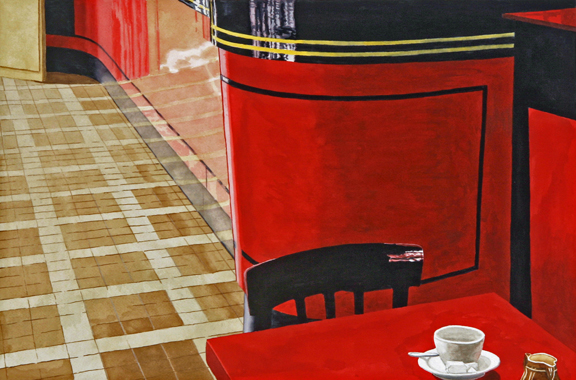
Revisiting the works of Richard Ewen has been particularly enjoyable for me. Among other things, they are a reminder of a wonderful lunch and afternoon in Paris this past April. Richard and I knew of each other’s work through Parisian Fields, but had not met. And yet at the lunch that Philippa and Richard had arranged, it seemed as if we were old friends. After lunch, Richard, his wife Mary, Philippa, and I spent a delightful afternoon wandering about the 5th arrondissement, visiting their apartment, and enjoying the company of new friends.

This is one reason why Philippa and I write this blog: we love Paris, love the new sights and experiences we find each time we visit, love to write about those sights and experiences, and love the way it allows us to connect with those who share our enthusiasm for the city.

I thank Richard for his generosity in helping me understand his work, answering my questions, letting me use his images, and above all helping me see Paris anew. Perhaps we need to feature more artists in Parisian Fields. What do you think?

Text by Norman Ball; photographs and illustrations by Richard Ewen.

Posted in City of Reflections, Paris art, Paris shops | Tagged , , , , , , , , , , | 11 Comments

Lighting the City of Light

Opinion is divided on whether the name “City of Light” refers to the brilliant minds of the city’s 18th-century philosophers, or to the brightly illuminated streets of the capital. There are arguments to be made on both sides.

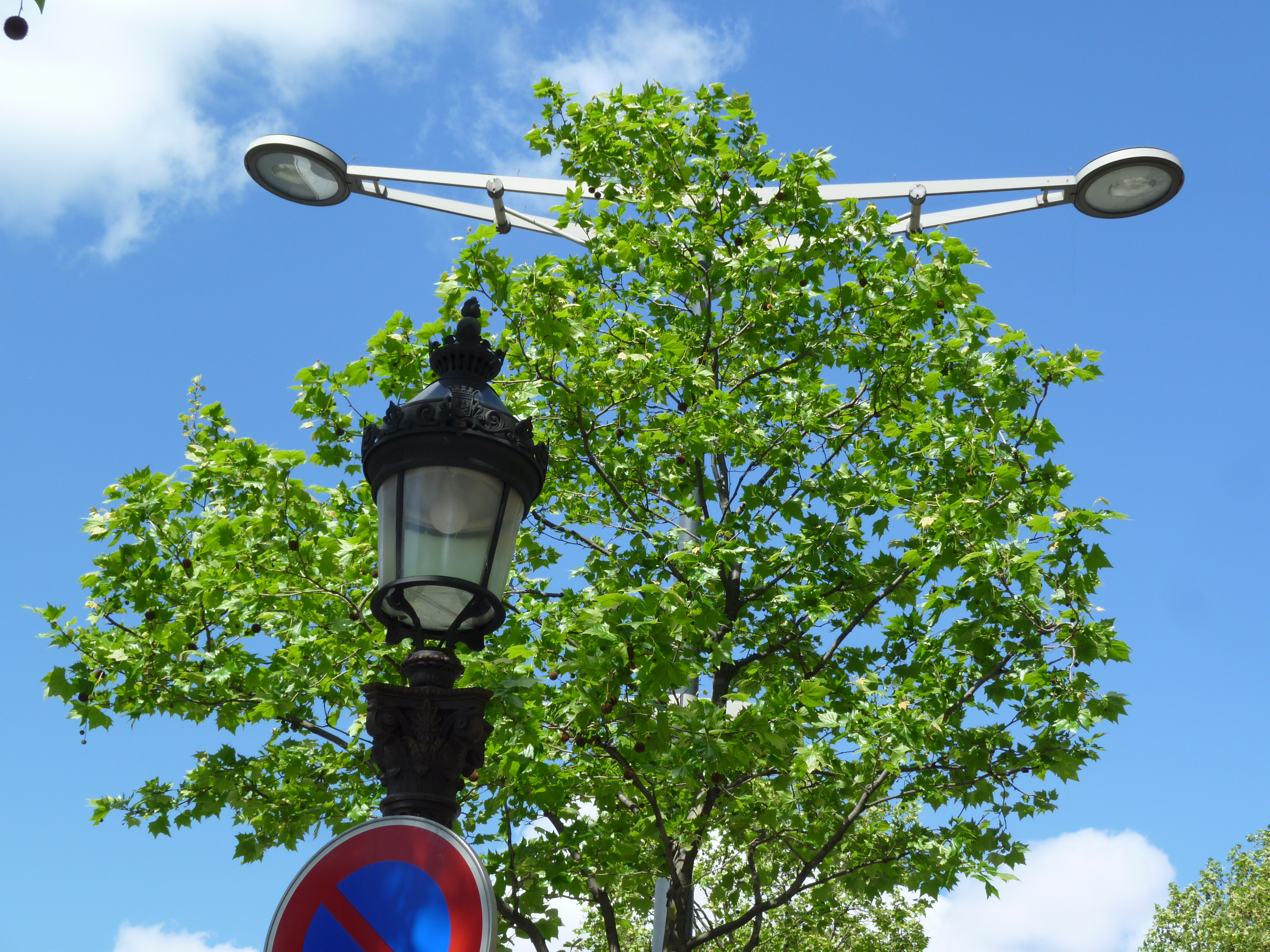
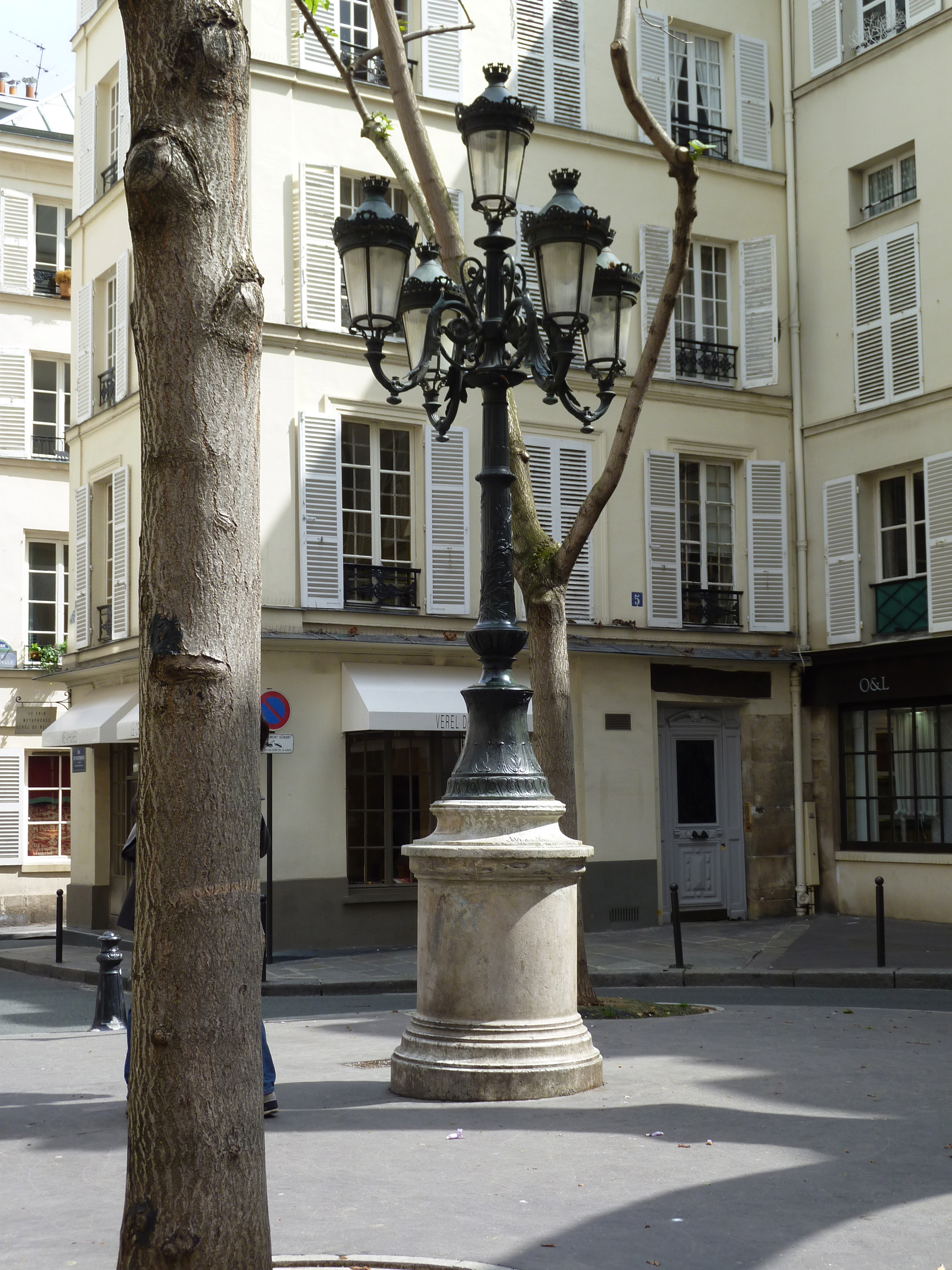
If the latter is correct, there is no question that Paris works hard on its illuminations. As I photographed streetlights here and there, I couldn’t help wondering at the many different styles, and about the logistics of replacing bulbs and carrying out maintenance in a city with as many types of lamp standards as France has cheeses.

Even on a single street, one can see several versions. The Champs-Elysées has tall modern standards that do the main work of lighting the boulevard, and shorter, old-fashioned ones that provide atmosphere and elegance on the sidewalks.

This one near Les Invalides combines old-fashioned style with modern practicality on a single pole.

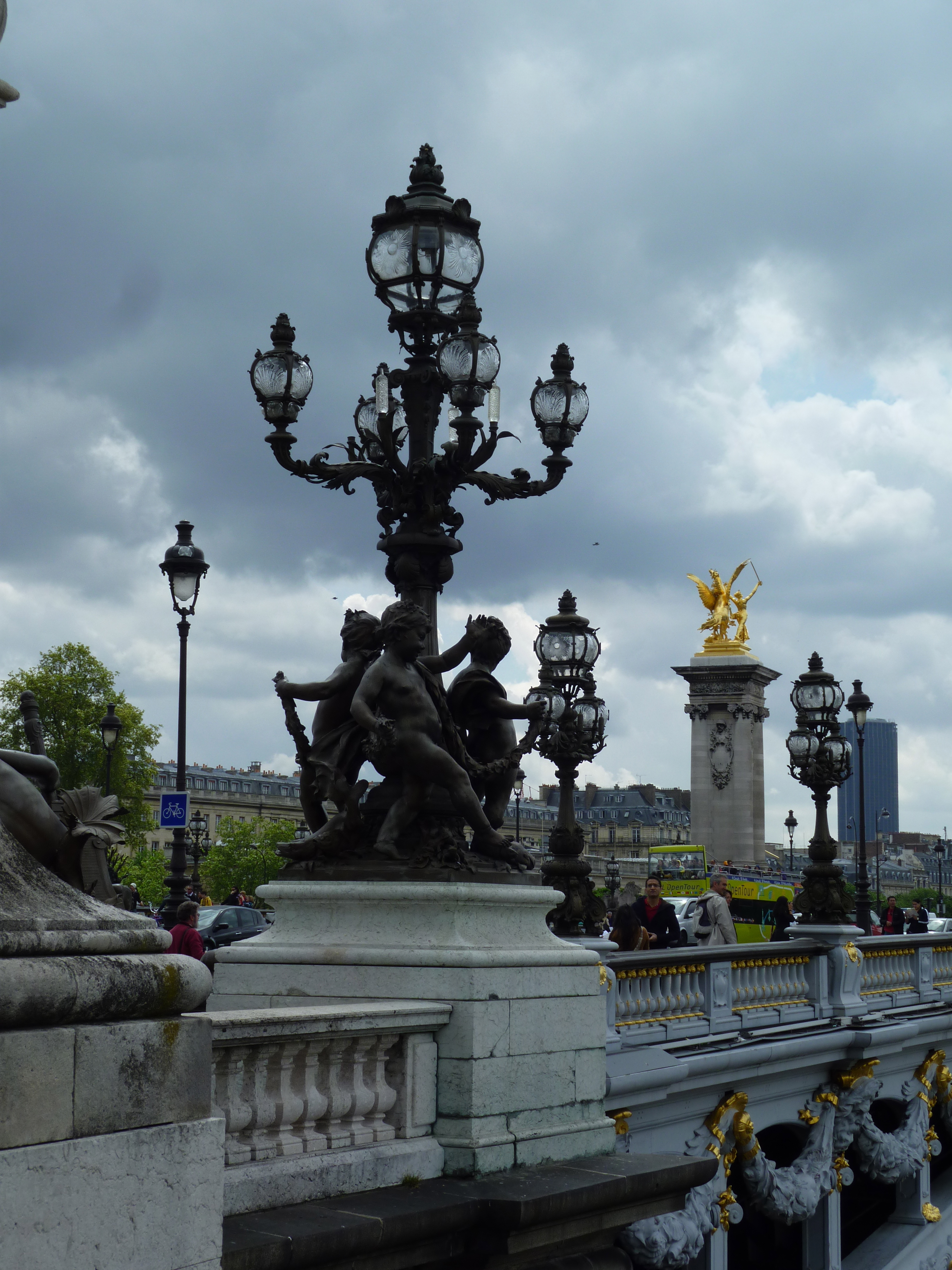
Each bridge seems to have its own version, from the elaborate lamps on the Pont Alexandre III…

… to the hideous modern ones on the Pont de l’Alma.

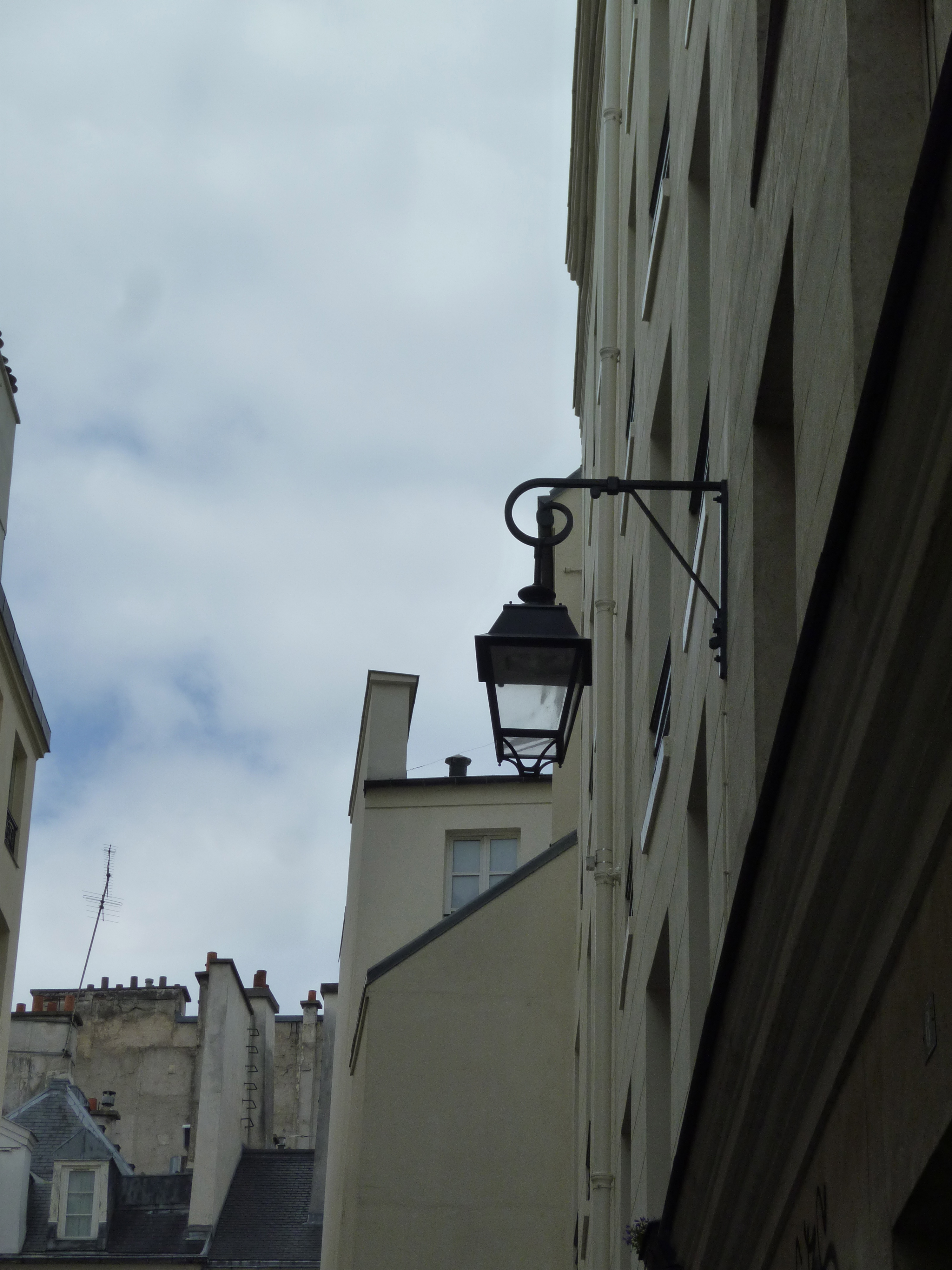
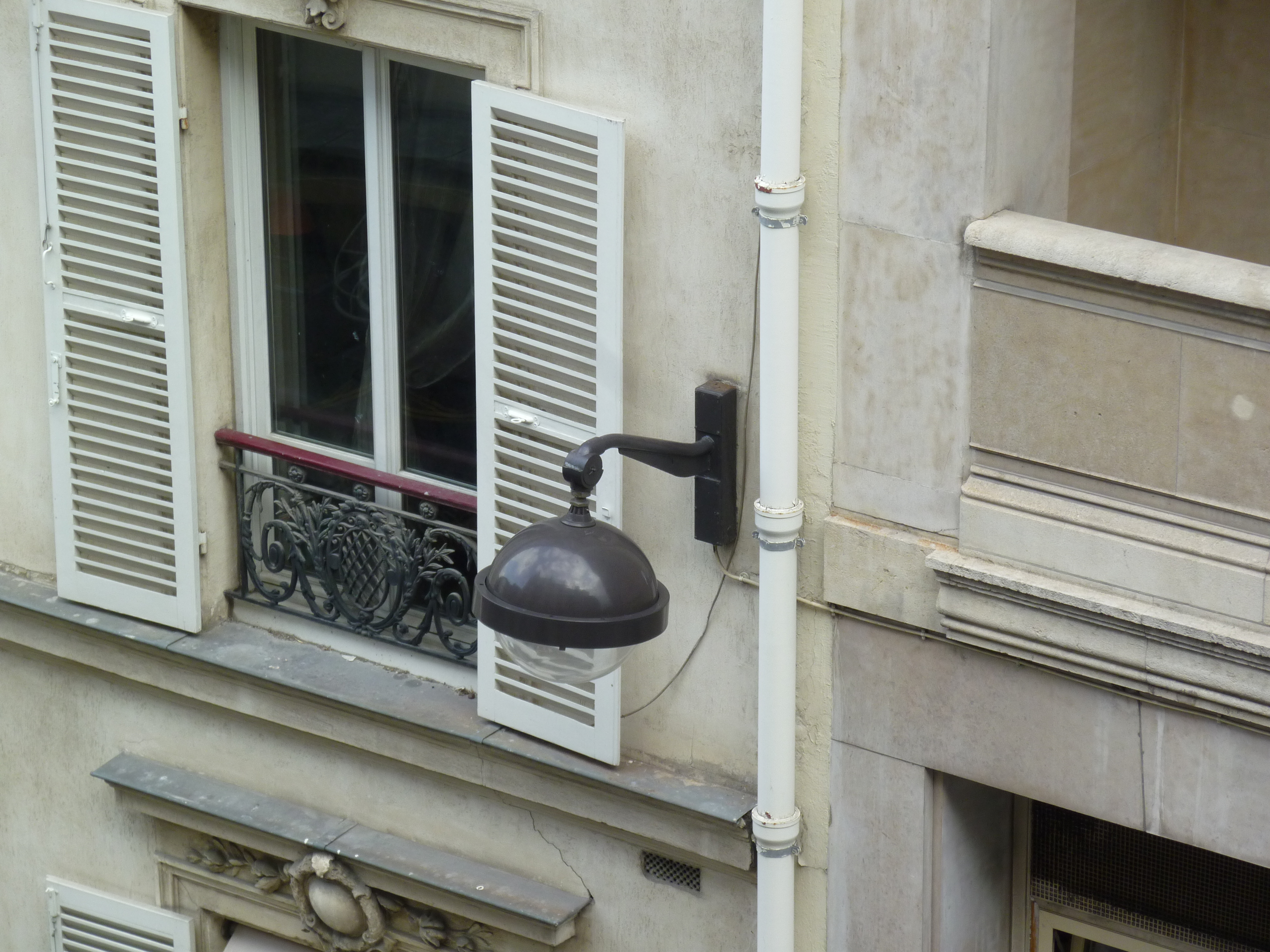
Some streets are too narrow to have lamp standards, so the lighting is attached to the walls of buildings.

It has taken more than three centuries to achieve this array of lighting in the city. Before the 16th century, Paris went dark when the sun set. Then the government formed a plan to require householders who had ground-floor windows overlooking main streets to keep a light burning, at least in the early hours of the evening. These lamps were to be provided by the authorities. But the cost of making and distributing them was too high. Paris stayed dark.

Someone suggested a system that would allow citizens to temporarily hire a torch from a network of torch-renters spaced at regular intervals – rather like a Velib’ system for light. There were no takers.

Public street lighting really began in the 17th century under the Sun King, Louis XIV. The lights were hung from ropes stretched across the streets. They consisted of a tallow candle in an iron-framed glass box. (Later, the candles were replaced with oil lamps.) There was even a plan to finance the system. Householders would pay a tax that covered both street cleaning and streetlighting (taxe des boues et des lanternes). This is one of the origins of today’s property tax – that necessary and unpopular civic obligation.

At first, the system required residents to participate by lowering the rope from an upper floor when the lamplighters approached, signalled by the ringing of a bell. Bad idea. Householders were seldom available or willing to act when they were needed. Eventually, mechanisms that lowered the line from the ground were installed, and protected in a locked box that was accessible only to lamplighters (a job outsourced to freelancers by committees in each district of the city).

Gabriel Nicholas de la Reynie, considered Paris’s first modern police chief, is credited with these first ventures into lighting infrastructure. Parisians may have mixed feelings about La Reynie: the street named for him is an insignificant two-block pedestrian way crossing the boulevard Sebastopol. La Reynie, one senses, may have stepped on some fairly significant toes in his quest for law, order, and good street lighting.

Reynie’s invention worked…most of the time. The lamps on ropes were easy targets for drunken miscreants, who liked to smash them as they passed. When the police responded by placing the ropes even higher up, ne’er-do-wells simply cut the ropes to enjoy watching a lamp plummet to the pavestones and smash to smithereens.

Lamps attached to buildings were slightly less vulnerable. But in the Revolution, these gallows-like contraptions were used for hangings. When you heard the expression, “A la lanterne!” it meant somebody’s number was up.

Revolutions and streetlights don’t mix. In subsequent upheavals (1830, 1848, and so on), lights were often smashed to allow rebels to move through the streets without being observed. Since the police were the originators of streetlighting (and lighting expenses were paid through the police budget), these lights were seen as symbols of official control. If the “City of Light” really does mean the City of Streetlights, not everyone wholeheartedly embraced this technology, or Paris’s light-filled reputation.

Gas light replaced the oil lamps in the 1840s. This was a bigger change than it sounds, because oil lamps are individual affairs, filled one at a time, but gas requires a centralized delivery system to each location. No doubt taxes went up.

Electricity arrived in the mid-19th century. The first electric street lights were bright, glaring arc lamps on very high poles that not only cast a harsh light, but also created very deep shadows. They were expensive, and used only in very well-frequented places, while the side streets kept the softer gaslights.

Today, Paris is subtly and carefully lit and each monument has its own customized lighting system to show it off to its best advantage … until a Bateau Mouche passes with its violent searchlights scraping the facades of the riverside buildings. The City of Light shines a bit too brightly then.
Text and photographs by Philippa Campsie

Posted in Paris civic functions, Paris streets | Tagged , , , , , , , , , | 11 Comments

The meaning of two wheels and a motor in Paris

It is glorious to walk the streets of Paris and revel in the colour, especially after hours in the cramped unbearable beigeness of an airplane. (Whatever happened to the use of the word steerage?) We were grateful to be on the ground and surrounded by such beauty. This is one of the first photos I took on a May afternoon last year. Sometimes I see Paris through the colours and images of motors and two wheels.

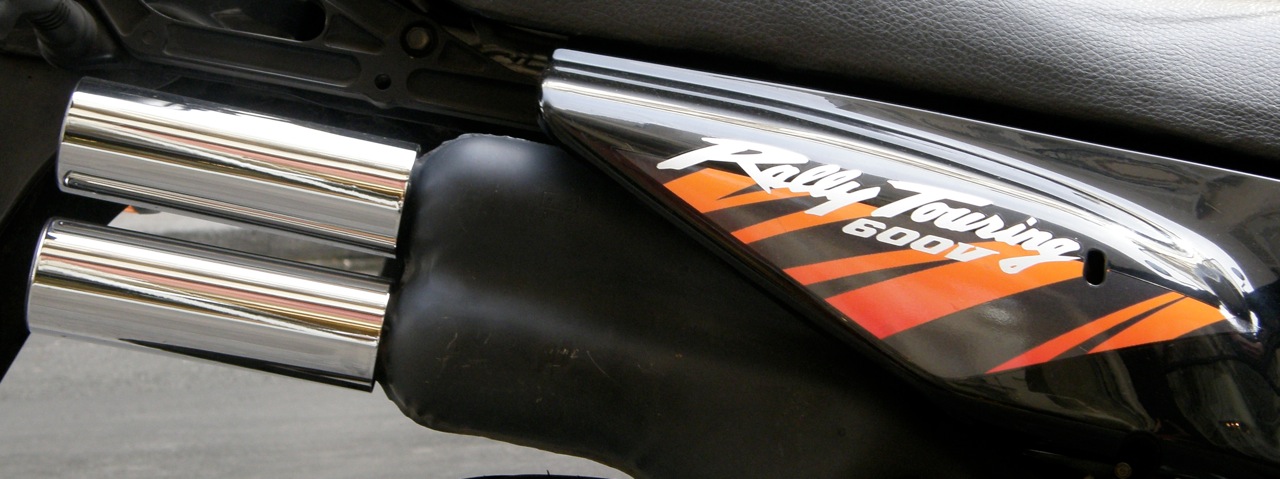
We had started to sate our need for beauty and colour in Artcurial, then in a few shops on the Avenue Montaigne. Surrounded by conspicuous prosperity, I caught sight of the bright orange and subdued grey paint of a Triumph motorcycle. In pursuit of an interesting photographic angle, I knelt to peer closely at the exhaust pipe, cylinder head, and braided stainless steel line shown above.

The sidewalk was crowded. Philippa is not usually surprised when I stop or wander off with my camera. But this time she whispered: “What are you doing down there?” I was unaware of the small crowd I had attracted until I walked away. I looked back and saw 5 or 6 people bent over the motorcycle, peering at it. One was even kneeling. We had a private chuckle and later Philippa told me how much she liked that shot.

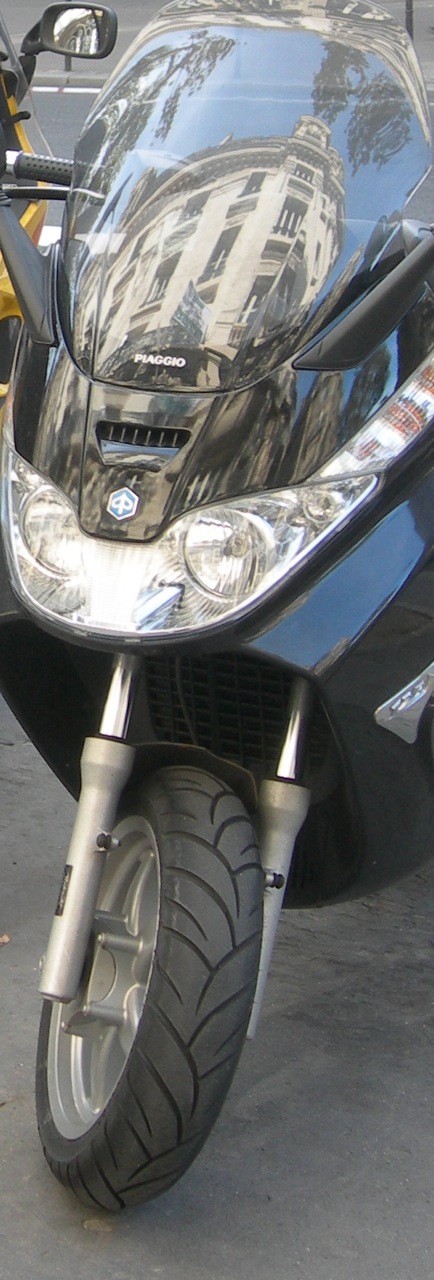
Many of my memories of Paris are expressed in reflections. This is what happens when one walks slowly and stops often. A passing blur becomes a building etched on the windscreen of a Piaggio.
In the shot below, my attempt to capture the vivid blue, bright chrome, and curves that reflect the surroundings almost into pure abstraction brought another accidental crowd. The same thing happened as I captured some exhaust pipe and muffler studies I might use for another purpose.

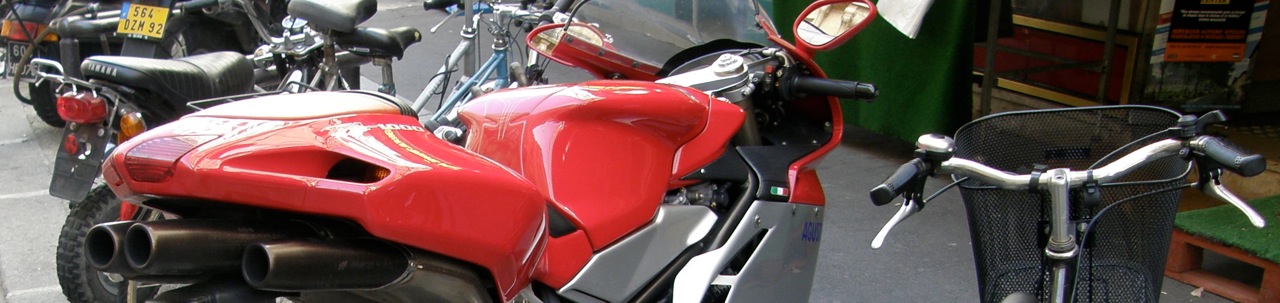
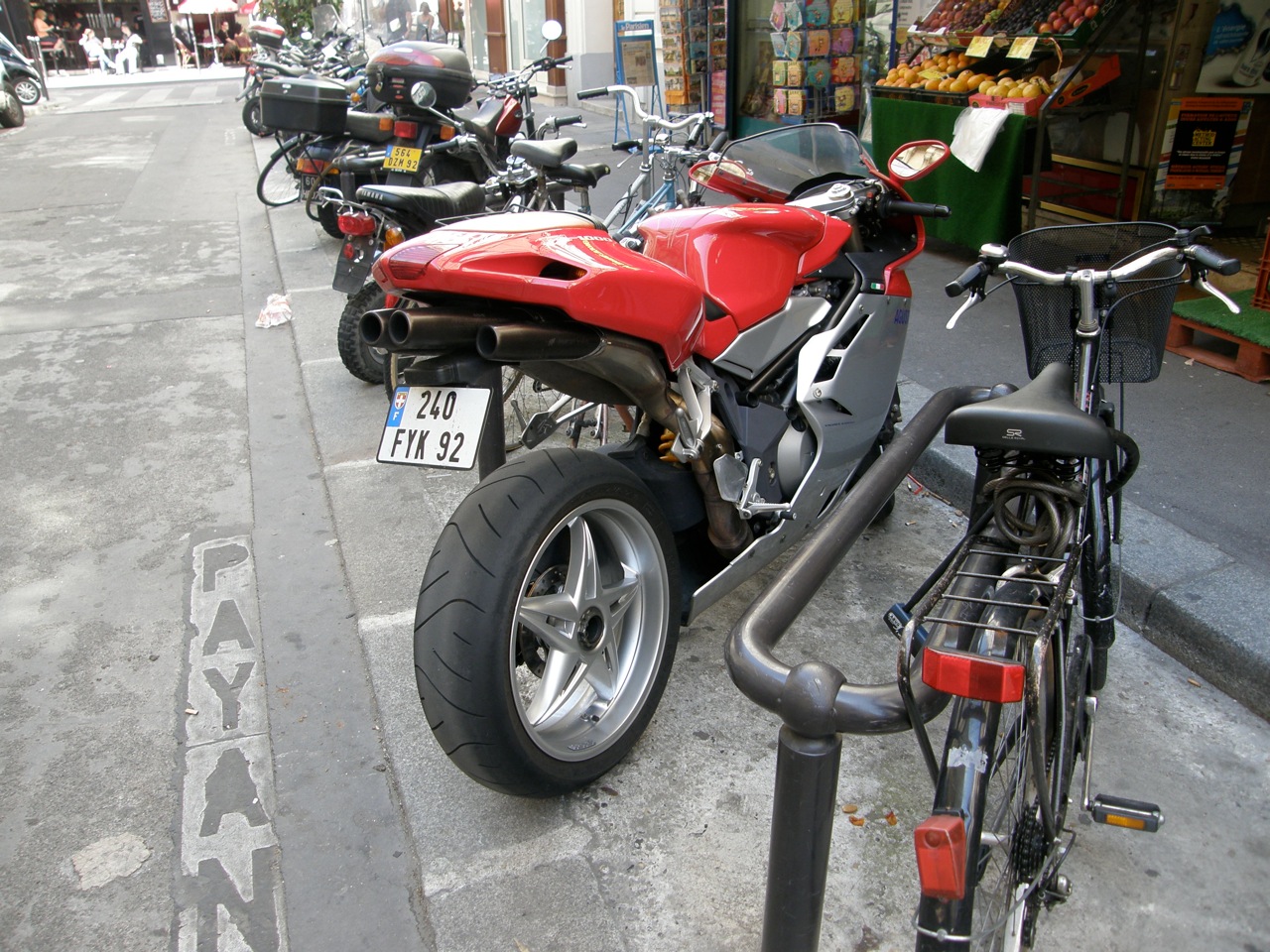
Sometimes the makings of vivid memories just jump out. I like red. The red on this motorcycle screamed at me, a welcoming scream, I might add.

Screaming red and voluptuous bodywork deserved a full stop and some major gawking. That was just the beginning. I looked closely. This stunning piece of machinery was an MV Agusta and when I saw it I had no one to share my excitement with.

I might have been a bit incoherent and reverently mumbled something about “Meccanica Verghera Augusta.” I had read about such machinery from my teens but never seen one this close. MV Augusta, a company founded in 1945, made its first motorcycle the following year and also won its first race the same year. Many times a World Champion.

Ah Paris, you are so good to me.

I spotted this Honda about the same time as the owner spotted me. It had an appealing chunky design and the orange and chrome winked at me in the sun. As I recall, someone asked why I was looking at the bike. I told him it was very good looking and I like motorcycles. He just stared at me. I asked if could take a picture. He nodded and said he worked in the store right behind us. He walked off, but his eyes stayed on me.

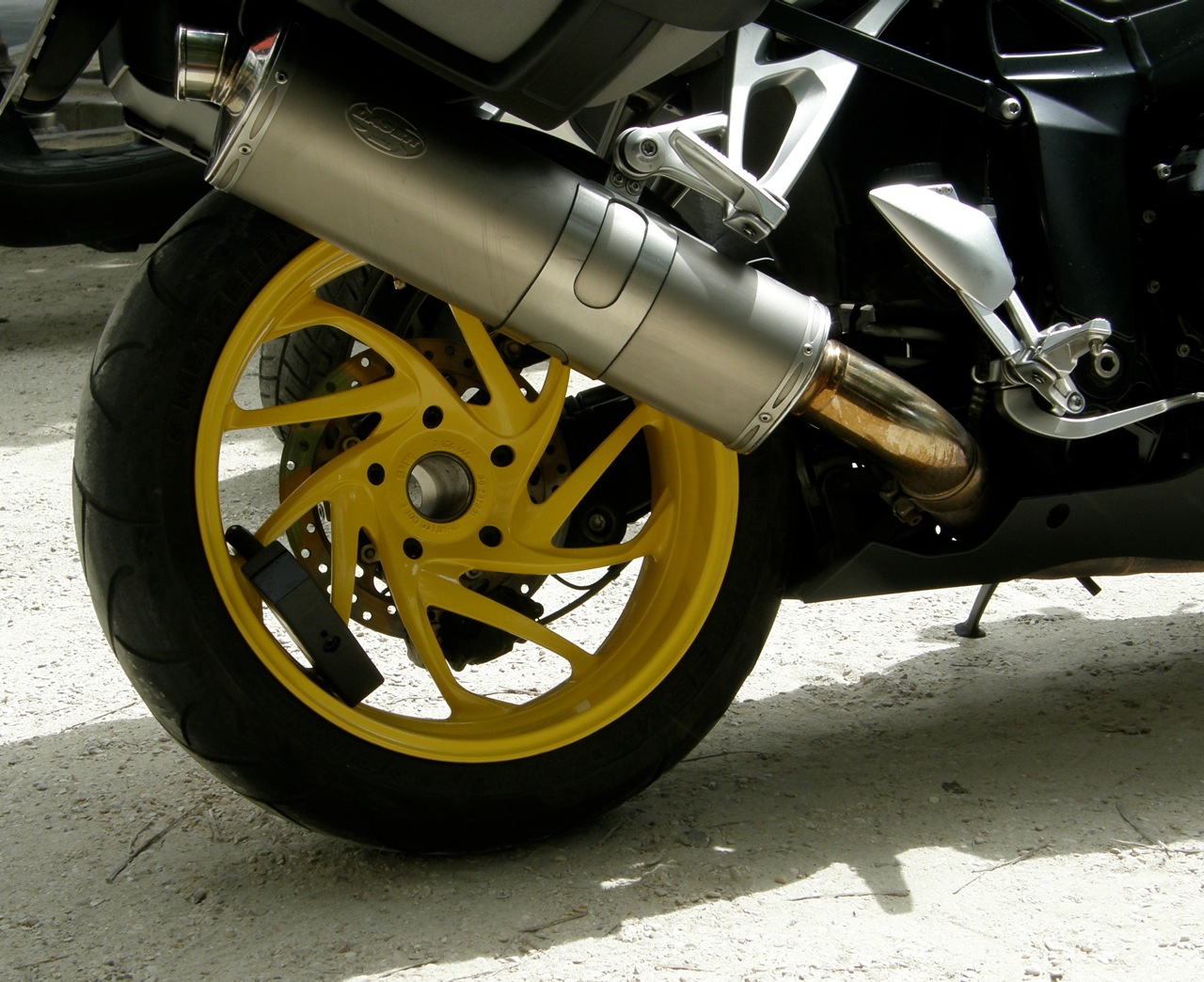
Sometimes brightly coloured wheels seem too joyous to ignore.

As many know, Paris (with or without champagne, absinthe, or wine) can be very intoxicating and disorienting. Here a lonely scooter helps us decide which way is, well, down.

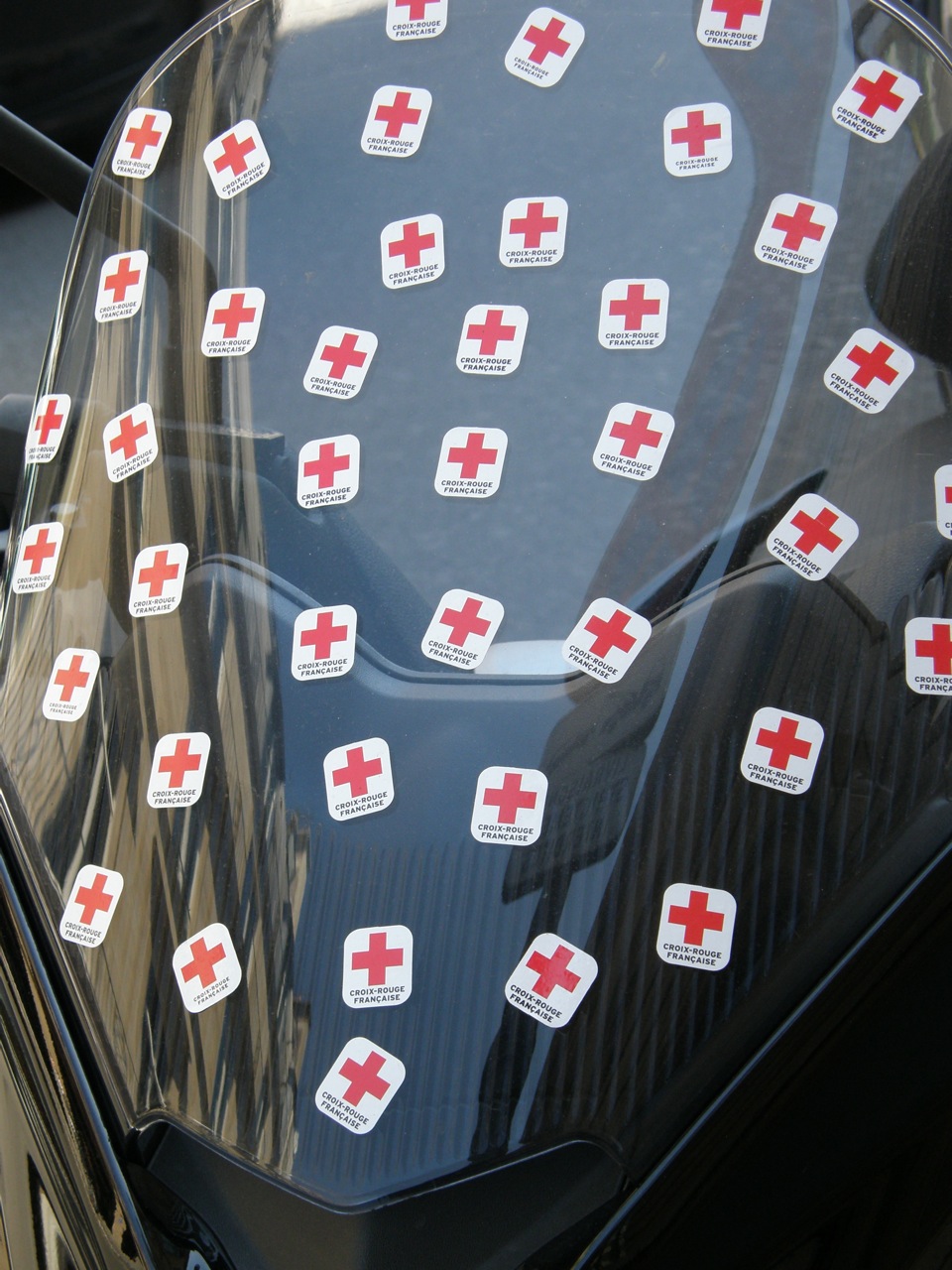
The anthropologists and art historians tell us we decorate ourselves as a means of expressing both individuality and belonging to a group. Sometimes the symbols are fairly straightforward. And I recognize the one below. But plastered all over the windscreen of a scooter in the heart of Paris? I’ll let you work on that message. Let me know your theories or stories.

In Paris I also enjoy distinctive motor sounds and have often surprised Philippa by identifying them by name before we see the source. I ask, who could not possibly appreciate the differences between the sound of a Ferrari in full scream and a Porsche winding up into its own roar? Or not physically feel the spine-tingling, ear-biting whine of a high-revving, motorcycle engine just shy of the redline?

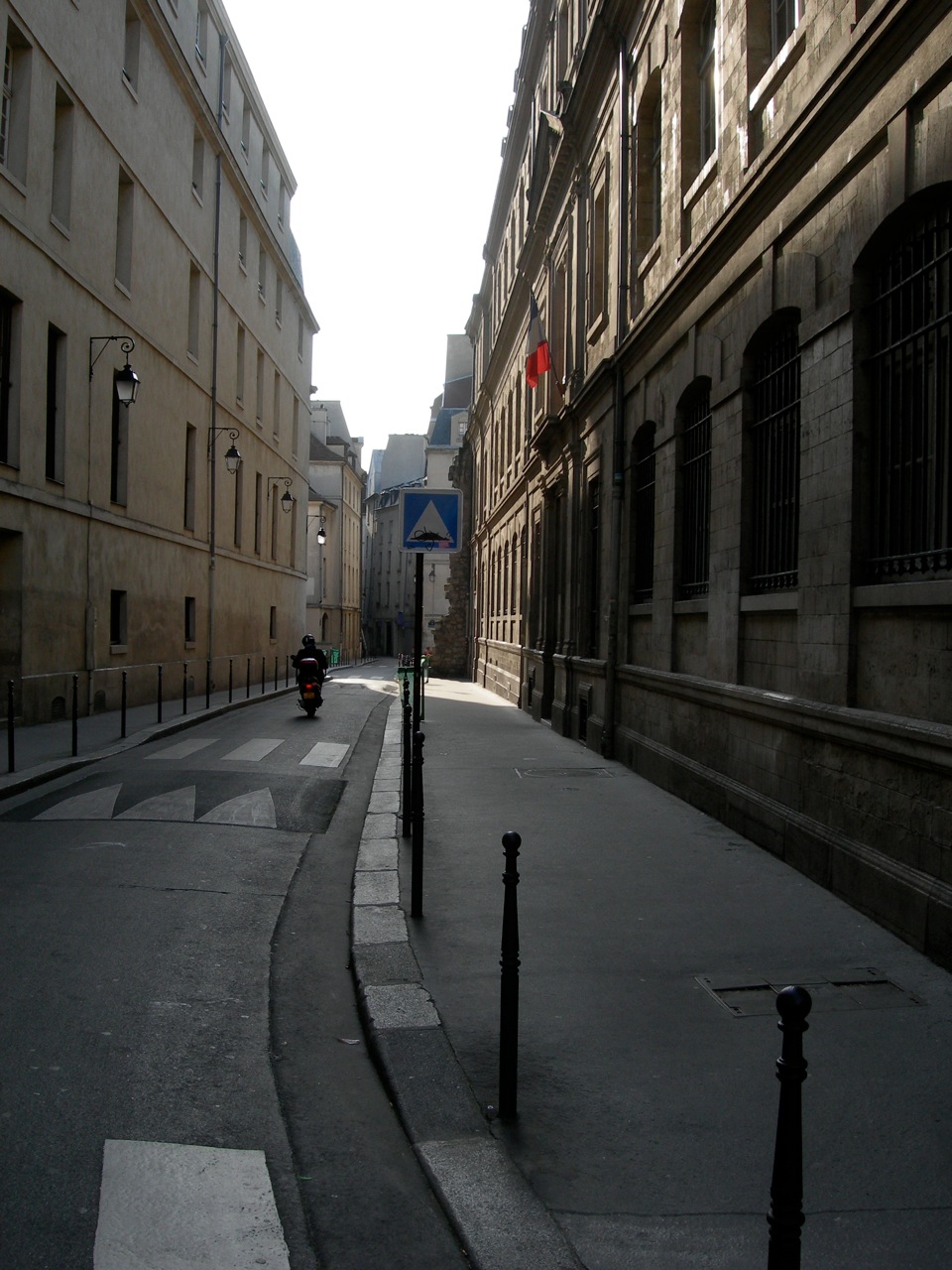
What do two wheels and a motor mean to me? I have tried to share the beauty and the wonder, and how they reflect the familiar into the newly almost-familiar. But there is something else. Despite all the light-change drag races on rue de Rivoli, two wheels and a motor in Paris mostly say quiet and remind me of walking home. I started to feel at home in Paris — even though regrettably it has never been our full-time home — when we rented an apartment in the Marais. We rented it three times and the sight of this lone motorcycle and a relaxed French flag still reminds me of that time and says home.

Text and photographs by Norman Ball

Posted in City of Reflections, Paris automotive | Tagged , , , , , , , | 6 Comments

The bouquinistes and the photographer of shadows

To quote from last week’s blog by Norman: “The sense of continuity is part of the fascination of learning more and more about Paris.”

But it’s not just about the continuity of major monuments and landmark buildings. It’s also the year-in, year-out sight of sidewalk cafés and Wallace fountains or the smell of the Metro (some people hate it; I am not one of them) or the yee-haw sound of police cars fighting the traffic. And among these elements of continuity there is one that never fails to surprise me in its persistence: the bouquinistes by the Seine.

Every year, I am amazed that in the days of iPads and eBooks and all those other things that start with single lowercase vowels, there is a place for the sale of faded copies of Paris Match, dog-eared pulp fiction, and recycled editions of the classics. How do these people survive?

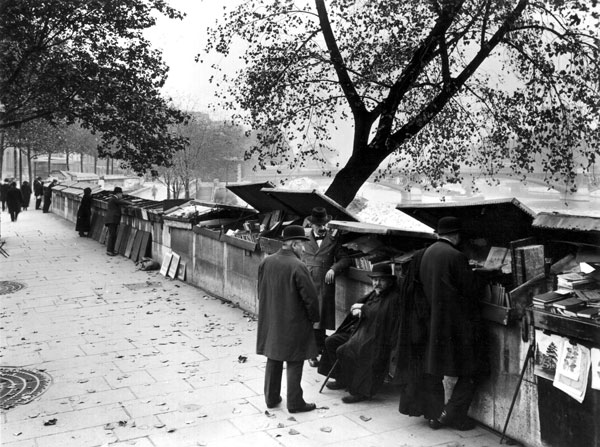
From a book called Paris: Discovering the City of Light,* I learned that there are about 250 bouquinistes, all of whom are officially registered with the City, as they have been since 1891, although the open-air booksellers were operating long before this regulation took effect. The city stipulates the colour of the boxes (dark green), the dimensions (8.2 metres long and 1.1 metre high), and requires the concession holders to be open at least four days each week.

But it was the information uncovered by David Downie in Paris, Paris, that really surprised me. There is a waiting list for those 250 spots, and people spend an average of four years waiting to get a box of their own. And the average age of the bouquinistes is going down, not up. Downie suggests that this is “proof of the profession’s stubborn vitality or, perhaps, an indication of a desperate economic situation that drives the young toward marginal businesses.”** Maybe it’s a bit of both.

Downie regularly frequents the bouquinistes’ stalls and has talked to them about their lives. One, a fourth-generation example of the species, told him that they really survive by selling souvenirs and tourist knickknacks, but they are required by law to devote a certain proportion of space to books nonetheless. The books come from flea markets and yard sales in suburbs and small towns. Some of the bouquinistes specialize – one focuses on books about jazz, for example, another on books on his native Brittany, still another on books published by La Pleïade.

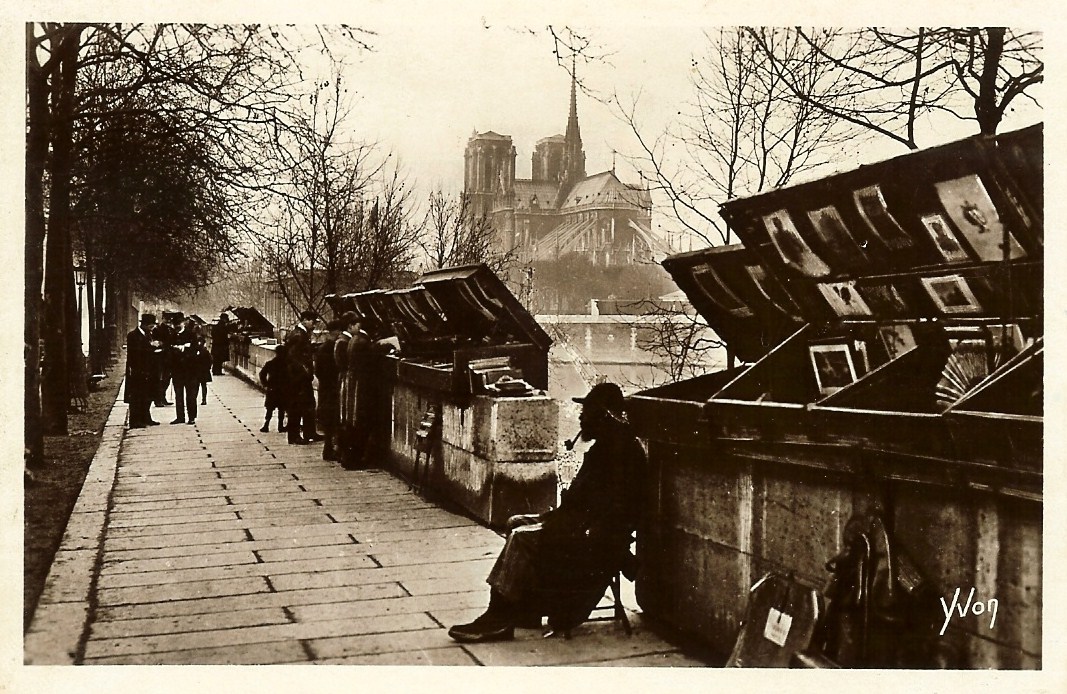
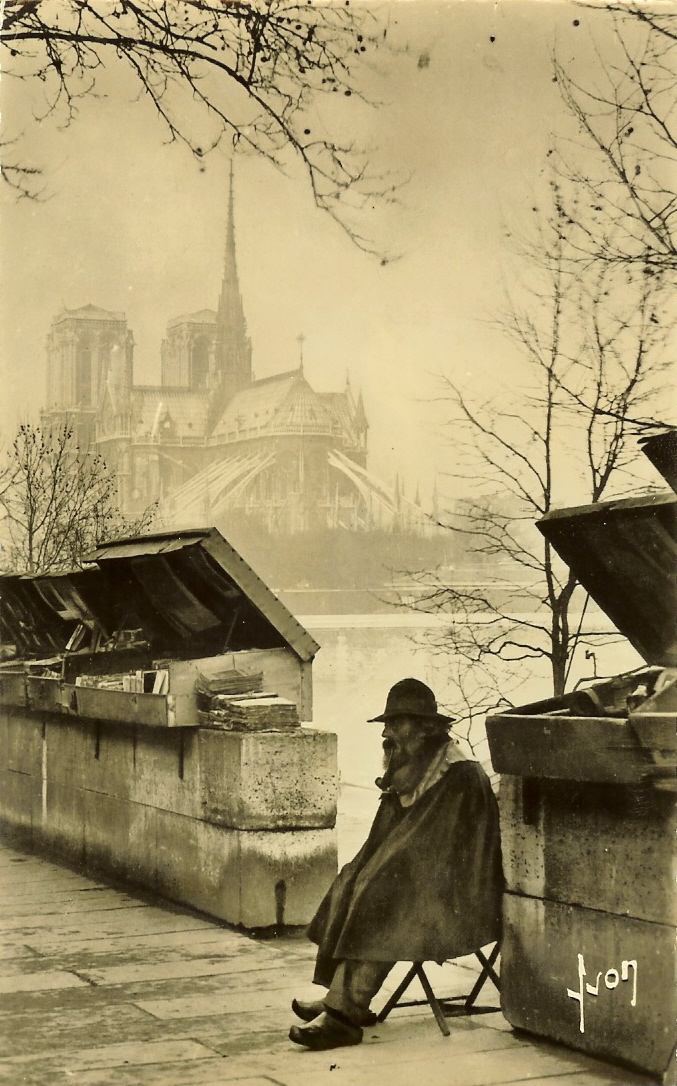
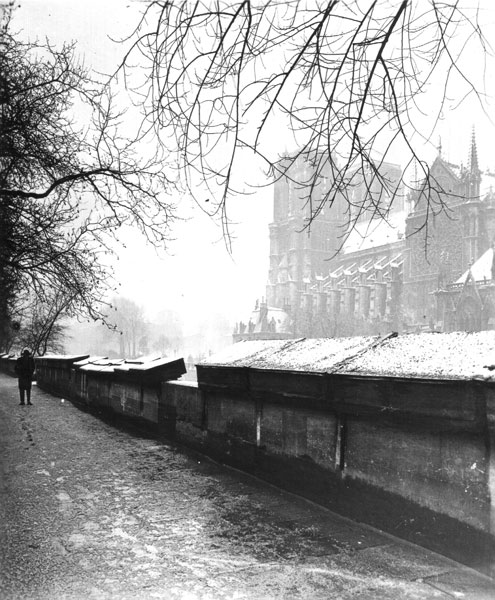
About 90 years before Downie published his book, another flâneur took an interest in the bouquinistes. The photographer Pierre Petit, better known by the single name “Yvon,” one day came across an old bookseller wearing a shapeless hat, a cloak over his shoulders, and wooden sabots on his feet. He was sitting on a folding stool and smoking a pipe. Yvon asked if the bookseller would pose for a photograph. Times weren’t good then either (this was just after the First World War), and the man, who was tired and about to close up for the day, asked for payment. Yvon gave him five francs and proceeded to take what is probably the most popular and frequently reproduced image of the bouquinistes.

Actually, there are at least two very similar images, one in landscape format showing the length of the sidewalk with people browsing in the book boxes in the background, and a second in portrait format taken closer to the subject and showing him alone, with Notre Dame behind him. I have postcards of each the two images both in black and white and after colour has been applied to each image.

The landscape version shows evidence of retouching (in the days before PhotoShop, this was done on the negative). There must have been a barge on the river with some kind of hoist that was visible just beyond the man, and Yvon has made an effort to minimize it. You can just see a sort of triangular shape in the gap between the boxes. Obscuring it made the man’s profile a bit clearer.

In the portrait version, Notre Dame seems to be wreathed in mist. This is a typical Yvon hallmark. Photographers of the day who took landscape shots for use as postcards tended to shoot in full sunlight. Come to think of it, most contemporary postcard photographers still do this, with bright blue cloudless skies (when people use the term “picture postcard view,” this is what they mean).

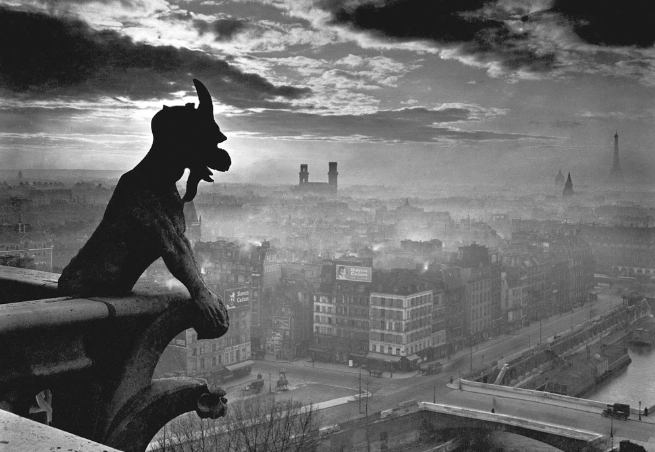
Yvon, however, went for the mood shots – early mornings or dusk rather than noon, rainy and misty days rather than sunshine, and off-seasons rather than high summer. He was one of the first to photograph the fierce gargoyles on the top of Notre Dame against a turbulent sky, creating images that have inspired generations of gothic mystery writers and film noir cinéastes.

Yvon bought his first camera at the age of 12. He stole some money from his father to do so, but his father recognized passion when he saw it and apparently forgave him. He went to work for an electric company before the First World War, but spent his free time as an amateur photographer. A bout of polio as a child had left him with a deformed foot, so he was not sent to fight when war broke out. After the war, he began to provide photographs for a magazine called l’Illustration. He used the pseudonym Yvon (a family name) because there was already a well-known portrait photographer who shared his real name, Pierre Petit.

Yvon’s work in l’Illustration was popular, and the editor suggested Yvon use his images for the hot new medium of the time – the postcard. Yvon invested his own money in printing a series of postcards of his distinctive views of the city, and he took the unusual step of including his name on each image. These were not the routine shots of famous buildings typical of postcards at that time, but artistic images born of Yvon’s wanderings in the city, looking for unusual angles or juxtapositions, and playing with the effects of shadows, mists, clouds, and reflections.

Yvon eventually quit his job at the electric company and founded his own company, Editions d’Art Yvon. At first he did it all – managing the printing, the shipping, the sales, and the accounts. Later, he hired some assistants for the office work so he could devote himself to photography. Apparently he was not much of a family man (he had a wife and three daughters) and preferred to be out with his camera. As his business grew, he travelled all over France taking images for his distinctive branded postcards.

In the 1930s, the postcard business was booming, and Yvon did well. During the Second World War he began to experiment with colour photography. In the 1950s, he sold the business, but he continued to take photographs right up to the end of his life in 1969 at the age of eighty-three. The company, Editions Yvon survived until earlier this year, when it merged with a company called La Carterie.

Yvon’s shot of the old bookseller was not his only image of the bouquinistes. There are several others in the only book devoted to his work.*** He even took a wonderful shot of the closed boxes covered with snow in winter. Maybe he wondered, as I do, how those people kept going year after year.

Text and contemporary photograph by Philippa Campsie.

*Kurt Ulrich and Dominique Lesbros, Paris: Discovering the City of Light, Bucher, 2007, p.17.
**David Downie, Paris, Paris, Broadway Books, 2011, p. 128
***Robert Stevens, Yvon’s Paris, W.W. Norton, 2010.

Posted in Paris bookstores, Paris postcards | Tagged , , , , , , , , , , , , , , , , , , | 12 Comments

Food, drink, and lodging in Paris postcards

In a sense, all postcards are a form of advertising. Some advertise the sender’s good fortune or superiority: “Hi. I’m here. You’re not.” Others advertise the attraction itself: Kozy Kabins in Niagara Falls, the highest rotating restaurant west of the Mississippi, or the world’s only combined alligator-and-ostrich farm.

I prefer the more traditional product ads, particularly those from Paris. Consider the one below.

I am fond of this card for several reasons. The subject, L’Église Sainte-Marie-Madeleine (the church of Saint Mary Magdalene) in the 8th arrondissement at the end of rue Royale is a beautiful building. Often called simply La Madeleine, it has a complicated history.

The spot on which is stands was once the site of an early synagogue, seized by Bishop Maurice de Sully in 1182. This was the beginning of a centuries-long tale of various attempts at building, a succession of architects, most of whom tore down their predecessors’ works.

Napoleon’s 1806 decision to build a Temple to the Glory of the Great Army led to a new round of architects, designs, more tearing down of various bits, followed by a loss of focus when the Arc de Triomphe du Carrousel was completed in 1808. Then Napoleon lost his job in a hostile takeover.

During the Restoration, Louis XVIII decided the structure should be a church. More architects, more competitions, more demolitions, and continuing confusion. In 1837, when trains were the coming thing, someone suggested turning the building into a train station. But reason (or faith) returned and it was consecrated as a Roman Catholic Church in 1842.

The interior is stunning, but I am particularly taken by the august exterior of this Neo-Classical style building. With its 52 Corinthian columns, each 20 metres high, it does not seem pretentious, but dignified, reassuring, correct. Even with the traffic that roars about it today, I find it calming just to be near it.

The card above was designed for and printed at the International Exposition in Paris in 1900. It reveals another religious connection. Or an advertisement. Look at the lower left: BENEDICTINE. The Benedictine monks of Fécamp were pioneers in the European liqueur industry. On the address side of the card is a beautifully designed and printed ad. Subtle. I like it.

The image below is from the same Exposition. I love the detail and the sense of perspective, which leaves room for writing, a reminder that at one time it was forbidden to put your message on the address side of the card. In the background to the left, we see the familiar Eiffel Tower built for the 1889 exposition and the more short-lived giant Ferris wheel built for the 1900 Exhibition.

The building with the turrets facing the river is the Palais de Justice, whose list of involuntary “guests” includes Marie Antoinette, Robespierre, and Napoleon III. If you look carefully on the bridge, the Pont de Change, you will see my first initial in several places. Alas, it does not stand for Norman, but for Napoleon III, who had it built as one of his many projects to modernize Paris. Look at the other side of the card.

This is even subtler than a fine bottle with ribbon and medal. It is the wrought-iron fountain in the Benedictine square in Fécamp. In this town, Alexandre Le Grand “rediscovered” the Benedictine Liqueur recipe originally created in 1510 by the monk Dom Bernardo Vincelli. If you are 18 or older, you may sign into this website to learn more.

But men and women cannot live on Benedictine alone. If you go to Paris, you’ll need a place to stay.

The card above advertises the Hotel Régina on the rue de Rivoli. It exists today under the same name. Philippa and I have walked by it many times. This card was issued to announce that it would be opening soon, 112 years ago: the first of March 1900, to be exact.

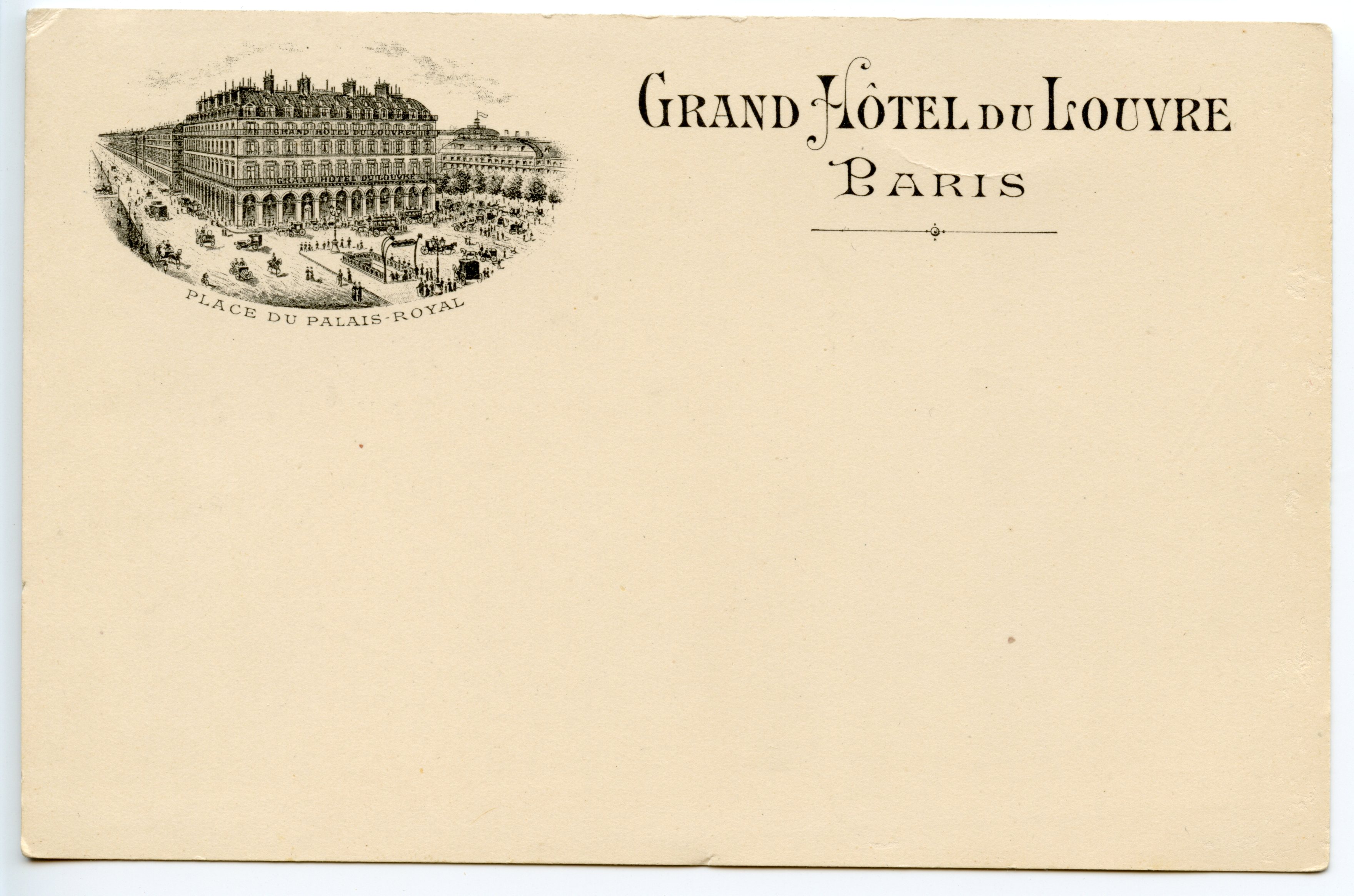
Or you might prefer the nearby Grand Hotel du Louvre.

It, too, exists today. Over the years, the hotel has had quite a roster of guests. The painter Camille Pissarro took up residence there in 1897, Sigmund Freud dropped in while writing about Leonardo da Vinci. The hotel and the atmosphere of the area influenced Sir Arthur Conan Doyle, author of the Sherlock Holmes tales.

The sense of continuity is part of the fascination of learning more and more about Paris. The Hotel du Louvre has been at its present site on the Place du Palais Royal since 1887. There was an earlier hotel of the same name, dating from 1855, a luxurious haven of 700 rooms and a staff of 1,250 on the other side of the Place. But by 1887, the Louvre was expanding, as were the major department stores, and the hotel had to move to a new building across the square. The original hotel still stands and one can visit the many shops and galleries in the Louvre des Antiquaires, 2, place du Palais Royal.

One might ask why such a fine hotel was relegated to such a relatively small image on the post card. The answer is on the back.

There is a clearly marked place for the postage stamp and a warning that that side of the card is to be used exclusively for an address. The message must go on the front, with the picture of the hotel. So space must be left below the image.

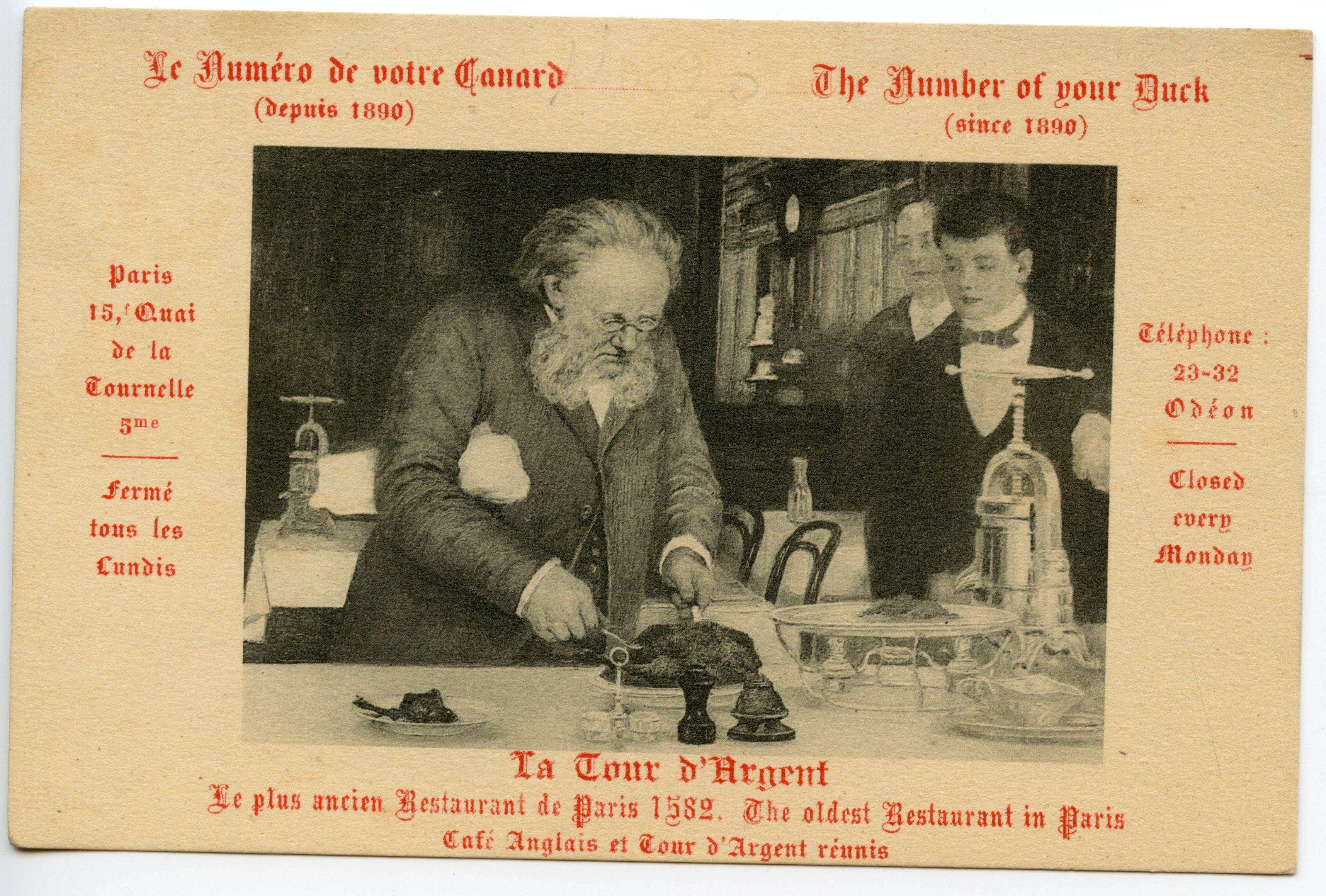
No advertising card that I own says more about continuity of Paris institutions than the one shown below.

The text in French and English provides a wonderful bit of Paris culinary history. La Tour d’Argent at 15, Quai de la Tournelle, in what is now the 5th arrondissement was founded in 1582 during the reign of Henry III as an inn next to a monastery. It got its name from the silvery stone used to build it. The combination of fine food and an equally fine view of the Seine and Notre Dame made it a favourite of the royal court.

Remarkably, it has continued as a popular restaurant. When Julia Child ate there one night in the early 1950s, she described it as “excellent in every way, except that it was so pricey that every guest was American.”

As the postcard indicates, it had merged with the Café Anglais, another venerable name in Paris culinary history. This café opened in 1802 and the name celebrates the Treaty of Amiens, which represented a brief suspension of hostilities between the warring English and French. Initially, it was a downscale eatery for domestic servants and coachmen. Located at 13, Boulevard des Italiens, it attracted the theatre crowd and eventually found favour with the higher levels of French society. It closed in 1913; the original building no longer exists. Instead, it became part of la Tour d’Argent, which also had risen to the highest culinary ranks.

In the mid 19th century, Frédéric Delair became the owner and formalized the famous duck recipe. He was so confident of the quality of his duck, that he numbered each one. Surely a high point in the history of culinary one-upmanship.

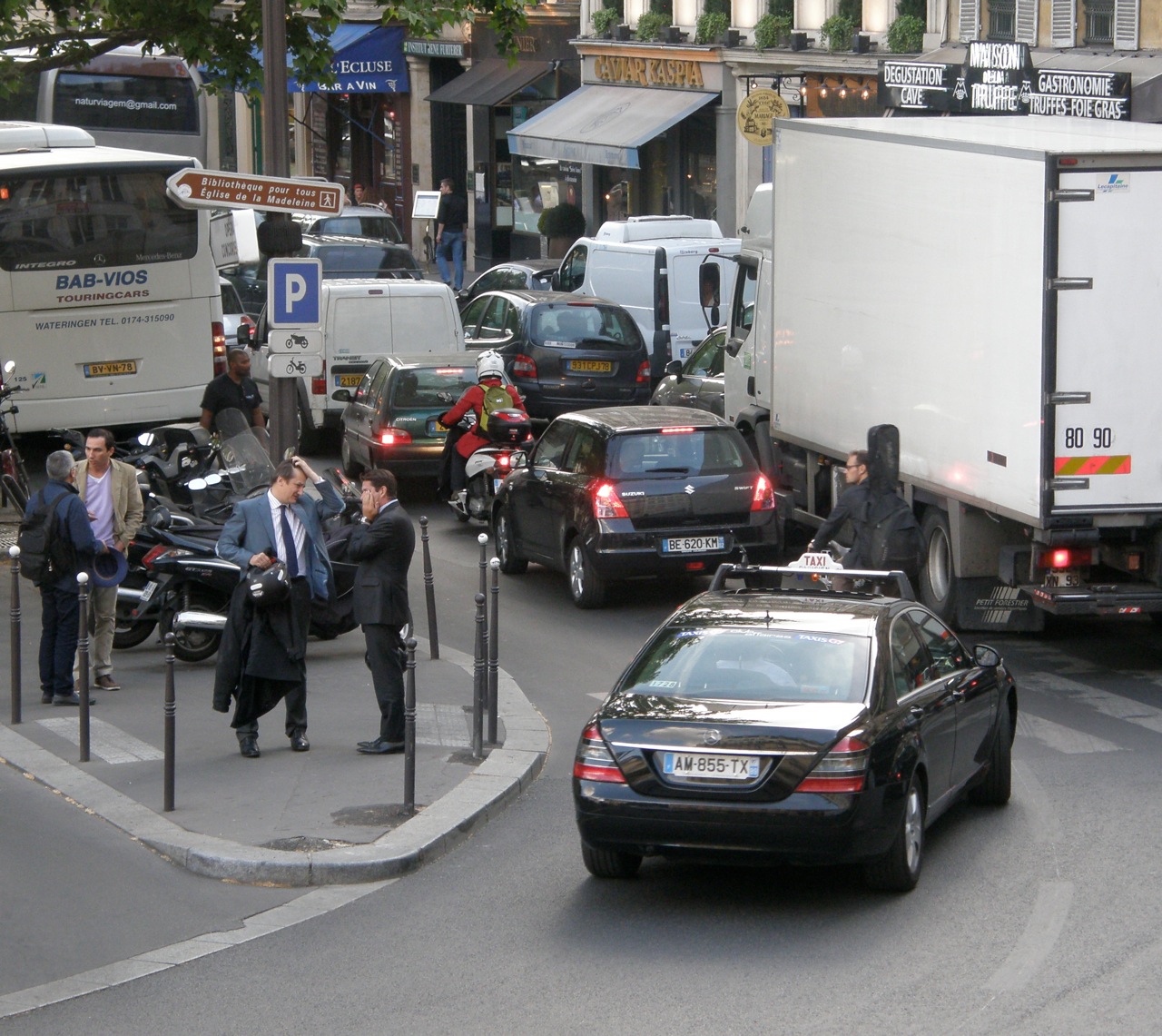
I doubt that Philippa and I will ever savour a numbered duck (the number is well over a million by now). However, we have many fine memories of food and drink in Paris. One afternoon, we chatted over wine in the café on the second floor of the Nicolas store that overlooks the Place de la Madeleine.

We admired the church opposite us and watched the traffic inch along. How I wish we could have overheard the two men deep in conversation as one scratched his head and the other buried his face in his hands.

But mostly we enjoyed the view of la Madeleine and the calm of those who know how to slow down.

Perhaps next time we will order a glass of Benedictine and raise a toast to the creators of early advertising postcards.

Text and photographs by Norman Ball.

Posted in Paris food, Paris hotels, Paris postcards | Tagged , , , , , , , , , , , , , , , , , , , , , , , , , , , , | 12 Comments

Connaissez-vous Paris?

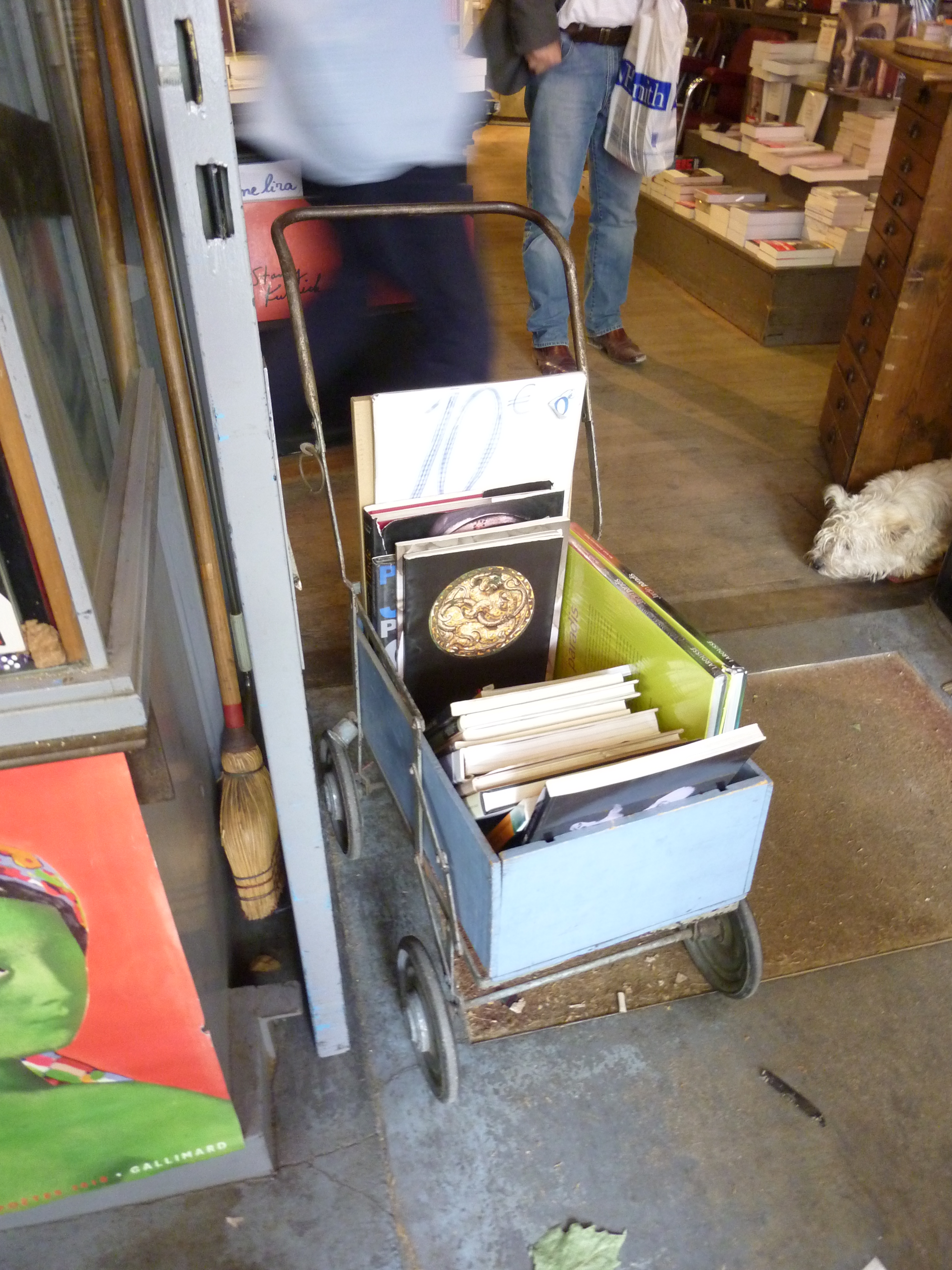
On the avenue Franklin Roosevelt, not far from the Champs-Elysées, is an unusual bookshop. The name, Livre Sterling, is a peculiarly anglophile pun on the fact that the word “livre” in French can mean either “pound” (₤) or “book” and “Sterling” denotes either money or quality.

When we stopped by in spring 2011, the bookshop sported a handmade banner with the words “Un libraire en colère” (bookseller in a rage). Was this a protest against illiteracy and e-books? Only partly. It was a publicity campaign for the owner of Livre Sterling, Emmanuel Delhomme, who had written a book with that title, about the joys and perils of bookselling in a non-literate age.

We made several visits to the bookshop, a delightful cavern filled not only with books, but with toys and odd objects on upper shelves and hanging from the ceiling. There was a resident dog, and inviting displays of books old and new on big tables.

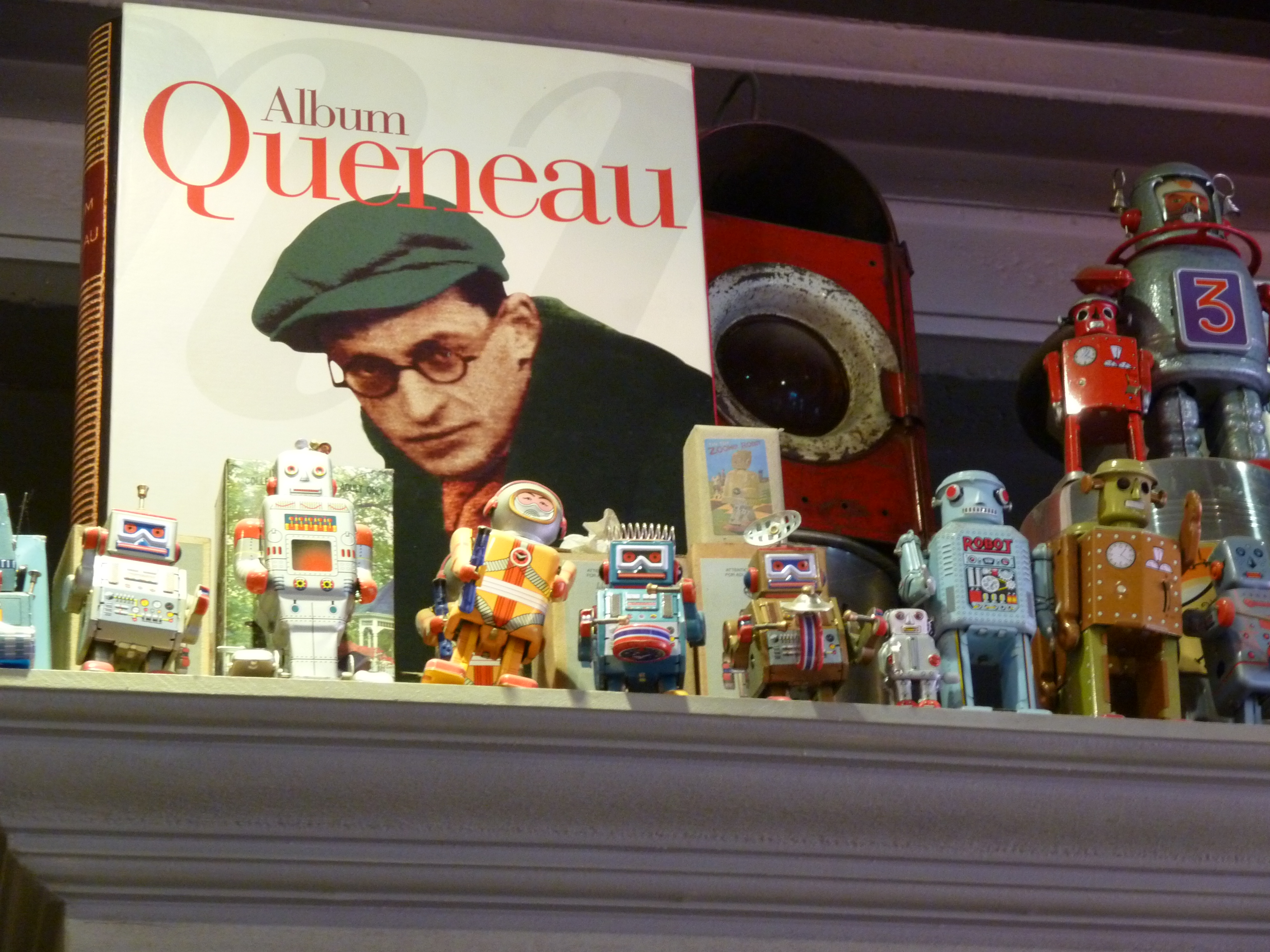
On a shelf, I spotted a photograph of Raymond Queneau. He is probably best known as the author of Zazie dans le Métro (1959), a novel that was made into a film by Louis Malle the following year. It’s the story of a little girl with very odd relatives who visits Paris and explores the city during a metro strike.

The novel apparently caused quite a stir at the time because of its use of informal language. Well, thank heaven for Raymond Queneau. Because of him, I can read modern novels that dispense with hyperformal grammar (the passé simple and the dreaded conditionnel deuxième forme) and tell stories in the kind of language one learns in French conversation class.

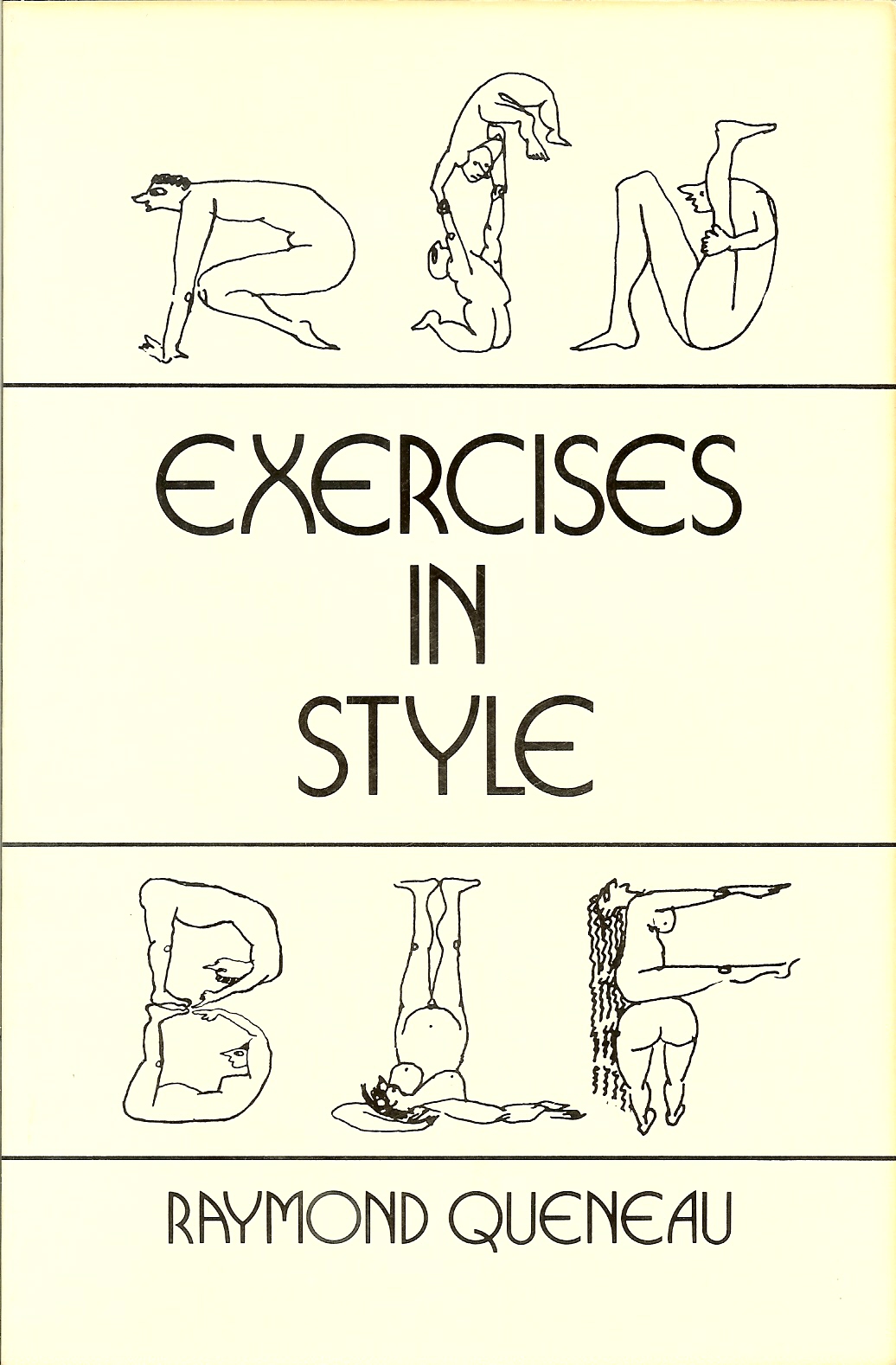
My own introduction to Queneau was actually through a translated version of his 1947 book, Exercises in Style. This is a series of short riffs on the same story (a minor incident on a Paris bus), told repeatedly using every conceivable variation on style: forwards, backwards, using metaphors or repetition, as a sonnet or Q&A, in the style of an official letter or a book blurb…99 variations in all. It’s a tour de force that should be studied by any aspiring writer.

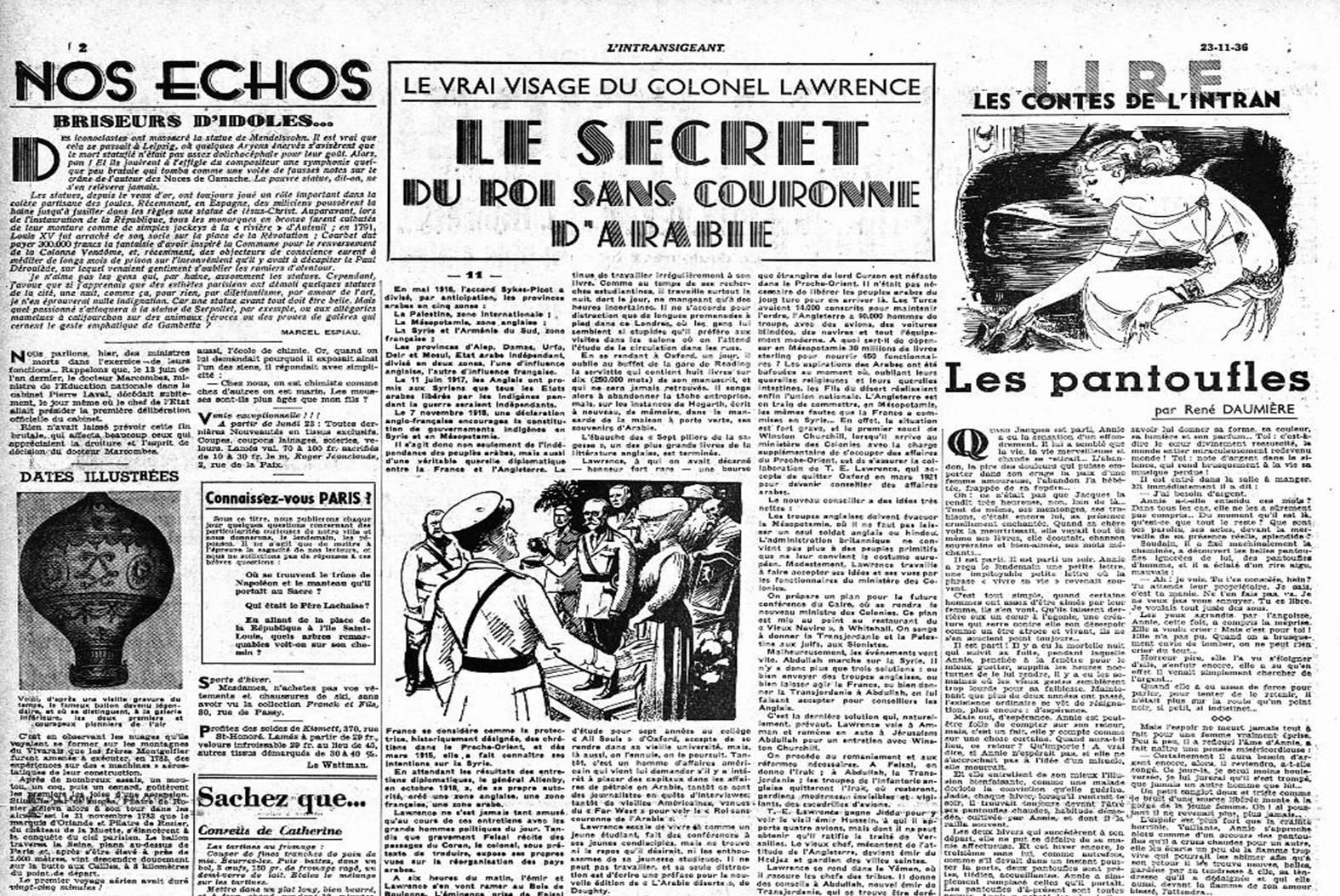
Foraging among the volumes at Livre Sterling, I found another book by Queneau, titled, Connaissez-vous Paris? (Do you know Paris?) This 2011 Folio edition is a reprint of a 1955 book that contains a series of questions and answers about Paris lore and trivia, originally published in the pages of the newspaper L’Intransigeant, at the rate of three a day, between November 1936 and October 1938. The book contains about a quarter of the original 2,012 questions and answers. After all, a lot has changed since the 1930s.

Thanks to Gallica, the online library of the Bibliothèque nationale de France, I was able to see the very first appearance of this feature in the newspaper, on November 23, 1936, page 2. One of the three questions remains on the first page of the 2011 paperback: Qui était le Père Lachaise? (Who was Pere Lachaise? Answer: He was the personal confessor of Louis XIV, who lived in a house situated where the cemetery is now.)

In his introduction to the compilation of questions that was published in 1955, Queneau explains how he chose his questions. They couldn’t be too banal, and they couldn’t be too obscure. So no questions about the location of the Eiffel Tower or the name of the restaurant owned by the father of someone who was himself not all that well known. Queneau continues:

I thought I knew Paris pretty well, but in working on the questions, I realized that not only did I not know Paris, but that hardly anyone could say they knew Paris all that well. I started with Rochegude [Le Marquis Félix de Rochegude, author of Promenades dans toutes les rues de Paris par arrondissement, 1910], replaced these days with Hillairet [Jacques Hillairet, author of Dictionnaire historique des rues de Paris, 1935], and even though they were separated by less than 30 years, Rochegude had noticed many things that had since disappeared, quite simply, without revolutions or bombing… “The form of a city changes faster, alas, than the heart of a mortal” [Baudelaire].

Queneau’s questions are usually about location (where did Debussy die?) or date (when was the Saint-Louis Hospital founded?) or the origins of street and district names (where does the name of the Quartier des Enfants Rouges come from?).* Should you ever have to play a game of Trivial Pursuit based on your knowledge of Paris, the book would come in handy.

Like Queneau, we have found that in attempting to convey knowledge about Paris, we are learning all kinds of things we didn’t know before. One day, perhaps, we will write our own version of Connaissez-vous Paris? It probably won’t have as many famous personnages and street name origins as Queneau’s book, but judging by the page-views on the blog, we can provide some answers to questions people actually have. For example:

1. Why are there bits of rolled up carpet in the gutter? (check last week’s blog)
2. What caused the flood of January 1910?
3. How does one get change for a 500-Euro note?
4. Where was the first Ferris wheel in Paris and what happened to it?
5. What are those stone or iron objects at the edges of archways into Paris courtyards?
6. What is the story behind Rodin’s famous bronze casting of the Burghers of Calais?

So many questions, so many stories to tell. And because each blog takes us quite a while to research, we have decided to publish every second week from now on instead of every week. We wouldn’t want to sacrifice quality for quantity.

So we’ll see you in two weeks, and the story we tell may be the answer to a question you didn’t know you had.

Text by Philippa Campsie; photographs by Philippa Campsie and Norman Ball

*Claude Debussy died on March 26, 1918, at 24, square du Bois-de-Boulogne. The Saint-Louis Hospital was founded in 1607 by Henri IV for plague victims. The Quartier (and the Market) named for the Enfants Rouges (Red Children) comes from an orphanage in which the children wore red uniforms.

Posted in Paris bookstores, Paris travel | Tagged , , , , , , , , , , , , , , , | 7 Comments

A most unusual water system keeps Paris clean

I was alarmed the first time I saw water pouring out of what looked like a sewer grate and onto the road. Now, I watch for such a sight. It is another manifestation of the enlightened engineering, design, and vision that make Paris civilized. After all, the word city comes from the same root as civilized.

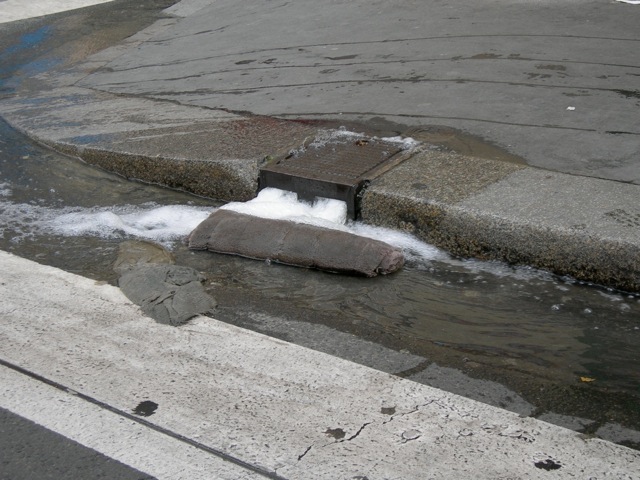
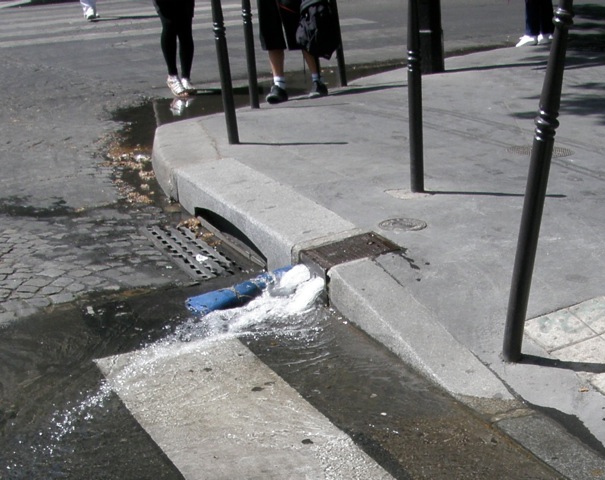
This photo tells part of the story of how Paris streets are cleaned. Water under relatively low pressure is emerging from a curbside opening, of which part of the cover is on the sidewalk. These are called WOs (washing outlets) or, in French, bouches de lavage, and there are 12,000 of them in Paris. In most cases, an old piece of carpet diverts the water from the road. The idea is to keep the water in the gutter where the sidewalk curb meets the road, so it can collect assorted debris and flush it into the sewer system.

Paris is also about style, fashion, and colour. So in the photo below red and green carpets add a little panache to engineering function. Notice the larger of the two holes on the checked cover plate inset into the sidewalk. That is where workmen insert a special wrench to turn the water valve to start or stop the flow of water.

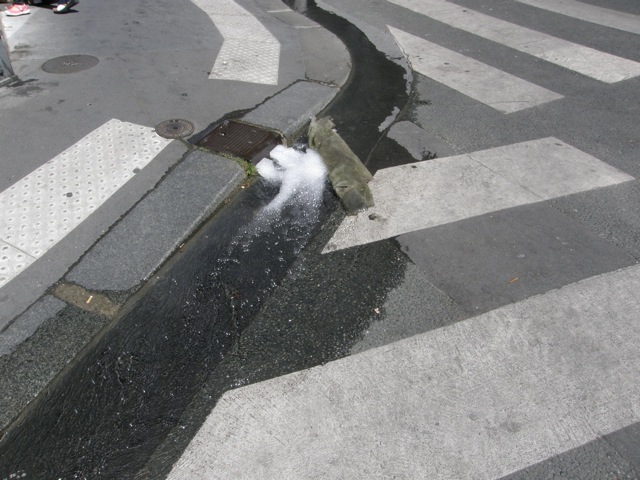
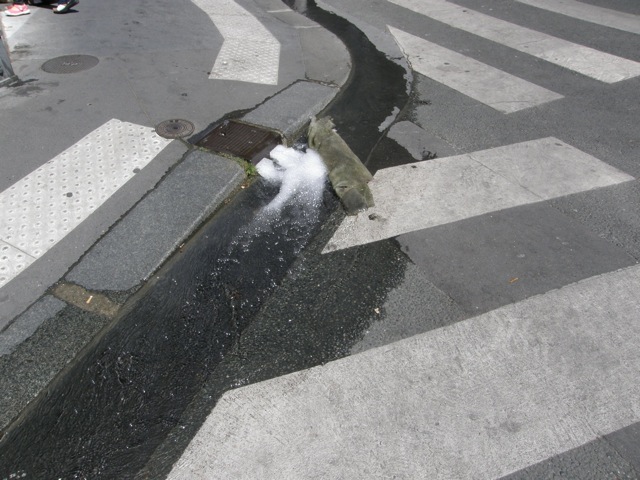
In the photo below, we see that the piece of carpet is placed so that the water can go in one direction only. Any street debris will be carried along with the flow of water. In some cases the water flows undisturbed or unaided.

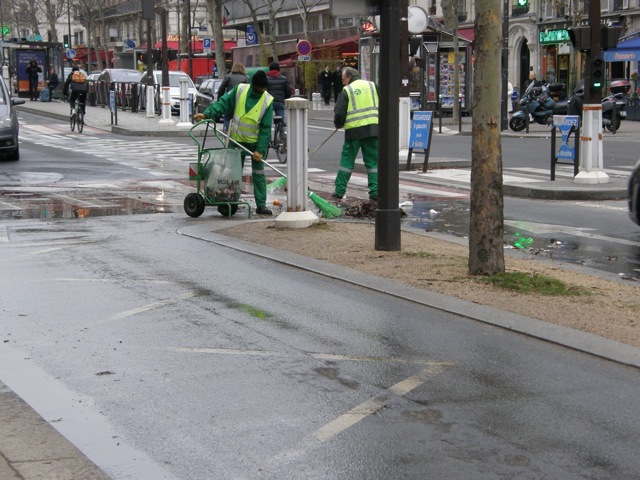
Paris’s men in green often give the water a helping hand. Here, on the rue du Faubourg St Jacques, near the Boulevard Port-Royal, water is flowing along the curb while two workers keep the debris moving where the tires of parked cars obstruct the flow.

Sometimes, as we see in the image below, there is a large amount of debris—after all, the Marché Port-Royal across the street had closed a short time ago—and it is skilfully and quickly swept together by the same two workmen. The larger pieces and clumps of leaves, paper, plastic and other rubbish go into the plastic bags in the cart. The rest will be swept away.

It is all part of an ingenious cycle. In the photo below, the blue carpet directs the water towards us and it flows down.

However, when one looks just behind the bit of carpet (upstream, so to speak), we see an open grate at road level. This is where the water from further upstream would bring its debris and re-enter the system. But this is no ordinary system, and Paris is one of the few cities in the world to have it.

How does it work? Why is it there?

Most cities have only one system to supply water, which is used for everything from making coffee, cooking, and taking a shower to cleaning streets, fighting fires, and watering gardens. Whether the water needs to be potable (safe to drink) or not, it all comes from the same place and the same set of supply pipes. We want our drinking and bathing water to be treated and purified, but it is expensive and energy-inefficient to have water for street cleaning or lawn-watering treated to the same standards as potable water. Nevertheless, that is what we do in virtually every city in the world. Well, not every city. Not in Paris.

In Paris, there are two different sets of underground water pipes. Both are attached to the ceilings of the sewers. One supplies untreated water for tasks such as flushing the streets of Paris. One system and set of water pipes carries untreated (non-potable) water from the Ourcq Canal and the Seine. The water comes out at various places through WOs on the curbs and after cleaning the streets and gutters, flows into the underground sewers. This water is then treated and discharged into the Seine. There is a parallel but separate system to deliver potable water to buildings, residences, homes, stores, and restaurants.

In other words, there are two water supply systems, each serving different purposes and each having varying purity levels. There is no mixing of water from the two systems, so don’t worry when you drink Paris tap water; it is safe and I like the taste. If you want to know more about the Paris Water Supply visit Le Pavillon de l’eau (Paris has got to be one of the only cities with an entire museum devoted to its water and water supply).

The Paris dual water supply system makes good sense. But it works only because it was part of the original plan for radical modernization of the city in the mid-nineteenth century. It would be too difficult to retrofit most modern cities to the same standard.

For this, we have to thank several people: Napoleon Bonaparte, the Emperor Napoleon III, Baron Haussmann, and a brilliant engineer called Eugène Belgrand.

Napoleon Bonaparte gave Parisians their first abundant supply of flowing water when he diverted the river Ourcq into the Seine within Paris. This is now known as the Ourcq canal.

Emperor Napoleon III (shown above) decided that for his greater glory and the greater comfort, convenience, and future fame of Paris, he had to modernize it, getting rid of many narrow crooked streets, opening up wide boulevards, and providing it with up-to-date infrastructure.
Carrying out this massive job fell to Baron Haussmann, who in turn chose Eugène Belgrand, a graduate of the world-renowned École Polytechnique, as his Director of Water and Sewers of Paris. Before Belgrand, Paris had had a massive, smelly, and not very satisfactory sewer and water supply system.

Belgrand made the sewage system four times larger than it had been before and when he finished, it was a tourist attraction. He doubled the amount of daily water available to each resident, while the number of dwellings with running water grew by four times.

It was Belgrand who put in the system that separated water for human consumption and water for other purposes. At a time when most water—drinking or otherwise—was not very good, it was an astoundingly far-sighted move. The initial costs were far higher than they would have been for a single system—the system most of the rest of the world has.

The river Ourcq water became the low-pressure non-potable system for what was called “public water” and the new high-pressure water drawn from underground became the “new waters,” a potable source under enough pressure to rise up to the top of the growing number of apartment buildings. Hence the famous signs proclaiming “Eau et Gaz à Tous les Etages.”*

That decision to have a dual water system and its execution keeps Paris streets clean today. And it involves more than water gushing out from a gutter drain and men with green plastic brooms helping it and the debris along.

One morning, as I sat on the balcony of our borrowed apartment, sipping coffee made with good Paris tap water and reading a book on nineteenth-century typewriter design, I quietly gave thanks for the men below who were working to keep the city so clean. One man drove the truck, while another swept the sidewalks with a high-pressure hose. Look at the front of the truck, with its system for spraying water from the movable front-mounted spray units.

The system is not only clean, it is energy-efficient. The truck is filled with untreated water, the kind of water that most cities in the world cannot reuse. The Velib’s are not the only thing in this picture to lower the carbon footprint of Paris.

If this photo represents part of what draws you to Paris, remember that only a minute later, I took this photo.

Thank you, Napoleon Bonaparte, Napoleon III, and the often-maligned Baron who carved the future out of the past and I think did a good job of a difficult task. And thank you also, Monsieur Belgrand. I intend to learn more about you. The city we love is built on the unglamorous but essential workings of its water systems, which were far more efficient than any others. This is just one of the many pieces of infrastructure that makes Paris so livable and, might I say, loveable. Paris’s dual water system is just as much a part of the Technology of Tourism as the Eiffel Tower.

Text and photographs by Norman Ball

*For a good introduction to the changes of Napoleon III and Baron Haussmann follow this link.

Posted in Paris streets | Tagged , , , , , , , , , , , , , , , | 43 Comments

A walk in the snow

No trip to Paris would be complete without at least one lengthy visit to Des Photographies, an intriguing shop in Village St. Paul in the Marais. There, with some help from Sylvain Calvier, I have found and bought some wonderful photos of Paris. They are some of my favourite Paris photos, for they have helped me see Paris in a new light.

Yes, Parisian snow can be inconvenient or worse, and in a recent blog, I talked about that. But it can also be beautiful.

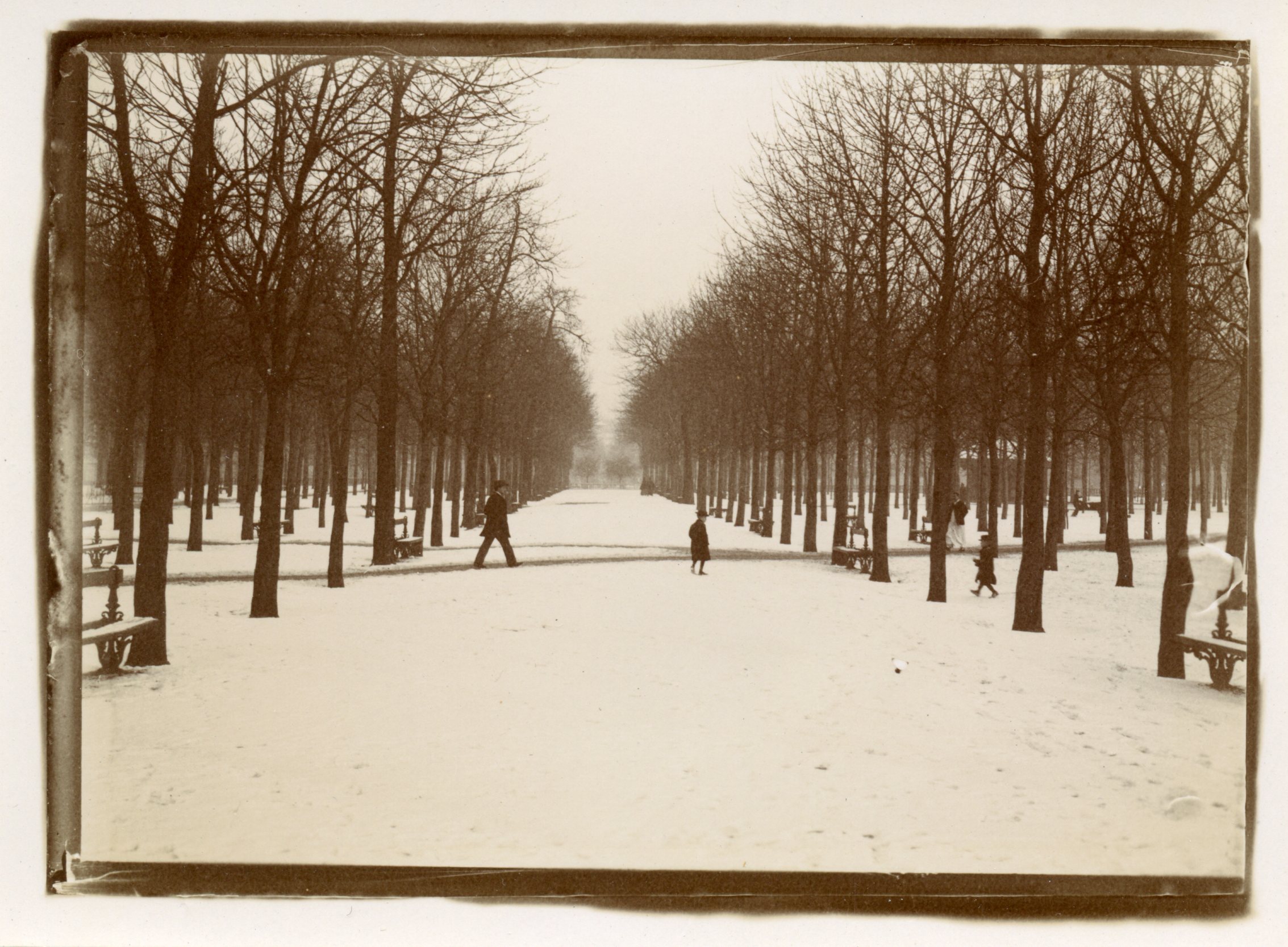
No matter how harried I might be, the photo above always calms me. It speak to me of when and where I bought it (along with several others). Things in Paris were getting rushed and I needed to slow down. I could think of no better place than Des Photographies. Just before I disappeared into the Metro, Philippa agreed to meet me at the shop in two or three hours. I need at least that long. Time stops for me there.

It is one of the classic small Parisian specialty shops. No space is unoccupied, and one walks very carefully. In quarters that are over 300 years old, it holds more than 100,000 photos, and yet the owner, or should one say curator, Sylvain Calvier, seems to know where to find whatever might be one’s interest. I have spent many enjoyable hours there, and some Euros too.

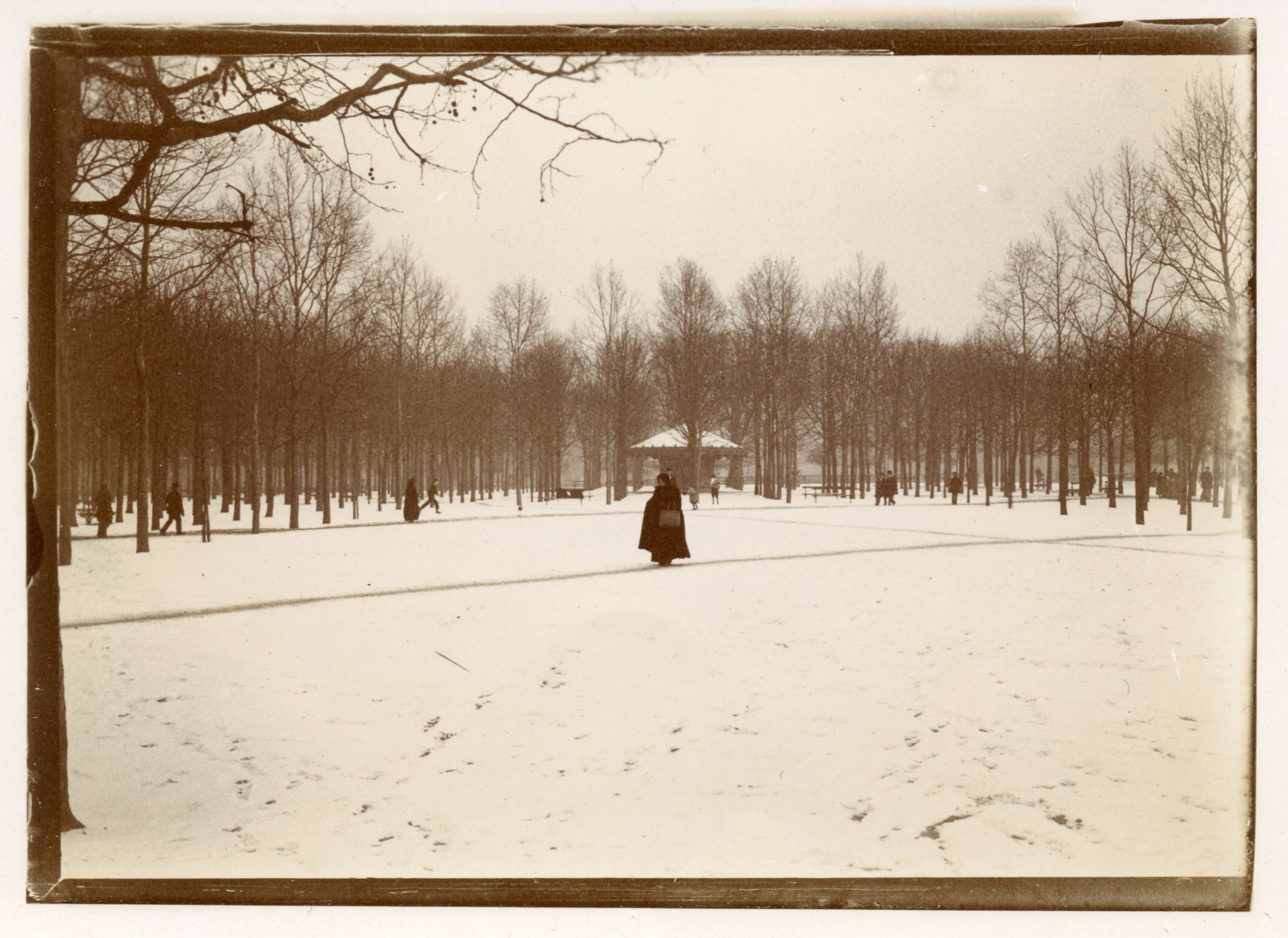
As I looked through a file of early 20th-century snapshots, these two winter photos held my attention. This was a different Paris. More than simply people walking across snow there was a sense of solitaryness, openness, and the unending variety and beauty of the lacelike patterns of trees temporarily denuded of leaves and highlighted by snow. Personal confession: I have never liked evergreen trees, they are so changeless and so boring.

Snow transforms landscapes. Paris is a chameleon, an alluring shapeshifter. One can feel crowded, hemmed in, pushed along, bombarded by sensory overload. And then suddenly it is none of these things. It is a Paris of parks, the geometry of outdoor spaces that whether tiny or large somehow combine vistas with intimacy, a series of mini-worlds that are not in collision. And the snow makes the landscape seem larger and more open, less crowded, and makes the orderly geometry more visible.

Snow helps one see basics more clearly. The back of this photo bears the hastily scrawled pencilled annotation: “Paris 1904 Le Louvre.”

A dusting of light snow seems to reduce the vastness of the Louvre and make it seem only a backdrop to an urban street scene: tram tracks, a bicyclist, some pedestrians, a small horsedrawn carriage, and a large omnibus drawn by four horses. When I had scanned the photo and enlarged it on screen, I noticed a passenger on the unprotected top level; it might have been colder, but it was cheaper up there. And behind the omnibus, a man with a furled umbrella. And again the openness. Snow seems to make people stand out in higher relief.

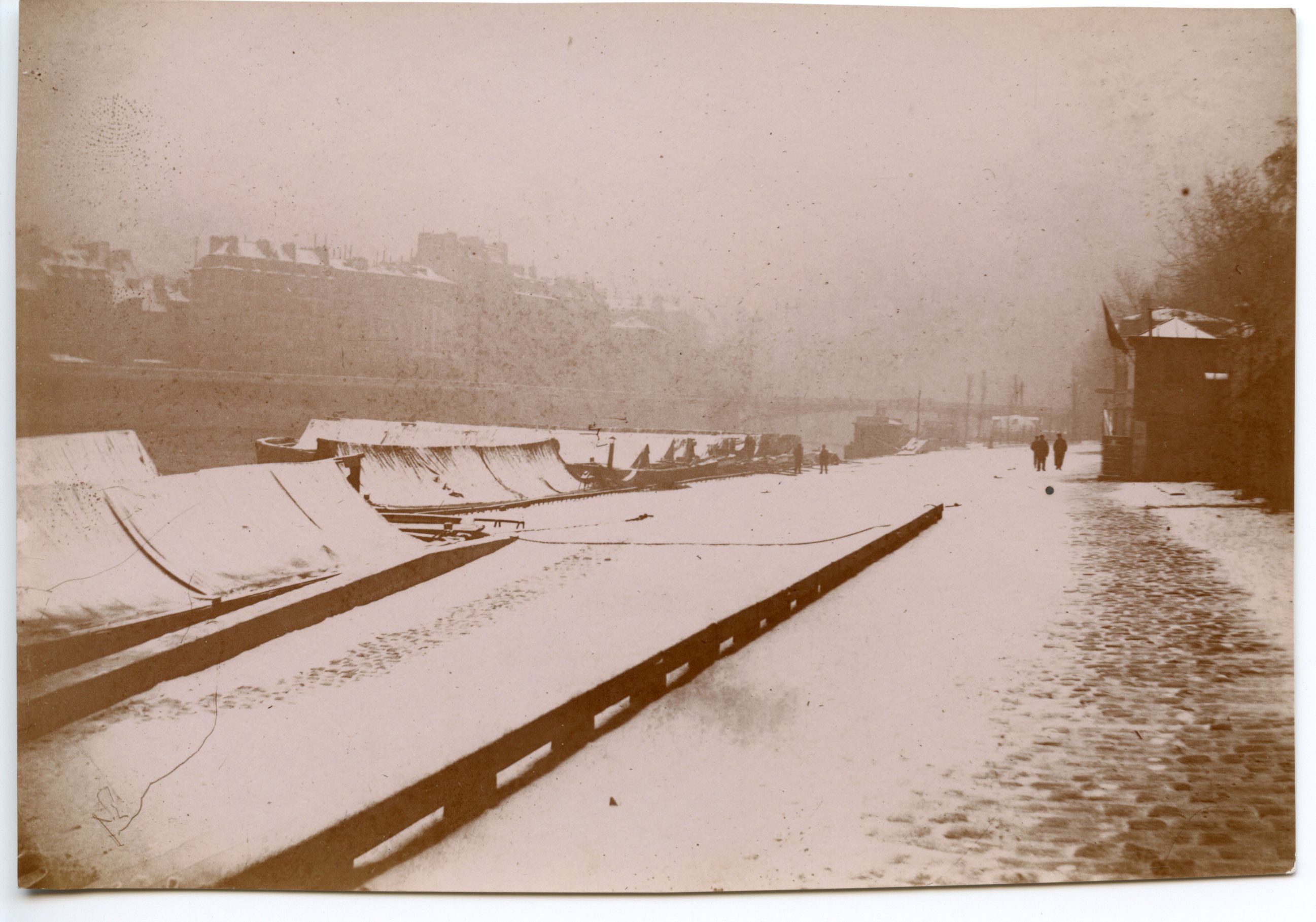
The famous péniches or barges of the Seine look very different here. I love this photo, because it captures three important elements of the Paris I have experienced: the Seine, working boats, and, yes, snow.

Faintly pencilled on the back are the words, “Le Mail au [sic] pommes.” What was that? Le Mail means a market area or mall; pommes are apples. It looked like one of the islands in the background. It turns out that there used to be an apple market near the Hôtel de Ville. Presumably the apples came in barges from Normandy, and perhaps there was some Calvados too, to keep everyone warm. For a view of the scene without snow, click here.

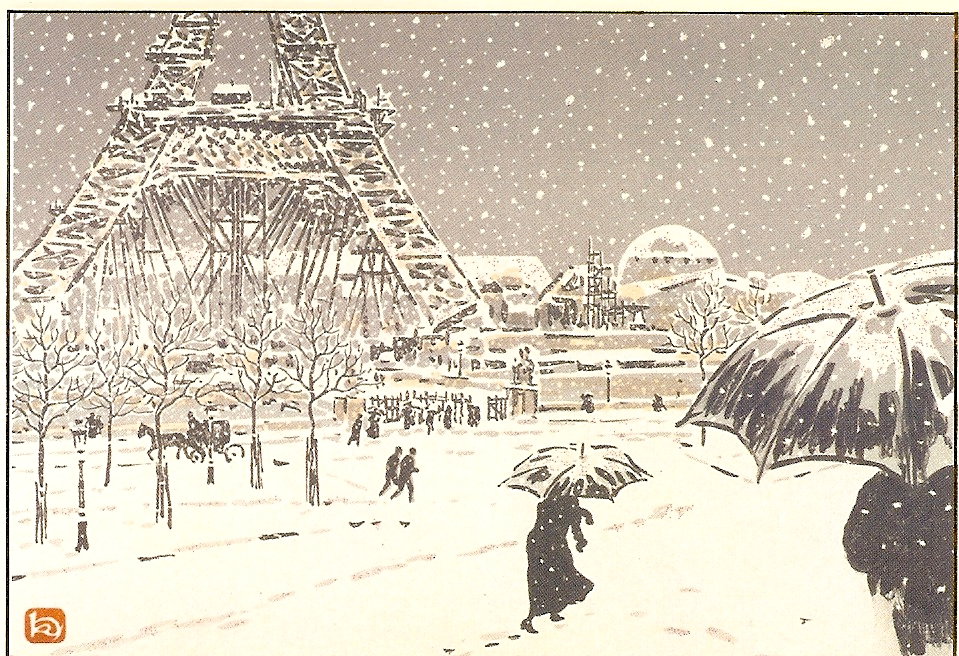
My photographs of Paris in the snow remind me of one of my favourite artists: Henri Rivière, celebrated for his Thirty-Six Views of the Eiffel Tower. In the prologue to the 1902 publication of this great work, Arsène Alexandre writes what too few have read or understood. He clearly states that an artist of the “eminence of Monsieur Henri-Riviére” did not paint the tower because of its greatness, but rather he took the tower as “simply a pretext, a mere excuse to depict everything admirable that is to be found in its vicinity.”* In other words, the paintings are about Paris, the thirty-six views are thirty-six ways of looking at the city and the inclusion of the Eiffel Tower is simply a reference point.

And of those thirty-six views, my favourite is Number 3, the Tower under Construction, as seen from the Trocadero. Henri Rivière was influenced by Japanese art, particularly woodcuts, and the piece feels Japanese. The snow has muted and softened the ironwork and the two umbrellas in the bottom right dominate an image one might have expected the Tower to dominate. Rivière has deftly captured essentials only.

Here is another image that reminds of Henri Rivière. The scene is reduced to its essentials: the trees, the snow, the solitary walker.

French history warns against the dangers of snow. Is vulnerability in the face of snow not the lesson to be drawn from the deadly failure of Napoleon’s march on Moscow? Listen to Victor Hugo in The Expiation, Russia 1812, beautifully translated by Robert Lowell.

The snow fell, and its power was multiplied.
For the first time the Eagle bowed its head—
dark days! Slowly the Emperor returned—
behind him Moscow! Its onion domes still burned.
The snow rained down in blizzards—rained and froze.
Past each white waste a further white waste rose.

…snowfall, floating through the quiet air
buried the huge army in a huge shroud.

Here in Canada, snow is familiar and expected. Songwriter Gilles Vigneault put it this way in 1964: “Mon pays ce n’est pas un pays, c’est l’hiver” (My country is not a country; it is winter.) Mind you, two centuries before, Voltaire, in Candide (1758), curtly dismissed the economic potential of New France as nothing more than “Quelques arpents de neige” (A few acres of snow). Snowy possessions were not worth investing in or retaining.

On February 29 just past, some Canadians may remember the “walk in the snow” of Pierre Elliott Trudeau. On that day in 1984, our controversial and flamboyant prime minister took a stroll to ponder his political future. In the snows of Ottawa, by a wide river that runs through a capital city, he found the clarity he needed to make a decision not to run for re-election.

Perhaps I should end with a photograph I took in winter in Paris. Again, people are silhouetted against the white background in a stately avenue of trees. Again, the scene is reduced to essentials. It combines the beauty of Paris and the familiarity of snow for a Canadian visitor.

Text and original photo by Norman Ball

*Henri Rivière, Thirty-Six Views of the Eiffel Tower, with a Prologue by Arsène Alexandre, 1902, republished in a facsimile edition by Chronicle Books, 2010, p.94 (translation by Alison Anderson).

Posted in Paris gardens, Paris parks | Tagged , , , , , , , , , , , , , , | 3 Comments

How I learned to stop worrying and love Wikipedia

When I am not working on the blog or running my own business, I teach in the geography department of the University of Toronto. Among other things, I talk to my students about research skills, and I encourage them to expand their search for information well beyond Wikipedia and the basic Google search.

Most of my colleagues disparage Wikipedia as an inadequate crutch in the search for reliable, verifiable, peer-reviewed, double-blind-tested information. And so did I…until I started to create Wikipedia entries. Now, although I still recognize its many flaws and weak spots, I have a newfound respect for this resource. And I started contributing as a direct result of this blog.

It all began with Stanley Loomis. In fall 2010, I wrote a blog inspired by Stanley Loomis’s 1967 book, A Crime of Passion, about the murder of the Duchesse de Praslin by her husband in 1847 in the house shown above (the blog is one of our all-time greatest hits; it continues to attract readers). Something about Loomis’s book inspired me in a way I cannot explain. I was desperate to know more about its author. But there was nothing whatever on the Internet about him.

Fortunately, with my access to the University of Toronto library system (the most extensive academic library in Canada), I was able to find out a few things published in long out-of-print journals. And then, on an impulse that surprised even me, I contacted his family. I just had to know more about him.

I stumbled onto the story of a fascinating life, cut short far too early. Stanley Loomis was hit by a car on the Place de la Concorde in 1972 and died of his injuries just a few days before what would have been his 50th birthday. He had written four books of French history and biography, each one a polished gem of research and insight. (The other three are Du Barry, Paris in the Terror, and The Fatal Friendship. I’ve read them all, now own them all, and recommend them all. They are out of print, but you can find them in libraries and through online secondhand booksellers.)

But the more I found out, the more I wanted to know. Since my first tentative e-mail to Stanley’s son, I have talked to many of Stanley’s family members and friends, all of whom were happy to share what they knew and delighted that someone was taking an interest. What could I do with what I learned? After a while, it occurred to me: write a Wikipedia entry.

In my first Wikipedia foray, I learned that there are rules and there are people who police those rules (also “bots” who troll Wikipedia entries looking for trouble). The information must be verifiable. No plagiarism. No conflict of interest. No copyright infractions. I wrote a carefully footnoted entry that seemed to pass muster. I felt satisfied that I had ensured that a worthwhile author was now visible to Internet browsers (what the French called Internautes). Since I posted it, it has been viewed hundreds of times, probably by people like me, who have read one of his books and immediately wanted to know more about their author.

Then it turned out that Stanley’s brother, an Arctic historian, had lived an equally interesting, although very different life, and had written a landmark book of his own. The family and friends I’d interviewed thought he, too, deserved his own entry. So I created a Wikipedia article about Chauncey C. Loomis, Jr.

I am still working on Stanley’s story (this is a long-term project), and hope to compile my findings into a complete biography. He belongs to my father’s generation (my father will be 91 in April; had he lived, Stanley would have turned 90 in December 2012). Many of those who knew him are still alive, and I hope to travel to his home town of Stockbridge, Massachusetts, this summer to read some of his correspondence which has been preserved by a long-time family friend.

But it didn’t stop there. Once I knew how to create a Wikipedia entry, I found some other gaps that needed to be filled. Last May, I bought a postcard in a Paris market that set me off on a little voyage of discovery. It was an image of the Grands Magasins Dufayel. And once again, I was astonished to find that there was next to no reliable information on the Internet about Georges Dufayel, who had popularized (although he did not invent) the practice of buying on credit – the foundation of modern retailing.

I was able to compile a short biography of Dufayel thanks to the Nineteenth Century French Collection at St. Michael’s College, University of Toronto. The photograph on the blog that inspired me, shown above, is now a part of Wikimedia Commons. That may not mean immortality, but many people who have never seen this blog have now seen that postcard image through Wikipedia.

My interest in Georges Dufayel led me to Gustave Rives, the architect who transformed the original department store into a palace of luxury.
I kept bumping into Gustave Rives in my research. In writing a blog about a stereoscopic image that Norman had found, I learned that Rives had designed the Hotel Astoria on the Champs Elysées, which had an interesting history. Then I discovered he played a crucial role in the preservation of the films of George Méliès (if you have seen the movie Hugo, you will know what I am talking about).

Out of curiosity, I did an online search for Rives, which led me to a genealogy website on which a message had been posted by his great-great-granddaughter. She wanted to know more about her ancestor. I wrote to her and she responded and put me in touch with a local historian from a Normandy resort town developed with Dufayel’s money and Gustave Rives’s architectural talents: Sainte-Adresse.

The local historian introduced me to two hugely valuable resources: the Gallica digital library (the online resource of the Bibliothèque nationale de France) and Leonore (the online resource about members of the Legion of Honour). I’d heard that the French didn’t “get” the Internet and that French websites were lame. But these websites are models of public access to primary documents. I was able to read online copies of the Figaro dating from the mid 19th century and to see archival documents from an institution I might never otherwise have approached. If you have ever experienced the thrill of primary research, you will understand what this means.

Together, the three of us (the descendant, the local historian, and I) assembled a biography of Gustave Rives, and a list of the buildings he had designed. I created an English Wikipedia entry, then translated it into French (my French contacts edited my efforts to make them sound idiomatic). Posting a Wikipedia entry in French stretched my French language abilities to the utmost. If I thought the English Wikipedia instructions were a little opaque, the French ones were a complete mystery.

I am still trying to figure out the protocol for uploading images to Wikimedia Commons. My Sainte-Adresse contact sent me a photograph he had found in the municipal archives, taken in about 1916 by an unknown photographer, of a building designed by Gustave Rives (now demolished). The gnomes who monitor Wikipedia questioned the photograph, because the copyright is hard to determine. I assume that a photograph that is nearly 100 years old is OK, but the gnomes want proof. It’s a pain in the neck, but I appreciate the fact that they asked. It gives me more respect for Wikipedia.

OK, Wikipedia is an open-ended source of information that can be corrupted at any point by malicious or misguided intervention. Not all the entries are reliable or up to date. But it has become the way to create a record of an individual who might otherwise have disappeared from view. In creating a few entries, I have validated the memories and knowledge of people who were connected to certain prominent people who have since been overlooked. People all over the world can read about them. That is a good feeling.

This blog may disappear one day, who knows? But I hope that the Wikipedia entries I have created will endure, and will bear witness to the important contributions of people who were celebrated in their day. I like to think the entries will be there for a long time. The subjects deserve to be remembered and it is an honour keep their memory alive.

Text by Philippa Campsie

Posted in Paris history, Paris postcards | Tagged , , , , , , , , , , , , , , , , , , | 12 Comments

Postcards from a Snowy Paris

Although it snows occasionally in Paris, it seems to be rare enough that only a small amount wreaks havoc. The city just isn’t prepared for snow. Parisian winters are normally mild, but there have been some very cold ones that have brought great hardship. Fortunately, Parisians are a resilient lot. Disaster after disaster, they survey the scene and get on with fixing the damage and carrying on with life.

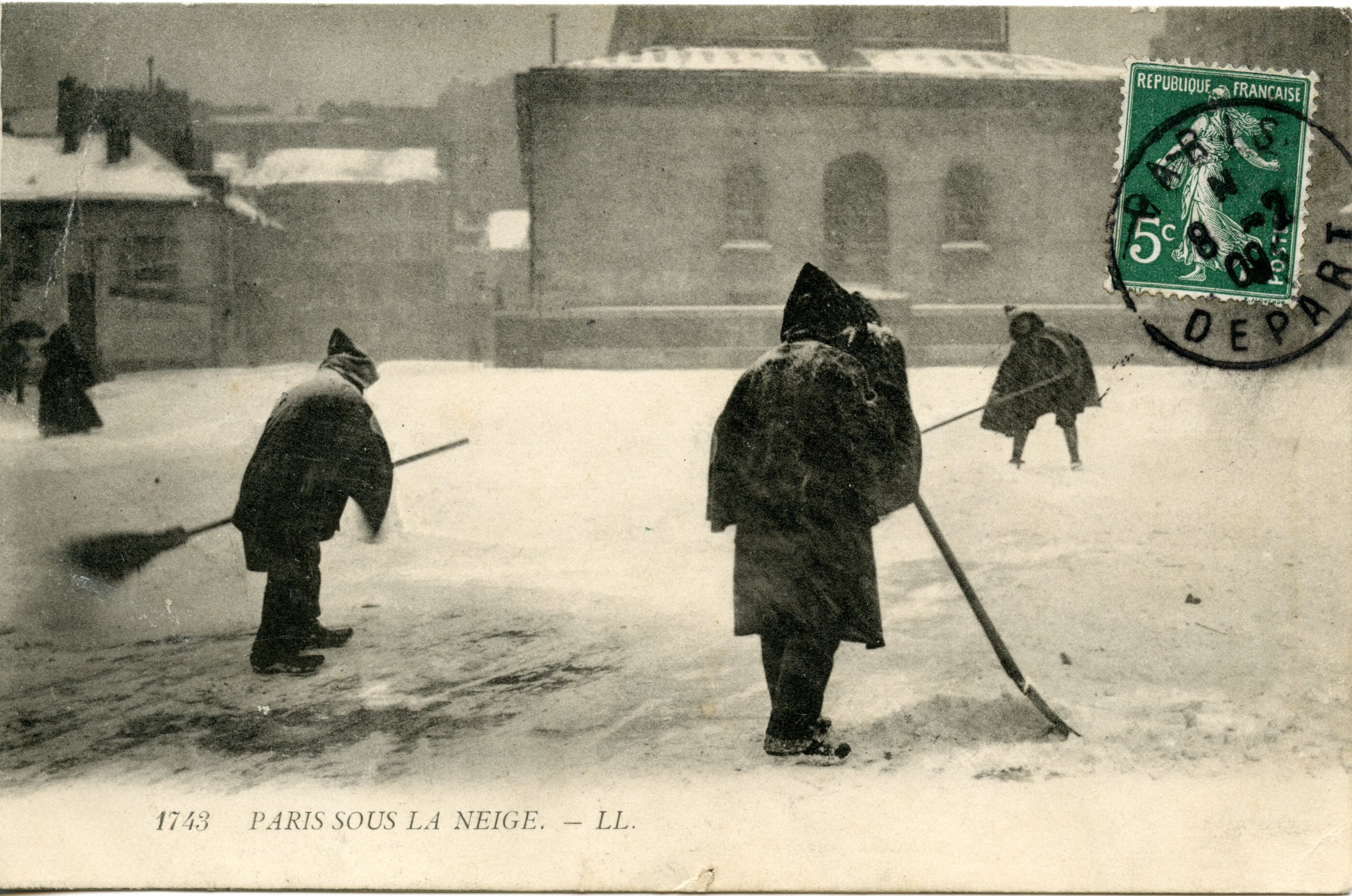
The image above seems timeless, with the workers in their hooded coats, wielding twig brooms and flat shovels. They are clearing what appears to be a light snowfall. (We cannot identify the location. Can any reader out there suggest where it might have been taken?)

That timeless scene seems a far cry from the “vigorous” winter of 1879-1880, when heavy snows and frigid temperatures led one newspaper, Le Petit Parisien, to put Paris and Greenland in the same category. It was an exceedingly difficult time, when trains moved no faster than pedestrians (if at all), telegraph services went down, and many apartment dwellers found themselves without the all-important gas needed for heating and light.

The roof of the Saint-Martin market collapsed under the heavy snow load. Fortunately, the market was closed and no one was killed. The temperature dropped as low as minus 21°C. For those who like numbers, 12,000 workers were hired to clear seven million cubic metres of snow. Even after converting that to seventy million cubic feet of snow, I’m still not sure what it means. An awful lot of snow, I guess.

But in the postcard, an aura of calm dominates the scene. The snow on the rooftops is more scenic than threatening, and the two figures just visible on the left edge seem unhurried. From the stamp cancellation on the front of the card, we know it was mailed from Paris in 1909.

The destination is shown on the back, as well as in the second postal mark. It is the town of Mennecy south of Paris in the département (administrative region) of Seine-et-Oise.

The next three cards, taken one year later, are from one of the great natural catastrophes in Parisian and French history: the Great Flood of January 1910, the likes of which Paris had not seen since 1658.

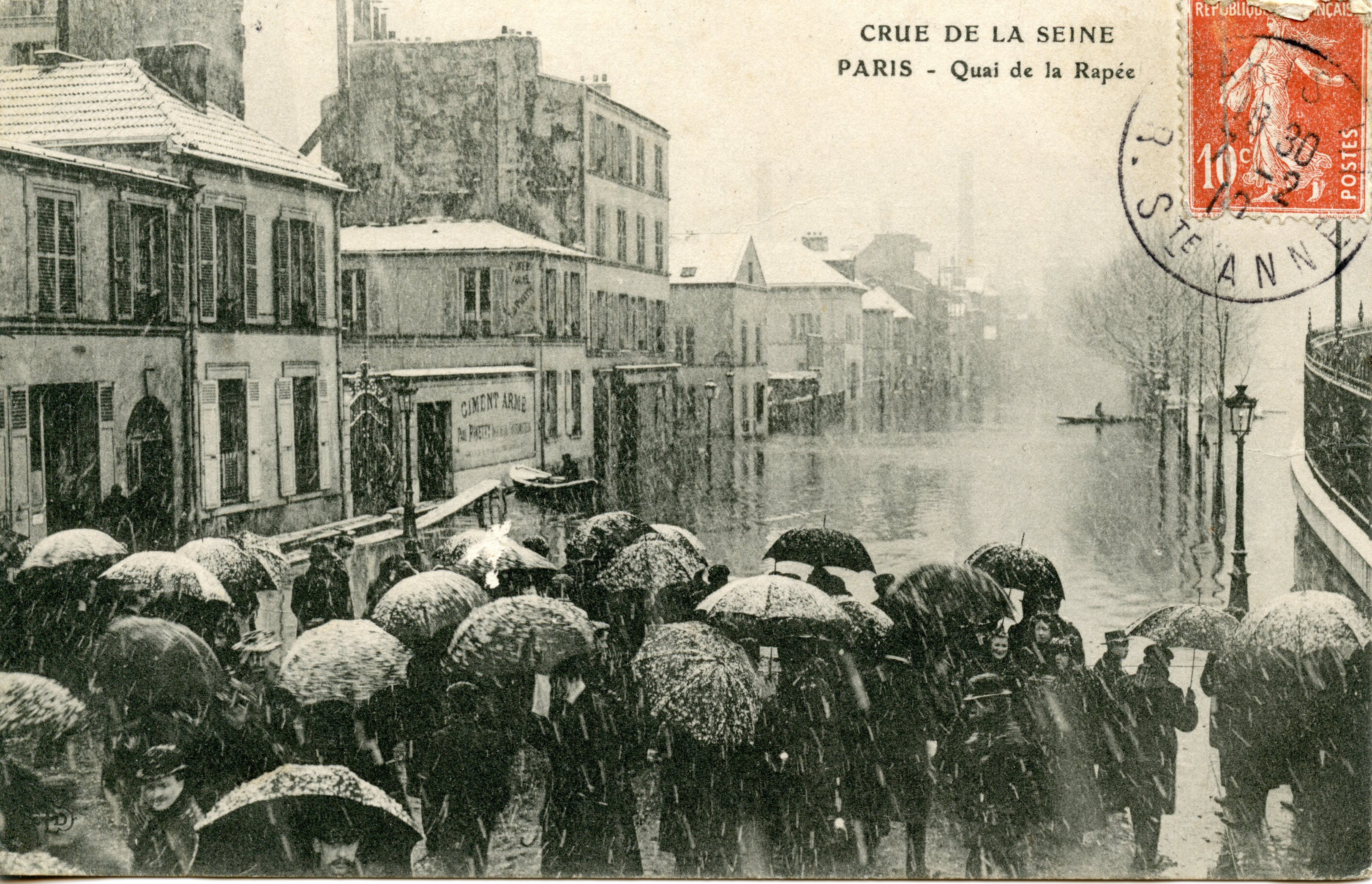
Snow-covered umbrellas dominate the foreground. It is quite unlike the first postcard, where there is only one umbrella and no sense of urgency. In this image, snow-covered roofs seem threatening, as do both the water in the street ahead and the boat floating where normally one would walk.

No single event triggered the flood. A series of unusual weather patterns accumulated and built on each other. The summer of 1909 had been cold and rainy. Sodden land held as much water as it could and the rest ran off. Fall and winter came with more rain and snow. As the New Year approached, it rained even harder and temperatures rose. Under the double load of meltwater and heavy rain, the Seine began to rise, causing small floods here and there. That was serious, but not a crisis. Then, on January 9, 1910 the rains came down even harder and by the January 14, the river was in full flood. And on some days the rains turned to snow.

This photo, taken on January 23, 1910, is both sad and threatening. By this time Paris had suffered serious damage. Thousands of homes and businesses had been flooded, not to mention the Metro, but Parisians soldiered on. Temporary sidewalks on stilts were erected so people could get to and from work, buy food and wine, and get on with their lives.

And what did those huddling on shore in the cold think of the struggling pleasure boat that advertised “Pianos on Board”? Perhaps they had dined and danced there once. Did it all seem irrelevant, perhaps even mocking? Or did it remind them why Paris, no matter what, was the pleasure capital of the world, a city of joy that sometimes suffered catastrophic interruptions? The waters would go down eventually, and the fun would resume on the boat and elsewhere.

The great flood of 1910 was not confined to Paris. The Seine is a long river and many outlying areas were flooded. At first glance, this image from Nanterre seems calm and the snow on the roof pleasantly scenic. On closer examination, you can see the height of the water. Nanterre is downstream from Paris, but close enough to be regarded as a suburb. This card, and the one below are from a series showing the damage done to Nanterre during the flood.

This second image shows an artificial gas facility where the coal in the right foreground would undergo what we call destructive distillation (heating to high temperature in the absence of air) in ovens or retorts inside the building on the right. The heat drove off gases which could be collected and stored in the gasometer on the left and distributed from there by gas lines. This was the artificial gas that powered, heated, and lit so many buildings and businesses in the 19th century. I wonder if the plant shown here had to shut down as a result of flood damage.

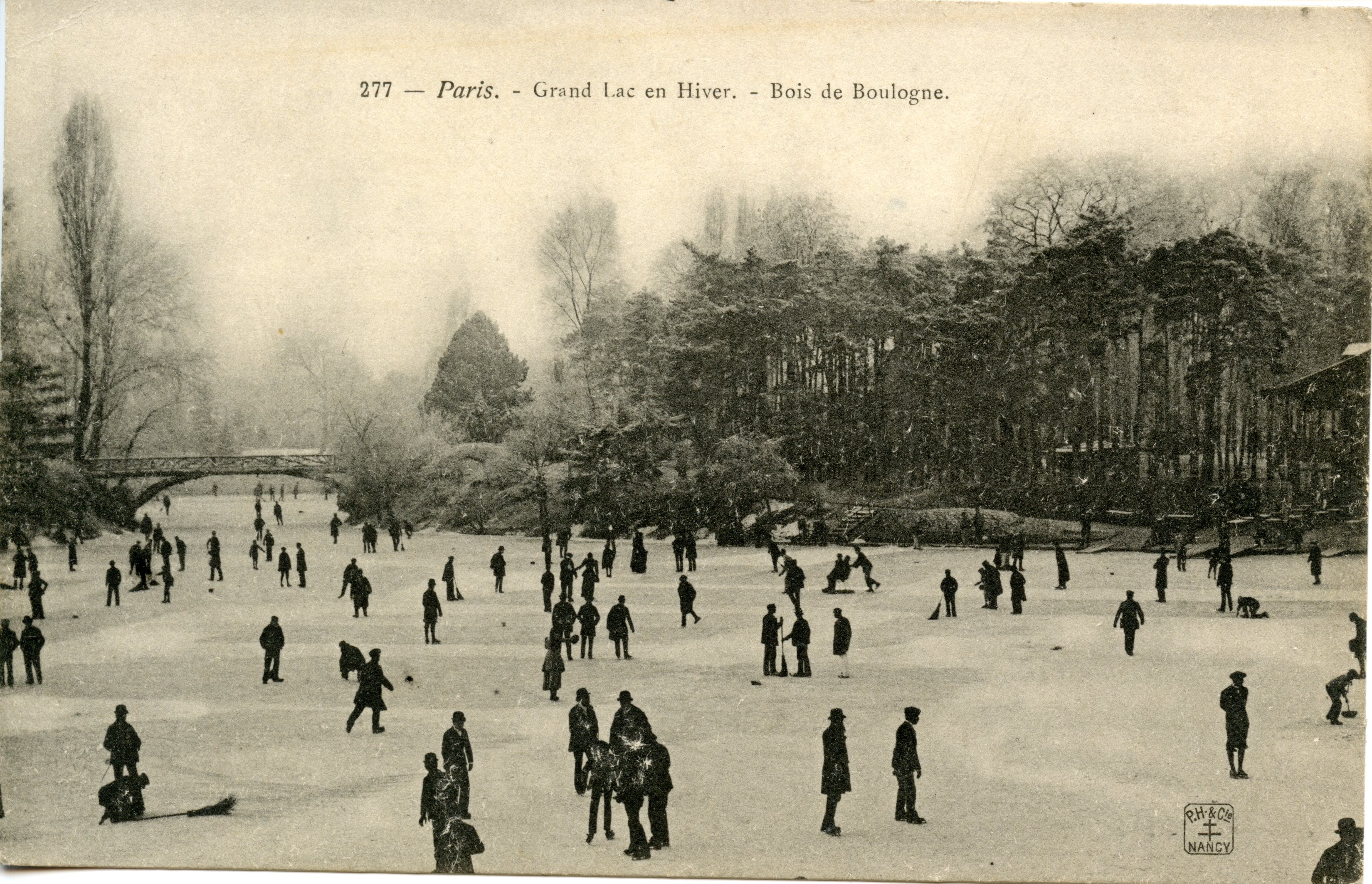
But cold temperatures and snow can also bring pleasure. The final postcard shows an idyllic winter scene in the Bois de Boulogne, one of the great Parisian parks. There is a lot going on. Some people are standing around talking, and some skating. When I first looked at the card I was puzzled by all the brooms. Are these the twig brooms we see in so many paintings and photos of Paris? Today the shape is fundamentally unchanged, but the bristles are no longer twigs but fluorescent green plastic.

After I had scanned the postcard and looked at it on a large screen, I could see that they were clearing individual skating areas. On the right I could see someone using a flat shovel similar to that in the first postcard. Near the middle is a wonderful apparatus—a chair of some sort mounted on runners and being pushed by a skater.

Yes, winter can be wonderful. The image of people enjoying the a cold bright day brought back memories of Christmas Day, 2010, when Philippa and I wandered through a snowy Jardin du Luxembourg. I shall always remember the young men playing table tennis in the snow. Come snow, come rain, Parisians always seem to find a way to have fun.

Text by Norman Ball

Posted in Paris history, Paris parks, Paris postcards | Tagged , , , , , , , , , , , , , , , | 7 Comments