Food, drink, and lodging in Paris postcards

In a sense, all postcards are a form of advertising. Some advertise the sender’s good fortune or superiority: “Hi. I’m here. You’re not.” Others advertise the attraction itself: Kozy Kabins in Niagara Falls, the highest rotating restaurant west of the Mississippi, or the world’s only combined alligator-and-ostrich farm.

I prefer the more traditional product ads, particularly those from Paris. Consider the one below.

I am fond of this card for several reasons. The subject, L’Église Sainte-Marie-Madeleine (the church of Saint Mary Magdalene) in the 8th arrondissement at the end of rue Royale is a beautiful building. Often called simply La Madeleine, it has a complicated history.

The spot on which is stands was once the site of an early synagogue, seized by Bishop Maurice de Sully in 1182. This was the beginning of a centuries-long tale of various attempts at building, a succession of architects, most of whom tore down their predecessors’ works.

Napoleon’s 1806 decision to build a Temple to the Glory of the Great Army led to a new round of architects, designs, more tearing down of various bits, followed by a loss of focus when the Arc de Triomphe du Carrousel was completed in 1808. Then Napoleon lost his job in a hostile takeover.

During the Restoration, Louis XVIII decided the structure should be a church. More architects, more competitions, more demolitions, and continuing confusion. In 1837, when trains were the coming thing, someone suggested turning the building into a train station. But reason (or faith) returned and it was consecrated as a Roman Catholic Church in 1842.

The interior is stunning, but I am particularly taken by the august exterior of this Neo-Classical style building. With its 52 Corinthian columns, each 20 metres high, it does not seem pretentious, but dignified, reassuring, correct. Even with the traffic that roars about it today, I find it calming just to be near it.

The card above was designed for and printed at the International Exposition in Paris in 1900. It reveals another religious connection. Or an advertisement. Look at the lower left: BENEDICTINE. The Benedictine monks of Fécamp were pioneers in the European liqueur industry. On the address side of the card is a beautifully designed and printed ad. Subtle. I like it.

The image below is from the same Exposition. I love the detail and the sense of perspective, which leaves room for writing, a reminder that at one time it was forbidden to put your message on the address side of the card. In the background to the left, we see the familiar Eiffel Tower built for the 1889 exposition and the more short-lived giant Ferris wheel built for the 1900 Exhibition.

The building with the turrets facing the river is the Palais de Justice, whose list of involuntary “guests” includes Marie Antoinette, Robespierre, and Napoleon III. If you look carefully on the bridge, the Pont de Change, you will see my first initial in several places. Alas, it does not stand for Norman, but for Napoleon III, who had it built as one of his many projects to modernize Paris. Look at the other side of the card.

This is even subtler than a fine bottle with ribbon and medal. It is the wrought-iron fountain in the Benedictine square in Fécamp. In this town, Alexandre Le Grand “rediscovered” the Benedictine Liqueur recipe originally created in 1510 by the monk Dom Bernardo Vincelli. If you are 18 or older, you may sign into this website to learn more.

But men and women cannot live on Benedictine alone. If you go to Paris, you’ll need a place to stay.

The card above advertises the Hotel Régina on the rue de Rivoli. It exists today under the same name. Philippa and I have walked by it many times. This card was issued to announce that it would be opening soon, 112 years ago: the first of March 1900, to be exact.

Or you might prefer the nearby Grand Hotel du Louvre.
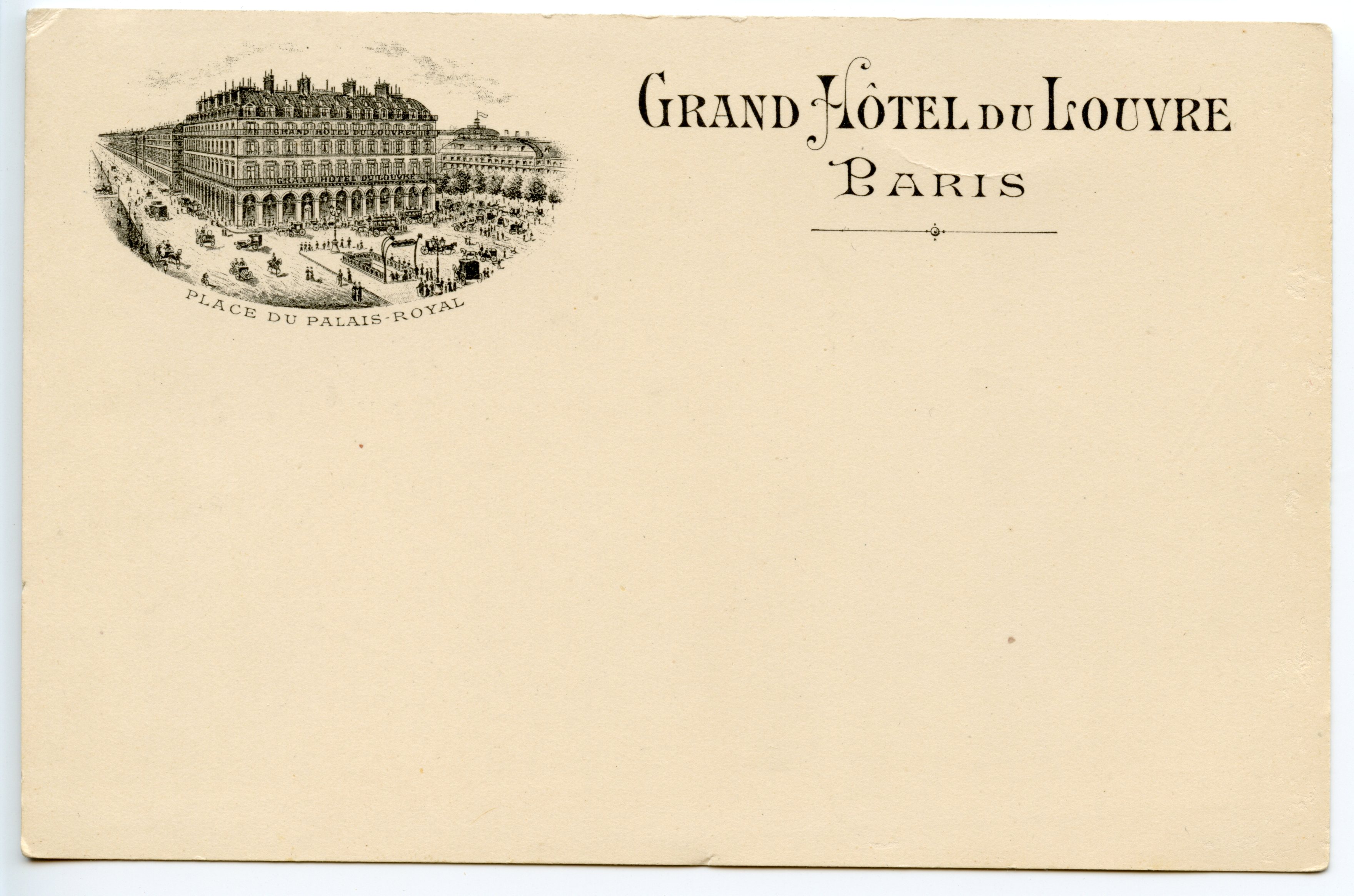
It, too, exists today. Over the years, the hotel has had quite a roster of guests. The painter Camille Pissarro took up residence there in 1897, Sigmund Freud dropped in while writing about Leonardo da Vinci. The hotel and the atmosphere of the area influenced Sir Arthur Conan Doyle, author of the Sherlock Holmes tales.

The sense of continuity is part of the fascination of learning more and more about Paris. The Hotel du Louvre has been at its present site on the Place du Palais Royal since 1887. There was an earlier hotel of the same name, dating from 1855, a luxurious haven of 700 rooms and a staff of 1,250 on the other side of the Place. But by 1887, the Louvre was expanding, as were the major department stores, and the hotel had to move to a new building across the square. The original hotel still stands and one can visit the many shops and galleries in the Louvre des Antiquaires, 2, place du Palais Royal.

One might ask why such a fine hotel was relegated to such a relatively small image on the post card. The answer is on the back.

There is a clearly marked place for the postage stamp and a warning that that side of the card is to be used exclusively for an address. The message must go on the front, with the picture of the hotel. So space must be left below the image.

No advertising card that I own says more about continuity of Paris institutions than the one shown below.
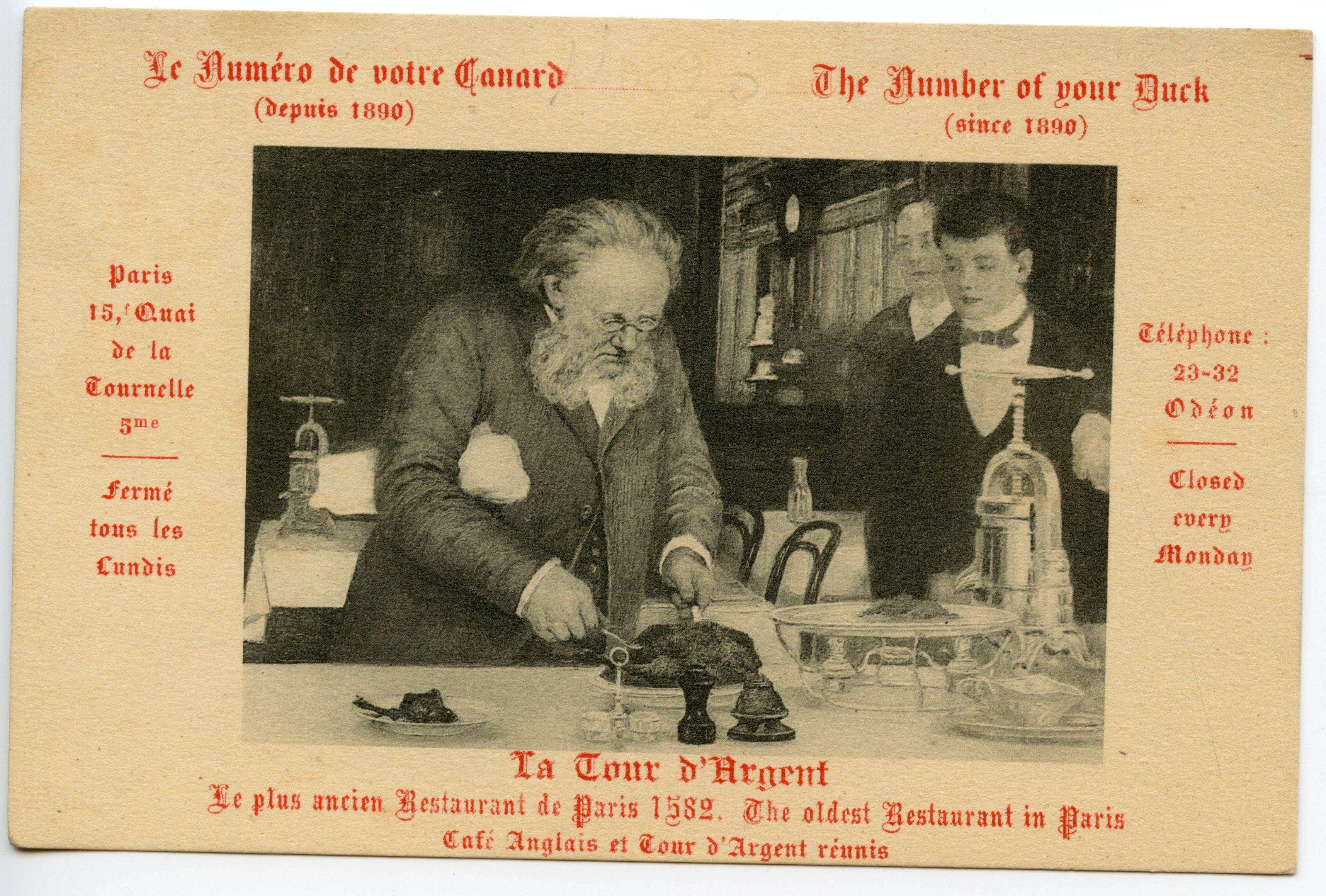
The text in French and English provides a wonderful bit of Paris culinary history. La Tour d’Argent at 15, Quai de la Tournelle, in what is now the 5th arrondissement was founded in 1582 during the reign of Henry III as an inn next to a monastery. It got its name from the silvery stone used to build it. The combination of fine food and an equally fine view of the Seine and Notre Dame made it a favourite of the royal court.

Remarkably, it has continued as a popular restaurant. When Julia Child ate there one night in the early 1950s, she described it as “excellent in every way, except that it was so pricey that every guest was American.”

As the postcard indicates, it had merged with the Café Anglais, another venerable name in Paris culinary history. This café opened in 1802 and the name celebrates the Treaty of Amiens, which represented a brief suspension of hostilities between the warring English and French. Initially, it was a downscale eatery for domestic servants and coachmen. Located at 13, Boulevard des Italiens, it attracted the theatre crowd and eventually found favour with the higher levels of French society. It closed in 1913; the original building no longer exists. Instead, it became part of la Tour d’Argent, which also had risen to the highest culinary ranks.

In the mid 19th century, Frédéric Delair became the owner and formalized the famous duck recipe. He was so confident of the quality of his duck, that he numbered each one. Surely a high point in the history of culinary one-upmanship.

I doubt that Philippa and I will ever savour a numbered duck (the number is well over a million by now). However, we have many fine memories of food and drink in Paris. One afternoon, we chatted over wine in the café on the second floor of the Nicolas store that overlooks the Place de la Madeleine.

We admired the church opposite us and watched the traffic inch along. How I wish we could have overheard the two men deep in conversation as one scratched his head and the other buried his face in his hands.
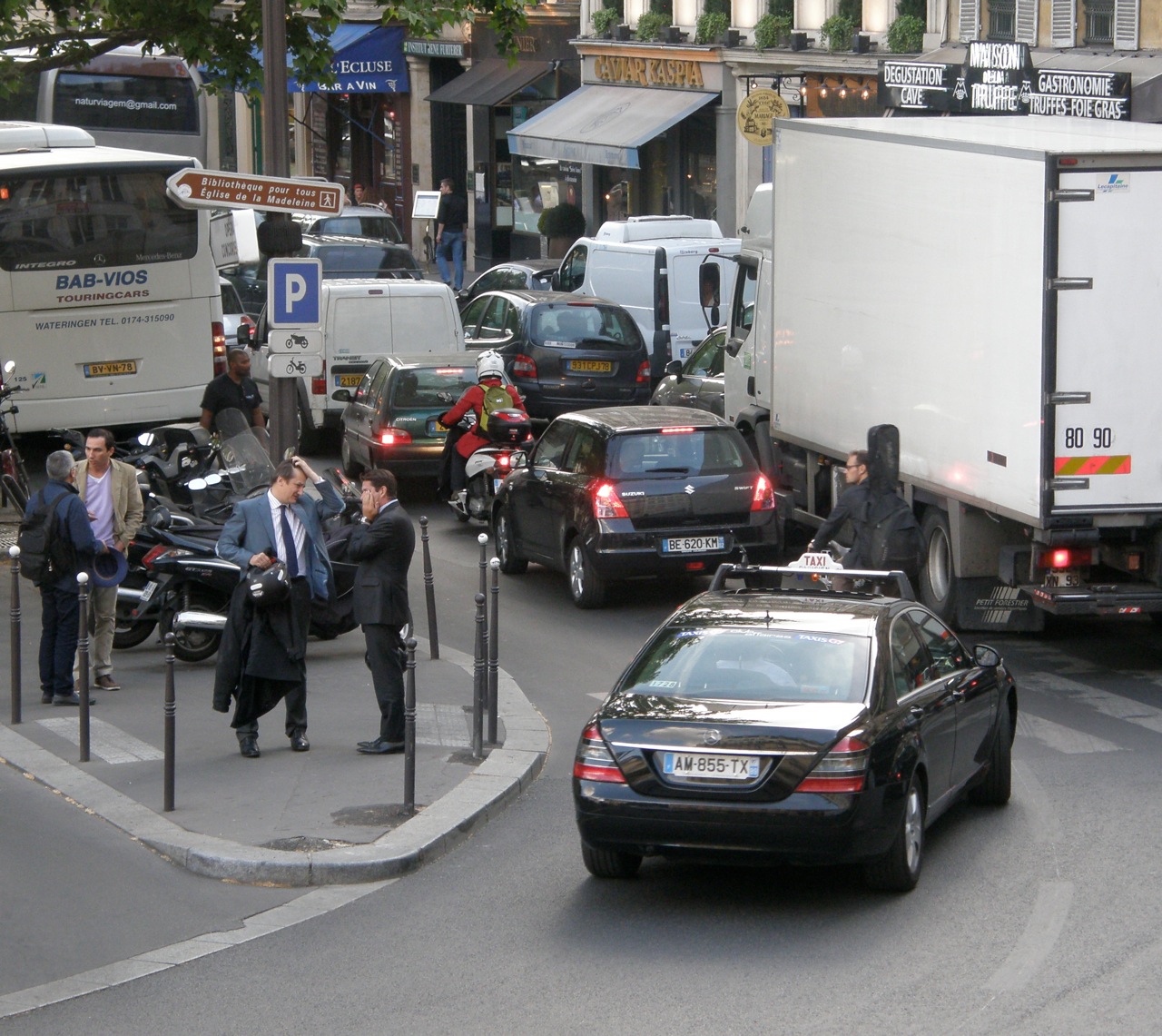
But mostly we enjoyed the view of la Madeleine and the calm of those who know how to slow down.

Perhaps next time we will order a glass of Benedictine and raise a toast to the creators of early advertising postcards.

Text and photographs by Norman Ball.

Posted in Paris food, Paris hotels, Paris postcards | Tagged , , , , , , , , , , , , , , , , , , , , , , , , , , , , | 12 Comments

Connaissez-vous Paris?

On the avenue Franklin Roosevelt, not far from the Champs-Elysées, is an unusual bookshop. The name, Livre Sterling, is a peculiarly anglophile pun on the fact that the word “livre” in French can mean either “pound” (₤) or “book” and “Sterling” denotes either money or quality.

When we stopped by in spring 2011, the bookshop sported a handmade banner with the words “Un libraire en colère” (bookseller in a rage). Was this a protest against illiteracy and e-books? Only partly. It was a publicity campaign for the owner of Livre Sterling, Emmanuel Delhomme, who had written a book with that title, about the joys and perils of bookselling in a non-literate age.

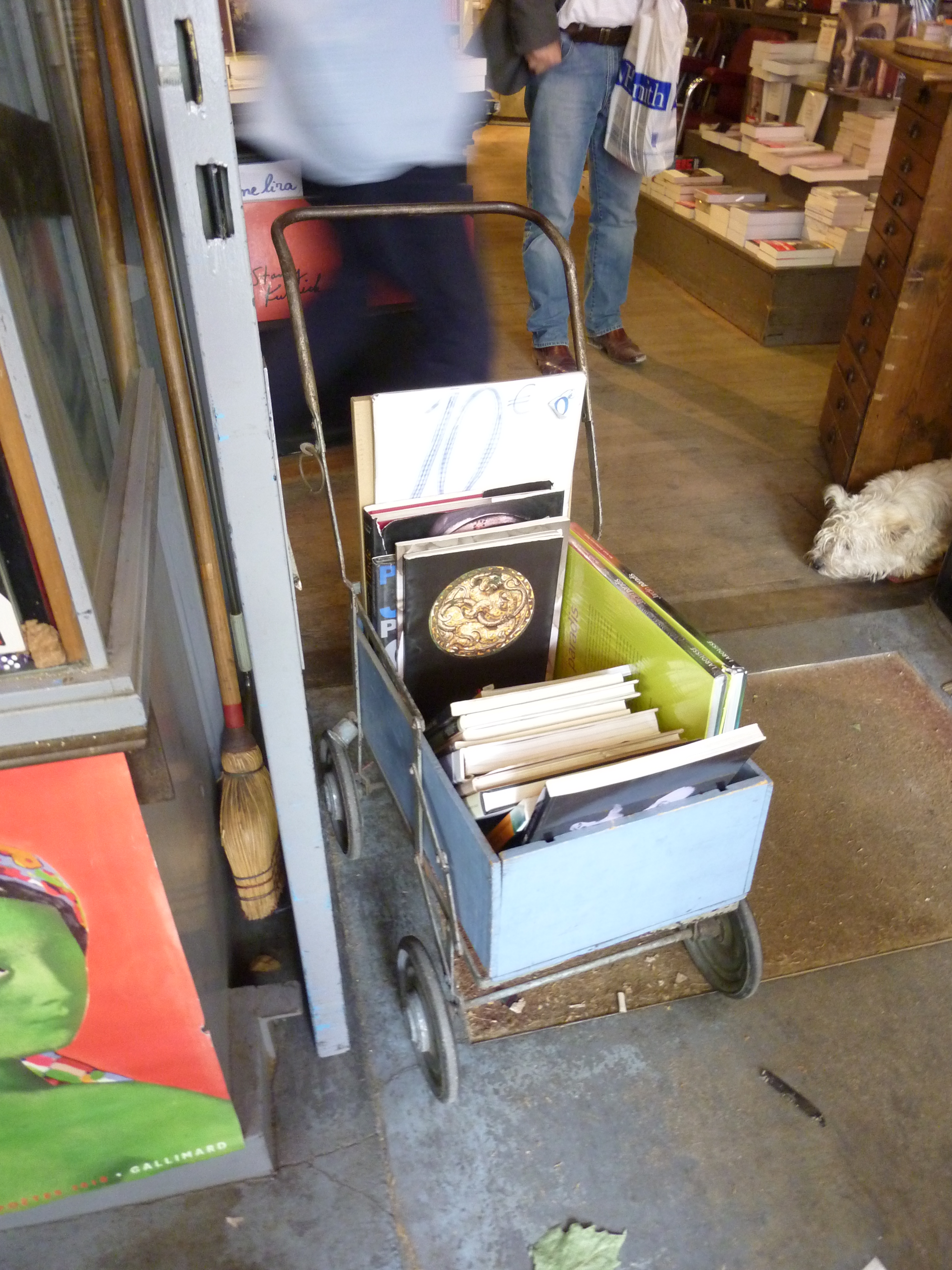
We made several visits to the bookshop, a delightful cavern filled not only with books, but with toys and odd objects on upper shelves and hanging from the ceiling. There was a resident dog, and inviting displays of books old and new on big tables.

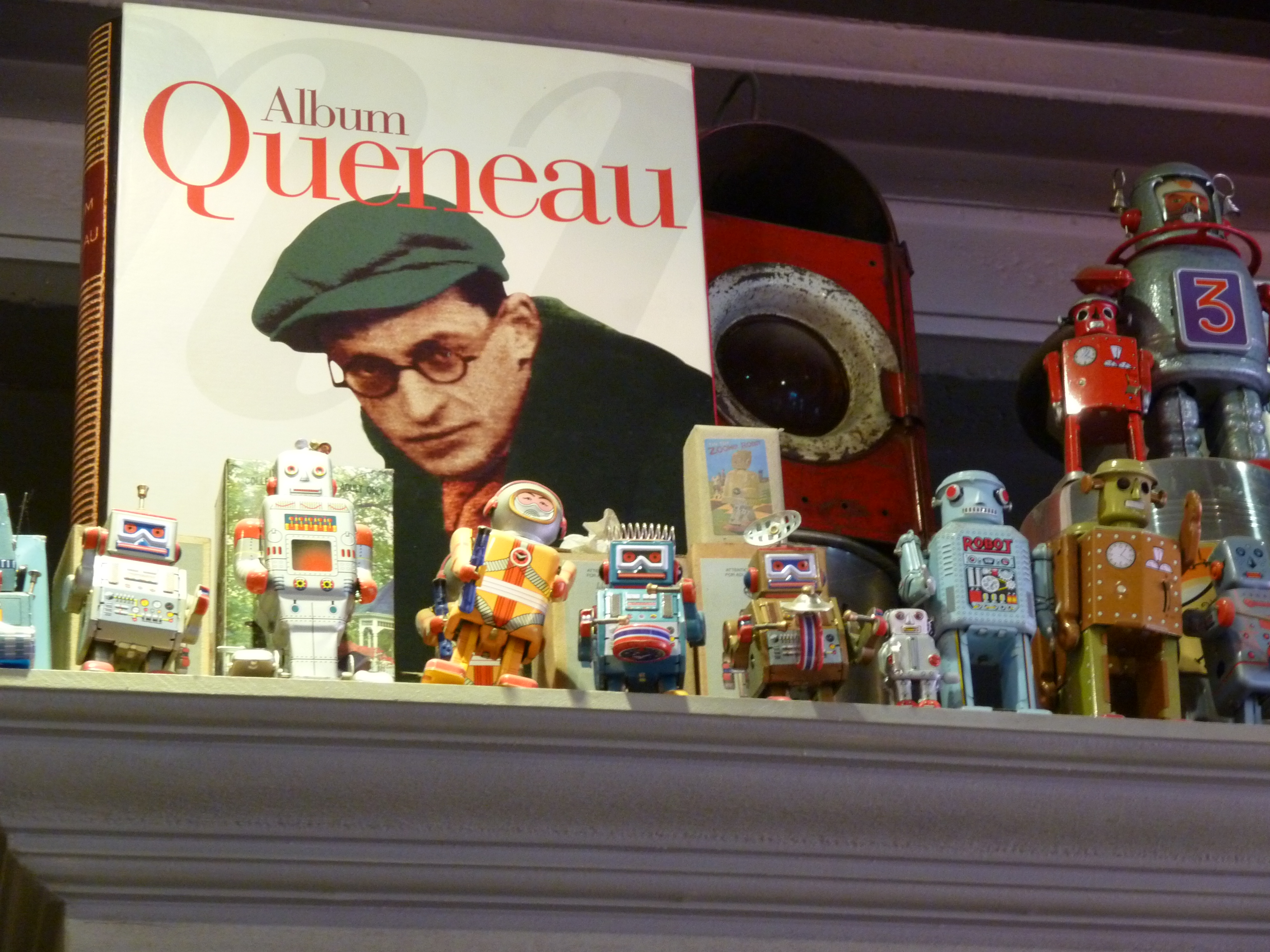
On a shelf, I spotted a photograph of Raymond Queneau. He is probably best known as the author of Zazie dans le Métro (1959), a novel that was made into a film by Louis Malle the following year. It’s the story of a little girl with very odd relatives who visits Paris and explores the city during a metro strike.

The novel apparently caused quite a stir at the time because of its use of informal language. Well, thank heaven for Raymond Queneau. Because of him, I can read modern novels that dispense with hyperformal grammar (the passé simple and the dreaded conditionnel deuxième forme) and tell stories in the kind of language one learns in French conversation class.

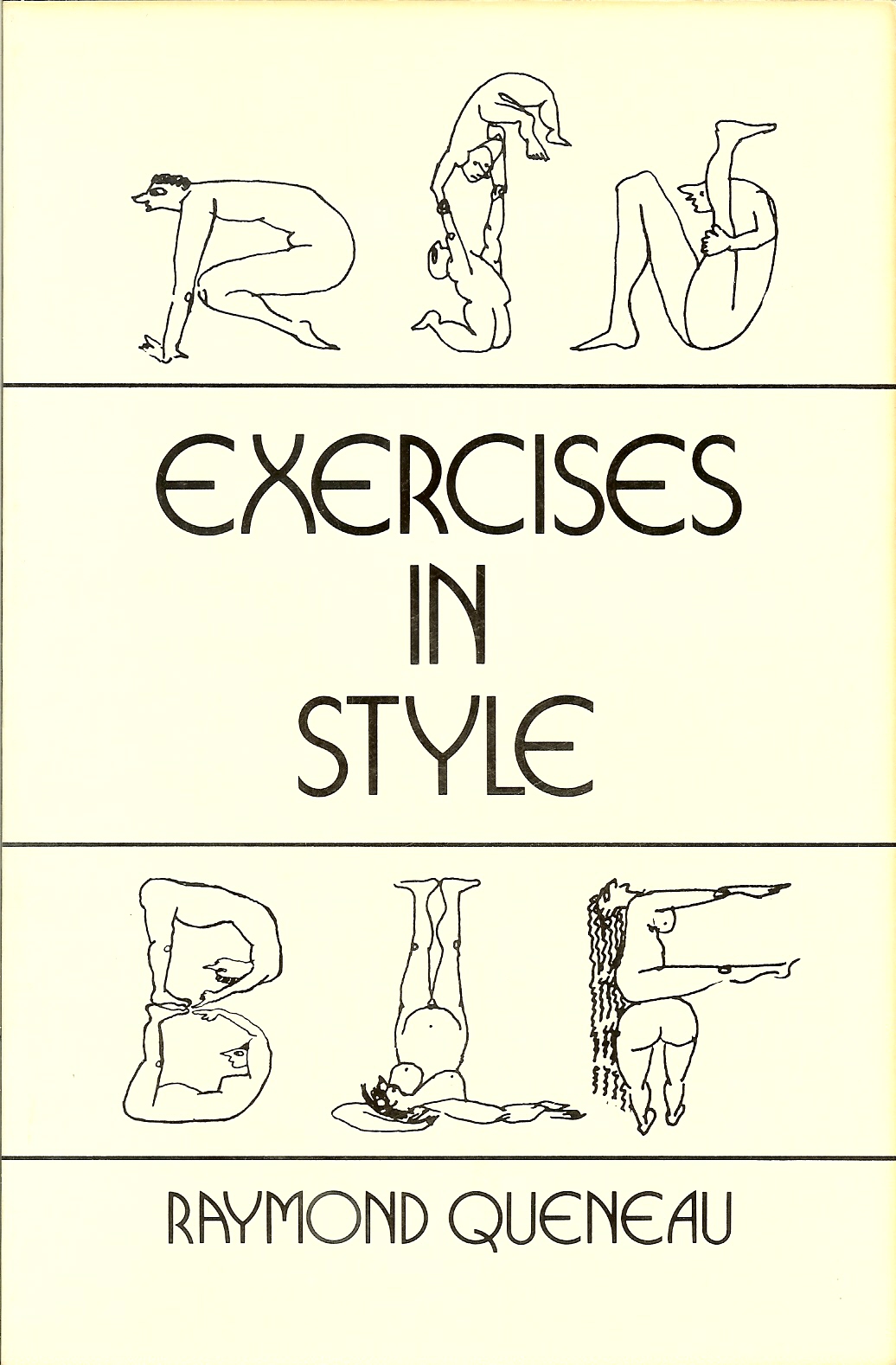
My own introduction to Queneau was actually through a translated version of his 1947 book, Exercises in Style. This is a series of short riffs on the same story (a minor incident on a Paris bus), told repeatedly using every conceivable variation on style: forwards, backwards, using metaphors or repetition, as a sonnet or Q&A, in the style of an official letter or a book blurb…99 variations in all. It’s a tour de force that should be studied by any aspiring writer.

Foraging among the volumes at Livre Sterling, I found another book by Queneau, titled, Connaissez-vous Paris? (Do you know Paris?) This 2011 Folio edition is a reprint of a 1955 book that contains a series of questions and answers about Paris lore and trivia, originally published in the pages of the newspaper L’Intransigeant, at the rate of three a day, between November 1936 and October 1938. The book contains about a quarter of the original 2,012 questions and answers. After all, a lot has changed since the 1930s.

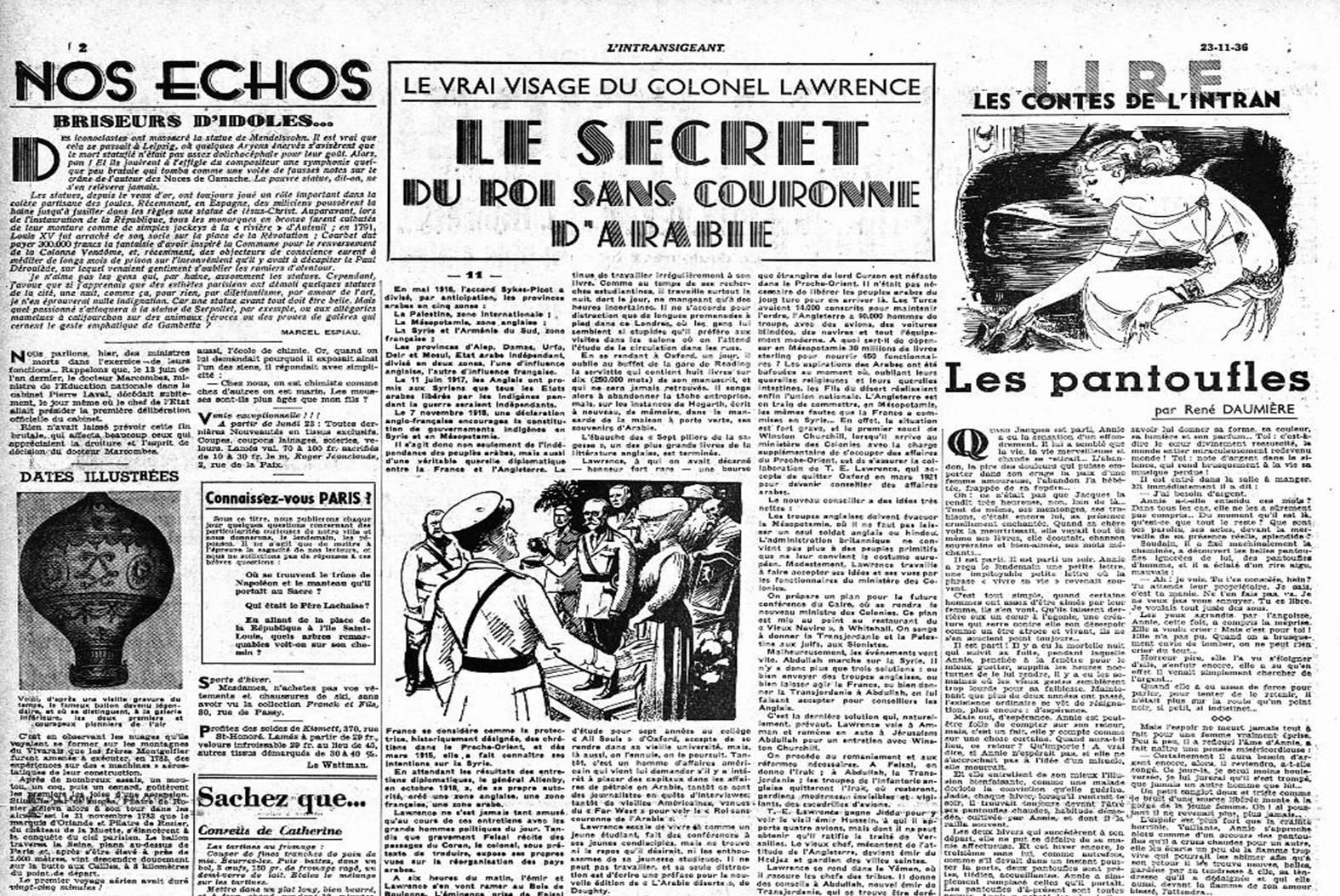
Thanks to Gallica, the online library of the Bibliothèque nationale de France, I was able to see the very first appearance of this feature in the newspaper, on November 23, 1936, page 2. One of the three questions remains on the first page of the 2011 paperback: Qui était le Père Lachaise? (Who was Pere Lachaise? Answer: He was the personal confessor of Louis XIV, who lived in a house situated where the cemetery is now.)

In his introduction to the compilation of questions that was published in 1955, Queneau explains how he chose his questions. They couldn’t be too banal, and they couldn’t be too obscure. So no questions about the location of the Eiffel Tower or the name of the restaurant owned by the father of someone who was himself not all that well known. Queneau continues:

I thought I knew Paris pretty well, but in working on the questions, I realized that not only did I not know Paris, but that hardly anyone could say they knew Paris all that well. I started with Rochegude [Le Marquis Félix de Rochegude, author of Promenades dans toutes les rues de Paris par arrondissement, 1910], replaced these days with Hillairet [Jacques Hillairet, author of Dictionnaire historique des rues de Paris, 1935], and even though they were separated by less than 30 years, Rochegude had noticed many things that had since disappeared, quite simply, without revolutions or bombing… “The form of a city changes faster, alas, than the heart of a mortal” [Baudelaire].
Queneau’s questions are usually about location (where did Debussy die?) or date (when was the Saint-Louis Hospital founded?) or the origins of street and district names (where does the name of the Quartier des Enfants Rouges come from?).* Should you ever have to play a game of Trivial Pursuit based on your knowledge of Paris, the book would come in handy.

Like Queneau, we have found that in attempting to convey knowledge about Paris, we are learning all kinds of things we didn’t know before. One day, perhaps, we will write our own version of Connaissez-vous Paris? It probably won’t have as many famous personnages and street name origins as Queneau’s book, but judging by the page-views on the blog, we can provide some answers to questions people actually have. For example:

1. Why are there bits of rolled up carpet in the gutter? (check last week’s blog)
2. What caused the flood of January 1910?
3. How does one get change for a 500-Euro note?
4. Where was the first Ferris wheel in Paris and what happened to it?
5. What are those stone or iron objects at the edges of archways into Paris courtyards?
6. What is the story behind Rodin’s famous bronze casting of the Burghers of Calais?

So many questions, so many stories to tell. And because each blog takes us quite a while to research, we have decided to publish every second week from now on instead of every week. We wouldn’t want to sacrifice quality for quantity.
So we’ll see you in two weeks, and the story we tell may be the answer to a question you didn’t know you had.

Text by Philippa Campsie; photographs by Philippa Campsie and Norman Ball

*Claude Debussy died on March 26, 1918, at 24, square du Bois-de-Boulogne. The Saint-Louis Hospital was founded in 1607 by Henri IV for plague victims. The Quartier (and the Market) named for the Enfants Rouges (Red Children) comes from an orphanage in which the children wore red uniforms.

Posted in Paris bookstores, Paris travel | Tagged , , , , , , , , , , , , , , , | 7 Comments

A most unusual water system keeps Paris clean

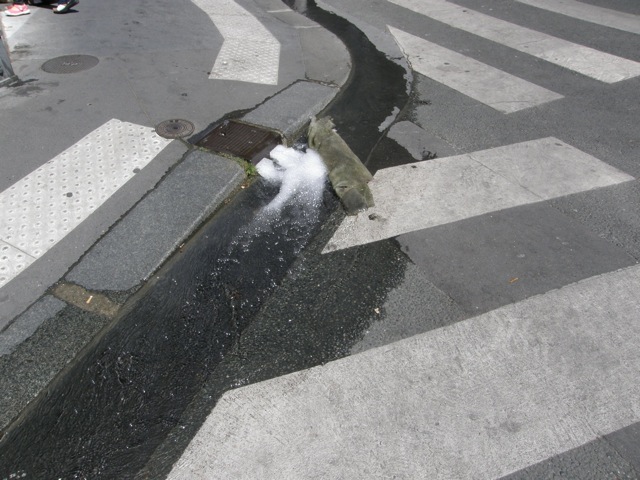
I was alarmed the first time I saw water pouring out of what looked like a sewer grate and onto the road. Now, I watch for such a sight. It is another manifestation of the enlightened engineering, design, and vision that make Paris civilized. After all, the word city comes from the same root as civilized.

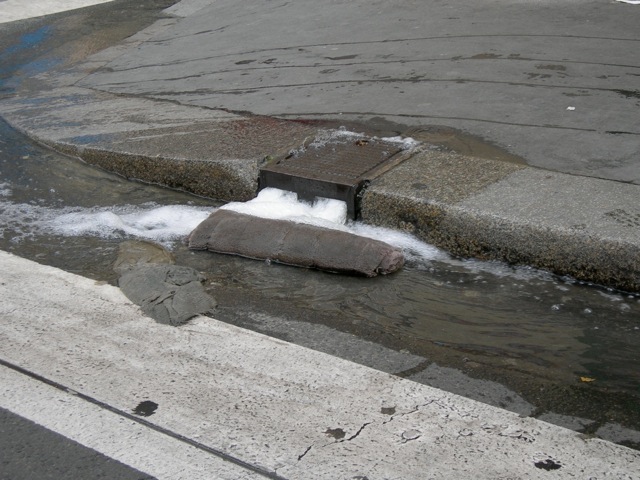
This photo tells part of the story of how Paris streets are cleaned. Water under relatively low pressure is emerging from a curbside opening, of which part of the cover is on the sidewalk. These are called WOs (washing outlets) or, in French, bouches de lavage, and there are 12,000 of them in Paris. In most cases, an old piece of carpet diverts the water from the road. The idea is to keep the water in the gutter where the sidewalk curb meets the road, so it can collect assorted debris and flush it into the sewer system.

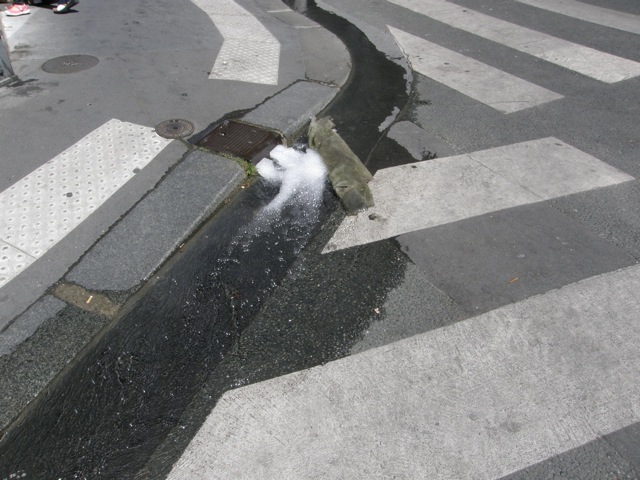
Paris is also about style, fashion, and colour. So in the photo below red and green carpets add a little panache to engineering function. Notice the larger of the two holes on the checked cover plate inset into the sidewalk. That is where workmen insert a special wrench to turn the water valve to start or stop the flow of water.

In the photo below, we see that the piece of carpet is placed so that the water can go in one direction only. Any street debris will be carried along with the flow of water. In some cases the water flows undisturbed or unaided.

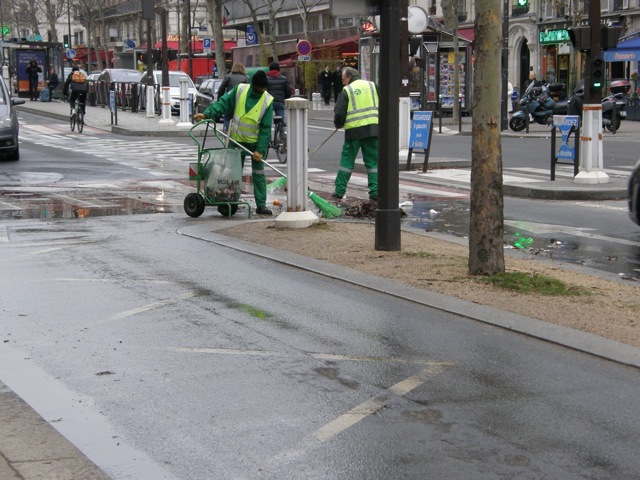
Paris’s men in green often give the water a helping hand. Here, on the rue du Faubourg St Jacques, near the Boulevard Port-Royal, water is flowing along the curb while two workers keep the debris moving where the tires of parked cars obstruct the flow.

Sometimes, as we see in the image below, there is a large amount of debris—after all, the Marché Port-Royal across the street had closed a short time ago—and it is skilfully and quickly swept together by the same two workmen. The larger pieces and clumps of leaves, paper, plastic and other rubbish go into the plastic bags in the cart. The rest will be swept away.

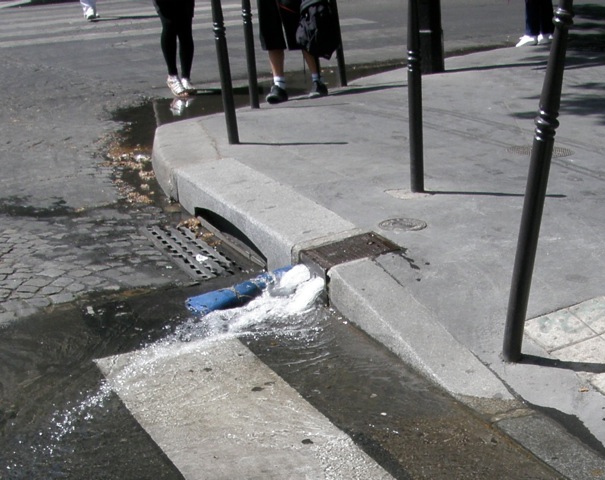
It is all part of an ingenious cycle. In the photo below, the blue carpet directs the water towards us and it flows down.

However, when one looks just behind the bit of carpet (upstream, so to speak), we see an open grate at road level. This is where the water from further upstream would bring its debris and re-enter the system. But this is no ordinary system, and Paris is one of the few cities in the world to have it.

How does it work? Why is it there?

Most cities have only one system to supply water, which is used for everything from making coffee, cooking, and taking a shower to cleaning streets, fighting fires, and watering gardens. Whether the water needs to be potable (safe to drink) or not, it all comes from the same place and the same set of supply pipes. We want our drinking and bathing water to be treated and purified, but it is expensive and energy-inefficient to have water for street cleaning or lawn-watering treated to the same standards as potable water. Nevertheless, that is what we do in virtually every city in the world. Well, not every city. Not in Paris.

In Paris, there are two different sets of underground water pipes. Both are attached to the ceilings of the sewers. One supplies untreated water for tasks such as flushing the streets of Paris. One system and set of water pipes carries untreated (non-potable) water from the Ourcq Canal and the Seine. The water comes out at various places through WOs on the curbs and after cleaning the streets and gutters, flows into the underground sewers. This water is then treated and discharged into the Seine. There is a parallel but separate system to deliver potable water to buildings, residences, homes, stores, and restaurants.

In other words, there are two water supply systems, each serving different purposes and each having varying purity levels. There is no mixing of water from the two systems, so don’t worry when you drink Paris tap water; it is safe and I like the taste. If you want to know more about the Paris Water Supply visit Le Pavillon de l’eau (Paris has got to be one of the only cities with an entire museum devoted to its water and water supply).

The Paris dual water supply system makes good sense. But it works only because it was part of the original plan for radical modernization of the city in the mid-nineteenth century. It would be too difficult to retrofit most modern cities to the same standard.

For this, we have to thank several people: Napoleon Bonaparte, the Emperor Napoleon III, Baron Haussmann, and a brilliant engineer called Eugène Belgrand.

Napoleon Bonaparte gave Parisians their first abundant supply of flowing water when he diverted the river Ourcq into the Seine within Paris. This is now known as the Ourcq canal.

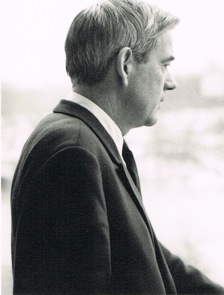
Emperor Napoleon III (shown above) decided that for his greater glory and the greater comfort, convenience, and future fame of Paris, he had to modernize it, getting rid of many narrow crooked streets, opening up wide boulevards, and providing it with up-to-date infrastructure.
Carrying out this massive job fell to Baron Haussmann, who in turn chose Eugène Belgrand, a graduate of the world-renowned École Polytechnique, as his Director of Water and Sewers of Paris. Before Belgrand, Paris had had a massive, smelly, and not very satisfactory sewer and water supply system.

Belgrand made the sewage system four times larger than it had been before and when he finished, it was a tourist attraction. He doubled the amount of daily water available to each resident, while the number of dwellings with running water grew by four times.

It was Belgrand who put in the system that separated water for human consumption and water for other purposes. At a time when most water—drinking or otherwise—was not very good, it was an astoundingly far-sighted move. The initial costs were far higher than they would have been for a single system—the system most of the rest of the world has.

The river Ourcq water became the low-pressure non-potable system for what was called “public water” and the new high-pressure water drawn from underground became the “new waters,” a potable source under enough pressure to rise up to the top of the growing number of apartment buildings. Hence the famous signs proclaiming “Eau et Gaz à Tous les Etages.”*

That decision to have a dual water system and its execution keeps Paris streets clean today. And it involves more than water gushing out from a gutter drain and men with green plastic brooms helping it and the debris along.

One morning, as I sat on the balcony of our borrowed apartment, sipping coffee made with good Paris tap water and reading a book on nineteenth-century typewriter design, I quietly gave thanks for the men below who were working to keep the city so clean. One man drove the truck, while another swept the sidewalks with a high-pressure hose. Look at the front of the truck, with its system for spraying water from the movable front-mounted spray units.

The system is not only clean, it is energy-efficient. The truck is filled with untreated water, the kind of water that most cities in the world cannot reuse. The Velib’s are not the only thing in this picture to lower the carbon footprint of Paris.

If this photo represents part of what draws you to Paris, remember that only a minute later, I took this photo.

Thank you, Napoleon Bonaparte, Napoleon III, and the often-maligned Baron who carved the future out of the past and I think did a good job of a difficult task. And thank you also, Monsieur Belgrand. I intend to learn more about you. The city we love is built on the unglamorous but essential workings of its water systems, which were far more efficient than any others. This is just one of the many pieces of infrastructure that makes Paris so livable and, might I say, loveable. Paris’s dual water system is just as much a part of the Technology of Tourism as the Eiffel Tower.

Text and photographs by Norman Ball

*For a good introduction to the changes of Napoleon III and Baron Haussmann follow this link.

Posted in Paris streets | Tagged , , , , , , , , , , , , , , , | 43 Comments

A walk in the snow

No trip to Paris would be complete without at least one lengthy visit to Des Photographies, an intriguing shop in Village St. Paul in the Marais. There, with some help from Sylvain Calvier, I have found and bought some wonderful photos of Paris. They are some of my favourite Paris photos, for they have helped me see Paris in a new light.

Yes, Parisian snow can be inconvenient or worse, and in a recent blog, I talked about that. But it can also be beautiful.

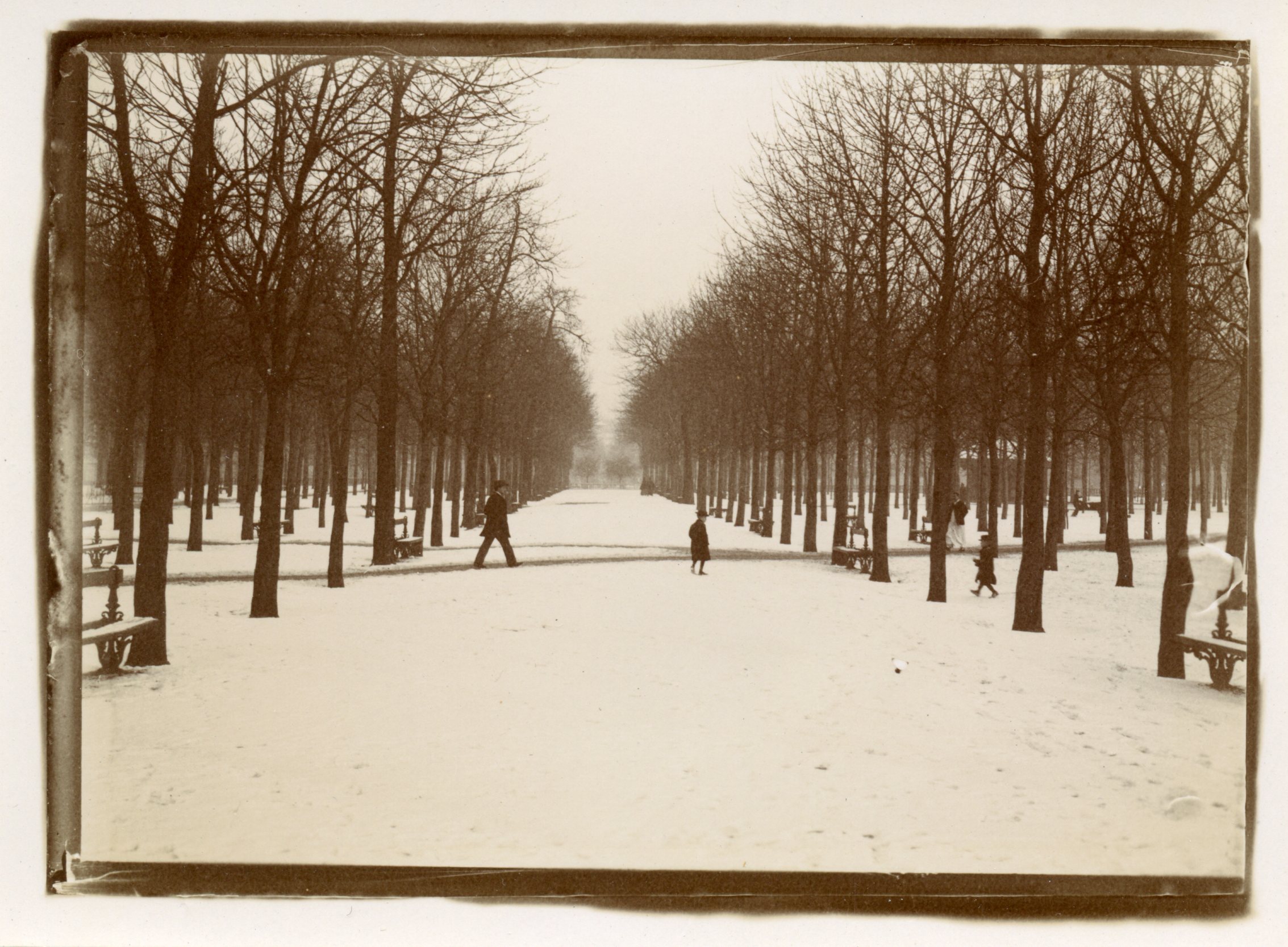
No matter how harried I might be, the photo above always calms me. It speak to me of when and where I bought it (along with several others). Things in Paris were getting rushed and I needed to slow down. I could think of no better place than Des Photographies. Just before I disappeared into the Metro, Philippa agreed to meet me at the shop in two or three hours. I need at least that long. Time stops for me there.

It is one of the classic small Parisian specialty shops. No space is unoccupied, and one walks very carefully. In quarters that are over 300 years old, it holds more than 100,000 photos, and yet the owner, or should one say curator, Sylvain Calvier, seems to know where to find whatever might be one’s interest. I have spent many enjoyable hours there, and some Euros too.

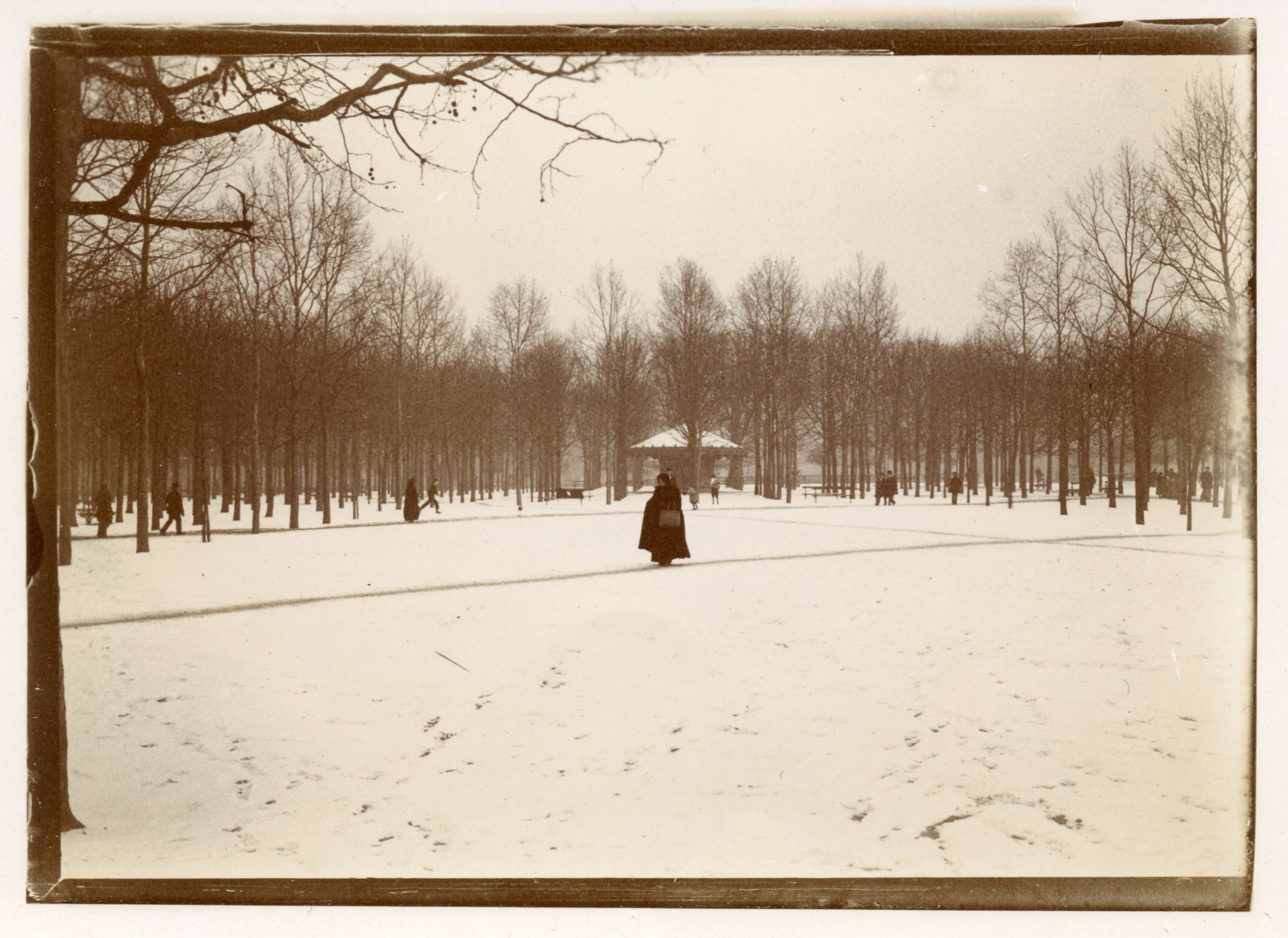
As I looked through a file of early 20th-century snapshots, these two winter photos held my attention. This was a different Paris. More than simply people walking across snow there was a sense of solitaryness, openness, and the unending variety and beauty of the lacelike patterns of trees temporarily denuded of leaves and highlighted by snow. Personal confession: I have never liked evergreen trees, they are so changeless and so boring.

Snow transforms landscapes. Paris is a chameleon, an alluring shapeshifter. One can feel crowded, hemmed in, pushed along, bombarded by sensory overload. And then suddenly it is none of these things. It is a Paris of parks, the geometry of outdoor spaces that whether tiny or large somehow combine vistas with intimacy, a series of mini-worlds that are not in collision. And the snow makes the landscape seem larger and more open, less crowded, and makes the orderly geometry more visible.

Snow helps one see basics more clearly. The back of this photo bears the hastily scrawled pencilled annotation: “Paris 1904 Le Louvre.”

A dusting of light snow seems to reduce the vastness of the Louvre and make it seem only a backdrop to an urban street scene: tram tracks, a bicyclist, some pedestrians, a small horsedrawn carriage, and a large omnibus drawn by four horses. When I had scanned the photo and enlarged it on screen, I noticed a passenger on the unprotected top level; it might have been colder, but it was cheaper up there. And behind the omnibus, a man with a furled umbrella. And again the openness. Snow seems to make people stand out in higher relief.

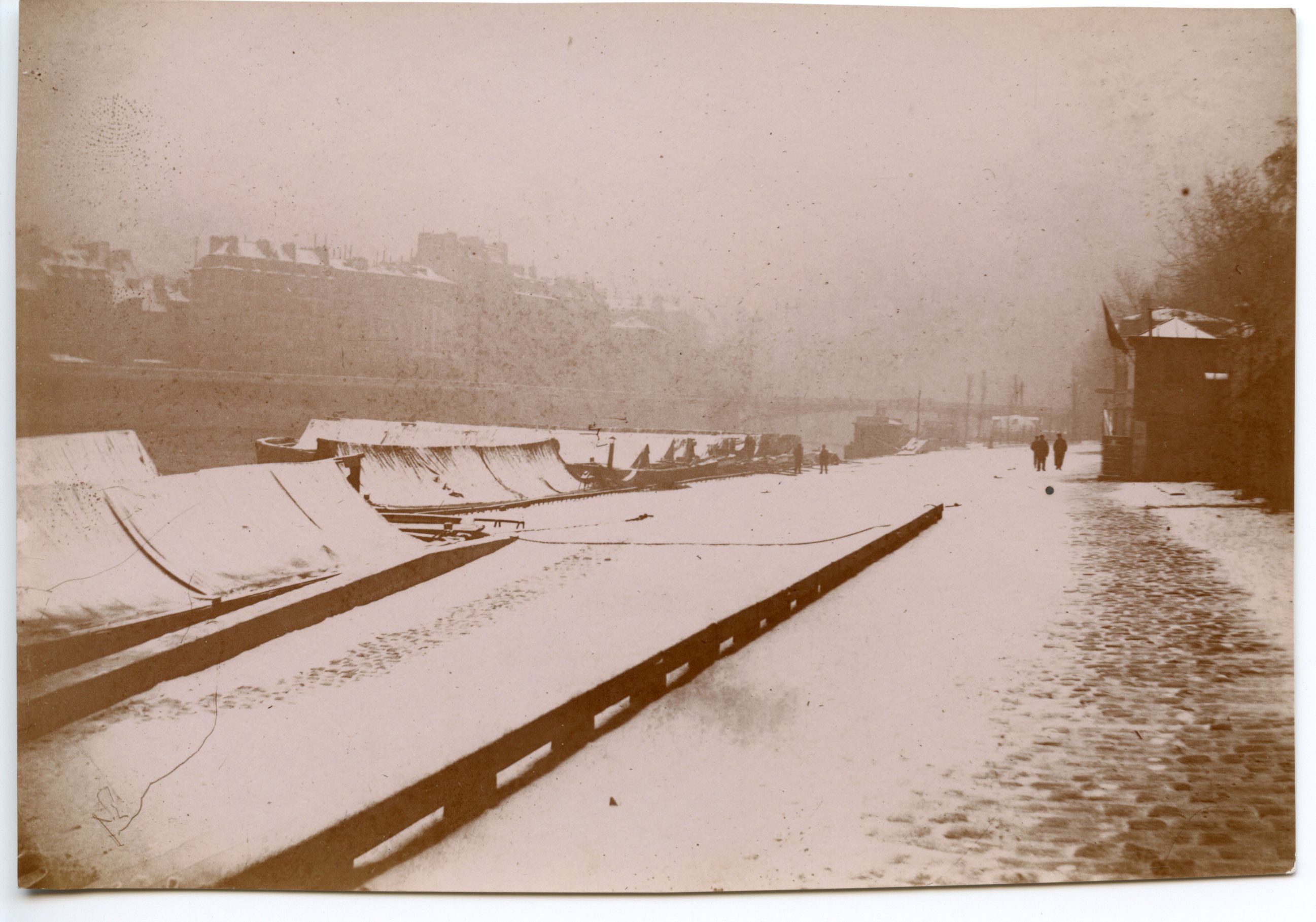
The famous péniches or barges of the Seine look very different here. I love this photo, because it captures three important elements of the Paris I have experienced: the Seine, working boats, and, yes, snow.

Faintly pencilled on the back are the words, “Le Mail au [sic] pommes.” What was that? Le Mail means a market area or mall; pommes are apples. It looked like one of the islands in the background. It turns out that there used to be an apple market near the Hôtel de Ville. Presumably the apples came in barges from Normandy, and perhaps there was some Calvados too, to keep everyone warm. For a view of the scene without snow, click here.

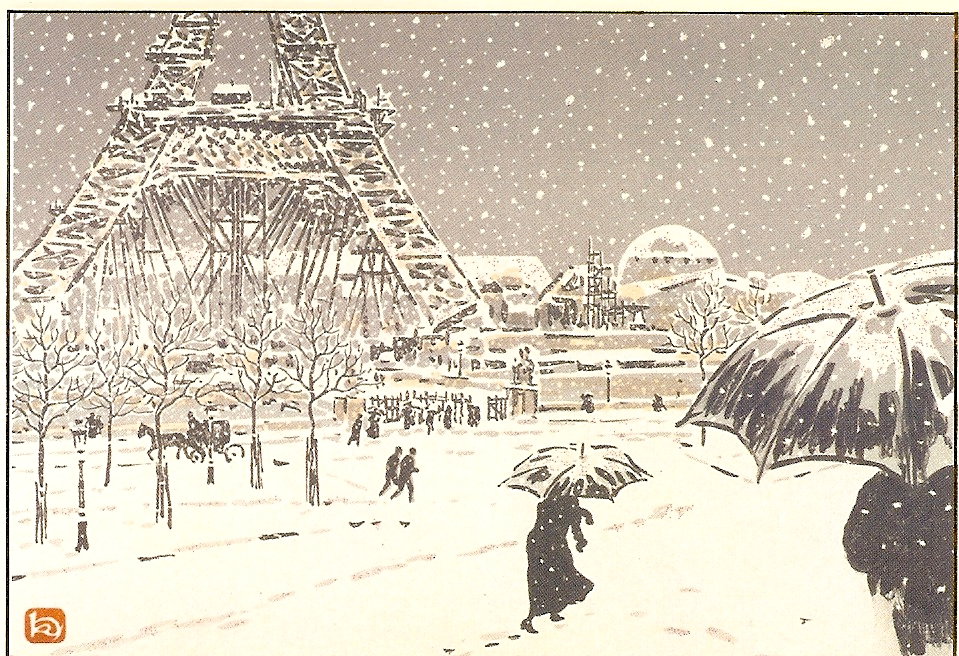
My photographs of Paris in the snow remind me of one of my favourite artists: Henri Rivière, celebrated for his Thirty-Six Views of the Eiffel Tower. In the prologue to the 1902 publication of this great work, Arsène Alexandre writes what too few have read or understood. He clearly states that an artist of the “eminence of Monsieur Henri-Riviére” did not paint the tower because of its greatness, but rather he took the tower as “simply a pretext, a mere excuse to depict everything admirable that is to be found in its vicinity.”* In other words, the paintings are about Paris, the thirty-six views are thirty-six ways of looking at the city and the inclusion of the Eiffel Tower is simply a reference point.

And of those thirty-six views, my favourite is Number 3, the Tower under Construction, as seen from the Trocadero. Henri Rivière was influenced by Japanese art, particularly woodcuts, and the piece feels Japanese. The snow has muted and softened the ironwork and the two umbrellas in the bottom right dominate an image one might have expected the Tower to dominate. Rivière has deftly captured essentials only.

Here is another image that reminds of Henri Rivière. The scene is reduced to its essentials: the trees, the snow, the solitary walker.

French history warns against the dangers of snow. Is vulnerability in the face of snow not the lesson to be drawn from the deadly failure of Napoleon’s march on Moscow? Listen to Victor Hugo in The Expiation, Russia 1812, beautifully translated by Robert Lowell.

The snow fell, and its power was multiplied.
For the first time the Eagle bowed its head—
dark days! Slowly the Emperor returned—
behind him Moscow! Its onion domes still burned.
The snow rained down in blizzards—rained and froze.
Past each white waste a further white waste rose.

…snowfall, floating through the quiet air
buried the huge army in a huge shroud.

Here in Canada, snow is familiar and expected. Songwriter Gilles Vigneault put it this way in 1964: “Mon pays ce n’est pas un pays, c’est l’hiver” (My country is not a country; it is winter.) Mind you, two centuries before, Voltaire, in Candide (1758), curtly dismissed the economic potential of New France as nothing more than “Quelques arpents de neige” (A few acres of snow). Snowy possessions were not worth investing in or retaining.

On February 29 just past, some Canadians may remember the “walk in the snow” of Pierre Elliott Trudeau. On that day in 1984, our controversial and flamboyant prime minister took a stroll to ponder his political future. In the snows of Ottawa, by a wide river that runs through a capital city, he found the clarity he needed to make a decision not to run for re-election.

Perhaps I should end with a photograph I took in winter in Paris. Again, people are silhouetted against the white background in a stately avenue of trees. Again, the scene is reduced to essentials. It combines the beauty of Paris and the familiarity of snow for a Canadian visitor.

Text and original photo by Norman Ball

*Henri Rivière, Thirty-Six Views of the Eiffel Tower, with a Prologue by Arsène Alexandre, 1902, republished in a facsimile edition by Chronicle Books, 2010, p.94 (translation by Alison Anderson).

Posted in Paris gardens, Paris parks | Tagged , , , , , , , , , , , , , , | 3 Comments

How I learned to stop worrying and love Wikipedia

When I am not working on the blog or running my own business, I teach in the geography department of the University of Toronto. Among other things, I talk to my students about research skills, and I encourage them to expand their search for information well beyond Wikipedia and the basic Google search.

Most of my colleagues disparage Wikipedia as an inadequate crutch in the search for reliable, verifiable, peer-reviewed, double-blind-tested information. And so did I…until I started to create Wikipedia entries. Now, although I still recognize its many flaws and weak spots, I have a newfound respect for this resource. And I started contributing as a direct result of this blog.

It all began with Stanley Loomis. In fall 2010, I wrote a blog inspired by Stanley Loomis’s 1967 book, A Crime of Passion, about the murder of the Duchesse de Praslin by her husband in 1847 in the house shown above (the blog is one of our all-time greatest hits; it continues to attract readers). Something about Loomis’s book inspired me in a way I cannot explain. I was desperate to know more about its author. But there was nothing whatever on the Internet about him.

Fortunately, with my access to the University of Toronto library system (the most extensive academic library in Canada), I was able to find out a few things published in long out-of-print journals. And then, on an impulse that surprised even me, I contacted his family. I just had to know more about him.

I stumbled onto the story of a fascinating life, cut short far too early. Stanley Loomis was hit by a car on the Place de la Concorde in 1972 and died of his injuries just a few days before what would have been his 50th birthday. He had written four books of French history and biography, each one a polished gem of research and insight. (The other three are Du Barry, Paris in the Terror, and The Fatal Friendship. I’ve read them all, now own them all, and recommend them all. They are out of print, but you can find them in libraries and through online secondhand booksellers.)

But the more I found out, the more I wanted to know. Since my first tentative e-mail to Stanley’s son, I have talked to many of Stanley’s family members and friends, all of whom were happy to share what they knew and delighted that someone was taking an interest. What could I do with what I learned? After a while, it occurred to me: write a Wikipedia entry.

In my first Wikipedia foray, I learned that there are rules and there are people who police those rules (also “bots” who troll Wikipedia entries looking for trouble). The information must be verifiable. No plagiarism. No conflict of interest. No copyright infractions. I wrote a carefully footnoted entry that seemed to pass muster. I felt satisfied that I had ensured that a worthwhile author was now visible to Internet browsers (what the French called Internautes). Since I posted it, it has been viewed hundreds of times, probably by people like me, who have read one of his books and immediately wanted to know more about their author.

Then it turned out that Stanley’s brother, an Arctic historian, had lived an equally interesting, although very different life, and had written a landmark book of his own. The family and friends I’d interviewed thought he, too, deserved his own entry. So I created a Wikipedia article about Chauncey C. Loomis, Jr.

I am still working on Stanley’s story (this is a long-term project), and hope to compile my findings into a complete biography. He belongs to my father’s generation (my father will be 91 in April; had he lived, Stanley would have turned 90 in December 2012). Many of those who knew him are still alive, and I hope to travel to his home town of Stockbridge, Massachusetts, this summer to read some of his correspondence which has been preserved by a long-time family friend.

But it didn’t stop there. Once I knew how to create a Wikipedia entry, I found some other gaps that needed to be filled. Last May, I bought a postcard in a Paris market that set me off on a little voyage of discovery. It was an image of the Grands Magasins Dufayel. And once again, I was astonished to find that there was next to no reliable information on the Internet about Georges Dufayel, who had popularized (although he did not invent) the practice of buying on credit – the foundation of modern retailing.

I was able to compile a short biography of Dufayel thanks to the Nineteenth Century French Collection at St. Michael’s College, University of Toronto. The photograph on the blog that inspired me, shown above, is now a part of Wikimedia Commons. That may not mean immortality, but many people who have never seen this blog have now seen that postcard image through Wikipedia.

My interest in Georges Dufayel led me to Gustave Rives, the architect who transformed the original department store into a palace of luxury.
I kept bumping into Gustave Rives in my research. In writing a blog about a stereoscopic image that Norman had found, I learned that Rives had designed the Hotel Astoria on the Champs Elysées, which had an interesting history. Then I discovered he played a crucial role in the preservation of the films of George Méliès (if you have seen the movie Hugo, you will know what I am talking about).

Out of curiosity, I did an online search for Rives, which led me to a genealogy website on which a message had been posted by his great-great-granddaughter. She wanted to know more about her ancestor. I wrote to her and she responded and put me in touch with a local historian from a Normandy resort town developed with Dufayel’s money and Gustave Rives’s architectural talents: Sainte-Adresse.

The local historian introduced me to two hugely valuable resources: the Gallica digital library (the online resource of the Bibliothèque nationale de France) and Leonore (the online resource about members of the Legion of Honour). I’d heard that the French didn’t “get” the Internet and that French websites were lame. But these websites are models of public access to primary documents. I was able to read online copies of the Figaro dating from the mid 19th century and to see archival documents from an institution I might never otherwise have approached. If you have ever experienced the thrill of primary research, you will understand what this means.

Together, the three of us (the descendant, the local historian, and I) assembled a biography of Gustave Rives, and a list of the buildings he had designed. I created an English Wikipedia entry, then translated it into French (my French contacts edited my efforts to make them sound idiomatic). Posting a Wikipedia entry in French stretched my French language abilities to the utmost. If I thought the English Wikipedia instructions were a little opaque, the French ones were a complete mystery.

I am still trying to figure out the protocol for uploading images to Wikimedia Commons. My Sainte-Adresse contact sent me a photograph he had found in the municipal archives, taken in about 1916 by an unknown photographer, of a building designed by Gustave Rives (now demolished). The gnomes who monitor Wikipedia questioned the photograph, because the copyright is hard to determine. I assume that a photograph that is nearly 100 years old is OK, but the gnomes want proof. It’s a pain in the neck, but I appreciate the fact that they asked. It gives me more respect for Wikipedia.

OK, Wikipedia is an open-ended source of information that can be corrupted at any point by malicious or misguided intervention. Not all the entries are reliable or up to date. But it has become the way to create a record of an individual who might otherwise have disappeared from view. In creating a few entries, I have validated the memories and knowledge of people who were connected to certain prominent people who have since been overlooked. People all over the world can read about them. That is a good feeling.

This blog may disappear one day, who knows? But I hope that the Wikipedia entries I have created will endure, and will bear witness to the important contributions of people who were celebrated in their day. I like to think the entries will be there for a long time. The subjects deserve to be remembered and it is an honour keep their memory alive.

Text by Philippa Campsie

Posted in Paris history, Paris postcards | Tagged , , , , , , , , , , , , , , , , , , | 12 Comments

Postcards from a Snowy Paris

Although it snows occasionally in Paris, it seems to be rare enough that only a small amount wreaks havoc. The city just isn’t prepared for snow. Parisian winters are normally mild, but there have been some very cold ones that have brought great hardship. Fortunately, Parisians are a resilient lot. Disaster after disaster, they survey the scene and get on with fixing the damage and carrying on with life.

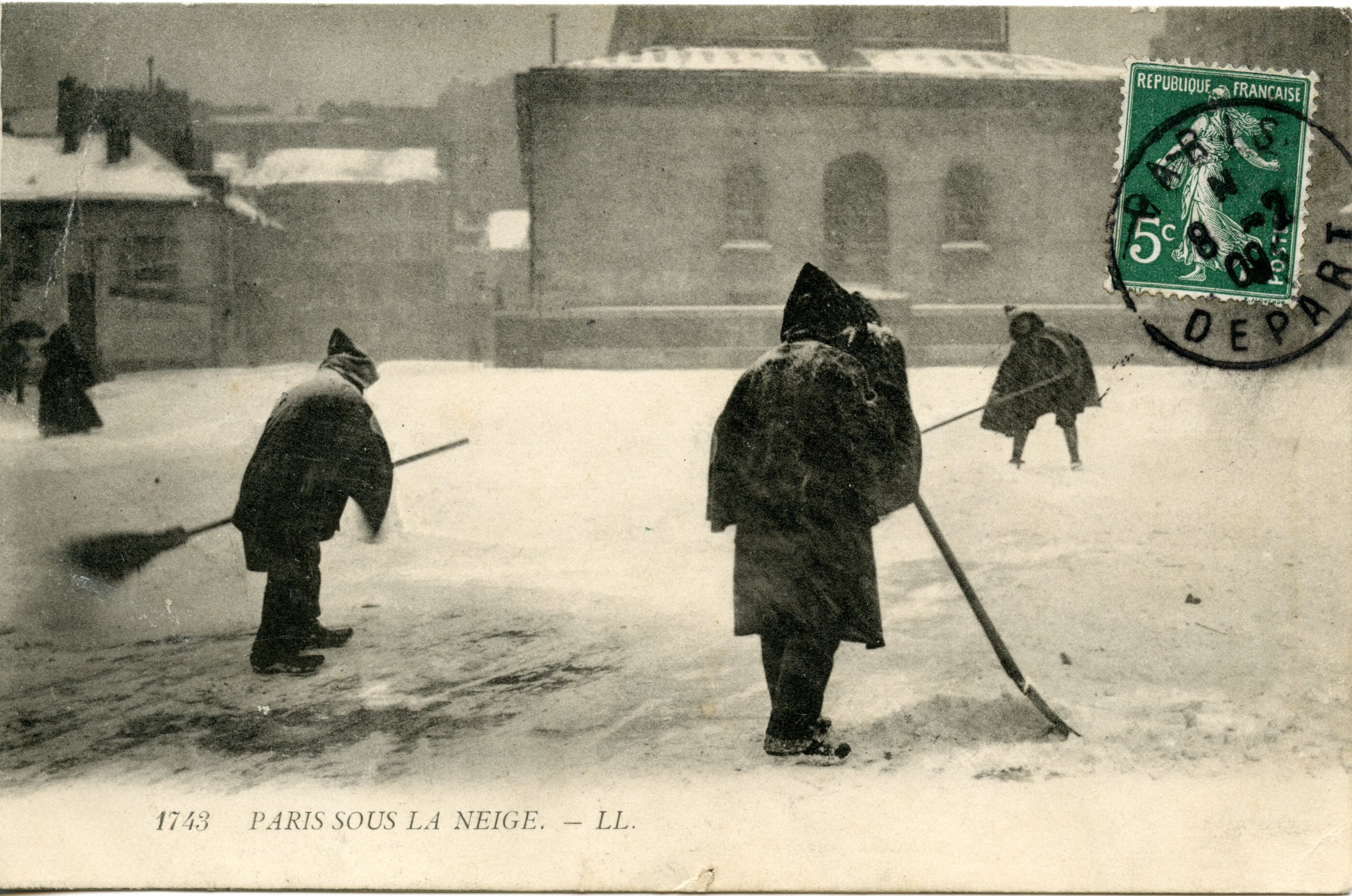
The image above seems timeless, with the workers in their hooded coats, wielding twig brooms and flat shovels. They are clearing what appears to be a light snowfall. (We cannot identify the location. Can any reader out there suggest where it might have been taken?)

That timeless scene seems a far cry from the “vigorous” winter of 1879-1880, when heavy snows and frigid temperatures led one newspaper, Le Petit Parisien, to put Paris and Greenland in the same category. It was an exceedingly difficult time, when trains moved no faster than pedestrians (if at all), telegraph services went down, and many apartment dwellers found themselves without the all-important gas needed for heating and light.

The roof of the Saint-Martin market collapsed under the heavy snow load. Fortunately, the market was closed and no one was killed. The temperature dropped as low as minus 21°C. For those who like numbers, 12,000 workers were hired to clear seven million cubic metres of snow. Even after converting that to seventy million cubic feet of snow, I’m still not sure what it means. An awful lot of snow, I guess.

But in the postcard, an aura of calm dominates the scene. The snow on the rooftops is more scenic than threatening, and the two figures just visible on the left edge seem unhurried. From the stamp cancellation on the front of the card, we know it was mailed from Paris in 1909.

The destination is shown on the back, as well as in the second postal mark. It is the town of Mennecy south of Paris in the département (administrative region) of Seine-et-Oise.

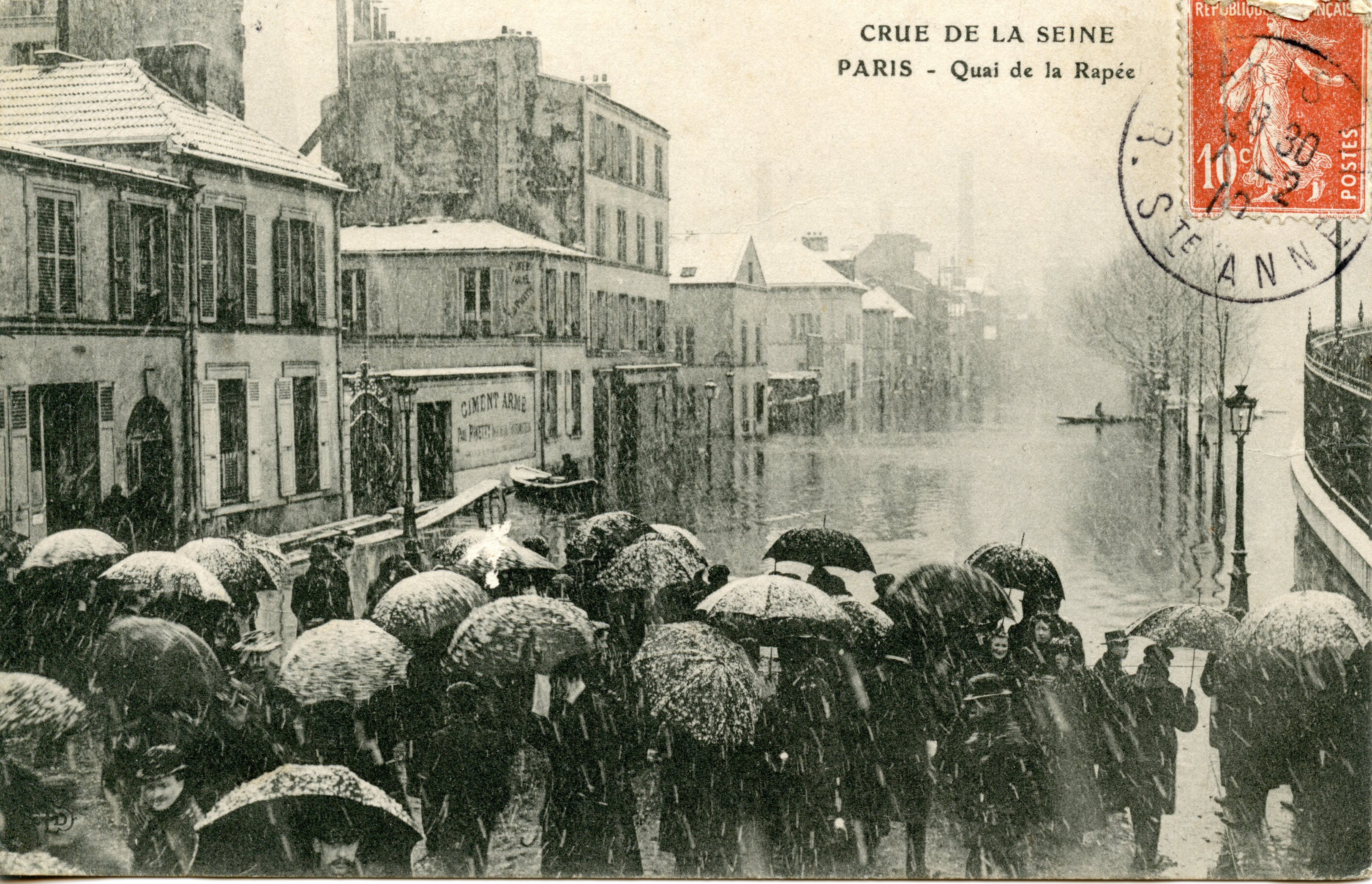
The next three cards, taken one year later, are from one of the great natural catastrophes in Parisian and French history: the Great Flood of January 1910, the likes of which Paris had not seen since 1658.

Snow-covered umbrellas dominate the foreground. It is quite unlike the first postcard, where there is only one umbrella and no sense of urgency. In this image, snow-covered roofs seem threatening, as do both the water in the street ahead and the boat floating where normally one would walk.

No single event triggered the flood. A series of unusual weather patterns accumulated and built on each other. The summer of 1909 had been cold and rainy. Sodden land held as much water as it could and the rest ran off. Fall and winter came with more rain and snow. As the New Year approached, it rained even harder and temperatures rose. Under the double load of meltwater and heavy rain, the Seine began to rise, causing small floods here and there. That was serious, but not a crisis. Then, on January 9, 1910 the rains came down even harder and by the January 14, the river was in full flood. And on some days the rains turned to snow.

This photo, taken on January 23, 1910, is both sad and threatening. By this time Paris had suffered serious damage. Thousands of homes and businesses had been flooded, not to mention the Metro, but Parisians soldiered on. Temporary sidewalks on stilts were erected so people could get to and from work, buy food and wine, and get on with their lives.

And what did those huddling on shore in the cold think of the struggling pleasure boat that advertised “Pianos on Board”? Perhaps they had dined and danced there once. Did it all seem irrelevant, perhaps even mocking? Or did it remind them why Paris, no matter what, was the pleasure capital of the world, a city of joy that sometimes suffered catastrophic interruptions? The waters would go down eventually, and the fun would resume on the boat and elsewhere.

The great flood of 1910 was not confined to Paris. The Seine is a long river and many outlying areas were flooded. At first glance, this image from Nanterre seems calm and the snow on the roof pleasantly scenic. On closer examination, you can see the height of the water. Nanterre is downstream from Paris, but close enough to be regarded as a suburb. This card, and the one below are from a series showing the damage done to Nanterre during the flood.

This second image shows an artificial gas facility where the coal in the right foreground would undergo what we call destructive distillation (heating to high temperature in the absence of air) in ovens or retorts inside the building on the right. The heat drove off gases which could be collected and stored in the gasometer on the left and distributed from there by gas lines. This was the artificial gas that powered, heated, and lit so many buildings and businesses in the 19th century. I wonder if the plant shown here had to shut down as a result of flood damage.

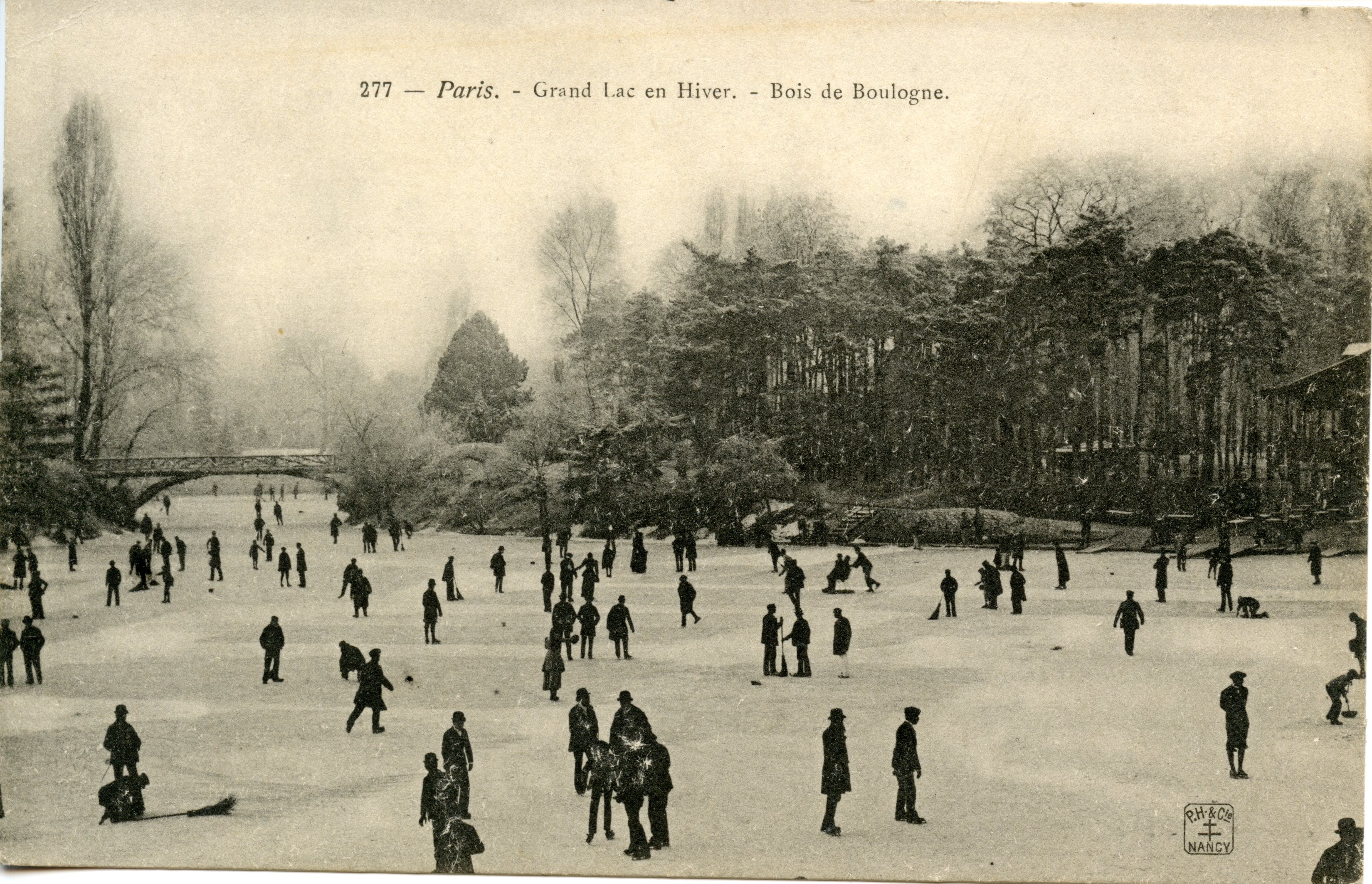
But cold temperatures and snow can also bring pleasure. The final postcard shows an idyllic winter scene in the Bois de Boulogne, one of the great Parisian parks. There is a lot going on. Some people are standing around talking, and some skating. When I first looked at the card I was puzzled by all the brooms. Are these the twig brooms we see in so many paintings and photos of Paris? Today the shape is fundamentally unchanged, but the bristles are no longer twigs but fluorescent green plastic.

After I had scanned the postcard and looked at it on a large screen, I could see that they were clearing individual skating areas. On the right I could see someone using a flat shovel similar to that in the first postcard. Near the middle is a wonderful apparatus—a chair of some sort mounted on runners and being pushed by a skater.

Yes, winter can be wonderful. The image of people enjoying the a cold bright day brought back memories of Christmas Day, 2010, when Philippa and I wandered through a snowy Jardin du Luxembourg. I shall always remember the young men playing table tennis in the snow. Come snow, come rain, Parisians always seem to find a way to have fun.

Text by Norman Ball

Posted in Paris history, Paris parks, Paris postcards | Tagged , , , , , , , , , , , , , , , | 7 Comments

Colour commentary

In the 1840s, my great-great grandfather came to Paris to study at the Gobelins Tapestry Factory. He was not a weaver or tapestry-maker, but a chemist who specialized in the science of colour and dyes, and the Gobelins was the centre of colour technology at the time.

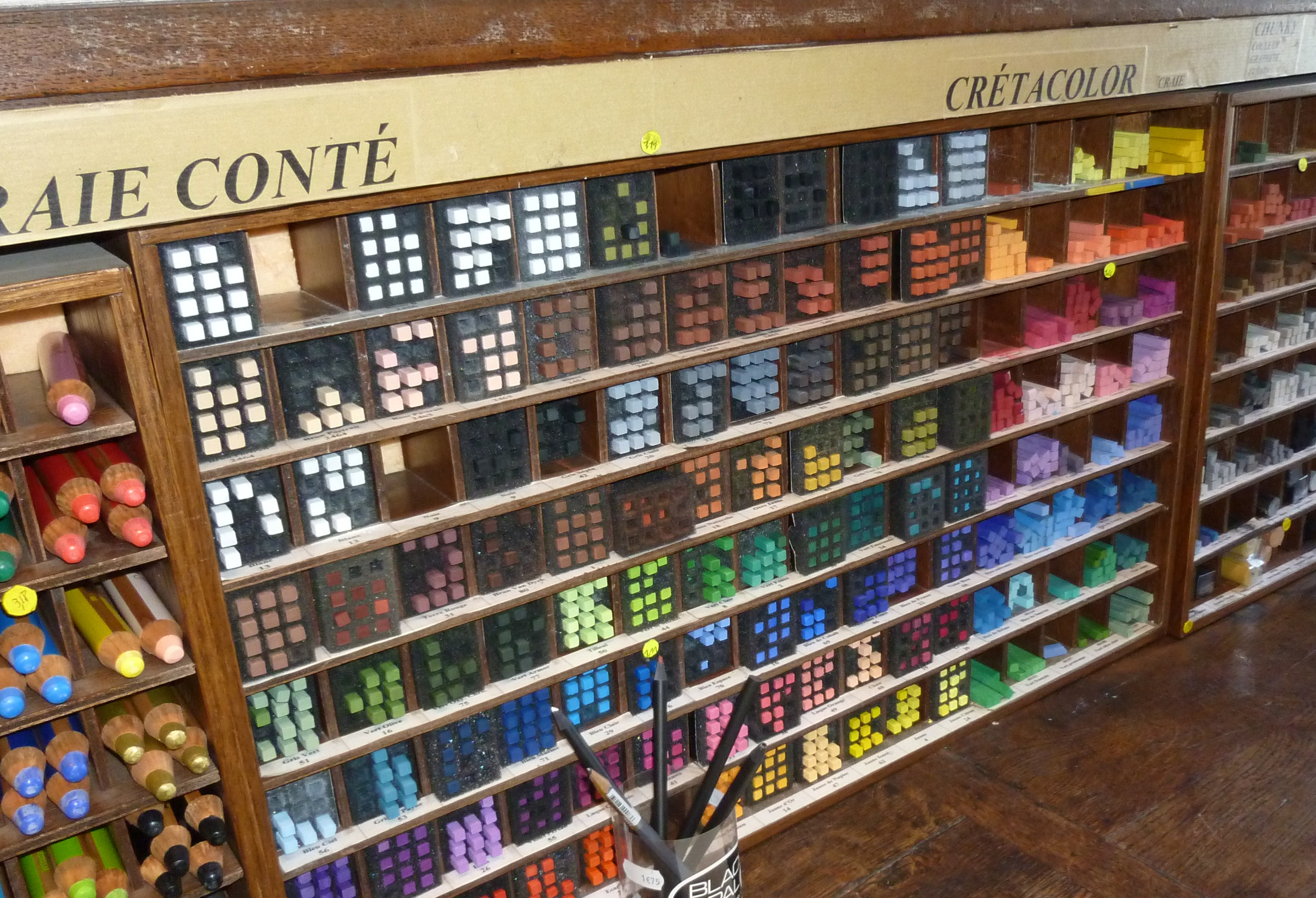
I like the idea of my ancestor studying colour in Paris. To me, the city is all about colour. Consider the art supplies in the shop Sennelier on the left bank.

Or the colours on display at any of the city’s flower shops, market stalls, or fabric emporiums.

But where I really love to find colour is on Paris’s façades. Interestingly, colour in architecture is considered controversial. Back in 2008, the Pavilion de l’Arsenal presented an exhibition called “Accords chromatiques” and published a book by the same name by Simon Texier. The opening line of the description was: “What if Paris were not the monochromatic city that is so often described?”*

Some architects frown on the use of colour, considering it vulgar, or a way to hide design flaws. Real architecture, they believe, is pure form and structure, colour is just a distraction. (You can even get into gender politics in this discussion – men are monochrome, women are all about colour…but let’s not go there now.)

The anti-colour faction was strong in the 18th century, but colour re-emerged in 19th century architecture, partly with the revival of interest in colourful medieval buildings – indeed the discovery that what are now monochrome church facades were once brightly painted. The 20th and 21st centuries seem to be divided into two camps on the subject – some pro, some anti colour.

Over the years, many of those who study architectural history have seen it largely through the medium of engravings or etchings or black-and-white photography, not realizing that the subjects in the photographs may have been colourful. The past was not sepia-toned for those who lived in it.

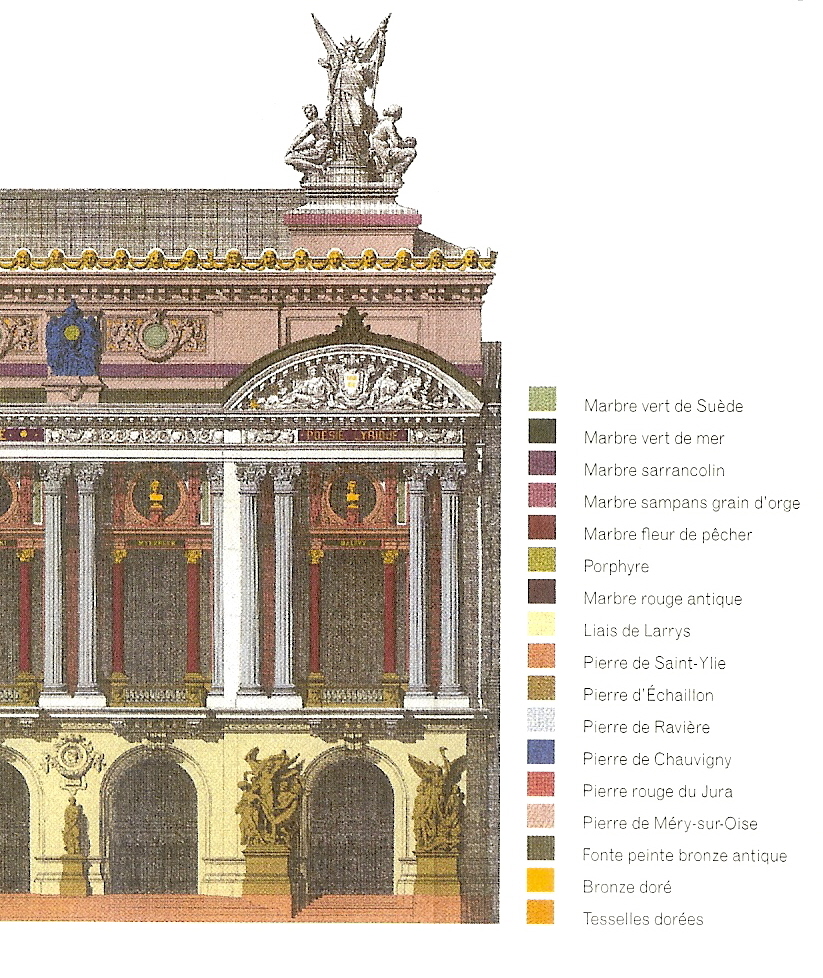
Of course, there is colour and colour. Some of it is fairly subtle. For example, there are at least 17 different building materials of different hues on the façade of the Opera (even before you consider the gold roof or the gilded mosaics), ranging from green Swedish marble to red stone from the Jura. Alain-Charles Perrot, the architect who supervised the restoration in the late 1990s, mapped them all so that replacements could be sourced from the original locations as much as possible.

Then there is the in-your-face colour of the Pompidou Centre, which looks like an oversized child’s toy.

In between are all kinds of gradations – facades with a little or a lot of coloured ceramic tile or mosaics, or those enlivened with painted walls or doors or shutters. Just as I am addicted to photographing courtyards, I tend to get out my camera when I see a particularly interesting touch of colour.

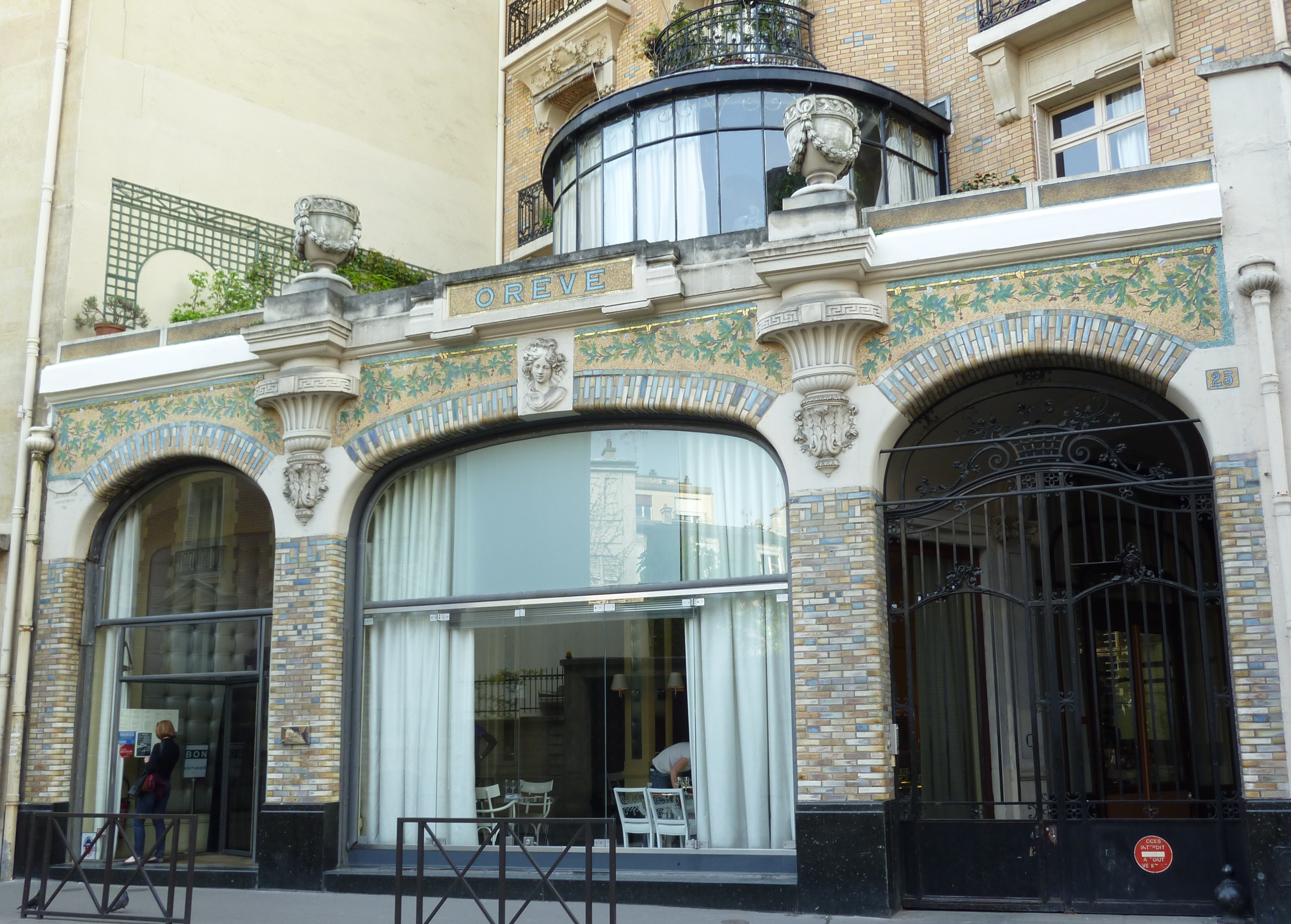
Consider this façade in the 16th on the rue de la Pompe. It is now a restaurant, but started life as a flower shop.

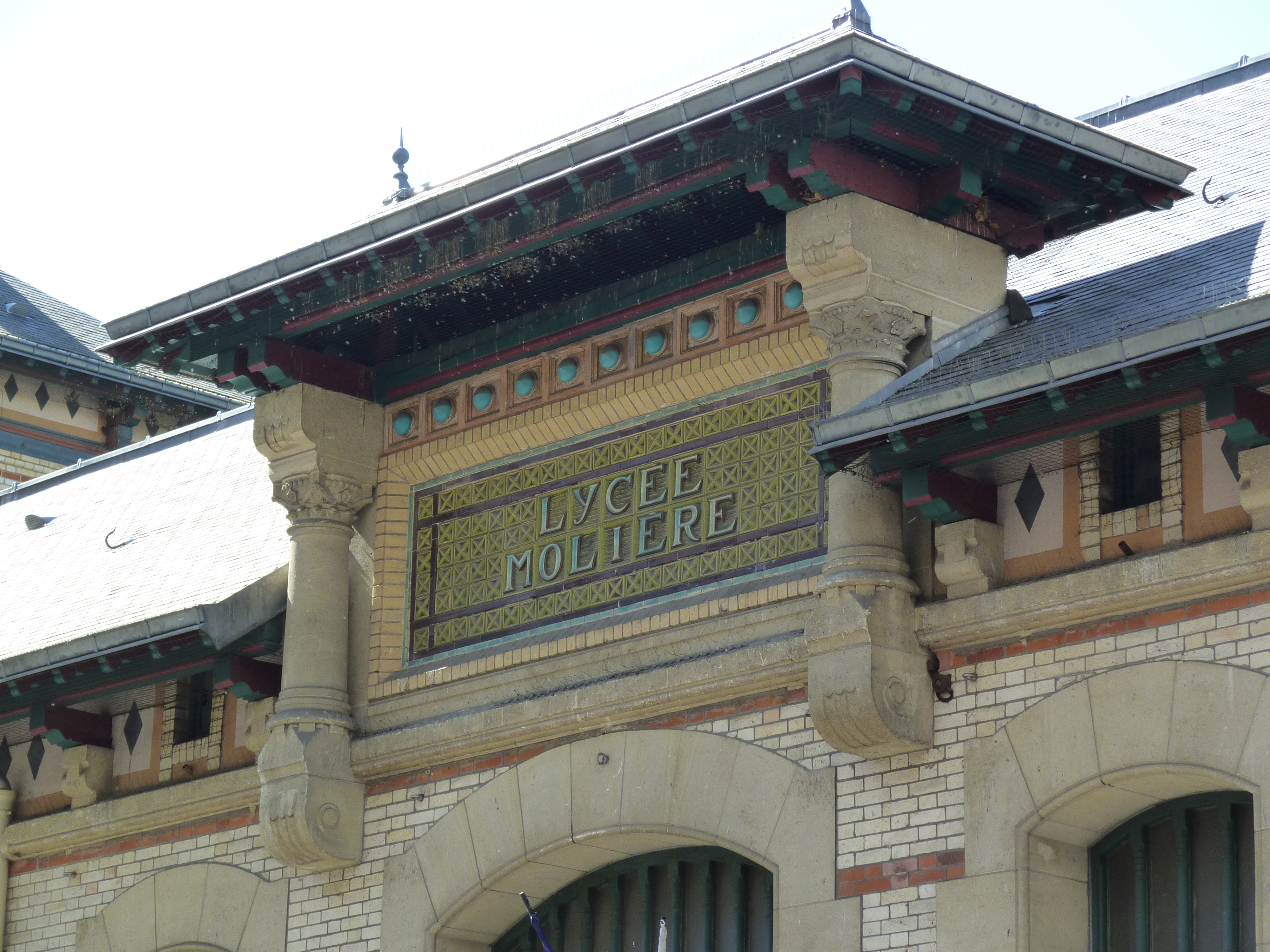
I was intrigued by the Chinese look of the entry to the Lycée Molière on the rue du Ranelagh.

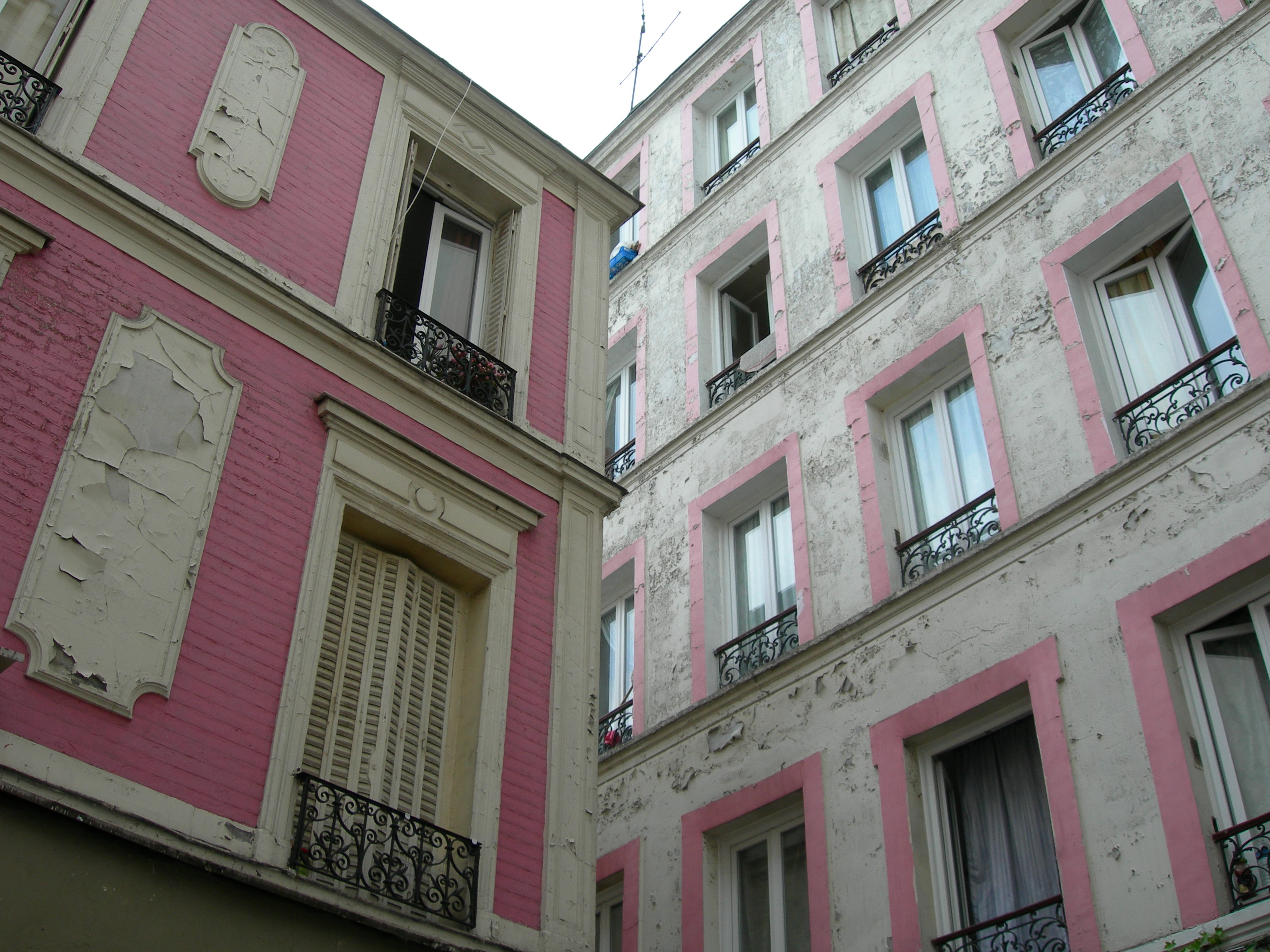
I loved the faded pink on this down-at-the-heels hotel…

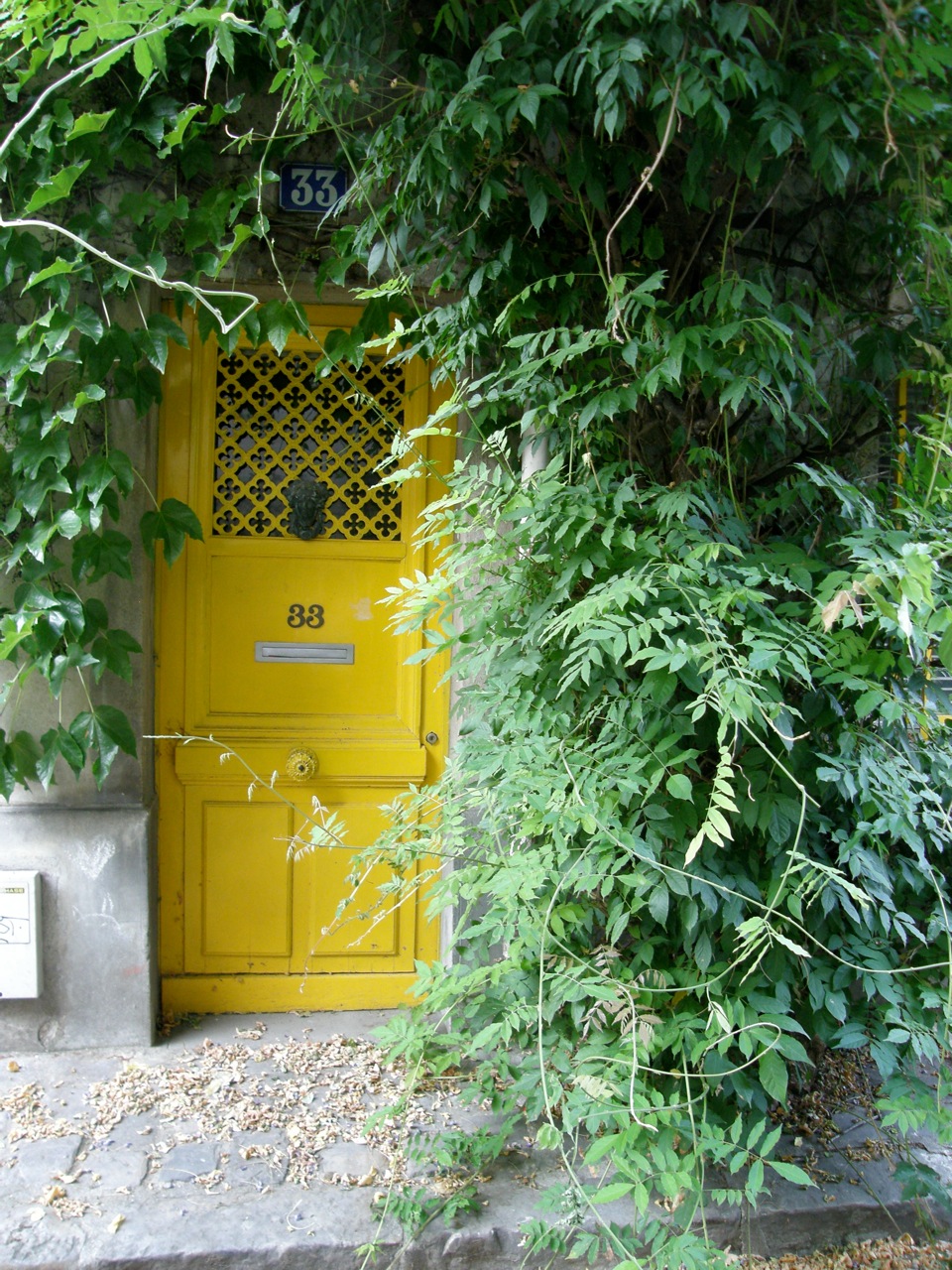
…and the bright yellow on this half-hidden door in the rue des Thermopyles.

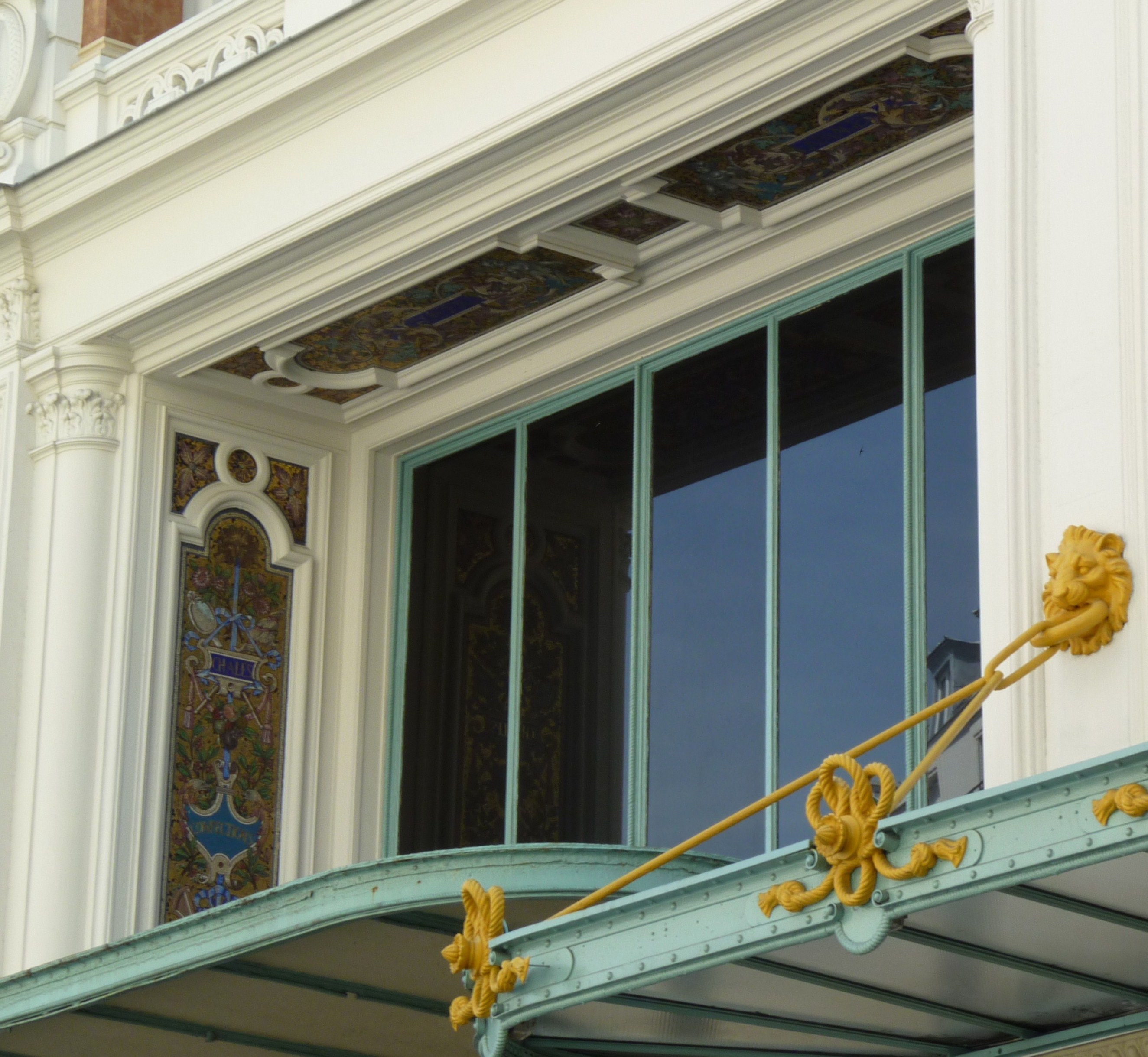
I nearly missed this detail around the windows on the rear façade of the Bon Marché, which is half-hidden by the overhang of the canopy.

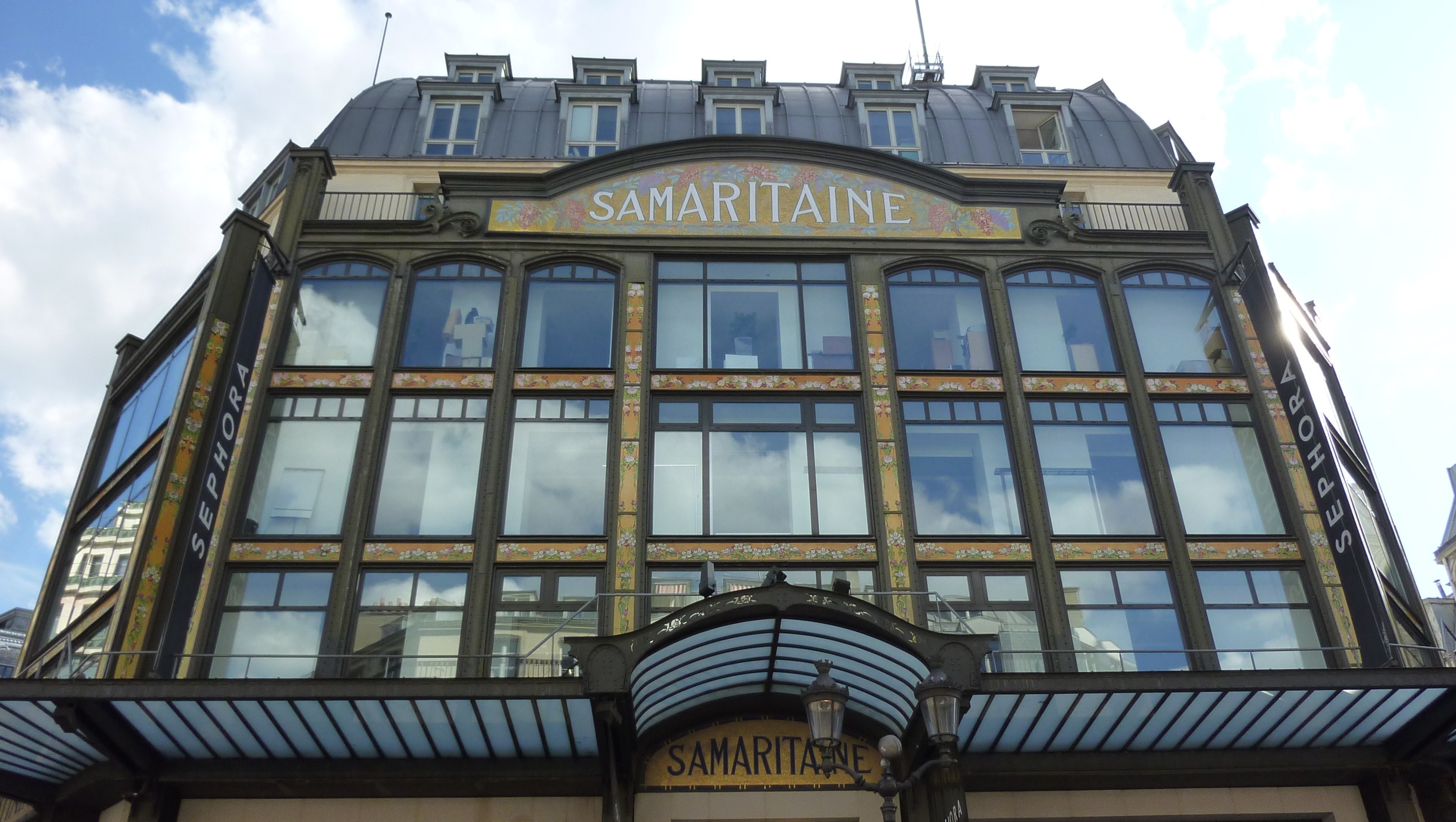
In fact, if you like colour, the grands magasins are awash in it. This façade of La Samaritaine is practically nothing but glass and mosaics, with some iron beams holding the whole thing together.

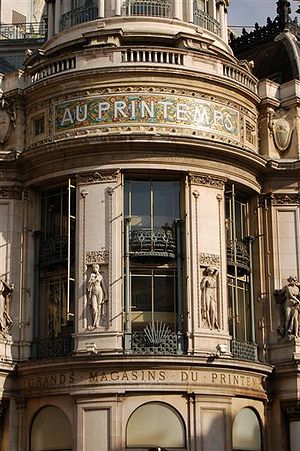
One of the most enthusiastic exponents of the use of colour in architecture was the architect Paul Sédille, who created the colourful façade of Printemps when he restored the building after a fire in 1881.

Sédille worked closely with Jules Loebnitz, whose company made earthenware tiles that did not crack or break when used on façades. Together, the two added colour to many Paris commercial and exposition buildings.

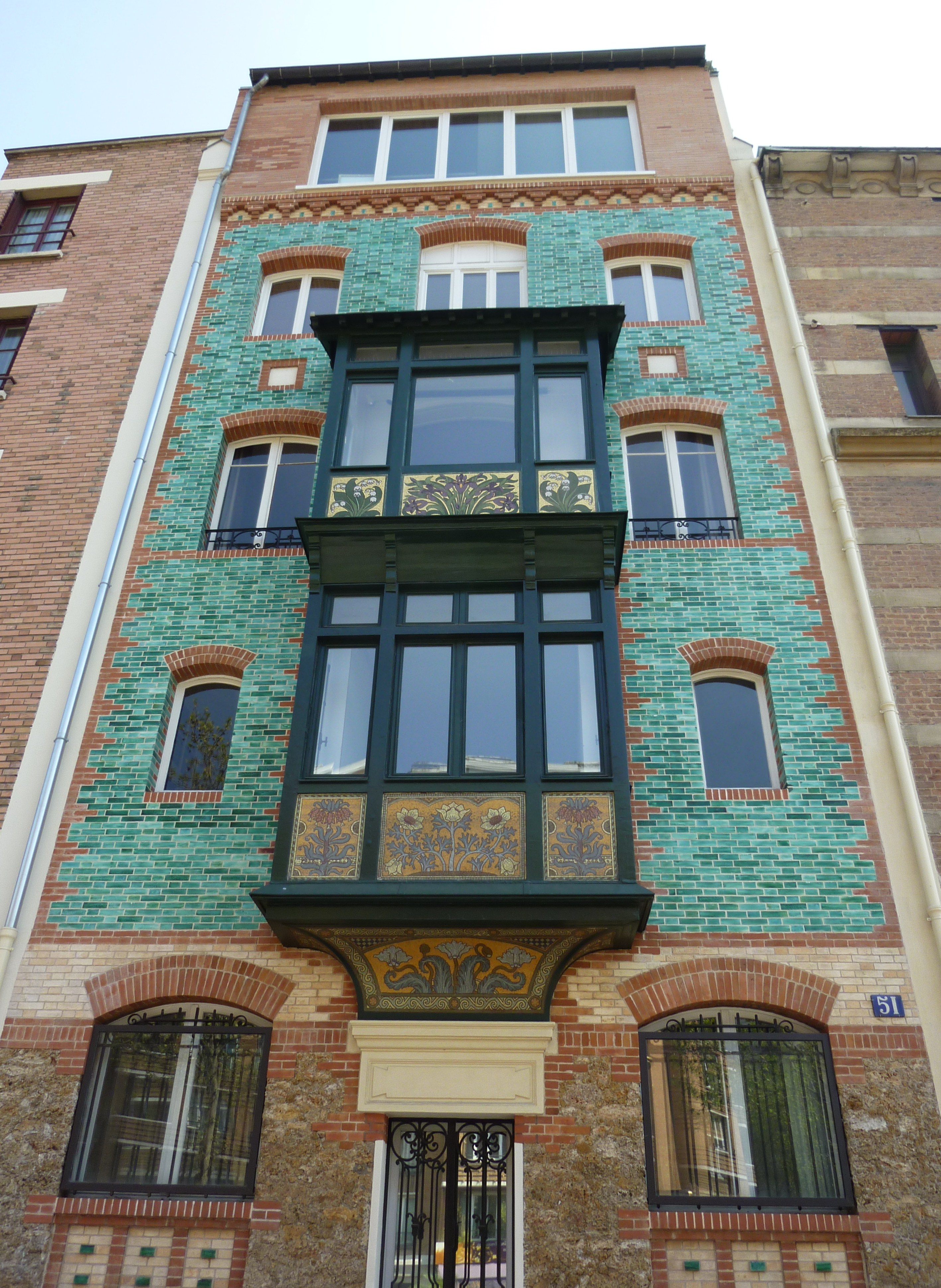
When I looked up Sédille (1807-1900) in an encyclopedia of French architects active in the 19th century, I found that he had designed one of the most colourful houses I have ever seen in Paris at 32, rue Eugène Flachat.

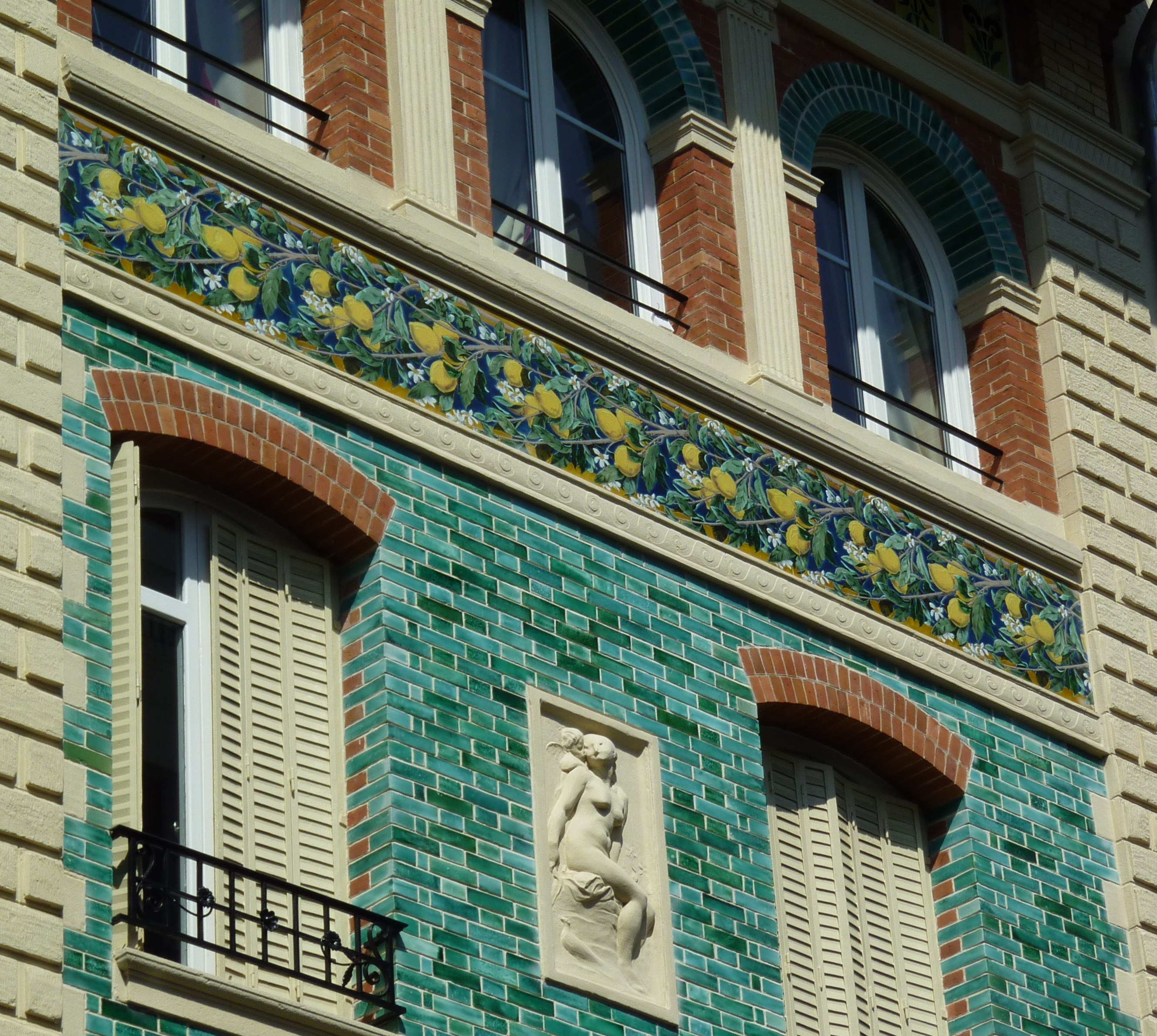
The other side of the house is visible at 51, boulevard Berthier. Same colour, but with a different treatment and different motifs in the mosaics. And yes, the bricks and tiles came from Loebnitz.

I was fascinated by this peacock of a house, and wanted to know more.

At the moment, the house appears to be used as offices. It is listed on the Internet as the address of the headquarters of Monceau Fleurs and the Centre de Formation Professionnelle des Fleuristes Modernes – appropriately enough – as well as the office of an architectural company called Build Up.

The encyclopedia of architects notes that it was built in 1892 for “F.-G. Dumas.” This turned out to François-Guillaume Dumas, editor of Paris Illustré and the Revue Illustrée, publisher of art catalogues, and author of an 1889 guidebook called Paris, ses vues, places, monuments, théâtres, etc.

Clearly this art publisher was making a strong statement in favour of colour in architecture. Some might find the colour a bit overpowering, but right now, in the middle of February when Paris is suffering through a rare snowy spell, the jolt of turquoise could be quite therapeutic for passers-by.

Text by Philippa Campsie; photographs by Philippa Campsie and Norman Ball, except for the photograph of Printemps, which comes from Wikimedia Commons.

* Et si Paris n’était pas cette ville monochrome que l’on nous décrit souvent ?

Posted in Paris architecture, Paris art, Paris streets | Tagged , , , , , , , , , , , , , , , , , , , , , , , | 6 Comments

Dateline Paris 1900: The Astounding Moving Electrical Sidewalk

In 1900, if you were lucky enough to have a ticket such as this one—and almost fifty million people did—you were in for an astounding treat. Paris and France went all out to make the Paris Universal Exposition the biggest and best yet anywhere in the world.

Although the Exposition seemed to have something for everyone, two words capture much of the spirit and substance of that great event: electricity and motion. As Charles Rearick writes in Paris Dreams, Paris Memories:

The fifty million visitors who came to the ‘Exposition Universelle’ were met with a dazzling profusion of electric lighting—in the pavilions and the Palais de l’Électricité and all the way up the Eiffel Tower. Outside the fairgrounds, the new lights illuminated the city’s monuments and the central boulevards.*

The newly constructed Pont Alexandre III led to the grounds, and provided lovely stopping points for flâneurs, flâneuses, and families. The ornate lamp standards might have looked like something from a far earlier age, but they were illuminated electrically: electricity and motion. Many who crossed the bridge would have travelled on the newly opened Métro in electrically driven cars: electricity and motion again.

For me, nothing captures the spirit of the Universal Exposition better than the image below.

It is a view of the Place de l’Ecole Militaire, looking towards l’avenue de Tourville on the right and to the left, l’avenue de La Motte-Picquet. There is plenty of motion at street level. But what of the two elevated roadways? On the left passengers are being treated to a ride on an elevated electric railway. The other simply looks like an elevated roadway or sidewalk.

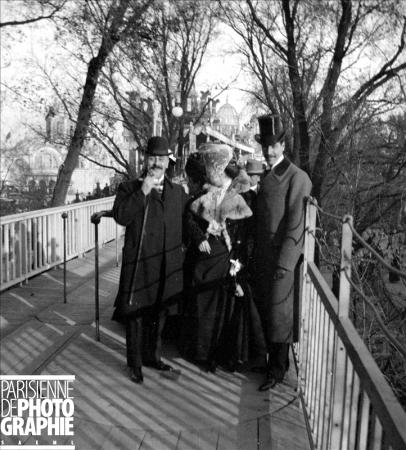
Look more closely at the happy group standing above. They don’t seem to be walking. There are more people behind them, also standing still. Why is there a semi-circular section on the sidewalk? And what are the waist-height poles to the left? Do you see the hand on top of one? We need to look at some other photos.

Here is another calm scene on the elevated sidewalk or roadway or whatever it is. On the left is a group standing on the sidewalk. We also see the poles in two distinct lines and note that the sidewalk is actually on three levels. And the wooden planks on the two higher levels follow the direction of the sidewalk and the lower level is at right angles to the direction of travel. Notice what looks like a station or shelter further along the sidewalk on the right side.

This was taken beside the building we saw in the previous photo. The child in the foreground seems to be a little unsure of his footing. Perhaps the man with what appears to be a porter’s or conductor’s cap is helping to keep the child from falling over. Beside the child, a man appears to be helping a woman move to the highest level of the sidewalk. Their images seem blurred because they are unsteady. It seems a rather animated scene. But the next is even more so.

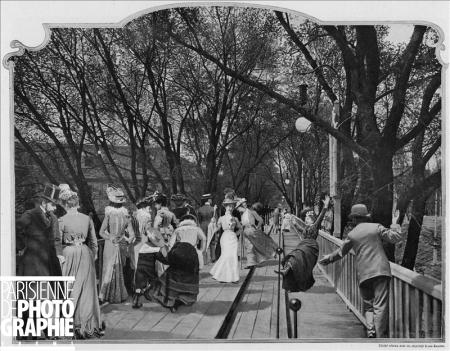
There is a lot going on. The man on the right wearing a bowler (or fedora) is rushing forward with hand outstretched to rescue a woman who is falling over. She is taking quite a tumble, he won’t get there in time, and she is going to hit the railing and the wooden sidewalk. Further back: more action. A woman is moving from the second to the third level; one skirted leg is thrown back. The lady with light coloured skirt, hat and parasol seems fine. Moving over to the left again, the lady wearing a dark skirt and the child are holding hands and both seem bent over determinedly. They seem to be bucking the wind or are leaning forward as if they had just got onto something moving and did not want to be thrown backwards. The two figures on the left, the man leaning on a railing and a woman admiring the view, are pictures of composure.

We have been looking at le trottoir roulant, the moving sidewalk, which in its day was one of the most famous marvels at the Universal Exposition of 1900. Historian Anne Friedberg writes:

The Paris trottoir was a two-mile-long, electric, three-tiered sidewalk. One trackway was stationary, the next moved at two-and-a-half miles per hour, the third at five miles her hour. The moving boardwalk moved bodies to see the grounds from new points of view at new speeds of movement. And the walkway itself was an exhibit, as patrons could sit and watch fellow fair-goers mechanically stroll.**

To get a real sense of what the experience was like (we suspect that the image above was staged), check out the video here. The film-maker? Thomas Edison. Notice how the passengers grab hold of the posts to swing on and off the sidewalk.

Alas, like the Gigantic Wheel at the same fair, le trottoir roulant had been preceded by a version at the Chicago World’s Columbian Exhibition in 1893. It shares something else as well.

Most of the grand structures and attractions built for great expositions are rather short-lived. The Eiffel Tower is a magnificent exception. In this street-level view of the moving sidewalk above, we see the support structure is rather roughly made of heavy wooden timbers. It was intended to be temporary and was eventually torn down.

Today the idea of a moving sidewalk does not seem at all novel. As we rush through airports wishing the moving sidewalks would go faster or as we travel on them in the Paris Métro—particularly that very long stretch in the Montparnasse station—we might pause to think of a time when they were novel, and if you got it just right, actually enjoyable.

Text by Norman Ball; images from the Roger-Viollet collection, Paris en images

* Charles Rearick, Paris Dreams, Paris Memories: The City and Its Mystique (Stanford University Press, 2011), p. 13.
** Anne Friedberg, “Trottoir roulant: the cinema and new mobilities of spectatorship,” in John Fullerton and Jan Olsson, eds., Allegories of Communication: Intermedial Concerns from Cinema to the Digital (John Libbey Publishing, 2004), p. 265.

Posted in Paris expositions, Paris metro, Paris popular culture | Tagged , , , , , , , , , , | 6 Comments

Sailing ships and rowboats

Père Lachaise Cemetery, spring 2010. I took this photograph, wondering what on earth a “caveau depositoire” might be. Turns out it is a temporary storage spot for bodies awaiting burial. But what attracted my attention at first was the image of a ship on what at first appears to be a headstone, but is in fact, simply an identification marker on a civic property.

The ship is, of course, the symbol of Paris, and you see it everywhere – on municipal buildings and facilities, including this one in the cemetery. I have photographed many others, from this unusual street sign on the rue de Penthièvre …

…to the tiny one on this marker indicating the boundary stone between Passy and Auteuil on the rue Berton.

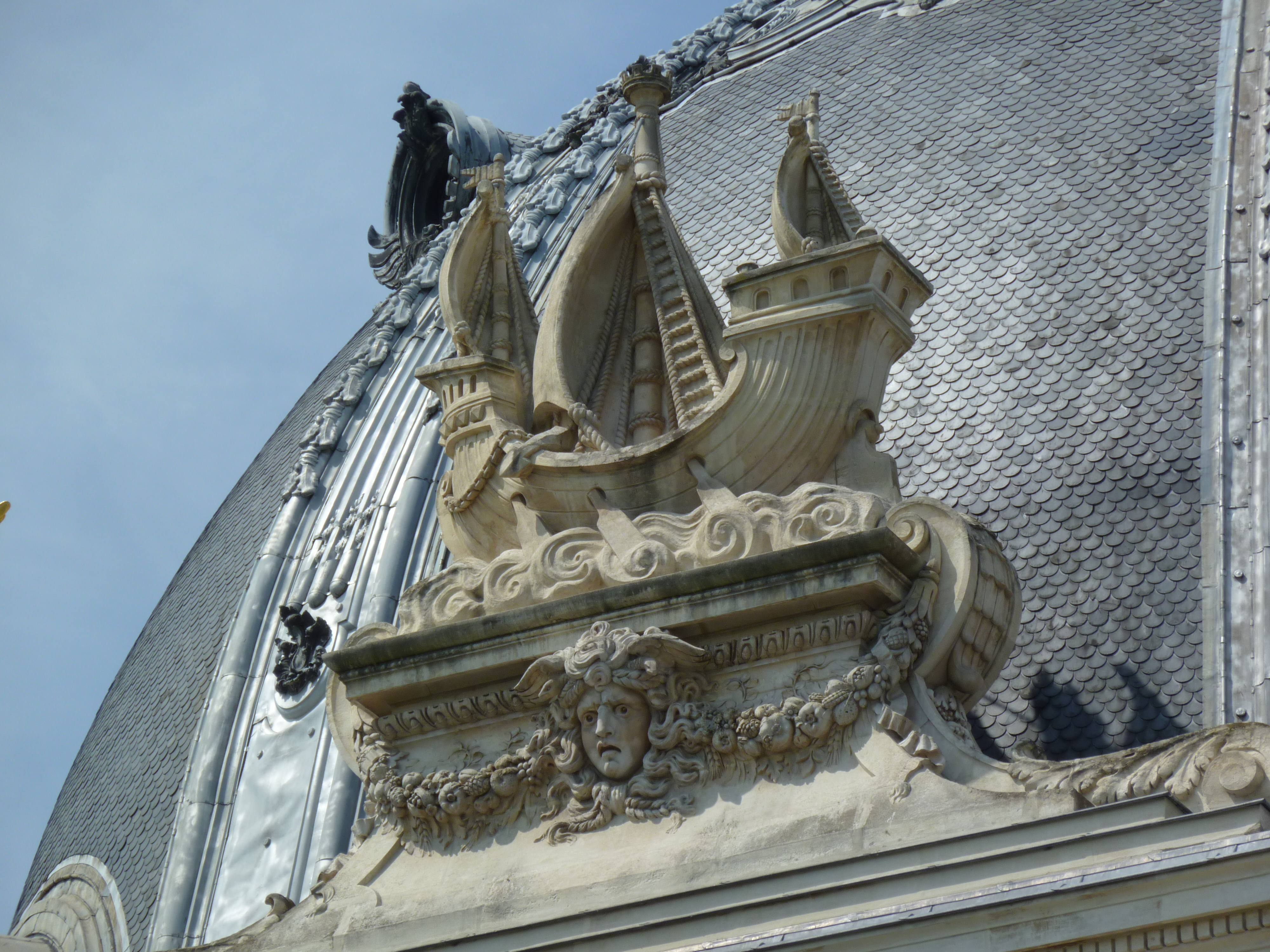
But it was only when I put together a little collection of these photos that I noticed something odd. Consider, for example, this elaborate version, on the dome of the Petit Palais.

It has oars. Three oars and three sails. The cemetery version had three sails, but no oars, and many of the others have one sail and no oars. Clearly there is no consistent corporate identity here.

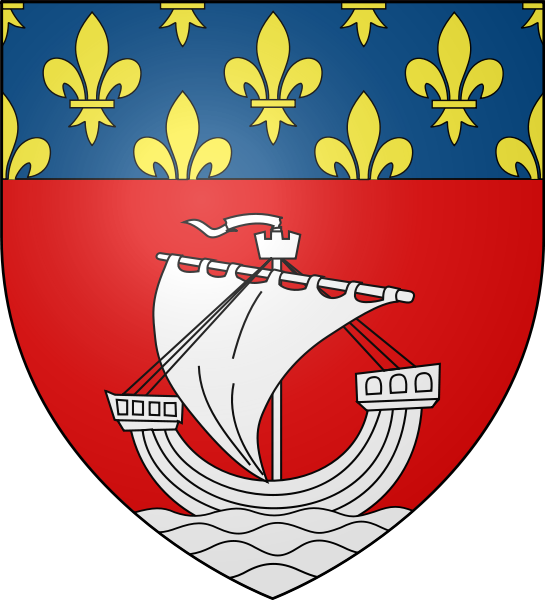
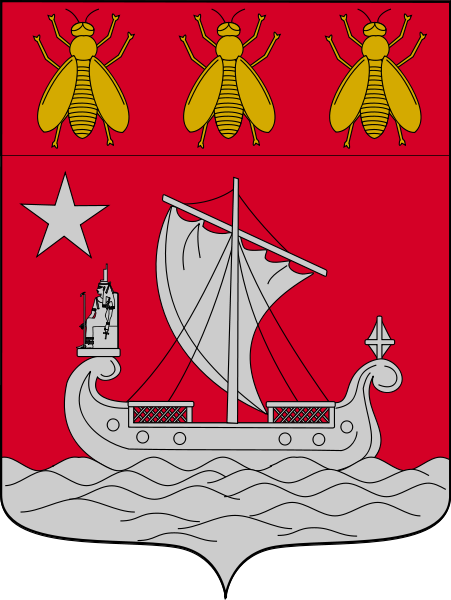
French Wikipedia notes that the coat of arms may have one, two or three masts and might or might not have oars. It also shows the standard version and two interesting alternatives.

The current one, shown above, is based on the original 14th century form – a rather unseaworthy-looking craft resembling no known boat shape (a semicircular profile with a single sail on top), perched on some choppy-looking waves.

The second, from the First Empire, includes bees, symbol of the Emperor Napoleon, and a star, symbol of the army, with a more stable version of the ship. It has an Egyptian figurehead at the front (Isis) and an inverted cross at the back. The former alludes to Napoleon’s military victories in Egypt, I suppose. The latter gave me pause. It was originally the symbol for St. Peter (although it is now associated with black magic). The allusion to St. Peter might have something to do with Napoleon’s takeover of the Papal States.

There is a third version, from the Second Republic (1848-1853), with a bigger, three-masted ship, and stars replacing the fleur-de-lys, which were associated with the recently overthrown royal family.

But not one of these ships has oars. And oars are clearly important, because they are what the city uses to indicate historic locations.

Oars are also prominent in the symbol the city used for the 1924 Olympics.

The inconsistency interested me. So I did a little research on the coat of arms.

The choice of a ship to symbolize Paris was the decision of Charles V in 1358. I’ve seen a couple of theories about why that particular symbol was chosen.

One is that the ship represents the boat-shaped Ile de la Cité, which once constituted the entire town. The oars are the bridges connecting it to the banks on either side. It’s an attractive theory, but probably not historically accurate.

More likely is that the ship represents the powerful guild of the Marchands de l’eau, who dominated the city from its earliest days. Although they sound like water-sellers, in fact this was a guild of boatmen who dominated waterborne trade on the river. What kind of boats would they have had? How big were they? Did they use sails or oars or both?

Both the Romans and the Vikings had ships that combined sails and oars, but they were sea-going ships, rather than rivercraft. And by the medieval period, when the Paris coat of arms came into use, boats had one or the other but usually not both – at least, if the images on the Bayeux tapestry are typical.

So the ship with sails and oars probably evokes the early history of the city the Romans called Lutetia.

In the end, the choice of what to portray seems to be left up to the individual artists and artisans who have created the endless variations of the coat of arms seen around the city. How dull if they were all the same.

And then there are the artistic opportunities in the additional elements of the coat of arms. This one, from the building overlooking the Montsouris reservoir, shows some of these. On top is a combination crown/castle or couronne murale (this one has four towers; some have five), symbolizing the autonomy of the city. There is also an oak branch on the left (a symbol of strength), and a laurel on the right (glory). And you can just see the banner with the motto “Fluctuat nec mergitur”: tossed by the waves, but not sinking.

Of course, exactly 102 years ago today, people were probably wondering about that last bit, as Paris struggled through the great flood of January 1910. Once again, the city depended on boatmen, and pressed rowboats and punts into service to ferry people through the streets. And the city, in the end, did not sink.

Text and original photographs by Philippa Campsie

Posted in Paris civic functions, Paris history | Tagged , , , , , , , | 4 Comments

The Paris Gigantic Wheel and Varieties Company Limited

It was an intriguing postcard, titled simply “Paris. La Grande Roue” (Paris, The Big Wheel). I didn’t recognize it, but I liked it, so I bought it. Little did I know that this purchase at an antiques fair in Paris would lead me to the Paris Gigantic Wheel and Varieties Company Limited and some unusual stories.

Can you imagine someone not recognizing the Eiffel Tower today? Well, in 1900 few in Paris could have imagined a future in which one would not recognize the Big Wheel. Ah, history and public memory can play such cruel tricks.

The back of the card is dated 10–12–18 (December 10, 1918, I gather) and contains a personal message from Jules to “ma cher petit [sic] femme” (my dear little wife). All we learn of the wheel is that Jules went up on it hoping to get a view of the Louvre from on high, but the day was too foggy. (You can see the message for yourself at the end of this post, if you are good at deciphering handwriting in French. And Jules had obviously failed dictée at school.)

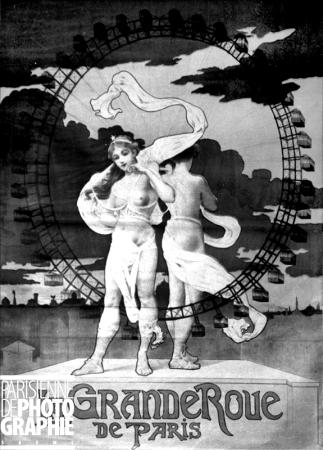
Given the French leadership in artistic advertising, there is no shortage of images such as the one above. One is left with the impression that this great wheel is the centrepiece, the pride and joy of the 1900 Universal Exposition in Paris.

At 106 metres (over 300 feet), it was the tallest panoramic wheel to date and it would hold that record for more than eight decades, long after it had been torn down. Each of the 40 carriages carried 40 passengers and the arrangement of stairs and loading platforms was designed to allow passengers to get on or off 8 carriages at a time. With loading and unloading, each trip took 20 minutes. It was designed to transport 4,800 passengers an hour in cabins the size of railway carriages.

Much has been written about the wheel’s spectacular location in the exposition grounds dominated by the Eiffel Tower. Looking at a map or bird’s-eye view of the site, we can see that the Gigantic Wheel is actually relegated to a corner about as remote from the Eiffel Tower as possible, and its surroundings were a far cry from the carefully landscaped grounds of the Champs de Mars and the Eiffel grounds.

This is interesting, and suggests another question. Was the Gigantic Wheel hot news at the time or same old same old? Yes it was big, the biggest yet, but even when it opened, it was old hat. It traced its origins to another fair, at which an American engineer called George Washington Gale Ferris Jr. had an idea that would let the Columbian Exposition of 1893 in Chicago “out-Eiffel” Eiffel and his tower, which had opened four years earlier. His Ferris Wheel was huge and genuinely innovative. It was a big hit with the public, but a commercial disaster.

The Chicago Ferris Wheel sparked a series of imitations: first, at Earl’s Court in London (1895 for the India Empire Exhibition), then at Blackpool, a major tourist centre in northern England (1896), then Vienna (1897, to celebrate the 50th anniversary of the coronation of Austrian Emperor Franz Josef), and finally Paris (1899, in anticipation of the 1900 Exposition). And all these gigantic wheels were the creation of one man: Walter B. Basset, former British naval officer and hero, and managing director of the prestigious British engineering firm of Maudslay, Sons & Field. Much of the original engineering design was the work of a young engineer by the name of H. Cecil Booth.

Each grand or panoramic wheel used the same pattern of financing. Create a company and sell shares or debentures. The London company was The Gigantic Wheel and Recreational Towers Co. Limited, followed by The Blackpool Gigantic Wheel Co. Ltd., then the Vienna Gigantic Wheel (Wiener Riesen Rad) Ltd., and finally, the Paris Gigantic Wheel and Varieties Company Limited. This was formulaic entertainment, an investment in what I call the Technology of Tourism.

Somehow, the Paris Gigantic Wheel lacked the spirit of either innovation or bold design displayed by Eiffel in his 1889 Tower or by Ferris with his original wheel in Chicago in 1893. But the world was changing.

In an excellent book on the buildings and remains of Universal Expositions in Paris, Sur les traces des expositions universelles, Sylvain Ageorges calls the Exposition of 1900 a turning point. Earlier expositions, beginning with first at the Crystal Palace in London in 1851, were heavily didactic, perhaps too much so for many visitors.

But Paris 1900 was different. It was “plus joyeuse et populaire que les autres” (more playful and popular than the others, p. 110). In addition to the “grande roue de Chicago,” there were films by the pioneering Lumière brothers projected on giant screens 21 by 16 metres, and, at Le Phono Ciné Théatre, there were moving pictures synchronized to phonograph sounds.

The Grande Roue opened the year before the fair and was part of a larger area of restaurants, theatres, and other entertainments that was in full swing in 1899. It was at the southeastern edge of the more glamorous fair (where the avenue de Suffren is now) and seemed both far less imaginative and more relentlessly commercial. Today we might call it an entertainment district, like the tacky cluster of wax museums, cheap restaurants, casinos, and shops a stone’s throw from the majestic power of Niagara Falls.

The postcard above places the Big Wheel in what is called “le Wonderland.” Some accounts credit the creation and ownership of the Grande Roue to the French industrialist, Théodore Vienne, who had made his fortune in textiles and then turned to other pursuits, such as the Paris-Roubaix cycle race and boxing matches.

Vienne was a director and major shareholder in Basset’s Paris Gigantic Wheel and Varieties Company Limited. He appears to have been the force behind other attractions in the avenue de Suffren area, which was described as “un véritable kaleidoscope d’attractions.”

I don’t know when the area became known as “le Wonderland.” Perhaps it was in 1907, when Victor Breyer and Théodore Vienne opened the Wonderland Français Arena. This was the work of Vienne in his capacity as a boxing promoter. Some said he was none too scrupulous, but he did bring the big-name fighters to Paris.

One finds increasing criticism of Wonderland as an undesirable centre of music halls and boxing. Some said it was simply the changing tastes of the young 20th century. Whatever the reasons, the area’s reputation declined and it became seedier. This did not help traffic on the Gigantic Wheel. Its days were numbered; perhaps they had been so since its opening.

The photo above was taken in 1920 during the demolition of La Grande Roue. It didn’t even win a first in the demolition class: Earl’s Court operated for only 11 years and was torn down in 1907. However, perhaps La Grande Roue first showed us something that Blackpool would later confirm: a big wheel cannot win out over a grand tower.* Even though the view from the Gigantic Wheel was spectacular, it was a passive experience in which you sat, waited, and watched.

When the wheel was demolished, the spacious carriages were sent to northern France to serve as much-needed housing in an area where the ravages of war had taken its toll (according to Norman Anderson, Ferris Wheels: An Illustrated History, p. 110). One wonders if the shareholders who had bought into the Paris Gigantic Wheel and Varieties Company Limited to finance the wheel ever made any money.

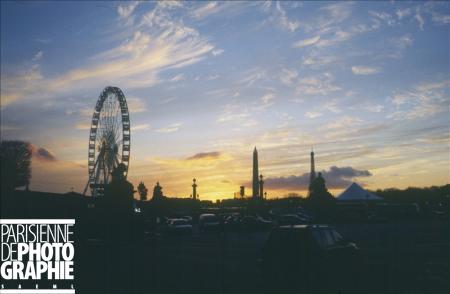
So is the history of Grande Roue all over in Paris? Absolutely not. There is another. It has a stunning location near the Place de la Concorde and stays up for only part of the year. Some people would like it to stay all year. I hope not. Each year the opening and closing creates fresh excitement. The first Grande Roue ran out of excitement. Let us hope that doesn’t happen for the second Grande Roue de Paris.

Text by Norman Ball, with illustrations from his postcard collection, and from the Roger Viollet collection, Paris en Images.

* Blackpool learned its lesson early on. The wheel opened in 1896, but in 1916 the Blackpool Gigantic Wheel Co. Ltd. went into voluntary liquidation. The new owners hung on until 1928 when they closed it, and sold off the carriages to people who converted them into storage sheds, living accommodations and even a café. When the Blackpool wheel opened, residents wondered if it would take business away from the popular tower. It didn’t.

Posted in Paris expositions, Paris history, Paris popular culture, Paris postcards | Tagged , , , , , , , , , , , , , , , , , , | 17 Comments