The man who gave Paris 50 fountains

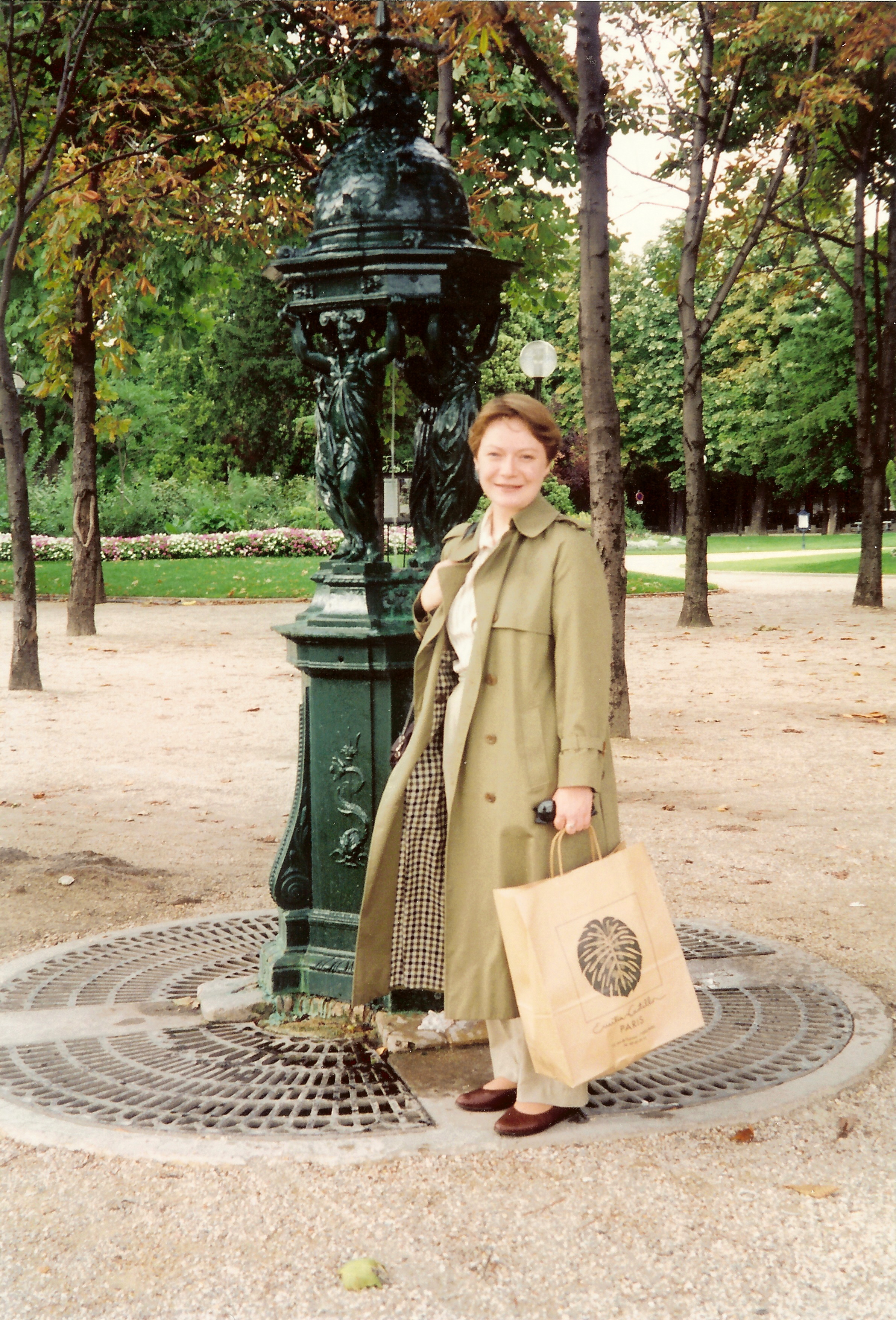
On our first visit to Paris together, Norman took a picture of me standing beside a Wallace fountain. I liked the dark green caryatids and the elegant dome.
PhilippainParis

Later, on a visit to the Pavillon de l’Eau, we learned that these fountains were a gift to the City of Paris from an Englishman named Wallace. How jolly decent of him, we thought. And until recently, that was all we knew about the matter.

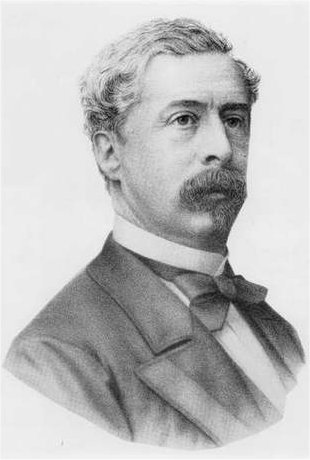
Then I read Matthew Harrison’s history of St. George’s Church in Paris, in which he summarized the odd life of Richard Wallace (1818-90), a benefactor of the church. Intrigued by his tale, I did more research and found a very complicated story indeed.
historical2

To start with, Wallace was not his name by birth, but one that he chose for himself. He was brought up in Paris by his grandmother, but he called her Aunt. He was the illegitimate son of an English nobleman who employed him as a secretary and left him a fortune, but never acknowledged him as a son. His French wife lived for years in England, but never learned to speak English, although she was the one who left the huge bequest of mostly French art to the English nation: it is now known as the Wallace Collection and is still on view in London.

Maybe I should start at the beginning.

Let’s go back to 1798, when Richard Wallace’s grandfather, Francis, son of the Marquess of Hertford, eloped with the illegitimate daughter of an Italian dancer. There is a lot of illegitimacy in this story. Her name was Maria Emily, but everyone called her Mie-Mie. Although she had been born out of wedlock, her wealthy father (the Duke of Queensberry) made sure that she grew up in comfort. Here is a picture of her, in a miniature from the Wallace Collection.
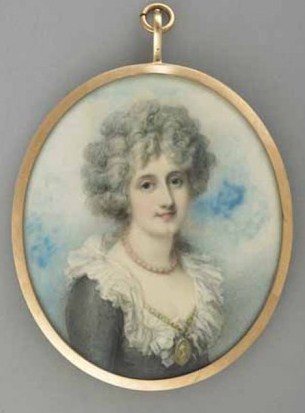
Mie-Mie

Mie-Mie was wealthy, but because of her origins, she was not accepted into London society after her marriage. She convinced her husband to move to Paris with their two children (a girl and a boy). This was 1802, during a short truce in the war between England and France. Mie-Mie loved Paris and settled in happily, but her husband frequently went back to England without her.

Soon, relations between England and France were fraying, and so were those between Francis and Mie-Mie. Francis returned to England, but Mie-Mie stayed in Paris, now with three children (one was, ahem, not her husband’s). When her father the Duke of Queensberry died, he left her a comfortable inheritance, and she no longer needed her husband’s support.

Her first son Richard (who had been born in 1800) grew up in France and went to England after Napoleon’s defeat at Waterloo in 1815. He joined the British army as a hussar. In 1822, his father Francis succeeded to the family title and became the third Marquess of Hertford. Mie-Mie was now a Marchioness.

Two years later, Richard turned up on his mother’s doorstep with a six-year-old boy called Richard Jackson. This was his illegitimate son, who had been given his father’s Christian name and his mother’s surname. (Well, it wasn’t really her name, it was the name she had taken after separating from her husband – I told you this was complicated – but close enough.)

Mie-Mie took the little boy in and told him to call her “Tante.” Her beloved daughter had died a few years earlier and Richard Jackson seemed to fill a hole in her life. She moved to the rue Taitbout and took an apartment directly over the Café de Paris, one of the smartest restaurants in the city. Richard Jackson grew up watching the comings and goings of le haute monde underneath his windows. He also watched the comings and goings of Mie-Mie’s younger son Henry, a founder of the Jockey Club and well-known man about town.
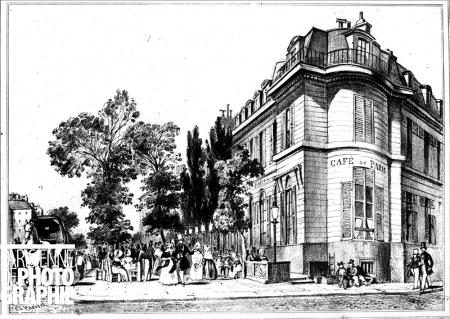
5473-6

Meanwhile, his father Richard wandered around Europe, at one point stopping in Paris long enough to acquire a mistress and a little chateau in the Bois de Boulogne called Bagatelle. Eventually, he settled in Paris in an apartment on the rue Laffitte, installed his mistress nearby, and started to collect art.

His first purchase was a Fragonard, which he bought at a public auction. At the time, nobody was interested in 18th-century French art. It had gone out of favour  during the Revolution and in the 1840s, you could pick up Fragonards, Watteaus, and Bouchers for a song.

In 1842, Mie-Mie’s husband Francis died, and her son Richard became the fourth Marquess of Hertford. Having inherited the family fortune and estates, he could now collect art on a grand scale, and he did.

That same year, at the age of 24, Richard Jackson formally changed his name to Richard Wallace, his mother’s maiden name. By now, he had a mistress of his own, and even a son by his mistress (the apple doesn’t fall far from the tree), but he still lived with Mie-Mie, leading a bohemian life and frequently running into debt. The new Marquess decided that his son needed an occupation, so he made Richard Wallace his personal secretary. But he never acknowledged that his secretary was his own son.

The two worked together closely. Richard frequently acted as the Marquess’s agent in art purchases, and kept records of the ever-expanding collection, which contained Dutch, Italian and Spanish masters as well as French, and furniture as well as pictures.

When the Revolution of 1848 broke out, the family (minus Richard Wallace’s mistress and child) beat a hasty retreat. They spent six years in Boulogne before returning to Paris. Mie-Mie, Henry and Richard settled back into the rue Taitbout, while Richard Wallace’s mistress lived elsewhere, looking after their son, who was now in his teens.

Mie-Mie died in 1856, deeply mourned by her sons and grandson. Her younger son Henry died two years later (his will listed four children by various mothers – typical). Her remaining son, the Marquess, who never married, settled at Bagatelle and became increasingly reclusive while continuing to amass artworks.

Fast forward to 1870, when everything changed. As the French engaged in a disastrous war with the Germans, the Marquess was dying at Bagatelle. After his death and burial at Père Lachaise, the family estates passed to a cousin, who became the new Marquess, but the art collection, several properties (including Bagatelle), and a huge sum of money went to Richard Wallace.

Wallace had little time to enjoy his new wealth. Paris was in chaos. The French army was defeated, the Emperor Napoleon III was captured, and the Empress Eugénie fled to England. Wallace moved the collection from Bagatelle into his father’s old apartment on the rue Laffitte to keep it safe (he himself still lived in Mie-Mie’s former apartment). It was the right decision, as the lovely Bagatelle was later commandeered by the military.
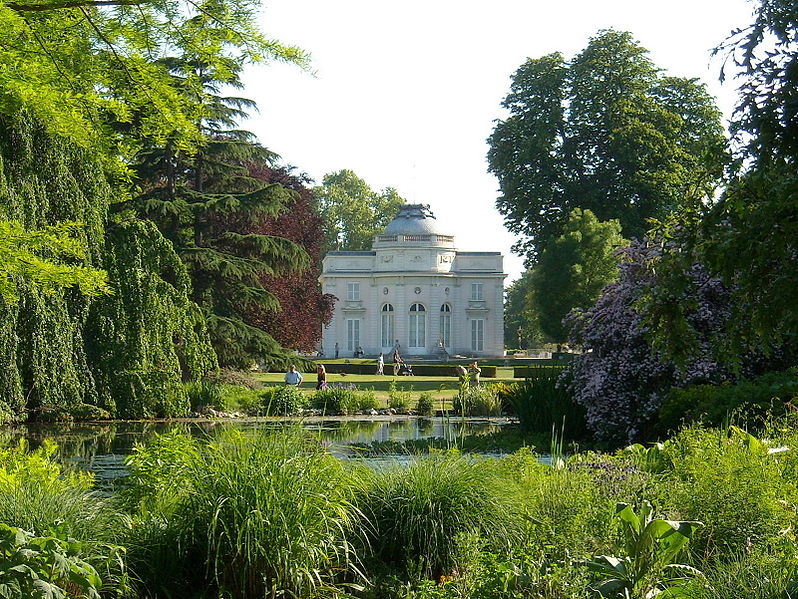
798px-Jardin_de_Bagatelle-Mai_2010

Wallace never thought of leaving Paris, but he helped other English residents escape. He started a relief fund to help feed the poor, who were starving in the besieged city, and to help people left homeless by shelling. He also set up a medical clinic to treat the wounded. At some point, he even found time to marry his long-suffering mistress, Julie Castelnau, 30 years after the birth of their son.

Wallace also remained in Paris during the Commune that followed the war, horrified by the bloodshed it caused, but willing to help those in need. When it was over, the French made him a member of the Legion of Honour and named a street after him, and Queen Victoria made him a baronet in recognition of his services to the English in Paris.

The violence of the Commune had so shocked Wallace that he decided to move to London in 1872, taking most of the collection with him. His parting gift to the city where he had lived was the 50 fountains that Parisians call les Wallaces, designed by the sculptor Charles Auguste Lebourg. (Later, Wallace honoured the memory of his father by founding and endowing the Hertford British Hospital in Paris, which opened in 1879.)
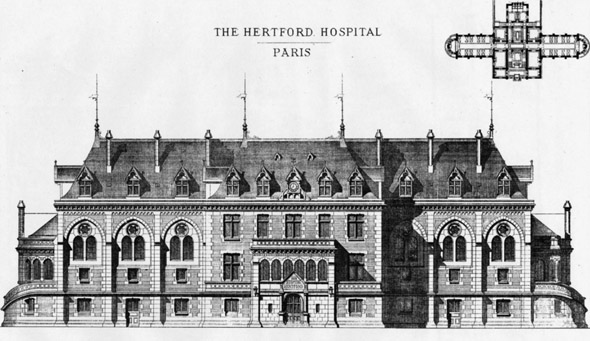
HertfordHospital

In London, Wallace moved in the best circles, dining with the Prince of Wales and the Prime Minister, but his wife Julie never learned to speak English and did not go out much. Their son, Edmond, disliked England and returned to France frequently. You won’t be surprised to learn that he had four children with a woman he did not marry. Wallace was furious and said, “Mon Dieu, est-ce que nous n’aurons jamais fini de bâtards?” (Are we never to have an end to bastards in this family?). Although Wallace became estranged from his son, he was devastated when Edmond died in 1877.

After this blow, Wallace withdrew from society, and went back to Paris to live at Bagatelle, leaving Julie in their huge London house with its enormous art collection. He died in 1890 in the same bed and in the same room as his father, attended only by a few servants, and was buried with his father at Père Lachaise.
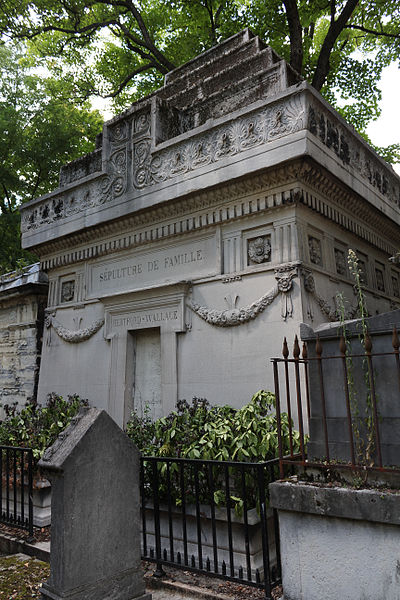
Père-Lachaise_-_Division_28_-_Wallace_01

His will left everything he owned to his wife. It was she who left it to the British nation in her will. She remained in England to the end of her life, taking a translator with her whenever she went out. She died in 1897 and was buried with her husband in Paris.
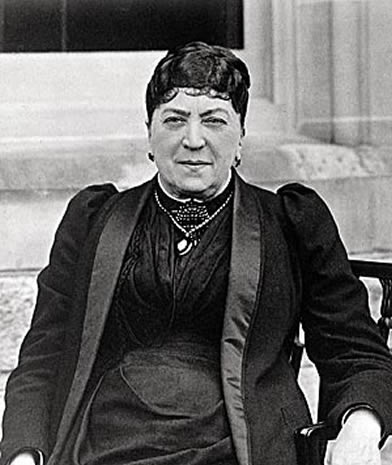
ARTOIS_38

Edmond’s descendants are still living in France, the Bagatelle still stands in the Bois de Boulogne surrounded by its gardens, and the Wallace Collection remains a fixture in London. The Café de Paris, which stood at the intersection of the rue Taitbout and the boulevard des Italiens, closed in 1856, the year that Mie-Mie died (there is another restaurant there now, and a Monoprix). But the Wallace fountains continue to adorn the streets of Paris, the enduring legacy of an unconventional family.
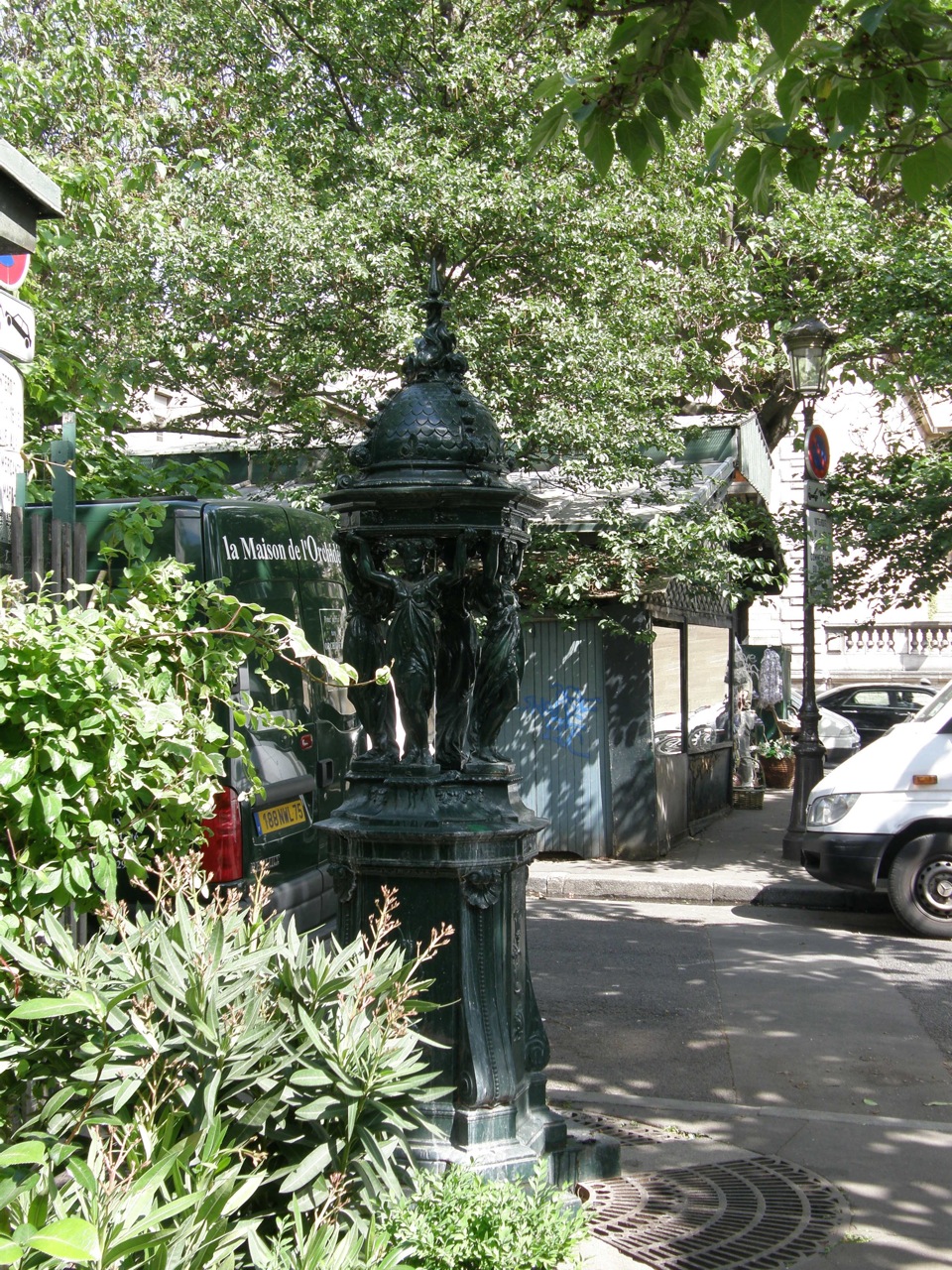
P5190234

Text by Philippa Campsie, original photographs by Norman Ball, portraits from the Wallace Collection website, picture of Cafe de Paris from Paris en Images, photograph of Bagatelle and Hertford-Wallace family tomb from Wikimedia Commons; photograph of the Hertford Hospital from Archiseek.

 Sources:

An Anglican Adventure: The History of Saint George’s Anglican Church, Paris, by Matthew Harrison, 2005, published by Saint George’s Anglican Church, Paris

The Greatest Collector: Lord Hertford and the Founding of the Wallace Collection, by Donald Mallett, 1979, Macmillan.

Posted in Paris churches, Paris history, Paris hospitals | Tagged , , , , , , , , , , , , , , , , , | 15 Comments

Postcards of a Working River

We don’t often think of Paris as a port city. But the city handles about 20 million tonnes of cargo a year, and with more than 7 million people travelling on the river each year, Paris is the leading river port in Europe for passenger transportation.

A hundred years ago, it was more than just passenger traffic. All kinds of products were shipped along the Seine: construction materials, farm products, fuel.

I gravitate to postcards of the working river and snap them up when I see affordable ones. Here is one of my favourites. Notice the white-shirted deckhand near the stern lowering the smokestack so that this boat can get under the Pont au Change.

Port of Paris011

Many of the postcards refer to different “ports” within the city. Each one was associated with a particular product. I was curious about the covered barges or péniches that came in to the Port de l’Hôtel de Ville shown in this postcard.

Port of Paris001

Apparently this was the place where apples were brought in from Normandy and unloaded underneath the windows of Paris’s city hall. At the quai, the apples were loaded by hand into baskets or paniers and handed up to the next worker.

Once up from the hold, workers had to carry the heavy baskets across a narrow gangplank to the quai. It was tiring and potentially dangerous work, particularly in bad weather.

One of the more famous specialized port areas was Bercy, where wine was unloaded. It grew to become the major wine warehousing area – not just in France, but in the world.

Les Halles de Bercy represented the wine equivalent of the Les Halles food market. And like the food market, the area fell on hard times in the mid 20th century. In the 1970s, when Les Halles was demolished, the Bercy area had fallen into ruins. Today, it is a redeveloped area with a park that preserves some of the old wine storage sheds or chais.

My image of Bercy shows it looking desolate during the flood of 1910. That is the customs shed underwater.

Port of Paris014

Other quais were the specialized sites for unloading bulk commodities such as plaster or coal.

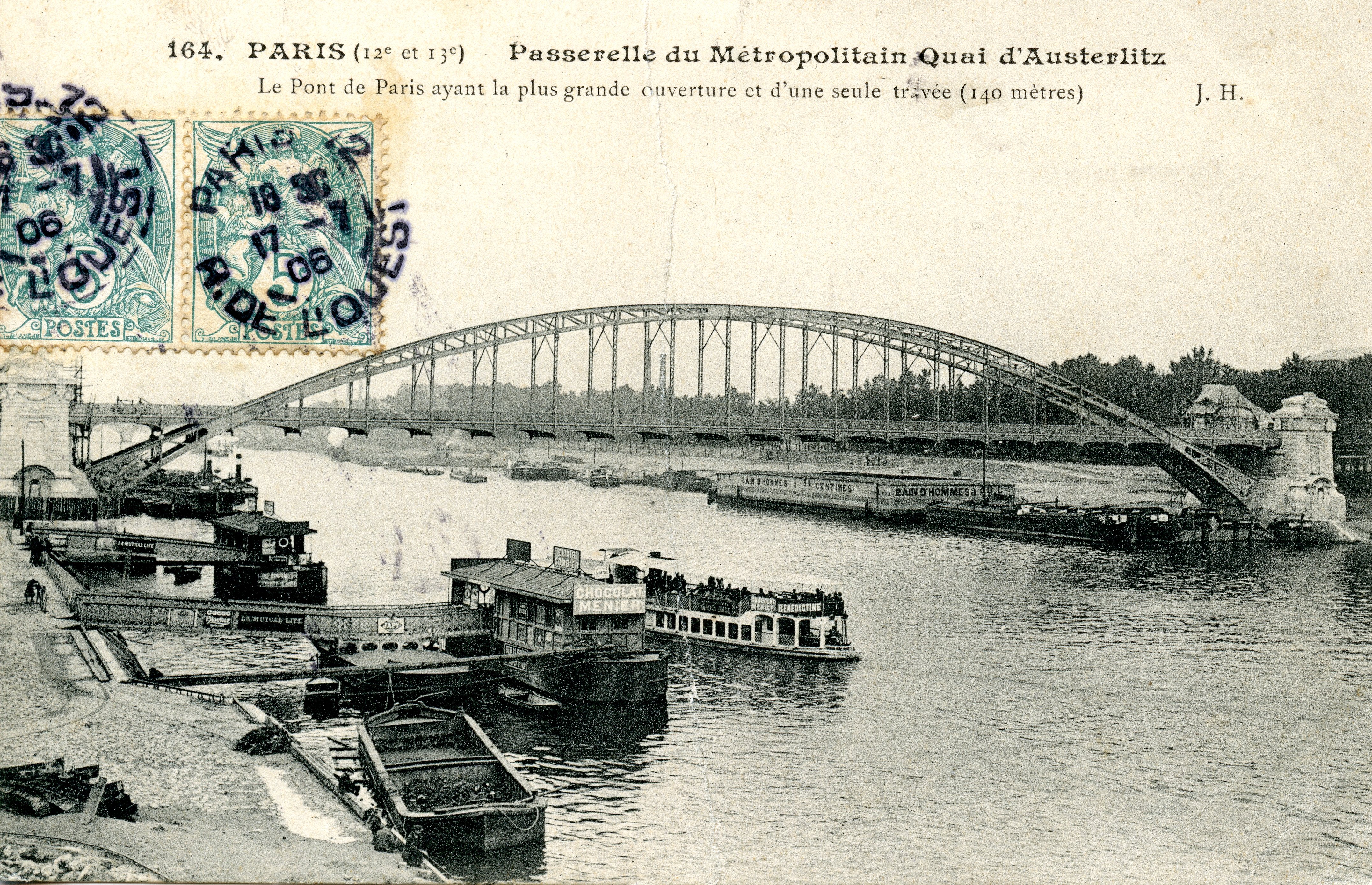
Not far from Bercy, the port d’Austerlitz handled bricks. Yet all this workaday activity co-existed with passenger traffic, recreation, and other activities.In this postcard of the Quai d’Austerlitz, sent in 1906, notice the advertisements for Chocolat Menier, Benedictine and “La Mutual Life,” and the “Bain d’Hommes – 30 centimes” on the far bank. At a time when many apartments were rather rudimentary in terms of water and sanitation, low-priced public bathing places were an important part of public health measures.

Port of Paris010

In many ways, it is this kind of extraordinary detail and variety that attracts me to these images.

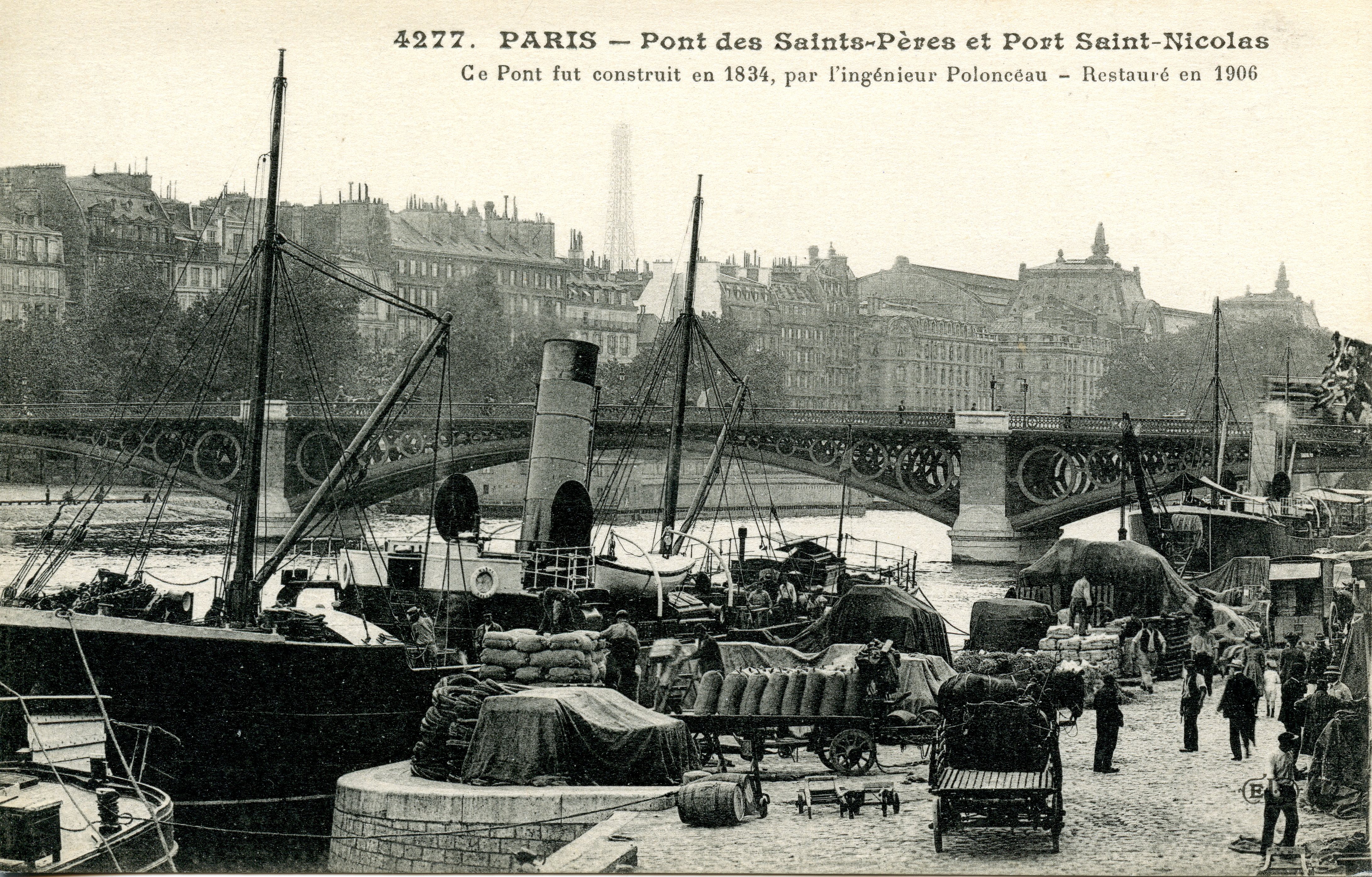
The postcard below shows the Port Saint-Nicolas, where a river boat from Rouen is unloading sacks (possibly containing plaster or lime). The Pont des Arts is in the background, which means that the Port Saint-Nicolas (now long gone) is right in front of the Louvre, and indeed, this area was also known as the Port du Louvre.

Port of Paris002

Notice the floating men’s swimming school beyond the piled-up sacks (Ecole de Natation du Louvre. Hommes).

In the next postcard, we see the same swimming school, but this view shows more activity on the quai and some passenger or pleasure boats in the river. But the same Rouen boat is tied up in roughly the same place. Perhaps it was a fixture in this spot.

Port of Paris003

The vantage point is identified as the Pont des Saints-Pères, today the Pont du Carrousel.

This third postcard is taken from the busy port, looking back at the bridge, as it was then. And, yes, it looks like the same Rouen boat once more.

Port of Paris004

What happened to the Pont des Saints-Pères? The website for the City of Paris tells us:

This first structure comprised a major technical innovation. It was designed by the engineer [Antoine-Rémy] Polonceau, who fought tooth and nail to have his project accepted in the face of opposition from the partisans of a suspension bridge. He even went as far as to finance the initial foundation work from his own pocket. The very lightweight structure consisted of three equal main arches, each of which itself comprised five composite wood and cast iron arches supporting a wooden deck. Although daring, this structure was nonetheless fragile, and in 1883, the bridge was closed for six months for replacement of some of the beams and cross-members. The technicians took this opportunity to suggest replacing the wooden deck with beaten [that is, wrought] iron, which was in fact done, but not before 1906. However, the structure was still extremely flexible and with the growth in the volume and weight of traffic, it shook and bounced disconcertingly.

Eventually, the bridge was replaced with the concrete structure that now crosses the river at this point.

Many people lived on houseboards and barges. The postcard below, which was mailed in 1904, depicts a rather ramshackle scene in which working and living are haphazardly mingled.

Port of Paris005

You can just see the Eiffel Tower on the right. This would have been in the river just off the 15th arrondissement and may have been taken from the Pont Mirabeau. The water level is very low, and a motley set of walkways connects the barges and houseboats to the shore.

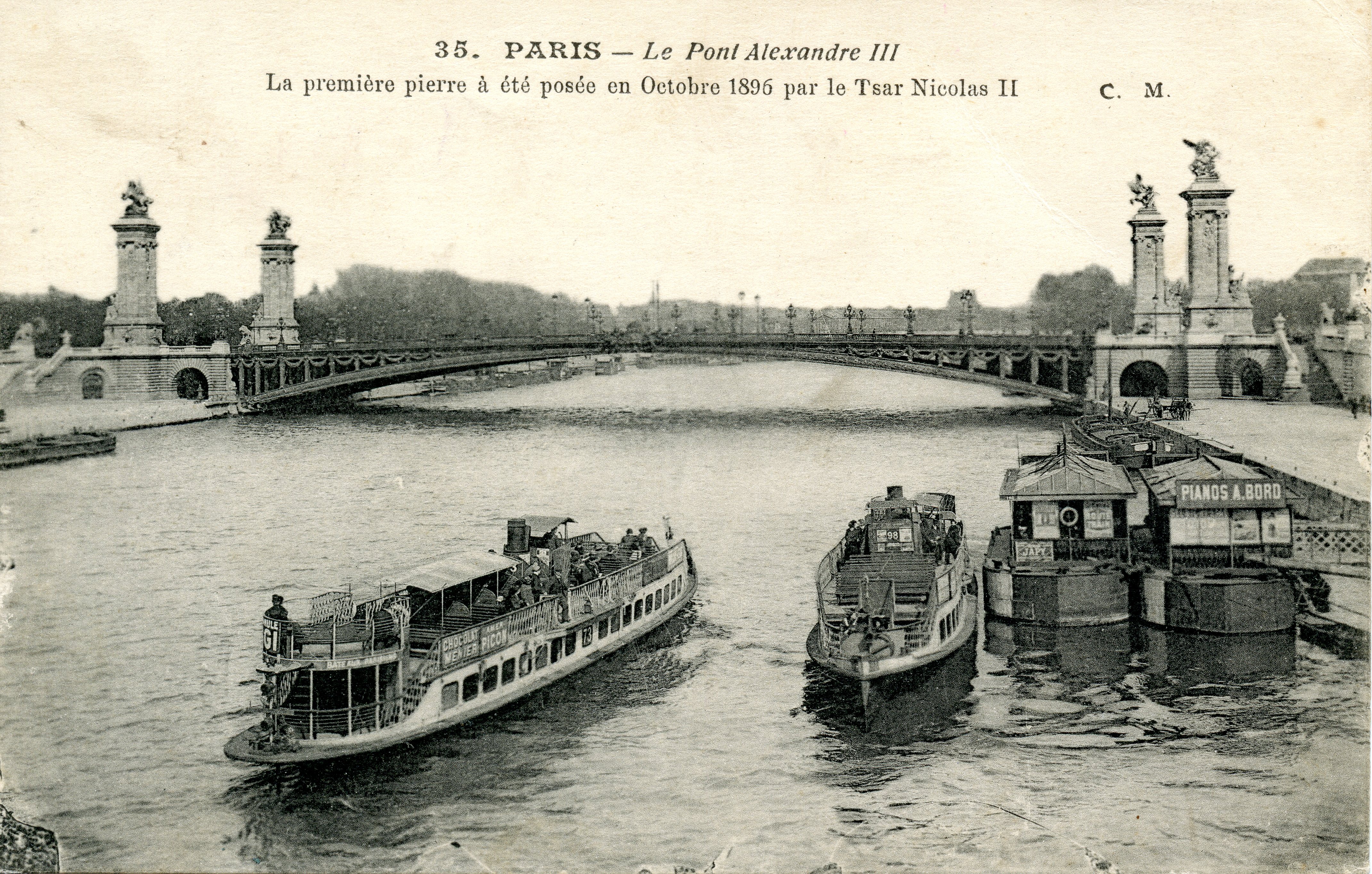
Today Paris is famous for its ubiquitous sightseeing boats – bateaux mouches – as well as boats for dining and entertainment. The idea of floating entertainment and sightseeing is well represented in early photos and postcards. In the image below, in addition to the magnificent Pont Alexandre III, one of the enduring monuments from the Exposition of 1900, we see a typical Parisian combo: tourist passenger boats cruising the river and two permanently moored entertainment vessels, with the promise of live piano music.

Port of Paris006

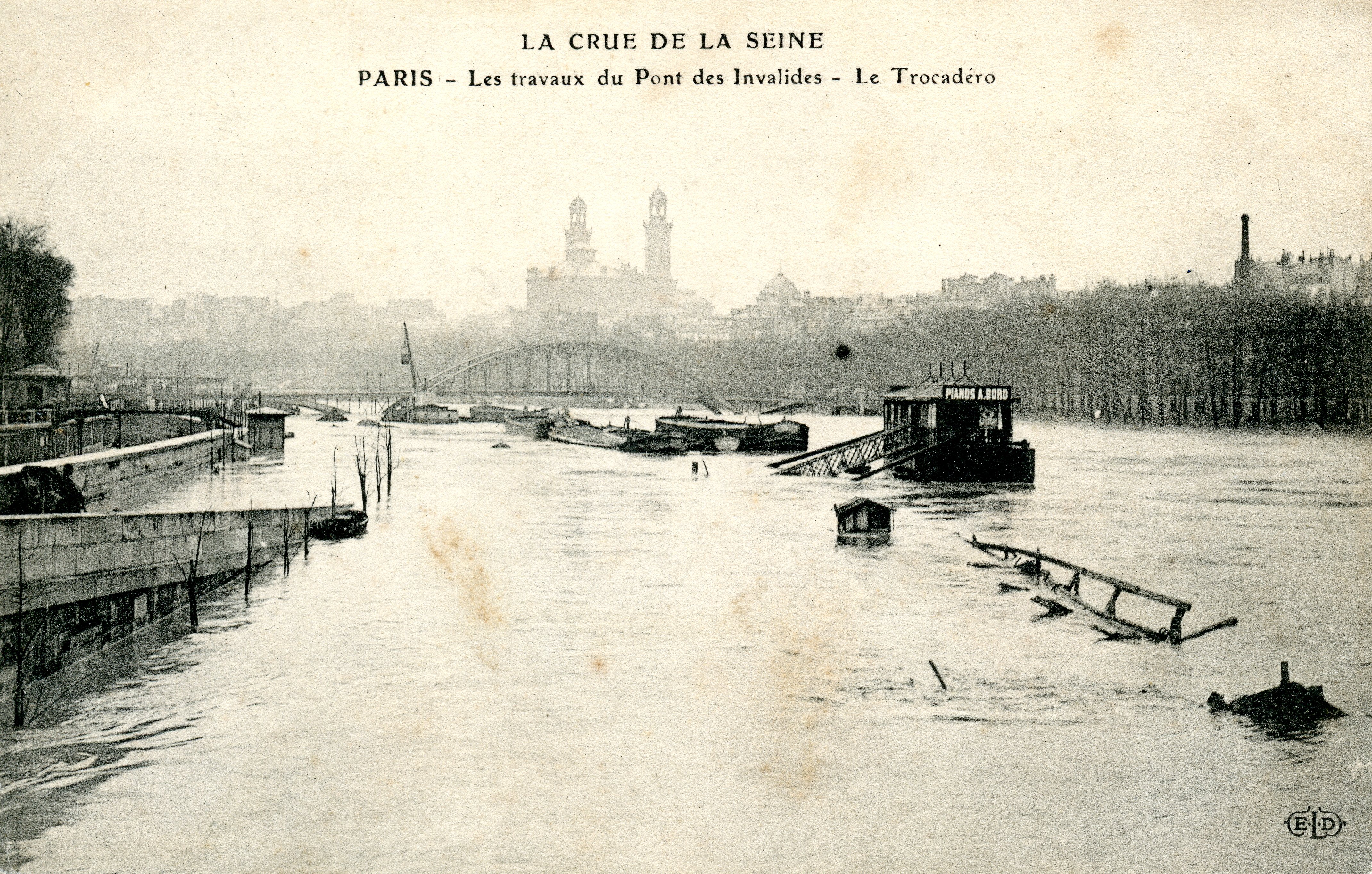
The great flood of 1910 was hard on floating places of entertainment like this. In the following postcard, the forlorn little boat in the middle is either the same as the boat second from the right in the postcard above, or one very like it. This was taken farther upstream, showing the nearly drowned Passerelle Debilly, which I wrote about in an earlier blog.

Port of Paris007

These are just a few of the many postcards I have collected of the working river. Perhaps I will show some others in a future blog.

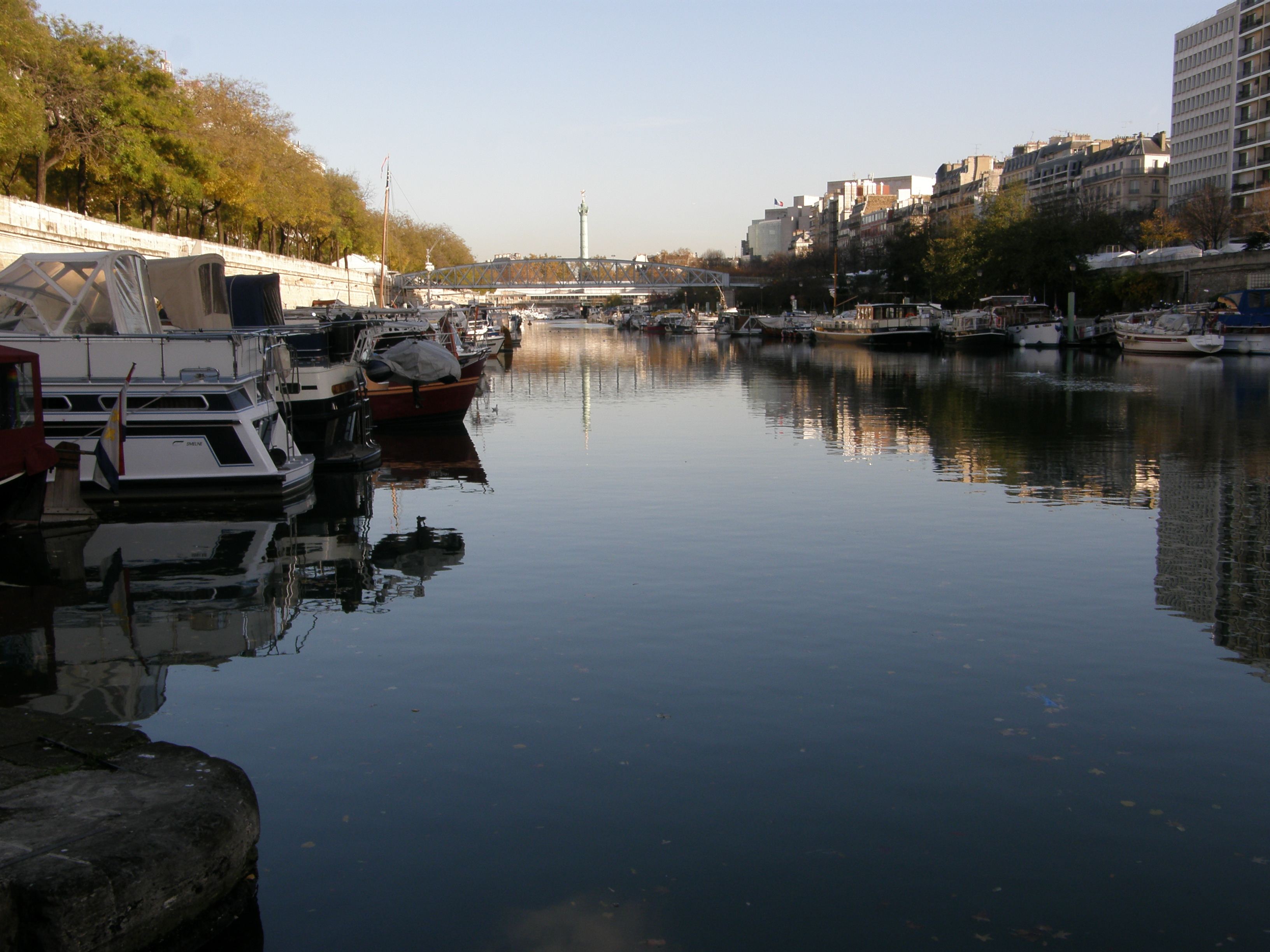
I will end with a view of the Bassin de l’Arsenal, looking towards the Colonne de Juillet in the Place de la Bastille. Note the barges full of sand and gravel.

Port of Paris008

Today, the same view shows pleasure boats and leisure. But they, too, are a form of work for their owners and caretakers.

OLYMPUS DIGITAL CAMERA

The Seine is still a working river, even as the work changes.

Text and original photograph by Norman Ball.

Posted in Paris bridges, Paris history, Paris markets, Paris postcards, Seine | Tagged , , , , , , , , , , , , , , , , , , , , | 10 Comments

Baltard’s Children

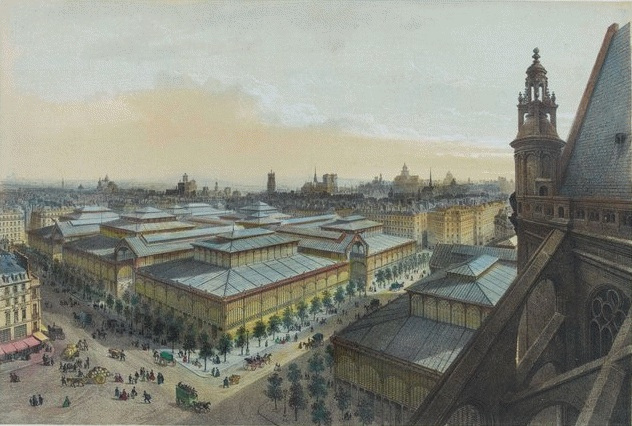
It is common among Parisians and lovers of Paris to bewail the loss of the nineteenth-century market buildings at Les Halles. Those pavilions of iron, wood and glass designed by Victor Baltard stood in the heart of the city from 1857 to 1973, when they were demolished in a fit of modernizing frenzy after the market itself had moved to suburban Rungis.

8080105097_e076f4da89_z

The story behind the pavilions contains a few surprises, as Norman and I found out at an exhibit at the Musée d’Orsay called Victor Baltard: Le fer et le pinceau (Victor Baltard: Iron and paintbrush).

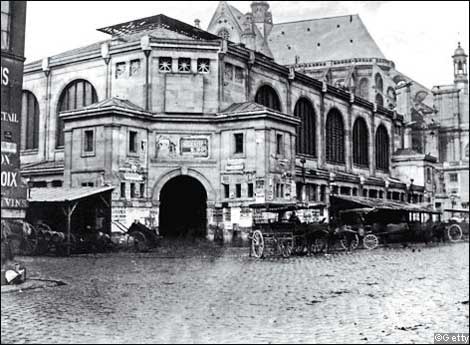
For one thing, the iron-and-glass pavilions were not the original plan for the markets. Baltard had designed something rather more traditional, capped by an iron roof but with stone walls. Construction was nearly complete on one of these buildings when in 1853 the Emperor Napoleon III decided to do a site visit. Apparently the Emperor was Not Pleased and work was halted. This was the building in question, photographed by Charles Marville.

db6b666c-2800-11df-9598-00144feabdc0.img

One can just imagine Napoleon striding about the site, and Baltard anxiously following, watching as the Emperor’s frown deepens and darkens. Finally, the Emperor speaks. “This won’t do at all. You’ll have to take it down.” Or words to that effect. Not the sort of thing an architect wants to hear.

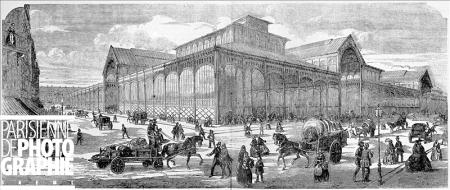
What did the Emperor want? According to Baron Haussmann, who worked closely with Napoleon III and was sensitive to his tastes, he wanted something more along the lines of the huge open trainshed at the Gare de l’Est, which had been completed a few years earlier. Haussmann quoted the Emperor as saying, “Ce sont de vastes parapluies qu’il me faut; rien de plus!” (It’s vast umbrellas that I want; nothing more!”)

Baltard’s competitors probably rubbed their hands in glee, hoping that they might have another crack at the plum assignment (Baltard was not the most popular choice for the job; to that point his résumé consisted mostly of church restorations). But after 10 days of furious rethinking, Baltard and his associate Félix Callet came back with three alternative designs, and the Emperor gave the nod to something that more closely resembled the vast umbrellas he had in mind.

The Emperor was right. The stone building that was demolished had narrow entries at the corners that would have become bottlenecks very quickly. Vast umbrellas of iron and glass would allow for much better circulation. Markets are all about circulation.

282-14

It was a fresh design, but not radical or unprecedented. The Crystal Palace at the Great Exhibition of 1851 in London had shown what was possible with iron and glass. Closer to home, the Bibliothèque Ste-Geneviève, designed by Henri Labrouste, had further demonstrated how slender iron columns could create a space with a high ceiling and plenty of room at floor level.

Baltard just needed a push to come up with the design that now seems inevitable. But once pushed, he made the most of his ideas. One could say that Baltard wrote the book on the design of market buildings, and it would not be a metaphor. He gathered his experiences into a practical guide called Monographie des halles centrales de Paris, filled with illustrations and construction details so that others could follow his lead. And one by one, new market buildings arose around the country, indeed, all around Europe, with slender iron pillars and wood-and-glass canopies. All you had to do was follow Baltard’s careful instructions, add a few tweaks and local adjustments, and voilà.

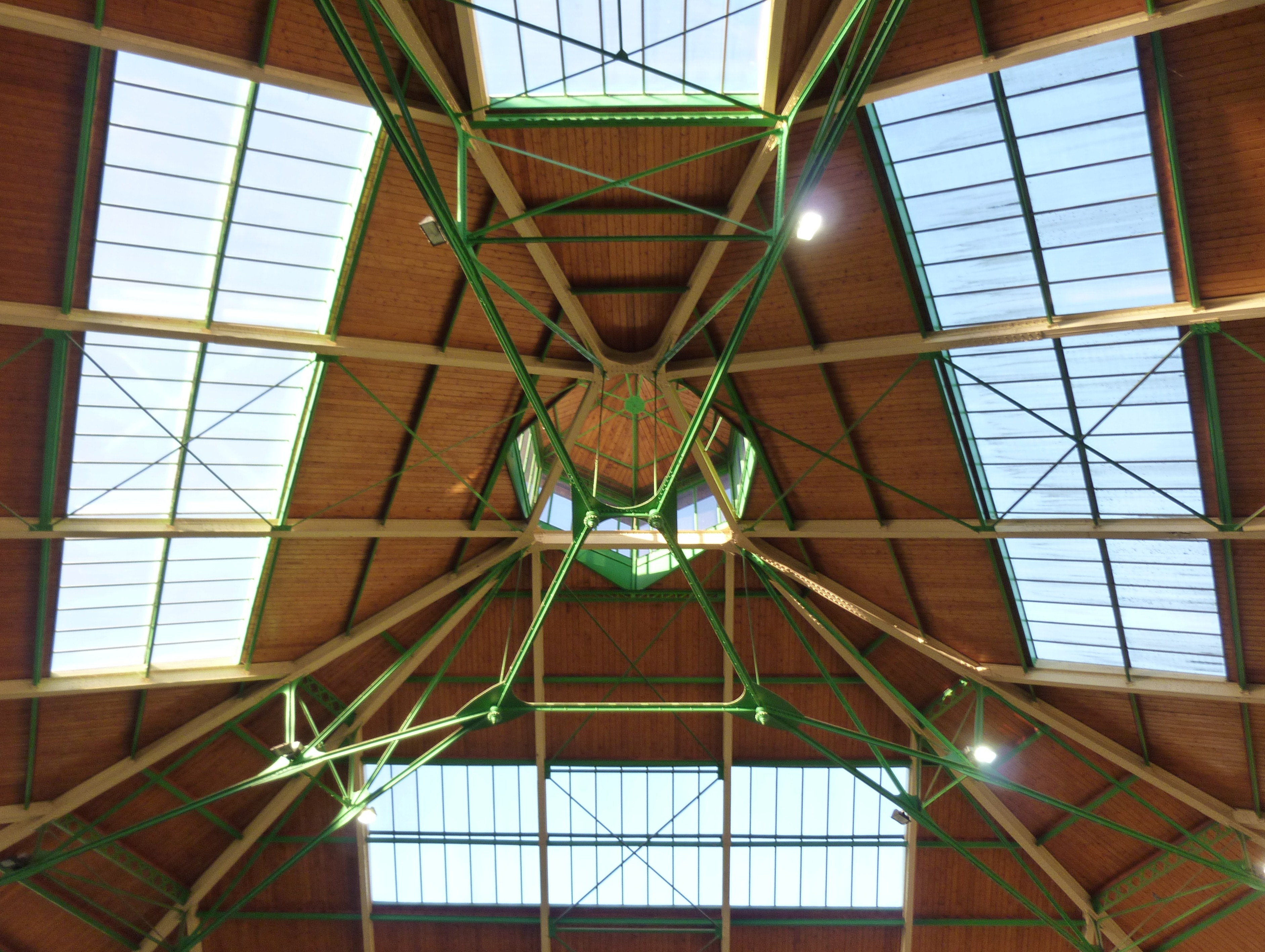
Norman and I saw one of Baltard’s children in Sens. We had gone to visit some friends who lived nearby and on a sunny Saturday morning, we wandered into the market building in the middle of town. It was an odd six-sided shape, but it was clearly in the Baltard tradition. This is a view up into the roof.

P1100261

So even though the original pavilions were demolished in 1973 (the authorities carried out the dirty deed in the summer, when many Parisians were on holiday and not on hand to protest), Baltard’s children live on in hundreds of other cities and towns.

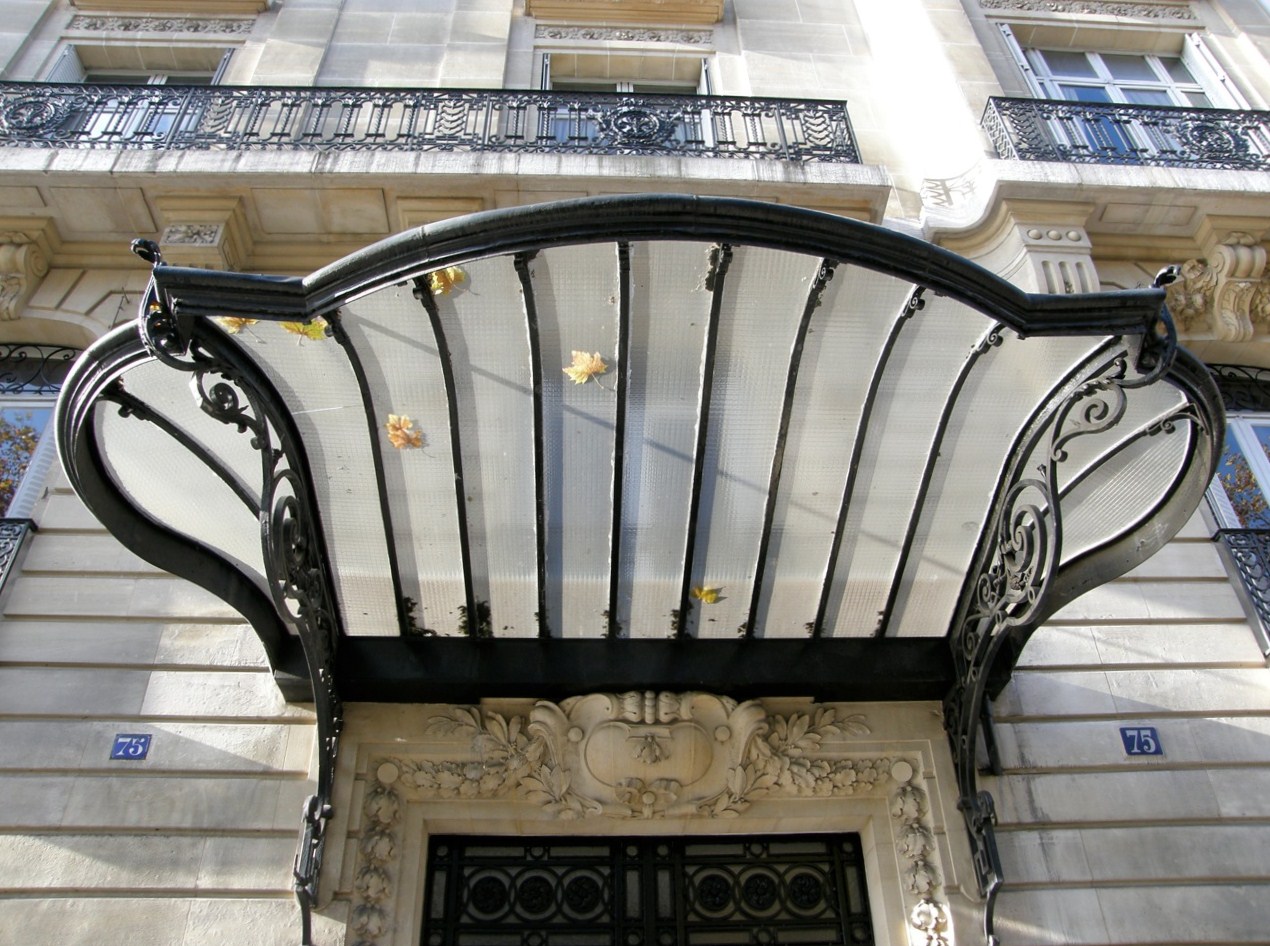
As for Paris itself, I see Baltard’s children in the iron and glass canopies over the entrances to many Paris buildings. Known as marquises (think “marquees”), these architectural umbrellas evoke Baltard for me. He didn’t invent them, of course (the connection exists solely in my imagination), but each one seems to pay a little homage to Les Halles.

Ostensibly they are there to provide shelter, but many are too small or too high to offer much protection against the rain. They are simply architectural accessories in iron and glass, the two materials that were so fashionable in the nineteenth century.

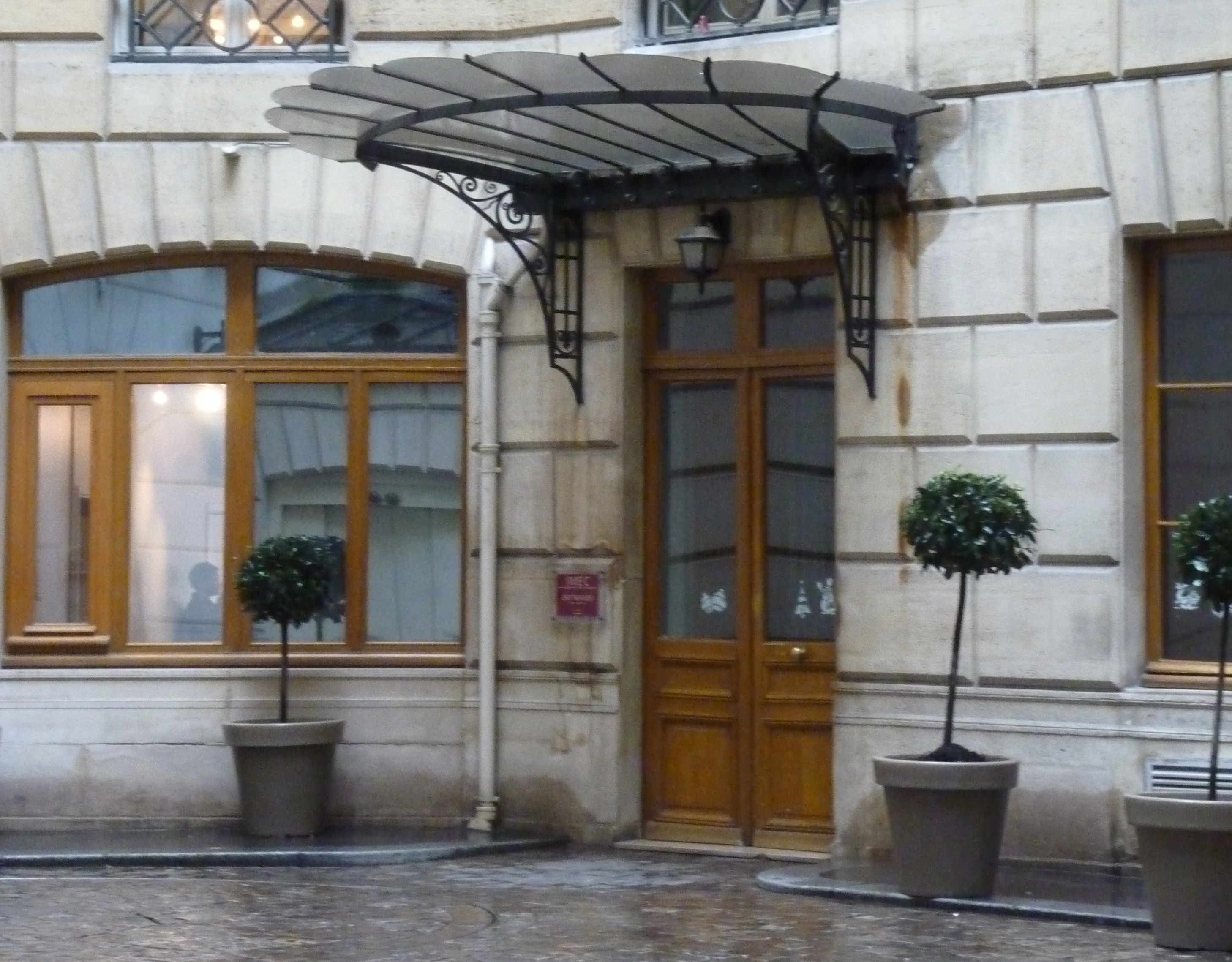
In Baltard’s day, when Haussmann was still controlling the look of Paris streets, marquises were not permitted on the exterior façades of buildings. There were found only in interior courtyards. You can still see them framing the courtyard entrances to grand buildings such as those on the rue du Faubourg St-Honoré (can you spot the marquise in this picture?).

P1030232

But as the architectural controls weakened during the late nineteenth century and buildings became more flamboyant, the marquises began to venture out of courtyards and take their places on the boulevards and avenues.

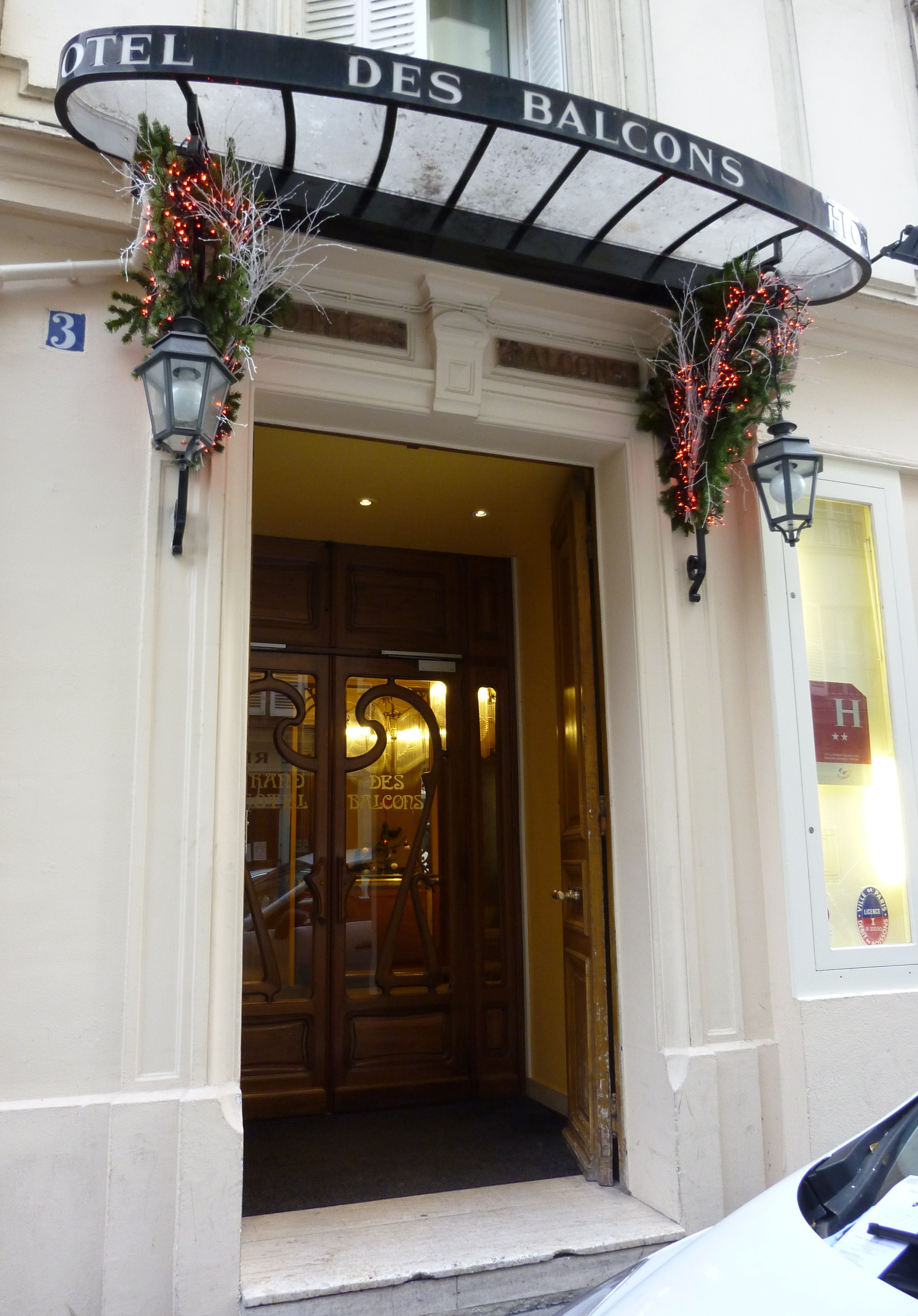
There is a tiny one on the Grand Hotel des Balcons, the hotel where Norman and I stayed on our first trip to Paris together, near the Place d’Orléans. Many happy memories and associations there.

P1100167

There is another on a little hotel close to the apartment where we stay these days.

P1090486

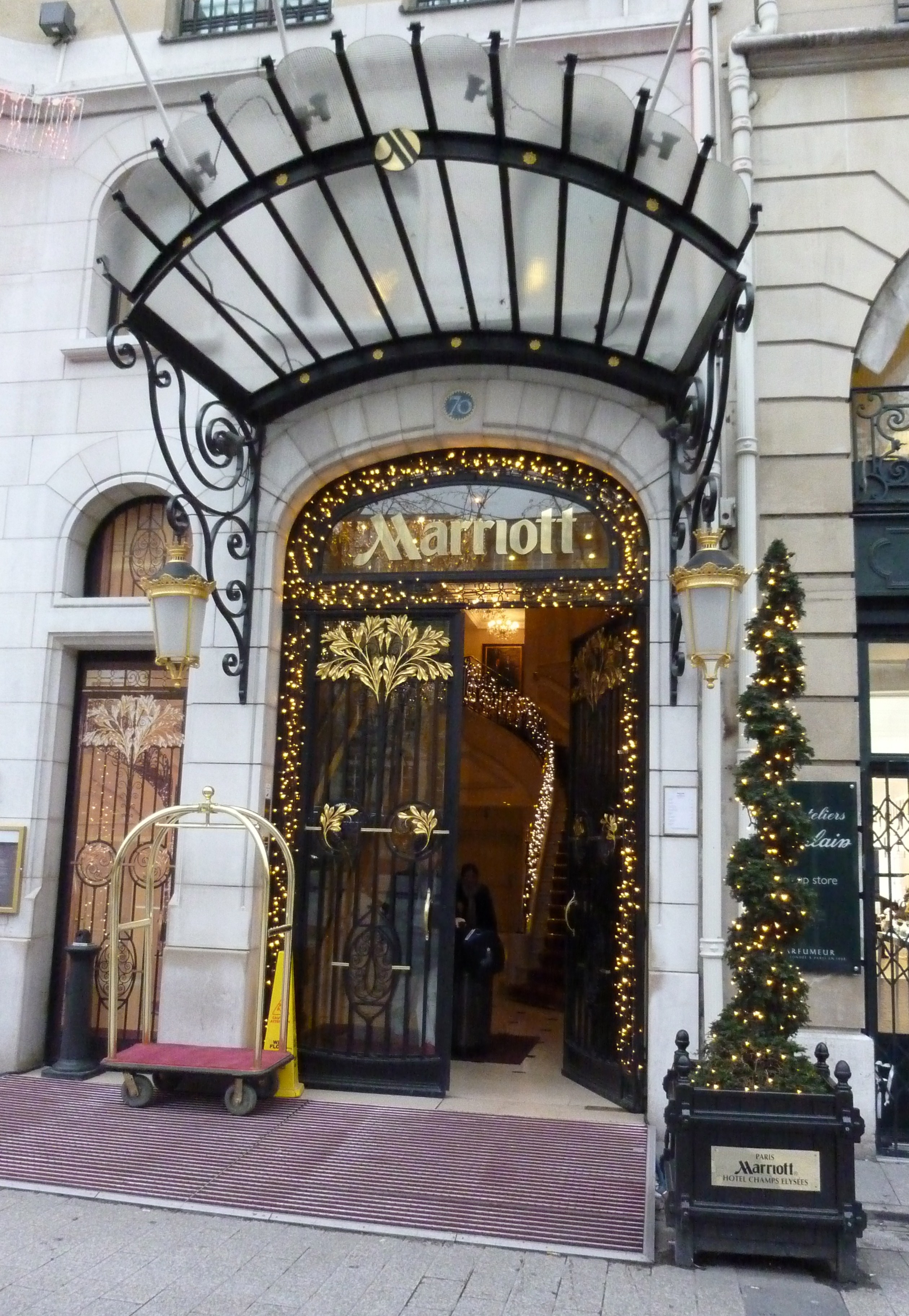
Indeed, marquises seem to be de rigueur for hotels, large and small. And hotels, like markets, are all about circulation.

P1090969

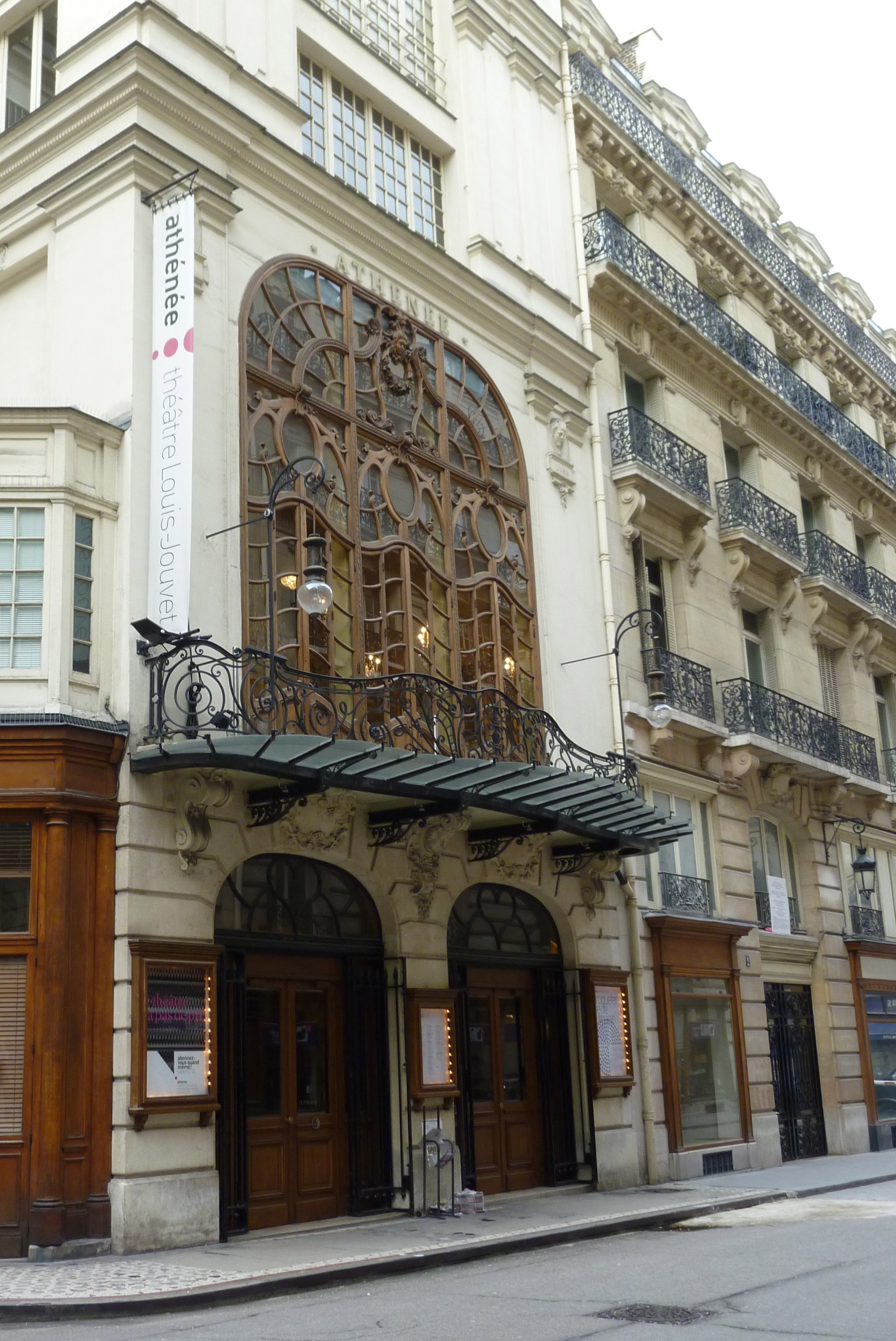
Many theatres have them.

P1090734

But some decorate otherwise anonymous doorways.

P1090609

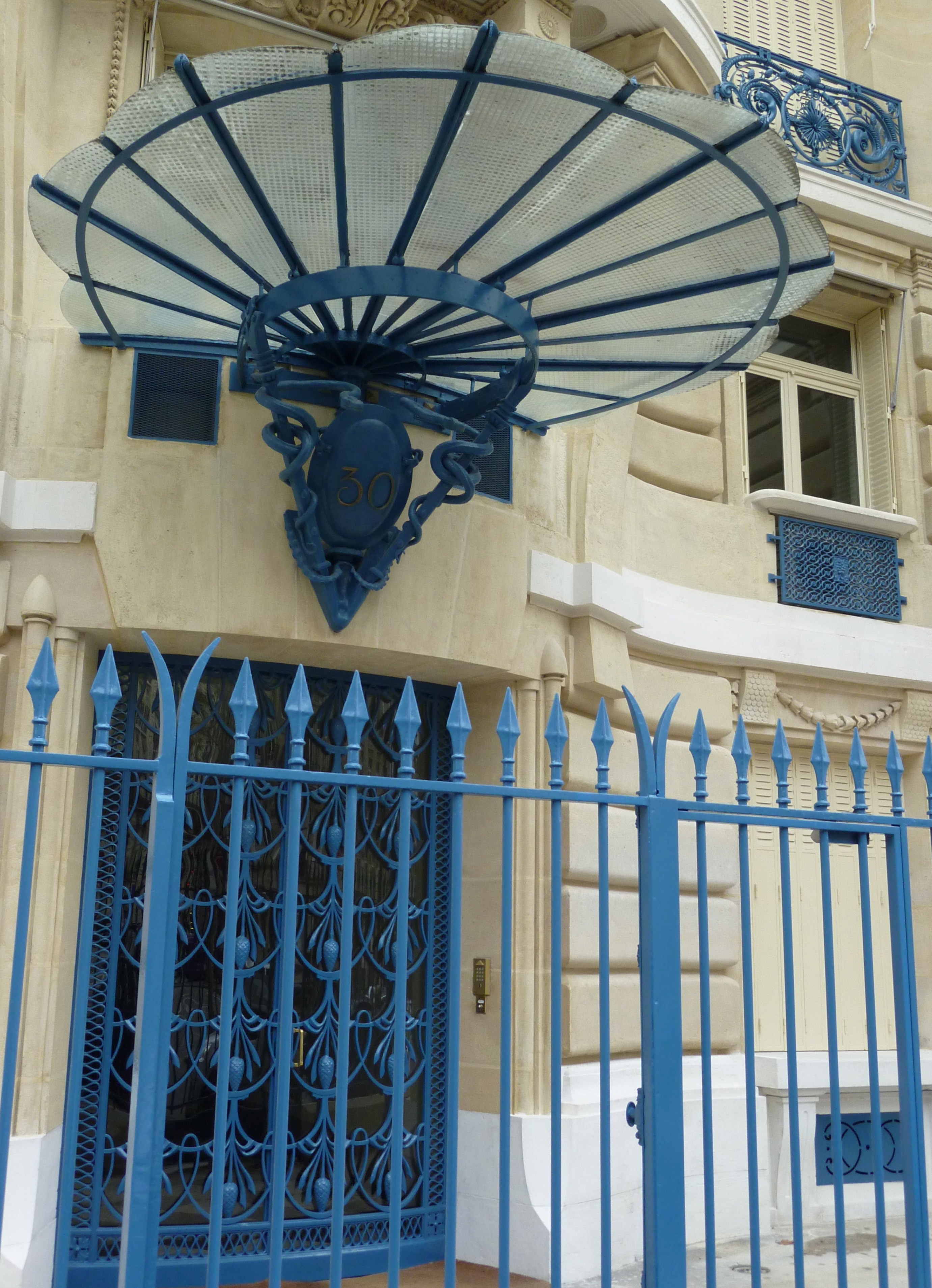
This parasol-like version in blue is on a grand and wildly decorated building on the Avenue Marceau. This may be the entrance to the concierge’s loge.

P1080935

I notice marquises wherever I go in Paris, and I’ve collected quite a few photographs of them.

P1090784

I think of them as little shards of Les Halles that have scattered throughout the city to remind us of the lost mother ship.

Text and original photographs by Philippa Campsie and Norman Ball. Historical photographs from Paris en images.

PB110212

Posted in Paris architecture, Paris history, Paris markets | Tagged , , , , , , , , , , , , , | 9 Comments

An Unbuilt Bridge and the Allure of Paris

The bridges crossing the Seine are a major part of Paris’s beauty. Could a bridge that was never built also be an asset? Consider the magazine headline below. What does it tell us about Paris and tourism when in July 1910 the American magazine Popular Mechanics featured this story?

Pop. Mech, 1910, Paris008

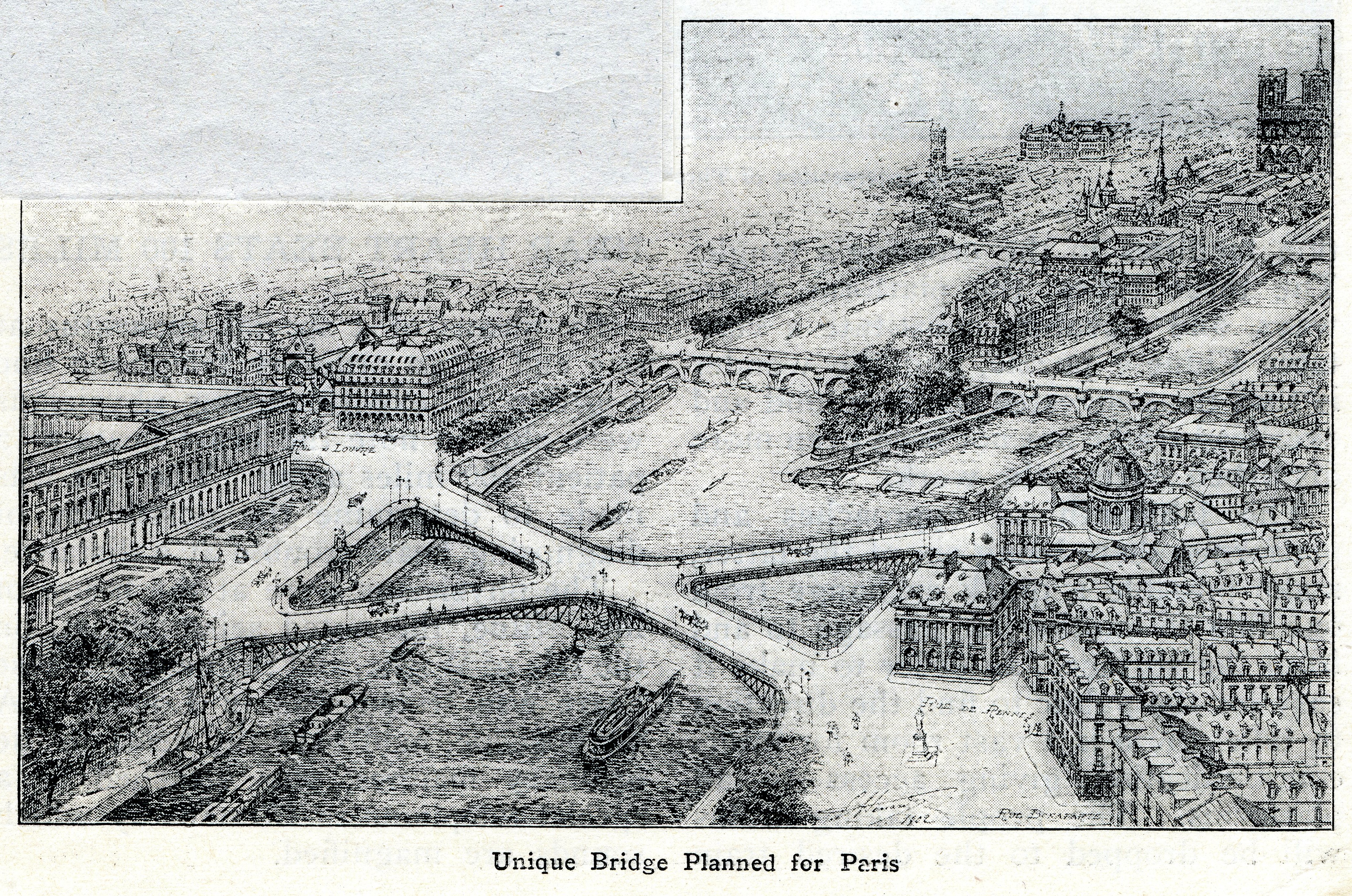
The upbeat article begins with the declaration that “Paris, which is today considered one of the most beautiful cities in the world, is still striving to become more beautiful” (p. 47). In pursuit of that aim, “the city has been authorized to borrow the immense sum of nearly $200,000,000.” Part of this amount was to go to “the creation of new boulevards and highways” including the projected letter-“X”  bridge shown in the rendering below.

Pop. Mech, 1910, Paris013

Much of the image is familiar. The Louvre is visible to the left, on the right bank. In the upper right, one sees the Ile de la Cité crossed by the oldest bridge in Paris, le Pont Neuf. In the very top right corner, Notre Dame Cathedral sits at the upstream end of the island. In the lower right we can see the dome of the Institut de France. And dominating the image is the “X” Bridge with “one branch connecting the rue de Rennes with the rue de Louvre, and the other forming a junction between the wharf of the Louvre and the wharf Conti.”

Something seems to be missing. Where is the pedestrian bridge Pont des Arts with its graceful arches springing across the river? The “X” bridge seems to have been designed to replace this historic river crossing, shown below in a photograph dating from 1900.

1407-15

The Pont des Arts, which opened in 1804, came to represent the dreams of an ideal artistic path. One studied art on the left bank at l’École des Beaux Arts and as one’s career blossomed, one crossed to the right bank where one’s work would be hung and exhibited in the Louvre.

The Pont des Arts was one of many contributions to the city by Napoleon, to beautify Paris and glorify his reign. As First Consul, he ordered the construction of this, Paris’s first metal bridge, a nine-arch pedestrian bridge or passerelle. It took its name from the Palais des Arts (Arts Palace), as the Palais du Louvre (Louvre Palace) was known during the First Empire.

With abutments for nine arches, however, the Pont des Arts represented quite a obstruction for ships and barges, which hit it frequently. This photo shows an engraving by Jules Després of the Frigorifique which ran aground against the bridge piles in 1879.

282-8

One can understand the logical appeal of the X-bridge: with only one pier in the centre of the river, it would be a less likely target for passing vessels than the Pont des Arts.

Nonetheless, the Pont des Arts survived the unrealized “X” bridge proposal. Popular Mechanics (July 1910, p. 47) made no mention of the impracticality of having horse-drawn traffic negotiate the mid-river intersection (the illustration, like so many renderings of proposed structures, shows enough life to make the bridge seem useful, but not so much that it reveals the potential bottleneck the bridge might represent). Nor does the article mention what would be torn down and lost to make its construction possible. The only hint of disbelief is found in the words “If erected” rather than “When erected.”

The Pont des Arts suffered bombardment during the First and Second World Wars, but it survived and was eventually replaced by a similar-looking structure of seven steel arches that opened in 1985. The new Pont des Arts is still a lovely pedestrian crossing, somewhat marred by the heavy incrustation of padlocks left by visiting “lovers.” The bridge is a space free from vehicles in a busy area. Places for moments of quietness are one of the great riches of Paris.

Having seen many renderings, visions and proposals from various times advocating a “new and improved” Paris, I am not particularly surprised by the “X” Bridge proposal. I am only grateful it did not go ahead.

But there is more to the story. I read about this in the July 1910 issue of Popular Mechanics, not in a fashion or tourist magazine. Popular Mechanics was then the kind of magazine aimed largely, but not exclusively, at young men with “grease under their fingernails.” In the early 1970s I interviewed a then-retired mechanical engineering professor who was in his eighties. He told me that in each freshmen class of the 1920s, it was easy to spot the students who would become good engineers: “they were the ones with grease under their fingernails; they tinkered with motorcycles and engines.” They also read magazines such as Popular Mechanics.

So here in a magazine for people with grease under their fingernails we find a bridge proposal for Paris. We also find Paris being praised as one of the most beautiful cities in the world. Perhaps it is a measure of just how much Paris was part of consciousness of the western world that it turned up in Popular Mechanics. And in that one issue, the X-bridge was not the only bit of Paris.

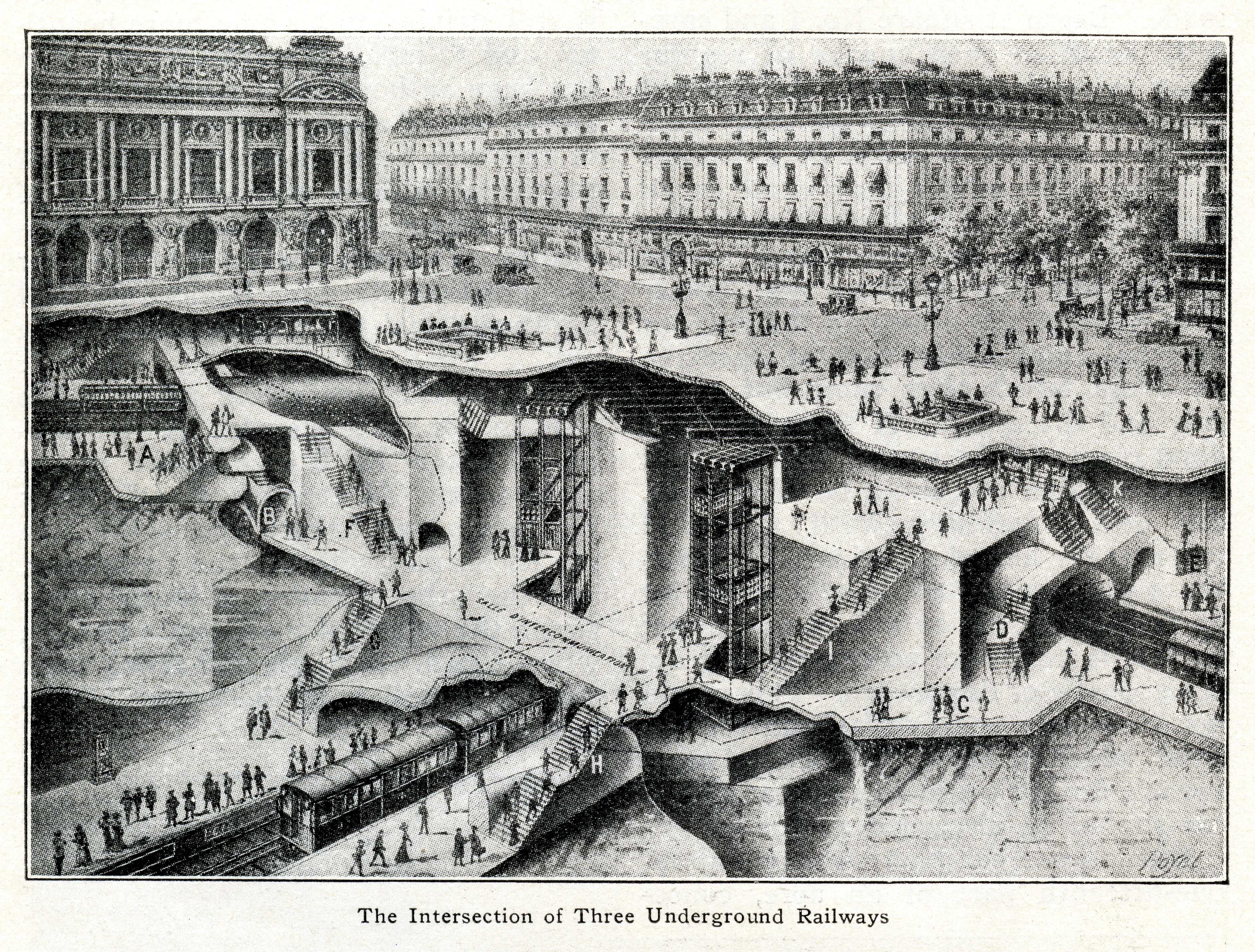
Among other features, an article titled “The Busiest Underground Corner in Paris” appeared in the same issue.

Pop. Mech, 1910, Paris010

The author appears to have been awe-struck, as I often am when using the Paris Metro. It starts: “Of all the wonderful engineering work done by the Metropolitan underground railways of Paris, the most complicated is that under the Place de l’Opera, where three great tubes cross each other, all of which must have station facilities in the crossing’s tangle.  The three tubes, the platform, stairways, and elevators constitute a veritable Chinese puzzle, and the wonder is that the congested underground and overhead traffic has not been even more disturbed during the work” (p. 48).

The image clearly shows “the three subway tubes, the platforms, stairways, elevators, and two of the openings leading from the boulevard.” Today, escalators move people far faster than elevators. The station is still a marvel and what the magazine failed to mention is that all this hidden “tangle” lies beneath the beautiful space in front of the Opera Garnier. It is all part of what makes Paris the world’s most-visited tourist destination and the second densest metro system; the Metro takes a bit of practice to get the hang of it, but soon one appreciates how easy it is to get around.

I wonder if the July 1910 issue of Popular Mechanics helped spark someone’s love affair with Paris; the love of someone with grease under his fingernails, perhaps. Each of us has a story about how we came to love the city. Mine started with the woman I love and with whom I write this blog. Those who hunted for gold in the Klondike and elsewhere used to say “gold is where you find it.” These pictures in a long-ago magazine for tinkerers and future engineers suggest that “Paris is where you find it.”

Text by Norman Ball

Photograph and illustration of the Pont des Arts from Paris en images.

Posted in Paris bridges, Paris metro | Tagged , , , , , , , , , | 16 Comments

The further adventures of the Nurse Who Wore Pearls

A friend recently asked us how we plan what to write about in our blog. The answer, in Norman’s words, is this: “Planning is what you resort to when chance breaks down.” And somehow, chance seldom seems to break down. This blog is a case in point.

A few months ago, I received a comment about a blog post I had written on Queen Philippa. The writer was a professor of medieval history who wanted to use one of my photographs in a lecture. Turns out she taught at the University of Toronto, where I am an adjunct professor myself. We arranged to meet for coffee.

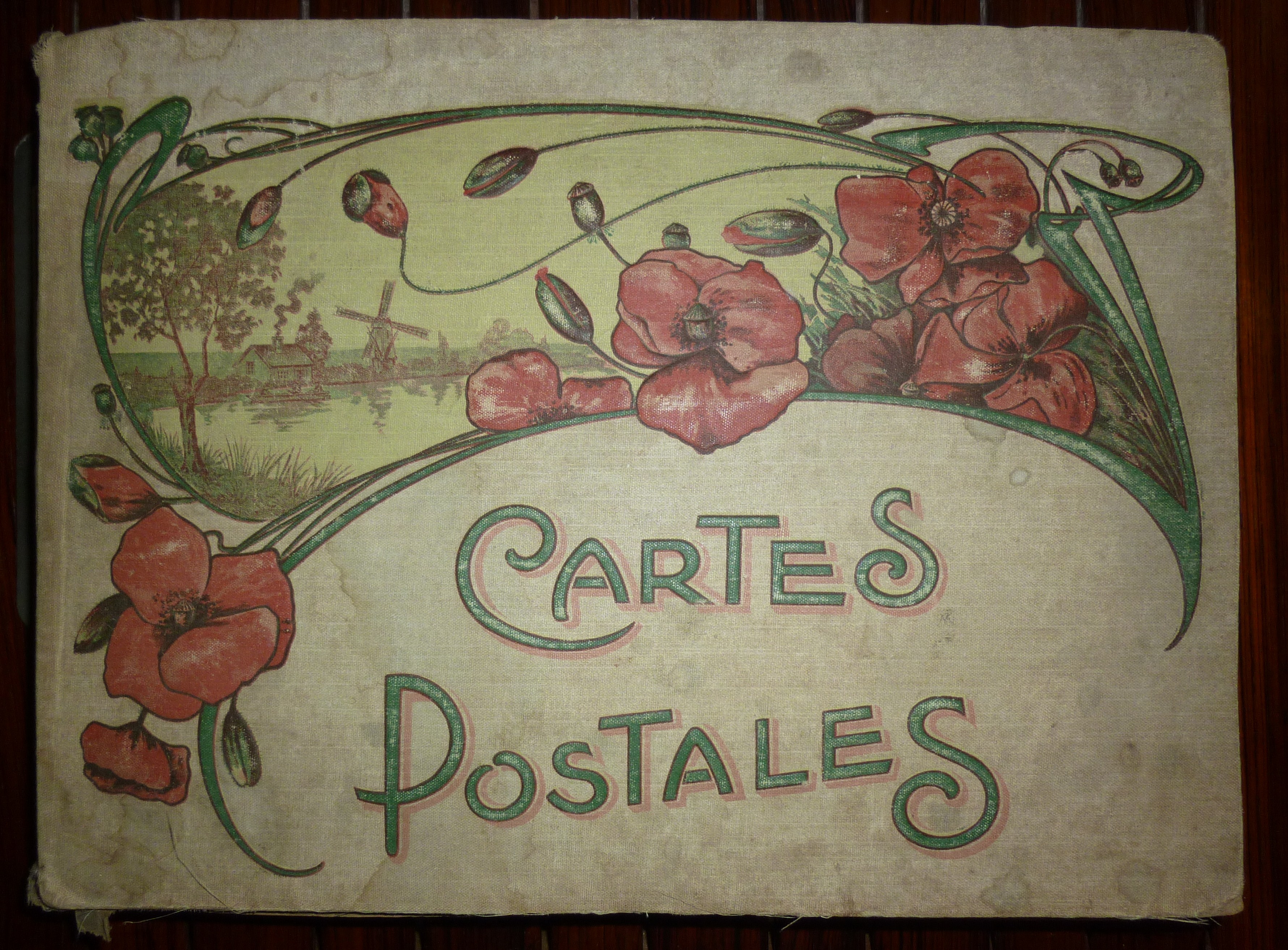
Chatting in her light-filled office with a view over one of the prettier parts of the campus, we found we had many common interests. She was originally from France, but had spent much of her life in Québec. When I mentioned the enjoyment we get from researching stories behind old postcards, she went over to a shelf and took down an album:

P1100742

She had inherited it from a relative who had collected postcards, particularly those in series, and offered to lend it to me.

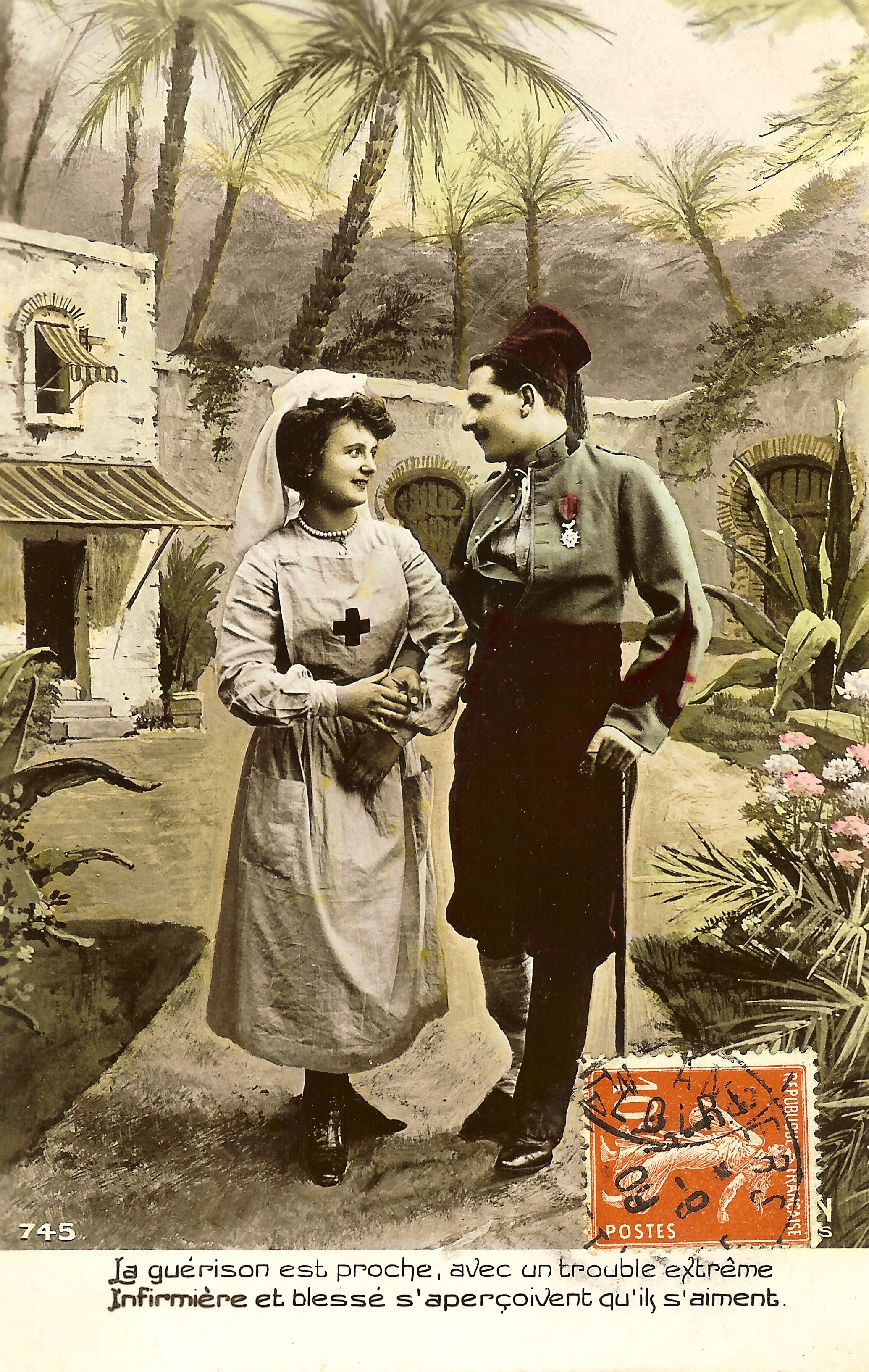
That night, Norman and I went through the pages, turning them carefully as some were a bit crumbly. About halfway through the album, I saw a familiar face: the Nurse with the Pearls, who had made an appearance in a previous blog.

WartimePostcards0001

The picture above is the postcard in my own collection. In my friend’s album, the postcard was part of a series, and the card had some interesting differences. I realized that I had made some erroneous assumptions about the card when I had seen it before.

The first thing that struck me was the postmark: 1909. This was not, as I had supposed, a First World War card. The “Ange de Dévouement” had been pressed into service as a wartime card in 1914, but its origins went farther back. But before I go on, let me show you the series of five, with captions translated rather literally, so you can follow the story.

Nursewithpearls0001 (2)

“Go, my dear daughter, where duty calls you. Of all missions, yours is the most beautiful.”

Nursewithpearls0002 (2)

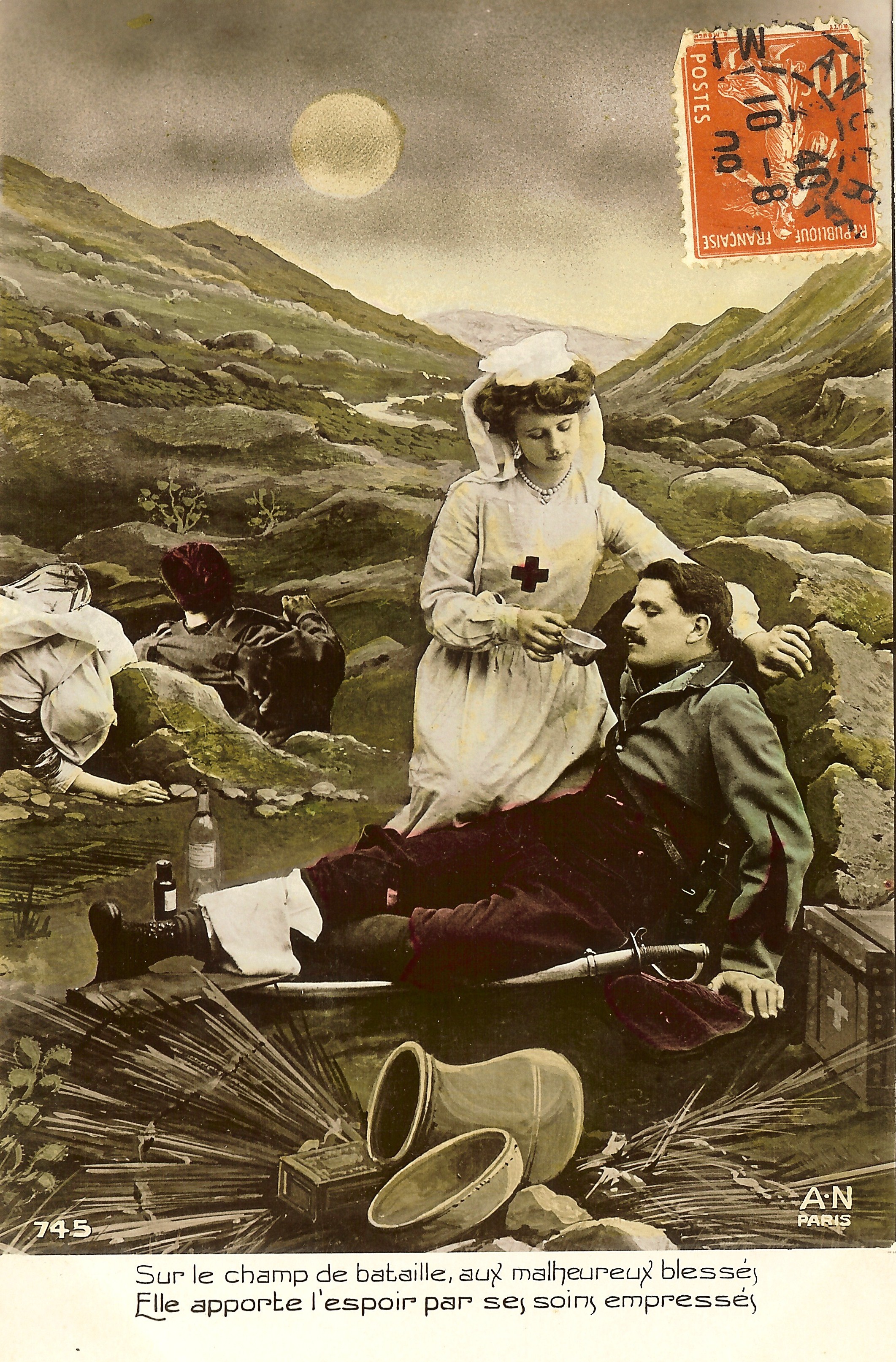
“On the battlefield, she brings hope to the wounded with her attentive care.”

Nursewithpearls0003 (2)

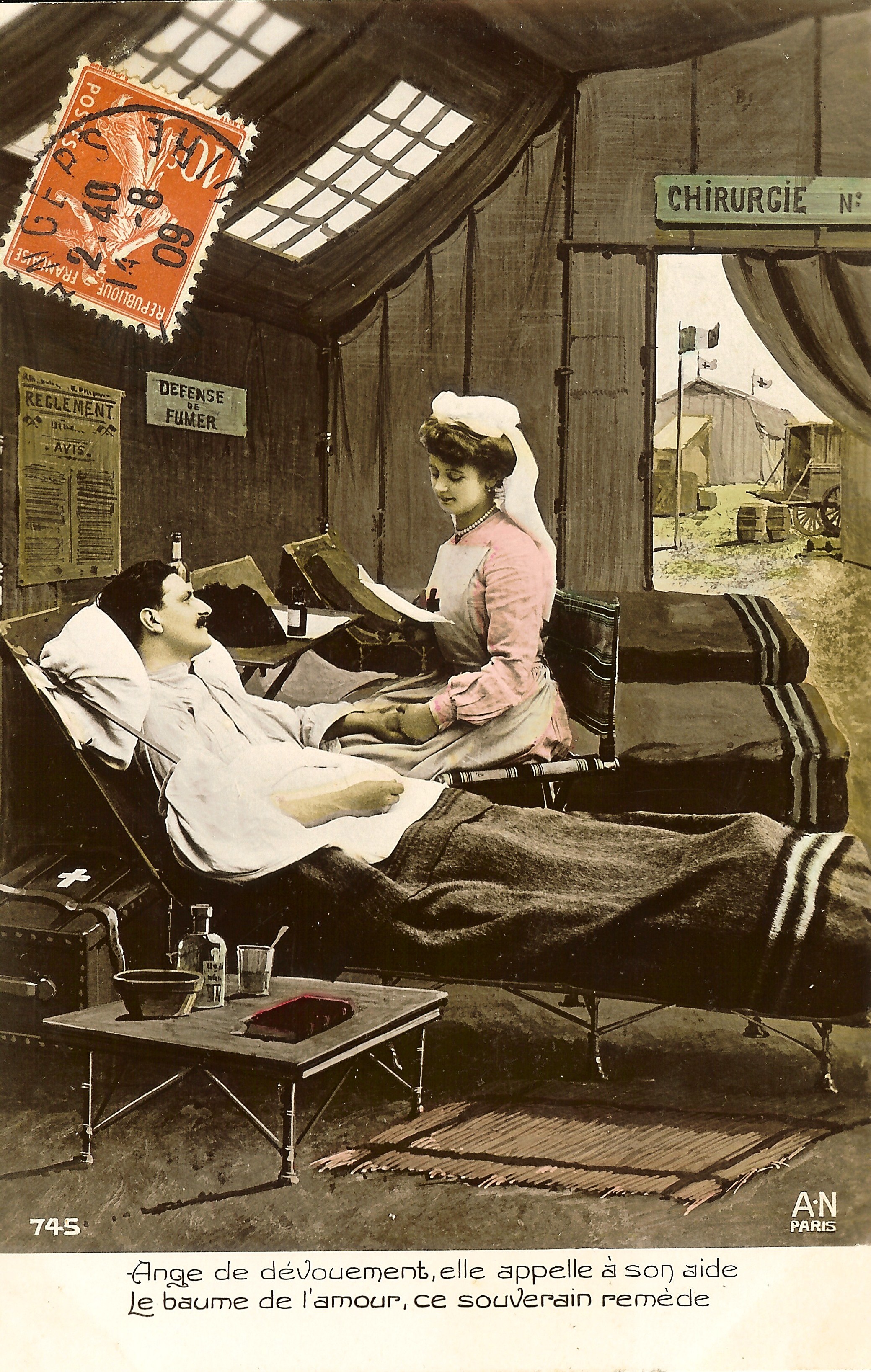
“The angel of devotion, she calls to her aid the balm of love, that sovereign remedy.”

Nursewithpearls0004 (2)

“Healing is nearly complete, which brings a deep anxiety, [since] the nurse and the wounded man realize that they love each other.”

Nursewithpearls0005 (2)

“When one has been in peril, one can be happy: to charm my old age, unite your two hearts.”

The cards, unlike others in series, are not numbered, so there might have been others. I wonder if there was some further complication before the happy resolution. But I love the fact that her pearls are firmly in place in the three middle images.

If you look closely, you will see that the backgrounds are not real. The figures have been photographed in a studio, and their images cut out and superimposed on painted backgrounds. Perhaps the least convincing is the one inside the hut; the two empty bunks are at the wrong angle, although the view through the tent flap is more realistic.

And look at the man’s uniform in the last two, especially the fez and the baggy trousers. He is no ordinary French soldier; he is a Zouave. In the late 19th and early 20th century, these regiments were made up of French settlers in Algeria and Tunisia conscripted into the French army. The background of the fourth postcard also suggests north Africa, with its palm trees and keyhole-shaped archways.

And what was the battlefield? Was it one of the battles by which the French extended their control over north Africa, or one of the skirmishes with British soldiers, as Britain was also trying to assert itself in that part of the world? We’ll never know. I think the postcard was left deliberately vague so that buyers could imagine what they wanted.

One purpose of the series might have been a bit of propaganda for the Red Cross. Would young women be more inclined to join the ranks of the nursing sisters if there was a possibility they would meet handsome young soldiers they could marry? Perhaps.

The mark “AN Paris” indicates that the series was the work of Armand Noyer, a prolific creator of postcards, stereocards, and cartes de fantaisie, many of them featuring shapely women in various states of déshabille (the risqué ones date mostly from the 1920s and 1930s; his prewar production was more straitlaced). He numbered each series: this one is 745.

The postcards were sent from someone called Madeleine, who lived in Angers, to Monsieur and Madame Emile Marsais, who lived at Les Grandes Barres, St-Aubin-de-Luigné, about 25 km southwest of Angers. Today there is a vineyard there.

The first four were sent between July and September 1909. Madeleine asks when Mrs Marsais will be visiting Angers, inquires about the couple’s trip to Lourdes, notifies them that she will be on the 1:57 train but not to worry about meeting her, and lets them know that she and her father will be driving out to “see the vines on Sunday.” Ah, so there was a vineyard then, too.

The fifth does not have a clear postmark, but seems to have been sent later than the others. Madeleine notes that the water has finally retreated from her father’s cellar, and none too soon, since at its height it came up to the highest step on the stairs. From that detail, we can determine the date: there was a flood in Angers in March 1910, two months after the devastating Paris floods.

Madeleine sent other series of cards to Mr and Mrs Marsais, although in most cases, she just scrawled “Bonjour” or “Amitiés” for a message. In the cards with a more detailed message, Madeleine’s spelling is a bit erratic; perhaps she was still just a teenager, or perhaps she had not had much of an education. Or perhaps she just was not very good at spelling.

Her last name might have been Gouadon. On one of the cards from another series, she invites Mr and Mrs Marsais to lunch and concludes, “Amitiés à tous et à 11 heures Maison Gouadon.” This unusual surname is associated with that area.*

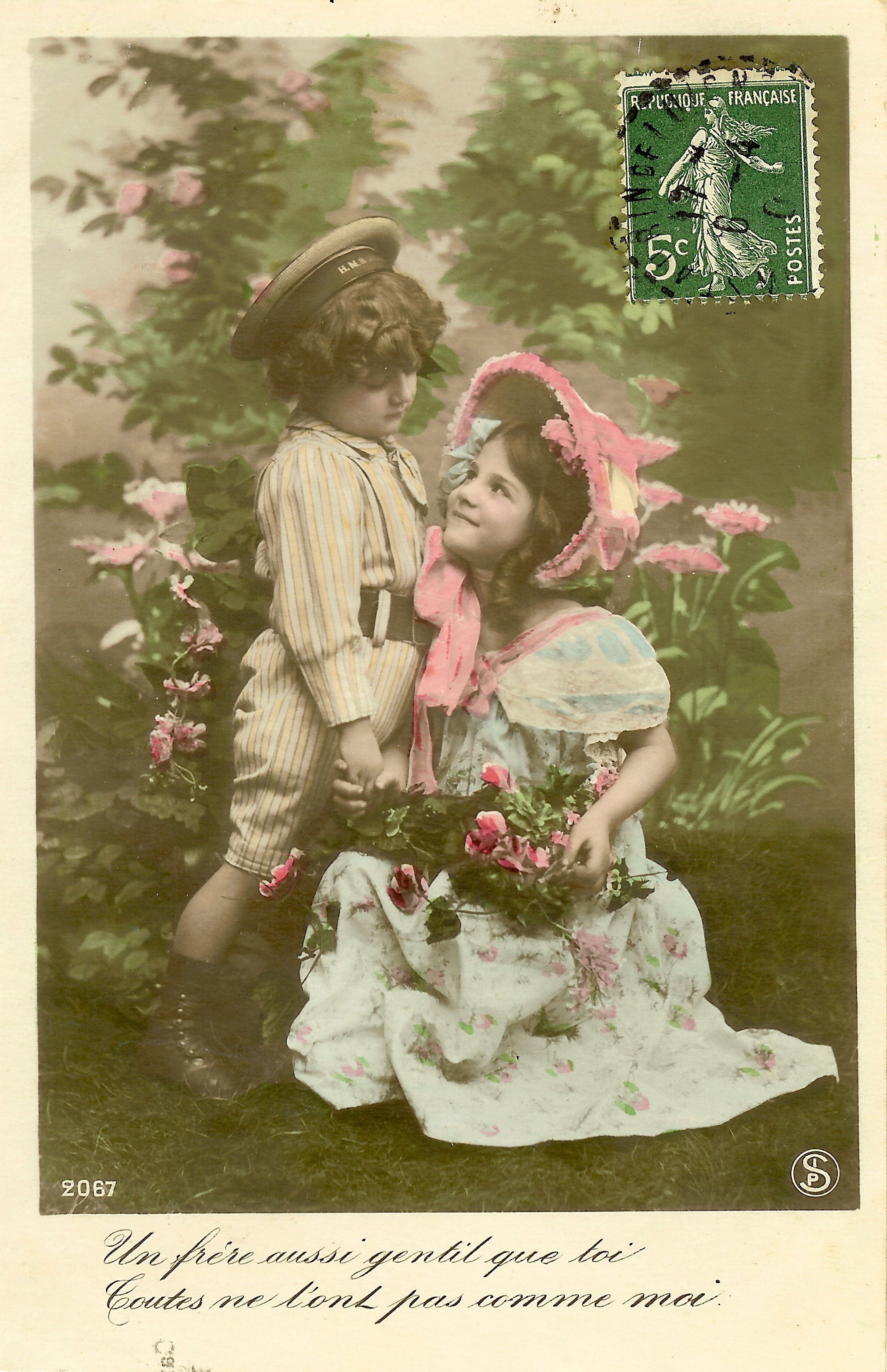
The album contains dozens of these series, many of them with winsome children in place of adult protagonists. These ones may seem impossibly sentimental, but in an age in which cat videos go viral, we in the 21st century cannot claim that the early 20th century had a monopoly on cutesiness.

I’ll leave you with some images from one of the children’s series, also sent by Madeleine [Gouadon?] to Mr and Mrs Marsais. All were mailed in April 1909.Since they are all rather similar, I will show only the first one in detail. The words underneath are about the joys of being brother and sister. I’ll spare you the translation.

scan0003

Children

Note that in the few months between the time these were sent, and the time Madeleine sent the series about the nurse, the price of postage has doubled, from 5 centimes to 10!

Text by Philippa Campsie

*The French have a wonderful website that that allows you to see where certain surnames are most concentrated. Type in a family name and the map will indicate where people with that name were born during four periods: 1891-1915; 1916-1940; 1941-1965; 1966-1990. For example, only 5 people with the name Gouadon were born in all of France between 1891 and 1915, two of them in the Maine-et-Loire department, where Angers is located. Perhaps Madeleine was one of them.

Posted in Paris postcards, World War I | Tagged , , , , , , , , , | 3 Comments

I’ll meet you on the passerelle Debilly

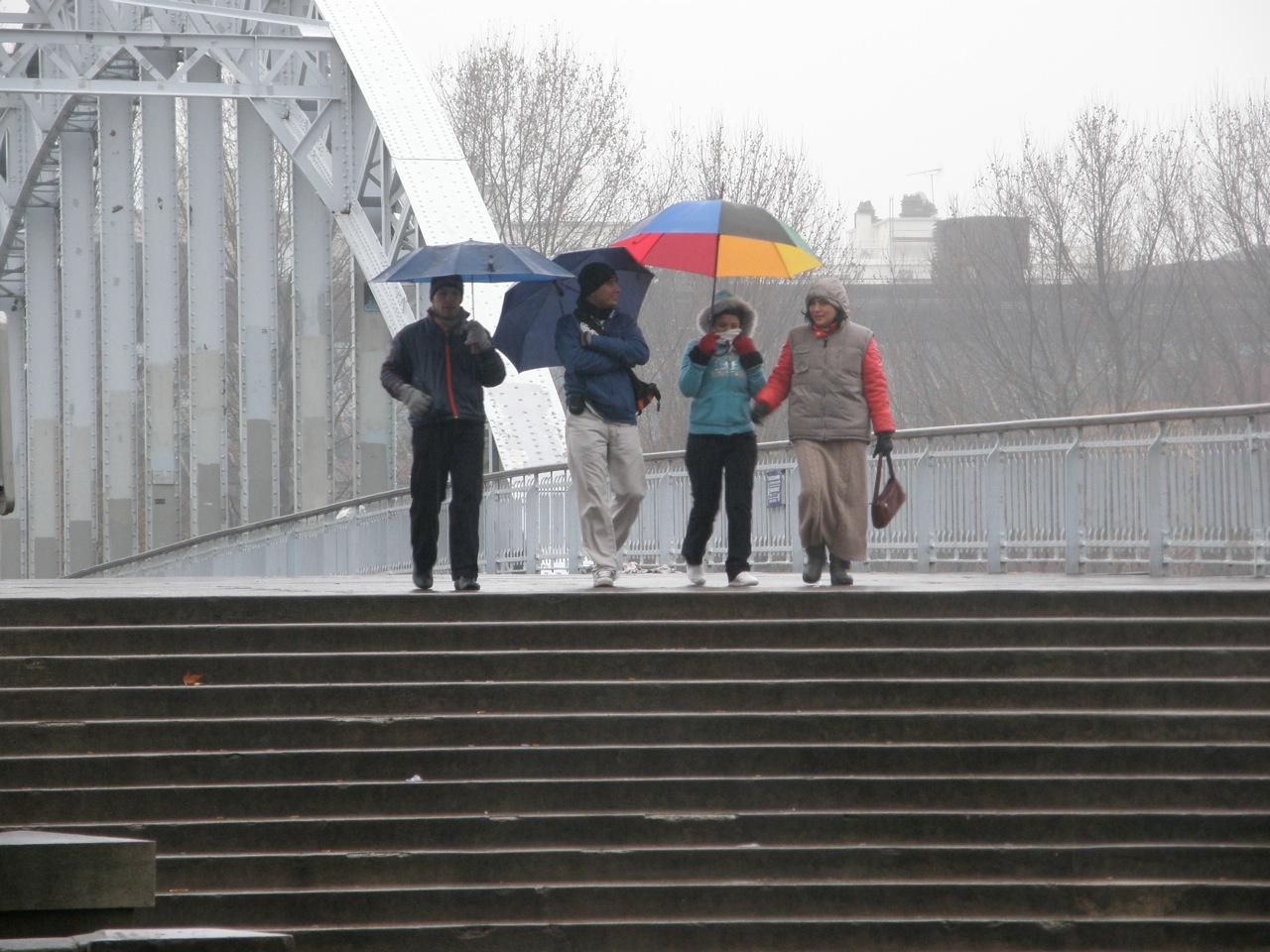
The passerelle Debilly is often overshadowed by its flamboyant neighbour, the Eiffel Tower. But then, the Eiffel Tower has been upstaging everything in the neighbourhood since it opened in 1889. Consider one of the first photos I ever took of the passerelle Debilly. I noticed the bridge, but at that time, I didn’t know its name. In the photo, the Eiffel Tower is, even partly obscured, the star.

PC170851

Philippa and I had just left the Palais de Tokyo. Outside it was a grey rainy day. I slipped on the stairs going down to the river, but it was Paris, and I didn’t mind so much.

Soon I was photographing others who seemed to take the rain in stride. I liked the bridge, but I was concentrating on the people and their umbrellas.

PC170859

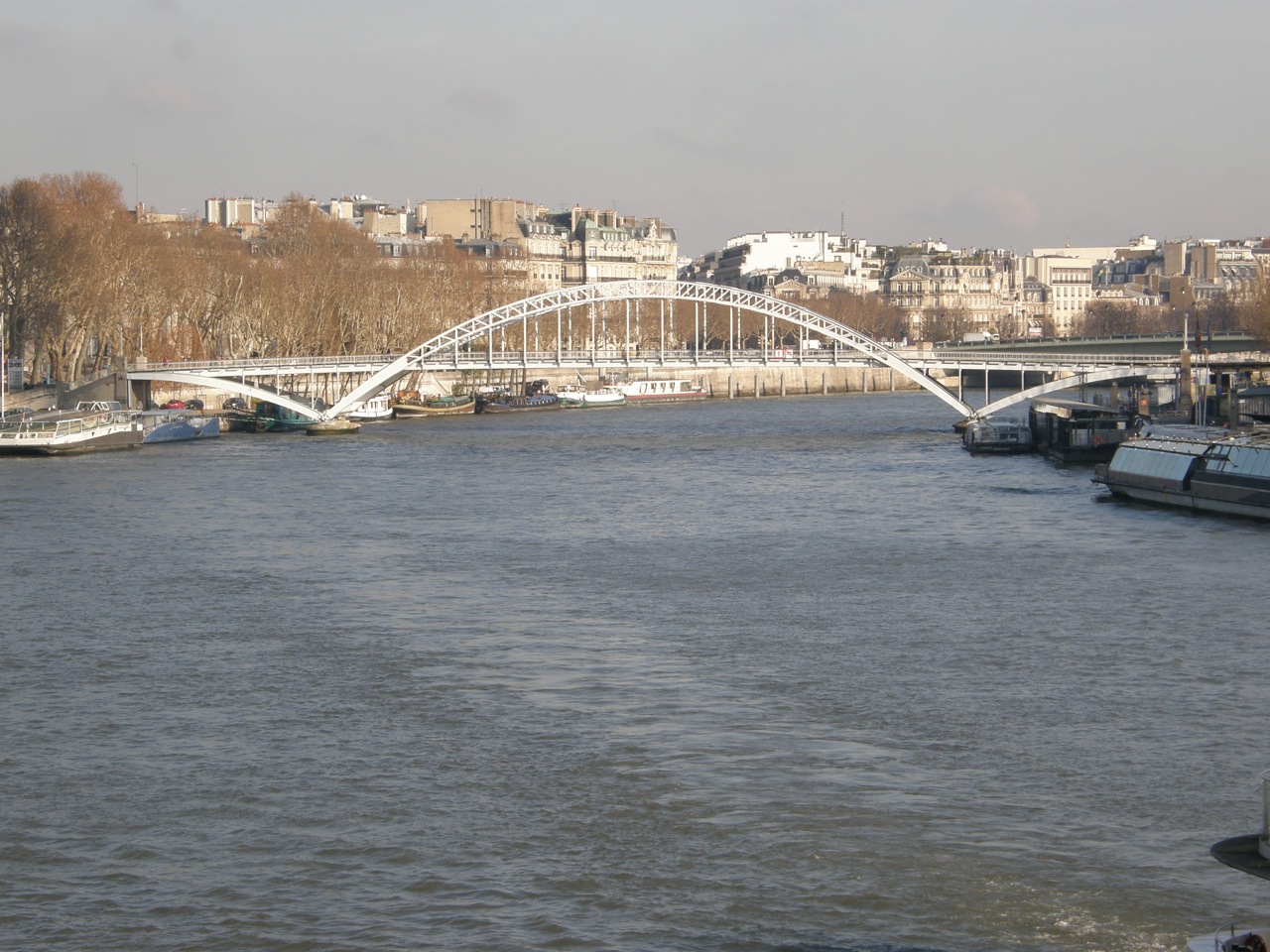
We encountered the bridge on other occasions, but I never had a chance to look at it more closely. Then, last December, I found myself near the bridge with time on my hands on a sunny day.

PC120142

As I drew closer, the bridge seemed to grow ever more exuberant.

PC120183

I was captivated. It was as if structural steel had captured the path of a skipping stone thrown from the bank of the Seine across the river.

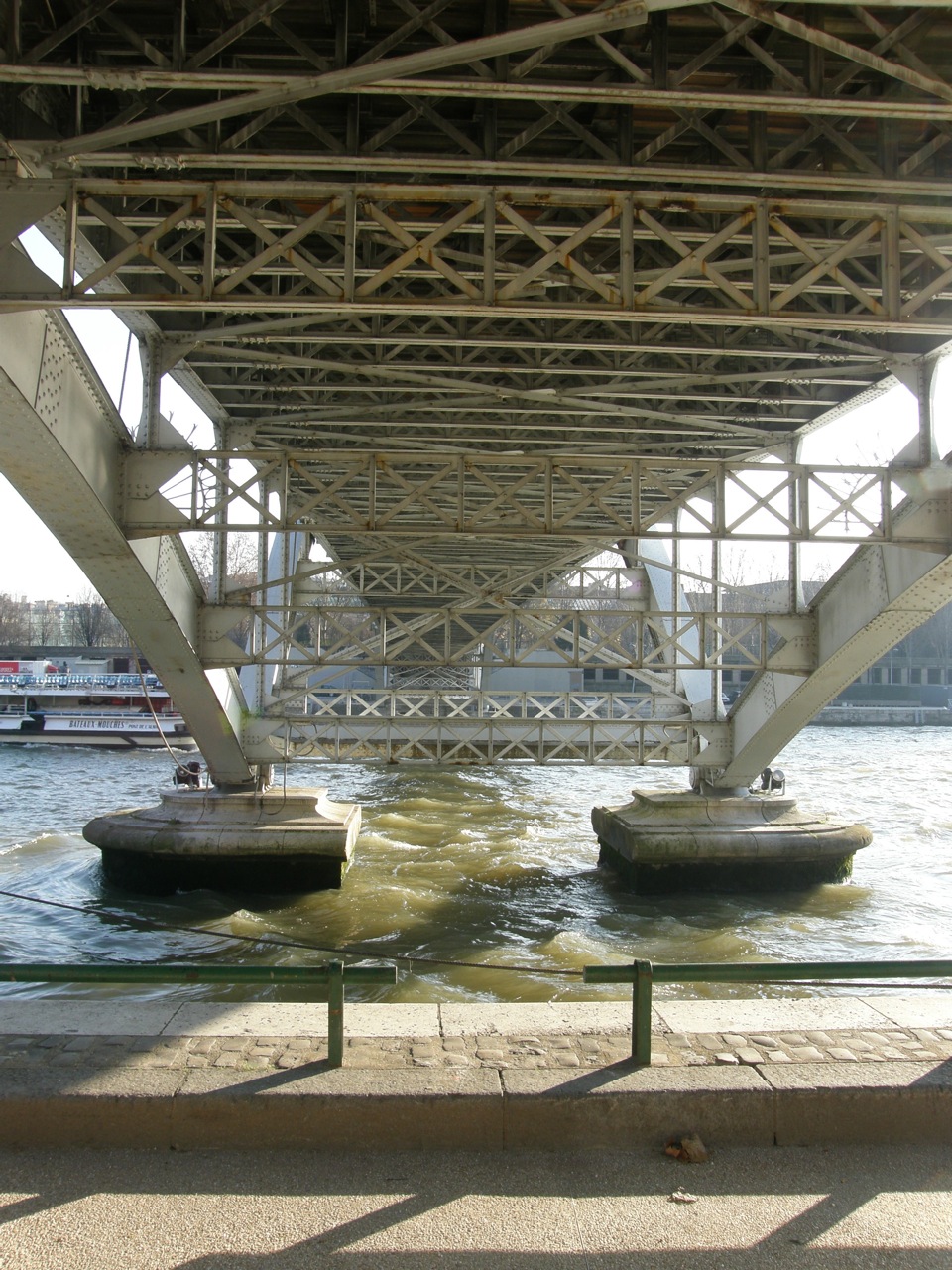
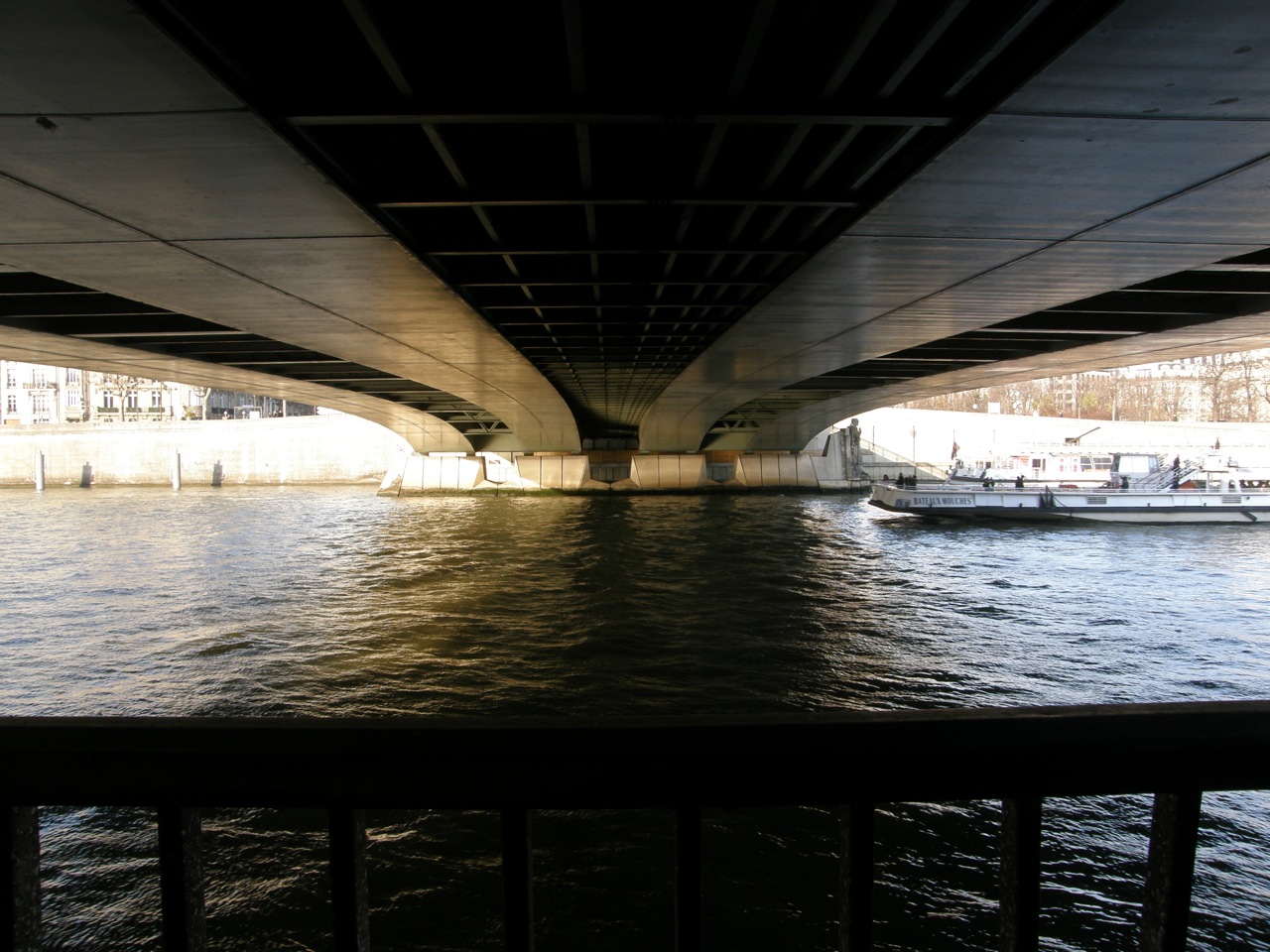
I always want to see the underside of bridges. Beneath the bridge, just above water level, I could appreciate the geometry of structural steel. The river was high that day, and fast-flowing muddy water bent gracefully around the piers. No vehicles rumbled overhead; I could hear the water.

PC120192

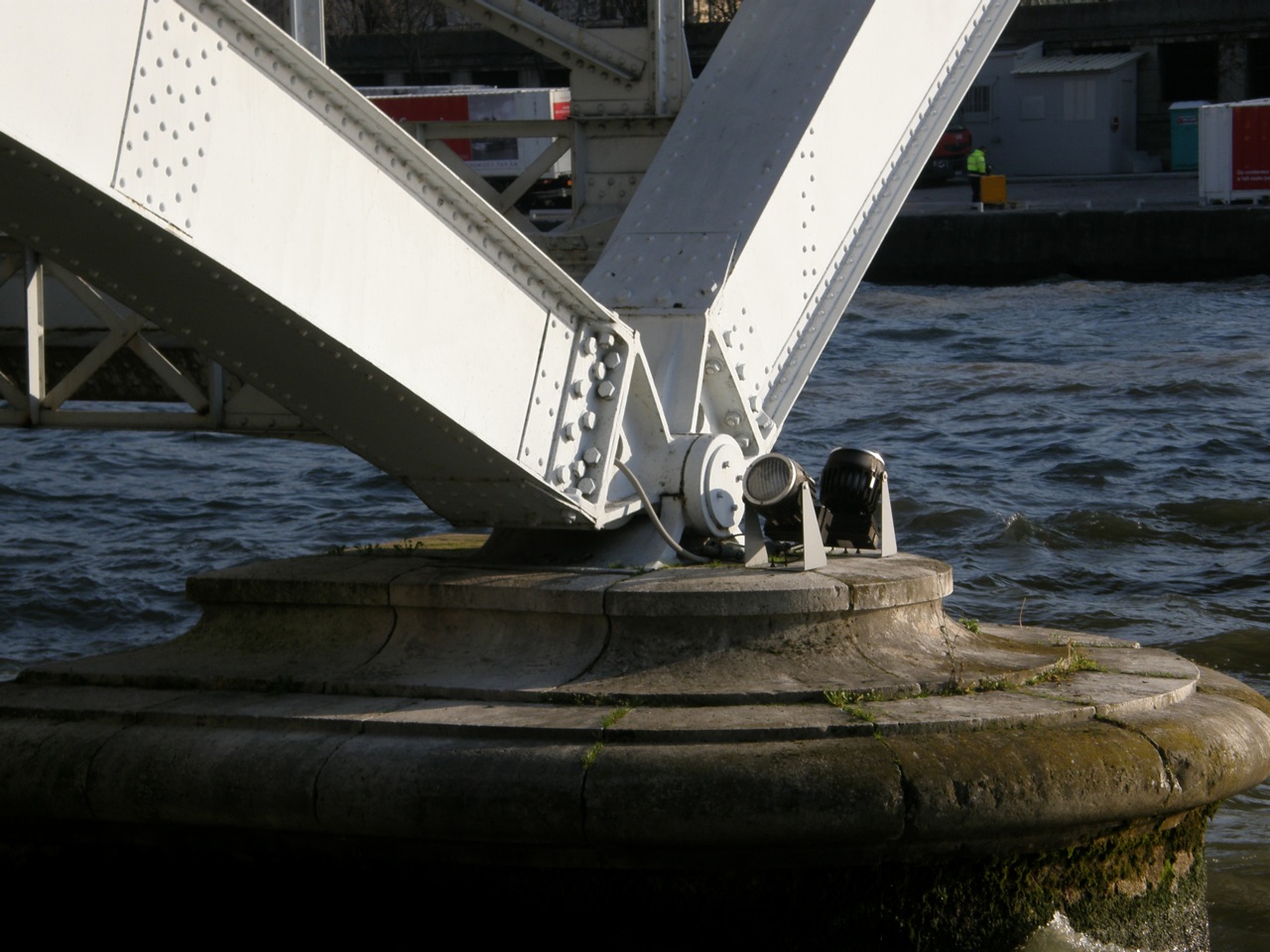
I was intrigued by the gracefulness of the two structural members that transfer the load to the bearings that support the bridge and allow slight movement as the bridge expands and contracts with changes in temperature.

PC120184

I also paid attention to the signs with no words. One sees variants of this warning all over Paris. The sharp points contrasted with the smooth regularity of the rivet heads.

PC120217

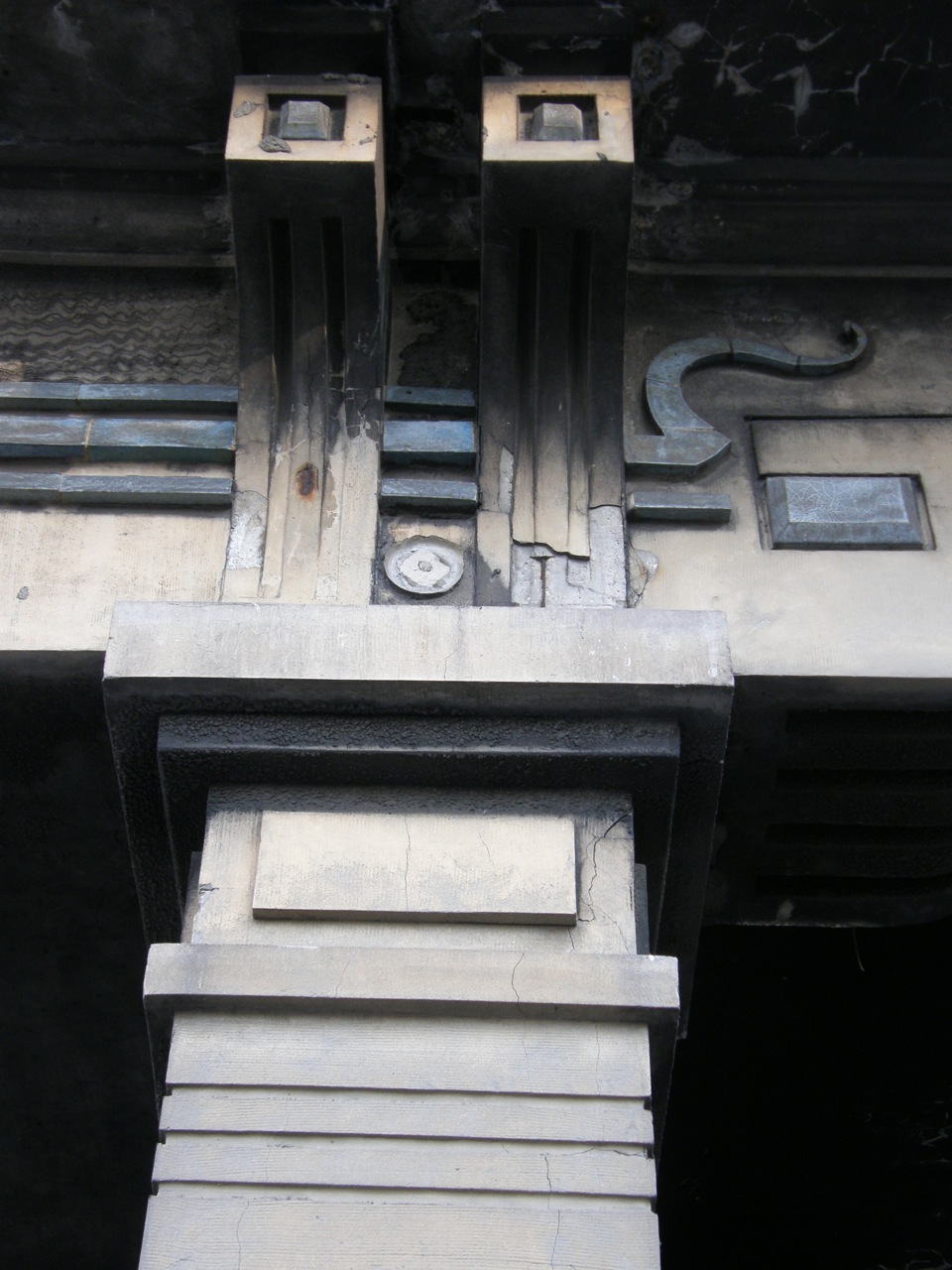
Soon I discovered that there was more to this bridge than seductively shaped ironwork and gracefully weathered wood. I began to notice more and more unusual details.

PC120228

Clearly someone had been given the freedom to make something very special.

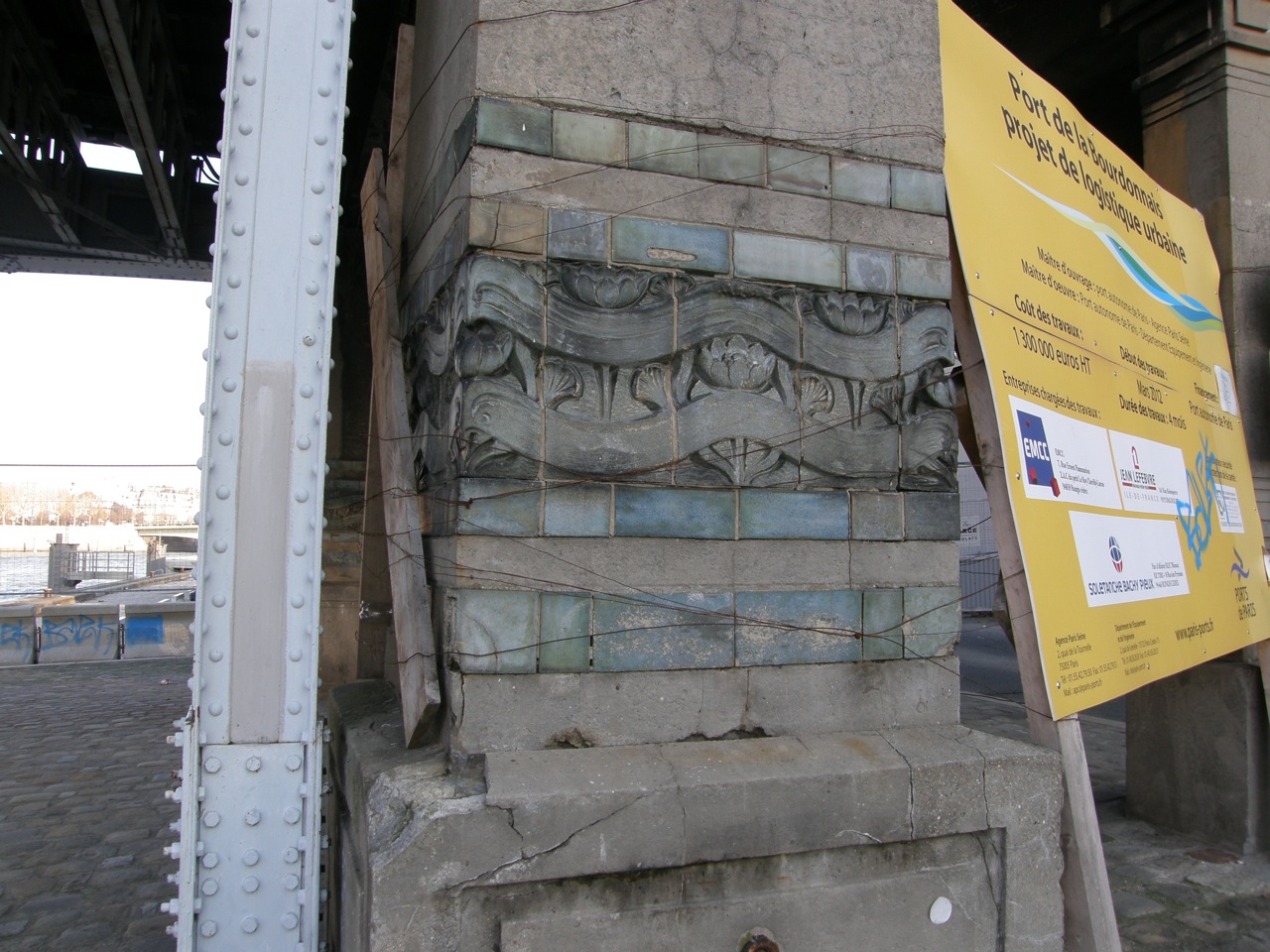
The columns were most unusual, the work of an artist capturing the waves on the Seine, an artist reminding us that Paris is an important port.

PC120238

On that afternoon I was looking at a rare beauty that clearly needed help. And it appears to be getting it. Restoration is under way.

PC120237

One can only hope that the inevitable signs of age can be restored and that the passerelle will one day be returned to its former glory.

PC120222

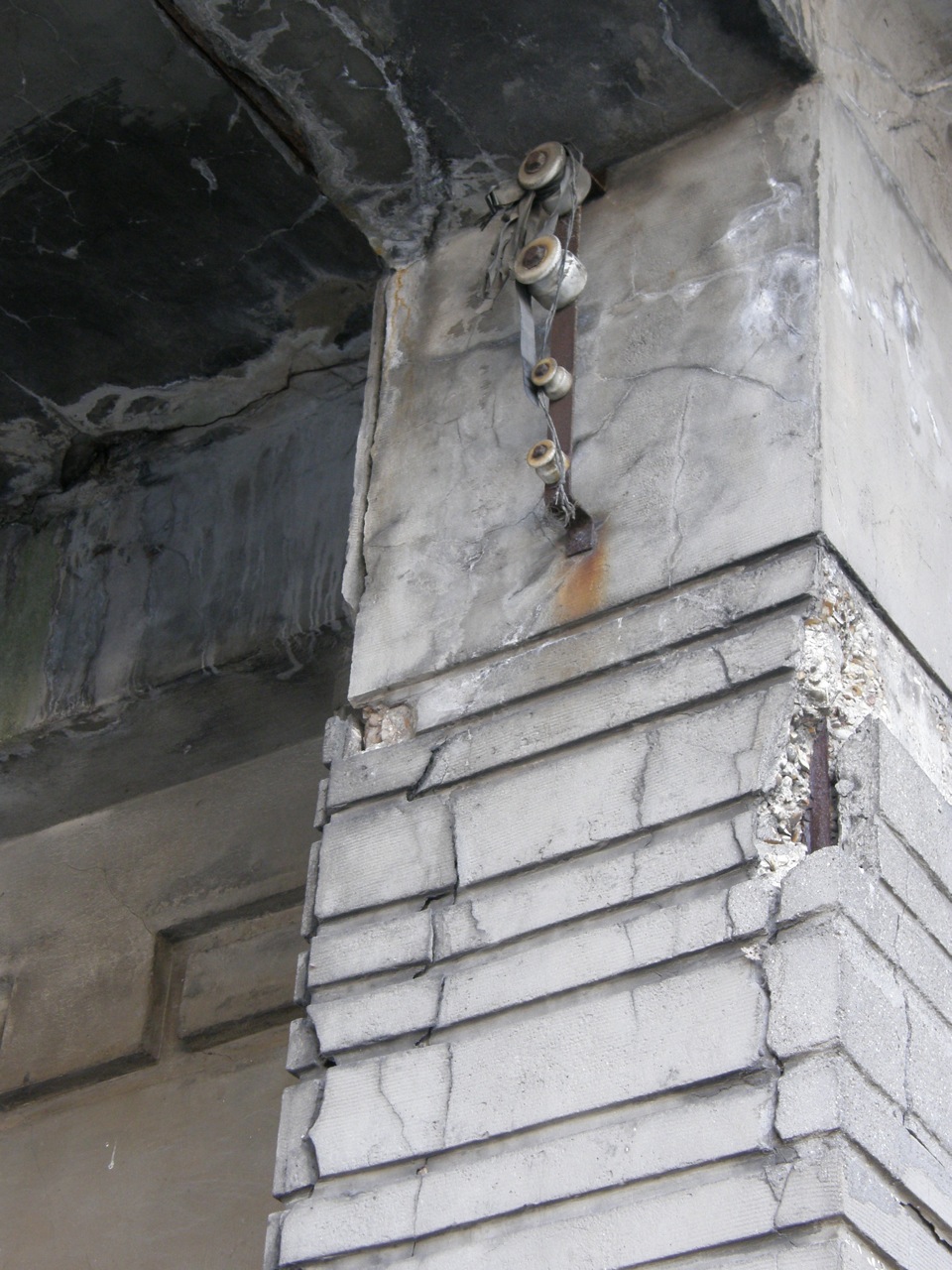
Perhaps a sensitive restoration will leave some evidence of former ways and former days. I am rather fond of this evidence of an older way of putting in electric wires. Surely anyone who has worked on rehabilitating an older house will recognize the porcelain insulators. I like them. I hope the remnants will stay as a tiny bit of history in-situ.

PC120225

After a couple of hours, I wandered away from the bridge and a few minutes later my cell phone rang. It was Philippa; she was on the right bank near the pont de l’Alma, which I could see quite clearly as I talked on the phone. My path to our meeting place inadvertently turned out to include a construction site I had to exit from carefully. But I did get an unusual view of a very different, and very modern bridge.

PC120256

Back at home in Toronto I started to find out more about the passerelle Debilly.

Structures made for International Expositions often have a short intended lifespan and most do not survive. The Eiffel Tower built for the 1889 International Exposition was expected—at least by some—to be torn down soon afterwards and it nearly met that fate. Three of my favourite Parisian sites, the Petit Palais, the Grand Palais, and the Alexander III bridge, were built for the Universal Exposition of 1900 and they too have survived. The modest passerelle Debilly was also a survivor from 1900.

It was originally known as the “passerelle de l’exposition militaire” and then the “passerelle de Magdebourg,” before it took the more dignified name of Passerelle Debilly in 1906 to honour the First Empire Army General Jean Louis Debilly, who died in the battle of Iéna (Jelna) in 1806. The Exposition included buildings on both sides of the river and the bridge was designed to link the Army and Navy Hall on one side with the “Old Paris” series of buildings on the other bank. These buildings have long since disappeared, but the bridge still crosses the Seine with pont de l’Alma upstream and the pont d’Iéna downstream.

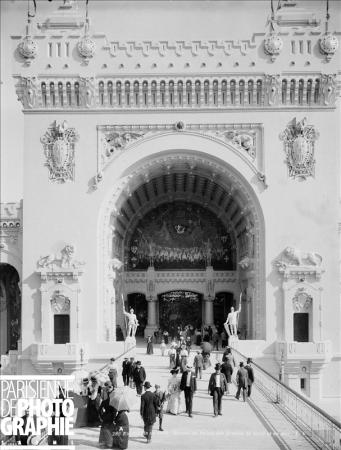
The image below, taken from a stereograph view, shows the bridge, on the upper left, entering the Army and Navy Hall, a magnificent structure. The Eiffel Tower is out of sight to the right of the photograph.

Paris exhibition 1900001

Here’s a closer view of the Army and Navy Building as seen from the passerelle.

5347-5

The bridge survived in part because it was useful and well-built. The City of Paris acquired it in 1902. Originally built to align with Avenue Albert de Mun, the city in 1906 moved it “quelques dizaines de mètres en amont” (several dozen metres upstream, actually more than 200 metres) towards Pont de l’Alma to a position opposite rue de la Manutention. Here it was further away from the pont d’Iéna, a name of no happy memories to Debilly.

Not everyone approved of the bridge. In 1941 one architect argued for its destruction because it was no more than an “accessoire oublié d’une fête passée” (a prop or accessory from a faded or past festival). Cooler heads or perhaps simply inertia prevailed and the bridge was left as is. In 1966 it was added to the supplementary registry of historical monuments. It was repainted in 1991 and the deck redone in 1997.

The 3-span bridge has a total span of 120 metres, but the large central span of 75 metres allows the piers to be quite close to the banks. This gives a wider navigation channel than would be the case with arches of equal length. The 22.5-metre side arches are actually half arches.

The passerelle Debilly was designed by engineers Jean Résal, Amédée Alby and André-Louis Lion. Résal was a professor at the famed École Polytechnique and he and Alby were the design engineers for the much more famous Pont Alexandre III, which also opened in 1900. Lion was the official engineer for Ponts et Chausées (Roads and Bridges).

The stunning ceramic tiles were made by the French company of Gentil et Bourdet.

Well-known as a rendezvous for lovers, Paris has also been the meeting place for spies from various nations. During the Cold War, the passerelle Debilly was apparently a favoured meeting place for spies and assorted “diplomats” who needed to exchange messages, currency, or other things. It was also the bridge on which, several days after the fall of the Berlin Wall, an agent of the Democratic Republic of German was found dead.

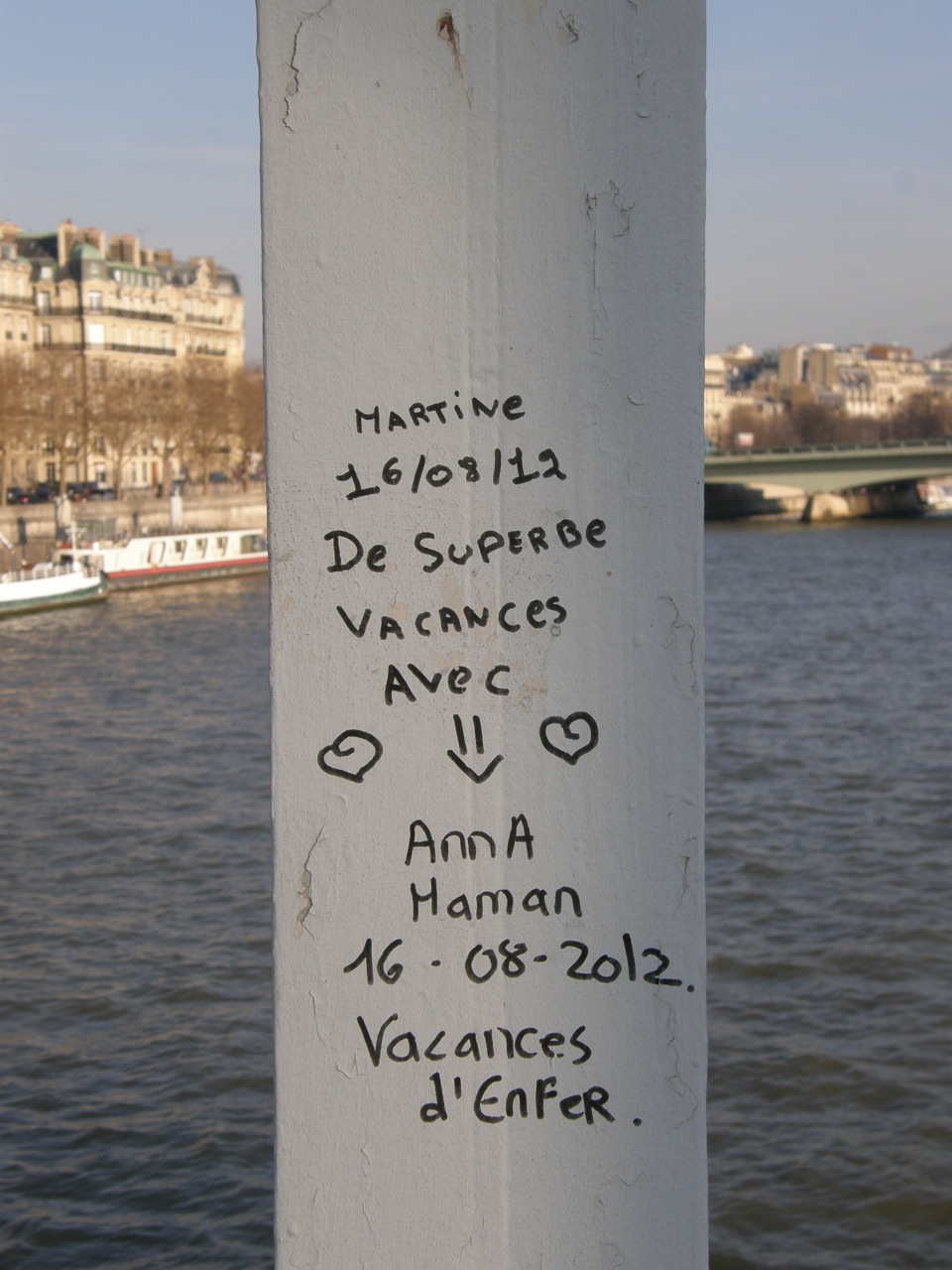
Who knows what other stories the bridge could tell? What happened when Martine and Anna had their “vacances” in Paris?

PC120210

Perhaps next time I will arrange a top-secret meeting on the bridge to exchange, um, stereocards?

Text and photographs by Norman Ball. Photograph of the Army and Navy building from Paris en Images.

Posted in Paris bridges | Tagged , , , , , , , , , , | 8 Comments

The forgotten fashionista

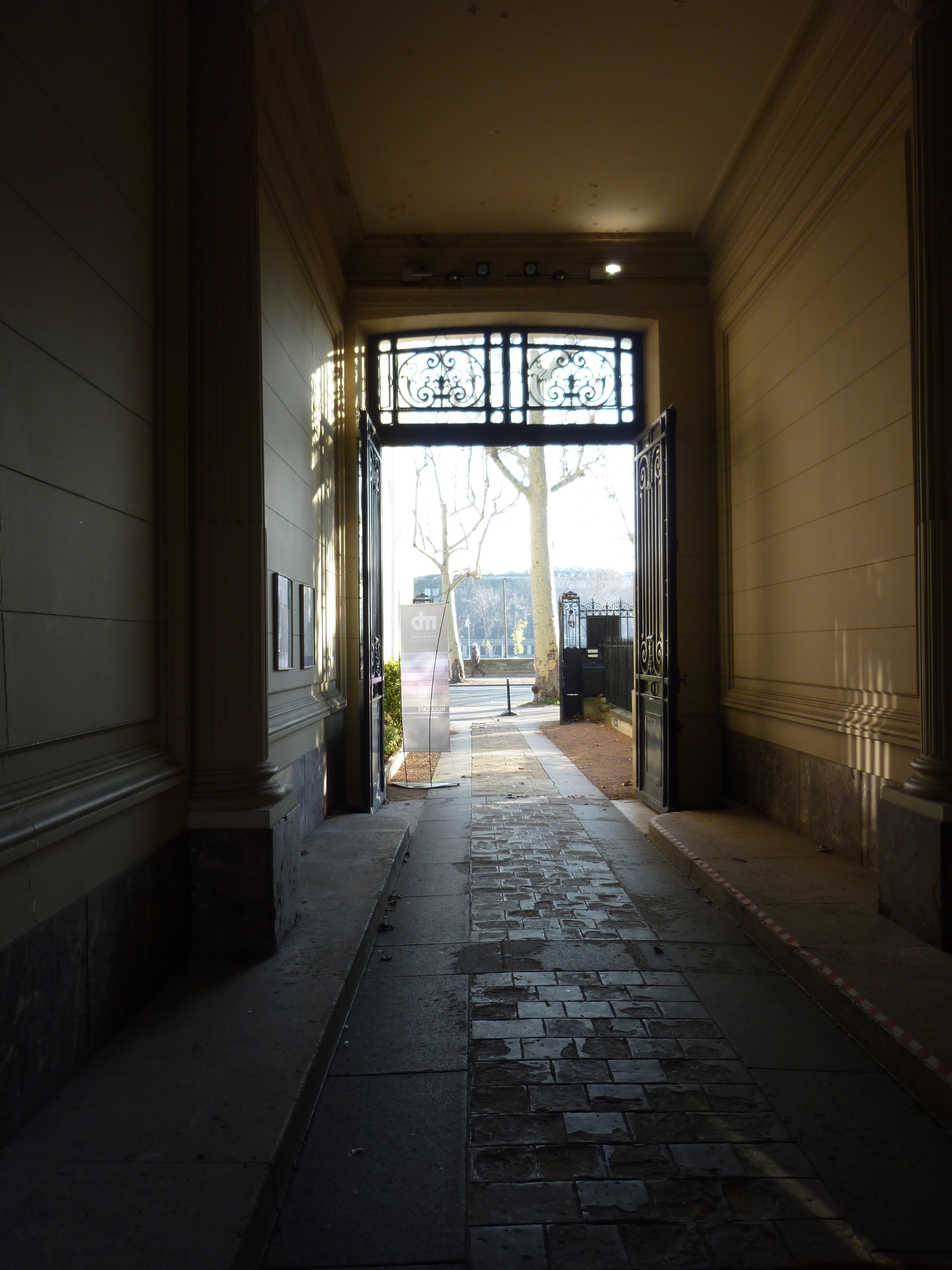
There are not a lot of private houses in Paris. Let alone private houses with a direct view of the river and the Eiffel Tower. So 34, avenue New York, home of the Mona Bismarck American Center for Art and Culture, is already something out of the ordinary.

P1090214

We went there last December to see an exhibit of prints and drawings by Mary Cassatt (I wrote an article about it for Girls’ Guide to Paris). The exhibition was interesting, but I was captivated by the house. The lunchroom offered a view of an enclosed garden, and a large poster on the wall provided the beginnings of an answer to the question in my mind: “Mona Who?

The short answer would be: a fabulously wealthy American society hostess (1897–1983), once nominated the “Best-Dressed Woman in the World,” and benefactress of the institution that occupies her former Paris residence.

There was a second exhibit on the upper floor, and I climbed the oval staircase to look around. A large room contained a grand piano, a gilded mirror, some candle sconces, and a few pictures. I spotted a small corridor leading to a powder room.

P1090190

One seldom has the opportunity to wash one’s hands and comb one’s hair in such elegant surroundings, and for a few minutes, I made myself at home.

P1090202

There were three black and white portraits of Mona on a ledge, so I photographed them (badly). However, I later found clearer versions of the same images online. Here is one of them.

74a8365c290a7a08c4fe2141d242720ce13e6c15-1968.2.01

Back home in Toronto, I decided to find out more about the woman whose house I had visited. There is remarkably little written about Mona Bismarck. And after reading what there was, I think I know why. Here is the story.

Mona (or Frances) Strader was the daughter of a Kentucky horse breeder and trainer, Robert Strader. Her childhood was sad and chaotic. Her parents divorced when she was four or five years old. She lived first with her maternal grandmother, then with her paternal grandmother. The former was later declared insane and sent to an asylum. An uncle suffered the same fate. Another uncle shot a prostitute and then turned the gun on himself. A third uncle died in a hunting accident. Only her father seemed to be a steady influence in Mona’s life, and he was not always around.

The only way out of this nightmare was marriage. Mona’s starter husband was Henry James Schlesinger, son of the richest man in Wisconsin. She’d met him through her father’s racing contacts. She was 19; he was 39. The marriage was not a success. In 1920, Mona sought a divorce after three years of marriage, and left her young (and only) son in her husband’s custody in Milwaukee.

tumblr_m5ly3zZTC51qhogwao1_500

At this point, she had already met husband No. 2, a wealthy banker called James Irving Bush, said to be the “handsomest man in America.” The two married in New York in 1921; she was 24; he was 38. Fairly soon, Mona discovered that her new husband behaved appallingly when he was drunk, and he was often drunk. This time she went to Paris to obtain a divorce (note to self: find out more about Paris as the “divorce destination” in the 1920s and 1930s).

Back in New York, Mona started up a fashion venture with a friend called Laura Curtis, who was engaged to be married to Harrison Williams, one of the richest men in the United States (a big step up from the richest family in Wisconsin). Rumours abounded that Mona “stole” Harrison’s affections while her friend was out of town. In fact, Laura Curtis jilted Harrison Williams, leaving him free to marry Mona. But the rumours won and it took Mona some time to live them down.

Fortunately, she didn’t have to do so while living in New York. Harrison Williams took her on a honeymoon cruise around the world in his enormous yacht, Warrior. She was 29; he was 53. It was 1926.

WARRIOR_121

Three years later, the stock market crash reduced her husband’s fortune of $680 million to a paltry $5 million. The Harrison Williamses apparently failed to notice their change in fortunes. They had a Long Island mansion at Oak Point; a New York town house on Fifth Avenue; an all-white house decorated by Syrie Maugham in Palm Beach; a Paris apartment on the rue Pouquet; and a villa with a large garden on the Island of Capri in the Bay of Naples called Il Fortino.

Meanwhile, Mona had become the darling of the fashion mavens. Cecil Beaton never tired of photographing or drawing her, although he said he could never fully capture the beauty of her huge acquamarine eyes and extraordinary silver hair.

Vogue and Harper’s Bazaar published endless stories about her exquisite life and clothes. And in 1933, the Paris couturiers Molyneux, Lanvin, Vionnet, Chanel and Lelong voted her the world’s “best-dressed woman.” Okay, the nomination was a little self-serving, since she wore their creations, but they were not alone in praising her sense of style. And in the end, it was Balenciaga who was her favourite couturier; he opened his fashion house in Paris in the late 1930s.

v4n3cover

Perhaps the best way to sum up Mona’s life at this point was the phrase used in 2007 by Emily M. Banis in the title of her master’s thesis for the Fashion Institute of Technology in New York: “Mona: Portrait of a Female Dandy.”

Mona was a “dandy” in the sense that her greatest creation, her work of art, was her own appearance and her lifestyle. That was what she did. That was all she did. Nobody ever saw her reading a book. Nobody ever credited her with a witty remark. If she wrote letters, they were unquotable. She never learned French or Italian, despite years spent in those countries.

What Mona created was herself. After her chaotic and unhappy childhood, her achievement was to control every aspect of her life. Her houses were perfect. Her clothes were perfect. Her dinners were perfect. Her flowers were perfect (she loved gardening and grew her favourite flowers from Kentucky and England in the gardens in Capri, even though every drop of fresh water had to be brought from the mainland). Nothing less than perfection was acceptable.

In 1943, Dali painted her in an extraordinary portrait. In the first version, he painted her naked, but she objected, so he painted her wearing rags (but with her ever-present pearls), surrounding by objects from antiquity that evoke a certain menace. Apparently Mona loved it and it graced her Paris house on the avenue New York until a few weeks ago.

Salvador DalÍ's portrait of Mona Bismarck

Harrison Williams died in 1953. His obituary in the New York Times noted: “The only reason the Harrison Williamses don’t live like princes…is that princes can’t afford to live like the Harrison Williamses.”

The following year, Mona acquired the final feature her life had lacked: an aristocratic title. She married Count Edward von Bismarck, the grandson of the German chancellor of that name. Eddie was thought to be gay, but he had been Mona’s long-time friend and confidant. He apparently believed that he was dying of stomach cancer, and she may have married him assuming it would be a very short marriage and a long widowhood. Eddie lived for another 16 years.

By this time, Mona had lost her trademark silver hair. In the 1950s, according to most sources, she started to dye her hair brown, and her friends were astonished that she would give up her most recognizable feature. Maybe, in middle age, she no longer wanted to be so recognizable.

mona-von-bismarck

Mona was devastated by the closing of the house of Balenciaga in 1968. The story goes that when she heard the news, she did not leave her room for three days. After this period of mourning, she switched to Givenchy.

Eddie died in 1970. Mona then married his doctor, Umberto de Martini, 14 years her junior. Big mistake. She thought he would look after her as she aged, as he had looked after Eddie; he thought she would fund his extracurricular activities, which included a mistress in England. When in 1979, he accidentally drove his Alfa Romeo off a bridge near Naples (her friends made the inevitable joke about “Martini on the rocks”), she was delivered from a burdensome marriage. She went back to using Bismarck as her surname.

012_mona_von_bismarck_theredlist

She lived for four more years, dying in 1983 at her house on the avenue New York, aged 86. The terms of her will would have created an arts foundation that encompassed her Paris house and the artworks in her villa at Capri. But she had forgotten her son by her first marriage, who contested the will and demanded an inheritance larger than the measly million or so she had assigned him. The Capri villa and its contents had to be sold, along with other parts of her collection.

Mona created herself. And when she died, her greatest achievement in life disappeared. Beauty and a glamorous lifestyle do not survive when the individual who brings them to life has gone. And exotic gardens may not survive the death of a gardener. This, I think, is why so few people have written about her, and why there is no full-length biography.

I didn’t know any of this as I washed my hands and snapped a couple of pictures of Mona’s first-floor powder room. She was a remote presence, a name on an oil painting in the front hall. But clearly many people have benefited from her legacy. The Mona Bismarck American Center may not be as well funded as Mona wanted it to be, but it nonetheless sponsors concerts and exhibitions that Paris residents and visitors enjoy, and the exhibit I saw was beautifully presented. The Center’s recent sale of the Dali portrait will contribute to its work. On February 5, 2013, the painting fetched a price of 2.6 million Euros at Sotheby’s in London.

Poor Mona. She had beauty, wealth, and an exalted social position. But in the photographs and portraits, she does not look happy. Be careful what you wish for. She wished for riches and control; she had riches during her life, but she could not quite control her legacy.

P1090210

Text and original photographs by Philippa Campsie

Sources: Emily M. Banis, Mona: Portrait of a Dandy, New York: Fashion Institute of Technology, master’s thesis, 2007; James D. Birchfield, Kentucky Countess: Mona Bismarck in Art and Fashion, Lexington: University of Kentucky Art Museum, 1997; Annette Tapert and Diana Edkins, The Power of Style, New York: Crown Publishers, 1994.


Posted in Paris art, Paris museums | Tagged , , , , , , , , , , , , , , , , | 24 Comments

The Jardin Mabille and the origins of the can-can

Paris has long been famous for dance, and not just the glamour of the ballet. The city was renowned for its bals (places and events for dancing). At one end of the social scale were the elaborate invitation-only affairs in the hôtels particuliers (private mansions) of the wealthy. Further down the scale one could find an immense variety of dancing opportunities for those with less money but more energy and enthusiasm. Among the latter was the Jardin Mabille.

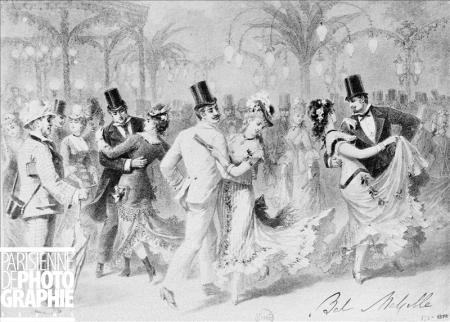
Paris, Jardin Mabille001

I found this image of one of the most celebrated of all bals in a collection of stereocards. The Jardin Mabille disappeared more than a century ago, but its influence persists.

The original Jardin Mabille was founded by one of Paris’s innumerable dance teachers, who in 1831 opened an outdoor dancing space reserved for his students. Monsieur Mabille (sometimes called Père Mabille, or Father Mabille), leased or owned land on the rue Montaigne (once known as the Allée des Veuves), just off the Champs-Elysées.

In the early 1800s, the Champs-Elysées was not yet the grand avenue laid out by Baron Haussmann. It was a fashionably countrified promenade, a straight, tree-lined drive outside the dense central urban area, leading towards Paris’s suburbs and countryside.

Père Mabille started a small venture, but his sons envisaged something grander. In 1844, they transformed the modest private dancing area into a major public attraction. Over the next few decades, the Jardin Mabille rose to prominence, then declined, and eventually disappeared.

Harriet Beecher Stowe (author of Uncle Tom’s Cabin) visited the Jardin Mabille in the early 1850s, after Père Mabille’s sons had introduced 3,000 gas lights, as well as landscaping with trees, flowerbeds, walkways, scenic paintings and mirrors. Entranced, she wrote of the

flower-beds laid out in every conceivable form, with diminutive jets of gas so distributed as to imitate flowers of the softest tints and most perfect shape… In the centre there is a circle of pillars, on the top of each of which is a pot of flowers with gas jets, and between them an arch of gas jets. In the midst of this is another circle, forming a pavilion for musicians, also brilliantly illuminated, and containing a large cotillion band of the most finished performers. Around this you will find thousands of gentlemen and ladies strolling, singly, in pairs or in groups. While the musicians repose they loiter, sauntering round, or recline on seats.

When the musicians broke into “a lively waltz” she was transported:

In an instant twenty or thirty couples are whirling along, floating like thistles in the wind… Their feet scarce touch the smooth-trodden earth. Round and round, in a vortex of life, beauty and brilliancy they go, a whirlwind of delight, eyes sparkling, cheeks flushing, and gauzy draperies floating by… It is a scene perfectly unearthly, or rather perfectly Parisian, and just as earthly as possible.

9400-8

She was not alone in her enthusiasm. More than a decade later, another observer wrote about the Jardin Mabille in its heyday. G. A. (George Augustus) Sala was among the many journalists who covered the Paris Exhibition of 1867, one of more than nine million people who attended the Exhibition. In a book published in 1868 he evoked “a merry age, a dancing age, a jovial, lighthearted devil-may-care age. Vive la Joie! Vive la bagatelle! Long live the Café Riche and the Jardin Mabille and the Closerie des Lilas and the Thirteenth Arrondissement!”

Curiously, in his 1868 account of the Exposition year, there is no description of dancing at the Jardin Mabille. But he notes that after a song, “Everybody applauds, everybody drinks, everybody is happy.” Going to the Jardin Mabille was about seeing and being seen.

Ten years later, in a 1878 letter to the London Telegraph, reprinted in the New York Times, Sala talks of revisiting the Jardin Mabille. He calls the Paris of 1867 a “sparkling, profligate city” and says that the Mabille had been populated by “the most sumptuous costumes that Worth could furnish, the costliest bonnets that Lucy Hocquet could build.” (Worth was Charles Frédéric Worth, the Englishman who emigrated to Paris and became couturier to Empress Éugenie. Today he is considered the father of French haute couture. La Maison Lucy Hocquet was the hat boutique where only the most well-off could afford to buy bonnets.)

9348-11

In his 1878 letter, Sala reeled off the names of “the grandest dandies from the clubs, millionaires from Brazil, from Mexico and from California; English peers and members of Parliament, Senators, Deputies, diplomatists, bankers, notaries, adventurers” who had patronized the Bal Mabille in the 1860s. But ten years later, something is amiss. Sala no longer sees the gorgeous women he remembered from his earlier visit. “It is only the poor relations…I seem to see at Mabille this Thursday night.” The “velvets and satins, the cashmeres and lace shawls, the brocades and the jewels, the feathers and the flowers of price” were no more.

Above all, the Bal Mabille was no longer a place where people came to dance. Sala notes:

The dancing is a mere hollow imposture… But to keep up the delusion that Mabille is the favorite home of Terpsichore [goddess of dance] the administration hire a few couples of semi-professional dancers.

These dancers he dismissed as “posture masters and mistresses [who] fling their limbs about to the music of a tolerable band at stated intervals during the evening.” What bothered Sala the most was the presence of what he called the gobemouche (literally, fly-swallower): the horde of gaping, naïve bumpkins. Gone was the sense of exclusivity that had thrilled him in 1867. Gone were the moneyed patrons, or at least those who had the appearance of money.

About the same time, John Russell Young accompanied then ex-President of the United States, General Ulysses S. Grant, on a world tour in the 1870s. Young went to the Jardin Mabille and saw the paid dancers who “mingle around in the crowd as though they had paid to come in.” Then “when the music commences (generally the music of the harmonious Offenbach), these young men and women rush upon the boarded floor and dance peculiar dances—the ‘Can-can,’ among others—not much worse than I have seen it on the New York stage.”

Young did not like the Jardin Mabille. But he had one explanation of its popularity amongst his fellow countrymen.

Mabille is said to be a very bad place, and [our American friends] attend expecting that something outrageous will certainly happen. I do not imagine that it occurs to one out of ten of our observing countrymen that Mabille is simply an institution kept by a Frenchman for English and Americans to visit.

The same comment is echoed in the writings of David Ross Locke, a.k.a. Petroleum V. Nasby, stage performer and writer, friend of Mark Twain, who set off in 1881 to visit Europe. To defray some of his expenses, he wrote about his travels for the Toledo Blade. Locke/Nasby described professionals at the Jardin Mabille doing their version of a “style of dancing [that] was always in favour in Paris among the people.”

Locke/Nasby had caught on to an important distinction. France had a long tradition of popular dances, that is, dances invented by poor people for whom exuberant movement was a welcome relief in lives filled with stress and hardship. But as tourism became a more important economic force, something happened to the lively dances at the Jardin Mabille. What had once been an individualistic expression of life’s ups and downs in dance, the can-can, a French working-class dance that had originated in the 1830s, was refashioned in the music halls of Britain and the musical stages of America as a public entertainment. Then it was reimported to Paris as an amusement for tourists, endlessly reproduced at the Moulin Rouge and the Folies Bergère.

And so it continues. The tourists are titillated by a dance that seems risqué and the locals earn money from their performance. What does it matter if the dance is not “authentic”? It has been evolving constantly since the 1830s. Culture is never static.

Text by Norman Ball. Historic illustrations from Paris en Images.

Posted in Paris dance, Paris history, Paris popular culture | Tagged , , , , , , , , , , | 8 Comments

A parachute in the Parc Monceau

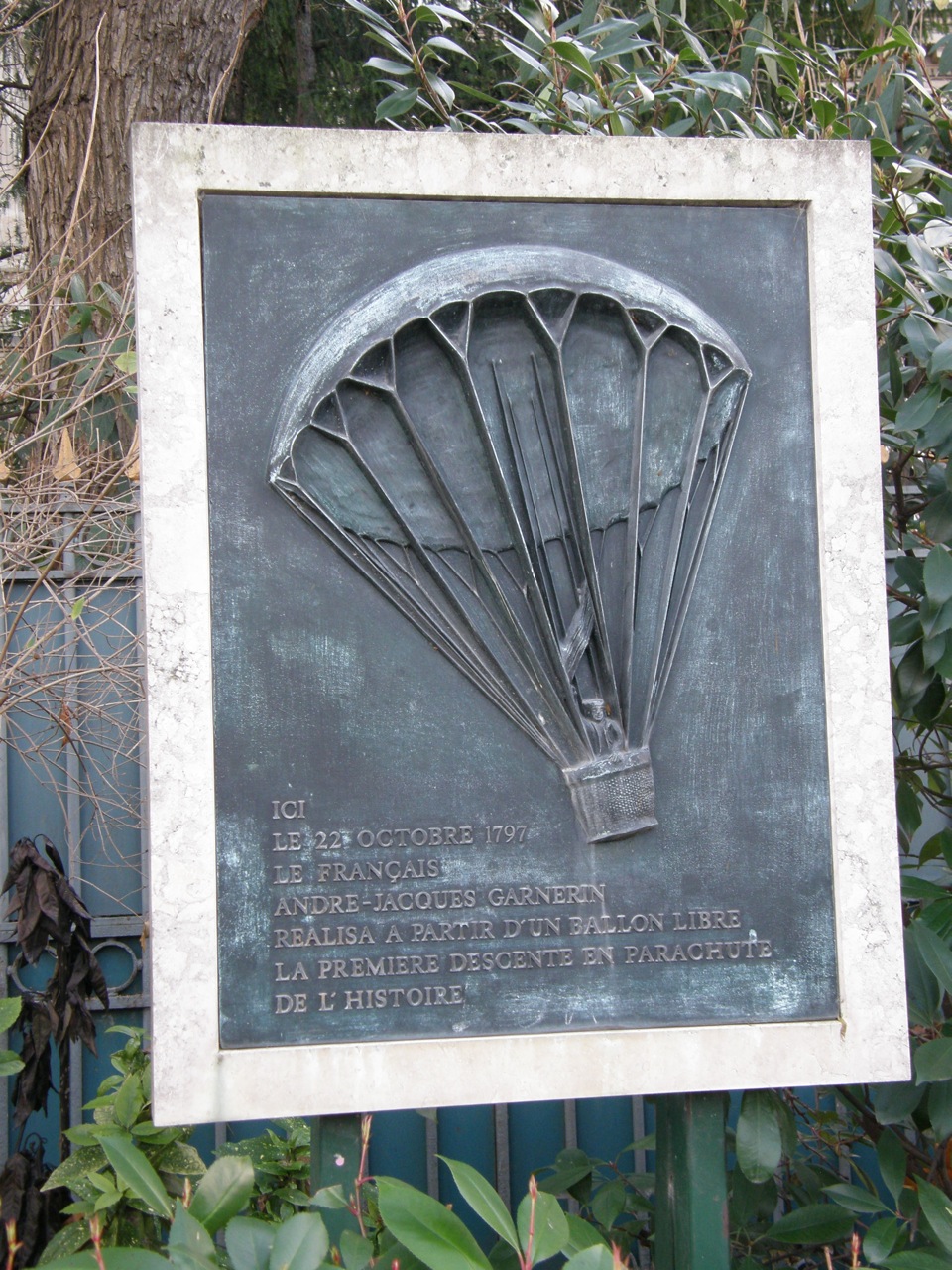
On Christmas Day, before it was time to go to dinner with friends, we wandered into the Parc Monceau. We have walked in the quiet park many times before, but had not noticed the little plaque near the path running along the south side.

PC251091

In translation it reads:

Here
On October 22, 1797
The Frenchman
André-Jacques Garnerin
Made from an untethered balloon
The first parachute descent
In history.

We had stumbled upon an important part of French aviation history. In the 1790s, ballooning or aerostatics was glamorous advanced technology. Ballooning represented adventure, fame, and the desire to push out the frontiers of knowledge, practice, and experience.

The ballooning craze burst onto the scene on June 5, 1783, when the Montgolfier brothers, Joseph-Michel and Jacques-Etienne, launched the world’s first successful hot-air balloon. There was no one on board, but the public was entranced. A new word entered the French vocabulary: montgolfier, meaning a hot-air balloon. Public interest grew even more feverish on October 15 of the same year, when Etienne Montgolfier went aloft on a tethered flight, a feat equalled the same day in the same craft by Pilatre de Rozier.

The next step came on November 21, 1783, when two men (Pilatre de Rozier and the Marquis François d’Arlandes) succeeded in going aloft and descending alive after an untethered flight. The feat was both exciting and controversial. King Louis XVI had thought it too dangerous an exploit for solid citizens and had proposed that criminals be sent up first to test the technology. He was over-ruled (not for the only time in his short life).

But hot air was not the only way to go aloft. Hydrogen gas, while dangerously explosive, is also lighter than air. August 27, 1783, was the date of the first unmanned flight in a hydrogen-filled balloon, from Paris to Gonesse, a distance of 25 km (16 miles). There followed flights with animals on board.

Meanwhile, ballooning mania had spread to all manner of toys, ornaments, jewellery, and household goods and furniture, including chairs with balloons carved in their wooden backs. Balloons were even used to hold lanterns aloft at parties.

2421-1

On December 1, 1783, less than two weeks after the first untethered manned flight in a hot-air balloon, a hydrogen balloon soared aloft from the grounds of the Château des Tuileries, where a huge crowd (one estimate was 400,000 – that is, more than half the population of Paris, so perhaps an exaggeration) turned out to watch.

The hydrogen-filled balloon made two flights that day. The first carried physicist Jacques Charles and his assistant, Nicolas-Louis Robert, 43 km (27 mi) from Paris to Nesles-la-Vallée. Then Jacques Charles took off again from their landing place and ascended to an altitude of 3,000 metres (9,842 feet).

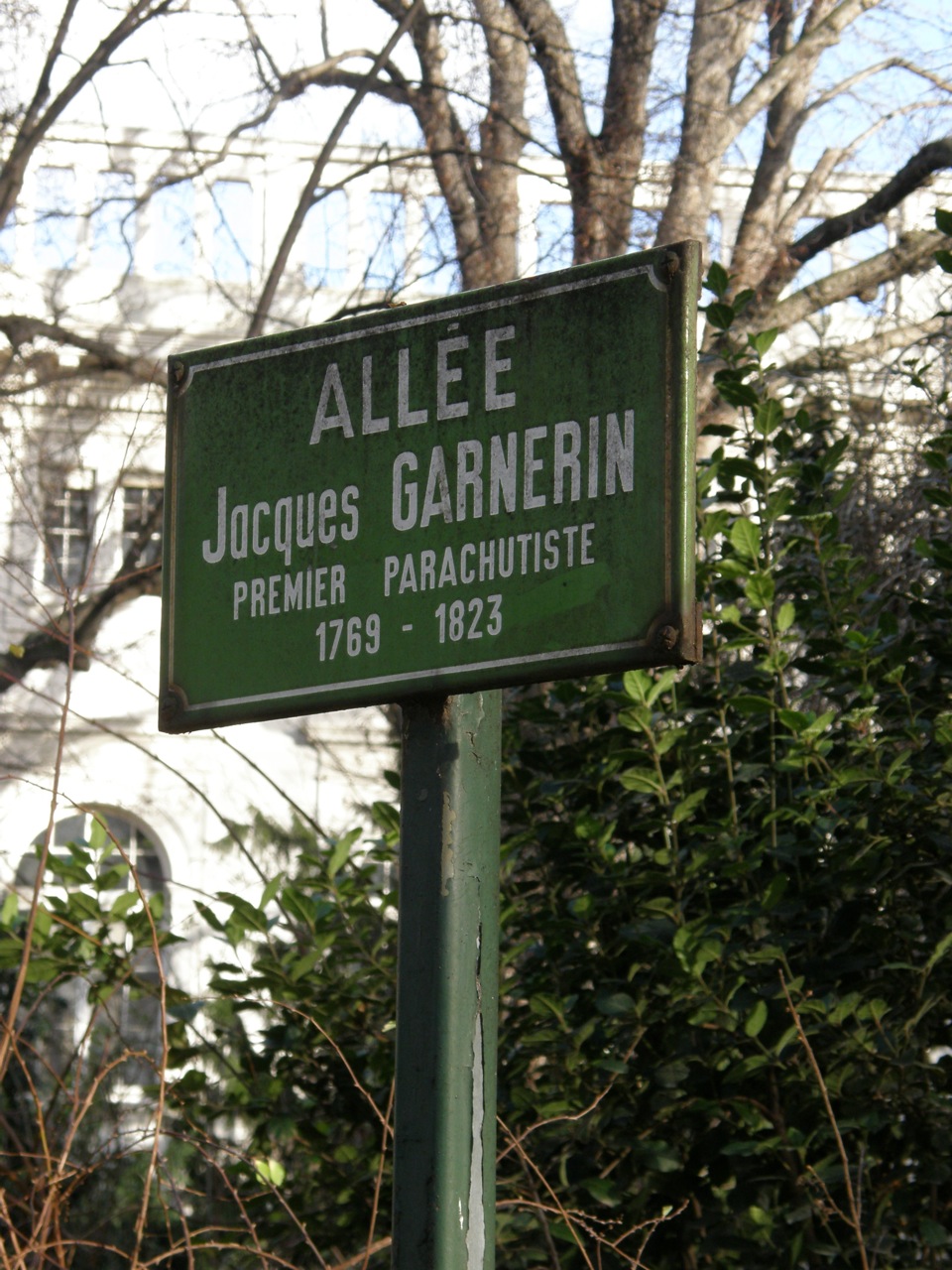
Where does our parachutist of the Parc Monceau enter the picture? André-Jacques Garnerin was born in Paris January 31, 1769. As a teenager he fell under the spell of ballooning. He studied physics under Jacques Charles (yes, the same Jacques Charles) and joined the army, where he held the rank of Inspector. He staunchly advocated ballooning for military purposes.

The year 1792 saw the beginning of what became known as the French Revolutionary Wars. Garnerin was captured by the British, handed over to the Austrians, and spent two or three years in prison in Buda. He survived these ordeals and on his release returned to his favourite pursuit.

Garnerin was both pioneer and showman. He became well-known for ballooning demonstrations in Parc Monceau. But the public can be fickle and Garnerin faced the question that many daredevils face: What next? Going up in an untethered balloon was becoming less novel. The public wanted more. How about jumping from one? The idea of parachutes was not new and there had been stunts such as jumping from a tall building. Garnerin decided to go one better.

Paris balloons001

On October 22, 1797, Garnerin ascended from Parc Monceau and leaped into history as the world’s first successful parachutist from a balloon. For his act of faith and courage, he was named “official French aeronaut of the state.”
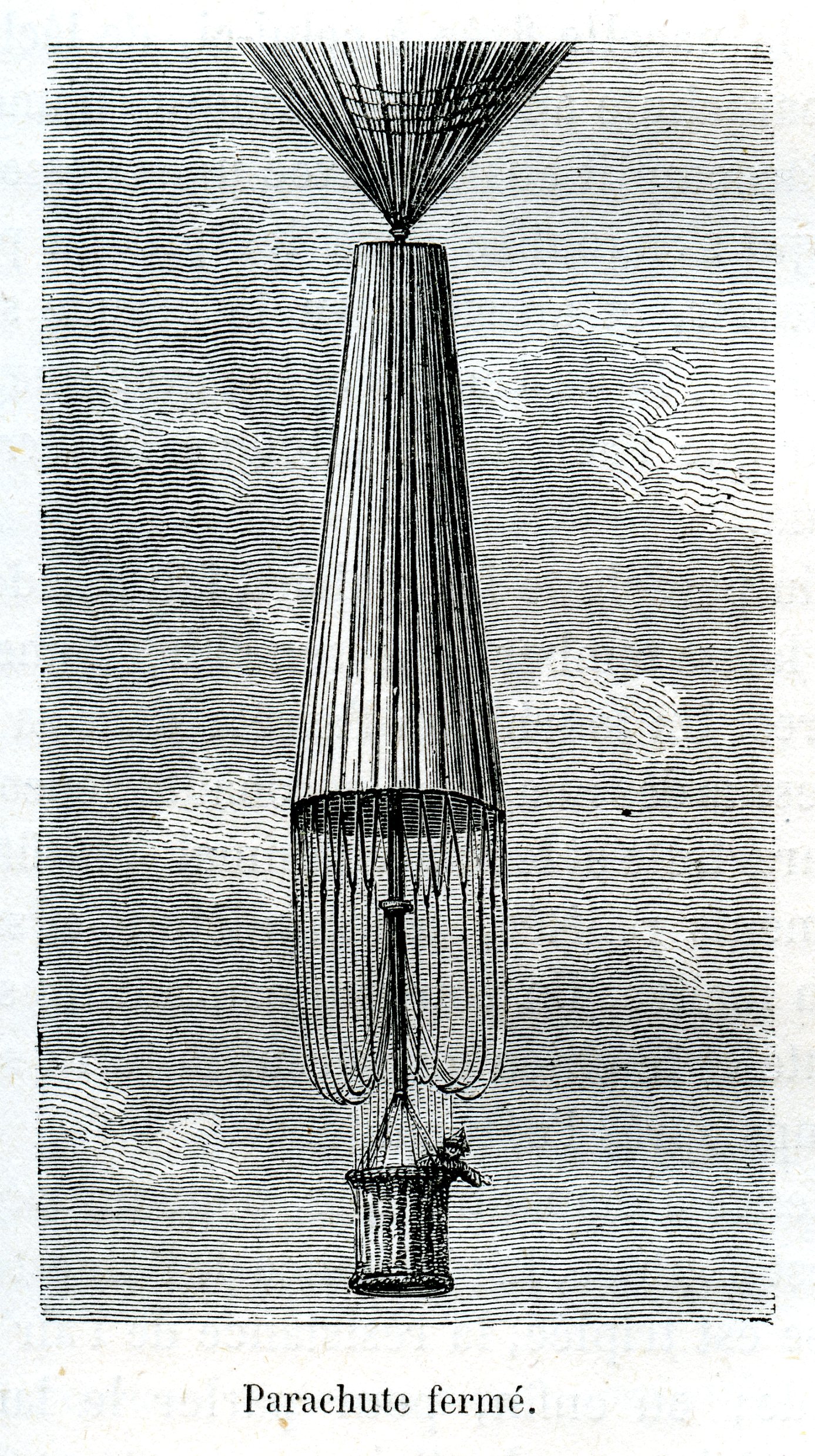
Unlike modern parachutes, Garnerin’s was not strapped onto his body. His parachute was attached to the underside of the balloon, and he was in a gondola or nacelle attached to the parachute. In the image above, we see the parachute looking like a folded umbrella attached to the underside of a balloon. When it was time for the jump, the parachutist simply released the cords attaching the parachute to the balloon, which drifted away, as we see in the image below of a descent made by Garnerin in 1802 in Britain, the first such feat performed there.

Paris balloons002

Descriptions of Garnerin’s early jumps suggest that the feat required a lot of nerve. First, the unopened parachute descended quickly; anyone watching feared the worst. As the parachute opened, the speed of descent slowed considerably, but the nacelle was subject to huge oscillations, making it appear as if it would be turned upside down and the parachutist would be lost.

The oscillations occurred because the parachute captured large volumes of air as it descended. This air had to escape, but unlike in more modern parachutes, there were no vents.

Descriptions of both parachute landings as well as balloon landings often included frightful accounts of the nacelle being dragged along with ground with its hapless occupants. Perhaps it is no wonder that a contemporary term for untethered balloons was ballon perdu, which we might translate as a “lost balloon.” It was “lost” only in the sense that there was no way of controlling it; the balloon went where the air currents drove it. There is another meaning to perdu, an archaic military term applied to a mission that seemed doomed from the start. No wonder Louis XVI thought balloon ascents should be reserved for criminals.

Garnerin continued to provide further thrills and parachute jumps as an international showman, balloonist, and parachutist. He shocked many with his proposal to take the first woman passenger aloft in a balloon from Parc Monceau in 1798. Public and press were enthusiastic, officialdom less so. First, there were scientific worries. Increased altitude means less air pressure and there were fears this could damage the delicate organs of even the healthiest female and cause her to faint. And there were worries on moral grounds. Just what might these two aeronauts be up to in the seclusion of the upper altitudes?

PC251103

Official worries were overcome, Garnerin looked after publicity, and on July 8, 1798, a large crowd assembled in Parc Monceau to see the reportedly young and beautiful Citoyenne Henri and Garnerin walk about the park before astronomer Jerôme Lalande assisted her into the basket. They were next seen about 30 km (19 mi) north of Paris when they landed at Goussainville.

Citoyenne Henri seemed to be none the worse for wear and whatever happened in the privacy of the balloon’s airborne basket, stayed in the basket. Further developments were reserved for Jeanne-Geneviève, Garnerin’s wife (and former student), who in 1799 became the first woman parachutist.

What happened to André-Jacques? Ballooning eventually took his life, but in an unexpected way. He was hit on the head by a beam while working on balloon equipment and died in Paris on August 18, 1823. His older brother, Jean-Baptiste-Olivier Garnerin, who had worked with André-Jacques for most of the balloonist’s career, lived for another 23 years.

PB110253

Perhaps one question remains. As we looked at the plaque, Philippa asked, “Why would he do it from here? Surely there are too many trees and houses in the way.” But both Paris and Parc Monceau were different then.

The Parc Monceau was established by the fabulously wealthy Philippe d’Orléans, Duke of Chartres, a cousin of King Louis XVI. In 1769 he began purchasing property in what was then known as the Monceau Plain and nine years later decided to create a public park. Although later modified, it was not intended to be a typical formal French park, but rather something that would surprise and amaze visitors.

The Duke of Chartres gave the design work to Louis Carrogis Carmontelle, who later wrote that the garden was “simply a fantasy, to have an extraordinary garden, a pure amusement.”* The park included statues, a windmill, a farmhouse, a lily pond, a miniature Egyptian pyramid, a Roman colonnade, a tartar tent, a temple of Mars, a minaret, an Italian vineyard, an enchanted grotto, and “a gothic building serving as a chemistry laboratory.”*

The Parc Monceau was unabashedly about fun and amusement. Alas, the Duke was guillotined during the Reign of Terror in 1793, and his park was nationalized. With the restoration of the monarchy in 1815, the park was returned to the Duke’s family, who reduced it by about half when they sold off lots to developers, who built luxurious houses all around. So Garnerin had taken off from a much larger park, with fewer surrounding buildings.

PB110248

The park changed hands again in 1860, when the city of Paris purchased it. Soon it was swept up in the remaking of Paris by Napoleon III and Baron Haussmann. In August 1861, it became the first of the new public parks in Paris to be remade and its appearance changed again.

Our serendipitous discovery in Parc Monceau on Christmas Day illustrates why we keep returning to Paris. No matter where we go, we find small clues that open up larger vistas, sometimes immediately and sometimes only after further research. Henry David Thoreau captured the essence of the experience of a place with his observation that “The question is not what you look at, but what you see.” He did not have Paris in mind, but we do when we read his words.

985-5

Text and original photographs by Norman Ball. Engravings from F. Marion, Les Ballons, Hachette, 1874. Other historic images from the Roger Viollet collection, Paris en images.

*Quoted by Dominique Jarrassé, Grammaire des Jardins Parisiens, Parigramme, Paris (2007), and cited in the Wikipedia article on the Parc Monceau.

Posted in Paris history, Paris parks | Tagged , , , , , , , , , , , , , , , , | 12 Comments

The chariot on the Champs-Elysées

For many people in Paris, owning a car is neither necessary nor desirable. Transit service is good and parking is difficult. But that means that when your groceries include, say, containers of milk or orange juice, bottles of wine or San Pellegrino (San Pé to the Parisians), cans of soup or cassoulet, or jars of jam or tomato sauce, the walk home can feel very long. So do your arms.

What you need is a bundle buggy (a.k.a. chariot de courses, sac à roulettes or caddie). Fill it up and wheel it home. We decided to get one for our daily shopping trips.

P1090266

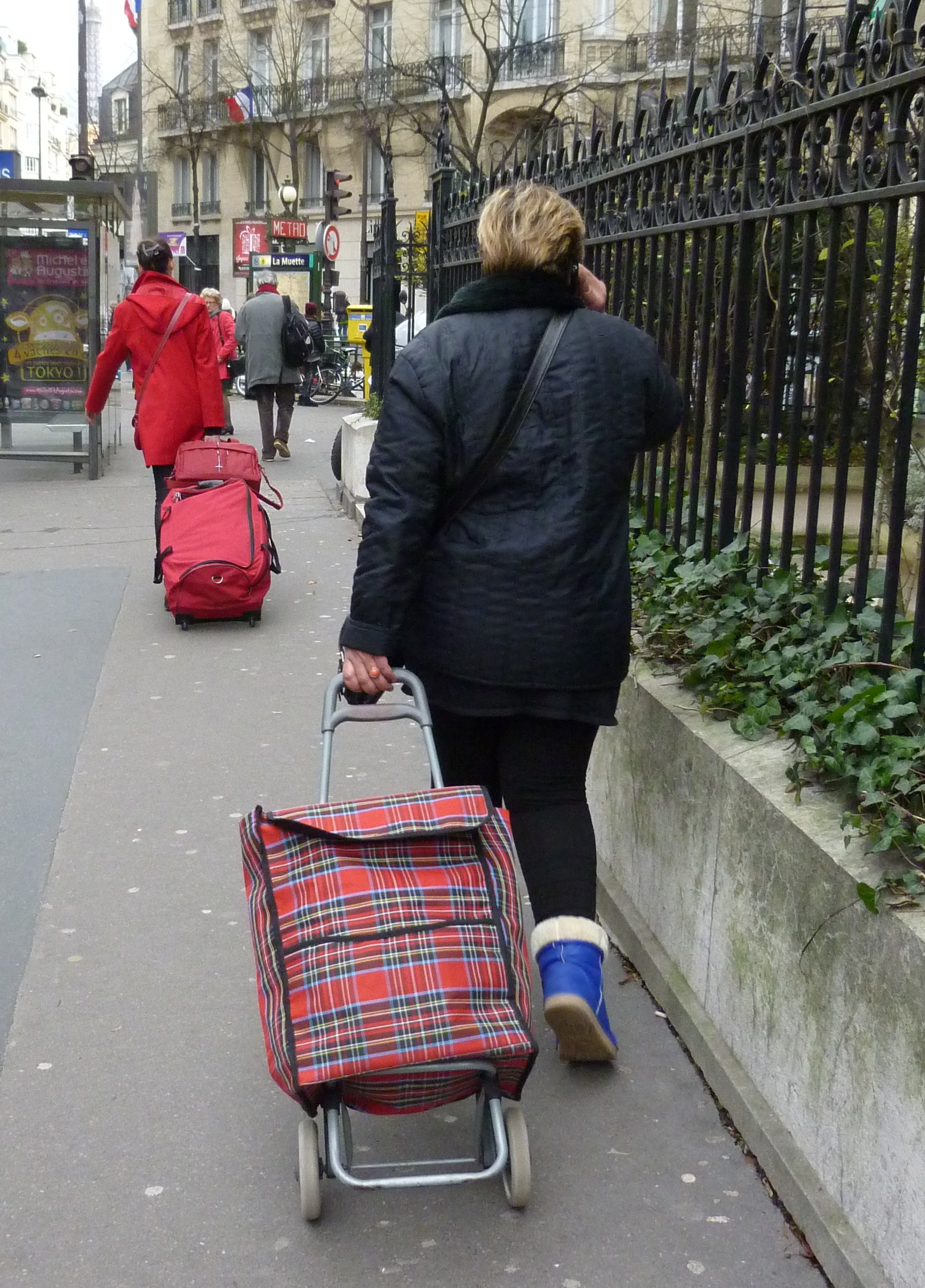
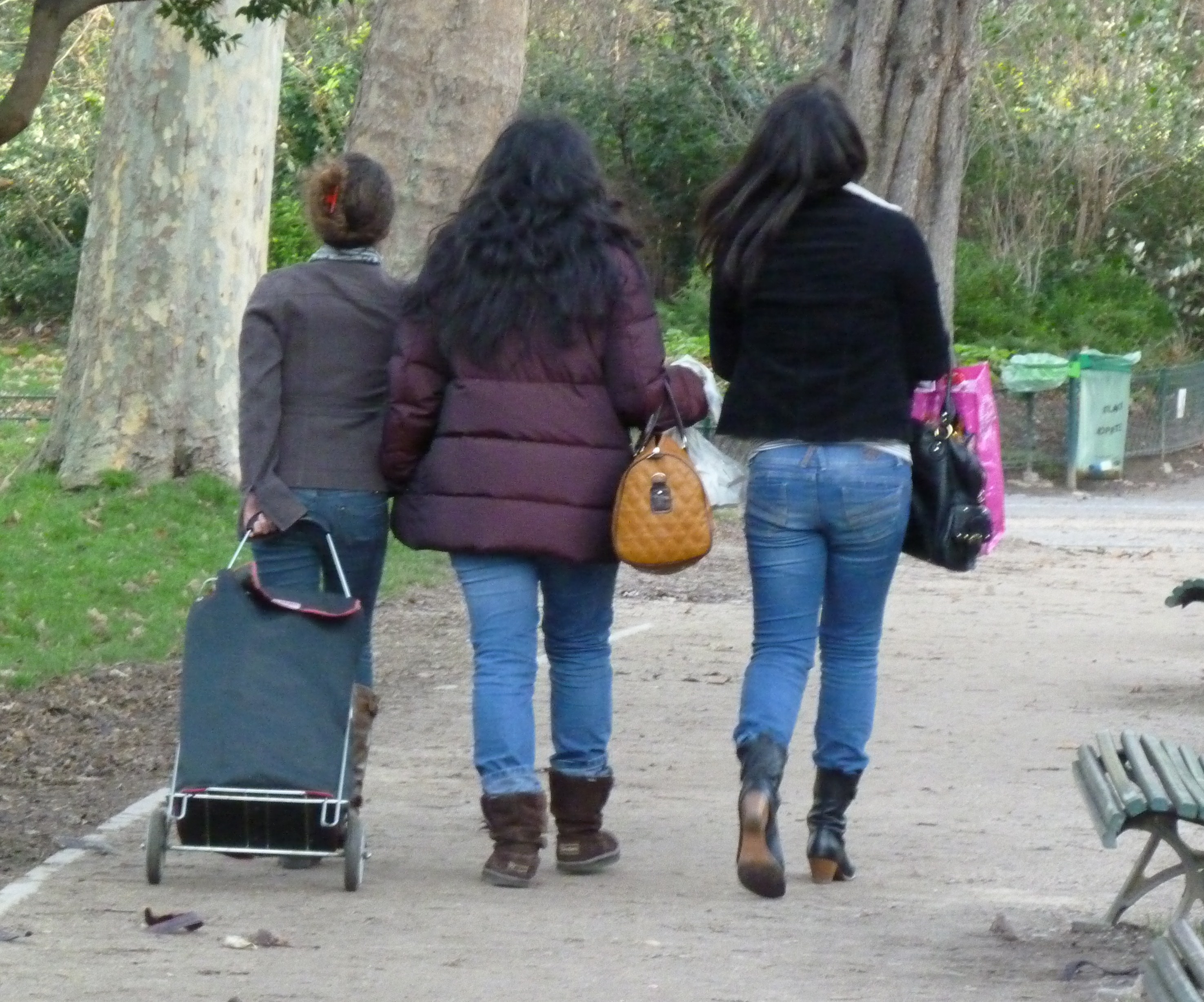
But first, some market research. This meant looking at what other people were using, and checking out the shops.

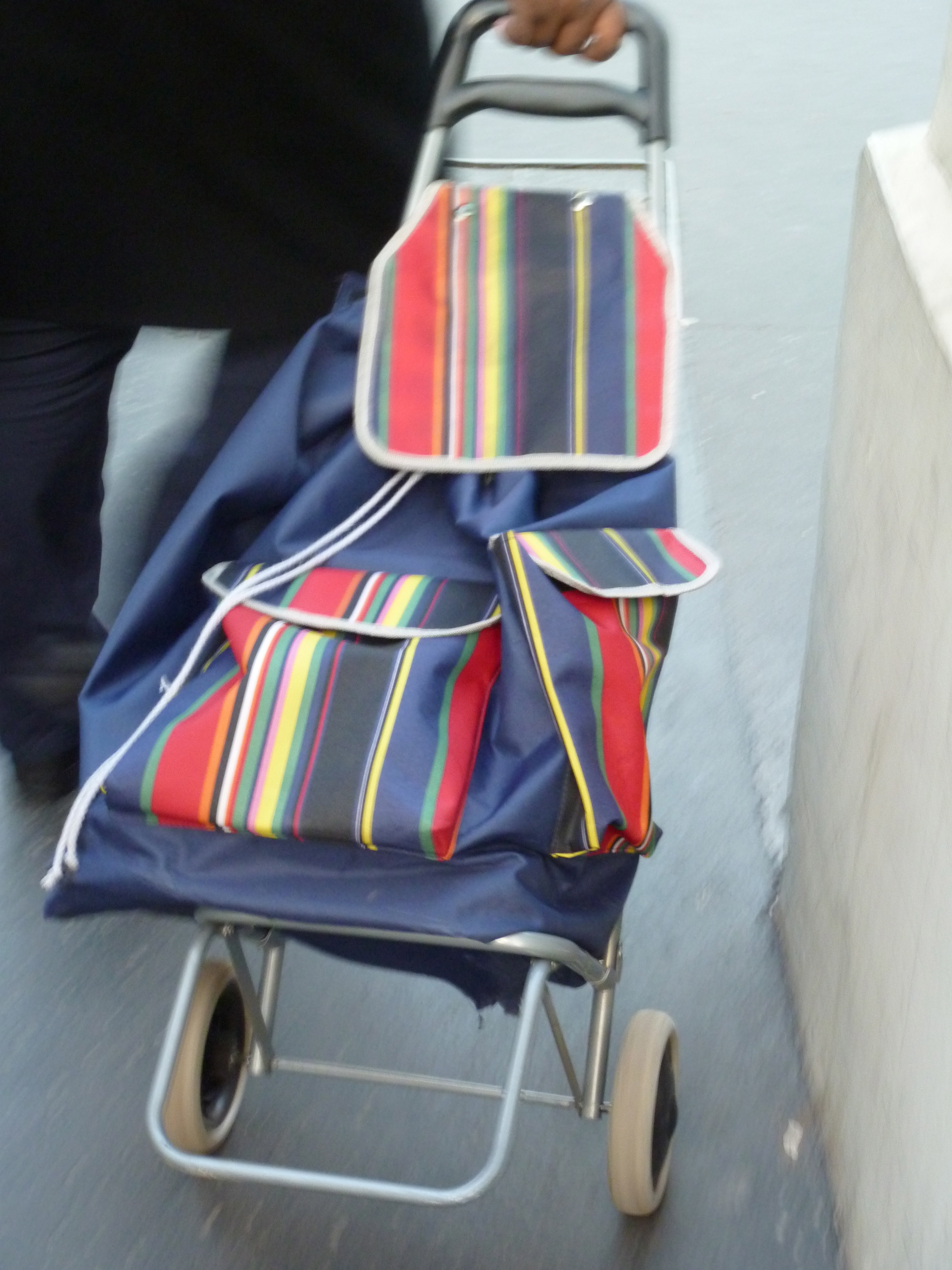
We wanted something sturdy and capacious. This one looked too flimsy. And too small.

P1090164

We wanted one with a drawstring closing, so our groceries wouldn’t fall out. This one looked insecure.

P1100236

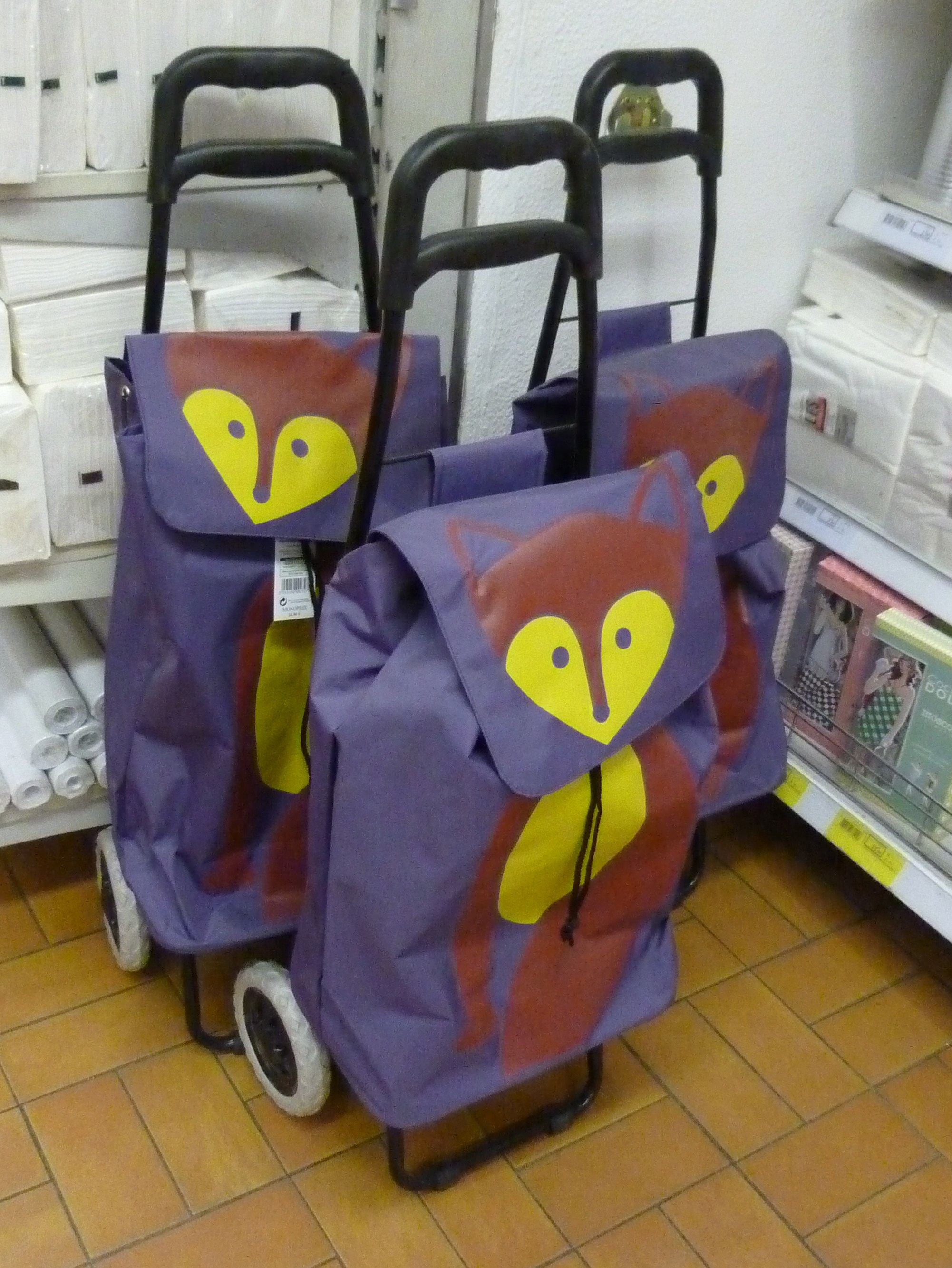
No cartoon characters or cute animals.

P1090689

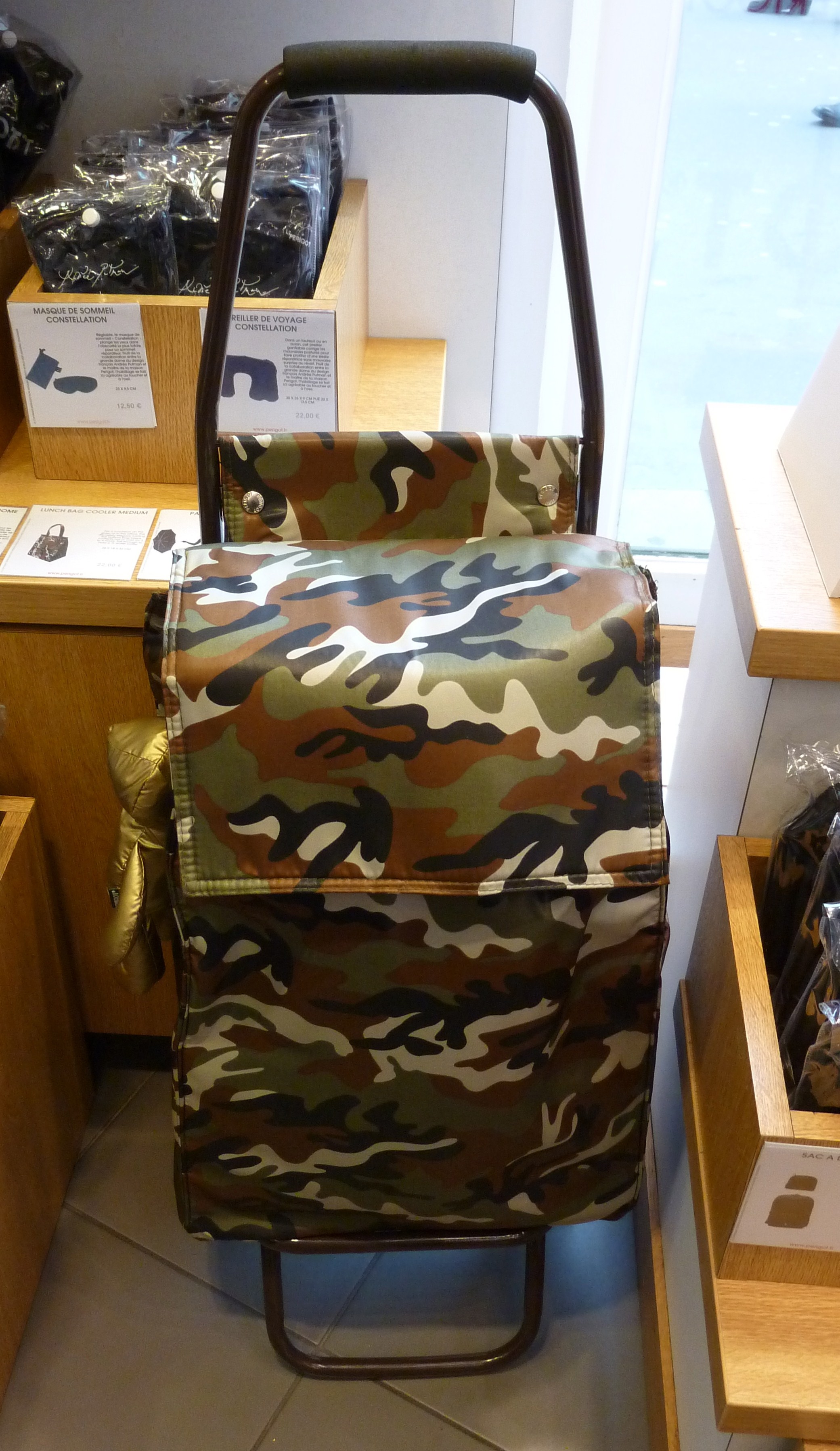
And affordable. The shop called Perigot sells a whole range of chariots in trendy patterns, including camouflage, but they cost about three times what we were willing to pay.

P1090712

That requirement took us to the 14th arrondissement. We had stayed a few times in this area, and we knew they had shops that sold relatively inexpensive chariots.

The first shop we tried on the rue Raymond Losserand had a simple, sturdy black number, but the manufacturers (we assume it was made somewhere in Asia) had tried to jazz it up with English words: “You Be Satisfy.”

No, we thought, we not be satisfy. We are not walking through Paris with silly English words on our buggy.

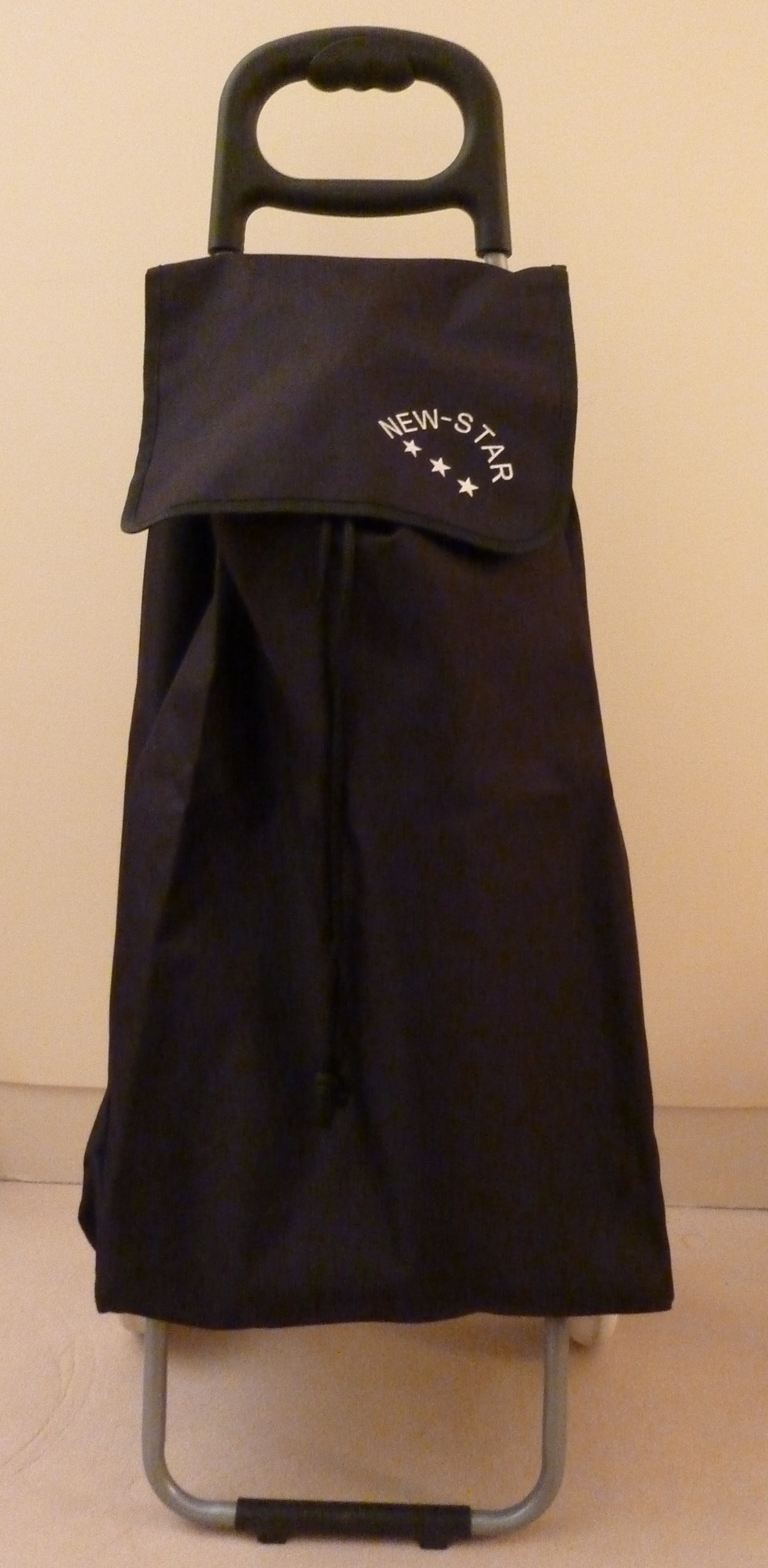
After looking in a few more shops in the area, we found another sturdy black one that said “New-Star.” We figured we could live with that, even though the hyphen was surplus to requirements. So we bought it for 29 euros.

P1100324

It had a rectangle of sturdy particle board on the bottom that could support 6 bottles of wine or San Pé standing upright, or three lying flat. There were two extra pockets on the back, solid-looking wheels, zippers on the sides to allow for expansion, and a comfortable handle.

Before leaving the area, we did some shopping at the mammoth Monoprix store in Montparnasse and brought the loaded chariot home on the bus without incident.

However, our local Monoprix is the one on the Champs-Elysées. And it was Christmastime. The broad boulevard is full of tourists and families out admiring the lights and the Christmas market. Pedestrians stop suddenly to take pictures, wander aimlessly back and forth, and move about in groups. Progress with a chariot is slow.

And when you get to Monoprix, the groceries and packaged goods are in the sub-basement, down two flights of stairs. There is no escalator. Norman had his work cut out getting the filled chariot back up to the street. (When Philippa went a few days later on her own, and was slowly bumping the New-Star up the stairs, the young woman behind her on the stairway grabbed the bar at the bottom and helped her carry it up, all without interrupting her conversation with the friend beside her. Many Parisians are like that – they do you a good turn without appearing to acknowledge that they are doing so.)

At least the Champs-Elysées is nice and wide. On smaller streets, you must hold the chariot underhand, with your hand held behind your back, so that you and the chariot are single file on the narrow pavement. Here is a picture showing the approved method, although it was taken in the broad allées of the Parc Monceau. Presumably this young woman was simply accustomed to holding it like that all the time.

P1100178

In the shops, there is a protocol for chariot users. If you enter with an empty chariot, you may fill it with your intended purchases, and then take them out and put them on the counter when you get to the cashier. However, if you enter a shop with a chariot that already has purchases in it, you should leave it at the door or with a cashier and, if necessary, use one of the metal or plastic caddies they provide.

You also have a new responsibility. Towing a chariot through the city makes you look like a resident, so tourists and even Parisians have a tendency to ask for directions. It helps to know the quartier well enough to direct people to major destinations, although Philippa was stumped when a woman with a small child asked where to find the office of social services.

Most of the chariot users we noticed were women, but Norman, who often goes grocery shopping with Philippa in both Paris and at home in Toronto, had no problem being the charioteer. Here he is window shopping on a rainy day with the New-Star in tow after a visit to the Nicolas wine shop.

P1090953

When we left Paris, we had to leave the New-Star in the apartment we had rented through friends. But we’ll be back and we know it will be there, ready for more adventures.

Happy New Year to all our readers.

Text and photographs by Philippa Campsie

Posted in Paris food, Paris markets, Paris shops | Tagged , , , , , , , , | 20 Comments