New Year’s is a time of cleaning up and clearing out, and to that end I have unsubscribed from all kinds of newsletters and mass mailings to keep my head clear and my inbox manageable. But I’m keeping a few, including one I can recommend wholeheartedly to readers of Parisian Fields: the newsletter from Gallica, the online presence of the Bibliothèque Nationale de France (BnF). The newsletter is in French, but much on the Gallica website is available in English.

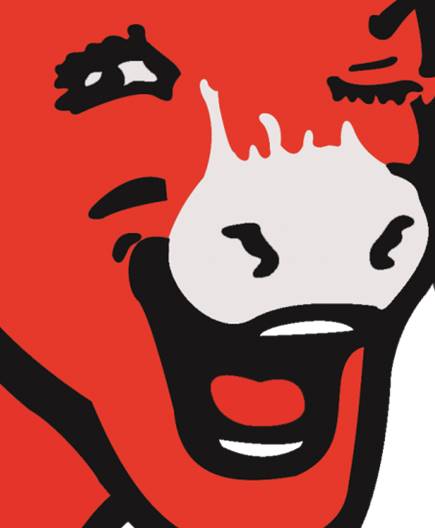
In the November/December edition, I spotted a familiar face: La vache qui rit, with her dangling earrings of cheese boxes, which show a cow wearing earrings which show a cow wearing earrings which show…presumably an infinite regression (or what the French call mise en abyme). The article profiled Benjamin Rabier (1864–1939), the illustrator who created the jovial red cow.* For years, he was an inspector at Les Halles, the central Paris markets, where he could observe animals up close. But he also drew and painted, creating a menagerie of creatures with distinct personalities, which appeared in books, journals, and children’s papers, in series that were precursors of today’s cartoon strips. His output was vast.
The newsletter article contains more than a dozen links to his illustrations. Among them, I found unexpected uses for snakes…

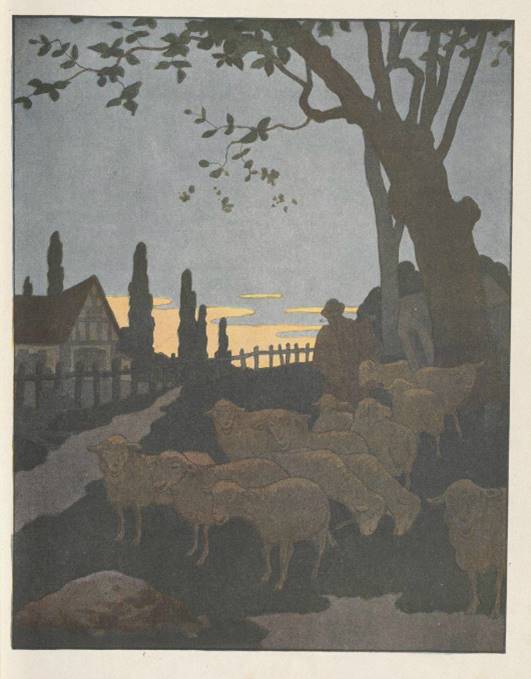
…vignettes of country life, likely from the Berry Region,** where Rabier lived much of his life…
…a shipboard jazz band so lively that the animals are escaping the borders of the picture…
 …trees observing a dramatic scene from under a layer of snow…
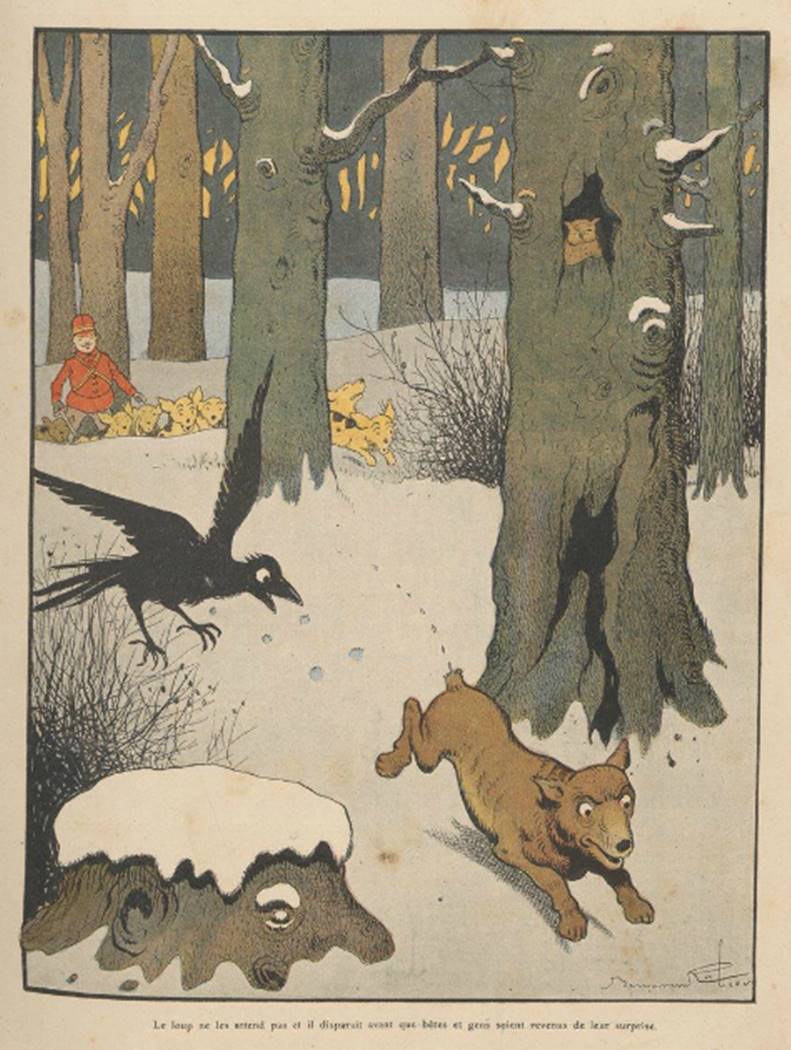 …and a monkey gazing disconsolately at his own reflection in a hand mirror.
 La vache qui rit was only one of Rabier’s publicity posters, not all of which involved animals…
 …although I was rather taken by this smartly dressed French sardine.

The newsletter shows the poster for the original vache, with her eyes almost closed: in modern versions she looks a bit more alert. Note that the cheese advertised is described as “gruyère.”
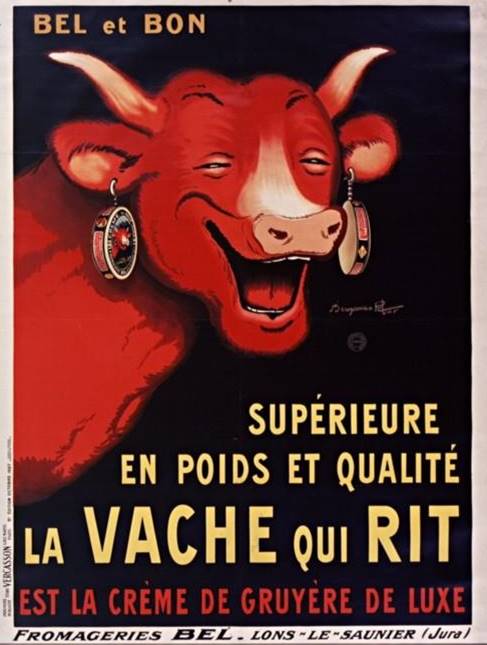
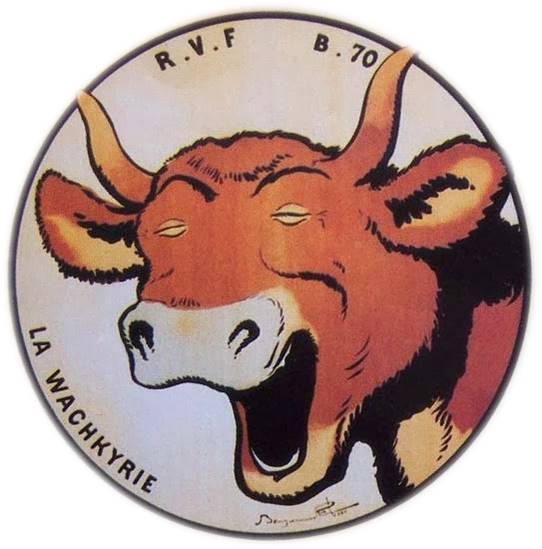
Various legends are associated with the creation of this pasteurized cheese made from cream mixed with gruyère, comté, emmenthal, edam, cheddar, or gouda, or some combination of these cheeses (today, the recipe differs according to the country in which it is made). Some say it was a Swiss invention from 1910; others say it was a French invention from about 1920. According to Wikipedia, the name and the image come from French meat supply trucks in the First World War, which were decorated with the image of a laughing cow and known as “Wachkyrie” or “Vachkyrie” – a pun on the “Valkyrie” symbol that marked German army trucks. Frankly, I thought it was one of those language myths that don’t hold up to close scrutiny. So I checked with Gallica.
That took me to the 12 January 1919 issue of La Revue Politique et Littéraire, which describes an exhibition of 155 signs from French army trucks at the Galerie Georges Petit in Paris (a BnF link helpfully supplied its address – 8 rue de Sèze, in the 8th arrondissement – and the fact that this gallery operated between 1877 and 1933). The signs showed imaginative and often amusing symbols used in wartime to distinguish the purposes and contents of trucks and vans. And yes, it mentioned (although it did not show) la Wachkyrie. The symbols illustrated in the article include a white mouse and an elephant with a cannon strapped to its back.
 La Wachkyrie was painted on the sides of the trucks, vans, and converted buses used by Ravitaillement en Viande Fraîche (Fresh Meat Supply).
 Versions differ as to who did the original wartime drawing, but I have seen at least one version that includes Benjamin Rabier’s distinctive signature and French Wikipedia says he contributed the image through an official contest. It’s possible.
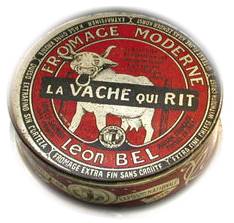
 Léon Bel (1878–1957), the man usually credited with developing the soft cheese in the years just after the First World War, may have worked for the RVF (depending on which source you consult), or he may just have been familiar with the image. One way or another, he registered the symbol in 1921 for his “fromage moderne.” But the first packages did not use the same image as the RVF. They show the cow standing up, without earrings, yawning rather than smiling, behind a rudimentary fence.
 At some point, it seems, Bel approached Rabier to recreate the original image. The earrings are said to be the suggestion of Bel’s wife, who thought the cow needed to look more feminine. At about the same time, Bel came up with the idea of individually wrapped triangles of cheese, which contributed to the product’s lasting success.
Certainly this nearly 100-year-old invention is going strong. We asked our culinary consultant (Norman’s sister Linda) about the cheese, and she offered the following suggestions:
- You can make any kind of vegetable soup with it. Sauté onions, add garlic, parsley, salt, and pepper, some broth, add diced vegetables, such as squash, turnip, carrot, zucchini, leeks, potatoes. Boil gently till veg are soft, purée with immersion blender or food processor, having added in 1–4 wedges of the cheese, depending on taste and quantity.
- Add 1 or 2 portions of La Vache Qui Rit to scrambled eggs. Stir to melt in.
- Drain a can of giant escargots, sauté in butter (and/or oil if desired) with 1 or 2 cloves crushed garlic. Remove escargots and set aside. Add a little broth or reserved liquid from can to the pan, heat and whisk in 1 or 2 wedges of La Vache Qui Rit until melted, return escargots to pan, stir to heat and coat in cheese. You could also grate a little aged cheddar over it before serving.
Of course, results will vary according to which country you are in. But bon appétit and Happy New Year to all.
Text by Philippa Campsie, all images from Gallica, except for the picture of the army truck, the Wachkyrie sign, the original can of cheese, and the winking cow. For more information, see the Maison de la Vache Qui Rit, a museum devoted to the brand. Thanks to Linda Prinsthal for the recipes.
*The choice of Rabier for the newsletter was prompted by an exhibit devoted to his work at the Museum of Children’s Illustration in Moulins (about 2½ hours by train from Paris, according to their website). If we were in France right now, we’d go.
**As it happens, I am also reading an absorbing book about this part of La France profonde: Célestine: Voices from a French Village, by Gillian Tindall (Henry Holt and Company, 1995).