The man who pawned a guillotine

If you walk up the rue de la Roquette in the direction of Pere Lachaise cemetery, you will notice a pleasant park on your left, with a rustic-looking entrance.

On the gate is a memorial tablet honouring 4,000 women Resistance members who were imprisoned there (…“dans ces lieux 4,000 Résistantes ont été imprisonnées pour avoir lutté contre l’Occupant…”).

But I found the French text imprecise. “Dans ces lieux…?” What lieux?

Later, I learned that this was once a women’s prison known as La Petite Roquette, demolished in 1974. On the other side of the rue de la Roquette stood La Grande Roquette, the men’s prison, demolished in 1911. All that remains of these grim places are the rustic-looking gate, the former prison entrance, and some granite stones set into the roadway where the rue de la Croix-Faubin meets the rue de la Roquette. You can see them on Google Street View.

You may feel as if a goose has walked over your grave when you look at them. This is where the prison guillotine once stood.

Most of us who are not French associate the guillotine with the part of the Revolution known as the Terror, and forget that the device remained in use in France until capital punishment was abolished in 1981. (Actually, the last execution by guillotine took place in 1972.) And we tend to think of “the guillotine” as if there were only one – the one on what is now the place de la Concorde, where the king, the queen, hundreds of aristocrats, and many others met their deaths. But there were lots of guillotines, at least one in every major city and town in the country back then.

The guillotine is as steeped in irony and paradox as it is in blood. Its name comes from a doctor and humanitarian called Joseph Ignace Guillotin, who proposed it as a humane, efficient, and egalitarian way of dispatching those whom the state saw fit to dispatch. Of course, in the 18th century, the radically humane idea of not putting people to death for their offences never occurred to him.

Before the guillotine, the choices depended on who you were and what you had done. Aristocrats were beheaded with a sword or an axe, thieves were hanged, heretics were burned at the stake, and so forth. Some executions were extended forms of torture. Dr Guillotin thought it might make more sense to have one single, reliable method for all that would be quick and involve minimal suffering.

He proposed an efficient decapitation device to the National Assembly in December 1789 during a debate on penal reform. No one paid any attention – admittedly, it was a busy time. But a year later, Robespierre revived the idea and asked another doctor, Dr. Antoine Louis of the Academy of Surgery, to do a feasibility study.

Dr. Louis found a harpsichord maker willing to develop a workable prototype based on Guillotin’s proposal. He may also have been aware of similar devices previously used in Northern England and in Switzerland. A long-standing but unverifiable story has it that he even consulted the king, who advised that the blade should be slightly curved for maximum efficiency – yes, that king.

Eventually, the harpsichord maker produced a couple of models and demanded a patent, but the government felt that he was asking for too much money. Dr. Louis found another manufacturer. The doctor’s name is still associated with the device – today, the French version of Wikipedia even offers the alternative name of “louisette” for the instrument.

In March 1792, some hapless sheep met their maker during the first public demonstration. It was used on a human felon a month later. The crowd was deeply disappointed at how quickly it went off. Where’s the drama in a machine that operates quietly and efficiently?

But the Terror of 1793 to 1794 provided the drama they longed for, as one after another, aristocrats mounted the scaffold and either awed the crowd with a devil-may-care-attitude (one complained that his appointment with death was interfering with his supper plans) or created a scene (Madame du Barry, former mistress of Louis XV, wept and struggled to the very last moment).

The official executioner, a fellow called Charles-Henri Sanson, was amazingly efficient: one afternoon he beheaded 54 people in 24 minutes. This would have been in the Place du Trône (now the Place de la Nation), where the guillotine was moved in the summer of 1794. There, during the last two months of the Terror, more people were guillotined than in the previous eleven months.

Sanson kept at the job until the day one of his sons, who was assisting him, fell off the scaffold, and died of his injuries. The father who had impassively killed thousands of people was grief-stricken and left the job to another of his sons – the job of executioner was traditionally hereditary and carried perks that were passed down through a family.

His son served both the Emperor Napoleon and the restored King Louis-Napoleon. Executioners can’t afford political loyalties. It was the grandson who ended the dynasty. His name was Clément-Henri Sanson. Think about it. Who calls a son “Clément” in a family of executioners? Indeed, Clément-Henri couldn’t stand the sight of blood. He gambled heavily to forget his job woes, and when he couldn’t pay his debts, he pawned the guillotine. (One wonders what sort of pawnbroker would take this object.) When the authorities found out, they fired him.

Executioners had plenty of work in the 19th century, but their ranks were thinned by another piece of technology – the railway. Once French towns were linked by efficient transportation, there was no need for every city and town to have its own headsman, so the job was centralized, and the Paris executioner (known as “Monsieur de Paris”) would travel to appointments by train.

The perks seemed to have disappeared along the way. By the 1950s, the holder of the position was a freelancer with no benefits, who had to pay all his own expenses. Guillotine operator Jules-Henri Desfourneaux could not afford to retire on his earnings of 30,000 (old) francs a month (about $90 at the time). He was getting frail, but kept at the job until he died at the age of 74 in 1951. He was succeeded by a cousin, because his son had committed suicide rather than take on the job.

The last public execution took place in 1939. To that point, the authorities persisted in the belief (despite abundant evidence to the contrary) that the sight of an execution would be sobering and make people more law-abiding. But the rowdy behaviour of the crowd at an execution in Versailles that year finally brought home the fact that some people enjoy violence and blood and are not sobered by the sight at all.

The guillotine was then set up inside the Prison de la Santé in the 14th arrondissement (this prison still stands), in the oddly named “Cour d’Honneur.” When an execution took place, a black awning was erected over the machine, so the sight was shrouded from public view.

In 1978 the machine was moved to Fresnes, a suburb to the south of Paris, but it was never used again, since the sentences of the last few people on death row were all commuted. It was eventually sent to a museum in Marseilles, but has never been displayed.

Still, those stones remain visible on the rue Roquette. The city has never paved them over. An odd memorial to a violent past.

Further reading: Robert Frederick Opie has written a short history of the device called, simply, Guillotine. Stanley Karnow’s story about impoverished executioner Desfourneaux forms a chapter of his book, Paris in the Fifties.

Text and photograph copyright Philippa Campsie.
Posted in Paris history | Tagged , , , , , , , , , , , , , , , , | 7 Comments

Papering Paris

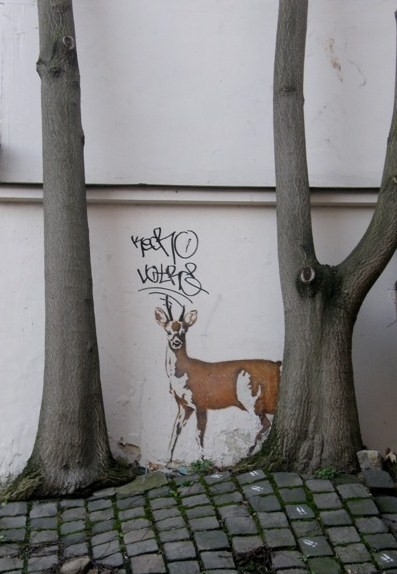
December. Montmartre. Mid-morning. Falling snow melting on empty tables and chairs. Artists hastily covering their paintings with plastic sheets. And on the ground, delicate white deer tracks running across the cobblestones. Suddenly I was staring at a deer that stared back at me.

The deer was a work of surreptitiously placed art. Its creator must have printed it on thin paper, cut it out and glued it to the wall, another installation in Paris’s large and ever-changing collection of Street Art.

The city’s visual richness keeps drawing us back to Paris, and street art is a huge part of that. As I see it, street art does not include tagging and undecipherable messages sprayed on walls and shops fronts. Street art—in paper, ceramics, painted freehand, or created with stencils—should indicate wit, forethought, and artistic talent. And it should somehow belong where it is found.

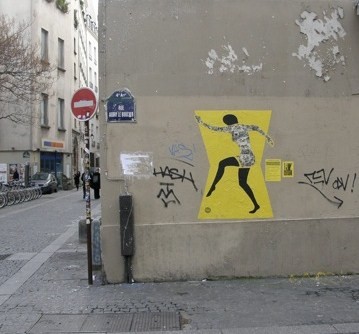
Item: Our Lady of the Black Tights.

Perhaps she is still in the 4th arrondissement, where we met her on Rue Aubry Le Boucher in December 2008. Finely proportioned, lively, and carefully executed, she seems to belong where she is. At the same time, she stands out alone within the larger street environment. However, when joined by pedestrians, she somehow seems more animated, exhorting us to a sprightly walk: Come on, folks, put a little more energy into it.

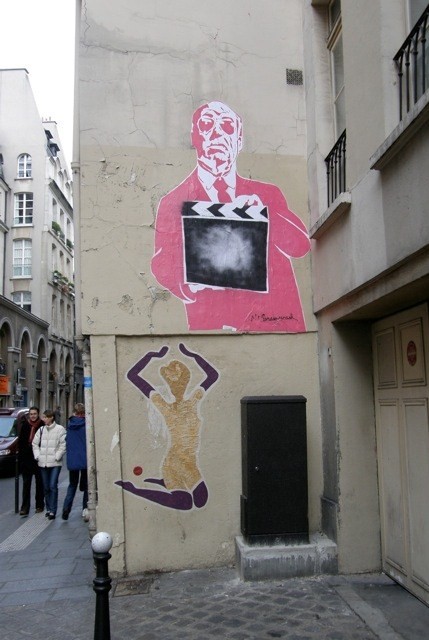
On another day’s ambling along in the Marais, I encountered Alfred Hitchcock and the Musical Lady. I am sure they did not come to the party together. The styles are too different. Perhaps the wrinkled directorial Hitchcock arrived first and someone thought he needed a female lead.

Hitchcock liked female leads who were mysterious and our Musical Lady certainly fits the bill. How does one explain that, except for her arms and legs, she is made entirely of a collage of layered sheet music? What is the message of the music? Is there a message?

You don’t have to look for street art. It will find you. Part of the experience is the way you come upon it – the moment at which you spot it, the angle of approach, the point at which you grasp what it is you are looking at.

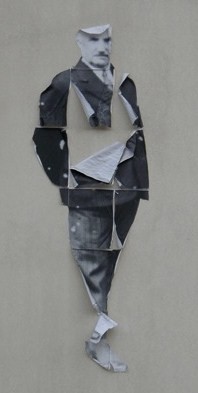
Philippa and I had just emerged from Notre Dame du Travail (our favourite Paris church and definitely a subject for a future blog) in the 14th and were headed towards the Gare Montparnasse. As we approached this modern apartment complex, we saw something on a pale wall.

As we walked towards him, he resolved himself into a man, who grew larger and more distinct.

So distinct, we could see he was disappearing.

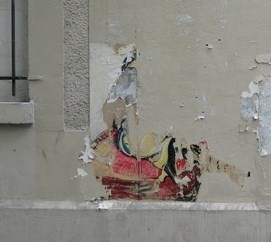
Paper-based street art will do that. It’s ephemeral and unless deliberately torn down, it ages gradually and gracefully. Then it is gone.

But will all paper-based street art age gracefully? What will happen now that some of it has become the high-priced art of galleries and auctions? It appears more and more frequently in art magazines and journals. One of its most mysterious practitioners, a British artist known only as Banksy, has even directed Exit Through the Gift Shop, a mockumentary satirizing the world of street art (Banksy appears in the film but his face is never revealed).

We don’t know where street art is going, we do know it will continue and take new and as-yet-unimaginable forms. The stern warnings painted on or carved into the stone on government building in Paris remind us that street art is not new: Défense d’Afficher Loi du 29 juillet 1881. Indeed, the enamelled Défense d’Afficher sign put up so many years ago on Rue de Gergovie has now become art itself.

It in no way belittles the quality of the artworks themselves to say I would probably find them less interesting if they were captured and presented in a gallery, even though some works seem too good to lose to the ravages of time and weather. And yet the transformation over time and the beauty of decay are also too good to lose. One hopes we will have both and if the history of French street art is anything to go by there is no reason to worry, no reason to

at least on that front.

Text and photographs copyright Norman R. Ball

Links: For an introduction to paper street art, see Sticker City: Paper Graffiti Art, by Claudia Walde, Thames and Hudson, 2007.

Posted in Paris street art, Paris streets | Tagged , , , , , , , , , , , | 4 Comments

A mutable feast

Last week, we were considering Paris in the 19th century, and how much has changed since then. But Paris is not just a moveable feast, it’s a mutable feast, and it has changed even since the 20th century. Think of the changes you’ve seen yourself in the last decade.

Fifteen years ago (when Norman took the photograph shown above), we arrived in Paris with a suitcase that had no wheels, a camera that required many rolls of film, and money in the form of travellers’ cheques. Our first stop was the American Express office on the rue Scribe, near the Opera. The place was bustling – this is where people came to cash cheques, make reservations for tours, or pick up mail. It sounds unbelievably quaint, but it was normal practice at the time.

Today, suitcases have wheels, cameras are digital (if not incorporated into mobile phones), and all you need is a bank card to withdraw money from an ATM. The American Express office near the Opera has shrunk from its former magnificence to a tiny little place with a small counter and a few clerks.

On that same trip we paid for our purchases in francs, rode on a city bus with an open platform on the back, and marvelled at the number of people smoking Gauloises or Gitanes at zinc bars in cafés. We stayed in a small hotel with flocked wallpaper and a chenille bedspread. It was heaven.

Or go a bit farther back… When I was a student in Paris (never you mind when), it seemed that half the cars on the road were Deux-Chevaux. I used to shop at La Samaritaine for necessities (« On trouve tout à la Samaritaine » was the store’s slogan). There were even a few “Vespasiennes” (outdoor facilities where men could urinate half in private, half in public) here and there. A vanished world. (One remaining Vespasienne still stands on the Boulevard Arago, rather the worse for wear.)

Simone Signoret said that nostalgia isn’t what it used to be, and she had a point. It’s fun to remember what was there, but so much has changed for the better. Who would want to go back to the time before the RER, the Eurostar, or Velib’? Or the days when most public toilets were unspeakably foul? (Does anyone else remember that horrible shiny toilet paper that felt as if it had been waxed?) Was the city better looking when so many of its buildings were covered with dark soot? Was the second-hand smoke of Gauloises really all that wonderful? Was life more comfortable when many people went twice a week to the public bains-douches because many apartments did not have modern bathing facilities and water came from a public tap in the courtyard?

(There is no question that Paris is cleaner than it used to be. In Paris in the Fifties, author Stanley Karnow notes that in the middle of the 20th century, only 15 percent of Paris dwellings had bathrooms and French soap consumption was the lowest in Europe. I can attest to having met French people who considered that having a bath more than twice a week was not merely unnecessary but bad for the health.)

On the whole, there only a few things I would want to bring back. I rather miss that bus with the open platform at the back. I notice with regret that more and more courtyards and laneways are protected with digicodes, and have become essentially gated communities. Some of the old covered markets have closed, while fast-food joints have proliferated. (In fact, indifferent food is everywhere, although it is still possible to find amazingly good food.) Gentrification in many areas has meant the death of small local shops and their replacement with boutiques catering to tourists and BoBos.* And, of course, I miss the Deux-Chevaux, one of my favourite cars.

At the same time, new buildings and spaces in Paris offer new delights, from the Cité de l’Architecture at the Palais de Chaillot in the west to the Viaduc des Arts and the Park Bercy in the east – new spaces created from old ones that embody Paris’s ability to reinvent itself endlessly.

Some old-fashioned elements of the city astonish me by their persistence. Cobblestoned streets. Wallace fountains. Open-air markets of all kinds. Les bouquinistes (can anyone really make a living selling copies of Paris Match from the 1950s?). Carrousels for children, and ponies for hire in the Parc Monceau. The remaining Guimard-designed Metro entrances. I keep wondering if next time, they will have gone, too. But amazingly enough, we see them year after year.

Otherwise, when we want a taste of the so-called good old days, we head to the nearest flea market (our favourite is the one at the Porte de Vanves). There we find many of the items that have vanished from the day-to-day world.

Take the paraphernalia of the old-fashioned café. Ashtrays, match holders, water carafes advertising various drinks, jetons for making a telephone call in the cabine at the back. All the flotsam and jetsam of ordinary life that people took for granted only a decade or two ago.

Consider this still life with carafe, ashtray, match holder, French francs, and a telephone jeton.

Flea markets specialize in these obsolete objects, along with recherché cutlery (pickle forks, anyone?), elaborately embroidered household linens, bakelite jewellery from the 1930s, and forgotten board games. The past is never far away at the Porte de Vanves.

Paris has largely avoided turning itself into a nostalgic theme park, and it looks forward, not back. Ten years from now, I wonder what people will be saying about 2010. Remember when Metro trains had drivers instead of being fully automated? Remember those cute little Internet cafes where people used to send “e-mails”? Remember when wine bottles had corks? Who knows?

We’ll keep going to Paris to see what’s new each year and to enjoy the older elements that survive into the present.

If there are things you remember about Paris 10, 20, or more years ago, please add a comment.

* “BoBo” (bourgeois-bohemians) is the popular French term for gentrifiers, a term derived from David Brooks’s book Bobos in Paradise. They are also known as champagne socialists or caviar socialists. This New York Times article from 2000 describes the BoBo phenomenon as it was emerging, and this 2008 article from the Guardian suggests that the BoBos have had their day. I’m not so sure.

Text and one photograph copyright Philippa Campsie, first photograph copyright Norman Ball

Posted in Paris history, Paris nostalgia | Tagged , , , , , , , , , , , , , | 5 Comments

A la recherche de Paris perdu

I am no great fan of GPS or satnav systems. They convey a false sense of certainty about one’s location (What do you mean this is Montparnasse? It says Montmartre right here!) and are subject to garbage-in-garbage-out problems (if you want the rue Corot and you type rue Cortot, too bad). Besides, what’s the fun of a map that just shows you what exists now? How about one that shows you the past?

I bought this map and gazeteer for a few Euros at a bouquiniste’s stall. It gives you the city just as it was in 1897, complete with crucial information on “Les Droits du Pechêur” (fishing rights), “Deuils” (mourning – including details on how long you should wear black for the death of, say, a sister-in-law), the duties of a concierge, and the “Arrêté portant réglementaire de la Circulation des Vélocipèdes sur les voies publiques en France” (nine rules for bicyclists). Show me a GPS system with added value like that.

It was the work of Jehlen & Léguillon, Printers, 58 rue Greneta (there’s a decor shop there now), and was subsidized by the advertisements that fill up more than half the space. J&L were at pains to show off their vast range of typefaces, and every line of every ad is different. This is not about tasteful typography, it’s a feast of fonts.

The ads include all kinds of patent remedies for every sort of illness or problem, from brown spots on the skin to cancerous tumours, which can apparently be treated without an operation “par la méthode Alliot-d’Etaves.” What a relief. Every snake oil salesman in town has a pitch in here. But there are also ads for clothing and corsets, food and wine, sewing machines and bicycles, locksmiths, lace repair, and artificial flowers.

The fold-out map in the middle is a printing tour-de-force with an extraordinary level of detail, plus more ads squeezed in – including one for “hommes-sandwichs” available for hire.

The map shows the old walls (l’Enceinte de Thiers) that framed the city and gave rise to the “Portes” around the circumference. You can see the railways and nine main-line stations (of which six survive*) and the Petite Ceinture circling the city, with its stations like beads on a string. Much of this disused railway line survives, and although it is officially off-limits to trespassers, many Parisians enjoy hiking parts of the route and have even set up a Facebook page to share entry points and photographs.

The central market of Les Halles is visible, as well as a wine market (Halles aux Vins) near the Jardin des Plantes (now part of the university).

Street names have changed – many since renamed for 20th-century figures – but the parks and cemeteries are all in place.

As well as schools, churches, hospitals, and administrative buildings, the map legend lists 28 theatres, 19 “concerts” (music halls), a mere 8 museums, 3 panoramas, and of course, le Pôle Nord

Wait a minute. The North Pole? On the rue de Clichy? It took me some time to figure that out. Apparently it was a skating rink. You can see a lovely poster for it here.

The maps shows the Paris of the Belle Epoque, of Proust’s novels and of Atget’s photographs. These are the street names they knew, the landmarks they saw, and even the company names they would have seen on shop fronts. It’s a window into a vanished world.

Sometimes imagination and memory are the best GPS of all.

*Gare St Lazare, Gare du Nord, Gare de l’Est, Gare de Lyon, Gare d’Austerlitz (then called Gare d’Orléans), Gare Montparnasse. Of the others, the Gare des Invalides is now the Musée d’Orsay, the Gare de Vincennes was demolished to make way for the Opéra Bastille, and the Gare de Sceaux is now part of the RER commuter train network.

Text copyright Philippa Campsie

Posted in Paris history, Paris maps | Tagged , , , , , , , , , , | 3 Comments

The red balloon

I’d nearly gone right past before I realized what I’d just seen. A balloon, drifting past the chairs and tables of a café in Montmartre. A red balloon. In Paris. I turned around and photographed it, murmuring to a bemused café patron nearby, “C’est un ballon rouge. A Paris! Il faut le photographier.” I’m not sure if he knew what I was on about, but he smiled encouragingly (or placatingly, assuming I was a nutcase).

I didn’t see the movie of The Red Balloon until I was an adult, but when I was about seven years old, I found a book based on the movie in my Grade 2 classroom, with a series of still photographs that told the story, no text (that I recall). My best friend and I frequently pored over the book, with its cast of boisterous Paris children in the streets of Ménilmontant, its magical relationship between a boy and a balloon, and its exhilarating and redemptive climax.

If you have never seen the movie (made in 1956), here is the story. A little boy spots a large red balloon attached to a thick string that is snarled up in a lamppost. He climbs the lamppost and disentangles the string to free the balloon. He can’t take on the bus, and has to run to school, which makes him late. He takes the balloon home, but his stern guardian (an elderly, grim-looking woman, clearly not his mother) ejects it. Undaunted, the balloon drifts up to his window and rejoins the little boy.

Thereafter, the balloon follows him everywhere. He does not need to hold the string; the balloon simply follows him. It strays only twice, once when distracted by an attractive blue balloon held by a little girl, and a second time at a flea market, when it becomes entranced by its own reflection in a mirror.

Inevitably, a gang of bullies notices this oddity and becomes jealous. They kidnap the balloon and fire on it with slingshots. The little boy rescues it briefly, and a chase through the alleys of the quartier ensues.

Alas, the balloon is recaptured and in an epic fight on a patch of vacant land, the bullies go in for the kill. The little boy watches in horror as the balloon is punctured and dies a slow, agonizing death. You can see it diminish and wrinkle; even its stout string becomes bent in its final throes. (The scene takes place in silence, except for the sound of escaping air. If you are not misty-eyed by now, you have a heart of stone.) A final kick from one of the nasty children, and it is gone.

But the death of the red balloon is not the ending. As it expires, balloons from across the city seem to hear its death-rattle and they converge on the scene. They jerk themselves from the hands of other children, they burst from windows and doors. Some form orderly rows as they approach the site of the murder; others arrived in clusters. The balloons proffer their strings to the heartbroken little boy, he gathers them up, and they bear him up into the sky, away from his tormentors, from Ménilmontant, from the city.

It never fails to move me. I think anyone who has felt a bit out of it as a child can relate.

There was a sequel, of sorts. In 2007, filmmaker Hsiao-hsien Hou made The Flight of the Red Balloon, with Juliette Binoche. It was a nice enough film, but the red balloon hovers on the margins on the film, watching over Binoche’s lonely son and his Chinese babysitter, but never really entering into the story. It seemed a waste of a good character. When you’ve been shown that balloons have personalities (loyalty, vanity, daring), can you go back to seeing them just as props?

The original film was written and directed by Albert Lamorisse and the little boy was played by his son Pascal. (The little girl with the blue balloon was his daughter, Sabine.) It won the Palme d’Or for short films at Cannes and an Oscar for best screenplay in 1957. The father-and-son team went on to make a further balloon-themed movie called Le Voyage en Ballon (English title: Stowaway in the Sky), which apparently won some awards, but I’ve never seen it or met anyone who has. Albert died in 1970, in a helicopter crash, while filming in Iran. The Red Balloon is his most enduring achievement.

Its setting, however, did not endure. Most of the streets in which the movie was shot have long ceased to exist, destroyed by urban renewal programs that swept away huge sections of Belleville and Ménilmontant. Only the huge church shown in the film, Notre Dame de la Croix, remains. Before their destruction, many of these streets were photographed by Willy Ronis – such as the famous Y-shaped intersection of stairs at the rue Vilin, which features in the film.

Even the green buses with their open platforms at the back have gone, although the No. 96 bus featured in the film still seems to ply the same route. Norman and I rode on a bus with an open rear platform during a visit to Paris in, I think, 2004 (the last ones in service travelled the No. 29 route through the Marais to the Gare St-Lazare), but these models have now been entirely phased out.

The enchantment of The Red Balloon is not just a matter of Paris nostalgia. In the course of 34 minutes, it provokes laughter, indignation, anxiety, grief, and exaltation. It stirs long-forgotten memories of childhood – the possessions that meant so much at the time, the bullies who damaged them, and the longing to fly away. Haven’t we all been there, and haven’t we all escaped?

Links: The actual movie lasts about half an hour and can be watched on YouTube in four installments (type in “Ballon Rouge” and you’ll find it). There is next to no dialogue, so you don’t need to understand French. There is also a good two-minute overview available on YouTube here.

Text and photographs copyright 2010 Philippa Campsie

Posted in Paris film | Tagged , , , , , , , | 13 Comments

A tomato grows in Bercy

On a tiny side street in the 3rd arrondissement near the market known as Les Enfants Rouges (named for a former orphanage where the children wore red jackets), we stumbled across a tiny garden, divided into even tinier plots, filled with flowers, herbs, and vegetables. A sign told us it was Le Potager des Oiseaux. Another time, Philippa found a similar little space in the 11th, called Le Jardin Nomade.

It’s somehow surprising to see food growing in Paris. We’re used to thinking of the city as a place where food is sold, cooked, consumed, and celebrated. But produced…? Not so much.

Paris’s food production hardly rivals that of France’s major agricultural areas, but if you know where to look, you can find it. There are beehives on the Opera Garnier, the Opera Bastille, the Grand Palais, the Tour d’Argent restaurant, and probably a few other rooftops. We once bought a little jar of honey from the Opera Garnier roof; it had an endearingly amateurish-looking label made on a photocopier and contained a pale honey with a faintly smoky taste.

And on the slopes behind Sacre-Coeur is the vineyard known as Clos Montmartre, at the corner of rue des Saules and rue St Vincent. It’s the only remaining vineyard in Paris. Once upon a time, the Butte Montmartre (Montmartre hill) was covered with vineyards and market gardens. Vincent Van Gogh painted them in 1887, with a mill in the background – no,  not the Moulin Rouge, the Moulin de Blute-Fin). All gone now. The original vines on the hill were killed by the phylloxera epidemic of the late 19th century that wiped out vines across the country. The Clos Montmartre was created some decades later, when a group of artists stopped a real estate development on the site and started a vineyard. The first grape harvest was in 1934. Today, the vineyard produces about 1,500 half-bottles of wine a year. Not much, admittedly, but it carries symbolic weight.

For growing veggies and fruit, the city offers about 50 jardins partagés (allotment gardens or community gardens), squeezed into leftover corners of land, mostly in the eastern and southern parts of the city. Gardening writer Marjorie Harris has also noticed these pocket gardens. “I was totally enchanted by the neighbourhood gardens tucked into corners and looked after by locals. It was like coming upon the most glorious oasis in a city full of them. There’s one in the 20th where we were staying and it was never unpopulated. People dropped in and out all day long.”

Some of these jardins partagés have wonderful names: Le Poireau Agile in the 10th (un poireau is a leek, and this name plays off the name of the famous inn called Le Lapin Agile), Le Jardin des Mots et des Merveilles in the 13th (the garden of words and wonders), Le Lapin Ouvrier in the 14th (the working rabbit), or Jardin de Perlimpinpin in the 17th (perlimpinpin comes from poudre de perlimpinpin, meaning a magic cure-all). We can’t help thinking that perhaps urban agriculture in other cities might find wider acceptance if community gardens were always given such charming names.

Even the ubiquitous windowboxes grow basil, mint, parsley, and tarragon, along with the typical geraniums. In the last apartment we rented, we had instructions to keep the herbs well watered.

The term “locavore” (that is, someone who seeks out locally grown food) has made the transition to French, and at least one book has even been written on the subject for a French audience. We find this a bit odd, as French people have been locavores for generations, and don’t seem to have as great a need to reconnect with the sources of their food as North Americans. Here, books like the 100-Mile Diet (about a couple in B.C. who survive for a year on local food) and Animal, Vegetable, Miracle (about a family’s experiences growing their own food in southern Appalachia) inspire fascination and awe. In most parts of France, 100-mile diets would probably not be a jaw-dropping feat, and growing your own is an experience common to all but the most jet-setting of urbanites.

Still, the generation that eats at McDo probably needs reminding about the origins of food now and then, so Paris provides educational gardens, including one in the Parc de Bercy, which welcome school tours.

Even the wife of the U.S. ambassador is getting into the act. She created a potager on the grounds of the embassy in the rue Faubourg St-Honoré, following the lead of Michelle Obama, who made a food garden on the White House grounds. Students from a local horticultural school helped plan it and plant it, and the embassy chef will use the produce (which includes artichokes, rhubarb, and red currants) in embassy menus.

And why not livestock? Apparently Louis XV, a noted bird fancier, and his mistress, Madame de Pompadour, kept chickens and other birds in cages on the roof of Versailles, and presumably enjoyed a ready supply of fresh eggs. For all we know, some Parisians do the same. We can just imagine the gleam in a chef’s eye, contemplating the birds and the bunnies in the pet market on the Quai de la Mégisserie….

Vocabulary: The Moulin de Blute-Fin translates as the mill that grinds finely (blutage is the word for separating the flour from the bran). A vegetable or kitchen garden is un potager; a market garden is un maraîcher.

Links: For the full list of Paris’s community gardens (in French): see http://jardinons-ensemble.org/

Text and photograph copyright Philippa Campsie

Posted in Paris food, Paris gardens | Tagged , , , , , , , , | 2 Comments

The sounds of Paris

Blogs about the sights of Paris abound, and people write in swooning terms about the tastes of its food, but what about its sounds? How to convey the sounds of a city that is noisy, but is somehow less noisy that you’d think, given the number of people and vehicles crammed into its space?

If you Google “Paris soundscapes,” you will come up with some interesting efforts to document the distinctive sounds of the city. One Paris writer, Christopher Pitts, includes some Paris sounds on his website – our favourite is the sound of the Sunday Fontainebleau market. It is mostly human voices, the most distinctive Paris noise – people talking passionately about food, produce, and meals.

Like all cities, Paris has a fair bit of traffic noise at all hours, but you can also hear birds, children’s voices, church bells, merry-go-rounds, and music. We once stayed in an apartment with windows opening into a courtyard and in the early evening enjoyed the sound of a competent pianist practising, or just playing for enjoyment.

Some pieces of music immediately conjure up the city for us, and one of those is Ravel’s Piano Concerto in G, written in 1931 and premiered by Marguerite Long at the Salle Pleyel in January 1932. (You can hear the exquisite adagio movement here.)

The music makes us think of being on the water at sunset, drifting with the current of the Seine, perhaps on one of those elderly working barges (péniches), watching the world slide past and looking up at the buildings on either side.

The story of the concerto’s premiere is described in Marguerite Long: A Life in French Music, 1874-1966, by Cecilia Dunoyer. Marguerite Long, a gifted pianist, had been a friend of Ravel’s for decades. Ravel had originally wanted to premiere the work himself. But he eventually realized that Marguerite was the better player and would do the work justice. Marguerite fondly remembered that he had always wanted to be remembered as a pianist, with these words, “If he were told that [his opera] Daphnis and Chloe was worthless but that he was a great pianist, he would have been content!”

In 1931, he finally brought her the music. At one point, as she read it through, she found tears streaming down her cheeks. She later told Ravel that she was transported by the way the music “simply flows.” He snorted: “Simply flows! I wrote it measure by measure and nearly died from it!”

The premiere on January 14, 1932, as part of an all-Ravel program, was a huge success (un succès fou). Long and Ravel then left for a European tour to showcase the concerto. It was a bit nerve-racking (angoissant) for her, not only because Ravel was not most reliable of orchestra conductors, but also because he was dreadfully absent-minded and tended to lose his keys, his wallet, train ticket and luggage on a regular basis. At one point, he forgot to get off the train, leaving Long stranded on a Berlin platform without any German money. On other occasions, he would become distraught because he couldn’t find his patent-leather shoes, which he wore for concerts (he had very small feet, and replacements were hard to find).

Marguerite was the perfect travelling companion. She took everything in stride, and usually laughed about his scrapes. She used to say, “We are gathering memories!” She was also a faithful interpreter of his work, for Ravel was very insistent about exactly how he wanted his music played, and she followed his advice.

Ravel wrote very little after completing the concerto. Later that year, he suffered a head injury in a taxi accident, which undermined his already fragile health. He died in 1937. Before his death, as he fretted about his inability to work, Marguerite reminded him of all the beautiful music he had already written, but he insisted, “I have not said or composed anything yet of what I wanted to say.”

Marguerite outlived him by almost 30 years, a gracious and forgiving friend to a genius.

Vocabulary: A soundscape is usually translated as un paysage sonore. Les péniches are the long barges on the Seine – some have living quarters on them. Un succès fou is the term for a wild success. Absent-mindedness is la distraction, and an absent-minded person is distrait.

Text copyright Philippa Campsie; illustration copyright Norman R. Ball

Posted in Paris music | Tagged , , | 5 Comments