I’ll meet you on the passerelle Debilly

The passerelle Debilly is often overshadowed by its flamboyant neighbour, the Eiffel Tower. But then, the Eiffel Tower has been upstaging everything in the neighbourhood since it opened in 1889. Consider one of the first photos I ever took of the passerelle Debilly. I noticed the bridge, but at that time, I didn’t know its name. In the photo, the Eiffel Tower is, even partly obscured, the star.

PC170851

Philippa and I had just left the Palais de Tokyo. Outside it was a grey rainy day. I slipped on the stairs going down to the river, but it was Paris, and I didn’t mind so much.

Soon I was photographing others who seemed to take the rain in stride. I liked the bridge, but I was concentrating on the people and their umbrellas.
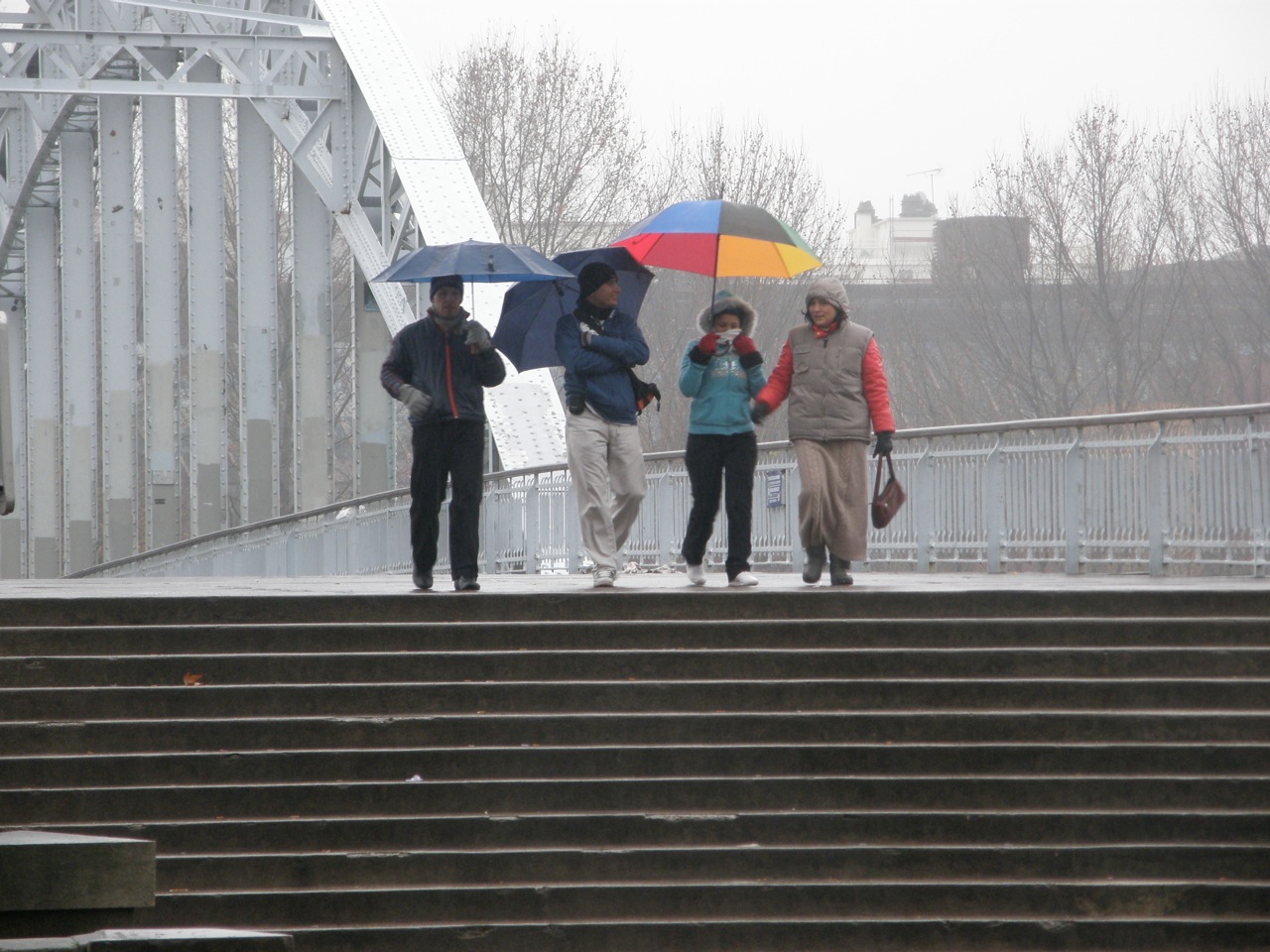
PC170859

We encountered the bridge on other occasions, but I never had a chance to look at it more closely. Then, last December, I found myself near the bridge with time on my hands on a sunny day.
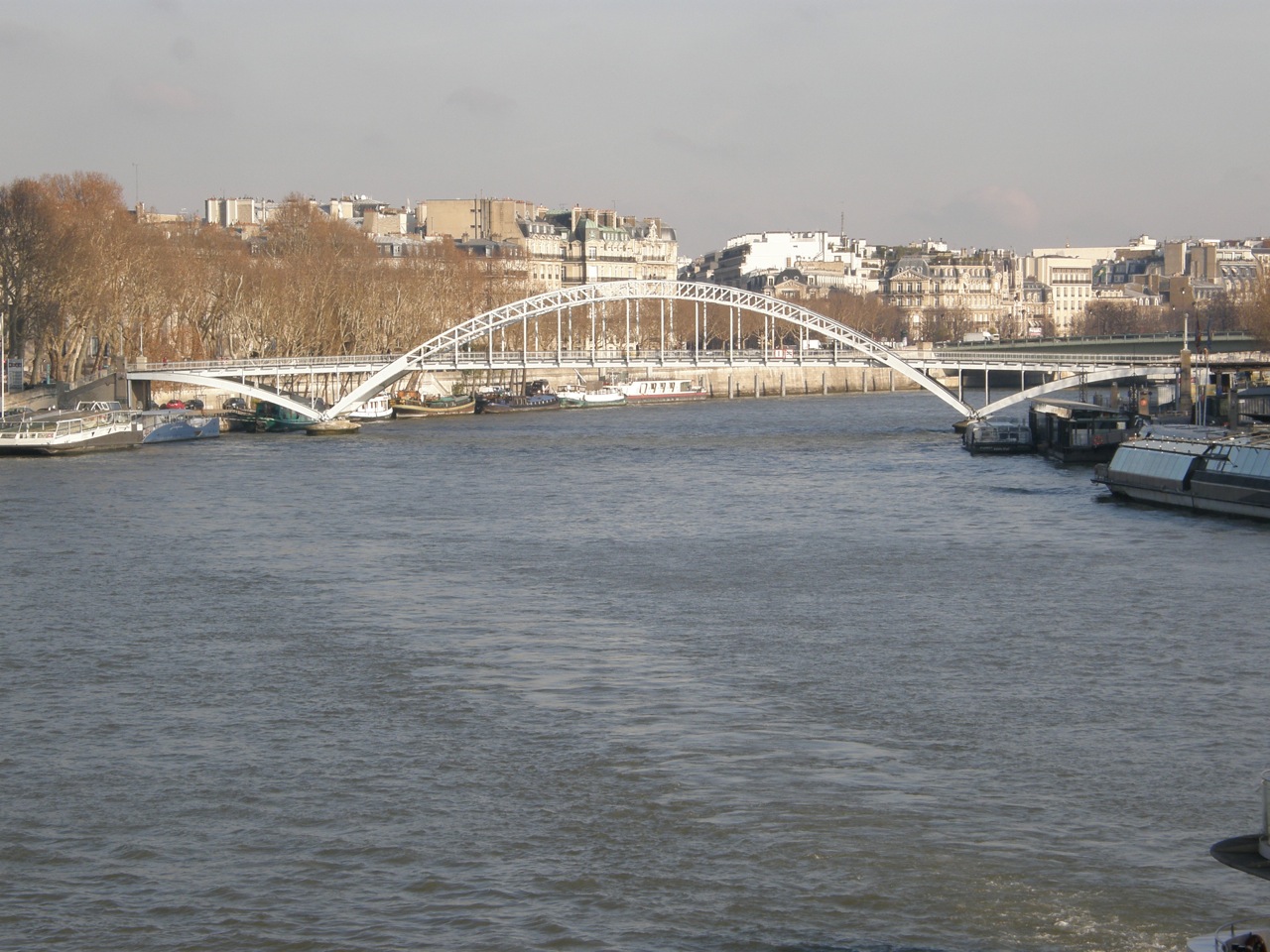
PC120142

As I drew closer, the bridge seemed to grow ever more exuberant.

PC120183

I was captivated. It was as if structural steel had captured the path of a skipping stone thrown from the bank of the Seine across the river.

I always want to see the underside of bridges. Beneath the bridge, just above water level, I could appreciate the geometry of structural steel. The river was high that day, and fast-flowing muddy water bent gracefully around the piers. No vehicles rumbled overhead; I could hear the water.
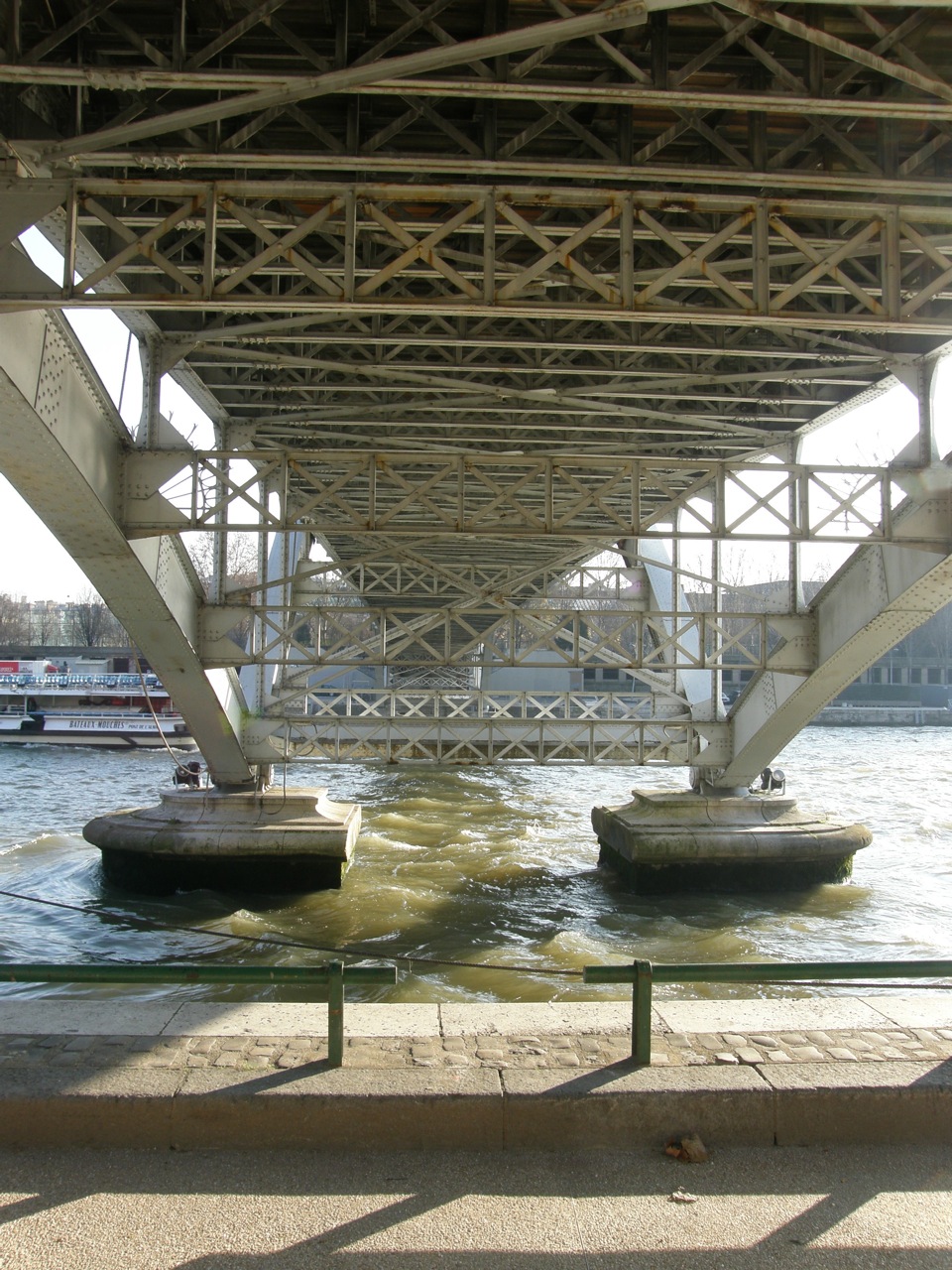
PC120192

I was intrigued by the gracefulness of the two structural members that transfer the load to the bearings that support the bridge and allow slight movement as the bridge expands and contracts with changes in temperature.
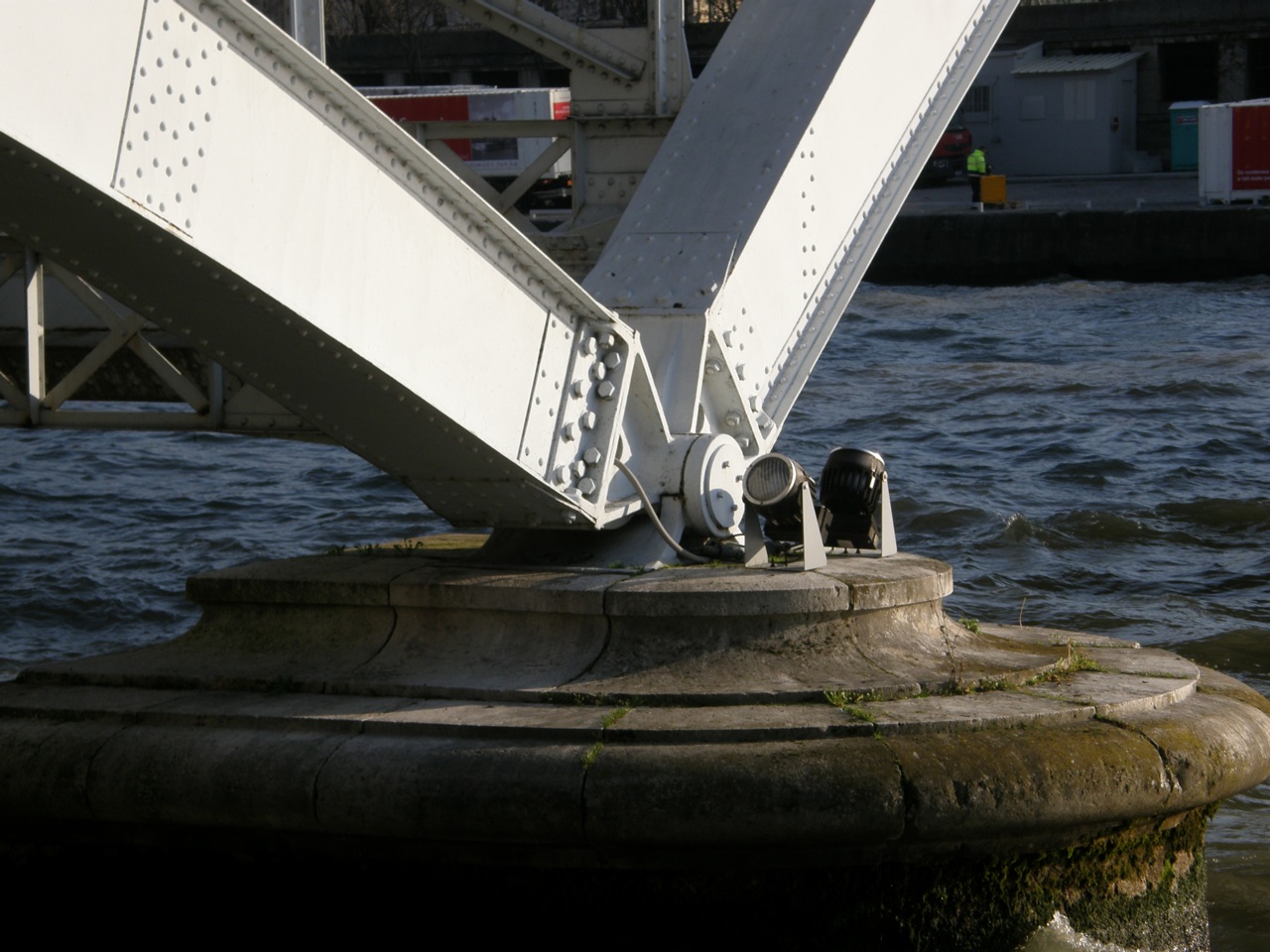
PC120184

I also paid attention to the signs with no words. One sees variants of this warning all over Paris. The sharp points contrasted with the smooth regularity of the rivet heads.

PC120217

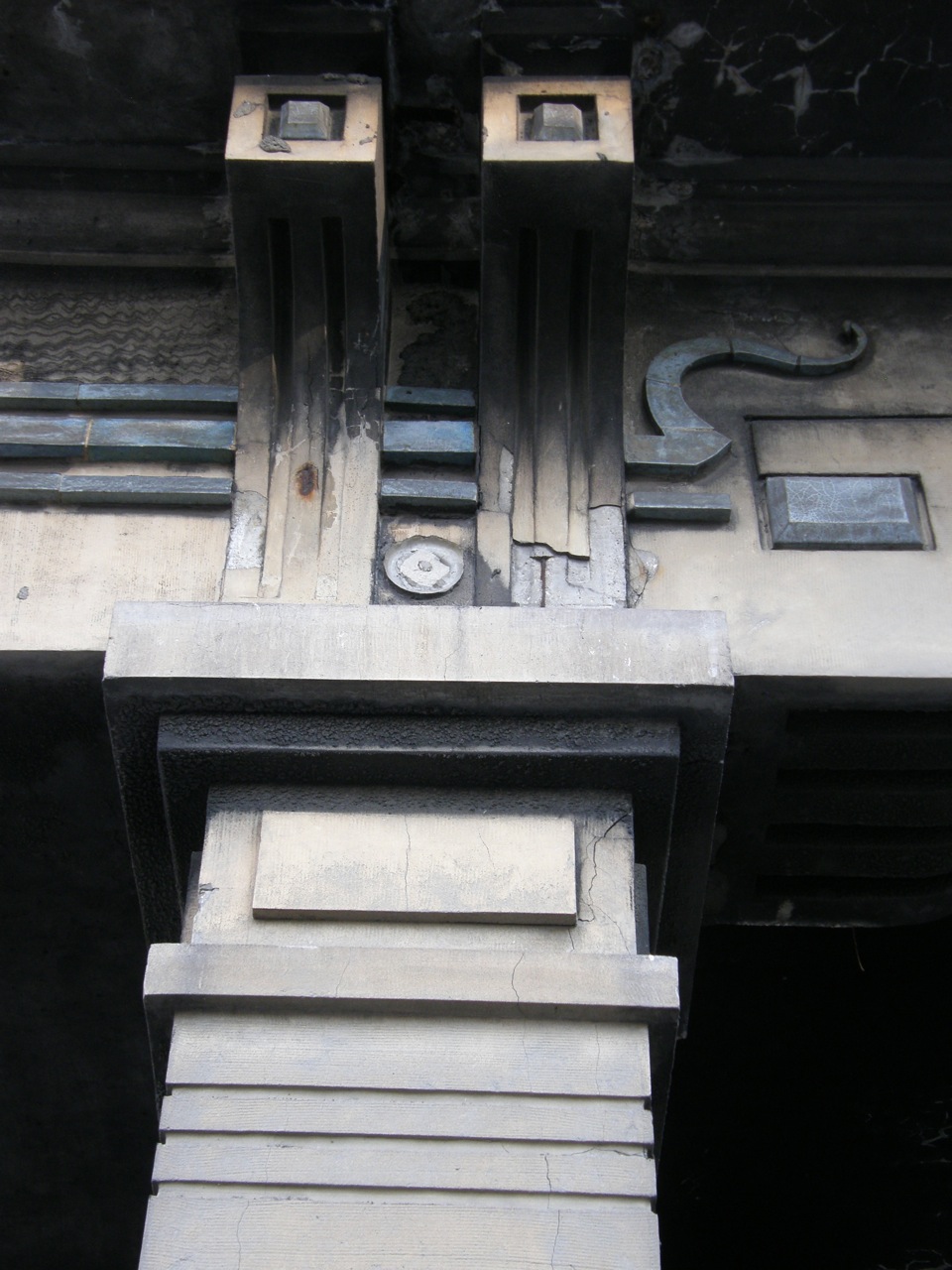
Soon I discovered that there was more to this bridge than seductively shaped ironwork and gracefully weathered wood. I began to notice more and more unusual details.
PC120228

Clearly someone had been given the freedom to make something very special.

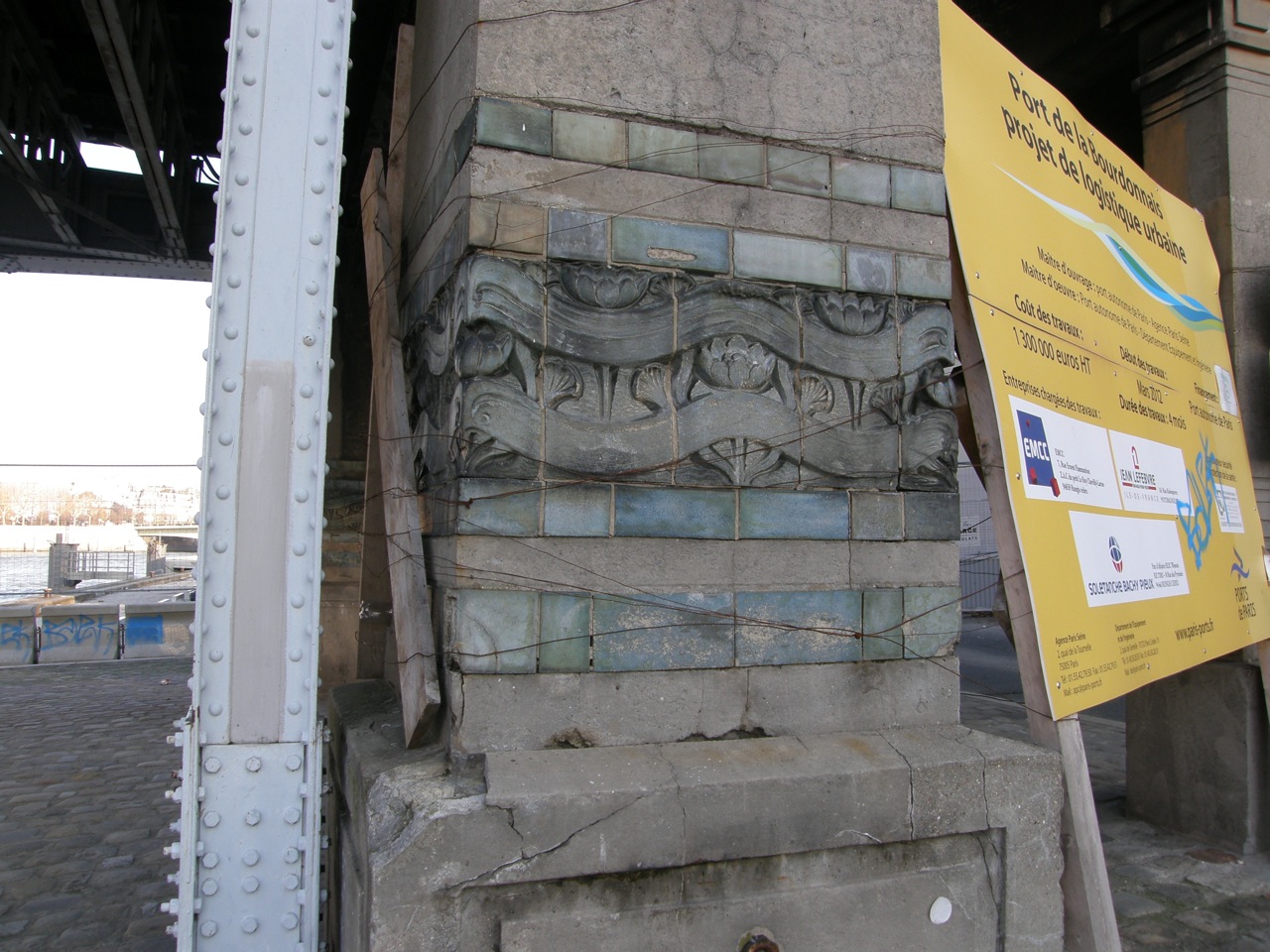
The columns were most unusual, the work of an artist capturing the waves on the Seine, an artist reminding us that Paris is an important port.

PC120238

On that afternoon I was looking at a rare beauty that clearly needed help. And it appears to be getting it. Restoration is under way.
PC120237

One can only hope that the inevitable signs of age can be restored and that the passerelle will one day be returned to its former glory.

PC120222

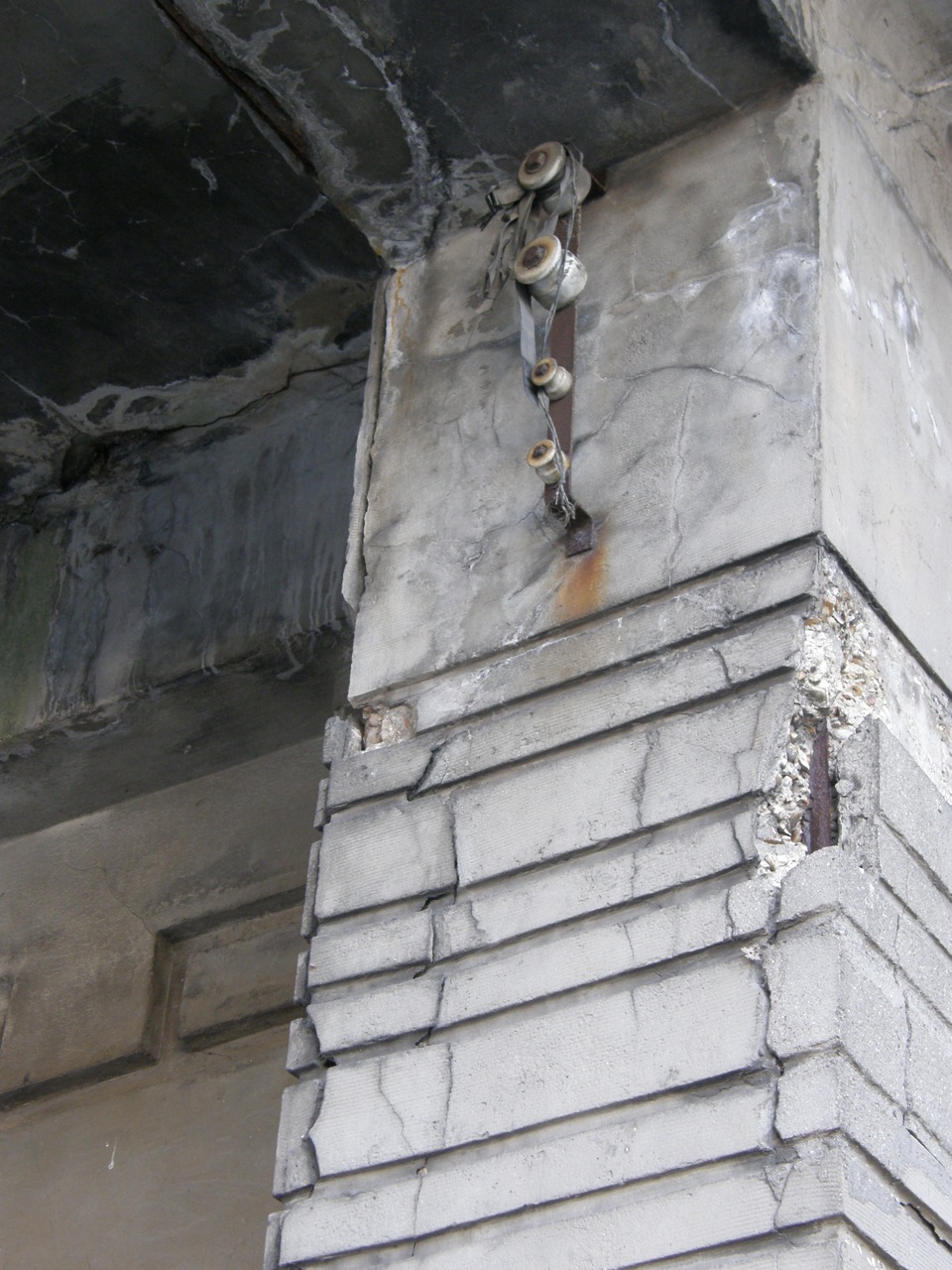
Perhaps a sensitive restoration will leave some evidence of former ways and former days. I am rather fond of this evidence of an older way of putting in electric wires. Surely anyone who has worked on rehabilitating an older house will recognize the porcelain insulators. I like them. I hope the remnants will stay as a tiny bit of history in-situ.
PC120225

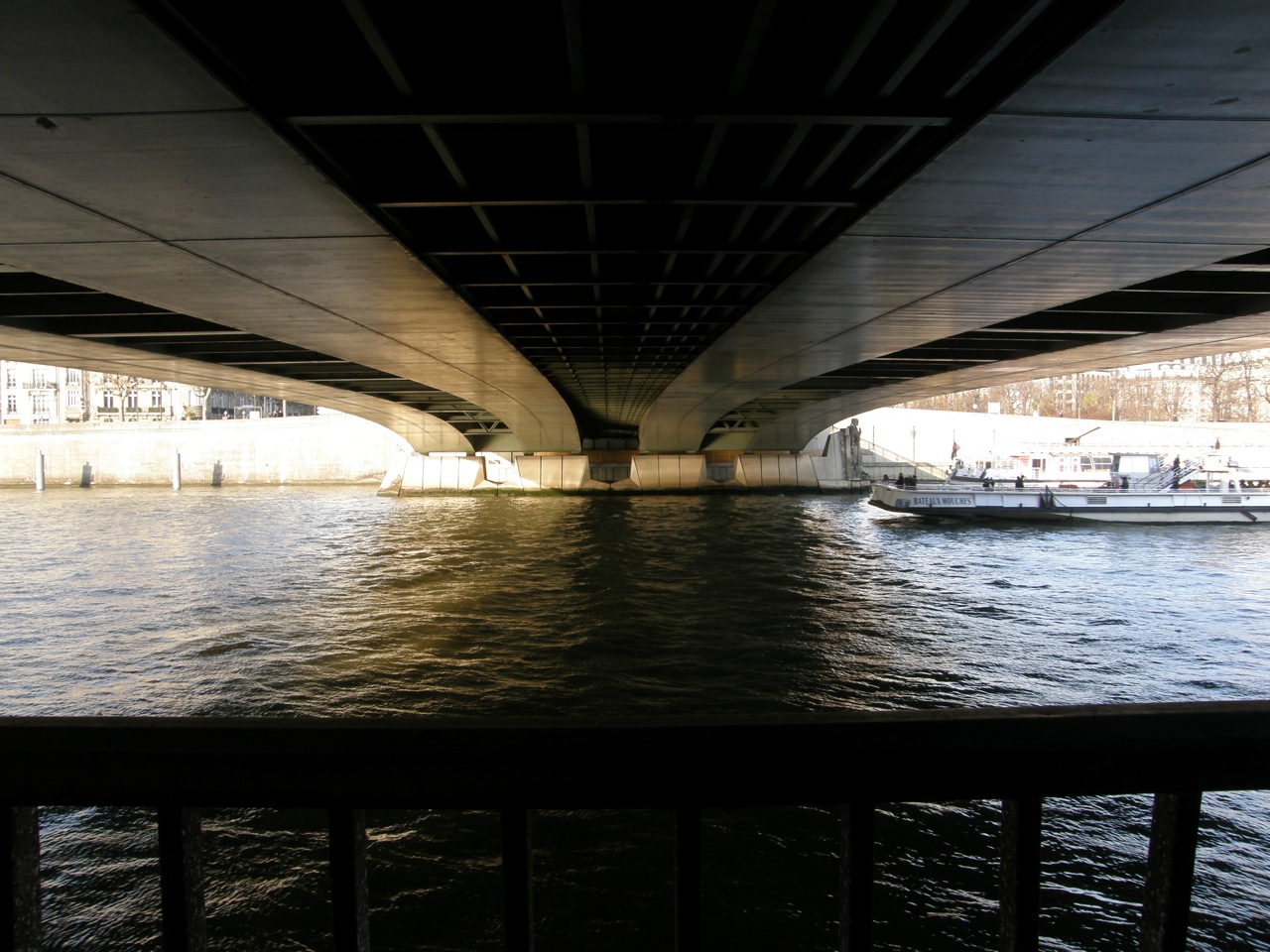
After a couple of hours, I wandered away from the bridge and a few minutes later my cell phone rang. It was Philippa; she was on the right bank near the pont de l’Alma, which I could see quite clearly as I talked on the phone. My path to our meeting place inadvertently turned out to include a construction site I had to exit from carefully. But I did get an unusual view of a very different, and very modern bridge.
PC120256

Back at home in Toronto I started to find out more about the passerelle Debilly.

Structures made for International Expositions often have a short intended lifespan and most do not survive. The Eiffel Tower built for the 1889 International Exposition was expected—at least by some—to be torn down soon afterwards and it nearly met that fate. Three of my favourite Parisian sites, the Petit Palais, the Grand Palais, and the Alexander III bridge, were built for the Universal Exposition of 1900 and they too have survived. The modest passerelle Debilly was also a survivor from 1900.

It was originally known as the “passerelle de l’exposition militaire” and then the “passerelle de Magdebourg,” before it took the more dignified name of Passerelle Debilly in 1906 to honour the First Empire Army General Jean Louis Debilly, who died in the battle of Iéna (Jelna) in 1806. The Exposition included buildings on both sides of the river and the bridge was designed to link the Army and Navy Hall on one side with the “Old Paris” series of buildings on the other bank. These buildings have long since disappeared, but the bridge still crosses the Seine with pont de l’Alma upstream and the pont d’Iéna downstream.

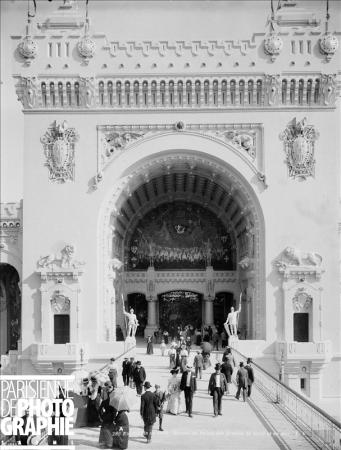
The image below, taken from a stereograph view, shows the bridge, on the upper left, entering the Army and Navy Hall, a magnificent structure. The Eiffel Tower is out of sight to the right of the photograph.

Paris exhibition 1900001

Here’s a closer view of the Army and Navy Building as seen from the passerelle.
5347-5

The bridge survived in part because it was useful and well-built. The City of Paris acquired it in 1902. Originally built to align with Avenue Albert de Mun, the city in 1906 moved it “quelques dizaines de mètres en amont” (several dozen metres upstream, actually more than 200 metres) towards Pont de l’Alma to a position opposite rue de la Manutention. Here it was further away from the pont d’Iéna, a name of no happy memories to Debilly.

Not everyone approved of the bridge. In 1941 one architect argued for its destruction because it was no more than an “accessoire oublié d’une fête passée” (a prop or accessory from a faded or past festival). Cooler heads or perhaps simply inertia prevailed and the bridge was left as is. In 1966 it was added to the supplementary registry of historical monuments. It was repainted in 1991 and the deck redone in 1997.

The 3-span bridge has a total span of 120 metres, but the large central span of 75 metres allows the piers to be quite close to the banks. This gives a wider navigation channel than would be the case with arches of equal length. The 22.5-metre side arches are actually half arches.

The passerelle Debilly was designed by engineers Jean Résal, Amédée Alby and André-Louis Lion. Résal was a professor at the famed École Polytechnique and he and Alby were the design engineers for the much more famous Pont Alexandre III, which also opened in 1900. Lion was the official engineer for Ponts et Chausées (Roads and Bridges).

The stunning ceramic tiles were made by the French company of Gentil et Bourdet.

Well-known as a rendezvous for lovers, Paris has also been the meeting place for spies from various nations. During the Cold War, the passerelle Debilly was apparently a favoured meeting place for spies and assorted “diplomats” who needed to exchange messages, currency, or other things. It was also the bridge on which, several days after the fall of the Berlin Wall, an agent of the Democratic Republic of German was found dead.

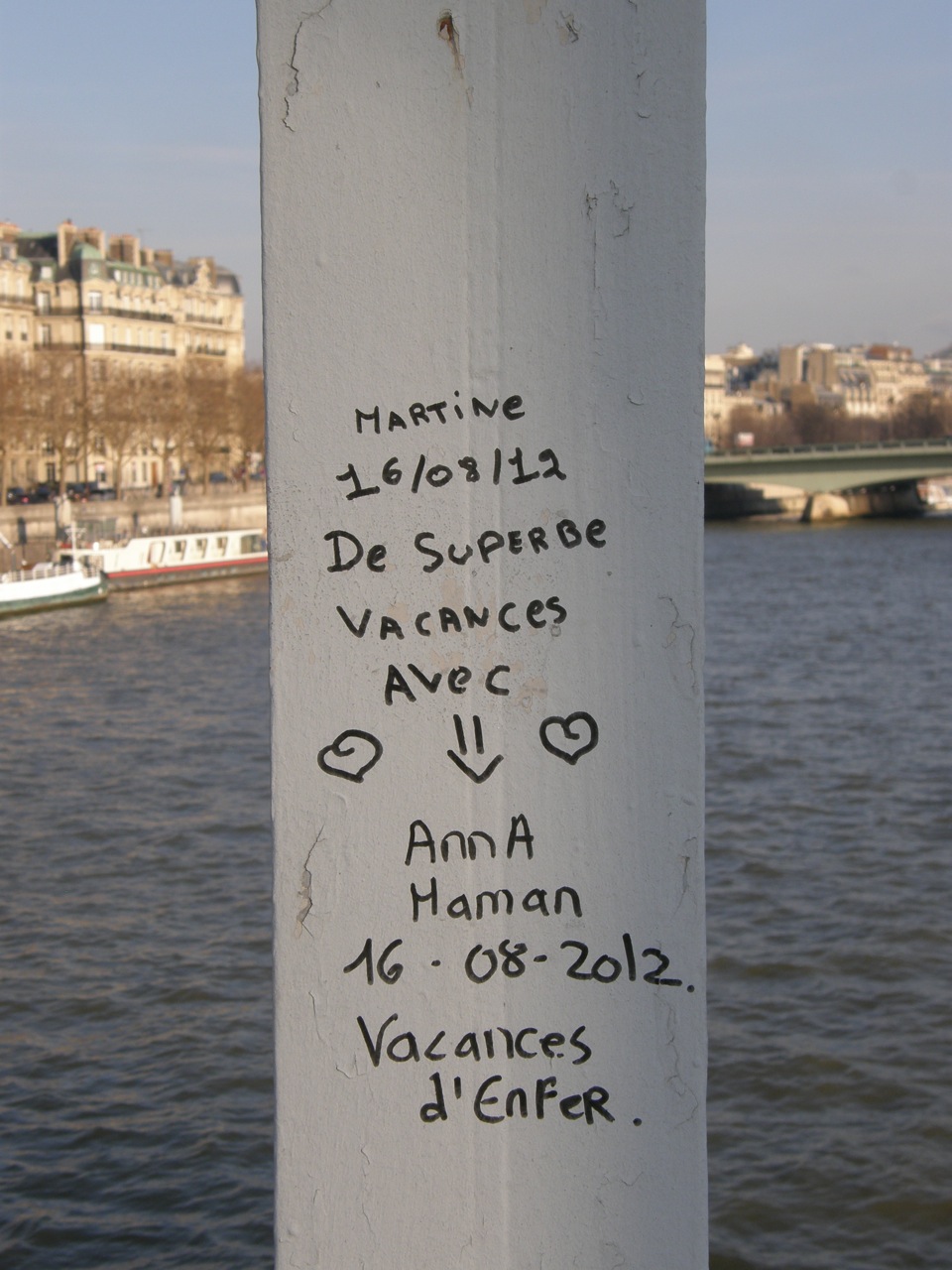
Who knows what other stories the bridge could tell? What happened when Martine and Anna had their “vacances” in Paris?
PC120210

Perhaps next time I will arrange a top-secret meeting on the bridge to exchange, um, stereocards?

Text and photographs by Norman Ball. Photograph of the Army and Navy building from Paris en Images.

Posted in Paris bridges | Tagged , , , , , , , , , , | 8 Comments

The forgotten fashionista

There are not a lot of private houses in Paris. Let alone private houses with a direct view of the river and the Eiffel Tower. So 34, avenue New York, home of the Mona Bismarck American Center for Art and Culture, is already something out of the ordinary.

P1090214

We went there last December to see an exhibit of prints and drawings by Mary Cassatt (I wrote an article about it for Girls’ Guide to Paris). The exhibition was interesting, but I was captivated by the house. The lunchroom offered a view of an enclosed garden, and a large poster on the wall provided the beginnings of an answer to the question in my mind: “Mona Who?”

The short answer would be: a fabulously wealthy American society hostess (1897–1983), once nominated the “Best-Dressed Woman in the World,” and benefactress of the institution that occupies her former Paris residence.

There was a second exhibit on the upper floor, and I climbed the oval staircase to look around. A large room contained a grand piano, a gilded mirror, some candle sconces, and a few pictures. I spotted a small corridor leading to a powder room.

P1090190

One seldom has the opportunity to wash one’s hands and comb one’s hair in such elegant surroundings, and for a few minutes, I made myself at home.

P1090202

There were three black and white portraits of Mona on a ledge, so I photographed them (badly). However, I later found clearer versions of the same images online. Here is one of them.

74a8365c290a7a08c4fe2141d242720ce13e6c15-1968.2.01

Back home in Toronto, I decided to find out more about the woman whose house I had visited. There is remarkably little written about Mona Bismarck. And after reading what there was, I think I know why. Here is the story.

Mona (or Frances) Strader was the daughter of a Kentucky horse breeder and trainer, Robert Strader. Her childhood was sad and chaotic. Her parents divorced when she was four or five years old. She lived first with her maternal grandmother, then with her paternal grandmother. The former was later declared insane and sent to an asylum. An uncle suffered the same fate. Another uncle shot a prostitute and then turned the gun on himself. A third uncle died in a hunting accident. Only her father seemed to be a steady influence in Mona’s life, and he was not always around.

The only way out of this nightmare was marriage. Mona’s starter husband was Henry James Schlesinger, son of the richest man in Wisconsin. She’d met him through her father’s racing contacts. She was 19; he was 39. The marriage was not a success. In 1920, Mona sought a divorce after three years of marriage, and left her young (and only) son in her husband’s custody in Milwaukee.

tumblr_m5ly3zZTC51qhogwao1_500

At this point, she had already met husband No. 2, a wealthy banker called James Irving Bush, said to be the “handsomest man in America.” The two married in New York in 1921; she was 24; he was 38. Fairly soon, Mona discovered that her new husband behaved appallingly when he was drunk, and he was often drunk. This time she went to Paris to obtain a divorce (note to self: find out more about Paris as the “divorce destination” in the 1920s and 1930s).

Back in New York, Mona started up a fashion venture with a friend called Laura Curtis, who was engaged to be married to Harrison Williams, one of the richest men in the United States (a big step up from the richest family in Wisconsin). Rumours abounded that Mona “stole” Harrison’s affections while her friend was out of town. In fact, Laura Curtis jilted Harrison Williams, leaving him free to marry Mona. But the rumours won and it took Mona some time to live them down.

Fortunately, she didn’t have to do so while living in New York. Harrison Williams took her on a honeymoon cruise around the world in his enormous yacht, Warrior. She was 29; he was 53. It was 1926.

WARRIOR_121

Three years later, the stock market crash reduced her husband’s fortune of $680 million to a paltry $5 million. The Harrison Williamses apparently failed to notice their change in fortunes. They had a Long Island mansion at Oak Point; a New York town house on Fifth Avenue; an all-white house decorated by Syrie Maugham in Palm Beach; a Paris apartment on the rue Pouquet; and a villa with a large garden on the Island of Capri in the Bay of Naples called Il Fortino.

Meanwhile, Mona had become the darling of the fashion mavens. Cecil Beaton never tired of photographing or drawing her, although he said he could never fully capture the beauty of her huge acquamarine eyes and extraordinary silver hair.

Vogue and Harper’s Bazaar published endless stories about her exquisite life and clothes. And in 1933, the Paris couturiers Molyneux, Lanvin, Vionnet, Chanel and Lelong voted her the world’s “best-dressed woman.” Okay, the nomination was a little self-serving, since she wore their creations, but they were not alone in praising her sense of style. And in the end, it was Balenciaga who was her favourite couturier; he opened his fashion house in Paris in the late 1930s.

v4n3cover

Perhaps the best way to sum up Mona’s life at this point was the phrase used in 2007 by Emily M. Banis in the title of her master’s thesis for the Fashion Institute of Technology in New York: “Mona: Portrait of a Female Dandy.”

Mona was a “dandy” in the sense that her greatest creation, her work of art, was her own appearance and her lifestyle. That was what she did. That was all she did. Nobody ever saw her reading a book. Nobody ever credited her with a witty remark. If she wrote letters, they were unquotable. She never learned French or Italian, despite years spent in those countries.

What Mona created was herself. After her chaotic and unhappy childhood, her achievement was to control every aspect of her life. Her houses were perfect. Her clothes were perfect. Her dinners were perfect. Her flowers were perfect (she loved gardening and grew her favourite flowers from Kentucky and England in the gardens in Capri, even though every drop of fresh water had to be brought from the mainland). Nothing less than perfection was acceptable.

In 1943, Dali painted her in an extraordinary portrait. In the first version, he painted her naked, but she objected, so he painted her wearing rags (but with her ever-present pearls), surrounding by objects from antiquity that evoke a certain menace. Apparently Mona loved it and it graced her Paris house on the avenue New York until a few weeks ago.

Salvador DalÍ's portrait of Mona Bismarck

Harrison Williams died in 1953. His obituary in the New York Times noted: “The only reason the Harrison Williamses don’t live like princes…is that princes can’t afford to live like the Harrison Williamses.”

The following year, Mona acquired the final feature her life had lacked: an aristocratic title. She married Count Edward von Bismarck, the grandson of the German chancellor of that name. Eddie was thought to be gay, but he had been Mona’s long-time friend and confidant. He apparently believed that he was dying of stomach cancer, and she may have married him assuming it would be a very short marriage and a long widowhood. Eddie lived for another 16 years.

By this time, Mona had lost her trademark silver hair. In the 1950s, according to most sources, she started to dye her hair brown, and her friends were astonished that she would give up her most recognizable feature. Maybe, in middle age, she no longer wanted to be so recognizable.

mona-von-bismarck

Mona was devastated by the closing of the house of Balenciaga in 1968. The story goes that when she heard the news, she did not leave her room for three days. After this period of mourning, she switched to Givenchy.

Eddie died in 1970. Mona then married his doctor, Umberto de Martini, 14 years her junior. Big mistake. She thought he would look after her as she aged, as he had looked after Eddie; he thought she would fund his extracurricular activities, which included a mistress in England. When in 1979, he accidentally drove his Alfa Romeo off a bridge near Naples (her friends made the inevitable joke about “Martini on the rocks”), she was delivered from a burdensome marriage. She went back to using Bismarck as her surname.

012_mona_von_bismarck_theredlist

She lived for four more years, dying in 1983 at her house on the avenue New York, aged 86. The terms of her will would have created an arts foundation that encompassed her Paris house and the artworks in her villa at Capri. But she had forgotten her son by her first marriage, who contested the will and demanded an inheritance larger than the measly million or so she had assigned him. The Capri villa and its contents had to be sold, along with other parts of her collection.

Mona created herself. And when she died, her greatest achievement in life disappeared. Beauty and a glamorous lifestyle do not survive when the individual who brings them to life has gone. And exotic gardens may not survive the death of a gardener. This, I think, is why so few people have written about her, and why there is no full-length biography.

I didn’t know any of this as I washed my hands and snapped a couple of pictures of Mona’s first-floor powder room. She was a remote presence, a name on an oil painting in the front hall. But clearly many people have benefited from her legacy. The Mona Bismarck American Center may not be as well funded as Mona wanted it to be, but it nonetheless sponsors concerts and exhibitions that Paris residents and visitors enjoy, and the exhibit I saw was beautifully presented. The Center’s recent sale of the Dali portrait will contribute to its work. On February 5, 2013, the painting fetched a price of 2.6 million Euros at Sotheby’s in London.

Poor Mona. She had beauty, wealth, and an exalted social position. But in the photographs and portraits, she does not look happy. Be careful what you wish for. She wished for riches and control; she had riches during her life, but she could not quite control her legacy.

P1090210

Text and original photographs by Philippa Campsie

Sources: Emily M. Banis, Mona: Portrait of a Dandy, New York: Fashion Institute of Technology, master’s thesis, 2007; James D. Birchfield, Kentucky Countess: Mona Bismarck in Art and Fashion, Lexington: University of Kentucky Art Museum, 1997; Annette Tapert and Diana Edkins, The Power of Style, New York: Crown Publishers, 1994.


Posted in Paris art, Paris museums | Tagged , , , , , , , , , , , , , , , , | 24 Comments

The Jardin Mabille and the origins of the can-can

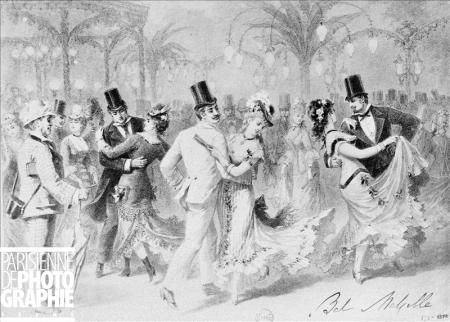
Paris has long been famous for dance, and not just the glamour of the ballet. The city was renowned for its bals (places and events for dancing). At one end of the social scale were the elaborate invitation-only affairs in the hôtels particuliers (private mansions) of the wealthy. Further down the scale one could find an immense variety of dancing opportunities for those with less money but more energy and enthusiasm. Among the latter was the Jardin Mabille.

Paris, Jardin Mabille001

I found this image of one of the most celebrated of all bals in a collection of stereocards. The Jardin Mabille disappeared more than a century ago, but its influence persists.

The original Jardin Mabille was founded by one of Paris’s innumerable dance teachers, who in 1831 opened an outdoor dancing space reserved for his students. Monsieur Mabille (sometimes called Père Mabille, or Father Mabille), leased or owned land on the rue Montaigne (once known as the Allée des Veuves), just off the Champs-Elysées.

In the early 1800s, the Champs-Elysées was not yet the grand avenue laid out by Baron Haussmann. It was a fashionably countrified promenade, a straight, tree-lined drive outside the dense central urban area, leading towards Paris’s suburbs and countryside.

Père Mabille started a small venture, but his sons envisaged something grander. In 1844, they transformed the modest private dancing area into a major public attraction. Over the next few decades, the Jardin Mabille rose to prominence, then declined, and eventually disappeared.

Harriet Beecher Stowe (author of Uncle Tom’s Cabin) visited the Jardin Mabille in the early 1850s, after Père Mabille’s sons had introduced 3,000 gas lights, as well as landscaping with trees, flowerbeds, walkways, scenic paintings and mirrors. Entranced, she wrote of the

flower-beds laid out in every conceivable form, with diminutive jets of gas so distributed as to imitate flowers of the softest tints and most perfect shape… In the centre there is a circle of pillars, on the top of each of which is a pot of flowers with gas jets, and between them an arch of gas jets. In the midst of this is another circle, forming a pavilion for musicians, also brilliantly illuminated, and containing a large cotillion band of the most finished performers. Around this you will find thousands of gentlemen and ladies strolling, singly, in pairs or in groups. While the musicians repose they loiter, sauntering round, or recline on seats.

When the musicians broke into “a lively waltz” she was transported:

In an instant twenty or thirty couples are whirling along, floating like thistles in the wind… Their feet scarce touch the smooth-trodden earth. Round and round, in a vortex of life, beauty and brilliancy they go, a whirlwind of delight, eyes sparkling, cheeks flushing, and gauzy draperies floating by… It is a scene perfectly unearthly, or rather perfectly Parisian, and just as earthly as possible.

9400-8

She was not alone in her enthusiasm. More than a decade later, another observer wrote about the Jardin Mabille in its heyday. G. A. (George Augustus) Sala was among the many journalists who covered the Paris Exhibition of 1867, one of more than nine million people who attended the Exhibition. In a book published in 1868 he evoked “a merry age, a dancing age, a jovial, lighthearted devil-may-care age. Vive la Joie! Vive la bagatelle! Long live the Café Riche and the Jardin Mabille and the Closerie des Lilas and the Thirteenth Arrondissement!”

Curiously, in his 1868 account of the Exposition year, there is no description of dancing at the Jardin Mabille. But he notes that after a song, “Everybody applauds, everybody drinks, everybody is happy.” Going to the Jardin Mabille was about seeing and being seen.

Ten years later, in a 1878 letter to the London Telegraph, reprinted in the New York Times, Sala talks of revisiting the Jardin Mabille. He calls the Paris of 1867 a “sparkling, profligate city” and says that the Mabille had been populated by “the most sumptuous costumes that Worth could furnish, the costliest bonnets that Lucy Hocquet could build.” (Worth was Charles Frédéric Worth, the Englishman who emigrated to Paris and became couturier to Empress Éugenie. Today he is considered the father of French haute couture. La Maison Lucy Hocquet was the hat boutique where only the most well-off could afford to buy bonnets.)

9348-11

In his 1878 letter, Sala reeled off the names of “the grandest dandies from the clubs, millionaires from Brazil, from Mexico and from California; English peers and members of Parliament, Senators, Deputies, diplomatists, bankers, notaries, adventurers” who had patronized the Bal Mabille in the 1860s. But ten years later, something is amiss. Sala no longer sees the gorgeous women he remembered from his earlier visit. “It is only the poor relations…I seem to see at Mabille this Thursday night.” The “velvets and satins, the cashmeres and lace shawls, the brocades and the jewels, the feathers and the flowers of price” were no more.

Above all, the Bal Mabille was no longer a place where people came to dance. Sala notes:

The dancing is a mere hollow imposture… But to keep up the delusion that Mabille is the favorite home of Terpsichore [goddess of dance] the administration hire a few couples of semi-professional dancers.

These dancers he dismissed as “posture masters and mistresses [who] fling their limbs about to the music of a tolerable band at stated intervals during the evening.” What bothered Sala the most was the presence of what he called the gobemouche (literally, fly-swallower): the horde of gaping, naïve bumpkins. Gone was the sense of exclusivity that had thrilled him in 1867. Gone were the moneyed patrons, or at least those who had the appearance of money.

About the same time, John Russell Young accompanied then ex-President of the United States, General Ulysses S. Grant, on a world tour in the 1870s. Young went to the Jardin Mabille and saw the paid dancers who “mingle around in the crowd as though they had paid to come in.” Then “when the music commences (generally the music of the harmonious Offenbach), these young men and women rush upon the boarded floor and dance peculiar dances—the ‘Can-can,’ among others—not much worse than I have seen it on the New York stage.”

Young did not like the Jardin Mabille. But he had one explanation of its popularity amongst his fellow countrymen.

Mabille is said to be a very bad place, and [our American friends] attend expecting that something outrageous will certainly happen. I do not imagine that it occurs to one out of ten of our observing countrymen that Mabille is simply an institution kept by a Frenchman for English and Americans to visit.

The same comment is echoed in the writings of David Ross Locke, a.k.a. Petroleum V. Nasby, stage performer and writer, friend of Mark Twain, who set off in 1881 to visit Europe. To defray some of his expenses, he wrote about his travels for the Toledo Blade. Locke/Nasby described professionals at the Jardin Mabille doing their version of a “style of dancing [that] was always in favour in Paris among the people.”

Locke/Nasby had caught on to an important distinction. France had a long tradition of popular dances, that is, dances invented by poor people for whom exuberant movement was a welcome relief in lives filled with stress and hardship. But as tourism became a more important economic force, something happened to the lively dances at the Jardin Mabille. What had once been an individualistic expression of life’s ups and downs in dance, the can-can, a French working-class dance that had originated in the 1830s, was refashioned in the music halls of Britain and the musical stages of America as a public entertainment. Then it was reimported to Paris as an amusement for tourists, endlessly reproduced at the Moulin Rouge and the Folies Bergère.

And so it continues. The tourists are titillated by a dance that seems risqué and the locals earn money from their performance. What does it matter if the dance is not “authentic”? It has been evolving constantly since the 1830s. Culture is never static.

Text by Norman Ball. Historic illustrations from Paris en Images.

Posted in Paris dance, Paris history, Paris popular culture | Tagged , , , , , , , , , , | 8 Comments

A parachute in the Parc Monceau

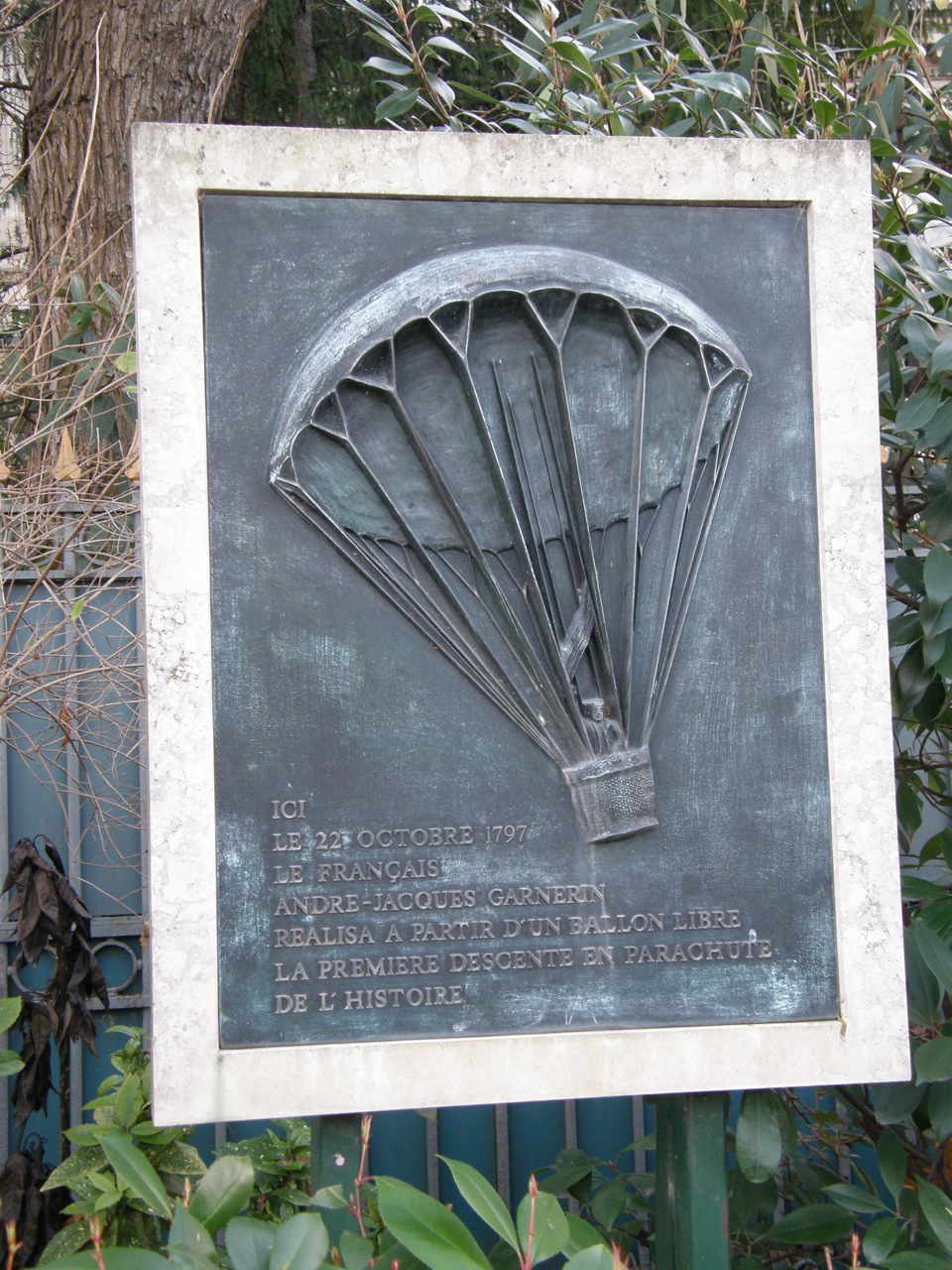
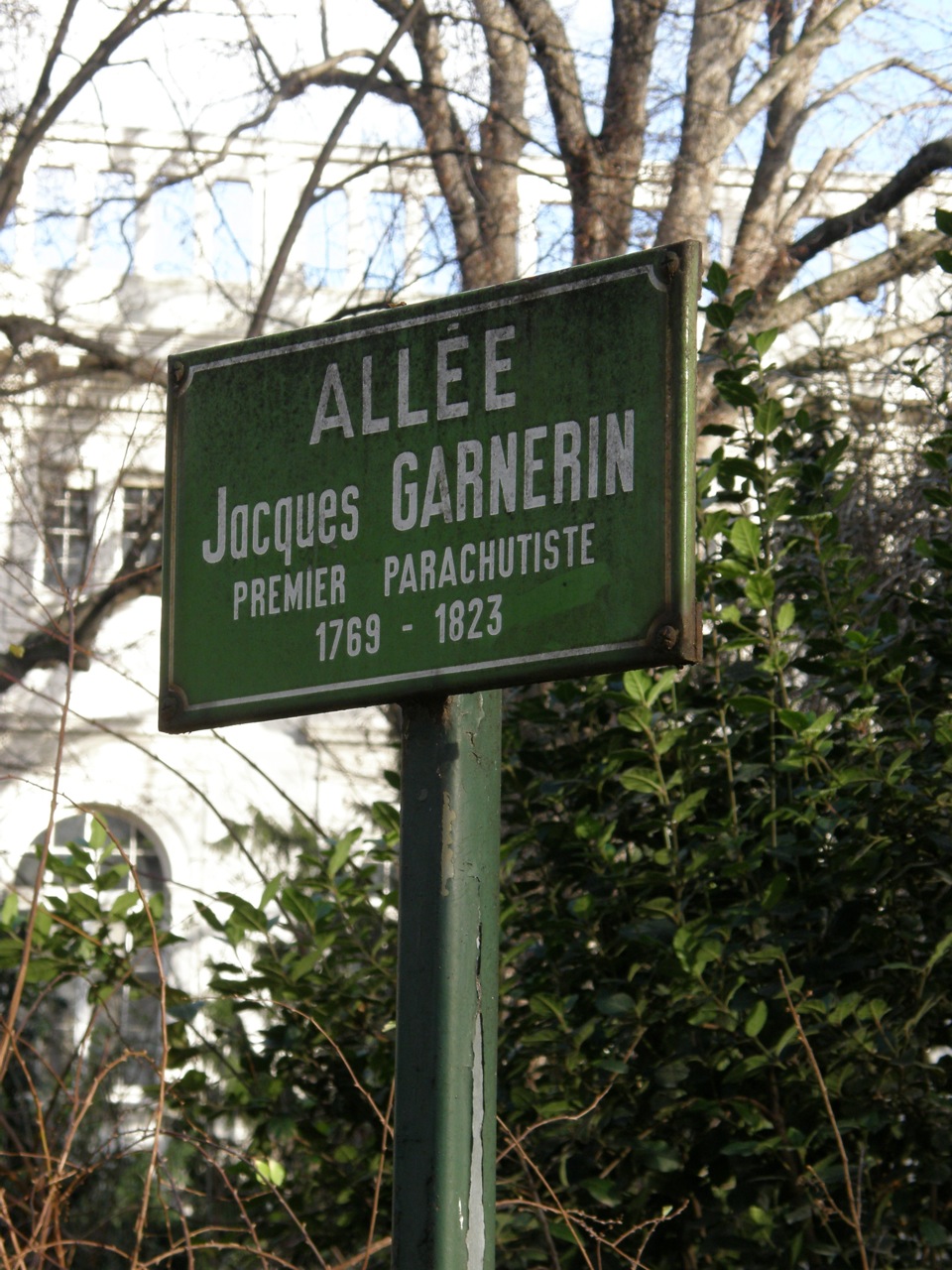
On Christmas Day, before it was time to go to dinner with friends, we wandered into the Parc Monceau. We have walked in the quiet park many times before, but had not noticed the little plaque near the path running along the south side.

PC251091

In translation it reads:

Here
On October 22, 1797
The Frenchman
André-Jacques Garnerin
Made from an untethered balloon
The first parachute descent
In history.

We had stumbled upon an important part of French aviation history. In the 1790s, ballooning or aerostatics was glamorous advanced technology. Ballooning represented adventure, fame, and the desire to push out the frontiers of knowledge, practice, and experience.

The ballooning craze burst onto the scene on June 5, 1783, when the Montgolfier brothers, Joseph-Michel and Jacques-Etienne, launched the world’s first successful hot-air balloon. There was no one on board, but the public was entranced. A new word entered the French vocabulary: montgolfier, meaning a hot-air balloon. Public interest grew even more feverish on October 15 of the same year, when Etienne Montgolfier went aloft on a tethered flight, a feat equalled the same day in the same craft by Pilatre de Rozier.

The next step came on November 21, 1783, when two men (Pilatre de Rozier and the Marquis François d’Arlandes) succeeded in going aloft and descending alive after an untethered flight. The feat was both exciting and controversial. King Louis XVI had thought it too dangerous an exploit for solid citizens and had proposed that criminals be sent up first to test the technology. He was over-ruled (not for the only time in his short life).

But hot air was not the only way to go aloft. Hydrogen gas, while dangerously explosive, is also lighter than air. August 27, 1783, was the date of the first unmanned flight in a hydrogen-filled balloon, from Paris to Gonesse, a distance of 25 km (16 miles). There followed flights with animals on board.

Meanwhile, ballooning mania had spread to all manner of toys, ornaments, jewellery, and household goods and furniture, including chairs with balloons carved in their wooden backs. Balloons were even used to hold lanterns aloft at parties.

2421-1

On December 1, 1783, less than two weeks after the first untethered manned flight in a hot-air balloon, a hydrogen balloon soared aloft from the grounds of the Château des Tuileries, where a huge crowd (one estimate was 400,000 – that is, more than half the population of Paris, so perhaps an exaggeration) turned out to watch.

The hydrogen-filled balloon made two flights that day. The first carried physicist Jacques Charles and his assistant, Nicolas-Louis Robert, 43 km (27 mi) from Paris to Nesles-la-Vallée. Then Jacques Charles took off again from their landing place and ascended to an altitude of 3,000 metres (9,842 feet).

Where does our parachutist of the Parc Monceau enter the picture? André-Jacques Garnerin was born in Paris January 31, 1769. As a teenager he fell under the spell of ballooning. He studied physics under Jacques Charles (yes, the same Jacques Charles) and joined the army, where he held the rank of Inspector. He staunchly advocated ballooning for military purposes.

The year 1792 saw the beginning of what became known as the French Revolutionary Wars. Garnerin was captured by the British, handed over to the Austrians, and spent two or three years in prison in Buda. He survived these ordeals and on his release returned to his favourite pursuit.

Garnerin was both pioneer and showman. He became well-known for ballooning demonstrations in Parc Monceau. But the public can be fickle and Garnerin faced the question that many daredevils face: What next? Going up in an untethered balloon was becoming less novel. The public wanted more. How about jumping from one? The idea of parachutes was not new and there had been stunts such as jumping from a tall building. Garnerin decided to go one better.

Paris balloons001

On October 22, 1797, Garnerin ascended from Parc Monceau and leaped into history as the world’s first successful parachutist from a balloon. For his act of faith and courage, he was named “official French aeronaut of the state.”

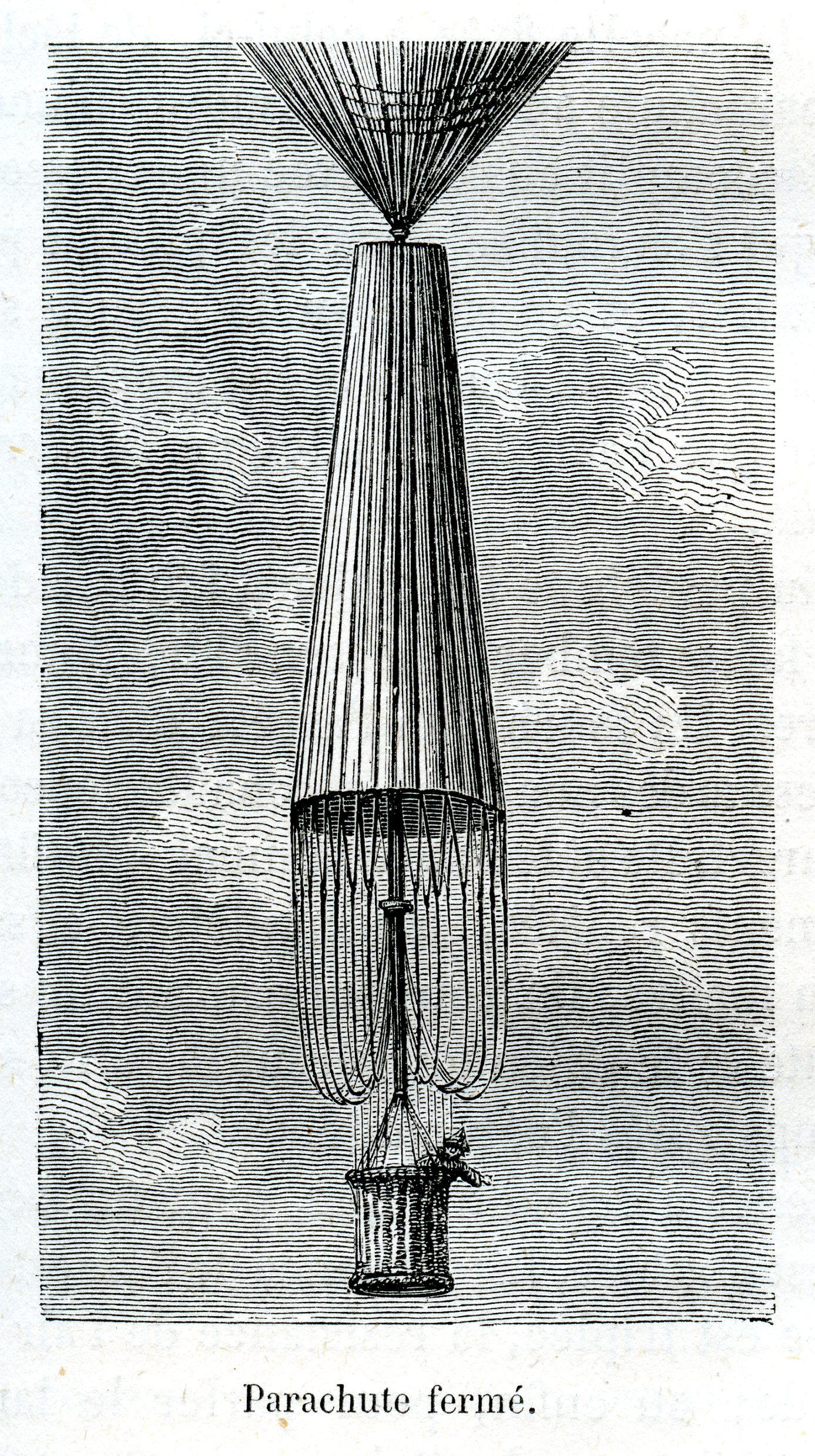
Unlike modern parachutes, Garnerin’s was not strapped onto his body. His parachute was attached to the underside of the balloon, and he was in a gondola or nacelle attached to the parachute. In the image above, we see the parachute looking like a folded umbrella attached to the underside of a balloon. When it was time for the jump, the parachutist simply released the cords attaching the parachute to the balloon, which drifted away, as we see in the image below of a descent made by Garnerin in 1802 in Britain, the first such feat performed there.

Paris balloons002

Descriptions of Garnerin’s early jumps suggest that the feat required a lot of nerve. First, the unopened parachute descended quickly; anyone watching feared the worst. As the parachute opened, the speed of descent slowed considerably, but the nacelle was subject to huge oscillations, making it appear as if it would be turned upside down and the parachutist would be lost.

The oscillations occurred because the parachute captured large volumes of air as it descended. This air had to escape, but unlike in more modern parachutes, there were no vents.

Descriptions of both parachute landings as well as balloon landings often included frightful accounts of the nacelle being dragged along with ground with its hapless occupants. Perhaps it is no wonder that a contemporary term for untethered balloons was ballon perdu, which we might translate as a “lost balloon.” It was “lost” only in the sense that there was no way of controlling it; the balloon went where the air currents drove it. There is another meaning to perdu, an archaic military term applied to a mission that seemed doomed from the start. No wonder Louis XVI thought balloon ascents should be reserved for criminals.

Garnerin continued to provide further thrills and parachute jumps as an international showman, balloonist, and parachutist. He shocked many with his proposal to take the first woman passenger aloft in a balloon from Parc Monceau in 1798. Public and press were enthusiastic, officialdom less so. First, there were scientific worries. Increased altitude means less air pressure and there were fears this could damage the delicate organs of even the healthiest female and cause her to faint. And there were worries on moral grounds. Just what might these two aeronauts be up to in the seclusion of the upper altitudes?

PC251103

Official worries were overcome, Garnerin looked after publicity, and on July 8, 1798, a large crowd assembled in Parc Monceau to see the reportedly young and beautiful Citoyenne Henri and Garnerin walk about the park before astronomer Jerôme Lalande assisted her into the basket. They were next seen about 30 km (19 mi) north of Paris when they landed at Goussainville.

Citoyenne Henri seemed to be none the worse for wear and whatever happened in the privacy of the balloon’s airborne basket, stayed in the basket. Further developments were reserved for Jeanne-Geneviève, Garnerin’s wife (and former student), who in 1799 became the first woman parachutist.

What happened to André-Jacques? Ballooning eventually took his life, but in an unexpected way. He was hit on the head by a beam while working on balloon equipment and died in Paris on August 18, 1823. His older brother, Jean-Baptiste-Olivier Garnerin, who had worked with André-Jacques for most of the balloonist’s career, lived for another 23 years.

PB110253

Perhaps one question remains. As we looked at the plaque, Philippa asked, “Why would he do it from here? Surely there are too many trees and houses in the way.” But both Paris and Parc Monceau were different then.

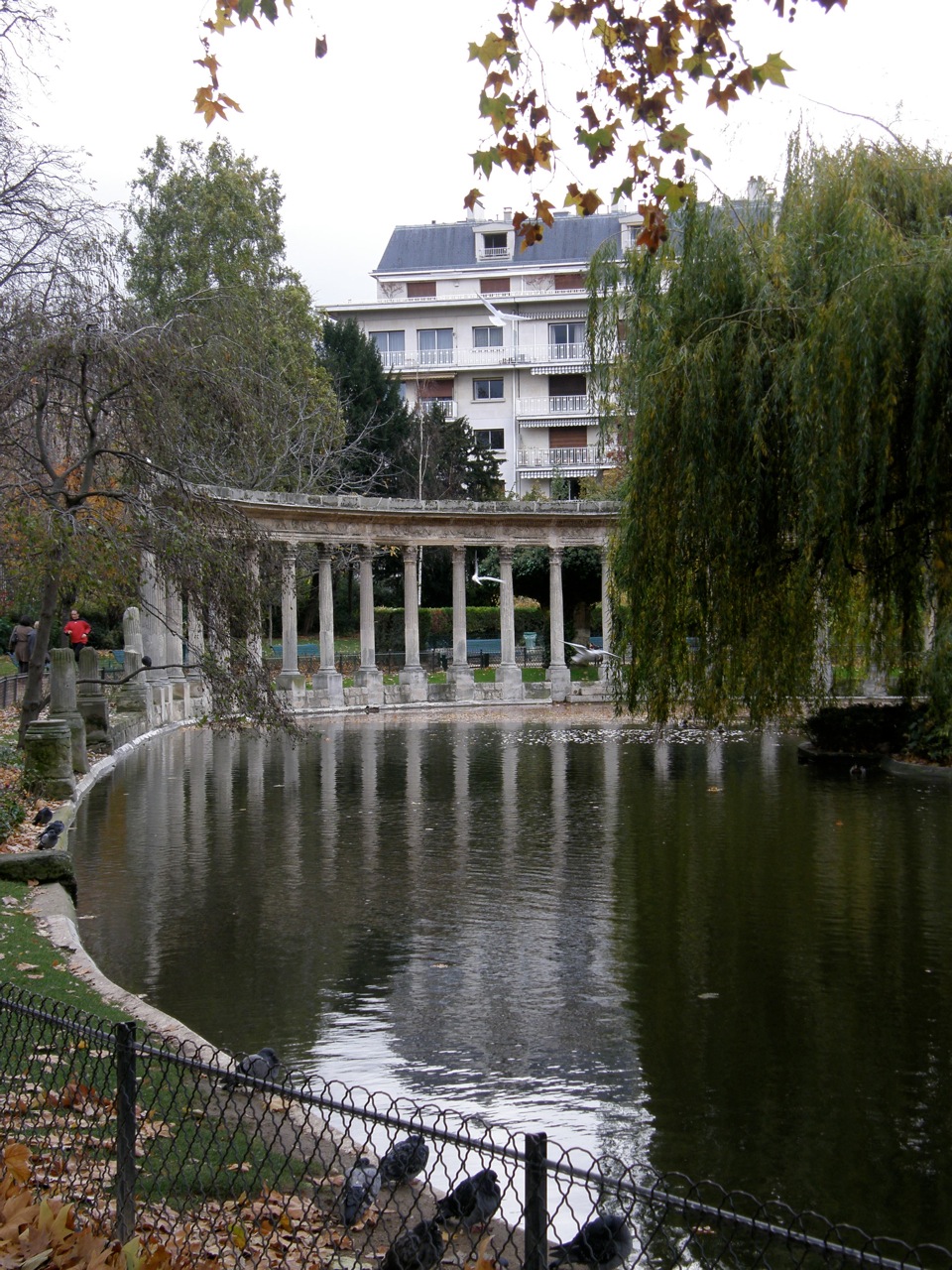
The Parc Monceau was established by the fabulously wealthy Philippe d’Orléans, Duke of Chartres, a cousin of King Louis XVI. In 1769 he began purchasing property in what was then known as the Monceau Plain and nine years later decided to create a public park. Although later modified, it was not intended to be a typical formal French park, but rather something that would surprise and amaze visitors.

The Duke of Chartres gave the design work to Louis Carrogis Carmontelle, who later wrote that the garden was “simply a fantasy, to have an extraordinary garden, a pure amusement.”* The park included statues, a windmill, a farmhouse, a lily pond, a miniature Egyptian pyramid, a Roman colonnade, a tartar tent, a temple of Mars, a minaret, an Italian vineyard, an enchanted grotto, and “a gothic building serving as a chemistry laboratory.”*

The Parc Monceau was unabashedly about fun and amusement. Alas, the Duke was guillotined during the Reign of Terror in 1793, and his park was nationalized. With the restoration of the monarchy in 1815, the park was returned to the Duke’s family, who reduced it by about half when they sold off lots to developers, who built luxurious houses all around. So Garnerin had taken off from a much larger park, with fewer surrounding buildings.

PB110248

The park changed hands again in 1860, when the city of Paris purchased it. Soon it was swept up in the remaking of Paris by Napoleon III and Baron Haussmann. In August 1861, it became the first of the new public parks in Paris to be remade and its appearance changed again.

Our serendipitous discovery in Parc Monceau on Christmas Day illustrates why we keep returning to Paris. No matter where we go, we find small clues that open up larger vistas, sometimes immediately and sometimes only after further research. Henry David Thoreau captured the essence of the experience of a place with his observation that “The question is not what you look at, but what you see.” He did not have Paris in mind, but we do when we read his words.

985-5

Text and original photographs by Norman Ball. Engravings from F. Marion, Les Ballons, Hachette, 1874. Other historic images from the Roger Viollet collection, Paris en images.

*Quoted by Dominique Jarrassé, Grammaire des Jardins Parisiens, Parigramme, Paris (2007), and cited in the Wikipedia article on the Parc Monceau.

Posted in Paris history, Paris parks | Tagged , , , , , , , , , , , , , , , , | 12 Comments

The chariot on the Champs-Elysées

For many people in Paris, owning a car is neither necessary nor desirable. Transit service is good and parking is difficult. But that means that when your groceries include, say, containers of milk or orange juice, bottles of wine or San Pellegrino (San Pé to the Parisians), cans of soup or cassoulet, or jars of jam or tomato sauce, the walk home can feel very long. So do your arms.

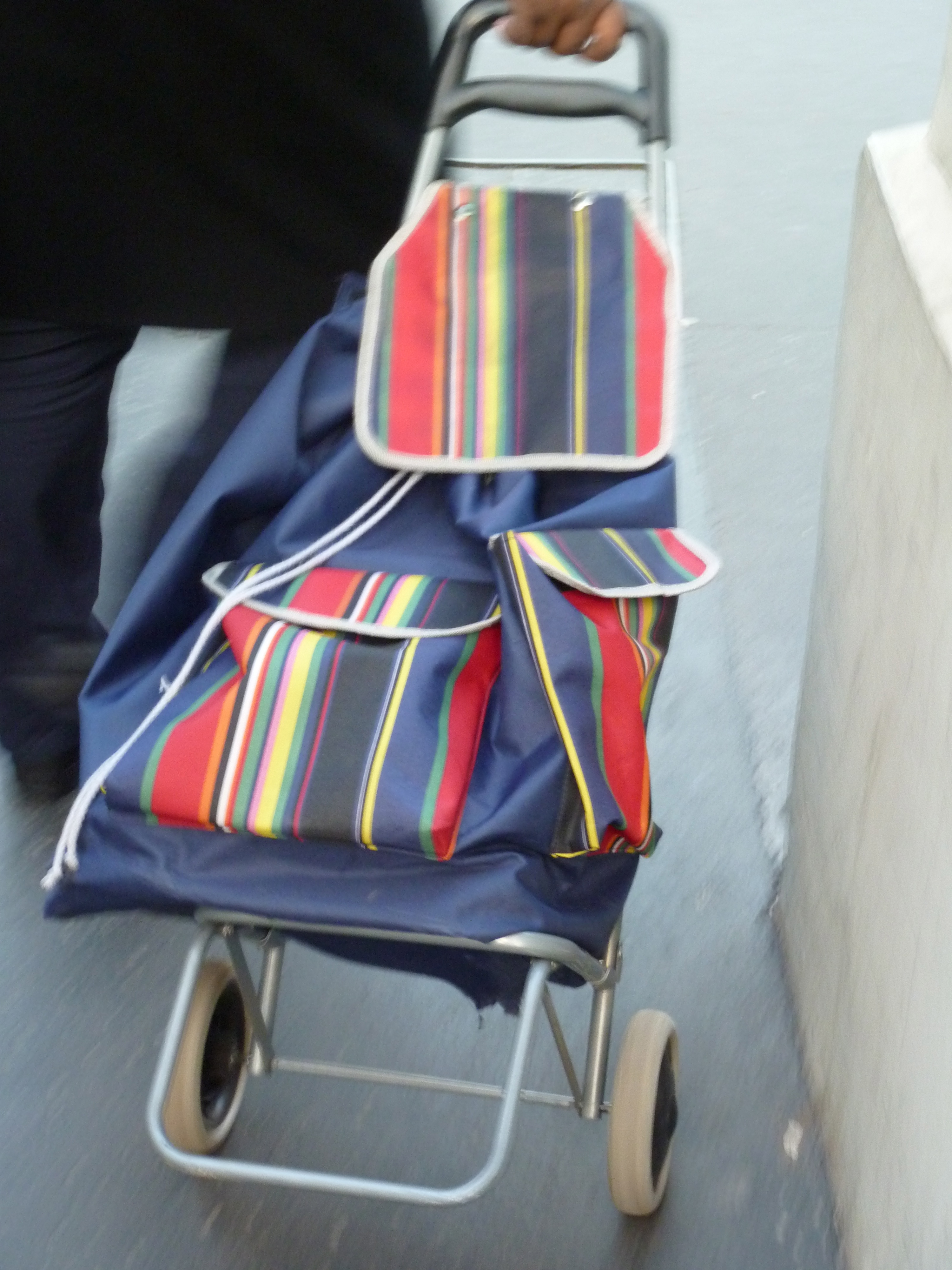
What you need is a bundle buggy (a.k.a. chariot de courses, sac à roulettes or caddie). Fill it up and wheel it home. We decided to get one for our daily shopping trips.

P1090266

But first, some market research. This meant looking at what other people were using, and checking out the shops.

We wanted something sturdy and capacious. This one looked too flimsy. And too small.

P1090164

We wanted one with a drawstring closing, so our groceries wouldn’t fall out. This one looked insecure.

P1100236

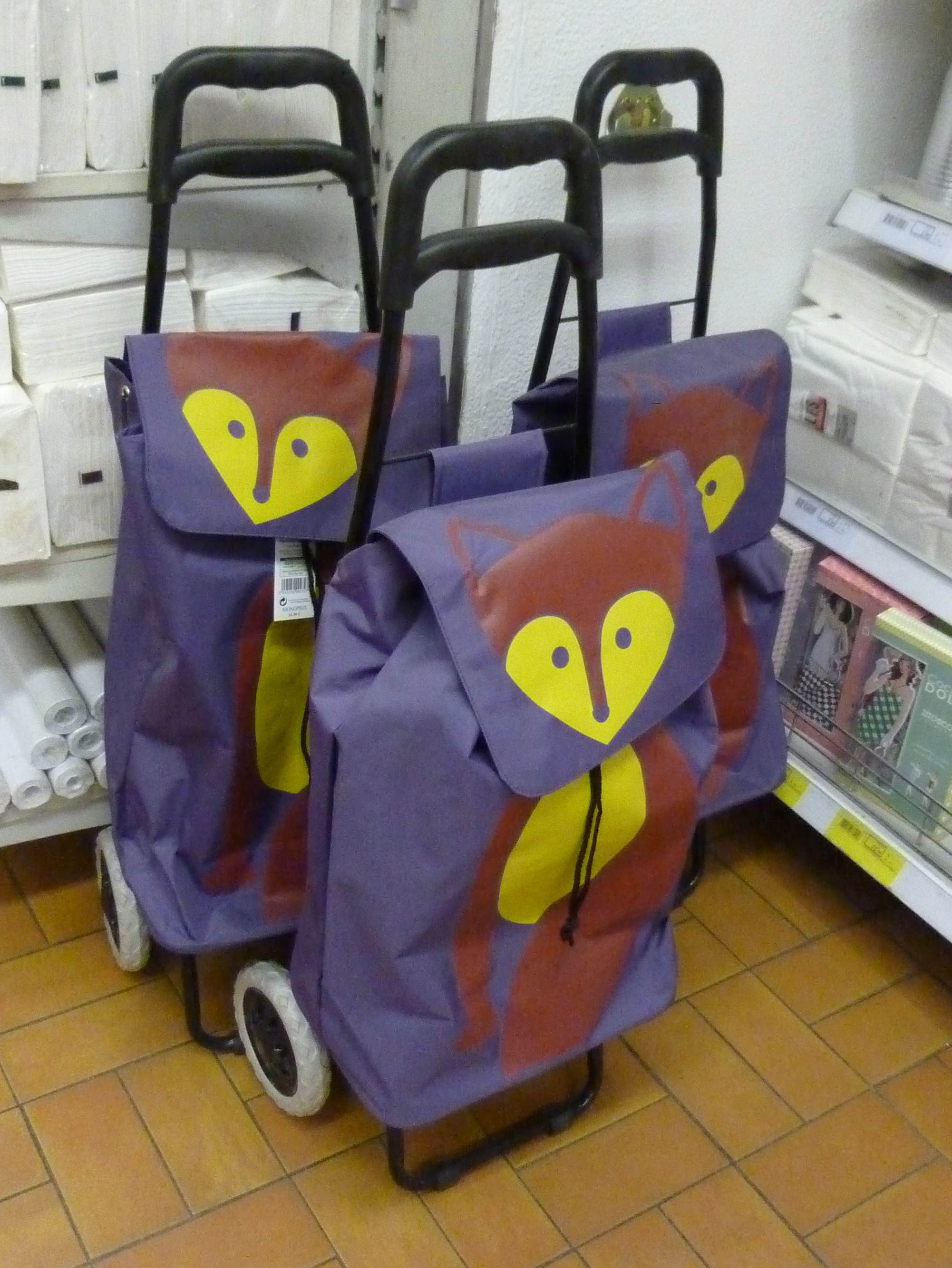
No cartoon characters or cute animals.

P1090689

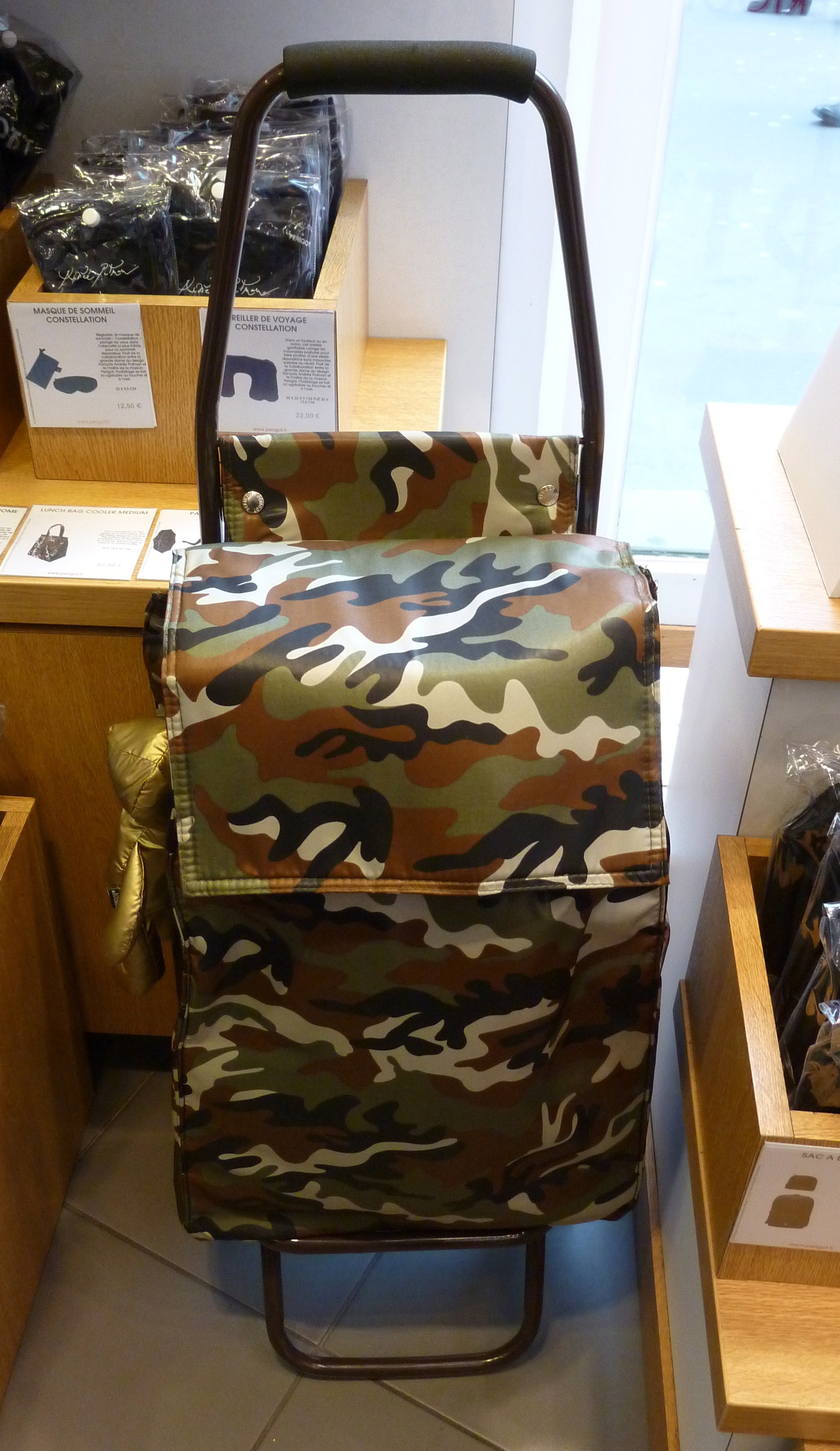
And affordable. The shop called Perigot sells a whole range of chariots in trendy patterns, including camouflage, but they cost about three times what we were willing to pay.

P1090712

That requirement took us to the 14th arrondissement. We had stayed a few times in this area, and we knew they had shops that sold relatively inexpensive chariots.

The first shop we tried on the rue Raymond Losserand had a simple, sturdy black number, but the manufacturers (we assume it was made somewhere in Asia) had tried to jazz it up with English words: “You Be Satisfy.”

No, we thought, we not be satisfy. We are not walking through Paris with silly English words on our buggy.

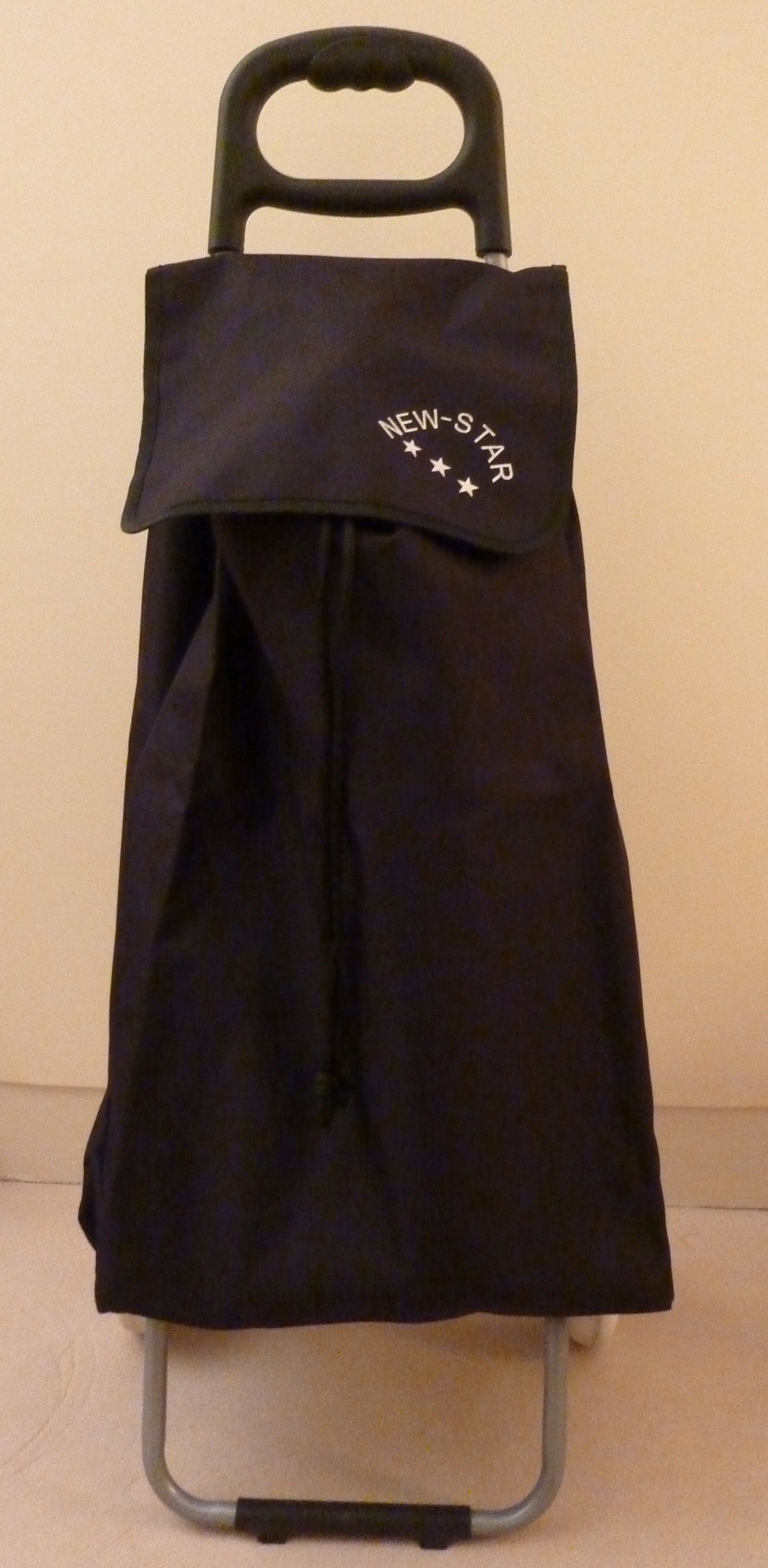
After looking in a few more shops in the area, we found another sturdy black one that said “New-Star.” We figured we could live with that, even though the hyphen was surplus to requirements. So we bought it for 29 euros.

P1100324

It had a rectangle of sturdy particle board on the bottom that could support 6 bottles of wine or San Pé standing upright, or three lying flat. There were two extra pockets on the back, solid-looking wheels, zippers on the sides to allow for expansion, and a comfortable handle.

Before leaving the area, we did some shopping at the mammoth Monoprix store in Montparnasse and brought the loaded chariot home on the bus without incident.

However, our local Monoprix is the one on the Champs-Elysées. And it was Christmastime. The broad boulevard is full of tourists and families out admiring the lights and the Christmas market. Pedestrians stop suddenly to take pictures, wander aimlessly back and forth, and move about in groups. Progress with a chariot is slow.

And when you get to Monoprix, the groceries and packaged goods are in the sub-basement, down two flights of stairs. There is no escalator. Norman had his work cut out getting the filled chariot back up to the street. (When Philippa went a few days later on her own, and was slowly bumping the New-Star up the stairs, the young woman behind her on the stairway grabbed the bar at the bottom and helped her carry it up, all without interrupting her conversation with the friend beside her. Many Parisians are like that – they do you a good turn without appearing to acknowledge that they are doing so.)

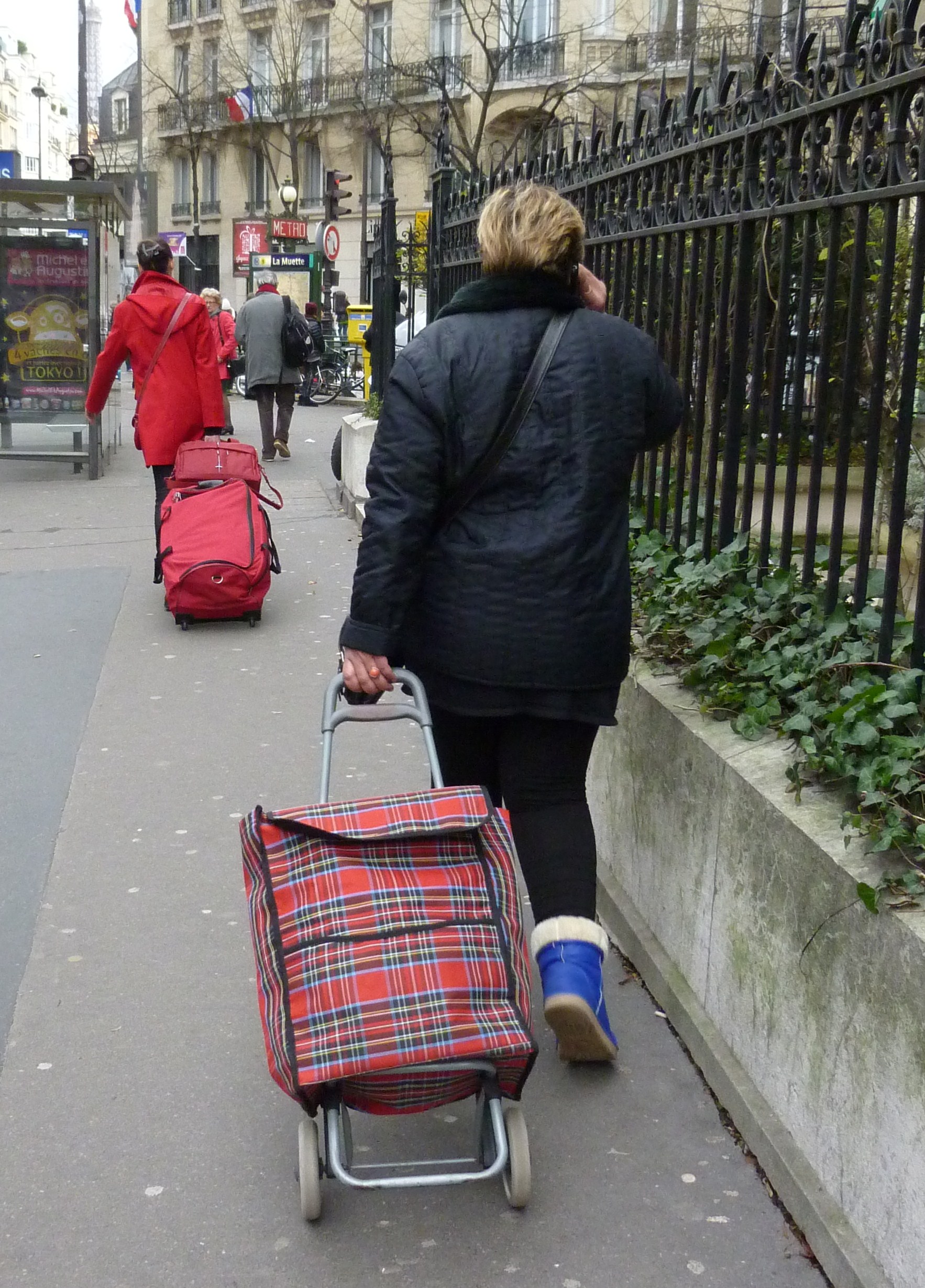
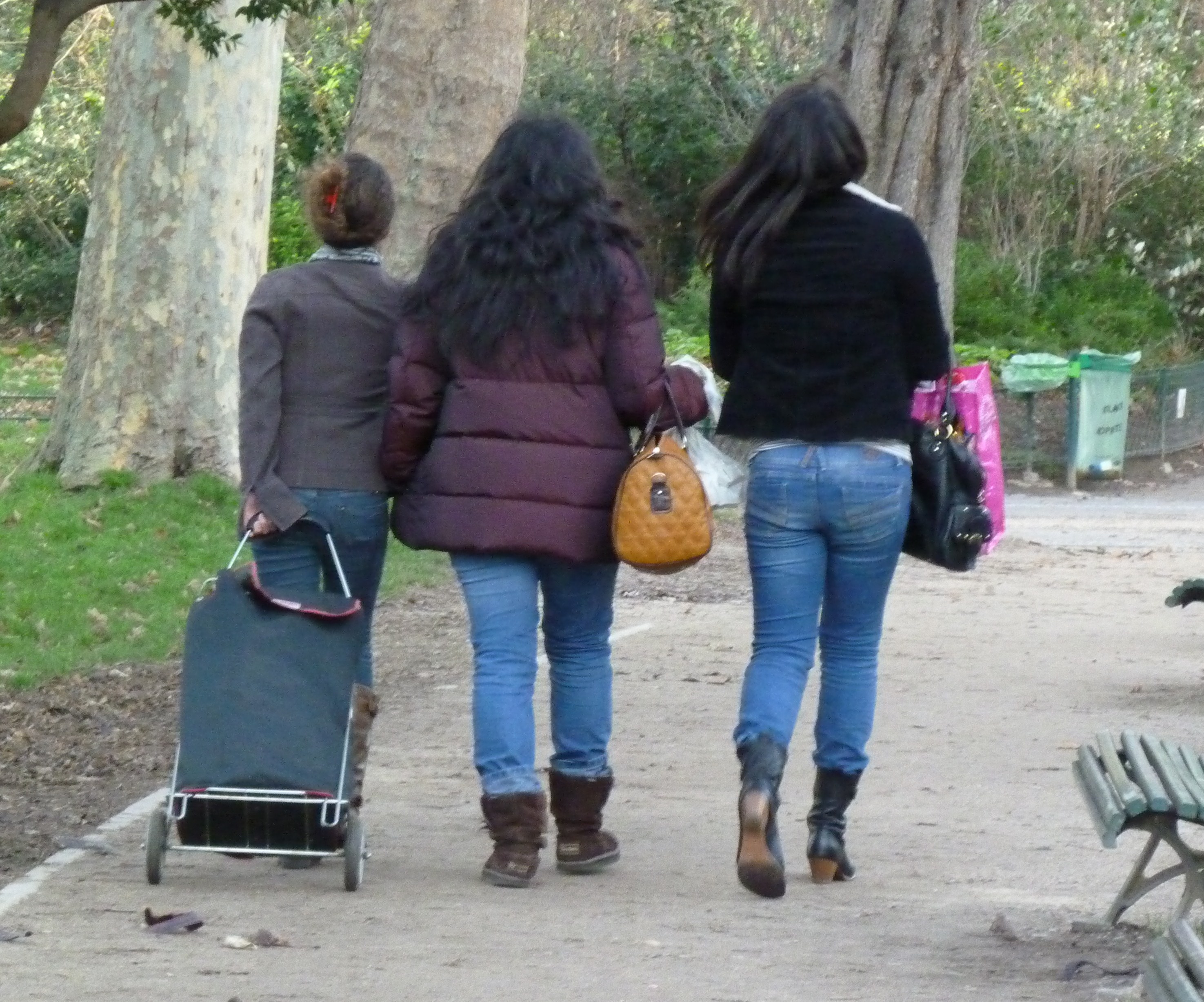
At least the Champs-Elysées is nice and wide. On smaller streets, you must hold the chariot underhand, with your hand held behind your back, so that you and the chariot are single file on the narrow pavement. Here is a picture showing the approved method, although it was taken in the broad allées of the Parc Monceau. Presumably this young woman was simply accustomed to holding it like that all the time.

P1100178

In the shops, there is a protocol for chariot users. If you enter with an empty chariot, you may fill it with your intended purchases, and then take them out and put them on the counter when you get to the cashier. However, if you enter a shop with a chariot that already has purchases in it, you should leave it at the door or with a cashier and, if necessary, use one of the metal or plastic caddies they provide.

You also have a new responsibility. Towing a chariot through the city makes you look like a resident, so tourists and even Parisians have a tendency to ask for directions. It helps to know the quartier well enough to direct people to major destinations, although Philippa was stumped when a woman with a small child asked where to find the office of social services.

Most of the chariot users we noticed were women, but Norman, who often goes grocery shopping with Philippa in both Paris and at home in Toronto, had no problem being the charioteer. Here he is window shopping on a rainy day with the New-Star in tow after a visit to the Nicolas wine shop.

P1090953

When we left Paris, we had to leave the New-Star in the apartment we had rented through friends. But we’ll be back and we know it will be there, ready for more adventures.

Happy New Year to all our readers.

Text and photographs by Philippa Campsie

Posted in Paris food, Paris markets, Paris shops | Tagged , , , , , , , , | 20 Comments

The Twelve Fleas of Christmas

A little less than twelve days before Christmas, my true love and I made a trip to the Marché aux Puces de Clignancourt. It was a chilly December Saturday morning, so the first order of business was to fortify ourselves against the cold with a café crème at a cozy inside table. Then we strolled among the shops, encountering the following items for sale.

P1090416

12 ostrich eggs on a padded swivel chair from some long-abandoned office. That will teach you to sit down without looking.

P1090358

Across from the café we found 11 globes on a shelf. They still show things like the Soviet Union, so they are for ornament only, not instruction.

P1090456

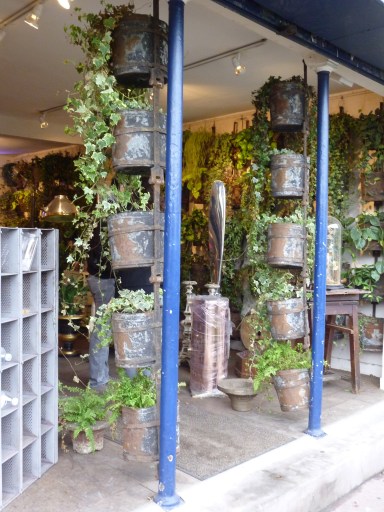
We spotted 10 pots of ivy and ferns in a florist’s shop on the rue des Rosiers (not to be confused with the street of the same name in central Paris, in the Marais; the flea market is in the commune of St-Ouen to the north of Paris).

P1090402

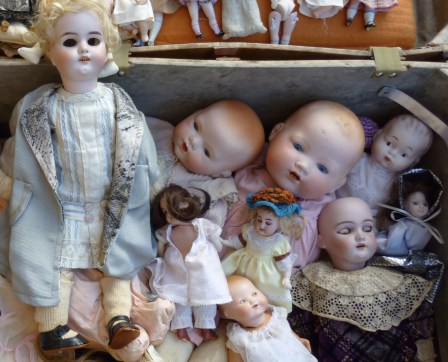
The 9 dolls in a box were part of a larger collection of dolls with porcelain heads. When she was a child, my mother had a doll called Felicity with a porcelain head. I wonder if Felicity might have been French.

P1090462

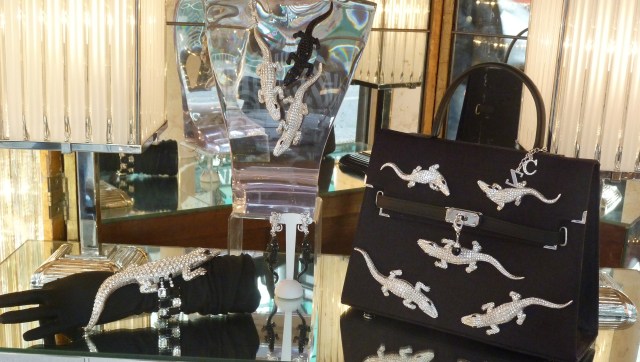
The 8 sparkly salamanders were in a boutique selling second-hand jewellery. A bit too glittery for me.

P1090418

When we returned home and I looked through my photographs, I thought at first that I did not have a picture that represented 7 of anything. And then I realized that there were 7 little white elephants (some might be ivory, some might be plastic) in a cabinet that was otherwise filled with pocket watches and compasses.

P1090375

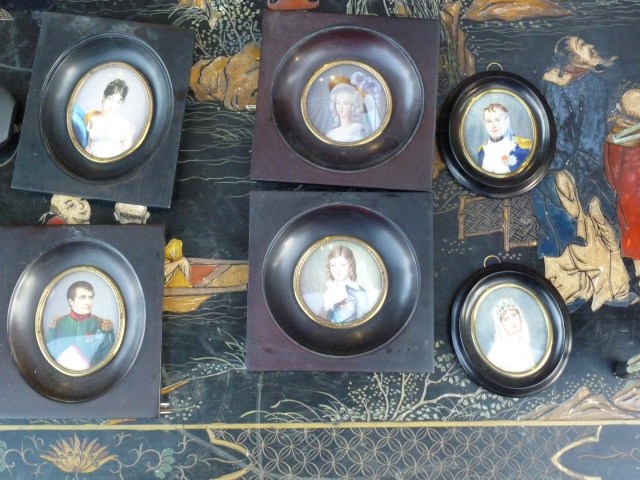
Six is for 6 royal and imperial miniatures. Can you identify them?

P1090390

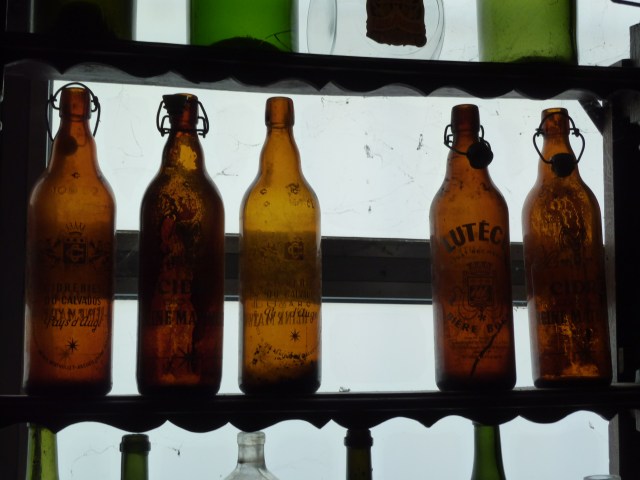
Five is for 5 amber bottles (cider and calvados) in the window of a shop selling all manner of bits and pieces related to food and drink.

P1090354

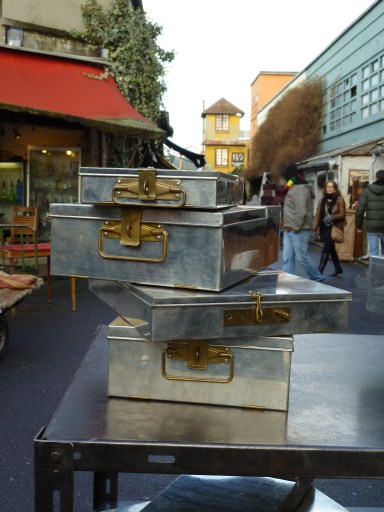
Four is for 4 metal cash boxes in a pile: these are modern reproductions of a traditional type of box, not antiques. Not everything in the Marche aux Puces has a lengthy provenance.

P1090349

Three is for 3 glass domes. Perfect for your stuffed owl collection.

P1090404

Two is for 2 armless half mannequins on a table. Useful for displaying hats, scarves and necklaces. Not so good for gloves or bracelets.

P1090384

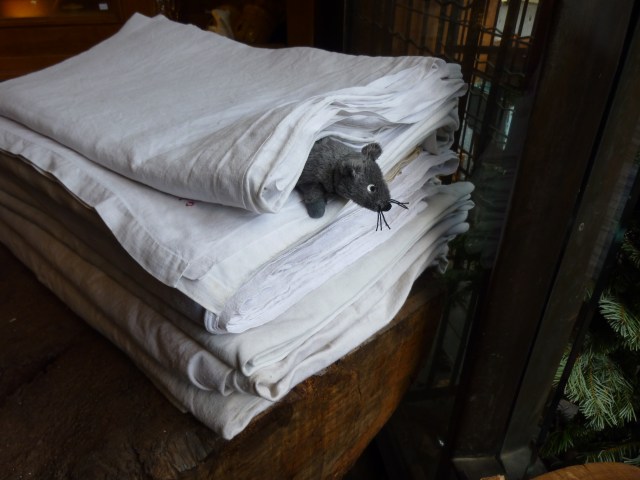
Finally, one is for a toy mouse (or rat) peeking out from a pile of linen. This was in the shop with the bottles and other food-related items. The woman minding the shop told us that some months ago, there was a special event at the Puces, and each boutique was invited to add some decorations related to a specific film. Her shop (naturally) chose the theme of the movie Ratatouille, and tucked toy mice/rats into pots and pans, glasses and napkins. Apparently at least one customer shrieked when he first spotted one.

Our day at the Puces was rounded out with a visit to the wonderful Librairie de l’Avenue, where the 92-year-old Jean Bedel was signing copies of his latest book, Saut de ‘Puces’ à Saint-Ouen. Naturally, we bought a copy and had it signed. We even chatted to the publisher (Monelle Hayot) over a glass of champagne.

As he wrote an inscription in the book, Bedel asked me for the English equivalent for “chineur.” This is what the French call the type of people who haunt flea markets. I suggested “bargain-hunter,” but it is not really the same thing. Bargain hunters in Canada go to Dollaramas. Chineurs are at least one part antiquarians and they are hunting for more than simply utilitarian objects. And the word includes both buyers and sellers.

It was a wonderful day, thanks in part to advice from our friend Michael, a Parisian letterpress printer. In the spirit of Christmas we share it with you. And may you too have a visit as fine as ours.

Take the No. 85 bus, which connects with the No. 1 Metro line at Louvre-Rivoli. The bus winds its way up and down the Montmartre hill on its way north (sit back and enjoy the tour).

Do not get off at the Porte de Clignancourt (the stuff here is for bargain hunters, not chineurs). Do not get off at the stop called “Marché aux Puces” (You will be tempted, I know, but your patience will be rewarded).

Wait until the bus is inching its way up the crowded and impossibly narrow rue des Rosiers and get off at the stop called “Paul Bert.” You will be right in the middle of the action, across from the Paul Bert/La Serpette market, which is where you will find some of the more interesting and unusual boutiques.

Merry Christmas to all and to all a good Paris flea market.

Photographs by Philippa Campsie; text by Philippa Campsie and Norman Ball.

Posted in Paris flea markets | Tagged , , , , , , , , , , , | 24 Comments

What a croque

It all started so innocently. I was going to write a blog about a simple and unremarkable café meal, the sort of thing that warms one up on a cold December day with a glass of vin chaud, and before I knew it, I had stumbled into a culinary and historical minefield.

First, the culinary difficulties. I wanted a straightforward recipe for a Paris dish so unremarkable that it is a cliché: the croque monsieur. I consulted some of my French cookbooks; I searched the Internet. And within a few minutes, I was knee-deep in controversy. What is a croque monsieur?

Croque_monsieur

I would have said that it consists of a couple of slices of even-textured bread (not a baguette), some ham in the middle, grilled with a bit of butter, and topped with a cheesy béchamel sauce, which might include a dash of mustard.

Nearly every element in that combination appears to be contested. Let’s start with the bread. Ginette Mathiot, author of the classic French cookbook Je Sais Cuisiner, calls for pain de mie (white sandwich bread), preferably a bit stale (rassis), with the crusts cut off. But others recommend fresh pain de mie, sturdier pain de campagne, or pain complet (wholewheat/wholemeal bread). What you do with the crusts is your business.

Can we all agree on the ham? Up to a point. Ginette Mathiot allows for a “croque monsieur économique” without any ham at all. Clothide Dusoulier, in her book Chocolate and Zucchini, specifies “brine-cured ham” rather than dry-cured ham. Fine, whatever.

Cheese? Julia Child, for some reason, favoured Mozzarella. Most recipes specify Gruyère. Some mention Emmenthal. But those are Swiss cheeses, and there are some nationalists in the room. Clothilde, who is French, allows for Comté as an alternative, and Nigel Slater (author of Real Fast Food), being English, says Cheddar is an option. Fair enough. I’m Canadian: can I make it with Oka?

And what do you do with the cheese? Grate it or slice it? Put it in between the bread slices with the ham or on top? Add it to a béchamel sauce? Take your choice. You will find at least one celebrity chef who endorses your preference.

Finally, grill it, bake it, or heat it in a pan with lots of butter?  Or – as Samuel Chamberlain suggests in his book Clémentine in the Kitchen – drench it with egg and make it into a sort of pain perdu (French toast) version? I had something like that in a Canadian diner once. It was vile. Then I found this comment on a recipe website:

Some people will tell you that a croque-monsieur is dipped in an egg wash – like French toast – before being fried. Remove those people from your autodialer this instant. These same people may also tell you that you can purchase a special croque-monsieur grilling iron, with shell-shaped indentations on each side that fold together, squeezing the sandwich inside, which is then placed on a grill and turned when half done, which produces a shell-shaped sandwich. While this is technically true, it has nothing to do with the traditional croque-monsieur, and since you’ve already deleted these people from your autodialer, you needn’t be troubled by them further.

I have no idea who wrote that, but I couldn’t agree more.

As for the historical difficulties, the rumours start with the Larousse Gastronomique, which states that the first croque monsieur (in all history?) “was served in 1910 in a Parisian café on the boulevard des Capucines.” Nine out of ten recipe writers repeat that incomplete and implausible factoid. I ask you, if the date is known and the street is known, then why not the restaurant or the chef?

scan0001

Let’s start with the date. Apparently Proust had a childhood fondness for croque-monsieur, and he was born in 1871. He mentions croque-monsieur in a letter he wrote to his mother in the 1890s. So 1910 sounds a bit off the mark for the very first one.

Then the place. When I Googled “croque monsieur” and “boulevard de Capucines,” I found a reference to a restaurant called “Le Trou dans le Mur” (the Hole in the Wall). Here is the story according to “Paris le Nez dans l’Air” (my translation):

It is often said that the French, and the Parisians in particular, are adept at “System D.” D for “débrouiller” [meaning coping with whatever life dishes out]. Sometimes this ability reaches the heights of ingenuity. On February 23, 1848, in the early days of the revolution that would usher in the Second Republic, a cannonball smashed into a concierge’s lodge at 23 boulevard des Capucines. But the cannon blast was not wasted. The concierge, who miraculously survived, had the bright idea of exploiting the yawning gap that exposed his lodging to the sidewalk. Thus was born the café known as “The Hole in the Wall.” It evolved from a local watering hole to a chic bar frequented by the who’s who of Paris. It is even said that in this location was born an English specialty: the croque monsieur.

It’s a great story. And I don’t believe a word of it. According to histories of 1848, there was a bloody stand-off on the boulevard des Capucines on the day in question, but it started when a group of rioters confronted a group of soldiers and a gun went off. The violence escalated and when it was over, between 30 and 50 people were dead. But in the accounts I have read, there were no cannons involved. This was not a pitched battle, planned in advance with heavy artillery in place. There were disorganized rioters and frightened soldiers with guns who overreacted. And I found no mention of any holes in walls. At least not on the day in question. Perhaps it was created some other time, during some other conflict. Or by some other means.

scan0002

Then I tried Googling “Trou dans le Mur/Hole in the Wall.” The search took me to Ernest Hemingway, who wrote:

The old Hole in the Wall bar…was a hangout for deserters and for dope peddlers during and after the first war. The Hole in the Wall was a narrow bar, almost a passageway, on the rue des Italiens with a red-painted façade, which had, at one time, a rear exit into the sewers of Paris from which you were supposed to be able to reach the catacombs.

Oh, sure. Hemingway makes it a dodgy bar, puts it on the next boulevard over (talk about a moveable feast), and adds an irrelevant and implausible detail about the catacombs (which are on the other side of the river). He doesn’t mention what he ate there. It’s just another Hemingway hangout with an improbably colourful clientele.

Finally, thanks to Gallica, I found a reference in a 1927 guidebook called Guide des plaisirs à Paris. It contains the following note: “American Bar (Au trou dans le mur), 23, boul. des Capucines – owes its name to the minuscule entryway on to the boulevard.” No mention of the specialité de la maison. There was also a Café Americain at 4, boulevard des Capucines, pictured in this photograph from Gallica. It is now the Grand Café Capucines.

f1.highres

Either or neither might have been the place where socialites first ate croque monsieur.

So what is one to make of all this?

I think I will put my faith in Proust. I believe that croque-monsieur was a 19th-century dish that had a funny name because it was intended for little kids (rather like Toad in the Hole for English children). And at some point before the First World War, some chef somewhere, likely in the touristy zone around the Opera that includes the boulevard des Capucines, thought it would be fun to make this nursery food into a chic supper for his clients after a night on the town. And the rest, as they say, is history. Sort of.

Text by Philippa Campsie

Posted in Paris food, Paris history | Tagged , , , , , , , , , , , , , , , , , , , | 14 Comments

The Mystery of the Missing Suspension Bridges of Paris

In the first half of the nineteenth century, France was a world leader in the design and construction of suspension bridges. And yet today not a single one of Paris’s nineteenth-century suspension bridges over the Seine remains. Why?

It was the image below that got me interested in this question. When a friend let me browse through his collection of early stereoviews of Paris, I found the following stereocard.

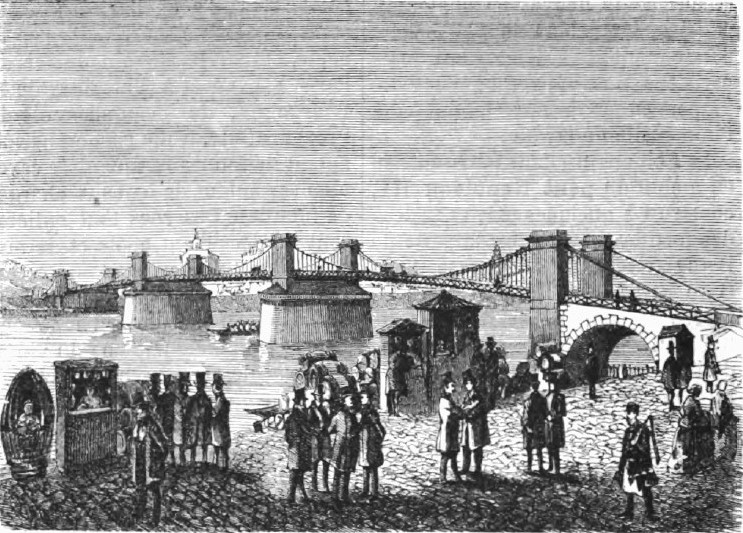
This old, faded photograph shows a very unusual bridge. Moving from right to left, we see three arched masonry spans. Above the top of the final masonry pier there is a short stubby tower that is part of a suspension bridge. This bridge continues on to the shore where a higher tower also supports the cables.

What was it? Where was it? I e-mailed the photograph to people I knew in Paris. Nobody had seen it before. One day in Paris, Philippa and I were having lunch in a crowded Parisian bistro with Adam Roberts, who writes the Invisible Paris blog, and we showed him an enlarged version of the image. He had never seen it before. The waiter and the two Parisian men at the next table also took a great interest in the photograph and an animated discussion ensued. The quest was good fun, but the mystery bridge was still a mystery.

Along the way, a retired bridge engineer friend told me about the 1839 bridge shown below, the Saint André-de-Cubzac bridge over the Dordogne River. It is one of many astounding French bridges from the early nineteenth century. The Bridgemeister website where I found this image rightly describes it as “perhaps one of the most fanciful suspension bridges ever built.” Looking at it, I wondered more and more why suspension bridges had vanished from Paris.

Then one day I found and bought the stereoview below, showing a suspension bridge. The handwriting on the back identified it as Pont Louis Philippe, Paris. It certainly wasn’t anything like the Pont Louis Philippe that stands today.

But now I had a starting point for my research. And very quickly, I made some startling discoveries. The woodcut engraving below leaves no doubt that it is the same bridge that started the whole quest. My sincere thanks to the creators of the website Art et Histoire where I found this image.

I also found this lovely pencil sketch from 1840.

Once I had a name for the bridge, a story emerged, only slightly confused by the fact that today there is a masonry bridge by the same name at almost the same spot. The current bridge crosses the River from the point at which the Rue du Pont Louis Philippe meets the embankment of the Seine to the Ile St-Louis, where it runs straight into the rue Jean du Bellay on the island.

The suspension bridge took a different route. It started at the same point, but crossed the river diagonally to the Quai aux Fleurs on the Ile de la Cité. Along the way, it touched the tip of the Ile Saint-Louis, where the support tower had been erected in the form of a triumphal arch. During 1848 Revolution the southern span was burned, but it was repaired and the bridge was given the name Pont de la Réforme. In 1852, the bridge got its old name back.

A demolition decree was issued on August 1, 1860, and the whole bridge was gone by 1862. Why? Admittedly it hadn’t been a particularly handsome bridge. Perhaps it was structurally unsound? One obscure publication in November 1850 notes that a commission of engineers examined the bridge and recommended that the suspension cables and deck be “tested to insure solidity.” But that is not what really happened.

As my interest in Paris suspension bridges grew, I came across the stereoview shown below, showing another suspension bridge in Paris, the Pont de Constantine.

Built in 1837 and named for a French military victory in Algeria that year, it was impressive for the time. It linked the Ile St-Louis and the Quai St-Bernard on the left bank. The main span of 333 feet was complemented by two smaller spans of 85 feet. With a width of just under 10 feet, it was a passerelle, or a pedestrian bridge. And in November 1850, it was reported that a commission of engineers had examined the bridge and recommended that the cables and deck be “tested to insure solidity.” Eventually, it was demolished and replaced by a fixed bridge in about 1863.

There was a pattern emerging here. Two Paris suspension bridges, built in the 1830s, reported in need of testing in 1850, and gone by the early 1860s. What are we missing?

The connection is an event that is little known and rarely mentioned: a deadly collapse of a French suspension bridge that shook the very foundations of French bridge engineering. Because of that collapse, the French halted all further construction of suspension bridges and let other countries assume the lead in suspension bridge design and construction.

The Basse-Chaine Suspension Bridge over the River Maine in Angers was completed on July 16, 1839. Its 335-foot span served pedestrians and wagons well. The bridge had been built “by two of the most experienced contractors in France who had conscientiously adhered to all the rules of the art as then known” (Tom F. Peters, Transitions in Engineering: Guillaume Henri Dufour and the Early 19th Century Cable Suspension Bridges, p. 169). Today we would call it state-of-the-art bridge engineering. France was the acknowledged world leader in suspension bridge design and construction.

Suspension bridges were known to oscillate in the wind and failures were not unknown, but on April 16, 1850, the unthinkable happened. It seems it was a stormy day and the bridge was oscillating. This would not have been regarded as unusual as 478 marching soldiers approached the bridge. But as they crossed, an anchorage tore loose and the deck disappeared beneath their feet; 226 soldiers fell to their deaths. It was the deadliest bridge collapse in history.

An inquiry was launched immediately. Its initial findings were disturbing. The bridge had been designed according to the best and most well-proven theories of the day, constructed to the highest standards, and there had been no visible signs of weakness before the collapse. This final finding led to an immediate halt to the construction of further French suspension bridges.

Cables carrying the weight of a suspension bridge must be anchored firmly. At the time, there were two methods for building suspension bridges. The British used massive eyebar chains made of heavy plate-iron links. Each bridge was held firm by these giant iron links, which went deep underground into anchorages.

By contrast, the French and Swiss pioneered a method of supporting suspension bridges with wire strands or cables, based on the work of engineer Louis Joseph Vicat. The wire cables were split into strands beneath the ground and grouted in place in the anchorages with hydraulic lime mortar. In theory, the mortar would protect the strands from water, rust (oxidation), and any subsequent loss of strength. Since 1831, this had been the approved and near-universal method of building suspension bridges in France.

No one seemed concerned by the fact that there was no way to inspect the anchored ends of the cables. It turned out that the hidden mortar did not always cling to the cable, and water leakage was a problem. The cables were rusting and the mortar was failing, weakening the entire structure.

The bridge that collapsed had been built according to this widely accepted practice. There had been no negligence, no shoddy workmanship. In the words of the Commission of Inquiry, the “oxidation did not originate in a structural error particular only to the Basse Chaine Bridge, but rather to a structural fault in the system itself, so that it is to be feared that the same result will occur wherever it has been applied” (quoted in Peters, p. 171).

Since 1831, hundreds of suspension bridges had been built using a system now shown to be dangerously faulty. Immediately all suspension bridges were suspect. The findings “struck…like a bombshell” and “all bridges built in the previous quarter century, that is, all those with inaccessible anchorage shafts, had to be immediately inspected” (Peters, p. 171). Hence those inspections of the Paris suspension bridges in November 1850.

During the next 20 years, there was an official moratorium on suspension bridge construction, and many existing bridges were demolished, like those in Paris. The moratorium was finally lifted in May 1870, by a French government decree. By this time, the French lead in iron cable suspension bridges had passed to North America, primarily through the work of a German immigrant, John A. Roebling, and the American-born engineer Charles Ellet Jr., who had studied at the École des Ponts et Chaussées in Paris.

In Paris, even the Bercy Bridge, shown below, was replaced, although it had been built using the British system of eyebar chains. Perhaps it fell victim to the need for bridges to carry more traffic, but likely it was the fear brought on by the deadliest bridge collapse in history.

Paris today has little visible heritage of one of the great epochs of French civil engineering. It was only with the work of Gustave Eiffel and Company that the French regained prominence in bridge engineering. But no further major suspension bridges were created in Paris, other than a very small Gustave Eiffel suspension footbridge in the Parc des Buttes-Chaumont.

Text by Norman Ball. With special thanks to Roger Dorton, Bob Wilson, Gregor Dallas, and Adam Roberts.

Posted in Paris bridges, Paris history | Tagged , , , , , , , , , , , , , , , , , , | 23 Comments

A French family in wartime

Today, November 11, is the anniversary of the end of the First World War. In France the Jour de L’Armistice or le Jour du Souvenir is a day of military parades and ceremonies. But there is more to remembrance than marchpasts and bugles.

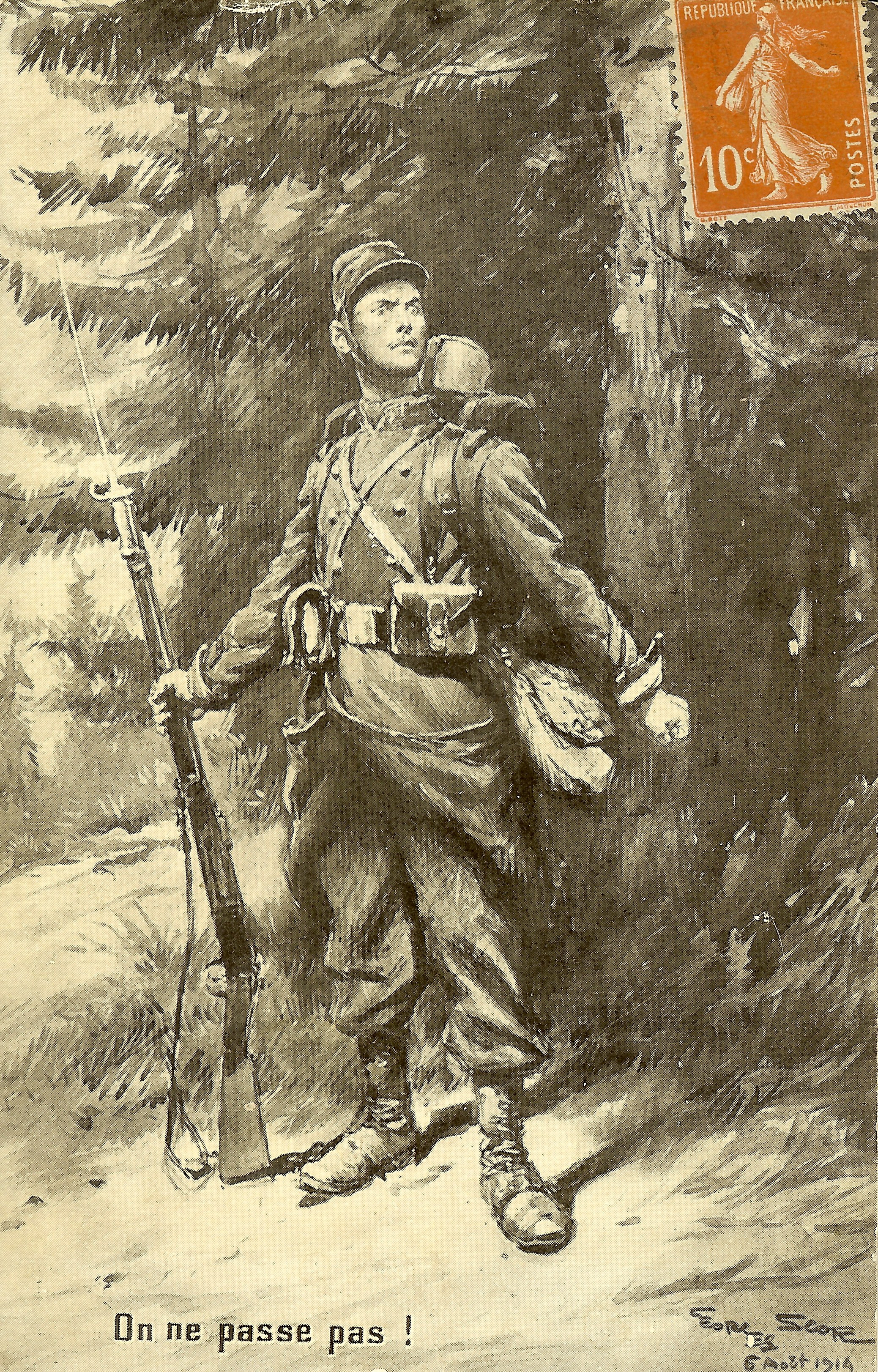
A few months ago, I bought six First World War postcards at an open-air antiques sale near the Bastille. The cards, dated 1914 to 1916, showed patriotic or sentimental images specifically created for wartime correspondence. The patriotic ones showed soldiers expressing devotion to France’s flag; the sentimental ones were of wounded men being treated by angelic (and slightly improbable-looking) nurses.

What caught my attention was that all six had been sent to the same address in Montreal: 1759 Park Avenue. Clearly, the postcards had formed part of a long-ago collection. I wish I had taken the time to search for others from the same source. However, the six I did buy provide brief glimpses of a family in wartime. I decided to find out what I could about the people who had sent and received these cards.

It took me some time to track down the address. You won’t find 1759 Park Avenue on Google Maps, because the street numbering has changed since 1915. But thanks to the Bibliothèque et archives nationales du Québec, I was able to look at street maps of Montreal dating from before the First World War. I found that 1759 Park Avenue corresponds to what is today 4859 avenue du Parc. The building still stands – a typical Montreal walk-up brick row house with lots of stairs in front.

The surname that appears on the cards is unusual – Bernigaud. Of the six cards, one had been sent to Louise Bernigaud and the rest to Jeanne or J. Bernigaud. Having two names instead of just one made it much easier to trace the family.

Louise and Jeanne were sisters and I found the whole Bernigaud family on a genealogical website. There were seven children: Louise was the eldest, followed by Henri, Philippe, Jeanne, Jean, Marie, and Paul. Their parents were Joseph and Marie. They came from Charolles, in the department of Saone-et-Loire, part of the Burgundy region. The family had left France in 1907 to come to North America (via the United States), and by late 1914 they were living in Montreal.

I spent some time deciphering the handwriting and peering at postmarks.

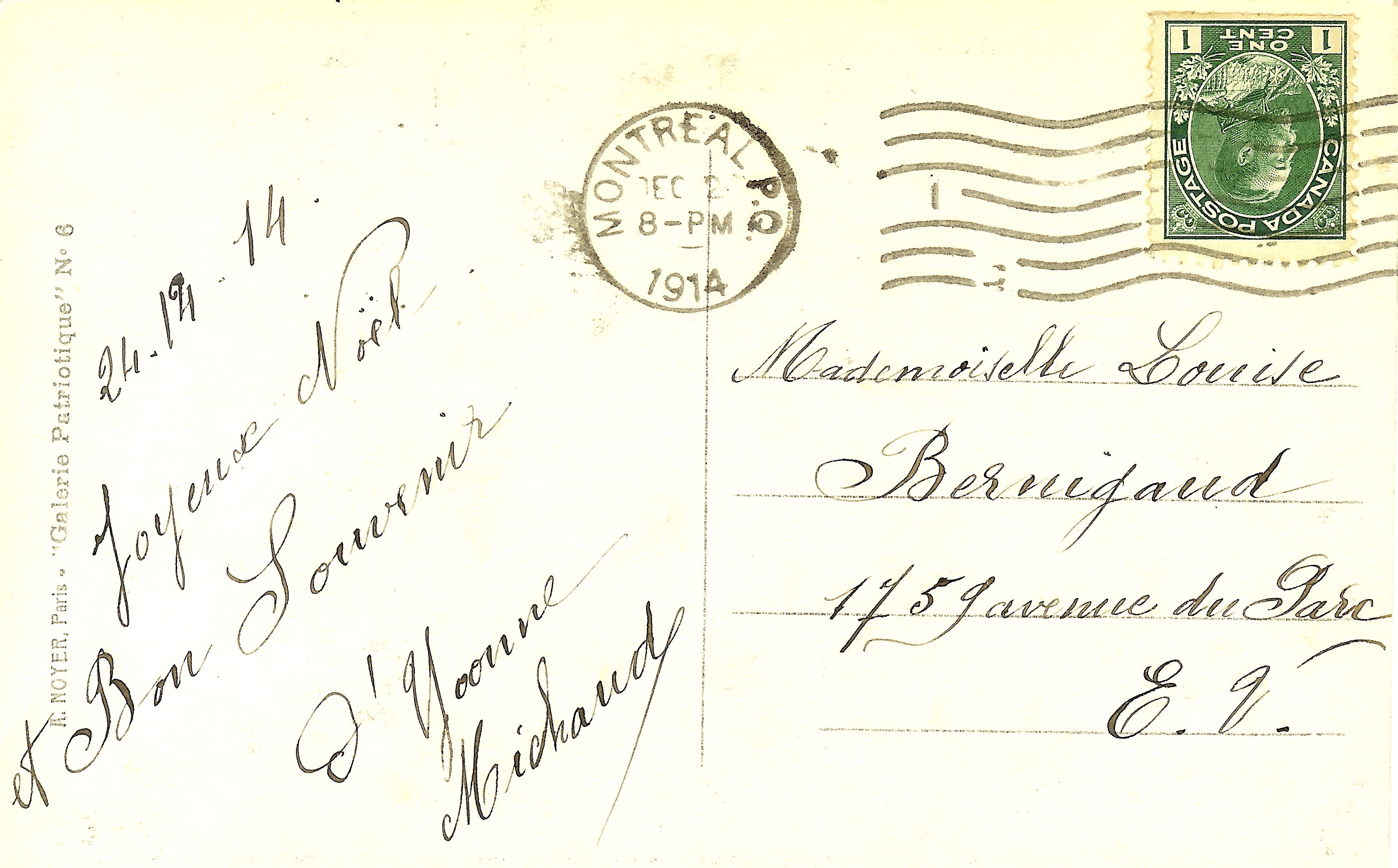
The first postcard (chronologically) was sent at Christmastime in 1914, from one Yvonne Michaud to Louise Bernigaud. It was posted in Montreal and contains the brief message “Joyeux Noël et Bon Souvenir.” There were several Yvonne Michauds in Montreal at the time. So no clues there.

The second was posted in Lyon Terreaux (one of the Lyon post offices) in July 1915 by someone called Jeannine, and was addressed to Jeanne. The sender, Jeannine, seems to have been working in a French hospital in Lyon (perhaps the Hôpital Desgenettes, a military establishment).  She thanks Jeanne for taking an interest in “her soldiers.” She mentions that her uncle is suffering from tuberculosis brought on the previous winter by the severe cold. (So many people died of tuberculosis in those days; it was one of the leading causes of death.) Her cousin Albert has been evacuated from a hospital in Perpignan. Alas, since I do not know her last name, I cannot find out any more about Jeannine.

The third postcard is also addressed to Jeanne Bernigaud from Lyon, sent in December 1915, but this time, the sender was one C. Vignal. The writer alludes to a loss in the family.

I hope 1916 brings you the happiness you wish for. I hope we see each other soon, at the end of this terrible war. I think how we were all together a year ago and that your dear departed had just received his papers. How happy he was! He had his reward and his sufferings were brief. He is watching over you and protecting you. I often think of him and of you.

Que 1916 vous apporte tout le bonheur que je vous souhaite. Que nous voyons bientôt, la fin de cette terrible guerre. Je pense que l’année dernière nous étions ensemble et que votre cher disparu avait reçu sa feuille. Comme il était heureux ! Il a eu sa récompense et ses souffrances été abrégés. Il veille sur vous et vous protège. Je pense souvent à lui et à vous.

At first I wondered if Jeanne Bernigaud had lost a fiancé, but as I continued my research, a different story emerged. All but one of the members of the Bernigaud family were mentioned in postwar records of various sorts. Philippe was missing.

At the French Defence Ministry website I found the record. Philippe Jean Marie Bernigaud had died at Souchez, near Vimy Ridge, on June 12, 1915, as the result of enemy action. He was 20 years old.

Canadians will immediately recognize the name “Vimy Ridge.” So many Canadians died during a later battle there (1917) that the Canadian government erected a monument to Canadian soldiers. I have visited the memorial, and was moved by its stark shapes and extraordinary vista towards the east. It has recently been meticulously restored.

Who was the author of this message, C. Vignal? There is a clue on the card. “We were all together a year ago.” I doubt that the entire Bernigaud family had returned to France. More likely C. Vignal had been in Canada. I found a Catherine Vignal who had come to Canada before the war with her husband Henri and had been counted in the census of 1911 there. She had been born in the early 1860s, which would make her in her early 50s at this point. A possibility, but I’m really only guessing.

Card No. 4. The message is addressed to Jeanne, written in pencil, and signed “Michaud.” There is a loop through the word that might make it “C. Michaud.” A relative of Yvonne Michaud? Or just another person with a fairly common last name? There is no stamp or postmark. It is dated 14 January 1916. The sender apologizes for not having written earlier, and sends good wishes for the New Year for Jeanne and her family, with the hope that the entire family would soon be reunited under one roof.

Card No. 5 is also from C. Michaud, also in pencil, and dated about a month later. Michaud has received good news of Henri (Jeanne’s older brother, who would have been about 23 then).

Neither of Michaud’s cards has a postmark. They might have been sent in a packet with other letters. Perhaps C. Michaud enclosed the card in a letter to a relative (Yvonne?) in Montreal, who delivered it by hand.

Despite the lack of a postmark, I believe they were sent from France. There is a record of Henri sailing from France to New York at the end of 1916, so I assume that he was in France when C. Michaud wrote the card and therefore that both Michaud’s cards were written from France. Was Henri also a soldier on active service? The ship’s manifest lists him as a “clerk.” Perhaps he was a clerk in the military? I wonder why he was returning to Canada.

The tone of both messages is very formal and respectful, so I’m guessing that Michaud is a young man, and a soldier, like the ones shown in the pictures on the cards. The use of pencil suggests he may have been writing from the field. I wonder what happened to him. On the French Defence Ministry site I found records of 26 people with the last name Michaud and the initial C who had died in the Great War. Many others with the same initial and last name may have survived the war and are not counted among the records of the fallen.

The last of the six postcards is from Jeannine again. It is stamped, but the postmark is too faint to read. The message is dated May 1916. Jeannine says she is now in a small town of 6,000 souls, but hastens to reassure Jeanne that it has its own post office. She mentions that the spring weather is good and speaks of her interest in gardening and stamp collecting. Part of the message is cryptic.

I found your “marriage proposal” very funny; the ceremony is not complicated. Sell the necklaces which you can.

Votre « demande en mariage » m’a bien amusée, la cérémonie n’est pas compliquée. Vendez les colliers ce que vous pourrez.

What was that all about? Jeanne might have sent her friend an amusing story about a proposal, or she might have received a proposal herself that she described in an amusing way. And selling necklaces? A mystery.

That is all. Thanks to ancestry.com, I was able to follow the Bernigaud family for a few years after the war. Jeanne returned to France, and in 1922 is living in Autun, not far from her birthplace. Her older sister Louise visited her there, but returned to Canada with their brother Henri on the S.S. Melita. Henri went into business of some sort. Jean trained as a pilot. Paul was a mechanic. Marie became a secretary and worked for the wife of an eccentric New York millionaire. Their mother, who may have been widowed by the 1920s, was living in Charenton outside Paris in 1931. But there the trail goes cold.

There is something extraordinarily compelling about these bits of paper that are still fresh and readable almost a hundred years after they were mailed. They were saved as a group, eventually they were sold, and they made their way into the hands of a dealer. They travelled from France to Canada, then they went back to France, and now I have returned them to Canada. Fragile, easily destroyed, yet somehow persisting into the 21st century, they continue to bear witness to the story of one French family in wartime.

Text by Philippa Campsie

Posted in Paris history, Paris postcards, World War I | Tagged , , , , , , , , , , , , , , , | 13 Comments

The Other Great Nineteenth-Century Tower of Paris

The story begins in a photograph shop in the Village St-Paul. I was browsing among the stereograph cards, when I came across something that looked like this. It captivated me.

I say “looked like,” because this is not the same stereograph. For some reason, I did not buy the card I saw in the Paris shop, and I later regretted my hesitation. But I kept my eyes open, and a year or so later found the one above in a bargain pile at a photo show in Toronto. Sometimes I get lucky.

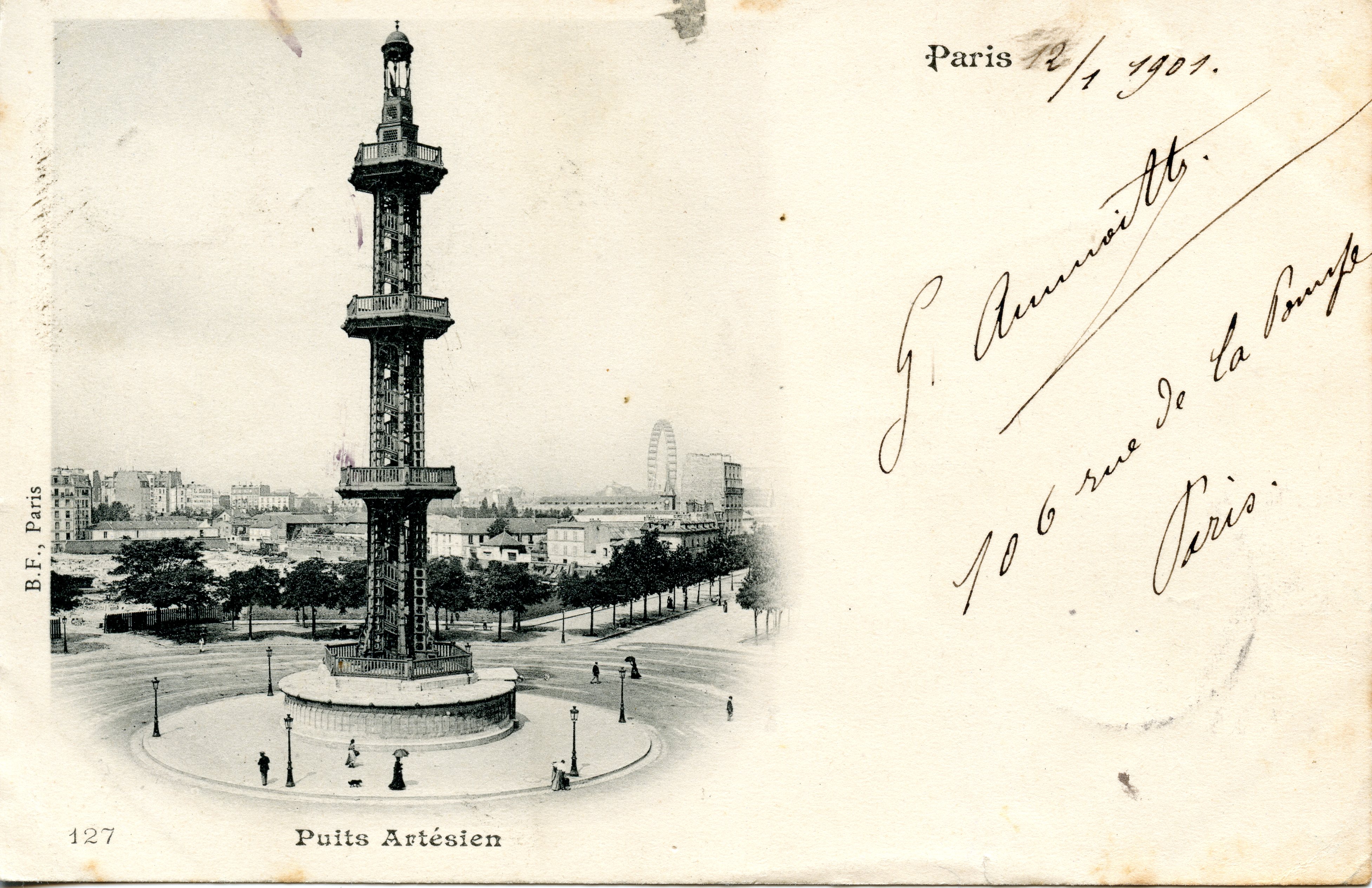
What was it? Where was it? The shop owner in the Village St-Paul had told me it was an artesian well that once stood on the Left Bank. That was all he knew. Later, I found a postcard that gave additional clues to its location.

The postcard was mailed in 1901. Look at the right side of the image. You can see the Great Wheel built for the 1900 Universal Exposition in Paris. Clearly, the tower was not far from the Champ de Mars, where the Exposition was held.

More and more intrigued, I went on eBay and ordered an illustration that had appeared in a magazine in 1888. Later I discovered it was based on an 1841 engraving.

Not your average artesian well. The iron tower rose to a height of about 13 storeys; the narrow base accentuated the sense of height. At certain times, visitors could climb the cast-iron circular stairs that wound up the middle of the column, stop on any one of the three circular balconies, and gaze out over the city and countryside. At other times, the tower was shrouded in diaphanous films of water that tumbled outwards and downwards from each of the balconies.

The tower was completed in 1841. But the story begins even earlier, in the days of Napoleon Bonaparte.

Throughout its history, Paris has made a clear distinction between what is inside the walls and what is outside, even though the location of the walls has changed over time. In the early 19th century, Paris had many slaughterhouses inside the walled city. Imagine the congestion, sounds, and odours as thousands of animals were walked along city streets to the slaughterhouses, where things got even noisier and smellier.

Napoleon Bonaparte considered this state of affairs unacceptable for his capital city. On February 9, 1810, he decreed that all the slaughterhouses in Paris were to be closed and replaced by five large new abattoirs outside the walls as they stood at the time. This was in the days before environmental assessments and impact studies, so work started about six weeks later. The abattoirs were finished in 1818, and as of September 15, 1818, it became illegal to bring animals for slaughter into the city. Alas for the exiled Napoleon, he was no longer in Paris to see the achievement of his decree.

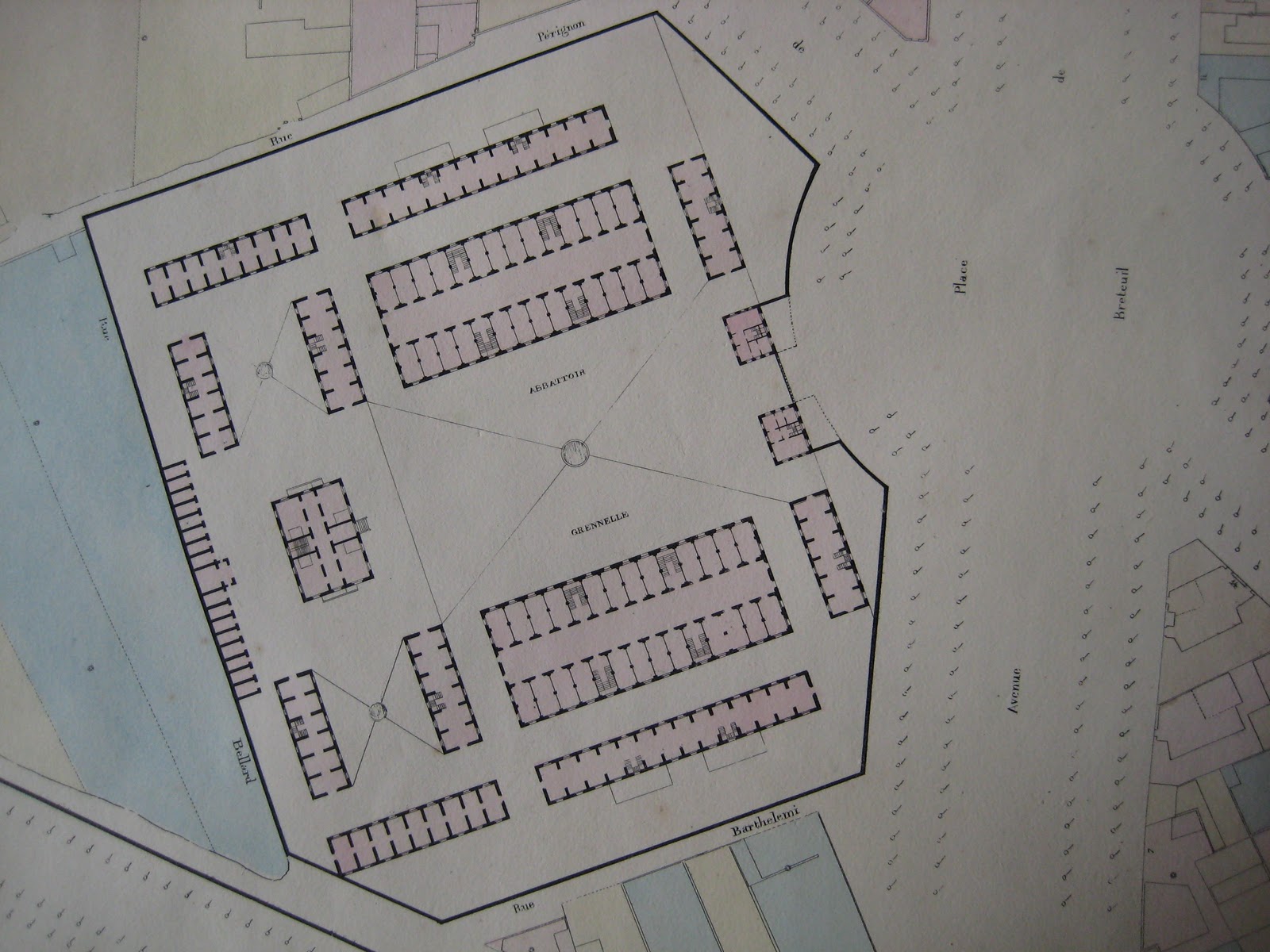
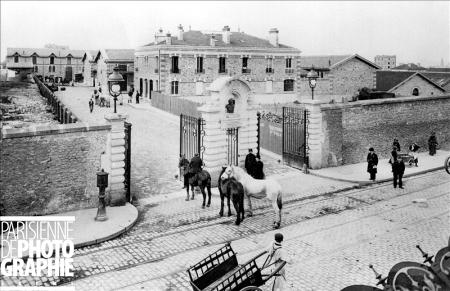
One of the five abattoirs was called Grenelle; it was also known as the Abattoirs des Invalides or Abattoirs de Vaugirard. It was a massive complex with 16 buildings covering about eight acres, with its own water pipes feeding 174 taps. Abattoirs need lots of water, particularly one with 48 échaudoirs of scalding water.

Paris is geologically well-situated for tapping underground water supplies through artesian wells, a technology in which France had been a leader for centuries (the word artesian comes from the French province of Artois). In an artesian well, the underground water source is under such pressure that when the rock above is drilled through, water flows upwards of its own accord, with no pumping required. The greater the pressure, the higher it flows above ground level.

Some artesian wells tap water very close to the surface. Not the one at Grenelle. Drilling started in the abattoir courtyard. It was a risky business, demanding both faith and technical competence. The political driver was the mayor of Paris: at the time, one François Arago, now remembered more as a famous physicist. The engineering was entrusted to Louis-Georges Mulot, who had successfully drilled other artesian wells in France.

Drilling started in December 1833 and continued for years. In 1837, more than 200 feet of drilling rods broke loose and fell to the bottom of the bore hole, then at a depth of over 1,250 feet. It took 15 months to recover the equipment and resume drilling. Finally, at a depth of almost 1,800 feet, the boring-rod broke through the rocky arch above the subterranean aquifer, dropped about 14 feet and water gushed up through the pipes in the well and flooded the wooden tower housing the drilling equipment. Mulot sent a terse message to the Mayor on the afternoon of February 26, 1841:

Monsieur Arago, Nous avons l’eau. Mulot.

The next day 100,000 visitors came to see the gusher (not a bad turnout in the days before Twitter). Beautifully clear water was coming out of the ground in the middle of an abattoir. The water was under such pressure that it rose up more than 100 feet.

The water needed to be contained and piped to a reservoir from which it could be distributed to other parts of Paris. Such a system required a pipe that rose high above the ground near the well to let the water continue flowing at an even pressure.

Now at other times and in other cities, this would have been simply a matter of creating a functional piece of equipment to do the job on the spot. But this was a time of great pride in engineering, and besides, this was Paris. Anything that high had to be carefully situated and aesthetically pleasing. It was decided to erect the tower several hundred metres away from the abattoir in the centre of Place de Breteuil. And the design of the column was given to Constant Delaperche, an accomplished painter and sculptor who had been born in Paris in 1790.

The pieces of Delaperche’s design were cast in the foundry at Fourchambault and then brought to the site, where all 100,000 kilograms were assembled into a glorious iron confection that defies categorization. The top reminds me of a Wallace Fountain and the column seems pagoda-like, but in a rather straitlaced fashion.

Of course, some people complained about it, just as they did with Eiffel’s much taller tower. But the two are very different. Eiffel’s had been conceived as an exposition decoration and it eventually became the home of important scientific work; it is still an important communications tower. The Grenelle tower was also a major tourist attraction, but it had been built as a workhorse.

Mulot continued to drill other wells and won many awards for his work. He died in Paris on April 11, 1872, at his home on Rue de Rochechouart, aged 80. At the time his most famous well was still serving Paris; it was the tourist tower of the day. Eiffel’s came later.

But for all of its seeming timelessness, Paris changes. And seemingly endless supplies of water dwindle. In 1903 the Place de Breteuil lost its magnificent tower. It was replaced by a statue of Louis Pasteur.

The abattoir was also demolished and the area is now a residential district, but in 1906, the site of the drilling was honoured by the erection of a magnificent fountain, La Fontaine du Puits de Grenelle (the fountain of the Grenelle artesian well), in an intersection now known as the place Georges-Mulot, 15th arrondissement. Four medallions adorn the four-sided fountain, celebrating local worthies. In addition to Louis-Georges Mulot, we find Valentin Haüy facing rue Valentin-Haüy, Rosa Bonheur facing rue Rosa-Bonheur and Eugène Bouchot facing …well, you know the drill by now.

And once again, I am reminded that if our vision of a past era concentrates on the “one big thing,” we miss many equally exciting but different achievements.

Text by Norman Ball. Photograph of the abattoir courtesy of Paris en Images.

For more information on the artesian well, I recommend this site: Centenaire 1911-2011 des rues Lapparent-Vaudoyer-Heredia

Posted in Paris civic functions, Paris history | Tagged , , , , , , , , , , , , , | 8 Comments