Paris in the year 2000, viewed from 1900

It seems that humans cannot resist dabbling in predicting the future. We have an innate need to ignore Yogi Berra’s clear warning, “It’s tough to make predictions, especially about the future.” So what did the year 2000 look like from a vantage point 100 years earlier? Let’s look at a few examples from a series of cigarette cards designed to be given away at the International Exposition of 1900 in Paris.

800px-France_in_XXI_Century._Electric_scrubbingOur parlour maid has a wonderful-looking machine to clean her wooden parquet floor. The machine looks a bit awkward, but has a traditional scrub brush and bar of soap. Indeed, it seems to be electrically powered, but the cord leads only to the wand the maid is holding.

As for the rest of the room, it seems very much of the late 1800s: a large potted plant; the ever-respectable but economical upright piano; heavy curtains and a blind at the window; a statue on a plinth; and two paintings on the walls. Did year 2000 ever look more like the year 1900? At least the maid does not seem to have a strenuous job. Let’s look at some other workers.

France_in_XXI_Century._FarmerClearly our farmer of the year 2000 is living better electrically. He sits on a stool working the controls while the electrically powered machines do what was once done by human labour. An electric harvester cuts the grain and perhaps even ties it in stooks. Another machine piles hay or grain into large mounds.
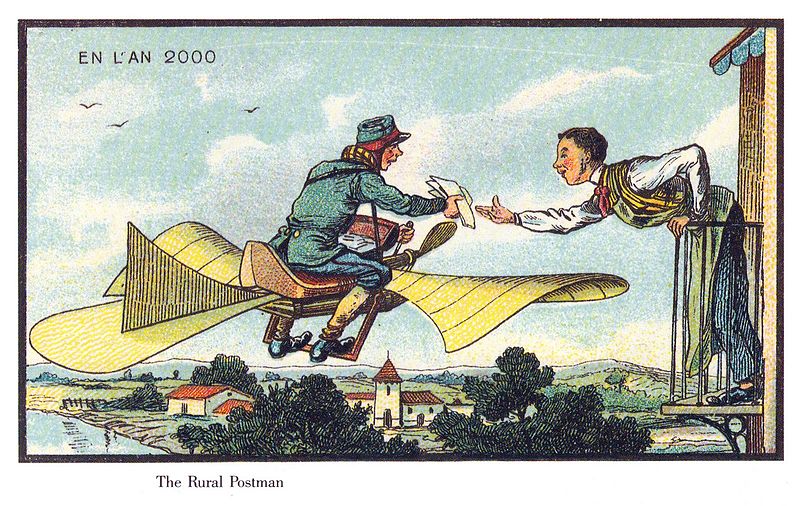
800px-France_in_XXI_Century._Air_postmanRapid everyday delivery by postmen who had conquered the air meant one no longer had to depend on those unreliable telegraph delivery boys. All has been arranged. Just lean out from your balcony and grab the letters as he flies by.
Screen Shot 2014-09-15 at 11.22.51 AM

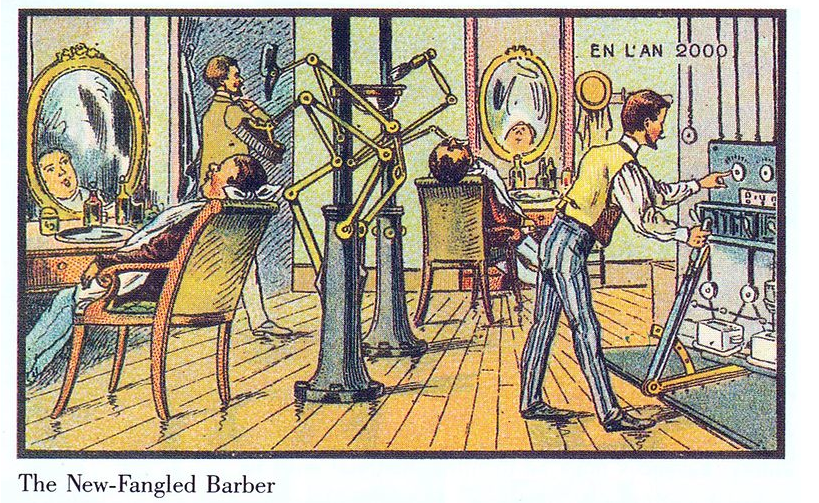
After a hard day’s work, or just to get ready for a night out on the town, a gentleman would need to visit his barber. But in the year 2000, the barber was a machine controller.  Mechanical arms shave the man sitting in the chair on the right. He looks a bit uncomfortable. The customer standing seems finished and the final errant hairs on his coat are being brushed off mechanically. The jolly man in the chair on the left is enjoying a chance to relax. Perhaps he is thinking of a trip to his tailor for a made-in-no-time suit for the opera.

France_in_XXI_Century._Latest_fashionThe man’s measurements are taken mechanically and sent to the forbidding-looking tailoring machine. It begins by gobbling up material from the bolt of fabric to the left of the machine. After  internal machinations, it spits out a completed suit jacket. But the men’s costumes show that fashion has not changed a bit since 1900.

Meanwhile, at home, other preparations are taking place.

800px-France_in_XXI_Century._Toilette_madameAgain we see the electric wires, control handles, and, above the bathtub, a brush with a strong resemblance to that used by the parlour maid to scrub the parquet floors. Madame is seated comfortably, even seductively, while her hair is done to perfection by electrical apparatus and all manner of other preparations completed. The mirror obscures what is happening to her foot, but the contraption looks fierce.

800px-France_in_XXI_Century._Air_cabOur happy couple of the future live only a short walk away from the Aero-Cab Station, where one never has to wait long for an aero-cab. The trip is over so quickly that there is hardly time to glance at the newspaper purchased at the newsstand before taking the elevator to the boarding level.
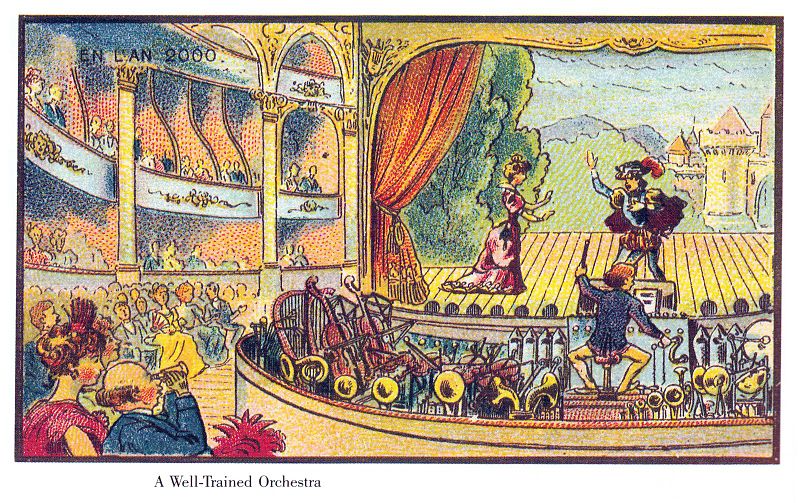
800px-France_in_XXI_Century._Robot_orchestraThe couple look down from their box at the Opera. Members of the audience are dressed in their finest, the story unfolding on stage is an old one. The music emanating from the orchestra pit comes from familiar instruments, all of which are controlled mechanically. The conductor has been reduced to sitting at a control panel. And without musicians to watch, something seems to be missing from the drama of a night at the opera.

But the next day brings an outing in a highly unusual vehicle.

800px-France_in_XXI_Century._Rolling_houseWho would have thought that one could put a house on wheels, fit it up with a steam engine, chefs, waiters, and a skilful driver? All of this so one could dine in comfort while heading for an afternoon at the seashore. Such a delightful prospect, part of what makes the future worth waiting for.
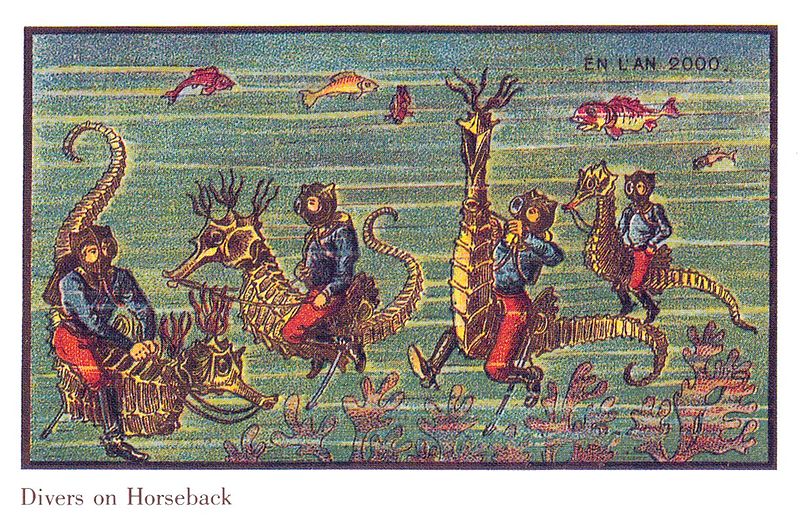
800px-France_in_XXI_Century._DiversFor the adventurous sort, there was always (sea)horseback riding. But with the boots, breeches, swords, and breathing apparatus, it all seems too energetic. The new underwater breathing apparatus was best reserved for more decorous pursuits.

France_in_XXI_Century._Water_croquetA jolly good game of croquet made for a perfect day. And as the woman’s dress suggests, it was an entertainment for those who knew how to dress. But some who enjoyed an afternoon watching a race beneath the waves seemed to have taken some liberties with their attire.

800px-France_in_XXI_Century._Race_in_PacificClearly the woman with the scandalously short skirt must have come directly from her work dancing on stage in a club frequented by the…well, by those whose names and stations in society we shall not repeat here.

But much as the world beneath the sea beckoned, there were other opportunities to have fun, high above the mountains.

800px-France_in_XXI_Century._Little_robbersThese naughty lads have been lucky to escape with their lives when the mother eagle attacks them to protect her baby eaglets. Have little boys not learned anything in the last 100 years? Whatever are they teaching them in the schools?

800px-France_in_XXI_Century._School

The new learning machines were perhaps not as effective as they were expensive. The teacher could feed the books into the machine; the least well-behaved boy in the class could turn the crank, but what did the electric wires feed into the young pupils heads? Today we know the expression “garbage in, garbage out.” Perhaps the books were outdated and stale. And how did anyone know if the boys (no girls to be seen in this school) were even paying attention to the lessons coursing through the wires?

Were the lads dreaming of the day when they would have their own airplane? Or a career as a dashing aviation policeman?

800px-France_in_XXI_Century._Flying_policeOr were they imagining a career in surveillance?
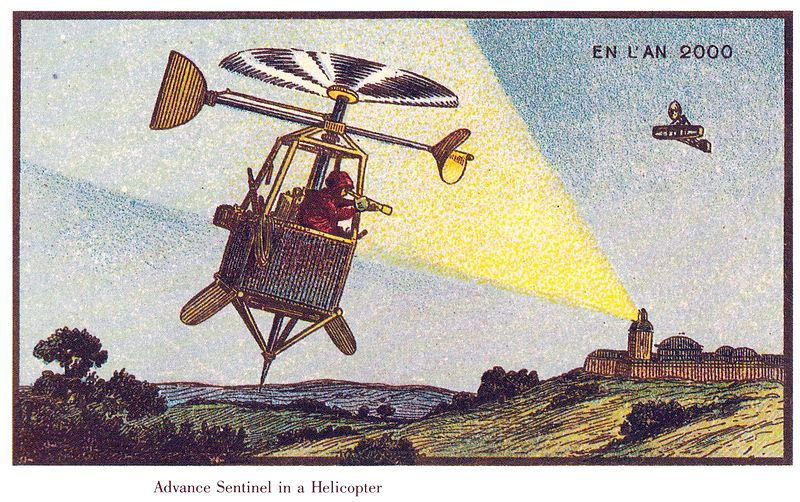
800px-France_in_XXI_Century._Helicopter

Perhaps some dreamed of the day when young boys (note the sailor suits in the image below) went off to war. Some by air…
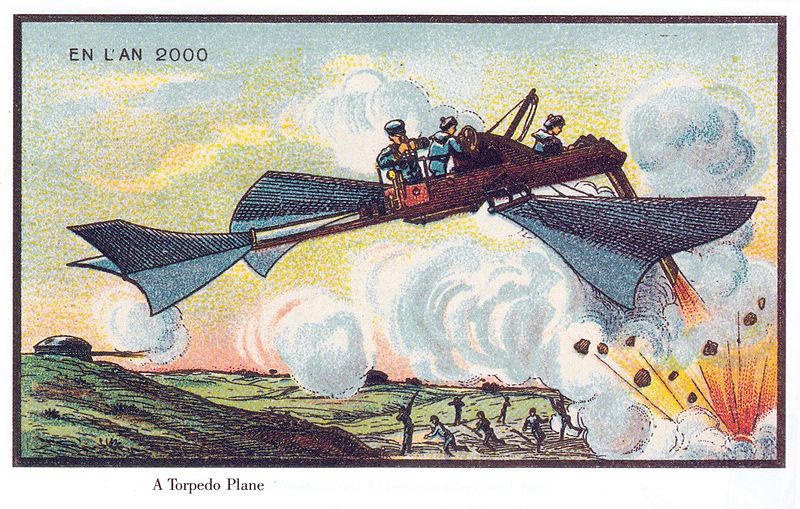
800px-France_in_XXI_Century._War_plane…and some by land.

800px-France_in_XXI_Century._War_carsAnd perhaps some dreamed that they could rescue those in peril.

France_in_XXI_Century._Air_firefightersAnd as each dreamed of the future, how many would realize what a jumbled mixture of past and present their dreams were made of? While hovering in the air to rescue child and infant, a steam engine on the ground pushed water up through the hose and onto the flames.

The images presented here show colourful visions of the year 2000 when it was 100 years into the future. There are 87 or more known cards in the series started by the French artist Jean-Marc Côté. The artist had been commissioned by a toy-and-novelty company called Armand Gervais et Cie of Lyon to produce images for cigarette cards to be distributed at the International Exposition of 1900 in Paris.

Unfortunately, Gervais died unexpectedly and his company ceased operations. The cards were never distributed. The plant closed down and was left untouched for almost a quarter of a century. Then a toy collector, Monsieur Renaud, visited the premises with the idea of using it to manufacture toys. He discovered instead the untouched inventory of the Gervais company, including the cards. Monsieur Renaud decided not to produce toys, but to buy the entire stock of the company as the basis of a left-bank store called Editions Renaud.

In 1978 the science fiction writer Isaac Asimov and his wife were living in Paris. They visited Editions Renaud, hit it off with Monsieur Renaud (who was then quite elderly) and bought a set of cards. According to Asimov, the set was the only one not to have been damaged by water in the abandoned factory. Intrigued with the collection, he wrote a book about it, published in 1986.

Futuredays: A Nineteenth-Century Vision of the Year 2000 is an astounding piece of work. I recommend it highly. I bought it some years ago, read it with enjoyment, and then somehow forgot about it until I was sorting some books that I had left in storage and rediscovered an old friend. Soon I, too, wanted to learn more.

My discovery of the online images of the Public Domain Review led to this blog. The site is well worth any time one spends there. So I dedicate this blog to Jean-Marc Côté, other unnamed artists who contributed to the series, Armand Gervais, Monsieur Renaud, Isaac Asimov and his wife Mariea (who, like my wife, speaks far better French than her husband).

800px-France_in_XXI_Century._Whale_bus

Let us leave this blog with another improbable image. It reminds me of the many futuristic images and stories that entertained us in our younger years when we were enraptured by Popular Mechanics magazine and the works of Jules Verne. However entranced we may be by the new and different, we seem to seek comfort in novelty and unintentionally lug the past into our visions of the future.

Text by Norman Ball; images courtesy Public Domain Review
 

Posted in Paris art, Paris popular culture | Tagged , , , , , , , , | 12 Comments

Fifty Ways to Close Your Shutters

On our last visit to Paris in June, we did most of our travelling by bus, which meant time spent waiting at bus stops and journeys on which we gazed out the window at the streets, instead of hurtling through a darkened tunnel on the Metro. And that meant studying Paris facades, ever familiar and ever new, noting details and differences.

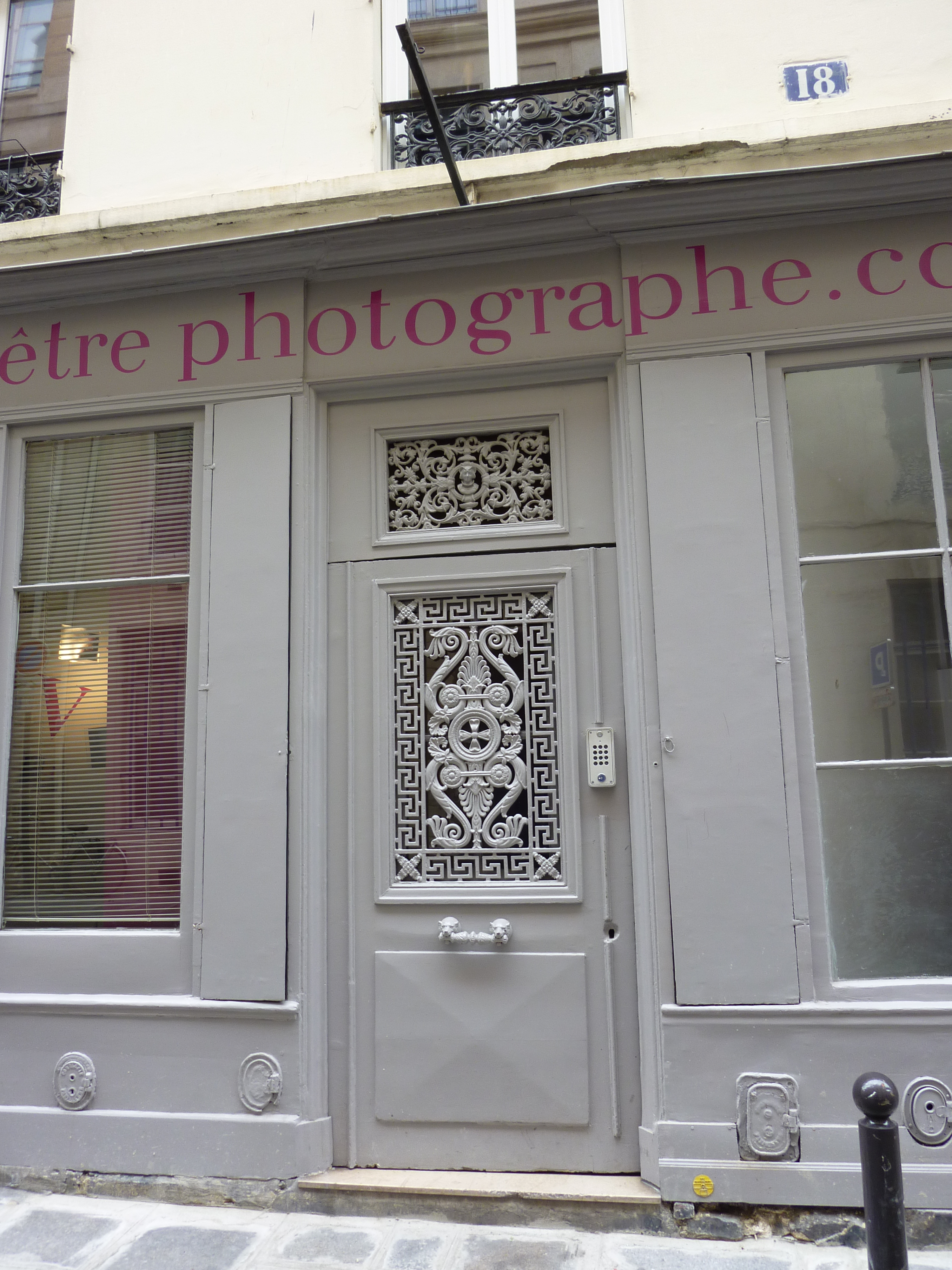
This time it was shutters. I started to notice all the different forms and styles and began to photograph them. For example, here is a photograph showing the two most common styles of all – exterior wooden louvred shutters above and folding metal shutters below. Utterly ordinary, and yet remarkable.

P1140448

When I tried to figure out the correct terms in French, I found myself in a thicket of words – volets, persiennes, contrevents, jalousies, stores, couvre-fenêtres, grilles de défense – plus a host of variations. Volets roulants valenciennes, persiennes à l’abbattant relevé, store cassette

For no particular reason (other than what else are you going to do while waiting at a bus stop?), I decided to create a typology of shutters.

First off, those wooden shutters are called volets (or to be more precise, volets battants, to distinguish them from volets roulants, or roll-down shutters).* Here is a typical Paris façade, photographed as a demonstration passed in front, with residents looking out to see what is going on. But when I looked again, I noticed that these windows are slightly unusual, because they are combined with individual awnings.

P1140644

These shutters need regular painting to keep them looking this tidy. Many Paris facades, however, do not get that kind of attention.

OLYMPUS DIGITAL CAMERA

Most, but not all, shutters have louvres in them to let through light or air. The term jalousie (literally, “jealousy”) was coined for shutters that allow the person inside to look out without being seen.

Picture1

The ones on the right with large and obvious hinges seem to be a very traditional design for what appear to be fairly modern security shutters.

Inside the shutters, there are other details, all with specific terms. This comes from a helpful website called “lexique des volets,” by a shutter manufacturer.

Lexique

Such old-fashioned and rather rustic shutters can be found in Paris, if you look.

P1150577

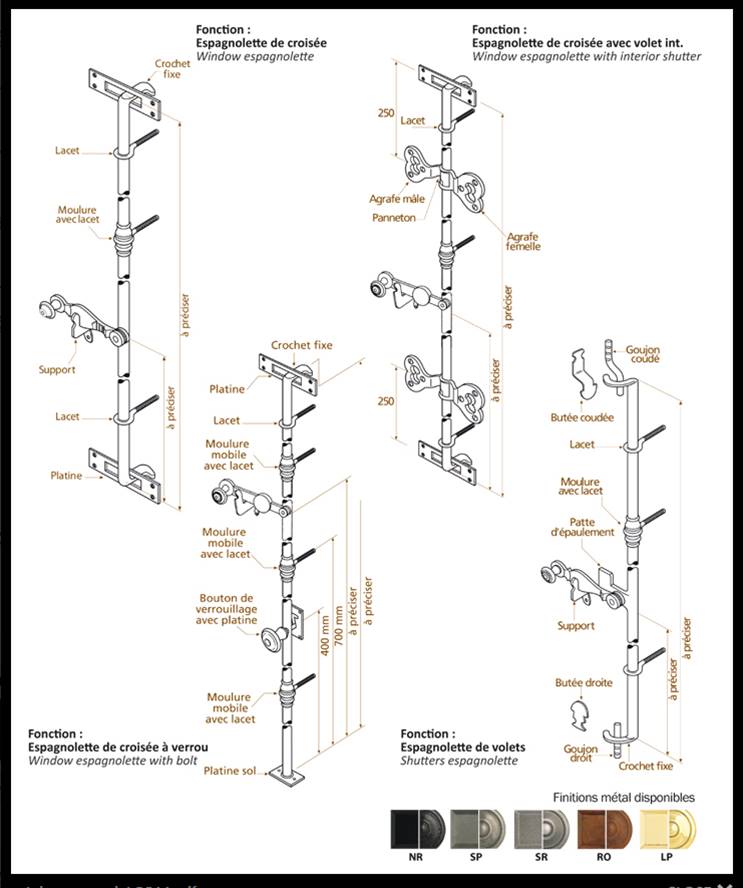
Notice the hardware on the open shutters. The interior closing mechanism is called an espagnolette. There are several types, shown on the website of a woodworking company.

Espagnolette

Just when you thought shutters were simple things.

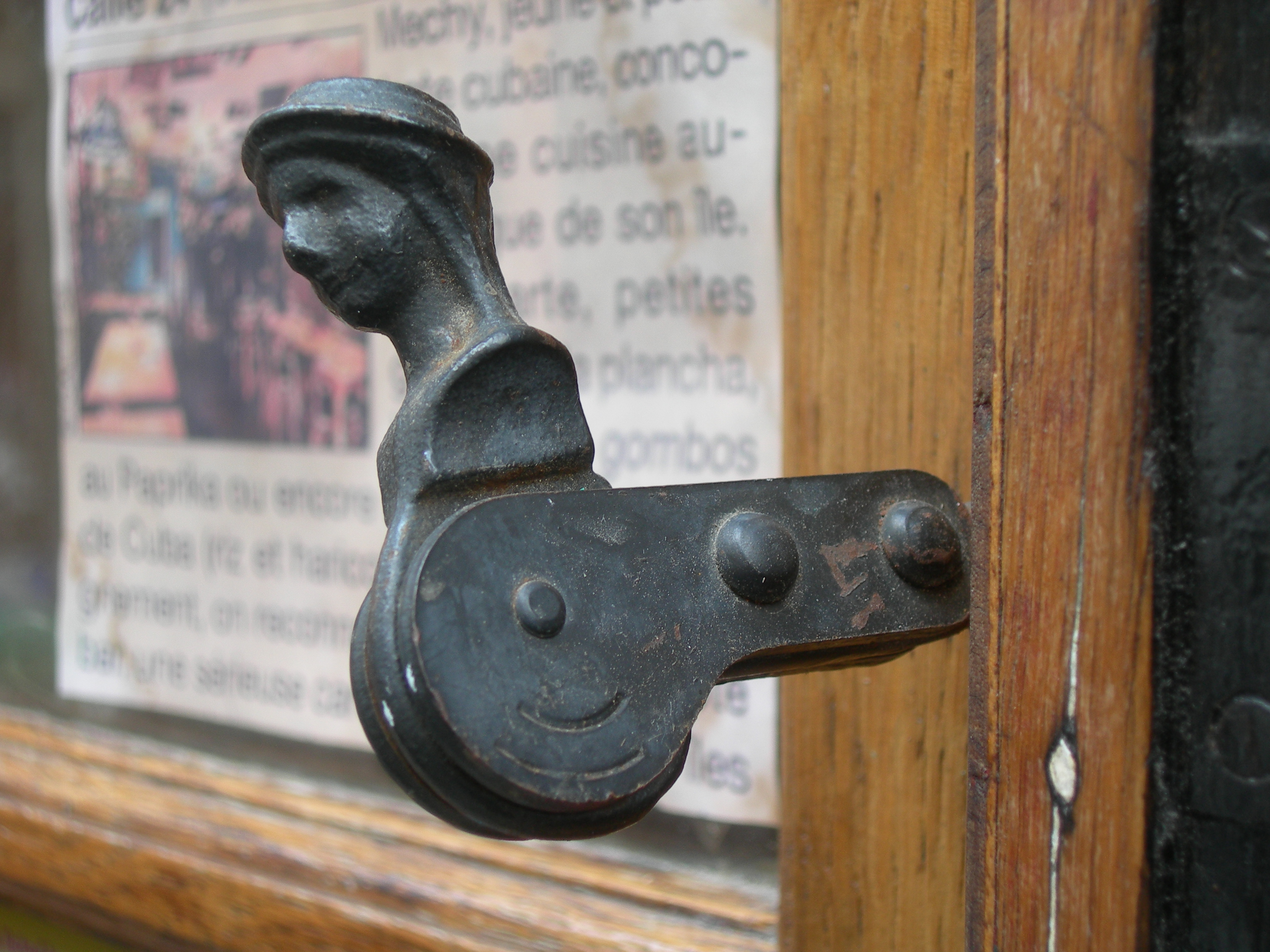
But I wanted to find the word to describe something we have seen from time to time – the little fixtures on the exterior wall used to hold the shutter and prevent it from swinging back and forth in the wind. Some are plain, but some have faces or other decorations on them. Norman photographed one in the Marais a few years ago.

DSCN1876

If you look closely at the next photo, you will see them holding back the shutters. (This is quite a complicated window, with its security grill and frosted glass privacy screen.)

OLYMPUS DIGITAL CAMERA

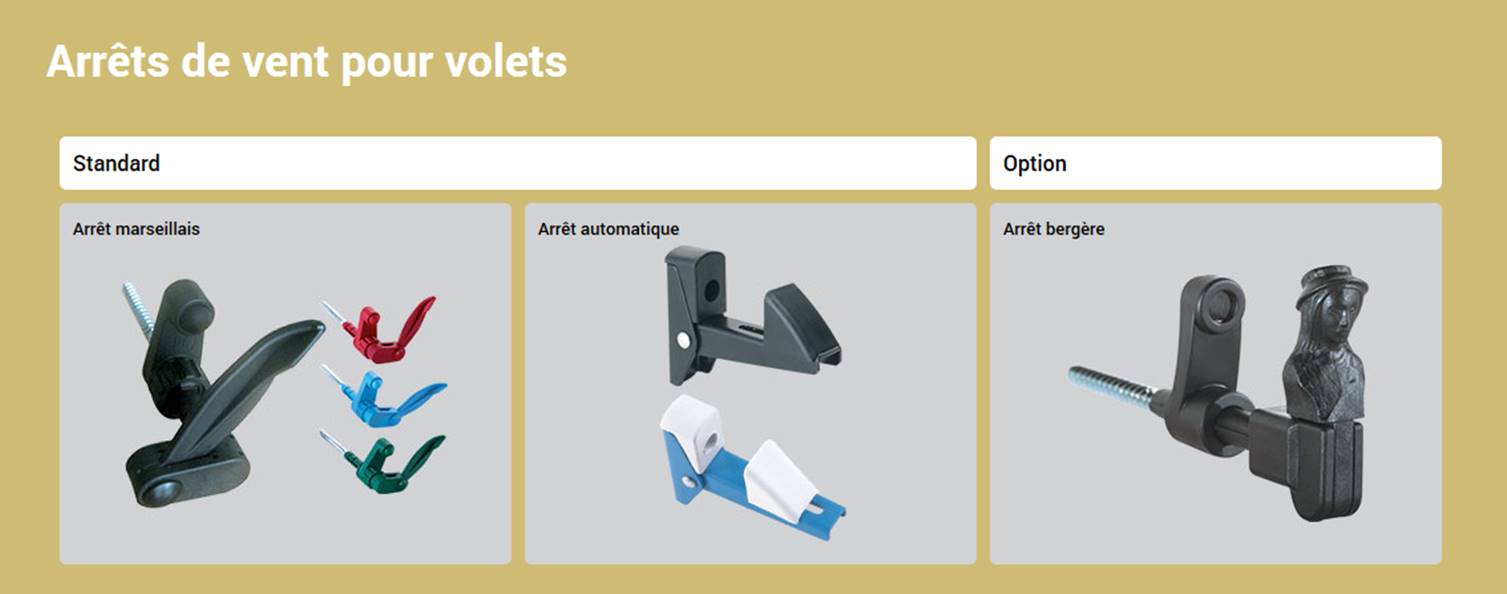
I found that they are called “arrêts de volet” (shutter stops) or “arrêts de vent” (wind stops), and they come in many forms and colours. You can still buy ones with faces on them: arrêts bergère, suggesting that the face with the hat and the long hair is that of a shepherdess. Isn’t French hardware wonderful?

Arrets de vent

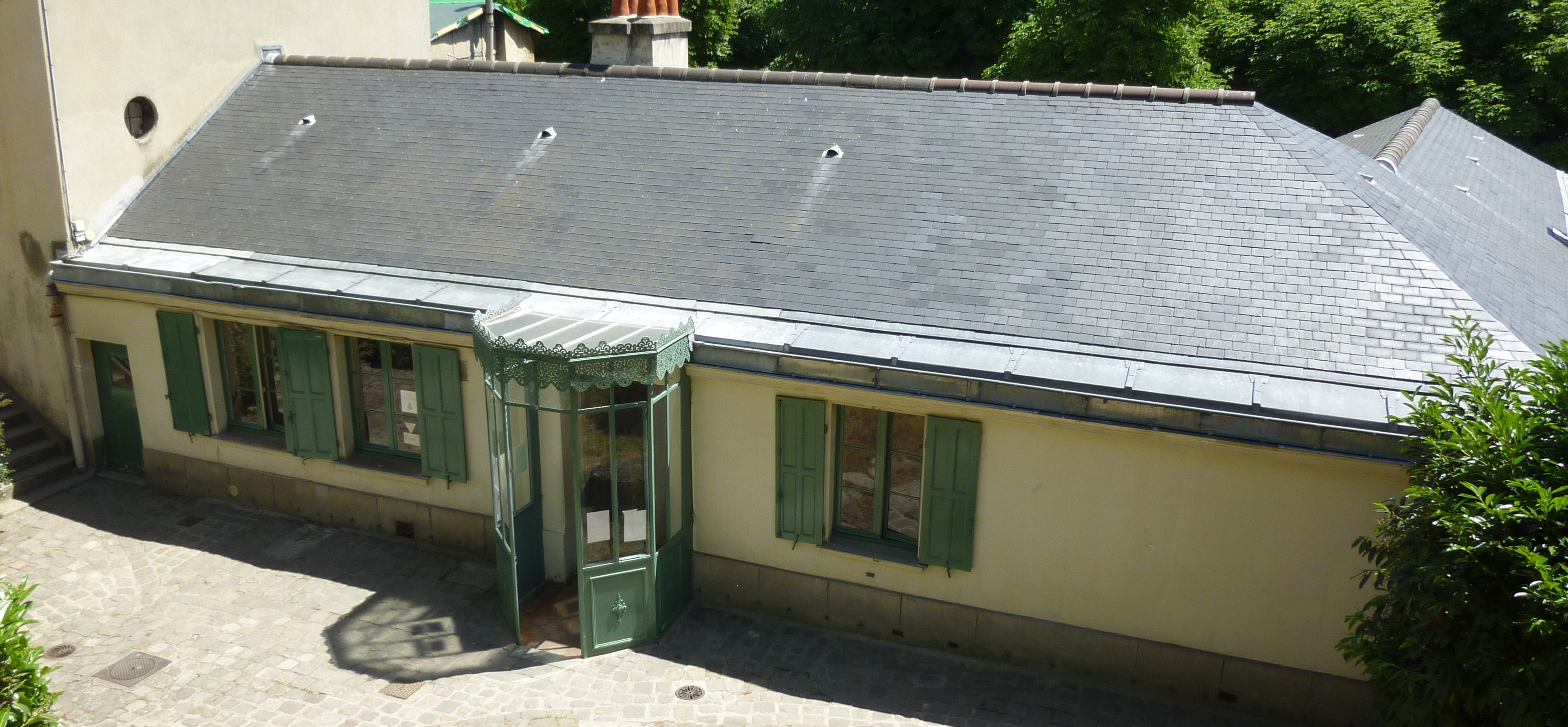
But these are modern ones. The oldest are simply bits of metal in a T-shape that project out from the wall and swivel to hold the shutter against the wall. You can see them at the Maison de Balzac, where they are still in use, painted green to match the shutters.

P1040124

Commercial premises sometimes have wooden shutters that fold right into the wall and don’t need an arrêt de volet. In the next picture, I like the way everything, including the hinges, are flush with the wall. (I am also fascinated by the various metal openings near the ground, but any investigation of them will have to wait for another blog.)

P1040960

Then there are persiennes. The term is used for a variety of louvred shutters, but it seems to be the common term for those folding metal exterior shutters that we have wrestled with in various rented apartments. They always seem to be slightly bent, so it is hard to get the closing to engage. Years ago, when I was a student and au pair in Paris, I used to help an elderly lady downstairs with her persiennes in the evenings. She was in her eighties and very bent and frail. She seemed able to open them on her own, but struggled with closing them.

Here is a photo that Norman took of the rusty persiennes in a flat we rented several times in the Marais.

DSCN0755

Persiennes of this type have the advantage of tucking neatly into the window embrasure, so when they are open, they do not clutter the façade or obstruct the view. But closed, they are not particularly attractive.

P1150583

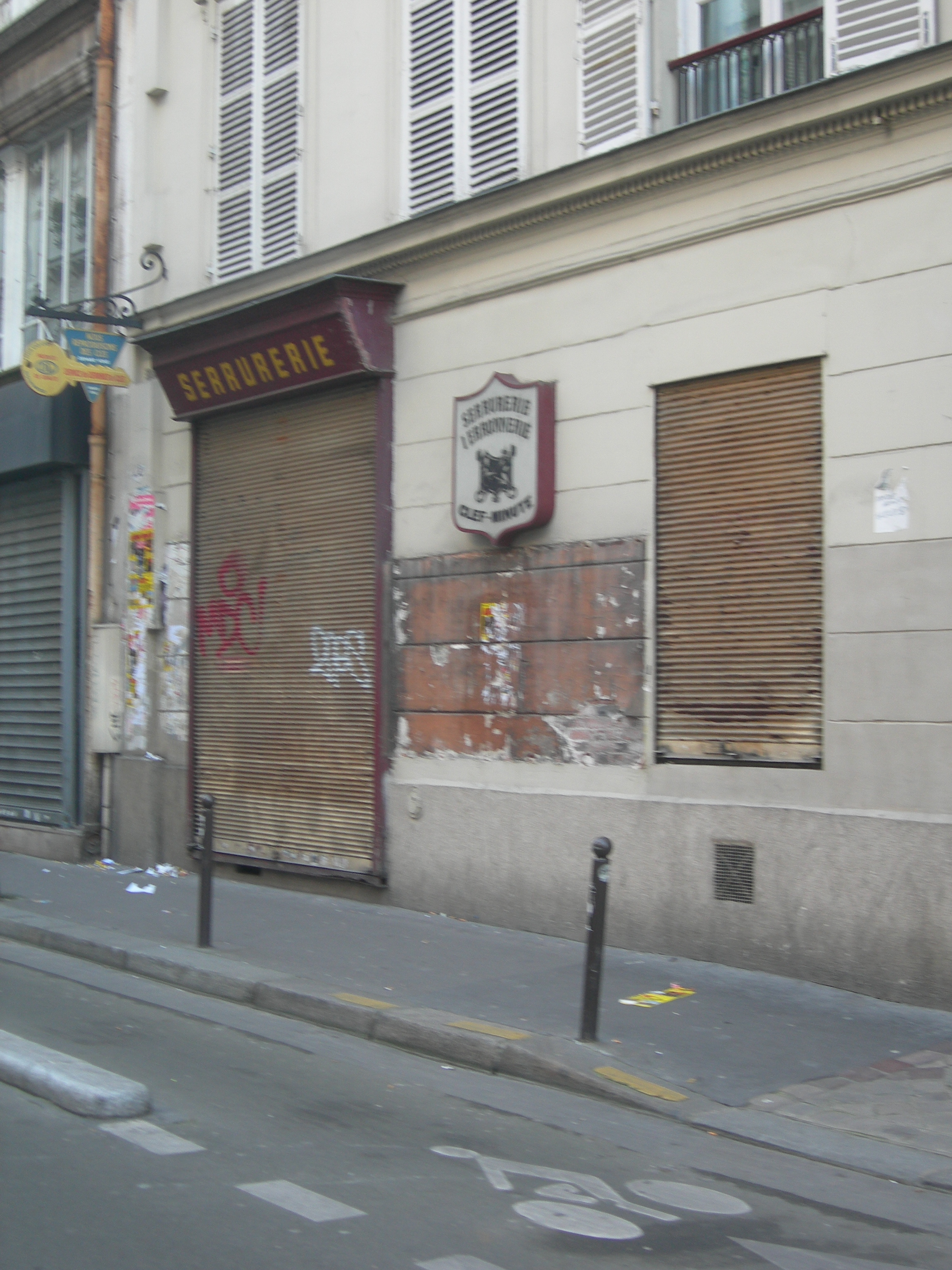
Modern shutters tend to be the roll-down kind (volets roulants), also very dull-looking, but practical. Some are electric and roll down at the push of a button, others have a hand-crank. Many are used as security shutters on commercial premises, and they tend to attract graffiti.

DSCN5432

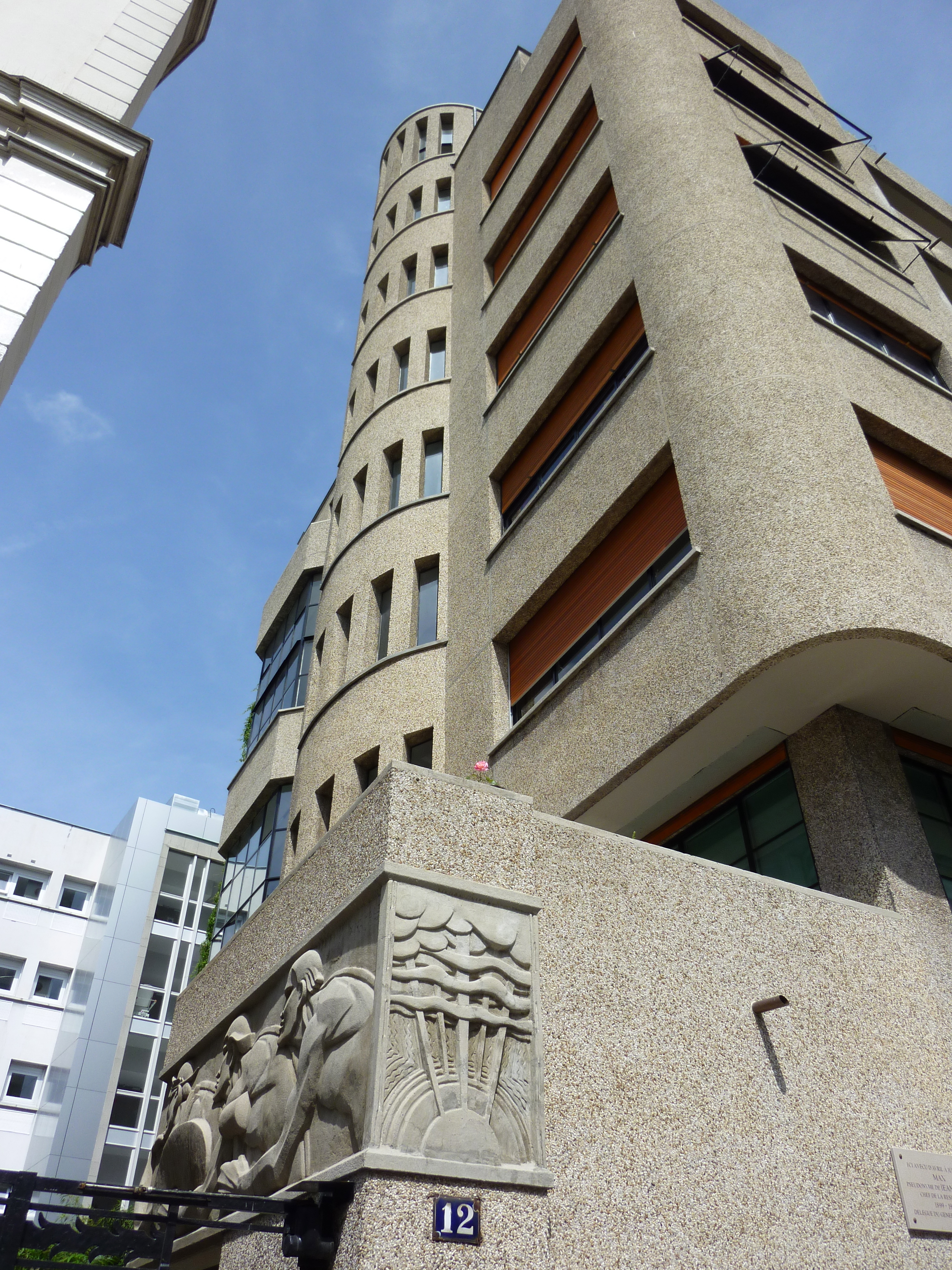
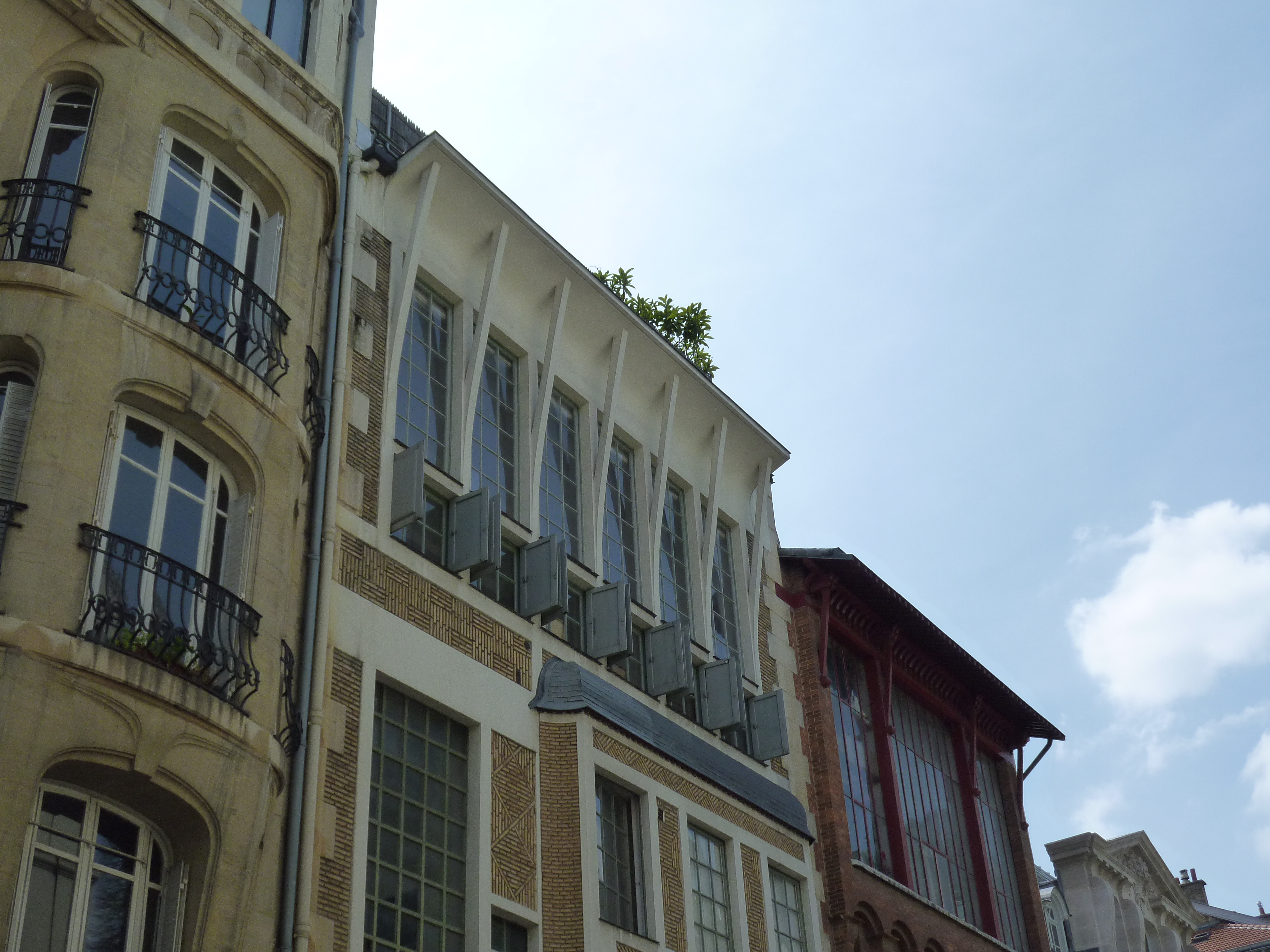
On this Art Deco building, note the frames that allow the shutters to function as awnings, open at the bottom.

P1150002

Fabric awnings and blinds are known as stores, and the window awnings that stand at an angle to the window seem to be called stores à l’italienne. (Stores also can mean interior blinds, as in stores venétiens or Venetian blinds.) I noticed awnings on quite a few institutional buildings. Here is the Port Royal maternity hospital.

P1150596

(Note also the interesting half-shutters just under the eaves.)

Exterior window blinds made of fabric seem quite common. Here are some rather dingy ones on a university building in the Latin Quarter. Of course, they would be impossible to keep clean.

P1150738

Bamboo is similarly used for exterior window coverings.

P1150581

The more I looked at windows, the more variations I noticed. This row of small shutters intrigued me. With all those huge expanses of glass above and below, what is the purpose of the shuttered windows? And note the persiennes to the left that leave the curved top of the window uncovered. The question of what to do with windows of unusual shapes must bedevil some Parisian homeowners.

P1140995

Of all the words I discovered in my typology of windows, the most exotic is moucharabieh. This is a word from North Africa for the filigreed window coverings, usually carved wood, on Moroccan buildings. The most outstanding Parisian version is found at the Institut du Monde Arabe, where the openings are designed to respond to changes in the light by opening and closing.

P1150124 2

My typology is hardly exhaustive, and the possibilities are endless. One could compile a further list just of modern window coverings, quite a few of them one-off architectural features.

Next time you are standing at a Paris bus stop, you can pass the time by counting the number of types of shutters and window closings you can see. Chances are, even a single façade will have more than one type. How many do you see in the photo below?

P1150270

Text by Philippa Campsie, photographs by Philippa Campsie and Norman Ball

*Volet is a word with many, many meanings. This translation website shows the many ways in which this word is used, and “shutter” is mentioned only a couple of times.


Posted in Paris architecture, Paris hospitals, Paris streets | Tagged , , , , , , , , , , , , , , , | 14 Comments

The scavengers

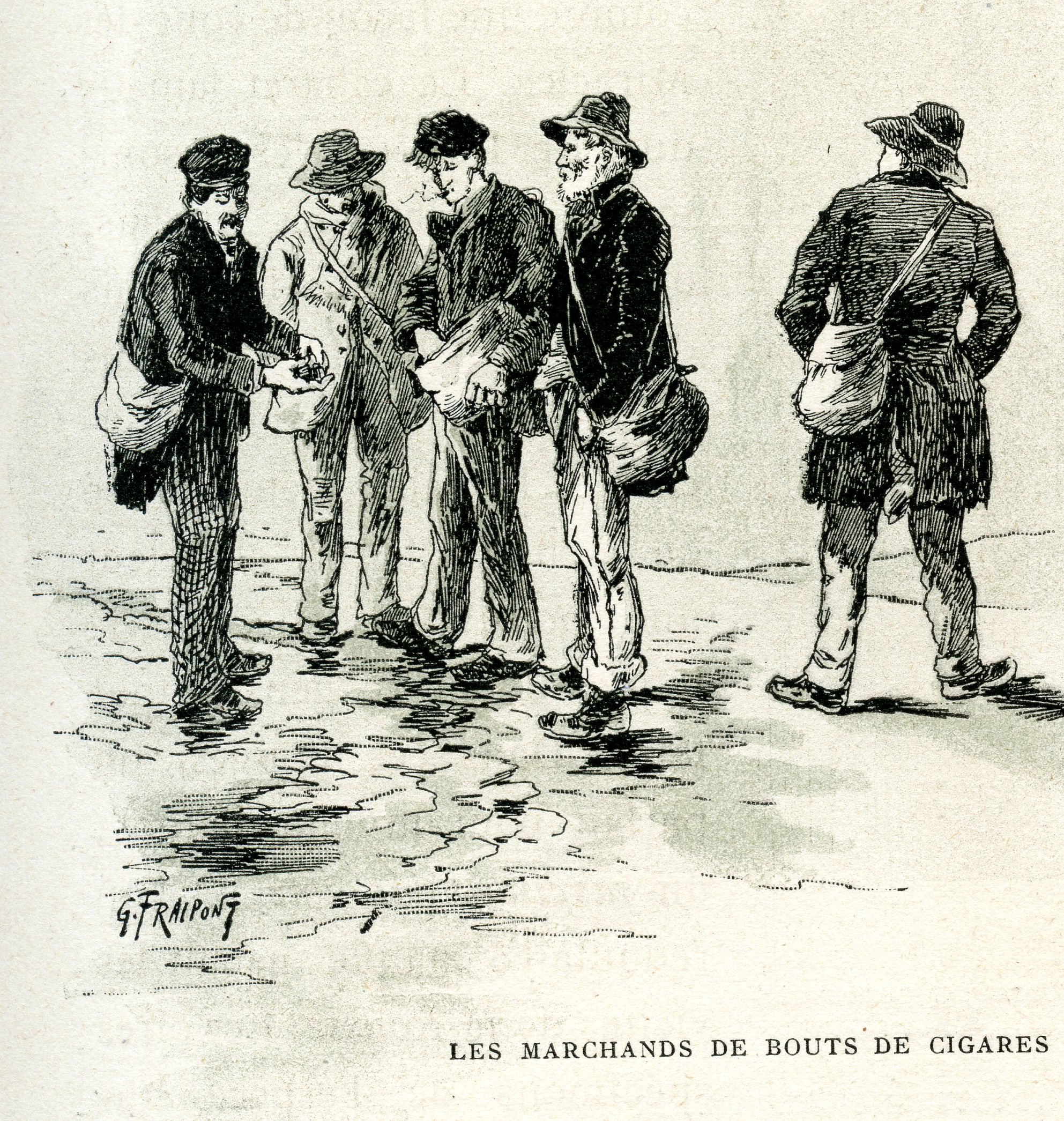
Major nineteenth-century cities such as Paris or London depended on complex ecosystems in which the showiest sometimes obscured underlying layers. Consider a city in which by 1900 it was said that as many as 300,000 cigars (perhaps the number included cigarettes) were consumed daily.

Paris cigars001

In 1890, Saint-Juirs, author of La Seine à Travers Paris (from which the illustration above is taken) warned readers that in La Place Maubert and its surroundings, “all the vices were represented” in the dives (bouges) frequented by “the worst specimens of the human species.” And yet, in these shady quarters, there were also honest people making a living. These were practitioners of les petits métiers or small trades. One group made a living from discarded cigars and cigarette butts.

In this shady milieu the honest people are represented by the scavengers of cigar butts, who have an industry that is respectable, even if not lucrative. Badly dressed in grimy, ragged clothes, the scavengers go into the rich areas, on the boulevards when café terraces are filled with guests; they watch intently around the theatres. Their eyes on the ground, they chase after bits of tobacco. The most well-off have a hook to grab the cigars thrown away by the smoker; the poorer ones pick up the remains with their hands. All of them have large pockets or bags to gobble up their harvest. The prodigality of the rich feeds their small earnings. In fact the streets give to those who exploit them more tobacco than that produced from ten fine plantations. Cigarette butts, cigar ends, either common or high-priced, the orphans abandoned on the sidewalks and carefully collected each day give a harvest of appreciable value. There are often pieces of good fortune, for the most expensive cigars, the havanas worth three francs, were rare finds.

In today’s currency three francs would be around €7. “All this debris is washed, then cut and formed into a special tobacco, superior in quality to caporal tobacco. The gatherers dry it by putting it in the sun on the banks of the river; then they retrace their steps to  Place Maubert,  where they run their market.”

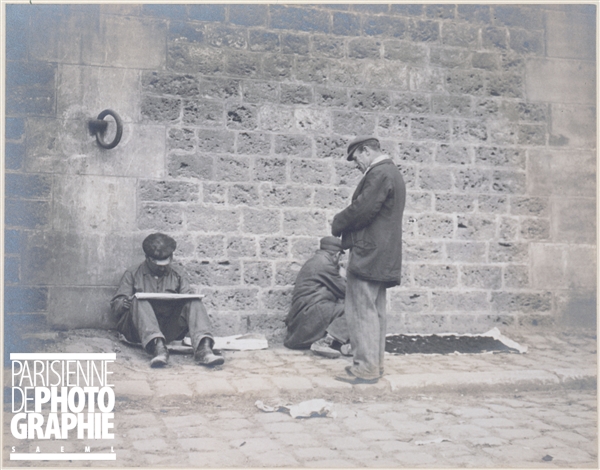
4309fc1b3e66ab505919ad69e5372084-2 In the photo above, taken about 1900, photographer Louis Vert has captured some men processing their tobacco finds on one of the embankments. The results would eventually end up as pipe tobacco or in roll-your-own cigarettes.

According to Gustave Macé, a former chef de la police de Sûreté, cigarette-butt and cigar-end scavengers were organized into groups with their own territories. Each had a leader whose many tasks included keeping track of potentially good picking sites such as well-to-do weddings, important funerals, and church festivals.

4e76475fbdc79f6050ad5757d44399e5

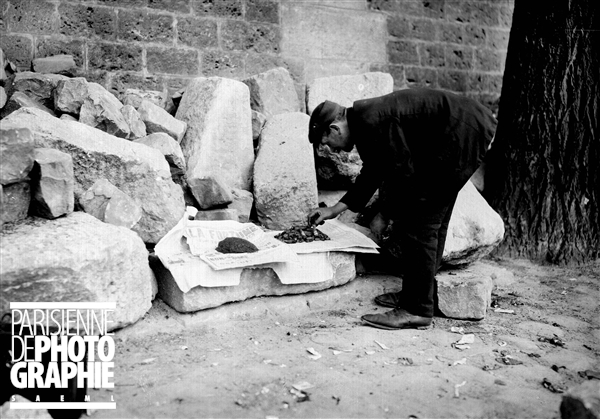
In this 1900 photo by Jacques Boyer, a lone worker is unpacking and sorting his finds. As with any product sold on the open market, prices varied according to supply and demand as well as quality. A cigar barely smoked fetched a better price than a short butt. The former could simply have the ash cut off and be sold as a small cigar, whereas those smoked down to a short stub had to be cut up and the tobacco mixed with other scavenged bits.

The top of the food—or tobacco—chain was occupied by those described as “moneybags” (richards) who specialized in cigars bought from waiters in cafés who kept an eye out for those precious barely smoked ones that could be resold immediately.

4ab442bf8fa5cafda9716a2af134b978

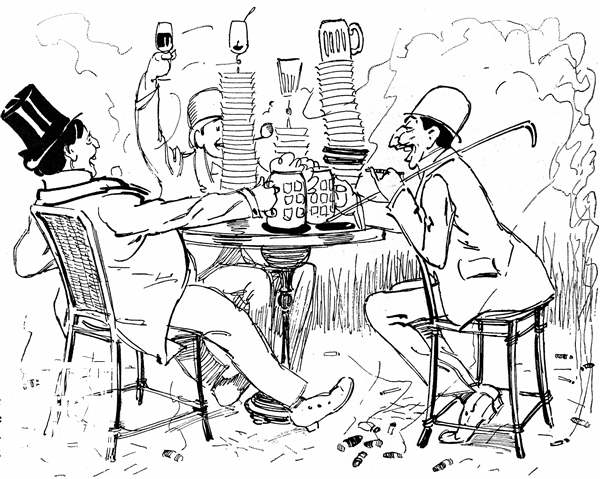
If you look closely at this caricature of a night of excess, you will spot the treasure trove of cigar and cigarette butts that scavengers sought.

One wonders what the tobacco tasted like and who bought it. Saint-Juirs claimed it to be superior to caporal, which was a strong dark tobacco. The reclaimed street tobacco was probably not renowned for either sweet aroma or gentle taste. However, it served its intended market of the  poverty-stricken elderly (vieillards indigents) or poor workmen. For those of us of a certain age, the smell of street tobacco might bring back memories of the would-be-poets and budding philosophers of our university days who proclaimed their pretensions with the strong aroma of Gauloise cigarettes.

In his 1867 book Les petites industries, Edmond Texier explained the origins of some of the little ways of making a living that were “not listed in the dictionary.” Nobody grew up with the dream of living off cigar and cigarette butts. Rather, such an occupation was “the conquest of the imagination by stomach cramps.” The need to eat threw one into such careers.

As Jean-Michel Le Corfec reminds us in Les petits métiers de Paris, those who were excluded from the mainstream of society either had to depend on public charity or find some kind of work to be able to eat. Living off discarded cigars and cigarette butts was one way.

ee9fb88ecd17015939a88c0c38e157c5

As for the smokers, the photographic archives yielded this photo, taken during the Commune of 1871. The woman looks as if she is enjoying a well-earned smoke and there will be little left for the scavengers.

The rich photographic and artistic history of Paris has captured some of the little trades that made up the functioning city. In a later blog I will describe some other petits métiers of Paris. They were essential parts of a complex city and a now-vanished way of life.

Text and translations by Norman Ball

Photographic images courtesy of Paris en Images, except for the first image, which is from Saint-Juirs,  La Seine à Travers Paris, Illustrée de 230 Dessins et de 17 Compositions en Couleurs par G. Fraipont. Paris: Librairie Artistique, 1890.

Additional information from Jean-Michel Le Corfec, Les Petits Métiers de Paris. Bordeaux: Éditions Sud Ouest, 2008.

Posted in Paris history, Paris popular culture | Tagged , , , , , , , , , , | 7 Comments

Pippa, Pouch, and a Paris Publisher

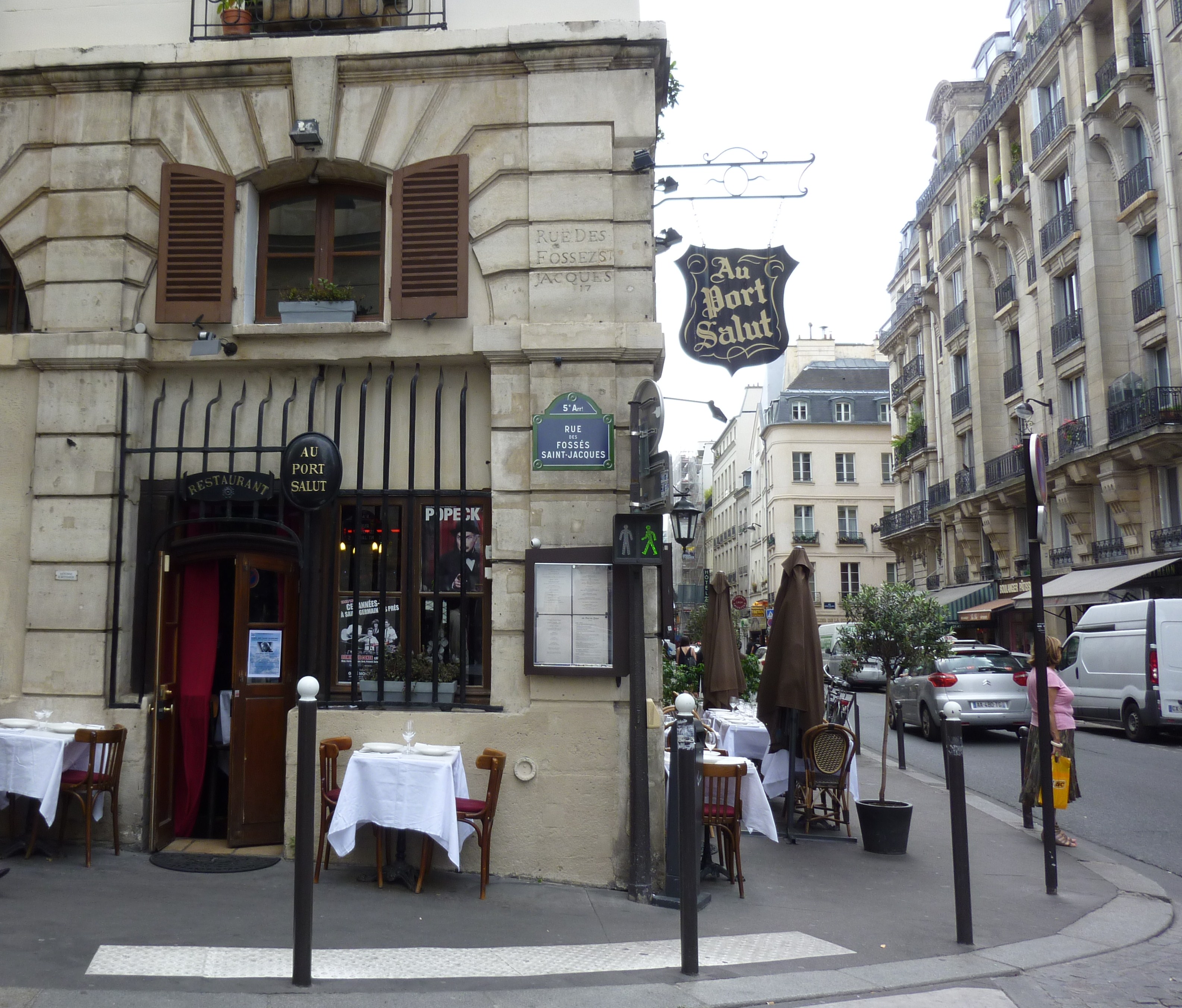
We don’t usually make a big deal of birthdays. Norman’s falls in late winter just as the academic term is winding up. Philippa’s falls in early summer, just as everyone is going away. This year we were in Paris for the latter occasion. At one point we contemplated dining in a grand restaurant and or visiting some major attraction, but in the end, we just walked up the boulevard St-Jacques, stopping for lunch at Au Port du Salut, at 163 bis.*

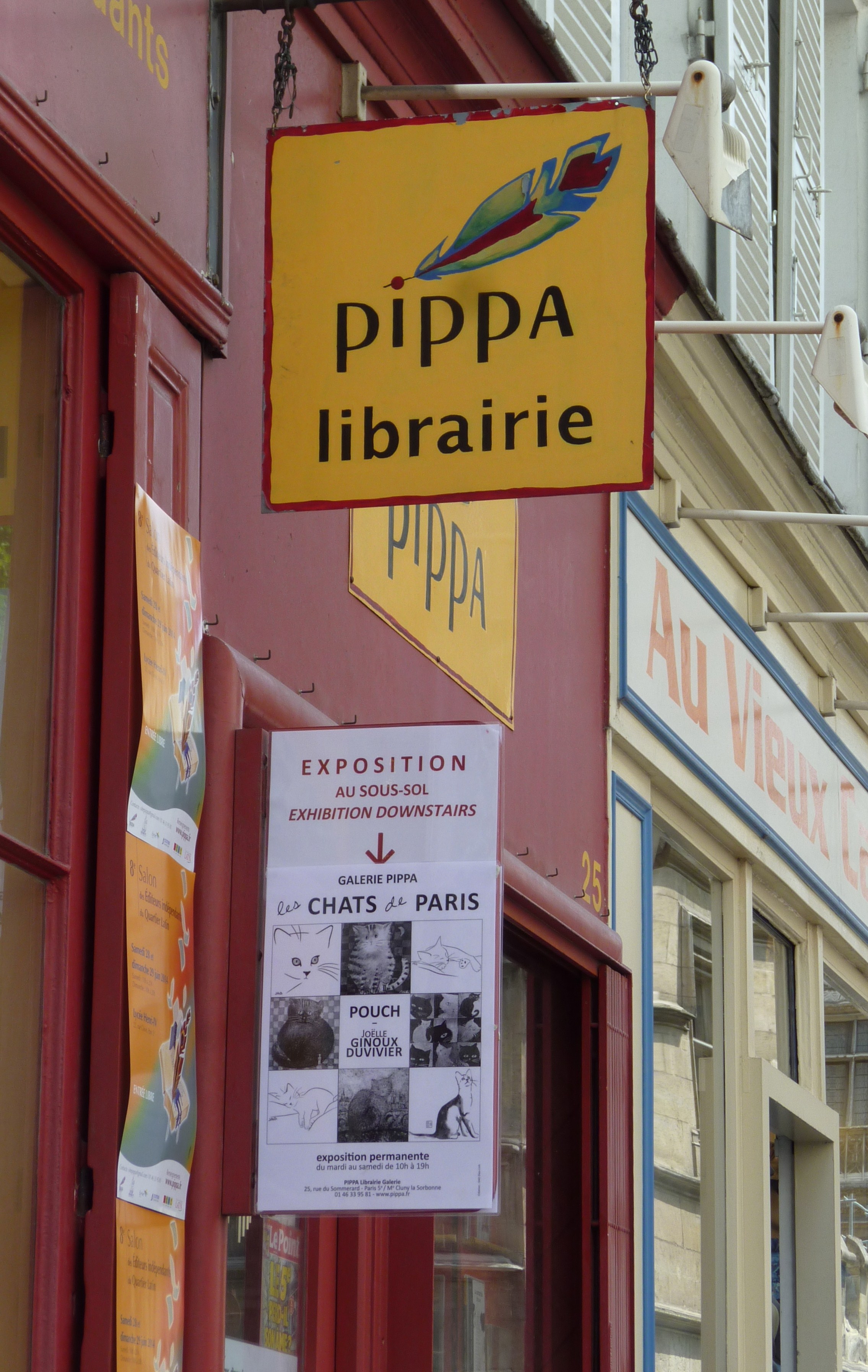
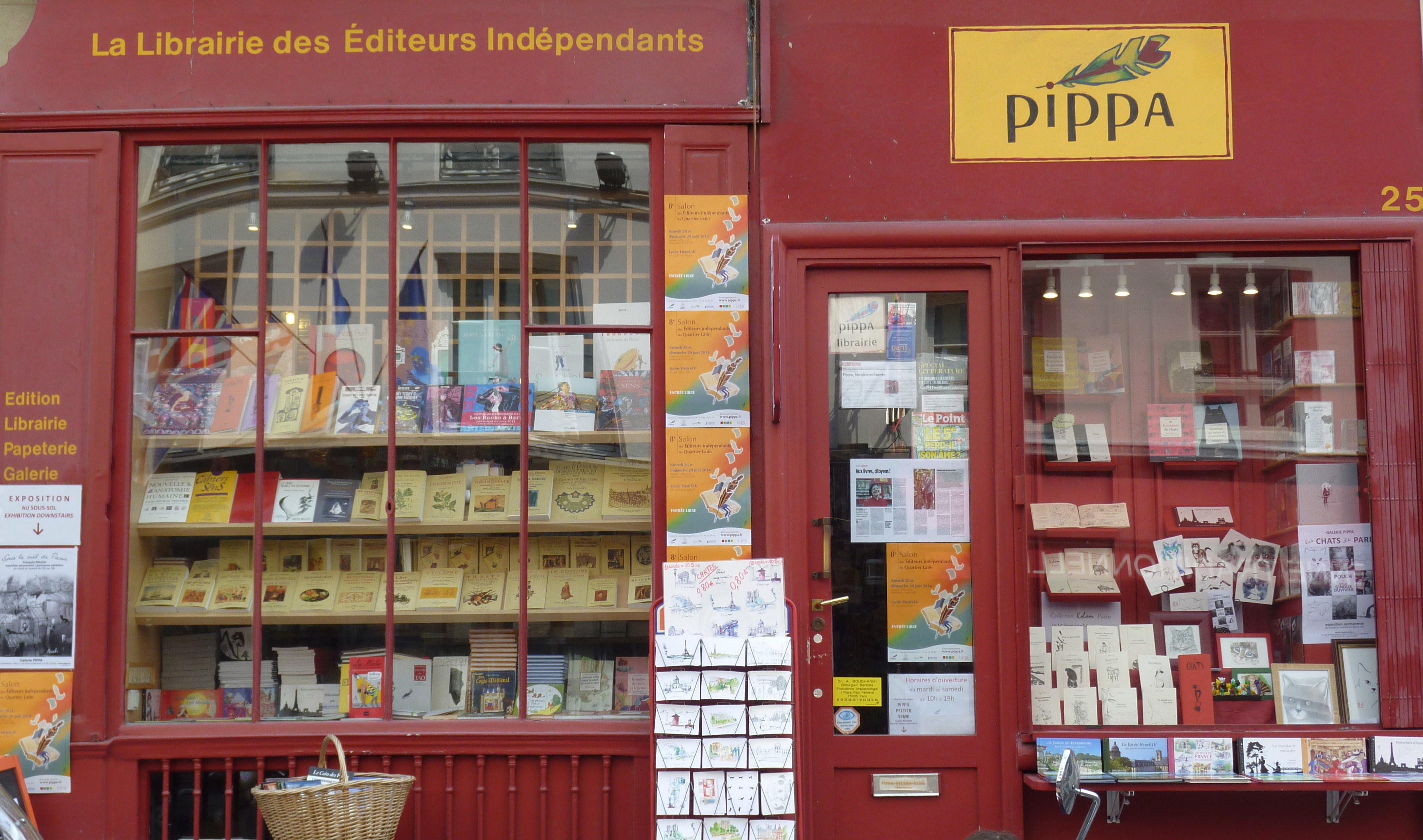
We then wandered on to a bookshop-gallery at 25, rue du Sommerard called, appropriately, Pippa (since Pippa is the short form of Philippa’s name, used by family and old friends). The previous week, at a poetry market in the Place St-Sulpice, we had seen someone with a bag on which was printed the bookshop name and had decided that this would make a good birthday destination.

P1150747

First, we asked about the name Pippa. The owner told us that the word meant a Chinese stringed instrument rather like a lute (more often spelled pipa). We never did find out why she chose it, though. And the logo is a feather, not a musical instrument.

Meanwhile, we had noticed another familiar name. The gallery in the basement was showing works by the illustrator and cartoonist François Pouch. As it happened, we already owned one of his engravings.

V2 A4 HD

Flashback to, oh, about 2005 or so. We were staying in the Marais and had taken a walk along the Canal St-Martin on a Sunday afternoon, when we came across a little open-air arts and crafts market. As we were admiring some pen-and-ink cartoons, an enormous gust of wind flattened several displays, including the one we were visiting. We immediately set to work helping the stall-holder reassemble the stand and clear away some broken glass from framed pictures that had fallen on the cobblestones. We chatted to him and ended up buying one of the unbroken pictures, an engraving by Pouch. (The glass later shattered inside Philippa’s suitcase on the way home to Canada.)

We’ve enjoyed the picture ever since – of a musician parking his modest bicycle at the bottom of a flight of grand stairs into an baroque opera house with over-the-top decoration. Pouch does a lot of images of musicians.

marché de la poésie

Flash forward again to 2014, and here are more of his pen-and-ink cartoons, with musicians and cats and rooftops. So there was the question of a birthday present settled (an original pen-and-ink work featuring all three), and we bought some books as well. Of course. Our plans to reduce the number of books in our lives always come to naught.

P1150749

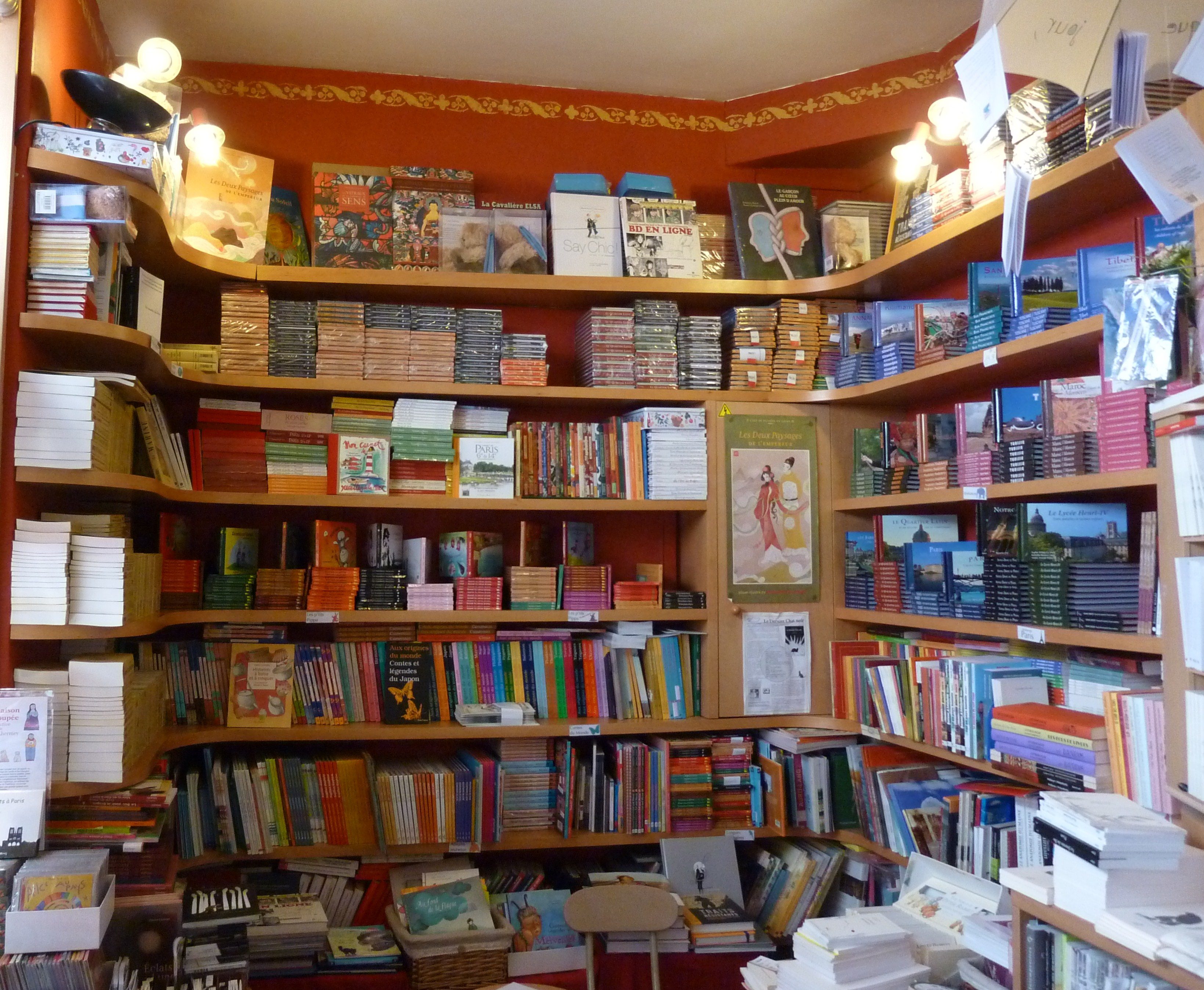
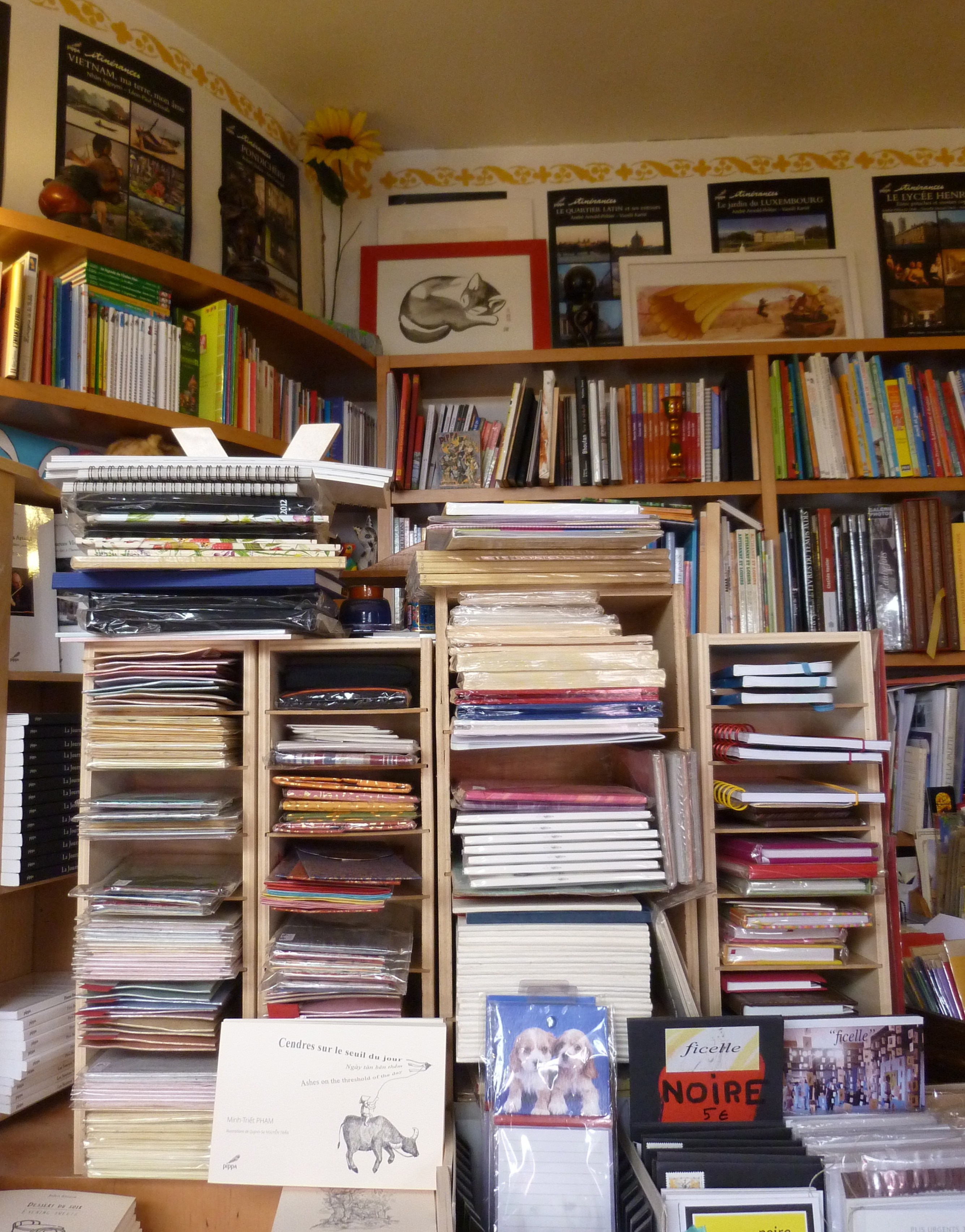
Librairie Pippa sells books by small and independent publishers, including its own line of poetry, children’s books, and travel books. We picked out several of these, as well as some wonderful facsimiles of 18th and 19th-century books by a publisher called Maxtor.

We struck up a conversation with the owner, Brigitte Peltier, whose husband, André Arnold-Peltier, is a photographer who has contributed to many of the travel books. Brigitte is an editor and publisher who founded Pippa Editions in 2006 and the bookshop in 2008. Like Philippa, she had worked in publishing companies for years before striking out on her own.

P1150751

It is encouraging to see a new bookshop in the Latin Quartier, where bookshops more often close than open. According to a 2011 article in Le Point, 70 bookshops in this area closed between 2003 and 2008 (we have noticed closures in other quartiers as well).

The main problem is, as always, rising rents vs. ever-narrowing profit margins. The area is becoming trendier and bookshops are being replaced by designer boutiques. Many publishers have moved to the suburbs. After all, fewer university students frequent the area around the old Sorbonne buildings since the Université de Paris was decentralized to campuses throughout the region. And those who remain buy fewer books. Meanwhile, in the cafés, the students who used to make a single drink last all evening as they argued over existentialism are being replaced by tourists.

Nevertheless, the quartier is still a centre for bookselling and a few publishers remain. There are 255 bookshops (down from about 340 ten years ago, but still a good showing compared to other cities). And you can now search their holdings through a single website. The site also lists all 300 bouquinistes by name and includes them in the search function, which strikes us as a lovely mixture of traditional and contemporary methods of bookselling.

P1150766

We are happy to report that one of those in the forefront of support for the Latin Quarter book trade is Toronto-born: Brian Spence, of the Abbey Bookshop on the rue de la Parcheminerie, celebrating its 25th anniversary this year.

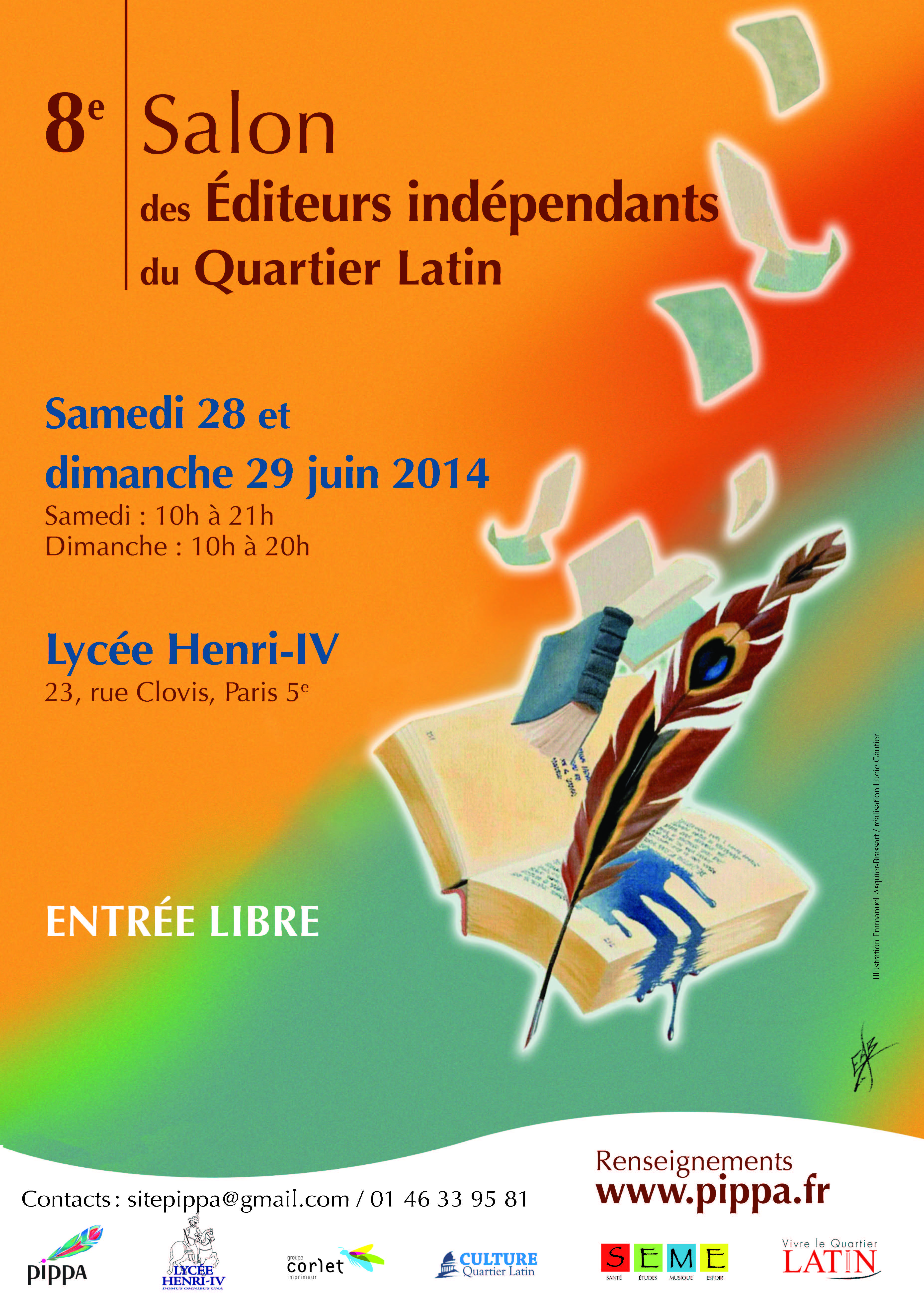
Brigitte, too, works hard to promote publishing and bookselling, through the Salon des éditeurs indépendants du Quartier Latin, held in June (alas, we left Paris the day it opened).

8e_salon_Affiche_V2

And as if that were not enough, Brigitte explained that some of the bookshop profits go to a charity that she founded, called SEMESanté Etudes Musique Espoir (Health Study Music Hope). SEME supports young people in India, Africa, and Vietnam – she mentioned, for example, helping a young woman in Pondicherry, India, train as a nurse. Doesn’t that just make you want to go out and buy more books?

Note that the shop is closed between July 11 and August 19, 2014. Even booksellers need time off.

Text and photographs by Philippa Campsie.

* We don’t do restaurant reviews, but if we did, we would give this small restaurant as many stars as we were allowed to give. We particularly recommend the “formule de midi” – the set-price lunch menu at 19.50 Euros. Given the genius of the chef, Marius Arranz, this is a stellar example of what the French call “un bon rapport qualité/prix” (good value for money). Michelin describes it as “une cuisine semi gastronomique à base de produits frais.” We’re not sure about the “semi gastronomique” – it seemed wholly gastronomique to us – but we can vouch for the fresh ingredients.

P1150730

Posted in Paris shops | Tagged , , , , , , , , , , , , , | 4 Comments

The contra-flâneur

On Friday, October 18, 1974, at 10:30 in the morning, Georges Perec took a seat in the café known as Tabac Saint-Sulpice, and assigned himself the task of observing what happened in the square in front of him. He wanted to describe the things that usually pass unnoticed – to capture “ce qui se passe quand il ne se passe rien” (what happens when nothing is happening).

His observations were published as an essay called “Tentative d’épuisement d’un lieu parisien” (Attempt to exhaust a Parisian place). He made notes on what he saw and what went past – mostly people and buses. He commented on the weather and the behaviour of pigeons, and on how even when the square seemed to be deserted, you could usually see someone somewhere.

P1140577

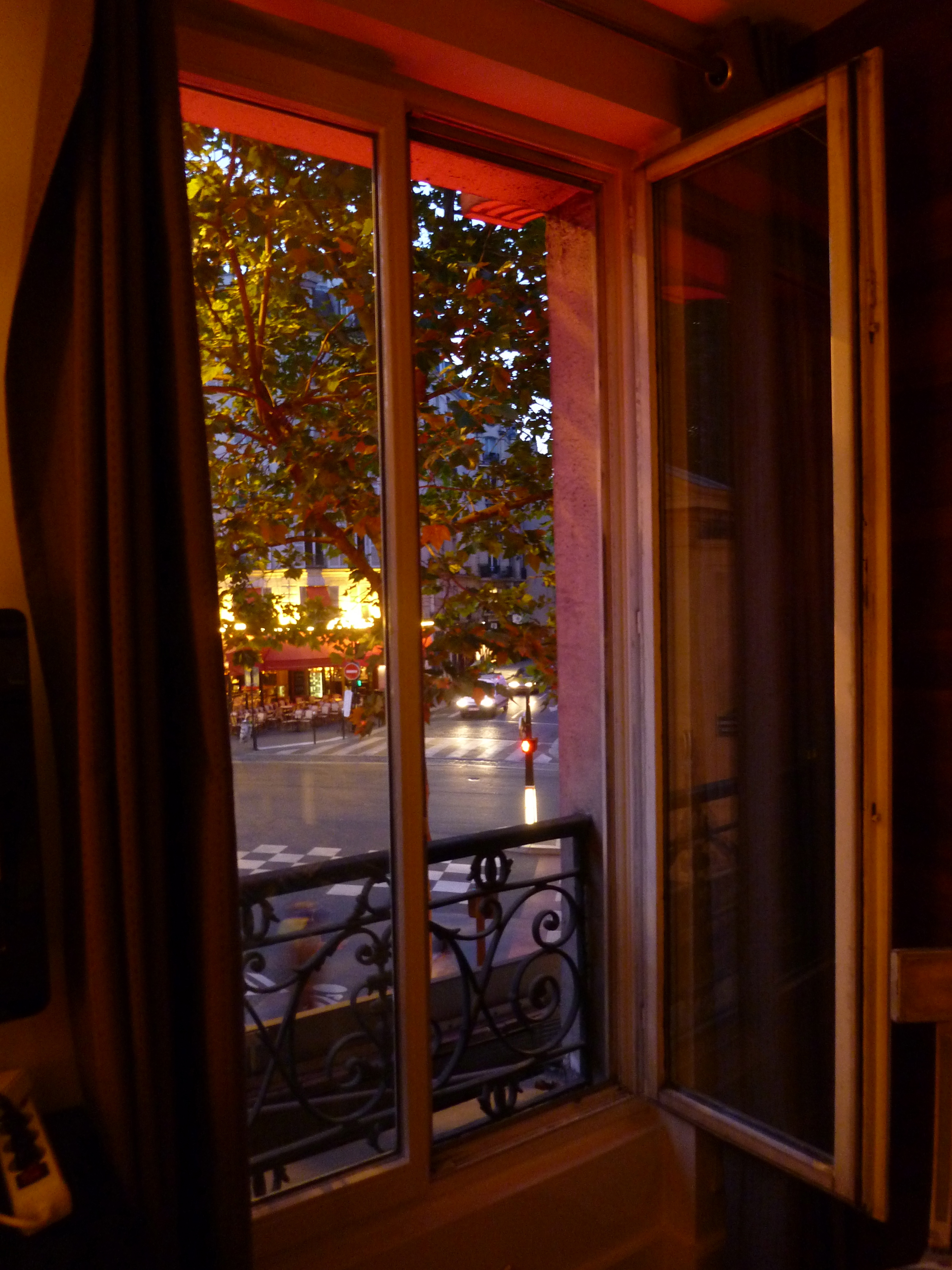
I thought I might try something similar with the view from our window, which overlooks the intersection of the boulevard Port-Royal with the rue St-Jacques, which becomes the rue du Faubourg St-Jacques as it crosses to the south side. I have written about this place before, but I wanted to look again, with new eyes.
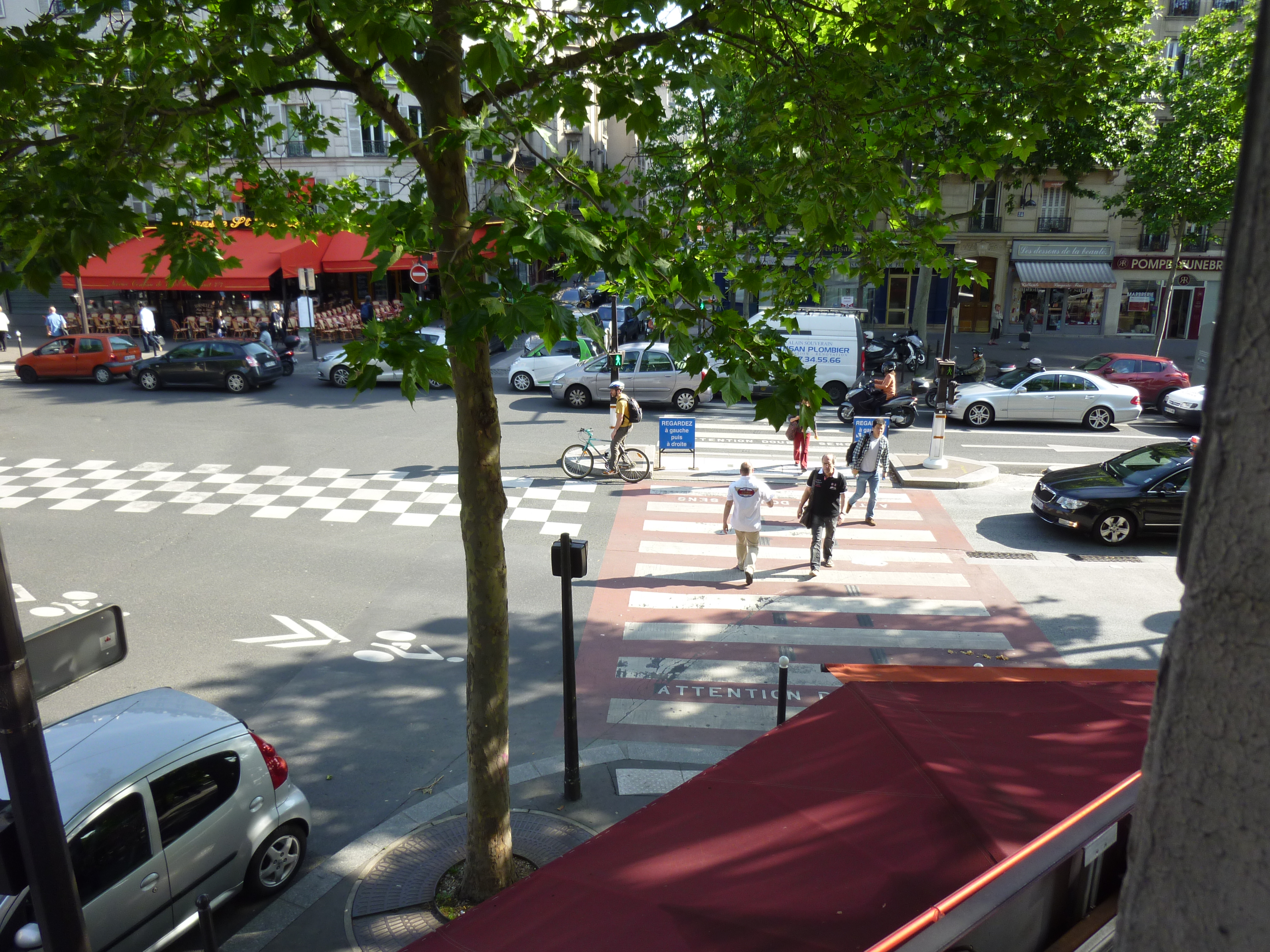
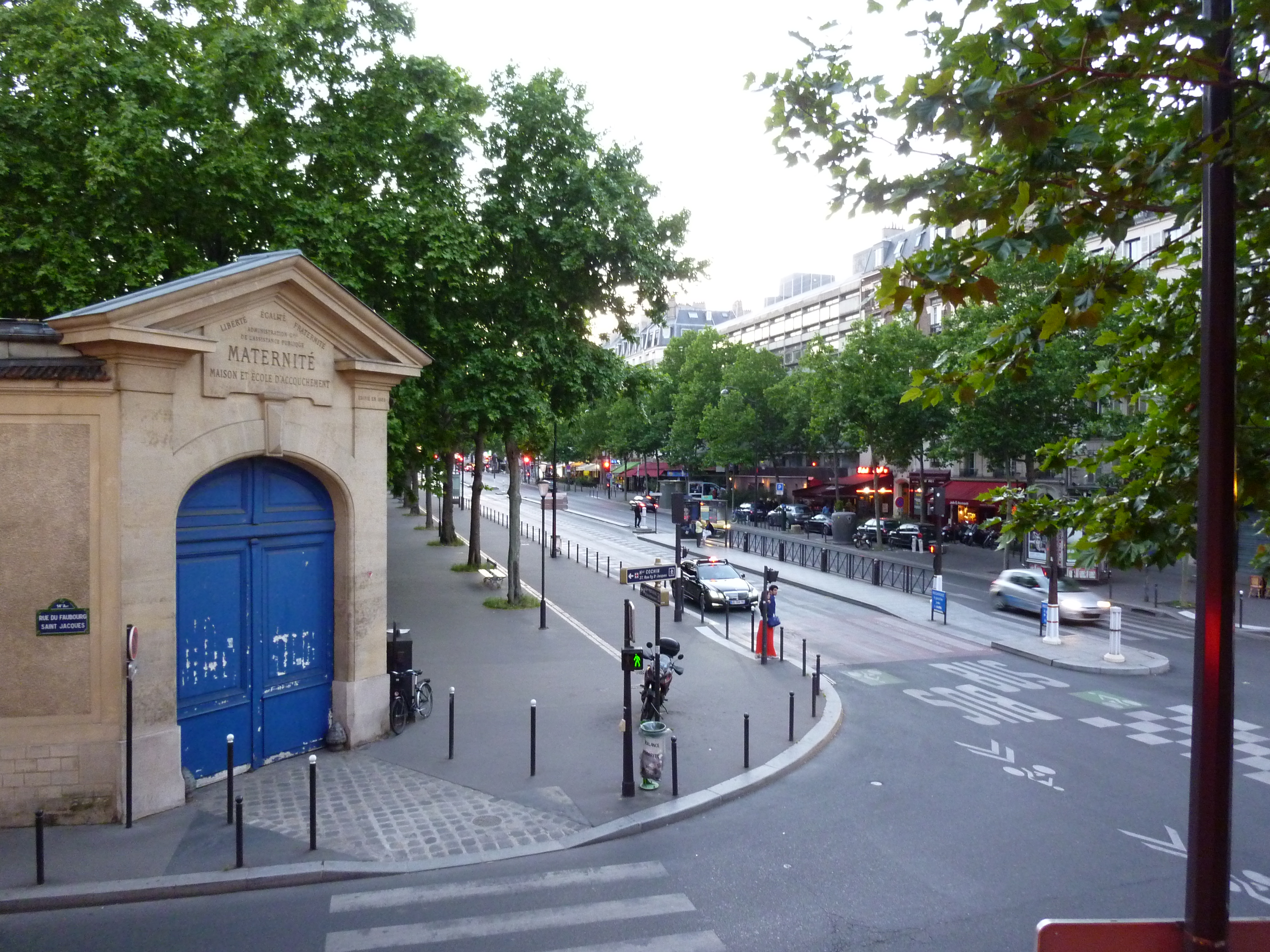
As Perec did, I will start with an inventory. On the four corners, from the northwest clockwise, we have: La Terrasse St-Jacques (a bistro with some pretensions), a boulangerie artisanale, the Harmony (a bistro with fewer pretensions), and the ancient and now unused 1888 entry to the Port Royal maternity hospital (the hospital is still there, with many old buildings, but the current entry is now to the west).

P1140898

We also have: a news kiosk, a bottle bank (for recycling glass), a phone booth, a mailbox, two bus shelters with seating, public toilets, public benches, street parking, garbage receptacles, a large container for donating used clothing, and an electronic sign posting helpful information from the Mairie, such as weather and upcoming events. This is a full-service intersection. Rows of mature plane trees provide shade and stanchions separate the sidewalks from the roads at the corners. There is a Velib’ stand, but it is not visible from the window.

Other businesses on the boulevard that I can see from the window include: a pompes funebres (funeral service), a lingerie boutique, an optician, a shop selling electronic cigarettes beside a regular tobacconist, a laundromat, two pharmacies, and a chocolatier that also sells ice cream. A food market sets up on Tuesdays, Thursdays, and Saturdays on the boulevard to the east of the intersection.

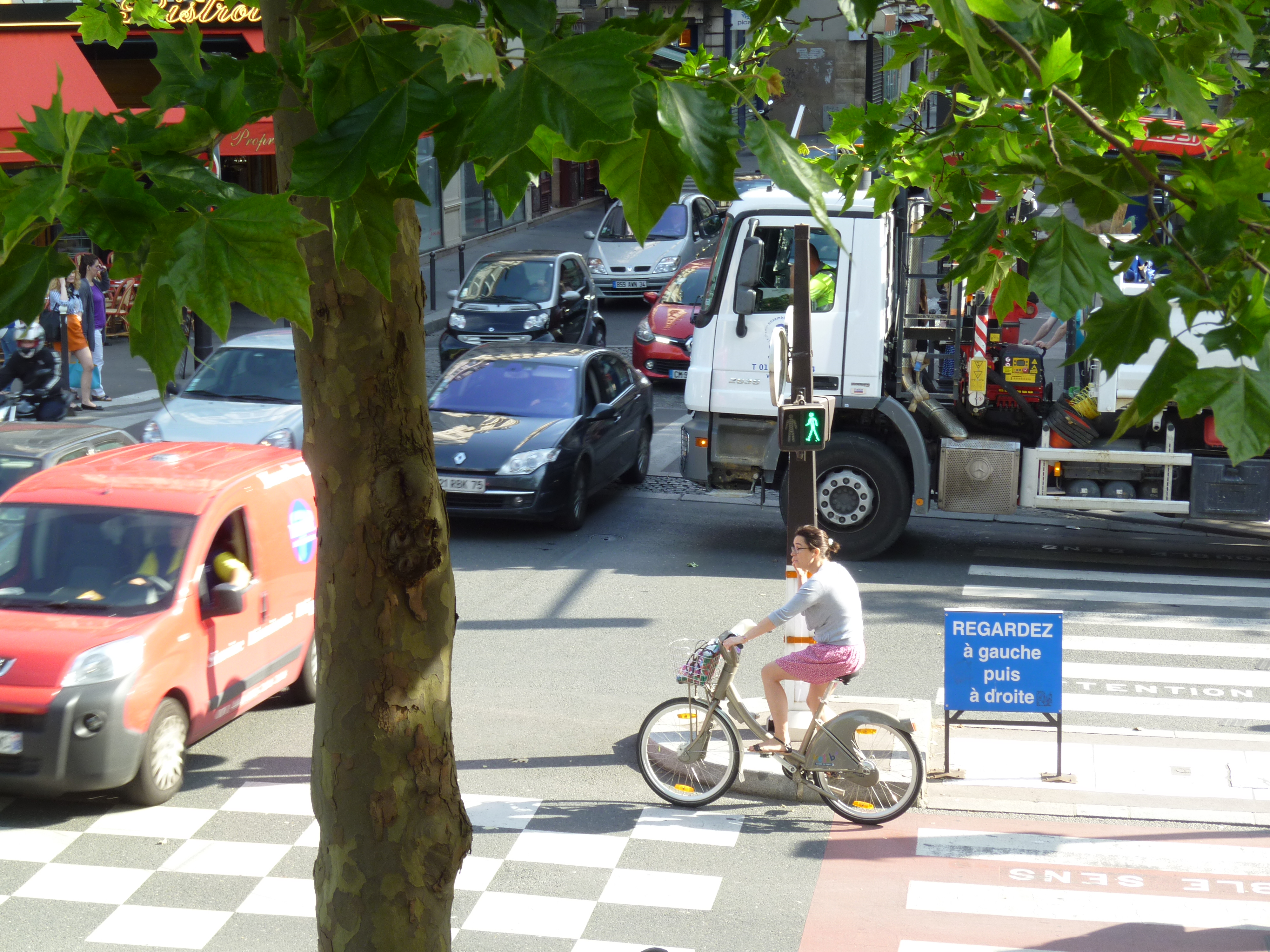
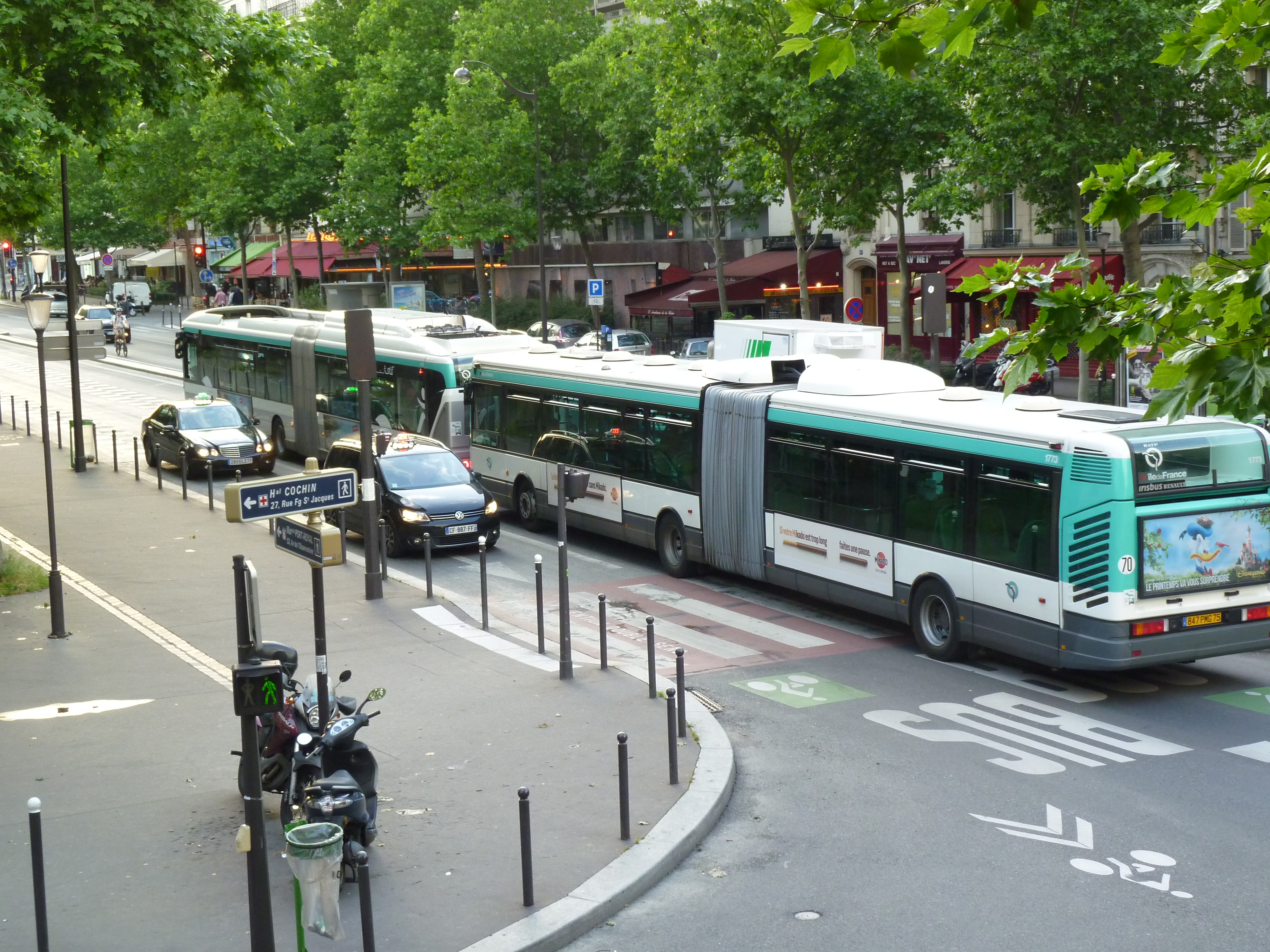
The traffic provides free entertainment because the intersection is complicated. There are four lanes on the boulevard, but they are not, as one would expect, two westbound lanes on the north side and two eastbound lanes on the south. Rather, there are two lanes of regular traffic in either direction on the north side, and two lanes of buses/bicycles/taxis/service vehicles in either direction on the south side.

P1140579

We observe non-locals navigate this complicated space in a car: they emerge from the one-way southbound rue St-Jacques and see a thicket of signs and arrows. The right-hand turn is straightforward, but the left-hand turn requires quick wits or a prior knowledge of the place. We keep expecting to hear the sound of metal crunching on metal, but it is mainly horns and occasional shouts we hear as one more neophyte turns into the bus lane, then laboriously backs out.

Two bus lines serve the boulevard: the 91, which shuttles between the Gare Montparnasse and the Place de la Bastille (unless it short-turns at the Gare de Lyon), and the 83, which arrives less frequently to take people between the Porte d’Ivry at the city’s southeastern edge and Friedland-Haussmann on the Right Bank. The busy 91s are long, articulated, low-floor vehicles; the 83s are ordinary buses. Instead of horns, the buses have bell-like chimes to warn pedestrians or stopped vehicles of their approach. From what we can see, Paris bus drivers seem both observant and patient – people running to catch the bus at the last moment usually succeed.

P1140556

Perec’s account of what happens when nothing is happening is fairly simple: people pass by with parcels, children, or dogs; there is a funeral, and later a wedding in Saint-Sulpice; it rains and then the rain stops.

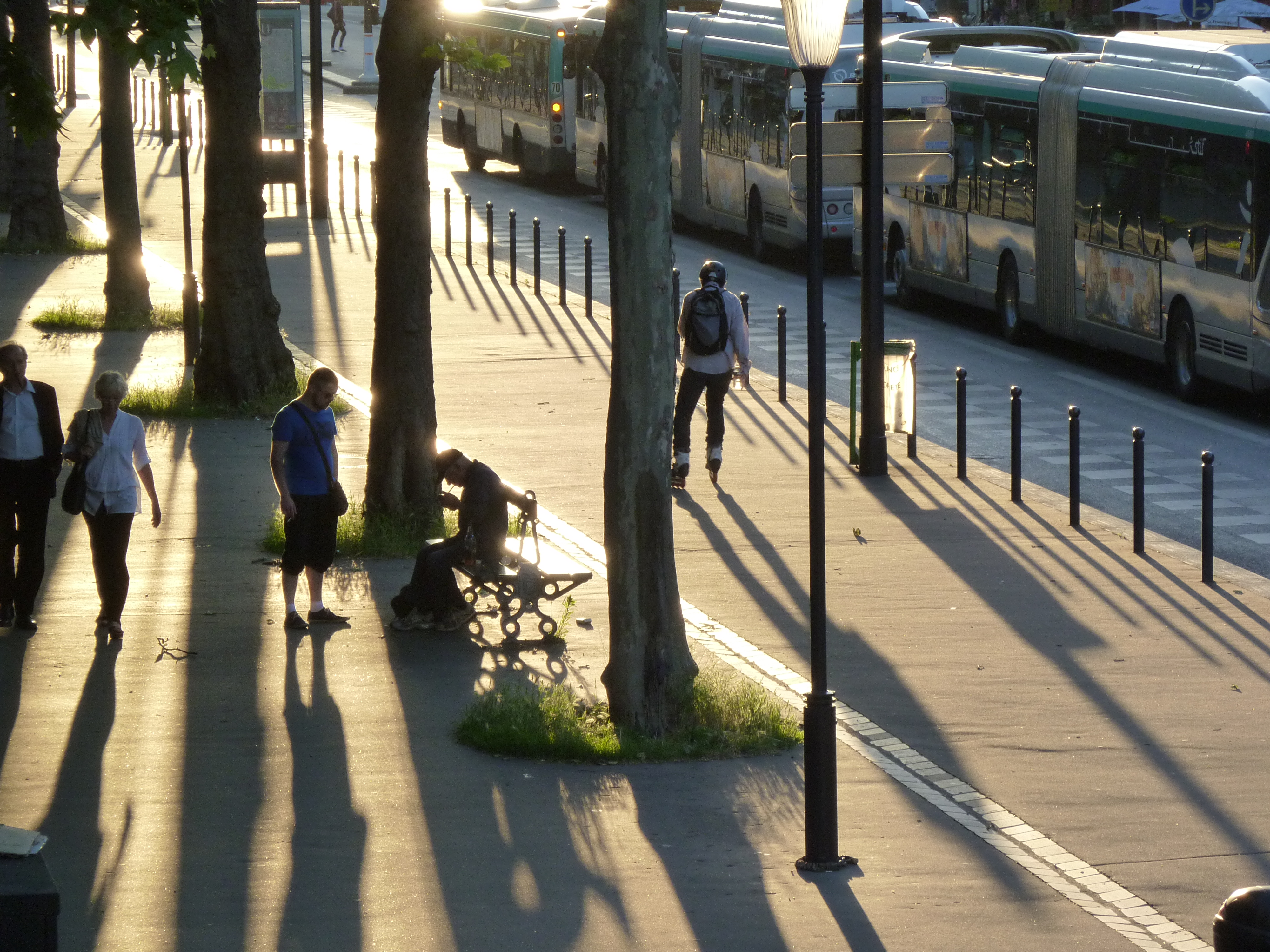
This intersection seems to be more animated. So far, we have seen a procession of motorcycles (about 50 or so) and another of rollerbladers (more than 100). There are many emergency vehicles (we live surrounded by hospitals, the Sapeurs-Pompiers are a block away along the boulevard, and the Santé prison is nearby). We are learning to distinguish a police siren from an ambulance siren.

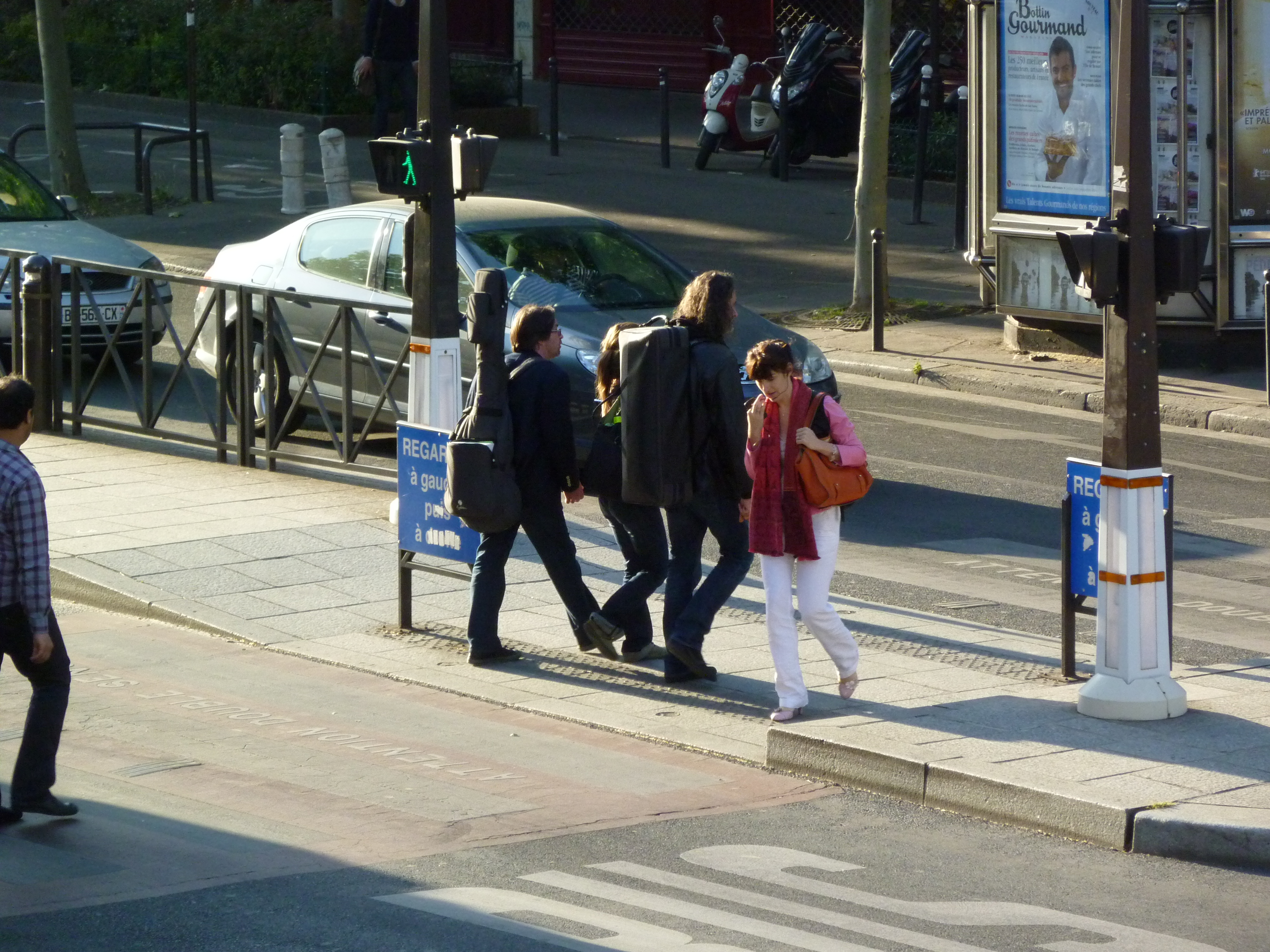
Perec noted many tourist buses, but this is not prime tourist country – although this morning we noted a baffled pair consulting a map on the opposite corner. Rather, we see commuters on Velib’s with briefcases in the baskets, people with shopping caddies going to the market, children on scooters, joggers hooked up to MP3 players, and people with musical instruments in specially designed backpacks (there is a music school nearby).

P1150290

You can see people carrying all kinds of things: an ironing board, a ladder, a cat in a carrier-box. In a city where many people make their way through life without a car, stuff that would normally be carried (and hidden) in a car suddenly becomes visible.

I am fascinated by what people are wearing. A woman in white with fluorescent orange running shoes and a matching orange scarf. A man in a raspberry-coloured suit. Another woman in a smart coral jacket with a handsome handbag. A man in military khaki with a képi ornamented with gold braid. An older woman in Turkish pants and complicated sandals with many straps.

Norman watches the cars and motorcycles. Renault, Peugeot, Citroen, Toyota, Fiat, Ford. SmartCars. The occasional Porsche or Maserati. Three-wheeled motorcycles. Vespas. Delivery vans. Delivery cycles. Street cleaning equipment. Garbage trucks – one of which got stuck in the intersection for several minutes; cars carefully manoeuvred around it.

The hospital’s presence is indicated not just by the ambulances, but by people with arms in casts, or hobbling along on crutches. We also spotted a man wearing a dark-blue paper hospital gown over his trousers, trailing an IV pole complete with a bag of some liquid, bumming cigarettes from the people at the two cafés. We have seen him twice.

One glimpses bits of other people’s lives. A young woman stops on the corner, hesitates, consults her smartphone, disappears. A few minutes later, she is back at the same corner, this time accompanied by a young man who is also consulting a smartphone. Were there others they were supposed to meet? They confer, look around, and eventually wander off. I guess this is what Perec calls a “micro-évènement” (micro-event).

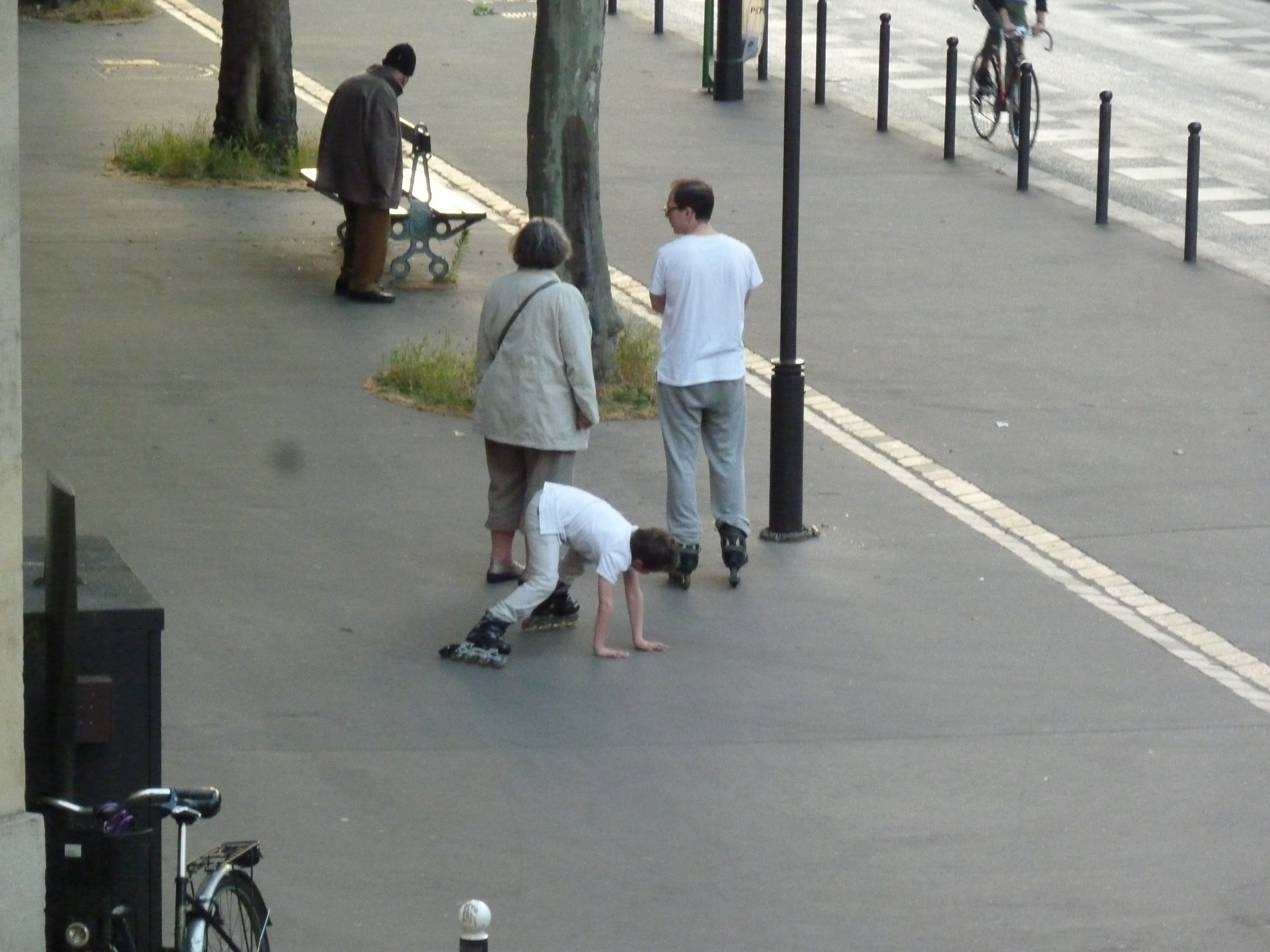
I watch a little boy rollerblading with his father. Eventually, I realize that two older people nearby watching the boy must be his grandparents.

P1150344

I spot a couple with a baby emerging from the maternity hospital. A newborn? The woman stopped to kiss the tiny head as they walked toward the bus stop.

Street philosophers occupy the benches for hours at a time, talking to each other or to themselves. One was there for an entire evening, waving his arms and addressing passersby until someone finally stopped and talked to him. He was still there when we went to bed.

P1140692

The light changes as the day passes. The pillars on the traffic island light up along with the streetlights. Parents walk their children back from school, commuters make the homeward journey, diners congregate in the bistros. This intersection never seems deserted.

Is it worth travelling so far to watch such everyday sights? Yes, if the goal is to understand the city a little better on each visit. And I find that the exercise of writing down what I see makes me notice more.

As I write this, an elderly man is studying something intently in the window of one of the pharmacies, a police car is approaching the intersection with its klaxons blaring, and a 91 bus passes full of people. A woman sits in the café opposite, writing, perhaps, a description of the intersection from the other side. Or a novel. She has been there for some time.

Perec’s essay positioned him as a “contra-flâneur”* – rather than wandering the boulevards looking for interesting literary material, he stayed in one place and let the world come to him. The same approach in mid-June 2014 at a busy intersection gives us a new way to appreciate life in Paris.

P1140705

Text and photographs by Philippa Campsie.

* I am indebted to Meeka Walsh for this expression, used in her essay, “Georges Perec: Soft Chalk and Pigeons,” Border Crossings.

Posted in Paris streets | Tagged , , , , | 21 Comments

Monsieur Rochefort and his surprising typewriters

When Martin, my typewriter collector friend, invited me to see “a little something from Paris,” I had never heard of the Dactyle typewriter. Nor did I realize I was about to learn the story of a French engineer/inventor who helped the blind communicate. Moreover, I encountered a mystery I need help to solve.

Dactyle 8

The typewriter that Martin took from this box at first looked familiar.

Dactyle 3

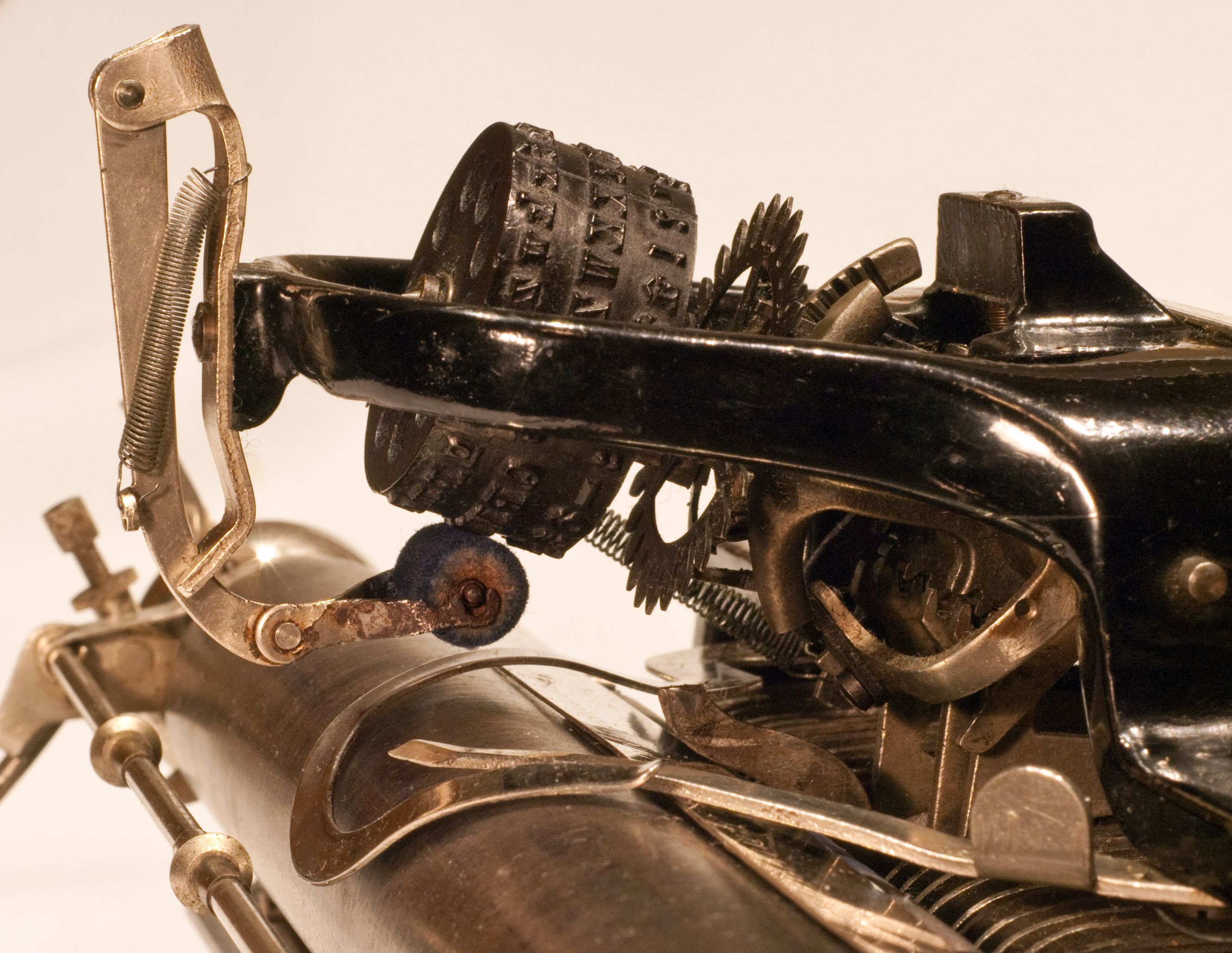
The spidery-looking keys, the cylindrical type-sleeve at the top, and the folding space bar in the middle all said “Blickensderfer 5” to me.

I have long admired the look and ingenuity of Blickensderfer typewriters. In the model 5, the cylindrical type-sleeve did not get out of alignment, and could be changed quickly, to alter the font or even the language. Moreover, with 28 keys there were 84 character possibilities. Look closely at the image below.

Blick inking wheel

Here the inking wheel is making contact with the uppercase letters, which are in the middle row. The top row of letters is for lowercase and the bottom row is the symbols and numbers. To select the Upper Case, one would press the lower left key marked Maj [Majuscule] and for symbols, Chif [Chiffre].

Dactyle 2But the keyboard is neither the English QWERTY nor the modern French AZERTY layout. Nor is it the “Scientific Keyboard” that Blickendserfer used on the typewriter he introduced at the Columbian Exposition of 1893 in Chicago. And the label says “Dactyle 46 Boul Haussmann Paris.”

I turned to a book called The Five-Pound Secretary: An Illustrated History of the Blickensderfer Typewriter.*

The name Dactyle appears on a significant number of Blickensderfer typewriters. The Dactyle was marketed primarily in France, although many were sold in Belgium and some in the French-speaking parts of Switzerland. The earliest known specimen has the features of the early No. 5… The Dactyle keyboard placed the most frequently used French letters in the first row and included special French characters.

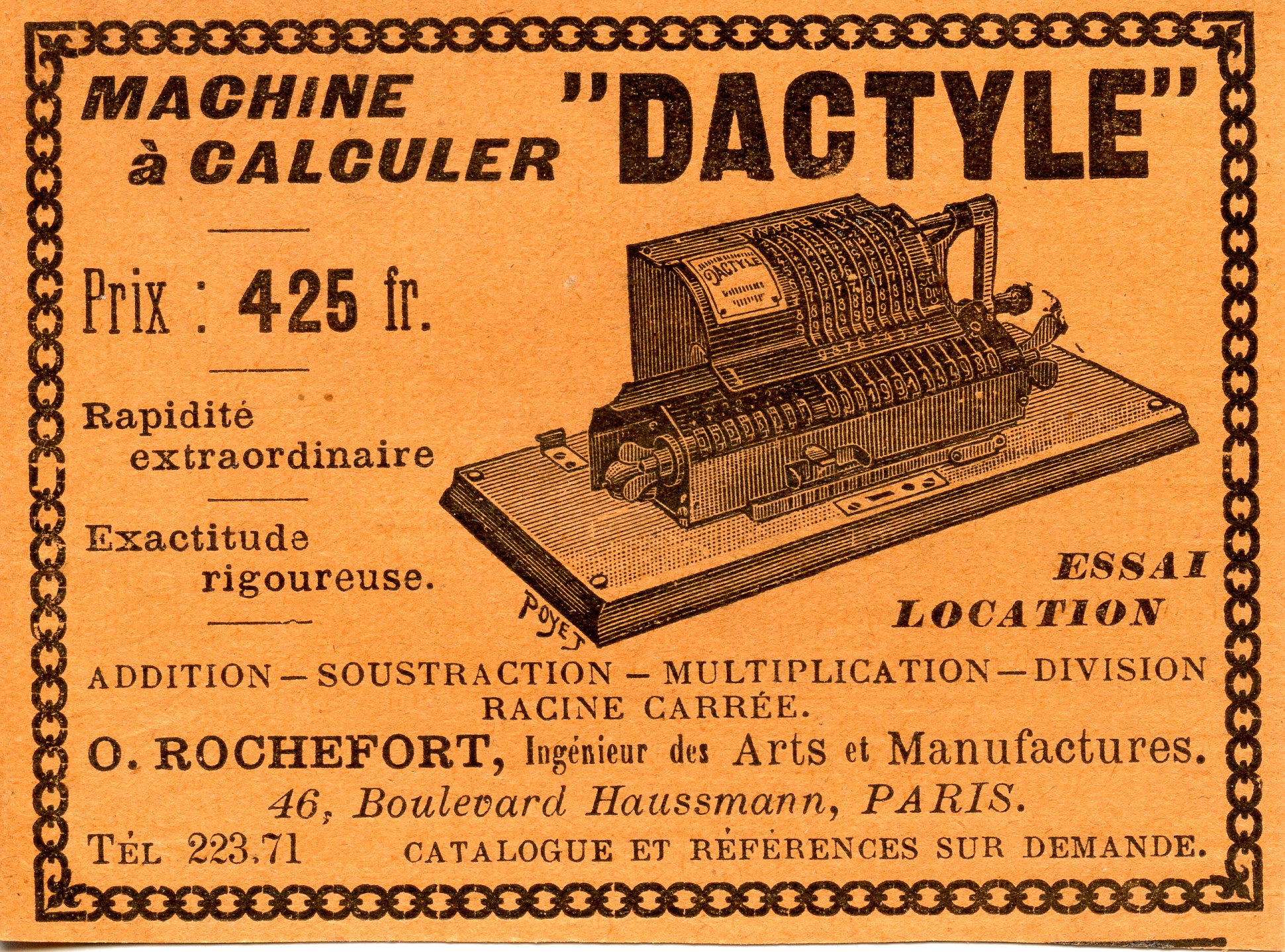
This was helpful, but I wanted to know who was behind the Dactyle name and operation. My first clue came with a 1904 ad I purchased on eBay.

Dactyle001

At last I had a name. O. Rochefort, engineer of arts and manufacturing. This ad was for a calculating machine. It didn’t mention typewriters, but the address was 46, Boulevard Haussmann. (The site is now that of the department store Galeries Lafayette. In about 1911, the company moved to 4, rue Lafayette.) With the help of a German-language website and a Dictionnaire biographique des grands commerçants et industriels available from Gallica, I put together part of the human story behind the machine.

Octave-Maximilien Rochefort, 1861–1950, was an inventor and manufacturer. He was a restless man, who travelled widely. After graduating from the École des Arts et Manufactures in 1884, he went to Algeria to work in forestry for two or three years, returned to France and soon left for Argentina in 1887. In Cordoba he was a public works engineer, involved in bridge building, and he even taught at the university. He returned to France in 1890, but left shortly thereafter for the coal mines of the United States.

OctaveRochefortClearly, Octave-Maximilien had an eye for new opportunities. In 1896 he returned to Paris to set up a typewriter factory and sales outlet. He is best-known for the Dactyle (a rebranded Blickensderfer) and the Hall Braille-Writer (see below) and what has been described as “the Harrison machine to impress Braille characters on copper sheets for printing Braille characters.” In addition to making the Hall Braille-Writer available in France, Rochefort also sold Dactyles where the typewriter keys had raised Braille characters to assist the blind in writing inked text for the sighted to read. How did he make the transition from bridge building and coal mines to typewriters, including typewriters for the blind?

pic-hall_braille

During the years of Rochefort’s stay in the United States, the most important and highly publicized technology showcase took place in Chicago in 1893: the World’s Fair Columbian Exposition. It was a stunning display of new technology from dozens of countries; the kind of event that would attract the curious and restless Rochefort.

It is more than likely Rochefort attended the Exposition. Typewriters were one of the hot technologies of the day and Blickensderfer was one of 23 typewriter manufacturers exhibiting. The award-winning Blickensderfer 5 appears to have captured the show and yet in the difficult financial year of 1893, Blickensderfer was in deep financial trouble.

It is not difficult to imagine that George C. Blickensderfer and Octave Rochefort met and talked business in Chicago before the fair ended October 29, 1893. Or perhaps a conversation that started in Chicago continued later. At some point, Rochefort acquired significant non-American rights. Rochefort was advertising the Dactyle in French as early as 1896.

And what else might Rochefort have seen at the Chicago World’s Fair? The Illinois Institution for the Education of the Blind was also an exhibitor; its star attraction was the Hall Braille-Writer, invented by superintendent Frank Haven Hall.

Hall was more interested in helping the blind than in making money. He never took out a patent on the machine, because he wanted it to be manufactured and used as widely as possible with no fees. Later in 1893, when a new state governor put Hall in another job, manufacturing of Hall’s inventions fell to the Chicago firm that had helped Hall with the development of his ideas. The company name was Harrison & Siefried, which explains why the “machine to impress Braille characters on copper sheets” is referred to as “the Harrison machine.”

Through his work in bringing the Hall machines to France, Rochefort joins the ranks of 19th-century benefactors of the blind. Rochefort was also an important inventor in his own right, but that is another story.

I am currently researching and writing about the plight of the blind in the late 19th century and the efforts to help them read and write. What started with Martin’s invitation to view the Dactyle, a typewriter for the sighted, has provided me with new research clues. That machine is now owned by a collector in England, but I am delighted to have had a chance to see it before it left Canada.
In the introduction I also mentioned a mystery. What is the meaning of this symbol which appears on the frame of the Dactyle? Could it be related to the Dreyfus affair? Rochefort’s  father was strongly anti-Dreyfus. Perhaps Octave was asserting his opposition to his father’s stance. Who can provide any further ideas?

Dactyle 6Text by Norman Ball; typewriter photographs by Martin Howard. Portrait of Rochefort from Gallica.

* Robert Blickensderfer and Paul Robert. The Five-Pound Secretary: An Illustrated History of the Blickensderfer Typewriter. Laren, the Netherlands: The Virtual Typewriter Museum, 2003.

Posted in Paris history, Paris typewriters | Tagged , , , , , , , , | 6 Comments

The invention of the omnibus

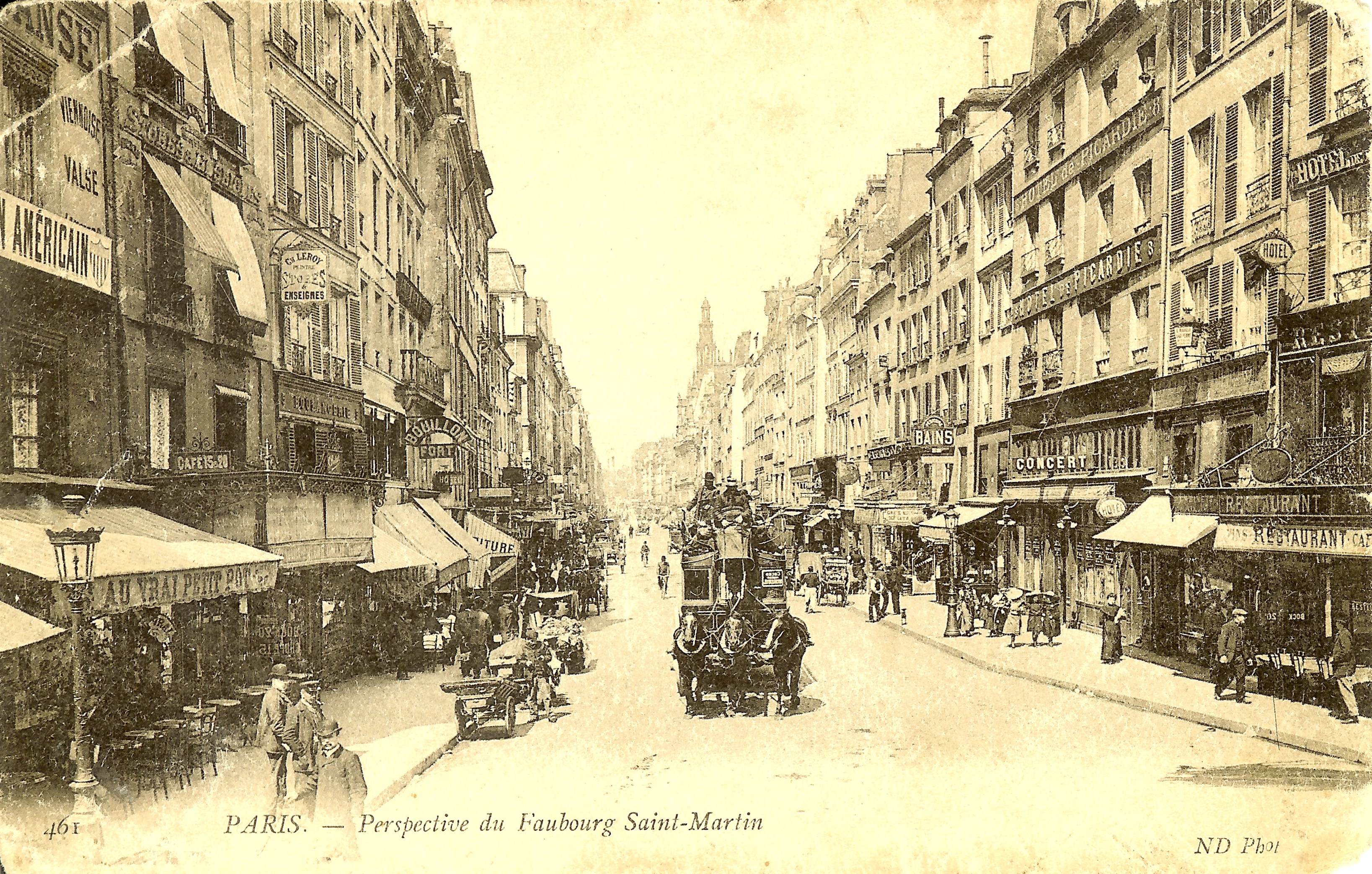
Take a good look at this postcard. What do you see? I tend to gravitate to postcards like this because of the rich detail in the buildings – the names of businesses, the façades of the old houses, the advertisements, the spire in the distance (it isn’t a church, it’s the mairie – city hall – of the 10th arrondissement). Most of the buildings are still there, recognizable in a modern view north along the Faubourg St-Martin.

Omnibus0002

It’s only after a while that I focus on what is in the street, not just on either side. (Norman says he is the exact opposite and looks at the vehicles first.) An omnibus pulled by three horses dominates the view, followed by two men on bicycles, with an assortment of delivery carts pulled up to the curbs on either side. Those vehicles have vanished forever, leaving only images in photos and postcards. But where did they come from?

Omnibuses were a French invention, and have a curious history, less well documented than the history of the buildings in Paris.

The story begins, not in Paris, but in Nantes, where a man called Stanislas Baudry built a steam-powered flour mill outside the city in 1823. Steam technology produces lots of hot water, and Baudry saw an opportunity to make some money on the side by opening a bathhouse. Unfortunately, the bathhouse was a very long walk from central Nantes, and there were few customers. Baudry hit on the idea of offering a shuttle service – a coach that left from the centre of town on a regular schedule. It held 16 passengers, seated eight to a bench on each side. But not all the people in the coach were necessarily going to the baths – some Nantais started to use the coach for short trips along the route.

Baudry was quick to spot another business opportunity opening up, and launched the first urban transit service in 1826. He called his coach an “omnibus,” a Latin word meaning “for all.” He expanded the business to Bordeaux the next year, and then to Lyon. His request to operate in Paris took longer to get approval, as the authorities were cautious about adding large vehicles to the already congested streets, but eventually Baudry and two partners were given permission to operate up to 100 vehicles, each of which could hold a minimum of 12 people and a maximum of 20. The authorities would set the routes.

At first, the single fare was 25 centimes (longer routes required double fares and the notion of a free transfer was not developed until 1834), collected by a conductor who was also there to help people on and off through the back door. There were no fixed stops along the route; passengers simply signalled when they wanted to get on or off. The No. 1 route and the most heavily used went between the Place de la Madeleine and the Place de la Bastille by way of the grands boulevards.

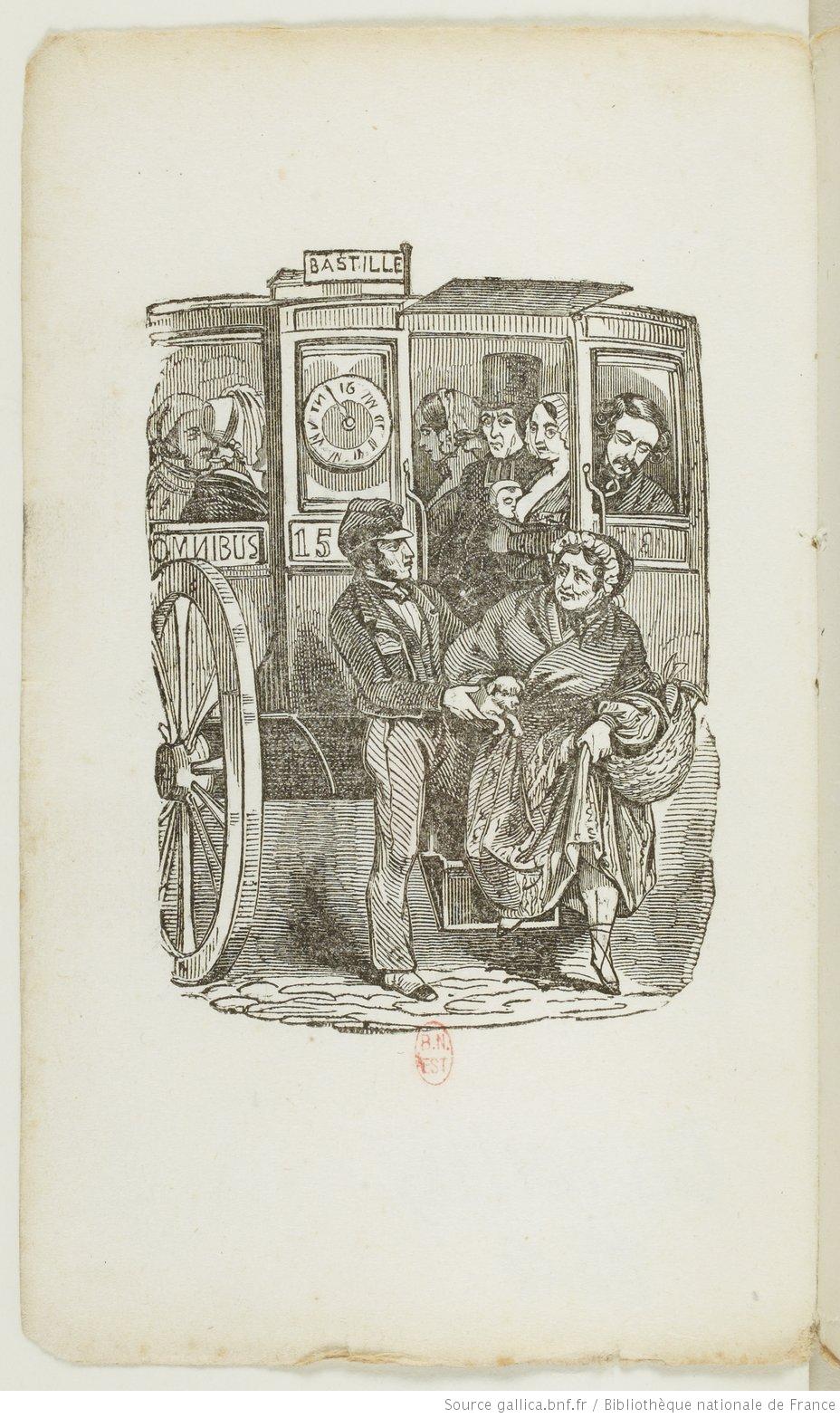
Gourdon_Gallica

Today transit is so common that it is hard to imagine just what an innovation this was. People who had never taken a coach between towns (that is, most people at the time) needed to get used to the idea of getting into a small, enclosed space with a group of complete strangers, who might be of any social class. In fact, the majority of passengers were middle class, since aristocrats had their own carriages, and the very poor found even 25 (soon raised to 30) centimes too steep. The conductor was also under orders to exclude drunks, dogs, and people with oversized packages, and had some discretion over admitting anyone who simply looked poorly dressed.

Women at first did not use the omnibuses. According to an often-repeated story (possibly an urban legend), the vivacious Duchesse de Berry was the first woman to do so, on a bet, and travelling in disguise. (This may have been a publicity stunt; it seems she had a financial interest in one of the other omnibus companies that sprang up after Baudry’s company led the way.) Eventually, more and more women used the service, although a woman travelling alone was often viewed with suspicion.

Omnibus0001

The omnibuses proved extremely popular from the start. But Baudry’s firm (Entreprise Générale des Omnibus) lost money in its first two years of operation and nearly failed. Renting facilities for stables and depots was expensive. The price of horse feed went up. The two winters were harsh and people stayed home. Some of the routes the firm was required to service were unprofitable. Competitors lured away customers. And the firm was overextended, having expanded massively in other cities while entering the Paris market.

In despair, Stanislas Baudry committed suicide in February 1830. He shot himself near the company stables on the Quai de Jemmapes, by the Canal St-Martin. It seems a strange loss of confidence in an otherwise canny entrepreneur. And if he had just stayed the course, he would have seen the company overcome its tribulations and become very lucrative indeed, particularly after a merger that brought together all the competing companies to form the Compagnie Générale des Omnibus in 1854.

He would also have seen further innovations, some successful, others…not so much. In the mid-1830s, one Marie-Toussaint-Henri, vicomte de Botherel, was so excited by the prospects of the omnibus that he decided to create omnibus-restaurants, from which cooked meals would be delivered to people’s houses. He spent vast sums from his considerable fortune building a huge central kitchen on the rue de Navarin and opening a café on the rue Neuve-Vivienne, but the logistics didn’t work and the business failed.

In 1853, the impériale was introduced, an omnibus with seating on the roof. At first, this upper deck was open to the weather, reached by a ladder, but later on some vehicles it was enclosed, and the ladder evolved into a curving staircase up the back of the omnibus.

Omnibus0004

The 1870s saw the introduction of the tram. Trams run on metal rails with less friction than wheels on a cobbled roadway, so the same number of horses can pull larger vehicles with more passengers. And the ride is much smoother. At first, the Compagnie Générale des Omnibus resisted the changeover. It had become so profitable with its existing vehicles (and with its sizable real estate holdings) that it was getting complacent and was reluctant to invest in new vehicles. The Paris authorities were getting desperate, however, as congestion increased and more and more tourists flocked to the city, attracted by the great exhibitions of 1855 and 1867. Tourists need transit. Eventually, in 1872, the city laid down tram lines (the tracks were set into the roads so that other vehicles could pass over them) and insisted that the company operate horse-drawn trams.

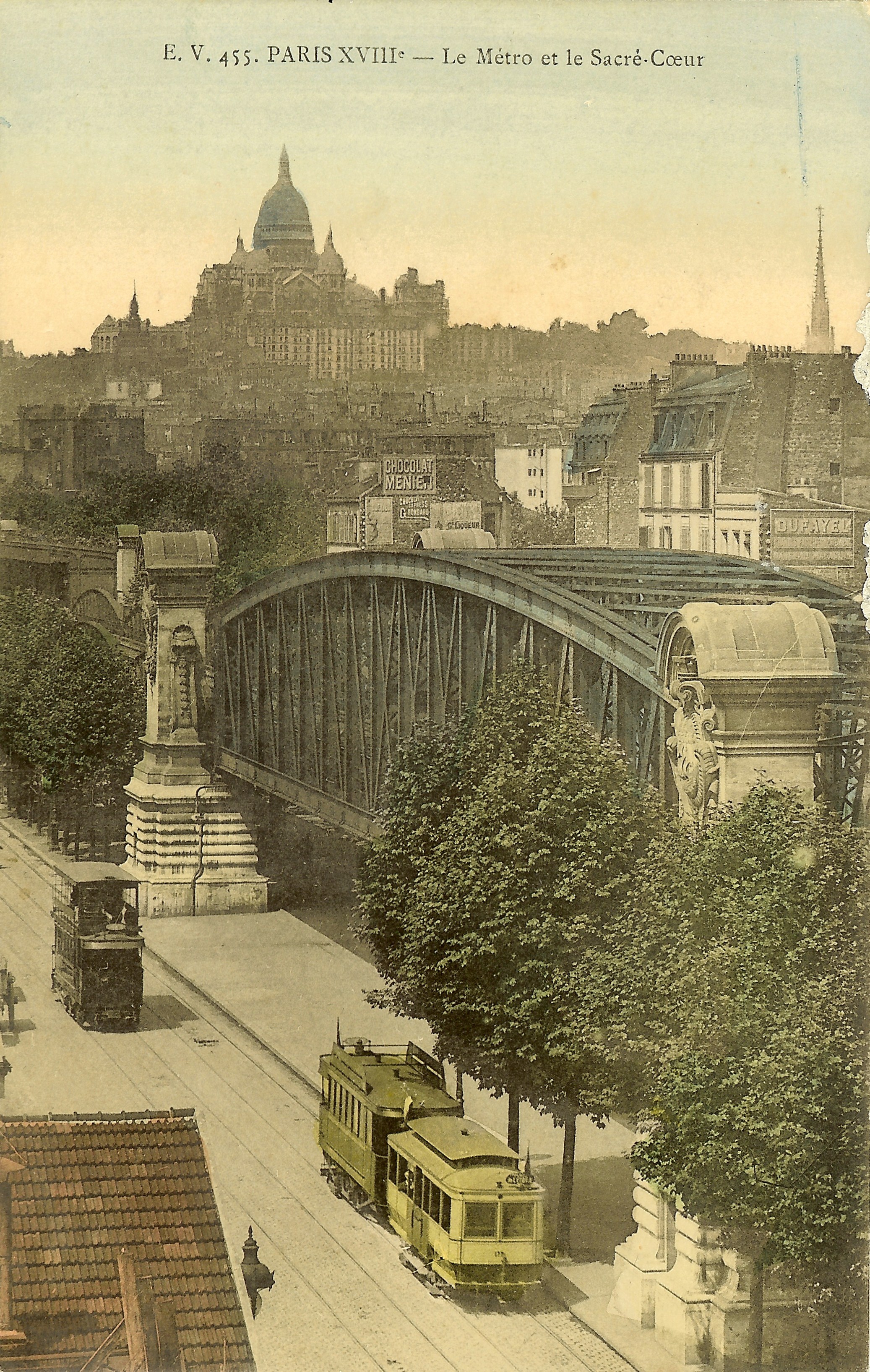
The next step was to get rid of the horses. The company had more than 9,000 of them at the time, and they needed feed, and stables, and veterinary care. Steam locomotion was considered too risky, but in 1880s, electric traction became an option. In this postcard, you can see a double-decker tram and a two-car tram passing the overground portion of the Metro on the Boulevard de la Chapelle near the rue d’Aubervilliers.

Omnibus0007

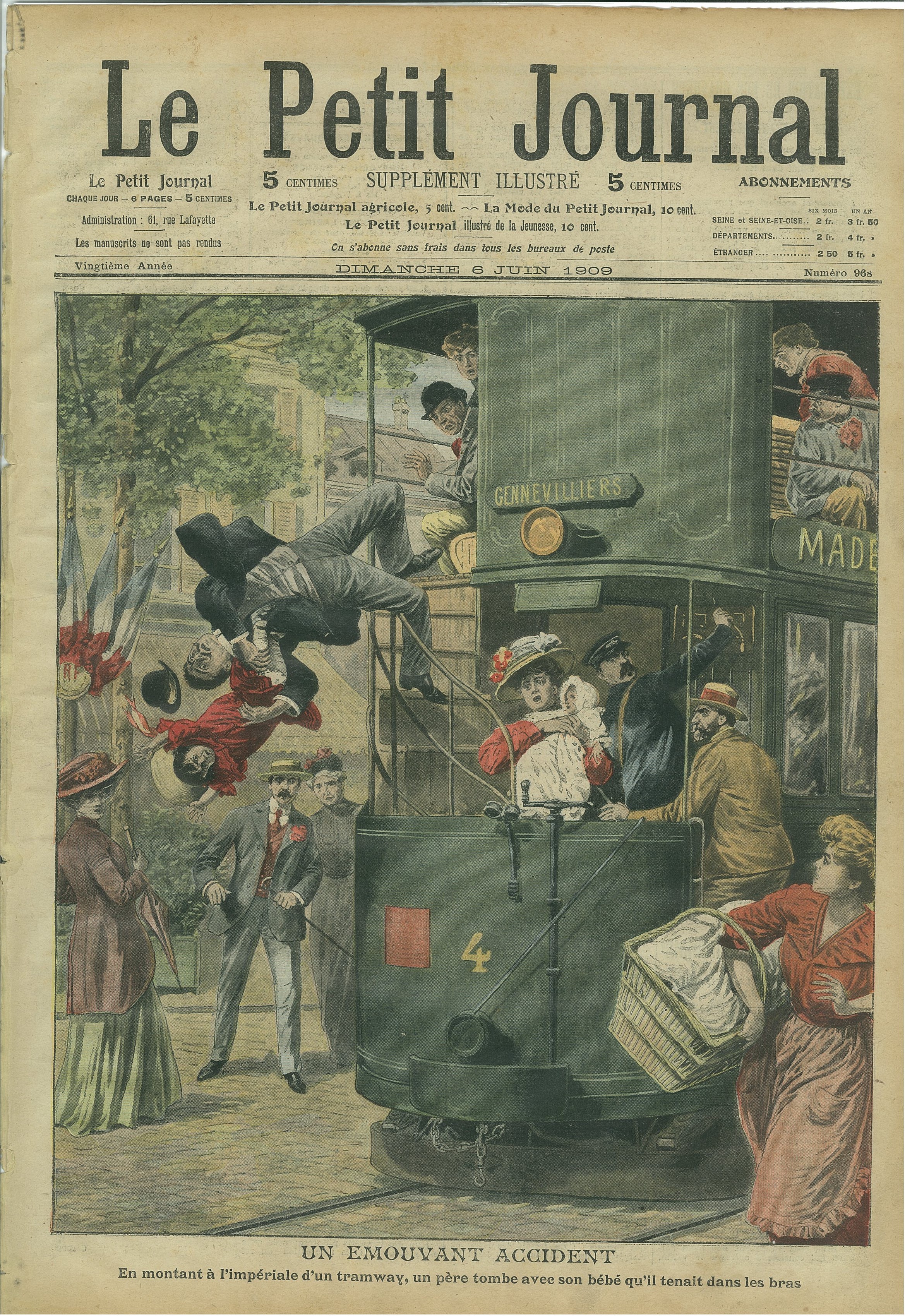
The double-decker trams maintained the stairway up the back of the vehicle, and from time to time, accidents occurred, like the one illustrated on the front page of Le Petit Journal, June 6, 1909.

Le Petit Journal

A father holding his two-year-old was mounting the steps when the vehicle started with a jolt, sending him flying, as his horrified wife, holding their younger child, looked on. The father survived with little more than cuts and bruises, but the toddler died.

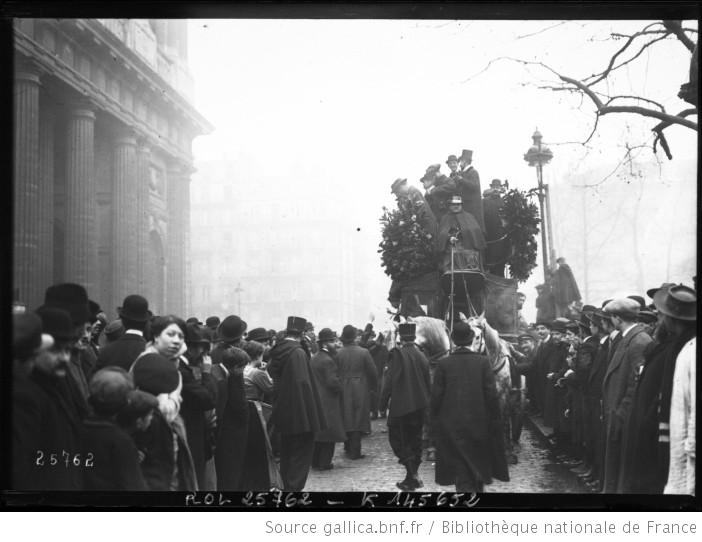
Trams were gradually overtaken by motor coaches, but horse-drawn omnibuses remained a common sight on Paris streets for many years. The very last horse-drawn impériale made its final trip between La Villette and St-Sulpice on January 11, 1913, accompanied by a crowd of well-wishers. In this image from Gallica of that historic run, it seems that it was foggy that day.

Last_horse-drawn-Omnibus The burly percherons were put out to pasture in the countryside, the men who had cared for them looked for other work, and the streets of Paris never looked quite the same again.

Text by Philippa Campsie; images from our postcard and Petit Journal collection; engraving from Physiologie de l’omnibus by Édouard Gourdon, Gallica. Final photograph from Gallica.

Further reading: Very little is available in English on the subject of early transit in Paris, with the exception of the wonderfully detailed book by Nicholas Papayanis, Horse-Drawn Cabs and Omnibuses in Paris: The Idea of Circulation and the Business of Public Transit (Louisiana State University Press, 1996).

Posted in Paris civic functions, Paris postcards, Paris streets, Paris travel | Tagged , , , , , , , , , , , , , | 19 Comments

The Paris Bridge That Never Was

It should have been the pride of Paris; a stunning suspension bridge leaping clear across the Seine. It should have been one of the crown jewels of both Paris and the career of Claude Navier, one of 19th-century France’s most brilliant mathematicians and engineers. But things don’t always work out as they should.

Navier1

This sketch by Navier shows what he planned for his 560-foot (155-metre) span across the Seine, at the site now occupied by the Pont Alexandre III. Suspension bridges were the latest thing, and Navier was the best French bridge analyst of the day. Construction started in 1824 and seemed to proceed well. In 1826 the bridge was not finished, but chain cables had joined the two shores and a roadway was suspended from the cable chains. Then the unthinkable occurred in July 1826: a crack appeared in the cable anchorages.

The anchorages were crucial to the safety and permanence of the bridge. In suspension bridges, the cables from which the roadway is suspended must carry all the weight of the bridge and traffic. At each end of the bridge, the cables pass over the bridge towers and then down into the ground where they are anchored with stone, concrete, and the earth above the abutments.

The first crack could be explained away by normal settling. What happened next could not be explained away so easily. As historian Edna Kranakis writes in Constructing a Bridge:

On the night of September 6 [1826], an accident occurred. A water main that passed close to the underground anchorage buttresses on the Champs-Elysées side of the bridge ruptured and flooded the area around the buttresses. Some of the supporting earthwork ceased to bear against the anchorages. As a result, the two fissures on the Champs-Elysées side suddenly widened … and the buttresses suffered some upturning and displacement… This movement in turn caused the towers on the Champs-Elysées side to tilt toward the river.

The bridge had not fallen down, although it was listing. And other bridges had had similar problems during construction, been repaired and then served for many decades, even centuries. At first, professional opinion stated the bridge could be rescued at a total cost of only 1 to 2% of the contract price. But in the end, the project was cancelled in spring 1827 and the Pont des Invalides (as it was known at the time) was dismantled, leaving in its place much more than an empty space.

What happened? What went wrong?

The story starts with Claude-Louis-Marie-Henri Navier (let’s just call him Claude). He was born in 1785 in Dijon. His father died when he was still quite young, but an uncle took him in and looked after his education. The uncle, Emiland Marie Gauthey, was professor of mathematics at the École des ponts et chaussées and a practising engineer.

Claude-Louis_Navier

Navier studied at the École polytechnique and then at the École des ponts et chaussées. Upon graduation in 1807 he started work for the Département de la Seine and remained there until 1822. In addition to his practical engineering work, Navier edited several engineering books and in 1821 became an associate professor of Applied Mechanics at the École des ponts et chaussées. In 1823 he published his first theoretical work on bridges and in 1830 joined the faculty of the École polytechnique. He held both posts until his death in 1836.

As historian Tom F. Peters writes in Transitions in Engineering, Navier “was not primarily a practitioner, although he had successfully built four large bridges and several canals in Italy.” However, he was thoroughly engaged in the major suspension bridge design and construction debates of the day and a leading engineering theoretician.

The French love theory. A colleague of mine once told me a story about two bureaucrats discussing a new economic project. The French one said, “Yes, we can see that it works in practice. But does it work in theory?” Navier would have understood this question.

Navier’s proposed suspension bridge was largely intended to show the importance of mathematical analysis to bridge building. Otherwise, nobody actually wanted a bridge in that location. Navier, perhaps somewhat unwisely, wrote:

There exists no urgent necessity to construct a bridge [from the Esplanade of the Hôtel des Invalides] to the Champs-Elysées; there is no obligation to build a suspension bridge in Paris. But if it is desired that one be built, let it be made into a monument; let the character of grandeur be given to this work that the style of construction admits of; let its disposition be calculated with the idea of an edifice approved by artists, agreeable to the public, honourable to the administration.

He must have known about the many arguments against it. It would block sightlines to the Hôtel des Invalides. The Egyptian decorative motifs were inappropriate. The beauty of the Champs-Elysées would be destroyed by building a major thoroughfare across it. It would create too much traffic.

Nevertheless, the exquisite drawings and the beauty of the mathematical calculations impressed the bureaucrats in the Corps des Ponts et Chaussées. They recommended only small changes. However, they disagreed with Navier on one point. Navier thought that something so magnificent needed to be state-financed. The bureaucrats insisted that the bridge had to be financed and built privately, and that investors should be given the right to charge tolls for 55 years.

On April 7, 1824, the project was opened to bidding. By August the successful bidders, headed by Alain Desjardins, started construction. But it was a curiously one-sided contract. The bridge had to be built according to a detailed set of specifications provided by the Corps. No change could be made without the written consent of the director of the Corps. There was no clause authorizing the contractor to suggest modifications, even though such a clause was a standard feature of this type of contract.

So if the contractor foresaw the problems, he could do nothing to prevent them. When the cracks appeared and the Corps des Ponts et Chaussées demanded that a new bridge be built at contractor expense, Desjardins argued that his company had built the bridge precisely as the contract had stipulated.

NavierbridgeStalemate. The ruined incomplete bridge became a symbol of what happens when theory and practice do not match.

Eventually the conflict was resolved with payouts to contractor and investors. Desjardins was given permission to build three more bridges in Paris, and could use the materials from the failed bridge. And perhaps most galling to Navier and others, Desjardins had a free hand in the bridge designs, so long as they could withstand the load tests the Corps would supervise.

Desjardins’s designs were far from elegant. At least one of his replacements was so hideous that it was described in one engineering publication in 1830 as “truly a villainous thing.”

But Navier’s career as a practising engineer was over. He bore the brunt of public criticism, was overlooked for further promotions, and died aged 51 in 1836. Posterity has been kinder, however, and his is one of the 72 names inscribed on the Eiffel Tower, for his contributions to mathematics.

It is difficult to know what to make of Navier and his disastrous bridge. Clearly he was a brilliant theoretician. But his story contains an element of arrogance; he was departing from proven practice in the way the abutments bore the weight of the entire structure, an approach that had been arrived at without sufficient testing.

Navier was an inspiration to those who wanted to see a greater role for mathematical analysis in engineering, design and construction. But he was caught up in political manoeuvring that let an untested structure go ahead and fail spectacularly.

“Trust me, I know what I’m doing” is what people usually say just before disaster strikes. Perhaps “Trust me, the theory works perfectly,” is what Navier said before his bridge wobbled, listed, and then was demolished. A lesson to us all.

Text by Norman Ball. Illustrations from Structurae, Wikipedia, and University of Houston.

For more on the chequered history of suspension bridges in France, read: The mystery of the missing suspension bridges of Paris.

Posted in Paris bridges, Paris history | Tagged , , , , , , , , , , , | 4 Comments

Pierre Lelong: The search for a 20th-century Post-Impressionist painter

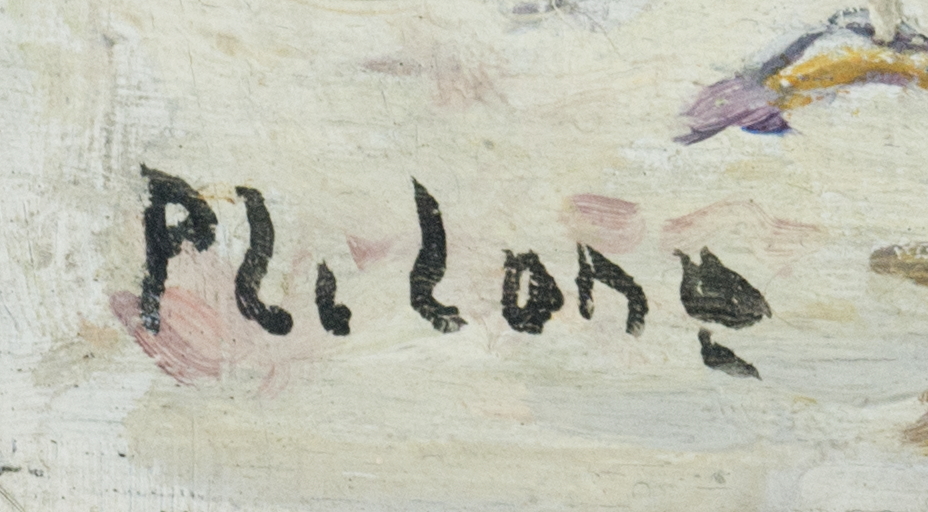
“Is there a library or museum in Paris that will research a painting/artist for you? This is the painting Pop said he bought off a street artist in Paris in 1934 when he was at the Sorbonne. It’s oil on wood and 27 cm x 22 cm. I’d guess the artist’s name is Plilong or P.L. Long or P. Lilong.” This message went from the owner to his sister, then to his sister’s friend Mary Ann, who sent it to us. It was accompanied by an image of the signature. Could we help with a little research?

EGW_1934_French_Painting-signature

The picture itself showed a flat rural landscape under a dull blue sky in which three people (probably men) and two beasts (horses? donkeys? oxen?) are straining to move a heavy load of something brown and red along a dusty white road. The style is Post-Impressionist, hence the sketchiness of the details. At first the picture doesn’t look like much, but then one becomes aware that the artist has successfully conveyed the effort and strain of the men and the animals, the heat of the day, and the dreariness of the surroundings rather effectively for a mere “street artist.”

I squinted at the signature, and tried various combinations on Google. The one that worked best was “P. Lelong.” OK, the third letter may not look much like an “e” but the only references to “Lilong” were to traditional forms of Chinese housing. There was a “Pierre Lelong” (actually there are six) listed on French Wikipedia; the one identified as an artist is described in a terse note: “Pierre Lelong (1908-1984) est un peintre figuratif français, membre du comité du Salon Comparaisons.” (Pierre Lelong was a figurative French painter and member of the committee of the Comparisons Salon.) That was all. But it was a start.

I found some other paintings online, all signed “P. Lelong” (not Pierre or Pierre-Emile, his full name), so I think this is our man. The signatures differ slightly, but the others date from long after the 1930s, and signatures can change over a lifetime. So who was he?

PLelong8

A search of the library catalogue at the University of Toronto turned up a monograph written in 1957* that provided some details about his early life. Born in 1908 in Neuilly, just outside Paris, he lost his mother when he was six and was raised by his grandmother. At 16, he started art classes at the Atelier Julien on the rue du Dragon in Paris, but his studies were interrupted by his military service and then, it seems, by the need to earn a living. He went to work for an insurance company (la Mutualité Agricole), and abandoned all thought of being an artist.

PLelong1

But in 1933, he was doing well enough at his job to have the leisure to take up his brushes again. What our friend’s friend thought was a “street artist” in 1934 seems to have been an insurance agent, moonlighting. By 1935 he was able to rent a studio in Montmartre and to travel during his summer holidays to Spain. (If the date of 1934 is not exact, my friend’s friend’s painting might have depicted Spanish peasants – certainly the flat, hot landscape looks like Spain.)

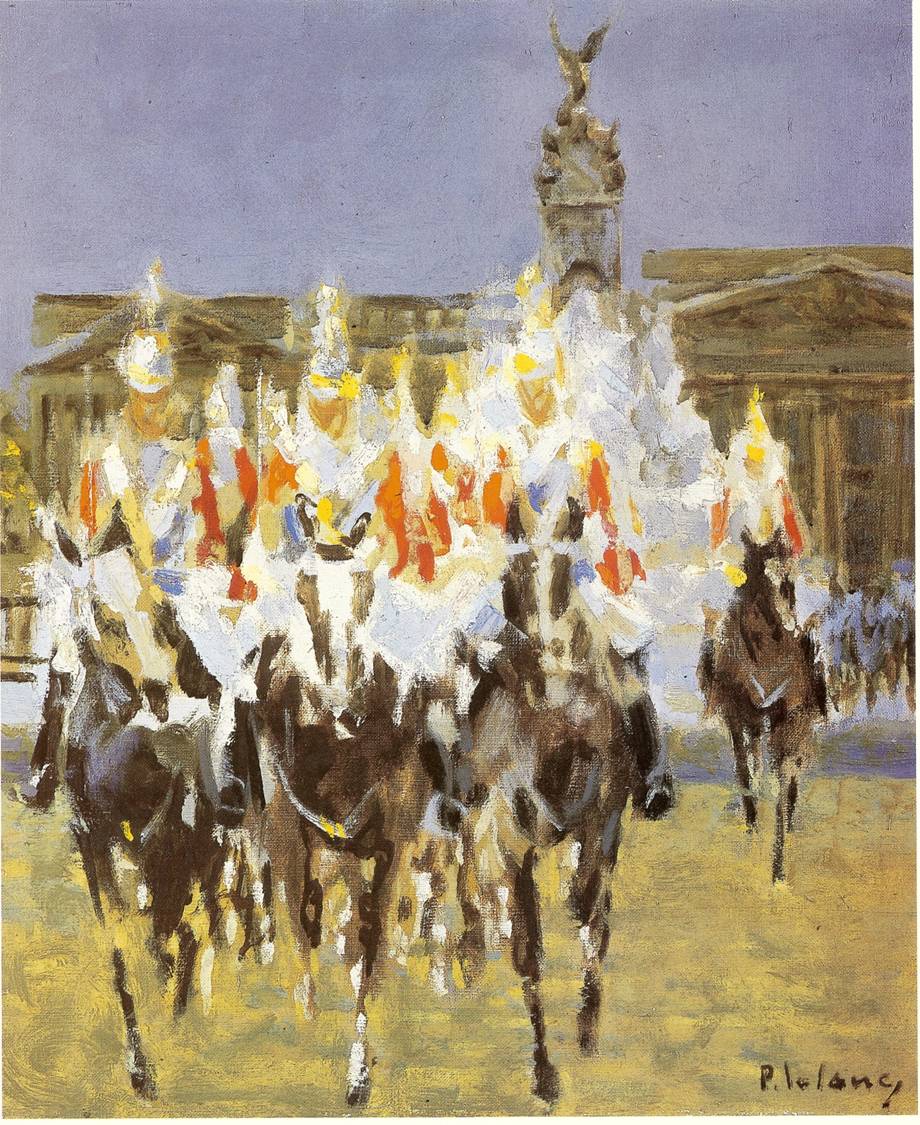
In 1938, he married Marie-Rose Salvatori from Trinidad. (I wonder how they met.) He was doing well, exhibiting here and there, and travelling quite bit. Then came the war. He became a liaison officer with an English regiment, the Royal Dragoon Guards. So presumably he spoke English.

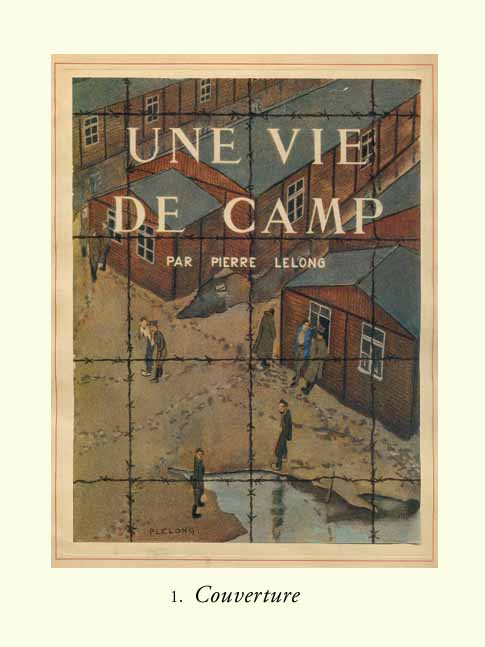
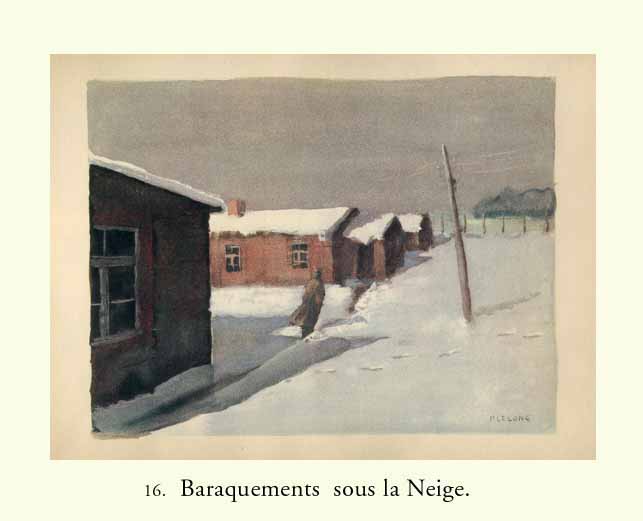
At Dunkirk, he was captured with other officers and interned at a camp near Dresden. Somehow, he was able to get painting materials. Strangely enough, this was the first time since his adolescence that he was able to concentrate full time on his art. What else was there to do? He painted what he saw – his fellow prisoners – waiting, eating, cooking, washing, waiting, playing cards, reading letters, waiting…

lelong_01

He was transferred to another camp near the Czechoslovakian border, where he worked in a garage and earned money selling paintings. He tried and failed to escape, tried again, and succeeded. It was February 1942.

lelong_10

For a while he settled in Clermont-Ferrand, in occupied France, and worked on his sketches from the camp. With the help of a another former prisoner, Henri Curtil, he produced a series called Une Vie de Camp, published in 1943. Then he and his wife sat out the rest of the war in Trinidad, where he went to work on his technique. He felt he’d never really mastered the art of painting. Methodically, he worked on still lifes, nudes, landscapes, and other genres until he felt satisfied with the result.

PLelong4

After the war, he went to the United States, where his only son, Jean-François, was born in 1946. He returned to Paris the following year, and found a studio at 10, boulevard des Batignolles. By this point, he was a full-time painter; not just a moonlighting insurance agent. He exhibited frequently, and kept busy doing illustrations for books, magazines, and newspapers. He was invited to paint a portrait of the composer Jacques Ibert, which was exhibited at a salon called “Peintres Témoins de leur Temps” (Painters Witnesses of their Times) in 1956. Lelong was interviewed on the radio, written up in the press, the picture of a successful painter. The future was bright.

But at that point, the 1957 account stops. What happened next? I found brief mentions of him in books about the “School of Paris” and so forth, but no indication of how or where he died (and only the year, not the day).

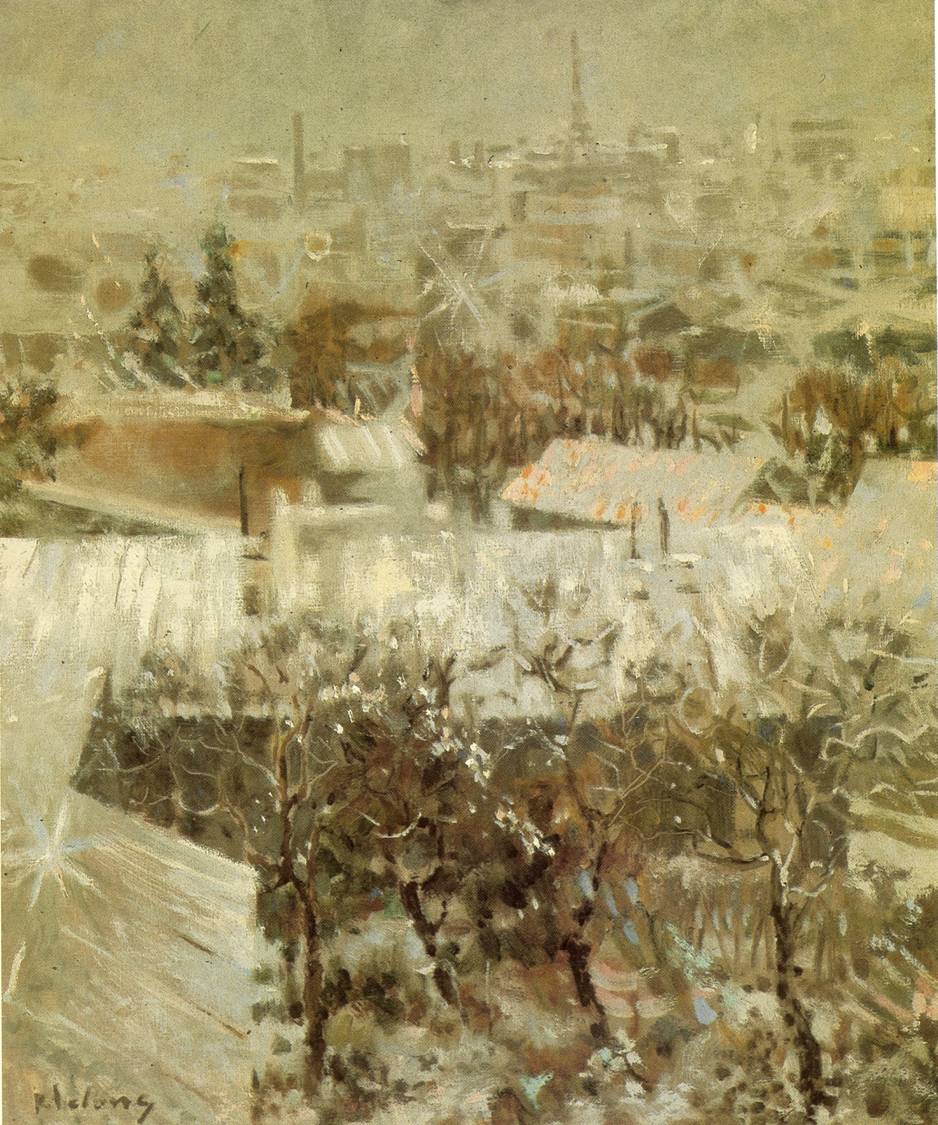
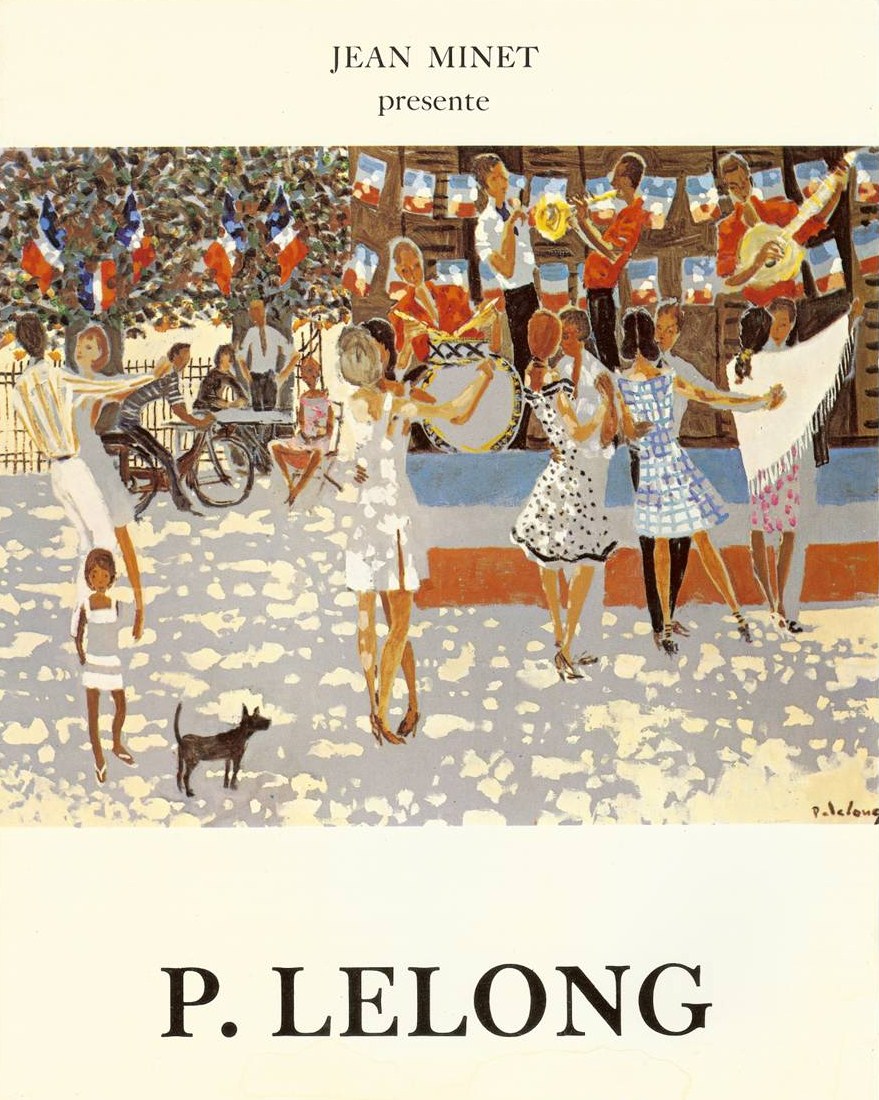
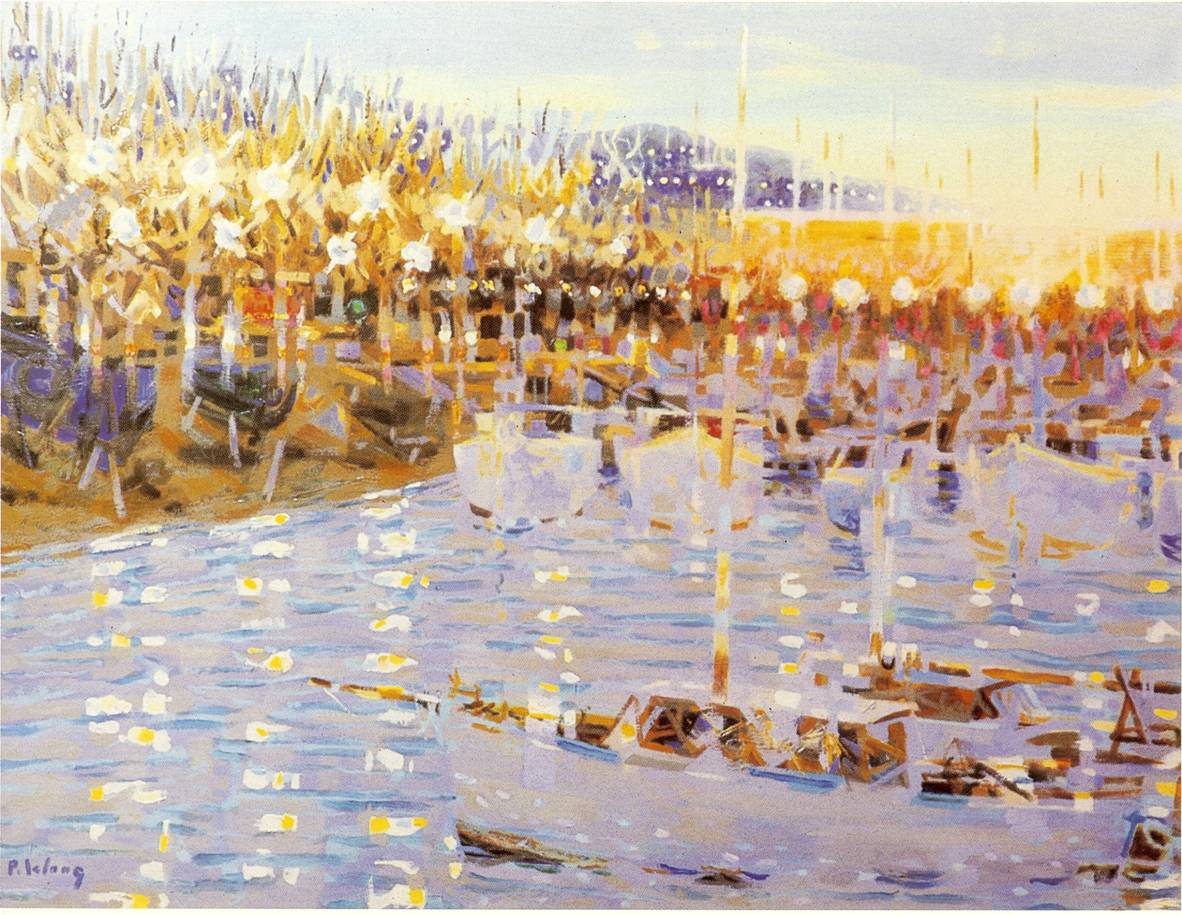
The next thing I found was a four-page exhibition brochure from 1978 on eBay. I bought it for a few Euros, because I liked the image of couples dancing on a sun-dappled square in front of a band, presumably on Bastille Day. It’s a light-filled, light-hearted, summery painting. Inside the brochure are three other images reproduced in black and white – boats, a beach, and a sunny interior with a nude. After the chilly gloom of the prisoner-of-war camp, Lelong seems to have focused on cheery scenes, full of warmth and colour. Perhaps his time in Trinidad was an influence there. He would have been 70 at the time of the exhibition.

PLelong9

But there the trail seemed to go cold. I tried a few genealogical websites. Nothing. I searched for any mentions of his son, Jean-Francois and his wife, Marie-Rose. Nothing. Until one day I found a mention of a limited-edition book about Lelong published in 1987, that is, a few years after his death.** Thanks to the wonders of interlibrary loan, I was able to borrow a copy from a library in Ottawa.

PLelong3

Along with an extended list of his many successes, including a retrospective exhibition in Nice of 150 works, I found the end of the story. Apparently, Lelong continued to paint as long as he could, working from an atelier at 74, rue des Plantes in the 14th. He vigorously defended the art of figurative paintings against the dominant abstract artists of the day. But his health started to fail in 1981, when he was 73, and he spent more and more time in hospital (it is not clear what the illness was). He died in Paris on 29 June 1984. And about six months later, his son, who was working in Morocco, died in a car accident there. I wonder what happened to his wife, Marie-Rose. Did she stay in Paris? Did she ever go back to Trinidad?

PLelong2

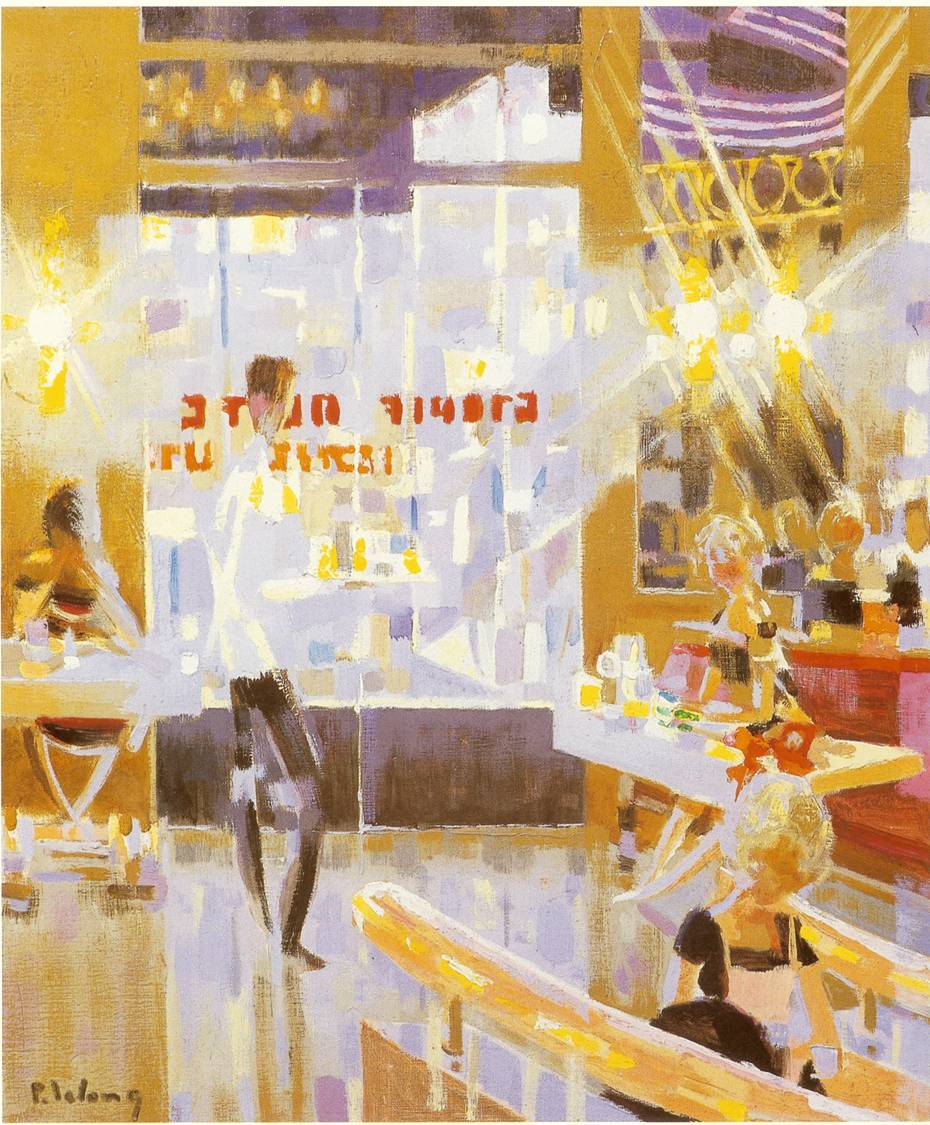
Lelong’s paintings turn up now and then in sales and on eBay, and so do copies of Une Vie de Camp. He painted mid-20th-century life in the style of the Impressionists – with cars instead of carriages, young women in short skirts instead of long gowns, motorboats instead of rowboats, electric lights instead of gaslight. Some images are reduced to geometrical shapes, but never completely abstracted. I like them. He came a long way from that initial 1930s painting, and as the research unfolded, I felt I had travelled at least part of the route with him. Our friend Mary Ann had sent us on an intriguing journey. Now to find an original we can afford…

Photo portrait Pierre Lelong

Text by Philippa Campsie. Images by Pierre-Emile Lelong.

* Ivan Bettex, Pierre-Emile Lelong, Geneva: Les cahiers d’art-documents, no. 53, 1957.

** Bertrand Duplessis, Pierre Lelong, ou la recontre d’un homme avec l’univers, Paris: Editions SMPMD, 1987.

Posted in Paris art | Tagged , , , , , , , , , , , , , , | 26 Comments

Paris Bridges: Mirrors of History

More than beautiful ornaments and a way to cross the Seine, Paris bridges are mirrors of history. They reflect impermanence, bad weather, political turbulence, and much more.

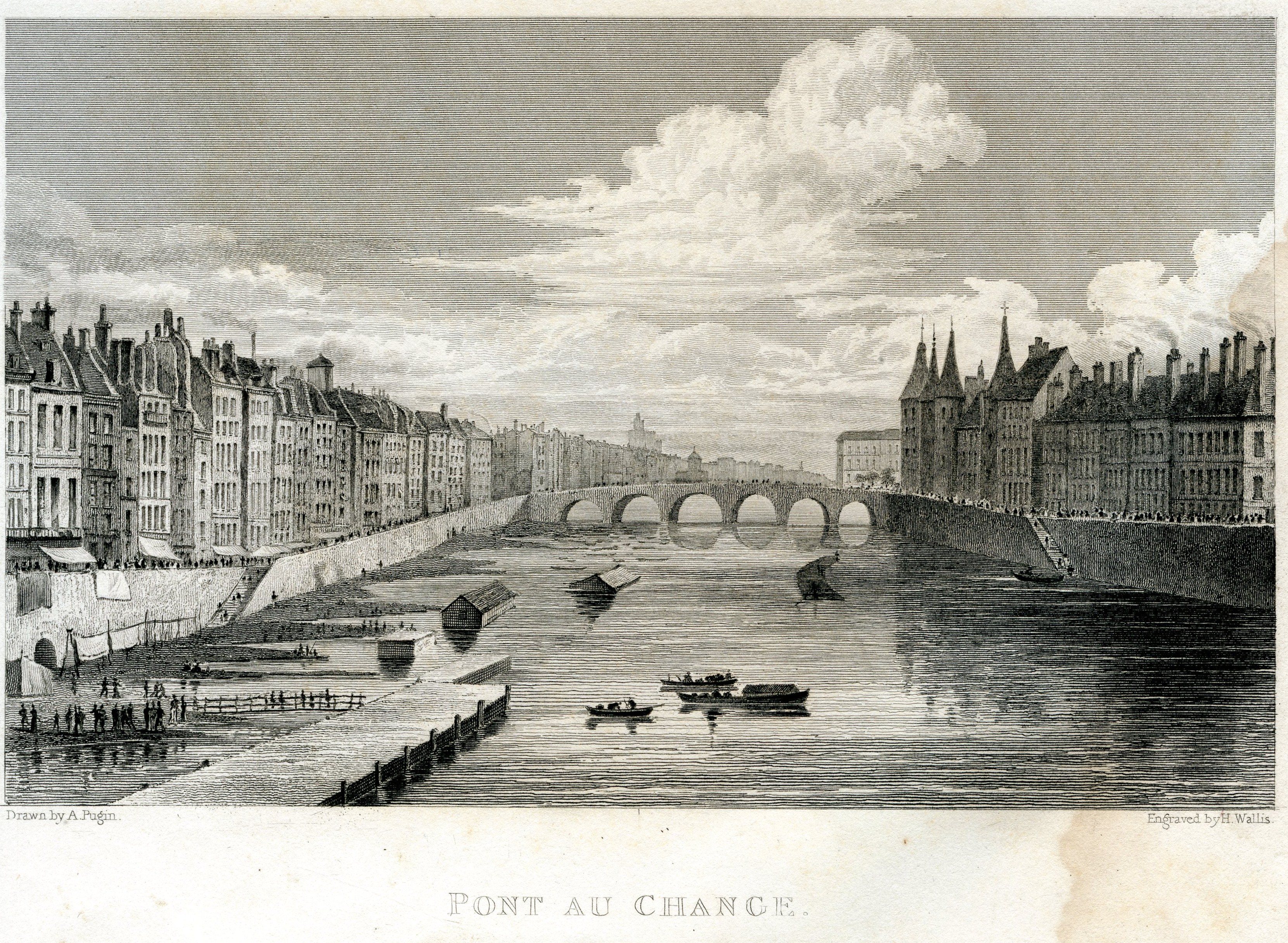
Bridges blog007The Pont au Change that exists today was built in 1858-1860. As the link between the Place du Châtelet on the right bank and the boulevard du Palais on the Île de la Cité, it is an important part of the north-south transportation network. In the image above, we see it as it looked in 1831. But this is just the tail end of the story. Paris and Its Environs Displayed in a Series of Two Hundred Views (1831), from which this image by Augustus Charles Pugin is taken, tells us that the Pont au Change “has existed in one shape or other, from time immemorial.” The phrase “one shape or other” is important.

Cécile Renaudin, in Les Grandes Catastrophes à Paris, traces the bridge at the Pont au Change to 872 when it was a stone bridge. We are not sure how long the bridge that was there in 872 lasted, but according to Sophie-Marguerite and Serge Montens in Paris de Pont en Pont (Paris from Bridge to Bridge), there was a wooden bridge at this site called Pont du Roy (King’s Bridge) during the Middle Ages. It was destroyed in 1280. And again in 1296. And again in 1373. And in 1408, 1510, 1616, 1621 and 1651. After that, it was replaced by a stone bridge.

The flood of 1296 was particularly brutal. All of what was then Paris was under water. The rapid flow and volume of the flood destroyed two stone bridges, their mills and the houses which had been build on them. The mills were driven by undershot waterwheels suspended from the underside of the bridge and turned by the water flowing by.

The effect of  ice could be even more disastrous than floods of water alone. For example, in 1408 when only three Parisian bridges spanned the Seine, severe cold, which froze the river, was followed by a rapid thaw, setting adrift loose masses of ice that destroyed all three bridges.

It may surprise some to learn that the Seine froze every so often. Modern Paris winters can be quite mild, but in 1514, it was so cold that wine froze and had to be cut by axes and sold by the livre (pound). In the winter of 1607-08, the communion wine in the chalice at the church of Saint-André-des-Arts froze and the priests had to use a stove to thaw it out.

When the great flood of 1616 took out the Pont au Change yet again, it was replaced quite quickly, but five years later fire destroyed the new bridge. Reconstruction did not start until 18 years later in 1639 and it was not finished until 1647. And four years later in 1651, it was gone again.

4b3ca65f393f022e0ce7f84461862147

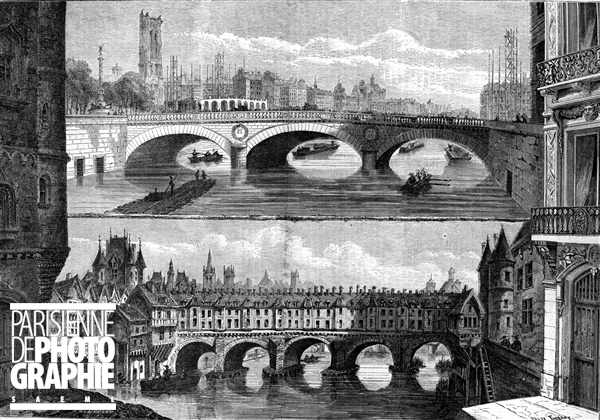
The engraving above by Felix Thorigny shows two views of the Pont au Change, 1660 (below) and 1680 (above). The bridge of 1660 is covered with three-storey houses. For many centuries, this was quite common in Paris and other cities such as London. Bridges were places of business and residence. Once known as the Grand Pont, it became the Pont au Change in 1141 after Louis VII, who reigned from 1137 to 1180, granted money changers the right to set up their stalls there. (Louis VII was also known as “Louis the Young,” although he lived to be 60; his father, Louis VI, was called “Louis the Fat”). One thing led to another and gambling stalls were eventually set up on the bridge during Carnival. However, this practice was abolished in 1604.

Paris and Its Environs notes that when the Pont au Change was “again carried away by a great flood in 1616, with all the houses that were upon it, some of the furniture…was washed as far as the town of St. Denis.” The bridge was rebuilt and the houses reappeared, not to be removed until 1788, by the order of Louis XVI.

Bridges blog002

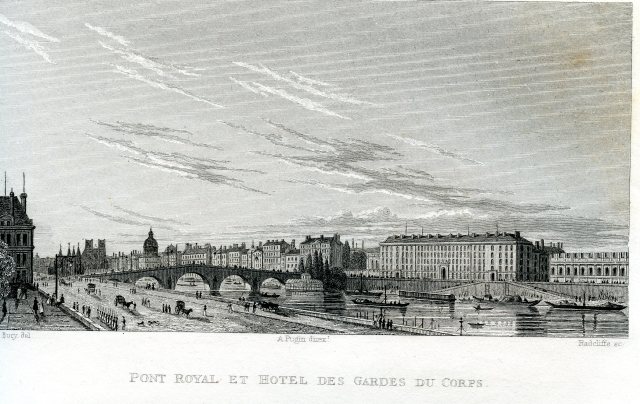
The story of successive bridges at the same site is a common one. The Pont Royal today connects l’avenue du Général-Lemonnier on the right bank with rue du Bac on the left. This was the former site of Pont Rouge, built in 1632, reconstructed a number of times, and finally carried away by ice in 1684. The following year, Louis XIV financed the construction of the replacement, le Pont Royal, completed in 1688 and still standing as one of the oldest bridges in Paris.

Bridges blog006

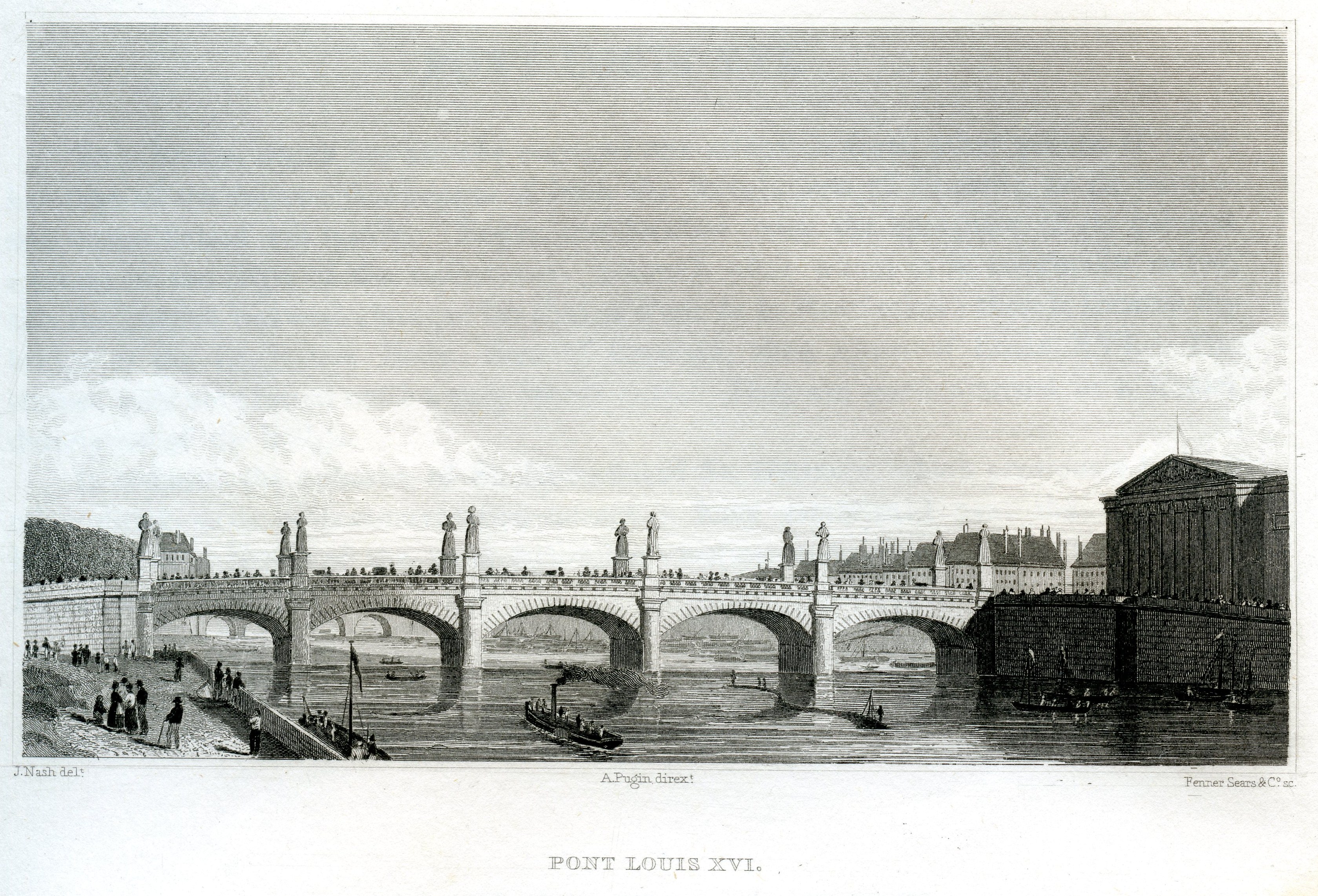
The changing names of some Parisian bridges reflect France’s often turbulent history. Consider what is now Pont de la Concorde and was Pont Louis XVI at the time the image above was created. The bridge links the place de la Concorde, formerly Place Louis XV, on the right bank with Quai d’Orsay et Quai Anatole-France. The French Revolution led to the renaming of Pont Louis XVI and the beheading of the man for whom it was named.

Paris and Its Environs notes that first it became “Pont de la Revolution [1792]; then it became the bridge of the Legislative Body, then of Concorde [1795], then again of Louis XVI.” And that wasn’t the end. Although with the Restoration, the name had reverted to Pont Louis XVI, in an attempt to appease pressure from anti-monarchical republicans, Louis-Philippe changed the name back to Pont de la Concorde in 1830. By this time, Place Louis XV had become Place de la Concorde and so it all seemed to fit together very well. Perhaps too well. Consider the long gestation period and the source of some of the stone for the bridge.

Some bridges took a long time to get built. “In 1722 the city of Paris had been authorized by Lettres patentes to raise a sum of money for the erection of a bridge opposite the Place Louis XV.” Time passed. Nothing happened. In 1786 Louis XIV issued an edict to allow “a loan of 30,000,000 livres to be employed in embellishing Paris, out of which 1,200,000 livres were assigned towards defraying the expense of erecting this bridge.” By that time, France was in dire financial straits and tension was rising. Construction started in 1787 and finished at the end of 1790, but events had overtaken the bridge. A year earlier, on 14 July 1789, the storming and subsequent destruction of the Bastille freed up more stone for the building of the bridge originally intended to honour Louis XVI.

There is one other change we should mention. In the engraving above titled Pont Louis XVI, we see 12 large statues on the bridge. In 1810, Napoleon had the bridge adorned with the statues of eight generals who had died in action during the Napoleonic wars. During the Restoration, they were replaced by 12 monumental marble statues of four great ministers, four soldiers, and four sailors. But sometimes too much is simply too much. These colossal statues were too heavy for the bridge, were removed and taken to Versailles.

The existence of the much-renamed Pont de la Concorde reflects another important aspect of Paris history—its growth by increased suburbanization. The bridge was built to connect “the suburbs of St. Honoré and St. Germain, which, previously had no other direct mode of communication except a ferry established near the Hotel des Invalides”—unless one went as far as Pont Royal.

Bridges blog003

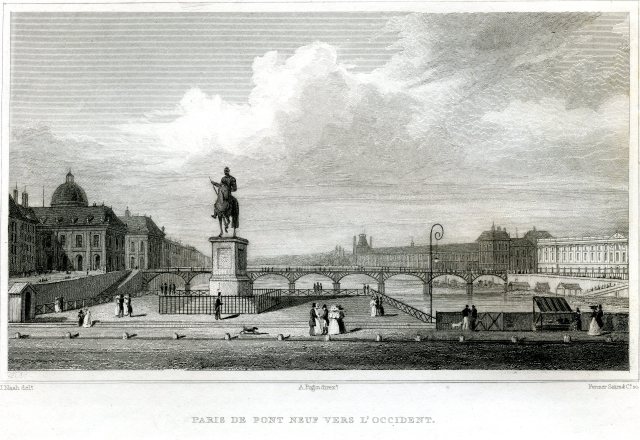
In addition to providing crossings and merchandising space, the bridges of Paris offered wonderful views of the river, its banks and the buildings of Paris. The image above is taken from the Pont Neuf looking towards the Pont des Arts. Paris and Its Environs described the view as “one of the most noble and striking in Paris.” It clearly shows the delicate iron work of the Pont des Arts, built in 1802-04, a bridge described as having “an elegant appearance but wants solidity and is only used for foot passengers.”

Bridges blog005

In the nineteenth century, Paris and London were vying to be the greatest city on earth. After praising the Austerlitz Bridge shown above, Pugin asserted that “the quiet river scenery of this plate will remind our English readers of some views of the Thames in the neighbourhood of the British metropolis, and particularly one just above Vauxhall. There is indeed a striking similarity in the light and elegant character of the Pont d’Austerlitz   and that of the Vauxhall Bridge. Both are also models of that great modern improvement in aquatic architecture, the cast iron bridge.” It was also a place to appreciate “the placid flow and unpretending character of the Seine [that] always appears to us to form an agreeable contrast with the magnificent works of art on its shore.”

The bridges of Paris gave then, as they do today, a view from above the river. In an earlier era they also allowed one to get above the smells of the river.

Bridges blog004This was true of both the Seine and the Thames, and Pugin mentions it, along with a useful tip for tourists. “The water [of the Seine] like that of the Thames, requires to be well filtered; and strangers find it needful to qualify the laxative qualities with wine or brandy.”

Text by Norman Ball. Images (except for one from Paris en Images) and all direct quotations from Paris and its Environs Displayed in a Series of Picturesque Views, The drawings made under the direction of Mr. [Augustus Charles] Pugin, and engraved under the superintendence of Mr. C. [Charles] Heath, with topographical and historical descriptions, 1831.

Posted in Paris bridges, Paris history | Tagged , , , , , , , , , , , , , , , | 7 Comments