Beating the August heat is a challenge in Paris and in Toronto. Sometimes the only solution is to divert oneself with a good book. Preferably in a cool bath.
The windows of our neighbourhood bookshop almost always feature a book with three words in the title: The Paris [something]. Network. Secret. Apartment. Bookseller. Affair. Library. Diversion. Sister. Whatever. Nearly all have similar cover art – a young woman, seen from behind or in a way that hides her face, with the Eiffel Tower visible in the background. I can’t keep all these books straight. Some are earnest and well-researched, some are ill-informed and filled with clichés, some are just girl-meets-boy with croissants. Many are set in wartime. One made me laugh out loud as the heroine tucked into a typical Paris breakfast of fresh eggs, yes, eggs, in – I kid you not – the occupied city of the Second World War with its food shortages. I forget which one that was. The Paris Egg, perhaps.
That is not the kind of book I have in mind.
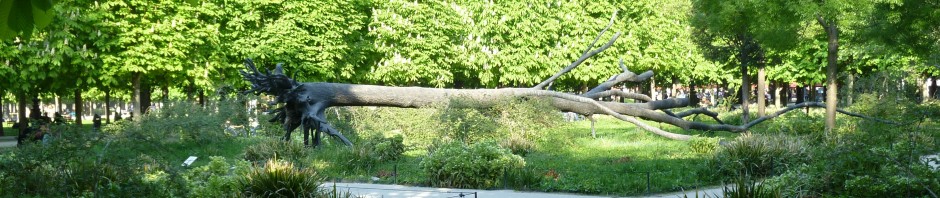
For the perfect summer escape, go to Brittany. I have just finished a mystery by Jean-Luc Bannelec, set in Concarneau. One can almost feel the brisk Breton breezes blowing off the page. Be prepared to experience an intense craving for seafood – like Simenon’s Maigret, the detective doesn’t like to work on an empty stomach. The author (the name above is a pseudonym) divides his time between Germany and Brittany, and writes in German. I am, of course, reading an English translation. A friend told me about the books a year or so ago, and each summer since then, I spend another few pleasurable hours with Commissaire Dupin. I’m getting quite used to the craving for fish.

For those who seek to understand more about modern Paris, read Impossible City: Paris in the 21st Century, by journalist Simon Kuper. Norman and I have long enjoyed his columns in the Financial Times and this is a distillation of his views as an “accidental Parisian” for more than 20 years. Kuper is clear-eyed, curious, well-informed, and thoughtful, and his book is an excellent guide to the city as it is and as it might one day become.
We will always feel gratitude towards Kuper and his wife Pamela Druckerman, who helped us remain sane in the months of lockdown with a weekly Zoom broadcast called Pandemonium U. Every week, Kuper or Druckerman would interview a writer or academic on his or her area of expertise, from cuisine to politics to art to history. Those informative interviews directed us to some terrific reads. They are still available online, so you can listen to them any time.
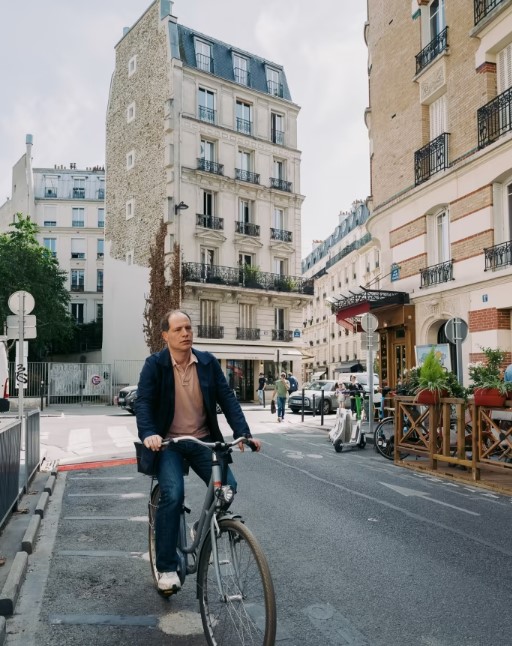
I even once spent an hour tracking down the location of a photograph of Simon Kuper on his bicycle that was featured in the Financial Times about a year ago. (It’s the kind of thing I do on a dull day when I need to spend virtual time in Paris.) And, as luck would have it, last December, our niece Alex treated us to a superb lunch on that very street, in the restaurant just visible on the right. I recognized the surroundings immediately.
Kuper’s insightful book ends on a positive note, describing the government’s ambitions for “Grand Paris,” a plan to join the banlieues to the central city by building 68 new Metro stations in places that previously had poor transportation connections. “By the time it’s completed around 2030, it could end up being a bigger urban transformation than Haussmann’s,”* Kuper suggests.
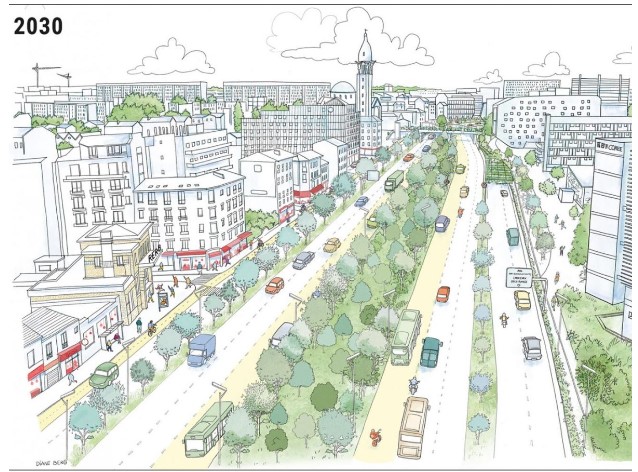
There is even a proposal to turn the Périphérique highway – that source of noise, pollution, and social alienation – into an urban boulevard, complete with trees and sidewalks, as shown in a conceptual rendering below. The French are not afraid to think big. I finished the book feeling heartened.
And for enjoyment and edification at the same time, you cannot do better than A Bite-Sized History of France: Gastronomic Tales of Revolution, War, and Enlightenment by Stéphane Hénault and Jeni Mitchell. Hénault is an experienced fromager (cheesemaker) and Mitchell is an academic specializing in the study of war. Each short chapter links a food or drink to events in history – Crusades and plums, Huguenots and chestnuts, the Renaissance and oranges, Napoléon and crêpes… It’s a fascinating way to tell history and fully appropriate for the subject.
Just to give you a sense of the “I-didn’t-know-that” appeal of the stories, here are two examples from the 20th century.
During the First World War, Camembert, often viewed as the quintessential French cheese, went from being a regional product little known outside Normandy and Paris to a cheese appreciated throughout France and abroad. French soldiers (poilus) received cheese with their rations, and at first the French government offered them mainly hard cheeses that had a long shelf life, such as Gruyère or Cantal. But thanks to an aggressive campaign by Normandy Camembert producers, who decorated their round boxes with French flags, assiduously lobbied the French government, and worked to keep prices low, Camembert “became the daily cheese of the French soldier, most of whom had never encountered it before. By 1918, the army was requesting 1 million Camemberts each month.”** The soldiers retained their taste for Camembert after the war.

Alas, the government did not restrict the use of the word “Camembert” to cheeses made in Normandy, except for the specific name “Camembert de Normandie.” French and foreign competitors began to manufacture versions of the cheese. I once tried something called Camembert that came from one of the Scandinavian countries, a version so bland that it left a faint aftertaste of wallpaper.
I was equally interested to learn that the baguette – that staple of French life, without which a meal is considered incomplete – has held this status for only about 100 years. A law passed in 1919 restricted working hours in French bakeries to between 5 a.m. and 10 p.m. As the authors put it, “It is commonly believed that this law is responsible for the rise of the baguette, which could be produced more quickly than traditional breads, thus allowing bakers to comply with the law but still offer fresh bread in the morning.”*** They acknowledge that other factors were at work, but there is nonetheless a connection between the progressive reforms of the interwar years and the baguette.

That’s a Canadian baguette, by the way, on our kitchen counter in Toronto. Not a bad one, but not quite the French version, made by someone who started work at 5 a.m. precisely.
If you would like to suggest your favourite French-themed books for summer reading, I would love to get your recommendations. As long as the first two words aren’t The Paris…
Now I think it’s time for another cool bath.
Text and baguette photograph by Philippa Campsie. Photograph of Concarneau from Wikimedia Commons. Picture of Simon Kuper from the Financial Times. Conceptual rendering of the Périphérique in 2030 from Challenges. Camembert from Saveur Lointaine.
*Simon Kuper, Impossible City (New York: Public Affairs, 2024), page 228.
**Stéphane Hénault and Jeni Mitchell, A Bite-Sized History of France (New York: The New Press, 2018), page 242.
***Ibid., page 251.




 Parisian Fields
I have a work colleague who is originally from Brittany and she discovered the books of Jean-Luc Bannalec at our library where we both work in Australia. She forgives him for being a German writer in disguise as his descriptions recall fond memories for her. I have yet to read him, but he is on my ridiculously long “must read” list. Thankyou for the reminder.
Maybe move him a few notches up the list? Of course, it’s your winter there, and you might want to save him for the Australian summer!
Love your emails.
Have you read The Paris Wife-lol!!!
I also love the Brittany books. Look forward to each new one. I used to visit friends every summer in a village near Saint Malo for many summers but, alas, they have died. All born in 1925 and 1930 so had long productive lives.
Will look in my Paris section for some titles.
I have read and enjoyed The Paris Wife, which is based on a true story. It’s the fiction stuff that is all much of a muchness.
Another German writing in a French setting, Patrick Süskind’s novel Perfume provides a most unusual and intense portrait of Paris in the 1740s. The first two pages of the book are viscerally stunning.
Good suggestion, although “viscerally stunning” suggests it might not be the best in the bath!
Loved your post! Paris happens to be the subject of many of our reading forays around here. These are some of our favorites. Some are classics, others are fresh perspectives on age-old subjects…
Clementine in the Kitchen – Phineas Beck (aka Samuel Chamberlain)
My Life in France – Julia Child
Paris, I Love You But You Are Bringing Me Down – Rosecrans Baldwin
Villa America – Liza Klaussman (more so about the French Riviera)
Bon Appetit – Jesse Hartland
(Don’t be turned off by the Paris___ title, these books are lovely!) Paris Letters, and the follow-up, A Paris Year – both by Janice McLeod
And last but not least, the always marvelous, A Moveable Feast – Ernest Hemingway
If they happen to spark your interest you’ll find reviews of all these books on our blog. Happy reading (and writing!)
Dear Katherine, Thank you for these helpful recommendations, and for letting us know about your interesting blog. I read Villa America recently. We found a copy in the Paris apartment we were staying in, which belongs to a Canadian friend. An excellent book. Best wishes, Philippa and Norman
Oh how fun. I collect books (fiction and non) about F. Scott Fitzgerald, so of course Paris comes up often. Glad you liked Villa America too. – My best, Katherine
Well…………….don’t keep us guessing!
What street was Simon Kuper on?
You mean you don’t want to spend an hour figuring it out? OK, the restaurant was Le Chardenoux. That should place it. Simon Kuper’s office is in the vicinity. Read https://www.ft.com/content/9d5ec6e8-8c5f-424d-bd13-b9b38135ee98 and you will get major office envy!
Just love your newsletter, Philippa…especially when isolated during our Vancouver Covid!
A great chuckle, right through all of the series is the ‘Merde’ series from Stephen Clarke, replete with Paris and Breton information. Witty and short enough for the bathtub.
Then a solid grasp of cultural comparisons in their illuminating ‘60Million Frenchmen Can’t be Wrong’’ from Jean Nadeau and Julie Barlow. A brilliant combination of fact and history. Maybe not bathtub reading though!
Stephen Clarke sounds perfect for the bathtub! That’s a great idea!
ThanksCarahttp://www.carablack.com
Of course! I have read quite a few. Thanks for posting a comment.
Hi Philippa,
Try out “Miss Morgan’s Book Brigade”. A thoroughly reasearched war story by Janet Skeslien Charles (who authored “The Paris Library” alas published with the back of a young woman and Eiffel Tower on the cover). I’ve understood that the authors do not choose titles or covers, that’s the publisher’s realm.
I’m reading Maigret à New York right now!
Thank you for your posts. They are the only ones I subscribe to and I’m one of those nearly 40 year expats in Paris. Lisa of FUSAC and Bill & Rosa’s Book Room
Thank you for the suggestion!
I used to work in publishing, and I don’t blame the authors one bit for cliches on the covers! I also suspect that unimaginative publishers reckon that anything beginning with “The Paris” will sell. But the field is now so crowded that nothing stands out.
We shall make a point of visiting Bill & Rosa’s Bookroom on our next visit. I once visited Boulogne-Billancourt in search of Mary Callery (https://parisianfields.com/2017/04/23/footsteps-and-sidetracks/). I am happy to have a reason to go back.
Well, there you go again giving me great pleasure in reading your blog. I did not know about Mary Callery and I have a friend who lives across Villa d’Alésia from the studio (she wishes they would trim the very tall Linden trees!). Boulogne-Billancourt is full of wonderful architecture especially from the 1930s. Let me know if you come by, if I’m there we’ll visit!
The story of the baguette is fascinating. Good reading suggestions too.
That history-through-food book has your name written all over it!
I’m rather late in commenting, but I have a suggestion: The President’s Hat, by Antoine Laurain. It’s available in both English and French.
I very much enjoyed this column (as I always do) and plan to expand my French detective reading to include Commissaire Dupin, in addition to my beloved Maigret.
Marsha
Dear Philippa, the oddest thing: I just left a comment to this wonderful post, but it shows up as coming from Sandra L. Grant. She is my sister, and we both subscribe to Parisian Fields and read regularly. At any rate, my real identity is Marsha Huff, in Milwaukee, Wisconsin. Cheers,Marsha
Hello Marsha, I have ordered The President’s Hat from the Toronto public library system and look forward to reading it. Thank you for the recommendation. I am so glad you enjoyed the blog. All the best, Philippa
Hello Philippa,
I’ve just sold a near-future novel set in Paris, in which the Périph’ is imagined as a complex of vertical farms, rooftop orchards, and gardened walls – a greenbelt to feed the inner city. From the beginning, I’ve vacillated over the title: The Paris Walls, The Paris Greenbelt, The Paris Architect, etc etc. After reading your post, I’m settled. I’ll stick with The Hunger of Those Who Built It.
I’ll be hunting out Kuper’s book. Thanks for steering me toward it. In return, I offer Mathias Énard’s The Annual Banquet of the Gravedigger’s Guild which I’ve just finished. Paris is present in the form of young David Mazon, who moves from Paris to the Marais of Poitevin to study the locals. It’s hilarious at times, and could only be set in France. Some of the exposition in the middle is positively Rabelaisian, and I confess, I skimmed some bits there to come back to later. But it is enormously evocative of that Paris | not-Paris division that is the Hexagone. Definitely worth seeking out for francophiles.
And thank you, too, by the way, for all your posts. They give me such quiet pleasure.
Wendy
Dear Wendy, Your comment gave me considerable quiet pleasure this morning! First, congratulations on selling your book and on choosing a title that won’t get lost among the other Paris books. I shall look for it when it appears. Second, thank you for the recommendation, which I shall seek out immediately. All the best, Philippa
Never have I seen Paris but I have visited in my mind. The book about the Eiffel Tower by Jill Jonnes is one that I love.