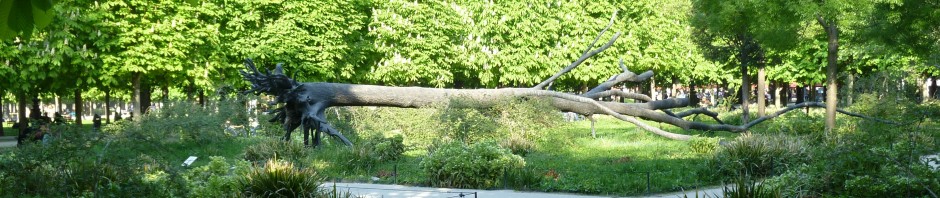
Opinion is divided as to whether Napoleon Bonaparte was a tyrant or a genius, or both. But perhaps we can all agree that he left something to be desired as a husband. His divorce from his beloved Josephine de Beauharnais when she could not give him an heir proved that establishing a dynasty was more important to him than she was. Josephine was shattered when he broke the news.

Further evidence of his insensitivity can be found in the fact that after the divorce in 1809–10, he decided to give Josephine a present and commissioned a porcelain tea set from the Sèvres factory. The theme was famous women, painted by a noted woman porcelain artist, Marie-Victoire Jaquotot. Completed in 1812, it was known as the Cabaret of Women – “cabaret” in this sense means a tea or coffee set with cups, saucers, and serving pieces.
Josephine took one look, packed it up, and sent it back to the factory. I don’t blame her. In order not to lose his investment, Napoleon re-gifted the set to his new wife, Marie-Thérèse. Almost immediately, she gave it to a friend, the Comtesse de Ségur. I don’t blame her, either.
We saw the porcelain in question recently at the Art Gallery of Ontario.
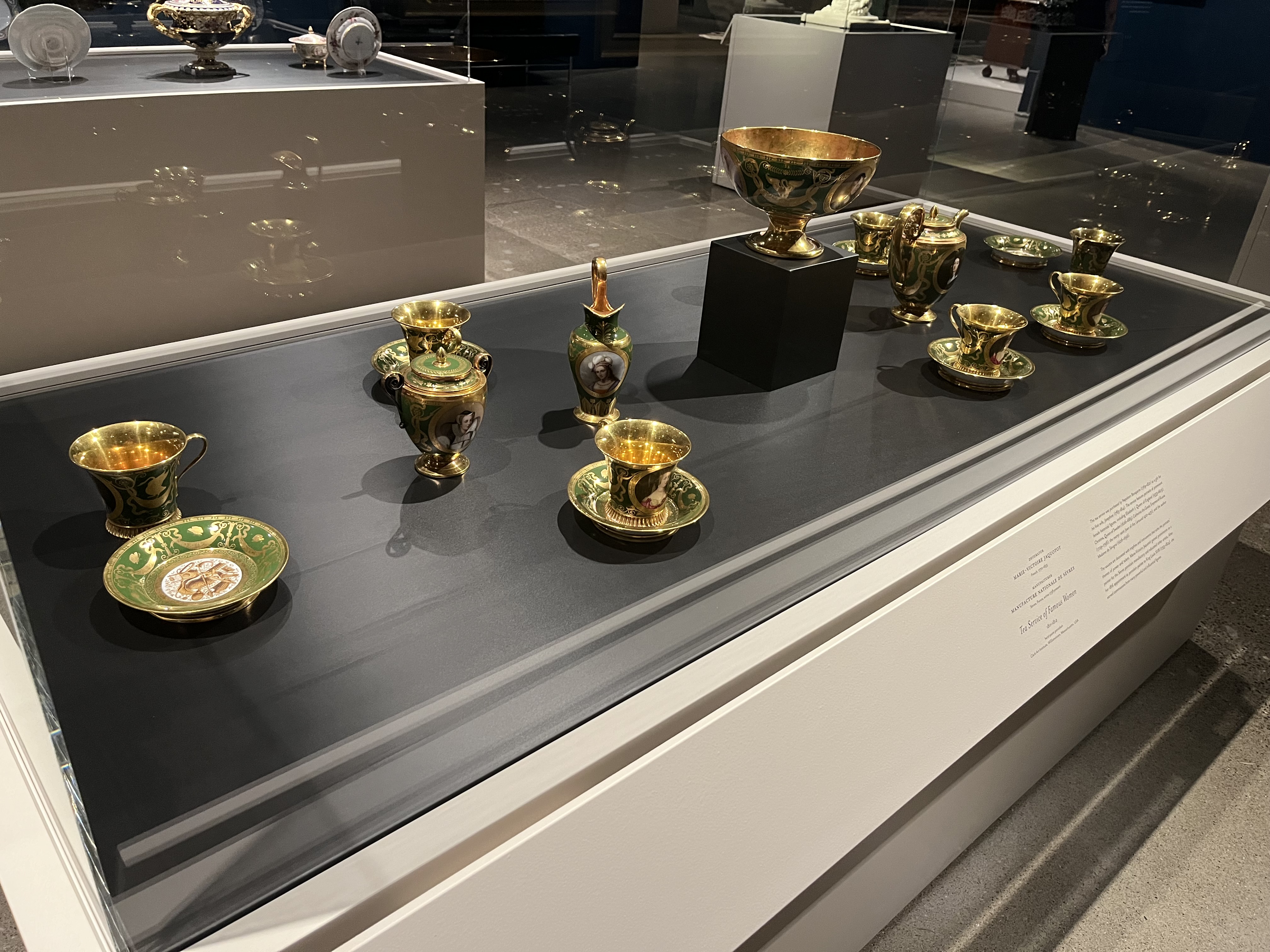
It was part of an exhibit called “Making Her Mark,” which focused on the work of European women artists from 1400 to 1800. The creation of the Cabaret des Femmes Célèbres falls after the latter date, but it fits within a tradition of fine work by professional women artists who are not often recognized today.
I was curious about the choice of women portrayed.* Queens of various nations, aristocratic ladies from France and elsewhere, plus some one-offs, like Joan of Arc, pictured on a jug, looking remarkably unmilitary, unlike most images of her.
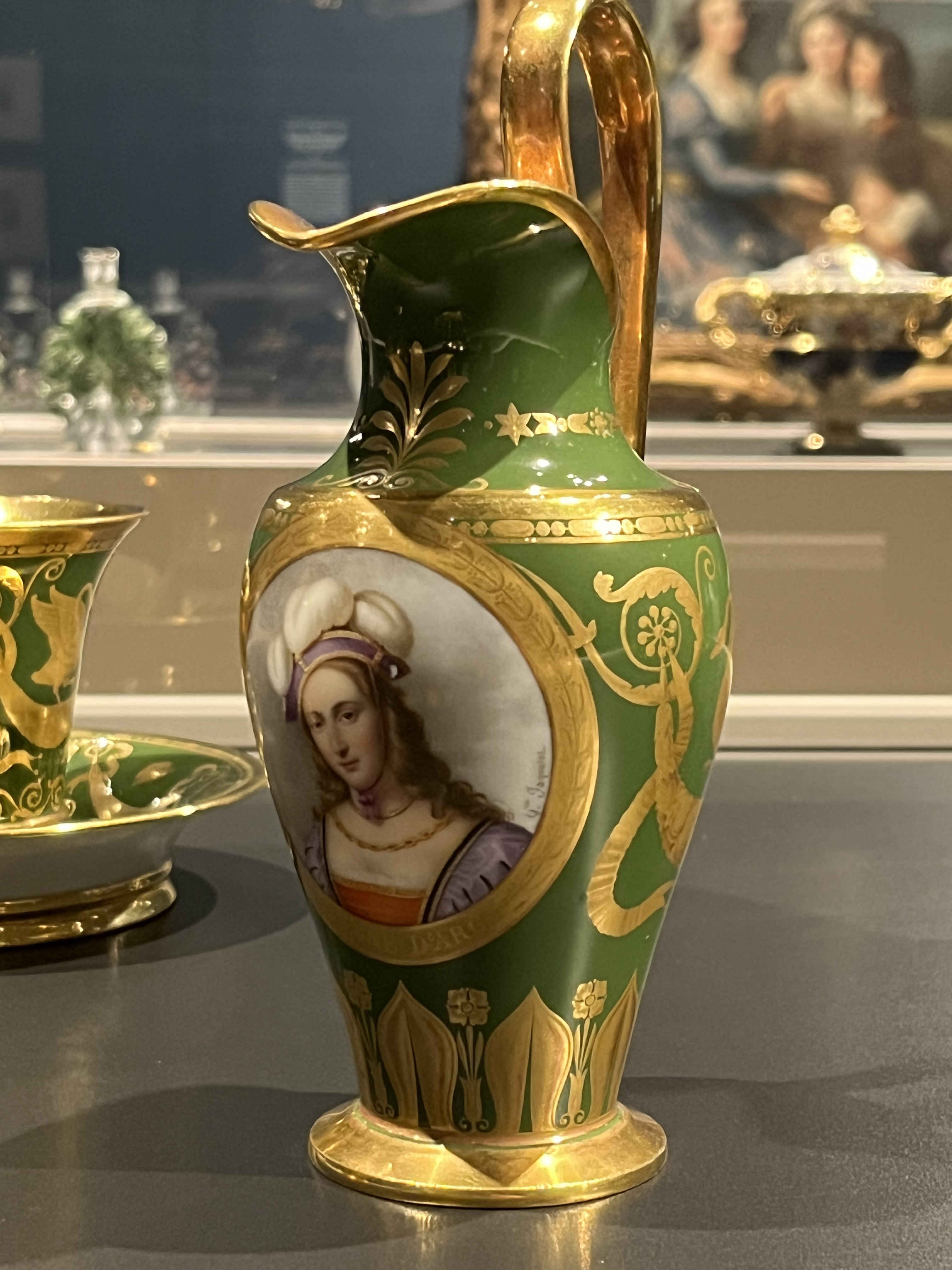
Mary Queen of Scots and Elizabeth I share a sugar bowl, which seems a bit cheeky. Mary looks as if she suspects who is on the other side.

This cup, one of eight with fluted bases, depicts Anna Scott, the “Duchesse de Montmouth [sic].” Scottish. Fabulously wealthy and titled. Husband executed for treason (the Monmouth Rebellion). Interesting choice.

And this is not at all what I thought Madame de Sevigné, the famous letter writer, would look like. I had a completely different mental image of her.

But even more than the faces on the porcelain, the woman who painted them interested me. One of the many things I learned from the exhibition was that in the late 18th and early 19th centuries, women not only excelled as porcelain painters, but also oversaw this work in some factories. At Sèvres, the most highly respected artist was Marie-Victoire Jaquotot (1772–1855), who created several cabarets featuring portraits of famous people. This was just one example of her work.
We’d visited the Sèvres porcelain museum a few years ago, and I highly recommend it. It is filled with brilliant colours and beautiful shapes.

I wish my mother could have been with us. She loved porcelain and had a small collection of pieces that interested her. Once I asked what it was that attracted her, and she said that porcelain never lost its colour. Textiles fade, paintings darken, metals corrode, but porcelain remains bright as the day it is made.
This quality is partly what ensured Marie-Victoire Jaquotot a secure and very profitable career. A recent article** about her work describes the early 19th-century fashion for creating reproductions of famous paintings on porcelain as a way of preserving them for posterity. She called her work “inalterable painting.” And it was – if you didn’t drop it. Her output was prodigious and some of her reproductions fetched more than the original paintings had.
She created several self-portraits, but this one made me laugh.
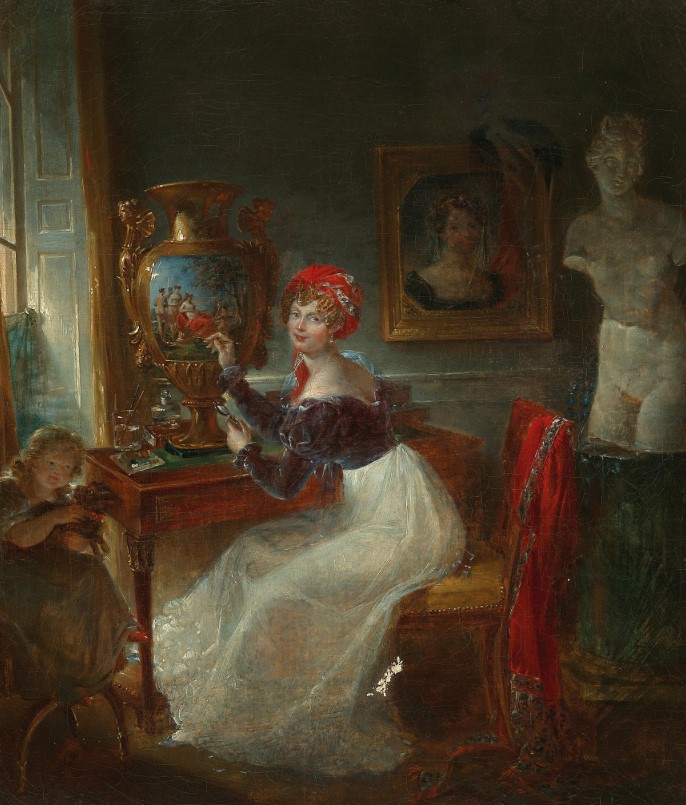
Somehow I can’t imagine anyone painting porcelain while dressed in the latest fashions and entertaining a small child with a dog.
She seems to have set out to become a professional from an early age. She studied with the painter Etienne-Charles Le Guay, who had a habit of marrying his students (and he had many women students). She was the second of three wives. It was 1794, she was 22, and he was 10 years older than her.
The marriage lasted seven years. She went on to have two children by Jean Comairas, an architect 10 years her junior (the son became a painter, the daughter died in infancy), and finally married a Jean Pinet, whom she outlived.
She was close to the royal family and for a few years in the late 1820s had an apartment and studio in the Louvre. She was designated the First Porcelain Painter to the King (was there a second?), had students of her own, and received an annual stipend of 1,000 francs. Although she used the facilities at Sèvres for creating the porcelain, she negotiated commissions directly with patrons, which annoyed the director of the porcelain factory no end. In this self-portrait, she looks demure, but she was a shrewd entrepreneur.

One of those women who defy stereotypes and upend our notions of women’s roles in the past. Her images endure, as “inalterable” as she had hoped. I hope the Comtesse de Ségur made good use of the tea set. It would be a shame to waste it.
The Art Gallery of Ontario exhibit (which was created in cooperation with the Baltimore Museum of Art) closes at the end of June, but if you want to see the Cabaret of Women, it is owned by the Clark Art Museum in Williamstown, Massachusetts. The Clark bought the set in 2021 through an auction arranged by Drouot and held in Fontainebleau, which offered a large range of items associated with Napoleon, from furniture to clothing to household items.
Text by Philippa Campsie. Photographs of the Art Gallery of Ontario and the Sèvres Museum by Philippa Campsie. Portraits of Marie-Victoire Jaquotot and engraving of Napoleon and the Empress Josephine from Wikimedia.
*The full list of women depicted in the Cabaret of Women, along with brief biographies and the sources of the images can be found here. It is a meticulous piece of documentation.
**Daniel Harkett, “Medium as Museum: Marie-Victoire Jaquotot’s Porcelain Painting and Post-Revolutionary Fantasies of Preservation,” Chapter 7 in Time, Media, and Visuality in Post-Revolutionary France, Iris Moon and Richard Taws, editors (London: Bloomsbury, 2021).









 Parisian Fields
you have a wonderful way of bringing characters from the past back as if they were sitting, painting, beside us! Thank you! So wonderful! Which wife was it that Napoleon had a glass (not a teacup) made from the shape of her breast?
p hornbostel (my 3rd great grandfather trained under Napoleon and was almost killed for trying to place him back on the throne in place of Louis XVIII—luckily for his progeny, the lovely Mme Recamier saved the day and snuck him out of prison).
Thank you for the comment. What a wonderful family history you have! There is indeed a story that the champagne coupe was modelled on the breast of someone…Marie Antoinette or maybe Madame de Pompadour (in both cases, that would make it earlier than Napoleon), but the origin of the story is a bit murky. Some people even think the coupe was an English invention. Who knows?
This is a fascinating post! Thank you for documenting this very singular group of objects and this fabulously talented artist. Now I am curious as to what other women artists are featured in the show, and what their history reveals.
Thank you for your comment. You can learn more about the exhibit here: https://artherstory.net/making-her-mark-leaves-its-mark-at-the-art-gallery-of-ontario/ I found it absolutely fascinating and plan to go back once more before the end of the month.
Your articles are always a delightful surprise – never know what gems you’ve uncovered. Thank you!
And I never know what I’m going to write about until I stumble over it! So glad you enjoy the blog.
I was just about to respond with very similar words. I love reading every article.
This was SO interesting! Thank you for such a beautiful detailing and the pictures are spectacular. I LOVE reading your emails.
I was pleased at how well the photos came out. There are some stock photos online, but the lighting in the art gallery showed the pieces in a more flattering light. So glad you enjoyed the blog.