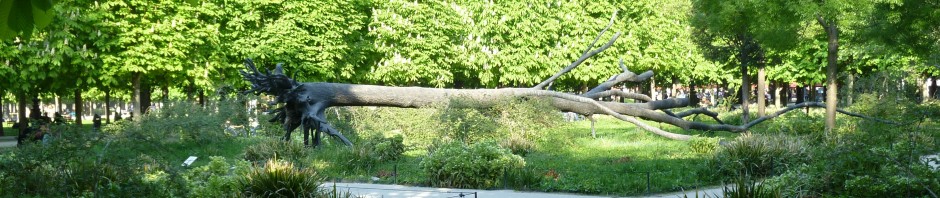
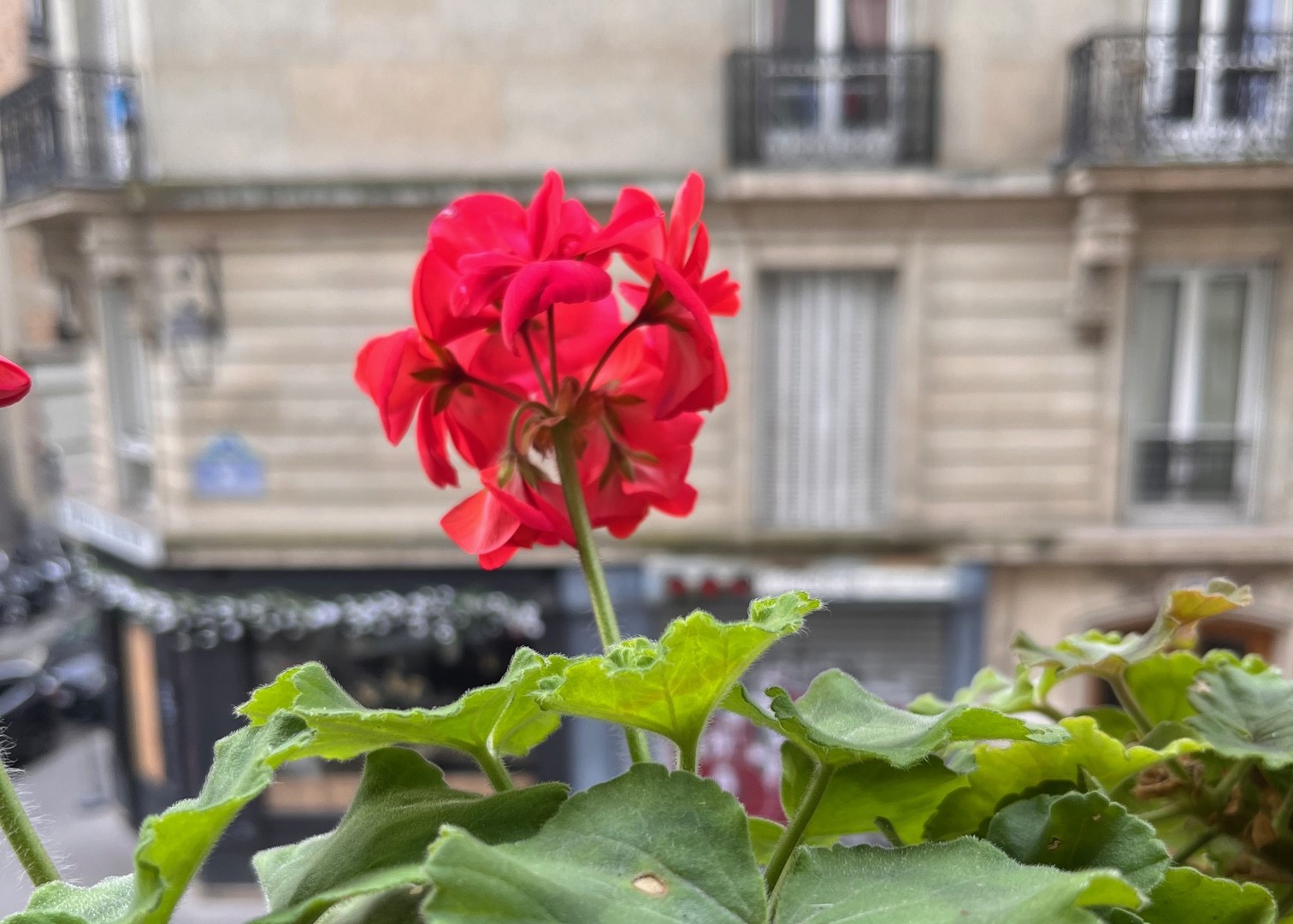
Finally, after almost four years, we were back in Paris. We stayed in an apartment belonging to a friend of Norman’s, and were greeted with the sight of red geraniums in the window boxes. We were there for Christmas and New Year’s, happy to get away from Toronto, with its cheesy Christmas music in shops and the insistent ads about what to buy for everyone on your list. This was a gift from us to each other, and we unwrapped it a day at a time.
Shortly after we arrived back in Toronto (during a snowstorm), I wrote down a list of things that we love about Paris, the reasons we return as often as we can. Not sights and monuments, but details we find pleasing.
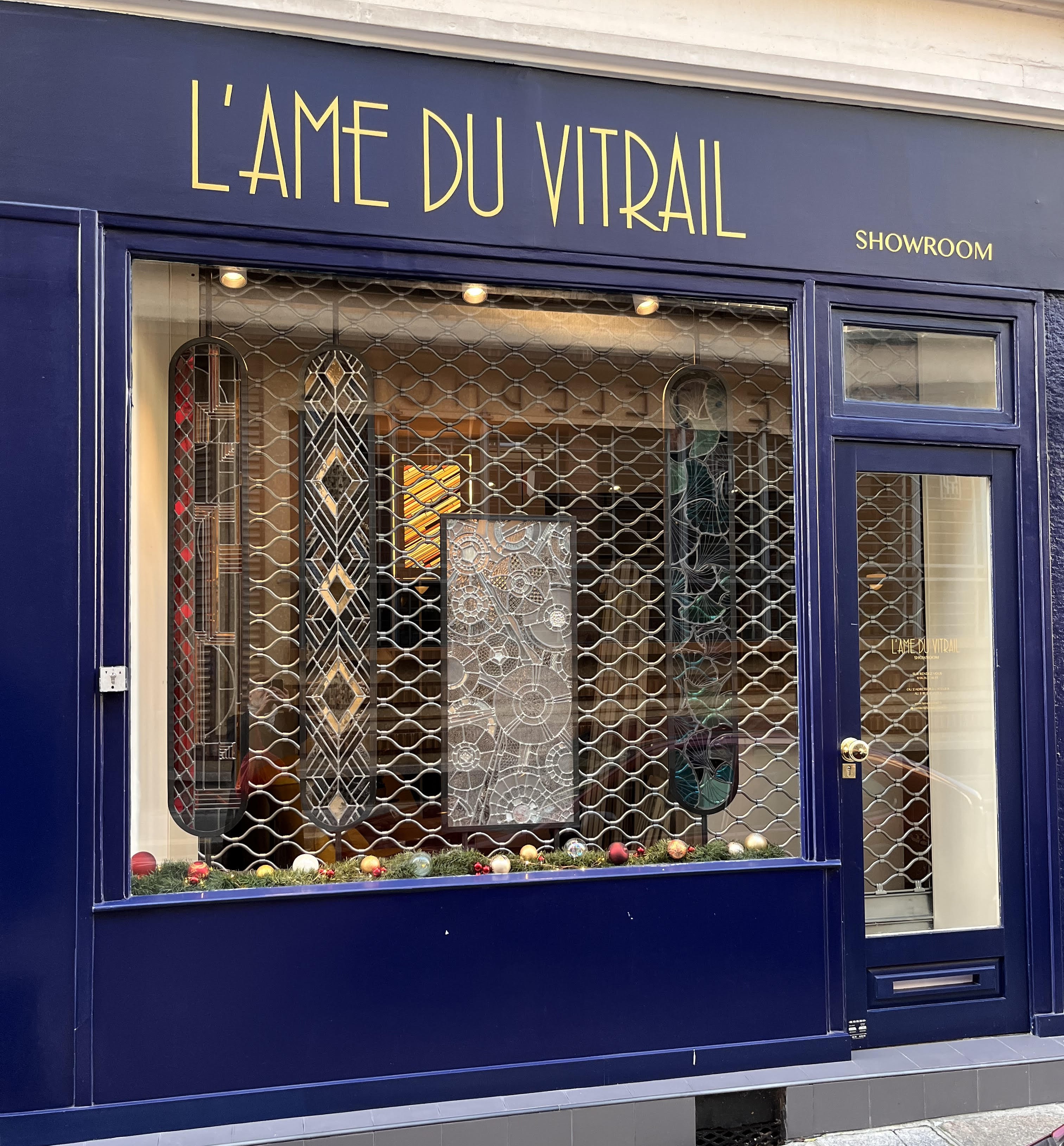
Such as the way in which the city is filled with ateliers in which people make things and repair things. A street that we often passed near the apartment had both a stained glass studio and a workshop in which a man made custom frames and mountings for unusual artwork. We chatted with the owner of the stained glass shop and Norman talked to the framer. Elsewhere in the city, we’ve seen people making furniture or musical instruments, fixing locks, mending china, and even repairing umbrellas. By comparison, many modern cities are mere logistics centres, storing and despatching, but not creating and never repairing.
At the larger scale, these skills aggregate to the art of restoration. On this visit, we saw several recently restored buildings: the Hotel de la Marine, the Musee Carnavalet, La Samaritaine department store (shown below), and the Bourse de Commerce, which has become an art gallery. In each one, we marvelled at the work that had been done and the care that had been taken with old materials.

We even found a shop called Les Toits Parisiens near the Village St-Paul, in which you can learn how to create artworks using zinc or ardoise (slate), the traditional materials of Paris roofs. We bought an original picture, a zinc objet, and some delicious little bonbons the colour of slate. We spent hours talking to the owner and examining everything in the small space.

Speaking of small spaces, we love the compactness of the city and are consistently amazed at the way in which bus drivers manage to manoeuvre articulated vehicles through impossibly small gaps in traffic or between buildings. I don’t know how they are trained, but they have our unbounded admiration.
We’ve heard residents of Paris complain about the public transit system, but they haven’t lived in Toronto. We are in awe of the extent and reach of the system, the frequency of Metro trains (even on public holidays), and the imaginative decoration of so many stations. We are also delighted when younger people leap to their feet if we seem to be hunting for a seat on the Metro. It’s not that we look terribly old, but giving up one’s seat is surprisingly common. In one bus, we watched a little minuet as a middle-aged woman gave her seat to an older woman, who in turn gave it up to an even older man with a cane. I’m quite sure he would have given way if someone with crutches and a cast had entered the bus.*
Good public transit means that living in Paris without a private car is a reasonable option for all kinds of people. This fact accounts for the interest provided by sidewalk traffic, as things that would be hidden away in cars in Canada are on display in the streets in Paris. People walk by carrying furniture, works of art, flowers, bags of groceries, tools, and toys.
Life is lived out in the open in so many ways. People in small apartments need cafés for meeting friends or just reading a book, and even in December, the outdoor terraces were filled with patrons, drinking coffee or wine and catching up on the news from other people or from newspapers. Lingering is allowed, because the table is important, socializing is important.
People speak of sitting outside cafés watching the world go by, but the world is just as fascinating inside the café. At one of our favourite restaurants, Café Varenne on the rue du Bac, we sat on little stools in the entrance, as the wait staff bustled around us, squeezing through the crowd without spilling the contents of their trays. We enjoyed the choreography as we waited for what the cheerful maître d’ called “the pole position.”
Despite the bustle of Paris life, we like the fact that social exchanges are given priority, even if you are merely buying stamps at the Post Office or cough drops at a pharmacie. It doesn’t matter how many people are waiting in line; these things cannot be rushed. You say Bonjour, get a Bonjour in return, state your business, discuss the options available, sometimes in considerable detail, make the transaction, and end with Au revoir (or Bonnes fêtes or Bonne année at this time of year). The people waiting behind you know they will have their time too. Indeed, it is common to see a line of people waiting as an elderly customer has a full and frank discussion with a pharmacist about health matters and then spends some time finding the money to pay for médicaments. This is as it should be.
What else? Papeteries (stationers’ shops) and drogueries – the latter are not drugstores but shops filled with every kind of tool and product to clean and shine anything you can imagine. Norman calls them “drudgery stores,” but even he has bought a variety of useful items there. And then there is Deyrolle, because after all who doesn’t need a stuffed owl? And the Bazar de l’Hotel de Ville basement hardware emporium, where we inspected the vast range of door handles available.

These places have knowledgeable sales staff. Sure, Paris has its share of sulky young people on the sales floor, absorbed in their mobile phones, but they mainly work for chain stores or shops catering to teenagers. In the papeteries, the drogueries, the shops selling housewares or artworks, or the specialized food shops, the staff pay attention, know the products, and can provide useful advice.
And they need to, because shops offer so many choices. Sometimes it’s overwhelming. A friend asked me which type of kiwi I preferred. I was speechless. There’s more than one kind of kiwi? She explained that she likes the yellow-fleshed ones, but the red-fleshed ones are nice, too. I didn’t know that green was not the only option. So she brought us some to show us. At the open-air markets, usually one stall sells nothing but lettuce, about 25 types (we’re lucky to find half a dozen in our central Toronto market). At the grocery store, I can spend hours pondering the available flavours of jam or yoghurt (chestnut, anyone? fig, plum, persimmon?).
It’s not just quantity and choice, but quality. Everything tastes better, fresher, juicier.
And the bread. Some people prefer croissants for breakfast, but give me a tartine (that is, a ficelle cut lengthwise), preferably with Normandy butter and a bit of jam, and I am in heaven. Later in the day, a baguette to go with the cheese course. The cheese is optional. Bread is much more of a temptation for me than pastries. I’ve never understood the appeal of macarons, although I enjoy financiers and I always hunt for pistachio éclairs (much better than the chocolate versions).
Paris is also becoming more welcoming to gluten-intolerant visitors. A friend of ours visiting from California is gluten-intolerant, and found a wealth of options, as well as sympathetic treatment in restaurants. She brought an amazing gluten-free galette des rois to an end-of-the year celebration with friends.
We loved the apartment, with its high ceilings and enormous windows. It even had (albeit a small one, high up on the wall), an internal window, as well as a transom over the entrance (shown below). I’ve always liked the way transoms, skylights, and windows in interior walls bring extra daylight deep into Paris apartments. In a previous place we rented, the internal window took the form of a porthole.

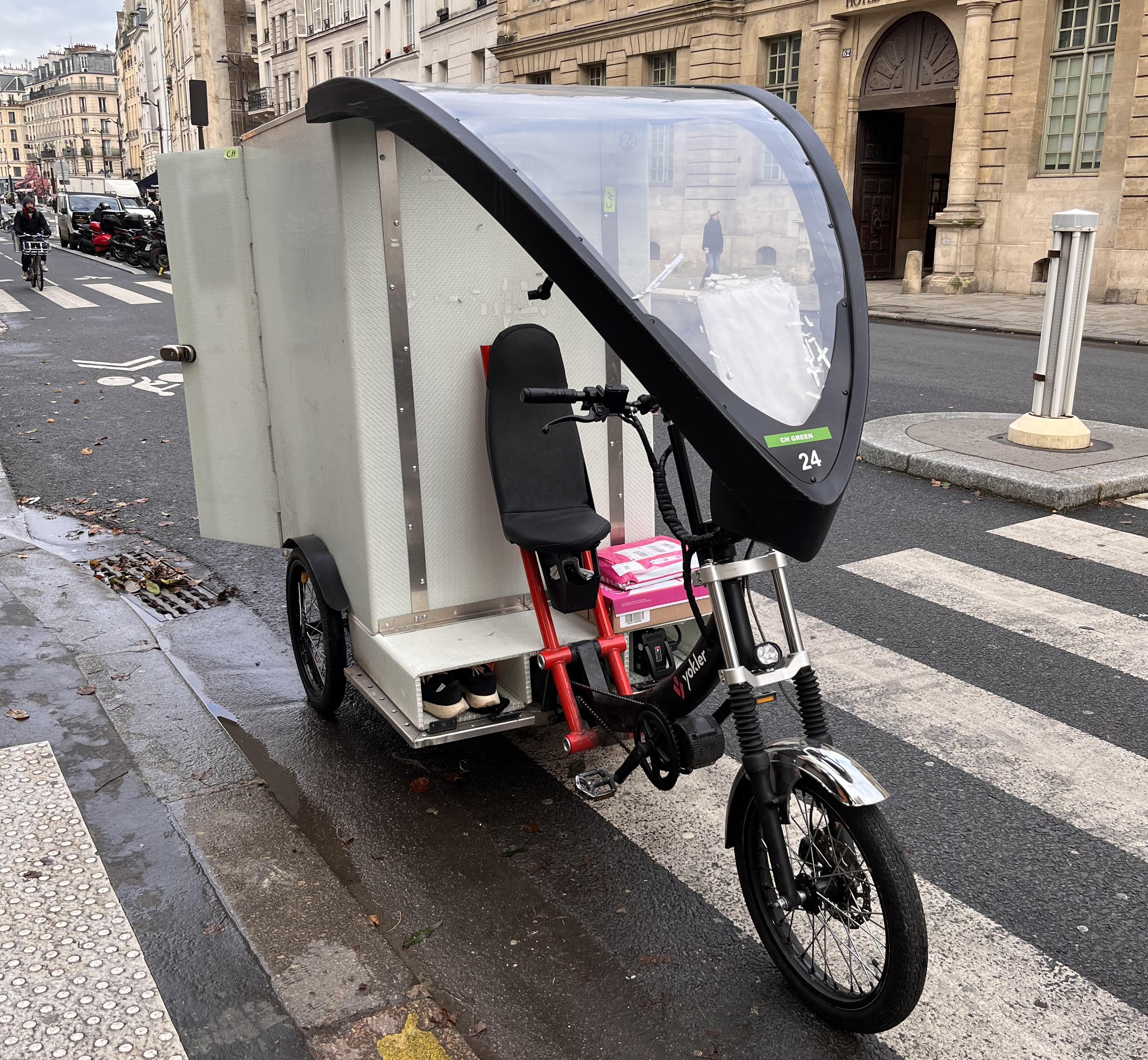
We were impressed with some of the changes over the last few years designed to reduce car traffic. Pedestrianized streets. Other streets limited to commercial traffic only (buses, taxis, delivery vehicles). Bike lanes – okay, the bicyclists themselves are casual about obeying traffic signals, but I appreciate the infrastructure. Pedal-powered/electric delivery vehicles of all kinds.
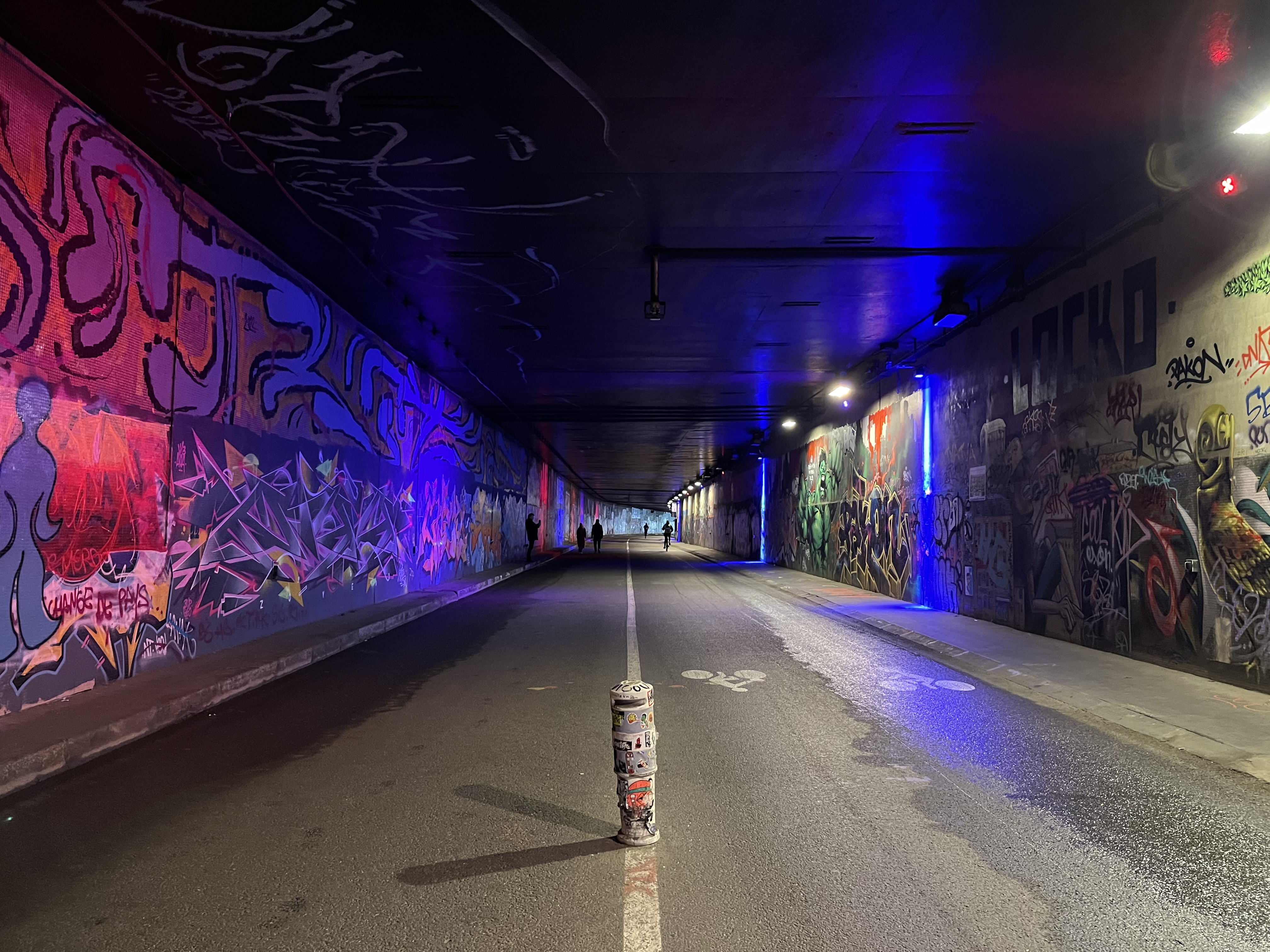
We had an unusual walk on the highway beside the Seine that is now closed to cars and open to pedestrians, cyclists, and scooters. A friend had invited us for a stroll by the river, but the water level was so high that part of the riverside path was closed. We ended up in a former highway tunnel. It was well lighted and ventilated, covered in graffiti (some of it sanctioned), and we emerged after more than a mile feeling faintly bemused but impressed.
Other environmental initiatives include copious recycling opportunities. Reusable food containers made without plastic (glass, pottery). Places to put Christmas trees when the season is over. Green roofs.
We could go on and on. But these everyday things keep us coming back. This was our twentieth visit to Paris as a couple, and we hope for twenty more.
And let us not forget…geraniums grow in the winter.
Feel free to suggest other things that you appreciate in the comments section.
Text by Philippa Campsie, photographs by Philippa Campsie and Norman Ball. Photograph of Metro sign (below) from Wikimedia Commons.
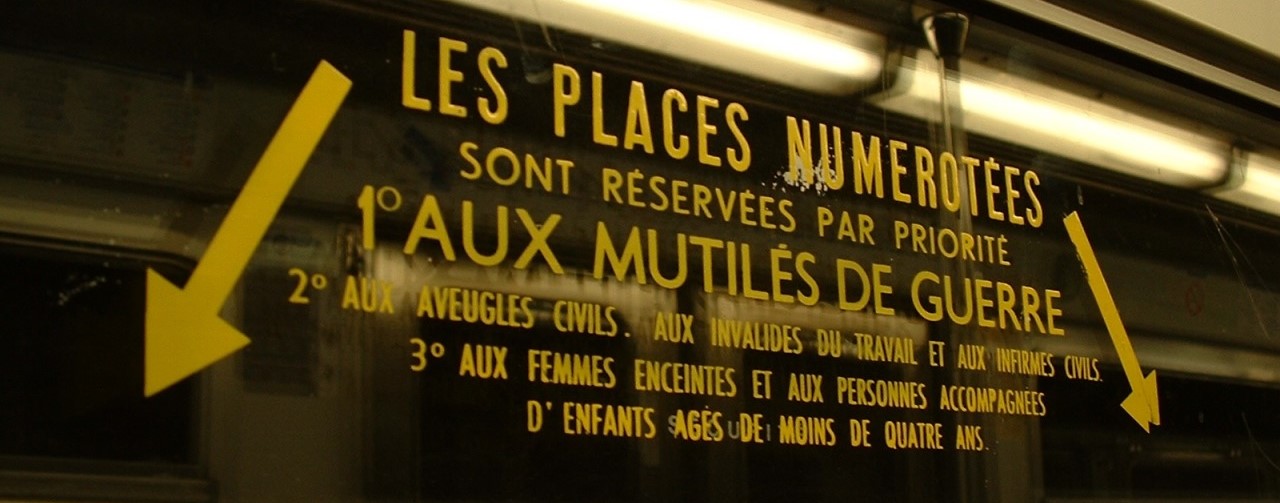
*The year that I was a student in France, the Metro cars all had signs on the windows for the seats nearby, reserved for “Mutilés de Guerre, Aveugles Civils, Invalides du travail et infirmes civils, Femmes enceintes, Femmes portant un enfant de moins de quatre ans sur les genoux” (people with war wounds, persons who are blind, people with work-related injuries or other infirmities, pregnant women, women holding a child of less than four years old on her knees). The wording has varied over the years, but clearly many passengers have adopted the tradition of giving up a seat to someone else from a young age.






 Parisian Fields
Always a delight to read these accounts of Paris. Delhi too has places where old stuff is repaired and even sold. It fills you with pride to buy a useful obect from the olden times. Equally delightful is to get a gadget repaired and use it for more years to come.
Keep writing for joy.
I do hope that more people learn the valuable skills associated with repair. It makes so much sense.
Another delightful piece, exploring aspects of Paris that so many others may overlook! I also appreciate the many artisanal shops that will repair almost any possession. When I accidentally knocked over a friend’s crystal bell, I was able to get it seemlessly repaired at an amazing glass workshop near Canal St Martin. The wonderful umbrella repair shop, Pep’s, that you previously wrote about, seems to have closed permanently, but I was able to have an old umbrella of sentimental value completely refreshed at Galerie Fayet in the Passage Jouffroy. They even polished the handle so that I could see my father’s initials again.
Sorry to hear about Pep’s closing, but I dare say the owner retired. Good to know that there are other umbrella repair shops available!
We are retired and spend most of each year in Paris in the 6th. We too love living there for all of the reasons you have described so well in your post. And when we left a few days ago (just before the snow) my geraniums were still blooming and so beautiful! We will return around the first of April. La vie est belle!
Bon retour. The 6th is a lovely area.
Enjoyed your comments. It was a refreshing alternative to most travel stories and the small details in your essay were much appreciated as it was an interesting collection of close ups of human interactions and comparisons! Well done.
Thank you so much for your comment. It always amazes me that in such a fast-paced city, things seem to slow down at the scale of conversation and social exchange.
Such a lovely post! I particularly liked the part about the repair shops – something no one really focuses on while discussing travel in a foreign city. I recently heard about Austria and their initiative to offer repair vouchers to residents to fix small issues with everyday household items (furniture, electronics, clothing, etc) as a way to keep still useful items out of their landfills. The program has been so successful that they are now in need of more skilled repairmen and restoration artisans to mend all the items.
It sounds like Paris is well on its way to care for such things too. Hoping that the US (and Canada!) will follow suit. Thank you so much for sharing your trip.
P.S. Our geraniums ae overwintering in our New England greenhouse. I once read that geraniums can live to be 50 years old, so for the past three years I have dug ours up and overwintered them with great success. It’s 12 degrees (F) outside with snow on the ground, and icicles on the roof as I write this. Currently, it’s 55 degrees (F) in the greenhouse and the geraniums are flowering away and growing with such cheerful enthusiasm it is positively heartwarming. Perhaps an indoor geranium plant would add some extra joie to your winter back home too. Cheers and happy New Year! – Katherine
My mother used to uproot her geraniums in fall, shake off the earth, turn them upside down, put them in paper bags, and store them in the furnace room over the winter. She would replant them in spring. But my parents had a bigger house and a much bigger furnace room. I am not sure where I could store the paper bags here.
Oh that’s an interesting way to overwinter them for sure. I’ll have to try that method next. When I pull mine from the garden bed, I usually just pot them in small containers and clip them all the way down to the bottom branches. Over the winter they sprout new leaves and shoots and by the time they are ready to go back out in spring, they are almost as big as bushes. I haven’t tried this method in the house, only the greenhouse, but I bet you would have successful results if you put a pot or two in a sunny windowsill. They can withstand shade and temps down to 25 degrees (F) so they aren’t very picky:) If you try it, please let me know how it goes. And thanks for the tip on the paper bags. Our cannas are overwintering in the basement in paper bags. I’m sure they’d love to have more company;)
Thank you very much. It is always a delight to read you.
Best wishes for the New Year
Anne-Nelly
Thank you and Happy New Year to you too!
Thank you, Philippa and Norman! This is delightful and optimistic……..good to hear that Paris is a wonderful as ever. I am so glad that you got back there!
Maybe I’ll see you by the lake, if the weather warms up a bit! Jane ________________________________
Thank you so much. Yes, we’ll see you when the cold snap is over!
What a delightful post! You were away over Christmas and were missed, but reading this today made me smile, and feel like I had been there with you! I’m so glad you were able to go to Paris again, and that you had such a lovely time. Thank you for sharing your experiences and memories. Linda
Thank you so much. It was such fun reliving our experiences and reviewing our photographs.
Hi Philippa,
This is a really excellent list!
One thing that you missed (for obvious reasons! 🙂) was the recent widespread adoption of the summer terraces/ parklets (terrasses estivales, or terrasses éphémères). Cafes, bars, bistrots, restaurants can apply for a licence to occupy the road outside their premises with a terrace between 1st April and 31st October. These can be as simple as fenced-off decking, or as elaborate as a covered marquee filled with exotic live plants. It was a measure introduced as a temporary one-off during the pandemic to space people out, but so enthusiastically embraced by businesses and public that it has been made a permanant recurring feature. It not only allows the business to gain extra space, but also project itself more visibly in the public space.
All the best from London/ Paris, Mike
Canadian cities have also expanded patios into roadways, but of course, these spaces can be used only in warm weather. But it’s such a good idea and the patios are very well used when they are open.
What’s wonderful is the ubiquity. There were 3700 summer terraces in 2023. Everywhere you look, there are people relaxing, chatting, eating, snacking, drinking. It calms the soul just to see them (and makes you want to join them).
It’s all part of the Paris mayor’s cunning plan to wean parisians off cars and onto active transport (walking, bikes, e-scooters..) and public transport. She’s halved the number of on-street parking spaces (replacing many of them with trees), and the French government is offering free e-bikes to the disabled, heavy discounts to the poor and those in large families. Companies that have more than ‘x’ car parking spaces must provide bike parking .. and another 100 schemes to rebalance away from cars.
The latest three-year survey of the Paris commercial sector found that there was a 39% increase (+69 shops) specialised in bike sales or repair, while car-related shops (garages etc) dropped 9%. Joined-up thinking that is having a visible effect on Paris.
So happy that you are back in Paris!!
Dear Philippa, What a delightful post! It makes me want to jump on a plane!
It sounds like you are well. How about meeting up for a walk sometime?
Happy New Year! Cheers, Meg
Inspired us to return to Paris …..strolling the streets & enjoying the parks.