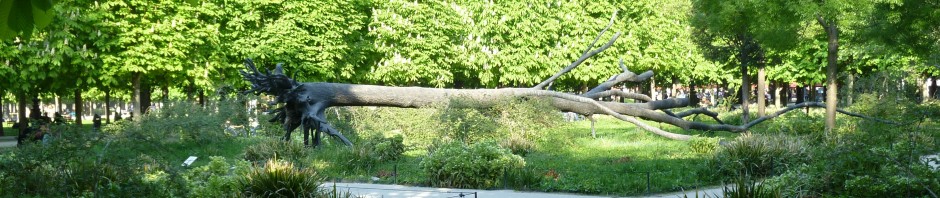
It’s January 19. Do you know where your New Year’s resolutions are?
This year, I decided to go minimalist and easy: look up. You can interpret those words any way you want. Chin up, perhaps, if you’re feeling blue. Or, put your device away if it is starting to dominate your life. Or notice your surroundings carefully, if you feel a call to mindfulness. Stand up straight, if your posture is slumped. Or all of the above.
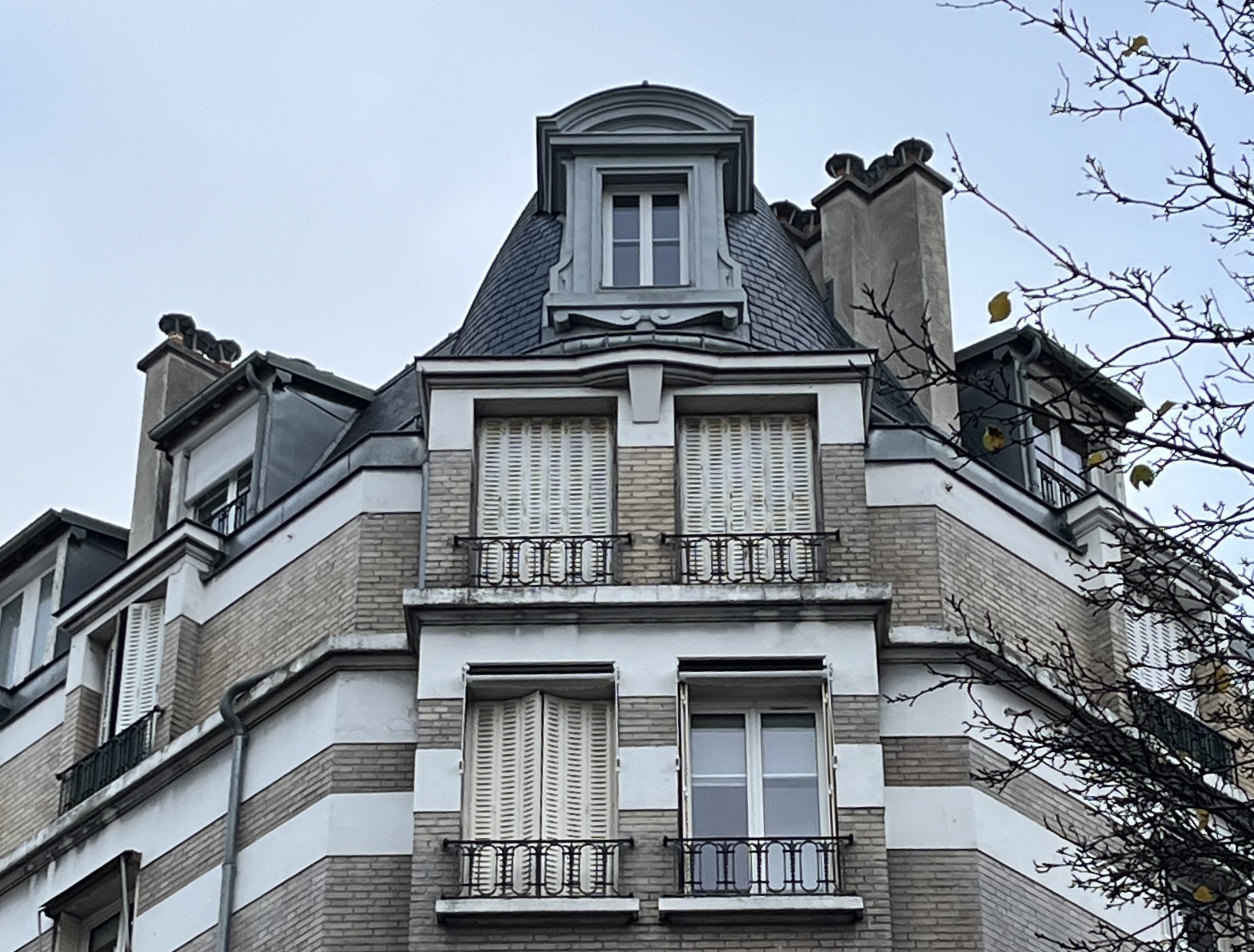
It started when I was in Paris and developed an interest in dormer windows (lucarnes). Our friend Mireille had sent us an article that provided a whole vocabulary to use for these features of Paris roofs. I was determined to become an expert lucarne-spotter. That called for a lot of looking up. But I became fascinated by what I saw above me. This building on the corner of the rue Neuve Saint-Pierre and the rue de l’Hôtel Saint-Paul has a fairly ornate dormer facing the intersection.
Now, you need to be careful when you look up in Paris. Not watching one’s feet can have unintended consequences, from twisting an ankle on uneven pavement to stepping in something undesirable (actually, the one time I did get something on my shoe, it turned out to be a piece of rotten fruit). The best place to study lucarnes is from a bus window, and we took a fair number of buses. Not ideal for photography, but good for practising identification techniques.
So here is a small guide to the dormers of Paris.
First of all, properly speaking, a dormer window is a window with a vertical glass surface that is set into a roof, rather than a skylight, which lies flush with the slope of the roof.* My Larousse (and Google Translate) offers the term lucarne for both dormers and skylights; but people may also call a skylight a tabatière (literally: snuffbox) or vasistas (also used for a transom window, and yes, the term comes from the German for “What is that?”). Some people simply use the popular brand name Velux. This photo that I took from the roof of the Galeries Lafayette shows buildings on the rue Scribe, with skylights on the left and dormers on the right.

Dormers can be further characterized by whether the dormer sits on the roof, detached from the rest of the façade, or whether it rises up from the façade through the roof, in which case it might be called une lucarne pendante (hanging), engagée (engaged), meunière (miller), or gerbière (a tall wheat sheaf that sticks up above its surroundings in a field). The following example on the rue Boissy d’Anglas shows dormers that are continuations of the façade.

Most of the other terms for dormers are related to the shape of the roof immediately on top of the window and its surroundings. Probably the most common type is la lucarne jacobine, or la lucarne en batière (boatman), which has a peaked or gable roof. Here is a tiny one on the roof of one of the oldest houses in Paris, on the rue François Miron.

Another common sight is la lucarne capucine, or la lucarne à croupe (in English, a hipped dormer). The roof of the dormer is three-sided, with a triangle over the window, as shown below on the rue de la Perle.

Interesting that these two types have names relating to religious orders. Jacobin is the name for the Dominican order in France; Capuchin is a type of Franciscan friar. The names allude to the hoods worn by monks. Jacobin hoods presumably formed a peak over the face, while the Capuchin version flopped down over the forehead.
Another common dormer in Paris is la lucarne rentrante, which is set back into the roof and offers a tiny bit of space in front of the window. I was able to get a good shot of these ones on the rue de Saintonge from the window of a friend’s apartment.

There are often windowboxes and a bit of greenery associated with these versions, and a few residents are even able to wedge a small chair into the space for soaking up rays in summer.
The one shown below, on the boulevard Henri IV, is particularly spacious. Notice the mosaics below the balconies.

Some grand buildings have dormers with a pediment or ornate decoration over the window. These are known as lucarnes à fronton. In this picture, taken in in the Cité Martignac off the rue de Grenelle, various kinds of dormers are visible, but the dormers on the right, just below the top-floor lucarnes rentrantes, have attractive pediments.
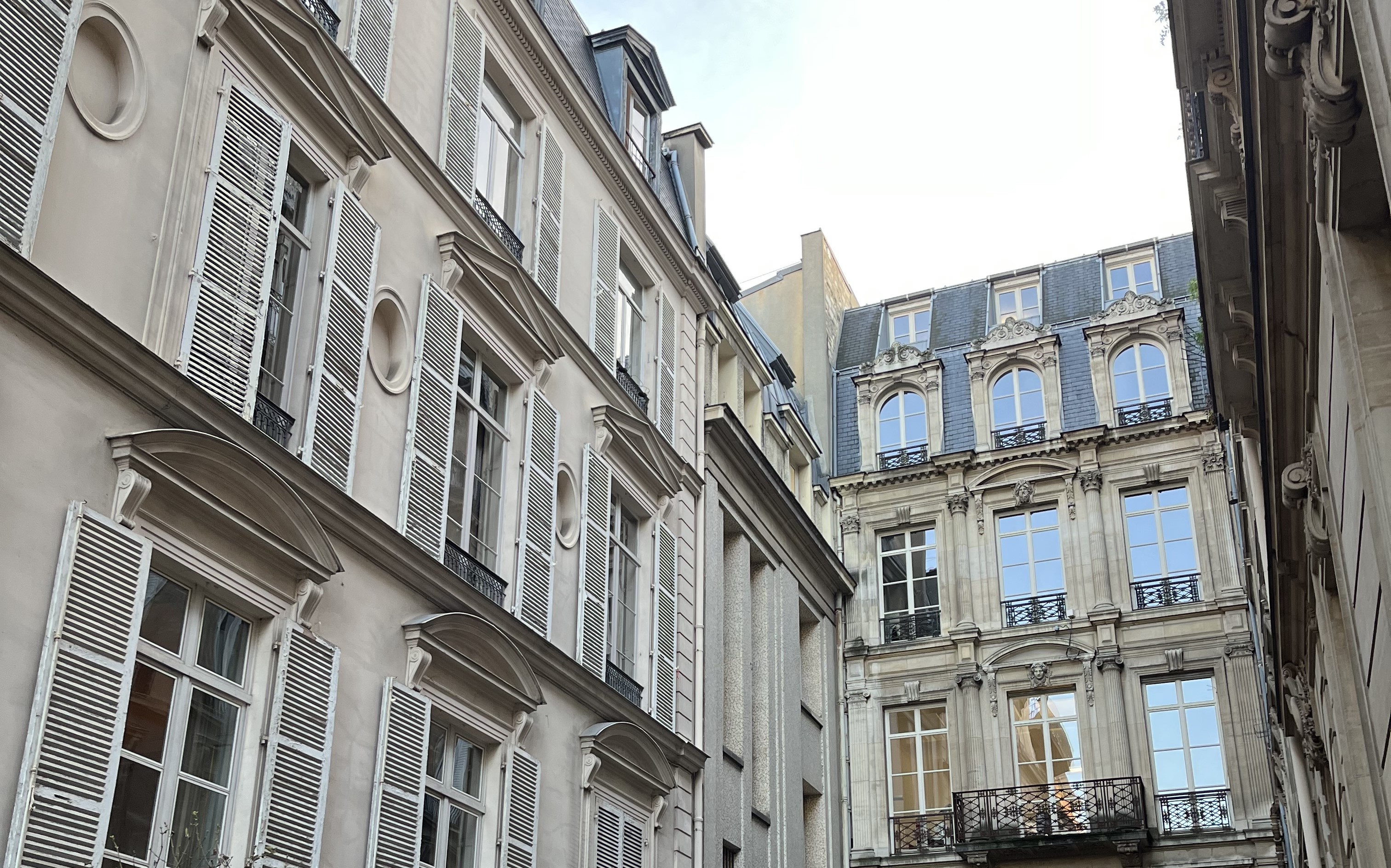
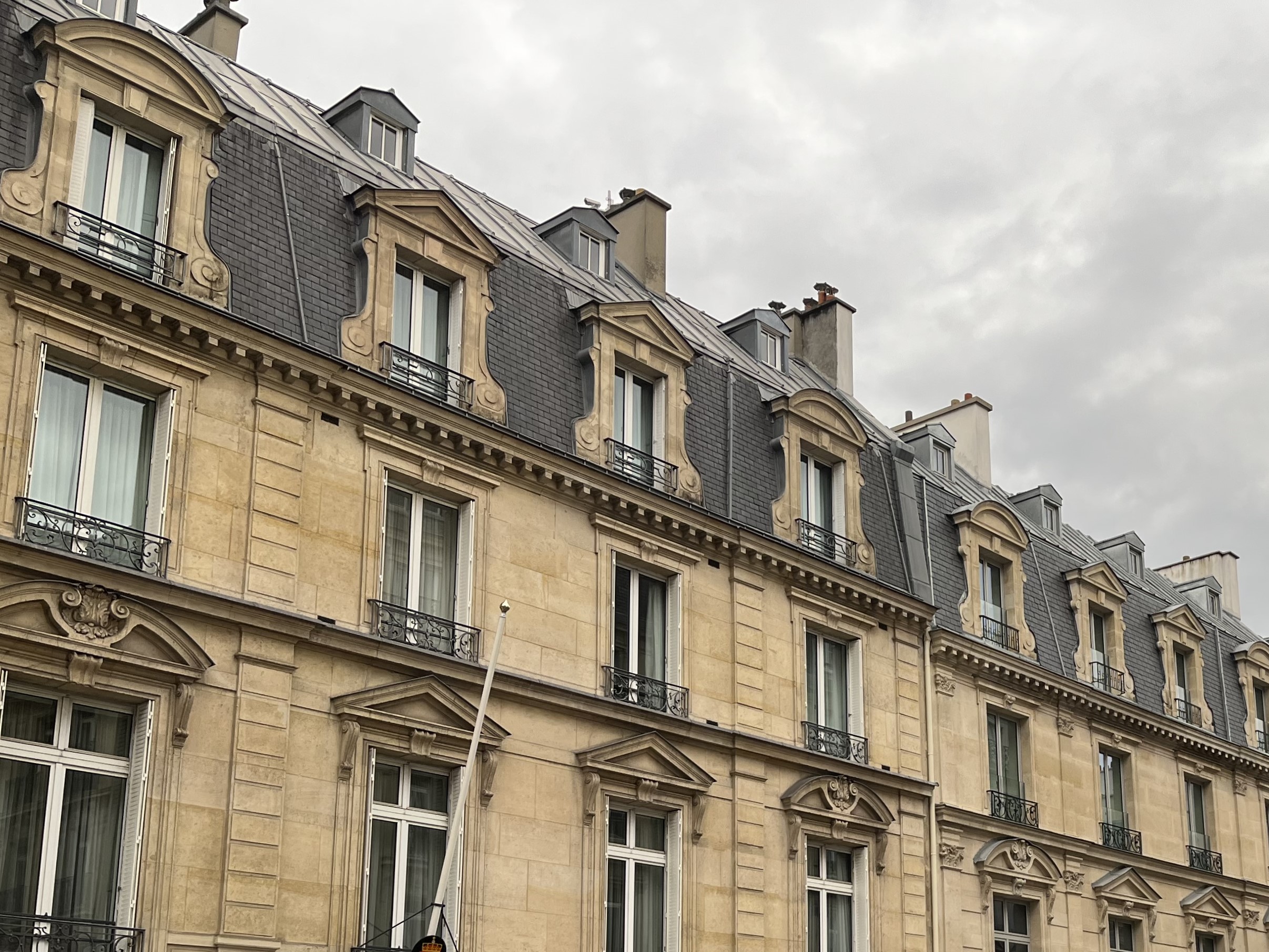
If the decoration extends out to either side, the dormer is said to have ailerons (fins). These lucarnes are on the rue François 1er.
Another group of dormers features rounded tops or rounded windows. These are known as lucarnes bombées (curved dormers) or lucarnes cintrées (arched dormers). The window may be squarish, but the roof over the window is rounded. These gentle curves are on the rue de la Perle.
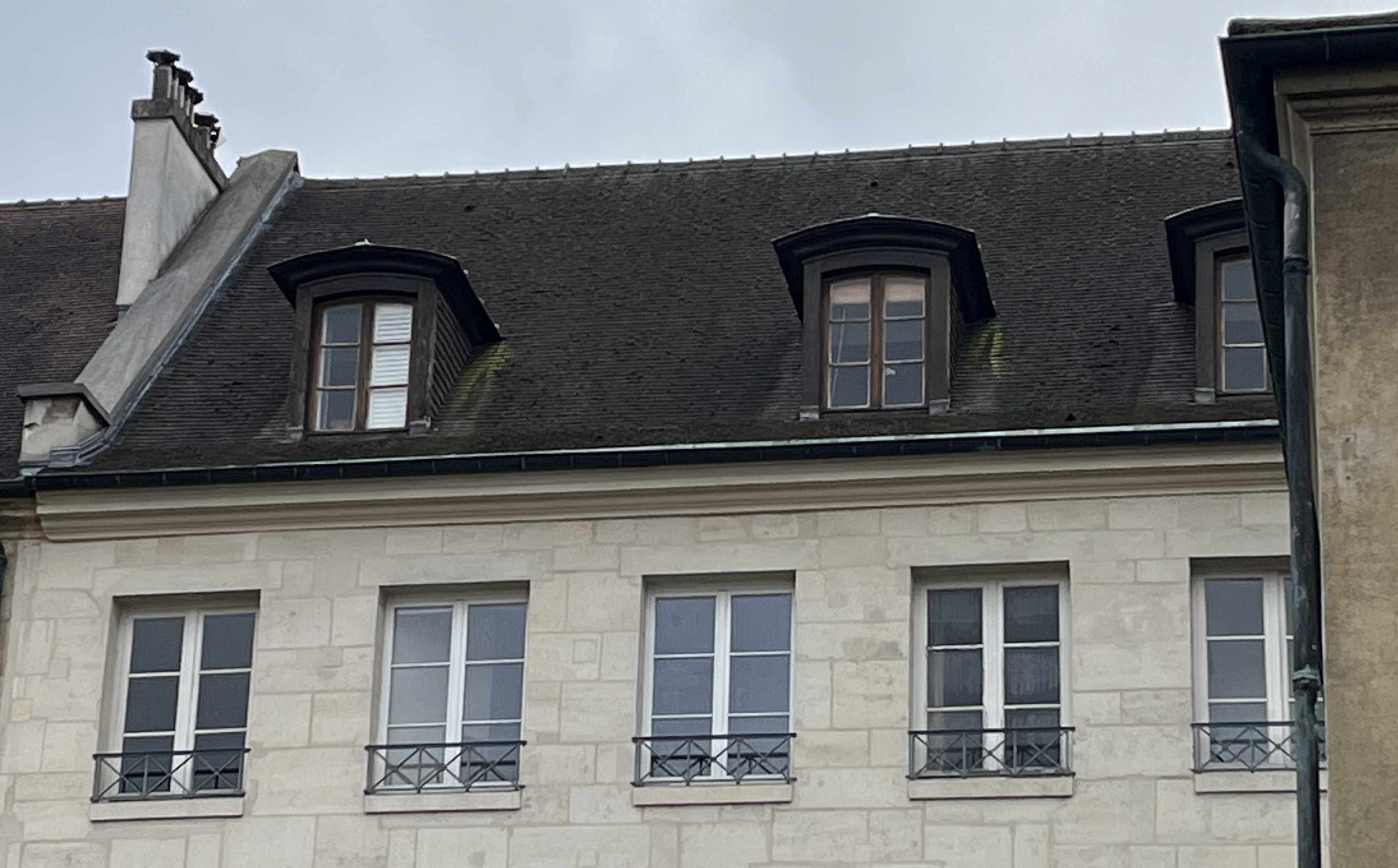
The curves may be more pronounced, as seen on the rue de Sully, shown below. Here the tops of the dormer windows are also rounded.

If the window itself is round or oval, it is called la lucarne à l’oeil-de-boeuf (ox eye). Once again, this is the rue François 1er.
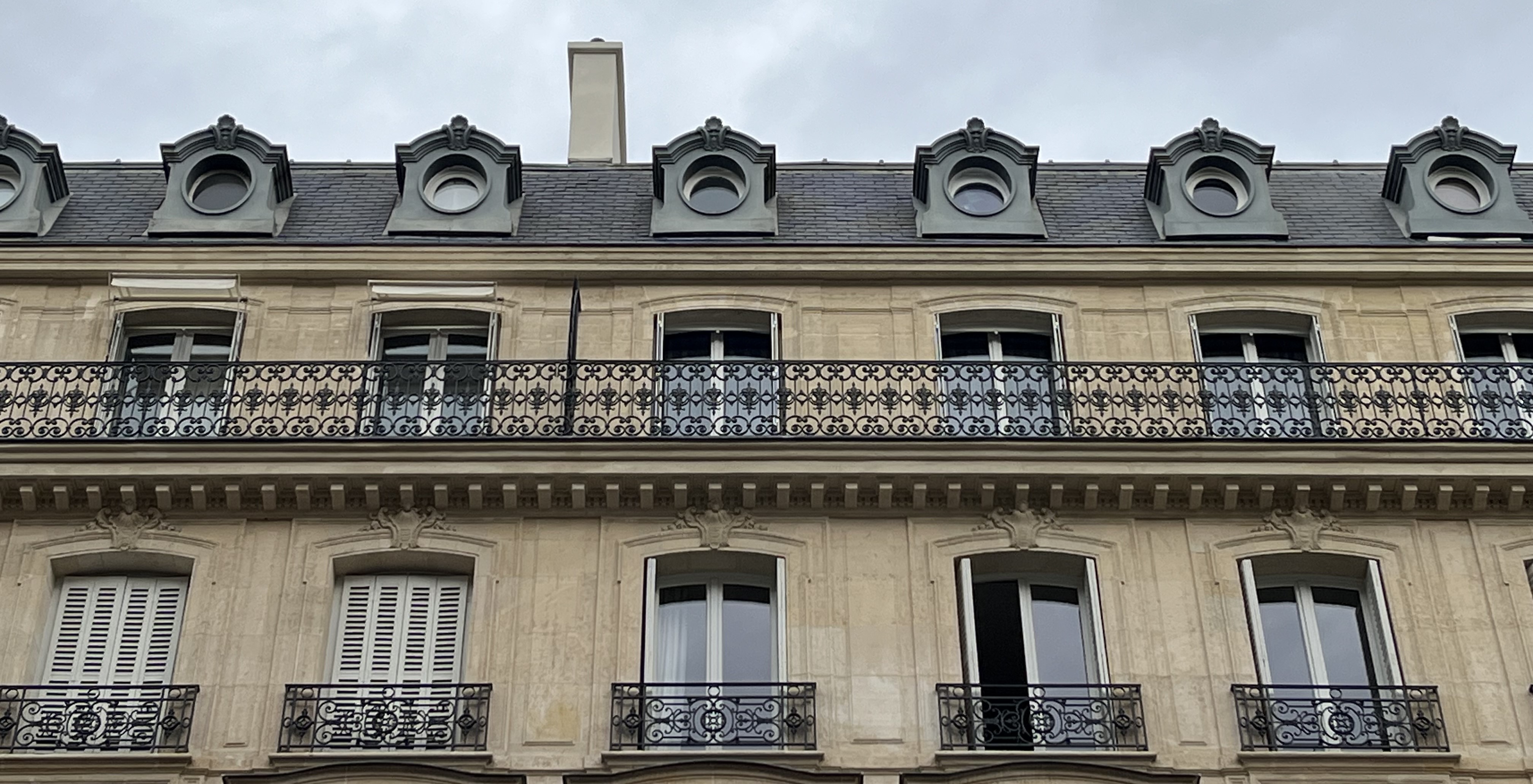
The Hôtel d’Aumont, containing the Tribunal of Paris, viewed from the rue des Nonnains d’Hyères, has lovely oeil-de-boeuf windows with stone frames.

Finally, there are the dogs. No, really. La lucarne rampante or chien couché (sleeping dog) has a roof that slopes down like the roof, but at a slightly different angle. On the rue de la Petite Pierre, shown below, the sleeping dogs on the uppermost level alternate with lucarnes bombées. Alas, these are the only ones I spotted, and the photograph is not as clear as it could be.

La lucarne retroussée or chien assis (sitting dog), in which the roof over the dormer is at a sharp angle to the slop of the roof, is also relatively rare, but I did see one at the corner of the rue Charlot and the rue Pastourelle and took a hasty and not very good photograph. Can you spot it?
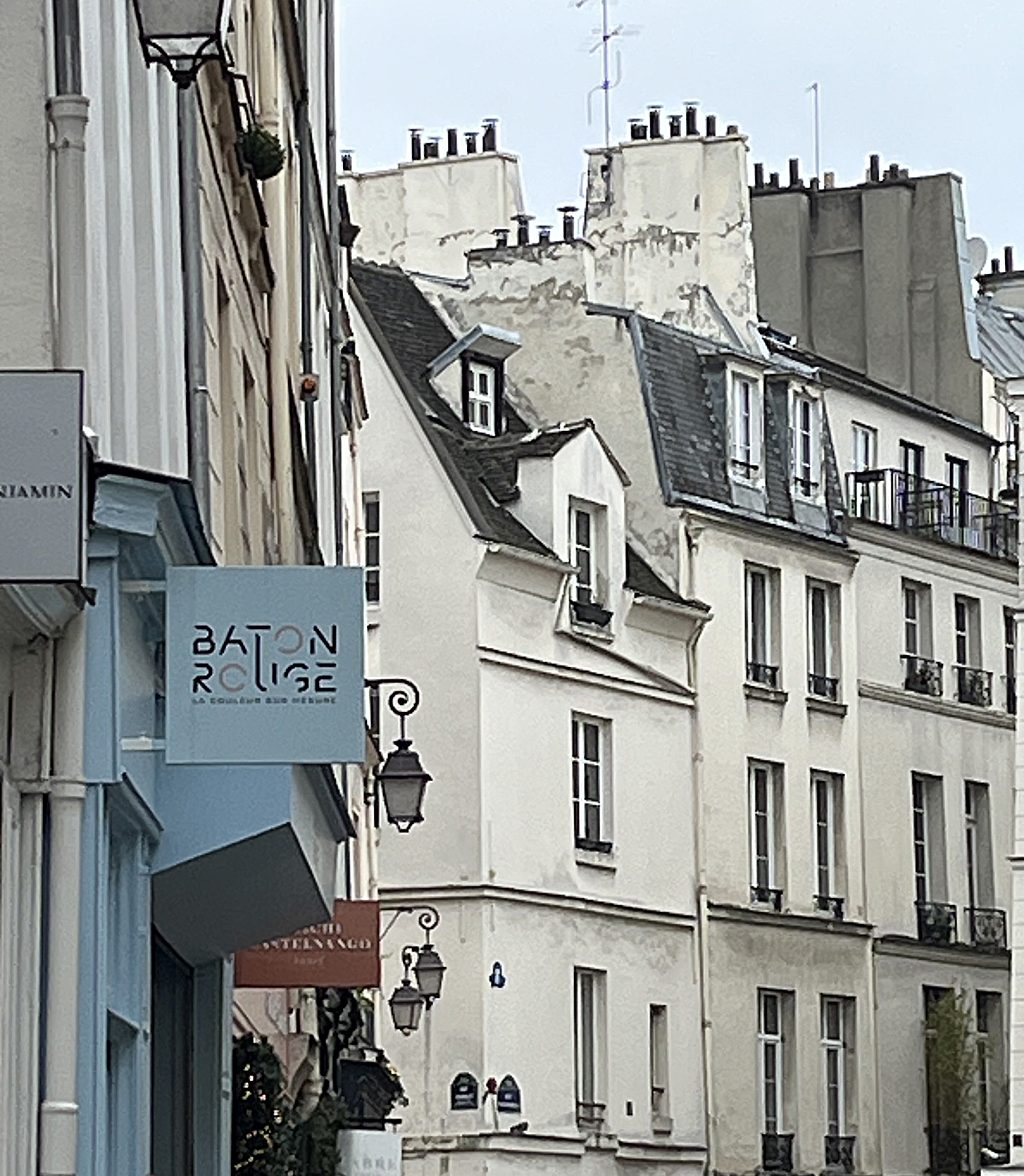
The odd thing is that many French people use the term chien assis for all dormers. I have no idea why, when so many other wonderful terms are available.
Certain dormer shapes are found elsewhere in France but rarely in Paris, such as the lucarne guitarde, which has a roof with a rounded front. Then there are Parisian one-offs, like this double-decker version on the rue Madame de Sévigné. No idea what it would be called.

A dormer at the corner of the rue de l’Hôtel de Ville and the rue du Brosse has a steeple on top, complete with weathervane.

Sometimes, as I gazed skyward, I couldn’t really tell what I was looking at. This building on the rue de Grenelle has all kinds of interesting details at the roof level, but all I could really see were the undersides of the dormer eaves.

I could not find a special name for a dormer with a flat roof, although I saw quite a few. The pictures of flat-roofed lucarnes that I found online seem to be on modern houses, so there does not seem to be a historic or colourful name available, but if anyone knows of a name other than lucarne à toit plat, please let me know.
On our last night in Paris, still looking up, I photographed the elaborate dormers in the Hôtel de Sully against a clear night sky.

Once you learn the names, it’s fun to go on a lucarne hunt anywhere. So go outside, look up, and tell me what kinds of dormers are in your neighbourhood, wherever you are.
*Also not to be confused with a gable (pignon), the triangle-shaped upper part of a wall between the two slopes of a pitched roof, as in Anne de la Maison aux Pignons Verts.









 Parisian Fields
What a fascinating article. Incredible research. I must start looking skywards more intently.
It’s a good habit to get into.
Very interesting article.
You should also look up the words ‘mansarde’ and ‘fenêtre mansardée’.
Thank you. I did, but the associated photographs were very varied. Does “fenêtre mansardée” have a meaning beyond a window or dormer in a mansard roof?
Not to my knowledge.
Hello, I don’t know why my “public display name” on WordPress has changed, but the reply “Not to my knowledge” is really from me… Best regards, Sophie Badreau
Loved this post! Thanks for sharing all the pretty rooftop photos of Paris and all that fascinating info about dormers. What a gorgeous architectural tour. Cheers and Happy New Year!
Thank you so much and a very Happy New Year to you too!
I did enjoy that!
Thank you!
Hi Philippa,
This is so interesting – great pictures –
I have painted a lot of dormer windows in my old Toronto street scenes and have always found them fascinating – curious, beautiful and often mysterious (my favourites!)
Take care in our Canadian “polar vortex” –
Hi to Norman,
Jane
A wonderful photo-essay with all sorts of intriguing tid-bits
A very interesting article. I doubt I’ll remember all of the names of the varieties, but I will certainly notice the difference.
So detailed! It was like being in an architecture class but carefully explained for people who are not well versed on the subject. Merci.
If you forward this correspondence please delete the forwarding history which includes my email address. It is a courtesy to me and others who may not wish to have their email addresses sent all over the World. Erasing the history helps prevent spammers from mining addresses and viruses from being propagated. Thank you.