The other night I couldn’t sleep, and to pass the time I got out Norman’s collection of Paris stereocards and looked at the images. After a while, I realized that one thing was missing from nearly every image: the Eiffel Tower. That’s because most of the images were too old to include it; that is, they were taken before 1889. Many date from the 1860s and 1870s and in those days, the popular monuments were the then-new Opéra, the old Hotel de Ville, and the now-vanished Tuileries Palace. Views of the latter two predate their destruction in 1871.
I was impressed at the age of the images, because stereoscopic photographs arrived on the scene remarkably quickly after the invention of photography itself. Commercial photography really began in Paris in the 1840s with Louis Daguerre, and stereoscopic photographs started to appear in the 1850s. Early experiments were conducted in Great Britain, but a French photographer and instrument maker called Jules Deboscq helped commercialize the technology.
Stereoscopic photographs are taken with a special camera with two lenses that are roughly the same distance apart as the pupils of the eyes in a human face. The stereo viewer also has two lenses that allow people to look at the two images separately with each eye. The card is inserted into a holder and can be moved closer to or farther away from the lenses to bring the image into focus. The human brain recombines the images in a way that creates a 3D effect. Here is a photo of Norman holding one of the viewers we own, patented in 1895 and created with aluminum, at that time a very new material.

Alas, given the way my eyes work, I am unable to experience the 3D effect, but the images are fascinating nonetheless. And the double image, one slightly at an angle to the other, makes for interesting comparisons. I’ve always loved those games in which two pictures are similar but not identical and you have to spot the differences. Try that with this image of the Tour St-Jacques. We are looking east and the top of the old Hotel de Ville is just visible to the left of the tower.

Look to the far left and you will see the name of the department store Pygmalion; it stood kitty-corners to the tower on the rue de Rivoli, between the boulevard Sebastopol and the rue St-Denis. But if you look at the right-hand image, you can see how much is cut off from the store name, while more buildings are visible to the right.
The stereocard is labelled “Photographie H.J. à Paris,” which identifies it as the work of photographer Hippolyte Jouvin (1825–89). We have quite a few of his images.
I also like this image, because I prefer photographs of streets to photographs of monuments.

There is no information printed on the stereocard, and someone has helpfully written in pencil on the back: “Street in Paris.” However, the Pantheon is clearly visible on the horizon, along with the tower of St-Etienne-du-Mont (faintly, to the left of it) The dark mass of trees at the end of the street would be the Jardin du Luxembourg, so it appears to be the rue de Fleurus, looking east, at the corner of the rue d’Assas. The building on the left has survived, but the one on the right has not.
Zooming in, I can see that the gates to the garden seem to close off the end of the street, which suggests that the photograph was taken before the rue Guynemer was built in 1866, running along the west side of the garden.
Here is a wonderfully busy street scene. The label on the back reads: “Place du Chateau d’Eau & Caserne du Prince Eugene.” Today this is the Place de la République.

I love the movement and bustle, the range of conveyances, some horse-powered, some human-powered, and the fountain in the middle with eight lions keeping watch. Since 1883, the monument to the republic has towered over the fountain, so this image is probably from the 1870s. The photographer is not identified, but the card backing is marked “Paris Instantané.” Several different stereocard publishers used that name. After all, to capture all those people in motion, you need a very fast exposure.
Here’s a vanished building, which I did not recognize.

Peering at it through a magnifying glass, I could see the street names: Cours la Reine and the rue Bayard. There is also some writing on the glass around the street lamp: Rue Bayard des Champs Elysées. I got out my 1850 Paris map and spotted “Maison Francois 1er” at that intersection. That checked out. But the connection to Francois 1er was tenuous. In the 1820s, a military officer called Alfred Brack bought the façade, which he found in a small town near Fontainebleau, had it brought to this spot stone by stone and sculpture by sculpture and reassembled facing the Seine. Then he had a house created behind it. People used to do that sort of thing. You can see that the back of the house is much less ornate relative to the façade. Brack spotted some salamanders in the carvings, the symbol of Francois 1er of France and gave it that name, but there is no evidence that the king had anything to do with it. It was demolished in the 1950s to make way for an office building.
The stereocard not only gives the photographer’s name, Henri Guérard (1846–97), but also his address on the rue de Rivoli. Quite a few photographers had establishments on that street. He was a publisher as well as a photographer, and sold books from that address. I can place him there in the 1870s, definitely. In 1879, the address is associated with another name.
Another card that identifies the photographer (or at least the publisher, Debitte & Hervé) but not the location is this one:

It is the Grand Hotel on the Boulevard des Capucines. The corner is occupied by the Café de la Paix, which opened in 1862. To the right, beyond the frame, would be the Opéra. The building still stands, along with the café on the corner (I once had breakfast there), and the hotel is now called InterContinental Paris le Grand.
The year of the Commune of Paris, 1871, was a watershed. We have several images, most of them badly faded, of the destruction caused by fires. I tweaked the contrast on this one of the Hotel de Ville after the fire to make it clearer.

This series called “Désastres de la Guerre” was published by someone with the initials “J.A.” Thanks to a comprehensive online resource on stereo photographers, I was able to identify this as Jean Andrieu (1816–c1895).
Here’s what the old building looked like before the 1871 fire, viewed from directly in front, as you approach from the rue Victoria.
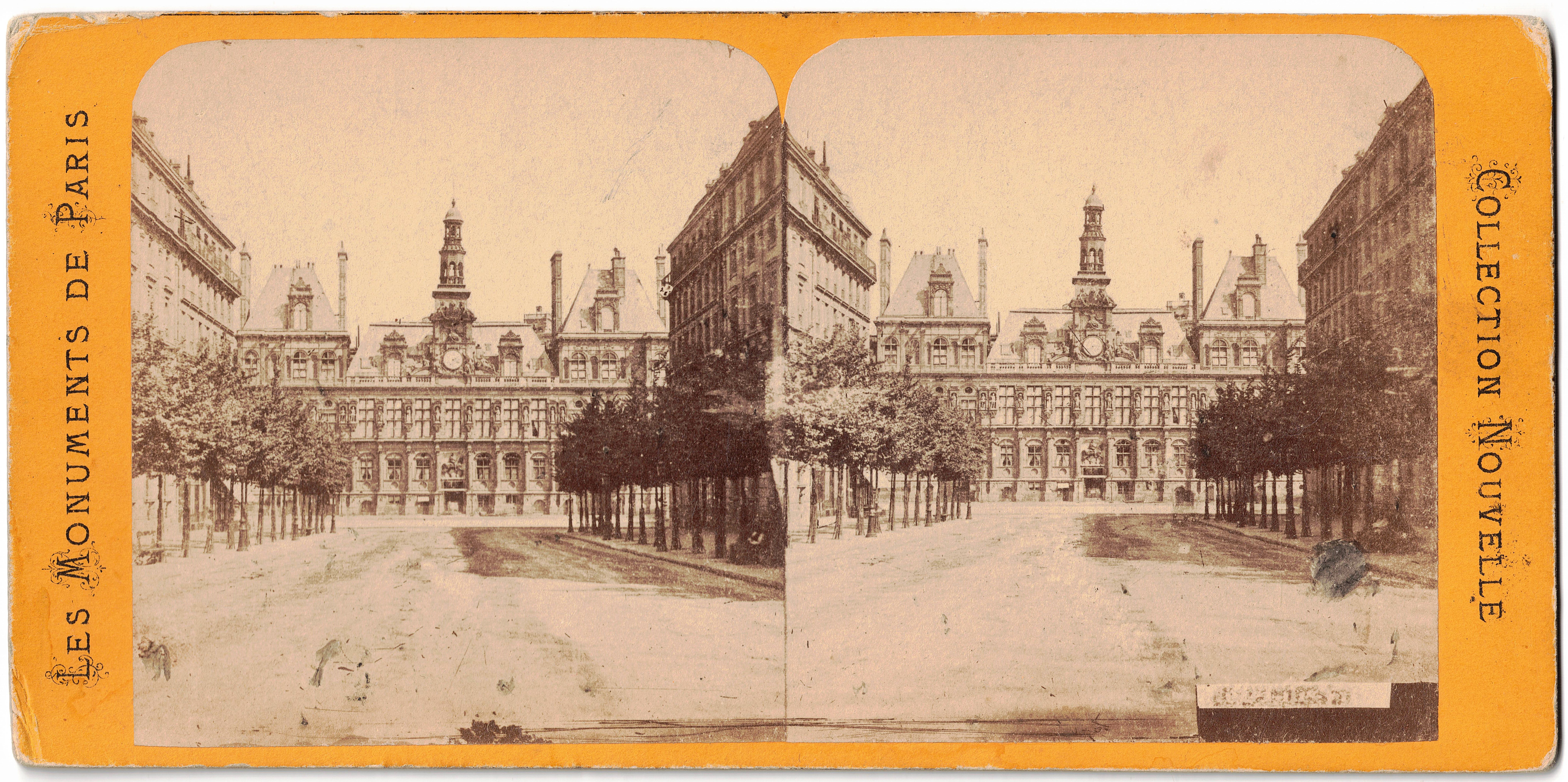
There is nothing on this card to identify the photographer. But if you are still playing the game, you will spot a bench visible on the left that is not visible on the right.
Clearly there was a market for disaster photography. Two entrepreneurs, identified only as “E.C.” and “A.T” produced a series simply called “Paris–1871.” This image of the Place Vendôme shows the base of the column that was toppled that year.

But here is something odd. This is the south side of the column, looking north, the side with the inscription – which also has been hacked off – and the door to the interior. But the image is reversed, because in every other picture of the monument, the bas-relief wheel (you will need to zoom in) is on the left side of the door.
Some of the publishers of stereocards used fancy techniques to add interest to their images. In this view of the former Tuileries Palace by the photographer Ernest Lamy (1828–1900), the images have been printed on thin tissue held by a special cardboard mount.

The back of the paper is coloured so that if you hold it up to the light, you can see the effect of lighted windows and even a moon, at least on one side.

It’s rather magical. Thanks to Norman for holding it still while I photographed it in front of my desk lamp.
I could go on and on, and lull you to sleep, as I was eventually lulled myself. I will leave you with the one image we do have of the Eiffel Tower, published by the Keystone View Company, one of many U.S. enterprises that published stereocards. This dates from the 1930s, showing that the popularity of these images lasted well into the 20th century.

Keystone and another company called Underwood and Underwood (which Keystone eventually bought out), published a vast range of views of many countries, with detailed captions on the back, and accompanying books that you could use to travel to distant lands in your armchair with your stereoscopic viewer providing an immersive experience. Great fun.
Sleep well, and may you dream of Paris.
Text and original photographs by Philippa Campsie; all other images from the stereocard collection of Norman Ball.







 Parisian Fields
This is fascinating. We had a stereocard viewer and cards back in 1960 in southern Ontario. As an amateur photographer with a full darkroom in the basement, my dad tried making his own stereocards. Can’t remember if he was successful. He also tried to make stereocards of lightning strikes. I think he just got wet.
I had a huge postcard collection in the ’70s of 19th century Paris street scenes which were readily available in Toronto antique and junque shops. I would read Balzac and Zola and the life stories of artists and search for photos of places/streets referenced. Of course, then there was no internet, so it would’ve been almost impossible to find out about the photographers.
When I moved to Rome in the mid-’90s, I bought postcards of scenes painted by Ettore Roesler Franz who was documenting the destruction of the medieval buildings when they were building the Lungotevere, and found that many of the buildings were still standing (he’d very helpfully supplied the actual address of these places). I’d take my own photos from the same viewpoint. Great way to learn the city and history.
Thank you so much for sharing your own enthusiasms. We used to have a neighbour who collected stereocards and who took stereo photographs himself quite successfully. I don’t think he tried to photograph lightning though! We have a large postcard collection and when we are in Paris, we usually check out flea markets for images of streets (not monuments). They are getting harder to find, but sometimes we come home with a few. I shall have to find out more about Ettore Roesler Franz, who seems to have done for Rome what Atget and Marville did for Paris.
I was in Rome in the mid-’90s and E.R. Franz was working 100+ years before. He was an amazingly prolific painter and, to get that speed, he photographed the scenes he painted, using 5×7 plates if I remember correctly, that he contact printed (in B&W of course) and then assembled in the studio, so that the original paintings were quite large, approximately 18×24″. He traced the resulting image and worked off of the watercolour sketches he’d made on site with notes. Unfortunately, I never retrieved the books I’d bought there, and I think most of them have remained out of print.
Greetings from Northern California, Sleepless here as well, so I greatly enjoyed your informative blog.
I hope it helped you drop off in the end!
Eventually, yes, thank you – and with many lovely memories of Paris neighborhoods revived!
That was fascinating. Thank you.
So glad you enjoyed the blog. Thank you.
I always learn so much from your blog!
Might as well make some use of insomnia!
Thank you for this charming post. What an amazing collection you and Norman have. Alas, I too have an eye condition which would not allow me to get the 3-d effect.
Hi Philippa,
Thank you for all your fascinating blogs.
This one is really wonderful!
I love the images.
Jane
Thank you so much. When you scan the images, you can zoom in and see all sorts of details you couldn’t otherwise see. I shall have to scan some more!
thank you Philippa! I do dream of returning to Paris!
Actually my son is going for a week in Nov and he is taking my grandson….I think it is to expand the latter’s views/education on a world outside N.America.
olive
Loved your article. We have two Stereo viewers hare at the Cochrane Heritage Village in Northeastern Ontario. I will have to look at our card collection to see if we have anything from Paris. I will do more research and write up an article for our Historical Society Newsletter.
Dawn.
PS I have reached 4,800 mini biographies on Famous Canadian Women. Hoping I live long enough to reach 5,000 LOL!
Hello Dawn, Thank you so much for your comment. Stereo photographs are a fascinating area for collectors. Congratulations on reaching 4,800 biographies. Given the many amazing women in Canadian history, reaching 5,000 should not take too long. Best wishes, Philippa
Gaining stereo vision is not impossible for many people even in mid life. The great Oliver Sacks wrote an article in the New Yorker about « stereo Sue » which inspired me to pursue vision therapy. It may be worth trying for others as well.